- What UPSC wants in answers (from the evaluators and toppers)
- Basic information about UPSC evaluators
- UPSC selects examiners with long academic or administrative careers, so younger people aren’t usually included.
- Examiners are not UPSC employees; they are invited from a national panel.
- Top 10 copies are re-evaluated to check and confirm the marks granted by every examiner; they also do some random checks on other copies checked by the examiner, which is done by a third examiner
- Structure
- Almost all UPSC answers should follow a traditional answer structuring
- A traditional answer is divided into 3 parts:
1. Introduction
2. Body
3. Conclusion
- Language & presentation
- Language should be very direct, crisp and clear to display very good conceptual clarity
- It should neither be too simple from the perspective of formal writing, nor too poetic or difficult to understand
- Explaining the concepts in easy language represents clarity of thought. Use a single sentence to convey a single idea; don't try to fuse multiple ideas in a confusing way
- Strictly avoid ambiguous and verbosity
- Ending each point with "...this derailed/stopped/halted the planning process", and not using innovative and diverse language, this shows lack of content
- Good handwriting
- Handwriting should be very good and easy to understand. Information should be arranged in an easy-to-consume form. The examiner is very impressed.
- Bad handwriting leads to difficulty in reading and conforming numerical data, for example 2026 and 2016 both looking same, and examiner is confused
- Grammar and vocabulary
- Keep grammar sorted, keep vocabulary balanced, never use slang or unprofessional language, keep it professional, try to be direct, avoid using advanced poetic English
- Bad english changes the meaning of sentences, like using "NPA's instead of NPAs", "Period review instead of Periodic review", "Police instead of policy", etc, leading examiner in confusion and even mis-interpretation of the context
- Do not use unprofessional english like using "b/w instead of between", using symbols instead of words, drawing up/down arrows to show increment/decrement, words like "honeymoon period", etc
- Do not use forceful words like "should", "must", etc, and instead use milder and suggestive words like "may", "might", "can", "could", "possible", etc
- Do not use disrespectful words like killed for freedom fighters, use "martyr"
- Using points instead of paragraphs
- Avoid using paragraphs, answer in points
- Try connecting points the points with each other, keep the whole answer in harmony from intro to conclusion
- Example of continuos points using free trade topic
- 1. Leading to the fall of businesses
- 2. The fall of businesses leads to unemployment
- 3. Unemployment leads to social unrest
- 4. Social unrest leading to political instability
- Use of abbreviations
- Examiner admires when full form is provided of the term in first occurrence, and later using short form, this shows you are not trying to write to fill space
- Use of design principle
- Information should in hierarchy
- Information should be arranged in proper hierarchy, use indentation and highlighting for establishing hierarchy
- Good alignment
- Text and diagrams should alignment horizontally and vertically
- Highlighting
- Highlight by underlining and boxing the keywords and data points to catch the attention of the examiner
- Spacing
- Congested information without proper spacing is very difficult to read and looks unorganized
- Diagrams
- Use flowcharts, graphs, charts, and other diagrams to represent numerical and geographical data visually to improve presentation
- Extract out from topper notes and copies
- Use boxes to contain the diagrams, mind maps and flow chart
- Avoid distributed information
- When drawing map of India, include A&N
- Mandatorily draw diagrams in every geography answer
- Showing evolution using timeline diagram
- Not every question requires a diagram like some questions of history, polity, etc, avoid forceful integration of diagrams in every question
- No need to be extra creative, just meet the basic demands of the question
- Intent
- Do not at any cost write anything sensitive to that looks to be emotionally manipulating them by hints of religion, caste, or any other ideology. even the candidature could be cancelled
- Examiner should not find any manipulation, bias based on religion, caste, gender, social status, etc. This can even disqualify the candidature
- Any hint of language disrespecting any figure, be it good or bad from personal perspective can lead to deduction in marks, specially in case in case of important figures like Mahatma Gandhi, Bhagat Singh, etc
- Content
- There won't be any time for analyzing and thinking; a speed of 30 wpm has to be maintained, and analysis has to be done beforehand
- Keep the content ready and structured before hand to replicate in the exam
- Meeting the demand of the question
- Be very specific to address the demand of the question
- Here a lot students fall into the trap of putting information they remember and not what is asked
- Avoid forcefully pushing generic current affairs information like "Trump trade war with India"
- Forgetting to include the fundamental information subconsciously due to habit of only giving sensational current affairs information, like forgetting to include the date of 15 Aug in a relevant question just because it's too known
- Complete the paper
- Completing the paper is half the battle won, without even leaving half a page empty, this doesn't mean to fill it with irrelevant information, filling with irrelevant information will impact examiners viewpoint on other answers
- Divide the whole time equally between each question, don't get emotionally attached to any question, attempt within time and move on (Anudeep Durishetty)
- Margin between very good answers and average answers is very less, but time difference is huge, the goal is to attempt and answer all questions (Anudeep Durishetty)
- Don't leave any question, write at least something generic around the location, related concepts, etc
- UPSC is checking if you can come up with a solution when faced with adversity
- Don't leave empty space in between answer in hope to fill it later, if left blank, it leads to subconscious impression of incomplete answer and lack of knowledge
- Try to cover the whole space, use strategies like diagrams, flows, etc
- Not all questions are to be perfectly answered, write an average answer and move on, don't waste more than allotted time on each question
- No bluffing
- No bluffing by incorrect facts, whole paper will go down the drain
- This will lead to internal negative marking by the examiner while assigning marks
- Preference for formal data over informal data
- For formal definitions, if proper cited definition is available by a person then use that and cite him, like definition of the constitution
- Few subjects are very critical for the play of words like Polity, in polity the words, definitions are given much more relevant if they are cited from Supreme court, any other authority, or simply "according to oxford/cambridge", etc
- Strictly avoid giving personal & emotional thoughts, perspectives, and analysis in GS papers, when not asked
- Each and every generic statement should be backed by data
- They dislike purely theoretical content and repetition of coaching language
- It's best to quote the source of data along with fact like census data, etc
- Back each and every argument with data, by official data of the government, an organization, or any other body, or a sensational current affair, the data should support the argument
- They love India-specific, current affairs-integrated answers
- Increasing specificity of generic data
- Give good amount of relevant facts, names of people (best ROI), policies, bodies, current affairs, etc to increase specificity
- Add year with each current affairs, schemes, other data point, and box it
- In case of making an ambiguous point more specific, integrate it with some data point like below:
- "Improving waste management to solve the issue" -> "Taking inspiration from Sweden waste management model for efficient waste management"
- In the above line, it was just an assumption based on the fact that Sweden is doing good in this domain, no one can't cancel this point, and it will make this point look very specific
- Use of "keywords" and "punch lines"
- Toppers are again and again reminding us to collect and use keywords in the answers to make striking points
- Use of trending "keywords" from supreme court, international relation, science and tech, etc
- Use of punch lines to make an impact and make an answer interesting to read, like "Rusted steel frame to a trusted steel frame"
- Collect from PYQs and toppers
- Structure based on priority of information
- Put most important points in the beginning, and weaker points towards middle
- Inclusion of critical information
- Examiner is actively searching for these keywords to estimate the minimum threshold knowledge of the candidate
- Missing out on the major elements from the topic leads to loss of marks, for example missing "bronze sculptures" in chola topic, missing very close and famous current affairs regarding a topic
- Giving extra
- Give a little extra than others in terms of examples, diagrams, etc, to fetch 1/2 mark extra over for each answer, leading to margin of 10 marks for the whole paper
- 1 mark less can shift rank upto 10-20 places
- Avoid using repetitive information points and using same data in a lot of questions
- Combine static + VIP statements + pure current affairs
- Recall failure strategies
- Air 75 Ketan Shukla advice to not waste time in remembering exact complex names for misc topics, just use custom alternate title like "Sweden model", "England model", etc
- "Farmer protest (2020)" can be used instead the exact name of the "Andolan"
- Strictly abstaining from intermixing of the information due to improper recall
- Ethics and Essays
- They want to test your reasoning, aptitude, and combined personality via ethics and essay, so make sure to keep it little personal to help them out
- Holistic approach
- A holistic and wholesome answer with multiple dimensions over depth on few dimensions
- UPSC demands interdisciplinary thinking, the answer should cover polity, science, ethics, economics, etc
- Include broad spectrum of examples and not limiting at a particular caste, religion, sect, gender, etc
- Showing neutrality in answer and not taking sides
- Give both aspects of the answer if it asks to agree, not simply agree, stay neutral, give both sides, and align 60% with question
- Avoid too much criticism and appreciation of government, policies, or any other topic
- They expect:
- No ideological bias
- No extreme views
- No populism
- No political opinions
- No emotional arguments
- Unique but known examples (value addition)
- Use examples which can be understood by the examiner immediately, but still rarely used by other candidates, this shows that you have not mugged up coaching material
- Like using example of statue of liberty, what it signifies with its posture, sword, and flame, this example will be very unique and still be very recognizable to the examiner
- Using names of people, facts, and other data which are part of PYQs and very famous news is going to be sweet spot
- Try to balance cutting-edge current affairs and traditional famous current affairs. Examiners will be hesitant to give marks if the information is too narrow to be understood by them
- While this is true for GS, it is not for optional, as optional is checked by subject experts, they appreciate minute details
- For optional avoid using the examples from books; everyone is going to write the same examples. Put in the effort to collect the good and dynamic examples, just make sure these examples feel credible by providing their source and data alongside.
- Showcase pragmatic approch whenever possible
- Avoid writing impractical and generic suggestions in the way forward
- They reward “On-the-ground” governance perspective with ethical considerations
- Using framework to generate answers rapidly
-
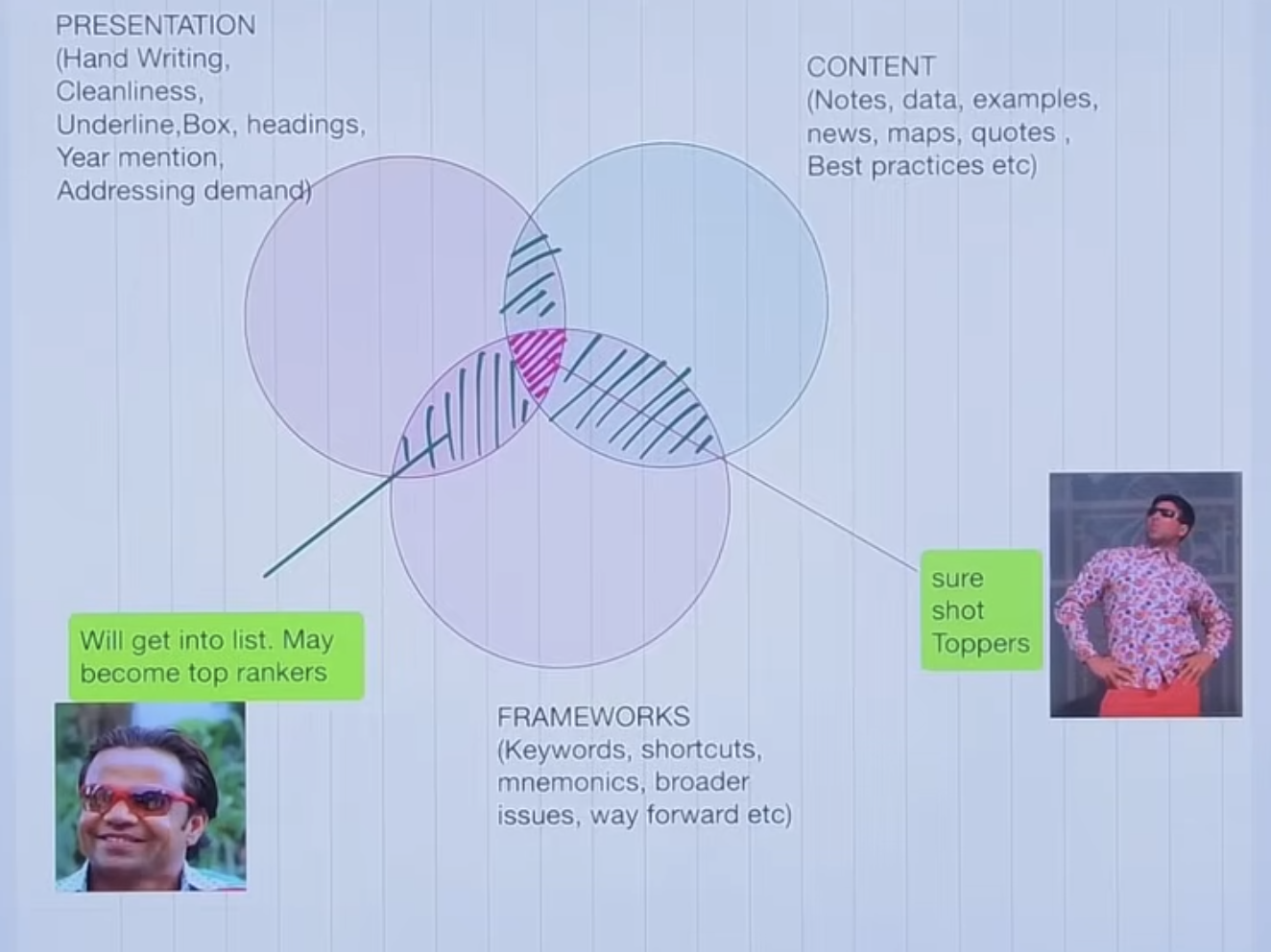
- Without framework, it won't be practical to complete even 50% paper on time
- Rapid and consistent answer generation using pre-defined structure and dimensions
- Framework helps in maintaining the proper structure of the answer, not following the standard intro, body and conclusion structure, missing any section will lead to loss of marks
- It helps to write on topics that are completely unknown, as there will be at least 2-3 questions in mains exam, whose answer is to be crafted right then and there
- Anthropology specific (332 marks)
- To get marks in the range of 260, include:
- By whom the concept was given
- Year in which it is given
- Study on the basis of which it is given
- Area of this study
- Always include anthropological case studies along with author for each and every point to support the argument or else there will be no distinction from a generic GS answer
- Choose the questions very carefully, as a few topics offer more marks than others
- Few topics are guaranteed to appear
- Choose questions whose all sub-sections can be answered on average instead of choosing those whose 2 out of 3 can be answered best
- Answer from the perspective of anthropological theories
- Quote thinkers in every answer and their sources
- Include their methodologies
- Use their definitions
- For paper II, force the anthropological perspective in every answer, and not like the GS paper
- Learning answer writing
- Stage 1
- Develop good handwriting with speed and precision
- Use a comfortable pen
- Hold at a good distance from the tip, keep the grip light
- Use the arm to write instead of finger movements, use fingers only for holding the pen
- Write in cursive
- Learn basic drawing skills - maps, shapes, etc
- Learn basic design principles - alignment, spacing, etc
- Underlining, boxing important information for visual appeal
- Stage 2
- Learn grammar rules
- Stage 3
- Practice english/hindi translations to test grammar knowledge
- Use grammarly to translate sentences initially for rapid feedback and then move to paper-pen
- Then move to paper pen practice
- Stage 4
- Error free grammar and efficient sentence formation
- Using advanced vocabulary to rephrase sentences to more concise and clear statements
- Use of words strategically
- Instead of calling it a failure, explosion, SpaceX calls it Rapid Unscheduled Disassembly
- Instead of calling it privatization, NITI Aayog calls it Strategic Disinvestment
- Stage 5
- Develop Answer generation framework
- Prepare a general framework to generate answers quickly in time limit
- At least 7-8 questions will be so unique, it would be difficult to attempt without framework
- Use Grok to write to answer last 10 year PYQs with planning phase like essay, to give a planning process of how it is generating and structuring the answer, what are the aspects it's including
- Prefer enriching answers from prelims PYQ statements, so examiner don't find difficult to relate
- Stage 6
- Practice the same questions as answered by the toppers in their answer sheets, and then check both copies side by side and give marks from the perspective of the examiner
- Thinking from the perspective of an examiner who will be checking 100's of copies today, how he/she feels like getting tired, bored, etc, and which answers excite him
- Validate the answer
- Practice PYQ's and validate answers using AI and toppers' answers
- Join insights secure for answer writing and peer review
- Stage 7
- Give full mocks of all 9 papers exactly scheduled like UPSC for a full dry run before actual exam
- Register for all India mocks to practice real-world testing like Vision IAS, etc
- Answer writing framework
- 1. Read question at least 2 times to get clear understanding and to avoid mis-interpretation
- 2. Identify the framing of the question
- Mainly four types
- a. Statement based questions
-

- b. Questions with statement and then continue with explicit demand
-
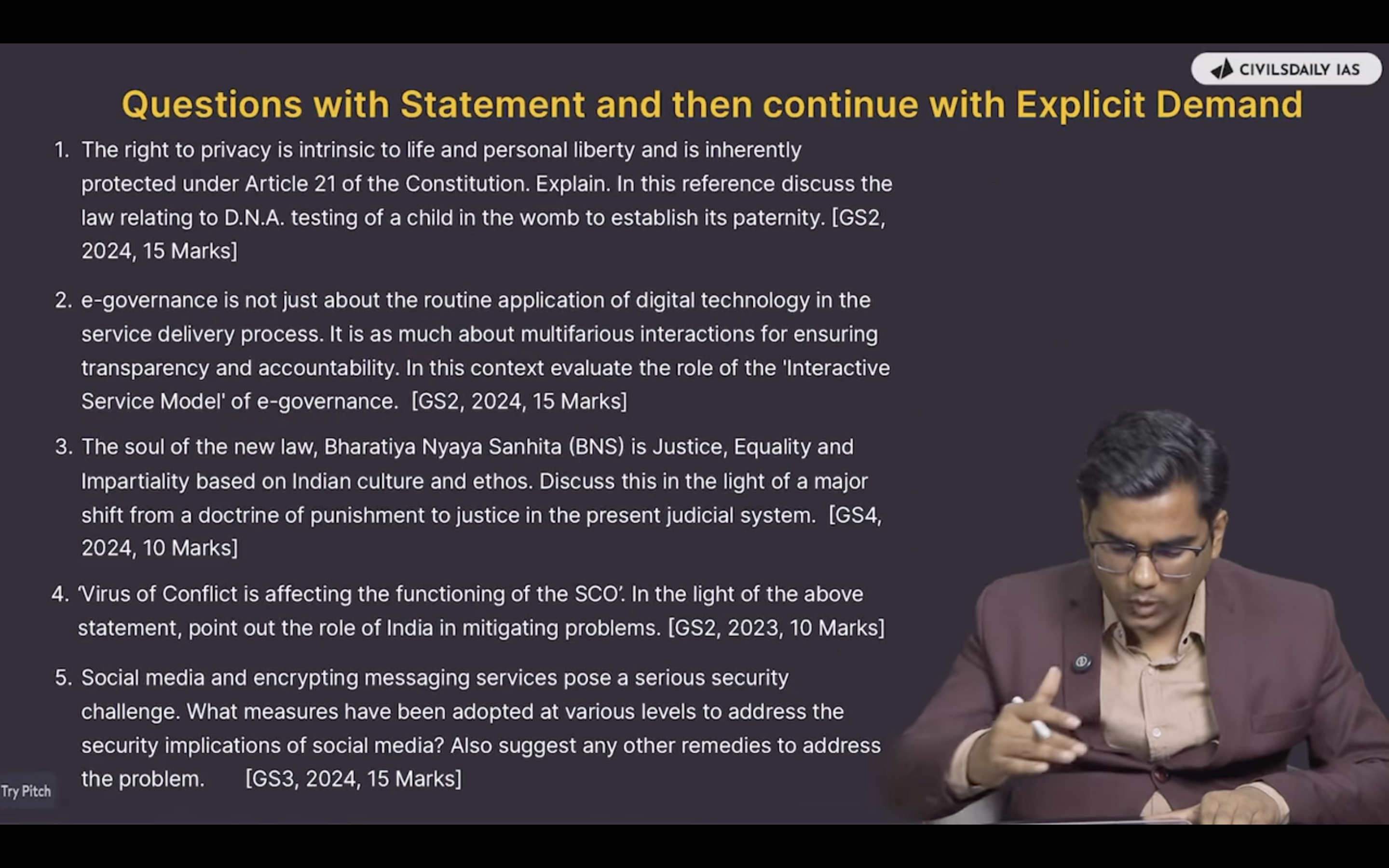
- c. Questions with directive
-
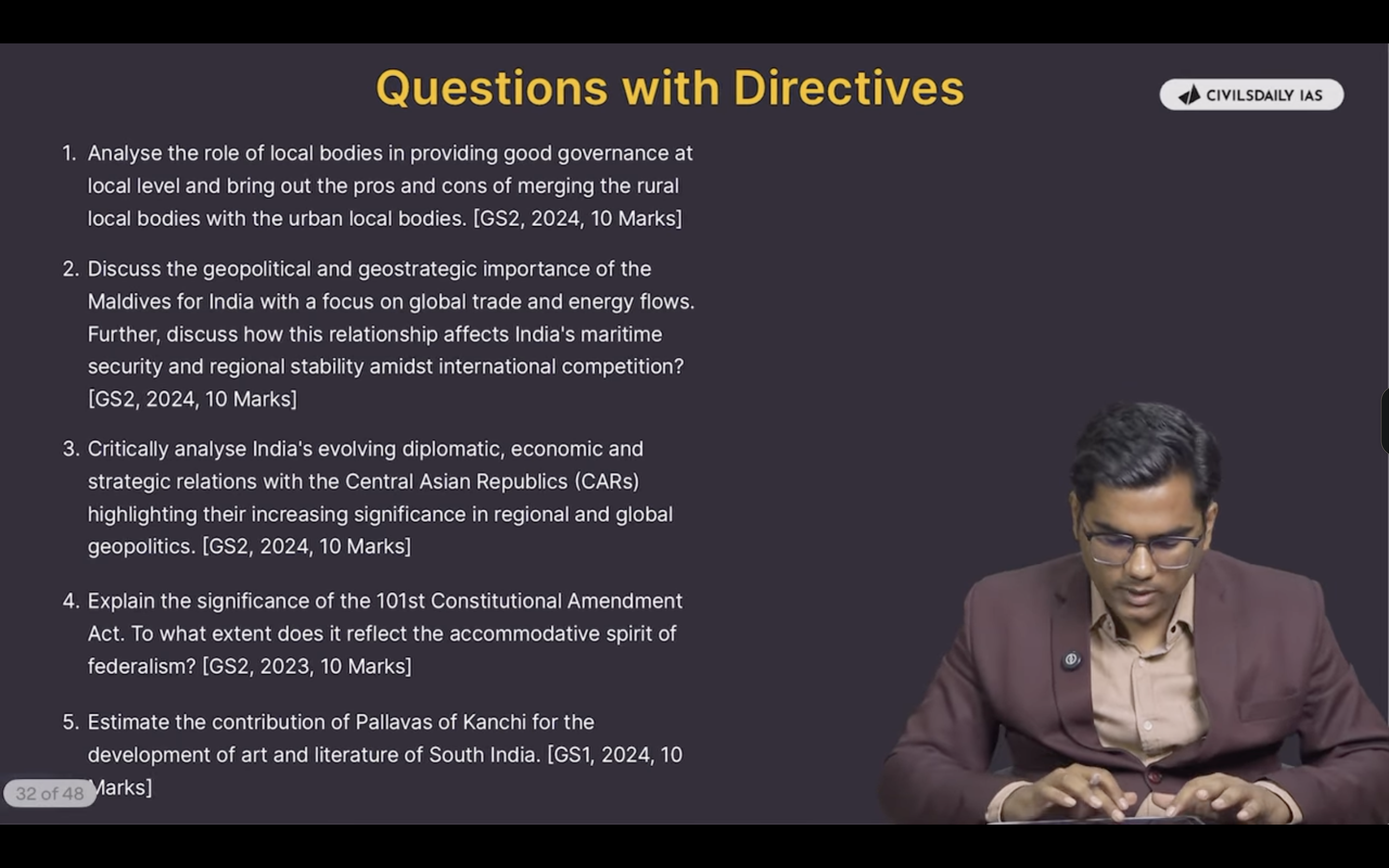
- d. Direct questions with explicit demand
-
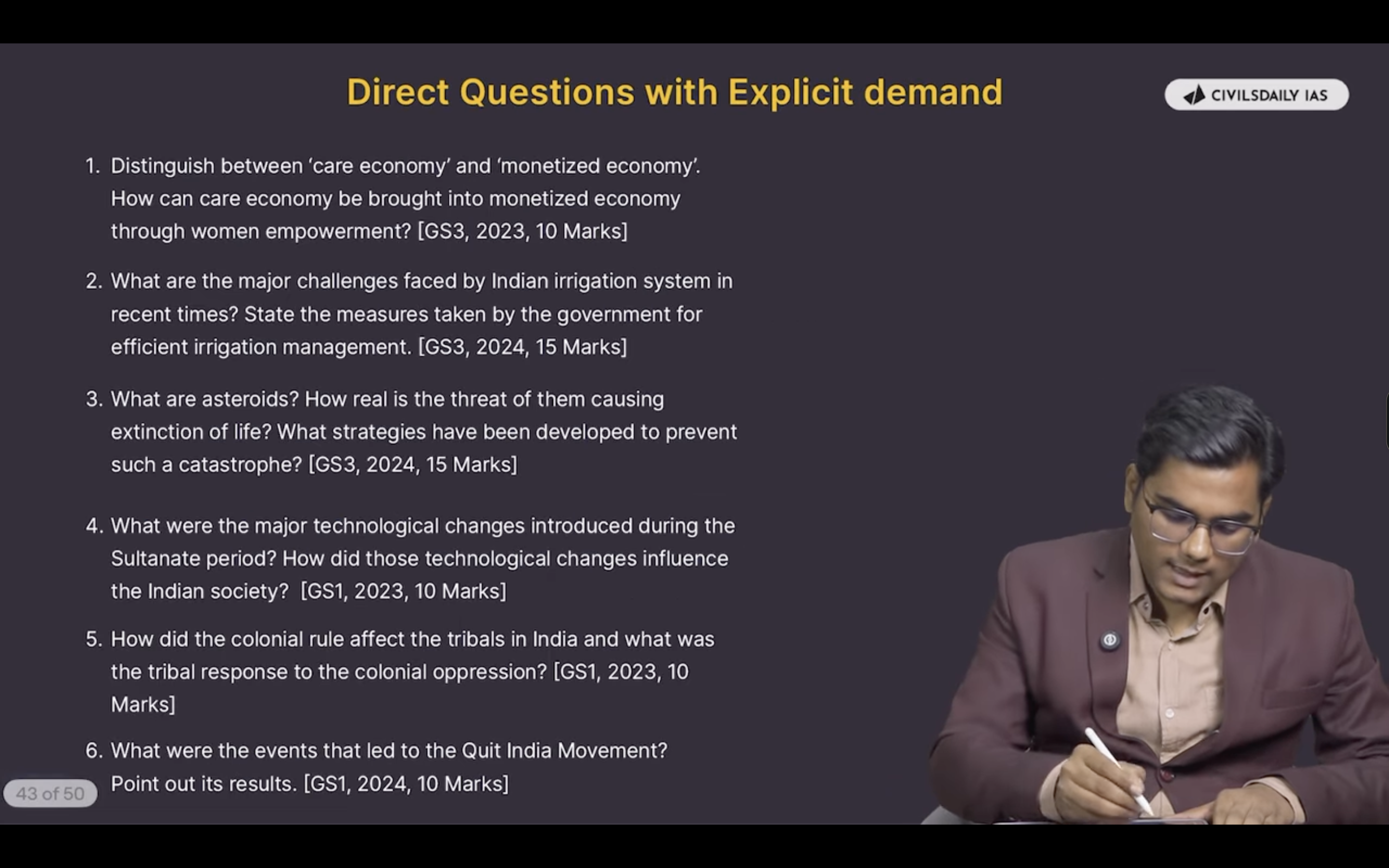
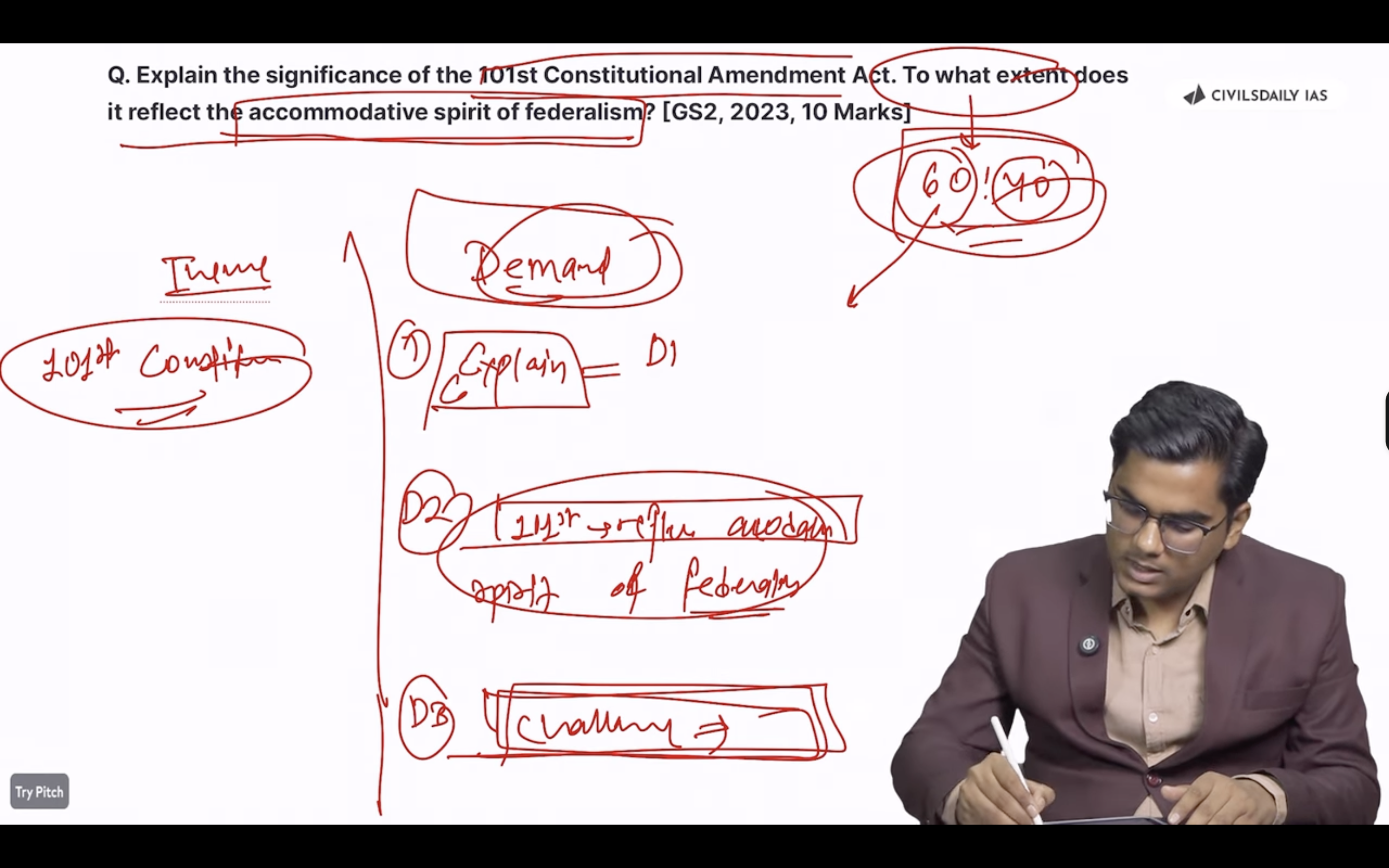
- 3. Theme and demand identification
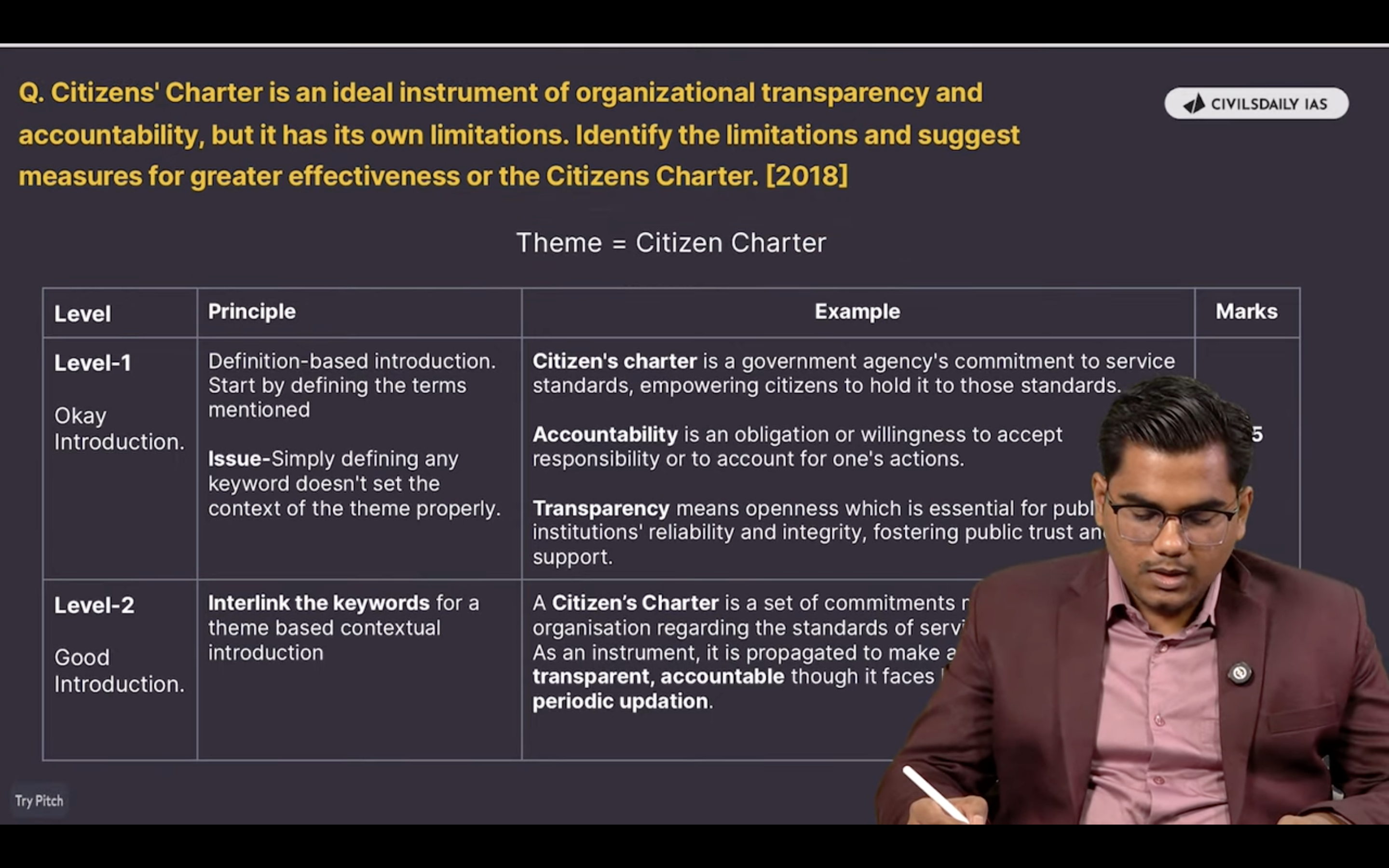
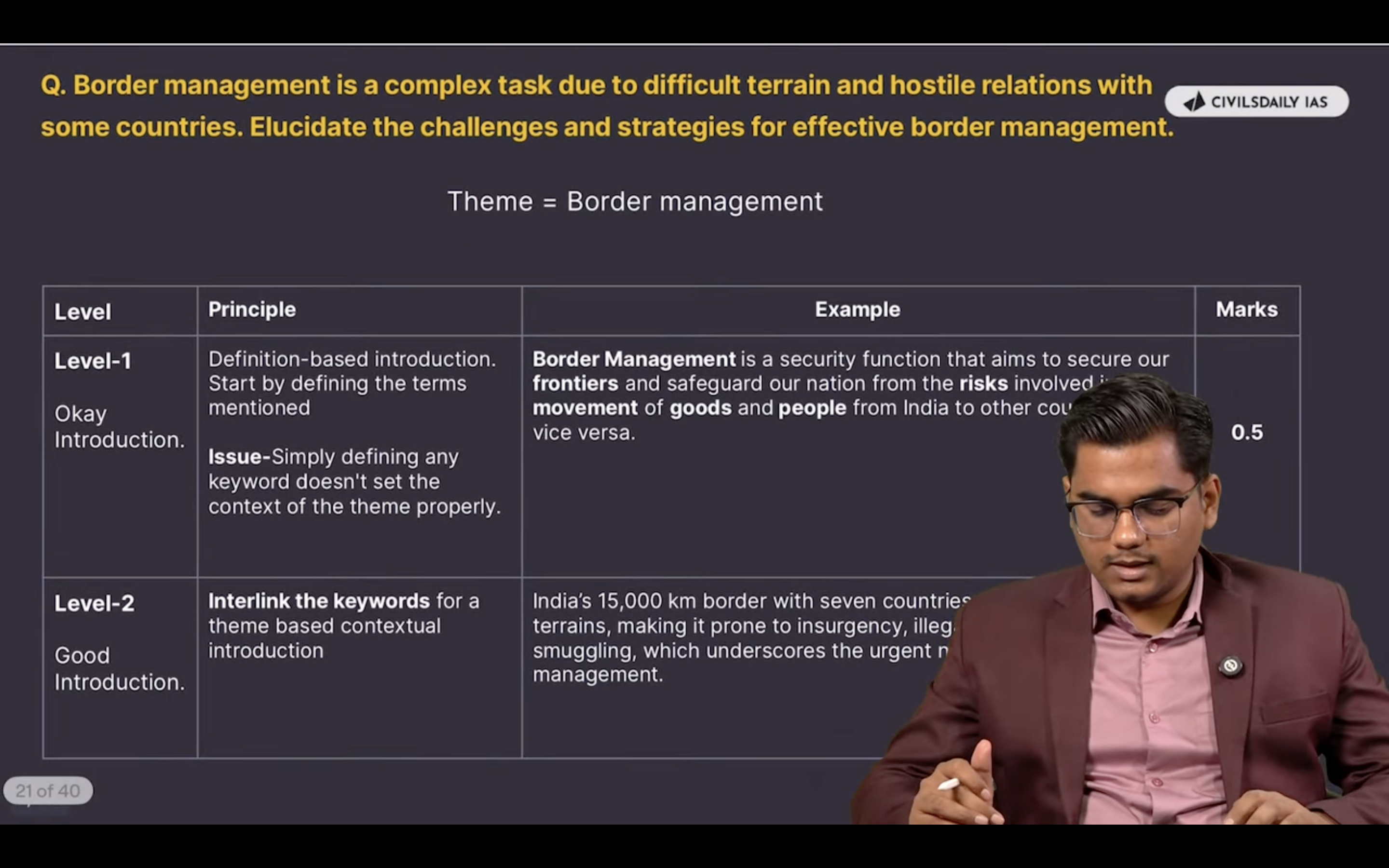
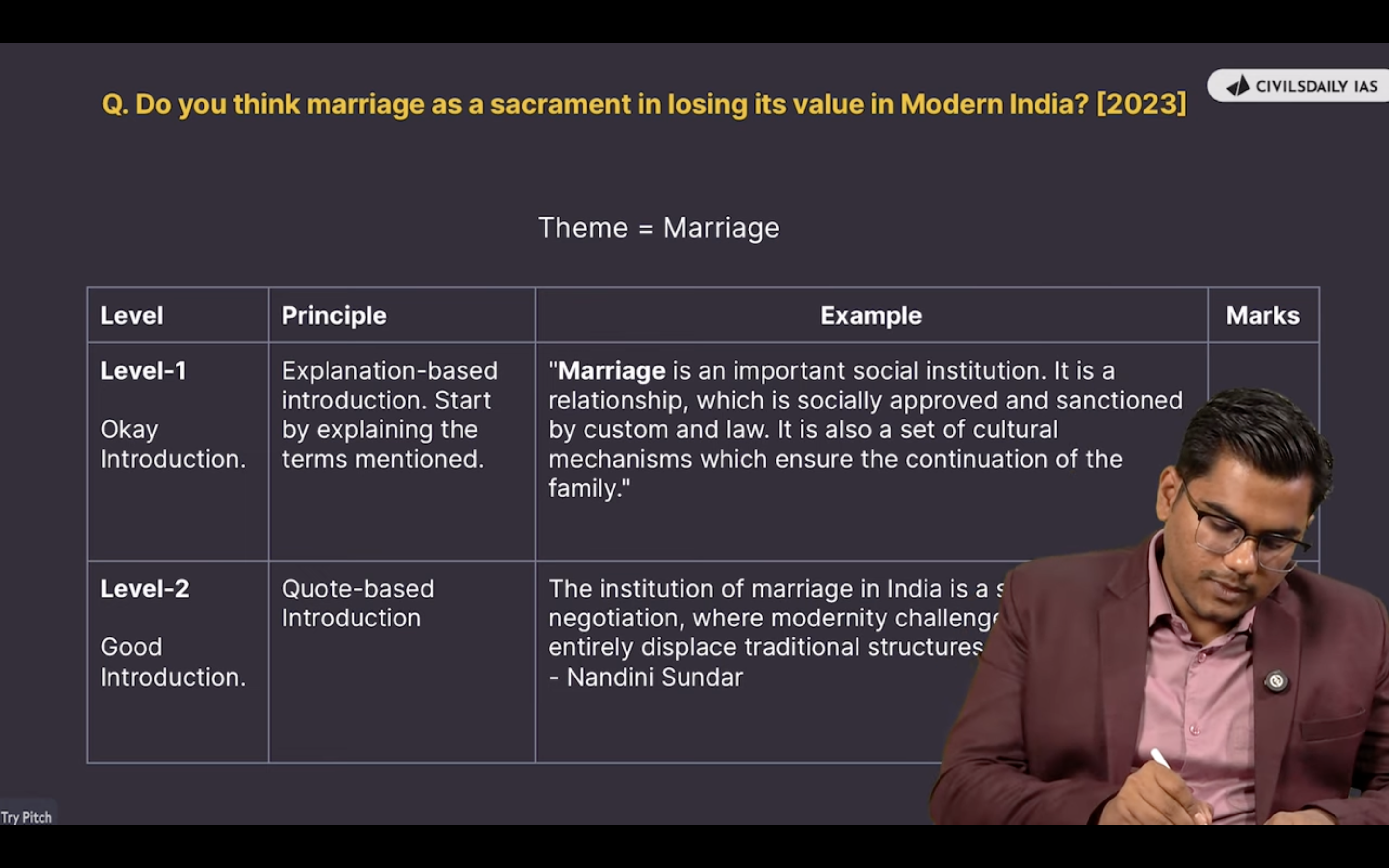
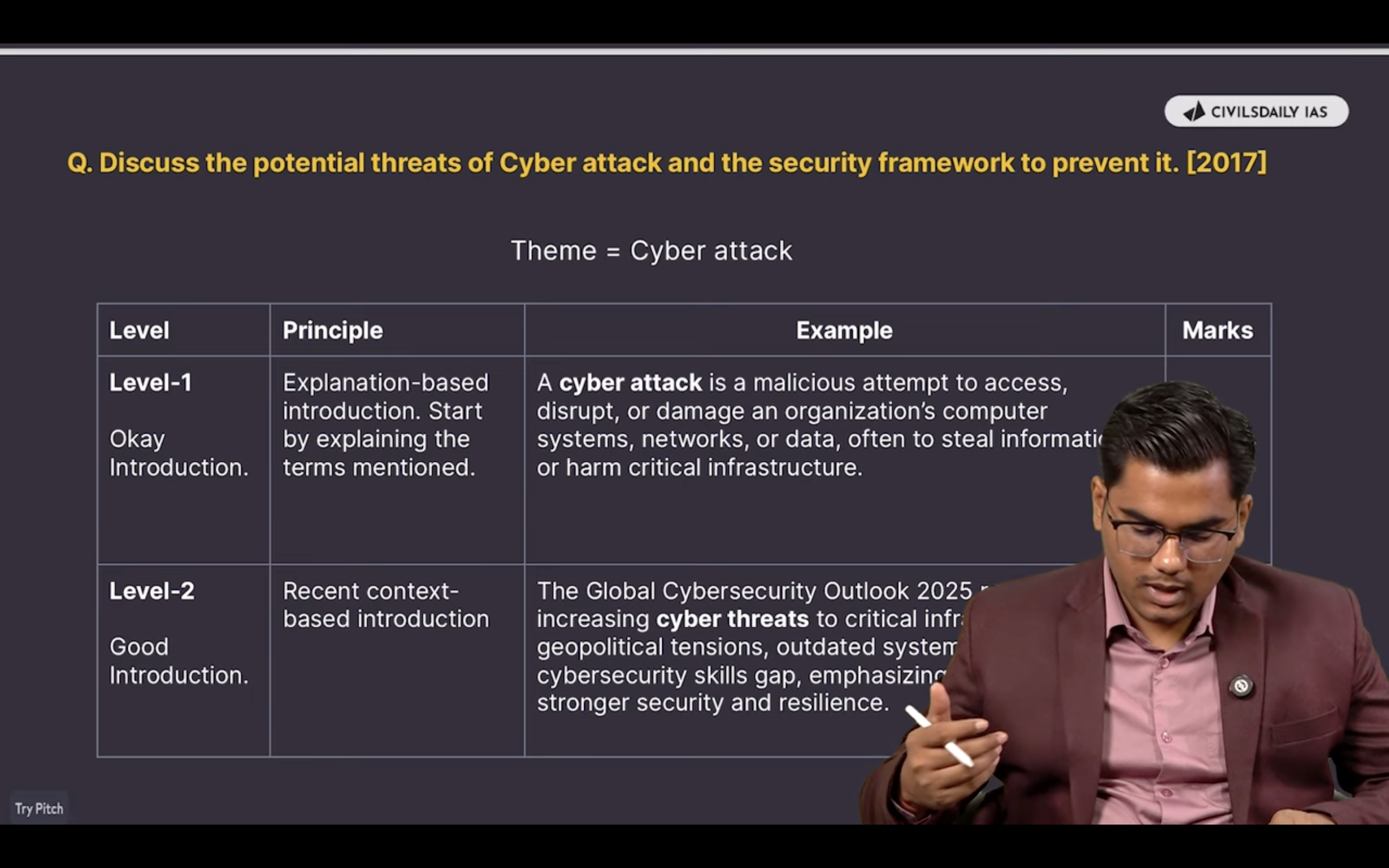
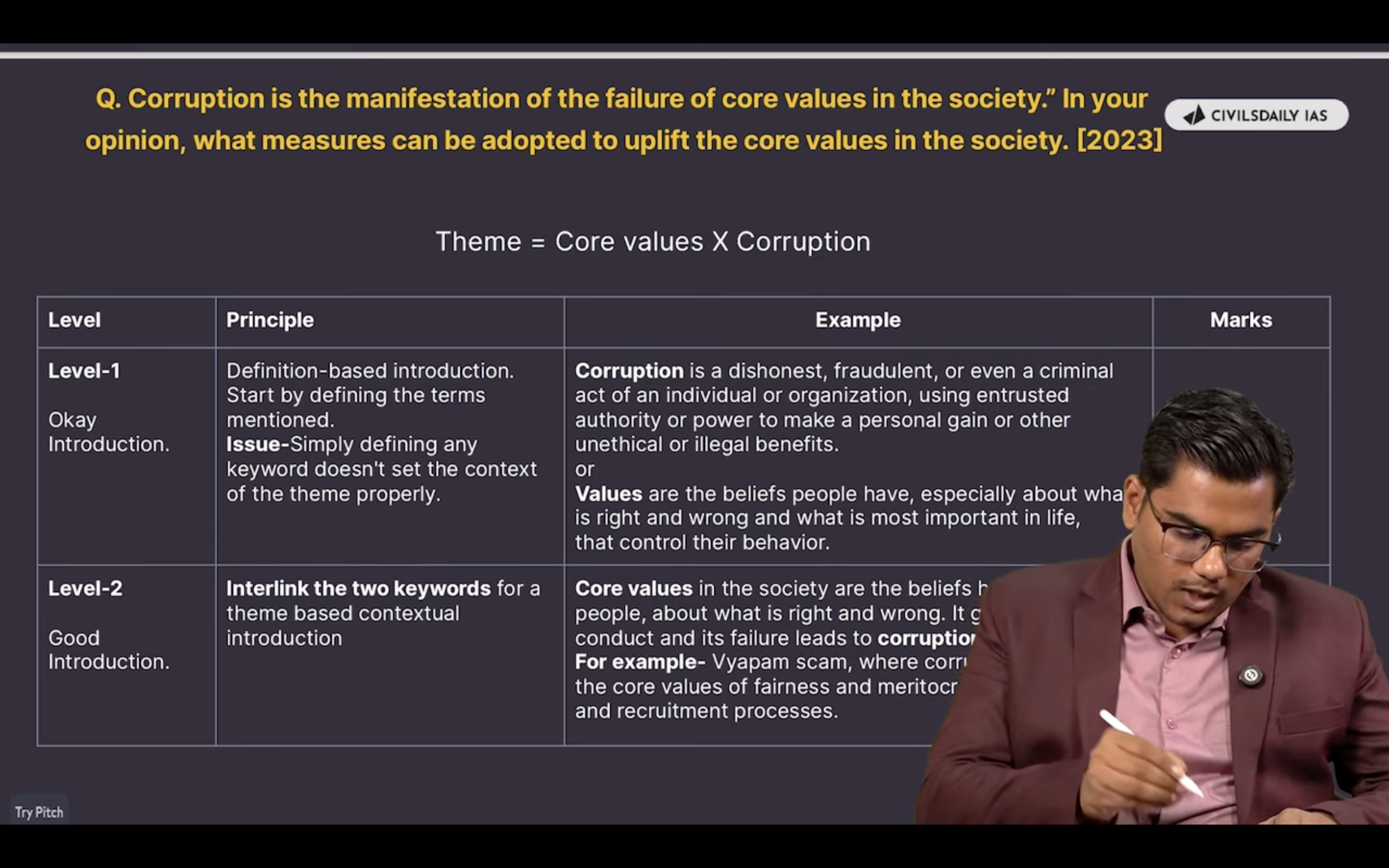
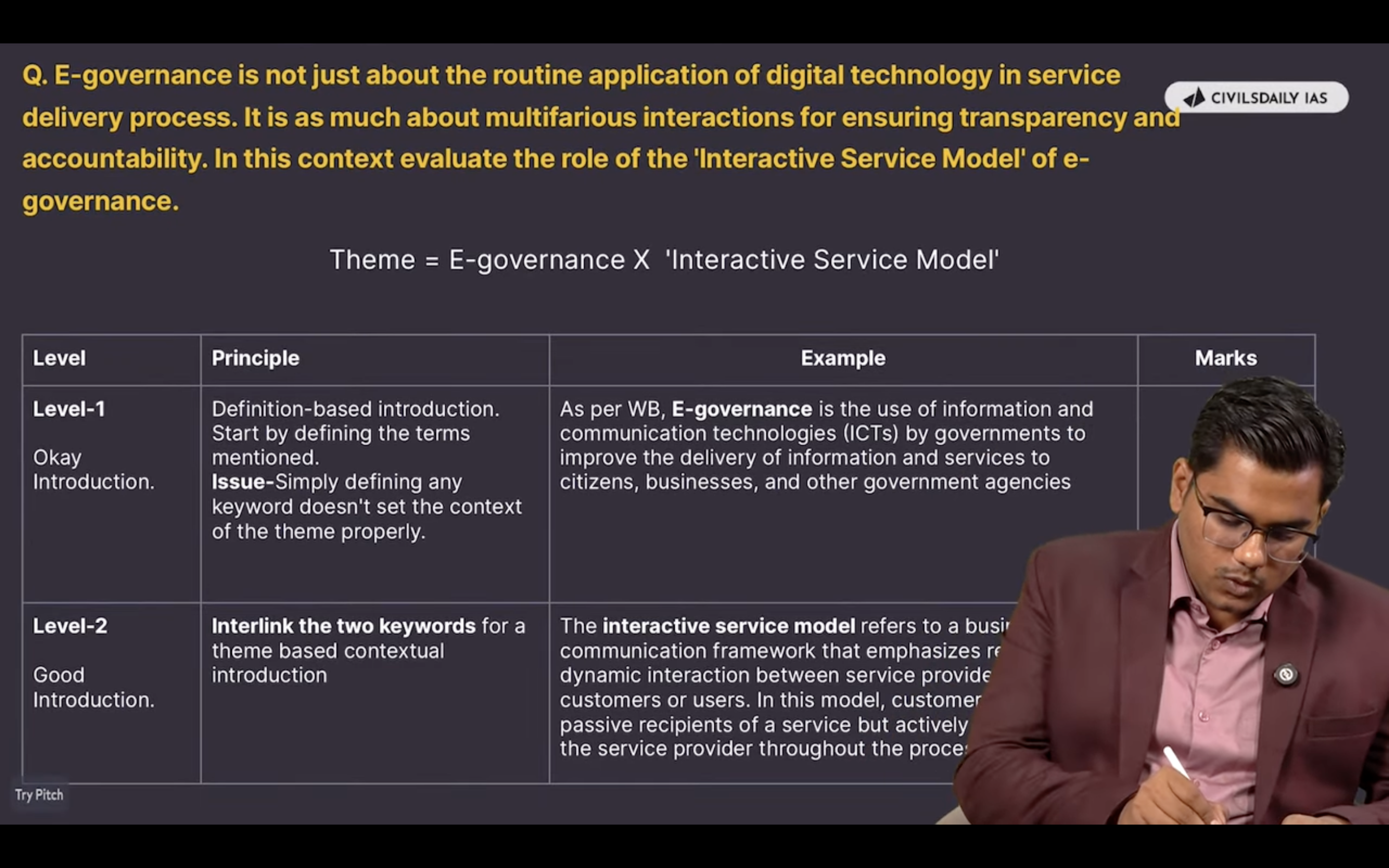
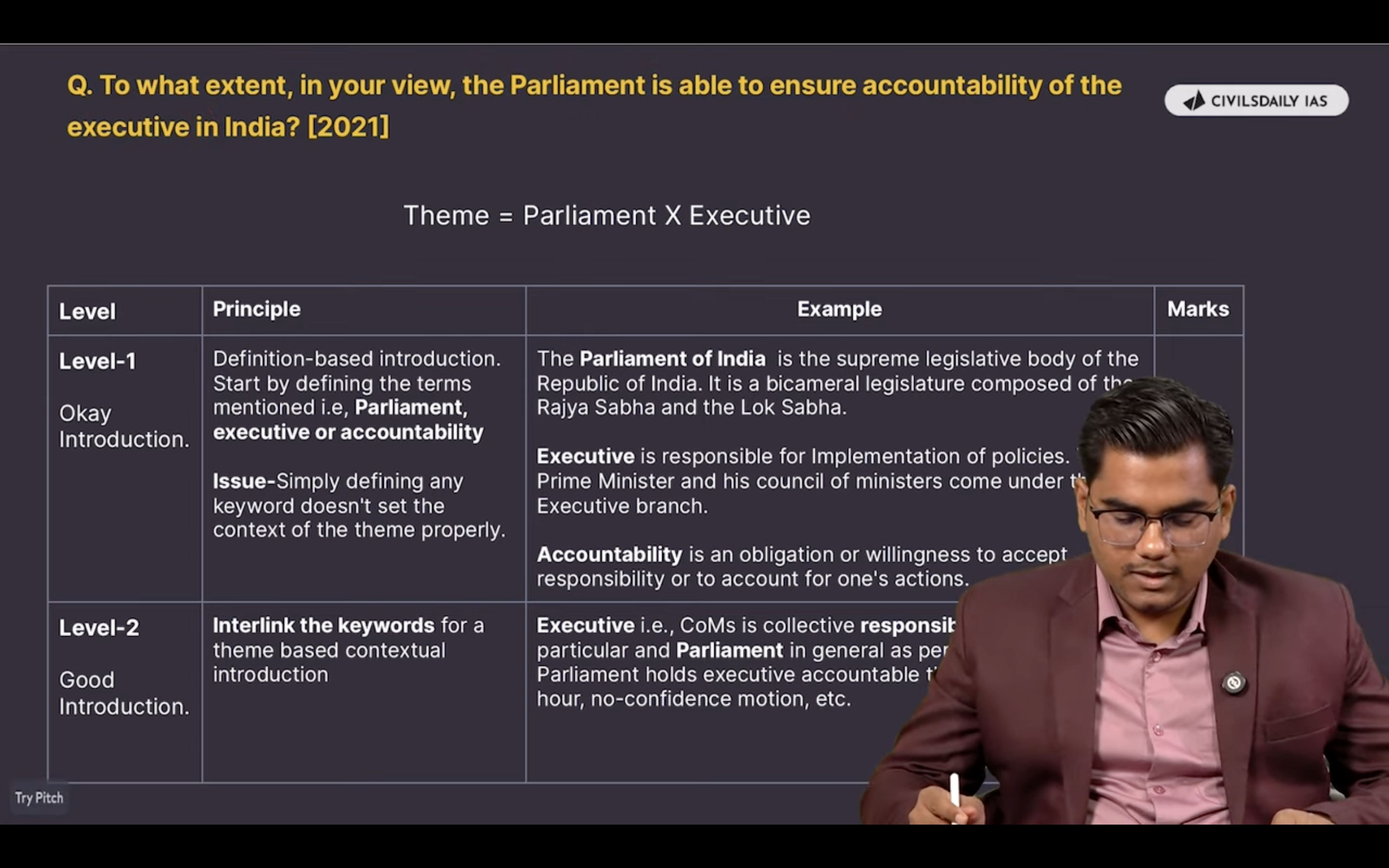
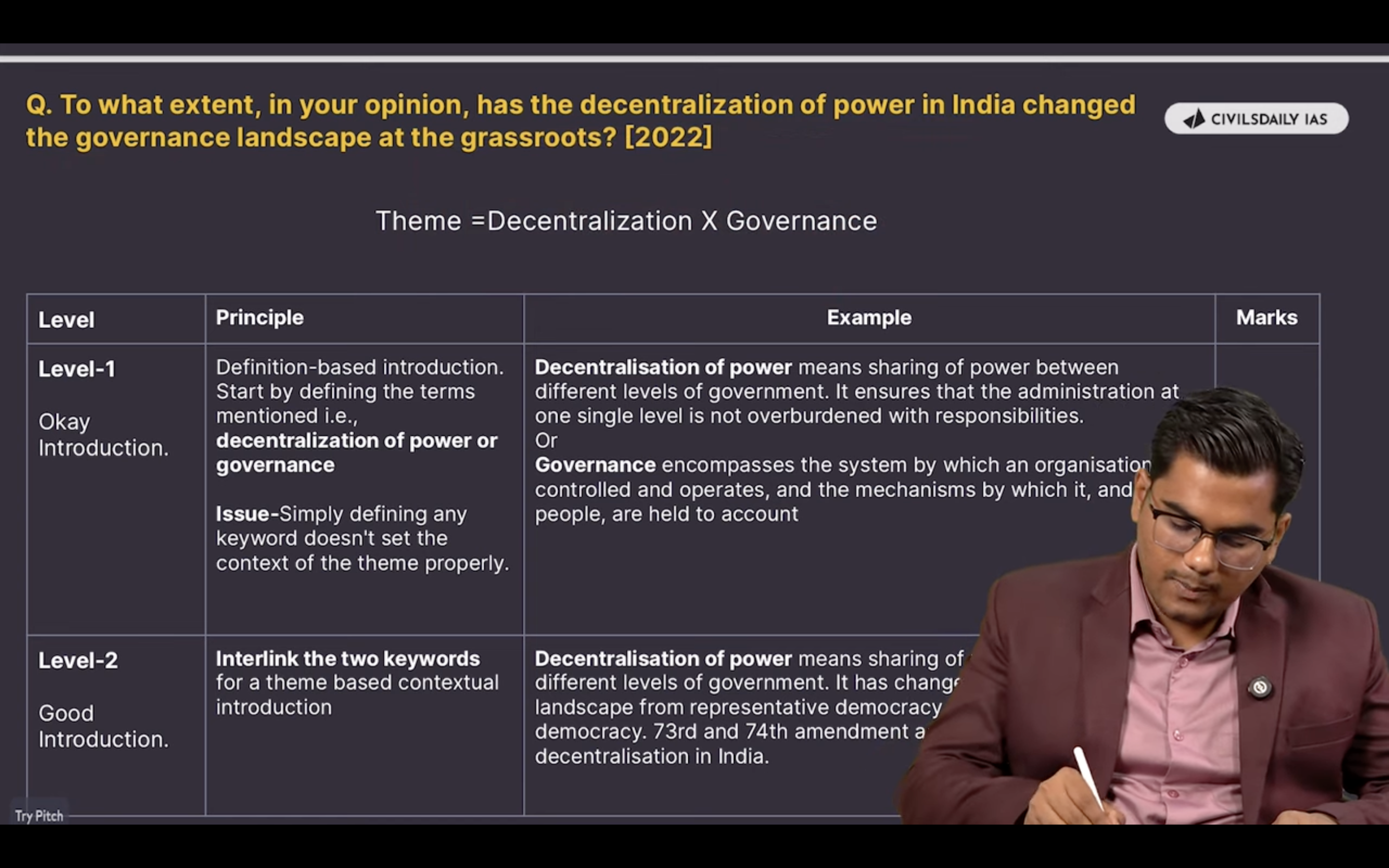
- a. Identify theme - single or multiple
- Some single theme questions
-

-
-
-
-
-
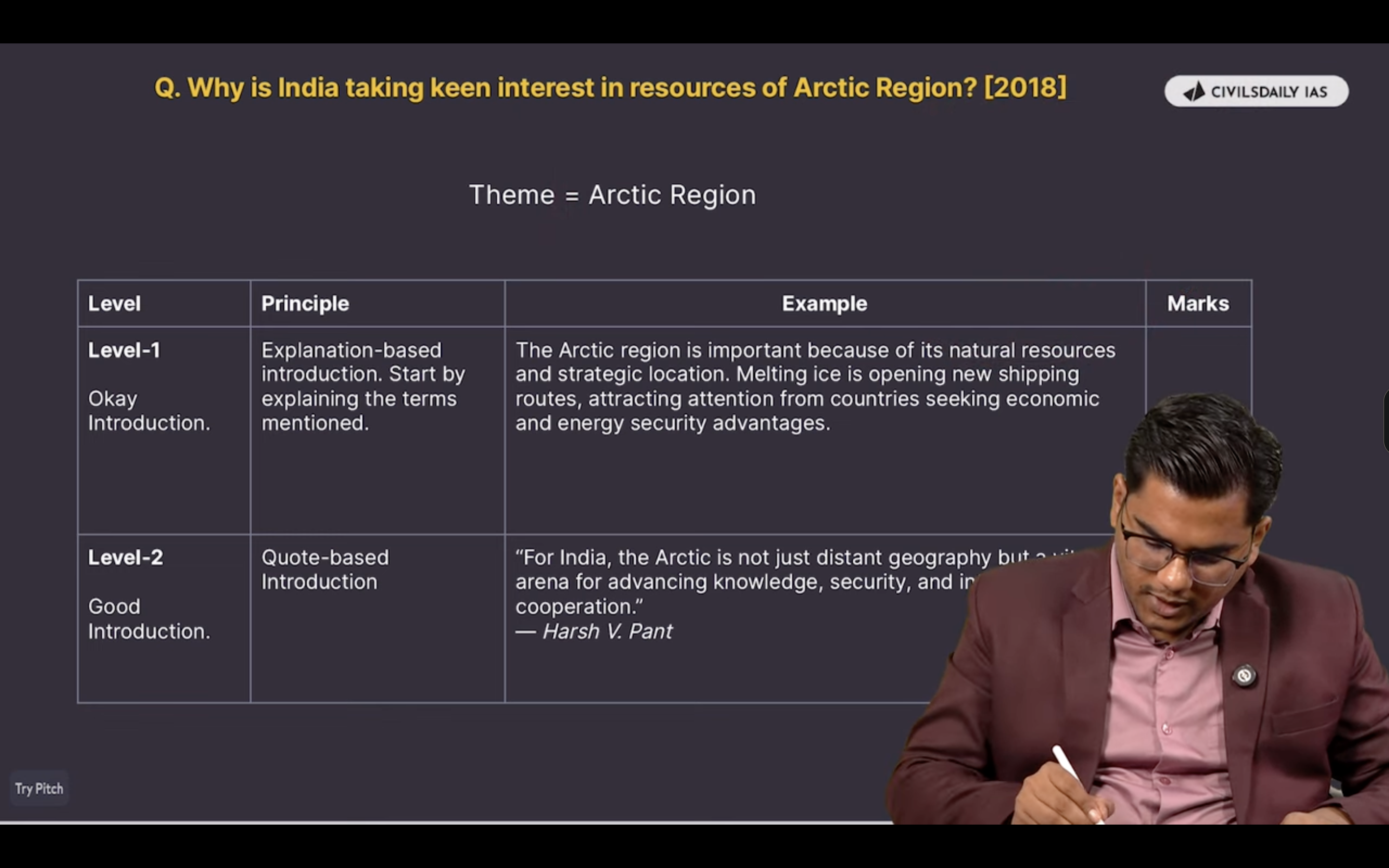
-
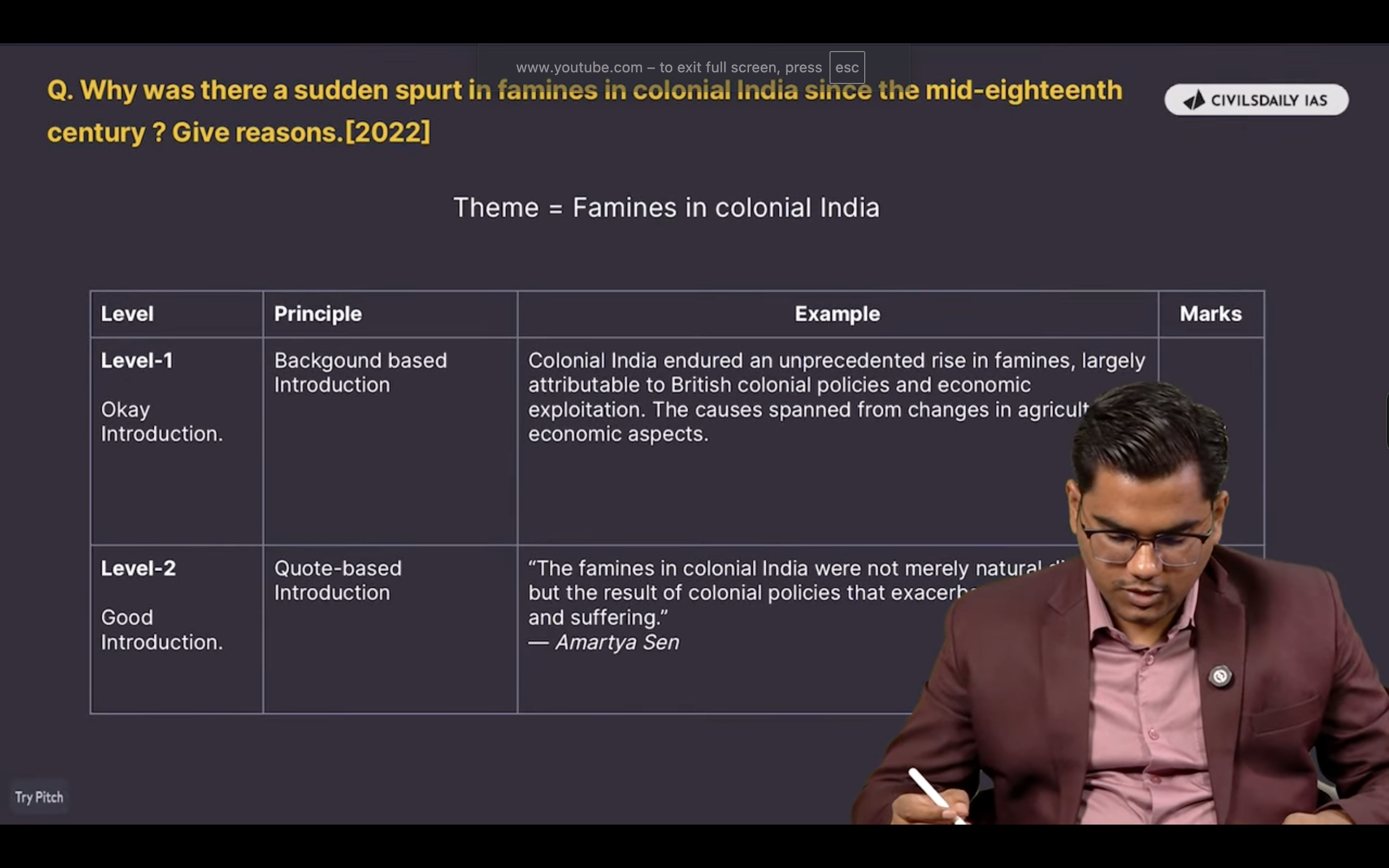
- Some multiple theme questions
-
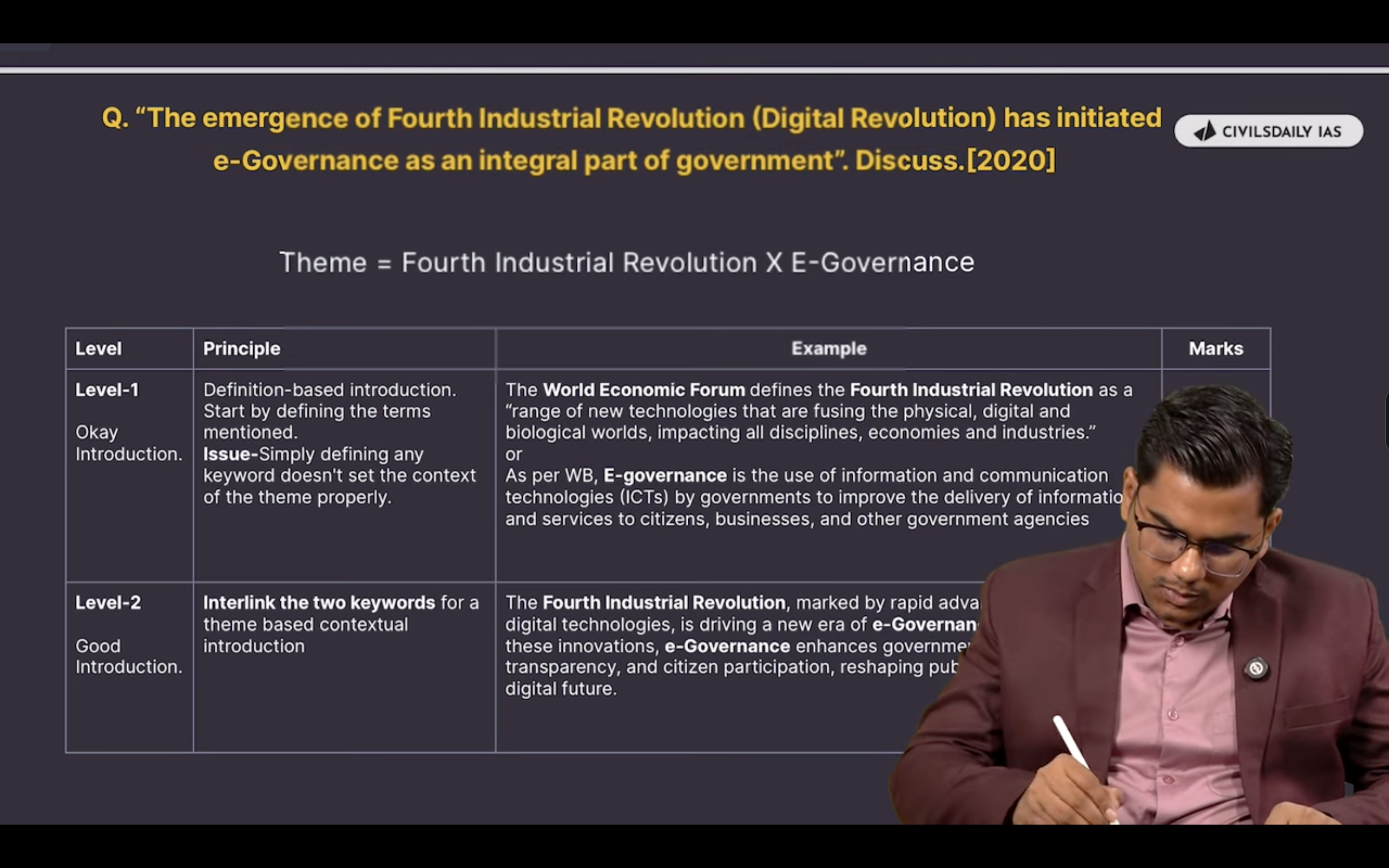
-
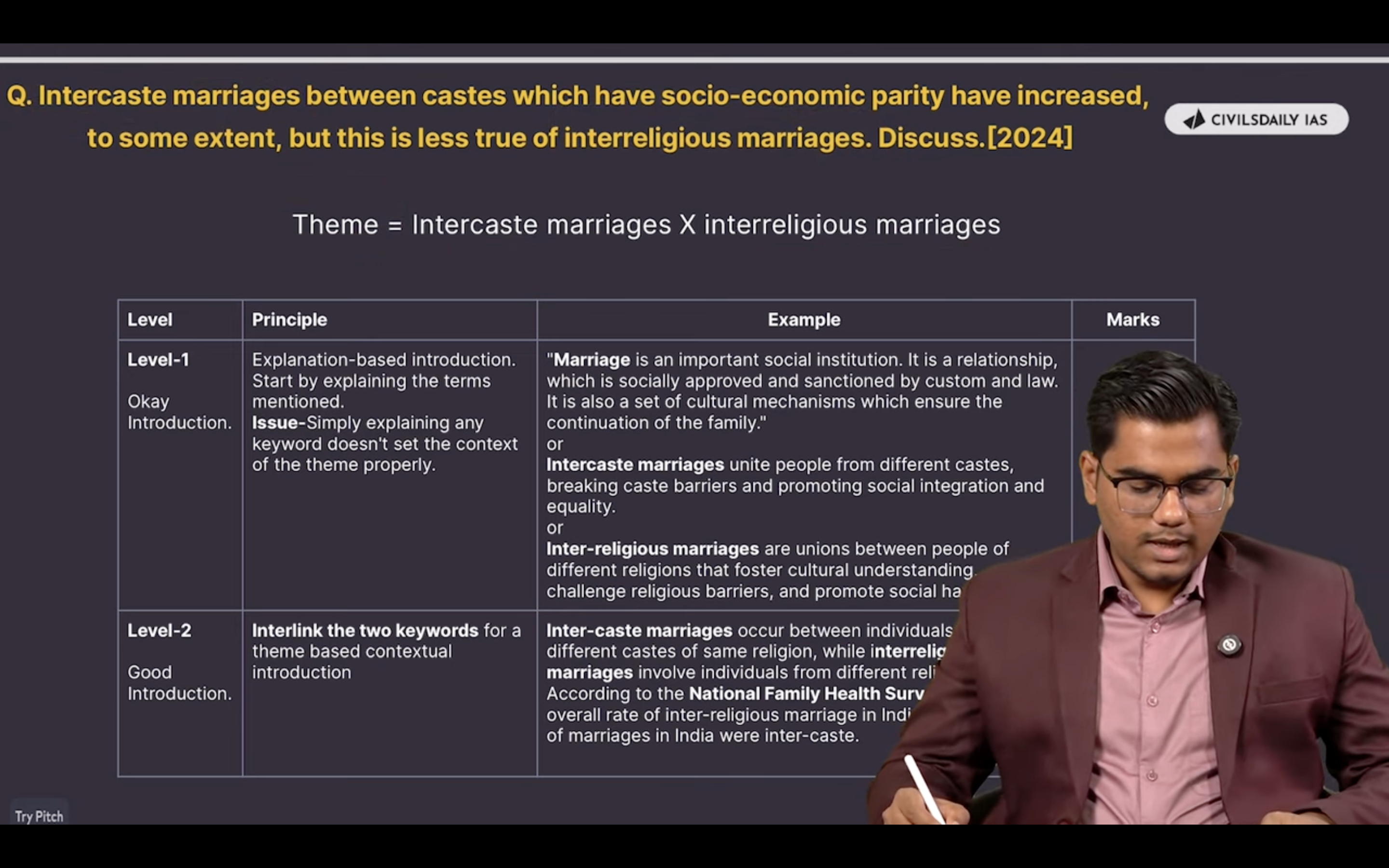
-
-
-
-
-
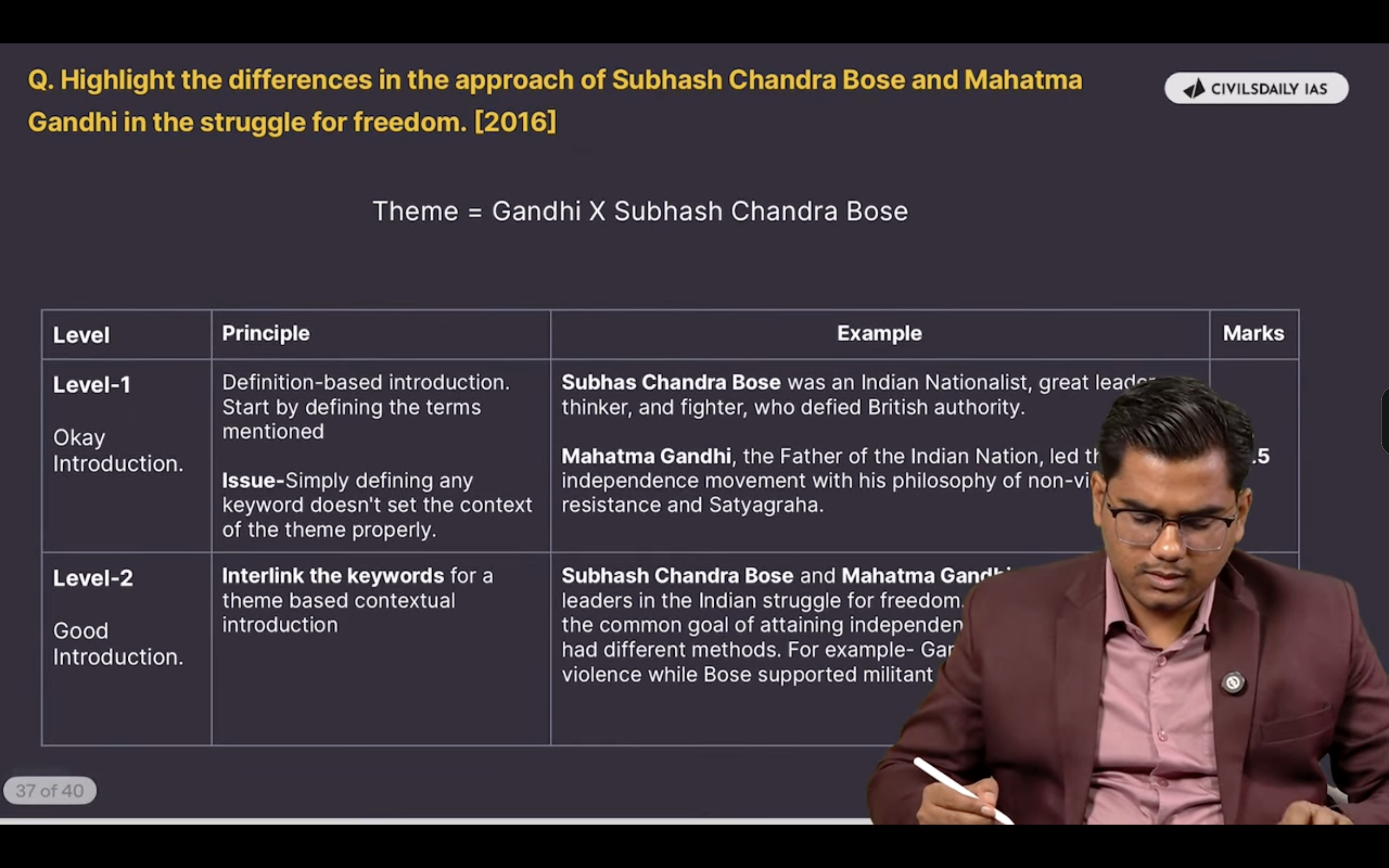
- b. Identify important keywords
- They can be - transparency, accountability, management, etc
- c. Identify demand based on categorization of questions
- There are two types of demands - implicit and explicit demand diving the demand into core and non-core part
- Deciding diagrams and mind-maps based on that, using quick diagrams to address non-core demand
- i. Statement based questions without explicit demand
- These questions don't have explicit demand, they only have implicit demand
- Need to break the statement into multiple parts to identify the theme and the demands
- Need to go beyond the demand for a holistic answer
- Mostly, ratio to address demand and go beyond demand is 70:30
- Based on directive, we can go 20-30% beyond the demand
- Example 1
-

-
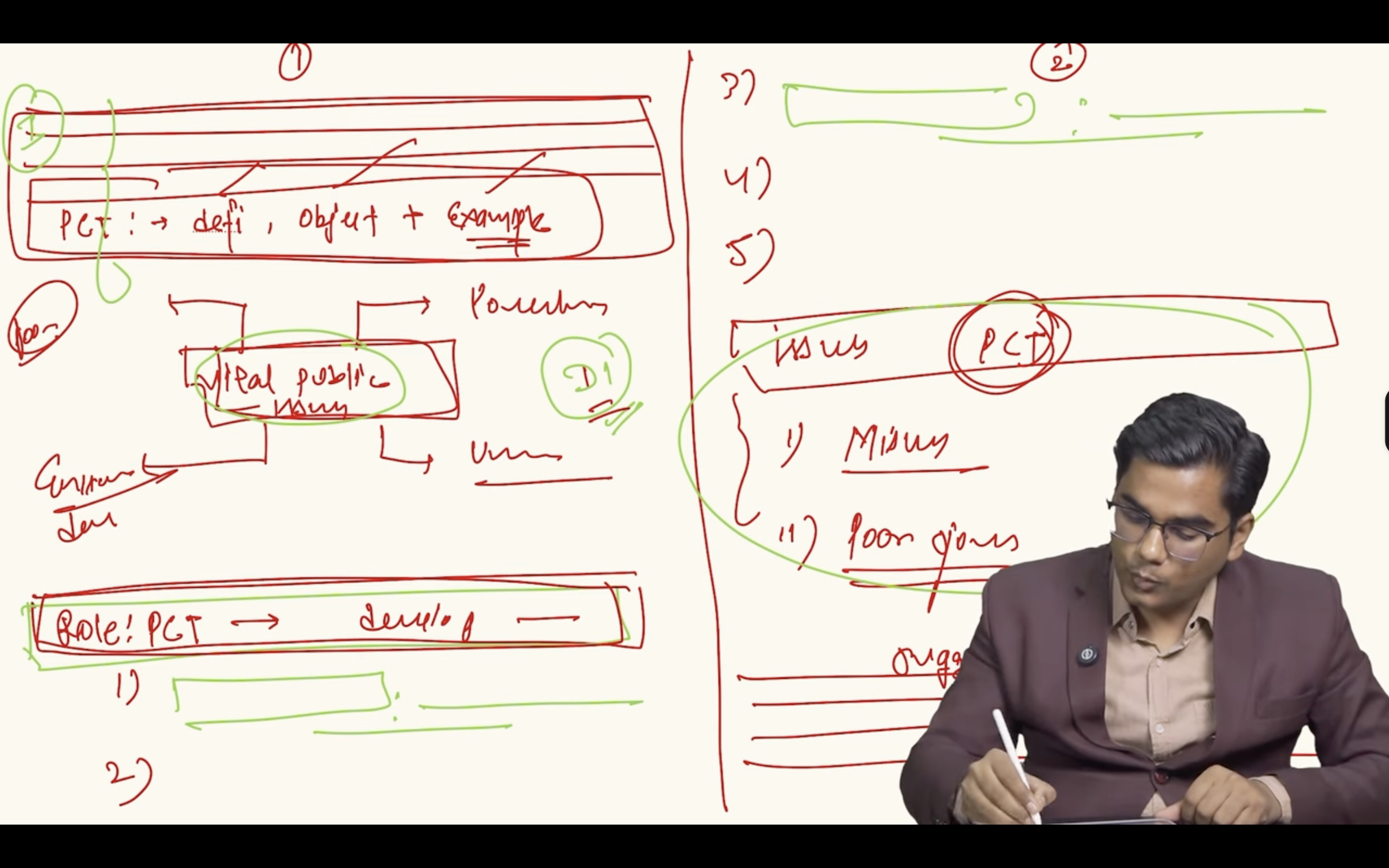
- Example 2
-

-
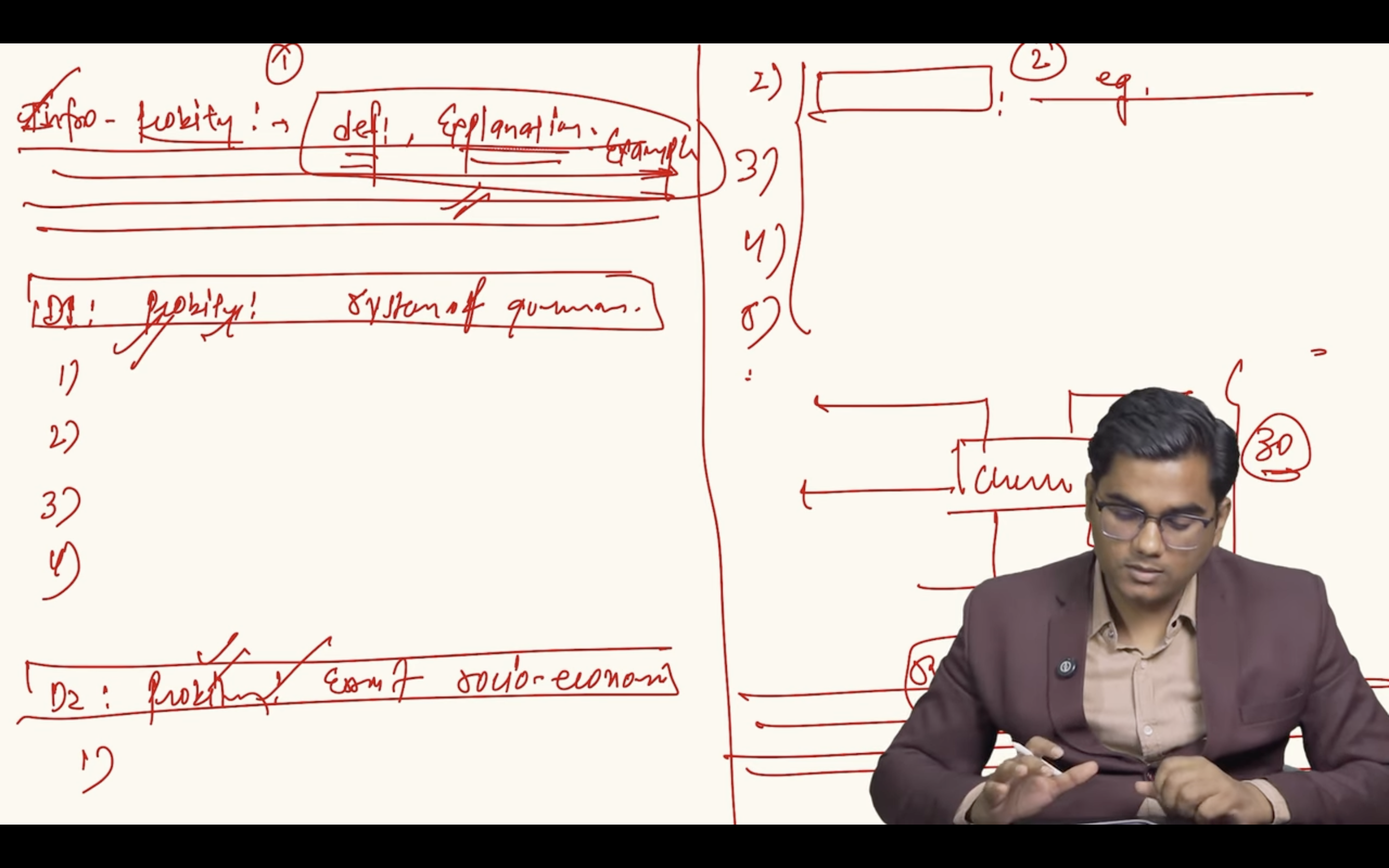
- Example 3
-

-
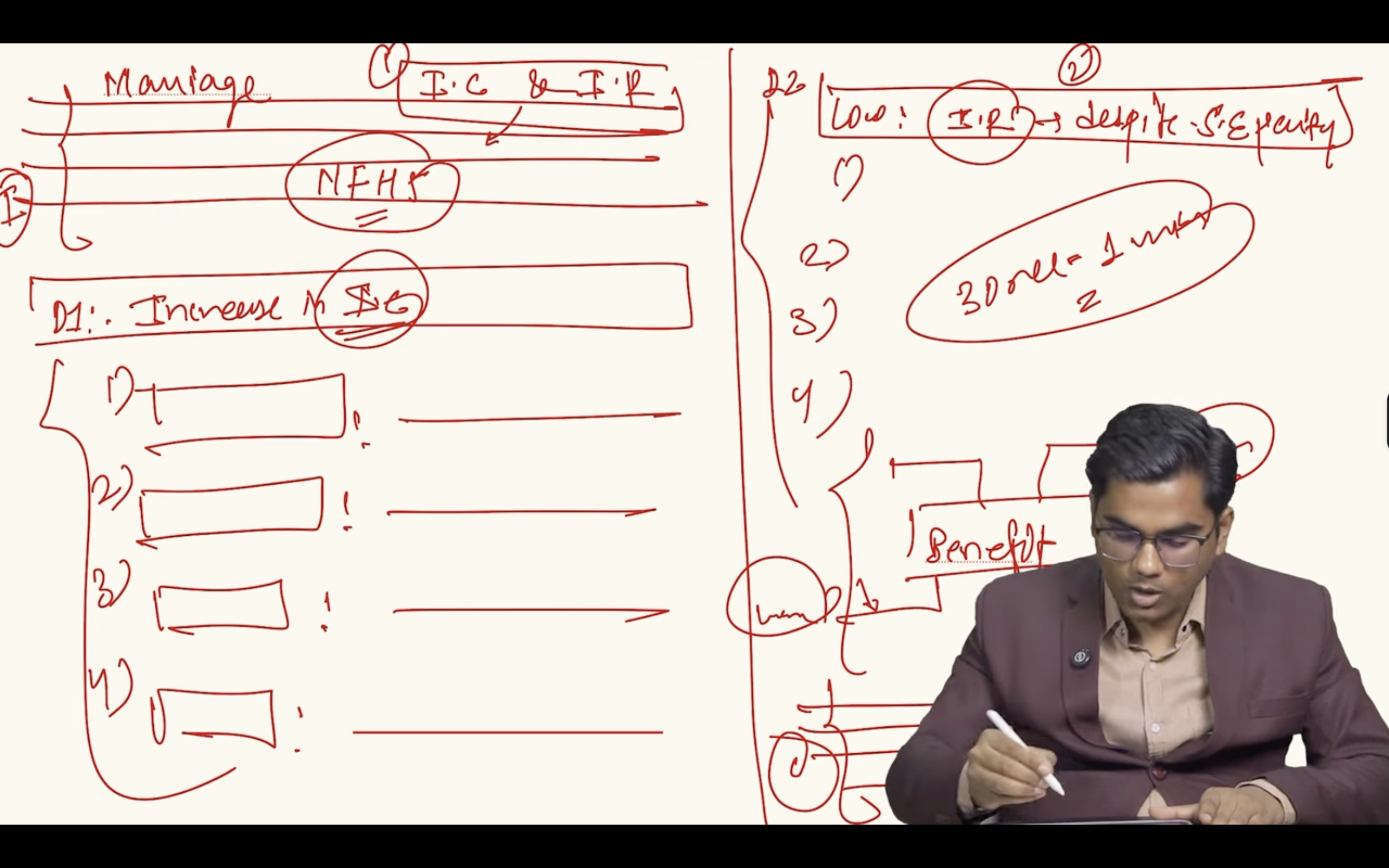
- ii. Statement based questions with explicit demand
- These questions have both implicit and explicit demands
- Implicit demand is to be figured mostly from the first statement while explicit is from the second statement.
- Need to break the statement into multiple parts to identify the theme and the demands
- Example 4
-

-
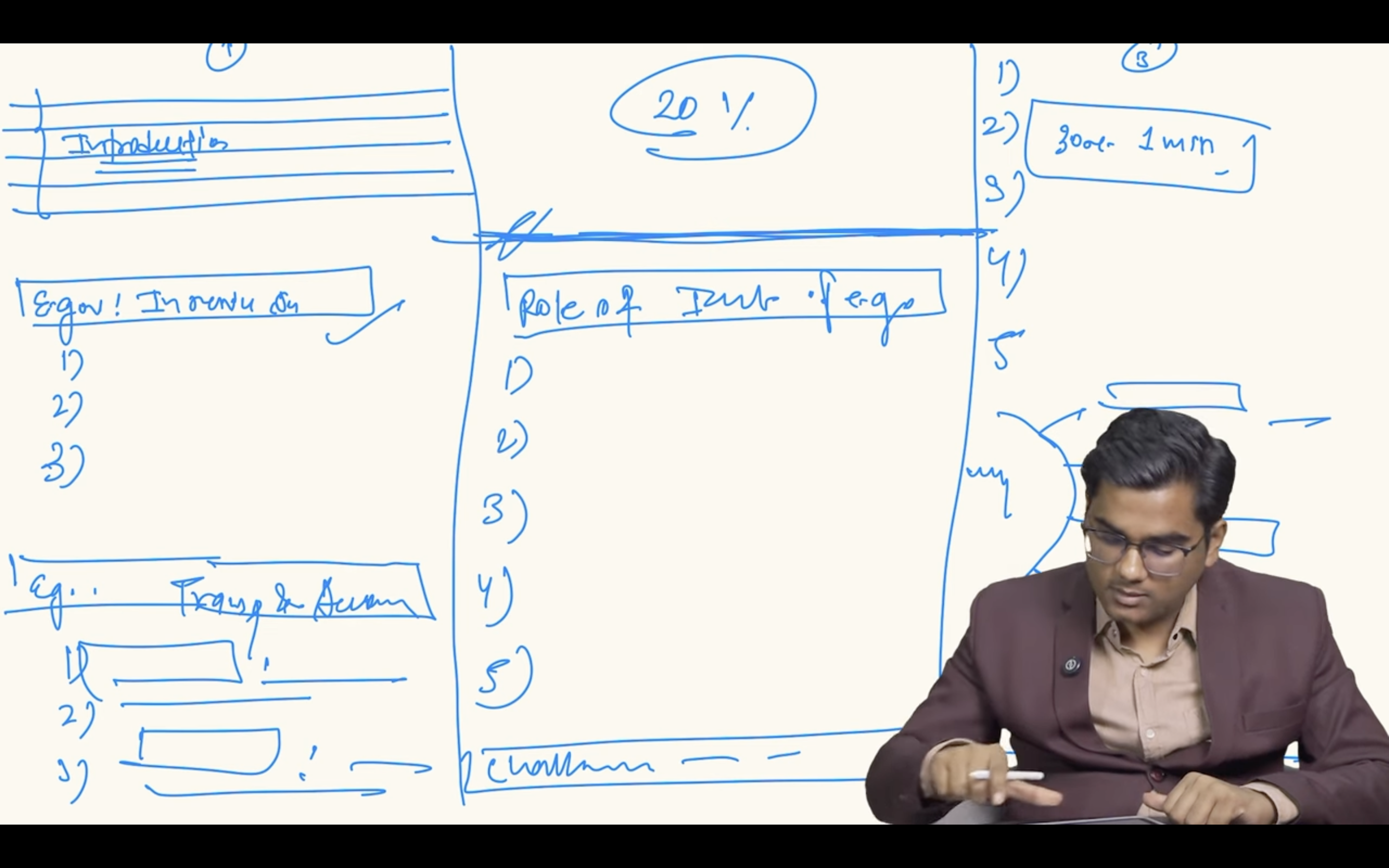
- Example 5
-

-
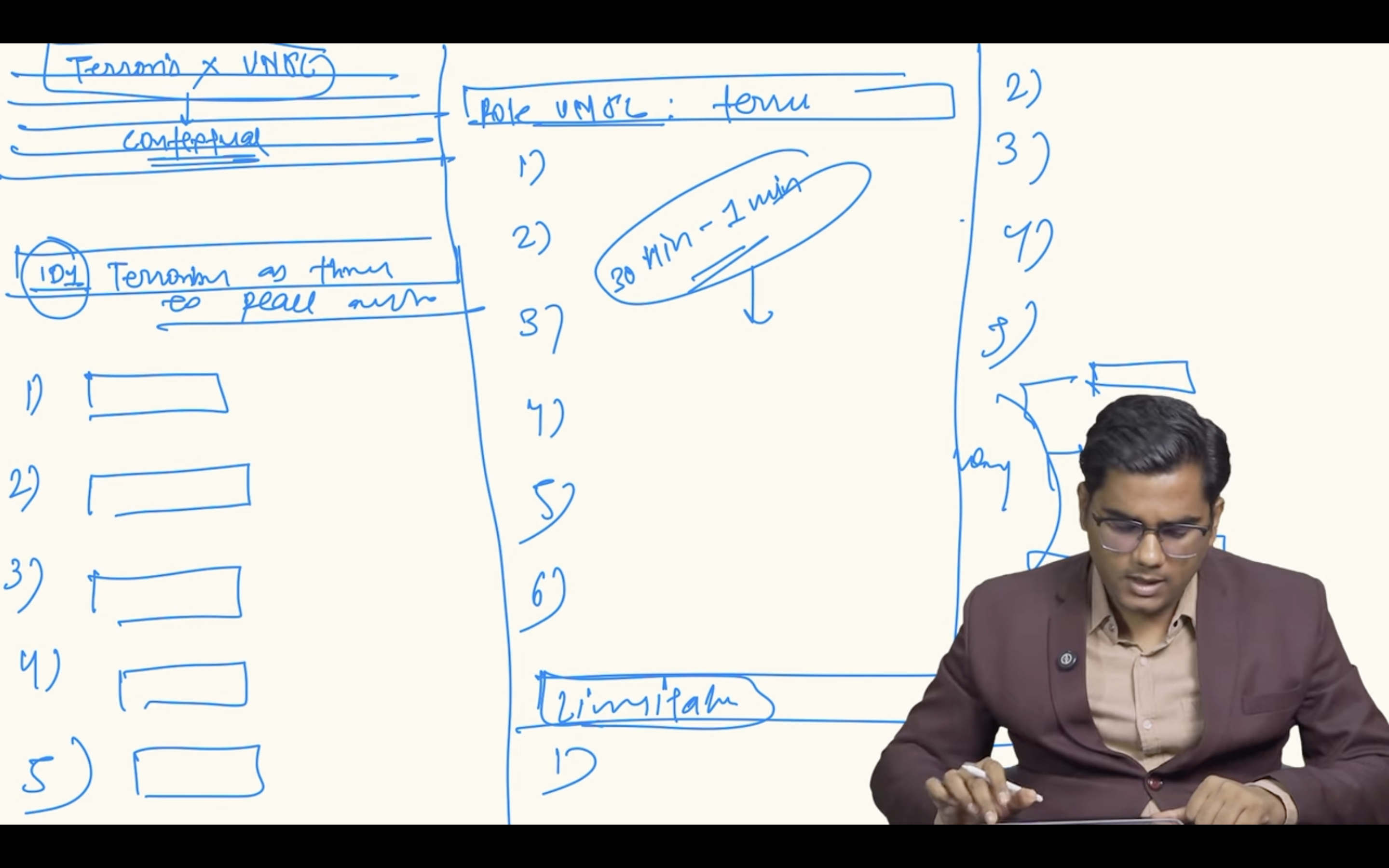
- iii. Questions with directive
-
- These questions also have both implicit and explicit demands
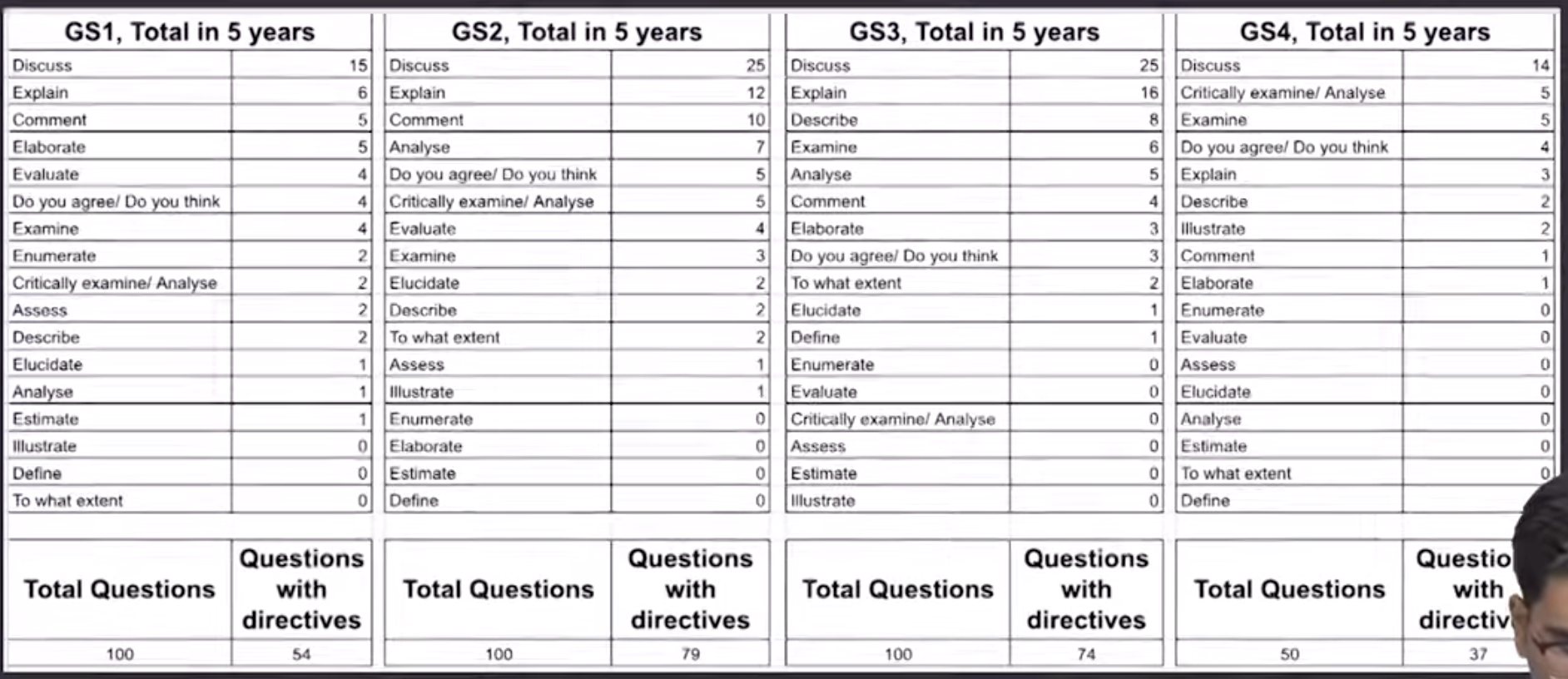
- Why directives are important
- To identify hidden demands
- Understanding of directives are highly linked to the context of the question, not to be treated independently
- Some directives can be used interchangeably like "Describe" and "Explain", while others can't like "Critically examine" vs "Elaborate".
- To decide weather to go beyond the core demand or not
- To decide weather to elaborate on theme, analysis, or substantiate with example
- To decide weighage of each demand
- Some GS papers have more questions based on directives while others have less
- GS1 have mere 55% questions based with directives, while GS2 has approximately 80%
- Very important directives
-
| Directive |
What it asks? |
How answer changes? |
Core : Beyond demand |
| Explanation Based |
| Elucidate |
- Clarify complexity
- Expose hidden assumptions
|
- Clear explanation
- Use illustrative examples
|
70:30 |
| Elaborate |
- Expand on an idea beyond basics
|
- Go deeper into sub-points and implications
|
70:30 |
| Explain |
- Reasons, factors/causes and consequences
|
- Link causes/effects
- Use “because” logic
|
Focus on core |
| Illustrate |
- Use examples, cases, diagrams
|
- Example first, then theory
|
Focus on core |
| Describe |
- Characteristics, features, functions
|
- Detailed attributes in narrative form
|
Focus on core |
| Multi-Angle Based |
| Discuss |
- Present multiple viewpoints
- Cover all angles
|
- Point–counterpoint
- Integrate before concluding
|
70:30 |
| Comment |
- Give brief opinion or observation
|
- Short, focused stance backed by reasons
|
70:30 |
| Do you agree / Do you think |
- State stance with justification
- Both for and against (60:40)
|
- Argue both sides then give opinion
|
60 (agree) : 40 (disagree) |
| To what extent |
- Qualify degree of agreement
- Cover both impact and what's left (60:40)
|
- Use spectrum-based judgement
|
60 (impact) : 40 (left) |
| Analysis Based |
| Critically Examine / Critically Analyze |
- Analyze with strengths & weaknesses
|
- Merits + drawbacks
- Balanced conclusion
|
60:40 |
| Analyze |
- Break into parts & inter-link
|
- Examine each part and synthesize
|
50:50 |
| Examine |
- Investigate topic in detail
|
- Similar to Analyze but allows more description
|
50:50 |
| Assess |
- Judge significance, value or impact
- Cost-benefit analysis
|
- Weigh benefits vs costs
- Give final judgement
|
50:50 |
| Evaluate |
- Determine worth using pros & cons
|
- Assign weight to arguments
- Reasoned conclusion
|
50:50 |
| Factual / Listing Based |
| Enumerate |
|
- Numbered or bullet points
- Minimal explanation
|
Core demand only |
| Define |
|
- Start with short definition
|
Core demand only |
| Estimation Based |
| Estimate |
- Reasoned approximation
- State assumptions
|
- Give numerical range
- Explain methodology & caveats
|
80:20 |
- Example 1
-
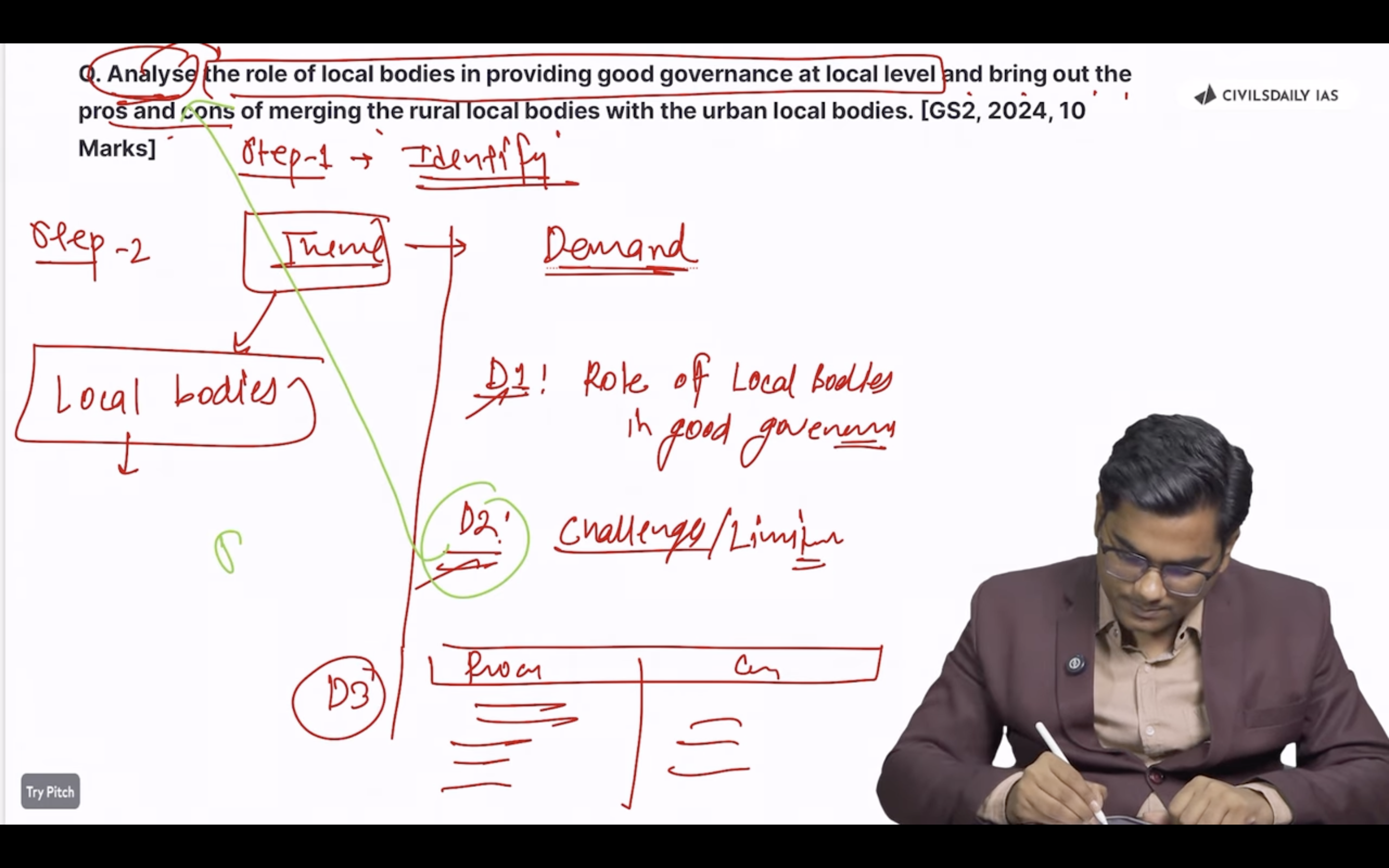
-

- Example 2
-
-
- iv. Direct questions with explicit demand
- These questions have direct explicit demands
- Example 1
-

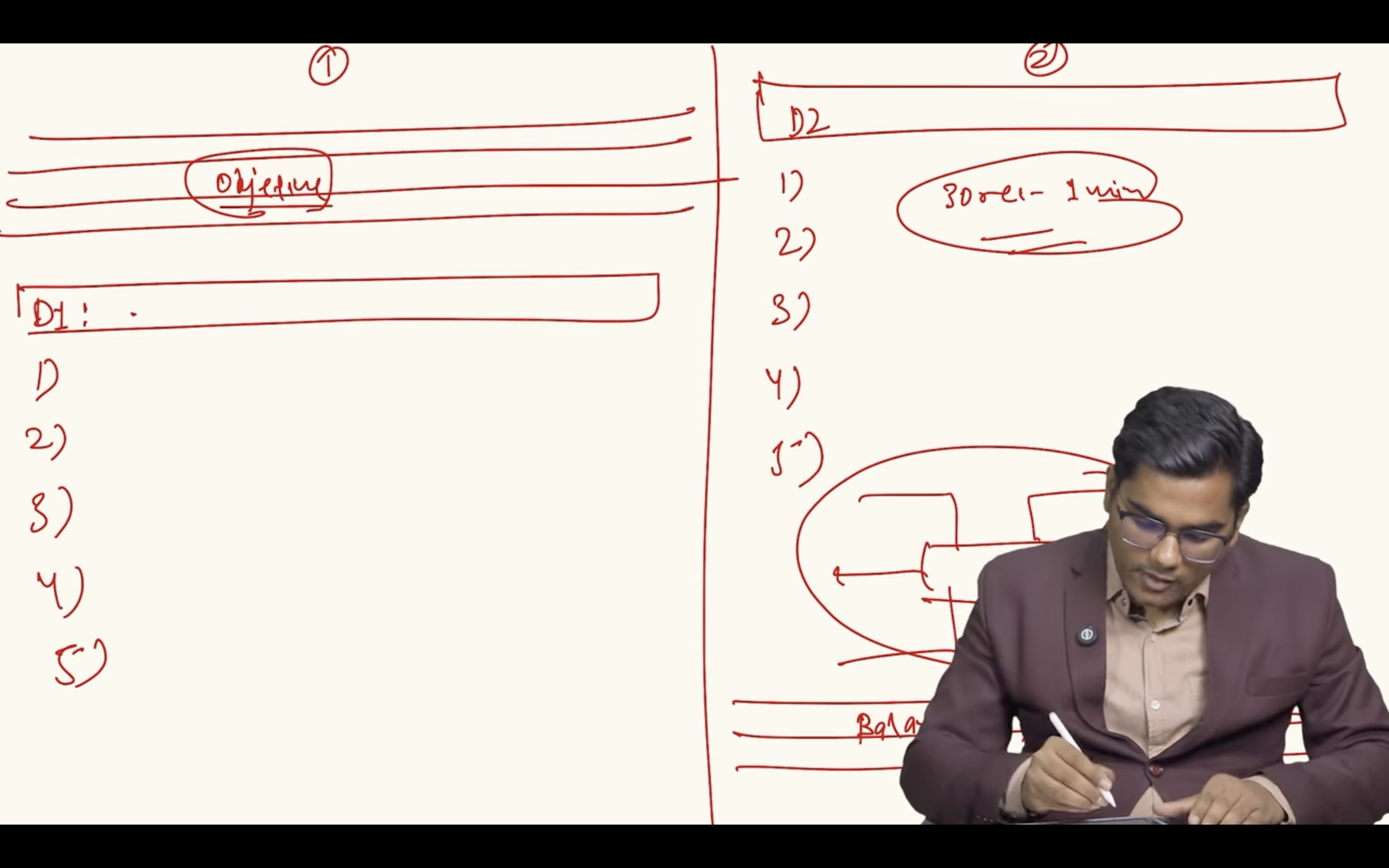
- 4. Answer planning
- Quickly generate a theme of answers before writing using a pencil, and use a checklist to mark each covered section to make sure all the aspects are covered
- Pencil allows the reusability of the same space again and again
- Use design principles to structure the answer
- Following the standard answer structure like
- Intro
- Body
- Conclusion/Way forward
- 5. Crafting an introduction
- Integrate all detected themes, keywords with multiple factual data points into a single sentence
- These data points include
- Recent context based on current affairs
- Official data points, etc based on subject
- Time-period
- Geographical location
- Key contributions
- Articles
- Supreme court judgments
- Quotes from scholars
- Etc, based on subject
- 6. Crafting body
- Hunt for Ketan Shukla frameworks
- Standard frameworks available
- PTDU approach for any scheme
- Planning stage
- Data accuracy
- Resource shortage
- Coordination with state governments
- Targeting stage
- Beneficiary identification
- Leakage and ghost beneficiaries
- Exclusion of english beneficiaries
- Delivery stage
- Technological challenges
- Last-mile connectivity
- Corruption and fraud
- Usage stage
- Beneficiary awareness
- Account opening and maintenance
- Transaction charges
- Schemes and policy issues
- Admin side
- Top down, lack of coordination, implementation gap, Monitoring and evaluation
- Beneficiary side
- Social and cultural barriers, awareness, social audit, GRM
- Outcome related
- PESTEL framework for multi-point
- Political
- Economic
- Social
- Technological
- Environmental
- My personal framework
-
- Have a generic framework of advantages, disadvantages, way-forward, etc and recall it while writing any answer and then make it specific to that answer
- Dynamically arrange for each answer for it looks organic
- This framework should have some special feature which allows highly unique data points relevant to topic
- Have generic data points on most fundamental entities from syllabus and PYQs like children, women, SC, ST, PWDs, environment, pollution, infrastructure, security, constitution, policy, etc
- First list down the terms and then proceed further
- The framework should not leave any ambiguity and it should be holistic, it should have details like below
- Polity
- Refer articles, laws, etc
- Society
- Women
- Problems
-
- Benefits
-
- OBC
- SC
- Etc
- And so on
- Drawing framework
- Drawing different types of diagrams based on different types of content like using a balance for comparison of values on both of its ends, etc
- For describing physical monuments
- Draw a basic diagram and explain the details like size, etc from that diagrams
- This can be done for current affairs also, if there is a bridge in news, just draw how it looks and explain river beneath, length and height of bridge, etc
- Use pencil for complex diagrams
- Align all the diagrams on the right side as much as possible, while content flows on the left side
- Mandatory diagram for every geography and IR answer, and try to add for most questions
- To be added in detail later
- 7. Crafting a conclusion
- a. Select type based on question
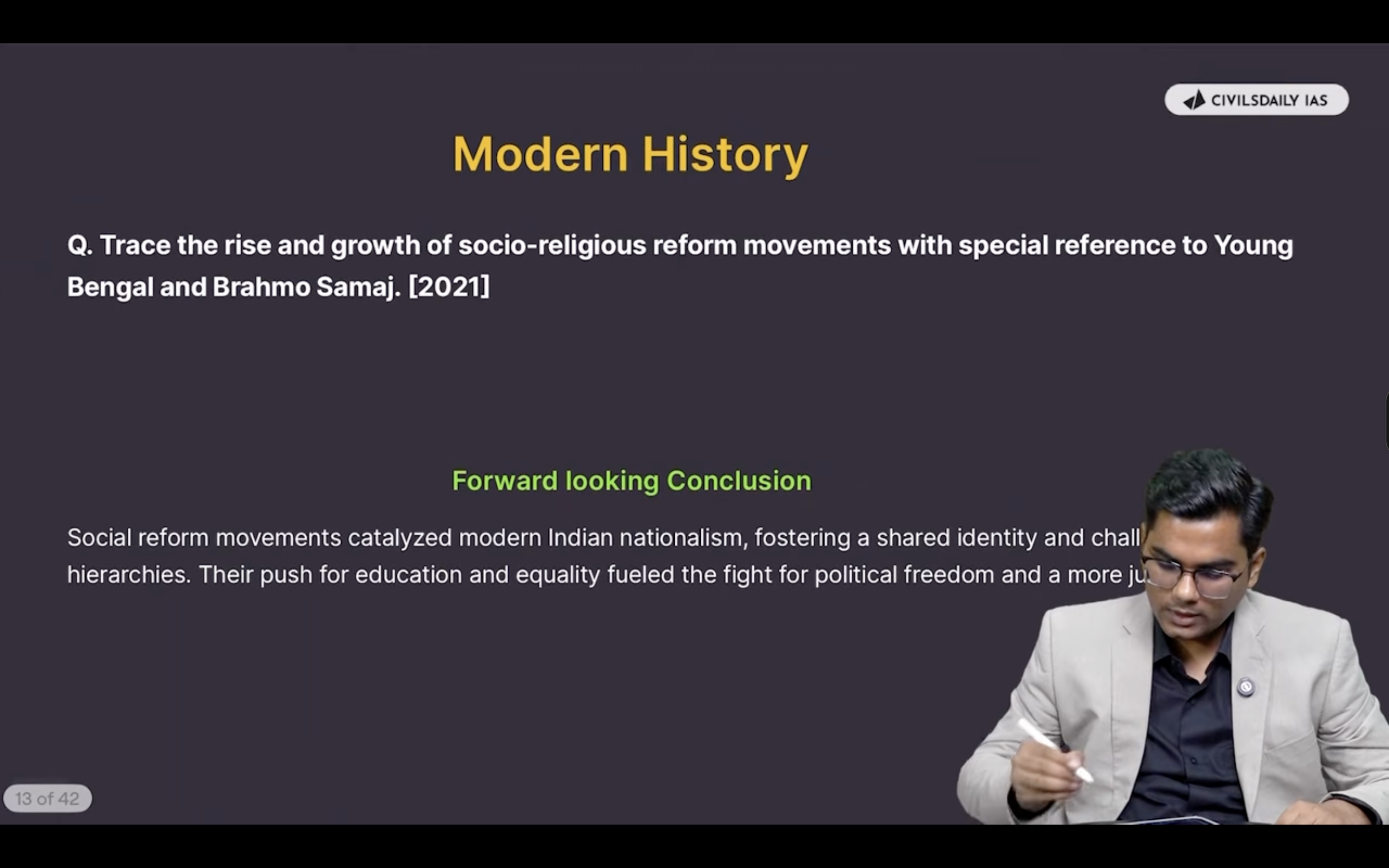
- i. Forward looking conclusion
- Mainly used in History and Art&Culture related questions
- What was the impact of the event in history itself
-
-

-

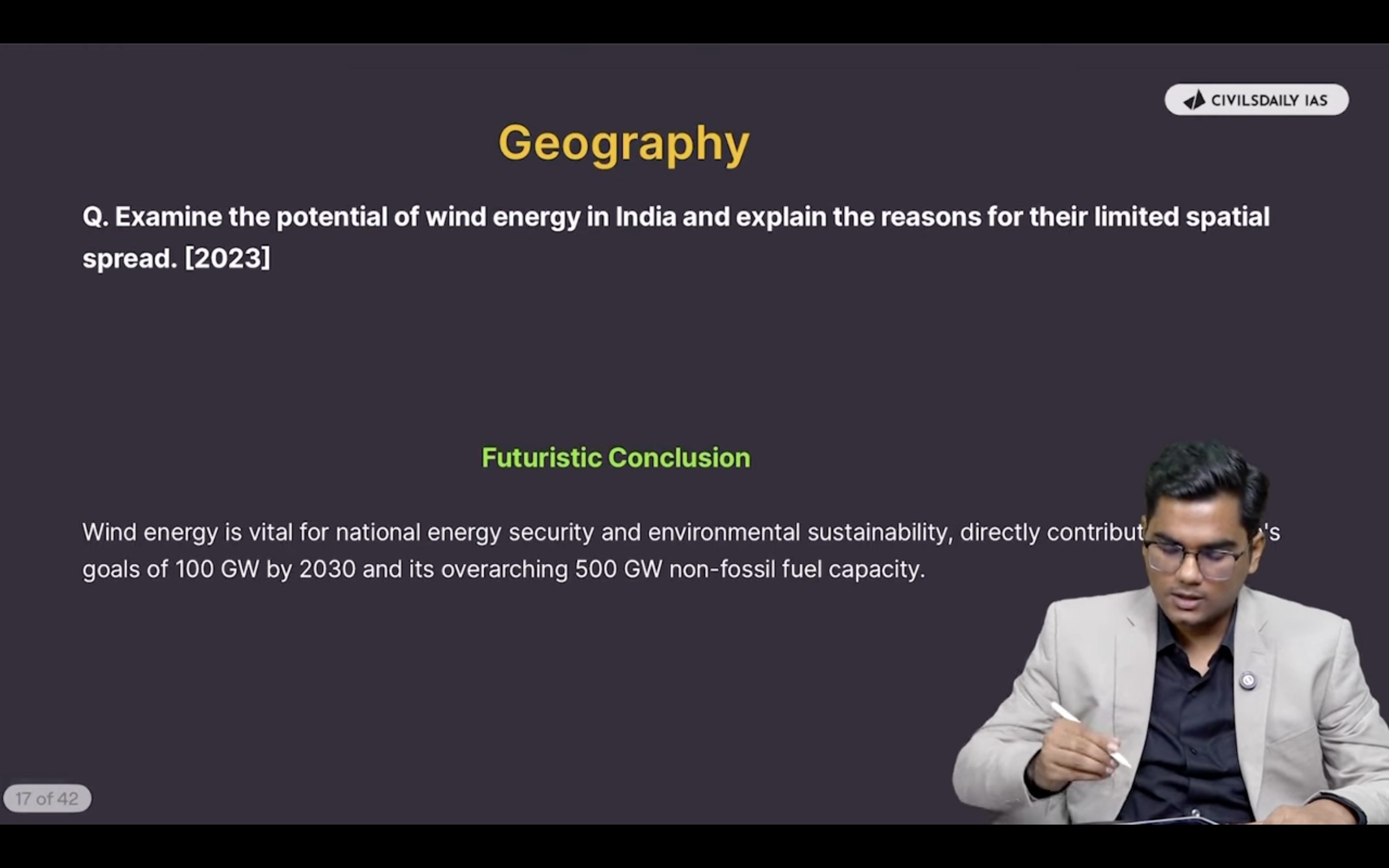
- ii. Futuristic conclusion
- Mainly used in Science&Tech, Geography, Economy, Environment, and International Relations
- If possible it should include data based on goals and targets for future
-
-

-

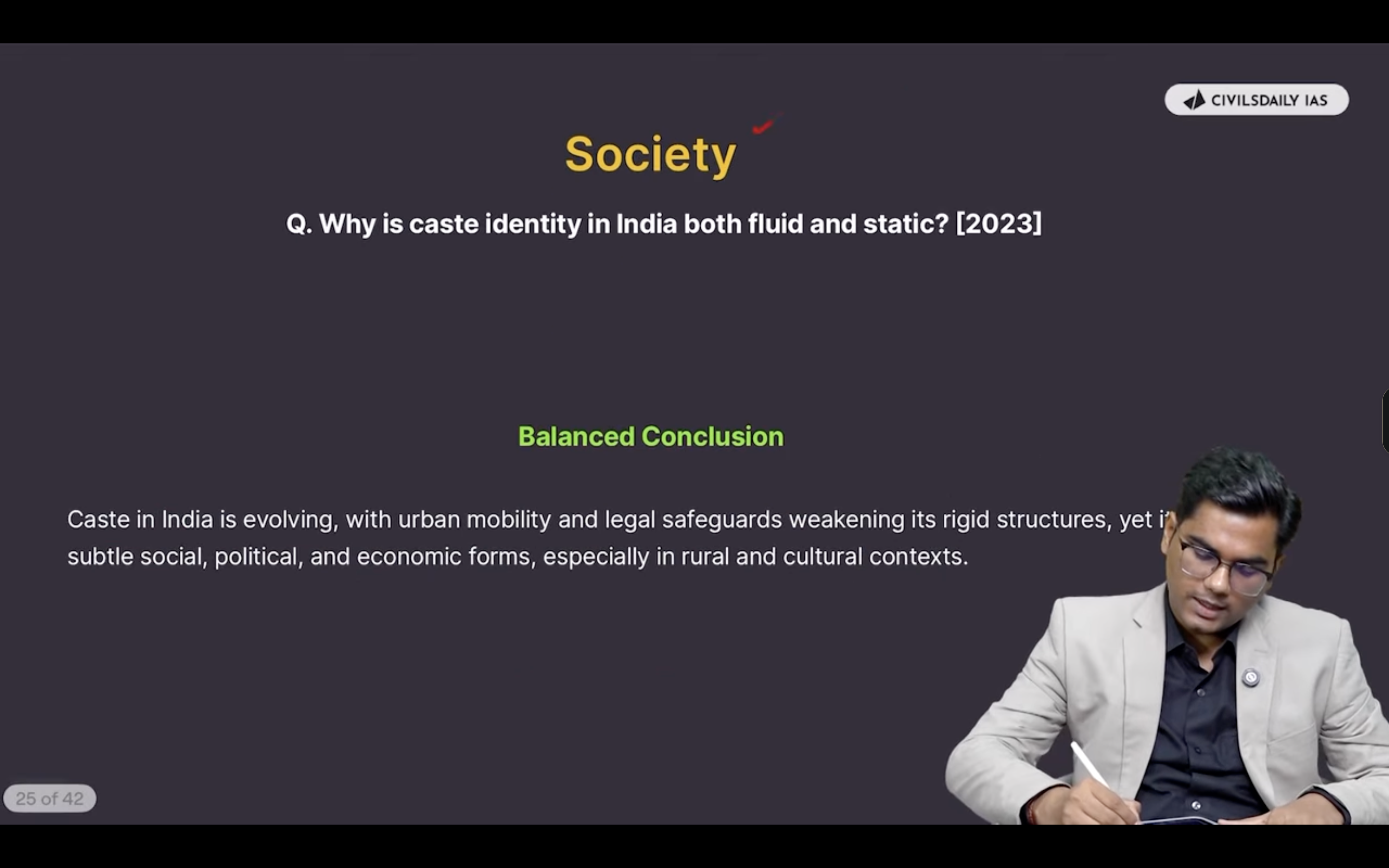
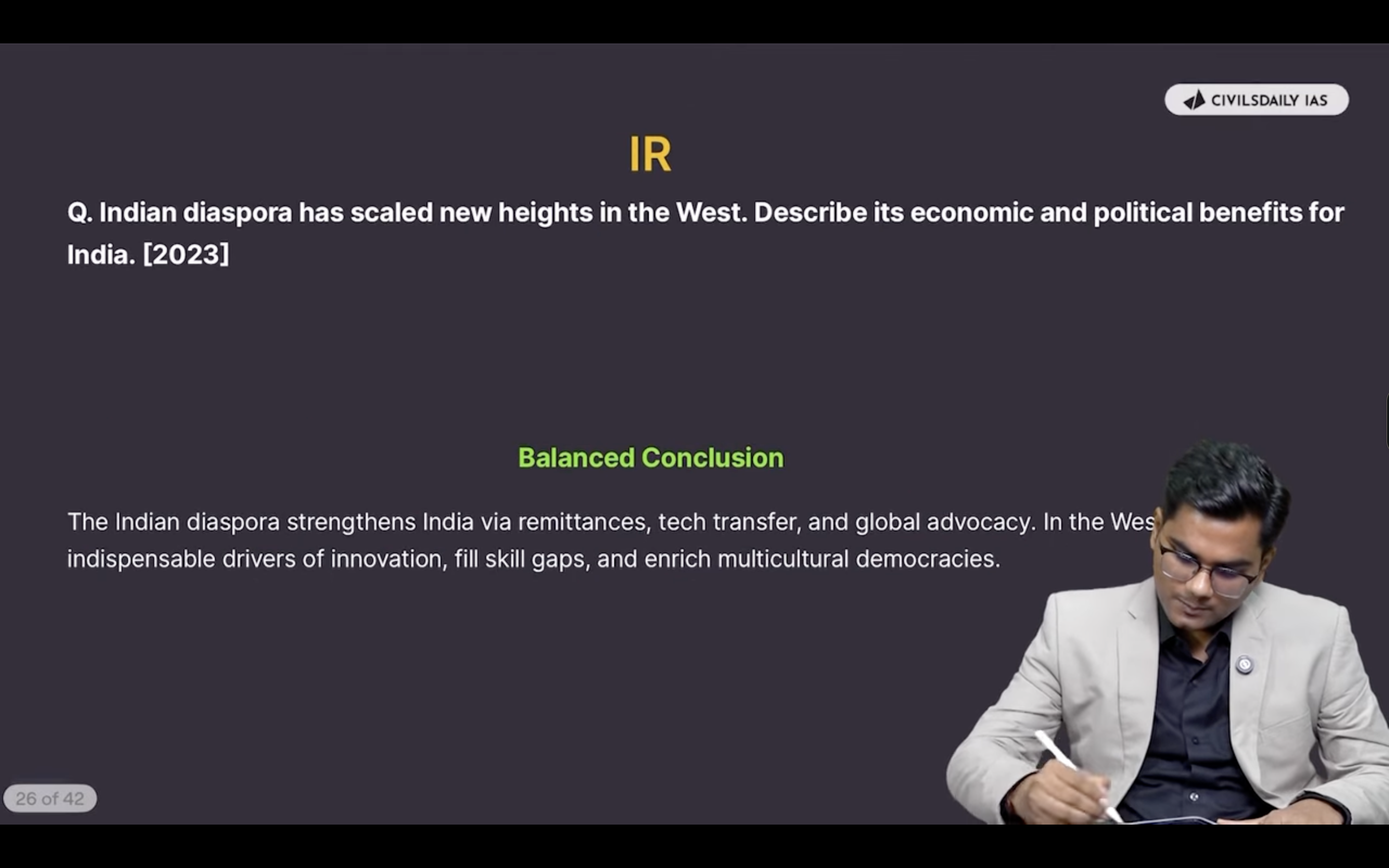
- iii. Balanced conclusion
- Mainly used in Social Justice, Applied Ethics, Polity, Governance, and International Relations
-

-

-
-
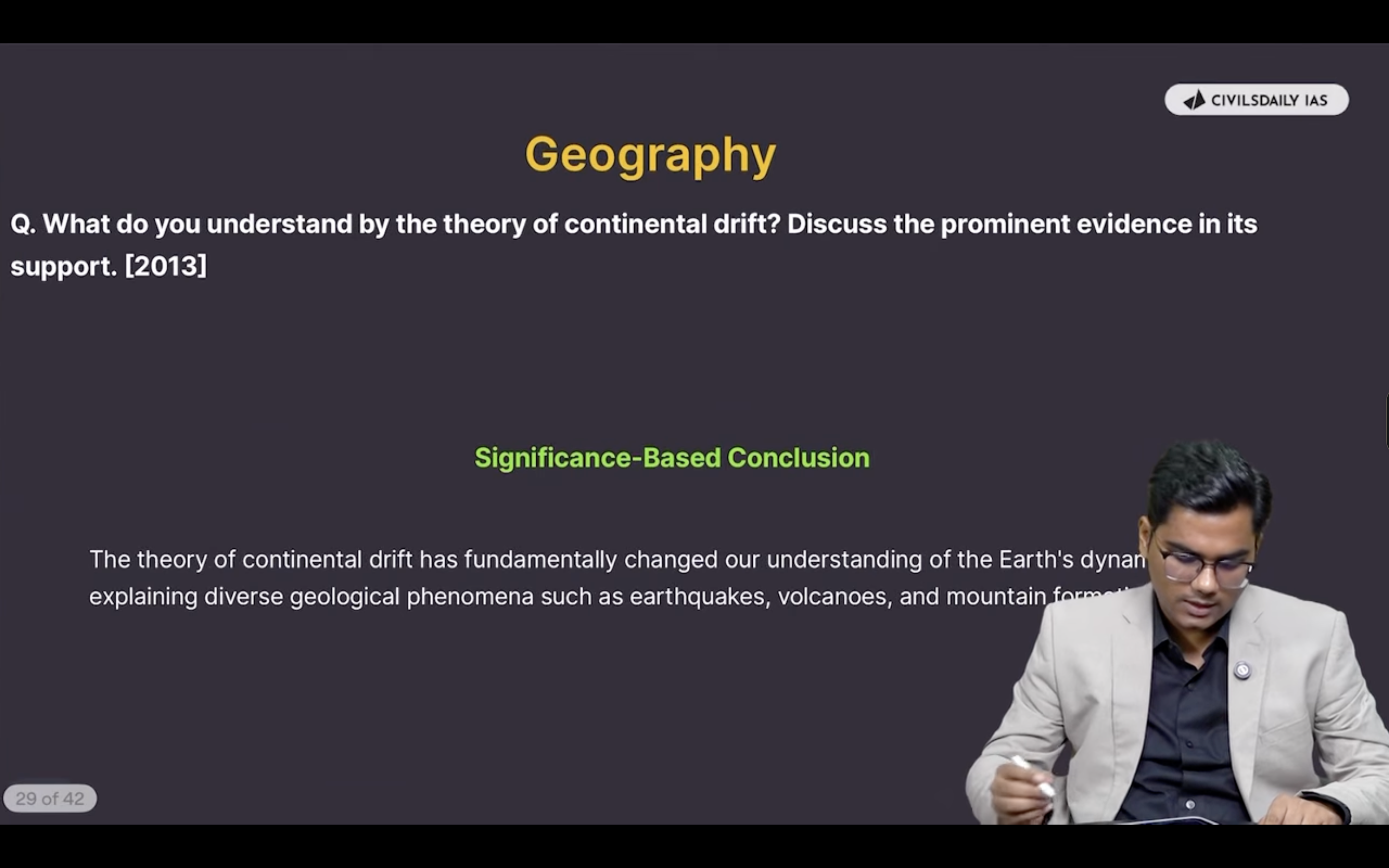
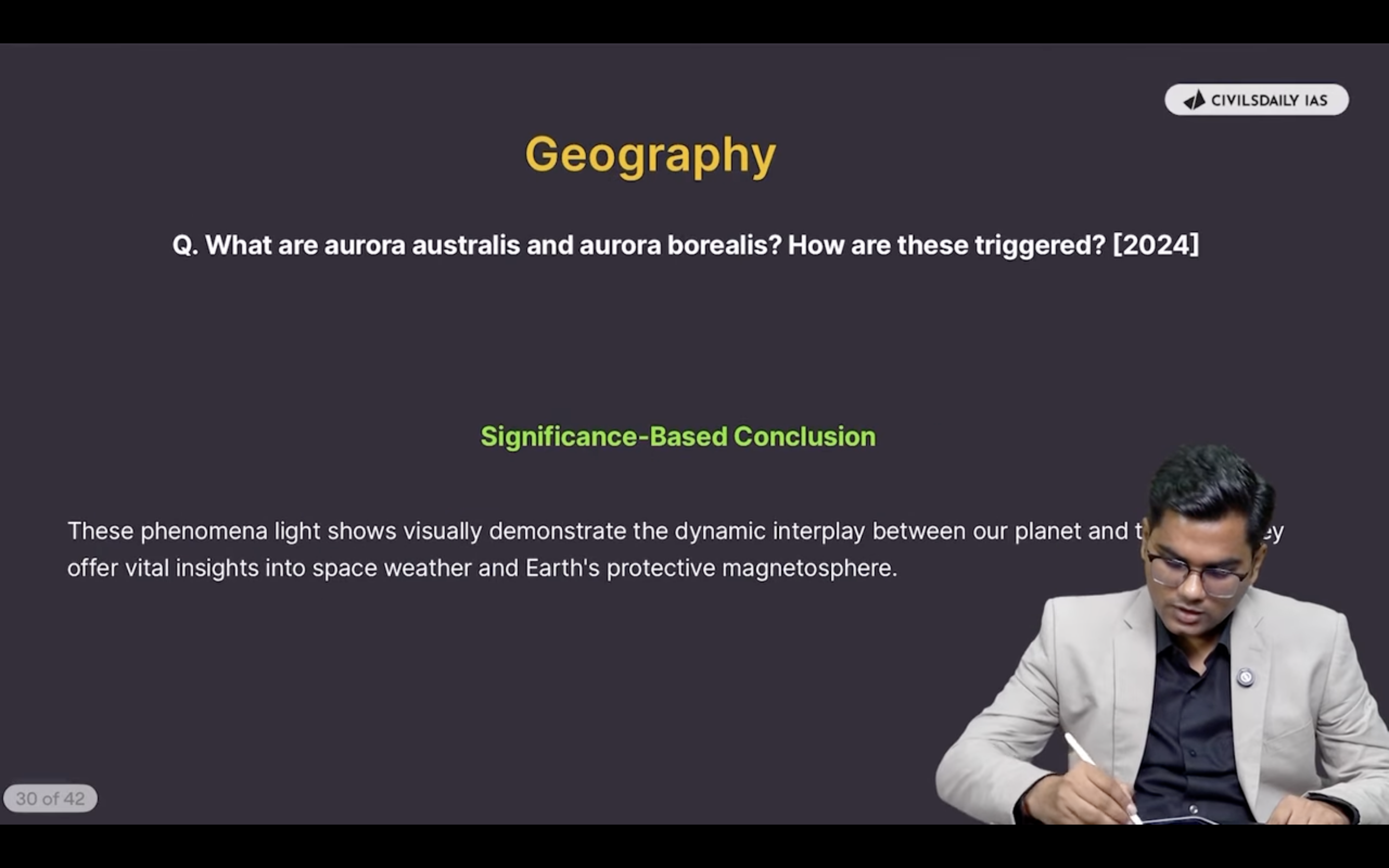
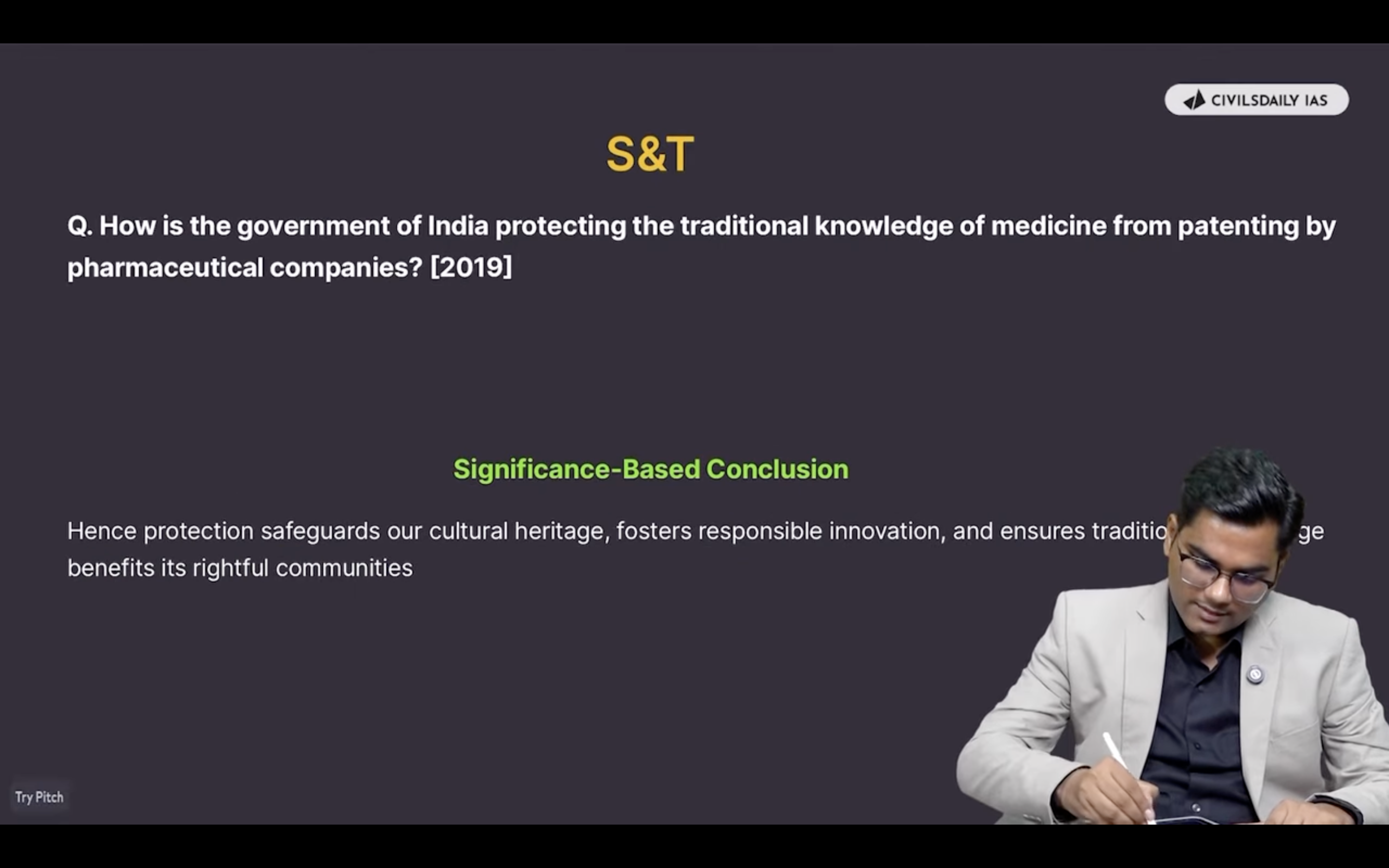
- iv. Significance based conclusion
- Mainly used in Geography and Science&Tech
-
-
-
- v. Summary + value addition based conclusion
- Mainly used in Society, Social Justice, Economy, Polity, Governance, Agriculture and Internat Security
- Includes data like keywords, committee, best practices, SDGs, constitutional debates, etc
-

-

-

-

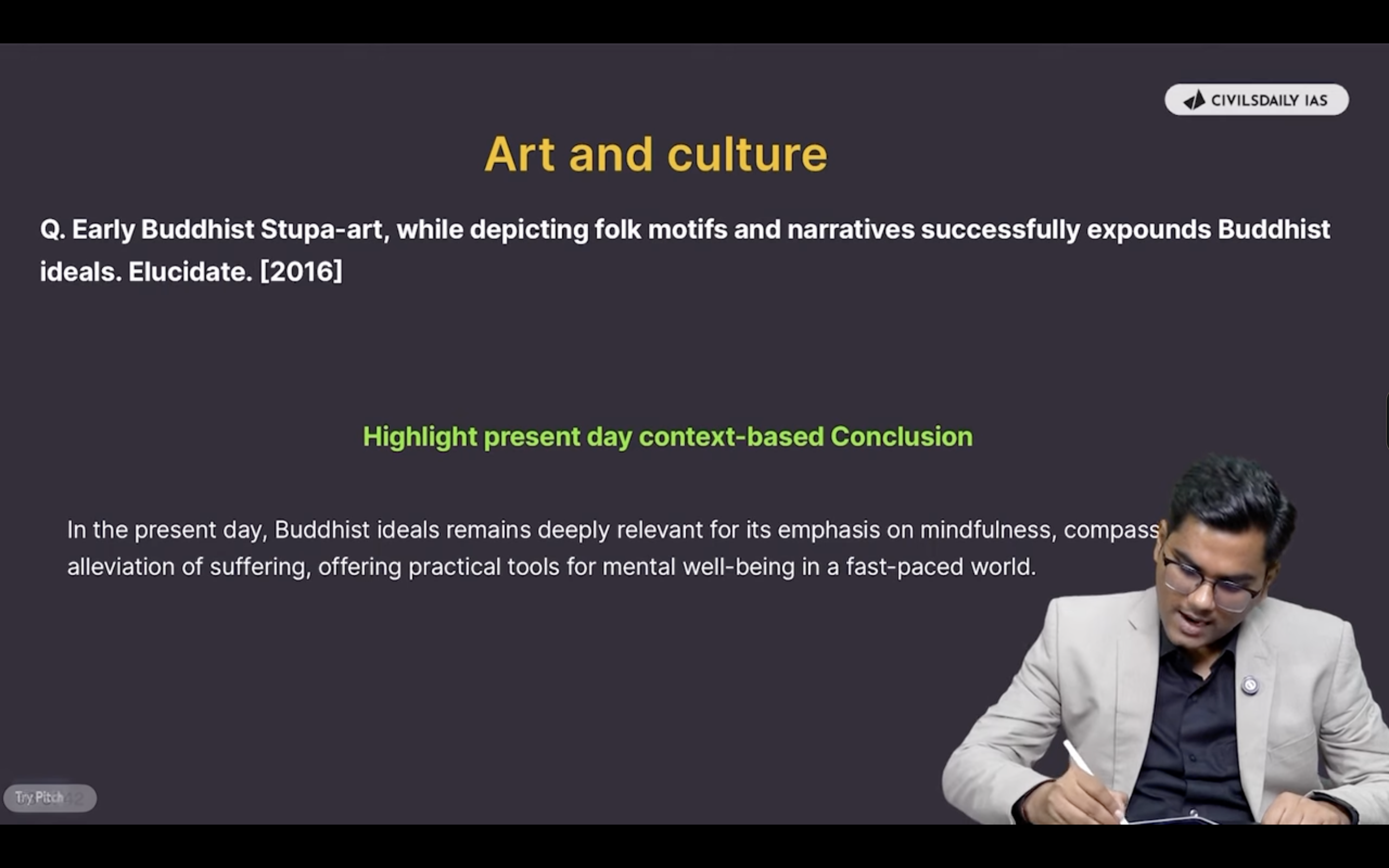
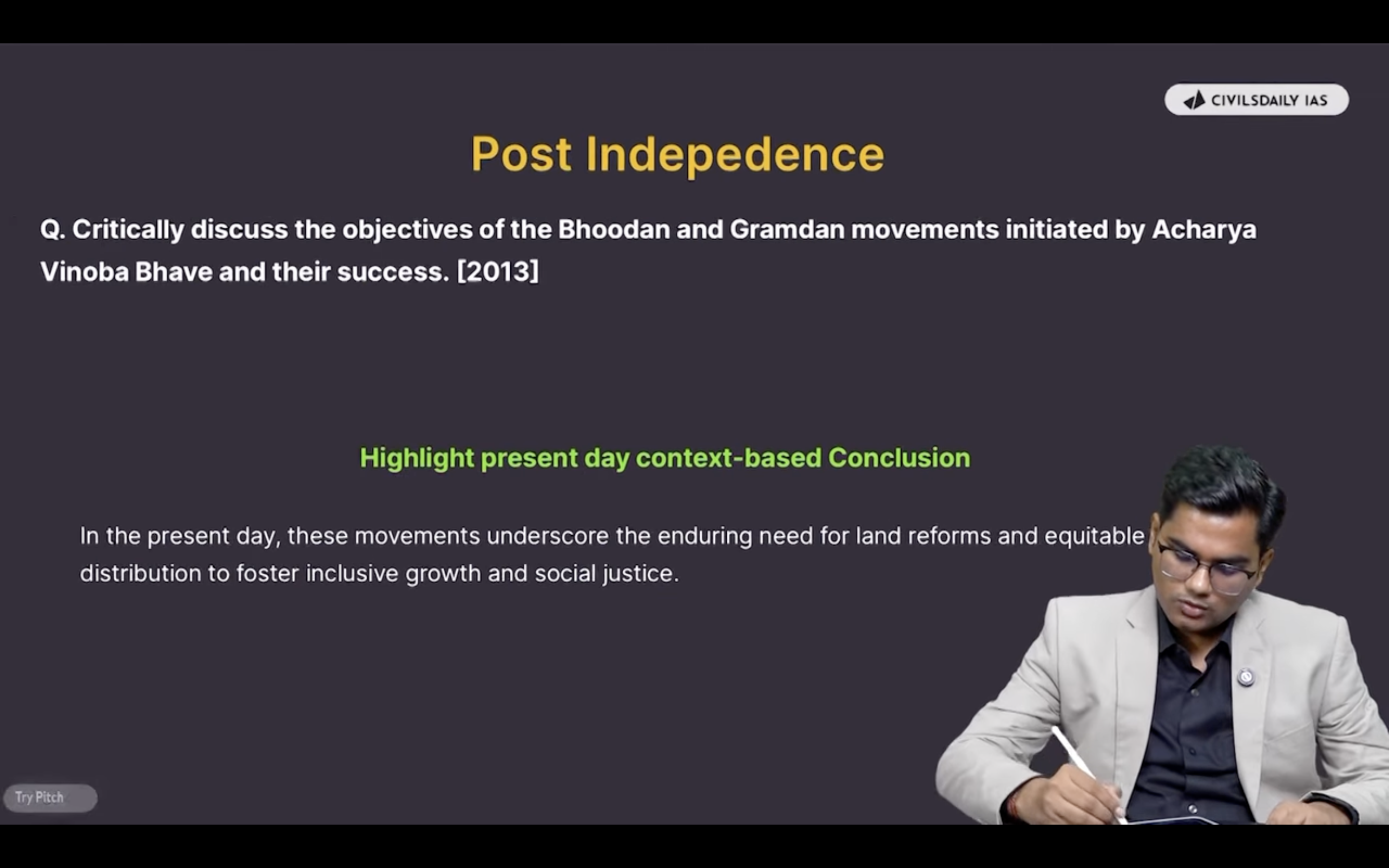
- vi. Highlight present data based conclusion
- Mainly used in History and Art&Culture
- Include present day context linking with current affairs
-
-
- b. Link with theme and maintain continuity with the body
- i. Include keywords from the main answer into the conclusion to link it harmoniously to summarize the whole answer
- It should show the examiner that demand of the question is met
- It should not introduce new questions or dimensions
- It should always be on positive note
- ii. Keep it concise
- 20 words for a 10 marker and 30 words for a 15 marker
- Overview
- Core
- List down all the different types of topics of different questions based on PYQs and syllabus
- Integrate all the keywords in these, highly highly critical
- This framework will evolve over time based on
- Topper copies
- Innovative ideas
- AI-based PYQ answers
- Syllabus
- Current affairs magazines
- Personal contemplations
- For unknown questions
- Follow first principle approach, break down to fundamental truths and then reason up from there
- Generic body dimensions
- Dimensions
- Misc topic:
- Dimensions
- Repository of data and best practices
- Earning public trust
- Spreading awareness
- Professional practice and use of modern research and innovation
- Political interference
- Historical:
- Generic
- The evolution or background of the issue
- Views and opinion of great leaders like
- Mahatma Gandhi
- Buddha
- Sri Krishna
- Prophet Mohammad
- Bhagat Singh
- Narendra Modi
- Mother Teresa
- Bhimrao Ramji Ambedkar
- Art and culture-based
- Kingdom
- Time period
- Economy specific
- Law-specific something
- Location
- Drawbacks
-
- Way forward
-
- Geographical:
- Generic
- Define
- Causes
- Effects
- Diagrams
- Drawbacks
-
- Way forward
-
- Current events
- Generic
- Recent current affairs
- Drawbacks
-
- Way forward
-
- Political:
- Generic
- Policy
- Origin
- Requirement
- Governance
- Federalism issues
- Administrative:
- Implementation challenges and bureaucracy
- Institutional:
- Role of NGOs, SHGs, or constitutional bodies
- Drawbacks
- Imbalance of power, checks and balances
- Misuse of political power
- Inter-State collaboration
- Way forward
- Fix corruption
- Force enforcement of particular law
- Spy network to uncover criminal network
- Empowering society via cooperatives
- Balancing accountability with autonomy
- Voting based on qualification of an exam, and this is to be scheduled in 2050 or something, so the country has enough time to prepare
- Elections based on Single Transferrable Voting (STV)
- Change voting for President rule from single majority to effective majority
- Overhaul of bureaucratic system to make independent contribution of public servants more public and personally rewarding, increasing competitiveness and stakes like private entities
- Similar to China's "Performance Evaluation System" but with additional precautionary measures for sustainable development goals
- Governance
- Generic
- Drawbacks
- Government interference
- Internal rivalries
- Limited reach
- Single purpose focus
- Weak audit system
- Lack of coordination
- Poor management
- Lack of use of digital infrastructure
- Way forward
- Use of technology in governance to reduce processing time, paperwork and increase efficiency
- Economic:
- Generic
- Employment
- Poverty
- Impact on GDP
- Infrastructure:
- Physical and social capital
- Financial Inclusion
- Over 30% of new bank branches in rural areas in 2024–25 (RBI Annual Report)
- Drawbacks
- Lack of resources
- Loss of price control, price manipulation
- Insurance disputes
- Trade imbalance
- Sustainability issues
- Example of subsidizing MDR to promote digital payments using UPI and Rupay cards, RBI remarks this as unsustainable.
- Poor and unreliable digital infrastructure
- High number of financial frauds in digital banking
- Money laundering issue
- Price manipulation by large holders called "whales"
- Tax evasion
- Selling policy with false claims
- To meet targets and fullfil their greeds, employees are selling policies with false claims
- I was also scammed into a ULIP policy
- Price volatility
- Frauds
- Distortion of credit allocation and artificial growth
- RBI's too much focus on Priority Sector Lending may promote artificial growth in some sectors for short term but die out in long term
- Lack of consumer protection
- Terror financing
- Lack of infrastructure
- Price manipulation by middleman
- Investment bubble
- Lack of liquidity
- High price
- High tariff
- High fees
- Need government initiatives to remove middle man like E-Kuber platform which allows direct buying of government security without intermediaries
- AI risk on monetary policy
- Central Bank cut repo, which leads to more liquidity and more employment, but what if instead of hiring humans, employers use AI, repo rate won't be much effective
- Big online companies consuming business of small Kirana shops
- India at the risk of demographic burden due to missed opportunity of demographic dividend
- Way forward
- Financial inclusion
- Like RBI's notes for visually impaired
- Establishment of Full-stack Digital Banks as Proposed by NITI Aayog 2021
- Supply chain diversification
- Increased connectivity
- Tourism
- Enhanced digital infrastructure
- More capital allocation to Payments Infrastructure Development Fund (PIDF) to provide wide coverage including remote areas
- Ease of use
- Expand National Common Mobility Card infrastructure to improve ease of use public services like transportation
- Ease of doing business
- More strategies like PRAVAAH Portal does for streamlining licensing
- Reduce fraud in digital banking
- More ATMs with Interoperable Card-less Cash Withdrawal (ICCW) facility to prevent card cloning frauds
- More use of AI like RBI's MuleHunter AI, Digital Payments Intelligence Platform in fraud reduction
- Popularizing apps like RBI's - Digital Lending Apps Public Repository which lists all legally allowed lending apps
- Strict action against fugitive economic offenders
- Under Fugitive Economic Offender Act reduce the amount from ₹100 crores to ₹10 crores for strict action and deterrence
- Ease of access to credit
- Further scaling of Direct Beneficiary Transfer (DBT) to prevent misuse of funds and leakage of subsidies
- Policy to leverage seized capital in development
- Like US Bitcoin Strategic Reserve Fund (2025)
- Heavy fines on anti–money laundering violations
- US court fined a hefty amount of over $4.3 billion on crypto platform Binance
- Accepting donation based on wide range of the currencies
- United Nations International Children's Emergency Fund is the first UN agency that accepts donations in cryptocurrency.
- Promoting digital financial system like CBDC
- Save transportation cost
- To trace a crime
- Reducing settlement time
- Targeted expenditure for public policies or conditional fungibility
- Only allowing for books, medicine, etc
- Fiscal stimulus
- Government investment in banks for stability and public trust
- Establishment of Banking Investment Company as recommended by P.J. Nayak Committee (2014)
- Conducting deeper audits to prevent possible financial distress
- Mandates to protect depositor interests
- Increased threshold for First Loss Default Guarantee (FLDG) from currently covers 5–10% of defaulted loan value
- Precautionary measure
- Like Capital Conservation Buffer (CCB) for scheduled commercial banks
- Greed of capitalism
- Capitalism does not care for AI safety concerns and risks to human existence
- Increasing privatization to increase efficiency
- Increasing retirement age to extend the window of demographic winter
- Implementing schemes like Britain's Pay-As-You-Go (PAYGO) in India on a limited scale
- 2nd Administrative Reforms Commission recommended making the FC a permanent body to avoid complexity of re-constitution every 5 years
- Green cities with mandatory trees on every building, public, private spaces
- Use of advanced robotics to leverage old working population as silver dividend, instead of becoming a liability, they become an asset
- Social:
- Generic
- Cultural
- Vulnerable groups
- Literacy
- Safety
- Social inclusion
- Marginal groups
- Women, youth
- Hierarchy
- Drawbacks
- Inequality
- Loss of personal freedom
- Synergy issue
- Population size
- Fast food culture
- Chain smoking
- Population decline
- Division of society
- Endogamy
- Heredity
- Outdated data
- Rise of religious intolerance
- Groups like Jogi's leaving their traditional work of wandering and promoting syncretism due to development and religious intolerance
- Way forward
- Social inclusion
- Demographic change
- Multi cultural exchange
- Appreciation via awards in public
- Public awareness
- Economy based reservation instead of caste
- Strengthening Social Cohesion via cooperatives
- Reducing wealth inequality
- Promote scientific temper
- Article 51A
- Should make mandatory in school education to help children attain emotional maturity
- Grant powers to NCSC, NSST, NCW, NCPCR for punishment upto a limit to increase their seriousness
- Ethical:
- Generic
- Stakeholders involved
- Options involved
- Moral implications and equity
- Drawbacks
- Poor implemenation of wellfare schemes
- Limited voice in decision making
- Socio-economic marginalization
- Way forward
- Necrophilia
- Stereotyping
- Restrictions on factory farming
- Innovations like artificial meat to reduce animal suffering
- An honesty system in many European countries, where there is no seller, but the customer shows honesty and puts the money in the box alongside
- Educational:
- Generic
- Awareness and societal values
- Drawbacks
- Quality of education
- Teacher shortage
- Forged documents
- Way forward
- Using AI
- Innovation driven education
- Compulsory enforcement of programmes like Atal-tinkering labs in every institute
- A single final exam project for each class dividing the class into multiple teams and assigning each team a niche domain of the project, like developing an AI driven car, one team will handle electronics, one team will handle AI, one will handle 3D printing, etc
- Environmental:
- Generic
- Sustainability
- Sustainable development goals
- Climate change
- Drawbacks
- High energy/electricity consumption
- Way forward
- Ombudsman for resolving conflicts
- Using digital media instead of single use resources like paper
- Heavy fines for not aligning to regulations
- Promoting green deposits
- Legislation to restrict the economic activities that damage wildlife
- Like EU Deforestation Regulation (EUDR),
- It is a market restriction designed to stop products linked to deforestation from entering the EU.
- Companies cannot sell certain products in the EU unless they prove the products did not come from deforested land after 31 December 2020.
- If companies violate the regulation, EU countries can impose:
- Heavy fines (up to 4% of EU turnover)
- Confiscation of products
- Exclusion from EU public procurement.
- Agriculture
- Drawbacks
- MSP issues like not guaranteed, price calculation, etc
- Irrigation issues
- Power issues
- Fertilizers issue
- Government policies inefficiencies issue
- Insufficient cold storage infrastructure
- Food wastage
- Transportation challenges like dependence on fuel prices
- Lack of time
- Way forwards
- Drip irrigation
- Solar energy
- Proper implementation of government policies (data to support inefficiency)
- Organic farming
- Fertilization methods like zero tillage, fertigation, etc
- Avoiding the middleman
- Robust storage laws
- Disaster management
- Generic
- Define
- Recent examples
- NDMA guidelines on that disaster
- Drawbacks
- Way forward
- Tsunami and floods
- Round plastic pods to shield a person in tsunami from physical harm from environment and floating on top for rescue
- Technological
- Generic
- Fundamental factors example
- Earth's gravity, magnetic field, rotation, etc
- Biological activity
- AI
- AI use in education
- AI use in health
- Smart prosthetics
- AI use in defence
- AI use in governance
- AI use in the judiciary
- E-governance
- Innovation
- Electric vehicles
- Single window system
- Promotion of entrepreneurship
- Grievance redraisel mechanism
- Drawbacks
- AI unpredictability and issues job loss, warfare, etc
- Increasing sophistication
- Privacy concerns
- Piracy and ownership violations
- Data quality
- Misleading promotion
- Quality issues
- Time constraints
- Misinformation
- Cybersecurity concerns, weak enforcement of laws and inaction of authorities
- I was scammed by a scammer impersonating himself as my sister's brother
- Police said they can do nothing, they were also scammed in their past
- AI infrastructure insurmountable energy and water consumption
- Algorithmic Bias
- May discriminate a certain group due to flawed training data
- Lack of standardization
- Using a fleet of fully autonomous drones for surveillance of railway tracks
- Big satellite constellations risking orbital debris blocking future launches
- Spacex rocket failure creating massive debris fall creating hazard for airplanes
- CCTV, mobiles hacked by enemy state, threat to national security, example being USA-Iran war
- India lacks capacity to build core technologies like capacitors, resistors, batteries, etc
- Way forward
- Brainstorming
- Ease of use
- Using blockchain based digital smart contracts to save processing time, energy consumption paperwork and increase efficiency
- Promoting digital infrastructure to improve traceability for crimes
- Balance between innovation and traditional methods
- Promoting digitization yet maintaining traditional systems as backup like physical cash in case of emergency situations
- Ice stupas built by Sonam Wangchuk in Ladakh as a sustainable means to solve water needs
- Use of NFT's in documents like property, etc
- For credible ownership verification
- For temper proof records
- Taking projects like "Vishwas NFT Marketplace" beyond test project
- Movable wind and solar farms based to get maximum efficiency
- Bionics for the disabled
- Artificial biomes for exoplanets
- DNA cold storage
- Open development of technology like Starship to inspire youth
- AI terraform other planets for resource extraction instead of replacing human jobs on planet Earth
- International law that mandates this principle
- Promoting core electronic technologies inland for maintaining sovereignty
- Judicial/Legal:
- Generic
- Relevant laws
- Relevant Supreme Court judgments
- Justice:
- Social, economic, and political justice (as per the Preamble)
- Drawbacks
- Dispute settlement issue
- Pending cases
- Way forward
- Clearance of pending cases
- Faster resolution of new cases
- Allowing the use of AI in legal cases to help the poor and marginal in social inclusion, and removing discrimination
- Health
- Generic
- Drawback
- Way forward
- Full scale implementation of projects like "Pilot project for road accident victims"
- Finance Commission recommendations:
- Proposed All India Medical and Health Service under All-India Services Act, 1951, for doctor recruitment via UPSC.
- Union and States to spend 2.5% of GDP on healthcare by 2025.
- Security/Strategic
- Generic
-
- Drawback
- Dependency constraints
- Timing match issue, why happened at this point only
- Terror financing
- Concerns over loss of sovereignty in policy-making for FDI in defense
- Way forward
- Maintaining strategic autonomy
- Mutual-trust
- Global digital ID system
- Like World Coin Project (2021) using blockchain
- Encouraging competition in defense for innovation, quality and cost reduction
- Using a fleet of fully autonomous drones for surveillance instead of current manual approach
- International:
- Generic
- Global best practices (e.g., UN Sustainable Development Goals)
- Treaties
- Drawbacks
-
- Way forward
- Endorsing global infrastructure
- Like globalizing Structured Financial Messaging System to compete againt SWIFT system and strengthen India's economic diplomacy.
- Standard international convention like Hague Service Convention for armed forces for better cooperation
- Keep a few striking beginnings and endings already prepared to use directly in writing
- Example:
- Starting
- A tale once told ....
- Ending
- Thus, when the story comes to an end ...
- Use punchlines here
- Pre-defined unique "Intros" and "Way-forwards"
- To stand out from the competition in a positive way and also to take the time from outside the exam into the exam
- Make a list of all important themes based on the main PYQs and the official syllabus
- Create "Intros" and "way-forwards" for important themes like naxal, terrorism, cyber security, AI, social justice, etc, based on PYQ themes
- These intros and way-forwards are not just general data; they use data, reports, and facts to make an answer of superior quality at first glance and gain an advantage.
- Multiple themes can be grouped with the same sample of "intros" and "way-forwards"