- The Importance of Ancient Indian History
- Understanding the Foundations of Civilization
- Early humans in India transitioned from hunting-gathering to agriculture (Mehrgarh, 7000 BCE), leading to settled life.
- The Indus Valley Civilization (Harappa, Mohenjo-Daro) displayed advanced urban planning, drainage, and trade systems.
- Agriculture, metalworking, and textile industries formed the economic base of early societies.
- Political Unification and State Formation
- Ancient rulers sought to unify India under one rule, reinforcing political and cultural integration.
- Notable examples:
- 3rd Century BCE - Ashoka ruled almost the entire subcontinent, spreading Buddhism and administrative uniformity.
- 4th Century CE - Samudragupta expanded rule from North to South India, linking diverse regions.
- 7th Century CE - Harshavardhana controlled North India before being challenged by Pulakesin II.
- Despite political fragmentation, administrative systems like tax collection and local governance remained similar.
- Cultural and Linguistic Integration
- Sanskrit and Prakrit shaped early Indian literature, while Tamil flourished in South India.
- Brahmi script, first used in Ashoka's inscriptions, evolved into modern Indian scripts.
- The Ramayana and Mahabharata created a shared cultural identity across the subcontinent.
- Pilgrimage sites (Varanasi, Rameshwaram, Puri) reinforced religious and cultural unity.
- Religious and Philosophical Evolution
- Hinduism, Buddhism, and Jainism originated in India, shaping spiritual traditions worldwide.
- The concept of Dharma (moral duty) was central to Indian thought and governance.
- The Bhakti and Sufi movements later promoted religious harmony and social reform.
- Cultural Synthesis and Foreign Influences
- India absorbed influences from Greeks, Scythians, Hunas, and Turks, enriching its traditions.
- Indo-Greek rulers like Menander adopted Buddhism, contributing to cross-cultural exchange.
- The Gandhara and Mathura schools of art reflect Greco-Buddhist artistic fusion.
- Science, Technology, and Knowledge Systems
- Aryabhata (5th century CE) proposed Earth's rotation and accurately calculated pi.
- The concept of zero in mathematics and the decimal system, developed in India, revolutionized mathematics.
- Sushruta Samhita documented advanced surgical techniques, including plastic surgery.
- The Iron Pillar of Delhi (4th century CE) showcases India's advanced metallurgy.
- Ancient astronomy texts, such as the Surya Siddhanta, described planetary movements.
- Trade, Commerce, and Economic Prosperity
- India was called the "Golden Bird" due to its economic wealth and trade dominance.
- Trade routes:
- Land routes:
- Silk Road, Uttarapatha, Dakshinapatha.
- Maritime routes:
- Indian Ocean trade with Southeast Asia, Africa, and Rome.
- Lothal (Indus Valley Civilization) had the world's earliest known dockyard.
- The Gupta Empire (4th-6th century CE) marked a golden age of trade, banking, and urbanization.
- Indian textiles, spices, and gemstones were exported worldwide, while gold, silver, and luxury goods were imported.
- The Idea of Bharatavarsha and National Identity
- Ancient Indians perceived the subcontinent as a single entity, calling it Bharatavarsha.
- The name originates from the Bharata tribe, mentioned in the Rigveda and the Mahabharata.
- The Bharatas are often linked to the consolidation of Vedic tribes after the Battle of the Ten Kings (Dasarajna Yuddha), a famous conflict described in the Rigveda.
- After defeating rival tribes (like Purus, Druhyus, etc.), they emerged as a leading power in the region.
- The Bharatas eventually merged with the Puru tribe to form the Kuru tribe, which became the dominant political and cultural power in the later Vedic age.
- In later tradition, the name Bharata is linked to King Bharata, a legendary emperor of ancient India, from whom the name Bharat for India is said to come.
- Foreigners identified India based on the Sindhu (Indus) River, leading to names like:
- 'Hind' (from Sanskrit Sindhu) in Persian and Arabic.
- 'India' in Greek.
- Despite linguistic and regional diversity, the idea of a united India persisted in literature and philosophy.
- The Construction of Ancient Indian History
-
| Archaeologists |
Historians |
| Study past human life through material remains like artifacts, monuments, and fossils. |
Study past human events through written records, manuscripts, and literary sources. |
| Use excavation techniques to uncover and analyze physical evidence. |
Interpret historical texts, inscriptions, and documents to understand the past. |
| Help reconstruct ancient cultures by analyzing tools, pottery, and ruins. |
Focus on political, social, and economic aspects of history through textual analysis. |
| Examples: Mortimer Wheeler, R.E.M. Wheeler. |
Examples: Herodotus, Edward Gibbon. |
- Material Remains
- Overview of Material Remains
- Ancient Indians left behind various material remains, including:
- Stone temples in South India
- Brick monasteries in Eastern India.
- These remains are crucial for understanding architecture, economy, and technology.
- Many of these structures are buried under mounds, with only a few excavated to reconstruct ancient life.
- Archaeological Excavations and Challenges
- Types of Excavations:
- Vertical Excavations:
- Focus on chronological sequence, layer by layer. Helps determine cultural evolution over time.
- Example:
- Harappan sites like Mohenjo-daro and Kalibangan.
- Horizontal Excavations:
- Uncover entire settlements, providing a clearer view of social and economic life.
- Example:
- Lothal, where dockyard structures were unearthed.
- Challenges in Excavation:
- High Costs:
- Large-scale horizontal excavations are expensive.
- Limited Funding:
- Many sites remain unexplored due to budget constraints.
- Environmental Erosion:
- Natural forces often degrade exposed remains.
- Political and Legal Issues:
- Some sites lie in disputed or inaccessible areas.
- Preservation of Ancient Remains
- Better Preservation in Dry Climates:
- Arid regions like Rajasthan and western Uttar Pradesh preserve artifacts well.
- Dry air prevents organic material decay.
- Deterioration in Humid Climates:
- Middle Gangetic basin and deltaic regions cause corrosion of iron tools.
- Mud structures disintegrate, but burnt bricks and stone structures survive.
- Discoveries from Excavations
- Excavations reveal urban centers from 2500 BCE in north-western India (Harappan sites).
- Findings from Gangetic basin (post-Vedic period):
- Settlement patterns (e.g., fortified cities of Mahajanapadas).
- Pottery types (e.g., Northern Black Polished Ware indicating economic prosperity).
- House structures (e.g., mud-brick houses in early phases, later stone architecture).
- Agricultural practices (cereal grains like wheat and barley found at sites).
- Tools and Implements (evidence of iron plowshares indicating agricultural expansion).
- Role of Archaeology in Understanding Material Life
- Archaeologists follows scientific approach and systematically excavate layers, reconstructing material culture.
- Helps analyze urbanization, technology, and trade networks of different periods.
- Scientific Analysis of Material Remains
- Dating Techniques:
- Radio-Carbon Dating (C-14):
- Determines age of organic remains (used in Harappan studies).
- Thermoluminescence Dating:
- Used for pottery and ceramics.
- Dendrochronology:
- Tree-ring dating (limited use in India).
- Climate and Agriculture:
- Pollen Analysis (Palynology):
- Reveals ancient climate and vegetation.
- Studies indicate agriculture in Rajasthan and Kashmir as early as 6000 BCE.
- Metallurgical Analysis:
- Determines metal sources and stages of metallurgy evolution.
- Example:
- Copper from Khetri mines (Rajasthan) used in Harappan tools.
- Animal Studies:
- Faunal remains (bones, teeth) show domesticated species like cattle, sheep, and horses.
- Example:
- Horse remains at Surkotada (Gujarat) suggest early domestication.
- Some material remains discussed in detail:
- Megalithic Burials in South India
- Megaliths:
- Large stones arranged in burial sites, found in Deccan and South India.
- Objects buried with the dead:
- Weapons, tools, pottery, ornaments - indicate belief in afterlife.
- Iron tools - suggest increasing metallurgical knowledge.
- Example:
- Adichanallur in Tamil Nadu - yielded skeletons, iron implements, and pottery.
- Coins
- Discovery and Study of Coins
- Many ancient coins and inscriptions have been found on the surface, while many others have been unearthed through excavations.
- The study of coins is called numismatics.
- Unlike modern currency, ancient Indian money was not paper-based (as paper currency emerged in India only in the 14th century).
- Coins were made of metals such as:
- Copper
- Silver
- Gold
- Lead
- Coin molds made of burnt clay have been discovered in large numbers, mostly from the Kushan period (first three Christian centuries).
- The use of coin molds declined significantly in the post-Gupta period.
- Storage and Hoarding (The act of collecting and keeping things, often secretly or in excessive amounts) of Coins
- In the absence of a modern banking system, people stored money in earthenware and brass vessels as precious hoards for emergencies.
- Many such hoards (A large collection of valuable things, often hidden or stored for future use) have been discovered, containing both Indian and foreign coins (including Roman coins).
- These coins are preserved in museums across India, including:
- Calcutta
- Patna
- Lucknow
- Delhi
- Jaipur
- Bombay
- Madras
- Indian coins are also found in Nepal, Bangladesh, Pakistan, and Afghanistan.
- During British rule, many Indian coins were taken to Britain and added to private and public collections.
- Coins of major dynasties have been catalogued (To systematically list or record items) and published, such as:
- Indian Museum, Calcutta
- British Museum, London
- However, many coins remain uncatalogued and unpublished.
- Evolution of Coins and Their Significance
- Early coins had only a few symbols, while later coins bore:
- Names of kings
- Names of gods
- Dates
- The regions where coins are found indicate their area of circulation, helping in reconstructing the history of several dynasties.
- Indo-Greek rule (2nd-1st century B.C.) has been reconstructed largely through coin evidence.
- Coins and Economic History
- Some coins were issued by guilds of merchants and goldsmiths with the ruler's permission, showing the importance of crafts and commerce.
- Coins facilitated large-scale transactions, aiding trade and commerce.
- The largest number of coins is found from post-Maurya times, made of:
- Lead
- Potin (A type of ancient alloy)
- Mainly made of Copper + Tin + Lead + sometimes zinc or arsenic in small amounts
- Copper
- Bronze
- Silver
- Gold
- The Guptas issued the most gold coins, indicating flourishing trade and economy.
- A decline in coinage in the post-Gupta period suggests a decline in trade and commerce.
- Religious and Cultural Significance of Coins
- Many coins depict religious symbols and legends, providing insights into:
- Religious beliefs
- Art and culture of the time
- Inscriptions
- Inscriptions are writings engraved, carved, or etched on hard surfaces like stone, metal, wood, etc
- Importance and Study of Inscriptions
- Inscriptions are more significant (important, meaningful, or having a noticeable effect) than coins for historical study.
- The study of inscriptions is called epigraphy, and the study of old writing is known as paleography.
- Inscriptions were engraved on various materials, including:
- Seals
- Stone pillars
- Rocks
- Copper plates
- Temple walls
- Bricks and images
- Early inscriptions were mainly on stone, but by the early Christian era, copper plates were also used.
- Despite this, stone inscriptions continued on a large scale in South India, especially on temple walls.
- Preservation and Language of Inscriptions
- Like coins, inscriptions are preserved in various museums across India.
- The largest collection is maintained in the office of the Chief Epigraphist at Mysore.
- The earliest inscriptions (3rd century B.C.) were written in Prakrit.
- Sanskrit became an epigraphic language in the 2nd century A.D. and gained popularity in the 4th-5th centuries.
- Regional languages began to appear in inscriptions from the 9th-10th centuries.
- Corpus Inscriptionum Indicarum (scholarly collection of ancient Indian inscriptions) is a major collection of inscriptions from the Maurya, post-Maurya, and Gupta periods.
- Many inscriptions from post-Gupta times remain unpublished.
- South India has topographical (physical features of a region like mountains, rivers, plains, etc) lists of inscriptions, but over 50,000 inscriptions (mostly from South India) are yet to be published.
- Scripts Used in Inscriptions
- Harrappan inscriptions
- Harappan inscriptions (c. 2500 B.C.) were written in a pictographic script, which remains undeciphered.
- Ashokan inscriptions
- Ashokan inscriptions (3rd century B.C.) were engraved in the Prakrit language using Brahmi script (written left to right) and Kharosthi script (written right to left).
- In Afghanistan, Greek and Aramaic scripts were used in Ashokan inscriptions.
- Dominance of Brahmi
- Brahmi remained dominant until the end of the Gupta period.
- After the 8th century, regional variations in Brahmi developed, leading to different script names.
- Decipherment of Inscriptions
- The oldest deciphered (converted into a readable or understandable form) inscriptions were issued by Ashoka in the 3rd century B.C.
- An Ashokan pillar inscription was discovered in Meerut by Firoz Shah Tughlaq, but it could not be deciphered by his scholars.
- The British also struggled to read Ashokan inscriptions in the late 18th century.
- In 1837, James Prinsep, a British civil servant, successfully deciphered Brahmi inscriptions.
- Identification of Ashoka
- James Prinsep identified the title "Devanampiya Piyadasi" (Beloved of the Gods, He who looks on with Affection) but initially struggled to link it to a specific historical figure.
- At the time, Prinsep actually mistakenly thought these inscriptions belonged to a King of Sri Lanka.
- George Turnour used Sri Lankan Buddhist chronicles (Dipavamsa and Mahavamsa) to suggest that "Piyadasi" was actually the Mauryan Emperor Ashoka.
- The mystery was finally settled when C. Beadon discovered the Maski Rock Edict in Karnataka. It was the first inscription to explicitly mention the name "Ashoka" alongside the title "Devanampiya."
- Types of Inscriptions
- Royal Orders and Administrative Inscriptions
- These inscriptions record royal decrees related to social, religious, and administrative matters.
- Ashokan inscriptions belong to this category.
- Votive Inscriptions
- Votice inscriptions were offered or dedicated in fulfillment of a vow (serious promise or commitment)
- These inscriptions were created by followers of Buddhism, Jainism, Vaishnavism, Shaivism, etc.
- They record the construction of pillars, temples, images, and tablets as acts of devotion.
- Eulogistic (highly praising or admiring) Inscriptions
- These inscriptions praise kings and conquerors but never mention their defeats.
- Example:
- Allahabad inscription of Samudragupta.
- Donative Inscriptions
- These inscriptions record donations of money, cattle, land, etc., mainly for religious purposes.
- Donations were made by kings, princes, artisans, and merchants.
- Land Grant Inscriptions
- These are crucial for understanding the land system and administration of ancient India.
- They were mostly engraved on copper plates and recorded grants of land, revenue, and villages to:
- Monks and priests
- Temples and monasteries
- Vassals and officials
- Written in multiple languages, including Prakrit, Sanskrit, Tamil, and Telugu.
- Literary Sources
- Manuscripts and Writing Materials
- Ancient Indians knew writing as early as 2500 B.C., but the oldest surviving manuscripts date to the 4th century A.D. (found in Central Asia).
- The Indus Valley Civilization (c. 2600–1900 B.C.) left behind seals, pottery marks, and inscriptions in what’s called the Indus script.
- Although the script is undeciphered, it clearly shows that writing was in use in the subcontinent by around 2500 B.C.
- Writing Materials:
- India:
- Birch bark and palm leaves
- Central Asia:
- Sheep leather and wooden tablets (written in Prakrit)
- These writings are considered inscriptions, but they serve the same purpose as manuscripts.
- Manuscripts were highly valued before the invention of printing.
- Most ancient Sanskrit manuscripts have been found in South India, Kashmir, and Nepal.
- Current Preservation:
- Inscriptions → Museums
- Manuscripts → Libraries
- Some literary sources
- Religious Literature
- Ancient books primarily focus on religious themes, offering insight into social and cultural conditions.
- Hindu Religious Texts:
- Vedas:
- Rig Veda (c. 1500-1000 B.C.) → Mainly contains prayers.
- Atharva Veda, Yajur Veda, Brahmanas, Upanishads (c. 1000-500 B.C.) → Contain prayers, rituals, magic, myths, and philosophical speculations.
- Epics:
- Mahabharata (compiled by c. A.D. 400)
- Originated with 8,800 verses (Jaya Samhita), expanded to 24,000 (Bharata), and finally reached 100,000 verses (Mahabharata or Satasahasra Samhita).
- Reflects history from 10th century B.C. to 4th century A.D.
- Contains narrative, descriptive, and didactic elements.
- Ramayana (composed later than Mahabharata)
- Originally had 12,000 verses, later expanded to 24,000 verses.
- Contains didactic portions added later.
- Puranas
- Compiled around A.D. 400 and provide mythological and historical insights.
- Post-Vedic Ritual Literature
- Shrautasutras (c. 600-300 B.C.)
- Prescribe grand public sacrifices for kings and nobles.
- Grihyasutras (c. 600-300 B.C.)
- Describe domestic rituals (birth, naming, sacred thread ceremony, marriage, funerals).
- Sulvasutras
- Early texts on geometry and mathematics, detailing measurements for sacrificial altars.
- Buddhist and Jaina Literature
- Buddhist Texts:
- Written in Pali (language of Magadha, now Bihar).
- Canonical (following a fixed, accepted, or authoritative standard) texts compiled in 2nd century B.C. in Sri Lanka, reflecting conditions in Buddha's time.
- Jataka Tales (stories, especially those that are imaginary, traditional, or recount past events):
- Narrate 550+ previous births of Buddha, often in animal forms.
- Provide valuable insights into society, economy, and politics (5th-2nd century B.C.).
- Jaina Texts:
- Written in Prakrit, compiled in 6th century A.D. (Valabhi, Gujarat).
- Contain references to political history of eastern Uttar Pradesh and Bihar.
- Emphasize trade and commerce.
- Secular Literature
- Law and Political Texts:
- Dharmasutras (500-200 B.C.) & Smritis (1st-6th century A.D.)
- Define duties for varnas, kings, and officials.
- Regulate property laws and punishments.
- Arthashastra of Kautilya
- Divided into 15 books, compiled around beginning of the Christian era.
- Some parts date back to Mauryan times.
- Provides rich material on polity and economy.
- Literary Works:
- Bhasa, Kalidasa, Banabhatta
- Their works reflect the cultural and social conditions of their times.
- Kalidasa's Abhijnanasakuntalam
- A famous Sanskrit drama offering glimpses into Gupta-era India.
- Tamil Sangam Literature
- Composed over 3-4 centuries by poets patronized by Tamil kings.
- Final compilation completed by 6th century A.D.
- A major source for social, economic, and political life in early Tamil Nadu.
- References to trade and commerce are supported by foreign accounts and archaeology.
- Foreign Accounts
- Ancient Indian history is supplemented by accounts from foreign travelers, particularly Greek, Roman, and Chinese visitors. These accounts provide insights into India's political, social, and economic conditions.
- Greek and Roman Accounts
- Greek sources are the primary basis for reconstructing Alexander's invasion of India, as Indian sources do not mention it.
- Greek visitors mention Sandrokottas, identified as Chandragupta Maurya, a contemporary of Alexander (322 B.C.). This identification serves as a key reference point in Indian chronology.
- Indika by Megasthenes (Greek ambassador to Chandragupta Maurya's court):
- Survives only in fragments quoted by later writers.
- Provides information on Mauryan administration, social structure, and economy.
- Contains exaggerations but remains a valuable source.
- Periplus of the Erythraean Sea (A.D. 80-115, Greek)
- Periplus of the Erythraean Sea (Greek text) (A.D. 80-115, Greek) describes ancient commercial activities between India, the Roman Empire, and other regions around the Red Sea and Indian Ocean.
- Ptolemy's Geography (A.D. 150, Greek)
- Ptolemy's Geography (A.D. 150, Greek) describe ancient geography based on available knowledge.
- Pliny's Naturalis Historia (1st century A.D., Latin)
- Pliny's Naturalis Historia (Latin encyclopedia) (1st century A.D., Latin) discusses Indo-Roman trade, particularly with Italy, geography, and natural sciences.
- Chinese Accounts
- Chinese Buddhist travelers visited India to study Buddhism and document their observations.
- Fa-hsien (5th century A.D.):
- Describes social, religious, and economic conditions during the Gupta period.
- Hsuan Tsang (7th century A.D.):
- Provides insights into India's society under Harsha.
- These foreign records provide critical external perspectives on India's past, particularly regarding trade, governance, and cultural exchanges.
- Historical Sense
- Ancient Indians are often criticized for lacking a historical sense, as they did not document history in a systematic manner like the Greeks or modern historians.
- However, historical elements can be found in various Indian texts and inscriptions.
- Historical Elements in the Puranas
- The Puranas contain dynastic histories up to the beginning of the Gupta period.
- Events are often recorded in the future tense, despite being written after they occurred.
- Reasons for using future tense:
- Framing as prophecy
- Writers presented events as predictions by ancient sages to create an aura of divine foresight.
- Religious worldview
- In Puranic belief, time is cyclical and enlightened sages can perceive past, present, and future.
- Didactic purpose
- Future tense reinforces moral and cosmic order, making history feel like destiny unfolding.
- Example
- A Purana might state "In the future, a king named Chandragupta will unite the land and uphold dharma," even though it was written centuries later.
- The Puranas acknowledge historical change, describing four successive ages:
- Krita, Treta, Dvapara, and Kali, each progressively declining in moral and social values.
- The concept of time is evident in inscriptions, which date events according to a king's reign.
- Several eras were established for chronological records:
- Vikrama Samvat (58 B.C.)
- Saka Samvat (A.D. 78)
- Gupta Era (A.D. 319)
- Inscriptions link events to time and place, while the Puranas and biographies explore their causes and effects, though not in a structured historical format.
- Biographical Writings and Historical Narratives
- Biographical literature in India reflects a strong historical sense.
- Banabhatta's Harshacharita (7th century):
- Semi-biographical account of Harshavardhana's early career.
- Written in an ornate style, it offers insights into court life and society.
- Sandhyakara Nandi's Ramacharita:
- On one level:
- It narrates the mythological story of Lord Rama from the Ramayana.
- On the parallel level:
- It records the contemporary historical biography of King Ramapala of Bengal.
- Chronicles the conflict between the Katvarta peasants and Pala prince Ramapala.
- Buhana's Vikramankadevacharita:
- Documents the achievements of Vikramaditya VI (1076-1127), the Chalukya ruler of Kalyan.
- Other Merchant biographies from Gujarat (12th-13th centuries)
- Kalhana's Rajatarangini - The First Historical Work
- Rajatarangini (The Stream of Kings) by Kalhana (12th century):
- Chronicles the kings of Kashmir.
- Considered the earliest Indian historical work with features resembling modern history.
- Uses biographical narratives but maintains a chronological and analytical approach.
- While ancient Indian historiography lacked systematic structure, elements of historical thought are evident in inscriptions, dynastic records, biographical writings, and the Rajatarangini.
- The Geographical Setting
- The Indian Subcontinent
- The Indian subcontinent is a well-defined geographical unit mostly lying in the tropical zone.
- Natural Boundaries:
- Himalayas in the north
- Surrounded by seas on other three sides
- The history of India is closely linked to its geography.
- The Indian subcontinent is as large as Europe (excluding Russia).
- Total area:
- 3,287,263 or 3.28 square kilometers.
- The subcontinent comprises many countries:
- India
- Some Indian states are larger than European countries.
- Bihar is as large as England.
- Madhya Pradesh is larger than several European nations.
- Pakistan
- Bangladesh
- Nepal
- Bhutan
- Sri lanka
- Maldives
-

- Mountain Passes and Historical Interactions
- Geography of Northwestern Mountain Ranges
- Sulaiman Ranges:
- Southward continuation of the Himalayas in the northwest.
- Kirthar Ranges:
- Located in Baluchistan, framing the region's southern edge.
- Hindukush Mountains
- Positioned between the Indus and Oxus river systems, not a complete barrier.
- Enabled connections despite rugged terrain.
- Key Mountain Passes Facilitating Movement
- Khyber Pass
- Located in the Hindukush/Safed Koh range.
- Linked India with Central Asia, allowing two-way traffic.
- Gomal Pass
- Located in the Sulaiman Ranges.
- Connected India to Central Asia, supporting movement.
- Bolan Pass
- Crossed through the Kirthar Ranges in Baluchistan.
- Served as a vital route for movement into India.
- Trick to remember:
- Since Bolan name feels similar to Baloch, it lies in Kirthar ranges which lie in Balochistan
- Historical Interactions Enabled by Passes
- Invasions and Migrations
- Originated from Iran, Afghanistan, and Soviet Central Asia.
- Passes provided entry points for groups like the Aryans and later invaders.
- Trade and Cultural Exchange
- Flourished due to accessible routes through Khyber, Gomal, Bolan, and other passes.
- Connected India with Central Asia and West Asia continuously.
- Himalayan Valleys and Their Historical Significance
- Influence of the Himalayas
- Protects India from cold Arctic winds from Siberia, keeping northern India warm.
- Reduces the need for heavy clothing and allows people to live outdoors for longer periods.
- Acts as a natural barrier against invasions from the north in pre-industrial times.
- The Valleys of Kashmir and Nepal
- Located in the Himalayas, these valleys were surrounded by high mountains.
- Developed distinct ways of life but remained connected to surrounding regions.
- Kashmir Valley
- Could be accessed through several passes.
- Economic and cultural interactions with the plains were continuous:
- Winter:
- Some people migrated to the plains.
- Summer:
- Shepherds from the plains moved into the valley.
- Despite the Pamir plateau, it served as a transmitting center of Buddhism for Central Asia.
- Nepal Valley
- Smaller in size than Kashmir.
- Connected to the Gangetic plains through multiple passes.
- Like Kashmir, it became a center for Sanskrit studies.
- Common Cultural Contributions
- Both valleys became repositories of Sanskrit manuscripts, housing the largest collection in the region.
- The Foothills of the Himalayas
- The foothills of the Himalayas refer to the lower hills at the base of the Himalayan mountain range. These are also known as the Shiwalik Hills (Outer Himalayas)
- Easier to clear than the dense jungles of the alluvial plains.
- River crossings were simpler due to narrower widths.
- Ancient trade and migration routes followed the foothills from west to east.
- Earliest agricultural settlements and states emerged in the foothills by the 6th century B.C..
-
- The Indian Peninsula: Geographical and Historical Significance
- The Eastern Peninsula and the Coromandel Coast
- The Coromandel Coast forms the southeastern coastline along the Bay of Bengal.
- Lies in Tamil Nadu and southern Andhra Pradesh.
- Played a key role in maritime trade.
- Relationship with the Eastern Ghats:
- The Eastern Ghats are low and fragmented, allowing easier movement.
- Several rivers, including the Krishna, Godavari, and Kaveri, create openings as they flow into the Bay of Bengal.
- Facilitated cultural and economic exchanges between the coast and interior regions.
- Major ancient port cities:
- Arikamedu (a trade center with Roman links).
- Situated on the Coromandel Coast in the Union Territory of Puducherry (formerly Pondicherry).
- Mahabalipuram (famous for Pallava-era rock-cut temples).
- Located in the Chengalpattu district of Tamil Nadu, about 60 km south of Chennai.
- Kaveripattanam (a major Chola port and urban center).
- Located at the mouth of the Kaveri River in the Mayiladuthurai district of Tamil Nadu.
- The Western Peninsula: Regional Divisions and Coastal Influence
- Unlike the east, the western peninsula lacks well-defined regional units due to rugged terrain.
- Maharashtra:
- Situated between the Tapti (not to be confused with Damanganga) in the north and the Bhima in the south.
- Karnataka:
- Located between:
- Bhima & upper Krishna (north).
- Tungabhadra (south).
- The Tungabhadra River acted as a geographical barrier:
- Chalukyas of Badami struggled to expand southward.
- Badami, formerly known as Vatapi is located in the Bagalkot district of the state of Karnataka, India.
- Pallavas and Cholas found it difficult to extend control northward.
- The Malabar Coast and the Western Ghats
- The Malabar Coast covers the southwestern coastline, now modern Kerala.
- Geographic and economic features:
- Several ports and small kingdoms flourished due to maritime trade.
- However, communication between the coastal region and the interior of Maharashtra, Karnataka, and Kerala was difficult due to:
- The high Western Ghats, which have fewer passes compared to the Eastern Ghats.
- The Northwestern Region: Indus-Gangetic Influence and the Vindhyan Divide
- This region includes parts of Punjab, Haryana, Rajasthan, and western Uttar Pradesh.
- Divided by the Aravalli Range, which influences climate and human settlement patterns.
- Major geographical features:
- Vindhya Range:
- A natural divide between northern India (Indo-Gangetic Plain) and southern India (Deccan Plateau).
- Limited movement in ancient times, shaping political and cultural exchanges.
- Aravalli Range:
- One of the oldest mountain ranges in the world.
- Extends diagonally across Rajasthan from northeast to southwest.
- Acts as a climatic barrier, influencing arid conditions in the Thar Desert.
- Western Rajasthan (Thar Desert):
- The Aravalli Range prevents moist winds from reaching the region, leading to desert conditions.
- Large human settlements were historically rare due to water scarcity.
- Small oases allowed for limited habitation and trade.
- Camels became the primary mode of transportation across the desert.
- Southeastern Rajasthan:
- Lies east of the Aravallis, receiving more rainfall and supporting agriculture.
- Khetri copper mines played a significant role in the Chalcolithic period.
- Enabled early industrial and trade activities.
- Gujarat: The Coastal Trade Hub
- Fertile plains supported by the Narmada, Tapti, Mahi, and Sabarmati rivers.
- Kathiawar Peninsula:
- It extends into the Arabian Sea and is bordered by the Gulf of Kutch (northwest) and the Gulf of Khambhat (southeast)
-
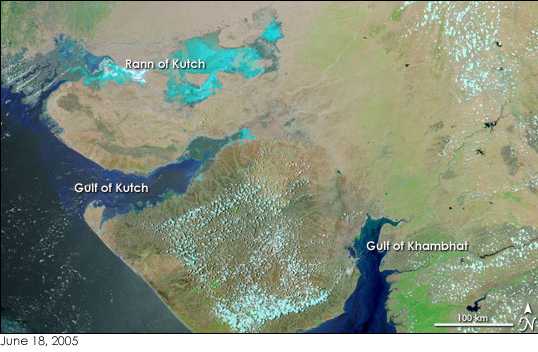
- A gulf is a large body of ocean or sea water that is partially enclosed by land, with a narrow opening connecting it to a larger water body.
- It is deeper and larger than a bay but smaller than a sea.
- Receives less rainfall but has an indented coastline with natural harbors.
- Facilitated both coastal and foreign trade.
- Gujarat became famous for its merchant communities and international trade.
- Madhya Pradesh: The Heart of India
-
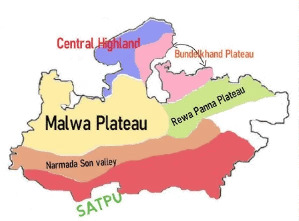
- Surrounded by major natural boundaries:
- North: Ganga-Yamuna Doab.
- West: Chambal River.
- East: Son River.
- South: Vindhya Mountains & Narmada River.
- Two Broad Divisions:
- Eastern Madhya Pradesh:
- Covered by Vindhya ranges.
- Became historically significant during the Gupta period (4th-5th century A.D.).
- Western Madhya Pradesh (Malwa region):
- A politically significant region since the 6th century B.C.
- Malwa served as a strategic hinterland for Gujarat's trade network.
- Contested between northern and Deccan powers:
- Sakas vs. Satavahanas (1st-2nd century A.D.).
- Marathas vs. Rajputs (18th century).
- Rivers and Their Influence on Historical India
- Major River Systems and Rainfall Distribution
- India's historical core was shaped by major river plains enriched by monsoon rains.
- Key river basins:
- Indus Plains (Northwest)
- Ganga-Yamuna Doab (Central Region)
- Middle Gangetic Basin (Eastern Region)
- Brahmaputra Basin (Far East)
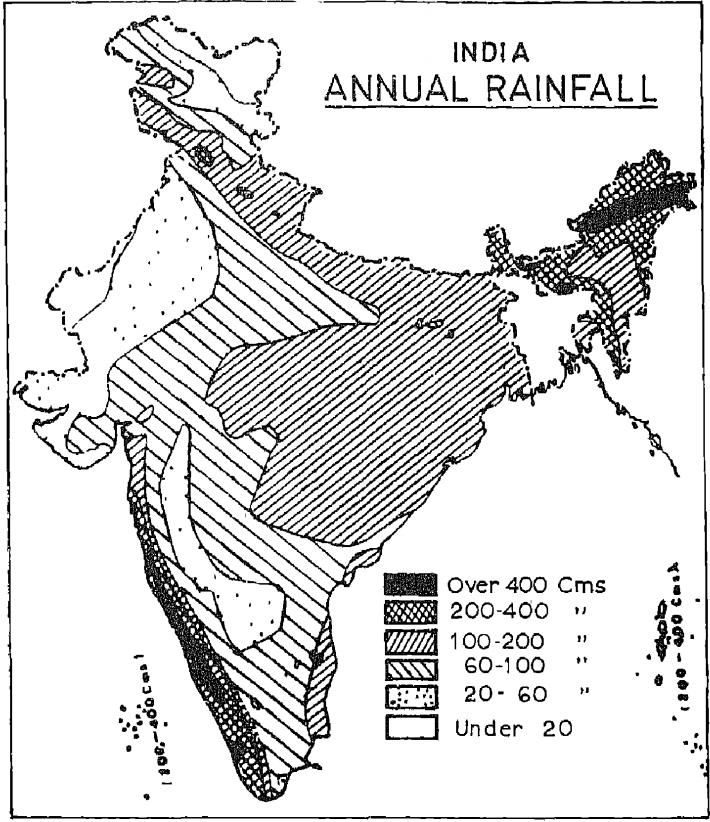
- Rainfall variation from west to east:
- Indus Basin -> 25-37 cm
- Western Gangetic Basin -> 37-60 cm
- Middle Gangetic Basin -> 60-125 cm
- Lower Gangetic & Brahmaputra Basin -> 125-250 cm
- Impact on Cultivation & Settlement:
- Western regions (Indus & Western Ganges) could be cleared with stone and copper tools.
- Eastern regions (Middle Ganges & Brahmaputra) had dense forests & hard soil, requiring iron tools for clearing.
- Human settlements expanded from west to east, following the availability of agricultural resources.
- Agriculture and Cultural Development
- Agriculture evolution:
- Indus & Western Gangetic Plains:
- Mainly wheat and barley.
- Middle & Lower Gangetic Plains:
- Mainly rice, later spreading to Gujarat and South India.
- Cultural Evolution:
- Harappan Civilization:
- Flourished in the Indus Valley.
- Vedic Culture:
- Originated in Punjab, expanded to the Western Gangetic Basin.
- Post-Vedic Iron Age Culture:
- Developed in the Middle Gangetic Basin.
- Lower Gangetic & North Bengal:
- Gained significance during the Gupta period.
- Brahmaputra Valley (Assam):
- Became important in early medieval times.
- Strategic Importance:
- The Ganga-Yamuna Doab was the most contested region due to its fertility and strategic position.
- Rivers as Lifelines of Trade, Transport, and Urban Development
- Rivers enabled commerce and communication:
- Before roads were built, boats transported people and goods.
- Even Ashoka's stone pillars were transported via rivers.
- Rivers remained vital for trade up to the East India Company era.
- Agricultural and Economic Benefits:
- Rivers fertilized nearby lands through flooding.
- They provided water for irrigation canals.
- However, floods also destroyed settlements, washing away ancient towns and monuments.
- Urban Settlements Along Rivers:
- Major cities flourished on riverbanks, including:
- Hastinapur (Ganga)
- Prayag (Allahabad) (Ganga-Yamuna)
- Varanasi (Ganga)
- Pataliputra (Ganga)
- Pre-industrial towns were located on riverbanks, while modern urban centers are based on roads, railways, and industries.
- Rivers as Political and Cultural Boundaries
- Rivers, like mountains, acted as natural boundaries:
- Kalinga (Coastal Odisha):
- Between Mahanadi (North) and Godavari (South).
- Andhra Pradesh:
- Between Godavari (North) and Krishna (South).
- Tamil Nadu:
- Between Krishna (North) and Kaveri (South).
- Historical Significance of River Deltas:
- Godavari & Krishna deltas became major urban & port centers under Satavahanas (1st century CE).
- Kaveri delta:
- Became the Chola Empire's core (Pre-1st century CE).
- Vaigai River (South) & South Pennar River (North) marked its extent.
- North Tamil Nadu:
- Consisted of uplands.
- Became prominent under the Pallavas (4th-6th century CE).
- Political and Cultural Evolution of Indian Regions
- Regions formed political and administrative units due to:
- Natural boundaries (rivers, mountains, deltas, plateaus).
- Difficult communication across vast territories.
- Defensible natural frontiers.
- Distinct cultural identities emerged in different regions:
- Each region developed its own way of life and language.
- Northern & Western India:
- Most languages derived from the Indo-Aryan stock, sharing common elements.
- Sanskrit:
- Cultivated & understood across India.
- Played a unifying cultural role.
- The Vindhya Mountains: The North-South Divide
- The Vindhya Mountains stretch from west to east, marking the boundary between northern and southern India.
- Linguistic and Cultural Divide:
- Dravidian language speakers lived south of the Vindhyas.
- Aryan language speakers lived north of them.
- Primitive tribes inhabited the Vindhya regions and still exist today.
- Influence of Coastal Regions:
- Eastern & Western Ghats attracted settlers and traders.
- The south engaged in flourishing foreign trade, leading to cultural and linguistic exchange.
- Frequent movement of northern and southern rulers, traders, missionaries, and Brahmanas fostered a composite culture.
- Interdependence Among Regions
- Natural Frontiers vs. Resource Distribution:
- Many regions had well-defined boundaries, but not all had sufficient resources.
- Inter-regional trade emerged from prehistoric times, driven by the need for metals and other essential materials.
- Utilization of Natural Resources and its Historical Impact
- Early Human Settlements:
- Initially, Indian plains were covered in dense forests.
- These forests provided game, food, fuel, and timber for survival.
- In that sentence, "game" means wild animals and birds hunted for food or sport — not games you play.
- Construction and Tool-making:
- Early construction materials included timber, later replaced by burnt bricks.
- Pataliputra, India's first important capital, had timber houses and palisades.
- The availability of various stones (including sandstone) influenced architecture and tool-making.
- Regional Architectural Differences:
- Earliest settlements developed in hilly regions and river valleys.
- Deccan & South India saw more stone temples and sculptures compared to North India, where different materials were used.
- Mineral Wealth and Its Historical Impact on India
- Copper: The First Metal Used
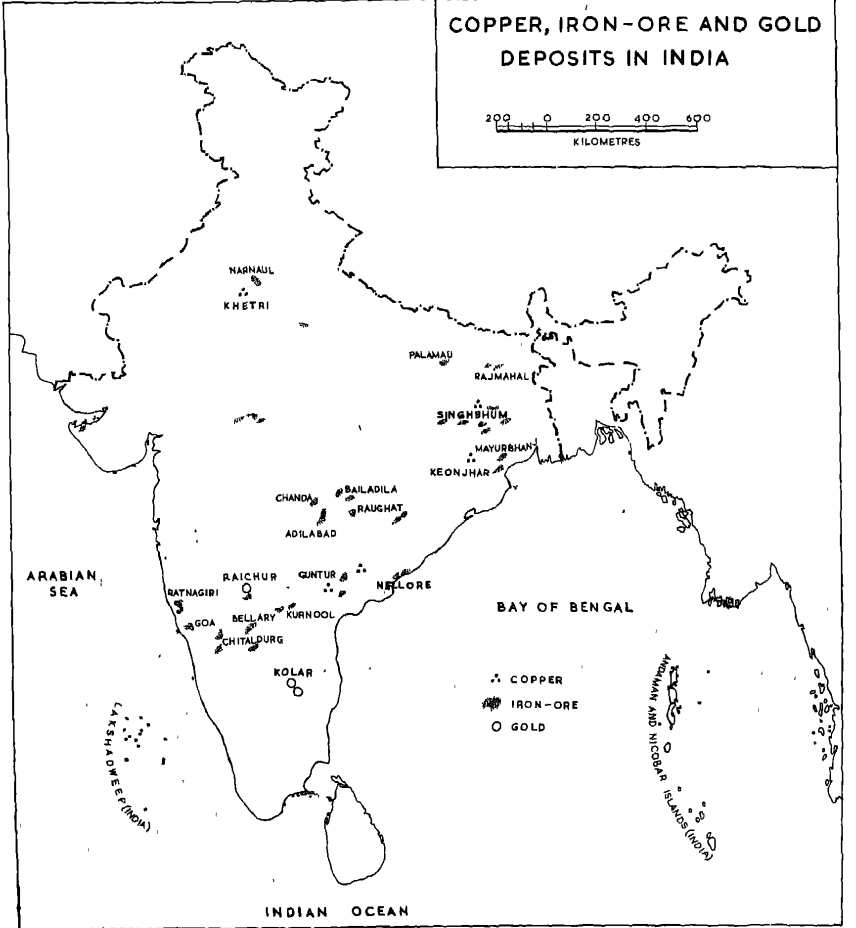
- Rich copper mines are found in the Chotanagpur plateau (located in eastern India, covering parts of Jharkhand, Odisha, West Bengal, Chhattisgarh, and Bihar), particularly in Singhbhum district.
- The copper belt extends 130 km and shows signs of ancient mining.
- Early copper usage:
- The earliest people in Bihar used copper implements and mined copper from Singhbhum and Hazaribagh.
- Many copper tools have been found in South Bihar and Madhya Pradesh.
- Khetri mines (Rajasthan) were used by pre-Vedic and Vedic people in Pakistan, Rajasthan, Gujarat, and the Ganga-Yamuna Doab.
- Copper celts found in Khetri date back to before 1000 BC.
- Cultural significance:
- Copper is considered pure in Hindu traditions and is still used in religious rituals.
- Tin: Scarcity and Bronze Production
- India does not produce tin today, and even in ancient times, it was scarce.
- Possible ancient tin sources:
- Rajasthan and Bihar, though their deposits are now exhausted.
- The Harappans sourced tin from Rajasthan and Afghanistan, but in limited quantities.
- Impact on Bronze Age:
- Bronze requires tin mixed with copper.
- India had very few bronze tools, unlike Western Asia, Egypt, and Crete.
- No proper Bronze Age in India due to scarcity of tin.
- Expansion of tin trade:
- From the early centuries AD, India traded with Burma and the Malaya Peninsula, which had abundant tin.
- This led to increased bronze usage, especially for South Indian temple statues.
- Bihar bronzes (Pala era) likely sourced tin from Gaya, Hazaribagh, and Ranchi, where tin ores were smelted until the mid-19th century.
- Iron: Driving Empires and Agriculture
- Rich iron deposits exist in South Bihar, eastern Madhya Pradesh, and Karnataka.
- Iron smelting and steel-making:
- The invention of bellows (A tool used to blow air) improved iron smelting (process of extracting metal from its ore by heating it to high temperatures).
- Iron became essential for warfare, jungle clearance, and agriculture.
- Iron's role in empire formation:
- Magadha's rise (6th-4th centuries BC) was aided by iron resources.
- Avanti (Ujjain's kingdom) became powerful in the 6th-5th centuries BC due to iron.
- Satavahanas and southern powers likely used iron ores from Andhra and Karnataka.
- Lead: The Coinage Metal of Andhra
- Andhra had rich lead deposits, which contributed to the abundant lead coinage of the Satavahanas (1st-2nd centuries AD).
- Toxic nature of lead
- In the 2nd century A.D., the toxic effects of lead were not understood. It was viewed simply as a heavy, durable metal perfect for trade.
- The real danger of lead comes from ingestion or inhalation. While merchants and citizens handled these coins daily, the primary risk would have been to the miners and mint-workers who inhaled lead fumes during the smelting process.
- Silver: Early Coinage and Scarcity
- India had little natural silver, but some mines existed.
- Early sources:
- Kharagpur hills (Monghyr district) had silver mines, mentioned even in Akbar's time.
- These mines supplied silver for punch-marked coins, which were widely used in Bihar.
- Gold: Kolar and International Trade
- Gold mining began only by the 2nd century AD.
- India's primary gold source are Kolar goldfields (Karnataka).
- Earliest gold trace found in a Neolithic site (1800 BC) in Karnataka.
- Trade and gold supply:
- Central Asia and the Roman Empire provided most of ancient India's gold.
- Gold coins were common from the 1st-5th centuries AD.
- Once foreign gold supplies stopped, gold coins became rare.
- Precious Stones and Trade
- India produced a variety of gemstones, including pearls.
- Main gemstone-producing regions:
- Central India, Orissa, and South India.
- Trade significance:
- Precious stones were highly sought by Romans.
- They became a major export commodity in the early centuries AD.
-
- The Stone Age
- The Old Stone Age (Palaeolithic Age)
- Human Existence in India
- Early humans lived in India as early as 500,000 B.C.
- Used tools made from unpolished, undressed, rough stones.
- Evidence found in:
- South India
- Soan or Solan river valley (Pakistan)
- Kashmir
- Tools were mainly stone pebbles used for:
- Hunting
- Cutting
- Other basic survival tasks
- Lifestyle:
- Dependent on food gathering and hunting.
- No knowledge of cultivation or house building.
- This phase continued until 8000 B.C.
- Archaeological Discoveries
- Palaeolithic Tools:
- Some as old as 100,000 B.C. found in Chotanagpur plateau.
- Tools dating 25,000 B.C. - 10,000 B.C. found in Kurnool district, Andhra Pradesh (~55 km from Kurnool).
- Bone implements and animal remains discovered alongside tools.
- Domestication of Animals:
- Animal remains from Belan valley, Mirzapur (U.P.) indicate domestication of:
- Goats, sheep, and cattle (~25,000 B.C.).
- Early humans still relied primarily on hunting and food gathering.
- Some primitive groups, as mentioned in the Puranas, continued living on roots and fruits in hills and caves until modern times.
- Geological Context: The Pleistocene Period
- The Old Stone Age (Palaeolithic culture) developed during the Pleistocene period (Ice Age).
- The Pleistocene period:
- Preceded the Holocene (~began 10,000 years ago).
- Exact start unknown, but human remains with stone tools in East Africa date to 3.5 million years ago.
- In India, earliest stone tools suggest human occupation in the Middle Pleistocene (~500,000 years ago).
- Climatic Conditions:
- Ice sheets covered vast areas in high altitudes.
- Tropical regions (except mountains) remained ice-free but experienced heavy rainfall.
- Phases in the Palaeolithic Age
- The Palaeolithic Age, also known as the Old Stone Age, is the earliest phase of human history. In India, it is divided into three phases based on the nature of stone tools used and changes in climate:
- Lower Palaeolithic (Early Old Stone Age)
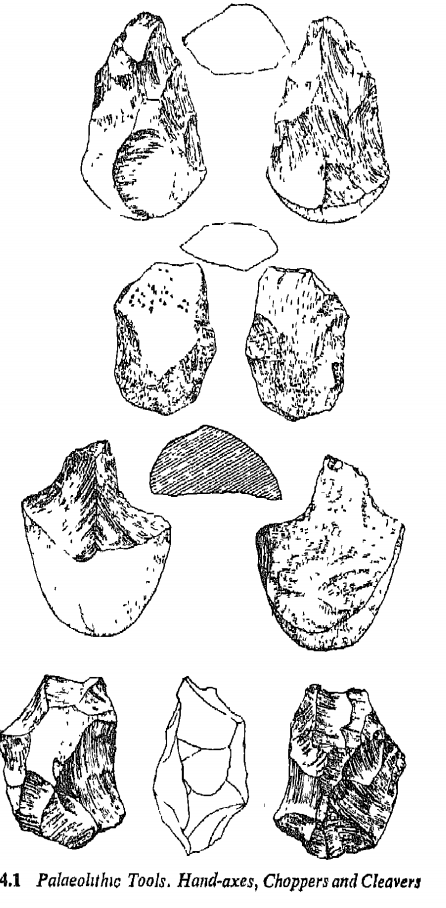
- The Lower Palaeolithic phase covers a significant part of the Ice Age and is characterized by the use of hand-axes and cleavers.
- These tools were primarily used for chopping and bear similarities to those found in Western Asia, Europe, and Africa.
- Key Sites in India:
- Soan valley
- The Soan Valley (now in Pakistan) is one of the earliest known sites.
- The Soon Valley, also known as Soan or Soon Sakesar Valley, is located in the Khushab District of Punjab province, Pakistan
- Belan valley
- Belan Valley (Mirzapur district, Uttar Pradesh) also contains significant Palaeolithic tools.
- The Belan Valley has caves and rock shelters, which were likely used as seasonal camps by early humans.
- Climate & Geological Aspects:
- Hand-axes have been discovered in deposits from the time of the second Himalayan glaciation.
- The climate during this period became less humid.
- Middle Palaeolithic (Middle Old Stone Age)
- The Middle Palaeolithic phase is characterized by the development of flake-based (A small, thin, sharp fragment chipped off from a larger rock) industries.
- The primary tools used during this period were scrapers, borers, and blade-like tools. These tools show regional variations, indicating diverse adaptations by early humans.
- Key Sites in India:
- The Soan Valley continued to be an important site, where a crude pebble industry existed in strata corresponding to the third Himalayan glaciation.
- Artifacts from this phase have also been found along the Narmada River and in regions south of the Tungabhadra River.
- Upper Palaeolithic (Late Old Stone Age)
- The Upper Palaeolithic phase coincided with the final phase of the Ice Age, during which the climate became comparatively warm.
- This period is globally significant due to the emergence of modern humans (Homo sapiens) and the development of advanced stone tool industries, particularly flint (Flint is a hard, sedimentary rock made of quartz) tools.
- Key Technological Advancements:
- Use of blades and burins, which represent a significant evolution in tool-making techniques.
- Key Sites in India:
- Tools from this phase have been discovered in Andhra Pradesh, Karnataka, Maharashtra, and the Chotanagpur Plateau.
- The Bhimbetka caves, located 40 km south of Bhopal, contain evidence of human habitation during this period. Excavations have revealed hand-axes, cleavers, blades, scrapers, and burins.
- An Upper Palaeolithic assemblage, consisting of massive flakes, blades, burins, and scrapers, has been found in the upper levels of the Gujarat dunes.
- Estimating the Age of the Palaeolithic Period
- Determining the exact beginning of the Palaeolithic Age is difficult. However, in a global context, human remains associated with stone tools are estimated to be as old as 3.5 million years.
- It is believed that modern humans (Homo sapiens) first appeared during the Upper Palaeolithic Age after passing through multiple evolutionary stages.
- Geographical Distribution of Palaeolithic Sites in India
- Palaeolithic sites are found in almost all parts of India, except for the alluvial plains (a flat or gently sloping area of land created by the deposition of river sediment) of the Indus and the Ganga, where river deposits may have obscured or destroyed evidence of early human occupation.
-
- The Late Stone Age (Mesolithic age)
- End of the Upper Palaeolithic Age
- The Upper Palaeolithic Age ended around 10,000 BCE with the conclusion of the Ice Age.
- The climate became warm and wet, leading to shifts in fauna and flora.
- These environmental changes allowed human migration to new regions.
- Since then, there have been no major climatic changes.
- Transition to the Mesolithic Age
- Around 10,000 BCE, an intermediate phase in Stone Age culture began, known as the Mesolithic Age.
- This period acted as a transition between the Palaeolithic Age and the Neolithic (New Stone Age).
- It is also referred to as the Late Stone Age.
- In India, this phase began around 10,000 BCE and lasted until 3000 BCE.
- Characteristics of the Late Stone Age
- Primary Tools:
- Microliths - Small, sharp stone tools.
- Key Archaeological Sites in India:
- Bagor (Rajasthan)
- Adamgarh (Madhya Pradesh)
- Bhimbetka (Madhya Pradesh)
- Damdama & Sarai Nahar Rai (Uttar Pradesh)
- Langhnaj (Gujarat)
- Only a few Late Stone Age sites have been scientifically dated, but available evidence suggests that they predated the Neolithic Age.
- Sequential Cultural Development in the Bélan Valley
- The Bélan Valley, located on the northern spurs of the Vindhyas, provides a continuous sequence of prehistoric cultures:
1. Palaeolithic Age
2. Mesolithic (Late Stone Age)
3. Neolithic Age
- This site serves as crucial evidence of the gradual cultural transition in prehistoric India.
-

- The New Stone Age (Neolithic Age)
- Chronology and Regional Variations
- The Neolithic Age in the world context began around 7000 BC.
- In the Indian subcontinent, Neolithic settlements date back to 6000 BC.
- Some later Neolithic sites in South and Eastern India date as late as 1000 BC.
- Neolithic Tools and Lifestyle
- Primary Tools:
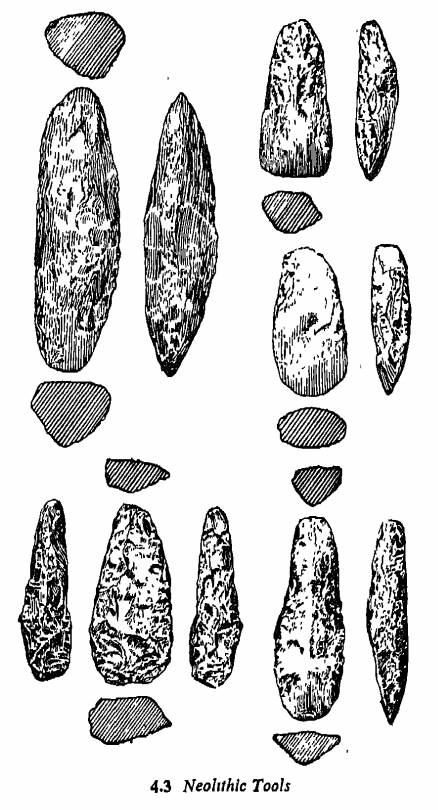
- Polished stone tools and implements, particularly stone axes, were widely used.
- These axes have been found throughout India and were used for various purposes.
- Connection to Ancient Legends:
- Parasurama, an axe-wielding hero, is associated with this phase (earlier than 1600 BC).
- Some Neolithic settlements likely belonged to a stone-copper phase.
-
-
- Major Neolithic Settlements
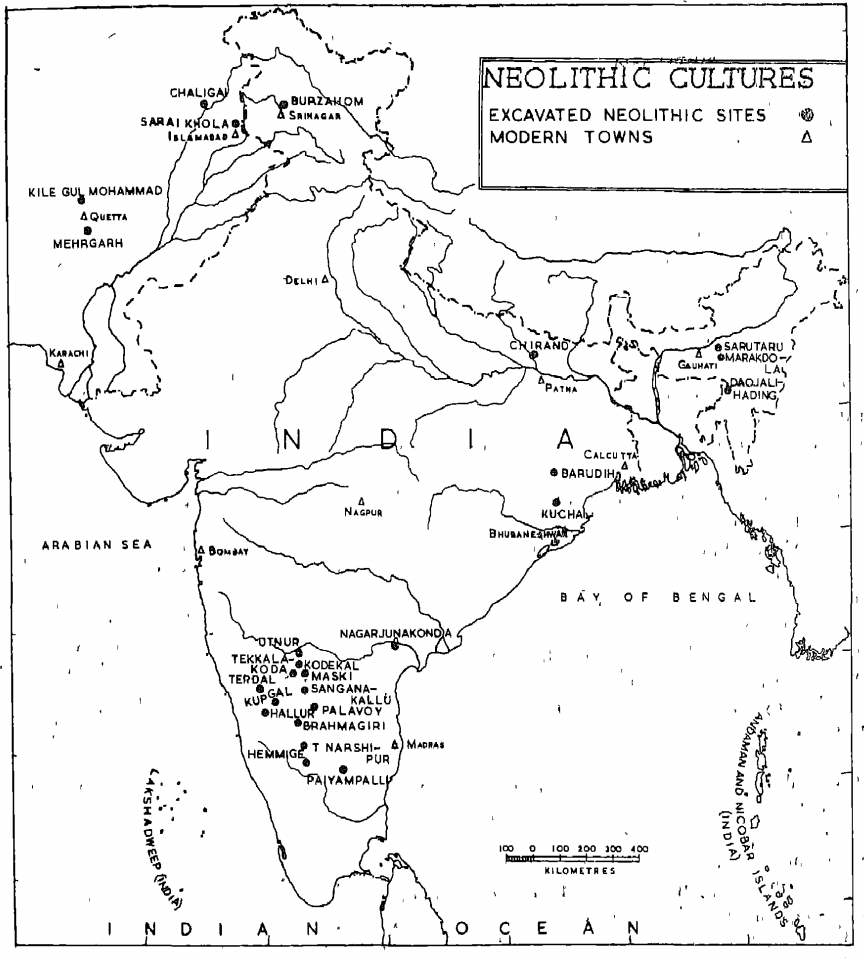
- Burzahom (Kashmir Valley)
-

- Located 20 km from Srinagar, on a plateau.
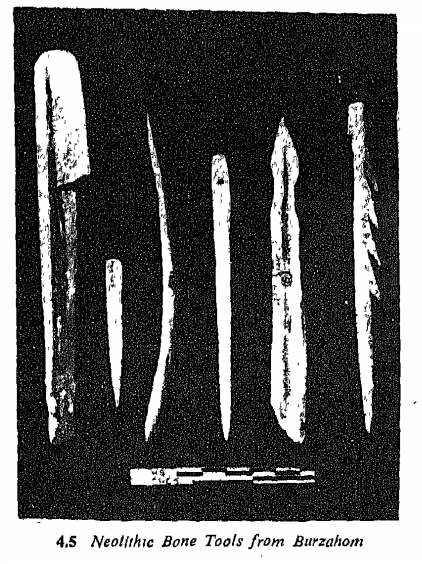
- People lived in pit dwellings (places where people live) and had a hunting and fishing economy.
- Key Features:
- Used polished stone tools and bone tools.
- Similar bone implements were also found at Chirand (Bihar).
- Used coarse grey pottery.
- Unique Burial Practice:
- Domestic dogs were buried with their masters.
- Earliest Date around 2400 BC.
- Chirand (Bihar)
- Located 40 km west of Patna, near the Ganga River.
- Settled due to open land formed by the confluence of four rivers (Ganga, Son, Gandak, and Ghaghara).
- Neolithic remains indicate a late Neolithic setup with bone tools.
- The exact dating of Chirand remains uncertain.
- Neolithic Settlements in South India
- Found south of the Godavari River, mainly near riverbanks and on granite hilltops.
- Key Features:
- Used stone axes and stone blades.
- Domesticated cattle, sheep, and goats.
- Rubbing stone querns suggest knowledge of grain production.
- Fire-baked earthen figurines found.
- Notable Sites:
- Maski, Brahmagiri, Hallur, Kodekal, Sanganakallu, T. Narsipur, Takkalakota (Karnataka).
- Paiyampalli (Tamil Nadu).
- Piklihal, Utnur (Andhra Pradesh).
- Piklihal and Ash Mound Settlements
- The Neolithic settlers of Piklihal were cattle herders.
- They domesticated cattle, sheep, and goats.
- Key Features:
- Seasonal camps with cowpens (place where cattle are kept) made of posts (A vertical pole or beam used for support) and stakes (A pointed stick driven into the ground for support or marking).
- Ash Mounds:
- Cow dung was accumulated and burned,
- The ground was cleared for the next seasonal camp.
- Neolithic Sites in Eastern and Northeastern India
- Hills of Assam and Garo Hills in Meghalaya contain Neolithic tools.
- Neolithic tools also found in:
- Northern Vindhyas (Mirzapur & Allahabad, Uttar Pradesh) - Known for early rice cultivation (6000 BC).
- Baluchistan - Appears to be one of the earliest Neolithic regions.
- Orissa hill areas - Evidence of rice cultivation and small-scale settlements.
-
- Neolithic Agriculture and Pottery
- Later Neolithic settlers transitioned to agriculture.
- They lived in circular or rectangular mud-and-reed houses.
- Key Agricultural Products:
- Rice and horsegram (kulathi).
- Tool Evolution:
- Used microlith blades along with polished tools.
- Pottery Development:
- Hand-made pottery in the early stage.
- Later, footwheels were used for making pots.
- Technological Advances in the Neolithic Age
- Between 9000 BC and 3000 BC, Western Asia saw significant progress in:
- Agriculture, weaving, house-building, and domestication of animals.
- In India, the Neolithic Age began around the sixth millennium (a period of 1,000 years) BC.
- Key Crops Introduced:
- Rice, wheat, and barley.
- The first villages started appearing, marking the beginning of civilization.
- Challenges of the Neolithic People
- Dependency on Stone Tools:
- Limited them to hilly regions and river valleys.
- Subsistence Economy:
- Even with effort, they could produce only enough for basic survival.
-
| Category |
Palaeolithic Age (Old Stone Age) |
Mesolithic Age (Middle Stone Age) |
Neolithic Age (New Stone Age) |
| Time Period |
~500,000 BCE - 10,000 BCE |
10,000 BCE - 3,000 BCE |
7,000 BCE - 1,000 BCE (Regional variations) |
| Stone Tools |
Rough, unpolished stone tools like hand axes, cleavers, and choppers. |
Microliths - small, sharp stone tools, often attached to wood/bone handles. |
Polished stone tools, particularly stone axes; grinding and drilling techniques introduced. |
| Food & Economy |
Hunting & gathering; no agriculture or domestication. |
Transition phase - began domesticating animals and practicing rudimentary agriculture. |
Full-fledged agriculture; domestication of cattle, sheep, and goats; pottery production. |
| Human Settlements |
Nomadic lifestyle, lived in rock shelters and open camps. |
Semi-permanent settlements; seasonal movement. |
Permanent villages; circular or rectangular mud houses. |
| Key Sites in India |
- Soan Valley (Pakistan)
- Belan Valley (Uttar Pradesh)
- Bhimbetka (Madhya Pradesh)
- Narmada Valley (Madhya Pradesh)
- Chotanagpur Plateau (Jharkhand)
|
- Bagor (Rajasthan)
- Adamgarh (Madhya Pradesh)
- Bhimbetka (Madhya Pradesh)
- Langhnaj (Gujarat)
|
- Mehrgarh (Pakistan)
- Burzahom (Kashmir)
- Chirand (Bihar)
- Piklihal, Brahmagiri (Karnataka)
- Paiyampalli (Tamil Nadu)
|
| Burial Practices |
No clear evidence of burial rituals. |
Occasional burials with grave goods, hinting at belief in afterlife. |
Well-organized burials; evidence of rituals (e.g., dog burials in Burzahom). |
| Art & Culture |
Cave paintings (e.g., Bhimbetka), basic artistic expressions. |
More advanced rock paintings, depiction of animals and daily life. |
Pottery making, weaving, and religious symbols emerge. |
| Major Technological Developments |
Fire control, crude stone tool-making. |
Bow & arrow invention, early domestication of animals. |
Agriculture, polished stone tools, pottery, wheel introduction. |
- The Chalcolithic (Stone-Copper) Phase
- Chalcolithic Settlements
- The Chalcolithic Period (Copper-Stone Age) varied across regions, but broadly, it spanned from around 4000 BCE to 2000 BCE in many parts of the world.
- However, in India, the Chalcolithic phase lasted from around 2500 BCE to 700 BCE, overlapping with the Harappan Civilization and continuing in non-Harappan regions.
- Indus civilization is chalcolithic but it's origin is neolithic as seen in Mehrgarh ,Birrana and Tamil nadu where a stone axe with indus script discovered .This shows that IVC has it's continueity right from the neolithic age.
- With the decline of the Neolithic period, the use of metals began, marking the advent (arrival or beginning of something significant) of the Chalcolithic culture.
- The first metal to be used was copper, and societies during this phase used both stone and copper implements.
- Geographical Distribution of Chalcolithic Sites
- Southeastern Rajasthan
- Major sites are Ahar and Gilund
- Located in the Banas Valley, which falls in a dry zone
- Western Madhya Pradesh (Malwa region)
- Major sites are Kayatha and Eran
- Western Maharashtra
- Most extensive excavations have been carried out here
- Major sites:
- Jorwe, Nevasa, Daimabad (Ahmadnagar district)
- Chandoli, Songaon, Inamgaon (Pune district)
- Nasik
- These sites were located in semi-arid regions, mostly on brown-black soil with ber and babul vegetation, but situated along riverbanks
- Navdatoli (on the Narmada River)
- Andhra Pradesh
- Some Chalcolithic elements are found in Neolithic sites, but copper objects are absent
- Allahabad region
- Several Chalcolithic sites were discovered, likely due to their proximity to the Vindhyas
- Eastern India
- Chirand (on the Ganga)
- Pandu Rajar Dhibi (Burdwan district, West Bengal)
- Mahishdal (Midnapore district, West Bengal)
- These settlements mark a transition from the Neolithic period, where early societies started adopting metal tools while continuing the use of stone implements.
-

- Chalcolithic Cultures
-

- Reasons why copper was the first metal to be used
- Occurs in native form
- Found in nature as pure metal nuggets (native copper), not just in ores.
- Could be used without advanced smelting techniques.
- Most other metals (like iron) are rarely found pure and require high-temperature extraction.
- Soft and malleable
- Can be shaped by hammering (cold working) without special tools.
- Allowed early humans to make ornaments, hooks, and small tools easily.
- Low melting point (relative to iron)
- Melts at about 1085°C, achievable in simple ancient furnaces.
- Iron melts at 1538°C, requiring more advanced technology.
- Durability and usefulness
- Harder and more durable than stone.
- Easier to work than many other metals.
- Could be alloyed with tin to make bronze, which is even harder.
- Abundant and visible
- Copper ores like malachite are colorful (green/blue) and easy to recognize.
- Attracted early people to collect and experiment with them.
- The Chalcolithic culture marked a transitional phase where people used both stone and copper tools. Stone blades played a significant role, although stone axes continued in many areas.
- This culture thrived in riverine tracts and near hills, with significant regional variations in tools, pottery, economy, and burial practices.
- Tools and Implements
- People primarily used small stone tools and weapons, with stone blades being significant.
- In some regions, stone-blade industries flourished, while in others, copper tools were more prominent.
- Ahar and Gilund (Rajasthan) had numerous copper implements, as raw copper was locally available.
- Jorwe and Chandoli (Maharashtra) had flat, rectangular copper axes, while copper chisels were found at Chandoli.
- Gilund had a stone-blade industry despite being in a dry region.
- Pottery
- Black-and-red pottery was widespread, found in Rajasthan, Madhya Pradesh, Maharashtra, Bihar, and West Bengal.
- The black and red color comes from how the pot was fired, not from coloring. It is due to controlled oxygen supply in the kiln.
- Pot was often placed upside down covered partially with ash/fuel
- How the color forms (most important concept)
- Red part
- Fired in presence of oxygen (oxidation)
- Iron in clay → turns red
- Black part
- Fired in absence of oxygen (reduction)
- Smoke/carbon gets trapped → turns black
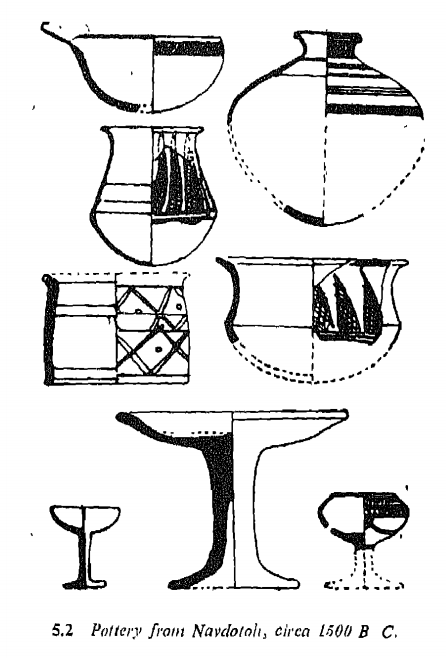
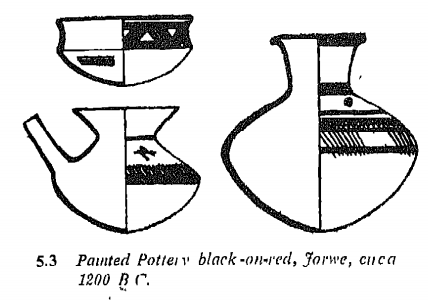
- These pots were wheel-made, sometimes painted with white decorations.
- Madhya Pradesh and Maharashtra settlements produced:
- Channel-spouted pots
- Dishes-on-stand
- Bowls-on-stand
- Pottery styles and variations indicate cultural diversity among different Chalcolithic groups.
- Economy and Agriculture
- The Chalcolithic people domesticated animals and cultivated crops.
- Animals:
- Cows, sheep, goats, pigs, buffaloes were domesticated.
- Deer was hunted.
- Camel remains were found, but evidence for horses is unclear.
- Food Crops:
- Wheat and rice were staples.
- Bajra, lentils (masoor), black gram, green gram, and grass pea were cultivated.
- Navdatoli (Maharashtra) had the most diverse range of cereals.
- Other Crops:
- Ber, linseed, cotton, ragi, and millets were cultivated in the Deccan region.
- Eastern India (Bihar & West Bengal):
- Fish hooks suggest fishing was common.
- Rice and fish formed a staple diet, a tradition still prevalent today.
- Settlements and Architecture
- Houses were mostly made of wattle and daub, sometimes using mud bricks.
- Inamgaon (Western Maharashtra):
- Early phase (1600–1300 B.C.) :
- Large mud houses with ovens and circular pit houses.
- Later phase (1300-1000 B.C.):
- Larger houses with multiple rooms, suggesting larger family structures.
-

- Jorwe Culture:
- Named after Jorwe village (Pravara River, Maharashtra).
- Settlements were nucleated villages with 35+ houses, mostly circular or rectangular.
- Economy was rural, with no signs of urban civilization.
- Some settlements (Eran, Kayatha, Inamgaon) were fortified with moats (a deep, wide ditch, usually filled with water), but large-scale city structures were absent.
- Arts and Crafts
- Copper smithing (working with copper) and stone-working were well-developed.
- Microlithic stone tools were widely used.
- Spindle whorls found in Malwa indicate knowledge of spinning and weaving.
- Maharashtra finds suggest cotton, flax, and silk threads were used, proving familiarity with cloth production.
-
-
- Religion and Burial Practices
- Maharashtra:
- Dead were buried under house floors (north-south orientation).
- Graves contained pots and copper objects, possibly for use in the afterlife.
- Terracotta figurines of women suggest mother goddess worship.
- Inamgaon:
-
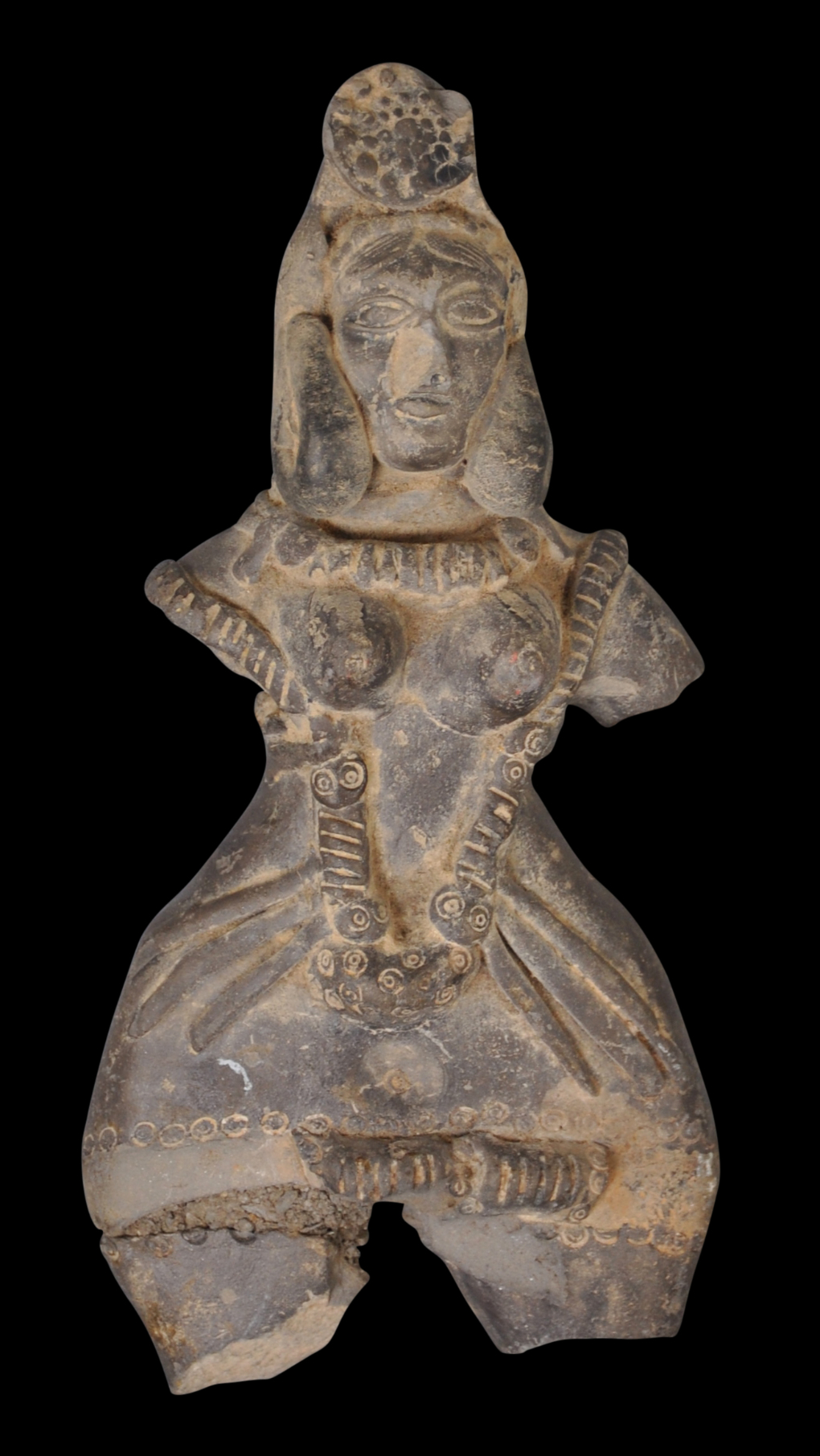
- A mother goddess figurine similar to Western Asian designs was found.
- Malwa & Rajasthan:
-
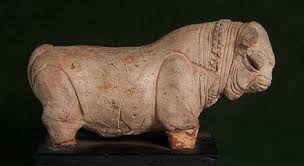
- Terracotta bull figurines suggest bull worship.
- Social Inequalities
- Some graves at Chandoli and Nevasa (Maharashtra) contained copper-bead necklaces, while others had only pots, indicating social differences.
- Inamgaon:
- Adults were buried with copper and pottery, further suggesting status differences.
- Kayatha:
- 29 copper bangles and valuable axes were found in a house, indicating wealth.
- Earthen pots with semi-precious stone necklaces (steatite, carnelian) indicate social hierarchy.
- Chronology and Legacy
- Chalcolithic culture lasted from 1800 B.C. to 1000 B.C., persisting in some areas until 800 B.C.
- Over time, iron tools replaced stone and copper tools.
- Black-and-red pottery continued until the 2nd century B.C. in several regions.
- Conclusion
- The Chalcolithic culture laid the foundation for early village economies, agriculture, and social structures. While they lacked urban civilization, they showed regional variations in tools, pottery, economy, and religious practices.
- The transition from the Stone-Copper phase to the Iron Age marked significant technological and societal advancements.
- Importance of the Chalcolithic Phase
- The Chalcolithic phase marks an important stage in Indian history, with traces of Chalcolithic cultures found across the country, except for the alluvial plains and densely forested areas.
- This phase saw the foundation of rural settlements, typically located on riverbanks near hills.
- Tools and Pottery
- People primarily used microliths and other stone tools, supplemented by limited copper tools.
- Most communities had knowledge of copper smelting (process of extracting metal from its ore by heating it to high temperatures). A distinctive feature of this phase was the widespread use of black-and-red wheel-turned pottery, making the Chalcolithic people the first to use painted pottery.
- Reason for black-and-red coloration
- Open kilns or updraft kilns
- Constructed with a lower firing chamber for fuel and an upper chamber for pots.
- Allowed potters to control oxygen flow during firing.
- Achieved through a two-stage firing process:
- The upper part of the pot turns black due to reduction firing (limited oxygen), where smoke and carbon penetrate the clay.
- The lower part remains red due to oxidation firing (ample oxygen), where iron compounds in the clay turn red.
- Deliberate control of firing atmosphere
- It was intended, not an accident. Chalcolithic potters deliberately controlled the firing atmosphere to get the black-and-red pattern — it was a stylistic and cultural choice, not just a by-product of random firing.
- It was not due to a limitation of technology, it was a mark of technological skill.
- These pots, used for cooking, eating, and storage, included the lota, but there is no evidence of the thali.
- Regional Variations
- South India:
- The Neolithic phase gradually transitioned into the Stone-Copper phase, leading to the classification of these cultures as Neolithic-Chalcolithic.
- Western Maharashtra and Rajasthan:
- The Chalcolithic people here appear to have been colonizers.
- Chronology:
- The earliest settlements emerged in Malwa and central India (Kayatha and Eran), followed by western Maharashtra, while those in West Bengal were among the last to appear.
- Agriculture and Diet
- The Chalcolithic people were the first to establish village communities in India, cultivating a greater variety of cereals than their Neolithic predecessors.
- Western India:
- Cultivated barley, wheat, and lentils. Their diet was supplemented with non-vegetarian food, with a higher reliance on animal meat.
- Southern and Eastern India:
- Primarily cultivated rice. Fish and rice were key dietary staples in the eastern regions.
- Settlements and Architecture
- Western Maharashtra, Western Madhya Pradesh, and Southeastern Rajasthan:
- These regions show evidence of well-structured settlements. Some sites, such as Kayatha and Eran in Madhya Pradesh and Tumaigon in western Maharashtra, were fortified.
- Eastern India (Chirand and Pandu Rayar Dhibi):
- Settlements were less developed, with structures indicated by postholes and round houses.
- Burial Practices
- Maharashtra:
- Bodies were placed in a north-south position, and extended burials were common.
- South India:
- Bodies were buried in an east-west position.
- West Bengal:
- Practiced post-extraction or fractional burials instead of complete burials.
- Post-Extraction Burial:
- Involves removing soft tissues or specific body parts before burial. This could be due to cultural, ritualistic, or practical reasons.
- Fractional Burial:
- Only a portion of the body (such as bones, skull, or ashes) is buried, while the rest may be disposed of in another manner, stored, or used in rituals.
- This phase played a crucial role in shaping early village life in India, with its advancements in agriculture, pottery, and metalwork, laying the foundation for later civilizations.
- Limitations of Chalcolithic Cultures
- The Chalcolithic cultures had several weaknesses that hindered their development, particularly in terms of health, technology, and urbanization.
- High Infant Mortality
- A significant indicator of their limitations was the high rate of infant mortality, as seen in the large number of child burials in western Maharashtra.
- Despite having a food-producing economy, the Chalcolithic people did not achieve longevity. The exact causes remain unclear but may include:
- Malnutrition
- Lack of medical knowledge
- Frequent outbreaks of epidemics
- Technological Constraints
- The Stone-Copper culture was primarily rural, with limited access to copper.
- Copper tools, while used, were relatively weak since they lacked the strength of bronze.
- Unlike civilizations in Crete, Egypt, and Mesopotamia, which advanced through bronze metallurgy, the Chalcolithic people in most of India did not develop the skill of mixing tin with copper to produce bronze.
- This lack of durable tools restricted technological and economic progress.
- Absence of Writing and Urbanization
- Chalcolithic societies did not develop writing and remained largely rural.
- Unlike the Bronze Age civilizations, which had cities, the Chalcolithic people lived in villages.
- Despite existing alongside the Indus Valley Civilization, most Stone-Copper Age cultures in India did not significantly benefit from the advanced technological knowledge of the Indus people.
- Overall, these limitations prevented the Chalcolithic cultures from achieving the level of complexity seen in contemporary civilizations elsewhere.
- The Copper Age in India
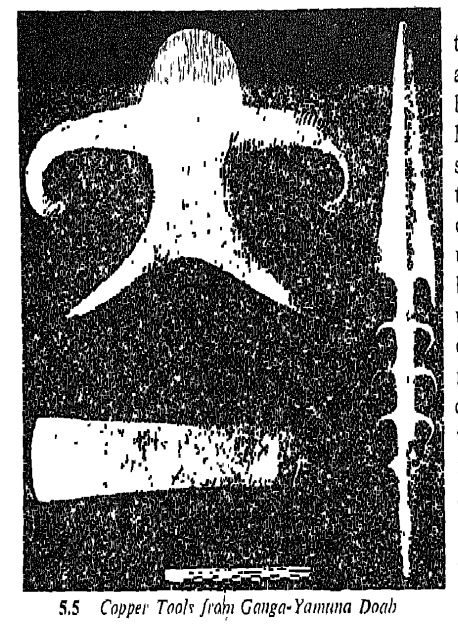
- The Copper Age in India is marked by the discovery of over forty hoards of copper objects across a vast region, from the Chotanagpur Plateau to the upper Gangetic basin.
- However, nearly half of these hoards are concentrated in the Ganga-Yamuna Doab, with only stray finds reported from other areas.
- Artifacts and Their Uses
- The copper hoards contain a variety of artifacts, including:
- Celts
- Harpoons
- Antennae swords
- Anthropomorphic figures
- Tool purpose and complexity
- These objects were used for fishing, hunting, fighting, as well as for artisanal and agricultural purposes.
- The complexity of these tools indicates a high level of technological skill among the coppersmiths, suggesting that the people who crafted them were not nomadic hunters but settled artisans and early agriculturists.
- Settlements and Cultural Context
- In the upper Gangetic basin, these objects have been found alongside ochre-colored pottery and mud structures, indicating a settled lifestyle.
-
- The majority of ochre-colored pottery sites are located in the upper Doab, while copper hoards are also found in Bihar's plateau region and the Khetri zone of Rajasthan.
- The ochre-colored pottery culture is dated between 2000 BC and 1800 BC.
- After the disappearance of ochre-colored pottery settlements, the Doab shows little habitation until around 1000 BC, except for small settlements using black-and-red ware with thin habitation deposits and limited artifacts.
- Legacy and Decline
- The copper-hoard people were contemporaries of the Harappans, and their settlements were geographically close to Harappan sites.
- Some cultural exchange likely took place between the copper-using groups and the bronze-using Harappans.
- However, no copper-hoard settlement lasted for more than a century, and their spread was limited. The reasons for their decline remain unclear.
- The religious significance of copper in Hindu traditions—such as its use in vessels and utensils—may have originated during this period.
- Thus, while the Metal Age in the upper Gangetic basin truly began with the copper-hoard people, their settlements remained short-lived and relatively small, leaving an intriguing but incomplete picture of their civilization.
-
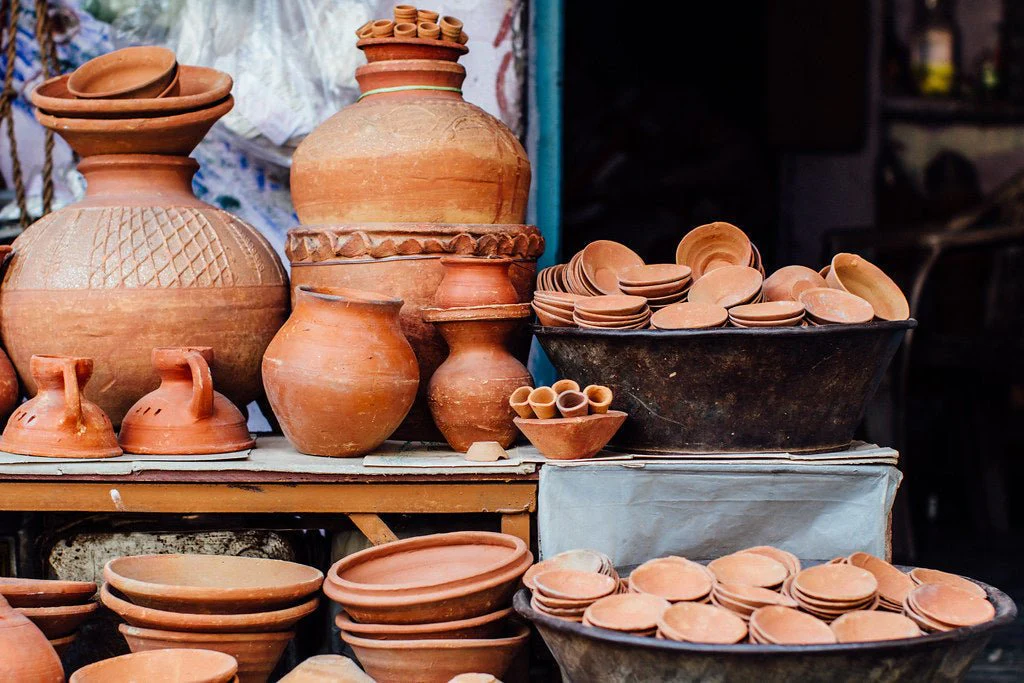
- More details on different pottery
-
| Pottery Type |
Period & Culture |
Scientific Reason for Color |
Usage & Significance |
| Black-and-Red Ware (BRW) |
Chalcolithic (c. 2500–1500 BCE), Ahar-Banas, Jorwe, Malwa Cultures |
Achieved through differential firing: red portion oxidized (oxygen exposure), black portion reduced (sealed from oxygen). Pots were inverted in kilns with partial covering. |
Used for cooking, storage, and burials, indicating ritualistic importance. |
| Ochre-Coloured Pottery (OCP) |
Late Harappan & Early Iron Age (c. 2000–1200 BCE), Ganga-Yamuna Doab |
High iron content in clay resulted in ochre color. Incomplete firing in open kilns led to an uneven texture. |
Mainly used in rural settlements, indicating decline in pottery refinement post-Harappan. |
| Painted Grey Ware (PGW) |
Early Vedic (c. 1200–600 BCE), Indo-Aryan Sites (Hastinapur, Ahichhatra) |
Fired at higher temperatures (over 900°C) in controlled conditions, leading to less oxidation of iron compounds in clay, giving a grey color. |
Associated with early Vedic society, possibly used by elites, found in Mahabharata-related sites. |
| Northern Black Polished Ware (NBPW) |
Mauryan Period (c. 600–200 BCE), Pataliputra, Taxila |
Fired at very high temperatures (over 1100°C) in reducing conditions, creating a highly lustrous and smooth black surface. |
Luxury ware associated with urban centers and high-status individuals. |
| Red Ware |
Found across multiple periods, from Harappan to post-Mauryan times |
High iron content in clay with complete oxidation during firing results in a red color. Fired at moderate temperatures (700–900°C) in open kilns. |
Most common pottery type, used for cooking, storage, and general household activities. |
- The Harappan Civilization
- Geographical Extent of the Harappan Civilization
-

-
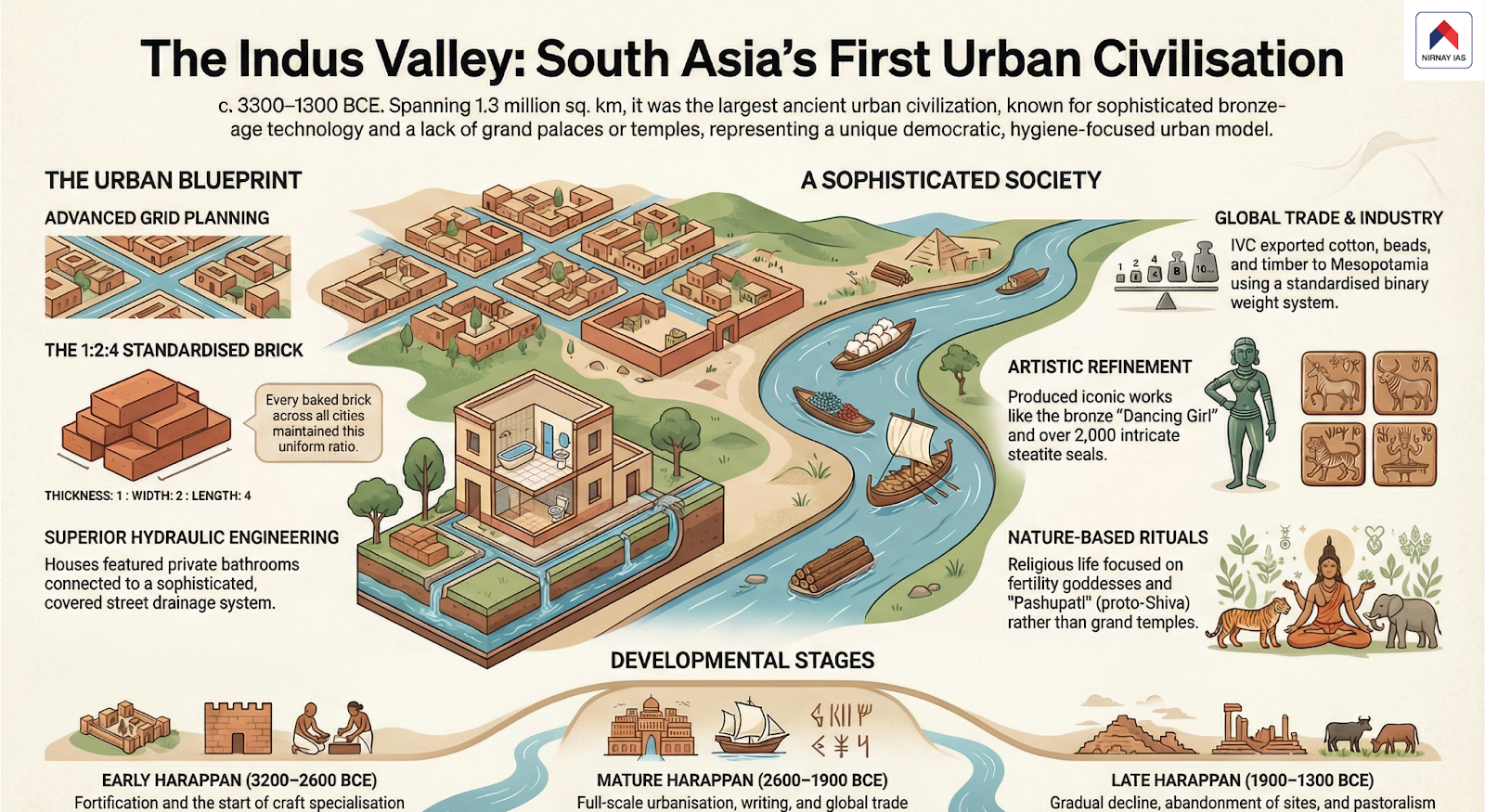
- The Indus or Harappan culture is older than the Chalcolithic cultures but is significantly more developed.
- It emerged in the northwestern part of the Indian subcontinent and is called Harappan because it was first discovered in 1921 at Harappa, located in West Punjab, Pakistan.
- Timeline and phases
- Early Harappan (3300-2600 BCE)
- Villages transformed into towns, use of copper, beads, trade starts
- Mature Harappan (2600-1900 BCE)
- Peak of urbanization, well-planned cities, trade with Mesopotamia
- Late Harappan (1900-1300 BCE)
- Decline, ruralization, loss of urban features
- Geographical Spread
- The Harappan culture extended over a vast area, covering parts of:
- Punjab, Sindh, Baluchistan, Gujarat, Rajasthan, and western Uttar Pradesh
- From Jammu (north) to the Narmada estuary (south)
- From the Makran coast of Baluchistan (west) to Meerut (northeast)
- This region formed a triangle covering approximately 1,299,600 square kilometers, making it larger than modern Pakistan and bigger than ancient Egypt and Mesopotamia.
- No other cultural zone in the third and second millennium B.C. was as extensive as the Harappan zone.
- Major Harappan Cities
- Over 250 Harappan sites have been identified, but only few are considered major cities:
- Harappa (Punjab, Pakistan)
- Mohenjo-daro (Sindh, Pakistan) - Located 483 km from Harappa, both were connected by the Indus River.
- Chanhudaro (Sindh, Pakistan) - 130 km south of Mohenjo-daro.
- Dholavira (Gujarat, India) - Water conservation, three-part city, unique stone inscriptions.
- Lothal (Gujarat, India) - Situated at the head of the Gulf of Cambay.
- Rakhigarhi (Haryana, India) - Largest Harappan site, skeletal remains.
- Kalibangan (Rajasthan, India) - Notable for pre-Harappan and Harappan phases.
- Banawali (Haryana, India) - Similar to Kalibangan, showing two cultural phases.
- These cities were highly organized with mud-brick platforms, well-planned streets, and drainage systems.
- Harappan Civilization Beyond the Core Cities
- Coastal settlements like Sutkagendor and Surkotada had citadels, indicating their significance.
- The later Harappan phase is observed in Rangpur and Rojdi in the Kathiawar peninsula, Gujarat.
- Thus, the Harappan civilization was one of the most widespread and advanced cultures of its time, characterized by its urban centers, trade networks, and technological sophistication.
- Town Planning and Structures in the Harappan Civilization
- The Harappan culture is renowned for its well-planned urban layout. Each city was divided into distinct sections, featuring systematic roads, drainage systems, public buildings, and residential areas.
- City Layout and Planning
- Harappan cities followed a grid system, where streets intersected at right angles, dividing the city into blocks.
- The cities were divided into:
- Citadel or Acropolis
- Located on a raised mound, possibly occupied by ruling elites.
- Lower Town
- Containing brick houses for common people.
- This structured layout was consistent across all Indus settlements, regardless of size.
-
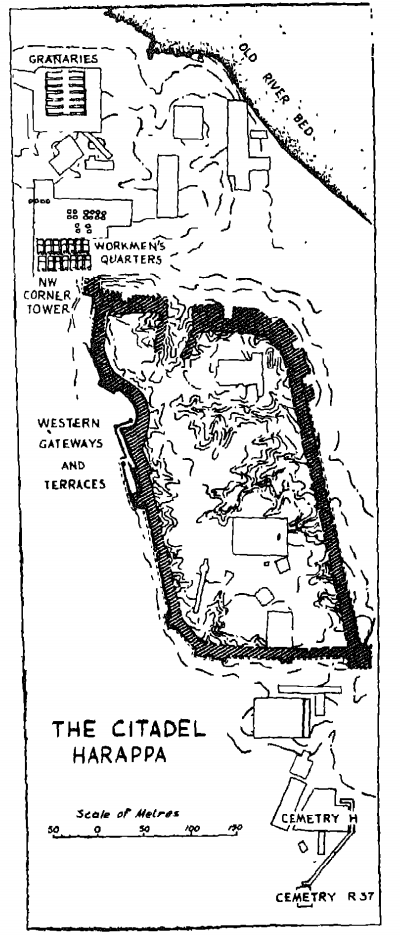
- Public Structures
- The Great Bath (Mohenjo-daro)
-
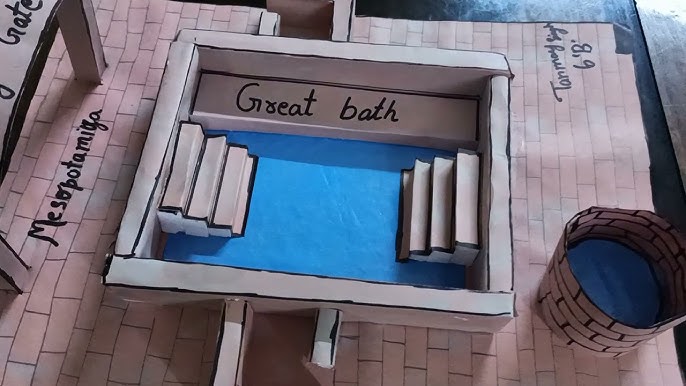
- Located on the citadel mound, it is an example of exceptional brickwork.
- Dimensions:
- 11.88 × 7.01 meters, 2.43 meters deep.
- Features:
- Flights (set of stairs between two landings) of steps on either side.
- Side rooms for changing clothes.
- Burnt brick flooring.
- Water supply from a large well in an adjacent room.
- Drainage outlet at one corner.
- Purpose: Likely used for ritual bathing, which is an important aspect of Indian religious traditions.
-
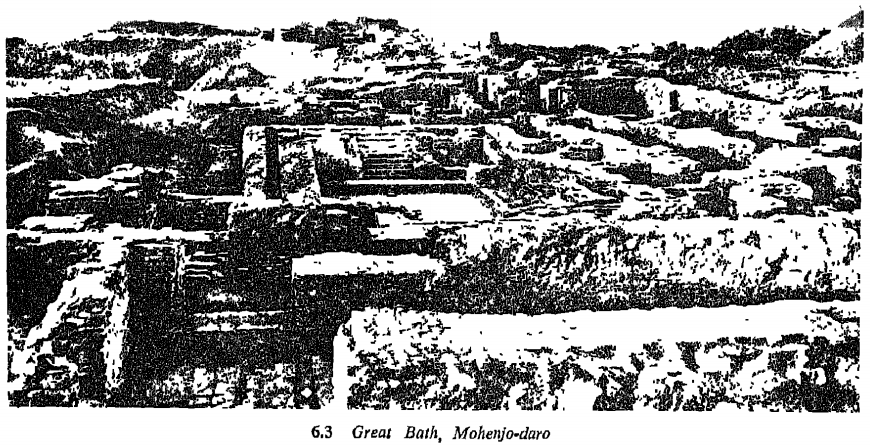
- Granaries
-
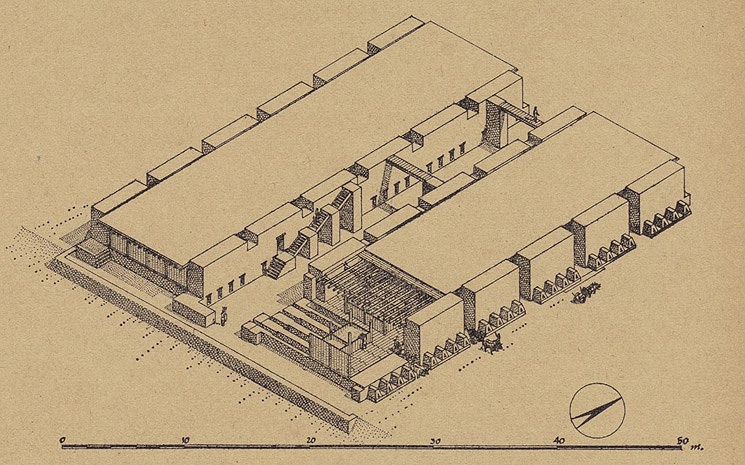
- Mohenjo-daro:
- The largest building was a granary, measuring 45.71 × 15.23 meters.
- Harappa:
- Had six granaries arranged in two rows of six, built on brick platforms near the riverbank.
- Each granary measured 15.23 × 6.09 meters.
- Total floor space was 838-1025 square meters (similar to Mohenjo-daro's Great Granary).
- Evidence of wheat and barley suggests these platforms were used for threshing grain.
- Two-roomed barracks were built nearby, possibly for laborers.
-

- Kalibangan:
- Brick platforms in the southern part were possibly used as granaries.
- Granaries were a crucial part of Harappan urban planning, highlighting organized food storage and distribution.
- Architectural Features
-
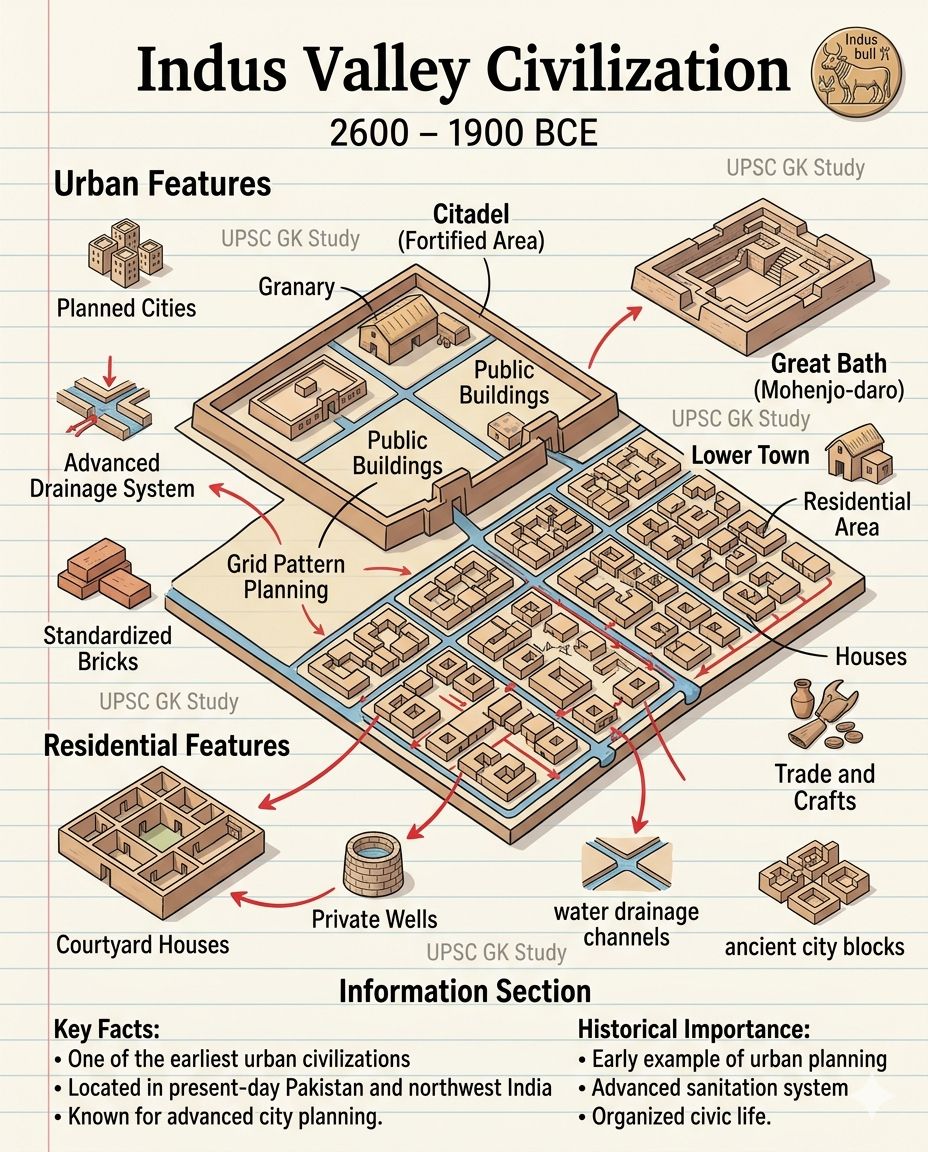
- Use of Burnt Bricks
- Harappan cities extensively used baked bricks, unlike contemporary Egyptian buildings, which relied mostly on dried bricks.
- While Mesopotamians also used baked bricks, their usage was far greater in Harappan cities.
- Drainage System
- Mohenjo-daro had an advanced drainage system that extended to almost every house.
- Features:
- Each house had a courtyard and bathroom.
- Many houses in Kalibangan had private wells.
- Wastewater drained into street drains, which were sometimes covered with bricks or stone slabs.
- Manholes were provided for maintenance.
- Remains of streets and drains have also been found at Banawali.
- The drainage system of Harappa was unique, with no other contemporary civilization giving such importance to hygiene and cleanliness.
-
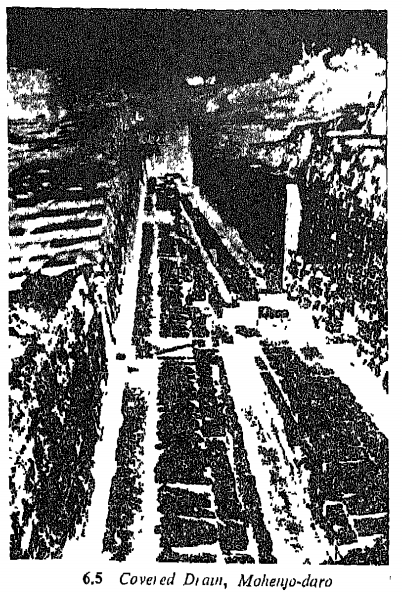
- Conclusion
- The Harappan civilization demonstrated sophisticated urban planning, with organized city layouts, advanced drainage, monumental structures, and extensive use of burnt bricks.
- Their commitment to sanitation and planning set them apart from other contemporary civilizations like Egypt and Mesopotamia.
-
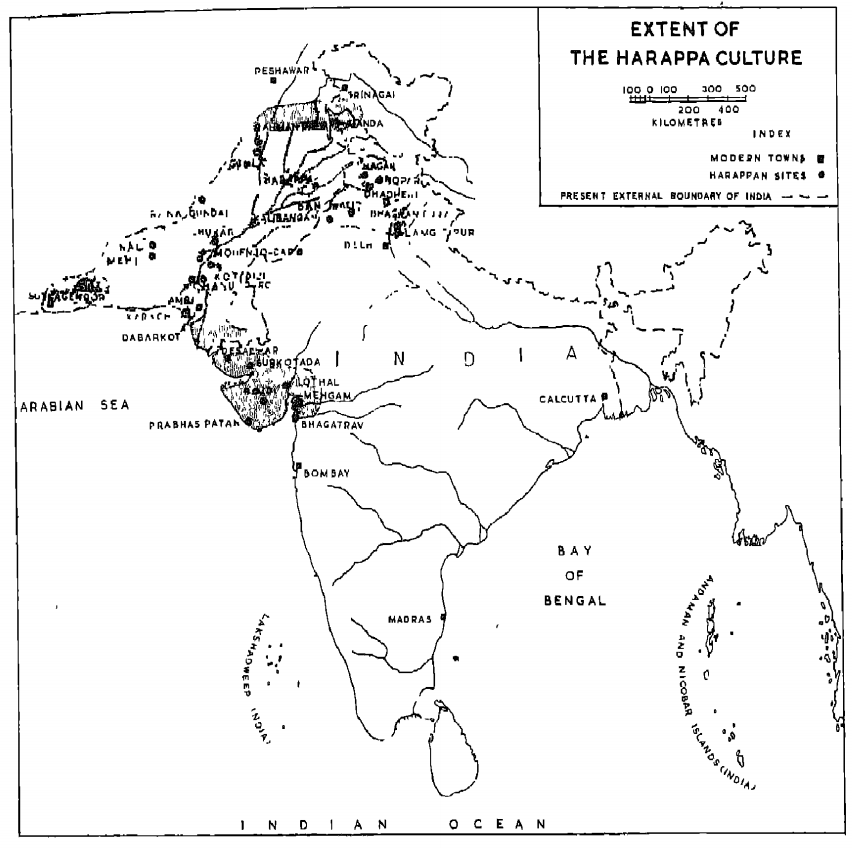
- Agriculture in the Harappan Civilization
- The Indus region, though largely rainless and infertile today, was highly fertile in ancient times, supporting prosperous villages and towns.
- Fertility and Agricultural Conditions
- Present-day rainfall in the Indus region is around 15 cm, but historical records suggest it was much more fertile in the past.
- Alexander's historians (4th century B.C.) described Sindh as a fertile region.
- The natural vegetation of the Indus Valley once attracted higher rainfall, providing timber and fuel for large-scale brick baking and construction.
- Over time, extensive agriculture, grazing, and fuel collection led to the destruction of natural vegetation.
- The annual flooding of the Indus River played a crucial role in maintaining the fertility of the land, similar to how the Nile supported Egypt.
- Burnt brick walls found in the region indicate annual floods, which deposited rich alluvial soil on the floodplains.
- Farming Practices
- Crops were sown in November, after the floodwaters receded, and harvested in April, before the next flood.
- No hoes (Hand tools with a flat blade used for digging, weeding, and loosening soil) or ploughshares (The cutting blade of a plow that turns over the soil to prepare it for planting crops) have been discovered
- However furrows (Long, narrow trenches or grooves in the soil made by a plow) found at Kalibangan (Rajasthan) suggest ploughing was practiced during the Harappan period.
- The Harappans likely used wooden ploughshares.
- It is unclear whether the plough was drawn by men or oxen.
- Stone sickles (Curved, hand-held farming tools with sharp blades used for cutting crops) may have been used for harvesting crops.
- Dams (Gubarbands or Aalas) for storing water were used in Baluchistan and Afghanistan, but there is no evidence of canal irrigation.
- Agricultural Production and Storage
- Harappan villages, mostly situated near floodplains, produced sufficient food grains to feed both themselves and city dwellers such as artisans, merchants, and administrators.
- Major crops included:
- Wheat and barley (two types of each).
- Rice (evidence from Lothal, c. 1800 B.C.).
- Peas, sesame, and mustard.
- Banawali has yielded a large quantity of barley.
- Granaries in Mohenjo-daro, Harappa, and possibly Kalibangan stored food grains.
- Cereals were likely collected as taxes from peasants and used to pay wages, similar to Mesopotamian cities, where wages were paid in barley.
- Cotton production:
- The Indus people were the first to produce cotton.
- The Greek word “sindon” (meaning cotton) is derived from Sindh, indicating its early origins in the region.
- Conclusion
- The Harappan civilization had a well-developed agricultural system that relied on flood-based farming.
- They cultivated a variety of crops, stored surplus grains, and supported a complex urban economy, making them one of the earliest agrarian (Related to farming, agriculture, or rural life) societies in history.
- Domestication of Animals in the Harappan Civilization
- While agriculture was a primary occupation, the Harappans also practiced large-scale animal domestication.
- Domesticated Animals
- Common domesticated animals included:
- Oxen, buffaloes, goats, sheep, and pigs.
- Humped bulls were especially favored.
- Pets:
- Dogs were kept from the very beginning.
- Cats were also domesticated, as evidenced by paw prints found in excavations.
- Beasts of burden:
- Asses and camels were likely used for transport and carrying loads.
- Evidence of the Horse
- The presence of horses in Harappan culture is debated:
- A doubtful terracotta figurine of a horse was found in Lothal.
- Horse remains have been reported from Surkotada (Gujarat, c. 2000 B.C.).
- A superficial level of Mohenjo-daro also yielded some evidence.
- However, the horse was not in regular use during the Harappan period.
- Wild Animals
- Elephants were well known to the Harappans and domesticated in some regions.
- Rhinoceroses were also familiar to them.
- Comparison with Mesopotamian Civilization
- Both Harappan and Sumerian (Mesopotamian) civilizations produced similar food grains and domesticated many of the same animals.
- However, the Harappans in Gujarat had two distinct features:
- They cultivated rice, which was not common in Mesopotamia.
- They domesticated elephants, unlike the Mesopotamians.
- Conclusion
- The Harappans had a well-developed system of animal domestication, which supported agriculture, transport, and daily life.
- While common livestock were widely used, the horse played a minimal role, and the domestication of elephants set them apart from their Mesopotamian counterparts.
- Technology and Crafts in the Harappan Civilization
- The Harappan culture belonged to the Bronze Age, with significant advancements in metallurgy, crafts, and construction.
- Metallurgy and Tool-making
- The Harappans primarily used stone tools and implements, but they were also skilled in bronze-making.
- Bronze was created by mixing tin with copper, though both metals were not easily available, making bronze tools relatively scarce.
- Sources of metals:
- Copper was mainly obtained from the Khetri mines in Rajasthan and possibly from Baluchistan.
- Tin was likely sourced from Afghanistan, though old workings in Hazaribagh, Bihar, suggest local extraction.
- Bronzesmiths played a vital role in Harappan society, producing:
- Tools like axes, saws, knives, and spears.
- Utensils and images.
- Craft Industries
- Several crafts flourished in Harappan towns, showcasing their technological expertise:
- Textile Industry:
- A piece of woven cotton was found at Mohenjo-daro, along with textile impressions on various objects.
- Spindle whorls were used for spinning wool and cotton.
- Spindle whorls
-
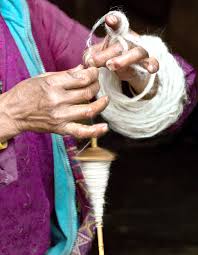
- Small, disc-shaped objects made of clay, bone, stone, or metal, used in spinning to maintain the momentum of a spindle while twisting fibers into thread or yarn.
- The Harappans were skilled weavers.
- Construction & Masonry:
- Huge brick structures indicate that brick-laying was a well-developed craft.
- This suggests the existence of a class of masons who specialized in construction.
- Boat-making:
- The Harappans were familiar with shipbuilding and boat-making, facilitating trade and transport.
- Seal-making & Terracotta Manufacturing:
- Seals and terracotta figurines were widely produced, signifying advanced artistic skills.
- Jewelry & Bead-making:
- Goldsmiths crafted jewelry using:
- Gold & silver (likely obtained from Afghanistan).
- Precious stones (probably sourced from South India).
- Bead-making was a specialized craft, and Harappans were experts in making intricate beads
- What is a bead?
-
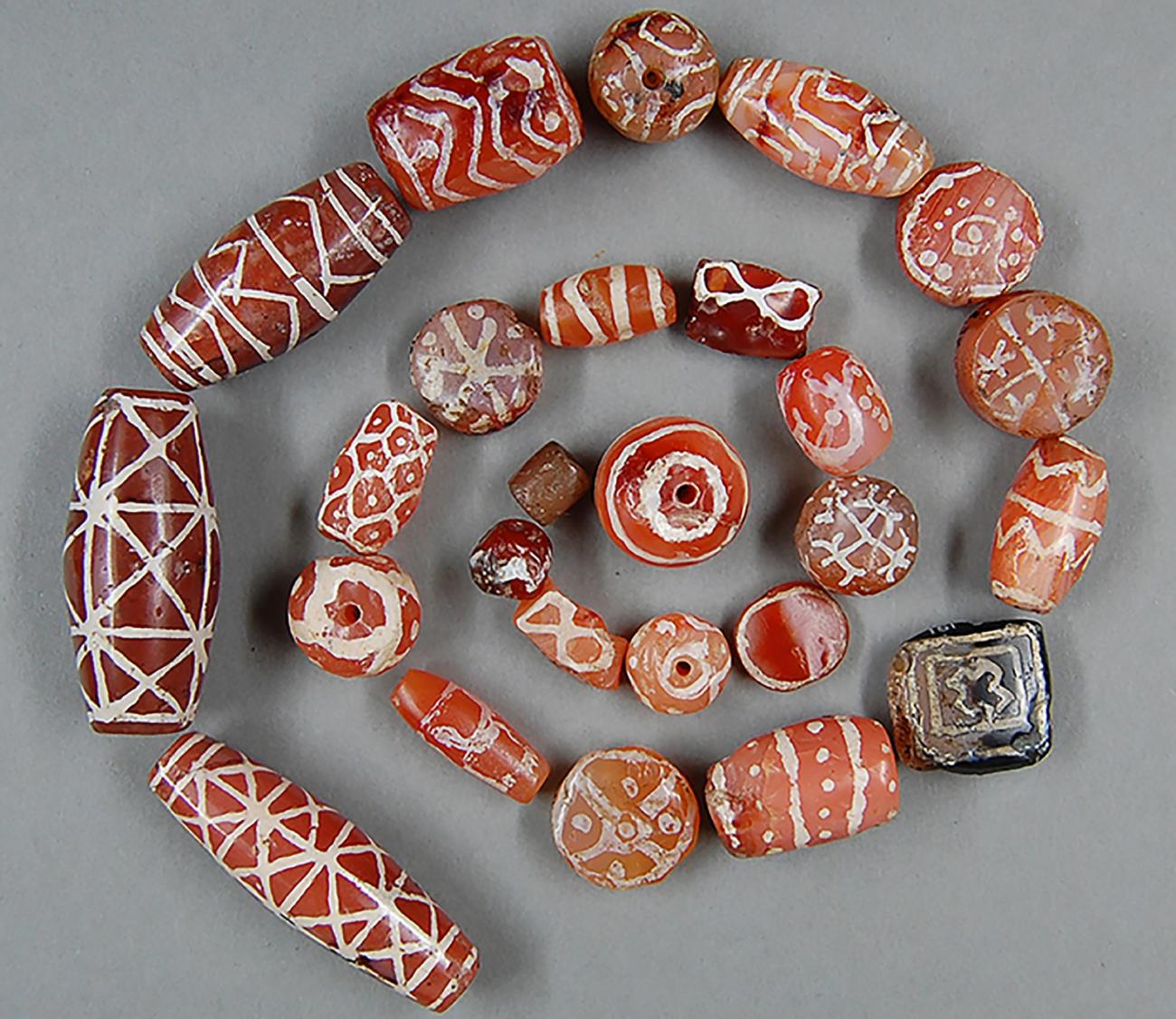
- A small, typically round object made of materials like glass, stone, shell, metal, or clay, often used in jewelry, decoration, or as trade items in ancient cultures.
- Pottery:
- The potter's wheel was extensively used.
- Harappan pottery was glossy and shining, indicating advanced ceramic techniques.
- Conclusion
- The Harappans displayed remarkable craftsmanship and technological skills in various fields, including metallurgy, textiles, construction, jewelry-making, and pottery.
- Their expertise in bronze-working and intricate crafts highlights their highly organized urban economy and sophisticated culture.
- Trade in the Harappan Civilization
- The Harappans engaged in extensive trade, both within the Indian subcontinent and with distant lands such as Mesopotamia, Afghanistan, and Iran.
- Since their cities lacked many essential raw materials, they relied on trade to acquire necessary resources.
- Mode of Trade and Transportation
- Barter System:
- The Harappans did not use metallic money, and there is no evidence of any standardized currency.
- They likely exchanged finished goods and food grains for raw materials through barter.
- Means of Transport:
- Boats and bullock ( two-wheeled or four-wheeled carts pulled by oxen (bullocks)) carts were used for trade and transportation.
- They practiced navigation along the Arabian Sea coast.
- The wheel was well known, and carts with solid wheels were commonly used in Harappa.
- They may have also used a single-horse cart, similar to the modern-day ekka.
-
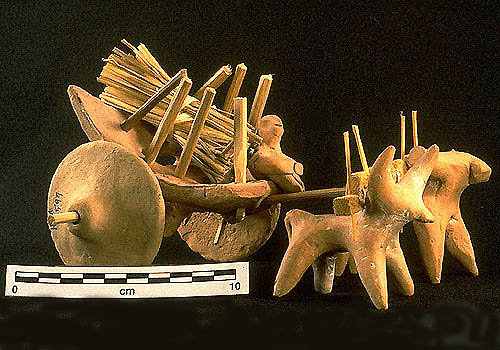
- Internal and External Trade
- Trade within India:
- The Harappans maintained commercial links with:
- Rajasthan (possibly for copper).
- Afghanistan (for lapis lazuli and other stones).
- Iran (for metals and luxury goods).
- Trade with Mesopotamia:
- The Harappan cities actively traded with those in the Tigris and Euphrates region (Mesopotamia).
- Harappan seals have been found in Mesopotamia, indicating direct contact.
- The Harappans may have adopted some Mesopotamian cosmetics and cultural influences.
- Meluha - The Indus Connection:
- Mesopotamian records (c. 2350 B.C.) mention trade with Meluha, which refers to the Indus region.
- These texts also mention two intermediate trading stations:
- Dilmun
- Likely Bahrain, an important port city
- Thousands of graves in Dilmun remain to be excavated, suggesting its importance in ancient trade.
- Makan
- Possibly Oman or the Makran coast
- Conclusion
- Trade played a vital role in the Harappan economy, allowing them to obtain metals, stones, and luxury goods from distant regions.
- Their advanced transportation system, navigation skills, and extensive trade links with Mesopotamia, Afghanistan, and Iran highlight their well-developed commercial network.
- Political Organization of the Harappans
- The political structure of the Harappan civilization remains unclear due to a lack of direct evidence. Unlike contemporary civilizations such as Egypt and Mesopotamia, no palaces or inscriptions indicating kingship have been found.
- Absence of Religious Rule
- No evidence of temple-based governance:
- In Mesopotamia, cities were ruled by priest-kings who controlled both political and religious affairs.
- However, Harappan sites lack large temples, except for structures like the Great Bath, which may have had ritual significance.
- This suggests that priests did not dominate political life.
- Limited evidence of religious influence:
- Some indications of a fire cult have been found at Kalibangan and Lothal.
- However, no large-scale temple structures or records of theocratic rule exist.
- Theocratic rule
- A system of government where religious authorities govern the state or laws are based on religion
- Possible Merchant Rule
- The Harappan rulers may have prioritized trade and economic stability over military expansion.
- The absence of grand palaces and military fortifications suggests a non-militaristic administration.
- Given the importance of long-distance trade, it is possible that merchants played a significant role in governance.
- Evidence of Centralized Administration
- Urban planning and uniformity in weights and measures indicate strong administrative control.
- The widespread use of standardized bricks and well-planned drainage systems suggests coordinated governance.
- The presence of large granaries at Harappa and Mohenjo-Daro indicates organized resource management, possibly under state supervision.
- Conclusion
- While the exact political structure remains uncertain, the lack of evidence for kingship or military conquests suggests that Harappan governance may have been commercial or administrative in nature, possibly controlled by a group of elites rather than a single ruler.
- Religious Practices of the Harappans
- The Harappan civilization had a deep connection with fertility worship, as suggested by numerous terracotta figurines discovered at excavation sites.
- Worship of the Earth Goddess
- A common terracotta figurine depicts a woman with a plant growing from her womb, likely symbolizing the goddess of fertility and earth.
- The Harappans revered the earth as a fertility goddess, similar to how the Egyptians worshipped the Nile goddess, Isis.
- Unclear Social Structure
- While Egyptians followed a matriarchal system, where daughters could inherit the throne or property, there is no conclusive evidence about Harappan inheritance laws.
- Influence on Later Hinduism
- Some Vedic texts mention the earth goddess, though she was not highly prominent.
- The concept of a supreme goddess took shape much later in Hinduism.
- By the 6th century A.D., various mother goddesses such as Durga, Amba, Kali, and Chandi were widely worshipped.
- Eventually, each village came to have its own local deity, reflecting the deep-rooted tradition of goddess worship.
-

- The Male Deity in the Indus Valley
- Depiction on a Seal
-
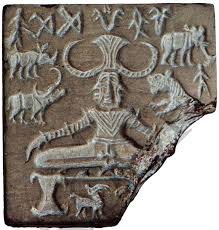
- A male deity is represented on a Harappan seal.
- He has three heads and horns and sits in a yogic posture, with one foot placed on the other.
- The deity is surrounded by an elephant, tiger, and rhinoceros, with a buffalo below his throne.
- Two deer appear at his feet.
- Resemblance to Pasupati Mahadeva
- The seal closely resembles the traditional image of Pasupati (Lord of Animals), a form of Siva.
- The four animals surrounding the deity may symbolize the four directions, similar to the later Hindu belief where each god has a vehicle.
- Phallus Worship and Later Hinduism
- Phallus (symbolic representation of the male reproductive organ) worship (Linga worship) was practiced in Harappa, as evidenced by numerous stone symbols of the phallus and female sex organs found at excavation sites.
- This form of worship later became intimately connected with Lord Siva in Hinduism.
- The Rig Veda mentions non-Aryan people who practiced phallus worship, indicating its ancient origins.
- Over time, phallus worship, which began in the Indus Valley, was accepted as a respectable religious practice in Hindu society.
- Tree and Animal Worship in the Indus Valley
- Tree Worship
- The people of the Indus region worshipped trees.
- A seal depicts a god seated among the branches of a pipal tree, a tree that continues to be worshipped in India today.
- Animal Worship
- Animals were revered, as seen in their representation on seals.
- The humped bull was particularly significant; even today, pious Indians give way to such bulls in market streets.
- The animals surrounding Pasupati Mahadeva suggest that they were also worshipped.
- Forms of Worship
- The Harappans worshipped gods in the form of trees, animals, and human beings.
- Unlike Egypt and Mesopotamia, they did not place their gods in temples.
- Use of Amulets
- An amulet is a small object worn or carried to bring good luck, protection, or ward off evil spirits.
- Many amulets have been discovered, suggesting that the Harappans believed in ghosts and evil forces.
- They likely used amulets as protection against harm.
- The Atharva Veda (differes significantly from other three vedas) also mentions charms, spells, and amulets for warding off diseases and evil forces.
-
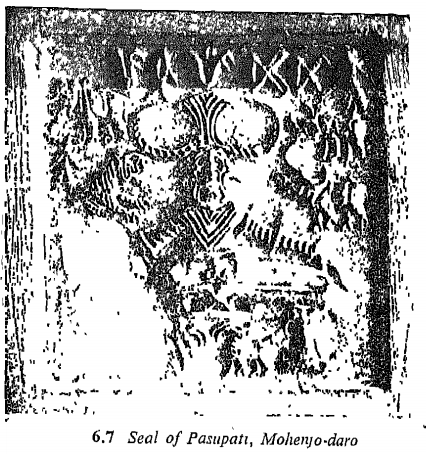
- The Harappan Script
- Invention and Discovery
- The Harappans invented writing, similar to the Mesopotamians.
- The earliest specimen of the Harappan script was found in 1853, with the complete script discovered by 1923.
- However, it remains undeciphered.
- Attempts at Decipherment (converted into a readable or understandable form)
- Scholars have attempted to connect it with:
- Dravidian or proto-Dravidian language.
- Sanskrit language.
- Sumerian language.
- However, none of these interpretations are conclusive.
- As a result, we cannot determine the Harappan literary contributions, beliefs, or ideas.
- Characteristics of the Script
- Unlike Egyptians and Mesopotamians, the Harappans did not write long inscriptions.
- Most inscriptions appear on seals and contain only a few words.
- These seals may have been used by propertied individuals to mark ownership.
- The script consists of 250 to 400 pictographs.
- Each letter is a pictogram, representing a sound, idea, or object.
- The script is not alphabetical, but pictographic.
- Comparison with Other Scripts
- Some efforts have been made to compare it with Mesopotamian and Egyptian scripts.
- However, it is an indigenous script, unique to the Indus region, with no connection to the scripts of Western Asia.
- Weights, Measures, and Artistic Creations of the Harappans
- Weights and Measures
- The Harappans likely used their script for recording private property and account-keeping.
- Trade and transactions required weights and measures, and numerous weight articles have been discovered.
- The Harappans primarily used the unit of 16 and its multiples:
- 16, 64, 160, 320, and 640.
- This tradition of 16 continued in India, as 16 annas once made a rupee.
- Harappans also possessed measurement tools:
- Measuring sticks with inscribed marks.
- One such stick was made of bronze.
- Harappan Pottery
- The Harappans were skilled in using the potter's wheel.
-

- Their pottery was painted in various colors and decorated with:
- Tree designs.
- Circles.
- Human images (found on some pottery fragments).
-
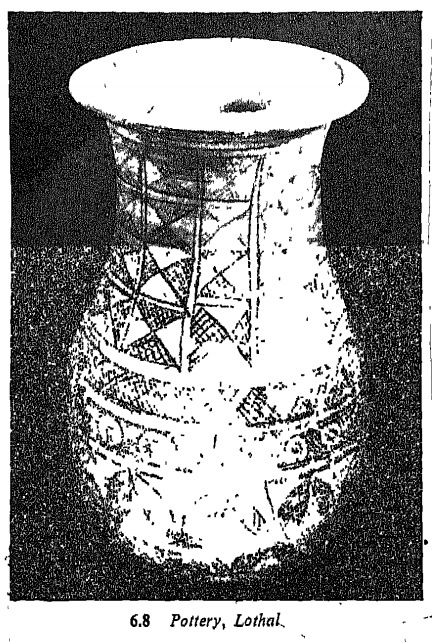
- Seals
- The greatest artistic achievement of the Harappans was their seals.
- Around 2000 seals have been discovered, with the majority featuring:
- Short inscriptions.
- Animal depictions, including:
- One-horned bull (unicorn bull).
- The "unicorn" label is due to the single horn depicted, but it's thought to be a profile view of a bull, where only one horn is visible.
- Buffalo.
- Tiger.
- Rhinoceros.
- Goat.
- Elephant.
-
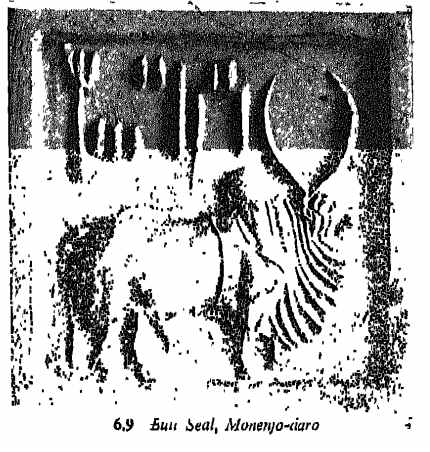
-
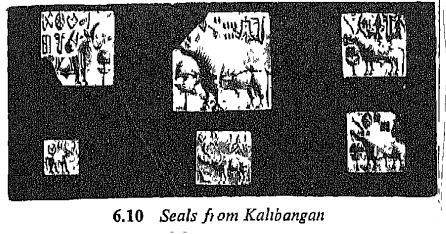
- Images
- The Harappan artisans created beautiful metal images.
-
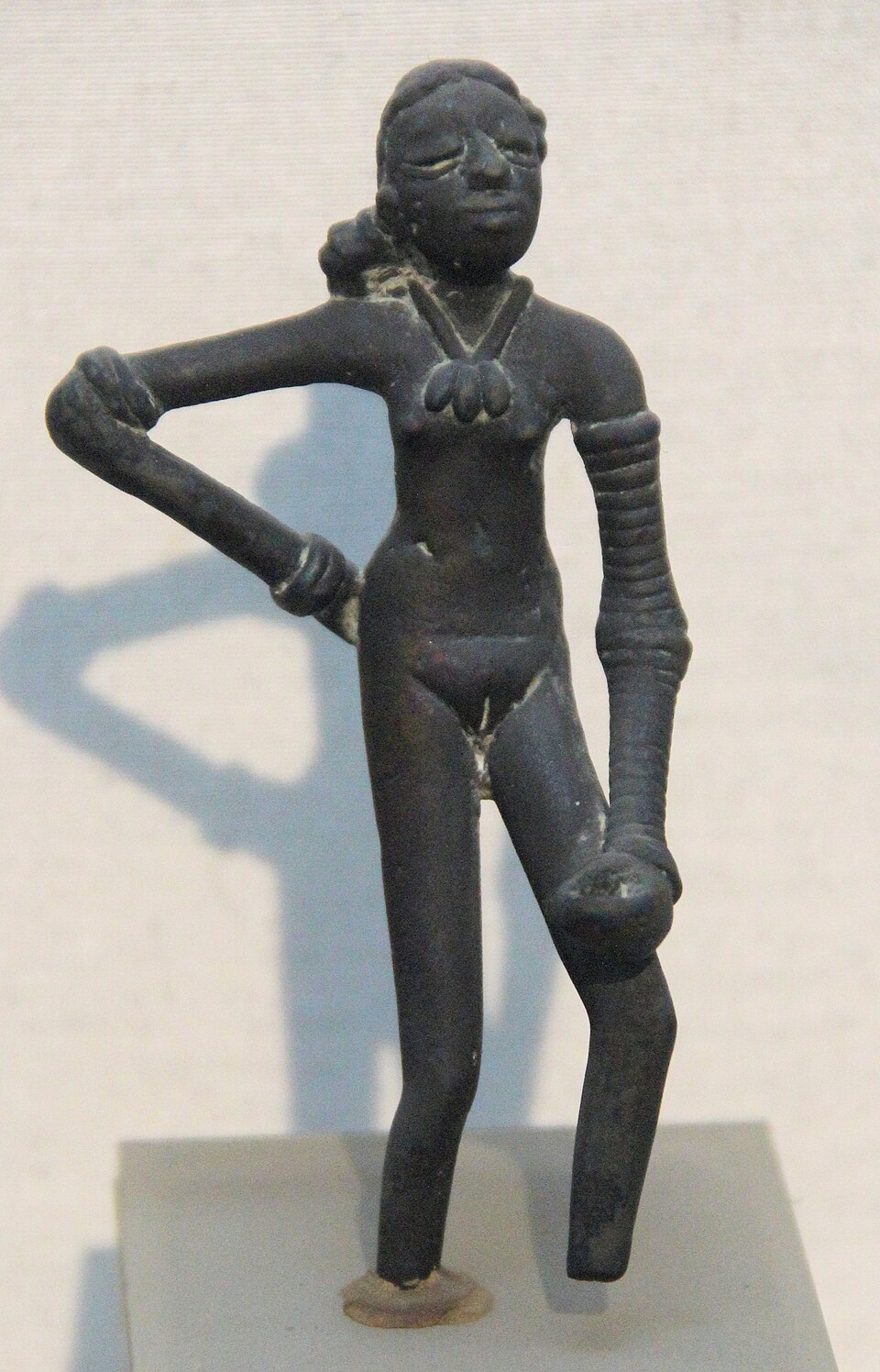
- The bronze statue of a woman dancer is the most notable specimen:
- The figure is naked except for a necklace.
- A few Harappan stone sculptures have also been found, including:
- A steatite statue with:
- An ornamented robe draped over the left shoulder and under the right arm.
- Short locks at the back, kept tidy with a woven fillet.
-

- Terracotta Figurines
- Terracotta figurines, made of fire-baked clay, were common.
- These figurines were likely used as toys or worship objects.
- They depicted:
- Birds.
- Dogs.
- Sheep.
- Cattle.
- Monkeys.
- Human figures (women outnumber men).
- Contrast in craftsmanship:
- Skilled craft
- Seals and metal images were crafted with great skill, likely for the upper classes.
- Simpler craft
- Terracotta pieces were simpler and likely used by common people.
- Unlike Egypt and Mesopotamia, the Harappan civilization produced fewer artistic works in stone.
- No massive stone sculptures similar to those of ancient Egypt and Mesopotamia have been found.
- Origin, Maturity, and End of the Harappan Culture
- Timeframe and Maturity
- The Harappan culture existed from c. 3300 BCE to 1300 BCE, with it's different phases as exaplained at beginning.
- Throughout its existence, the civilization maintained uniformity in:
- Tools and weapons.
- Town planning.
- Seals and terracotta works.
- Long chert blades.
- However, changes did occur, such as variations in pottery at Mohenjo-daro over time.
- Around 1750 B.C., the key cities Harappa and Mohenjo-daro disappeared, while other settlements faded gradually, continuing in a degenerate phase in:
- Gujarat.
- Rajasthan.
- Western Uttar Pradesh.
- Origins of the Harappan Culture
- The origin of the Harappan culture remains unclear.
- Several pre-Harappan settlements were found in:
- Baluchistan.
- Kalibangan (Rajasthan).
- The connection between these and the mature Harappan culture is uncertain, though it may have evolved indigenously.
- There is no clear proof of outside influence, though contacts with Mesopotamian cities might have provided some stimulus.
- Unique Features of the Harappan Culture
- Despite external contacts, the Harappan culture was distinctly Indian.
- Features that set it apart from contemporary civilizations like Mesopotamia:
- Planned cities with a chessboard layout, including:
- Straight streets.
- Drainage pipes and cesspits.
- Rectangular houses with:
- Brick-lined bathrooms.
- Wells.
- Stairways (found in all Harappan cities).
- Advanced drainage system, unparalleled in antiquity, except for:
- Crete (Knossos).
- Superior use of burnt bricks, a technique not as advanced in Western Asia.
- Unique pottery and seals, depicting the local animal world.
- Distinctive script, bearing no resemblance to Egyptian or Mesopotamian scripts.
- Though part of the Bronze Age, Harappans used bronze sparingly and still relied heavily on stone implements.
- The Harappan culture covered a vast area, unmatched by any other contemporary civilization:
- Harappa's structures spanned 5 km in circuit, making it the largest known Bronze Age urban complex.
- Decline and Theories of Disappearance
- While Mesopotamian cultures continued beyond 1750 B.C., the Harappan civilization declined rapidly.
- Various theories have been proposed for its disappearance:
- Environmental Factors:
- Soil salinity increase due to desert expansion, leading to decreased fertility.
- Economic Decline
- Trade collapse, agriculture issues
- Natural Disasters and climate change:
- Sudden land subsidence or uplift, triggering floods.
- Possible shifts in monsoon patterns
- Aryan Invasion Theory (Disputed):
- The Harappan culture might have been destroyed by the Aryans.
- Signs of Transition and New Influences
- Decline in Urban Planning
- In the later phase, houses were built over older structures in a more haphazard manner, and street planning became irregular.
- In the declining phase, drainage systems became clogged, garbage accumulated in streets and homes, and public hygiene deteriorated
- As the civilization weakened, local governance structures eroded, leading to poor maintenance of urban infrastructure.
- Later phases of Harappan culture indicate gradual changes due to incoming new people:
- New tools and pottery emerged in the Indus basin.
- Signs of insecurity and violence at Mohenjo-daro:
- Hoarded jewelry.
- Clustered human skulls.
- New weapon types appeared in later Mohenjo-daro levels, including:
- Axes.
- Daggers.
- Knives with midribs and flat tangs.
- Cemetery evidence at late Harappan sites suggests the arrival of new groups:
- New pottery styles at Harappa and Baluchistan.
- Painted Grey Ware (associated with Vedic culture) found at:
- Punjab and Haryana, mixed with late Harappan pottery.
- Aryan Influence and Lack of Direct Conflict
- Some scholars attribute the changes to barbarian, horse-riding people from Iran entering through the hills.
- However, the newcomers were not in overwhelming numbers and did not completely replace the Harappan cities in Punjab and Sindh.
- The Rig Vedic Aryans later settled in the Seven Rivers region, previously occupied by the Harappans, but:
- No mass-scale confrontation between the Harappans and Aryans has been recorded.
- Advent of the Aryans and the Age of the Rig Veda
- Rig veda
- Rig veda was composed orally around 1500 BCE - 1200 BCE but writing was developed by that time, so it was was written around 500–100 BCE (or even later).
- It was passed through guru–shishya tradition, this oral system was extremely precise (no need for writing initially)
- Clear evidence of writing appears during the Maurya Empire (3rd century BCE) with the inscriptions of Ashoka in Brahmi script
- Original Home and Identity of the Aryans
- Origins and Linguistic Connections
- The Aryans spoke Indo-European languages, which are now found across Europe, Iran, and the Indian subcontinent in various modified forms.
- Their original homeland is believed to be east of the Alps in Eurasia. However, modern throries suggest that aryans were nomadic pastoralists from the Central Asian Steppe (southern Russia, Kazakhstan).
- Evidence from common words in Indo-European languages for animals (e.g., goats, dogs, horses) and plants (e.g., pine, maple) suggests that they were familiar with the fauna and flora of Eurasia.
- They knew rivers and forests but had fewer common words for mountains, despite crossing many hills.
- Early Life and Migration
- The Aryans primarily led a pastoral life, with agriculture as a secondary occupation.
- Due to their nomadic lifestyle, they did not leave behind solid material remains.
- The horse played a crucial role in their mobility and warfare, helping them and allied groups expand into Western Asia from 2000 B.C. onwards.
- Aryans in Iran and Westward Movement
- Before reaching India, the Aryans first appeared in Iran, where they lived for a long time alongside the Indo-Iranians.
- Connections with Iranian culture:
- The Rig Veda (India's earliest Indo-European text) and the Avesta (Iran's oldest text) share similar gods and social class names.
- The Kassite inscriptions (1600 B.C.) and the Mitanni inscriptions (14th century B.C.) in Iraq also mention Aryan names, suggesting that some Aryans migrated westward from Iran.
- Aryans in India
- Around 1500 B.C., the Aryans entered India in multiple waves.
- Their earliest settlements were in:
- Eastern Afghanistan
- Punjab
- Western Uttar Pradesh
- The Rig Veda mentions several rivers in this region, including:
- Sindhu (Indus) - the most frequently mentioned river
- Sarasvati - now lost, identified with the Ghaggar river
- Kubha - a river in Afghanistan
- They possibly obtained copper from the Khetri mines in Rajasthan.
- This area was referred to as the “Land of the Seven Rivers.” (northwestern part of the Indian subcontinent).
- Rivers included
- Sindhu (Indus)
- Vitasta (Jhelum)
- Asikni (Chenab)
- Parushni (Ravi)
- Vipasha (Beas)
- Sutudri (Sutlej)
- Sarasvati (now-lost river)
- Conflict with Indigenous People
- The first wave of Aryans, the Rig Vedic people, arrived around 1500 B.C.
- They encountered indigenous inhabitants called dasas and dasyus.
- The dasas appear in both the Rig Veda and Iranian texts, suggesting they were possibly a branch of early Aryans.
- The dasyus may have been the original inhabitants of the region, differing from the Aryans in culture and religious practices.
- The Rig Veda describes conflicts, including:
- The defeat of Sambara (Dasyu chief) by Divodasa (a leader from the Bharata clan, an Aryan group).
- Trasadasyu, an Aryan chief, was known for subduing the dasyus.
- The term dasyuhatya (“slaughter of the dasyus”) is frequently mentioned.
- The dasyus may have worshipped the phallus and did not rely on cattle for dairy products.
- Tribal Conflicts Among the Aryans
- Weapons and Military Advantages
- The exact weapons of the Aryans' adversaries remain largely unknown.
- However, the Rig Veda describes Indra as “Purandara” (Breaker of Forts), suggesting that Aryans attacked fortified settlements.
- Some of these forts may have been Harappan settlements, though this is uncertain.
- The Aryans' military superiority came from:
- Horse-drawn chariots, introduced for the first time in West Asia and India.
- Coats of mail (varman) (A type of protective armor made of interlinked metal rings) and advanced weaponry.
- Types of Conflicts
- The Aryans engaged in two types of conflicts:
1. Wars against the pre-Aryans (possibly the Harappans or indigenous tribes).
2. Inter-tribal conflicts among different Aryan groups.
- Inter-Tribal Rivalries
- The Aryans were divided into five tribes, known as panchajana.
- They often fought among themselves and even allied with non-Aryan groups at times.
- The Bharatas and Tritsu were the dominant ruling clans, supported by the priest Vasishtha.
- They were both Indo-Aryans
- The name Bharatavarsha (India) originates from Bharata, first mentioned in the Rig Veda.
- The Battle of Ten Kings
- One of the most significant inter-tribal conflicts was the Battle of Ten Kings.
- It was fought on the river Parushni (modern Ravi).
- The battle was between:
- The Bharatas (led by King Sudas).
- A confederation of ten kings, consisting of:
- Five Aryan tribal chiefs.
- Five non-Aryan tribal leaders.
- Outcome:
- Sudas and the Bharatas emerged victorious, establishing their dominance.
- Among the defeated groups, the Purus were the most significant.
- Later, the Bharatas allied with the Purus, forming a new ruling tribe called the Kurus.
- The Kurus merged with the Panchalas, establishing their rule in the upper Gangetic basin, where they played a crucial role in later Vedic history.
- Material Life of the Rig Vedic Aryans
- Weapons and Tools
- The Rig Vedic Aryans owed their success in India to their horses, chariots, and possibly advanced bronze weapons.
- However, no archaeological evidence of these bronze weapons has been found.
- They likely used copper from the Khetri mines in Rajasthan.
- Agriculture and Craftsmanship
- The Rig Vedic Aryans had knowledge of agriculture:
- The ploughshare is mentioned in the earliest part of the Rig Veda (some believe it is an interpolation).
- This ploughshare was possibly made of wood.
- They were familiar with sowing, harvesting, and threshing.
- They had an understanding of different seasons.
- Various craftsmen and artisans are mentioned in the Rig Veda, including:
- Carpenters
- Chariot-makers
- Weavers
- Leather workers
- Potters
- The term ayas (meaning copper or bronze) suggests that metalworking was known.
- Pastoral Economy and Wealth
- Despite agricultural knowledge, pastoralism was central to their economy.
- The cow was the most important form of wealth:
- Most wars were fought for cattle, as indicated by the Rig Vedic term for war, gavisthi (search for cows).
- Gifts to priests were made in terms of cows and women slaves, not land.
- Land was not a well-established form of private property.
- Archaeological Evidence
- Excavations at Bhagwanpura (Haryana) and three sites in Punjab have uncovered:
- Painted Grey Ware alongside late Harappan pottery.
- These finds are dated to 1600 B.C.-1000 B.C., roughly aligning with the Rig Vedic period.
- Tribal Polity in the Rig Vedic Period
- The Role of the King (Rajan)
- The tribal chief (rajan) was at the center of the administration, mainly due to his successful leadership in war.
- The position of the king was largely hereditary, though some traces of election by the tribal assembly (samiti) existed.
- His primary duties included:
- Protecting the tribe and its cattle.
- Fighting wars on behalf of the tribe.
- Offering prayers to the gods for the tribe's welfare.
- Tribal Assemblies
- Several tribal assemblies played an important role in governance, including:
- Sabha
- A smaller, select body of elders and important persons
- Likely composed of nobles, priests, and influential members
- Functions:
- Advised the king
- Acted as a judicial body (settling disputes)
- Discussed important policies
- Samiti
- A larger, general assembly of the tribe (vis)
- More democratic in nature compared to Sabha
- Functions:
- Elected or confirmed the king
- Discussed major political decisions (war, alliances)
- Represented the will of the people
- Vidatha
- The earliest assembly (even before Sabha and Samiti)
- Had multi-functional roles:
- Religious (rituals, sacrifices)
- Military (war planning)
- Economic (distribution of resources)
- Included both men and women (important point)
- Gana
- Refers to a tribal group or clan, not exactly an assembly
- Later evolved into republican states (Gana-sanghas)
- These assemblies had deliberative, military, and religious functions.
- Women participated in the sabha and vidatha.
- The sabha and samiti were the most influential political bodies, and kings sought their support.
- Administrative Functionaries
- The king was assisted by key officials, including:
- Purohita (chief priest):
- Played a crucial role in advising and inspiring the king.
- Two important priests were Vasishtha and Visvamitra, who praised tribal chiefs in exchange for rewards (cows, women slaves, etc.).
- Senani (military commander):
- Led warriors into battle.
- Used spears, axes, and swords in combat.
- No officer was responsible for tax collection. Instead, the king received:
- Dana (voluntary gifts) from people.
- Spoils of war, which were possibly distributed in assemblies.
- No official for justice administration is mentioned, but:
- Theft and burglary (especially cattle theft) were known crimes.
- Spies were used to monitor unlawful activities.
- Territorial Administration and Local Officials
- Titles of officials did not indicate a structured territorial administration.
- Some officers were attached to specific lands, such as:
- Vrajapati (officer over pasture lands)
- "Vraja" refers to a pasture or enclosure for cattle and "Pati" means lord/master
- Gramani (originally a leader of a small tribal unit):
- Initially, led warriors in battle.
- Later became the head of the village, eventually merging with the vrajapati.
- Military and Expansion
- No regular standing army was maintained. Instead, a militia was mustered (Gathered or assembled) in times of war.
- Military duties were carried out by tribal groups, such as:
- Wara
- Gana
- Grama
- Sardia
- The government remained tribal and military in nature.
- There was no organized civil or territorial administration because the Aryans were in a constant state of migration and expansion.
- Tribe and Family in the Rig Vedic Period
- Kinship and Tribal Identity
- Kinship formed the foundation of the social structure.
- A person's clan identity was crucial, as seen in the names of several Rig Vedic kings.
- Primary loyalty was given to the tribe (jana), rather than to any specific territory.
- The term jana appears 275 times in the Rig Veda.
- The term janapada (territory) is not mentioned at all, indicating that territory or kingdoms were not yet established.
- Tribal Organization
- Another significant term for a tribe in the Rig Veda is vis, which appears 170 times.
- The vis was further divided into grama (smaller tribal units), primarily for warfare.
- Inter-grama conflicts led to samgrama (war).
- The vaisya varna (social class) emerged from the vis, which consisted of the mass of tribal people.
- Family Structure (Kula and Griha)
- The term kula (family) is rarely mentioned in the Rig Veda.
- A more common term for the family unit was griha (household).
- The Rig Vedic family was large and joint, including not only parents and children but also slaves and extended relatives.
- The same word was used for nephew, grandson, cousin, etc., suggesting that family differentiation had not advanced much.
- It was a patriarchal society, with the father as the head of the family (similar to Roman society).
- Multiple generations lived under the same roof, reinforcing the joint family system.
- Sons were highly valued, as they were seen as warriors.
- Prayers for sons appear frequently in Rig Vedic hymns.
- There is no expressed desire for daughters, though prayers for children and cattle are common.
- Status of Women
- Women had some rights and social presence:
- They could attend assemblies.
- They could perform sacrifices alongside their husbands.
- Some women composed hymns:
- The Rig Veda mentions five women who composed hymns.
- Later texts mention 20 such women.
- The hymns were orally composed, as writing had not yet developed.
- Marriage and Social Practices
- Marriage as an institution was established, but primitive customs persisted:
- Mythological references hint at early practices:
- Yami (twin sister of Yama) proposed a love relationship, but Yama rejected it.
- Traces of polyandry (form of marriage in which a woman has multiple husbands at the same time, opposite of polygyny):
- The Maruts are said to have shared Rodasi.
- The two Asvin brothers are depicted as living with Surya, the daughter of the sun god.
- These instances may indicate matrilineal influences, though they were not common.
- Some sons were named after their mothers (e.g., Mamateya).
- Other marriage customs in the Rig Veda:
- Levirate (marrying a deceased husband's brother) and widow remarriage were practiced.
- No evidence of child marriage.
- The marriageable age was approximately 16 to 17 years.
- Social Divisions in the Rig Vedic Period
- Emergence of Social Hierarchy
- The Rig Veda reflects awareness of physical differences among people in north-western India (1500-1000 BC).
- The term varna originally meant color, suggesting that the Aryans were fair-skinned, while the indigenous inhabitants were darker.
- However, the importance of color-based distinctions has been exaggerated by Western writers.
- The real cause of social divisions was the Aryan conquest of the indigenous people.
- Dasas and Dasyus (the conquered people) were enslaved and categorized as Sudras.
- Wealth distribution contributed to inequality:
- Tribal chiefs and priests accumulated a larger share of the booty, while common people received less.
- This led to social stratification within the tribe.
- Evolution of the Fourfold Varna System
- Initially, society was divided into three groups:
1. Warriors (Kshatriyas)
2. Priests (Brahmanas)
3. Common people (Vaisyas)
- This was similar to social divisions in Iran.
- The fourth division, Sudras, appeared later, towards the end of the Rig Vedic period.
- Sudras are mentioned for the first time in the tenth book of the Rig Veda (The Rigveda consists of 10 books, known as Mandalas), which is a later addition.
- Slavery and Social Inequality
- Slaves were common and were often given as gifts to priests.
- Most slaves were women, employed primarily in domestic work.
- Slaves were not used in agriculture or other productive activities.
- Social inequalities emerged due to the unequal distribution of war spoils.
- Princes and priests benefited, while common tribal people lost out.
- Occupational Divisions
- Occupational differentiation had begun, but it was not rigid.
- A Rig Vedic verse illustrates this:
- “I am a poet, my father is a physician, and my mother is a grinder. Earning a livelihood through different means, we live together.”
- Wealth in Rig Vedic society was measured by cattle, chariots, horses, and slaves, not land.
- Gifts of land were absent, and even gifts of cereals were rare.
- There were domestic slaves but no wage earners.
- Tribal and Egalitarian (principle or belief in equality, especially regarding social, political, and economic rights) Society
- The economy was primarily pastoral, not agricultural.
- This limited the possibility of collecting regular tributes.
- Taxation and land accumulation were absent, keeping tribal elements strong.
- Despite emerging social divisions, society remained largely tribal and egalitarian.
- Rig Vedic Gods and Worship Practices
- Nature-Based Deities
- The Aryans personified natural forces, attributing human or animal characteristics to them.
- They worshipped these deities through hymns, which were composed by poets from different families.
- The major gods of the Rig Veda included:
- Indra (Purandara, Breaker of Forts)
- Most prominent deity in the Rig Veda, with 250 hymns dedicated to him.
- Depicted as a warlord, leading Aryans to victory against demons.
- Considered the rain god, responsible for rainfall.
- Agni (Fire God)
- Second most important deity, with 200 hymns in his honor.
- Fire was essential for burning forests, cooking, and sacrifices.
- Agni served as an intermediary between gods and people, carrying offerings to the deities through smoke.
- Varuna (God of Cosmic Order and Water)
- Thought to uphold natural order, and events in the world were seen as reflections of his desires.
- Soma (God of Plants and Intoxication)
- Soma was both a god and an intoxicating drink.
- Rig Vedic hymns describe its preparation from unidentified plants.
- Maruts (Storm Gods)
- Represented storm and wind.
- Played a role in weather phenomena and battles.
- Female Deities
- Female divinities existed but were less significant than male gods in the patriarchal Rig Vedic society.
- Examples:
- Aditi
- Possibly associated with infinity or motherhood.
- Ushas
- Represented the dawn, symbolizing the beginning of the day.
- Mode of Worship
- Prayers and sacrifices were the primary modes of worship.
- Worship was collective and individual:
- Every tribe or clan had a special god.
- Prayers were often recited in chorus by the entire tribe.
- Sacrifices were performed with offerings of vegetables, barley, etc.
- Sacrificial rituals were simple:
- Agni and Indra were often invoked in sacrifices by the entire tribe (jana).
- No complex rituals or sacrificial formulas were involved, unlike later Vedic times.
- Purpose of Worship
- People did not worship gods for spiritual upliftment or liberation from suffering.
- Their prayers focused on material and worldly desires, including:
- Praya (children)
- Pasu (cattle)
- Food
- Wealth
- Health
- The Later Vedic Phase : Transition to State and Social Formation
- Expansion in the Later Vedic Period (c. 1000-600 B.C.)
- Sources and Textual Developments
- The history of this period is primarily based on later Vedic texts, compiled after the Rig Veda.
- Vedic Samhitas:
- Rig Veda Samhita
- The oldest Vedic text, forming the basis for the early Vedic period.
- Sama Veda Samhita
- Modified Rig Vedic hymns set to tunes for singing.
- Yajur Veda Samhita
- Contained hymns and rituals, reflecting the social and political environment.
- Atharva Veda Samhita
- Focused on charms and spells, revealing non-Aryan beliefs and practices.
- Brahmanas
- Brahmanas followed the Samhitas and contained ritualistic formulas explaining the social and religious aspects of rituals.
- Archaeological Evidence: The Painted Grey Ware (PGW) Culture
- Later Vedic texts and excavations provide insights into life during this period.
- Around 500 PGW sites have been discovered in the upper Gangetic basin (1000-600 B.C.).
- PGW culture is identified through:
- Painted grey pottery (earthen bowls and dishes).
- Weapons, indicating a warrior society.
- These sites help reconstruct the life of the Vedic people in western Uttar Pradesh, Punjab, Haryana, and Rajasthan.
-
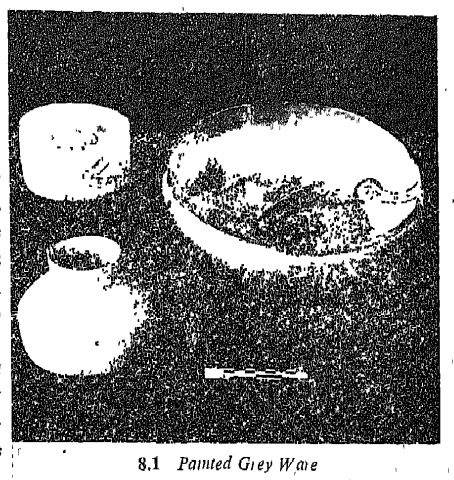
-
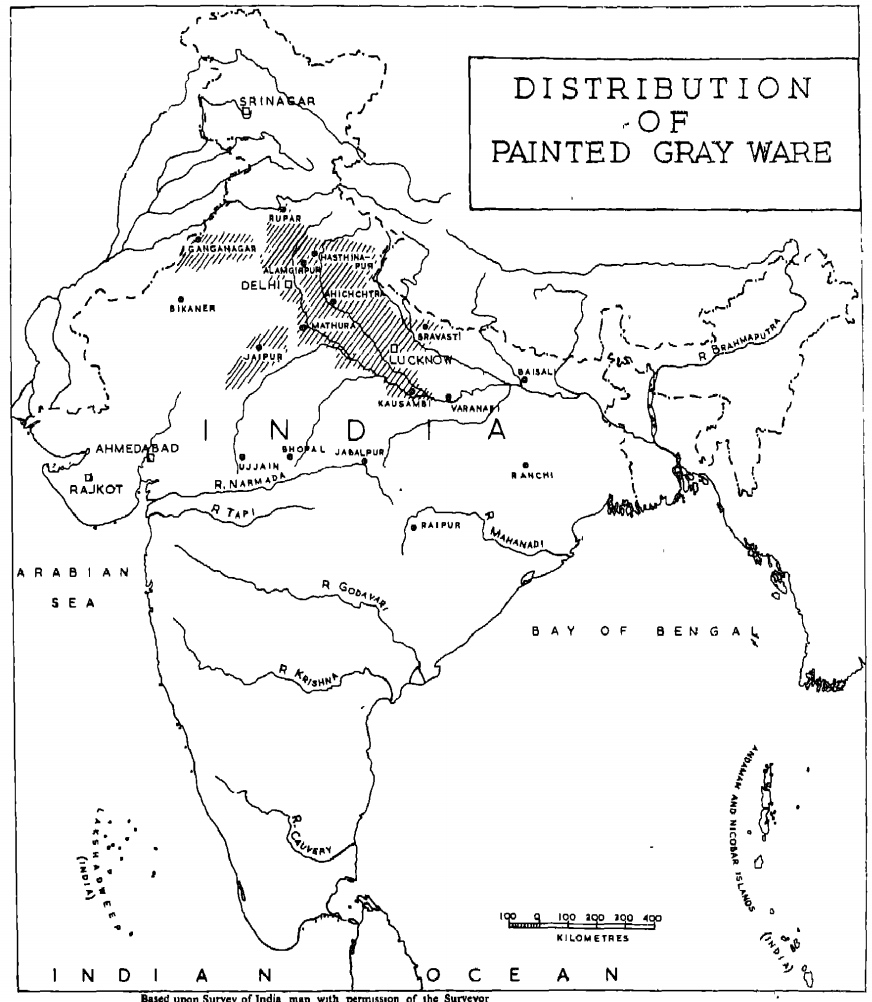
- Aryan Expansion and Tribal Mergers
- Aryans expanded from Punjab into western Uttar Pradesh, covering the Ganga-Yamuna doab.
- Major tribal formations:
- Kuru
- Bharatas and Purus merged to form the Kuru people
- Initially settled between the Sarasvati and Drishadvati rivers.
- Later occupied Delhi and the upper doab, establishing Kurukshetra.
- Merger of Kurus and Panchalas
- Kurus and Panchalas united, extending their control over Delhi and the upper/middle doab.
- Hastinapur (Meerut district) became their capital.
- Excavations at Hastinapur (900-500 B.C.)
- Show early town life, but settlements consisted of mud structures, not grand cities.
- Hastinapur was later flooded, causing the Kuru survivors to migrate to Kausambi (near Allahabad).
- The Mahabharata is based on a battle within the Kuru clan, fought around 950 B.C., leading to their decline.
- The Panchala kingdom
- Located in modern Bareilly, Badaun, and Farrukhabad.
- Known for philosopher-kings and Brahmana theologians.
- Further Eastward Expansion (600 B.C.)
- Vedic people extended from the doab to Kosala (eastern Uttar Pradesh) and Videha (north Bihar).
- Encounters with non-Vedic groups:
- In eastern Uttar Pradesh and Bihar, faced people using copper tools and black-and-red pottery.
- In western Uttar Pradesh, encountered people using ochre/red pots and copper tools (settled since 1800 B.C.).
- Possible interactions with remnants of the Late Harappan culture, though these groups were not purely Harappan.
- Factors behind Vedic success:
- Iron weapons
- Horse-drawn chariots, providing a military advantage
- By the end of the later Vedic period, Aryans had expanded significantly, setting the stage for the rise of Mahajanapadas (large kingdoms) in the 6th century B.C..
- The PGW-Iron Phase Culture and the Later Vedic Economy
- Introduction of Iron and its Impact
- Around 1000 B.C., iron began to be used in the Gandhara region (Pakistan) and Baluchistan.
- Iron implements, such as arrowheads and spearheads, appeared in eastern Punjab, western Uttar Pradesh, and Rajasthan around 800 B.C.
- With iron weapons, the Vedic people likely defeated adversaries in the upper Gangetic basin and cleared forests using iron axes.
- The spread of iron knowledge reached eastern Uttar Pradesh and Videha by the seventh century B.C.
- Later Vedic texts refer to iron as syama or krishna ayas.
-

- Agriculture in the Later Vedic Period
- Despite few iron agricultural tools being found, agriculture was the primary occupation.
- Ploughing was significant, with texts mentioning six, eight, twelve, or even twenty-four oxen yoked to a plough (possibly exaggerated).
- Ploughing was done using a wooden ploughshare, suitable for the light soil of the upper Gangetic basin.
- Bullocks were scarce due to cattle slaughter in sacrifices, leading to primitive farming methods.
- The Satapatha Brahmana discusses ploughing rituals, with legends associating King Janaka (father of Sita) and Balarama (Krishna's brother) with ploughing.
- Over time, upper varnas were prohibited from ploughing.
- Crops and Food Production
- Barley remained an important crop, but rice and wheat became staples.
- Rice (vrihi in Vedic texts) was first encountered in the doab region, with remains found at Hastinapur (8th century B.C.).
- Rice was commonly used in rituals, while wheat was rarely mentioned.
- Various lentils were also cultivated.
- Arts, Crafts, and Metalworking
- Skilled professions included smiths and smelters, involved in ironworking from around 1000 B.C.
- Numerous pre-1000 B.C. copper tools found in western Uttar Pradesh and Bihar indicate coppersmiths' presence.
- The Vedic people may have used copper mines in Khetri (Rajasthan).
- Copper objects, found at Painted Grey Ware (PGW) sites, were used for war, hunting, and ornamentation.
- Weaving was mainly a female occupation, while leather work, pottery, and carpentry flourished.
- Four types of pottery were used:
- Black-and-red ware
- Black-slipped ware
- Painted Grey Ware (PGW) - the most distinctive, used for rituals and dining.
- Red ware - the most widely used pottery type.
- PGW layers also contained glass hoards and bangles, likely prestige objects for the elite.
- Jewel-workers, mentioned in later Vedic texts, catered to wealthier sections of society.
- Settlements and Lifestyle
- Agriculture and crafts enabled a settled life, with over 500 PGW sites found, mainly in the upper Gangetic basin.
- Key areas of settlement:
- Kuru-Panchala region (western Uttar Pradesh & Delhi)
- Madra region (Punjab & Haryana)
- Matsya region (Rajasthan)
- Excavated sites include Hastinapur, Atranjikhera, and Noh.
- Settlements, lasting 1-3 centuries, consisted of mudbrick and wattle-and-daub houses.
- Despite primitive structures, recovered ovens and rice remains confirm agricultural activities.
- The Rise of Proto-Urban Centers
- Though nagara (city) is mentioned in later Vedic texts, true urbanization was absent.
- Hastinapur and Kausambi (near Allahabad) were early proto-urban centers at the end of the Vedic period.
- These settlements suggest the faint beginnings of town life.
- References to seas and sea voyages hint at some commercial activity, possibly influenced by growing crafts and trade.
- Conclusion: Advancements in Material Life
- The later Vedic period marked a shift from pastoral, semi-nomadic life to a settled agricultural society.
- Agriculture became the mainstay of the economy, complemented by crafts and trade.
- Peasants produced enough for self-sustenance and marginal surplus to support rulers and priests.
- Despite economic and social advancements, full-fledged towns had yet to emerge.
- Political Organization in the Later Vedic Period
- Decline of Popular Assemblies and Rise of Royal Power
- During the later Vedic period, popular assemblies lost their significance as royal authority expanded.
- The vidarka assembly completely disappeared, while the sabha and samiti continued but underwent changes.
- These assemblies became dominated by princes and wealthy nobles, sidelining common people.
- Women were no longer allowed to participate in the sabha, which became an exclusive domain of nobles and Brahmanas.
- Formation of Larger Kingdoms and Territorial Authority
- The emergence of larger kingdoms strengthened the position of the king.
- Tribal authority transitioned into territorial authority, meaning that rulers governed over fixed regions rather than just their clans.
- Initially, lands were named after the first tribes that settled there, but over time, these tribal names became territorial names.
- Example:
- Panchala was originally the name of a tribe but later referred to a specific region.
- The term rashtra (meaning “territory”) first appears in this period, reflecting this shift.
- Strengthening of Kingship through Rituals
- Various rituals and sacrifices reinforced the king's authority:
- Rajasuya sacrifice:
- Conferred supreme power upon the king.
- Ashvamedha sacrifice:
- Demonstrated the king's unquestioned control over any land where his royal horse roamed uninterrupted.
- Vajapeya (chariot race):
- A ceremonial race where the king's chariot was made to win, symbolizing his superiority.
- These grand rituals impressed the people and enhanced the king's prestige.
- Taxation and Administration
- Sangrihitri
- The collection of taxes and tributes became a regular practice, likely managed by an officer called sangrihitri.
- Large-scale sacrifices provided opportunities for rulers to display their generosity by distributing wealth and food among different social groups.
- The king was assisted by:
- Priests (for religious and ceremonial duties)
- Military commanders (for defense and warfare)
- Chief queens and high-ranking officials (for governance)
- Local Governance and Military Structure
- At the village level, administration was likely managed by village assemblies, controlled by the chiefs of dominant tribes.
- These assemblies were also responsible for local dispute resolution and trials.
- Despite increasing royal power, the king did not maintain a standing army. Instead,:
- Tribal warriors were mobilized during wartime.
- A ritual for success in war required the king to share a meal from the same plate as his people, symbolizing unity.
- Social Organization in the Later Vedic Period
- The Varna System and Social Hierarchy
- The later Vedic society was divided into four varnas:
- Brahmanas (Priests)
- The growing influence of sacrifices increased the power of the Brahmanas significantly. Initially, they were one among sixteen priestly classes, but over time, they emerged as the most dominant.
- They conducted rituals, officiated at agricultural festivals, and performed ceremonies for their patrons. In return, kings pledged not to harm them.
- Rajanyas or Kshatriyas (Warriors and Nobles)
- The Rajanyas (Kshatriyas) represented the warrior-noble class and sometimes clashed with the Brahmanas for supremacy. However, when it came to ruling over the lower varnas, both classes cooperated.
- By the end of the later Vedic period, it was emphasized that the Brahmanas and Kshatriyas should work together to govern society.
- Vaishyas (Commoners and Traders)
- The Vaishyas were responsible for agriculture, cattle-rearing, and trade.
- Towards the end of the Vedic period, they also engaged in commerce.
- They were the only group required to pay tribute, which supported the ruling class.
- The Kshatriyas depended on the tributes collected from the Vaishyas for their sustenance.
- A long process of subjugation turned the Vaishyas into tribute-payers. Various rituals were prescribed to enforce their submission to the ruling Rajanya (Kshatriya) class.
- Shudras (Servants and Laborers) : The Disadvantaged Class
- The Shudras were denied many privileges, including the upanayana (sacred thread) ceremony that was granted to the three higher varnas.
- This marked the beginning of several social disabilities imposed on them.
- The Aitareya Brahmana describes their low status: they were seen as servants, made to work at will, and subject to punishment at the discretion of higher varnas.
- Despite these restrictions, certain artisans like chariot makers (Chathakaras) were granted a higher status and were entitled to the sacred thread ceremony, indicating that rigid varna distinctions had not yet fully developed.
- Power of the King and the Social Order
- The prince (Rajanya) sought to dominate the social structure:
- Brahmanas were described as seekers of livelihood, dependent on royal gifts, and removable at will.
- Vaishyas were described as tribute-payers who could be beaten or oppressed.
- Shudras occupied the lowest position, being treated as servants and subjected to forced labor.
- However, some public rituals, especially related to royal coronation ceremonies, included Shudras, suggesting that tribal traditions still influenced society.
- Family and Gender Roles
- The father's authority increased significantly, to the extent that he could even disinherit his son.
- Among royal families, the right of primogeniture (succession by the eldest son) became stronger.
- Male ancestors were worshipped, reinforcing patriarchal norms.
- Women were generally subordinated, though some women theologians participated in philosophical discussions, and certain queens took part in coronation rituals.
- However, the overall trend was a decline in women's status, and they were increasingly regarded as inferior to men.
- Gotra System and Marriage
- The gotra system emerged during this period.
- The term gotra originally referred to a cow-pen where a clan's cattle were kept but later came to signify descent from a common ancestor.
- Gotra exogamy became a practice, meaning marriage was prohibited between individuals of the same gotra.
- The Ashrama System (Stages of Life)
- The concept of four ashramas (stages of life) was not fully established in the later Vedic period.
- By post-Vedic times, the four stages were:
1. Brahmacharya (Student)
2. Grihastha (Householder)
3. Vanaprastha (Partial Retirement)
4. Sannyasa (Complete Renunciation)
- However, in later Vedic texts, only three stages were mentioned, with Sannyasa not yet well-established.
- Gods, Rituals, and Philosophy
- Development of Religious Practices
- The later Vedic period saw the upper deity evolve under Brahmanical influence, becoming central to Aryan culture.
- The Kuru-Panchala region became the cradle of this culture, where the Vedic literature was compiled.
- The cult of sacrifice became the foundation of religious practices, accompanied by complex rituals and formulae.
- Changes in the Pantheon (group of gods or deities)
- Decline of Earlier Gods:
- Indra (god of war) and Agni (fire god) lost their earlier prominence.
- Rise of New Deities:
- Prajapati (the creator) became the supreme deity.
- Rudra (associated with animals) gained importance.
- Vishnu emerged as the preserver and protector of settled life.
- Pushan, once associated with cattle, became the god of the Shudras as society divided into varnas.
- Signs of Idolatry:
- Some symbolic objects began to be worshipped, marking the early phase of idol worship.
- Evolution of Worship and Sacrifices
- Worship still aimed at material benefits, but methods changed:
- Prayers continued but became less central.
- Sacrifices became dominant—both public and private:
- Public sacrifices involved kings and communities, often tied to tribal identity.
- Private sacrifices were conducted at home, reflecting a settled way of life.
- Rituals involved the killing of animals, particularly cattle. The guest was known as goghna (one who was fed on cattle).
- "Goghna" is a Sanskrit word with multiple meanings, most notably related to the concept of a guest and the killing of a cow. It can mean "one for whom a cow is killed" or "a guest". The word is derived from go (cow) and ghna (killer or one who destroys).
- Brahmanas as Priests:
- Brahmanas were originally one of sixteen priestly classes but later monopolized ritual knowledge.
- They developed an elaborate system of sacrifices, often influenced by non-Aryan traditions.
- Sacrificial Rewards and Priesthood
- Generous Rewards:
- Priests officiating sacrifices received large dakshinas (gifts), including:
- Cows, gold, cloth, and horses.
- Some priests even demanded land, though large-scale land grants were rare.
- The Satapatha Brahmana describes claims over land in the ashvamedha ritual, though such transfers were likely exaggerated.
- The sacrificer (yajamana) relied on the magical power of words during sacrifices, with success tied to precise recitations.
- Reaction Against Ritualism and Rise of Philosophy
- Towards the end of the Vedic period, priestly dominance and excessive ritualism faced opposition, especially in Panchala and Videha (c. 600 BCE).
- The Upanishads emerged, promoting:
- Criticism of rituals and priestly authority.
- Emphasis on right belief and knowledge over sacrifices.
- Focus on understanding Atman (self) and Brahman (universal soul).
- Brahman was conceived as a supreme being, likened to powerful kings.
- Some Kshatriya princes in Panchala and Videha encouraged these ideas, fostering religious reform and promoting stability and integration in society.
- Jainism and Buddhism
- Rise of Religious Sects in the Sixth Century B.C
- In the middle Gangetic basin during the sixth century B.C., numerous religious sects emerged. Historical records mention as many as 62 different sects, many of which were based on regional customs and rituals practiced by diverse communities in northeast India.
- Among these, Jainism and Buddhism stood out as the most significant religious reform movements.
- Causes of Origin
- Social Structure and Varna System
- During post-Vedic times, society was rigidly divided into four varnas:
- Brahmanas:
- Priests and teachers, holding the highest status, enjoying privileges such as exemption from taxes and punishments, and receiving gifts.
- Kshatriyas:
- Warriors and rulers, governing and collecting taxes from peasants.
- Vaishyas:
- Agriculturists, cattle-rearers, and traders, serving as principal taxpayers. They, along with Brahmanas and Kshatriyas, were categorized as dvija (twice-born) and allowed to study the Vedas.
- The concept of "twice-born" stemmed from the belief that a person is first born physically and then, at a later date, is reborn spiritually through a rite of passage called Upanayana (sacred thread ceremony).
- Access to Vedic study:
- This initiation marked the individual's formal entry into a school for Vedic studies, granting them the right to study the Vedas (ancient scriptures of Hinduism).
- Shudras:
- Servants of the three higher varnas, barred from Vedic studies, working as domestic slaves, agricultural laborers, craftsmen, and hired workers. They were often labeled as cruel, greedy, and thieves, with some being treated as untouchables.
- The varna system created tensions in society, particularly among the Kshatriyas, who resented the ritualistic domination of the Brahmanas.
- As rulers, they led a protest movement against the emphasis on birth-based privileges in the varna system.
- Vardhamana Mahavira (founder of Jainism) and Gautama Buddha (founder of Buddhism) both belonged to Kshatriya clans and opposed Brahmanical authority.
- Agricultural Changes and Economic Shift
- The real cause of the rise of new religions lay in the transformation of agriculture in northeast India (eastern Uttar Pradesh, northern and southern Bihar).
- This region, with over 100 cm of rainfall, was heavily forested before being colonized.
- Before 600 B.C., inhabitants used stone and copper tools, leading a precarious life along riverbanks.
- The introduction of iron tools (axes and ploughshares) around 600 B.C. allowed for large-scale deforestation, agriculture, and permanent settlements.
- Agriculture required cattle (bullocks for ploughing), but Vedic sacrifices involved mass slaughter of cattle, which hindered the growth of agrarian society.
- For agricultural stability, cattle killing had to be reduced, leading to religious movements that rejected Vedic animal sacrifices.
- Rise of Cities and Trade Expansion
- By the sixth century B.C., urbanization was growing in northeast India. Prominent cities included:
- Kausambi (near Allahabad)
- Kushinagar (Deoria district, Uttar Pradesh)
- Banaras
- Vaisali (north Bihar)
- Chirand (Chapra district)
- Rajgir (about 100 km from Patna)
- These cities had a significant population of artisans and traders, who were among the first to use coins for transactions.
- The earliest punch-marked coins appeared in the fifth century B.C., circulating in eastern Uttar Pradesh and Bihar.
-

- Trade and commerce flourished, leading to the rise of Vaishyas (merchant class), who were eager to improve their social status.
- The Vaishyas supported Jainism and Buddhism because:
- Both religions initially rejected the varna system, allowing Vaishyas greater participation.
- They promoted non-violence, which reduced wars and benefited trade.
- Brahmanical law-books (Dharmasutras) condemned moneylending, making Vaishyas, who relied on lending for trade, seek alternative religious affiliations.
- Reaction Against Private Property and Materialism
- A section of society opposed the growing wealth and materialism in urban areas. They resented:
- The accumulation of wealth, including coins (silver, copper, gold).
- The adoption of new lifestyles, clothing, and luxuries.
- The rise of social inequalities due to economic changes.
- This reaction led many to seek a return to a simple, ascetic lifestyle, inspiring the ideals of Jainism and Buddhism, which emphasized:
- Renunciation of material wealth.
- Non-violence and simplicity.
- Monastic life, where monks forwent luxuries and accepted only minimal offerings for survival.
- This reaction against materialism in the sixth century B.C. mirrors the opposition to industrialization in modern times, where people long for a return to a simpler way of life.
- Thus, the rise of Jainism and Buddhism was driven by social tensions, economic transformations, the spread of agriculture, and growing trade.
- These factors collectively led to a rejection of Brahmanical dominance and ritual sacrifices, giving birth to two of India's most influential religions.
- Vardhamana Mahavira and Jainism
- Origin & Founder
- Jainism originated around 6th century BCE as part of the Shramana tradition.
- The Shramana tradition encompassed various ascetic and renunciant movements that arose in the 1st millennium BCE, advocating for spiritual liberation through self-discipline, meditation, and ethical conduct, as opposed to the Vedic religion's emphasis on rituals and sacrifices.
- Founded by Rishabhanatha (first Tirthankara) and later propagated by Vardhamana Mahavira (24th Tirthankara).
- A Tirthankara is a spiritual teacher in Jainism who has attained liberation (moksha) and helps others cross the cycle of birth and death (samsara).
- The word Tirthankara means "ford-maker," symbolizing their role in creating a path for others to achieve enlightenment.
- In Jainism, there are traditionally 24 Tirthankaras in each half of a cosmic time cycle, who serve as spiritual teachers and guides.
- Mahavira is the 24th and last Tirthankara of the current cycle known as Avasarpiṇī. This means there is no Tirthankara after Mahavira in this particular time cycle.
- All the names for Mahavira
- Vardhamana
- Original name
- Mahavira
- Means great hero
- Jina
- Means the conqueror of senses and desires
- Tirthankara
- Means ford-maker
- Nigantha Nataputta
- Name used in buddhist texts
- Bhagavan
- Usually means God
- Arhat/Arihant
- Means worthy-one
- Life of Mahavira
- Vardhamana Mahavira, the 24th Tirthankara of Jainism, was born in 599 B.C. (some traditions suggest 540 BCE) in Kundagrama, near Vaishali (modern Bihar).
- He belonged to a prominent Kshatriya Jnatrika clan, his father was the clan's head, and his mother was a Lichchhavi princess, connecting him to the royal family of Magadha.
- Father:
- Siddhartha, who was the head of the Jnatrika clan.
- Mother:
- Trishala, a Lichchhavi Princess.
- There are differing beliefs regarding Mahavira's marital status:
- Śvetāmbara Tradition:
- According to this tradition, Mahavira married a princess named Yashoda and had a daughter named Priyadarśanā (also known as Anojjā or Anojjā Kumari). His daughter, Priyadarshana, later married to Jamali.
- Digambara Tradition:
- This tradition holds that Mahavira refused to marry Yashoda and remained celibate.
- These high-status connections helped him gain access to princes and nobles during his religious mission.
- Renunciation and Ascetic Life
- Initially, Mahavira lived the life of a householder, but at the age of 30, he renounced (formally give up or reject something) the world in search of truth and became an ascetic (person who practices severe self-discipline and abstains from worldly pleasures). For the next 12 years, he wandered from place to place, staying no more than a day in a village and five days in a town.
- He is said to have never changed his clothes during this period and eventually abandoned them altogether, embracing extreme austerity (strict and simple way of living).
- Attainment of Kevalya and Teachings
- At the age of 42, Mahavira attained Kevalya (perfect knowledge), overcoming misery and achieving enlightenment. This spiritual victory earned him the title Mahavira (the great hero) and Jina (the conqueror), leading his followers to be called Jains.
- For the next 30 years, Mahavira traveled extensively, spreading his teachings across Kosala, Magadha, Mithila, Champa, and other regions.
- Death
- Mahavira passed away in 527 B.C. at the age of 72 in Pavapuri, near modern-day Rajgir.
- Mnemonic for Maharvira
- Sid Jaat Tried Lichi for Priyadarsana 30 times, got success at 42 and finally met 72 hoors
- Sid -> Siddhartha
- Jaat -> Jnatrika
- Tried -> Trishala
- Lichi -> Lichachhavi
- for -> _x
- Priyadarsana -> Priyadarsana
- 30 times got -> Age of renounciation
- success at 42 -> Age of attainment of Kevalya
- finally 72 hoors -> Death
- Doctrines of Jainism
- Jainism is based on five fundamental doctrines:
1. Ahimsa (Non-violence) - Do not commit violence.
2. Satya (Truthfulness) - Do not speak a lie.
3. Asteya (Non-stealing) - Do not steal.
4. Aparigraha (Non-possession) - Do not acquire property.
5. Brahmacharya (Celibacy/Continence) - Observe self-restraint.
- It is believed that the first four doctrines were inherited from earlier teachers, while Mahavira introduced the fifth one, Brahmacharya.
- Mnemonic to remember:
- Aeh! Satmola Ahista Apad Brahmchod
- Aeh! -> Ahimsa
- Satmola -> Satya
- Apad -> Aparigraha
- Brahmachod -> Brahmacharya
- The Three Jewels (Triratna) of Jainism
- Jainism's ultimate goal is freedom from worldly bonds (moksha), which does not require rituals. Instead, liberation can be achieved through:
1. Right Knowledge
2. Right Action
3. Right Faith
- These three principles are collectively known as the Three Gems (Triratna) of Jainism.
- Mnemonic to remember:
- KFC
- K -> Right knowledge
- F -> Right faith
- C -> Right conduct/action
- Sects in Jainism
- Mahavira advocated extreme asceticism, which led to a division in Jainism over time.
- His predecessor, Parsva/Parshvanatha (23'th Tirthankara), allowed followers to wear upper and lower garments, whereas Mahavira insisted on complete renunciation of clothing. This difference later led to the formation of two sects:
- Svetambaras - Those who wear white clothes.
- Digambaras - Those who remain naked.
- Jainism's Beliefs on Gods and the Varna System
- Jain philosophy holds that the world is eternal and self-sustaining, meaning it is neither created nor maintained by any supreme being (God). Instead, it operates by its own cosmic laws and is governed by six eternal substances (Dravyas), including Jiva (soul) and Ajiva (non-living matter).
- Jainism acknowledged the existence of gods but regarded them as inferior to the Jina (spiritually liberated beings).
- Jainism recognizes the existence of various gods, often sharing them with Hinduism. However, these gods are not considered supreme beings or creators of the universe. Instead, they are seen as living beings in higher realms, still subject to karma and reincarnation, and are not on the same level of spiritual achievement as the Jinas.
- Unlike Buddhism, Jainism did not reject the varna system.
- Mahavira believed that a person's birth in a high or low varna was determined by past karma—one's sins or virtues from a previous life.
- However, he emphasized that even a Chandala (outcaste) could attain liberation through a pure and meritorious life.
- Other points
- The surest way of annihilating Karma is to practise penance.
- Every object, even the smallest particle, has a soul.
- Karma is the bane (a cause of great distress, harm, or ruin) of the soul and must be ended.
- Spread of Jainism
- Mahavira actively worked to spread Jainism by organizing an order of followers, which included both men and women.
- However, Jainism did not attract a large following initially, with only 14,000 adherents, as it did not significantly differentiate itself from the Brahmanical tradition.
- Despite this, Jainism gradually expanded into southern and western India.
- Jainism in South India
- A late tradition attributes the spread of Jainism in Karnataka to Chandragupta Maurya (322-298 B.C.), who is said to have abdicated his throne, embraced Jainism, and spent his last years as a Jaina ascetic in Karnataka. However, there is no concrete historical evidence to support this claim.
- Another major reason for the expansion of Jainism in the south was the great famine that struck Magadha 200 years after Mahavira's death.
- The famine lasted 12 years, forcing many Jains to migrate southward under Bhadrabahu (prominent Jain monk).
- Others remained in Magadha under Sthulabhadra (a jain monk and scholar, known for being the chief disciple of Bhadrabahu).
- Sthula means big or strong in Sanskrit and Bhadra means auspicious or noble.
- Upon their return, differences arose between the two groups.
- The southern Jains (Bhadrabahu's followers) claimed they had strictly followed religious rules, while they accused the Magadhan Jains of becoming lax.
- To resolve these differences, a Jain council was held at Pataliputra (modern Patna), but the southern Jains (Digambaras) boycotted it and refused to accept its decisions.
- This led to a split in Jainism:
- Digambaras (southern followers, who practiced complete renunciation).
- Svetambaras (Magadhan followers, who wore white robes ( garments, often long and flowing)).
- Epigraphic evidence for Jainism in Karnataka dates to the third century A.D.. From the sixth century onward, numerous Jaina monastic establishments (Basadis) were built in Karnataka, receiving land grants from local rulers.
- Jainism in Other Regions
- Kalinga (Orissa):
- Jainism spread to Kalinga in the fourth century B.C. and gained state patronage under King Kharavela (first century B.C.), who defeated the rulers of Andhra and Magadha.
- Tamil Nadu:
- By the second and first centuries B.C., Jainism had reached southern Tamil Nadu.
- Western and Central India:
- Over time, Jainism spread to Malwa, Gujarat, and Rajasthan, where it still has a strong presence today, particularly among traders and merchants.
- Unlike Buddhism, which eventually declined in India, Jainism maintained its influence in these regions despite not receiving as much royal patronage.
- Contribution of Jainism
- Opposition to Varna System & Vedic Rituals
- Jainism made one of the earliest efforts to challenge the rigid Varna system and ritualistic Vedic practices.
- Unlike Brahmanism, which used Sanskrit, Jain monks adopted Prakrit, the language of the common people, to spread their teachings.
- Development of Literature & Language
- Jain religious texts were written in Ardhamagadhi and were compiled in the sixth century A.D. at Valabhi (Gujarat), a renowned center of learning.
- Jainism played a crucial role in the development of regional languages:
- Prakrit dialects contributed to the evolution of languages like Sauraseni, which later gave rise to Marathi.
- The earliest significant works in Apabhramsa (a later form of Prakrit) were composed by Jain scholars.
- Jain scholars even developed the first grammar of Apabhramsa.
- Jain literature includes:
- Epics
- Puranas
- Novels
- Dramas
- A vast portion of Jain manuscripts remains unpublished and is preserved in temples of Gujarat and Rajasthan.
- Use of Sanskrit & Kannada
- While Jain literature initially flourished in Prakrit and Apabhramsa, in early medieval times, Jain scholars extensively wrote in Sanskrit as well.
- Jainism also significantly contributed to the growth of Kannada literature, producing numerous texts in this language.
- Gautama Buddha and Buddhism
- Life of Buddha
- Birth and Early Life
- Gautama Buddha, also known as Siddhartha, was a contemporary of Mahavira.
- He was born in 563 B.C. in a Sakya Kshatriya family (hence called Shakyamuni) at Lumbini, located in the foothills of Nepal.
- Familty
- Father :
- Suddhodana (Chief of republican clan Kapilavastu)
- Mother :
- Mahamaya (Died after childbirth, raised by Prajapati Gautami). His mother belonged to the Kosalan dynasty.
- Wife :
- Yashodhara
- Son :
- Rahul
- Like Mahavira, Gautama came from a noble family and inherited republican values.
- All the names of the Buddha
- Siddhartha Gautama
- Real full name
- Buddha
- Means the enlightened one
- Tathagata
- Tatha + Gata (Thus Gone) & Tatha + Agata (Thus Come)
- Means the one who has gone beyond the cycle of birth and death
- Bhagavan
- Blessed one
- Sugata
- Well gone
- Jina
- Conqueror of desires, this is common for Mahavira and Buddha
- Lokanatha
- Lord of the world
- Dharmraja
- King of dharma
- Renunciation and Enlightenment
- From childhood, Gautama displayed a meditative nature.
- Though married early, he found no interest in married life.
- Disturbed by human suffering, he sought a solution to life's miseries.
- At 29 years of age, he renounced his home, just as Mahavira had done.
- He wandered for six years in search of truth.
- At 35, he attained enlightenment under a pipal tree at Bodh Gaya.
- From then on, he was known as the Buddha, or the Enlightened One.
- Teachings and Missionary Work
- First Sermon delivered at Sarnath (Deer Park) - “Dharmachakra Pravartana” (Banaras).
- Dharmachakra Pravartana (धर्मचक्र प्रवर्तन) is a Sanskrit phrase that translates to "Turning the Wheel of Dharma". It refers to the first sermon delivered by Gautama Buddha after his enlightenment
- Undertook long journeys, spreading his teachings far and wide.
- His strong physique enabled him to walk 20 to 30 km per day.
- He preached and meditated continuously for 40 years, resting only during the rainy season.
- He debated with and defeated Brahmanical scholars and followers of rival sects.
- His teachings were universal, without discrimination based on wealth, caste, or gender.
- Death (Mahaparinirvana)
- Gautama Buddha passed away at 80 years of age in 483 B.C..
- His death took place at Kusinagar, identified with Kasta village in Deoria district, eastern Uttar Pradesh.
- Mnemonic
- Sakya Sudh Kapil-vastu (object) Me Gautami, Yashodhara or Rahul ke lie 29 ya 35 ka dudh ka packet la or Sarnath Dharmachakra ko Kusinagar-80 bhej
- Sakya -> Sakya khstriya family
- Sudh -> Suddhodana (father)
- Kapil-vastu -> Kapilvastu (father clan)
- Me -> Mahamaya (real mother)
- Gautami -> Gautami (adoptive mother)
- Yashodhara -> Yashodhara (wife)
- Rahul -> Rahul (son)
- ke lie -> _x
- 29 ya -> 29 years, age of renunciation
- 35 -> 35 years, age of enlightenment
- ka.. ..la or -> _x
- Sarnath -> Sarnath (first sermon location)
- Dharachakra ko -> Dharmachakra Parivartana (name of first sermon)
- Kusinagar -> Kusinagar (death place)
- 80 bhej -> Attaining Mahaparnirvana
- Doctrines of Buddhism
- Practical Approach and Core Philosophy
- Gautama Buddha was a practical reformer who focused on real-world problems rather than engaging in debates about the soul (atman) and Brahman, which were central to contemporary philosophical discussions.
- He emphasized that the world is full of sorrow and that human suffering arises from desires.
- The key to attaining Nirvana (liberation, a state of bliss and rest) is to conquer desires, which leads to freedom from the cycle of birth and death.
- Core Teachings of Buddhism
- The Four Noble Truths (Chatur Arya Satya)
- 1. Dukkha :
- Life is full of suffering
- The term dukkha is often translated as "suffering", but it encompasses a broader range of experiences like unease, frustration, disappointment, or the feeling that "something is always a little off", according to Tricycle: The Buddhist Review. Even in moments of joy or pleasure, there is an underlying current of dissatisfaction because of the impermanent nature of these experiences.
- The Three Forms of Dukkh
- a. Dukkha-dukkha (Suffering of Suffering):
- This refers to the obvious physical and mental suffering we readily recognize, such as pain from sickness, old age, death, loss, grief, fear, or despair.
- b. Viparinama-dukkha (Suffering of Change):
- This type of suffering arises from the impermanence of all phenomena. Even pleasant experiences are transient, and attachment to them inevitably leads to disappointment when they end.
- c. Sankhara-dukkha (Suffering of Conditioned Existence):
- This is the most subtle and pervasive form of dukkha. It reflects the fundamental unsatisfactoriness inherent in all conditioned phenomena (things that are compounded, impermanent, and dependent on other things). This relates to the concept of anicca (impermanence) and anatta (non-self) which are fundamental to Buddhist teachings.
- 2. Samudaya :
- Desire (Tanha) is the root cause of suffering, stemming from desires and attachments.
- 3. Nirodha :
- Suffering can be ended through the cessation of craving and attachment, leading to the state of Nirvana.
- 4. Magga :
- The path to the cessation of suffering is the Eightfold Path, a practical guide to ethical conduct, mental discipline, and wisdom.
- The Eightfold Path (Astangika Marga)
- Purpose
- To eliminate human suffering (Dukkha).
- Provides a practical path for self-realization and liberation.
- Recorded in Buddhist texts around the 3rd century B.C.
- Does not depend on priests, rituals, or metaphysical speculations.
- Represents the "Middle Path" (Madhyamaka Marga), avoiding extremes of luxury and self-mortification.
- Components of the Eightfold Path
- 1. Right View (Samma Ditthi)
- Understanding the Four Noble Truths correctly.
- Realization that worldly existence is transient (Anitya), suffering (Dukkha), and devoid of permanent self (Anatta).
- Example:
- Recognizing that wealth or power cannot provide lasting happiness.
- 2. Right Intention (Samma Sankappa)
- Cultivating thoughts free from ill-will, hatred, and harmful desires.
- Developing intention of renunciation, goodwill, and harmlessness.
- Example:
- Choosing compassion over revenge when wronged.
- 3. Right Speech (Samma Vaca)
- Avoiding lies, gossip, harsh words, and divisive talk.
- Encouraging truthful, gentle, and harmonious communication.
- Example:
- Advising a friend with kindness rather than criticism.
- 4. Right Action (Samma Kammanta)
- Ethical conduct in daily life.
- Abstaining from killing, stealing, and sexual misconduct.
- Example:
- Earning honestly instead of cheating or exploiting others.
- 5. Right Livelihood (Samma Ajiva)
- Choosing a profession that does not harm others.
- Avoiding trades such as slavery, weapons, intoxicants, or animal slaughter.
- Example:
- A farmer producing food vs. a trader in arms.
- 6. Right Effort (Samma Vayama)
- Continuous effort to eliminate evil thoughts and cultivate wholesome ones.
- Fourfold effort:
- Preventing unwholesome states.
- Overcoming unwholesome states.
- Developing wholesome states.
- Maintaining wholesome states.
- Example:
- Persistently practicing kindness to replace anger.
- 7. Right Mindfulness (Samma Sati)
- Constant awareness of body, feelings, mind, and phenomena.
- Developing self-observation without attachment.
- Example:
- Mindful breathing to control anxiety.
- 8. Right Concentration (Samma Samadhi)
- Practicing deep meditation (Dhyana) leading to tranquility and insight.
- Attaining mental focus necessary for Nirvana.
- Example:
- Entering higher states of consciousness through meditation.
- Significance
- Practical code of conduct applicable to all individuals.
- Promotes ethical life, mental discipline, and wisdom.
- Empowers individuals to seek liberation without priestly mediation.
- Emphasizes balance: neither indulgence in luxury nor extreme asceticism.
- Notes
- Closely linked with the Four Noble Truths.
- Foundation of Buddhist philosophy and practice.
- Inspires later developments in meditation traditions (Zen, Vipassana, etc.).
- Mnemonic for eight fold path
- View Intended Speech Action Live Effort Minding Concentration
- View -> Right View
- Intended -> Right Intention
- Speech -> Right Speech
- Action -> Right Action
- Live -> Right Live
- Effort -> Right Effort
- Minding -> Right Mindfulness
- Concentration -> Right Concentration
- VISA LESS
- V -> Right View
- I -> Right Intention
- S -> Right Speech
- A -> Right Action
- L -> Right Livelihood
- E -> Right Effort
- S -> Sati = Right Mindfullness
- S -> Samadhi = Right Concentration
- Mnemonic for 4 noble truths
- Dukhi Samudaye ka Nirodh Magha
- Dukhi -> Dukkha
- Samudaye -> Samudaya
- ka -> _x
- Nirodh -> Nirodh
- Magha -> Magga
-

- The Three Jewels of Buddhism (Triratna):
- 1. Buddha (The Enlightened One)
- 2. Dhamma (The Teachings)
- 3. Sangha (The Religious Order)
- Mnemonic for Triratna
- BDSm
- B -> Buddha
- D -> Dhamma
- S -> Sangha
- m -> _x
- The Three Marks of Existence (Tri-Lakshana)
- 1. Anicca ((Impermanence)):
- Anicca refers to the Buddhist doctrine that all conditioned phenomena are transient, evanescent, and inconstant. This means everything, whether physical or mental, is in a state of flux – constantly arising, changing, and dissolving.
- 2. Dukkha (Suffering or Unsatisfactoriness):
- Dukkha is often translated as suffering, pain, or misery, but in a broader sense, it encompasses unsatisfactoriness, stress, unease, discomfort, frustration, and the inherent unsatisfying nature of conditioned existence. It signifies that life in its ordinary, unexamined state is not truly fulfilling or complete.
- 3. Anatta (No permanent self / No permanent soul) :
- Anatta (or Anātman in Sanskrit) is the doctrine that there is no unchanging, permanent self or essence (soul) that can be found in any phenomenon, including living beings. Instead, the individual is seen as a collection of five constantly changing aggregates (khandhas) – form, feeling, perception, mental formations, and consciousness.
- Mnemonic for Tri-Lakshana
- Any Dukh Anna?
- Any -> Anicca
- Dukh -> Dukkha
- Anna -> Anatta
- Code of Conduct, the five precepts (Panchasheel)
- 1. Do not commit violence.
- 2. Do not covet (strongly desire something, especially something that belongs to someone else) the property of others.
- 3. Do not speak a lie.
- 4. Do not indulge in corrupt practices.
- 5. Do not use intoxicants.
- These principles form a universal ethical code, found in many religious and philosophical traditions.
- Special Features of Buddhism and Causes of Its Spread
- Revolutionary Aspects of Buddhism
- Rejection of God and Soul (Atman):
- Buddhism did not recognize the existence of God or the soul (atman), which marked a radical departure in Indian religious history.
- Appeal to Common People:
- Unlike Brahmanism, early Buddhism avoided complex philosophical discussions, making it accessible to ordinary people.
- It attracted lower social orders by criticizing the varna system and offering equal opportunities for spiritual pursuit.
- Women were also admitted into the Sangha, bringing them on par with men.
- While initially hesitant, the Buddha eventually allowed women to be ordained into the monastic order, forming the Bhikkhuni Sangha (Order of Nuns). This was a groundbreaking decision for the time, as women in many societies were often relegated to domestic roles or considered spiritually inferior.
- According to Buddhist scriptures, particularly in the Vinaya Pitaka, it is recorded that he said that if women had not been allowed into the Sangha, the Dharma would have lasted for a thousand years. But with their inclusion, it would only last for five hundred years.
- He is also said to have used analogies to explain his concern, such as comparing a family with many women and few men to one that is easily violated by robbers, or a field of rice or sugarcane infested by disease that will not last long.
- Some modern scholars question the authenticity of this particular dialogue and the Garudhammas themselves, arguing that they may have been later additions to the scriptures reflecting the biases of the monks who compiled them.
- However, the establishment of the Bhikkhuni Sangha came with certain regulations, known as the Eight Garudhammas (heavy rules), which placed nuns in a subordinate position to monks, regardless of seniority.
- Liberal and Democratic Nature:
- Compared to Brahmanism, Buddhism was more inclusive, accepting people regardless of caste or gender.
- Spread of Buddhism in Non-Vedic Regions
- Buddhism found fertile ground for conversion in regions outside Vedic influence, particularly in Magadha.
- The people of Magadha readily accepted Buddhism because they were looked down upon by orthodox Brahmanas.
- Magadha was considered outside Aryavarta (the holy land of Aryas), making its people more open to non-Vedic traditions.
- Even today, north Bihar communities prefer not to be cremated south of the Ganga in Magadha, reflecting this ancient tradition.
- Buddha's Personality and Preaching Method
- Tackling Evil with Goodness:
- Buddha promoted non-violence, compassion, and love as responses to hatred and evil.
- Calm and Poised Nature:
- He remained unprovoked by slander or abuse and tackled his opponents with wit and wisdom.
- Example:
- When an ignorant person abused him, Buddha listened silently and then asked (anecdote from Akkosa Sutta):
- “My son, if a person does not accept a present, what happens to it?”
- The person replied, “It remains with the one who offered it.”
- Buddha responded, “My son, I do not accept your abuse.”
- Use of Pali Language and Organized Religious Order
- Use of Pali, the common spoken language, helped spread Buddhist teachings widely among the masses.
- Buddha established the Sangha (religious order), which was open to all, irrespective of caste or gender.
- Monks had to follow strict rules and regulations, including vows of continence, poverty, and faith.
- Royal Patronage and Global Spread
- Rapid Expansion During Buddha's Lifetime:
- The kingdoms of Magadha, Kosala, and Kausambi, along with several republican states, adopted Buddhism.
- Ashoka's Role in the Expansion of Buddhism:
- Around 200 years after Buddha's death, Maurya King Ashoka embraced Buddhism, making it a major turning point.
- Through his missionaries, Ashoka spread Buddhism to Central Asia, West Asia, and Sri Lanka, transforming it into a world religion.
- Buddhism's Continued Influence:
- Even though Buddhism later declined in India, it remains strongly rooted in Sri Lanka, Burma, Tibet, China, Japan, and other parts of South, Southeast, and East Asia.
- Sects of Buddhism
- Hinayana (Lesser Vehicle/The School of the Elders)
- Believes Buddha was a teacher, not a god.
- Does not accept idol worship.
- Follows original Pali texts (Theravada Buddhism).
- Spread to Sri Lanka, Myanmar, Thailand, Cambodia, Laos.
- Theravada is the only surviving branch of the Hinayana group.
- Mahayana (The Greater Vehicle)
- Believes Buddha was divine.
- Encourages idol worship.
- Emphasizes Bodhisattvas (future Buddhas) like Avalokiteshvara, Manjushri.
- Spread to China, Japan, Korea, Vietnam.
- Vajrayana (Diamond Vehicle/The Thunderbolt Vehicle)
- Tantric Buddhism (Mystical Practices, Mantras, Mandalas, Rituals).
- Dalai Lama (Tibetan Buddhism) follows Vajrayana.
- Spread to Tibet, Mongolia, Bhutan.
- Important Buddhist Literature
-
| Buddhist Text |
Description |
Tradition & Language |
| Tripitaka (Three Baskets) |
Earliest Buddhist scriptures |
Hinayana, Pali |
| Sutta Pitaka |
Teachings of Buddha |
Hinayana, Pali |
| Vinaya Pitaka |
Monastic rules for monks and nuns |
Hinayana, Pali |
| Abhidhamma Pitaka |
Philosophical analysis |
Hinayana, Pali |
| Jataka Tales |
Stories of Buddha's previous births |
Hinayana, Pali |
| Lalitavistara |
Biography of Buddha |
Mahayana, Sanskrit |
| Mahavastu |
Mixed Buddhist teachings |
Mahayana, Sanskrit |
- Causes of the Decline of Buddhism
- Transformation into Ritualism and Ceremonialism
- Initial Spirit of Reform Lost:
- Like many religions, Buddhism began with a reformist zeal but gradually succumbed to the rituals and ceremonies it originally denounced.
- Influence of Brahmanism:
- Over time, Buddhism absorbed many elements of Brahmanism, the very system it had opposed.
- To counter Buddhism, Brahmanas reformed their practices, emphasizing:
- Preservation of cattle wealth
- Promise of heaven to women and Sudras, making their religion more inclusive.
- Shift from Simplicity to Idol Worship:
- By the first century A.D., large-scale idol worship became common in Buddhism.
- Devotees made rich offerings, which led to increasing materialism among Buddhist monks.
- Separation from the Common People
- Abandonment of Pali Language:
- Initially, Buddhism spread widely using Pali, the language of the common people.
- However, monks later adopted Sanskrit, a language of intellectual elites, making Buddhism less accessible.
- Monks Isolated from Society:
- Buddhist monks withdrew from active engagement in people's daily lives.
- The monasteries became self-sufficient and wealthy, reducing monks' interaction with the broader society.
- Corruption and Degeneration of Monasteries
- Accumulation of Wealth:
- Generous royal grants and devotee offerings made Buddhist monasteries extremely wealthy.
- Nalanda and other monasteries controlled revenues from hundreds of villages.
- Moral Decline:
- By the 7th century A.D., monasteries became centers of luxury and corruption, contradicting Buddha's original teachings.
- The rise of Vajrayana Buddhism introduced esoteric rituals, including tantric practices.
- Perception of Women:
- The presence of women in monasteries led to further moral degeneration.
- Buddha's warning to Ananda:
- “If women were not admitted into monasteries, Buddhism would have lasted for thousands of years. But because they have been admitted, it will last only five hundred years.”
- Turkish Invasions and Destruction of Monasteries
- Targeting of Buddhist Monasteries:
- Due to their immense wealth, Buddhist monasteries became prime targets for Turkish invaders.
- Nalanda and other Buddhist centers were attacked, leading to the massacre of monks.
- Survival in Neighboring Regions:
- Some monks fled to Nepal and Tibet, ensuring Buddhism's survival outside India.
- Extinction in India:
- By the 12th century A.D., Buddhism had practically disappeared from its land of origin.
- Assimilation into Hinduism
- Buddha became an incarnation of Vishnu in Hinduism.
- Importance and Influence of Buddhism
- Social and Economic Impact
- Awareness of Social Problems:
- Buddhism recognized the growing economic inequalities in 6th century B.C. northeast India, caused by:
- Iron ploughshare agriculture
- Expansion of trade and coin usage
- To address this, Buddhism discouraged accumulation of wealth, believing poverty led to hatred, cruelty, and violence.
- The Buddha recommended:
- Providing grain to farmers
- Wealth to traders
- Wages to laborers
- The poor were encouraged to give alms to monks, with the promise of wealth in their next life.
- Monastic Code and Opposition to Materialism:
- The Buddhist code of conduct for monks was a reaction to material excesses. It:
- Imposed restrictions on food, dress, and sexual behavior.
- Forbade monks from accepting gold and silver or engaging in trade.
- These rules were later relaxed, but initially, they resembled primitive communism, reminiscent of early tribal society.
- This discipline partially opposed the growing use of money, private property, and luxury in the 6th century B.C.
- Contradictions and Strengthening of Social Hierarchy:
- While Buddhism sought to mitigate social inequalities, it also reinforced the new social order:
- Debtors were barred from joining the Sangha, benefiting moneylenders.
- Slaves were not admitted, indirectly supporting slave owners.
- These rules reflected Buddhism's adjustment to changing material conditions rather than revolutionary opposition.
- Similarities and Differences with Brahmanism
- Despite renouncing the world and criticizing Brahmanical greed, Buddhist monks:
- Did not participate in production but lived on alms and donations like Brahmanas.
- Emphasized family obligations, private property, and political authority.
- Supported social class order, though:
- Brahmanas justified varna by birth.
- Buddhists defined varna by action and attributes.
- Buddhism primarily focused on individual salvation (Nirvana), offering an escape for monks but requiring lay followers to conform to existing social conditions.
- Inclusivity and Influence on Brahmanical Society
- Women and Sudras in Buddhism:
- Buddhism provided social upliftment by allowing women and Sudras to convert.
- Under Brahmanism, they were denied:
- The sacred thread
- The right to read the Vedas
- Conversion to Buddhism freed them from these marks of inferiority.
- Promotion of Non-Violence and Cattle Protection:
- Buddhism emphasized non-violence and respect for animal life.
- The Suttanipata (early Buddhist text) described cattle as:
- Annada vannada sukhada (givers of food, beauty, and happiness).
- This teaching opposed the slaughter of animals, influencing later Brahmanical emphasis on cow sanctity.
- Intellectual and Cultural Contributions
- Rise of Rationalism:
- Buddhism encouraged critical thinking, promoting:
- Logical reasoning over superstition.
- Merit-based judgment rather than blind faith.
- Literary Development:
- Buddhist scholars significantly enriched Pali literature.
- Three categories of early Pali texts:
1. Teachings of the Buddha
2. Rules for the Sangha
3. Philosophical exposition of Dhamma
- Apabhramsa writings in East India during the Middle Ages also originated from Buddhist monks.
- Growth of Educational Institutions:
- Buddhist monasteries evolved into residential universities.
- Prominent centers of learning:
- Nalanda and Vikramasila (Bihar)
- Valabhi (Gujarat)
- Impact on Art and Architecture
- Sculpture and Artistic Representation:
- The first human statues worshipped in India were likely Buddha images.
- Stone panels depicting Buddha's life were created at:
- Gaya (Bihar)
- Sanchi and Bharhut (Madhya Pradesh)
- From the 1st century A.D., Buddha's panel images became common.
- Fusion of Greek and Indian Art:
- Gandhara Art (Northwest India) blended Indian and foreign artistic styles.
- Kushan influence promoted Buddhist art in the delta region.
- Cave Architecture:
- Buddhist monks carved residential caves in:
- Barabar Hills (Gaya, Bihar)
- Nasik (Western India)
- Buddhism left a profound mark on Indian society, culture, education, and art, even though it declined as an organized religion.
- Modern Revival of Buddhism
- Swami Vivekananda spread Buddhist ideas in the West.
- B.R. Ambedkar led the Dalit Buddhist movement (Navayana Buddhism) in 1956.
- Unlike Theravāda, Mahāyāna, or Vajrayāna, Navayana is not a classical sect but a reformation movement within Buddhism.
- Dalai Lama & Tibetan Buddhism have gained global influence.
- Territorial States and the First Magadhan Empire
- Rise of Large Territorial States in the Sixth Century B.C
- Impact of Iron Technology
- The widespread use of iron in eastern Uttar Pradesh and western Bihar facilitated the growth of large territorial states.
- Iron weapons strengthened the warrior class, making them a key force in state formation.
- Iron agricultural tools allowed peasants to produce surplus food grains, exceeding their own consumption needs.
- Role of Surplus Production
- The extra produce was collected by princes to:
- Support military forces.
- Maintain administrative structures.
- The surplus also sustained urban centers, which emerged in the sixth century B.C..
- Expansion and Strengthening of Territorial Identity
- With increased resources, people expanded their land at the cost of neighboring areas.
- The rise of large states with towns as their centers of power reinforced the territorial concept.
- Allegiance shifted from the jana (tribe) to the janapada (territory), marking a significant change in political identity.
- This transformation played a crucial role in shaping early Indian statehood and governance.
- The Mahajanapadas: The Sixteen Great States
- Geographical Distribution
- During the age of the Buddha, 16 large states, known as mahajanapadas, emerged.
- These states were mostly located north of the Vindhyas, extending from the north-west frontier to Bihar.
- Among them, Magadha, Kosala, Vatsa, and Avanti were the most powerful.
-
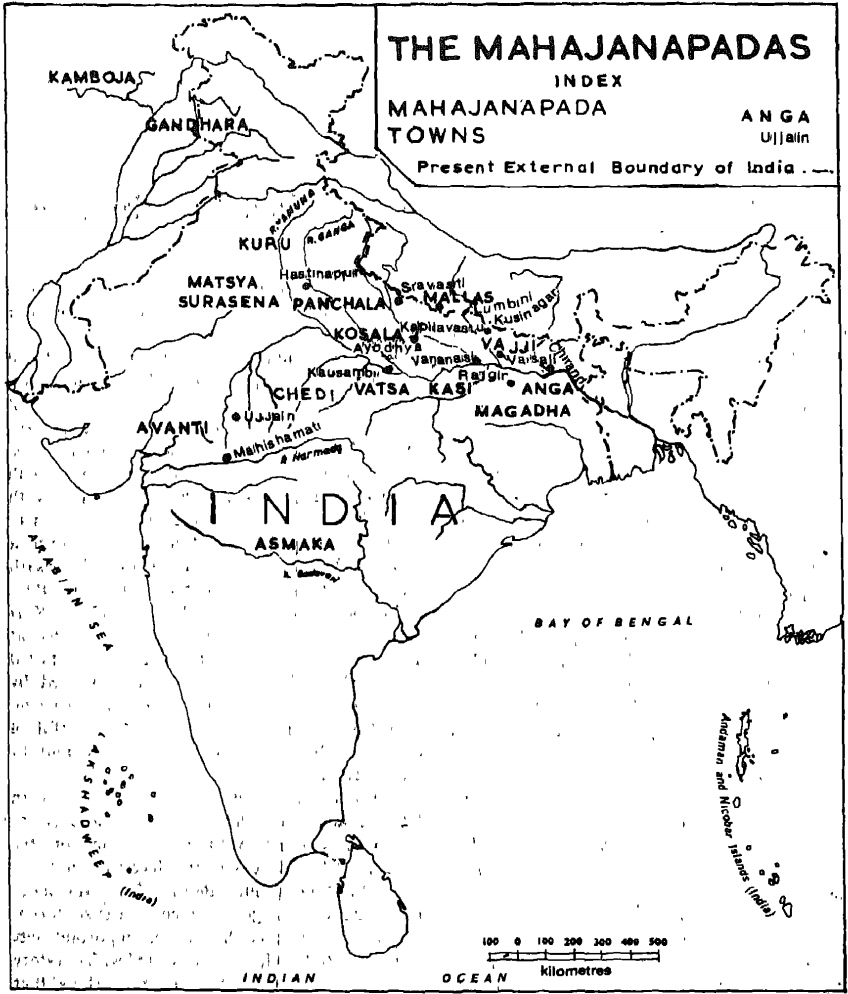
-

- 16 Mahajanpadas table
-
| Mahajanapada |
Capital |
Government Type |
Location (Modern Region) |
Important Rulers |
Historical Significance |
| Anga |
Champa |
Monarchy |
Bihar |
Karna (Mahabharata) |
Eventually annexed by Magadha |
| Magadha |
Rajagriha (later Pataliputra) |
Monarchy |
Bihar |
Bimbisara, Ajatashatru |
Strongest Mahajanapada; later became Mauryan Empire's core |
| Vajji |
Vaishali |
Republic |
Bihar |
- |
Confederation of eight clans, including Lichchhavis; Gautama Buddha visited here |
| Malla |
Kusinara, Pava |
Republic |
Uttar Pradesh |
- |
Gautama Buddha attained Mahaparinirvana at Kusinara |
| Kasi |
Varanasi |
Monarchy |
Uttar Pradesh |
- |
Initially powerful but later subdued by Kosala |
| Kosala |
Shravasti |
Monarchy |
Uttar Pradesh |
Prasenajit |
Associated with Gautama Buddha; included Ayodhya |
| Vatsa |
Kausambi |
Monarchy |
Uttar Pradesh |
Udayana |
Flourishing trade center, linked to Magadha |
| Chedi |
Shuktimati |
Monarchy |
Madhya Pradesh |
Shishupala (Mahabharata) |
Connected to Mahabharata legends |
| Kuru |
Indraprastha |
Monarchy |
Delhi, Haryana |
Duryodhana (Mahabharata) |
Declined in political importance after Vedic period |
| Panchala |
Ahichhatra, Kampilya |
Monarchy |
Uttar Pradesh |
Drupada (Mahabharata) |
Home of Draupadi; later absorbed by Magadha |
| Matsya |
Viratanagara |
Monarchy |
Rajasthan |
Virata (Mahabharata) |
Place where Pandavas lived during exile |
| Surasena |
Mathura |
Monarchy |
Uttar Pradesh |
Kamsa |
Important for Krishna legends |
| Assaka |
Potali (Paithan) |
Monarchy |
Maharashtra |
- |
Only Mahajanapada in southern India |
| Avanti |
Ujjain (North), Mahishmati (South) |
Monarchy |
Madhya Pradesh |
Chand Pradyota Mahasena |
Major center of Buddhism and trade |
| Gandhara |
Taxila |
Monarchy |
Pakistan, Afghanistan |
Pushkarasarin |
Famous for Gandhara art and Taxila University |
| Kamboja |
Pooncha (Rajouri) |
Republic |
Kashmir |
- |
Known for its warriors and horses |
- Remember through alphabetical sequence
- A3 – C1 – G1 – K4 – M3 – P1 – S1 – V2
- Major Mahajanapadas
1. Anga
- Located in modern Monghyr and Bhagalpur districts.
- Capital:
- Champa, inhabited since the sixth century B.C.
- Eventually annexed by Magadha.
2. Magadha
- Covered Patna, Gaya, and parts of Shahabad.
- Became the leading state of its time.
3. Vajji (Wajjis Confederacy)
- Located north of the Ganga in Tirhut.
- Confederation of eight clans, with the Lichchhavis as the most powerful.
- Capital:
- Vaisali (modern Basarh, Vaisali district).
4. Kasi
- Capital:
- Varanasi (earliest habitation at Rajghat, c. 700 B.C.).
- Initially powerful but later subjugated by Kosala.
5. Kosala
- Encompassed eastern Uttar Pradesh.
- Capital:
- Sravasti (modern Sahet-Mahet).
- Included Ayodhya (not significantly settled before the sixth century B.C.).
- Governed the Sakyas of Kapilavastu (Buddha's birthplace, identified with Piprahwa, Basti district).
- Neighboring Mallas, whose territory included Kusinara (modern Kasia, Deoria district), where Buddha passed away.
6. Vatsa
- Located along the Yamuna, with its capital at Kausambi.
- Originally a Kuru clan, they migrated from Hastinapur.
- Strongly fortified capital, strategically located near the confluence of the Ganga and Yamuna.
7. Kuru and Panchala
- Situated in western Uttar Pradesh.
- Lost political significance after the Later Vedic period.
8. Avanti
- Located in central Malwa and Madhya Pradesh.
- Divided into two parts:
- North:
- Capital Ujjain (eventually the more dominant center).
- South:
- Capital Mahishamati.
- Developed ironworking and strong fortifications.
- Political Struggles and Magadha's Supremacy
- The period from the sixth century B.C. onward was marked by constant struggles for dominance among these states.
- Ultimately, Magadha emerged victorious, laying the foundation for an Indian empire.
- Rise and Growth of the Magadhan Empire
- Emergence of Magadha
- Haryanka Dynasty
- Bimbisara (544 B.C. - 492 B.C.)
- Magadha rose to prominence under Bimbisara, a contemporary of Gautama Buddha.
- He initiated a policy of conquests and expansion, which culminated in the Kalinga war under Ashoka.
- Territorial Expansion:
- Annexed Anga and placed it under his son Ajatasatru, who governed from Champa.
- Strengthened Magadha through marriage alliances:
- First wife:
- Princess of Kosala (sister of Prasenajit), bringing a revenue-rich Kasi village as dowry.
- Second wife:
- Chellana, a Lichchhavi princess from Vaisali.
- Third wife:
- Daughter of the chief of the Madra clan of Punjab.
- These alliances enhanced diplomatic prestige and facilitated westward and northward expansion.
- Magadha's Rivalry with Avanti
- Avanti (Capital: Ujjain) was Magadha's strongest rival.
- King Chandra Pradyota Mahasena of Avanti fought Bimbisara but later formed an alliance.
- Bimbisara displayed diplomatic acumen:
- Sent royal physician Jivaka to treat Pradyota when he was ill.
- Received an embassy from Gandhara, showcasing Magadha's growing political influence.
- By the 6th century B.C., Bimbisara had established Magadha as the dominant power with control over 80,000 villages (conventional figure).
- Strengthening of Magadha's Capital
- The earliest capital of Magadha was Rajgir (Girivraja).
- It was surrounded by five hills with stone fortifications, making it impregnable.
- Ajatasatru's Reign and Expansion (492-460 B.C.)
- Ascended the throne by killing his father, Bimbisara.
- His rule marked the peak of Haryanka power, with an aggressive expansionist policy.
- Major wars
- Wars with Kosala
- Conflict with Kosala led to prolonged wars.
- Eventually, Ajatasatru triumphed, forcing the Kosalan king to:
- Give his daughter in marriage to Ajatasatru.
- Leave Kasi under Magadhan control.
- War Against Vaisali (Lichchhavis)
- Despite being of Lichchhavi descent (through his mother), Ajatasatru attacked Vaisali, claiming they had allied with Kosala.
- Used diplomatic manipulation to create internal divisions among the Lichchhavis.
- Military innovations:
- War engine (catapult-like) to hurl stones.
- Chariot with a rotating mace, enabling mass killings.
- Took 16 years to subjugate Vaisali, expanding Magadha further.
- Rivalry with Avanti
- Avanti, having defeated the Vatsas of Kausambi, now threatened Magadha.
- To counter this, Ajatasatru fortified Rajgir.
- However, the invasion never materialized during his reign.
- Udayin (460-444 B.C.) and the Shift to Pataliputra
- Strategic move:
- Built a fort at Pataliputra, located at the confluence of the Ganga and Son rivers.
- This centralized location made Pataliputra the power center of Magadha.
- The Sisunaga Dynasty and Avanti's Fall
- Udayin's successors (Sisunagas) temporarily shifted the capital to Vaisali.
- Their greatest achievement was defeating Avanti (Ujjain), ending a 100-year rivalry.
- Avanti was absorbed into Magadha, remaining under its control until the Mauryan era.
- The Nanda Dynasty (Most Powerful Rulers of Magadha)
- The Nandas succeeded the Sisunagas and expanded Magadha further.
- Mahapadma Nanda:
- Conquered Kalinga, bringing back a Jina idol as a war trophy.
- Subjugated Kosala, likely after a rebellion.
- Declared himself ekarat (sole sovereign), destroying other ruling princes.
- Military Strength
- Maintained a massive army:
- 200,000 infantry (on foot)
- 60,000 cavalry (horse/elephant riding)
- 6,000 war elephants
- Efficient taxation system funded this large military force.
- Alexander's Invasion (326 B.C.):
- Nandas' strength deterred Alexander from advancing eastward.
- Decline of the Nandas
- Later Nanda rulers became weak and unpopular.
- Their rule ended with the rise of the Mauryan Empire, under which Magadha reached its peak of glory.
- Causes of Magadha's Success
- The expansion and dominance of the Magadhan empire in the two centuries preceding the rise of the Mauryas can be attributed to a combination of strategic, geographical, economic, military, and societal factors.
- While ambitious rulers such as Bimbisara, Ajatasatru, and Mahapadma Nanda played a crucial role in its growth through conquests and diplomacy, several other factors contributed significantly to Magadha's success.
- Geographical and Strategic Advantages
- Magadha enjoyed a favorable geographical position in the age of iron. The richest iron deposits were located near Rajgir, enabling the Magadhan rulers to equip their armies with superior iron weapons.
- The kingdom's two capitals, Rajgir and Pataliputra, were strategically located:
- Rajgir was surrounded by five hills, making it naturally impregnable in an era without advanced siege technology.
- Pataliputra occupied a pivotal position at the confluence of the Ganga, Gandak, and Son rivers, facilitating easy communication and movement of troops in all directions.
- The natural water barriers of the Son, Ganga, and Punpun rivers made Pataliputra a formidable water-fort (Jaladurga), providing exceptional defense.
- Agricultural Prosperity and Economic Strength
- Magadha lay at the center of the fertile middle Gangetic plain, where the land was highly productive due to heavy rainfall.
- The region produced varieties of paddy, allowing for agricultural surplus, which the rulers could tax to sustain a strong state.
- The rise of towns and trade contributed to economic prosperity. The rulers collected tolls from commercial activities, ensuring wealth accumulation to maintain a powerful army.
- Military Superiority
- Magadha pioneered the large-scale use of elephants in warfare, giving it a strategic advantage over its rivals. Elephants were effective in:
- Storming fortresses
- Marching through marshy and rugged terrain
- Crushing enemy formations
- According to Greek sources, the Nandas maintained a massive force of 6,000 elephants, which played a crucial role in their military campaigns.
- Political and Administrative Efficiency
- The Magadhan rulers employed both fair and ruthless means to expand their kingdom and consolidate power.
- The ability to generate significant revenue through taxation and trade allowed them to maintain a large standing army.
- The shift of capital from Rajgir to Pataliputra strengthened the state's administrative efficiency and control over expanding territories.
- Unorthodox Social Structure
- Magadha's population included Kiratas and Magadhas, groups considered low in the Brahmanical hierarchy. However, this racial and cultural admixture led to a society more open to expansionist and unorthodox policies.
- The region was relatively newly Aryanized, which made its rulers and people more dynamic and ambitious compared to older, more traditional kingdoms influenced by Vedic orthodoxy.
- Rivalry and Competition
- The most serious competitor of Magadha was Avanti, with its capital at Ujjain. Avanti also had access to iron ore in eastern Madhya Pradesh, allowing it to forge high-quality weapons.
- However, Magadha eventually defeated Avanti after a century-long struggle, solidifying its dominance in northern India.
- Conclusion
- The combination of geographical advantages, economic strength, military innovation, political ambition, and a flexible social structure enabled Magadha to defeat rival kingdoms and establish the first great empire in Indian history.
- These factors laid the foundation for the eventual rise of the Maurya dynasty, under which Magadha reached its peak.
- Iranian and Macedonian Invasions
- Iranian Invasion of North-West India
- While north-east India saw the gradual expansion of the Magadhan empire, the situation in north-west India during the first half of the sixth century B.C. was markedly different.
- Political Disunity in North-West India
- The region was fragmented, with small principalities such as:
- Kambojas
- Gandharas
- Madras
- These states frequently fought among themselves, lacking a strong kingdom like Magadha to unite them.
- Moreover, the region was prosperous and easily accessible via the Hindu Kush passes, making it vulnerable to external invasions.
- Iranian Expansion into India
- Around 516 B.C., the Achaemenian ruler Darius I took advantage of this political disunity and invaded north-west India.
- He annexed Punjab (west of the Indus) and Sindh, incorporating them into the Iranian empire as its twentieth satrapy (province).
- This satrapy included:
- Sindh
- North-west frontier
- Part of Punjab west of the Indus
- Economic and Military Significance of the Indian Satrapy
- This Indian province was the most fertile and populous in the Achaemenian empire.
- It paid 360 talents (A talent was a significant measure of weight, roughly 26-30 kg (57-66 lbs) of gold) of gold in annual tribute, contributing one-third of Iran's total revenue from its Asian provinces.
- Indian soldiers were also recruited into the Iranian army.
- Xerxes, the successor of Darius, deployed Indian troops in his prolonged war against the Greeks.
- Continued Iranian Rule Until Alexander's Invasion
- Iranian control over north-west India continued for nearly two centuries.
- India remained a part of the Achaemenian empire until Alexander the Great's invasion in the fourth century B.C.
- Results of Indo-Iranian Contact
- The Indo-Iranian interaction lasted for approximately 200 years, significantly influencing trade, culture, and administration in India.
- Economic Impact: Trade and Commerce
- The contact fostered Indo-Iranian trade, as evidenced by the presence of Iranian coins in the north-west frontier region.
- However, the continuation of punch-marked coins in India was not a direct result of Iranian influence.
- Cultural Influence: Writing System
- One of the most notable influences was the introduction of the Kharosthi script by Iranian scribes.
- Characteristics of the Kharosthi script:
- Written from right to left, similar to Arabic.
- Used in Ashokan inscriptions in north-west India during the third century B.C.
- Continued to be in use until the third century A.D.
- Artistic Influence: Mauryan Sculpture
- The monuments of Ashoka's time, particularly the ball-shaped capitals, were inspired by Iranian models.
- In architecture, the capital is the topmost member of a column, mediating between the column and the load it supports.
-
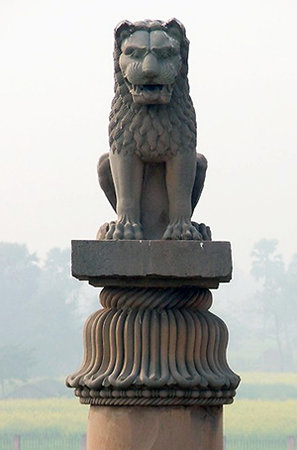
- Administrative and Linguistic Influence
- Iranian influence is evident in the preamble of Ashoka's edicts and the use of certain words.
- Example:
- The Iranian term “dipi” (meaning inscription) was replaced by “lipi” in Ashokan inscriptions.
- Indirect Influence: Greek Interest in India
- Through the Iranians, the Greeks became aware of India's vast wealth.
- This knowledge aroused Greek interest, eventually leading to Alexander's invasion of India.
- Alexander's Invasion of India
- Background: Greek-Iranian Conflict
- In the fourth century B.C., the Greeks and Iranians fought for world supremacy.
- Under Alexander of Macedonia, the Greeks defeated the Iranians, conquering Asia Minor, Iraq, and Iran.
- Defeating the Persian Empire (the biggest power of that time) is one of the main reasons why Alexander the Great is praised so much
- Achaemenid Persian Empire was one of the largest and most powerful empires of the ancient world. A relatively small kingdom (Macedonia) defeated a superpower.
- He died as an undefeated ruler
-

-
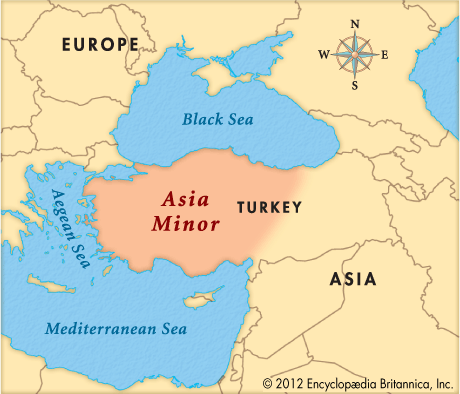
- From Iran, Alexander marched to India, attracted by its great wealth.
- Greek historians like Herodotus described India as a fabulous land, further tempting Alexander.
- His invasion was also driven by:
- Geographical curiosity, as he believed the eastern side of India was connected to the Caspian Sea.
- Aspirations to surpass mythical conquerors.
- Political Condition of North-West India
- The region was divided into independent monarchies and tribal republics.
- These rulers were deeply connected to their land but failed to unite against a common enemy.
- Two prominent rulers:
- Ambhi (Prince of Taxila) - submitted to Alexander.
- Ambhi of Taxila readily surrendered, providing troops and treasure.
- Porus (Kingdom between Jhelum & Chenab) - resisted him.
- Porus resisted at the Battle of Jhelum - though defeated, his bravery impressed Alexander, who restored his kingdom and made him an ally.
- The Khyber Pass remained unguarded, making invasion easier.
- Alexander's Campaign in India (326-325 B.C.)
- After conquering Iran, Alexander moved to Kabul and then entered India through the Khyber Pass. Took five months to reach the Indus.
- Advanced up to the Beas River, but could not proceed further.
- Halt at the Beas River
- Alexander wanted to march eastward, but his army refused due to:
- War-weariness and homesickness after ten years of campaigning.
- The hot Indian climate and disease outbreaks.
- Fierce resistance from Indian forces along the Indus.
- Reports of Magadha's Nanda dynasty, whose massive army greatly outnumbered Alexander's forces.
- Despite repeated appeals, his soldiers refused to continue.
- Alexander lamented:
- “I am trying to rouse (To wake up or awaken someone) the hearts that are disloyal and crushed with craven (Completely lacking courage; cowardly) fears.”
- Forced to retreat, his dream of an eastern empire remained unfulfilled.
- Return and Aftermath
- On his return, Alexander defeated several small republics along the way.
- He stayed in India for 19 months (326-325 B.C.), mostly engaged in fighting.
- He had little time to organize his conquests but made some administrative arrangements:
- Most conquered states were restored to their rulers who accepted his authority.
- His own territorial possessions were divided into three provinces, each under a Greek governor.
- He founded several cities to maintain Greek influence.
- Alexandria (Egypt)
- The most famous city, founded in 331 BCE.
- Became a major center of learning, trade, and culture.
- Home to the Great Library of Alexandria and the Lighthouse of Alexandria (one of the Seven Wonders of the Ancient World).
- Alexandria Arachosia (Afghanistan)
- Modern-day Kandahar.
- A key administrative and military base in the eastern part of Alexander's empire.
- Alexandria Eschate ("The Furthest") (Tajikistan)
- Located in present-day Khojand (Tajikistan).
- Marked the easternmost expansion of Alexander's conquests.
- Alexandria Bucephalous (Pakistan)
- Founded in honor of Bucephalus, Alexander's beloved horse, after it died following the Battle of the Hydaspes (326 BCE).
- Likely near modern Jhelum in Pakistan.
- Alexandria on the Indus (Pakistan)
- Founded near modern-day Uch, Pakistan.
- Served as a key military and trade center on the Indus River.
- Alexandria Margiana (Turkmenistan)
- Modern Merv, Turkmenistan.
- Built as a defensive settlement on the empire's northeastern frontier.
- Alexandria in the Caucasus (Afghanistan)
- Modern Begram, Afghanistan.
- Became a major trade hub connecting Central Asia with India.
- Effects of Alexander's Invasion
- First Contact Between Ancient India and Europe
- Alexander's invasion marked the first direct contact between ancient India and Europe.
- His campaign was a triumphant success, adding an Indian province to his empire, larger than the territory conquered by Iran.
- However, the Greek hold on India was short-lived, as the Mauryas soon took over.
- Indo-Greek Interaction and Trade
- The most significant result of Alexander's invasion was the direct Indo-Greek connection in multiple fields.
- His campaign opened four major routes by land and sea, facilitating trade and movement of Greek merchants and craftsmen.
- Greek Settlements in India
- Even before Alexander's invasion, some Greeks lived in north-west India.
- After the invasion, more Greek settlements were established, including:
- Alexandria in the Kabul region
- Boukephala on the Jhelum
- Alexandria in Sindh
- Although these areas later came under the Mauryas, Greek settlers continued to live under Chandragupta Maurya and Ashoka.
- Geographical Contributions
- Alexander was deeply interested in geography and explored the Indian Ocean at the mouth of the Indus.
- He sent his friend Nearchus with a fleet to explore the coastline from the Indus to the Euphrates, searching for harbors.
- His historians provided valuable geographical records, helping establish a chronology of Indian events.
- Observations on Indian Society and Economy
- Greek historians recorded important social and economic details, including:
- The sati system, where widows self-immolated on their husband's pyre.
- The sale of girls in marketplaces by poor parents.
- The fine breed of oxen in north-west India, leading Alexander to send 200,000 oxen to Macedonia.
- The flourishing carpentry industry, with carpenters specializing in chariots, boats, and ships.
- Political Impact: Rise of the Maurya Empire
- Alexander's invasion weakened the power of petty states in north-west India, creating a power vacuum.
- This facilitated the expansion of the Maurya empire.
- Chandragupta Maurya is believed to have observed Alexander's military tactics, which later helped him overthrow the Nanda dynasty and establish the Maurya empire.
- State and Varna Society in the Age of the Buddha
- Material Life in North India (c. 6th Century B.C.)
- The material life of North India, particularly in eastern Uttar Pradesh and Bihar, can be reconstructed using Pali texts, Sanskrit Sutra literature, and archaeological evidence.
- The sixth century B.C. marks the beginning of the Northern Black Polished Ware (NBP) phase, characterized by a glossy, fine-quality pottery used as tableware for the wealthy.
-
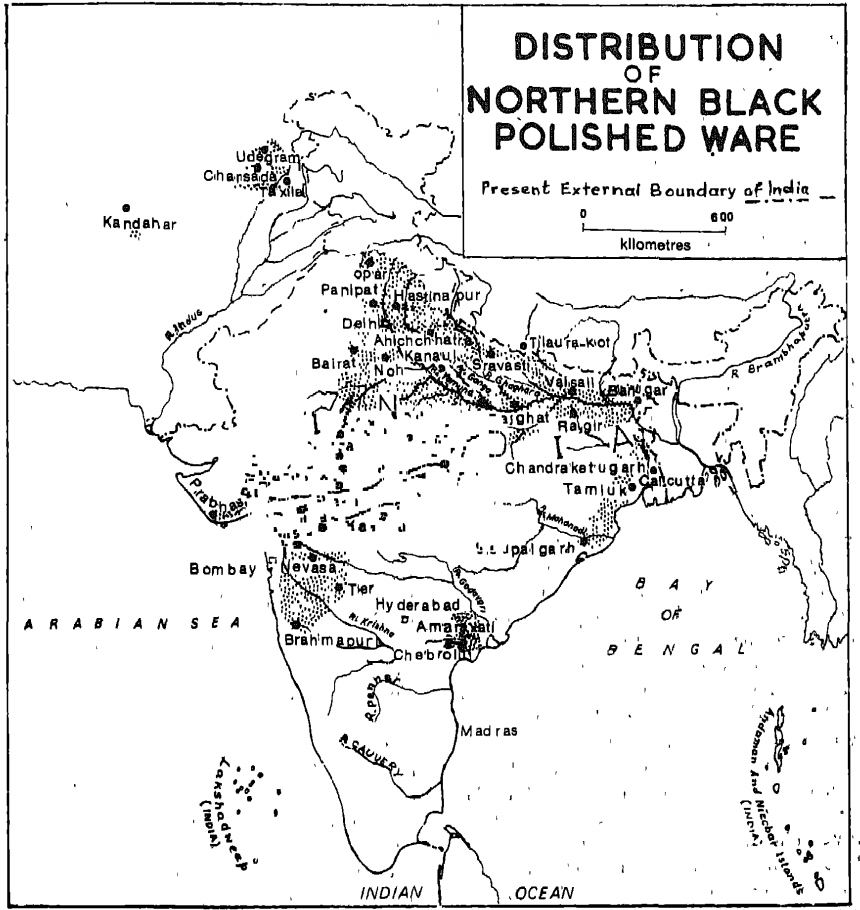
- This period also saw the introduction of iron implements for agriculture and crafts, the emergence of metallic money, and the use of burnt bricks and ring wells, which appeared in the mid-NBP phase (c. 3rd century B.C.).
- Urbanization and Settlements
- The NBP phase marked India's second urbanization, as the first urban phase (Harappan civilization) had disappeared by c. 1500 B.C., leaving a gap of about 1,000 years without towns.
- By the 6th century B.C., new towns emerged in the middle Gangetic basin.
- Many towns mentioned in Pali and Sanskrit texts, such as Kausambi, Sravasti, Ayodhya, Kapilavastu, Varanasi, Vaisali, Rajgir, Pataliputra, and Champa, have been excavated and show habitation signs from the NBP phase.
- Wooden palisades in Patna, possibly from Maurya or pre-Maurya times, suggest fortifications in some towns.
- Buildings were mostly made of mud-brick and wood, though Pali texts mention seven-storied palaces, which have not been found.
- Excavated structures appear unimpressive, but the material remains indicate a significant population increase compared to the earlier Painted Grey Ware settlements.
- Artisans, Merchants, and Guilds
- Many towns began as seats of government but evolved into market centers inhabited by artisans and merchants.
- Specialization in crafts developed due to guild systems and localization:
- Saddalaputta at Vaisali had 500 potters' shops.
- 18 artisan guilds are mentioned, with specific references to smiths, carpenters, leather workers, and painters.
- Merchants lived in designated streets, such as “vessa” (merchants' streets) in Varanasi and ivory workers' streets.
- Craftsmanship was hereditary, with sons learning their family trade.
- Trade and Transport
- Craft products, including fine textiles, ivory objects, and pottery, were transported over long distances.
- Large-scale trade is indicated by frequent references to 500 cartloads of goods.
- All major cities were located on riverbanks and trade routes, interconnected as follows:
- Sravasti linked to Kausambi and Varanasi.
- Traders traveled from Kosala and Magadha via Mathura to Taxila.
- Routes extended from Mathura to Ujjain and the Gujarat coast.
- Eastern routes went from Sravasti through Kapilavastu, Kusinara, Vaisali, and Patna to Rajgir and Champa (near modern Bhagalpur).
- Currency and Economic Transactions
- The terms “iskka” and “satamana” in Vedic texts likely refer to early coins, though actual coins date only from the 6th century B.C..
- Before coins, barter and cattle were common exchange mediums.
- The earliest metallic coins, appearing in Gautama Buddha's time, were mostly silver, with some copper.
- These were punch-marked coins, featuring symbols like hills, trees, fish, bulls, elephants, and crescents.
- The first hoards of these coins have been found in eastern Uttar Pradesh and Magadha, with some early coins also found in Taxila.
- The Pali texts show extensive monetary usage, with wages and prices being paid in coins, and even the price of a dead mouse being estimated in money.
- Role of Writing
- Writing likely began before Ashoka (3rd century B.C.).
- The earliest records, possibly written on perishable materials, have not survived.
- Writing facilitated:
- Trade documentation and bookkeeping.
- Tax collection and military administration.
- Compilation of laws and rituals.
- Development of measurement texts like Sulvasutras, aiding in land demarcation.
- Rural Settlements and Agriculture
- Though rural settlements from the NBP phase remain largely unexcavated, a strong rural base was essential for urbanization.
- Cities relied on peasants' taxes, tributes, and agricultural produce.
- Peasants purchased iron tools such as axes, adzes, knives, razors, nails, and sickles, found in early layers at Kausambi.
- Pali texts mention three types of villages:
- Typical villages, inhabited by various castes and communities, led by a bhojaka (village headman).
- Craft villages, such as a carpenters' village near Varanasi, which served as market hubs.
- Border villages, located at the edge of forests, mainly inhabited by fowlers and hunters.
- Land was divided into family-allotted plots, cultivated with family labor and hired agricultural workers.
- Fields were fenced, and irrigation channels were dug collectively under the supervision of the village headman.
- Peasants paid one-sixth of their produce as tax, collected directly by royal agents, with no intermediate landlords.
- Some villages were granted to Brahmanas and merchants.
- Large plots were worked by slaves and agricultural laborers.
- Wealthy peasants, called grāmakapatis, were similar to Vaishyas.
- Crops and Agricultural Advancements
- Rice was the staple (A basic or essential item) crop in eastern Uttar Pradesh and Bihar.
- Various types of paddy (rice in its husk before processing) and paddy fields are described in Pali texts.
- Large-scale paddy transplantation began in the age of Buddha, significantly increasing yields.
- Other crops included barley, pulses, millet, cotton, and sugarcane.
- Agricultural progress was driven by iron ploughshares and fertile alluvial soil between Allahabad and Rajmahal.
- Technological Advancements and Resource Utilization
- Iron played a key role in clearing forests and expanding cultivation.
- Iron tools were hardened for greater durability.
- Tools from Rajghat (Varanasi) indicate the use of iron ore from Singhbhum and Mayurbhanj.
- Iron supplies boosted crafts and agriculture, supporting economic growth.
- Economic Transformation
- The economic landscape of this period contrasts sharply with earlier Vedic rural economies in western Uttar Pradesh and chalcolithic economies in Bihar and Uttar Pradesh.
- A fully developed food-producing economy emerged in the middle Gangetic basin, supporting non-agricultural populations.
- This economic surplus enabled long-term taxation, standing armies, and the rise of large territorial states.
- Conclusion
- The material culture of 6th century B.C. North India was marked by rapid urbanization, economic expansion, and technological progress.
- The interplay between agriculture, trade, currency, and governance laid the foundation for the emergence of large kingdoms and a complex socio-economic structure.
- This period saw the transformation of the middle Gangetic basin into a thriving center of urban life, commerce, and state formation.
- Administrative System
- Rise of Kosala and Magadha
- During this period, many states existed, but only Kosala and Magadha emerged as powerful.
- Both were ruled by hereditary monarchs belonging to the Kshatriya varna.
- The Jatakas mention that oppressive kings and chief priests were sometimes expelled by the people, but such events were rare.
- The king held the highest official status and enjoyed special protection of his person and property.
- Only great religious leaders, like the Buddha, could challenge the king's authority.
- The king was primarily a warlord, leading his kingdom to victory, as seen in the careers of Bimbisara and Ajatasatru.
- Role of Officials
- The king ruled with the help of various officials, both high and low.
- Higher officials were called mahamatras and performed various functions, including:
- Mantrin (minister)
- Senanayaka (commander)
- Judge
- Chief accountant
- Head of the royal harem
- A separate class of officers called ayuktas may have performed similar functions in some states.
- Administration and Ministers
- The king's administration relied on capable ministers.
- Varsakara of Magadha weakened the Lichchhavis of Vaisali, helping Ajatasatru conquer the republic.
- Dirghacharayana of Kosala supported the king of Kosala.
- Most high-ranking officials and ministers were recruited from the Brahmana class, but they were not from the king's own clan.
- Revenue and Payment System
- In Kosala and Magadha, despite the circulation of punch-marked silver coins, influential brahmanas and sethis were paid through village revenue grants.
- Unlike in later Vedic times, the king did not need clan approval to grant revenue rights.
- However, these grants only provided revenue—they did not include administrative authority.
- Village Administration
- The village headman managed rural administration.
- Originally, headmen led tribal regiments and were called gramini (leader of a grama or tribal military unit).
- As agriculture and plough cultivation became common, the gramini evolved into a village headman in pre-Mauryan times.
- They were known by different titles:
- Gramabhojaka
- Gramini
- Gramika
- King Bimbisara is said to have summoned 86,000 gramikas, showing their importance and direct links to the king.
- Duties of Village Headmen
- The village headmen were responsible for:
- Assessing and collecting taxes from villagers
- Maintaining law and order in the locality
- Sometimes, oppressive headmen were punished by the villagers.
- Army and Taxation
- Expansion of the Army
- The real increase in state power is seen in the formation of a large professional army.
- At the time of Alexander's invasion, the Nanda ruler of Magadha maintained:
- 20,000 cavalry
- 200,000 infantry
- 2,000 horse-chariots
- 4,000 elephants
- Chariots were losing importance in both northeast and northwest India, where they had been introduced by the Aryans.
- Rulers in northwest India had fewer elephants than the Magadhan kings but maintained a comparable number of horses.
- The possession of numerous elephants gave Magadhan princes a military advantage.
- State Revenue and Taxation
- Maintaining a large, long-service army required significant state resources.
- The Nandas were known for their enormous wealth, which likely helped sustain their army.
- However, there is no clear record of how they raised taxes from the people.
- Taxation System
- A firm fiscal system was established, where:
- Kshatriyas (warriors) and Brahmanas (priests) were exempt from taxation.
- The tax burden fell on the peasants (mainly Vaishyas or Grihapatis).
- The Bal system, which was originally a voluntary payment by tribesmen in Vedic times, became a compulsory tax under the king.
- Balisadhakas (tax officers) were appointed to collect this tax.
- The king collected one-sixth of the produce as tax from peasants.
- Tax Collection and Payment
- Taxes were assessed and collected by royal agents with the help of village headmen.
- The advent of writing may have helped improve the tax system.
- Payments were made in both cash and kind (refers to goods or services rather than money):
- Punch-marked coins suggest tax payments in cash.
- In northeastern India, payments were often made in paddy.
- Peasants were also subjected to forced labor for royal projects.
- The birth stories of the Buddha mention peasants fleeing their kingdom to escape excessive taxation.
- Taxes on Artisans and Traders
- Artisans had to work one day per month for the king.
- Traders paid customs duties on the sale of their goods.
- Tolls were collected by officers known as saulkika ( remember like Sulka(toll) + ika (Adhikari)) or sulkadhyaksha ((Sulka(toll)) + Adhyaksha(Supervisor)).
- Decline of Popular Assemblies
- The sabha and samiti were no longer summoned by kings, leading to the decline of popular assemblies in post-Vedic times.
- These assemblies were originally tribal institutions, but as tribes dissolved into varna and caste groups, they lost their significance.
- In small kingdoms, assemblies may have functioned effectively in the Vedic period.
- However, in large states like Kosala and Magadha, holding big assemblies became impractical.
- Reasons for their decline:
- Difficulty in communication across large states.
- Integration of non-Vedic people who did not fit into the old tribal system.
- Rise of the Parishad and Republican Assemblies
- Instead of large assemblies, a small council called Parishad, consisting exclusively of Brahmanas, emerged.
- However, assemblies continued to flourish in smaller republican states like:
- Sakyas
- Lichchhavis
- The Republican Experiment
- Geographical Presence and Origins
- The republican system of government existed primarily in:
- The Indus basin
- The Indus basin republics may have been remnants of Vedic tribes, though some may have evolved from earlier monarchies.
- The foothills of the Himalayas in eastern Uttar Pradesh and Bihar
- In Uttar Pradesh and Bihar, the republican system might have been influenced by old tribal ideals of equality, which did not grant much prominence to the raja.
- Structure of Republican Governance
- Real power in these republics lay with tribal oligarchies (Power is concentrated in the hands of a small group) rather than a single ruler.
- Composition of the Ruling Class
- In the republics of the Sakyas and Lichchhavis, the ruling class belonged to the same clan and varna.
- In Vaisali, the Lichchhavis had 7707 rajas in the assembly, but brahmanas were not included.
- In post-Maurya republics like the Malavas and Kshudrakas, both kshatriyas and brahmanas were granted citizenship, but slaves and hired laborers were excluded.
- In one state on the Beas River in Punjab, membership was restricted to those who could supply at least one elephant to the state—making it a typical oligarchy in the Indus basin.
- Administrative Machinery
- The administrative system in the Sakya and Lichchhavi republics was simple and included:
- Raja (Chief)
- Uparaja (Vice-King)
- Senapati (Commander)
- Bhandagarika (Treasurer)
- The Lichchhavis reportedly had seven courts to try the same case one after another, though this might be an exaggeration.
- Unlike monarchies, certain states in the Buddha's time were ruled by leaders responsible to assemblies, rather than by hereditary kings.
- Thus, while political power was not shared equally, the republican tradition in India dates back at least to the age of the Buddha.
- Differences Between Republics and Monarchies
- Revenue and Administration
- In monarchies, the king alone claimed all revenue from the peasants.
- In republics, every tribal oligarch (raja) had a share of the revenue.
- Among the Lichchhavis, each of the 7707 rajas maintained his own storehouse and administration.
- Military Organization
- Monarchies maintained a regular standing army and did not allow any private military forces within their territory.
- In republics, each raja had his own small army under his senapati, leading to competition among them.
- Role of the Brahmanas
- In monarchies, brahmanas held significant influence.
- In republics, they were excluded from governance, and law-books did not recognize these states.
- Governance Model
- Monarchies functioned under a single ruler.
- Republics operated through oligarchic assemblies rather than individual leadership.
- Decline of the Republican Tradition
- The republican tradition weakened after the Maurya period.
- Even before the Mauryas, monarchies were stronger and more widespread.
- Ancient thinkers saw kingship as the most common and stable form of government.
- Buddhist Explanation of Kingship's Origin
- The Digha Nikaya (an early Buddhist Pali text) describes the origins of kingship:
- In the earliest times, humans lived harmoniously.
- With the emergence of private property, conflicts arose over land and women.
- To resolve disputes, people elected a chief responsible for law and order.
- In exchange for protection, they offered him a portion of their paddy.
- This elected chief became the king, marking the birth of kingship and the state.
- Social Orders and Legislation
- Origins of the Legal and Judicial System
- The Indian legal and judicial system originated during this period.
- Previously, society was governed by tribal law, which did not recognize class distinctions.
- Over time, the tribal community became clearly divided into four varnas:
- Brahmanas (priests and teachers)
- Kshatriyas (rulers and warriors)
- Vaisyas (peasants and taxpayers)
- Sudras (laborers serving the other three classes)
- The Dharmasutras formalized the duties of each varna, and both civil and criminal laws were based on varna divisions.
- Discrimination Against the Sudras
- The higher the varna, the purer it was considered, and the higher the moral conduct expected.
- Sudras suffered severe social and legal discrimination:
- Denied religious and legal rights
- Excluded from upanayana (sacred thread ceremony)
- Severely punished for crimes against higher varnas, while crimes against them were punished lightly
- Shunned by higher varnas, their food was avoided, and intermarriage was prohibited
- Denied high positions and expected to work as slaves, artisans, or agricultural laborers
- Even Buddhism and Jainism did not significantly improve the status of the Sudras.
- Though they were admitted into new religious orders, their overall social position remained low.
- Gautama Buddha visited assemblies of brahmanas, kshatriyas, and grihapatis (householders), but there is no mention of an assembly of sudras.
- Administration of Civil and Criminal Law
- Royal agents administered law and imposed harsh punishments, including:
- Scourging (to whip, punish, or cause great suffering)
- Beheading
- Tearing out the tongue
- Criminal punishments often followed the principle of revenge (“tooth for tooth, eye for eye”).
- Integration of Non-Vedic Tribes
- Although brahmanical law-books framed laws based on varna hierarchy, they also accommodated the customs of non-Vedic tribal groups.
- Many indigenous tribes were gradually absorbed into the brahmanical social order.
- Some were assigned fictitious social origins, while others were allowed to follow their own customs.
- Economic and Political Developments
- The age of the Buddha was crucial in shaping Indian polity, economy, and society:
- Agriculture flourished, particularly in eastern Uttar Pradesh and Bihar, due to the use of iron tools in alluvial areas.
- Food production increased, allowing for tax collection from peasants.
- Large states emerged, funded by regular taxes and tributes.
- To maintain social order, the varna system was institutionalized, clearly defining the roles of each class:
- Kshatriyas - rulers and warriors
- Brahmanas - priests and teachers
- Vaisyas - peasants and taxpayers
- Sudras - laborers serving all three classes
- The Age of the Mauryas
- Chandragupta Maurya and the Foundation of the Maurya Dynasty
- Origins and Rise to Power
- Chandragupta Maurya founded the Maurya dynasty, but his origins remain debated:
- Brahmanical tradition states he was born to Mura, a Sudra woman in the Nanda court.
- Earlier Buddhist tradition identifies him as a Kshatriya from the Maurya clan in Gorakhpur, near the Nepalese Terai.
- Taking advantage of the weakness and unpopularity of the Nanda dynasty, he overthrew them with the help of Chanakya (Kautilya) and established Mauryan rule.
- Conquests and Expansion
- Greek writer Justin claims Chandragupta overran the whole of India with an army of 600,000 soldiers—though this is uncertain.
- He successfully defeated Seleucus I Nicator, the Greek viceroy ruling west of the Indus.
- Following a peace treaty, Chandragupta:
- Gained control over eastern Afghanistan, Baluchistan, and the Indus region.
- Gave 500 war elephants to Seleucus in return.
- Extent of the Mauryan Empire
- Chandragupta built a vast empire covering:
- Bihar, Orissa, Bengal
- Western and north-western India
- The Deccan
- The Mauryan Empire excluded:
- Kerala, Tamil Nadu, and parts of north-eastern India.
- In the north-west, the Mauryas controlled territories beyond those held by the British Empire centuries later.
- Imperial Organization Under Chandragupta Maurya
- Sources of Information
- The Mauryan administration was highly elaborate, as described by:
- Megasthenes, a Greek ambassador sent by Seleucus to Chandragupta Maurya's court.
- Lived in Pataliputra and wrote about its administration and that of the empire.
- His original account is lost, but fragments appear in later Greek writings, compiled into a book.
- Kautilya's Arthashastra, though compiled later, contains authentic information on Mauryan governance and economy.
- Centralized Monarchy
- Chandragupta Maurya was an autocrat, holding absolute power.
- Arthashastra states that his happiness lay in the happiness of his subjects, though it is unclear how closely he followed this ideal.
- Megasthenes mentions a royal council advising the king, but its role was not binding. High-ranking officers were chosen from among these councillors.
- Provincial and Urban Administration
- The empire was divided into provinces, each governed by a prince from the royal family.
- Provinces were further subdivided into smaller administrative units.
- Major Mauryan cities included Pataliputra, Kausambi, Ujjain, and Taxila.
- Pataliputra's administration was handled by six committees of five members each, responsible for:
- Sanitation
- Care of foreigners
- Birth and death registration
- Regulation of weights and measures
- Other civic functions
- Central Government and Economic Control
- The central government maintained two dozen departments, regulating social and economic activities, particularly near the capital.
- The state controlled major economic activities to ensure financial stability:
- New land was cultivated using peasants and Sudra laborers.
- Taxes on peasants ranged from one-fourth to one-sixth of the produce.
- Irrigation fees were collected from those using state-provided water.
- Emergency crop production was imposed when necessary.
- Tolls were levied on goods entering towns.
- The state had monopolies on mining, liquor sales, and weapon manufacturing.
- Mauryan Military Strength
- The Mauryas maintained a vast military, as recorded by Pliny and Megasthenes:
- 600,000 foot soldiers
- 30,000 cavalry
- 9,000 elephants
- 8,000 chariots (mentioned in another source)
- A possible navy
- Military administration was managed by a board of 30 officers, divided into six committees (five members each), overseeing:
- Infantry
- Cavalry
- Elephants
- Chariots
- Navy
- Transport
- The Mauryan military was nearly three times larger than the Nanda army, owing to a larger empire and greater resources.
- Conclusion
- Chandragupta established an efficient administrative system with a strong financial base.
- The combination of a centralized monarchy, provincial governance, economic control, and military strength enabled the Mauryan Empire to flourish and expand.
- Bindusara (c. 297-273 BCE) - Son of Chandragupta
- Expanded the empire towards Deccan (South India).
- Known as "Amitraghata" (Slayer of Enemies).
- Maintained relations with Greek rulers like Antiochus I.
- Asoka (273-232 B.C.)
- Accession to the Throne
- Chandragupta Maurya was succeeded by his son Bindusara, who maintained relations with Greek princes.
- Asoka, Bindusara's son, is considered the greatest Mauryan ruler.
- Buddhist tradition portrays him as cruel in his early years, claiming he killed 99 brothers to seize the throne.
- However, this statement is legendary and lacks historical credibility.
- His biography, written by Buddhist scholars, contains fictional elements and cannot be taken literally.
- Asokan Edicts (official orders, proclamations, or decrees issued by an authority): A Historical Source
- Nature and Distribution
- Asoka was the first Indian king to communicate directly with the people through inscriptions.
- His edicts were engraved on:
- Rocks
- Polished stone pillars (mounted with capitals)
- Caves
- Found across the Indian subcontinent, as well as in Kandahar, Afghanistan.
- Composition and Language
- Asoka issued 44 royal orders, each with multiple copies.
- The inscriptions were written in different languages and scripts:
- Prakrit language and Brahmi script (majority of the empire).
- Kharosthi script (north-western region).
- Aramaic and Greek (Kandahar region).
- Significance
- Placed along ancient highways, making them accessible to the public.
- Provide valuable insights into:
- Asoka's policies (both external and domestic).
- His governance style and moral teachings.
- The extent of his empire and its administration.
- Impact of the Kalinga War
- The Turning Point in Asoka's Rule
- After ascending the throne, Asoka fought only one major war—the Kalinga War.
- According to his 13th Major Rock Edict, the war resulted in:
- 100,000 people killed
- 150,000 taken as prisoners
- Many more perished due to war-related suffering.
- The war deeply affected Asoka, causing him grief (Deep sorrow, especially due to loss) and remorse (a deep feeling of regret or guilt for a wrong committed), particularly due to the suffering of Brahmin priests and Buddhist monks.
- As a result, he abandoned physical conquest (bherighosha) and adopted a policy of cultural conquest (dhammaghosha).
- Asoka's Own Words (13th Major Rock Edict)
- In his edicts, Asoka expresses deep remorse over the war:
- “On conquering Kalinga, the Beloved of the Gods felt remorse, for when an independent country is conquered, the slaughter, death, and deportation of the people is extremely grievous… The Beloved of the Gods considers victory by Dhamma to be the foremost victory.”
- Shift to Dhamma and Foreign Policy
- Asoka now focused on ideological expansion, urging:
- Tribal peoples and frontier kingdoms to see him as a father and obey him with confidence.
- His officials to propagate the principles of dhamma across the empire.
- He no longer considered foreign conquests legitimate but instead sought to influence other regions ideologically.
- His foreign policy involved:
- Sending ambassadors of peace to Greek kingdoms in Western Asia and Greece.
- Undertaking welfare measures for people and animals in foreign lands—a unique initiative for that era.
- According to Buddhist tradition, sending Buddhist missionaries to Sri Lanka and Central Asia to spread dhamma.
- Pragmatism (a philosophy or approach that emphasizes practicality, real-world results, and problem-solving over abstract theories or ideals) in Governance
- Despite his transformation, Asoka was not an extreme pacifist (someone who believes in peace and opposes war or violence):
- He retained Kalinga after its conquest and integrated it into the Maurya Empire.
- There is no evidence that he disbanded the massive army inherited from Chandragupta Maurya.
- While urging tribal people to follow dharma, he also threatened action against those who violated social order.
- Administrative Reforms Under Dhamma
- Within the empire, Asoka introduced officers called rajukas, who had the power to:
- Reward people for good conduct.
- Punish them if necessary to maintain order.
- His policy of consolidation (the act of strengthening, uniting, or making something more stable and effective) through dhamma had practical success:
- The Kandahar inscription suggests that hunters and fishermen abandoned their traditional killing practices, possibly adopting settled agricultural life.
- Internal Policy and Buddhism
- Asoka's Conversion to Buddhism
- Asoka was converted to Buddhism after the Kalinga War.
- According to tradition:
- He became a monk and undertook pilgrimages (dharma yatras) to Buddhist shrines.
- He made huge donations to the Buddhist community.
- Buddhist Council and Missionary Work
- A Buddhist council was held under the chairmanship of Asoka's brother.
- Missionaries were sent to:
- South India
- Sri Lanka
- Burma
- Other countries to spread Buddhism
- Rummindei Pillar Inscription of Asoka
- The inscription is in Brahmi script and written in Prakrit language.
- It marks the birthplace of Buddha (Lumbini) and states:
- “When King Devanampriya Priyadarsin had been anointed ( to be chosen, blessed, or consecrated for a special role, often in a religious or ceremonial context) for twenty years, he came himself and worshiped (this spot), because the Buddha Sakyamuni was born here. (He) both caused to be made a stone bearing wall and caused a stone pillar to be set up (in order to show) that the Blessed One was born here. The village of Lumbini was exempted from bali (tribute), and bhaga (the royal share of the produce) was reduced to one-eighth.”
-

- Governance and Administration
- Asoka followed the ideal of paternal kingship, repeatedly reminding his officials that he considered his subjects as his children.
- His officials (rajukas and dharmamahamatras) were instructed to:
- Propagate dhamma among various social groups, including women.
- Administer justice fairly.
- Ensure the welfare of the people as representatives of the king.
- Social and Religious Policies
- Rituals and Animal Protection:
- He disapproved of rituals, especially those performed by women.
- He forbade the killing of certain birds and animals.
- He completely prohibited animal slaughter in the capital.
- He interdicted (to prohibit, forbid, or restrict something, often by legal or authoritative order) excessive social revelries (lively and noisy celebrations, often involving drinking, dancing, and festivity).
- Broad Religious Outlook:
- Asoka's dharma was not sectarian (strong loyalty to a particular group, especially in religion or politics); it aimed at preserving the social order.
- It emphasized:
- Obedience to parents.
- Respect for Brahmanas and Buddhist monks.
- Compassion towards slaves and servants.
- These values were common to both Buddhism and Brahmanism.
- Asoka's Teachings and Social Order
- Asoka emphasized living in harmony:
- Compassion towards animals.
- Proper behavior towards relatives.
- Strengthening the family institution and social classes.
- His teachings focused on moral and ethical living rather than religious conversion.
- Unlike Buddhist teachings, he never spoke about nirvana—instead, he stated that good behavior would lead to heaven.
- His policies aimed at tolerance and maintaining social order, rather than promoting a sectarian faith.
- Asoka's Place in History
-
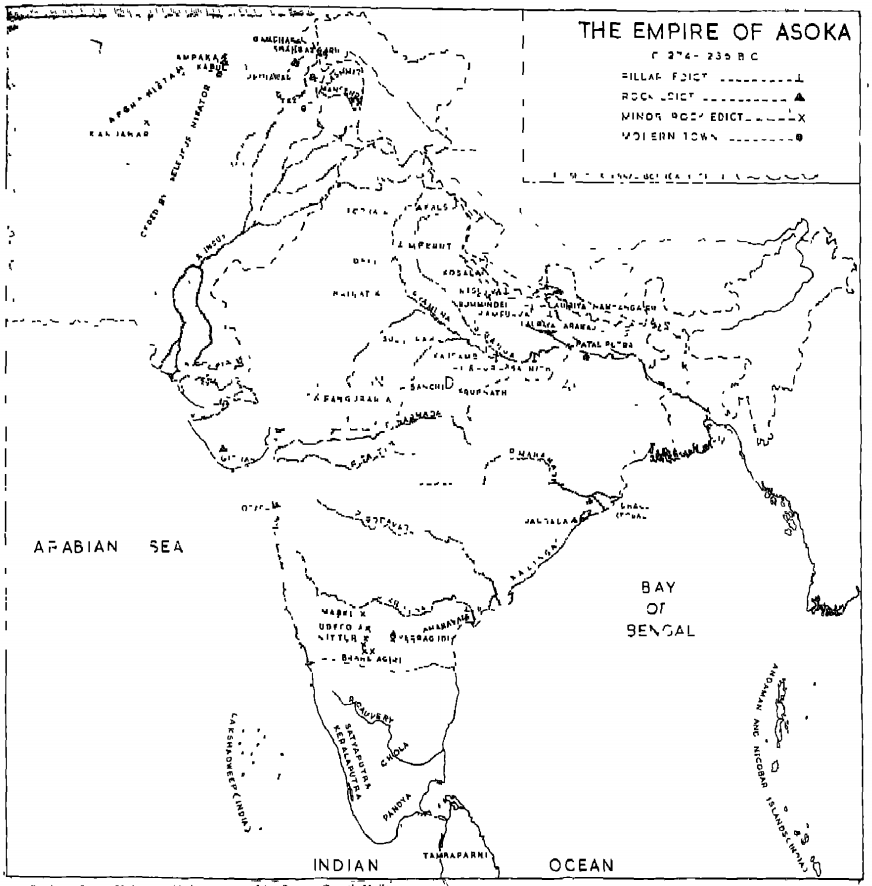
- Asoka's Achievements
- Asoka is regarded as one of the greatest missionary (a person who is sent to spread religious beliefs, provide humanitarian aid, or promote a cause, usually in foreign lands) rulers in ancient history.
- His zeal (great enthusiasm, passion, or dedication toward a cause, goal, or belief) and devotion helped him achieve significant success both domestically and internationally.
- Contrary to the belief that his pacific policies weakened the Maurya Empire, his reign saw remarkable accomplishments.
- Political and Cultural Unification
- Asoka politically unified India, strengthening it further through:
- One dharma (ethical code).
- One language (Prakrit in most regions).
- One script (Brahmi, widely used in inscriptions).
- Despite favoring Brahmi, he respected and accommodated:
- Other scripts like Kharosthi, Aramaic, and Greek.
- Languages such as Greek, Prakrit, and Sanskrit.
- Various religious sects, including non-Buddhist and even anti-Buddhist groups, to whom he also made donations.
- His tolerant religious policy ensured no forced imposition of Buddhism on his subjects.
- Missionary and Administrative Policies
- Asoka was deeply committed to missionary activities.
- He deputed officials to far-flung regions of his empire, which:
- Strengthened administration.
- Promoted cultural integration between the Gangetic heartland and distant provinces like:
- Kalinga
- Lower Deccan
- Northern Bengal
- Policy of Peace and Non-Aggression
- Asoka is historically significant for his policy of peace, non-aggression, and cultural conquest.
- Unlike his predecessors, he renounced military conquest after the Kalinga war.
- His vision stood in stark contrast (difference between things or the act of comparing to highlight differences) to:
- Kautilya's Arthashastra, which advocated continuous expansion.
- The Magadhan rulers before him, who followed an aggressive military approach.
- Asoka's ideals were unique, as no Indian king before him had pursued such a pacifist policy.
- A similar example existed only in Egypt, where Akhenaten (14th century BCE) had adopted a pacific (Calm, peaceful, or avoiding conflict) policy.
- However, Asoka was likely unaware of Akhenaten's precedent (an earlier event, decision, or action that serves as an example or guide for future situations).
- Despite having ample resources and a large army, he never waged war again after Kalinga's conquest.
- Limitations of Asoka's Policy
- His policy did not leave a lasting impact on his viceroys and vassals.
- After his retirement in 232 BCE, many of them declared independence in their regions.
- Neighboring powers were not influenced by his peaceful approach.
- Within 25 years of his departure, foreign forces invaded India's northwestern frontiers.
- Other rulers included
- Dasaratha Maurya (c. 232-224 BCE) - Grandson of Ashoka
- The empire started weakening.
- Samprati (c. 224-215 BCE) - Promoted Jainism
- Little expansion or administration.
- Salisuka (c. 215-202 BCE) - Weak ruler
- Faced internal revolts.
- Devavarman (c. 202-195 BCE) - Lost territories
- The empire shrank further.
- Satadhanvan (c. 195-187 BCE) - Short reign
- Empire decline continued
- Brihadratha (c. 187-185 BCE) - Last Mauryan ruler
- Killed by Pushyamitra Shunga, a Brahmin general, who founded the Shunga Dynasty.
- Significance of the Maurya Rule
- State Control in the Mauryan Empire
- The King's Authority and Dharma
- The Brahmanical law-books emphasized that the king should govern according to the Dharmashastras and existing customs.
- Kautilya's Arthashastra advised the king to uphold dharma when the varna-ashrama system weakened.
- The king was regarded as dharmapravartaka (promulgator of social order).
- Ashoka's inscriptions explicitly stated that royal orders were supreme over other laws, and he actively promoted dharma through officials.
- Rise of Royal Absolutism
- The assertion of absolute monarchy was a natural consequence of the military expansion by Magadhan rulers.
- Kingdoms such as Anga, Vatsali, Kasi, Kosala, Avanti, and Kalinga were annexed into the Magadhan Empire, leading to greater centralized control over all aspects of life.
- Military dominance eventually evolved into coercive state control over administration, economy, and society.
- Vast Bureaucratic Machinery
- The state maintained an extensive bureaucracy, unparalleled in earlier Indian history.
- A sophisticated espionage system supported the administration:
- Spies gathered intelligence on foreign threats and government officers.
- Some spies also manipulated superstitions to extract money from the public.
- Government Officials and Salaries
- High-ranking functionaries, known as ti-shas, were primarily paid in cash.
- Major officials and their salaries:
- Minister (Mantri), High Priest (Purohita), Commander-in-Chief (Senapati), and Crown Prince (Yuvaraja) - Paid up to 48,000 panas.
- Lower-ranked officers - Paid 60 panas, with some receiving as little as 10-20 panas.
- This led to massive income disparity between high and low-level officials.
- Economic Regulations
- State Control and Administration
- According to Kautilya's Arthashastra, the Mauryan state appointed 27 superintendents (adhyakshas) to regulate various economic activities, including:
- Agriculture:
- Providing irrigation facilities and regulating water supply.
- Trade and Commerce:
- Managing markets and ensuring fair transactions.
- Weights and Measures:
- Standardizing trade practices.
- Crafts and Industries:
- Overseeing weaving, spinning, and mining.
- Megasthenes mentions that land measurement and water distribution were carefully regulated, similar to Egyptian practices.
- Taxation System
- The Mauryan period marked a significant development in taxation. Kautilya lists numerous taxes levied on:
- Peasants, artisans, and traders
- Land and produce
- The administration prioritized tax assessment over storage. Key officials included:
- Samaharta - Head of tax assessment.
- Sanadhata - Chief custodian of the treasury and storehouses.
- Epigraphic evidence suggests that taxes were collected in kind, with rural granaries serving as reserves for famine and drought relief.
- Currency and Economy
- The Mauryan economy relied on punch-marked silver coins bearing the symbols of:
- Peacock
- Hill and crescent (a curved, moon-like shape)
- These coins were widely circulated, aiding in:
- Tax collection and salary payments
- Market transactions across the empire
- Social and Labor Organization
- Role of Slavery
- A notable social development was the employment of slaves in agriculture.
- Megasthenes claimed not to have seen slaves in India.
- However, domestic slaves had existed since Vedic times.
- The Mauryan state maintained large farms worked by:
- Slaves (possibly including 150,000 war captives from Kalinga).
- Hired laborers.
- Despite this, ancient Indian society was not a slave society like Greece or Rome. Instead, shudras served as laborers, artisans, and domestic workers under the higher varnas.
- Infrastructure and Transportation
- Roads and Communication
- The Mauryan administration maintained an extensive road network that enabled trade and governance:
- Pataliputra to Nepal (via Vaisali and Champaran).
- Himalayan foothills route (connecting Vaisali, Champaran, Kapilavastu, Kalsi, Hazara, and Peshawar).
- Northwestern India to Patna (as described by Megasthenes).
- Kalinga to Andhra and Karnataka, improving connectivity in southern India.
- The strategic location of Pataliputra facilitated movement in all directions, enhancing royal control over a vast territory.
- Population and Military
- The Mauryas ruled over a relatively small population:
- The army numbered around 650,000 soldiers.
- If 10% of the population served in the army, the total population would be around 6.5 million.
- Ashokan inscriptions suggest that state control was strongest in the Middle Gangetic region, but weaker in the extreme east and south.
- Art and Architecture
- Stone Masonry and Pillars
- The Mauryan period witnessed a major transformation in architecture:
- Use of stone masonry on a large scale.
- Megasthenes compared Pataliputra's palace to the grandeur of Iran's capital.
- Excavations at Kumhrar (Patna) reveal remnants of an 80-pillared hall.
-
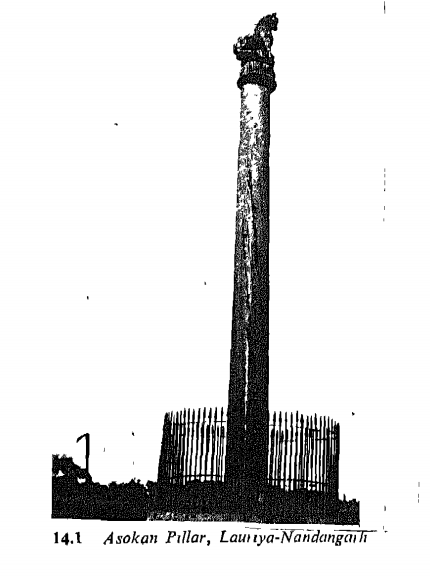
- Mauryan artisans excelled in stone polishing, seen in:
- Highly polished stone pillars, set up across the empire.
- Each pillar made of a single sandstone piece, with sculpted capitals featuring lions or bulls.
-
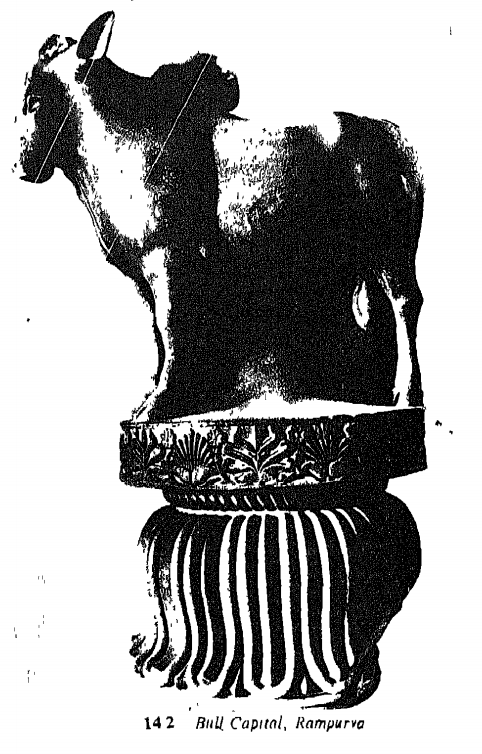
-
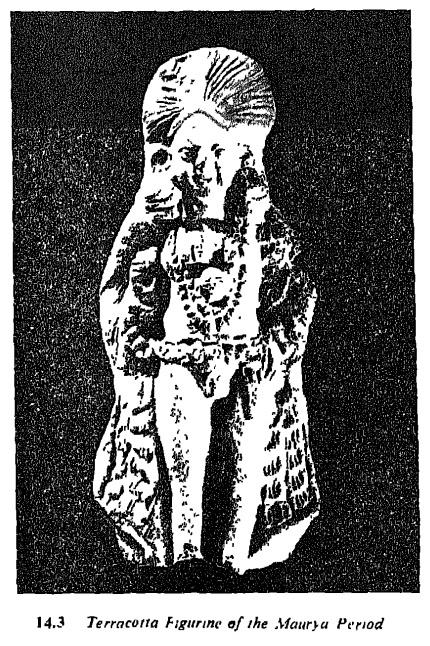
- Cave Architecture
- Mauryan rulers pioneered rock-cut caves for monks.
- The Barabar Caves (30 km from Gaya) are the earliest examples.
- This architectural tradition later spread to western and southern India.
-
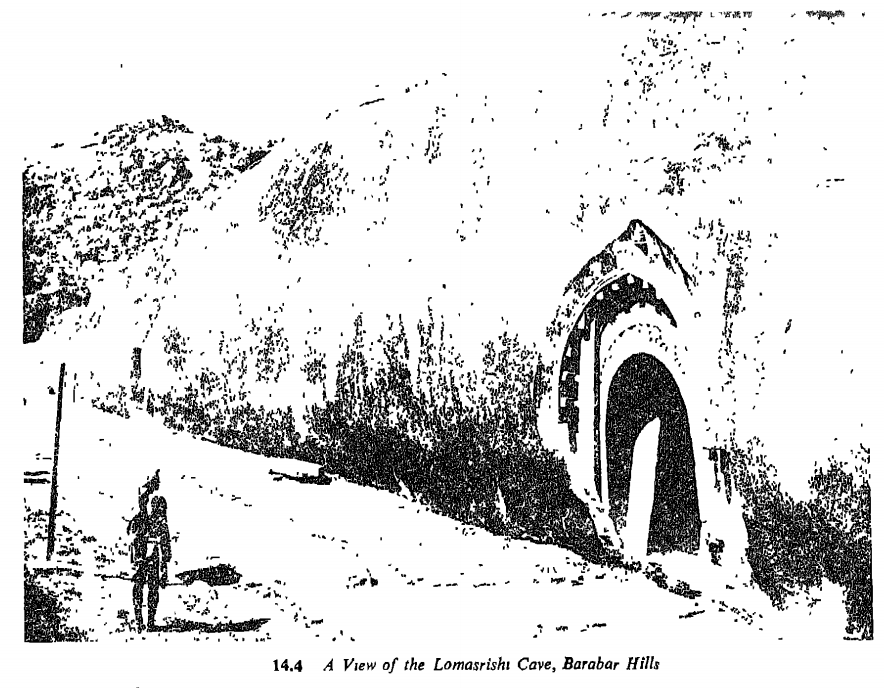
-
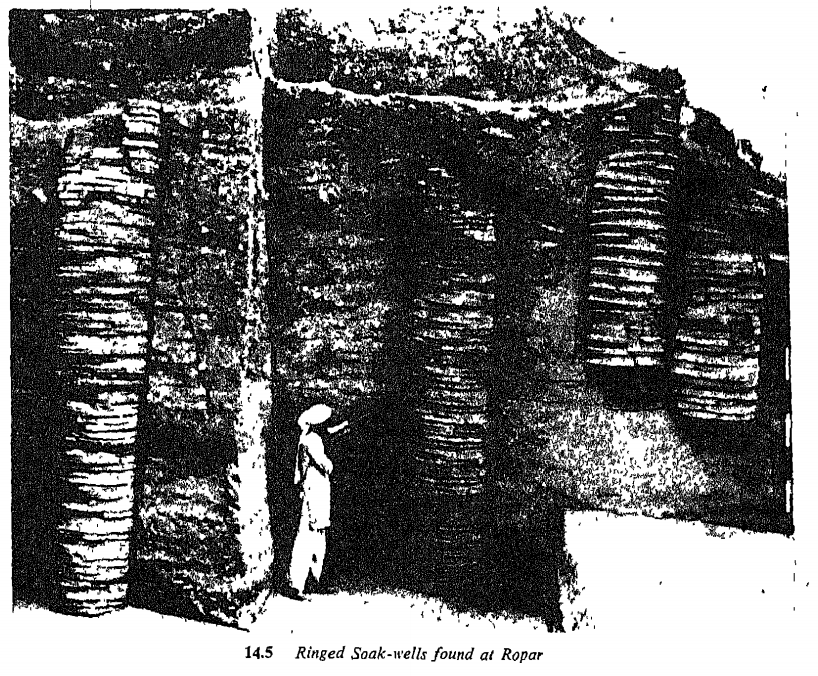
- Causes of the Fall of the Maurya Empire
- The Magadhan empire, which had been established through successive wars culminating in the conquest of Kalinga, began to disintegrate after the exit of Ashoka in 232 BCE. Several factors contributed to the decline and eventual fall of the Maurya Empire.
- Brahmanical Reaction
- Ashoka's policies led to growing resentment among the Brahmanas. Although he adopted a tolerant approach and asked people to respect Brahmanas, his measures—such as prohibiting the killing of animals and birds and criticizing superfluous rituals—significantly affected their income.
- The Brahmanas, who depended on sacrifices and rituals for their livelihood, suffered due to the anti-sacrifice stance of Buddhism and Ashoka's policies.
- Despite Ashoka's efforts to maintain religious harmony, the Brahmanas desired a government that favored them and preserved their traditional privileges.
- Some of the new kingdoms that emerged after the fall of the Maurya Empire were ruled by Brahmanas, such as the Sungas and Kanvas in the east and the Satavahanas in the Deccan. These dynasties revived Vedic sacrifices, which Ashoka had neglected.
- Financial Crisis
- The enormous expenditure on maintaining the army and bureaucracy led to a severe financial strain on the Maurya treasury.
- The Mauryas had the largest army and the largest regiment of officers in ancient India, which required extensive resources.
- Despite imposing numerous taxes, it became difficult to sustain such a vast administrative structure.
- Ashoka's generous donations to Buddhist monks further depleted state finances.
- In the final stages of the empire, the treasury became so exhausted that gold images were reportedly melted to cover expenses.
- Oppressive Rule in the Provinces
- Misrule and oppressive administration in various provinces contributed to the empire's decline.
- During Bindusara's reign, the people of Taxila complained about the tyranny of corrupt bureaucrats (dushtamatyas). Ashoka resolved the issue temporarily, but the problem persisted when he became emperor.
- The Kalinga edicts suggest that Ashoka was deeply concerned about oppression in the provinces. He instructed the mahamatrus (officials) not to mistreat townspeople.
- To improve administration, he introduced the rotation of officers in key regions like Tosali (Kalinga), Ujjain, and Taxila.
- Despite these measures, discontent continued, and after Ashoka's retirement, regions like Taxila were quick to rebel against Maurya rule.
- Spread of New Material Knowledge in Outlying Areas
- The spread of technological and agricultural advancements weakened the Maurya Empire's dominance.
- Magadha had initially expanded due to its material advantages, such as the early use of iron tools and weapons.
- However, as knowledge of these techniques spread to central India, the Deccan, and Kalinga, the core Gangetic region lost its unique advantage.
- With access to better tools and resources, peripheral provinces developed independently and formed new kingdoms.
- This explains the emergence of the Sungas and Kanvas in central India, the Chetis in Kalinga, and the Satavahanas in the Deccan.
- Neglect of the North-West Frontier
- Ashoka's focus on missionary activities left the north-western frontier vulnerable to external threats.
- In the third century BCE, Central Asia witnessed constant tribal movements, particularly among the Scythians, who relied on cavalry warfare.
- In response to these threats, the Chinese ruler Shih Huang Ti (247-210 BCE) built the Great Wall of China around 220 BCE to protect his empire.
- However, Ashoka did not take similar measures to secure India's frontiers.
- As a result, when the Scythians advanced, they pushed the Parthians, Sakas, and Greeks towards India.
- The Greeks, who had established a kingdom in Bactria (north Afghanistan), became the first to invade India in 206 BCE, triggering a series of invasions that continued until the beginning of the Christian era.
- Final Collapse and the Rise of the Sungas
- The Maurya Empire ultimately fell in 185 BCE when Pushyamitra Sunga, a Brahmana and general of the last Maurya king, Brihadratha, usurped (to take power, a position, or rights forcefully or without legal authority) the throne.
- Pushyamitra Sunga is said to have killed Brihadratha in public and declared himself ruler of Pataliputra.
- The Sungas ruled over Pataliputra and central India, actively reviving Brahmanical traditions through Vedic sacrifices.
- They reportedly persecuted Buddhists, marking a significant shift from the Maurya policies of religious tolerance.
- The Kanvas, another Brahmana dynasty, succeeded the Sungas and continued to rule over the remnants of the Maurya Empire.
- Thus, a combination of financial instability, administrative inefficiencies, regional rebellions, technological diffusion, and foreign invasions led to the eventual downfall of the Maurya Empire.
- Central Asian Contacts and Their Results
-
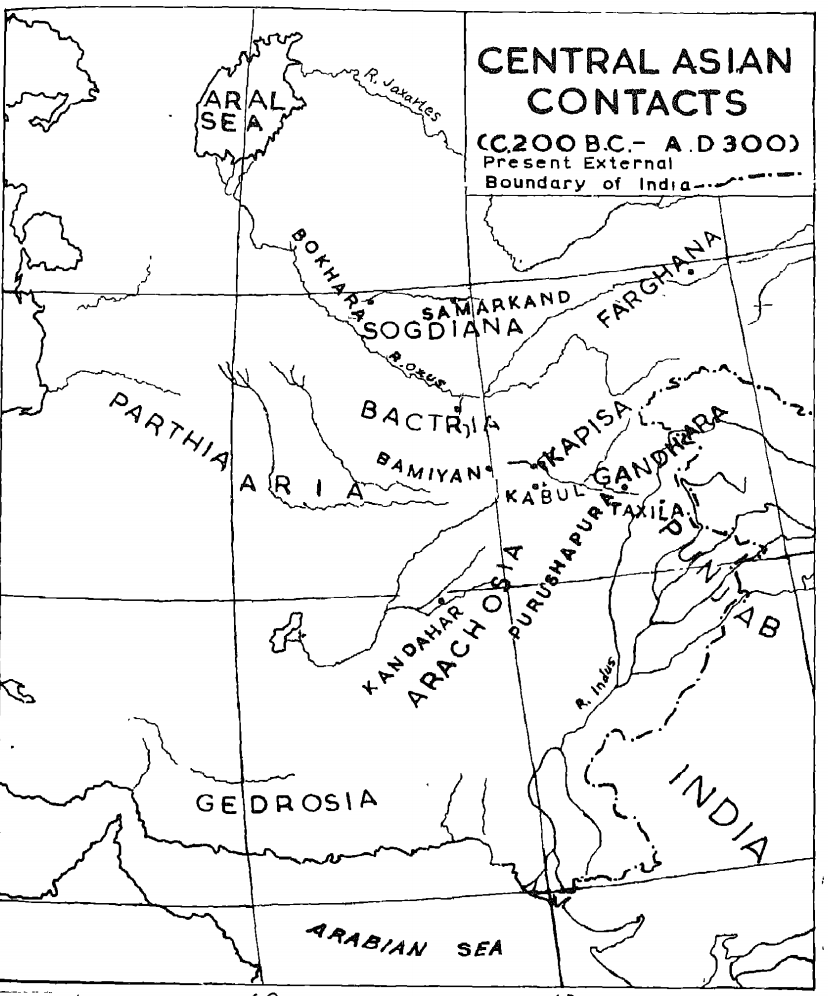
- Around 200 B.C., India did not witness the rise of a large empire like that of the Mauryas. However, this period was marked by extensive and intimate contacts between Central Asia and India.
- In eastern India, central India, and the Deccan, the Mauryas were succeeded by native dynasties such as the Sungas, Kanvas, and Satavahanas.
- In north-western India, power shifted to several ruling dynasties from Central Asia.
- The Indo-Greeks
- Around 200 B.C., a series of invasions took place, beginning with the Greeks from Bactria, a region south of the Oxus River in present-day northern Afghanistan. These invaders came in successive waves, sometimes ruling simultaneously in different regions.
- Causes of Indo-Greek Invasions
- The weakness of the Seleucid Empire, which controlled Bactria and parts of Iran (Parthia), made the region vulnerable.
-

- Seleucid Empire (312–63 BC) was a major Hellenistic Greek state in Western Asia founded by Seleucus I Nicator, one of Alexander the Great’s generals
- The Scythian (nomadic warrior people who lived in the Eurasian steppes (modern-day Ukraine, southern Russia, and Central Asia)) tribes put increasing pressure on the Greek rulers in Bactria, forcing them to retreat.
- With the construction of the Great Wall of China, the Scythians could no longer push eastward, so they turned their attention towards the Greeks and Parthians, ultimately leading the Bactrian Greeks to invade India.
- The successors of Ashoka were too weak to resist these foreign invasions.
- Greek Rule in India
- The Indo-Greeks (Bactrian Greeks) were the first to invade India, expanding their control over north-western India by the early 2nd century B.C.
- They occupied a larger territory than that conquered by Alexander, reportedly advancing as far as Ayodhya and Pataliputra.
- However, the Greeks failed to establish a unified rule in India, with two Greek dynasties ruling simultaneously in north-western India.
- Menander (165-145 B.C.)
- The most famous Indo-Greek ruler, also known as Milinda, ruled from Sakala (modern Sialkot, Punjab).
- He invaded the Ganga-Yamuna Doab and later converted to Buddhism under the influence of Nagasena.
- Their philosophical discussions were compiled in the famous book Milinda Panho (The Questions of Milinda).
- Significance of Indo-Greek Rule
- Coinage:
- The Indo-Greeks were the first rulers in India to issue coins definitively attributed (A quality, feature, or trait that belongs to a person, thing, or idea) to individual kings.
- Unlike the early punch-marked coins, which cannot be assigned to specific dynasties, Greek coins provided clear attributions.
- They were also the first to introduce gold coins in India, a trend that expanded under the Kushans.
-

- Art and Culture:
- Greek rule introduced Hellenistic artistic elements in north-western India, which contributed to the development of Gandhara art.
- The Sakas
- The Sakas were Iranian-speaking nomadic tribes closely related to the Scythians, who lived in the Central Asian steppes and later migrated into South Asia, Persia, and China.
- Steppes refer to a vast, semi-arid, grass-covered plain that is largely treeless
-
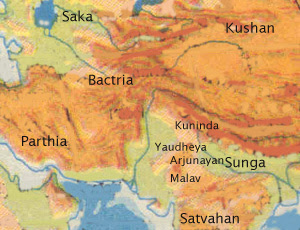
- After the Greeks, the Sakas emerged as the next major foreign rulers in India, controlling a much larger territory than their predecessors.
- They established five branches of rule, each with its seat of power in different regions of India and Afghanistan:
- Afghanistan
- Punjab, with Taxila as the capital
- Mathura, where they ruled for about two centuries
- Western India, where they continued to rule until the 4th century A.D.
- Upper Deccan
-
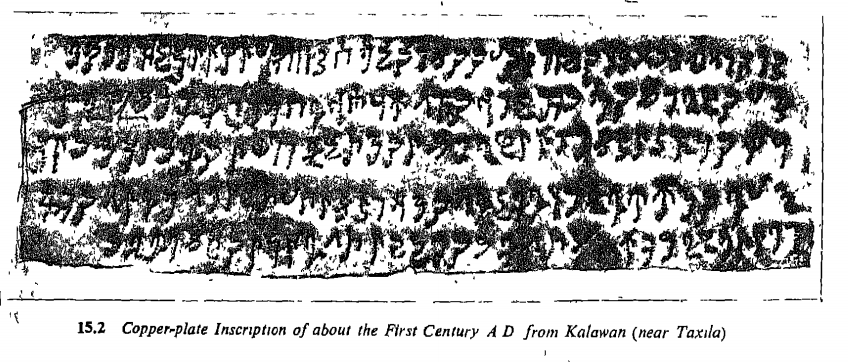
- Resistance Against the Sakas
- The Sakas faced little effective resistance from Indian rulers.
- Around 58 B.C., a king of Ujjain successfully fought against them and drove them out.
- He adopted the title Vikramaditya, and his victory led to the establishment of the Vikrama Samvat era in 58 B.C.
- Vikram Samvat is the traditional lunar calendar of India for determining Hindu festivals (Diwali, Holi, etc.)
- The title Vikramaditya became prestigious, similar to how Roman emperors adopted the title Caesar.
- As a result, 14 rulers in Indian history later adopted the title Vikramaditya, especially in western India and the western Deccan until the 12th century A.D.
- Saka Rule in Western India
- Among the different Saka branches, only those in western India held power for a long duration—about four centuries.
- The most famous Saka ruler in India was Rudradaman I (A.D. 130-150).
- His rule extended over Sindh, Kutch, and Gujarat, and he also recovered territories from the Satavahanas, including:
- Konkan
- Narmada Valley
- Malwa
- Kathiawar
- Contributions of Rudradaman I
- He is remembered for repairing and improving the Sudarshana Lake in Kathiawar, which had been used for irrigation since Mauryan times.
- He was a great patron of Sanskrit
- Despite being of foreign origin, he issued the first-ever long inscription in pure Sanskrit, whereas earlier long inscriptions in India were composed in Prakrit.
- The Parthians
-
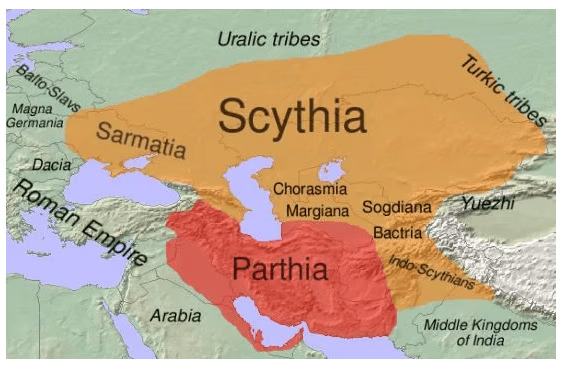
- The Parthians were an Iranian people who established the Parthian Empire (247 BCE - 224 CE) in Persia (modern Iran).
- After the Sakas, the Parthians established their rule in north-western India. In many ancient Indian Sanskrit texts, both groups are mentioned together as Saka-Pahlavas because they ruled parallelly for some time.
- Origins and Expansion
- The Parthians originally lived in Iran and later migrated to India.
- Unlike the Greeks and the Sakas, they controlled only a small portion of north-western India during the 1st century A.D.
- Key Parthian Ruler
- The most famous Parthian king was Gondophernes.
- It is believed that during his reign, St. Thomas came to India to propagate Christianity.
- Who Was St. Thomas?
- St. Thomas, also known as Thomas the Apostle or "Doubting Thomas", was one of the twelve apostles of Jesus Christ. He is best known for:
- Doubting Jesus' Resurrection
- He initially refused to believe that Jesus had risen from the dead until he saw and touched Jesus' wounds.
- Missionary Work in India
- According to Christian tradition, he traveled to India to spread Christianity.
- Martyrdom in India
- The suffering or death of a person because of their religious or ideological beliefs
- He was believed to be martyred in Chennai (Tamil Nadu), India.
- Integration into Indian Society
- Over time, the Parthians, like the Sakas, became an integral part of Indian polity and society.
- The Kushans
-
- The Kushans, also known as the Yuechis or Tocharians, were a nomadic tribe from the steppes of North Central Asia near China.
- They first occupied Bactria (North Afghanistan), displacing the Sakas, and gradually moved into the Kabul Valley. By crossing the Hindukush, they seized Gandhara, replacing the Greek and Parthian rule.
- Eventually, they expanded their empire over the lower Indus basin and greater Gangetic basin, creating a vast domain extending from Khorasan in Central Asia to Varanasi in India. Their rule unified territories across five modern countries, fostering cultural interactions.
- Kushan Dynasties
- The Kushan rule was marked by two successive dynasties:
1. The Kadphises Dynasty (c. A.D. 50 - 78)
- Founded by chiefs of the Kadphises house and lasted 28 years.
- Kadphises I issued copper coins south of the Hindukush, imitating Roman coins.
- Kadphises II minted a large number of gold coins and expanded the kingdom east of the Indus.
2. The Kanishka Dynasty (A.D. 78 - 230)
- Extended Kushan power over Upper India and the Lower Indus Basin.
- Issued gold coins with higher gold content than the Gupta coins.
- Their inscriptions were found in north-western India, Sindh, Mathura, Sravasti, Kausambi, and Varanasi, indicating rule over the greater Gangetic basin.
- Major Kushan Capitals
- Purushapura (Peshawar)
- The primary capital, where Kanishka built a monastery and a massive stupa.
- Mathura
- The secondary capital, evidenced by Kushan coins, inscriptions, sculptures, and structures.
- Kanishka: The Greatest Kushan Ruler
- Despite suffering defeats against the Chinese, Kanishka is historically significant for:
- Starting the Saka era in A.D. 78, which is still used by the Government of India.
- Saka Samvat was adopted on March 22, 1957 as the National Calender of India on recommendation of Calender Reform Committee
- It is debated who started Saka era, but this book mentions this, but other sources mention Satvahana king started the saka era
- Patronizing Buddhism and holding a Buddhist council in Kashmir, finalizing the doctrines of Mahayana Buddhism.
- Supporting Sanskrit literature and art, significantly influencing Indian culture.
-
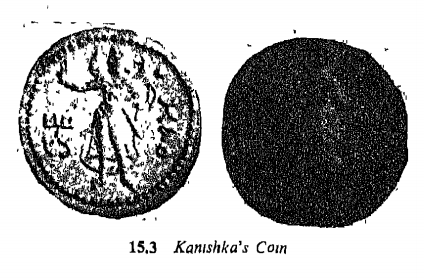
- Decline of the Kushan Empire
- Kanishka's successors ruled north-western India until A.D. 230.
- Some later rulers had Indianized names, such as Vasudeva.
- The Kushan Empire in Afghanistan and west of the Indus was overthrown in the mid-3rd century A.D. by the Sassanian Empire of Iran.
- However, Kushan principalities survived in India for about a century.
- Kushan influence persisted in Kabul Valley, Kapisa, Bactria, Khorezm, and Sogdiana (modern Bokhara and Samarkand) until the 3rd and 4th centuries.
- Archaeological Findings
- Kushan coins, inscriptions, and terracottas have been found across Central Asia.
- A huge Kushan palace at Toprak-Kala in Khorezm (3rd-4th century A.D.) contained administrative archives with inscriptions in Aramaic script and the Khorezmian language.
- Mnemonic to remember order of invasions
- Ghee Shakkar vala Paratha Khao Ho?
- Ghee -> Indo-Greeks
- Shakkar -> Sakas
- vala -> _x
- Paratha -> Indo-Parthians
- Khao -> Kushanas
- Ho -> White Hunas
- Impact of Central Asian Contacts on India
- Structures and Pottery
- Construction Advances:
- The Saka-Kushan phase marked a significant advancement in construction, with multiple structural layers found in northern India.
- Architectural Features:
- Extensive use of burnt bricks for flooring.
- Tiles for both flooring and roofing.
- Brick wells became common.
- Pottery Developments:
- Red ware pottery, found in plain and polished forms with fine fabric.
- Notable types include sprinklers and spouted channels.
- Similarities with thin red pottery from Kushan layers in Soviet Central Asia.
- Techniques extended to regions like Farghana, indicating cultural exchange.
- Trade and Technology
- Cultural Integration:
- Sakas and Kushans settled permanently in India, adopting Indian script, language, and religion.
- Military Contributions:
- Introduced better cavalry and large-scale horse riding.
- Popularized reins and saddles, visible in Buddhist sculptures.
- Enthusiastic horsemen, evidenced by terracotta figures from Begram, Afghanistan.
- Some foreign horsemen used heavy armor, spears, lances, and possibly rope stirrups.
- Attire Influences:
- Introduced turbans, tunics, trousers, and long coats.
- Afghan and Punjabi turbans, and sherwanis, evolved from these influences.
- Brought in caps, helmets, and boots, widely used by warriors.
- Economic Influence:
- Established strong trade ties with Central Asia.
- India received gold from the Altai Mountains and possibly via Roman trade.
- The Kushans controlled the Silk Route, bringing immense wealth through tolls.
- First rulers in India to issue gold coins on a large scale.
- Polity
- Feudatory System:
- Central Asian rulers imposed their rule over many native princes.
- The Kushans adopted the title "King of Kings," showing supremacy over smaller rulers.
- Divine Kingship:
- Kushan kings were called “Sons of God.”
- Inspired by Chinese kingship, adapted in India to emphasize royal authority.
- Manu's laws reinforced the king's divine status.
- Government Structure:
- Introduced the satrap system, dividing the empire into satrapies.
- Some regions had hereditary dual rule (father and son ruling jointly).
- Less centralization under these rulers.
- Social Classification:
- Sakas and Parthians were seen as fallen Kshatriyas.
- The concept of "fallen Kshatriyas" was a way to categorize certain groups of people who were considered to have once belonged to the Kshatriya varna (the warrior and ruling class) but had lost their status. This loss of status was often due to a failure to uphold their traditional duties or by not adhering to the Dharma (righteous conduct) associated with their caste.
- Large-scale assimilation of foreigners into Indian society occurred during the post-Maurya period.
- Military Governorship:
- The Greeks introduced the concept of military governors (strategos) to maintain control.
-
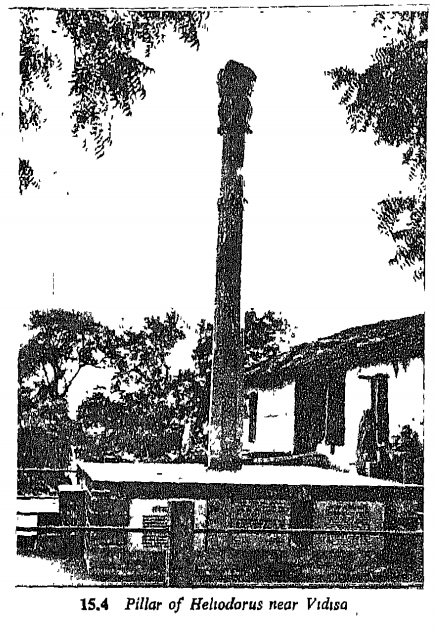
- New Elements in Indian Society
- Cultural Assimilation:
- Greeks, Sakas, Parthians, and Kushans gradually lost their separate identity.
- They were absorbed into Indian society as Kshatriyas.
- Vishnu texts supported this assimilation, as seen in Kushan ruler Vasudeva's name, linked to Krishna.
- Religion
- Religious Conversions:
- Some foreign rulers embraced Vaishnavism (worship of Vishnu).
- Greek ambassador Heliodorus erected a pillar in honor of Vishnu in Vidisha, Madhya Pradesh.
- A few rulers adopted Buddhism, such as Menander, who engaged in debates with the Buddhist teacher Nagasena.
- The Kushans worshipped both Shiva and Buddha, with their images appearing on coins.
- The Origin of Mahayana Buddhism
- Transformation of Buddhism:
- Foreign influence led to changes in Buddhism, making it more accessible.
- The original puritanical form was too abstract (Something that exists as an idea but not as a physical object) for foreigners.
- A new sect, Mahayana (Great Wheel), emerged, emphasizing Buddha's image worship.
- Those rejecting Mahayana were called followers of Hinayana (Lesser Vehicle).
- Kanishka's Patronage (a supporter or sponsor):
- Convened a Buddhist council in Kashmir to engrave Buddhist teachings on copper sheets.
- Built many stupas in Buddha's memory.
- Gandhara Art
- Artistic Patronage:
- Foreign rulers actively supported Indian art and literature.
- The Kushan empire facilitated interaction between Indian, Greek, and Roman artisans.
- Gandhara Art:
- Developed in the northwestern frontier, blending Graeco-Roman and Indian styles.
- Buddha images featured Graeco-Roman hairstyles.
-
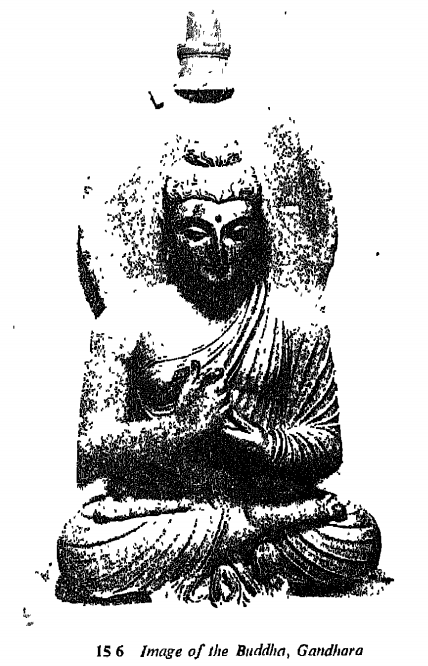
- Mathura Art:
- Mathura remained a hub of indigenous art.
- Produced the famous headless statue of Kanishka.
- Created numerous Buddha and Mahavira images.
- The Mathura Museum holds the largest Kushan-era sculpture collection.
-
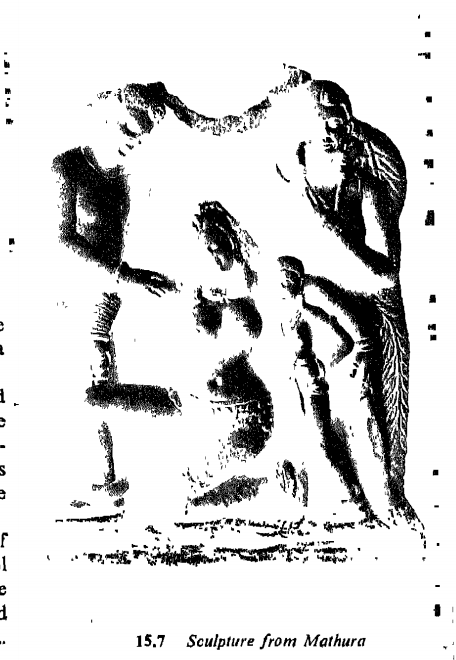
- Southern Developments:
- Rock-cut Buddhist caves emerged in Maharashtra.
- Nagarjunakonda and Amaravati in Andhra Pradesh became major Buddhist art centers.
- Early Buddhist panels are found in Gaya, Sanchi, and Bharhut (2nd century B.C.).
-
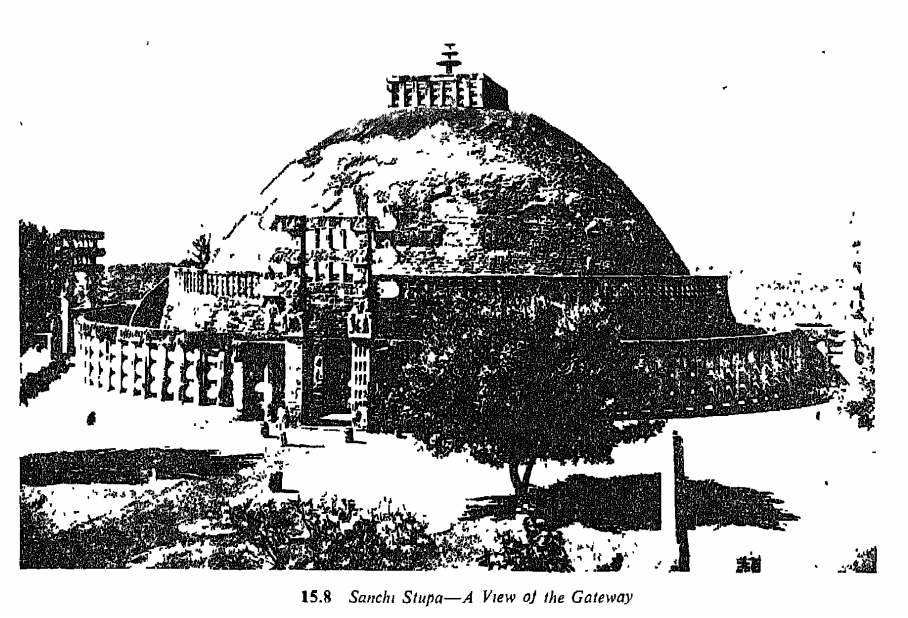
- Literature and Learning
- Sanskrit Literature:
- Foreign rulers promoted Sanskrit.
- Earliest kāvya-style inscription by Rudradaman (c. A.D. 150).
- Prakrit continued for inscriptions until the 4th century A.D.
- Notable Writers:
- Aśvaghoṣa, under Kushan patronage, wrote Buddhacharita (Buddha's biography) and Saundarananda.
- Growth of Mahayana Buddhism led to avadānas (Buddhist tales), e.g., Mahāvastu and Divyāvadāna.
- Theatrical Influence:
- Greek influence introduced curtains (yāvanikā) to Indian theatre.
- Science and Technology
- Astronomy & Astrology:
- Indian texts adopted Greek planetary movement terms.
- Indian astrology absorbed Greek ideas; the term horāśāstra was derived from “horoscope.”
- Medicine & Chemistry:
- Charaka and Sushruta pioneered medicine, botany, and chemistry.
- Charakasamhitā detailed herbal medicines and chemical processes.
- Indian medicine (auṣadhi) relied on plants (oṣadhi).
- Technological Advancements:
-
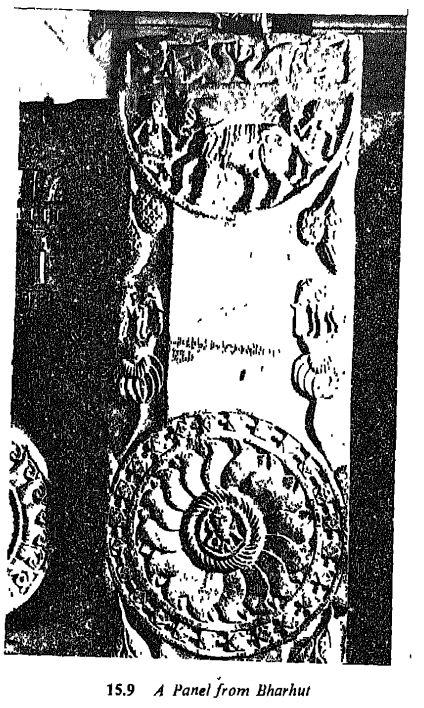
- Central Asian influence seen in trousers and long boots (Kanishka depicted wearing them).
- Leather shoe-making possibly began in this period.
- Kushan copper and gold coins imitated Roman coins.
- Diplomatic ties with Rome:
- Indian embassies sent to Emperor Augustus (A.D. 27-28) and Trajan (A.D. 110-120).
- Roman contacts may have influenced Indian glass-making, which flourished during this era.
-
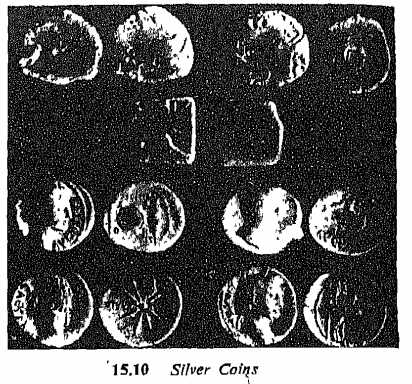
- The Age of the Satavahanas
- Political History of the Satavahanas
- The Satavahanas, considered identical to the Andhras mentioned in the Puranas, were the most important native successors of the Mauryas in the Deccan and central India. However, while the Puranas speak only of Andhra rule, the name “Andhra” does not appear in Satavahana inscriptions.
- According to some Puranas, the Andhras ruled for 300 years, a period now attributed to the Satavahana dynasty.
- Early Satavahana Rule
- The earliest Satavahana inscriptions date back to the first century B.C., when they defeated the Kanvas and established their power in parts of central India. However, their initial stronghold was not in Andhra, but in Maharashtra, where most of their early inscriptions have been found.
- They established their rule in the upper Godavari valley, a region that remains agriculturally rich in present-day Maharashtra.
- Gradually, the Satavahanas expanded their rule over Karnataka and Andhra. Their greatest rivals were the Sakas, who had established dominance in the upper Deccan and western India. At one point, the Satavahanas lost their territories in Maharashtra and western India to the Sakas.
- Gautamiputra Satakarni (A.D. 106-130)
- The fortunes of the Satavahana dynasty were revived by Gautamiputra Satakarni (A.D. 106-130). He:
- Called himself the only Brahmana.
- Defeated the Sakas and destroyed many Kshatriya rulers.
- Eliminated the Kshaharata lineage, to which his adversary Nahapana belonged.
- Overstruck more than 8,000 silver coins of Nahapana found near Nasik, proving his conquest.
- Occupied Malwa and Kathiawar, which were under Saka control.
- Gautamiputra Satakarni's empire extended from Malwa in the north to Karnataka in the south, possibly exerting general authority over Andhra.
- Later Satavahana Kings (A.D. 130-220)
- The successors of Gautamiputra Satakarni ruled until A.D. 220.
- Vasisthiputra Pulumayi (A.D. 130-154)
- His coins and inscriptions found in Andhra indicate that by the mid-2nd century, Andhra was fully integrated into the Satavahana kingdom.
- Established his capital at Paithan (Pratisthan) on the Godavari in Aurangabad district.
- Continued conflict with the Sakas, who sought control over Konkan and Malwa.
- Rudradaman I (A.D. 130-150) - Saka Ruler of Saurashtra (Kathiawar)
- Defeated the Satavahanas twice but did not destroy them due to matrimonial alliances.
- Yana Sri Satakarni (A.D. 165-194)
- Recovered North Konkan and Malwa from the Sakas.
- Promoted trade and navigation.
- His coins have been found across Andhra, Maharashtra, Madhya Pradesh, and Gujarat, indicating extensive influence.
-
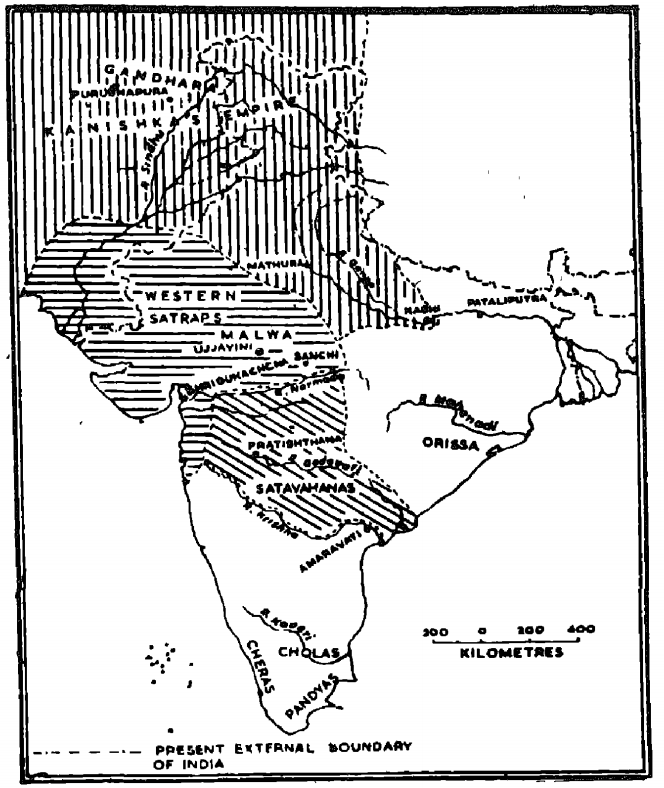
- Aspects of Material Culture Under the Satavahanas
- The material culture of the Deccan under the Satavahanas was a fusion of local traditions and northern influences.
- Iron Usage and Metallurgy
- The megalith builders of the Deccan were already familiar with iron tools and agriculture.
- Before circa 200 B.C., a few iron hoes were in use, but their number increased significantly in the first two or three centuries of the Christian era.
- The form of hoes remained largely unchanged from the megalithic to the Satavahana phase, except that they were now fully socketed.
- Other iron tools from this period include:
- Socketed hoes
- Sickles, spades, ploughshares
- Axes, adzes, razors
- Tanged and socketed arrowheads and daggers
- A blacksmith's shop has been discovered at a site in Karimnagar district, indicating advanced ironworking.
- The iron ores of Karimnagar and Warangal were likely exploited, as evidence of iron mining dates back to the megalithic phase.
- Gold and Coinage
- Gold workings from the early Christian centuries have been found in the Kolar fields.
- Unlike the Kushans, the Satavahanas did not issue gold coins, but likely used gold as bullion (form of bars, ingots, or coins).
- Their coinage primarily consisted of:
- Lead coins, which are common in the Deccan.
- Potin, copper, and bronze coins.
- The Ikshvakus, who succeeded the Satavahanas, also issued their own coins.
- Both the Satavahanas and Ikshvakus seem to have exploited the mineral resources of the Deccan.
- Agriculture and Economy
- The people of the Deccan practiced paddy transplantation.
- The Krishna-Godavari delta developed into a major rice-producing region in the first two centuries A.D.
- Cotton production was another key feature of the Deccan's economy.
- Foreign accounts describe Andhra as famous for its cotton products.
- The economy was strong enough to sustain a large military force. According to Pliny, the Andhra kingdom maintained:
- 100,000 infantry
- 2,000 cavalry
- 1,000 elephants
- Urbanization and Infrastructure
- Contact with north India introduced new elements of material culture, such as:
- Coins
- Burnt bricks
- Ring wells
- By 200 B.C. - A.D. 200, sites like Peddabankur (Karimnagar district) show:
- Regular use of fire-baked bricks.
- Flat, perforated roof tiles for durable structures.
- 22 brick wells dating to the second century A.D., facilitating dense habitation.
- Covered underground drains leading waste water into soakage pits.
- Towns emerged in:
- Maharashtra by the first century B.C., with several crafts flourishing.
- Eastern Deccan a century later.
- Pliny mentions that Andhra in the western Deccan had:
- 30 walled towns.
- Numerous villages.
- Inscriptions and excavations confirm the existence of several towns in the second and third centuries A.D.
- Increasing trade activity is indicated by numerous Roman and Satavahana coins. These coins appeared earlier in western Deccan and about a century later in eastern Deccan (Godavari-Krishna region).
- Pattern of Administration Under the Satavahanas
- Divine Kingship and Royal Ideals
- The Satavahana rulers upheld the royal ideals set forth in the Dharmashastras.
- The king was portrayed as the upholder of dharma and was assigned divine attributes.
- The Satavahana king was compared to legendary figures such as:
- Rama, Bhima, Kesava, Arjuna
- Supernatural forces, to emphasize his divinity and prowess.
- Administrative Structure
- The Satavahanas retained some administrative units from the Ashokan period:
- The district was called “ahara”, the same term used during Ashoka's reign.
- Officials were known as “amatyas” and “mahamatras”, similar to those in Mauryan administration.
- Military and Feudal Elements
- The administration had strong military influences, evident in key appointments:
- The senapati (commander) was also appointed as the provincial governor.
- Since tribal communities in the Deccan were not fully Hinduized or reconciled to Satavahana rule, military control was necessary.
- In rural areas, administration was handled by the gaulmika, who led a military regiment consisting of:
- 9 chariots
- 9 elephants
- 25 horses
- 45 foot soldiers
-
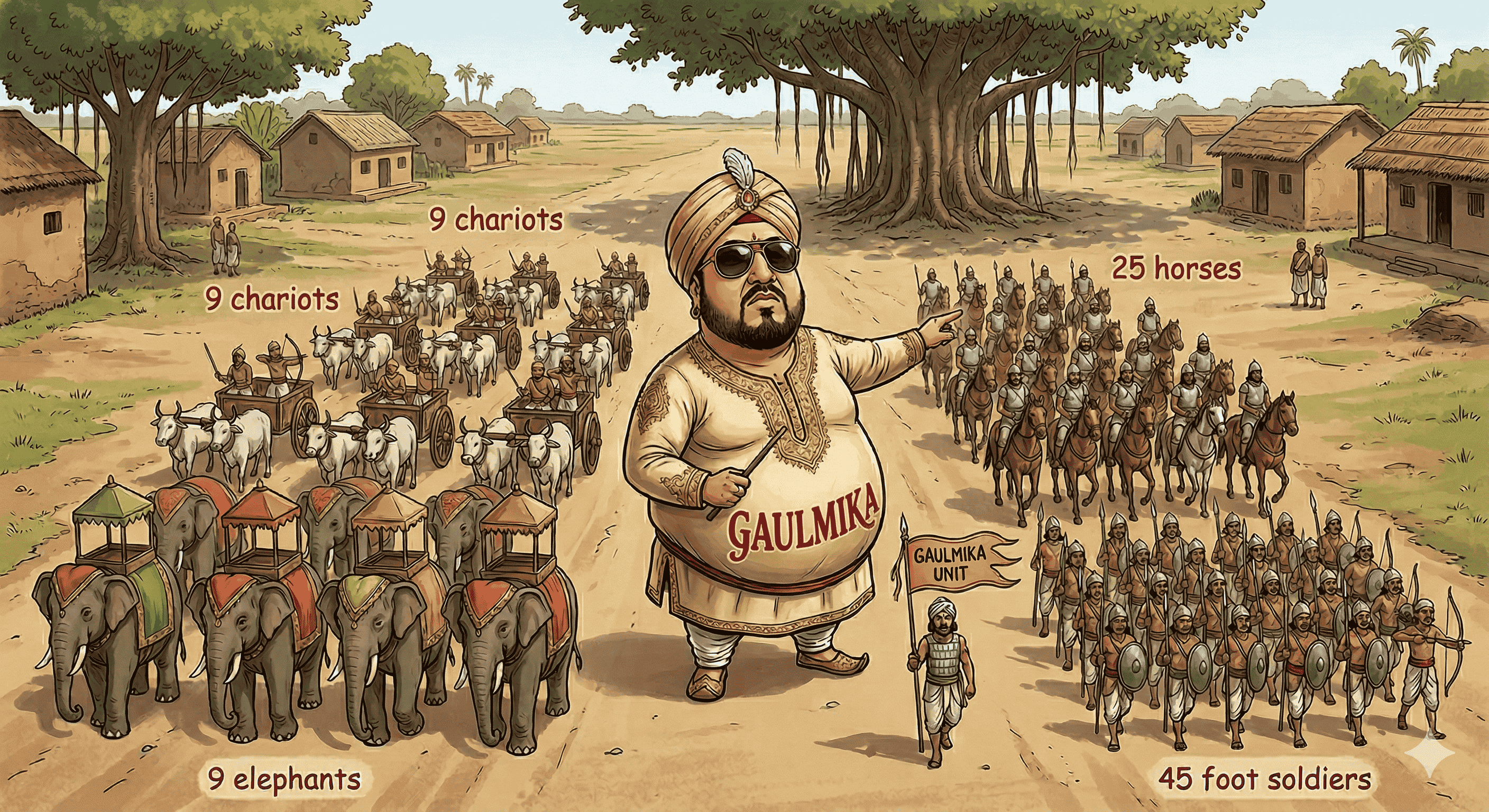
- The head of the army platoon was stationed in the countryside to maintain peace and order.
- Military influence is further evident in inscriptions mentioning:
- “Kataka” (military camps)
- “Skandhavaras” (military settlements), which also functioned as administrative centers when the king was present.
- This highlights the coercive nature of Satavahana rule.
- Land Grants and Religious Patronage
- The Satavahanas initiated the practice of granting tax-free villages to:
- Brahmanas
- Buddhist monks
- The cultivated fields and villages granted to them were declared free from interference by:
- Royal policemen
- Soldiers
- Other royal officials
- These granted lands became autonomous enclaves within the kingdom.
- Buddhist monks promoted peace and social order by preaching good conduct and respect for authority.
- Brahmanas helped enforce the varna system, which contributed to social stability.
- Feudal Hierarchy and Feudatories
- The Satavahana kingdom had a three-tiered system of feudatories:
- 1. Raja (King)
- The highest-ranked feudatory, with the right to mint coins.
- 2. Mahabhoja
- The second-grade feudatory.
- 3. Senapati
- The third-grade feudatory.
- These feudatories and landed beneficiaries held significant local authority, shaping the decentralized nature of Satavahana rule.
- Religion Under the Satavahanas
- Promotion of Brahmanism
- The Satavahana rulers identified as Brahmanas and symbolized the triumph of Brahmanism.
- They actively performed Vedic sacrifices, including:
- Ashvamedha (horse sacrifice)
- Vajapeya (royal consecration sacrifice)
- They worshipped several Vaishnava deities, such as:
- Krishna
- Vasudeva
- Other Vaishnava gods
- Brahmanas were granted liberal sacrificial fees, reinforcing their religious authority.
- Support for Buddhism
- Despite their Brahmanical inclinations, the Satavahanas patronized Buddhism, particularly the Mahayana sect.
- Buddhist monks received land grants, facilitating the growth of monastic institutions.
- Buddhism flourished in:
- Nagarjunakonda and Amaravati (Andhra Pradesh) - Became major centers of Buddhist culture.
- Nasik and Junar (Western Deccan, Maharashtra) - Buddhism thrived here due to the patronage of traders.
- Under the Ikshvakus (successors of the Satavahanas), Buddhism continued to receive strong support.
- Architecture Under the Satavahanas
- Rock-Cut Temples and Monasteries
- The Satavahana period saw the creation of rock-cut temples and monasteries in the north-western Deccan (Maharashtra).
- This tradition began around 200 BC, about a century before the Satavahanas.
- Two major structures were:
- Chaitya (Temple):
- A large hall with numerous columns.
- The most famous chaitya is at Karle (Western Deccan), measuring:
- 40 meters long, 15 meters wide, 15 meters high.
- A remarkable example of rock-cut architecture.
-
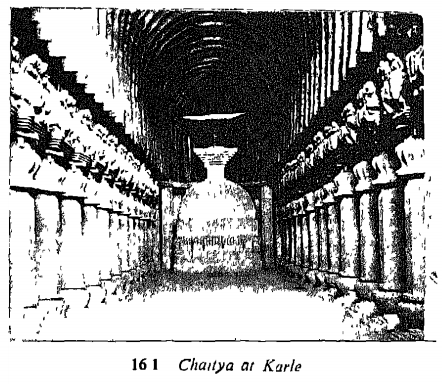
- Vihara (Monastery):
- A central hall accessed through a doorway from a front verandah.
- Excavated near chaityas as residences for monks during the rainy season.
- Nasik has three viharas, carrying inscriptions of Nahapana and Gautamiputra, dating to the 1st-2nd centuries A.D.
- Buddhist Architecture in Andhra
- Rock-cut architecture also existed in Andhra Pradesh (Krishna-Godavari region), but the region was better known for its free-standing Buddhist structures.
- The most notable Buddhist monuments include:
- Stupas:
- Found across 125 km around Ellora.
- Most famous stupas:
- Amaravati Stupa:
- Originated around 200 BC, but completely rebuilt in the late 2nd century A.D.
- Dimensions:
- Dome 53 meters across the base.
- 33 meters in height.
- Covered with sculptures depicting scenes from Buddha's life.
-
- Nagarjunakonda:
- Flourished under the Ikshvakus (successors of the Satavahanas).
- Contained Buddhist stupas and the earliest Brahmanical brick temples.
-
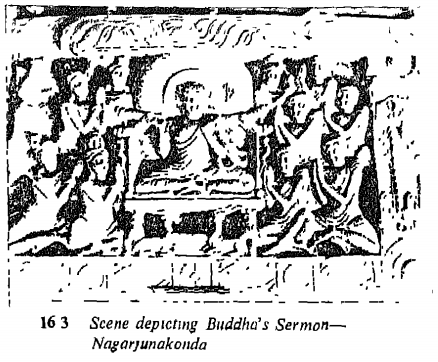
- Language Under the Satavahanas
- Official Language: Prakrit
- All inscriptions were composed in Prakrit and written in the Brahmi script, similar to the Asokan period.
- Literary Contributions:
- Some Satavahana kings may have authored books in Prakrit.
- The Gathasaptasati, a collection of 700 verses in Prakrit, is attributed to King Hala.
- However, the text appears to have been edited much later, possibly after the 6th century A.D.
- The Dawn of History in the Deep South
- Transition to the Historical Period in South India
- Markers of the Historical Period
- Several key elements define the beginning of the historical period:
- Large-scale rural settlements practicing plough agriculture with iron implements.
- Formation of the state system.
- Rise of social classes.
- Use of writing.
- Beginnings of written literature.
- Megalithic Culture in Peninsular India
- These historical elements were absent in the Kaveri delta until around 200 B.C.
- Before this, the uplands of the peninsula were inhabited by megalith builders.
- Their actual settlements are rare, but their graves (megaliths) provide insights into their culture.
- Megaliths were stone-circled graves, containing skeletons, pottery, and iron objects.
-
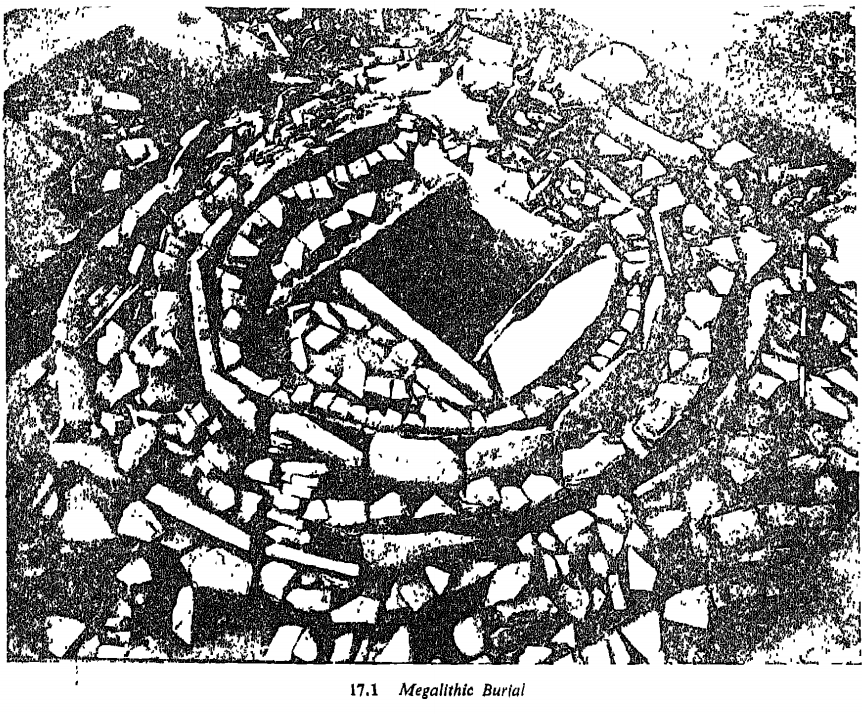
- Material Culture of the Megalithic People
- They used various types of pottery, but black-and-red ware was most popular.
- They buried goods with the dead, likely believing in an afterlife.
- Grave goods suggest their sources of livelihood:
- Weapons:
- Arrowheads, spearheads, tridents (later associated with Shiva).
- Agricultural tools:
- Hoes, sickles (fewer in number compared to weapons).
- The prevalence of weapons suggests that agriculture was not very advanced.
- Geographical Spread and Variations
- Megaliths are found across upland areas of the peninsula, with a concentration in eastern Andhra and Tamil Nadu.
- Their beginnings can be traced to around 1000 B.C., lasting until 1st century B.C., and in some places, even into the early Christian era.
- The Cholas, Pandyas, and Cheras (mentioned in Ashokan inscriptions) were likely in the megalithic phase of material culture.
- Burial Practices:
- In southern Tamil Nadu, skeletons were placed in urns made of red pottery, often without stone circles or many grave goods.
- In the Krishna-Godavari valley, the dominant practice was cist burial or pit burial with stone circles.
- Despite using iron, megalithic people relied on upland areas for settlement rather than plains or lowlands.
- Transition to Settled Agriculture and State Formation
- By the beginning of the Christian era, or slightly earlier, they:
- Moved from uplands to fertile river basins and marshy deltaic regions.
- Adopted wet paddy cultivation.
- Established villages and towns.
- Developed social classes.
- Influences from the North:
- Contact with northern traders, conquerors, and Jain and Buddhist missionaries introduced new elements of material culture.
- These changes laid the foundation for state formation in South India.
- By the 1st century A.D., the history of the deep south becomes clearer through written records, Greek and Roman accounts, and archaeological evidence.
- Three Early Kingdoms
-

- The southern end of the Indian peninsula, located south of the Krishna River, was divided into three major kingdoms: Chola, Pandya, and Chera (Kerala).
- These kingdoms were mentioned in Ashoka's inscriptions (3rd century B.C.), indicating that they lay outside the Maurya Empire, in what is now Tamil Nadu and Kerala.
- Pandya Kingdom
- The Pandyas are first mentioned by Megasthenes, who noted their kingdom was renowned for pearls.
- He also recorded that the kingdom was ruled by a woman and claimed that seven-year-old mothers existed there, which suggests the presence of a matriarchal society.
- The Pandya territory covered the southernmost and southeastern regions of the peninsula, corresponding to modern Tirunelveli, Ramnad, and Madurai.
- Madurai, the Pandya capital, derived its name from the Tamil word for Mathura.
- Sangam literature (compiled in Tamil academies in the early Christian era) mentions Pandya rulers but lacks a connected historical account.
- The Pandyas profited from trade with the Roman Empire and even sent embassies to Emperor Augustus.
- Brahmanas held considerable influence, and the Pandya kings performed Vedic sacrifices in the early centuries of the Christian era.
- Chola Kingdom
- The Chola kingdom, also known as Cholamandalam or Coromandel, was located northeast of the Pandya territory, between the Pennar and Velur rivers.
- Uraiyur, a major center for cotton trade, was the Cholas' political hub.
- In the mid-2nd century B.C., a Chola king named Elara conquered Sri Lanka and ruled for nearly 50 years.
- A more detailed Chola history begins in the 2nd century A.D. with Karikala (c. A.D. 100), the most famous early Chola ruler.
-
- He founded Puhar (Kaveripattanam) and built 160 km of embankments along the Kaveri River using the labor of 12,000 Sri Lankan captives.
- Puhar (Kaveripattanam) became a major trade and commerce center with a large dock, as confirmed by excavations.
- The Cholas gained wealth from cotton trade and maintained a navy that sailed to the Ganga, Irrawaddy, and the Malaya Archipelago.
- Decline of the Cholas:
- After Karikala, Chola power declined rapidly.
- Kaveripattanam was destroyed, and the neighboring Cheras and Pandyas expanded at the Cholas' expense.
- The Pallavas from the north further weakened them.
- From the 4th to the 9th century A.D., the Cholas played only a marginal role in South Indian history.
- Chera (Kerala) Kingdom
- The Chera kingdom lay west and north of Pandya land, covering the modern Kerala region between the sea and the mountains.
- It was as significant as the Chola and Pandya kingdoms due to its trade with the Romans.
- The Romans stationed two regiments at Muziris (Cranganore) to protect their trade interests and even built a temple to Augustus there.
- The most notable event in Chera history was their war against the Cholas (c. A.D. 150):
- The Cheras killed the father of Chola king Karikala, but their own king was also killed.
- Later, they formed a matrimonial alliance with the Cholas.
- The Chera king allied with the Pandyas against the Cholas but was defeated.
- It is said that the Chera king, wounded in the back, committed suicide out of shame.
- The greatest Chera ruler was Senguttuvan (the Red Chera), known for his victories over rivals and securing his cousin's throne.
-

- He is said to have crossed the Ganga, but this is likely an exaggeration.
- After the 2nd century A.D., Chera power declined, and there is no record of their history until the 8th century A.D.
- Economic and Cultural Significance of These Kingdoms
- These three kingdoms were engaged in continuous warfare with each other and Sri Lanka.
- Despite frequent wars, they thrived due to natural resources and trade.
- Their primary exports included:
- Spices, especially pepper, in high demand in the Western world.
- Ivory from elephants.
- Pearls from the sea.
- Precious stones from their mines.
- Fine textiles, including muslin and silk.
- Uraiyur was especially noted for its cotton trade.
- Early Tamil poems describe intricate silk weaving and cotton fabric as thin as a snake's skin.
- Trade connections extended to the Greek and Hellenistic kingdoms of Egypt and Arabia, as well as the Malaya Archipelago and China.
- Tamil words for rice, ginger, and cinnamon were adopted into the Greek language, showing linguistic influence.
- Trade flourished when Egypt became a Roman province and the monsoons were discovered (early 1st century A.D.), leading to a boom in commerce with Rome.
- However, as Roman trade declined, these kingdoms also weakened and decayed.
-
- The Purse and the Sword
- Sources of Revenue
- Trade and Customs Duties
- Trade, both foreign and internal, was a major source of royal income.
- Customs officials operated in Puhar to collect duties.
- Transit taxes were imposed on merchants transporting goods.
- Soldiers patrolled roads to ensure merchant safety and prevent smuggling.
- Spoils of War
- War plunder (to steal goods, especially by force, often during war, raids, or conflicts) contributed significantly to the treasury.
- Agricultural Revenue
- The primary and most stable source of income was agriculture.
- The king claimed a share of agricultural produce, though the exact proportion is unknown.
- The fertile regions of the peninsula produced:
- Grains like paddy, ragi
- Cash crops like sugarcane, pepper, turmeric
- Fruits of various kinds
- The Kaveri delta was exceptionally productive, with a saying that “the space where an elephant could lie down could feed seven people.”
- The Military System
- Composition of the Army :
- Chariots drawn by oxen
- Elephants
- Cavalry
- Infantry
- Role of Elephants and Horses
- Elephants played a crucial role in warfare.
- Horses were imported by sea into the Pandya kingdom.
- Military Leadership and Equipment
- Nobles, princes, and army captains rode elephants.
- Commanders drove chariots.
- Foot soldiers and cavalry wore leather sandals for foot protection.
- Rise of Social Classes
- Role of Taxes in Society
- Taxes funded both the professional army and royal patronage of poets and priests.
- Poets and priests, primarily Brahmanas, were highly respected and generously rewarded by kings.
- King Karikala is said to have gifted one poet 1.6 million gold pieces.
- Other rewards included cash, land, chariots, horses, and even elephants.
- Brahmanas and Social Structure
- The Brahmanas first appeared in Tamil lands during the Sangam Age.
- An ideal king was expected never to harm the Brahmanas.
- Tamil Brahmanas consumed meat and wine.
- Absence of the Traditional Varnas
- Kshatriyas and Vaishyas are not explicitly mentioned in Sangam texts as regular varnas.
- However, a warrior class existed:
- Military captains were given the title enadi at a formal ceremony.
-
- Civil and military offices under both the Cholas and Pandyas were held by vailaias (rich peasants).
-
- The Ruling Class and Peasantry
- The ruling caste was known as arasar, and they intermarried with the vailaias.
- The vailaias (fourth caste) were the dominant peasantry, owning the majority of the land:
- Rich peasants owned land but did not plow it themselves, employing laborers instead.
- Poor peasants worked directly on the land.
- Agricultural labor was mainly done by women of the lowest class (Aadaisi-yar), who were similar to slaves.
- Lower-Class Artisans and Laborers
- Pulaiyans:
- Low-class artisans who made ropes, charpoys, and mats from animal skins.
- Outcasts and forest tribes:
- Lived in extreme poverty, surviving on daily earnings.
- Social Inequalities
- Sharp divisions between the rich and the poor existed:
- The rich lived in brick houses.
- The poor lived in huts and humble dwellings.
- Merchants in cities resided in upper-story buildings.
- Caste and religion did not yet strictly enforce social hierarchy.
- Brahmanas and ruling classes dominated society, but the rigid caste distinctions of later periods had not yet fully developed.
- Beginnings of Brahmanism
- Influence of Brahmanism
- Tamil society in the early centuries of the Christian era was influenced by Brahmanism, but its impact was limited:
- Confined to a small part of Tamil territory.
- Affected mainly the upper levels of Tamil society.
- Royal Patronage of Vedic Traditions
- Kings performed Vedic sacrifices, showcasing their association with Brahmanical traditions.
- Brahmanas, as followers of the Vedas, engaged in philosophical disputes, possibly with Jainas and Buddhists.
- Popular Religious Practices
- The chief local deity worshipped by the people was Murugan (Subramaniya).
-
- Vishnu worship is also mentioned but may have been a later development.
- Funerary Practices
- The megalithic tradition of providing for the dead persisted.
- People offered paddy to the deceased.
- Cremation was introduced, but inhumation (burial) from the megalithic phase continued.
- Tamil Language and Sangam Literature
- The Sangam Assemblies
- The Sangam was a college or assembly of Tamil poets, likely held under royal patronage.
- The exact number of Sangams and their duration remain uncertain.
- A Tamil commentary (8th century A.D.) claims:
- Three Sangams lasted for 9,990 years.
- Attended by 8,598 poets.
- 197 Pandya kings acted as patrons.
- These claims are exaggerated, but a Sangam was definitely held in Madurai under royal patronage.
- Compilation of Sangam Literature
- The available Sangam literature was compiled between A.D. 300-600.
- The chronological classification of the texts into early, middle, and late strata is still unclear.
- Descriptions in Sangam texts align with:
- Greek and Roman accounts.
- Archaeological findings.
- Writing and Inscriptions
- The art of writing was known to Tamils before the Christian era.
- Over 70 short inscriptions in the Brahmi script have been found in natural caves (mainly in the Madurai region).
- These inscriptions:
- Contain an early form of Tamil mixed with Prakrit words.
- Date back to 2nd-1st centuries B.C.
- Coincide with the arrival of Jaina and Buddhist missionaries in the region.
- Inscribed potsherds from excavations confirm the existence of written Tamil at the beginning of the Christian era.
- Given this evidence, it is unsurprising that a significant body of Sangam literature was produced in the early centuries of the Christian era, though it was formally compiled by A.D. 600.
- Crafts, Trade and Towns in the Post-Maurya Age
-

- Crafts and Economic Developments (200 B.C.-A.D. 200)
- Growth of Crafts and Artisans
- The period of Sakas, Kushans, Satavahanas, and early Tamil states was one of the most prosperous in terms of crafts and commerce.
- Artisans and Craftsmen:
- The Digha Nikaya (pre-Maurya) mentions about 24 occupations.
- The Mahavastu (this period) lists 36 kinds of workers in Rajgir.
- The Milinda Panho records 75 occupations, 60 of which are craft-based.
- Though craftsmen were mainly associated with towns, excavations show their presence in villages as well.
- In Karimnagar (Telangana), craftsmen like carpenters, blacksmiths, goldsmiths, and potters lived in separate quarters.
- Agricultural laborers lived at one end of the settlement.
- Mining and Metallurgy
- Eight major metalworking crafts involved:
- Gold, silver, lead, tin, copper, brass, iron, and precious stones.
- Other metals: Brass, zinc, antimony, and red arsenic.
- Iron technology advanced significantly:
- Kushan and Satavahana layers contain numerous iron artifacts.
- Special progress in iron manufacture was seen in Telangana (Andhra).
- Weapons, balance rods, socketed axes, hoes, sickles, ploughshares, razors, and ladles found in Karimnagar and Nalgonda districts.
- Indian iron and steel (including cutlery) were exported to Abyssinian ports and highly valued in Western Asia.
- Textile and Dyeing Industry
- Cloth-making and silk-weaving flourished.
- Mathura was a major center for a special type of cloth called sataka.
- Dyeing Industry:
- Thrived in South India.
- Brick-built dyeing vats found in Uraiyur (Tiruchirapalli, Tamil Nadu).
- Similar vats excavated at Arikamedu.
- These belong to 1st-3rd centuries A.D., a period when the handloom textile industry thrived.
- Increased oil production due to the use of the oil wheel.
- Luxury and Specialized Crafts
- Ivory work, glass manufacture, and bead cutting were prominent.
- Excavations in Kushan sites reveal many such products.
- Indian ivories found in Afghanistan and Rome resemble those from Satavahana sites in Deccan.
- Glass objects from Rome found in Taxila and Afghanistan.
- Glass-blowing knowledge entered India around the beginning of the Christian era.
- Bead-cutting became widespread, with large numbers of semi-precious stone beads in post-Maurya layers.
- Coin-minting:
- Coins were made from gold, silver, copper, bronze, lead, and potin.
- Fake Roman coins were also produced.
- Coin-moulds found in north India and Deccan.
- A Satavahana coin-mould could produce six coins at a time.
- Terracotta and Sculptural Art
- Terracotta production flourished, mainly for urban elite.
- Found in large quantities in Kushan and Satavahana sites, especially:
- Yelleshwaram (Nalgonda district) - largest number of terracottas and their moulds.
- Kondapur (near Hyderabad) - another major center.
- Terracotta popularity declined in the Gupta and post-Gupta periods, coinciding with urban decline.
- Guilds (associations of craftsmen or merchants) and Economic Organizations
- Artisans were organized into guilds, playing a key role in economic life.
- Guilds in Maharashtra (2nd century A.D.):
- Lay Buddhists deposited money with guilds of potters, oil millers, and weavers to support monks.
- Guilds in Mathura:
- A chief deposited money with the flour-makers' guild to feed 100 Brahmanas daily.
- At least two dozen guilds are known from texts.
- Most artisans, based on inscriptions, were concentrated in:
- Mathura region.
- Western Deccan (major trade route areas).
- Trade and Economic Expansion (200 B.C.-A.D. 200)
- Roman Trade and Monsoon Navigation
- India's trade with the eastern Roman Empire flourished.
- Initially, much of the trade was overland, but it was disrupted by Sakas, Parthians, and Kushans (1st century B.C.).
- Parthians (Iran) imported iron and steel from India but hindered (obstructed, delayed, or made difficult) trade beyond Iran.
- Sea trade expanded (1st century A.D.) with the discovery of monsoon winds, allowing:
- Faster sailing across the Arabian Sea.
- Access to western ports like Broach ((Bharuch) - Gujarat) and Sopara (Maharashtra).
- Eastern ports like Arikamedu (Tamil Nadu) and Tamralipti (West Bengal).
- Broach was the most important port, receiving:
- Goods from Satavahana, Saka, and Kushan kingdoms.
- Imports from Rome and West Asia.
- Major Trade Routes
- Northwestern Routes (linking Kushan and Saka territories to Broach):
- Two major routes converged at Taxila and connected to the Silk Road (Central Asia).
- Route 1:
- Ran north to south from Taxila to lower Indus basin, then to Broach.
- Route 2 (Uttara-patha):
- More frequently used.
- Taxila → Punjab → Western Yamuna coast → Mathura → Ujjain → Broach.
- Eastern Route:
- Kausambi (near Allahabad) → Ujjain, linking with western routes.
-
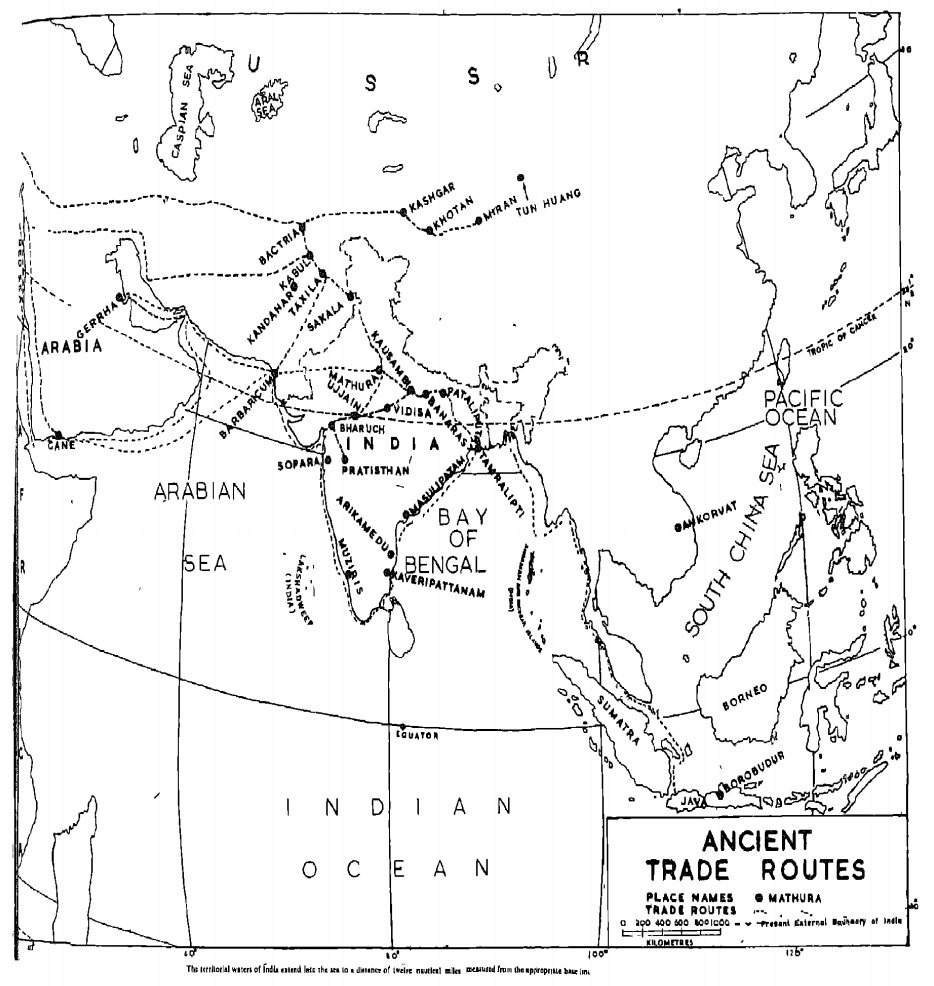
- Conclusion
- The Saka-Kushan-Satavahana period saw unprecedented growth in crafts, metallurgy, textiles, and luxury goods.
- Artisans thrived in guilds and were key to urban and religious economic systems.
- Trade networks flourished, especially Roman trade via monsoon navigation.
- Urban handicrafts, terracotta art, and coin-minting played a vital role in economic expansion.
- Foreign Trade with Rome
- Nature of Trade
- The trade between India and Rome was significant but focused on luxury goods rather than daily necessities.
- South India was the first region to establish trade with Rome, as evident from the discovery of early Roman coins in Tamil kingdoms, which were outside Satavahana control.
- Major exports from India to Rome included:
- Spices (especially from South India)
- Muslin (lightweight, finely woven cotton fabric), pearls, jewels, and precious stones (from Central and South India)
- Iron goods, particularly cutlery
- India's Role in Transit Trade
- India acted as an intermediary in trade between China, Central Asia, and the Roman Empire.
- Silk was traditionally sent from China to Rome via the Silk Road (passing through North Afghanistan and Iran).
- The Parthian control of Iran disrupted this route, leading to alternative trade routes through:
- North-western India to western Indian ports
- The east coast of India, from where it was sent to the West
- As a result, India engaged in significant transit trade in silk.
- Roman Imports to India
- Key Roman goods exported to India included:
- Wine amphorae and pottery (found in Tamluk, Arikamedu, and South India)
- Lead (used by the Satavahanas for coin minting, imported in coiled strips)
- Roman trade mainly influenced South India and the Satavahana kingdom, with limited penetration into North India.
- Despite this, the Kushan-controlled north-western subcontinent engaged in trade with the eastern Roman Empire.
- The Roman conquest of Mesopotamia (A.D. 11) and Emperor Trajan's campaigns in the Persian Gulf further facilitated trade.
- Roman Influence in India
- Roman trade goods and cultural influences reached north-western India and Afghanistan.
- At Begram (north of Kabul), artifacts of Western origin were discovered, including:
- Large glass jars (from Italy, Egypt, and Syria)
- Bronze stands, steel yards, weights, Greco-Roman statues, jugs, and alabaster vessels
- Taxila (modern Surkap in Pakistan) revealed Greco-Roman bronze sculptures, silver ornaments, bronze pots, and coins of Emperor Tiberius.
- Despite these finds, certain Roman goods (e.g., Arretine pottery) were largely confined to South India.
- Both the Satavahanas and the Kushans profited from Roman trade, though the Satavahanas benefited the most.
- Impact of Roman Trade on India's Economy
- A major Roman export to India was gold and silver coins.
- Around 85 Roman coin hoards have been found across India, most of them in the south.
- The Roman historian Pliny (A.D. 7) lamented that Rome was being drained of gold due to its trade with India.
- Complaints arose in A.D. 22 about the excessive Roman expenditure on Indian pepper (for exotic flavor, medicinal properties, and status as a luxury item), which was called “yavanapriya” (beloved of the Greeks) in Sanskrit.
- Similar concerns arose over high prices paid for Indian steel cutlery.
- The trade imbalance was so severe that Rome eventually restricted imports of Indian pepper and steel.
- Use of Roman Gold in India
- Roman gold coins were valued for their intrinsic worth and possibly used in large transactions.
- The Kushans issued many gold coins, but not all were minted from Roman gold.
- India had a history of gold trade, dating back to the tribute paid to the Iranian Empire in the 5th century B.C.
- Potential sources of Indian gold included:
- Central Asia
- Karnataka
- Gold mines in Dhalbhum (South Bihar)
- Contact with Rome influenced Indian coinage, leading to the dinar-type gold coins, which became widespread under the Guptas.
- However, gold coins were not used in daily transactions, which were conducted using coins made of lead, potin, or copper.
- Expansion of the Money Economy
- Lead and copper deposits in Andhra allowed for extensive coin minting.
- The Satavahanas issued lead or potin coins, while the Kushans produced large numbers of copper coins.
- Other ruling groups using copper and bronze coins included:
- The Nagas (Central India)
- The Yaudheyas (Eastern Rajasthan, Haryana, Punjab, and Uttar Pradesh)
- The Mitras (rulers of Kausambi, Mathura, Avanti, and Ahichhatra in Uttar Pradesh)
- The deep penetration of the money economy in this period coincided with:
- The growth of arts and crafts
- India's thriving trade with Rome
- Urban Settlements
- The expansion of crafts, commerce, and the increasing use of money led to the prosperity of numerous towns during this period.
- Urban Centers in North India
- Several important towns, such as Vaisali, Pataliputra, Varanasi, Kausambi, Sravasti, Hastinapur, Mathura, and Indraprastha (Purana Quila in New Delhi), are mentioned in literary texts and described by Chinese pilgrims.
- Most of these towns flourished during the Kushan period (1st-2nd century A.D.), as evidenced by archaeological findings, including terracotta figures found in Ter (Osmanabad district).
- Excavations reveal that agate, jasper, and carnelian were extensively worked for bead manufacturing after 200 B.C., utilizing raw materials from the trap bedrock of the Sipra River.
-
- Urban Centers in the Satavahana Kingdom
- The Satavahana kingdom witnessed urban growth parallel to the Kushan and Saka regions.
- Major towns of this period include Tagar (Ter), Paithan, Dhanyakataka, Amaravati, Nagarjunakonda, Broach, Sopara, Arikamedu, and Kaveripattanam.
- Excavations indicate well-developed structures, particularly those from the Kushan period at Nagarjunakonda.
-
- Excavation Findings and Structural Developments
- Prosperous Kushan phases have been identified in sites across Bihar (Chirand, Sonpur, Buxar) and Eastern Uttar Pradesh (Ghazipur).
- Other thriving urban sites during the Kushan period include Sohgaura, Bhita, Kausambi, Shringaverapur (near Allahabad), Atranjikhera, Meerut, and Muzaffarnagar.
- Mathura (Sonkh excavation) reveals seven Kushan layers, compared to only one Gupta layer, indicating a decline in urban activity after the Kushans.
- Punjab (Jullundar, Ludhiana, Ropar) and Haryana also show strong evidence of Kushan-era urban development.
- Gupta-era structures were often built with reused Kushan bricks, suggesting a decline in urbanization post-Kushan rule.
- Ujjain, the most important town in the Saka kingdom (Malwa & western India), held a strategic position at the intersection of major trade routes.
- Trade and Urban Growth
- Towns flourished due to thriving trade with the Roman Empire and Central Asia.
- Urban centers in Punjab and Western Uttar Pradesh prospered as they lay along the north-western (Uttarapatha) trade route, stretching from Mathura to Taxila.
- The Kushan Empire ensured security on trade routes, facilitating economic growth.
- However, the decline of the Kushan Empire (3rd century A.D.) severely impacted urban settlements.
- Decline of Urban Centers
- The Roman Empire banned trade with India in the 3rd century A.D., leading to economic setbacks. Few reasons include:
- Severe Gold & Silver Drain
- Rome imported luxury goods from India (spices, silk, pearls, and cotton) but exported very little in return.
- Political Instability in Rome
- The Crisis of the Third Century (235-284 CE) saw frequent civil wars, economic collapse, and invasions.
- Rise of the Sassanian Empire (224 CE)
- The Sassanian Persians (modern Iran) became powerful and blocked Roman trade routes to India.
- Decline of Roman Economy
- Overreliance on slave labor, debased currency, and internal corruption weakened Rome's economy.
- Without trade, artisans and merchants lost their livelihood, resulting in the decline of urban centers.
- Archaeological evidence from the Deccan suggests a reduction in urban settlements after the Satavahana phase.
- Thus, while urbanization peaked under the Kushans and Satavahanas, its decline was marked by political instability and trade restrictions imposed by Rome.
- The Rise and Growth of the Gupta Empire
- Background
- Emergence of Post-Mauryan Powers
- After the decline of the Maurya Empire, two significant powers emerged:
- Satavahanas (Deccan & South)
- Kushans (North India)
- The Satavahanas brought political stability and economic prosperity through trade with the Roman Empire.
- The Kushans played a similar role in northern India.
- Both empires collapsed by the mid-3rd century AD.
- Rise of the Gupta Empire
- The Gupta Empire emerged from the ruins of the Kushan Empire.
- The Guptas possibly had Vaishya origins.
- Although not as vast as the Maurya Empire, they successfully unified northern India for over a century (335-455 AD).
- Their original kingdom included Uttar Pradesh and Bihar.
- Uttar Pradesh was the core region, as evident from Gupta coins and inscriptions.
- The center of power was likely at Prayag (modern Allahabad).
- Continuity from the Kushans
- The Guptas possibly succeeded the Kushans in Uttar Pradesh without any major time gap.
- Archaeological evidence shows that Gupta antiquities immediately follow Kushan remains.
- The Guptas adopted military advancements from the Kushans:
- Saddles, reins, buttoned coats, trousers, and boots → Ensured greater mobility
- Cavalry-based warfare → Similar to the Kushan military strategy
- Coins depict horsemen, emphasizing the role of cavalry over chariots & elephants.
- Economic and Material Advantages
- The Guptas controlled fertile lands in Madhyadesa (Bihar & Uttar Pradesh).
- They had access to iron ores in central India & south Bihar, strengthening military capability.
- Trade links with the Byzantine Empire (Eastern Roman Empire) boosted their economy.
- Due to these advantages, they expanded their rule over:
- Anuganga (Middle Gangetic Basin)
- Prayag (modern Allahabad)
- Saketa (modern Ayodhya)
- Magadha
- Eventually, this expansion led to the formation of an all-India empire.
- Transition from the Kushans & Murundas
- Kushan rule in northern India ended around 230 AD.
- Central India fell under the Murundas, possibly related to the Kushans.
- The Murundas ruled until 250 AD, after which their power declined.
- By 275 AD, the Gupta dynasty emerged as the dominant force.
- Rulers
- Sri Gupta (c. 240-280 CE) - Founder of the Gupta dynasty
- Ruled a small kingdom in Magadha (Bihar).
- Ghatotkacha (c. 280-319 CE) - Son of Sri Gupta
- Expanded the kingdom slightly.
- Chandragupta I and the Foundation of Gupta Empire
- The first prominent Gupta ruler was Chandragupta I.
- He strengthened his position through a strategic marriage with a Lichchhavi princess from Nepal.
- The Guptas were possibly Vaishyas, and this marriage into a Kshatriya family enhanced their royal legitimacy.
- Took the title "Maharajadhiraja" (King of Kings).
- Chandragupta I was an influential ruler, as he:
- Started the Gupta Era in 319-320 AD → Marked the beginning of Gupta rule.
- Established a stable political base that facilitated future Gupta expansion.
- Samudragupta (335-380 AD)
- Expansion of the Gupta Kingdom
- Samudragupta, the son and successor of Chandragupta I, significantly expanded the Gupta Empire.
- Unlike Ashoka, who promoted peace and non-aggression, Samudragupta thrived on war and conquest.
- His court poet, Harishena, recorded his military exploits in a long inscription at Allahabad, on the same pillar that carries Ashoka's peaceful edicts.
- Patron of arts and music (depicted playing the veena on coins).
- Conquests of Samudragupta
- His military campaigns can be divided into five groups:
- Group One: Conquest of the Ganga-Yamuna Doab
- Defeated local princes and incorporated their kingdoms into the Gupta Empire.
- Group Two: Subjugation of the Eastern Himalayan and Frontier States
- A "frontier" refers to a transitional zone or borderland between a dominant power and less controlled or independent neighboring territories, often characterized by a mix of cultures and interactions.
- Defeated rulers of Nepal, Assam, Bengal, and other republics in Punjab.
- Group Three: Control over the Vindhya Forest Kingdoms (Atavika Rajyas)
- Brought the tribal forest kingdoms under Gupta authority.
- Group Four: Victories in Eastern Deccan & South India
- Defeated twelve rulers from the eastern Deccan and Tamil Nadu.
- Reached Kanchi (Tamil Nadu), where the Pallavas accepted his suzerainty.
- Unlike in the north, he defeated but later liberated these rulers.
- Group Five: Defeat of the Sakas and Kushans
- Ousted the Sakas and Kushans, some of whom ruled in Afghanistan.
- Several distant rulers submitted to him.
- Influence Beyond India
- Samudragupta's power was recognized even outside India.
- A Chinese source mentions that Meghavarman, the ruler of Sri Lanka, sent a missionary to seek permission to build a Buddhist temple at Gaya.
- Samudragupta granted this request, leading to the development of a major monastic center.
- Legacy
- The Allahabad inscription suggests that Samudragupta was never defeated in battle.
- Due to his military brilliance and conquests, he is often called “The Napoleon of India.”
- He successfully unified a vast part of India, and his influence extended across the subcontinent.
-
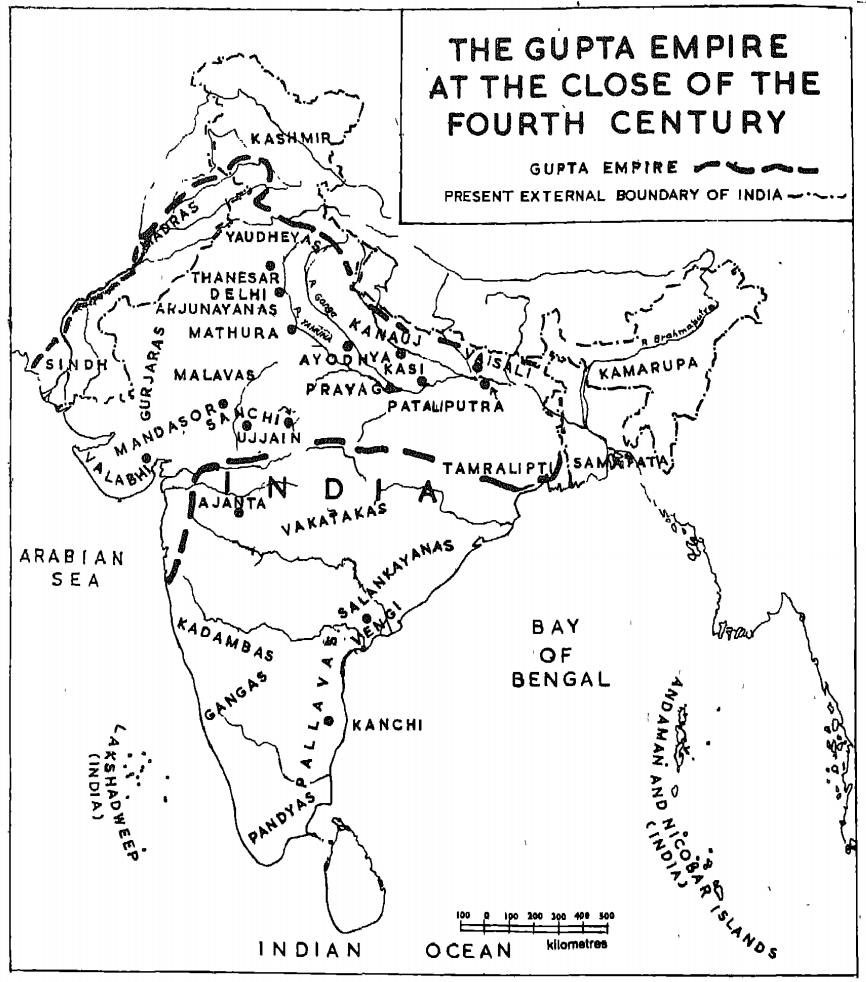
- Chandragupta II (A.D. 380-412) - Peak of Gupta power
- Expansion of the Gupta Empire
- Chandragupta II expanded the empire through marriage alliances and military conquests.
- He married his daughter, Prabhavati, to a Vakataka prince (a Brahmana ruler of central India).
- After the prince's death, his young son succeeded him, making Prabhavati the virtual (something that exists in effect but not physically) ruler.
- Prabhavati governed with the assistance of an official sent by Chandragupta II, allowing him to exercise indirect control over the Vakataka kingdom.
- This control provided strategic advantages, enabling him to conquer western Malwa and Gujarat, which had been under Saka rule for nearly four centuries.
- Significance of the Western Conquest
- The victory over Malwa and Gujarat gave Chandragupta II access to the western seacoast, a region famous for trade and commerce.
- This boosted the prosperity of Malwa, particularly its chief city, Ujjain.
- Ujjain became so important that Chandragupta II is believed to have made it the second capital of the Gupta Empire.
- Military Achievements and the Iron Pillar Inscription
- The Iron Pillar inscription near Qutb Minar, Delhi, glorifies the achievements of a king named Chandra.
- If Chandra is identified as Chandragupta II, it suggests he established Gupta authority in north-western India and a significant part of Bengal.
- Title of Vikramaditya & Patronage of Scholars
- Chandragupta II adopted the title Vikramaditya, originally used by a ruler of Ujjain in 58 B.C. to mark his victory over the Sakas.
- His court at Ujjain was adorned by many scholars, including the Aryabhata, Varahamihira. renowned poet Kalidasa and lexicographer Amarasimha.
- Fa-Hsien's Visit to India (399-414 A.D.)
- During Chandragupta II's reign, the Chinese Buddhist pilgrim Fa-Hsien visited India.
- He wrote an elaborate account of Indian society, providing valuable insights into Gupta-era life.
-
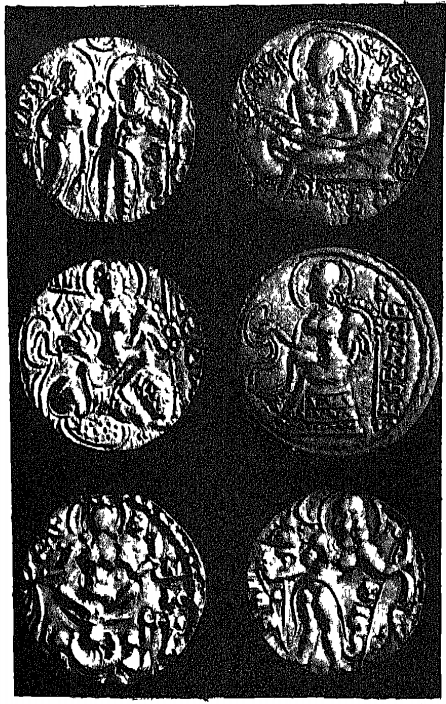
- Kumaragupta I (c. 415-455 CE) - Maintained the empire's prosperity
- Established Nalanda University.
- Faced threats from Pushyamitras and Hunas.
- Skandagupta (c. 455-467 CE) - Fought the Huna invasions
- Weakened the empire by defending against Hunas (White Huns).
- After his death, the empire started declining.
- Successors (Decline Phase) (c. 467-550 CE)
- Puru Gupta (467-473 CE)
- Narasimhagupta Baladitya (473-495 CE)
- Buddhagupta (495-540 CE)
- Vishnugupta (c. 540-550 CE)
- Last known Gupta ruler
- Fall of the Gupta Empire
- Huna Invasions and Military Decline
- After Chandragupta II, his successors faced invasions by the Hunas from Central Asia in the second half of the fifth century A.D.
- Initially, Skandagupta successfully resisted the Hunas, but his successors proved weak against them.
- The Hunas excelled in horsemanship, possibly used metal stirrups, and were skilled archers, achieving military success in both Iran and India.
- By 485 A.D., the Hunas occupied eastern Malwa and central India, with Punjab and Rajasthan also falling under their control.
- The Gupta Empire shrank significantly at the beginning of the sixth century due to these invasions.
- Yasodharman's Challenge to Gupta Authority
- The Huna power was later overthrown by Yasodharman of Malwa.
- Yasodharman dealt the final, decisive blow to the Hunas, effectively breaking their power in India.
- After defeating the foreign invaders, he didn't hand the land back to the Guptas. Instead, he turned around and challenged the Gupta Emperor’s authority.
- In 532 A.D., Yasodharman successfully challenged the Guptas and erected pillars of victory to commemorate his conquests across northern India.
- Though his rule was short-lived, it severely weakened the Guptas.
- Rise of Feudatories and Regional Powers
- Several governors and feudatories appointed by the Guptas began asserting independence:
- North Bengal and Samatata (Southeast Bengal) rulers became autonomous.
- The Later Guptas of Magadha emerged as a separate power in Bihar.
- The Maukharis, with their capital at Kanauj, rose to power in Bihar and Uttar Pradesh.
- Independent princes in northern Madhya Pradesh issued land grants in their own name, though they still used the Gupta era for dating.
- The rulers of Valabhi established authority in Gujarat and western Malwa.
- The princes of Thaneswar gained control in Haryana and eventually moved towards Kanauj.
- Economic Decline and Loss of Trade
- The loss of western India by the end of the fifth century deprived the Guptas of wealth from trade and commerce, severely impacting their economy.
- Land grants for religious and other purposes further weakened state revenues, making it difficult to maintain a large professional army.
- Decline in foreign trade also affected economic stability:
- A silk weaver guild migrated from Gujarat to Malwa in 473 A.D. and took up non-productive professions, indicating reduced demand for their goods.
- The benefits of Gujarat's trade gradually disappeared.
- Currency Debasement and the Final Decline
- From the mid-fifth century, the Gupta kings tried to maintain their gold currency by reducing the gold content, but this failed to restore stability.
- After Skandagupta II's reign (A.D. 467), almost no Gupta coins or inscriptions were found in western Malwa and Saurashtra, indicating a complete loss of control over the region.
- Though the Imperial Guptas continued to rule until the mid-sixth century, their glory had faded a century earlier.
- Life in the Gupta Age
- System of Administration
- Monarchical Structure and Kingship
- Unlike the Mauryas, the Gupta rulers adopted grand titles such as paramesvara, maharajadhiraja, and paramabhattaraka, reflecting their supremacy over lesser kings within their empire.
- Kingship was hereditary, but the absence of a strict primogeniture system (system or practice where the eldest son inherits the entire estate, throne, or position of the father) led to succession disputes, allowing chiefs and high officials to exploit uncertainties.
- The Guptas maintained strong ties with the Brahmanical order by making generous gifts to Brahmanas, who, in turn, glorified the king as Vishnu, the preserver. Coins often depicted the goddess Lakshmi as Vishnu's consort.
- Military Organization
- The size of the Gupta army is unknown, but the king maintained a standing army, supplemented by forces from feudatories.
- Military tactics evolved, with cavalry and horse archery gaining prominence, while chariots became obsolete.
- Taxation and Revenue Administration
- Land taxes increased, while trade and commerce taxes declined.
- The king collected taxes ranging from one-fourth to one-sixth of agricultural produce.
- Villagers were required to provide food and supplies for the army and royal officers. In central and western India, peasants were subjected to vishti (forced labor) for serving the army and officials.
- Judicial System
- The Gupta period saw the development of a structured legal system with separate civil and criminal laws.
- Criminal law covered offenses like theft and adultery, while civil law addressed disputes over property and inheritance.
- Laws varied according to varna distinctions.
- The king, assisted by Brahmana priests, was responsible for upholding justice. Guilds had autonomy in governing their own affairs.
- Bureaucracy and Administration
- The Gupta administrative system was less elaborate than that of the Mauryas.
- The most important officials were the kumaramatyas, appointed by the king and likely paid in cash.
- Unlike the Mauryas, the Guptas (who were probably of Vaisya origin) recruited officials beyond the upper varnas.
- Offices became hereditary, consolidating power but weakening central control.
- Provincial and Local Governance
- The empire was divided into divisions (bhuktis), each governed by an uparika.
- Bhuktis were further divided into districts (vishayas), administered by vishaya-patis.
- In eastern India, vishayas were subdivided into vithis, which contained multiple villages.
- Role of Village and Urban Administration
- The village headman gained importance, managing local affairs with the help of elders. No land transaction could occur without their approval.
- Urban administration relied on professional guilds (shrenis) consisting of artisans, merchants, and scribes, who governed town affairs.
- Artisans and bankers had their own guilds, which regulated their members and enforced trade laws.
- Guilds flourished in places like Vaisali, Bhita, Mandasor, and Indore, enjoying immunities and self-governance.
- Feudalism (social, economic, and political system in which land was the main source of power) in the Gupta Empire
- The empire was largely managed by feudatories, many of whom were subjugated by Samudragupta.
- Vassal chiefs had three primary obligations:
1. Attending the Gupta court.
2. Paying tribute.
3. Offering daughters in marriage to the ruling family.
- Feudatory chiefs received charters, marked with the royal Garuda seal, granting them autonomy in their regions.
- Land Grants and Economic Impact
- The Gupta period saw an increase in fiscal and administrative land grants, particularly in Madhya Pradesh.
- Religious beneficiaries (Brahmanas) received tax-free land and were authorized to collect taxes from peasants. These villages were exempt from royal jurisdiction.
- It is unclear whether state officials were compensated with land grants, though the circulation of gold coins suggests that higher officials were paid in cash.
- Economic Changes: Decline of Trade and Rise of Landed Classes
- Fa-hsien's accounts indicate that Magadha had thriving cities and wealthy Buddhist patrons.
- However, foreign trade declined significantly after A.D. 550, particularly with the Eastern Roman Empire, which learned silk production, reducing India's silk exports.
- As early as the mid-5th century, a silk-weaving guild from western India (Lata) migrated to Mandasor, where members abandoned their trade due to declining demand.
- Emergence of Landed Aristocracy
- Land grants to priests facilitated agricultural expansion but reduced local peasants to lower socio-economic status.
- In central and western India, peasants were subjected to forced labor (vishti), increasing their burdens.
- Social and Religious Developments During the Gupta Period
- Brahmana Supremacy and Caste System
- The Guptas, originally Vaisyas, were elevated to Kshatriya status by the brahmanas.
- Brahmanas gained wealth and privileges through numerous land grants, as outlined in the law-book of Narada.
- They depicted Gupta rulers as possessing divine attributes, strengthening their influence.
- Caste Expansion and Integration of Foreigners
- The caste system expanded due to the assimilation of foreigners and tribal groups.
- Many foreign conquerors, including the Hunas, were assigned Kshatriya status. The Hunas were later classified as one of the thirty-six Rajput clans, and some Rajputs still carry the title Huna.
- Tribal chiefs integrated into brahmanical society were granted high status, while common tribal members were often assigned a lower caste.
- Status of Sudras and Women
- Sudras and women gained some social privileges, such as the right to listen to the epics and Puranas.
- Krishna worship became accessible to them.
- From the seventh century onward, Sudras were increasingly identified as agriculturists rather than servants or laborers.
- Increase in Untouchability
- The number of untouchables, especially the Chandalas, grew during this period.
- Fa-hsien observed that Chandalas lived outside villages, worked in trades related to meat, and were considered polluting by upper castes.
- Religious Transformations
- Decline of Buddhism
- Buddhism lost royal patronage under the Guptas.
- While Fa-hsien noted its presence, it had declined significantly, especially in Magadha.
- Rise of Brahmanism and Vaishnavism
- Vishnu and Shiva became the most revered deities, with Vishnu emerging as the protector of the varna system.
- Key texts such as the Vishnupurana and Vishnusmriti were compiled in his honor.
- By the fourth century A.D., the Bhagavad Gita promoted devotion to Krishna and reinforced caste duties.
- Religious Practices and Festivals
- Idol worship in temples became widespread.
- Agricultural festivals were integrated into religious traditions, providing income for priests.
- Religious Tolerance
- The Gupta rulers did not persecute Buddhists or Jains.
- Buddhism itself had absorbed several Hindu elements, reducing religious conflicts.
- Art and Culture During the Gupta Period
- Patronage of Art and Literature
-
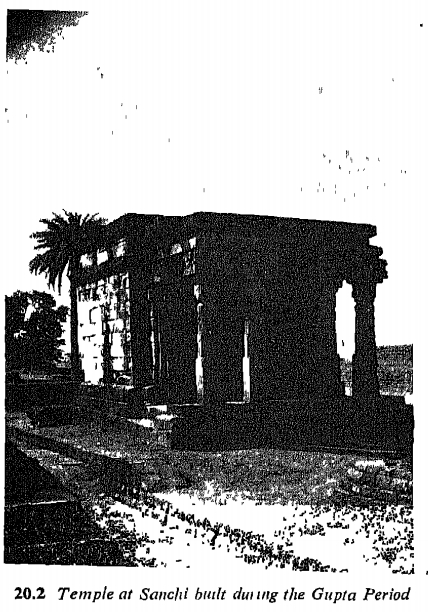
- The Gupta period is often called the “Golden Age” of ancient India, though economically, some northern Indian towns declined.
- The Guptas possessed a large amount of gold and issued the most gold coins.
- Princes and wealthy individuals supported artists and scholars.
- Samudragupta is depicted on his coins playing the vina (lute), showcasing his musical patronage.
- Chandragupta II is credited with maintaining the Nine Luminaries—great scholars at his court.
- Akbar modeled his court after the ancient Indian tradition of the "Navaratnas" (Nine Gems).
- Religious Influence on Art
- Ancient Indian art was primarily inspired by religion.
- Buddhism had earlier led to the construction of stone pillars, cave carvings, and stupas (dome-shaped relic structures).
- The Gupta period saw an evolution in Buddhist and Hindu art, with significant advancements in sculpture and painting.
-
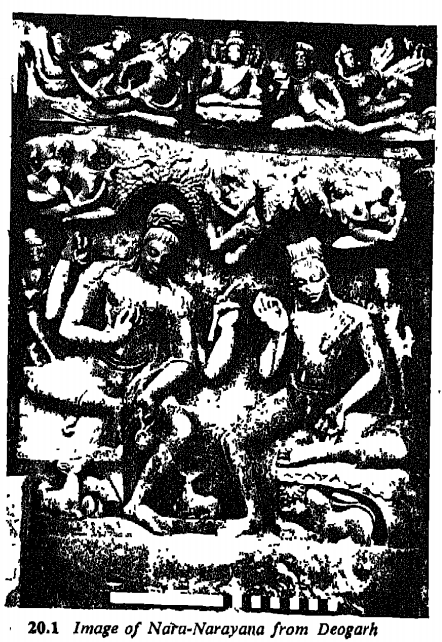
- Buddhist Art and Architecture
- The Gupta period produced some of the most exquisite Buddhist artworks.
- A 2-meter-high bronze Buddha statue was discovered in Sultanganj, Bhagalpur.
- Fa-hsien reported seeing a 25-meter-high copper Buddha statue, but it is no longer traceable.
-
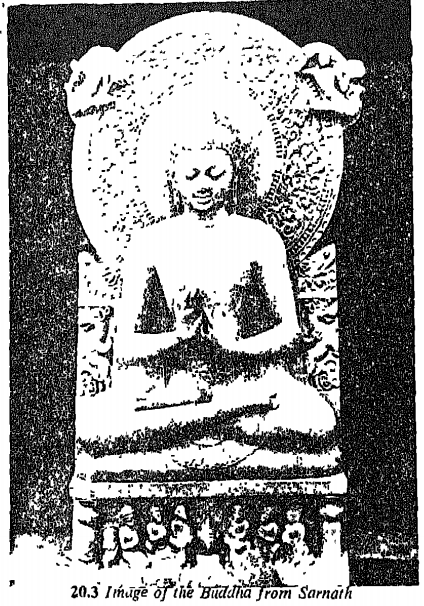
- Notable Buddhist art centers:
- Sarnath and Mathura - produced beautiful Buddha images.
- Ajanta paintings - the finest example of Gupta-era Buddhist art, depicting scenes from Gautama Buddha's life and earlier Buddhas.
- The Ajanta paintings are known for their lifelike depictions and vibrant colors, which have remained intact for over 14 centuries.
-
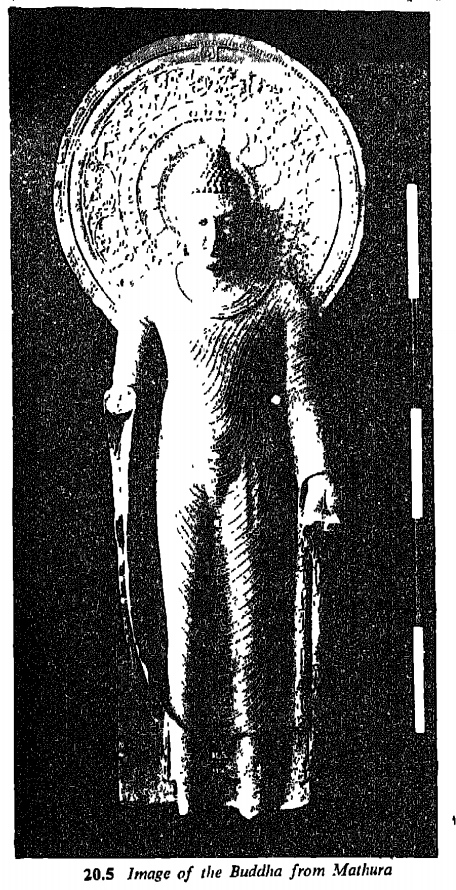
- Rise of Hindu Iconography
- As supporters of Brahmanism, the Guptas saw the emergence of Hindu deities in sculpture.
-

- Images of Vishnu, Shiva, and other gods appeared, often arranged in a hierarchical pantheon:
- The chief deity is depicted larger in size.
- Retainers and subordinate gods appear smaller, symbolizing social and divine hierarchy.
-

- Architecture
- The Gupta period saw limited architectural achievements, primarily brick and stone temples:
- Bhitargaon (Kanpur) - a notable brick temple.
- Bhitari (Ghazipur) and Deogarh (Jhansi) - other examples of Gupta brick architecture.
- The Buddhist university at Nalanda, established in the fifth century, had its earliest brick structures from this period.
- Literature During the Gupta Period
- Secular Literature
- The Gupta period was remarkable for the production of secular literature.
- Bhasa wrote thirteen plays, but Kalidasa's works made this era truly famous.
- Kalidasa - The Greatest Sanskrit Poet & Dramatist
- Author of famous plays like Abhijnanashakuntalam, Meghaduta, and Raghuvamsha.
- Abhijnanasakuntalam is considered one of the world's greatest literary works.
- Abhijnanashakuntalam was one of the first Indian works translated into European languages, alongside the Bhagavad Gita.
- Known as the Shakespeare of India.
- Patronized by Chandragupta II (Vikramaditya).
- Vishnu Sharma - The Author of Panchatantra
- Wrote Panchatantra, a collection of moral stories using animal characters.
- One of the earliest works of political science and ethics.
- Sudraka - The Playwright
- Wrote Mrichchhakatika (The Little Clay Cart), a famous Sanskrit drama.
- It depicted the life of common people, traders, and courtesans.
- Distinctive Features of Gupta Plays:
- All plays from this period were comedies—no tragedies are known.
- Language variation:
- Higher-class characters spoke Sanskrit, while women and Shudras used Prakrit.
- Religious Literature
- The Ramayana and Mahabharata were likely compiled, expanded, and refined in the 4th century A.D.
- Ramayana:
- Depicts Rama's exile and his battle against Ravana to rescue Sita.
- Emphasizes ideal family relationships:
- A son must obey his father.
- A younger brother must obey his elder brother.
- A wife must be faithful to her husband.
- Theme:
- The triumph of righteousness (Rama) over evil (Ravana).
- Mahabharata:
- Narrates the conflict between the Pandavas and Kauravas over kingship.
- Highlights the idea that “kingship knows no kinship.”
- The Bhagavad Gita, part of the Mahabharata, teaches:
- One must perform their duties based on caste and rank without expecting rewards.
- Theme:
- Victory of righteousness over evil.
- Puranas:
- Compiled during the Gupta period, these texts contained myths, legends, and sermons for educating common people.
- This period also saw the compilation of Smritis (law-books in verse), with commentaries on them emerging later.
- Development of Sanskrit Grammar
- Sanskrit grammar was further refined, based on the works of Panini and Patanjali.
- Patanjali (Influence in Gupta Period)
- Earlier, he wrote the Mahabhashya on Sanskrit grammar.
- His work influenced linguistics and yoga studies in the Gupta era.
- Amarasimha - The Lexicographer
- Amarasimha, a scholar in Chandragupta I's court, compiled Amarakosa, a Sanskrit thesaurus (dictionary) memorized by students.
- Important for linguistic studies and Sanskrit grammar.
- Classical Literary Style
- The Gupta period was a golden phase of classical literature, known for its ornate Sanskrit style.
- Key literary trends:
- Verse gained prominence over prose.
- Commentaries on existing texts began to emerge.
- Science and Technology During the Gupta Period
- Mathematics and Astronomy
- Aryabhata (476 CE - 550 CE) - The Mathematician & Astronomer
- Aryabhata, a mathematician from Pataliputra, wrote the Aryabhatiya, a key mathematical and astronomical text, which showcased his expertise in various calculations.
- Introduced the concept of zero and the decimal system.
- Explained the heliocentric theory (Earth rotates on its axis).
- Calculated pi (π ≈ 3.1416) and the approximate value of a year (365.25 days).
- Brahmagupta - Mathematician & Astronomer (Later Gupta Period, 598 CE)
- Wrote Brahmasphutasiddhanta, which expanded Aryabhata's work.
- First to use zero as a number and describe negative numbers.
- Varahamihira - The Astronomer & Astrologer
- Author of Brihat Samhita, an encyclopedia on astronomy, astrology, and meteorology.
- Introduced the concept of horoscopy in India.
- Stated that the Earth is spherical.
- Other important works
- A Gupta inscription from 448 A.D. (Allahabad) indicates that the decimal system was known in India by the early 5th century.
- In astronomy, the Romaka Sidhanta was compiled, incorporating Greek influences.
- Medical science
- Dhanvantri - The Father of Ayurveda
- Court physician of the Guptas, regarded as the pioneer of Ayurveda.
- Wrote about surgical techniques, medicinal herbs, and treatments.
- Geography
- Shanku - The Geographer
- Contributed to geography and cartography (map-making).
- Wrote about land measurement techniques.
- Metallurgy and Craftsmanship
- Gupta craftsmen excelled in iron and bronze work.
- Bronze Buddha images were mass-produced, aided by advancements in iron technology.
- The Mehrauli Iron Pillar (Delhi), manufactured in the 4th century A.D., is a remarkable example of iron craftsmanship:
- Originally it was probably installed at Udayagiri (Madhya Pradesh) and later shifted to Delhi under Delhi Sultanate as a symbol of power and authority
- It has remained rust-free for over 1,500 years.
- Western iron foundries could not replicate such a feat until recent centuries.
- Unfortunately, later artisans failed to build upon this metallurgical expertise.
-
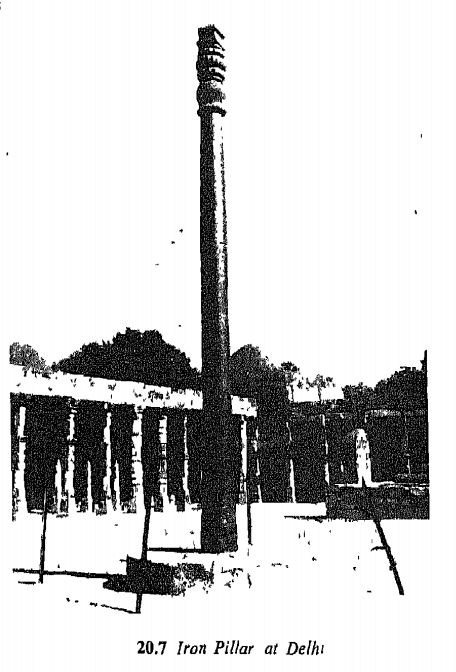
- Spread of Civilization in Eastern India
- Signs of Civilization in Eastern India (4th-7th Century A.D.)
- Defining Civilization
- A society is considered civilized if it possesses:
- Writing skills, a taxation system, and law enforcement mechanisms.
- Social classes and specialized roles in priestly, administrative, and productive functions.
- The ability to produce surplus goods, supporting both producers (artisans, peasants) and non-producing consumers.
- Delayed Civilization in Eastern India
- In eastern Madhya Pradesh, Orissa, West Bengal, Bangladesh, and Assam, these elements appeared much later.
- Before the mid-4th century A.D., no significant written records exist in these regions.
- Spread of Civilization (4th-7th Century A.D.)
- This period saw the expansion of an advanced rural economy, formation of state systems, and social class distinctions in:
- Eastern Madhya Pradesh
- Orissa
- Eastern and Southeast Bengal
- Assam
- The distribution of Gupta-era inscriptions in these regions demonstrates this cultural diffusion.
- Role of Land Grants in Cultural Expansion
- Many inscriptions are land grant records issued by feudatory princes and others.
- These grants were primarily for religious purposes, benefiting:
- Brahmanas and Buddhists
- Vaishnavite temples and Buddhist monasteries
- The beneficiaries of these grants played a crucial role in spreading and strengthening civilization.
- A region-wise analysis helps understand this process in detail.
- Political and Cultural Developments in Orissa and Eastern & Southern Madhya Pradesh
- Early State Formation and Trade in Kalinga (Coastal Orissa)
- Kalinga (Coastal Orissa, south of the Mahanadi) rose to prominence under Ashoka, but a strong state was established only in the 1st century B.C. under Kharavela, who advanced as far as Magadha.
- In the 1st and 2nd centuries A.D., Orissa's ports engaged in trade of pearls, ivory, and muslin, with archaeological evidence from Sisupalgarh (Kalinganagari, 60 km from Bhubaneswar) indicating Roman trade connections.
- However, northern Orissa did not experience significant state formation or commercial activity.
- Gupta Conquests and State Expansion (4th-6th Century A.D.)
- Samudragupta's conquests (4th century A.D.) included Kosala and Mahakantara (covering parts of northern and western Orissa).
- From the second half of the 4th century to the 6th century, multiple regional states emerged, with at least five identifiable kingdoms:
- Matharas (Pitṛbhaktas)
- Dominated the region between Mahanadi and Krishna rivers.
- Vasisthas
- Ruled in south Kalinga near Andhra.
- Nalas
- Controlled the forest areas of Mahakantara.
- Manas
- Occupied coastal Orissa, beyond the Mahanadi.
- Each state developed systems of taxation, administration, and military organization. The Nalas and Manas also introduced their own coinage.
- The rulers favored Brahmanas through land grants, performed Vedic sacrifices, and sought power, prestige, and legitimacy.
- Economic and Administrative Advancements
- Advanced culture spread beyond the coastal regions into other parts of Orissa and Eastern Madhya Pradesh.
- The discovery of Nala gold coins in Bastar (Madhya Pradesh) suggests an economy with large-scale monetary transactions.
- Manas-issued copper coins, indicating the use of metallic currency among artisans and peasants.
- States increased revenue by creating new fiscal units in rural areas:
- Matharas established Mahendrabhoga (in the Mahendra mountains).
- Dantayavagubhoga district, supplying ivory and rice-gruel for administrators, was formed in a less developed area.
- Brahmanical land grants (agraharas):
- These lands funded religious and educational activities.
- Some grants remained taxable, unlike those in other parts of India.
- Agricultural improvements:
- Brahmana-led cultivation expansion in tribal, forest, and red soil regions.
- The introduction of detailed seasonal divisions:
- Earlier there were three seasons of four months each.
- Under the Matharas (5th century A.D.) the year was divided into 12 lunar months, improving weather-based agricultural planning.
- Spread of Writing and Sanskritization
- Writing was known in coastal Orissa since the 3rd century B.C., with Prakrit inscriptions continuing until the mid-4th century A.D.
- From A.D. 350 onward, Sanskrit became the dominant language, spreading beyond the coastal region, north of the Mahanadi.
- Sanskrit's influence extended to Brahmanical religion, law, and social structures:
- Royal charters began quoting Puranas and Dharmasastras.
- Kings claimed to uphold the varna system and align themselves with the Gangetic cultural traditions.
- The holy dip at Prayag (confluence of Ganga and Yamuna) became a symbol of spiritual merit, attracting victorious kings.
- Bengal
- Early Writing and Settlements
- Writing was prevalent in north Bengal during Asoka's time, as evidenced by an inscription in Bogra district.
- Local settlements maintained storehouses filled with coins and food grains for Buddhist monks, indicating tax payments and surplus production.
- Prakrit and Buddhism were known in this region.
- In the second century B.C., an inscription from Noakhali (south-east Bengal) also confirms knowledge of Prakrit and Brahmi script.
- Political Developments (4th-6th Century A.D.)
- By the mid-4th century, a ruler with the title of Maharaja governed Pokhatna (Damodara, Bankura district). He was a devotee of Vishnu and possibly granted a village to a deity.
- By the 5th and 6th centuries, the region between the Ganga and Brahmaputra (now Bangladesh) had become a settled, Sanskrit-educated region.
- Around A.D. 550, Gupta governors became independent and ruled north Bengal, though parts may have been under Kamarupa.
- Local vassal rulers, called Samaniya Maharajas, developed administrative and military structures, including horses, elephants, foot soldiers, and boats for taxation and warfare.
- By A.D. 600, the area was known as Gauda, with Sasanka as its ruler, a rival of Harsha.
- Land Transactions and Agriculture
- Between A.D. 432-433, numerous land sale records on copper plates were found in Pundravardhanabhukti (north Bengal, now mostly in Bangladesh).
- Land was often bought using gold coins (dinara) and granted for religious purposes, making it tax-exempt.
- These records indicate an active local administration involving scribes, merchants, artisans, and landowners under Gupta-appointed governors.
- Most land grants describe the land as uncultivated and tax-free, implying expansion of agriculture and settlement.
- Development in Deltaic Bengal (Samatata & Vanga)
- The deltaic region (Brahmaputra basin, Samatata) acknowledged Samudragupta's authority.
- South-east Bengal was likely not ruled by Brahmanized princes, lacking Sanskrit and the varna system, unlike north Bengal.
- Around A.D. 525, a structured state emerged, covering Samatata and parts of Vanga, issuing gold coins in the late 6th century.
- By the 7th century, the Khadga kingdom (Dacca area), Lokanatha's Brahmana feudatory kingdom, and the Ratas (Comilla area) had formed.
- These rulers issued land grants and created agraharas (Brahmana land endowments).
- Social and Cultural Progress
- Sanskrit culture spread, leading to sophisticated poetic meters by the second half of the 7th century.
- Fiscal and administrative units, like Dandabhukti (border of Bengal and Orissa), were created to manage tribal populations and promote Sanskrit-based culture.
- Vardhamanabhukti (Burdwan) emerged as a center in the 7th century.
- Land grants in Faridpur (south-east Bengal) and Comilla show the transformation of forested and waterlogged regions into cultivated lands.
- Formation of Multiple States (Mid-5th to 7th Century)
- This period saw the rise of nearly half a dozen states, some independent and others feudatory.
- Each state had a military camp, maintained cavalry, elephants, boats, and tax-collection systems.
- Expansion occurred through warfare and land grants to Buddhists and Brahmanas.
- The rise in land endowments led to the appointment of an Agrithartkahad officer to oversee them.
- Land Ownership and Governance
- Initially, land was owned collectively by tribes and communities, with grants given to priests.
- Later, individual families gained land ownership, but the community still influenced sales and donations.
- Over time, kings claimed more land and rights, enabling them to grant land and collect taxes.
- Sanskrit, the official language of the Puranas and Dharmasastras, was known to administrative functionaries, emphasizing the spread of Brahmanical culture.
- Conclusion
- The 5th-7th centuries marked a crucial phase in Bengal's history, with political consolidation, land expansion, and cultural Sanskritization.
- The transition from tribal to organized state systems signified the advancement of civilization in the region.
- Assam
- Early Settlements and Political Developments
- Kamarupa, covering the Brahmaputra basin, gained prominence in the 7th century.
- However, excavations in Ambari (near Gauhati) indicate settlements existed as early as the 4th century A.D.
- In the same period, Samudragupta received tributes from Davaka (possibly in Nowgong district) and Kamarupa, suggesting their rulers were tribute-collecting chiefs from tribal peasantry.
- Growth of Settlements and Cultural Influence
- Excavations confirm developed settlements in Ambari by the 6th and 7th centuries, supported by inscriptions.
- By the early 6th century, Sanskrit and writing were in active use.
- Kamarupa kings adopted the title “Yarman,” a designation found across northern, central, and southern India.
- They solidified their power through land grants to Brahmanas.
- Rise of Bhaskaravarman (7th Century)
- Bhaskaravarman emerged as a powerful ruler, controlling much of the Brahmaputra basin and areas beyond.
- Buddhism gained influence in Kamarupa during this time.
- The Chinese traveler Hsuan Tsang (Hieun Tsang) visited Kamarupa, further documenting its development.
- The Formative Phase of Eastern India (4th-7th Century)
- Spread of Civilization and Cultural Developments
- Different parts of eastern India gained prominence at varying times, but their formative phase spanned from the 4th to the 7th century.
- This period saw the spread of writing, Sanskrit learning, Vedic rituals, Brahmanical social classes, and state systems across:
- Eastern Madhya Pradesh
- North Orissa
- West Bengal
- Bangladesh
- Assam
- Gupta influence played a key role in stimulating cultural and state formation, as seen in:
- Direct rule over north Bengal and north-west Orissa
- Use of the Gupta era in inscriptions across the region
- Political and Economic Advancements
- New states emerged in Bengal, where rulers built strong military camps with elephants, horses, and boats, funded by taxation from rural communities.
- 5th-6th centuries marked major developments, including:
- Large-scale writing and use of Sanskrit
- Formation of a varna-based society
- Growth of Buddhism, Brahmanism, Saivism, and Vaishnavism
- Decline of communal land authority, with private property and land transactions using gold coins
- Agriculture and trade flourished, supported by:
- Iron ploughshare agriculture
- Wet paddy cultivation (noted by Kalidasa in Vanga)
- High-quality sugarcane production in north Bengal
- Growth of crafts and a food-surplus economy
- Expansion into Outlying Regions
- The decline of the Gupta empire coincided with rapid development in previously remote and less-inhabited areas, such as:
- Red soil regions of West Bengal, north Orissa, and Chotanagpur plateau, which were difficult to cultivate
- Jungle areas with alluvial soil and heavy rainfall in Bangladesh and the Brahmaputra basin
- These regions, once ruled by tribal chiefs, gradually integrated into state systems and became part of historical records.
- Harsha and His Times
- Harsha's Kingdom (A.D. 606-647)
- Political Background and Rise of Harsha
- The Gupta empire ruled northern and western India for about 160 years, with power centered in Uttar Pradesh and Bihar, until its decline in the mid-6th century.
- Following their fall, northern India fragmented into multiple kingdoms.
- The White Hunas dominated Kashmir, Punjab, and western India from around A.D. 500.
- North and western India were divided among several feudatories, who took control of the former Gupta territories.
- Gradually, one ruling family from Thanesar (Haryana) expanded its control over these feudatories.
- The leader responsible for this consolidation of power was Harshavardhana (A.D. 606-647).
- Kanauj: The New Political Center
- Harsha shifted his capital from Thanesar to Kanauj, which then became a major political and military center.
- Decline of Pataliputra:
- Pataliputra had thrived on trade, commerce, and taxation from traders using its four river routes.
- However, with the decline of trade and scarcity of money, officials and soldiers were instead compensated through land grants, reducing Pataliputra's importance.
- Rise of Kanauj:
- With its strategic location in the doab (Farrukhabad, Uttar Pradesh), Kanauj emerged as a key fortified military center.
- Unlike the plains, Kanauj's elevated position made it easier to defend.
- Troops could be moved swiftly using both land and water routes, allowing control over the eastern and western doab.
- Its emergence under Harsha symbolized the transition from a pre-feudal to a feudal political order in northern India.
- Sources of Harsha's Reign
- Banabhatta, his court poet, chronicled his life in the Harshacharita.
- Chinese traveler Hsuan Tsang (Hieun Tsang) visited India in the 7th century A.D., staying for 15 years and providing valuable insights.
- Harsha's inscriptions mention various taxes and officials, reflecting the administrative system of his time.
- Extent of Harsha's Empire and Challenges
- Harsha is often termed the last great Hindu emperor of northern India, but this is only partially true.
- His direct rule extended over Rajasthan, Punjab, Uttar Pradesh, Bihar, and Orissa, with his influence spreading beyond these regions.
- Several peripheral states acknowledged his sovereignty, but he never controlled the entire Indian subcontinent.
- His southward expansion was checked at the Narmada River by Pulakesin II, the Chalukyan ruler of Karnataka and Maharashtra (capital: Badami, modern Bijapur district).
- Despite this setback, Harsha faced no major opposition and succeeded in bringing political unity to a significant part of India.
- Administration Under Harsha
- Feudal and Decentralized Governance
- Harsha's administration followed a structure similar to the Gupta system but became more feudal and decentralized over time.
- His empire relied heavily on feudatories, who played a crucial role in governance and military support.
- Military Strength:
- Harsha reportedly had an army of 100,000 horses and 60,000 elephants, a number far exceeding that of the Mauryas (who had 30,000 cavalry and 9,000 elephants despite controlling a much larger territory).
- This vast military force was possible because Harsha could mobilize his feudatories, who provided foot soldiers and horses in times of war.
- Land Grants and Revenue System
- Land grants continued under Harsha, given to priests for religious services and officers as rewards for their service.
- Administrative Charters:
- Officers received land grants via charters, similar to earlier practices.
- These grants provided privileges to priests as seen in previous dynasties.
- Hsuan Tsang's Account:
- Harsha's revenue was divided into four parts:
1. Royal expenditures (for the king's needs).
2. Scholars and education.
3. Public servants and administration.
4. Religious purposes.
- Ministers and high-ranking officials were granted land, marking the beginning of feudal practices in administration.
- Law and Order
- Harsha's administration struggled with maintaining internal security.
- Robbery and Crime:
- Despite Harsha's efforts, robbery was common. Even Hsuan Tsang, a royal guest, was robbed during his travels.
- Harsh Punishments:
- Robbery was considered treason, and the punishment was amputation of the right hand.
- However, due to the influence of Buddhism, punishments were often softened, and criminals were instead imprisoned for life.
- Hsuan Tsang's Account of Harsha's Reign
- Journey and Purpose
- The Chinese pilgrim Hsuan Tsang visited India during Harsha's reign, leaving China in A.D. 629 and returning in A.D. 645.
- His primary purpose was to study at the Buddhist university of Nalanda (Bihar) and collect Buddhist texts.
- He spent several years at Harsha's court, traveling extensively across India.
- His account provides a richer and more detailed description of India's economic, social, and religious life compared to Fa-hsien's earlier account.
- Observations on Cities
- Declining Cities:
- Pataliputra and Vaisali had lost their former glory.
- Rising Cities:
- Prayag (Allahabad) and Kanauj in the Gangetic doab had become prominent political and cultural centers.
- Society and Social Classes
- Brahmanas and Kshatriyas:
- Lived simple lives, in contrast to the nobles and priests, who enjoyed luxurious lifestyles.
- Sudras as Agriculturists:
- Hsuan Tsang's account is significant as he describes Sudras as agriculturalists, unlike earlier texts, which portrayed them as servants of the three higher varnas.
- Untouchables and Social Exclusion:
- He mentions scavengers and executioners as untouchables, living outside villages.
- They consumed garlic and onions, and their presence was announced loudly so others could avoid contact with them.
- Buddhism and Nalanda Under Harsha
- State of Buddhism
- During Hsuan Tsang's visit, Buddhism had fragmented into 18 sects.
- Many old Buddhist centers had declined, but Nalanda emerged as the most prominent.
- Nalanda University
- Nalanda was a renowned Buddhist university, reportedly housing 10,000 students, all of whom were monks.
- Excavations reveal an impressive complex, constructed and renovated over 700 years (5th century A.D. onward).
- However, evidence suggests the monastery could not have accommodated 10,000 monks.
- I-tsing account
- By A.D. 670, Chinese pilgrim I-tsing recorded only 3,000 monks, which seems a more realistic estimate.
- The university was financially supported by revenues from 200 villages.
- Nalanda remained a major monastic center during Harsha's reign.
-

- Harsha's Religious Policy
- Initially a Shaivite, Harsha later became a great patron of Buddhism.
- He followed a tolerant religious policy, supporting multiple faiths.
- He organized a grand assembly at Prayag, attended by tributary princes, ministers, and nobles.
- An image of Buddha was worshipped.
- Hsuan Tsang delivered discourses.
- At the end of the event, Harsha made generous donations, keeping only his personal clothing.
- Hsuan Tsang describes Harsha as kind, courteous, and helpful, with free movement granted to the pilgrim across the empire.
- Harsha as a Literary Patron
- Harsha was a literary figure, having authored three plays.
- He patronized scholars, including his court poet Banabhatta.
- Banabhatta's Harshacharita provides a glorified account of Harsha's early life, written in an ornate ( highly decorative, elaborate, and intricate form of expression in art, architecture, literature, or speech) style that influenced later writers.
- Formation of New States and Rural Expansion in the Peninsula
- The New Phase (c. A.D. 300-750)
-
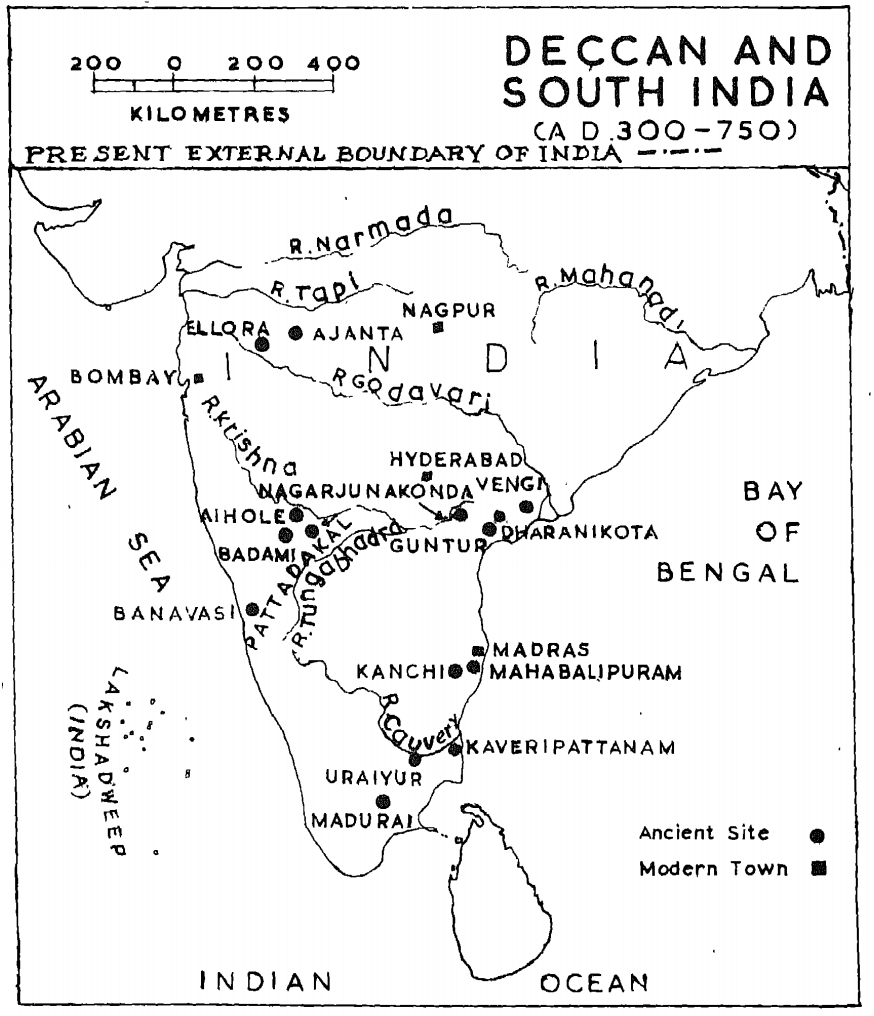
- Political Developments
- This period marks the second historical phase in the regions south of the Vindhyas, continuing some trends from the first phase (c. 200 B.C. - A.D. 300) while introducing new developments.
- First Phase (200 B.C. - A.D. 300):
- Satavahanas dominated the Deccan.
- Tamil kingdoms ruled the southern districts of Tamil Nadu.
- Northern Tamil Nadu, southern Karnataka, southern Maharashtra, and the land between the Godavari and the Mahanadi remained under external political control, lacking independent states.
- Second Phase (A.D. 300-750):
- Between A.D. 300 and 600, around two dozen states emerged, as evidenced by land charters.
-
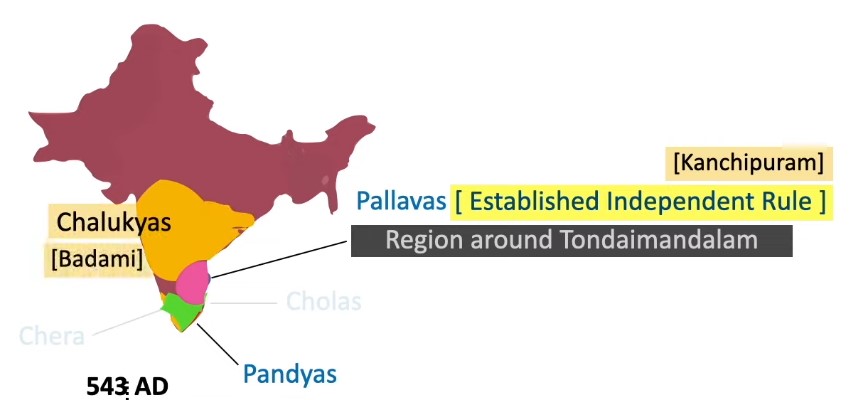
- By the seventh century, three major states had solidified their power:
- Pallavas of Kanchi
- Chalukyas of Badami
- Pandyas of Madurai
- Economic and Agrarian Changes
- The first historical phase was characterized by:
- Thriving crafts.
- Internal and external trade.
- Extensive coin usage.
- Numerous towns.
- The second phase saw a decline in trade, towns, and coinage
- A significant feature of this period was the large-scale land grants to Brahmanas, often tax-free.
- These land grants indicate that new areas were brought under cultivation, leading to agrarian expansion and rural settlement growth.
- Religious and Cultural Shifts
- This period saw the rise of Brahmanism, replacing earlier Buddhist and Jain influences.
- First Phase (200 B.C. - A.D. 300):
- Buddhist monuments were widespread in Andhra and Maharashtra.
- Jainism and Buddhism were present in southern Tamil Nadu.
- Second Phase (A.D. 300-750):
- Jainism became confined to Karnataka.
- Vedic sacrifices were frequently performed by kings across the peninsula.
- The construction of stone temples for Shiva and Vishnu began:
- Pallavas initiated temple-building in Tamil Nadu.
- Chalukyas of Badami built temples in Karnataka.
- By the end of this phase, South India had transformed from a land of megaliths to a land of temples.
- Linguistic Changes
- Before A.D. 400, inscriptions in Andhra, Karnataka, and Tamil Nadu were primarily in Prakrit.
- The Brahmi inscriptions in Tamil Nadu also contained Prakrit words.
- From A.D. 400 onwards, Sanskrit became the official language in the peninsula, and most charters were composed in it.
- States of the Deccan and South India
- The Vakatakas (Successors of the Satavahanas)
- Ruled northern Maharashtra and Vidarbha (Berar).
- Were Brahmanas and issued numerous land grants to fellow Brahmanas.
- Actively promoted Brahmanical religion and performed Vedic sacrifices.
- Played a role in North Indian politics:
- Chandragupta II married his daughter, Prabhavati Gupta, into the Vakataka royal family.
- With their support, he conquered Gujarat and parts of Western India from the Sakas (late 4th century A.D.).
- Served as a conduit for transmitting Brahmanical ideas and social institutions to the South.
- The Chalukyas of Badami
- Overthrew the Vakatakas and ruled the Deccan for nearly two centuries (until A.D. 757).
- Eventually displaced by their feudatories (individuals or states that owe allegiance and provide service), the Rashtrakutas.
- Claimed descent from:
- Brahman, Manu, or the Moon (likely for legitimacy).
- Boasted of ruling at Ayodhya, though they were likely a local Kanarese people elevated under Brahmanical influence.
- Established their kingdom in western Deccan (early 6th century A.D.):
- Capital at Vatapi (modern Badami, Karnataka).
- Later branched into several ruling houses but remained the dominant power in the Deccan.
- No other Deccan power was as significant until the rise of Vijayanagar in the late medieval period.
-
- The Ikshvakus
- Emerged in the Krishna-Guntur region after the decline of the Satavahanas.
- Likely a local tribe that adopted the name “Ikshvaku” to assert antiquity.
- Left behind monuments at Nagarjunakonda and Dharanikota.
- Initiated the practice of land grants in the Krishna-Guntur region (several copper plate charters discovered).
- The Pallavas
- Supplanted the Ikshvakus.
- Origin:
- “Pallava” means “creeper” (Sanskrit equivalent of Tamil “tondai”).
- Possibly a local tribe that established authority in Tondainadu (land of creepers).
- Initially had a reputation as uncivilized or even robbers (Tamil word “Pallava” also means “robber”).
- Extended authority over southern Andhra and northern Tamil Nadu.
- Established capital at Kanchi (modern Kanchipuram), which became a center of temple-building and Vedic learning.
- The Kadambas
- Early rivals of the Pallavas, ruling northern Karnataka (4th century A.D.).
- Founded by Mayurasarman:
- Came to Kanchi for education but was driven out.
- Set up camp in a forest and, with the help of local tribes, defeated the Pallavas.
- Though later defeated, was recognized as a ruler by the Pallavas.
- Religious influence:
- Performed 18 Ashvamedha sacrifices.
- Generously granted villages to Brahmanas.
- Capital:
- Vaijayanti (Banavasi, North Kanara, Karnataka).
- The Western Gangas
- Established rule in southern Karnataka (4th century A.D.).
- Kingdom located between:
- Pallavas (east).
- Kadambas (west).
- Often feudatories of the Pallavas.
- Distinguished from the Eastern Gangas of Kalinga.
- Early capital:
- Kolar (possibly influenced by its gold mines).
- Religious and Economic Influence
- Land Grants:
- The Pallavas, Kadambas, and Chalukyas extensively granted villages to Brahmanas, often tax-free.
- These grants:
- Expanded agrarian settlements.
- Allowed Brahmanas to collect dues directly from peasants.
- Granted up to 18 types of immunities, including exemption from taxes and forced labor.
- Religious Patronage:
- Pallavas, Kadambas, and Chalukyas performed major Vedic sacrifices (Ashvamedha, Vayapeya).
- Boosted priestly class wealth, often at the expense of peasants.
- The Kalabhra Revolt (6th Century A.D.)
- A social and political uprising against the land-grant-based Brahmanical system.
- Led by the Kalabhras, who are depicted as “evil rulers” in later sources.
- Overthrew numerous kings and ruled Tamil land.
- Revoked Brahmadeya (Brahmana land grants), redistributing land.
- Possibly inclined toward Buddhism, as they patronized Buddhist monasteries.
- Suppressed through joint efforts of:
- Pandyas, Pallavas, and Chalukyas of Badami.
- Some traditions claim they even imprisoned the Chola, Pandya, and Chera kings.
- The scale of the revolt suggests it impacted areas beyond Tamil land.
- The confederacy (union of independent states, groups, or entities) against the Kalabhras indicates that the revolt challenged the prevailing social and political order in South India.
- Conflict Between the Pallavas and the Chalukyas
- Background
- The Pallavas of Kanchi and the Chalukyas of Badami fought for supremacy in peninsular India from the 6th to 8th centuries.
- The Pandyas of Madurai and Tinnevelly played a minor role in the conflict.
- Despite both dynasties patronizing Brahmanism, performing Vedic sacrifices, and granting land to Brahmanas, they clashed over plunder, prestige, and territorial control.
- The Krishna-Tungabhadra doab was the main battleground, later contested between the Vijayanagar and Bahmani kingdoms.
- Pulakesin II and Early Conflicts (609-642 A.D.)
- The conflict intensified during the reign of Pulakesin II (609-642 A.D.), the most famous Chalukya king.
- His achievements are recorded in the Aihole inscription, composed by his court poet Ravikirti.
- He overthrew the Kadambas of Banavasi and subjugated the Gangas of Mysore.
- He repelled Harsha's army at the Narmada, preventing northern expansion into the Deccan.
- Pulakesin II nearly reached Kanchipuram, but the Pallavas ceded their northern provinces to maintain peace.
- Around 610 A.D., he seized the Krishna-Godavari region, establishing the Eastern Chalukyas of Vengi.
- However, his second invasion of Pallava territory failed, leading to his downfall.
- Pallava Counterattack Under Narasimhavarman I (630-668 A.D.)
- Narasimhavarman I (630-668 A.D.) defeated Pulakesin II around 642 A.D., capturing Vatapi (Badami).
- He took the title Vatapikonda (Conqueror of Vatapi).
- He also defeated the Cholas, Cheras, Pandyas, and Kalabhras.
- Renewed Conflict and Chalukya Victory (8th Century A.D.)
- After a brief pause in the late 7th century, the conflict resumed in the early 8th century.
- Vikramaditya II (733-745 A.D.), a Chalukya king, invaded Kanchi three times.
- In 740 A.D., he decisively defeated the Pallavas, ending their dominance in southern India.
- Despite this, the Pallava ruling house survived for another century.
- The Chalukya victory was short-lived, as their empire fell to the Rashtrakutas in 757 A.D..
- Temples in Early Medieval India
- Rise of Temple Worship
- Alongside Vedic sacrifices, the worship of Brahma, Vishnu, and Shiva gained popularity, especially the last two.
- From the 7th century, the Alvar saints promoted the Vaishnavite tradition, while the Nayanmars popularized the Shaivite tradition.
- Nayanmars -> Nandi -> Shaivite
- Alwars -> Not Shaivite -> Vaishnavite
- Pallava Temples (7th-8th Century A.D.)
- The Pallava kings constructed numerous stone temples to house these deities.
- At Mahabalipuram
- Seven Rath Remple
- The most famous are the seven ratha temples at Mahabalipuram, built in the 7th century by Narasimhavarman I.
-
- Shore Temple
- Mahabalipuram (Mamallapuram) also houses the Shore Temple, a notable structural temple.
- At Kanchipuram
- Kailasanatha Temple
- Several other structural temples were built at Kanchipuram, including the Kailasanatha Temple (8th century A.D.).
-
- Trick to remember Pallavas temple:
-
- Chalukya Temples (7th-8th Century A.D.)
- The Chalukyas of Badami built numerous temples, particularly at Aihole, which contains around 70 temples (c. 610 A.D. onward).
- Temple construction continued in Badami and Pattadakal, where ten temples were built in the 7th and 8th centuries.
- Notable temples at Pattadakal:
- Papanatha Temple (c. 680 A.D.)
- Features a low, stunted tower in northern style.
- Virupaksha Temple (c. 740 A.D.)
- Built in southern style, measuring 40 meters with a high, square, storied tower (sikhara).
- Temple walls are adorned with sculptures from the Ramayana.
- Trick to remember Chalukyas temple:
-

- Temple Maintenance and Patronage
- Before the 8th century, temple maintenance was likely funded by taxes collected by the king.
- After the 8th century, land grants to temples became common, often recorded on temple walls.
- Some temples in Karnataka under the Chalukyas were built by Jain traders.
- While common people primarily worshipped village gods with offerings of paddy and toddy, they may have also contributed to major temples for religious and social status.
- Demands on the Peasantry
- Need for Resources
- Enormous resources were required for:
- Wars
- Art and literature
- Religious patronage
- Administration
- These resources were largely extracted from the peasantry.
- Types of Taxation and Extractions
- Both the Vakataka (Vidarbha & Maharashtra) and Pallava (Southern Andhra & Northern Tamil Nadu) kingdoms imposed similar burdens on agrarian communities.
- Key demands included:
- Land tax
- A portion of the agricultural produce.
- Benevolence tax
- Payments in cereals and gold.
- Resource extraction:
- Trees like palmyra were tapped for salt, sugar, and liquor.
- Hidden treasures and deposits in villages belonged to the king.
- Natural goods tax:
- Peasants had to provide flowers, milk, wood, and grass.
- Forced labor (Vishti)
- Peasants could be compelled to work for the state without pay.
- Additional Peasant Obligations
- During royal visits and army movements, villagers had to:
- Supply bullocks for carts.
- Provide cots, charcoal, ovens, cooking pots, and attendants.
- Impact on Peasantry
- These demands placed a heavy burden on the labor and produce of rural communities.
- Many of these taxes were exempted for Brahmanas through 18 types of immunities granted from the 4th century A.D. onward.
- Over time, state extractions from the peasantry increased further.
- Rural Expansion
- Increase in Agricultural Production
- The heavy demands of the king on the peasantry suggest that the agricultural output must have increased.
- Tax collection and state expansion would not have been possible without higher agricultural productivity.
- Formation of New States
- During this period, new states emerged in the trans-Vindhyan regions.
- These states consisted of feudatory chiefdoms—small states within larger states.
- Each state, whether paramount (supreme, most important, or having the highest authority) or feudatory, required:
- Its own army.
- Its own taxation system.
- An administrative machinery.
- Priestly and other supporters.
- The survival and expansion of these states depended on resources from their rural base.
- Rural proliferation and increased agricultural production became essential.
- Role of Brahmanas in Rural Growth
- In tribal areas, land grants to Brahmanas helped integrate local peasants into the agrarian economy.
- The Brahmanas introduced:
- Better cattle preservation methods.
- Improved agricultural techniques.
- In labor-scarce areas, sharecroppers and weavers were assigned to Brahmanas, as seen in an early Pallava grant.
- This contributed to the spread of new cultivation techniques and the growth of rural communities.
- Types of Villages in South India
- Three main types of villages existed:
- Ur
- The most common type, inhabited by peasant castes.
- Land was likely held in common.
- The village headman collected and paid taxes on behalf of the community.
- Mainly found in southern Tamil Nadu.
- Sabha
- Consisted of Brahmadeya villages (granted to Brahmanas) and Agrahara villages.
- Brahmana landowners had individual rights but conducted activities collectively.
- Nagaram
- Villages dominated by traders and merchants.
- Possibly formed due to the decline of trade, which led merchants to settle in villages.
- Rural Administration
- In Chalukya territories, village elders (Mahajana) managed local affairs.
- The period A.D. 300 - A.D. 750 saw significant rural expansion, better land utilization, and structured village organization.
- Social Structure
- Dominance of Princes and Priests
- Society was dominated by princes and priests.
- Princes claimed Brahmana or Kshatriya status, though many were originally local tribal chiefs.
- These chiefs were elevated to the second varna due to their benefactions to priests.
- Priests legitimized the rulers by:
- Creating respectable family trees.
- Tracing their lineage to ancient solar and lunar dynasties.
- This process secured legitimacy for the rulers in the eyes of the people.
- Role of Priests
- The priests were mainly Brahmanas, though Jain and Buddhist monks also held similar status.
- They gained power and influence due to land grants.
- Peasantry and Social Hierarchy
- Below the princes and priests was the peasantry, divided into numerous peasant castes.
- In the Brahmanical system, most of them were likely classified as Sudras.
- Peasants and artisans were expected to:
- Produce goods.
- Render services.
- Make payments.
- Failure to do so was seen as a violation of dharma (norms).
- The Age of Kali and Restoration of Order
- When the social order collapsed, it was called the age of Kali.
- It was the king's duty to restore peace and order.
- Many rulers, including the Vakataka, Pallava, Kadamba, and Western Ganga kings, adopted the title Dharma-Maharaja (King of Dharma).
- Simhavarman, the founder of Pallava power, was credited with restoring dharma.
- He is said to have suppressed the Kalabhras, a group that had disrupted the existing social order.
- India's Cultural and Commercial Interactions with the World
- Indian Law and Maritime Travel
- Medieval lawgivers forbade crossing the seas, implying isolation
- The prohibition on crossing the seas, often referred to as Kala Pani (literally "black water") or Samudra Ullanghana ("crossing the ocean"), was a significant taboo in certain sections of Hindu society, especially among upper castes like Brahmins.
- Here are some examples of the implications of this taboo:
- Social Exclusion and Loss of Caste:
- The primary consequence of violating the Kala Pani prohibition was the potential loss of one's caste or social status, leading to social ostracism. Mahatma Gandhi, for example, was excommunicated from his caste after traveling to Britain to study law.
- Difficulty in Maintaining Ritual Purity:
- One of the reasons cited for the prohibition was the difficulty in maintaining ritual purity and performing daily religious observances on a ship or in a foreign land. This concern was so significant that Maharaja Sawai Madho Singh II even carried Ganga water with him when he traveled to England in 1901 to avoid drinking foreign water,.
- Mutiny Among Soldiers:
- During the British colonial period, the reluctance of high-caste Indian soldiers to cross the seas for military campaigns led to instances of discontent and even mutiny, as they feared losing their faith and caste status.
- Impact on Trade and Travel:
- While Indian traders had a history of maritime activity, particularly from the southern kingdoms, the Kala Pani proscription likely influenced the degree and nature of their engagement in overseas ventures, with some accounts suggesting that the taboo contributed to a reluctance among some Hindus to engage in extensive maritime trade during the Portuguese Age of Exploration,.
- Opposition to Priests Visiting Foreign Lands:
- In recent times, controversies have arisen over priests or religious figures who have traveled overseas. For instance, in 2007, the ascension of Sugunendra Tirtha to the Udupi Krishna Temple was opposed by some seers because he had visited foreign countries, committing the offense of saagarolanga,.
- However, India maintained extensive contacts with Asia, West Asia, and the Roman Empire since ancient times.
- Harappan traders engaged with Mesopotamian cities (2400-1700 B.C.), as evidenced by discovered seals.
- From the Christian era onward, India traded with China, Southeast Asia, and the Roman Empire.
- The Silk Route and land connections facilitated commerce and cultural exchange.
- Spread of Buddhism and Cultural Exchange
- Buddhism played a key role in India's interactions with Sri Lanka, Burma, China, and Central Asia.
- Ashoka (3rd century B.C.) likely sent missionaries to Sri Lanka, leading to permanent Buddhist influence.
- Brahmi inscriptions (2nd-1st century B.C.) found in Sri Lanka confirm early Buddhist presence.
- Buddhism spread to Burma (Myanmar), where Theravada Buddhism flourished, inspiring temple and statue construction.
- Burmese and Sri Lankan Buddhists produced an extensive Buddhist literary corpus, surpassing India's.
- Even after Buddhism declined in India, it remained dominant in Burma and Sri Lanka.
- Buddhism's Expansion into Central and East Asia
- Kanishka's reign (2nd century A.D.) saw increased Indian Buddhist missions to China, Central Asia, and Afghanistan.
- Buddhism spread from China to Korea and Japan, prompting Chinese pilgrimages to India (e.g., Fa-hsien, Hsuan Tsang).
- Dunhuang in China became a major Buddhist center.
- India adopted silk-growing techniques from China, while China learned Buddhist painting from India.
- Buddhism in Afghanistan and Central Asia
- Afghanistan and Central Asia became major Buddhist centers.
- Begram and Bamiyan (Afghanistan) housed numerous Buddhist statues and monasteries.
- Bamiyan had the tallest rock-cut Buddha statue (early Christian era) and many monastic caves.
- In March 2001, they were deliberately destroyed by the Taliban
- Buddhism thrived here until Islam replaced it (7th century A.D.).
- Central Asia preserved Indian Buddhist stupas, monasteries, inscriptions, and manuscripts.
- Kushan rule helped spread Prakrit (Kharosthi script) to Central Asia.
-
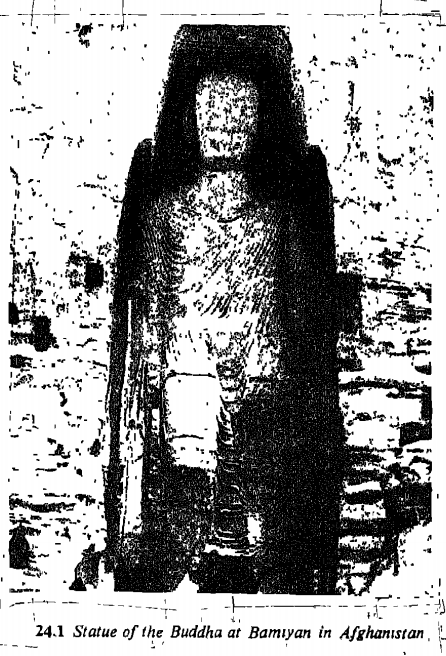
- Indian Influence in Southeast Asia
- Southeast Asia absorbed Indian culture, mostly through Brahmanical traditions rather than Buddhism.
- Burma (Myanmar) had strong Buddhist influences, with extensive remains from the Gupta period.
- India's trade and settlements (1st century A.D.) in Java (Indonesia) called it Suvarnadvipa (Island of Gold).
- Pallavas established colonies in Java (early Christian era).
- Champa (Vietnam) and Kamboja (Cambodia) were Indianized kingdoms with Sanskrit as the official language.
- Srivijaya and Hindu Influence in Southeast Asia
- Sumatra (Srivijaya Kingdom, 5th-10th century A.D.) became a center of Indian culture.
- Kamboja (Cambodia), founded in the 6th century A.D., was a Shiva-worshipping kingdom and a Sanskrit learning hub.
- Champa (Southern & Northern Vietnam) was a major Vedic and Dharmashastra education center.
- Angkor Wat (Cambodia), built in medieval times, surpasses Borobudur in grandeur.
- The Ramayana and Mahabharata influenced Indonesian culture, with folk plays and Sanskrit-influenced Bahasa Indonesia.
-
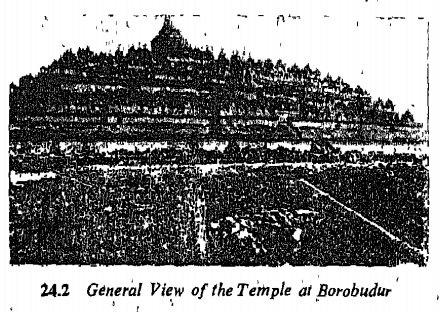
- Indian Ocean Trade and Cultural Exchange
- Indian settlements thrived in the Indian Ocean until the 13th century.
- Trade, not just religion, played a vital role in cultural exchange.
- Suvarnabhumi and Suvarnadvipa (Southeast Asia) indicate Indian interest in gold trade.
- Indians adopted:
- Gold coin minting from Greeks and Romans.
- Silk cultivation from China.
- Betel leaf farming from Indonesia.
- Cotton farming spread from India to China & Central Asia.
- Indian art, religion, script, and language had a profound impact, but cultures evolved uniquely, never becoming exact replicas of Indian traditions.
- Transformation of the Ancient Phase
- Social Crisis and the Origin of Land Grants
- The transformation of ancient Indian society into medieval society was primarily driven by the practice of land grants.
- While charters suggest that kings granted land to acquire religious merit and that monks and priests required land for performing religious rites, the real reason behind this practice was a deep social crisis that disrupted the ancient order.
- The Crisis of the Varna System
- Ancient Indian society functioned based on the varna system, where:
- Vaishyas (peasants) engaged in productive activities and paid taxes.
- Shudras (laborers) provided essential services.
- The taxes collected from the vaishyas allowed the king to:
- Pay salaries to officials and soldiers.
- Reward priests.
- Purchase luxury goods from merchants and artisans.
- However, in the third and fourth centuries A.D., this system faced a severe breakdown. Puranic texts describe a situation where:
- Social classes abandoned their assigned functions.
- The lower orders sought to claim the status and privileges of the higher orders.
- Peasants refused to pay taxes and resisted forced labor.
- This led to varna-sankara (the intermixture of social classes) and the weakening of traditional social barriers. Oppression by the ruling classes, heavy taxation, and lack of royal protection fueled this crisis.
- In Puranic literature, this disorder was referred to as Kaliyuga—a time of moral and social decay.
- Response to the Crisis
- To restore order, rulers implemented several measures:
- Coercive Measures
- The law-book of Manu urged that vaishyas and shudras should strictly adhere to their designated roles, potentially leading to forceful suppression.
- Land Grants to Priests and Officials
- Instead of directly collecting taxes, kings granted land to Brahmanas and state officials as payment for their services. This had several advantages:
- The burden of tax collection and law enforcement was transferred to the new landowners.
- These beneficiaries could directly manage rebellious peasants.
- It encouraged the cultivation of new lands.
- By settling Brahmanas in newly conquered tribal areas, the ruling classes sought to spread Brahmanical culture and instill loyalty to the king.
- Thus, land grants became a crucial strategy to stabilize the social and political system, shaping the transition from ancient to medieval India.
- Decline of Central Control
- From the fifth century A.D., land grants became increasingly common. These grants, especially to Brahmanas, significantly weakened royal authority by transferring key administrative and fiscal powers to local beneficiaries.
- Impact of Land Grants to Brahmanas
- Exemption from Taxes
- Villages granted to Brahmanas were made tax-free, meaning all revenues that previously went to the king were now collected by the Brahmanas.
- Administrative Autonomy
- The beneficiaries gained the right to govern the people in the donated villages.
- Exclusion of Royal Officials
- Government officers and royal retainers were not allowed to enter the gifted villages, reducing central oversight.
- Judicial Authority
- Initially, the king retained the right to punish thieves, but by later periods, the beneficiaries were given full judicial authority over criminal offenses.
- Thus, the Brahmanas not only collected taxes but also maintained law and order, effectively acting as independent rulers within their granted villages. Since these grants were permanent, royal power was steadily eroded from the end of the Gupta period.
- Weakening of Royal Authority
- In earlier periods, such as the Maurya era, taxation and law enforcement were strictly under state control:
- Mauryas:
- Taxes were assessed and collected by royal agents, and law and order were maintained by the central administration.
- Kushans & Early Guptas:
- The state continued to pay officials in cash, supported by a steady supply of copper and gold coins.
- However, from the sixth century A.D., a major shift occurred:
- Officials Paid in Land Revenues
- Law-books of the time recommended rewarding services with land instead of cash.
- Harshavardhana's Era:
- Public officials, including governors, ministers, magistrates, and officers, were granted land for their personal upkeep.
- A quarter of royal revenue was set aside for rewarding top officials.
- Consequences
- These grants created powerful local vested interests that operated independently of the central government.
- As more regions became autonomous pockets, the king's direct control over taxation and law enforcement weakened.
- The shift from salaried officials to land-holding elites further fragmented central authority, accelerating the decline of strong, centralized rule.
- Thus, land grants—both to religious figures and government officials—played a key role in dismantling central control, paving the way for feudal structures in medieval India.
- New Agrarian Economy
- A significant transformation occurred in the agrarian economy as land grants became more widespread.
- The landed beneficiaries, such as Brahmanas and religious institutions, neither cultivated the land themselves nor collected revenues directly. Instead, the actual work was done by peasants and sharecroppers, who were attached to the land without legal ownership.
- Cultivation by Peasants and Sharecroppers
- According to the Chinese pilgrim I-tsing, most Indian monasteries had their lands cultivated by servants and other workers.
- Hsuan Tsang describes the Shudras as agriculturists, suggesting that by this time, they no longer worked primarily as slaves or agricultural laborers but possibly occupied the land temporarily.
- This shift was particularly evident in the old settled regions of North India.
- Expansion of Land Grants in Tribal Areas
- From the fifth-sixth centuries A.D., land grants to Brahmanas increased significantly, particularly in tribal areas.
- In these regions, agriculturists were placed under the direct control of religious beneficiaries, especially the Brahmanas.
- Restricted Mobility of Peasants and Artisans
- From the sixth century onwards, peasants and sharecroppers were increasingly bound to the land in backward and mountainous regions like Orissa and the Deccan.
- Over time, this practice spread to the Ganga basin and North India, where:
- Peasants and artisans were restricted from leaving the villages granted to beneficiaries.
- They were expected to remain in the same village to fulfill its agricultural and economic needs.
- Thus, the agrarian economy gradually moved towards a more rigid and localized structure, limiting social and economic mobility while strengthening the control of landowning beneficiaries.
- Decline of Trade and Towns
- From the sixth century A.D., trade began to decline significantly. The end of long-distance trade weakened urban economies, leading to the decay of towns and a shift in social organization.
- Decline of Trade
- End of Foreign Trade:
- Trade with the western Roman Empire ended in the third century.
- The silk trade with Iran and Byzantium ceased in the mid-sixth century.
- Some commerce continued with China and Southeast Asia, but its benefits were largely taken by Arab merchants, who acted as middlemen.
- By the pre-Muslim period, the Arabs had practically monopolized India's export trade.
- Decline in Coinage:
- The long decline of trade is evident from the scarcity of gold coins after the sixth century.
- This decline was not limited to North India but also affected South India.
- Decay of Towns
- Flourishing Towns Under Earlier Dynasties:
- Under the Satavahanas and Kushans, towns thrived in West and North India.
- Some cities continued to exist during the Gupta period, but post-Gupta times saw the ruin of many old commercial centers.
- Archaeological Evidence of Urban Decline:
- Excavations show that several towns began to decline during the Gupta period and mostly disappeared in post-Gupta times.
- Examples include:
- Haryana and East Punjab
- Purana Qila (Delhi), Mathura, Hastinapur, Sravasti, Kausambi (near Allahabad), Rajghat (Varanasi), Chirand, Vaisali, Pataliputra
- Hsuan Tsang's Observations:
- The Chinese pilgrim Hsuan Tsang visited several towns once associated with the Buddha but found them almost deserted or in ruins.
- Shift to Rural Economy:
- With limited markets for exports, artisans and merchants abandoned urban centers and migrated to the countryside to take up agriculture.
- In the late fifth century, a group of silk weavers from the western coast migrated to Mandasor (Malwa), abandoned silk weaving, and adopted new professions.
- The decay of trade and towns forced villages to become self-sufficient, producing oil, salt, spices, and cloth on their own.
- Changes in Social Organization
- Transformation of Vaisyas' Status:
- In the Gangetic basin, vaisyas were traditionally free peasants.
- However, land grants introduced landlords between peasants and the king, effectively reducing the status of the vaisyas to that of shudras.
- Spread of the Modified Social Order:
- The modified Brahmanical social order expanded from North India to Bengal and South India due to land grants given to Brahmanas (brought from the north) in the fifth-sixth centuries.
- In outlying regions, society became simplified into two major classes:
- Brahmanas (landlords and religious elites)
- Shudras (peasants and laborers)
- Thus, the decline of trade and urban life led to greater ruralization, self-sufficient village economies, and significant shifts in social hierarchy, reinforcing land-based economic structures.
- Changes in the Varna System
- The traditional varna system, which divided society into four main varnas (Brahmanas, Kshatriyas, Vaisyas, and Sudras), underwent significant modifications due to land grants and political changes.
- Emergence of Landed Classes and Social Mobility
- Frequent seizures of power and land grants led to the rise of new categories of landowners.
- Individuals who acquired land and power sought higher social status, even if they originally belonged to a lower varna.
- Challenge to the Traditional System:
- According to the Dharmasastras, varna-based hierarchy determined social and economic rights.
- However, economically prosperous individuals from lower varnas created a contradiction between wealth and social status.
- Adjustments in Social Classification:
- The need to recognize new landed elites led to modifications in written texts.
- Varehamihira, an astrologer from the sixth century, followed the old practice of prescribing house sizes based on varna.
- However, he also classified houses based on the ranks of ruling chiefs, indicating a shift toward land-based social status rather than strict varna divisions.
- Rise of Castes and Sub-Castes
- From the seventh century onwards, the varna system fragmented into numerous castes and sub-castes, leading to a more complex jati (caste) hierarchy.
- Expansion of Mixed Castes:
- An eighth-century Purana mentions that thousands of mixed castes were formed due to intermarriage, particularly between vaisya women and lower-caste men.
- This led to the further division of Sudras and untouchables into multiple sub-castes.
- Fragmentation of Brahmanas and Rajputs:
- The Brahmanas and Rajputs (who emerged as a dominant force in politics and society by the seventh century) also developed many sub-castes.
- Territorial and Occupational Basis of Caste:
- Due to limited mobility in the economy, even people engaged in the same occupation became divided into separate castes based on their geographical location.
- Integration of Tribals into Hindu Society:
- Many tribal communities were absorbed into the Hindu caste system due to the land grants given to Brahmanas in tribal regions.
- These groups were mostly classified as Sudras or mixed castes, with each tribe being assigned a separate caste status.
- Conclusion
- Thus, while varna remained a theoretical framework, actual social divisions became more fluid yet rigid with the emergence of land-based hierarchies, regional caste divisions, and the integration of tribal communities into the caste order.
- Cultural Developments (6th-7th Centuries A.D.)
- The sixth and seventh centuries marked significant cultural transformations, including the rise of regional identities, linguistic changes, and script diversification.
- Formation of Regional Identities
- Several sub-national units emerged, such as Andhra, Assam, Bengal, Gujarat, Karnataka, Maharashtra, Orissa, Rajasthan, and Tamil Nadu.
- These identities were recognized by both Indian and foreign sources:
- Hsuan Tsang, the Chinese traveler, mentions several nationalities.
- Visakhadatta (6th-century author) describes people from different regions with distinct customs, clothing, and languages.
- Jaina texts (8th century) list 18 major nationalities, detailing their physical traits, languages, and character.
- Sanskrit Literature and Ornate Style
- Sanskrit continued as the language of the ruling class since the 2nd century A.D.
- Due to royal opulence and grandeur, Sanskrit prose and poetry became verbose and highly ornate.
- This ornate style gained popularity from the 7th century onwards.
- Bana, a leading Sanskrit writer, exemplifies this florid prose style.
- Despite being difficult to imitate, his works influenced medieval Sanskrit writers.
- Development of Regional Languages
- From the 7th century A.D., regional languages began evolving from Prakrit dialects.
- Buddhist writings (Eastern India) show early forms of Bengali, Assamese, Maithili, Oriya, and Hindi.
- Jaina Prakrit texts reveal the origins of Gujarati and Rajasthani.
- Factors behind linguistic diversification:
- The breakup of the Gupta Empire led to the rise of independent principalities, reducing countrywide communication.
- The decline of trade further isolated regions, accelerating the growth of distinct languages.
- Emergence of Regional Scripts
- Before the 7th century, a single script (with minor variations) was used across India, from Maurya to Gupta times.
- A Gupta-era scholar could read inscriptions from different parts of the country.
- After the 7th century, distinct regional scripts emerged, making cross-regional reading difficult.
- Each region adopted its own script, requiring multiple script knowledge to read post-Gupta inscriptions.
- Conclusion
- The 6th-7th centuries saw the rise of regional cultural identities, the transformation of Sanskrit literature, the birth of regional languages, and the divergence of scripts, marking a major shift in India's cultural landscape.
- Bhakti and Tantricism
- Development of Regional Styles in Sculpture and Temple Construction
- From the seventh-eighth centuries, every region in India began to develop its own style of sculpture and temple construction. South India, in particular, became a hub of stone temples, where both stone and bronze were the primary media for representing divinities.
- The production of bronze statues flourished, especially in:
- South India - primarily for Brahmanical temples.
- Eastern India - mainly for Buddhist temples and monasteries.
- Although the same gods and goddesses were worshipped across India, regional variations emerged in their artistic depictions.
- Religious Hierarchy in Post-Gupta Times
- During the post-Gupta period, Hindu divinities were organized in hierarchical ranks, mirroring the stratification in society based on:
- Ritual status
- Landed property
- Military power
- The most supreme deities—Vishnu, Shiva, and Durga—were placed at the top, presiding over minor gods and goddesses who were relegated to the roles of attendants and retainers. This hierarchical arrangement was reflected in both art and literature.
- Additionally, monastic organizations of the Jainas, Saivites, and Vaishnavites were also divided into five ranks, with the Acharya (chief monk) occupying the highest status, often coronated in a manner similar to a prince.
- Rise of the Bhakti Movement
- From the seventh century A.D., the Bhakti cult spread across India, particularly in South India. The Bhakti tradition emphasized:
- Devotional surrender to a personal god.
- Making offerings to the deity in return for receiving prasada (divine favor).
- A relationship akin to feudal dependence, where devotees' devotion mirrored the tenant-landlord relationship in society.
- The Spread of Tantricism
- One of the most remarkable religious developments from the sixth century A.D. was the rise of Tantricism, which gained prominence as:
- Large numbers of Brahmanas received land grants in regions like Nepal, Assam, Bengal, Orissa, Central India, and the Deccan.
- Tantric texts, shrines, and practices began to appear around the same time.
- Tantricism was inclusive, admitting both women and Sudras into its ranks.
- Tantric practices placed significant emphasis on:
- Magic rituals aimed at fulfilling material desires.
- Curing ailments and injuries using mystical techniques.
- Incorporation of aboriginal tribal customs into Brahmanical traditions.
- Over time, Tantric rituals—which originally stemmed from tribal traditions—were systematized, compiled, and promoted by Brahmanas. However, they were later distorted to cater to the interests of wealthy patrons.
- Integration of Tantricism into Major Religions
- Tantric practices were not confined to Hinduism; they influenced multiple religious traditions, including:
- Jainism
- Buddhism
- Saivism
- Vaishnavism
- From the seventh century A.D., Tantricism remained a dominant force throughout medieval India. Numerous medieval manuscripts discovered across India contain extensive references to Tantricism and astrology, often presenting the two as interwoven concepts.
- Thus, in the sixth and seventh centuries, significant transformations occurred in polity, society, economy, language, script, and religion. These changes marked the transition from ancient India to medieval India, shaping the foundations of the medieval period.
- Sequence of Social Changes
- Early Society in Pre-Vedic Times
- Lack of Written Records
- No written texts exist for studying society during pre-Vedic times.
- Archaeological evidence serves as the primary source of information.
- Paleolithic Age (Old Stone Age)
- People lived in small groups in hilly areas.
- Subsistence depended on:
- Hunting wild animals.
- Gathering wild fruits and vegetation roots.
- Transition to Food Production
- Towards the end of the Stone Age and the beginning of the Metal Age, humans:
- Learned to cultivate crops.
- Began to live in permanent houses.
- Neolithic and Chalcolithic Settlements
- Communities primarily lived in upland regions, near hills and rivers.
- Early peasant villages emerged in the Indus basin, gradually leading to urban centers.
- Rise and Fall of Urbanization
- The Harappan civilization developed with:
- Well-planned cities.
- Large and small houses for different social classes.
- After its decline, urbanism did not reappear in India for nearly a thousand years.
- Tribal and Pastoral Phase
- Pastoral Society in the Rig Vedic Period
- The Rig Vedic society was primarily pastoral and semi-nomadic.
- Cattle and horses were the chief possessions, and wealth was measured in terms of cattle.
- The term “gau” (cow) appears 176 times in the earlier portions of the Rig Veda.
- A wealthy person was called “gomat” (owner of cattle).
- Wars were fought for cattle, and the raja's main duty was to protect them, earning him titles like “gopa” (protector of cows) and “gopati” (lord of cows).
- The importance of cattle is also reflected in family terminology:
- A daughter was called “duhitr” (one who milks the cow).
- The buffalo, an unfamiliar animal to the Vedic people, was called “govala” (cow-haired).
- References to agriculture in the Rig Veda are fewer compared to cattle-rearing.
- Wealth Distribution and Tribal Economy
- People produced only enough for subsistence, with limited surplus.
- The chief's wealth came mainly from:
- War spoils taken from enemy tribes.
- Tributes (bali) exacted from defeated or hostile tribes.
- Voluntary gifts given by tribal kinsmen in return for leadership and military protection.
- Periodical sacrifices served as events for distributing these gifts and tributes.
- Priests received the largest share for their religious services.
- Princes and priests sought unequal wealth distribution, although voluntary contributions from tribesmen remained significant.
- Ordinary tribal members received a share (amsa or bhaga), distributed in folk assemblies attended by rajas and tribal followers.
- Social Structure and Property
- Despite the presence of artisans, peasants, priests, and warriors, society remained:
- Tribal
- Pastoral
- Semi-nomadic
- Egalitarian (no rigid class structure).
- Forms of property:
- Spoils of war and cattle were the primary wealth.
- Women slaves were given as gifts, but their numbers were likely small.
- Gifts of cereals were rare since large-scale agriculture was not yet developed.
- Social hierarchy:
- High ranks existed, but social classes had not yet emerged.
- Princes and priests employed women slaves for domestic service, but a formal serving order (Sudras) had not yet developed.
- Agriculture and the Origin of Upper Orders
- Transition to Agriculture
- As the Vedic people migrated from Afghanistan and Punjab to western Uttar Pradesh, they became full-fledged agriculturists.
- Later Vedic settlements persisted for two to three centuries, leading to the emergence of territorial chiefdoms.
- Economic Contributions and Social Structure
- Peasants contributed tributes that enabled princes to perform sacrifices and reward priests.
- Nobles and warriors, supported by peasant tributes, also paid the priests.
- Peasants supplied food to craftsmen such as smiths, chariot-makers, and carpenters, who primarily served the warrior class.
- However, despite these economic developments, the peasant economy did not yet support trade and urbanization, which became prominent only in the age of the Buddha.
- The society did not use metallic money at this stage.
- Absence of Taxation and Professional Army
- The Vedic communities lacked a formal taxation system and professional army.
- Taxes were collected by the prince's kinsmen rather than appointed officials.
- Payments made to the king resembled sacrificial offerings to the gods rather than structured taxation.
- The tribal militia of the pastoral era evolved into a peasant militia.
- The vis (tribal peasantry) formed the sena (armed host) and was referred to as bala (force) in later Vedic times.
- The army for the asvamedha horse sacrifice consisted of:
- Kshatriyas (military captains and leaders, armed with bows, quivers, and shields).
- Vis (peasants) (rank-and-file members, armed with sticks).
- Rituals reinforced the subjugation of the vaisyas (peasants) under the warrior nobles.
- Weak Development of Taxation and Ruling Class
- The transition from tribal warriors to a tax-paying agrarian society was still in its early stages.
- Agriculture relied on wooden ploughshares, and cattle were indiscriminately slaughtered in sacrifices, limiting surplus production.
- As a result, peasants could not pay regular taxes.
- Princes were not entirely disconnected from peasants and were expected to support agriculture, sometimes even ploughing the land themselves.
- The rajanya (nobles) ruled over their peasant kinsmen but depended on the peasant militia for warfare.
- Land grants required the consent of the tribal peasantry, preventing a sharp distinction between rulers and the ruled.
- Varna System of Production and Government
- Transformation of Society Through Iron Technology
- The introduction of iron tools for crafts and cultivation led to a shift from a relatively egalitarian Vedic society to a fully agricultural and class-divided social order by the sixth century B.C.
- The clearing of forests in the middle Gangetic basin, one of the most fertile regions in the world, enabled the establishment of numerous rural and urban settlements.
- This agricultural expansion facilitated the rise of large territorial states and ultimately the formation of the Magadhan empire.
- Agricultural Surplus and Labor Specialization
- The use of iron ploughshares, sickles, and other tools allowed peasants to produce a surplus beyond their subsistence needs.
- This surplus supported artisans who provided tools, clothing, and luxury items, as well as weapons for the ruling classes.
- Production techniques in post-Vedic times advanced significantly compared to the Vedic age.
- The accumulation of large tracts of land led to the need for additional labor, including slaves and hired workers.
- Unlike the Vedic period, where family-based farming was the norm, wage labor and slavery became common during the age of the Buddha.
- In the Mauryan period, large state farms employed slaves, including the 150,000 people captured in Kalinga by Ashoka, who were put to work in farms and mines.
- However, in general, most slaves in ancient India were used for domestic work, while small peasants remained the dominant force in production, occasionally aided by slaves and hired laborers.
- Taxation, Administration, and the Role of the Varna System
- With increased production, surplus wealth was collected by the ruling classes through both administrative and religious means.
- Kings appointed tax-collectors to assess and collect revenue.
- To reinforce social obedience, the varna system was formalized:
- The three higher varnas were ritually distinguished from the Sudras, the fourth and lowest varna.
- The twice-born (Brahmanas, Kshatriyas, and Vaisyas) were entitled to Vedic education and sacred thread investiture, while Sudras were excluded and assigned to serve the higher varnas.
- Some law-givers even restricted slavery to Sudras alone.
- The twice-born were considered citizens, while Sudras were effectively treated as non-citizens.
- Social Hierarchy and Economic Distinctions
- Within the twice-born ranks, further divisions emerged:
- Brahmanas were forbidden from ploughing or engaging in manual labor.
- The higher varnas developed disdain for manual labor, leading to the marginalization of craftsmen and the emergence of untouchability.
- The Vaisyas, though part of the twice-born, worked as peasants, herdsmen, artisans, and traders.
- Crucially, they were the primary taxpayers whose contributions sustained the Kshatriyas and Brahmanas.
- The Kshatriyas were responsible for collecting taxes from peasants and tolls from traders and artisans, allowing them to pay their priests and officials in both cash and kind.
- Differentiation in Economic Privileges
- The rate of interest on loans varied by varna:
- Brahmanas - 2%
- Kshatriyas - 3%
- Vaisyas - 4%
- Sudras - 5%
- Sudra guests were only provided food if they had performed work for the host.
- While these rules, outlined in the Dharma Sastras (law-books), may not have been strictly enforced, they reflect the social norms of the time.
- Conflicts and Cooperation Between Priests and Warriors
- The Brahmanas and Kshatriyas, both dependent on the tributes, taxes, and labor of peasants and artisans, occasionally clashed over the division of social surplus.
- Kshatriyas resented the Brahmanas' claim to the highest status in society.
- Despite these tensions, they resolved their differences in the face of opposition from Vaisyas and Sudras.
- Ancient texts emphasize their interdependence:
- Kshatriyas could not prosper without Brahmanas, and Brahmanas could not thrive without Kshatriyas.
- Their mutual cooperation was deemed essential for ruling and sustaining society.
- Social Crisis and the Rise of Landed Classes
- The Functioning and Decline of the Old Order
- For several centuries, the social and economic system in the Gangetic basin functioned effectively, supporting the rise of successive large states.
- The first and second centuries A.D. witnessed a period of booming trade, urbanization, and artistic flourishing.
- This phase reached its peak around the third century A.D., after which its progressive role began to decline.
- By the third century A.D., a deep social crisis emerged, reflected in the Puranic descriptions of the Kali age, written in the third and fourth centuries A.D.
- Social Crisis: Breakdown of the Varna System
- The Kali age was marked by varna-samkara, or the intermixture of varnas, indicating a disruption of traditional roles:
- Vaisyas and Sudras (peasants, artisans, and laborers) either refused to perform their assigned productive roles or declined to pay taxes and provide labor.
- Varna boundaries concerning marriage and social interactions were increasingly disregarded.
- In response, epics and legal texts emphasized the need for danda (coercion) to enforce social order:
- Manu explicitly stated that Vaisyas and Sudras should not be allowed to deviate from their designated duties.
- Kings were portrayed as restorers and upholders of the varna system.
- Shift in Taxation and Administration
- Coercion alone was insufficient to compel peasants to pay taxes and laborers to work.
- Instead of collecting taxes centrally and redistributing them among priests, military chiefs, and administrators, the state adopted a more decentralized system:
- Land revenues were assigned directly to these groups for their support, a sharp departure from earlier Vedic practices.
- Previously, only the community could grant land to priests and possibly princes, but now the raja (king) seized this power and distributed land to influential individuals.
- These beneficiaries were not only granted land but also given administrative authority, including the power to maintain law and order.
- Land Grants and Expansion into Tribal Areas
- To secure additional revenue, expanding kingdoms sought to integrate tribal areas into their tax base.
- This was achieved by granting land in these backward regions to enterprising Brahmanas, who:
- Introduced new agricultural methods to the local population.
- Taught loyalty and discipline to the tribal inhabitants.
- Spread Ayurveda medicine and agricultural knowledge, increasing overall production.
- Promoted literacy through the use of Prakrit and Sanskrit.
- Impact of Land Grants on Society
- The process of granting land helped extend civilization to the deep south and far east, a movement that had been initiated earlier by traders, Jainas, and Buddhists.
- These grants facilitated the incorporation of aboriginal peasants into the Hindu social order, where they were categorized as Sudras.
- Over time, Sudras came to be recognized as peasants and agriculturists, as reflected in early medieval texts.
- Decline of Independent Vaisya Peasants and Rise of Feudalism
- In developed areas, land grants weakened the position of independent Vaisya peasants, who previously held economic significance.
- As a result, Vaisyas and Sudras became socially and economically closer from the Gupta period onward.
- The most significant consequence of land grants was the emergence of a class of landlords who lived off the produce of peasants.
- By the 5th-6th centuries A.D., this transformation laid the foundation for a new social structure—feudalism.
- Legacy in Science and Civilization
- Religion and the Formation of Social Classes
- Agrarian Society and the Influence of Religion
- Despite the presence of towns during the Harappan civilization and from the Maurya to the Gupta period, ancient Indian civilization was not as urbanized as those of Greece and Rome.
- The vast expanse of the Indian subcontinent, with much of it located far from the sea, limited trade and commerce, making Indian life primarily agrarian.
- Compared to Western cultures, religion played a far greater role in shaping Indian society, influencing economy, polity, art, and literature.
- Apart from Hinduism, India gave rise to Jainism and Buddhism, which later spread to Japan, Central Asia, and beyond.
- While Christianity arrived in India around the first century A.D., it did not gain much prominence in ancient times.
- Buddhism eventually declined within India, though it significantly contributed to the diffusion of Indian art, language, and literature in neighboring regions.
- Religion and Social Class Structure
- Unlike in other ancient societies where social classes were defined and enforced primarily by the state, in India, varna laws were upheld by both the state and religion.
- The duties of priests, warriors, peasants, and laborers were believed to have been divinely ordained and codified in religious law.
- Punishments for violating these duties involved both secular penalties and religious penances, varying according to varna status.
- Over time, varnas (social classes) and jatis (castes) came to be seen as hereditary, reinforced by both legal and religious frameworks.
- The Role of Dharma in Social Stability
- The varna system ensured that:
- Brahmanas served as priests.
- Kshatriyas acted as rulers and warriors.
- Vaishyas engaged in production and taxation.
- Sudras performed labor and servitude.
- Religious doctrines strongly indoctrinated individuals into accepting their roles:
- The Bhagavad Gita taught that one must adhere to their own dharma rather than take up another's, as it was considered dangerous.
- The lower classes toiled in the belief that fulfilling their dharma would earn them a better life in the next world or rebirth.
- Reduction of Social Conflict through Religious Indoctrination
- This religious conditioning helped reduce social tensions between the producing classes and the ruling elite, which included princes, priests, officials, soldiers, and merchants.
- In contrast to Greece and Rome, where slaves and laborers worked under the threat of physical coercion, in India:
- Vaishyas and Sudras labored willingly, believing in the religious sanctity of their duties.
- The need for harsh coercion was minimized, as people were mentally conditioned to accept their social roles.
- Philosophical Systems in Ancient India
- Idealism and the Search for Truth
- Indian thinkers deeply explored the nature of reality, considering the world to be an illusion (maya) and pondering the relationship between the soul (atman) and God (Brahman).
- No other civilization is believed to have delved as profoundly into this philosophical question as India.
- Ancient India became renowned for its contributions to philosophy and spiritualism, particularly through the Upanishads, which emphasized the pursuit of real knowledge and the abandonment of material life.
- Many Western philosophers admired Indian thought:
- The German philosopher Schopenhauer found solace in the Vedas and Upanishads, claiming they consoled him in life and would console him after death.
- Western thinkers continue to be drawn to the Upanishads, as they seek answers to human problems brought about by modern technology.
- Materialism in Indian Philosophy
- Despite its strong spiritual tradition, India also developed materialist schools of thought that rejected the idea of divine creation.
- Sankhya system
- The Sankhya system, founded by Kapila (c. 580 B.C.), contained materialist elements:
- It argued that the soul (purusha) attains liberation through real knowledge.
- Real knowledge is acquired through observation, inference, and words.
- It denied the existence of God, asserting that the world is not created by a divine being but by nature and is governed by natural forces.
- Charvaka and the Lokayata System
- The most radical materialist philosophy in ancient India was developed by Charvaka (c. 6th century B.C.), whose system is known as Lokayata.
- Core beliefs of Lokayata philosophy:
- Only what is experienced through the senses is real.
- Anything beyond direct perception—including gods and an afterlife—is dismissed as non-existent.
- This philosophy rejected spiritual doctrines, making it a stark contrast to the dominant idealist schools.
- The Coexistence of Idealism and Materialism
- Ancient India saw the simultaneous development of both idealist and materialist philosophies.
- While the Upanishads promoted detachment from the material world, thinkers like Charvaka championed a purely rational and empirical worldview.
- These diverse philosophical traditions highlight the depth and breadth of Indian thought, ranging from spiritual introspection to rational skepticism.
- Indian Craftsmanship and Material Culture
- Advancements in Dyeing and Colors
- Indian craftsmen made significant progress in material culture, excelling in various fields of production.
- They were highly skilled in dyeing and creating long-lasting, vibrant colors.
- The durability of Indian pigments is evident in the Ajanta and Ellora paintings, which have remained intact for centuries.
- Mastery in Steel Production
- India was a pioneer in steelmaking, developing advanced metallurgical techniques before other civilizations.
- Indian steel, later known as wootz, was exported to many countries from early times.
- Indian craftsmen produced exceptionally strong steel swords, unmatched by any other civilization.
- These swords were highly sought after across Asia and Europe, reinforcing India's reputation in metallurgy.
- Political Organization in Ancient India
- Experiments in Democracy
- Alongside Greece, India was one of the few countries to experiment with some form of democracy in ancient times.
- Ashoka: A Model Ruler
- Ashoka, one of India's greatest rulers, initially expanded his empire through military conquest.
- Despite his victory over Kalinga, he renounced aggression and adopted a policy of peace.
- His reign, along with that of other Indian rulers, emphasized religious tolerance, ensuring that the beliefs of all communities were respected.
- Science and Mathematics in Ancient India
- Interconnection of Religion and Science
- In ancient India, religion and science were deeply intertwined.
- Astronomy developed significantly because planets were considered gods, leading to their detailed observation.
- Understanding planetary movements was essential for predicting seasons and weather, which were crucial for agriculture.
- Grammar and linguistics evolved due to the Brahmanical emphasis on the precise recitation of Vedic prayers.
- Panini, in the 4th century B.C., systematized Sanskrit grammar in his work, Ashtadhyayi.
- Mathematics and Numerical Innovations
- By the 3rd century B.C., mathematics, astronomy, and medicine developed as separate disciplines.
- India made three fundamental contributions to mathematics:
- Notation system
- Decimal system
- Use of zero
- The earliest epigraphic evidence of the decimal system is from the 5th century A.D.
- Indian numerals were later adopted by the Arabs, who introduced them to the Western world.
- Though called Arabic numerals in English, the Arabs themselves referred to them as Hindsa (Indian numerals).
- These numerals were used in Ashokan inscriptions from the 3rd century B.C.
- Zero and Algebra
- Zero was discovered in India around the 2nd century B.C., treated as a separate numeral.
- The earliest recorded use of zero in Arabia dates to A.D. 87, and it spread to Europe through Arab traders.
- Both Indians and Greeks contributed to algebra, but Western Europe adopted it via Arab scholars, who had earlier learned it from India.
- Geometry and Trigonometry
- Apastamba
- Apastamba (2nd century B.C.) developed practical geometry for altar construction.
- His work defined acute, obtuse, and right angles.
- Aryabhata
- Aryabhata (A.D. 476-500) formulated rules for finding the area of a triangle, leading to the origin of trigonometry.
- Suryasiddhanta, a major astronomical text, had no equivalent in contemporary Greece.
- Advancements in Astronomy
- Aryabhata (5th century A.D.) and Varahamihira (6th century A.D.) were renowned astronomers.
- Aryabhata:
- Calculated planetary positions using Babylonian methods.
- Discovered the causes of solar and lunar eclipses.
- Estimated the Earth's circumference, a measurement considered accurate even today.
- Recognized that the Sun is stationary and the Earth rotates.
- His work, Aryabhatiya, remains a significant text.
- Varahamihira (author of Brihatsamhita, 6th century A.D.):
- Stated that the Moon orbits the Earth and the Earth orbits the Sun.
- Utilized Greek astronomical knowledge but made original contributions in planetary observations.
- Applied Sciences: Chemistry and Metallurgy
- Indian craftsmen made significant contributions to chemistry:
- Invented lasting dyes and discovered the blue color.
- Indian blacksmiths were pioneers in steel manufacturing.
- Indian steel, known later as wootz, was exported globally.
- Ancient Indian Medicine
- Early Medical Practices
- Ancient Indian physicians studied anatomy, devised methods for diagnosing diseases, and prescribed medicinal treatments.
- The Atharva Veda contains the earliest references to medicines, but remedies were often mixed with magical charms and spells, preventing medicine from developing on scientific principles.
- Contributions of Sushruta and Charaka
- During the post-Maurya period, India saw the rise of two great Ayurvedic scholars:
- Sushruta
- Author of Sushruta Samhita
- Sushruta is believed to have lived around 600 BCE during the Vedic period of ancient India.
- His Sushruta Samhita describes surgical techniques for:
- Cataract removal
- Treatment of stone disease
- Various other ailments
- He listed 121 surgical instruments used in operations.
- Emphasized diet and cleanliness in disease treatment.
- Charaka
- Author of Charaka Samhita, 2nd century A.D.
- His Charaka Samhita is considered an encyclopedia of Indian medicine.
- It describes diseases such as:
- Various fevers
- Leprosy
- Hysteria (Mirgi)
- Tuberculosis (though he may not have recognized its infectious nature).
- Contains the names of numerous plants and herbs used as medicines.
- Useful for the study of ancient Indian flora and early chemistry.
- Impact on Future Medical Development
- Indian medicine evolved based on Charaka's foundational principles.
- Ayurveda continued to develop, influencing medical practices in India and beyond.
- Ancient Indian Contributions to Geography
- Knowledge of Indian Geography
- Ancient Indians had limited knowledge of lands outside India.
- The epics and Puranas describe India's:
- Rivers
- Mountain ranges
- Pilgrimage sites
- Different regions
- Though they were aware of China and Western countries, they lacked clear knowledge of their exact locations and distances from India.
- Navigation and Shipbuilding
- Ancient Indians gained some knowledge of navigation.
- They made contributions to the craft of shipbuilding.
- However, due to:
- The seats of power being far from the coast.
- The absence of maritime threats.
- Indian rulers did not prioritize naval advancements.
- Ancient Indian Contributions to Art and Literature
- Art and Architecture
- Ancient Indian masons (re skilled workers who build or repair structures using stone, brick, or concrete) and craftsmen created remarkable works of art.
- Ashoka's monolithic pillars:
- Known for their shining polish, similar to Northern Black Polished Ware.
- The technique used to achieve this polish remains a mystery.
- These pillars were topped with animal statues, especially lions.
- The Lion Capital of Ashoka was later adopted as India's national emblem.
- Ajanta Caves and Paintings
- The Ajanta cave temples date from 2nd century B.C. to 7th century A.D.
- Ajanta paintings:
- Appeared in 2nd century A.D., mostly during Gupta times.
- Themes were taken from Buddha's previous incarnations and ancient literature.
- The technique, lines, and colors displayed a level of proficiency unmatched before the European Renaissance.
- Ajanta is regarded as the birthplace of Asian art.
- Spread of Indian Art
- Indian art influenced regions from Central Asia and China to Southeast Asia.
- Gandhara Art:
- A fusion of Indian, Central Asian, and Hellenistic styles.
- The first Buddha statue was created in this style.
- Though its features were Indian, elements like drapery and head presentation reflected Greek influence.
- South Indian temples served as models for Southeast Asian architecture, including:
- Angkor Wat (Hindu-Buddhist temple complex) in Cambodia.
- Borobudur (Buddhist temple) in Java (Island in Indonesia).
- Education and Literature
- Nalanda University
- One of the earliest residential universities, attracting students from India, Tibet, and China.
- Strict admission standards:
- Only students who passed the test of the dvarapandita (scholar at the gate) were admitted.
- Housed thousands of monks engaged in learning, philosophy, and meditation.
- Indian Literature
- Rig Veda:
- The earliest Indo-Aryan literary work.
- Provides insights into Aryan culture.
- Gupta Period Literature:
- The works of Kalidasa, especially Abhijnanasakuntalam, which has been translated into many global languages.
- Ancient History PYQs
- [1995]
- Q1: The word ‘Hindu' as reference to the people of Hind (India) was first used by:
- Options:
(a) the Greeks
(b) the Romans
(c) the Chinese
(d) the Arabs
- Answer:
(d) the Arabs
- Analysis:
- Historical Context:
- The term "Hindu" derives from the Old Persian word "Hindush," used in the Achaemenid Empire (6th century BCE) to refer to the region around the Indus River (Sindhu in Sanskrit).
- The Arabs, who came into contact with India during the early Islamic expansions (7th-8th centuries CE), adopted and popularized this term.
- They used "Al-Hind" in Arabic texts to denote the land and people east of the Indus, as seen in works like those of Al-Biruni (11th century CE), who documented Indian culture extensively.
- Why Not Others?:
- Greeks:
- The Greeks, under Alexander (326 BCE) and later the Indo-Greeks, referred to the region as "India" (from "Indos," their term for the Indus River), not "Hindu." Megasthenes' Indica uses "Indoi" for the people.
- Romans:
- The Romans followed the Greek nomenclature, calling it "India" in texts like Pliny's Natural History (1st century CE), without using "Hindu."
- Chinese:
- Chinese pilgrims like Fa-Hien (5th century CE) and Hiuen Tsang (7th century CE) used terms like "Yin-du" (a transliteration of "India"), focusing on Buddhist connections rather than a native ethnonym like "Hindu."
- Linguistic Evolution:
- The Sanskrit "Sindhu" (river) became "Hindu" in Persian due to the phonetic shift (S to H), a common feature in Indo-Iranian languages. This term later entered Arabic usage and eventually referred to the people and their religious practices, distinct from "Muslim."
- Broader Connection:
- The Arab usage reflects their role as intermediaries in India's medieval trade networks (e.g., via the Persian Gulf), contrasting with earlier Greek/Roman direct contact or Chinese pilgrimage-based accounts. This ties into questions on maritime trade or cultural diffusion.
- Key Takeaway:
- "Hindu" as an ethnonym emerged from Persian-Arabic usage, not indigenous self-identification, which initially lacked a unified term for the subcontinent's diverse peoples until later periods.
- Q2: Who among the following was a Brahmavadini who composed some hymns of the Vedas?
- Options:
(a) Lopamudra
(b) Gargi
(c) Leelavati
(d) Savitri
- Answer:
(a) Lopamudra
- Analysis:
- Historical Context:
- A Brahmavadini in Vedic tradition refers to a woman who was a seer or composer of Vedic hymns, indicating her deep spiritual and intellectual engagement with the Rigveda.
- Lopamudra, the wife of the sage Agastya, is credited with composing hymns, notably Rigveda 1.179, which reflects a dialogue between her and Agastya on themes of duty, desire, and asceticism.
- This showcases the active participation of women in Vedic intellectual life during the early Vedic period (c. 1500-1200 BCE).
- Why Not Others?:
- Gargi:
- Known as a philosopher and debater, Gargi Vachaknavi appears in the Brihadaranyaka Upanishad (3.6, 3.8), where she challenges Yajnavalkya on metaphysical questions. While a prominent Brahmavadini in philosophical discourse, she is not explicitly credited with composing Vedic hymns.
- Leelavati:
- A later figure associated with mathematics (from Bhaskara II's 12th-century text Lilavati), not a Vedic seer or hymn composer, making her irrelevant here.
- Savitri:
- A legendary figure from the Mahabharata (wife of Satyavan), symbolizing devotion, but not linked to Vedic hymn composition.
- Related Figures:
- Vishwavar Atreyi:
- Another Rigvedic rishika, credited with hymns like Rigveda 5.28, associated with the Atri family, reflecting women's roles as seers.
- Ghosha Kakshivati:
- A Vedic seer credited with Rigveda 10.39-40, known for hymns praising the Ashvins, notable for her personal appeal as a woman seeking divine aid.
- Apala:
- Attributed with Rigveda 8.91, a hymn to Indra, showcasing a female voice in Vedic ritual poetry.
- Maitreyi:
- A philosopher from the Brihadaranyaka Upanishad (2.4, 4.5), wife of Yajnavalkya, known for metaphysical discussions rather than hymn composition, often paired with Gargi in UPSC contexts.
- Vedic Women's Role:
- The Rigveda names several female seers (rishikas), but Lopamudra stands out for her documented contribution. This reflects a period when women had access to Vedic learning, though such roles diminished in later Vedic and post-Vedic society.
- Broader Connection:
- Lopamudra's inclusion in the Rigveda highlights the oral tradition's diversity and the cultural significance of rishis/rishikas. It ties into questions on Vedic literature (e.g., Q70 [2004] on Atharvaveda) or philosophical developments (e.g., Upanishadic thinkers like Gargi).
- Key Takeaway:
- Lopamudra's authorship underscores the intellectual agency of women in early Vedic India, a contrast to their later marginalization in textual traditions.
- Q3: Match List-I with List-II and select the correct answer using the codes given below the lists:
- List-I (Eras):
A. Vikrama era
B. Saka era
C. Gupta era
D. Kali era
- List-II (Reckoned from):
1. 3102 B.C.
2. 320 A.D.
3. 78 A.D.
4. 58 B.C.
5. 248 A.D.
- Options:
(a) A-2, B-4, C-5, D-1
(b) A-1, B-3, C-2, D-4
(c) A-4, B-5, C-2, D-3
(d) A-4, B-3, C-2, D-1
- Answer:
(d) A-4, B-3, C-2, D-1
- Analysis:
- Historical Context:
- Ancient India used various eras to reckon time, often tied to significant historical or mythological events. The correct matches are: Vikrama era (58 B.C.), Saka era (78 A.D.), Gupta era (320 A.D.), and Kali era (3102 B.C.), reflecting their origins in royal commemorations or cosmological beliefs.
- These eras are critical for dating inscriptions, texts, and events in Indian history, making them a frequent UPSC focus.
- Correct Matches Explained:
- Vikrama Era (58 B.C.):
- Initiated by King Vikramaditya (possibly a legendary figure or the Malwa king who defeated the Sakas), starting in 58 B.C. It's widely used in North Indian inscriptions and calendars.
- Saka Era (78 A.D.):
- Began with the Kushana king Kanishka (though traditionally linked to Shalivahana), marking 78 A.D. as year zero. It's the basis for India's national calendar today.
- Gupta Era (320 A.D.):
- Started by the Gupta dynasty, likely with Chandragupta I's ascension in 319-320 A.D., used in Gupta inscriptions to signify their golden age.
- Kali Era (3102 B.C.):
- A mythological era from Puranic tradition, believed to mark the start of Kali Yuga after Krishna's death, calculated as 3102 B.C. by astronomers like Aryabhata.
- Why Not Others?:
- (a) A-2, B-4, C-5, D-1:
- Incorrect—Vikrama as 320 A.D. (Gupta era), Saka as 58 B.C. (Vikrama), Gupta as 248 A.D. (no historical basis), Kali as 3102 B.C. (correct but others mismatch).
- (b) A-1, B-3, C-2, D-4:
- Incorrect—Vikrama as 3102 B.C. (Kali), Kali as 58 B.C. (Vikrama), others partially correct but misaligned.
- (c) A-4, B-5, C-2, D-3:
- Incorrect—Saka as 248 A.D. (no basis), Kali as 78 A.D. (wrong), others partially correct but inconsistent.
- Sequence of Ancient Indian Eras:
- Kali Era:
- 3102 B.C. (earliest, mythological, tied to Puranic cosmology).
- Vikrama Era:
- 58 B.C. (post-Vedic, linked to a victorious king).
- Saka Era:
- 78 A.D. (classical period, Kushana influence).
- Gupta Era:
- 320 A.D. (golden age, Gupta dynasty's rise).
- Other Relevant Eras:
- Harsha Era:
- 606 A.D., started by Harshavardhana, used in some North Indian records (e.g., Q63 [2002] on Harsha).
- Kollam Era:
- 824 A.D., South Indian era from Kerala, linked to regional history, less common in UPSC but worth noting.
- Buddhist Era:
- 544 B.C., based on Buddha's Parinirvana, used in Buddhist contexts (e.g., Q152 [2024-I] on Buddha's epithets).
- Related Figures:
- Vikramaditya:
- Legendary king (possibly Chandragupta II or a Malwa ruler), linked to the Vikrama era's origin after defeating the Sakas, often in UPSC for cultural patronage.
- Kanishka:
- Kushana ruler (1st-2nd century A.D.), associated with the Saka era's start in 78 A.D., known for Buddhist councils (e.g., Q57 [2001]).
- Chandragupta I:
- Gupta founder (r. 319-335 A.D.), initiated the Gupta era in 320 A.D., marking the dynasty's rise (e.g., Q76 [2006] on Allahabad Pillar).
- Aryabhata:
- Astronomer (5th century A.D.), calculated Kali Yuga's start as 3102 B.C., influencing Puranic chronology and scientific traditions (e.g., Q84 [2012-I]).
- Broader Connection:
- Ties into questions on ancient Indian astronomy (e.g., Aryabhata's Kali Yuga calculations), dynastic timelines (e.g., Q76 [2006] on Gupta inscriptions), or cultural continuity (e.g., modern use of Saka era).
- Key Takeaway:
- Mastery of these eras provides a framework for sequencing India's ancient history, from Vedic myths (Kali) to classical empires (Gupta).
- Q4: In Sanskrit plays written during the Gupta period women and Sudras speak:
- Options:
(a) Sanskrit
(b) Prakrit
(c) Pali
(d) Sauraseni
- Answer:
(b) Prakrit
- Analysis:
- Historical Context:
- During the Gupta period (4th-6th centuries A.D.), considered a golden age of Indian literature, Sanskrit drama flourished with playwrights like Kalidasa and Sudraka.
- In these plays, a linguistic hierarchy was observed: Sanskrit was reserved for high-status characters (kings, Brahmins), while Prakrit, a group of vernacular languages derived from Sanskrit, was used for women, Sudras, and other lower-status characters.
- This reflects the social stratification of the time and the Gupta era's emphasis on Sanskrit as a refined, elite language.
- Why Not Others?:
- (a) Sanskrit:
- Incorrect—Sanskrit was the language of the educated elite (e.g., Brahmins, kings) in Gupta plays, not typically used by women or Sudras, who were depicted as less learned.
- (c) Pali:
- Incorrect—Pali was the liturgical language of Theravada Buddhism, used in Buddhist texts (e.g., Tripitaka), not in Gupta-era Sanskrit dramas, which were rooted in Brahmanical traditions.
- (d) Sauraseni:
- Incorrect—Sauraseni is a specific dialect of Prakrit, used in some dramas (e.g., by Bhasa), but the question asks for the broader category, Prakrit, which encompasses Sauraseni and other dialects like Magadhi.
- Linguistic Role in Drama:
- Prakrit's use in plays like Kalidasa's Abhijnanashakuntalam or Sudraka's Mrichchhakatika highlights its accessibility and its role as a dramatic device to differentiate characters by social class, enhancing realism and audience relatability.
- Evolution of Languages:
- Sanskrit:
- Sacred language of Vedic texts, refined during Gupta period as a literary standard.
- Prakrit:
- Evolved from Sanskrit, used in Jain and Buddhist texts, and vernacular drama; includes dialects like Sauraseni, Magadhi, and Maharashtri.
- Pali:
- A Prakrit variant, standardized for Buddhist canon, distinct from dramatic usage.
- Related Figures:
- Kalidasa:
- Gupta-era playwright (e.g., Abhijnanashakuntalam), used Prakrit for lower characters, Sanskrit for upper ones, exemplifying this convention (e.g., Q105 [2015-I]).
- Sudraka:
- Author of Mrichchhakatika, a Gupta-era play where Prakrit is prominent for commoners, reflecting social realism (e.g., Q34 [1998]).
- Bhasa:
- Earlier playwright (pre-Gupta, but influential), used specific Prakrit dialects like Sauraseni, setting the stage for Gupta conventions (e.g., Q150 [2024-I]).
- Bharata Muni:
- Author of Natyashastra (c. 200 BCE-200 CE), codified drama rules, including language use, influencing Gupta playwrights.
- Broader Connection:
- Links to questions on Gupta literary figures (e.g., Q18 [1996] on Vishakhadatta), language evolution (e.g., Q22 [1997] on scripts), or social structure, showing how language mirrored status in classical India.
- Key Takeaway:
- The use of Prakrit for women and Sudras in Gupta plays underscores the period's linguistic and social distinctions, with Sanskrit as the preserve of the elite.
- Q5: The name by which Ashoka is generally referred to in his inscriptions is:
- Options:
(a) Chakravarti
(b) Dharmadeva
(c) Dharmakirti
(d) Priyadarsi
- Answer:
(d) Priyadarsi
- Analysis:
- Historical Context:
- Ashoka, the Mauryan emperor (r. 268-232 BCE), is primarily known through his inscriptions, such as the Rock Edicts and Pillar Edicts, which are key sources for understanding his reign and policies.
- In these inscriptions, Ashoka frequently refers to himself as "Devanampiya Piyadasi" (Beloved of the Gods, Priyadarsi), emphasizing his benevolence and dharmic governance.
- Why Not Others?:
- (a) Chakravarti:
- Incorrect—Chakravarti refers to a universal ruler, a title not explicitly used in Ashoka's inscriptions, though implied in his imperial ambitions.
- (b) Dharmadeva:
- Incorrect—Dharmadeva (God of Dharma) is not used in Ashoka's inscriptions; it is more associated with later rulers or deities.
- (c) Dharmakirti:
- Incorrect—Dharmakirti was a 7th-century Buddhist philosopher, unrelated to Ashoka's titles.
- Significance of Priyadarsi:
- The title "Priyadarsi" underscores Ashoka's self-image as a compassionate ruler, aligning with his promotion of Dharma (moral law) after his conversion to Buddhism post-Kalinga War (261 BCE).
- It contrasts with his earlier, more militaristic persona, reflecting his transformation into a pacifist ruler advocating non-violence, welfare, and religious tolerance.
- Epigraphic Evidence:
- Major Rock Edict 1:
- Uses "Devanampiya Piyadasi" to announce policies like banning animal sacrifices.
- Maski Edict:
- Explicitly identifies "Devanampiya Piyadasi" as Ashoka, confirming his identity.
- Pillar Edict 7:
- Emphasizes his dharmic achievements under this title.
- Names Used by Other Ancient Indian Rulers:
- Chandragupta Maurya:
- Used the title "Samrat" (Universal Monarch) in Greek and Jain sources.
- Samudragupta:
- Called "Kaviraja" (Poet-King) in the Allahabad Prashasti.
- Harsha:
- Known as "Siladitya" in Chinese accounts by Xuanzang.
- Kanishka:
- Used the title "Devaputra" (Son of God) in his inscriptions, reflecting Kushana influence.
- Rudradaman I:
- Referred to as "Mahakshatrapa" (Great Satrap) in Junagadh inscription.
- Broader Connection:
- Ties into questions on Mauryan administration (e.g., Q45 [2003] on Ashokan edicts), Buddhist influence (e.g., Q152 [2024-I] on Buddha's epithets), or ancient Indian governance (e.g., Q76 [2006] on Allahabad Pillar).
- Key Takeaway:
- Ashoka's use of "Priyadarsi" in inscriptions reflects his dharmic identity, central to understanding his reign and legacy.
- Q6: The term 'Yavanapriya' mentioned in ancient Sanskrit texts denoted:
- Options:
(a) a fine variety of Indian muslin
(b) ivory
(c) damsels sent to the Greek court for dance performance
(d) pepper
- Answer:
(d) pepper
- Analysis:
- Historical Context:
- "Yavanapriya" (literally "beloved of the Yavanas") appears in ancient Sanskrit texts, referring to pepper, a spice highly valued by the Yavanas (Greeks and other Western foreigners) in Indo-Roman trade.
- Pepper, especially black pepper from South India (Malabar Coast), was a major export during the classical period (c. 200 BCE-300 CE), documented in texts like the Periplus of the Erythraean Sea (1st century CE).
- Why Not Others?:
- (a) A fine variety of Indian muslin:
- Incorrect—Indian muslin (e.g., Dhaka muslin) was indeed exported, but it is not referred to as Yavanapriya.
- (b) Ivory:
- Incorrect—Ivory was traded, but Yavanapriya specifically denotes pepper, not ivory.
- (c) Damsels sent to the Greek court for dance performance:
- Incorrect—No textual evidence supports this; it is a misinterpretation of cultural exchange.
- Significance of Pepper:
- Pepper was dubbed "black gold" due to its high demand in the Roman Empire, fetching prices up to 100 times its weight in gold.
- South Indian ports like Muziris and Arikamedu were key centers, as noted in Sangam literature (e.g., Pattinappalai) and Roman accounts.
- Trade Context:
- Indo-Roman Trade:
- Pepper was exchanged for Roman gold and silver coins, found in hoards across South India (e.g., Q83 [2010-I] on coinage).
- Sangam Period:
- Tamil texts mention Yavana traders, linking pepper exports to cultural exchanges (e.g., Q34 [1998] on Sangam literature).
- Broader Connection:
- Links to questions on ancient trade routes (e.g., Q105 [2015-I] on Silk Route), port towns (e.g., Q150 [2024-I] on Arikamedu), or economic history (e.g., Q22 [1997] on Roman coins).
- Key Takeaway:
- Yavanapriya highlights pepper's role in Indo-Roman trade, reflecting India's economic significance in the ancient world.
- Q7: The concept of Anuvrata was advocated by:
- Options:
(a) Mahayana Buddhism
(b) Hinayana Buddhism
(c) Jainism
(d) The Lokayata school
- Answer:
(c) Jainism
- Analysis:
- Historical Context:
- Anuvrata (lesser vows) are ethical precepts in Jainism, designed for lay followers (shravakas) as opposed to the stricter Mahavratas (great vows) for ascetics.
- These include five vows: non-violence (ahimsa), truthfulness (satya), non-stealing (asteya), chastity (brahmacharya), and non-possession (aparigraha), adapted for practical life.
- Why Not Others?:
- (a) Mahayana Buddhism:
- Incorrect—Mahayana emphasizes Bodhisattva ideals and universal compassion, not Anuvrata.
- (b) Hinayana Buddhism:
- Incorrect—Hinayana (Theravada) focuses on individual liberation via the Eightfold Path, not Anuvrata.
- (d) The Lokayata school:
- Incorrect—Lokayata (Charvaka) is a materialist philosophy rejecting vows and spiritual practices.
- Jain Ethical Framework:
- Anuvratas:
- Allow lay Jains to follow ethical principles without renouncing worldly life, balancing spiritual and social duties.
- Mahavratas:
- Stricter vows for monks/nuns, requiring complete adherence, e.g., total non-violence, including avoiding harm to minute life forms.
- Related Figures:
- Mahavira:
- 24th Tirthankara, formalized Jain vows, emphasizing ahimsa (e.g., Q57 [2001] on Jain councils).
- Kundakunda:
- Jain philosopher (c. 2nd century CE), wrote on lay and ascetic practices, influencing Anuvrata interpretations.
- Broader Connection:
- Ties into questions on Jain ethics (e.g., Q76 [2006] on ahimsa), religious reforms (e.g., Q152 [2024-I] on Tirthankaras), or social practices (e.g., Q34 [1998] on vows).
- Key Takeaway:
- Anuvrata reflects Jainism's practical approach to ethics, distinguishing it from Buddhism and materialist schools.
- Q8: According to Mimamsa system of philosophy, liberation is possible by means of:
- Options:
(a) jnana
(b) bhakti
(c) yoga
(d) karma
- Answer:
(d) karma
- Analysis:
- Historical Context:
- Mimamsa (Purva Mimamsa), one of the six orthodox (astika) schools of Indian philosophy, focuses on Vedic rituals and their interpretation, emphasizing karma (ritual action) as the path to liberation.
- It holds that performing Vedic rituals correctly leads to apurva (latent merit), which ensures liberation (moksha) in the afterlife, not through knowledge (jnana) or devotion (bhakti).
- Why Not Others?:
- (a) Jnana:
- Incorrect—Jnana (knowledge) is central to Vedanta (Uttara Mimamsa), not Mimamsa, which prioritizes action over knowledge.
- (b) Bhakti:
- Incorrect—Bhakti (devotion) is associated with Bhakti traditions (e.g., Vaishnavism), not Mimamsa, which is ritual-centric.
- (c) Yoga:
- Incorrect—Yoga (meditation, discipline) is part of Patanjali's Yoga Sutras, not Mimamsa, which focuses on Vedic injunctions.
- Mimamsa Philosophy:
- Karma-Kanda:
- Mimamsa deals with the ritualistic portion of the Vedas (Samhitas, Brahmanas), interpreting duties (dharma) and sacrifices (yajnas).
- Apurva:
- The unseen merit generated by rituals, leading to liberation, as per Kumarila Bhatta and Prabhakara, key Mimamsa thinkers.
- Related Figures:
- Jaimini:
- Founder of Mimamsa (c. 4th-2nd century BCE), authored Mimamsa Sutras, codifying ritual interpretations.
- Kumarila Bhatta:
- 7th-century philosopher, defended Mimamsa against Buddhist critiques, emphasizing karma's efficacy.
- Prabhakara:
- Rival Mimamsa thinker, focused on duty (niyoga) over results, influencing ritual ethics.
- Other Schools of Indian Philosophy:
- Vedanta (Uttara Mimamsa):
- Focuses on Jnana (knowledge) as the path to liberation, primarily through Advaita (non-dualism) and Dvaita (dualism) interpretations.
- Nyaya:
- Emphasizes logic and reasoning as tools for attaining knowledge and truth.
- Vaisheshika:
- Concerned with metaphysics, atomism, and categories of existence.
- Sankhya:
- Proposes dualism between Purusha (consciousness) and Prakriti (matter) as fundamental to liberation.
- Yoga:
- Centers on discipline, meditation, and self-realization as outlined in Patanjali's Yoga Sutras.
- Broader Connection:
- Links to questions on Vedic philosophy (e.g., Q70 [2004] on Atharvaveda), orthodox schools (e.g., Q83 [2010-I] on Nyaya), or ritual practices (e.g., Q105 [2015-I] on yajnas).
- Key Takeaway:
- Mimamsa's emphasis on karma distinguishes it from jnana-centric Vedanta, bhakti-oriented traditions, and other philosophical systems, highlighting Vedic ritualism.
- Q9: Bronze icons of Nataraja cast during the Chola period invariably show the deity with:
- Options:
(a) eight hands
(b) six hands
(c) four hands
(d) two hands
- Answer:
(c) four hands
- Analysis:
- Historical Context:
- The Chola dynasty (9th-13th centuries CE) is renowned for its bronze sculptures, particularly of Nataraja (Shiva as the Lord of Dance), symbolizing cosmic creation, preservation, and destruction.
- Chola Nataraja icons typically depict Shiva with four hands, each holding symbolic objects, reflecting Shaivite iconography.
- Iconographic Details:
- Four Hands:
- Upper right: Holds damaru (drum), symbolizing creation.
- Upper left: Holds agni (fire), symbolizing destruction.
- Lower right: Shows abhaya mudra (protection).
- Lower left: Points to lifted foot (gaja hasta), symbolizing liberation.
- Other Features:
- Dancing on Apasmara (demon of ignorance), surrounded by a prabhamandala (circle of flames), symbolizing the cosmic cycle.
- Why Not Others?:
- (a) Eight hands:
- Incorrect—Eight hands are seen in some Vishnu or Durga icons, not standard for Chola Nataraja.
- (b) Six hands:
- Incorrect—Six hands are rare and not typical for Chola Nataraja, though seen in other regional Shiva depictions.
- (d) Two hands:
- Incorrect—Two hands are insufficient for Nataraja's symbolic attributes, not aligning with Chola iconography.
- Chola Art Context:
- Bronzes:
- Made using lost-wax (cire-perdue) technique, showcasing Chola metallurgical skill (e.g., Q150 [2024-I] on Chola art).
- Temples:
- Nataraja icons were installed in Shiva temples (e.g., Brihadeeswara Temple, Thanjavur), reflecting Chola patronage of Shaivism.
- Related Figures:
- Rajaraja I:
- Chola king (r. 985-1014 CE), patronized Nataraja bronzes and temple construction (e.g., Q34 [1998] on Chola administration).
- Rajendra I:
- Expanded Chola art, continuing bronze traditions (e.g., Q76 [2006] on Gangaikondacholapuram).
- Broader Connection:
- Ties into questions on Chola art (e.g., Q83 [2010-I] on bronzes), temple architecture (e.g., Q105 [2015-I] on Dravidian style), or Shaivite iconography (e.g., Q152 [2024-I] on Shiva forms).
- Key Takeaway:
- Chola Nataraja bronzes with four hands epitomize the dynasty's artistic and religious excellence, symbolizing cosmic balance.
- [1996]
- Q10: According to ancient Indian cosmogonic ideas, the sequential order of the cycle of four aeons (yugas) is:
- Options:
(a) Dvapara, Krita, Treta and Kali
(b) Krita, Dvapara, Treta and Kali
(c) Krita, Treta, Dvapara and Kali
(d) Treta, Dvapara, Kali and Krita
- Answer:
(c) Krita, Treta, Dvapara and Kali
- Analysis:
- Historical Context:
- In Hindu cosmology, time is cyclic, divided into four yugas (ages), forming a Mahayuga (Great Age).
- The four yugas in descending order of virtue and longevity are:
1. Krita Yuga (Satya Yuga) - The Golden Age of truth and righteousness.
2. Treta Yuga - Decline of dharma begins; birth of figures like Rama.
3. Dvapara Yuga - Further moral decline; Krishna's era.
4. Kali Yuga - The present age of darkness and moral decay.
- This sequence appears in texts like the Mahabharata and Puranas (e.g., Vishnu Purana, Bhagavata Purana).
- Why Not Others?:
- (a) Dvapara, Krita, Treta and Kali:
- Incorrect—Dvapara precedes Kali but does not come before Krita and Treta.
- (b) Krita, Dvapara, Treta and Kali:
- Incorrect—Treta follows Krita, not Dvapara.
- (d) Treta, Dvapara, Kali and Krita:
- Incorrect—The cycle does not end with Krita, as time progresses cyclically.
- Duration of Yugas:
- Krita Yuga: 1,728,000 years
- Treta Yuga: 1,296,000 years
- Dvapara Yuga: 864,000 years
- Kali Yuga: 432,000 years (current yuga)
- One Mahayuga (complete cycle) = 4,320,000 years.
- Broader Connection:
- Related to questions on Hindu cosmology (e.g., Q92 [2016-I] on Kalpas).
- Links to avatars of Vishnu appearing in different yugas (e.g., Q50 [2008] on Dashavatara).
- Connects with Buddhist and Jain time cycles, which also use cyclic cosmology but differ in details.
- Key Takeaway:
- The yuga cycle reflects Hindu views on time as cyclical rather than linear, influencing mythology, philosophy, and historical narratives.
- Q11: Which one of the following temples figured in the news regarding the institution of the Devadasi?
- Options:
(a) Jagannath temple, Puri
(b) Pashupatinath temple, Kathmandu
(c) Kandariya Mahadev temple, Khajuraho
(d) Chausath Yogini temple, Bhedaghat
- Answer:
(a) Jagannath temple, Puri
- Analysis:
- Historical Context:
- The Devadasi system was a long-standing tradition in Hindu temples, where women were dedicated to the service of deities, often performing rituals and classical dances.
- The practice was most prevalent in South India, Odisha, and Maharashtra, with Odisha's Jagannath temple being one of the well-known temples historically associated with Devadasis.
- Why Not Others?:
- (b) Pashupatinath temple, Kathmandu:
- Incorrect—This is a major Shaivite temple in Nepal, but there is no significant historical association with the Devadasi tradition.
- (c) Kandariya Mahadev temple, Khajuraho:
- Incorrect—Khajuraho temples are famous for their intricate sculptures, including those depicting dancers and celestial beings, but they were not known for an institutionalized Devadasi system.
- (d) Chausath Yogini temple, Bhedaghat:
- Incorrect—A temple dedicated to the 64 Yoginis, known for Tantric worship rather than the Devadasi practice.
- The Devadasi Tradition in Jagannath Temple:
- Devadasis, known as Maharis in Odisha, performed dance and music as part of temple rituals.
- The tradition was linked to Odissi dance, which evolved from temple performances.
- Over time, the practice declined due to social and legal reforms, including laws banning the Devadasi system in the 20th century.
- Broader Connection:
- Links to questions on temple traditions (e.g., Q102 [2012-I] on Brihadeshwara temple).
- Connects with the history of classical Indian dance forms (e.g., Q78 [2016-I] on Natya Shastra).
- Relates to social reform movements against the Devadasi system (e.g., Q33 [2004] on anti-Devadasi legislation).
- Key Takeaway:
- The Jagannath temple's historical association with the Devadasi system highlights the intersection of religion, art, and social change in Indian history.
- Q12: The river most mentioned in early Vedic literature is:
- Options:
(a) Sindhu
(b) Sutudri
(c) Sarasvati
(d) Ganga
- Answer:
(a) Sindhu
- Analysis:
- Historical Context:
- The Rigveda, the oldest Vedic text (c. 1500-1000 BCE), frequently mentions rivers, as the early Vedic civilization flourished along their banks.
- The Sindhu (Indus) River is the most frequently mentioned river in the Rigveda, playing a central role in Vedic geography, economy, and religious hymns.
- Why Not Others?:
- (b) Sutudri (Satluj):
- Incorrect—While the Sutudri is mentioned in the Rigveda as part of the Sapta Sindhu (seven rivers), it is not the most frequently referenced river.
- (c) Sarasvati:
- Incorrect—The Sarasvati is highly revered in the Rigveda and is called the "greatest river," but it is not mentioned as frequently as the Sindhu.
- (d) Ganga:
- Incorrect—Though the Ganga is a sacred river in later Hindu traditions, it is only briefly mentioned in the Rigveda, unlike the Sindhu.
- Significance of the Sindhu River:
- Described in the Rigveda as mighty, wide, and full of water, the Sindhu was central to the Vedic people's livelihood, trade, and culture.
- The term "Sapta Sindhu" (seven rivers) reflects the riverine focus of early Vedic society.
- The later name "India" is derived from "Sindhu," as Persian and Greek sources referred to it as "Hindu" and "Indus."
- Broader Connection:
- Links to questions on Vedic geography (e.g., Q89 [2011-I] on Sapta Sindhu).
- Relates to debates on the Sarasvati's existence and its drying up (e.g., Q54 [2016-I] on Rigvedic rivers).
- Connects to the continuity between Vedic and Harappan civilizations (e.g., Q120 [2018-I] on Indus Valley sites).
- Key Takeaway:
- The Sindhu River's prominence in the Rigveda underscores its centrality in early Vedic civilization, influencing later cultural and historical narratives.
- Q13: Which one of the following is not a part of early Jain literature?
- Options:
(a) Therigatha
(b) Acarangasutra
(c) Sutrakritanga
(d) Brihatkalpasutra
- Answer:
(a) Therigatha
- Analysis:
- Historical Context:
- Jain literature primarily consists of the Agamas and related commentaries, written in Prakrit (especially Ardhamagadhi, a type (dialect) of prakrit).
- The Therigatha, on the other hand, belongs to the Buddhist canon, making it the incorrect option.
- Why Not Others?:
- (b) Acarangasutra:
- Correct—One of the oldest Jain texts, detailing the conduct of monks and Mahavira's teachings.
- (c) Sutrakritanga:
- Correct—A key Jain scripture expanding on ethical and philosophical principles.
- (d) Brihatkalpasutra:
- Correct—A Jain text discussing monastic rules and discipline.
- Basic outlin of Indian Religious Literature (Chronological Order):
- Vedic Literature (c. 1500 - 500 BCE):
- Rigveda (c. 1500 - 1200 BCE)
- The oldest Vedic text, a collection of hymns dedicated to deities.
- Samaveda (c. 1200 - 1000 BCE)
- Melodic chants derived mostly from the Rigveda.
- Yajurveda (c. 1200 - 1000 BCE)
- Ritual formulas for sacrifices.
- Atharvaveda (c. 1200 - 1000 BCE)
- Spells, charms, and incantations, reflecting folk traditions.
- Brahmanas (c. 1000 - 800 BCE)
- Prose texts explaining Vedic rituals and their significance.
- Aranyakas (c. 900 - 700 BCE)
- Forest treatises exploring mystical meanings of rituals.
- Upanishads (c. 800 - 500 BCE)
- Philosophical texts emphasizing metaphysics and self-realization.
- Jain Literature (c. 6th century BCE - 5th century CE):
- Acarangasutra (c. 4th-3rd century BCE)
- Oldest Jain text, detailing Mahavira's teachings and monastic conduct.
- Sutrakritanga (c. 3rd-2nd century BCE)
- Discusses Jain philosophy and ethics.
- Uttaradhyayana Sutra (c. 2nd-1st century BCE)
- A compilation of Jain moral teachings.
- Brihatkalpasutra (c. 1st-5th century CE)
- Monastic discipline rules.
- Buddhist Literature (c. 5th century BCE - 5th century CE):
- Sutta Pitaka (c. 5th-3rd century BCE)
- Collection of Buddha's discourses.
- Vinaya Pitaka (c. 5th-3rd century BCE)
- Monastic code of conduct.
- Abhidhamma Pitaka (c. 3rd-2nd century BCE)
- Philosophical analysis of Buddhist teachings.
- Therigatha (c. 3rd-2nd century BCE)
- Verses of early Buddhist nuns.
- Dhammapada (c. 3rd-1st century BCE)
- Collection of Buddha's teachings in verse form.
- Puranic and Later Hindu Literature (c. 3rd century BCE - 12th century CE):
- Mahabharata (c. 4th century BCE - 4th century CE)
- The epic detailing the Kurukshetra war and dharma.
- Ramayana (c. 5th-3rd century BCE)
- The story of Rama's exile and battle against Ravana.
- Dharmashastras (c. 3rd century BCE - 5th century CE)
- Legal and ethical treatises, including Manusmriti.
- Puranas (c. 3rd century CE - 12th century CE):
- Vishnu Purana
- Describes creation, avatars of Vishnu, and dynasties.
- Bhagavata Purana
- Focuses on Krishna's life and Bhakti movement.
- Shiva Purana
- Devoted to stories and philosophy of Shiva.
- Markandeya Purana
- Contains Devi Mahatmya, an important text on goddess worship.
- Matsya Purana
- Deals with cosmology, legends, and temple construction.
- Tantric and Bhakti Literature (c. 7th - 18th century CE):
- Agamas and Tantras (c. 7th - 12th century CE)
- Scriptures for Shaiva, Shakta, and Vaishnava traditions.
- Alvars' Tamil Bhakti Poetry (c. 7th - 9th century CE)
- Devotional hymns dedicated to Vishnu.
- Nayanars' Tamil Shaiva Poetry (c. 7th - 9th century CE)
- Devotional hymns in praise of Shiva.
- Dnyaneshwari (c. 13th century CE)
- Marathi commentary on the Bhagavad Gita.
- Ramcharitmanas (c. 16th century CE)
- Tulsidas' retelling of the Ramayana in Hindi.
- Broader Connection:
- Links to questions on Jainism (e.g., Q48 [2001] on Mahavira's teachings), Buddhist texts (e.g., Q92 [2016-I] on the Tripitaka), or Vedic traditions (e.g., Q70 [2004] on the Upanishads).
- Key Takeaway:
- Jain literature focuses on ethical discipline and asceticism, contrasting with the Vedic ritualistic tradition, the Buddhist path of middle-way philosophy, and the later Puranic devotional movements.
- Q14: Which of the following were common to both Buddhism and Jainism?
- Statements:
1. Avoidance of extremities of penance and enjoyment
2. Indifference to the authority of the Vedas
3. Denial of efficacy of rituals
4. Non-injury to animal life
- Options:
(a) 1, 2, 3 and 4
(b) 2, 3 and 4
(c) 1, 3, and 4
(d) 1 and 2
- Answer:
(b) 2, 3 and 4
- Analysis:
- Commonalities Between Buddhism and Jainism:
- Indifference to the Authority of the Vedas (Statement 2):
- Both Buddhism and Jainism rejected Vedic authority, challenging Brahmanical supremacy.
- Buddha and Mahavira opposed Vedic sacrifices and priestly dominance.
- Denial of Efficacy of Rituals (Statement 3):
- Both religions emphasized ethical conduct over ritualistic practices.
- Jainism focused on asceticism and self-discipline, while Buddhism promoted the Middle Path.
- Non-Injury to Animal Life (Statement 4):
- Ahimsa (non-violence) was central to both traditions.
- Jainism took a more extreme stance, with monks using face masks and brooms to avoid harming even microorganisms.
- Why Not Statement 1?
- Avoidance of Extremities of Penance and Enjoyment (Statement 1):
- This is true for Buddhism, which promoted the Middle Path (avoiding both indulgence and extreme asceticism).
- However, Jainism advocated severe asceticism, including fasting, nudity, and extreme penance.
- Hence, this was not a common feature.
- Broader Connection:
- Relates to questions on heterodox sects (e.g., Q67 [2013] on Ajivikas), Vedic opposition (e.g., Q102 [2018] on Charvaka), and socio-religious movements (e.g., Q56 [2009] on Bhakti-Sufi traditions).
- Key Takeaway:
- Both Buddhism and Jainism rejected Vedic authority and rituals and emphasized non-violence, but only Buddhism followed the Middle Path, while Jainism embraced extreme asceticism.
- Q15: In the context of ancient Indian society, which one of the following terms does not belong to the category of the other three?
- Options:
(a) Kula
(b) Vamsa
(c) Kosa
(d) Gotra
- Answer:
(c) Kosa
- Analysis:
- Meaning of the Terms:
- Kula (Family/Clan):
- Refers to a joint family or extended kinship group in ancient Indian society.
- Found in Vedic and Smriti texts, defining social and familial obligations.
- Vamsa (Lineage/Dynasty):
- Denotes a genealogical lineage or royal family, often traced through paternal ancestry.
- Used in Puranic texts and inscriptions to establish legitimacy.
- Gotra (Ancestral Lineage):
- Refers to an exogamous clan system within Brahminical tradition.
- Originally denoted lineages traced to rishis (e.g., Bharadwaja Gotra).
- Kosa (Treasury/Wealth):
- Unlike the other three, Kosa refers to a state's treasury or financial resources.
- Mentioned in Arthashastra and Smriti texts concerning state administration.
- Why Kosa is Different?
- Kula, Vamsa, and Gotra relate to social and familial structures, whereas Kosa pertains to economic and financial administration.
- Broader Connection:
- Links to questions on socio-political structures (e.g., Q78 [2011] on Varna-Jati), governance (e.g., Q89 [2015] on Mauryan economy), and kinship systems (e.g., Q45 [2003] on gotra rules).
- Key Takeaway:
- Kula, Vamsa, and Gotra define kinship, lineage, and social identity, whereas Kosa concerns financial administration, making it the outlier.
- Q16: Who among the following is known for his work on medicine during the Gupta period?
- Options:
(a) Saumilla
(b) Sudraka
(c) Shaunaka
(d) Susrutha
- Answer:
(d) Susrutha
- Analysis:
- Historical Context:
- Susrutha is regarded as the father of surgery in ancient India.
- Though he is traditionally believed to have lived before (around 600 BCE) the Gupta period, his work, the "Susrutha Samhita," remained influential and was studied during the Gupta era (4th-6th century CE).
- The Gupta period saw a revival of Ayurveda, with significant contributions by scholars like Vagbhata and Charaka.
- Why Not Others?:
- (a) Saumilla:
- Incorrect—There are no significant references linking Saumilla to medicine.
- (b) Sudraka:
- Incorrect—Sudraka is traditionally identified as the author of the Sanskrit play "Mricchakatika" (The Little Clay Cart), unrelated to medicine.
- (c) Shaunaka:
- Incorrect—Shaunaka was a Vedic sage known for his work in Vedic literature, particularly in compiling the Rigveda.
- Susrutha's Contributions:
- Authored "Susrutha Samhita," a comprehensive text on surgery, including descriptions of plastic surgery, cataract removal, and wound treatment.
- Detailed surgical procedures, including rhinoplasty (nose surgery) and lithotomy (removal of kidney stones).
- Classified surgical instruments and developed antiseptic practices.
- Broader Connection:
- Links to questions on ancient science and technology (e.g., Q102 [2016] on Ayurveda).
- Medical advancements in ancient India (e.g., Q134 [2018] on Charaka and Ayurveda).
- Key Takeaway:
- Susrutha's pioneering work in medicine and surgery had a lasting impact on both Indian and global medical traditions.
- Q17: Which one of the following sculptures invariably used green schist as the medium?
- Options:
- (a) Maurya sculptures
- (b) Mathura sculptures
- (c) Bharhut sculptures
- (d) Gandhara sculptures
- Answer:
- (c) Bharhut sculptures
- Analysis:
- Historical Context:
- The Bharhut stupa, located in Madhya Pradesh, is one of the most important early Buddhist art sites. It flourished around the 2nd century BCE.
- The sculptures at Bharhut include detailed reliefs and friezes depicting various scenes from the life of the Buddha, made primarily from green schist.
- Why Not Others?:
- (a) Maurya sculptures:
- Incorrect—Mauryan sculptures, like those at Sanchi and the Ashokan pillars, primarily used sandstone (especially Chunar sandstone).
- (b) Mathura sculptures:
- Incorrect—The Mathura school is known for using red sandstone to carve images of Buddha and deities. This material is characteristic of Mathura art.
- (d) Gandhara sculptures:
- Incorrect—While green schist was used in Gandhara art, this is not the only material used, and other materials like grey schist and stucco were also commonly employed.
- Gandhara sculptures are famous for their Greco-Roman influence and the depiction of Buddha and Bodhisattvas, with green schist being one of the materials, but not the exclusive one.
- Bharhut Art and Green Schist:
- The Bharhut sculptures are a major part of early Buddhist art. The green schist used in these sculptures was abundant in the region.
- The sculptures include narrative reliefs and represent some of the earliest Buddhist artistic expressions, such as scenes from the Jataka tales.
- Why Green Schist in Bharhut?:
- Availability: The green schist found in the region around Bharhut was a convenient material for sculptors.
- Workability: It is relatively soft, which made it easier to carve fine details compared to harder stones like granite.
- Durability: Green schist is durable enough to withstand the elements over time, preserving the sculptures.
- Key Takeaway:
- Bharhut sculptures used green schist primarily, unlike Gandhara sculptures which used a variety of materials. Understanding the material used is crucial in differentiating between the distinct regional styles in early Indian Buddhist art.
- Q18: Match List-I with List-II and select the correct answer:
- List-I:
A. Vishakhadatta
B. Varahamihira
C. Charaka
D. Brahmagupta
- List-II:
1. Medicine
2. Drama
3. Astronomy
4. Mathematics
- Options:
(a) A-1, B-3, C-4, D-2
(b) A-2, B-1, C-3, D-4
(c) A-2, B-3, C-1, D-4
(d) A-3, B-4, C-1, D-2
- Answer:
(c) A-2, B-3, C-1, D-4
- Analysis:
- Matching the scholars with their respective fields:
- A. Vishakhadatta → 2. Drama
- Vishakhadatta was an ancient Indian playwright best known for his Sanskrit drama "Mudrarakshasa," which depicts the rise of Chandragupta Maurya and Chanakya's political strategies.
- B. Varahamihira → 3. Astronomy
- Varahamihira (6th century CE) was a renowned astronomer and astrologer of the Gupta period. His work "Brihat Samhita" covers astronomy, astrology, and various sciences.
- C. Charaka → 1. Medicine
- Charaka (c. 2nd century CE) was one of the principal contributors to Ayurveda. His "Charaka Samhita" is a foundational text of ancient Indian medicine, detailing diagnoses, treatments, and herbal remedies.
- D. Brahmagupta → 4. Mathematics
- Brahmagupta (7th century CE) was a pioneering Indian mathematician and astronomer. His work "Brahmasphutasiddhanta" introduced concepts like zero, negative numbers, and algebraic rules.
- Why Not Other Options?:
- (a) Incorrect—It wrongly pairs Vishakhadatta with medicine and Charaka with mathematics.
- (b) Incorrect—It mismatches Varahamihira with medicine instead of astronomy.
- (d) Incorrect—It incorrectly places Brahmagupta in drama rather than mathematics.
- Other Relevant Scholars:
- Aryabhata (5th century CE) → Astronomy & Mathematics
- Author of "Aryabhatiya," introduced concepts of zero, pi, and heliocentrism.
- Sushruta (c. 600 BCE) → Medicine
- Known as the "Father of Surgery," wrote "Sushruta Samhita" detailing surgical techniques.
- Patanjali (2nd century BCE) → Yoga & Grammar
- Authored "Yoga Sutras" and "Mahabhashya" (commentary on Panini's grammar).
- Panini (c. 4th century BCE) → Grammar
- Composed "Ashtadhyayi," the foundational text of Sanskrit grammar.
- Bhaskaracharya (12th century CE) → Mathematics & Astronomy
- Wrote "Lilavati" and "Siddhanta Shiromani," covering algebra and planetary motion.
- Kalidasa (4th-5th century CE) → Sanskrit Literature
- Famous for plays like "Shakuntala" and "Meghaduta."
- Kautilya (Chanakya) (4th century BCE) → Political Science & Economics
- Wrote "Arthashastra," dealing with governance, economics, and military strategy.
- Nagarjuna (2nd century CE) → Buddhist Philosophy & Alchemy
- Developed Madhyamaka (Middle Way) philosophy and early concepts of chemistry.
- Kanada (6th century BCE) → Atomic Theory & Philosophy
- Founder of Vaisheshika school, theorized about atoms (paramanus).
- Broader Connection:
- Ties into questions on ancient Indian literature (e.g., Q90 [2016] on Sanskrit plays).
- Related to science and technology in ancient India (e.g., Q52 [2021] on Aryabhata).
- Key Takeaway:
- Ancient Indian intellectual traditions were diverse, with scholars excelling in literature, medicine, astronomy, and mathematics, leaving a lasting impact on global knowledge systems.
- Q19: Which one of the following texts of ancient India allows divorce to a wife deserted by her husband?
- Options:
(a) Kamasutra
(b) Manava Dharma Shastra
(c) Sukra Nitisara
(d) Arthashastra
- Answer:
(d) Arthashastra
- Analysis:
- Legal Perspective in Ancient India:
- The Arthashastra, attributed to Kautilya (Chanakya, 4th century BCE), is a treatise on statecraft, economics, and law. It allows divorce under certain conditions, including desertion.
- It specifies that if a husband abandons his wife, she may remarry after waiting for a prescribed period.
- Why Not Others?:
- (a) Kamasutra:
- Incorrect—The Kamasutra by Vatsyayana (c. 3rd century CE) primarily deals with love, relationships, and social etiquette, but does not focus on legal divorce.
- (b) Manava Dharma Shastra (Manusmriti):
- Incorrect—Manusmriti, a Hindu legal text (c. 2nd century BCE-2nd century CE), upholds patriarchal norms and generally discourages divorce, advocating lifelong marital bonds.
- (c) Sukra Nitisara:
- Incorrect—Sukra Nitisara is a medieval text on ethics and governance but does not explicitly mention divorce provisions for deserted wives.
- Other Ancient Texts on Marriage & Law:
- Narada Smriti (c. 5th century CE):
- Discusses various legal grounds for divorce.
- Yajnavalkya Smriti (c. 3rd-5th century CE):
- Allows remarriage under specific conditions.
- Baudhayana Dharmasutra (c. 6th century BCE):
- Mentions annulment under extreme circumstances.
- Vishnu Smriti (c. 7th century CE):
- Discusses marriage laws, including conditions under which a woman may leave her husband.
- Brihaspati Smriti (c. 6th century CE):
- Recognizes some autonomy for women in cases of abandonment or prolonged absence of the husband.
- Connection to Other Topics:
- Links to questions on ancient Indian law codes (e.g., Q78 [2011] on Manusmriti).
- Related to women's rights in historical India (e.g., Q45 [2018] on widow remarriage).
- Key Takeaway:
- Unlike Manusmriti, which restricts women's rights, the Arthashastra provides a pragmatic legal framework, allowing remarriage in cases of abandonment, showcasing a more flexible approach to social issues in ancient India.
- [1997]
- Q20: Match List-I with List-II and select the correct answer using the codes given below the lists:
- List-I:
A. Gupta
B. Chandela
C. Chalukya
D. Pallava
- List-II:
1. Badami
2. Panamalai
3. Khajuraho
4. Deogarh
- Answer:
(a) A-4, B-3, C-1, D-2
- Analysis:
- Explanation of the Correct Matches:
- (A-4) Gupta - Deogarh:
- The Gupta period (4th-6th century CE) is known for temple architecture, including the Dashavatara Temple at Deogarh (Uttar Pradesh), one of the earliest surviving Hindu temples.
- (B-3) Chandela - Khajuraho:
- The Chandelas (9th-13th century CE) built the famous Khajuraho temple complex (Madhya Pradesh), known for its intricate Nagara-style sculptures.
- (C-1) Chalukya - Badami:
- The Chalukyas (6th-8th century CE) made Badami (Karnataka) their capital, known for rock-cut cave temples and early structural temples.
- (D-2) Pallava - Panamalai:
- The Pallavas (4th-9th century CE) developed South Indian temple architecture, with sites like Panamalai (Tamil Nadu), known for early structural temples in Dravidian style.
- Why Not Others?:
- Option (b) places Chandela with Panamalai, which is incorrect since Chandela architecture is associated with Khajuraho.
- Option (c) misplaces Gupta architecture, as Deogarh, not Panamalai, represents their temple-building efforts.
- Option (d) mismatches Khajuraho and Deogarh, which belong to different dynasties.
- Other Architectural Contributions:
- Maurya:
- Stupas (Sanchi, Bharhut), Ashokan pillars
- Satavahana:
- Amaravati stupa
- Rashtrakuta:
- Ellora Kailasanatha temple
- Hoysala:
- Belur, Halebidu temples
- Vijayanagara:
- Hampi temples
- Connection to Other Topics:
- Related to ancient and medieval Indian architecture (e.g., Q95 [2015] on temple styles).
- Can link to questions on rock-cut architecture (e.g., Q62 [2013] on Ajanta and Elephanta caves).
- Connects with artistic influences in South and North India (e.g., Q41 [2016] on Dravidian vs Nagara style).
- Key Takeaway:
- Understanding temple architecture across dynasties helps in analyzing artistic developments, political patronage, and religious symbolism in Indian history.
- Q21: Which one of the following statements regarding Ashoka stone pillars is incorrect?
- Options:
(a) These are highly polished
(b) These are monolithic
(c) The shaft of pillars is tapering in shape
(d) These are parts of architectural structures
- Answer:
(d) These are parts of architectural structures
- Analysis:
- Why (d) is Incorrect?:
- Ashoka's pillars were standalone monuments, not parts of architectural structures like temples or stupas.
- These pillars were erected independently across the Mauryan Empire to propagate Dhamma (Buddhist teachings and moral edicts).
- Explanation of Other Options:
- (a) Highly Polished:
- Correct—Mauryan pillars exhibit the famous "Mauryan polish," giving them a smooth, glossy finish.
- (b) Monolithic:
- Correct—Each pillar was carved from a single block of sandstone, primarily from the Chunar region (Uttar Pradesh).
- (c) Tapering Shaft:
- Correct—The shafts were slightly tapered, creating a slender and elegant appearance.
- Ashokan Pillar Characteristics:
- Material:
- Sandstone, mainly from Chunar and Mathura.
- Shape:
- Monolithic, tapering, and highly polished.
- Capitals:
- Usually adorned with animal sculptures (e.g., the famous lion capital of Sarnath, now India's national emblem).
- Locations:
- Found in Sarnath, Sanchi, Lauriya Nandangarh, Rampurva, and other Mauryan sites.
- Broader Context:
- Links to Mauryan Art:
- Ashokan pillars represent the earliest known examples of imperial propaganda through monumental inscriptions.
- Compare with Persian Achaemenid pillars (e.g., those at Persepolis), which influenced Ashokan style.
- Related to Mauryan Stupas:
- While pillars stood alone, stupas (e.g., Sanchi) were religious architectural structures.
- Connection to Other Topics:
- Can be linked to questions on Mauryan art (e.g., Q102 [2014] on Gandhara vs. Mauryan art).
- Related to epigraphy and inscriptions (e.g., Q78 [2017] on Ashokan edicts).
- Key Takeaway:
- Ashokan pillars were independent structures used for political and religious messaging, not architectural components of temples or stupas.
- Q22: Which one of the following scripts of ancient India was written from right to left?
- Options:
(a) Brahmi
(b) Nandnagari
(c) Sharada
(d) Kharosthi
- Answer:
(d) Kharosthi
- Analysis:
- Why (d) Kharosthi?:
- Kharosthi was a script used primarily in the northwestern region of the Indian subcontinent, particularly in Gandhara (modern-day Pakistan and Afghanistan).
- It was derived from the Aramaic script, which was written from right to left, and retained this writing direction.
- Characteristics of Kharosthi:
- Period:
- Used between the 4th century BCE and the 3rd century CE.
- Usage:
- Primarily in inscriptions and Buddhist texts (e.g., Gandharan Buddhist manuscripts).
- Decline:
- Replaced by Brahmi-derived scripts over time.
- Explanation of Other Options:
- (a) Brahmi:
- Incorrect—Brahmi, the most widely used script in ancient India, was written from left to right.
- It is the precursor of most modern Indian scripts, including Devanagari, Tamil, and Kannada.
- (b) Nandnagari:
- Incorrect—A variant of the Nagari script, used in medieval India, written from left to right.
- Mainly used in Sanskrit texts.
- (c) Sharada:
- Incorrect—Sharada, an early script of the northwestern region (modern Kashmir), was written from left to right.
- Precursor to Gurmukhi script.
- Other Prevalent Scripts in Ancient India:
- Brahmi:
- The oldest attested script in India (from at least the 3rd century BCE).
- Left-to-right direction.
- Grantha:
- Used in South India for Sanskrit texts.
- Developed from Brahmi.
- Gupta Script:
- Prevalent during the Gupta period (4th-6th century CE).
- Evolved into later Nagari and regional scripts.
- Siddham:
- Developed from Gupta script.
- Used for Buddhist texts and spread to East Asia.
- Tamil-Brahmi:
- Variant of Brahmi used for Tamil inscriptions.
- Found in Sangam-era records.
- Broader Context:
- Links to Ancient Scripts:
- Can be connected to questions on epigraphy (e.g., Q56 [2016] on Ashokan inscriptions).
- Related to Gandhara art and Indo-Greek influences.
- Indo-Greek Connection:
- Kharosthi was used in coinage of Indo-Greek and Kushan rulers, showing cross-cultural exchanges.
- Key Takeaway:
- Kharosthi is the only major ancient Indian script written from right to left, reflecting Persian and Aramaic influences.
- Q23: The famous dialogue between Nachiketa and Yama is mentioned in the:
- Options:
(a) Chhandogyopanishad
(b) Mundakopanishad
(c) Kathopanishad
(d) Kenopanishad
- Answer:
(c) Kathopanishad
- Analysis:
- Why (c) Kathopanishad?:
- The Kathopanishad contains the dialogue between Nachiketa, a young seeker, and Yama, the god of death.
- Nachiketa, after being sent to Yama's abode by his father, seeks knowledge of the ultimate truth (Brahman) and the nature of the soul (atman).
- Yama instructs him on the immortality of the soul, karma, and self-realization.
- Explanation of Other Options:
- (a) Chhandogyopanishad:
- Incorrect—A part of the Sama Veda, it discusses metaphysical concepts, including the famous "Tat Tvam Asi" (You are That) teaching.
- (b) Mundakopanishad:
- Incorrect—Belongs to the Atharva Veda, focusing on Brahman and the two types of knowledge (higher and lower).
- (d) Kenopanishad:
- Incorrect—Explains the supremacy of Brahman over the senses and mind, belonging to the Sama Veda.
- Key Teachings of Kathopanishad:
- Concept of Atman:
- Yama explains that the soul (atman) is eternal and beyond death.
- The Path to Liberation:
- Yama describes two paths—Preyas (the pleasant) and Shreyas (the good)—emphasizing the importance of choosing wisdom over material pleasures.
- Parallels with the Bhagavad Gita:
- Some verses of the Kathopanishad are found in the Bhagavad Gita (e.g., discussions on the indestructibility of the soul).
- Broader Context:
- Links to Questions on Upanishads:
- Similar to Q67 [2012] on "Tat Tvam Asi" and Q98 [2017] on Vedantic philosophy.
- Can connect to questions on Hindu metaphysics and spiritual dialogues (e.g., Q45 [2015] on Bhagavad Gita).
- Key Takeaway:
- The Kathopanishad, through the Nachiketa-Yama dialogue, emphasizes the imperishable nature of the soul and the pursuit of spiritual wisdom.
- Q24: Milindapanho is in the form of a dialogue between the king Menander and Buddhist monk:
- Options:
(a) Nagasena
(b) Nagarjuna
(c) Nagabhatta
(d) Kumarilabhatta
- Answer:
(a) Nagasena
- Analysis:
- Why (a) Nagasena?:
- The Milindapanho (Questions of Milinda) is a Pali Buddhist text written in the form of a dialogue between the Indo-Greek king Menander I (Milinda) and the Buddhist sage Nagasena.
- The text discusses deep philosophical questions related to Buddhist doctrines, including the nature of self (anatta), karma, and Nirvana.
- Explanation of Other Options:
- (b) Nagarjuna:
- Incorrect—Nagarjuna was a 2nd-3rd century CE Mahayana Buddhist philosopher and founder of the Madhyamaka school.
- (c) Nagabhatta:
- Incorrect—Nagabhatta was a Gurjara-Pratihara ruler, not related to Buddhist philosophy.
- (d) Kumarilabhatta:
- Incorrect—Kumarilabhatta was a 7th-8th century CE Mimamsa philosopher who defended Vedic rituals against Buddhist critiques.
- Key Teachings of Milindapanho:
- Concept of Anatta (No-Self):
- Nagasena explains that there is no permanent "self"; the individual is just an aggregate of five skandhas (form, sensation, perception, mental formations, and consciousness).
- The Chariot Analogy:
- Nagasena compares the self to a chariot, arguing that just as a chariot is a combination of its parts, a person is a combination of mental and physical elements.
- Karma and Rebirth:
- The text discusses how actions (karma) shape future existences without a permanent self.
- Historical Significance:
- Menander I (c. 165 - 130 BCE):
- A powerful Indo-Greek ruler known for his patronage of Buddhism.
- After his discussions with Nagasena, he is said to have embraced Buddhism.
- Text's Influence:
- Considered one of the earliest instances of Buddhist dialogues influencing later philosophical traditions.
- Helps in understanding the interaction between Hellenistic and Buddhist thought.
- Broader Context:
- Links to Questions on Buddhist Texts:
- Similar to Q45 [2014] on Tripitaka and Q78 [2016] on Jataka Tales.
- Can connect to questions on Greek influence on Buddhism (e.g., Q39 [2012] on Gandhara Art).
- Key Takeaway:
- The Milindapanho is a key Buddhist text illustrating the spread of Buddhism into Hellenistic culture through philosophical dialogue.
- Q25: Which one of the following edicts mentions the personal name of Ashoka?
- Options:
(a) Kalsi
(b) Rummindei
(c) Special Kalinga Edict
(d) Maski
- Answer:
(d) Maski
- Analysis:
- Why (d) Maski?:
- The Maski Edict is a Minor Rock Edict where Ashoka explicitly mentions his name as Devanampiya Piyadassi (Beloved of the Gods, Piyadassi).
- This was the first edict discovered that confirmed Ashoka's identity with the title Piyadassi, resolving a historical debate.
- Explanation of Other Options:
- (a) Kalsi:
- Incorrect—Kalsi contains Major Rock Edict 13, which describes the Kalinga War and its consequences but does not mention Ashoka's name.
- (b) Rummindei:
- Incorrect—Rummindei Edict (also called the Lumbini Edict) records Ashoka's visit to Lumbini, the birthplace of Buddha, and his tax concessions for the region but does not mention his name.
- (c) Special Kalinga Edict:
- Incorrect—These edicts (found at Dhauli and Jaugada) deal with Ashoka's special governance policies for Kalinga but do not mention his personal name.
- All Major and Minor Ashokan Edicts and Their Features:
- Major Rock Edicts (14 in total, found in Girnar, Kalsi, Dhauli, Jaugada, etc.):
- Edict 1 (Animal Protection Edict):
- Found at Girnar (Junagadh, Gujarat), Kalsi (Dehradun, Uttarakhand), Dhauli (near Bhubaneswar, Odisha), Jaugada (Ganjam, Odisha):
- Prohibition of animal slaughter and festive killings.
- Edict 2 (Medical Care Edict):
- Found at Girnar (Junagadh, Gujarat), Kalsi (Dehradun, Uttarakhand), Dhauli (near Bhubaneswar, Odisha), Jaugada (Ganjam, Odisha):
- Welfare measures including medical treatment for humans and animals, extended to neighboring regions including the Sangam Kingdoms (Cholas, Pandyas, Cheras, Satyaputras, Keralaputras) in South India, showcasing Ashoka's outreach beyond his empire.
- Edict 3 (Moral Conduct Edict):
- Found at Girnar (Junagadh, Gujarat), Kalsi (Dehradun, Uttarakhand), Dhauli (near Bhubaneswar, Odisha), Jaugada (Ganjam, Odisha):
- Encouragement of generosity and proper behavior.
- Edict 4 (Dhamma Promotion Edict):
- Found at Girnar (Junagadh, Gujarat), Kalsi (Dehradun, Uttarakhand), Dhauli (near Bhubaneswar, Odisha), Jaugada (Ganjam, Odisha):
- Importance of Dhamma and its spread.
- Edict 5 (Dhamma Mahamatra Edict):
- Found at Girnar (Junagadh, Gujarat), Kalsi (Dehradun, Uttarakhand), Dhauli (near Bhubaneswar, Odisha), Jaugada (Ganjam, Odisha):
- Appointment of Dhamma Mahamatras for welfare administration.
- Edict 6 (King's Administration Edict):
- Found at Girnar (Junagadh, Gujarat), Kalsi (Dehradun, Uttarakhand), Dhauli (near Bhubaneswar, Odisha), Jaugada (Ganjam, Odisha):
- The role of the king in administration and justice.
- Edict 7 (Religious Tolerance Edict):
- Found at Girnar (Junagadh, Gujarat), Kalsi (Dehradun, Uttarakhand), Dhauli (near Bhubaneswar, Odisha), Jaugada (Ganjam, Odisha):
- Promotion of religious tolerance.
- Edict 8 (Buddhist Pilgrimage Edict):
- Found at Girnar (Junagadh, Gujarat), Kalsi (Dehradun, Uttarakhand), Dhauli (near Bhubaneswar, Odisha), Jaugada (Ganjam, Odisha):
- Ashoka's pilgrimage to Buddhist sites.
- Edict 9 (Ritual Condemnation Edict):
- Found at Girnar (Junagadh, Gujarat), Kalsi (Dehradun, Uttarakhand), Dhauli (near Bhubaneswar, Odisha), Jaugada (Ganjam, Odisha):
- Condemnation of ceremonies and rituals.
- Edict 10 (Dhamma over Fame Edict):
- Found at Girnar (Junagadh, Gujarat), Kalsi (Dehradun, Uttarakhand), Dhauli (near Bhubaneswar, Odisha), Jaugada (Ganjam, Odisha):
- Dhamma is superior to fame and glory.
- Edict 11 (Explanation of Dhamma Edict):
- Found at Girnar (Junagadh, Gujarat), Kalsi (Dehradun, Uttarakhand), Dhauli (near Bhubaneswar, Odisha), Jaugada (Ganjam, Odisha):
- Further elaboration of Dhamma principles.
- Edict 12 (Religious Harmony Edict):
- Found at Girnar (Junagadh, Gujarat), Kalsi (Dehradun, Uttarakhand), Dhauli (near Bhubaneswar, Odisha), Jaugada (Ganjam, Odisha):
- Emphasis on religious harmony and mutual respect.
- Edict 13 (Kalinga War Edict):
- Found at Kalsi (Dehradun, Uttarakhand), Dhauli (near Bhubaneswar, Odisha), Jaugada (Ganjam, Odisha):
- Description of the Kalinga War and its consequences, including Ashoka's remorse; lists unconquered southern neighbors—the Sangam Kingdoms (Cholas, Pandyas, Satyaputras, Keralaputras)—alongside Kalinga, indicating Mauryan diplomatic awareness.
- Edict 14 (Dhamma Summary Edict):
- Found at Girnar (Junagadh, Gujarat), Kalsi (Dehradun, Uttarakhand), Dhauli (near Bhubaneswar, Odisha), Jaugada (Ganjam, Odisha):
- Summary of Ashoka's Dhamma policies.
- Minor Rock Edicts (Found in Bhabru, Maski, Gujarra, etc.):
- Bhabru Edict:
- Found near Bairat (Jaipur, Rajasthan):
- Ashoka declares himself a Buddhist and mentions Buddhist texts he reveres.
- Maski Edict:
- Found near Maski (Raichur, Karnataka):
- First edict to explicitly mention Ashoka by name as Devanampiya Piyadassi.
- Gujarra Edict:
- Found near Datia (Gwalior, Madhya Pradesh):
- Also mentions Ashoka's name, similar to Maski.
- Pillar Edicts (7 Major Edicts, found in Delhi-Topra, Lauriya-Nandangarh, etc.):
- Pillar Edict 1 (Animal Welfare Edict):
- Found at Delhi-Topra (Delhi), Lauriya-Nandangarh (Champaran, Bihar), Allahabad (Prayagraj, Uttar Pradesh):
- Prohibition of animal sacrifice.
- Pillar Edict 2 (Public Welfare Edict):
- Found at Delhi-Topra (Delhi), Lauriya-Nandangarh (Champaran, Bihar), Allahabad (Prayagraj, Uttar Pradesh):
- Ashoka's charity and medical facilities for all.
- Pillar Edict 3 (Respect and Duty Edict):
- Found at Delhi-Topra (Delhi), Lauriya-Nandangarh (Champaran, Bihar), Allahabad (Prayagraj, Uttar Pradesh):
- Respect for parents, teachers, and elders.
- Pillar Edict 4 (Dhamma Over Wealth Edict):
- Found at Delhi-Topra (Delhi), Lauriya-Nandangarh (Champaran, Bihar), Allahabad (Prayagraj, Uttar Pradesh):
- Dhamma is superior to material wealth.
- Pillar Edict 5 (Dhamma Officers Edict):
- Found at Delhi-Topra (Delhi), Lauriya-Nandangarh (Champaran, Bihar), Allahabad (Prayagraj, Uttar Pradesh):
- Appointment of Dhamma Mahamatras for public welfare.
- Pillar Edict 6 (Justice and Fairness Edict):
- Found at Delhi-Topra (Delhi), Lauriya-Nandangarh (Champaran, Bihar), Allahabad (Prayagraj, Uttar Pradesh):
- Instruction on fairness and impartiality in administration.
- Pillar Edict 7 (Dhamma Consolidation Edict):
- Found at Delhi-Topra (Delhi), Lauriya-Nandangarh (Champaran, Bihar):
- Summary of Ashoka's Dhamma policies.
- Separate Edicts (Special Kalinga Edicts in Dhauli and Jaugada, Odisha):
- Special Kalinga Edict 1:
- Found at Dhauli (near Bhubaneswar, Odisha):
- Describes different governance policies for Kalinga, emphasizing non-violence.
- Special Kalinga Edict 2:
- Found at Jaugada (Ganjam, Odisha):
- Ensures justice and welfare administration for the people of Kalinga.
- Historical Significance:
- The Maski Edict played a crucial role in identifying the historical Ashoka and proving that the Mauryan emperor was the same as the Piyadassi mentioned in earlier inscriptions.
- These edicts provide valuable insights into Ashoka's administrative policies, ethical governance, and promotion of Dhamma.
- Key Takeaway:
- The Maski Edict is historically significant as it explicitly names Ashoka, confirming his identity in inscriptions.
- Q26: The following map shows four of the sixteen Mahajanapadas that existed in ancient India. The places marked A, B, C and D respectively are:
-
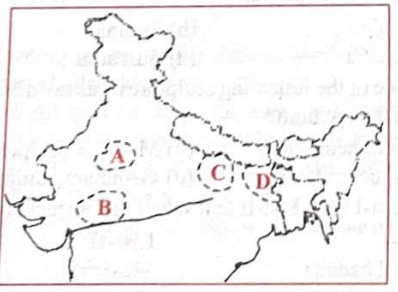
- Options:
(a) Matsya, Cedi, Kosala, Anga
(b) Surasena, Avanti, Vatsa, Magadha
(c) Matsya, Avanti, Vatsa, Anga
(d) Surasena, Cedi, Kosala, Magadha
- Answer:
(c) Matsya, Avanti, Vatsa, Anga
- Analysis:
- Matsya Mahajanpada comprised the present day Jaipur-Bharatpur-Alwar area of Rajasthan
- Avanti was one of the most important ones and its core area comprises the present day Ujjain district of Madhya Preadesh
- Vatsa with its capital at Kausambi was another powerful Mahajanapada, annexed by Magadha.
- Anja Mahajanapada was in Gangetic valley
- Q27: In the Mahayana Buddhism, the Bodhisattva Avalokitesvara was also known as:
- Options:
(a) Vajrapani
(b) Manjusri
(c) Padmapani
(d) Maitreya
- Answer:
(c) Padmapani
- Analysis:
- A Bodhisattva in Buddhism is a being who seeks enlightenment (Bodhi) not just for themselves but for the benefit of all sentient beings.
- Why (c) Padmapani?
- Avalokitesvara, the Bodhisattva of Compassion in Mahayana Buddhism, is often depicted holding a lotus (Padma), which is why he is also called Padmapani.
- He is considered the embodiment of boundless compassion and is revered in various Buddhist traditions, especially in Tibet and East Asia.
- Explanation of Other Options:
- (a) Vajrapani:
- Incorrect—Vajrapani is the Bodhisattva of Power and is often depicted holding a vajra (thunderbolt).
- (b) Manjusri:
- Incorrect—Manjusri is the Bodhisattva of Wisdom, depicted holding a sword to cut through ignorance.
- (d) Maitreya:
- Incorrect—Maitreya is the future Buddha, who is prophesied to appear when the teachings of Gautama Buddha have faded.
- Important Bodhisattvas in Mahayana Buddhism:
- Avalokitesvara (Padmapani):
- Bodhisattva of Compassion, depicted with a lotus.
- Worshipped as Guanyin in China and Kannon in Japan.
- Manjusri:
- Bodhisattva of Wisdom, depicted with a sword and a book (Prajnaparamita).
- Vajrapani:
- Bodhisattva of Power and Protector of Buddha's teachings.
- Maitreya:
- The future Buddha who will appear in the next age.
- Depicted sitting on a throne, waiting to descend to earth.
- Ksitigarbha:
- Bodhisattva of the Underworld, protector of souls in Buddhist hells.
- Samantabhadra:
- Bodhisattva of Practice and Meditation, often depicted with an elephant.
- Akasagarbha:
- Bodhisattva of Space and Infinite Wisdom.
- Symbolism of Avalokitesvara:
- He is known for his thousand-armed form (Sahasrabhuj Lokeshvara) to help countless beings.
- He is worshipped in different names and forms across cultures:
- In Tibet, as Chenrezig.
- In China, as Guanyin.
- In Japan, as Kannon.
- Broader Context:
- Links to Questions on Mahayana Buddhism:
- Related to Q34 [2016] on Buddhist councils and Q42 [2018] on different Bodhisattvas.
- Can be connected to questions on Buddhist iconography in art and sculpture, such as Gandhara and Ajanta paintings.
- Key Takeaway:
- Avalokitesvara, also called Padmapani, is the Bodhisattva of Compassion, widely venerated in Mahayana Buddhism, symbolizing mercy and protection.
- Mahayana Buddhism emphasizes the role of Bodhisattvas, enlightened beings who delay Nirvana to help others achieve liberation.
- Q28: The silver coins issued by the Guptas were called:
- Options:
(a) Rupaka
(b) Karshapana
(c) Dinara
(d) Pana
- Answer:
(a) Rupaka
- Analysis:
- Why (a) Rupaka?:
- The Gupta Empire issued silver coins called Rupaka, which followed the weight standard of the Western Kshatrapas.
- These coins typically featured the king's portrait on one side and a deity or Garuda on the other.
- Explanation of Other Options:
- (b) Karshapana:
- Incorrect—Karshapana was an ancient punch-marked coin used in the Mauryan period, not the Gupta era.
- (c) Dinara:
- Incorrect—Dinara was the name of gold coins issued by the Gupta rulers, modeled after the Roman Aureus.
- (d) Pana:
- Incorrect—Pana was a currency used in earlier periods, particularly in the Mauryan empire.
- Coinage System of the Gupta Empire:
- Gold Coins (Dinara):
- The most prominent coins of the Gupta period, showcasing rulers and Hindu deities like Vishnu and Lakshmi.
- Silver Coins (Rupaka):
- Issued mainly in western India, influenced by the earlier Kshatrapa coinage.
- Copper Coins:
- Used for smaller transactions, but not as widely circulated as gold and silver coins.
- Important Gupta Rulers and Their Coinage:
- Chandragupta I (c. 319 - 335 CE):
- Issued gold Dinara coins, depicting himself and his queen, Kumaradevi.
- Samudragupta (c. 335 - 375 CE):
- Issued various types of coins, including Standard Type, Archer Type, and Battle Axe Type.
- Chandragupta II (c. 375 - 415 CE):
- Introduced silver Rupaka coins after defeating the Western Kshatrapas.
- Kumaragupta I (c. 415 - 455 CE):
- Issued coins with Kartikeya and Garuda insignia.
- Skandagupta (c. 455 - 467 CE):
- Issued coins depicting Vishnu's Garuda and war-related imagery.
- Broader Context:
- Links to Questions on Ancient Indian Economy:
- Similar to Q42 [2015] on Mauryan currency and Q63 [2017] on Kushana coinage.
- Can connect to questions on trade, commerce, and monetary systems in ancient India.
- Key Takeaway:
- The Gupta period saw an advanced coinage system, with Rupaka being the standard silver currency, alongside gold Dinara and lesser-used copper coins.
- Q29: Match List-I with List-II and select the correct answer using the codes given below the lists:
- List-I (Author):
A. Varahamihira
B. Vishakhadatta
C. Sudraka
D. Bilhana
- List-II (Work):
1. Prabhakaravardhana
2. Mrichchhakatika
3. Brihat-Samhita
4. Devi-Chandraguptam
5. Vikramankadeva-Charita
- Options:
(a) A-3, B-4, C-2, D-5
(b) A-3, B-2, C-4, D-5
(c) A-5, B-4, C-2, D-3
(d) A-1, B-3, C-4, D-2
- Answer:
(a) A-3, B-4, C-2, D-5
- Analysis:
- Historical Context:
- The Gupta and post-Gupta periods (4th-11th centuries A.D.) were a high point for Indian literature, producing works in astronomy, drama, and poetry. This question pairs notable authors with their works, spanning scientific treatises (Varahamihira), Sanskrit plays (Vishakhadatta, Sudraka), and historical poetry (Bilhana).
- These works reflect the cultural and intellectual diversity of ancient India, often tied to royal patronage.
- Correct Matches Explained:
- Varahamihira - Brihat-Samhita (A-3):
- A 6th-century astronomer and polymath, Varahamihira wrote Brihat-Samhita, an encyclopedic work covering astronomy, astrology, architecture, and omens, influential in Gupta scientific traditions.
- Vishakhadatta - Devi-Chandraguptam (B-4):
- Vishakhadatta, a Gupta-era playwright, is attributed with Devi-Chandraguptam, a political drama about Chandragupta Maurya and the rise of his dynasty.
- Sudraka - Mrichchhakatika (C-2):
- Sudraka, a playwright of uncertain date but likely from the early post-Gupta period, is credited with Mrichchhakatika (The Little Clay Cart), which blends romance and social commentary.
- Bilhana - Vikramankadeva-Charita (D-5):
- Bilhana, an 11th-century Kashmiri poet, wrote Vikramankadeva-Charita, a poetic biography of Chalukya king Vikramaditya VI.
- Why Not Others?:
- (b) A-3, B-2, C-4, D-5:
- Incorrect—This option misassigns Vishakhadatta’s work, pairing him with Mrichchhakatika instead of Devi-Chandraguptam.
- (c) A-5, B-4, C-2, D-3:
- Incorrect—Varahamihira is incorrectly paired with Vikramankadeva-Charita, and Bilhana is misassigned to Brihat-Samhita.
- (d) A-1, B-3, C-4, D-2:
- Incorrect—Varahamihira is wrongly associated with Prabhakaravardhana, a king, not a work, and other mismatches occur in the pairings.
- Literary Genres Represented:
- Scientific Treatise:
- Brihat-Samhita: Astronomy and astrology, blending science with practical knowledge.
- Sanskrit Drama:
- Mrichchhakatika and Devi-Chandraguptam: Political and social narratives, rooted in Gupta theatrical traditions.
- Historical Poetry:
- Vikramankadeva-Charita: Courtly eulogy, typical of medieval India.
- Other Notable Works by These Authors:
- Varahamihira:
- Pancha-Siddhantika: Treatise on five astronomical systems, complementing Brihat-Samhita.
- Vishakhadatta:
- Mudrarakshasa: Political drama about Chandragupta Maurya and Chanakya, often UPSC-tested (e.g., Q18 [1996]).
- Sudraka:
- Mrichchhakatika is his only widely recognized work, though authorship is debated.
- Bilhana:
- Chaurapanchasika: Romantic poetry, showcasing his versatility beyond historical themes.
- Related Figures:
- Kalidasa:
- Gupta-era poet and playwright (e.g., Abhijnanashakuntalam), contemporary of Vishakhadatta and Sudraka, known for Sanskrit-Prakrit usage (e.g., Q105 [2015-I]).
- Bhasa:
- Pre-Gupta playwright, influenced later drama (e.g., Svapnavasavadatta), setting the stage for Gupta works (e.g., Q150 [2024-I]).
- Aryabhata:
- 5th-century astronomer, peer of Varahamihira, authored Aryabhatiya, impacting scientific literature (e.g., Q84 [2012-I]).
- Harisena:
- Gupta poet, wrote the Allahabad Pillar inscription, akin to Bilhana's courtly style (e.g., Q76 [2006]).
- Broader Connection:
- Links to questions on Gupta cultural achievements (e.g., Q18 [1996] on Vishakhadatta), literary traditions (e.g., Q4 [1995] on Prakrit), or medieval poetry (e.g., Q142 [2022-I] on Chalukyas).
- Key Takeaway:
- Matching authors to works reveals the diversity of Gupta and post-Gupta literature, from science (Varahamihira) to drama (Vishakhadatta, Sudraka) to poetry (Bilhana).
- Q30: Which one of the following was a common institution in the village system of ancient India?
- Options:
(a) Chaturvedimangalam
(b) Parishad
(c) Ashtadikgaja
(d) Manigrama
- Answer:
(b) Parishad (book is saying option d, but option b makes more sense)
- Analysis:
- Historical Context:
- In ancient India, village systems were the backbone of agrarian society, especially during Vedic and post-Vedic periods (c. 1500 BCE-600 CE). Local institutions managed community affairs, with the Parishad being a common assembly of learned Brahmins or elders that advised on religious, legal, and social matters.
- These bodies were prominent in Vedic texts and continued in various forms into later periods, reflecting decentralized governance.
- Why Not Others?:
- (a) Chaturvedimangalam:
- Incorrect—Refers to a South Indian Brahmin settlement endowed with land (common in Chola period, 9th-13th centuries CE), not a widespread village institution in ancient India.
- (c) Ashtadikgaja:
- Incorrect—Means "eight elephants of the directions," a term for eight poets in the court of Vijayanagara king Krishnadevaraya (16th century CE), unrelated to ancient village systems.
- (d) Manigrama:
- Incorrect—A medieval South Indian merchant guild (e.g., in Chola inscriptions), not a common village institution but a trade-specific organization.
- Role of Parishad:
- The Parishad, often comprising Vedic scholars or village elders, acted as a council for dispute resolution, education, and upholding Dharma, as seen in texts like the Rigveda and Dharmashastras (e.g., Manu Smriti).
- Village Institutions in Ancient India:
- Sabha:
- Village assembly for general community decisions, broader than Parishad, mentioned in Rigveda (e.g., 10.191).
- Samiti:
- Larger tribal or regional gathering, less localized than Parishad, also Vedic in origin (e.g., Atharvaveda 7.12).
- Gramani:
- Village headman, a key administrative figure alongside Parishad, responsible for local leadership (Rigveda 10.62).
- Panchayat:
- Council of five elders, evolved from Vedic assemblies, common in later texts for village justice (e.g., Yajnavalkya Smriti).
- Gana:
- Tribal or clan council, prevalent in Vedic and post-Vedic republics (e.g., Licchavis), influencing village governance.
- Vidatha:
- Early Vedic assembly for ritual and social functions, possibly a precursor to Parishad (Rigveda 3.38).
- Related Figures:
- Yajnavalkya:
- Vedic sage (c. 1200 BCE), linked to Parishad-like assemblies in Brihadaranyaka Upanishad, known for legal and philosophical contributions (e.g., Q2 [1995] on Gargi).
- Manu:
- Author of Manu Smriti (c. 200 BCE-200 CE), codified roles of village councils like Parishad in social governance.
- Kautilya:
- Mauryan-era scholar (c. 300 BCE), described local governance in Arthashastra, including village-level bodies (e.g., Q18 [1996] on Vishakhadatta).
- Harsha:
- 7th-century ruler, his records (e.g., by Bana) mention village councils, evolving from earlier Parishads (e.g., Q63 [2002]).
- Broader Connection:
- Ties to questions on Vedic society (e.g., Q2 [1995] on Brahmavadinis), Mauryan administration (e.g., Q25 [1997] on Ashoka), or Chola local governance (e.g., Q40 [1999] on Uttiramerur).
- Key Takeaway:
- Parishad was a vital village institution in ancient India, reflecting the role of scholarly councils in local governance, distinct from later specialized bodies like guilds or courts.
- Q31: The Badami rock inscription of Pulakesin I is dated in the Saka year 465. If the same were to be dated in Vikrama Samvat, the year would be:
- Options:
(a) 601
(b) 300
(c) 330
(d) 407
- Answer:
(a) 601
- Analysis:
- Historical Context:
- Pulakesin I (r. 543-566 CE), founder of the Chalukya dynasty of Badami, issued the Badami rock inscription, dated Saka year 465. The Saka era begins in 78 CE, while the Vikrama Samvat starts in 58 BCE. Converting between these eras requires adjusting for their respective starting points.
- The Chalukyas of Badami (6th-8th centuries CE) were a major South Indian power, and their inscriptions often used the Saka era, reflecting regional chronological traditions.
- Calculation:
- Saka Year 465 + Saka Era start (78 CE) = 465 + 78 = 543 CE.
- Vikrama Samvat Year = 543 CE + Vikrama Samvat offset (58 years from 58 BCE to 1 CE) = 543 + 58 = 601.
- Thus, Saka 465 corresponds to Vikrama Samvat 601.
- Why Not Others?:
- (b) 300:
- Incorrect—Vikrama Samvat 300 = 300 - 58 = 242 CE, far earlier than Saka 465 (543 CE).
- (c) 330:
- Incorrect—Vikrama Samvat 330 = 330 - 58 = 272 CE, still too early for 543 CE.
- (d) 407:
- Incorrect—Vikrama Samvat 407 = 407 - 58 = 349 CE, not matching 543 CE.
- Chronological Systems in Ancient India:
- Saka Era:
- Starts 78 CE, linked to Kushana king Kanishka, widely used in South India (e.g., Chalukya inscriptions).
- Vikrama Samvat:
- Starts 58 BCE, attributed to King Vikramaditya, prevalent in North India.
- Gupta Era:
- Starts 320 CE, used by the Gupta dynasty (e.g., Q3 [1995]).
- Kali Era:
- Starts 3102 BCE, mythological, less common in inscriptions (e.g., Q3 [1995]).
- Conversion Formulae:
- Saka to CE:
- Saka Year + 78 = CE Year.
- CE to Vikrama Samvat:
- CE Year + 58 = Vikrama Samvat Year.
- Vikrama Samvat to CE:
- Vikrama Samvat Year - 58 = CE Year.
- Related Figures:
- Pulakesin I:
- Chalukya founder (r. 543-566 CE), issued the Badami inscription, established dynasty's power in Deccan (e.g., Q142 [2022-I] on Chalukyas).
- Kanishka:
- Kushana ruler (1st-2nd century CE), associated with Saka era's origin (78 CE), known for Buddhist patronage (e.g., Q57 [2001]).
- Vikramaditya:
- Legendary king (possibly Malwa ruler or Chandragupta II), linked to Vikrama Samvat (58 BCE) (e.g., Q3 [1995]).
- Kirttivarman I:
- Son of Pulakesin I (r. 566-597 CE), continued Chalukya inscriptions, maintaining Saka era usage.
- Broader Connection:
- Ties to questions on Chalukya history (e.g., Q142 [2022-I]), era conversions (e.g., Q3 [1995] on eras), or inscription dating (e.g., Q76 [2006] on Gupta records).
- Key Takeaway:
- Converting Saka 465 (543 CE) to Vikrama Samvat 601 highlights the interplay of India's dating systems, with Pulakesin I's inscription anchoring Chalukya history.
- [1998]
- Q32: Many of the Greeks, Kushanas and Shakas embraced Buddhism rather than Hinduism because:
- Options:
(a) Buddhism was in the ascendant at that time
(b) they had renounced the policy of war and violence
(c) caste-ridden Hinduism did not attract them
(d) Buddhism provided easier access to Indian society
- Answer:
(c) caste-ridden Hinduism did not attract them
- Analysis:
- Historical Context:
- During the post-Mauryan period (c. 200 BCE-300 CE), foreign groups like the Greeks (Indo-Greeks), Kushanas, and Shakas (Indo-Scythians) entered Northwest India. This era saw Buddhism flourishing under royal patronage (e.g., Ashoka), while Hinduism was rooted in Vedic traditions and caste hierarchy (varna system).
- These foreign rulers often adopted Buddhism, as evident in inscriptions, coins, and art (e.g., Gandhara school), reflecting its appeal over Hinduism's rigid social structure.
- Why Not Others?:
- (a) Buddhism was in the ascendant at that time:
- Partially true—Buddhism was prominent (e.g., Mauryan support), but its rise alone doesn't explain their preference; caste was a stronger factor.
- (b) they had renounced the policy of war and violence:
- Incorrect—These groups were warrior cultures (e.g., Kushanas under Kanishka); their conversion wasn't about pacifism but practicality and acceptance.
- (d) Buddhism provided easier access to Indian society:
- Plausible—Buddhism's egalitarian ethos aided integration, but caste aversion (option c) is the more direct and historically supported reason.
- Appeal of Buddhism to Foreigners:
- Buddhism rejected caste distinctions, offering a universal doctrine (e.g., Four Noble Truths) that appealed to outsiders without hereditary social barriers, unlike Hinduism's varna system (Brahmins, Kshatriyas, etc.) which excluded foreigners as mlecchas (barbarians).
- Patronage of stupas, monasteries, and trade routes (e.g., Silk Road) by these rulers further aligned with Buddhism's monastic and mercantile support base.
- Socio-Religious Dynamics:
- Vedic Hinduism:
- Emphasized caste and ritual purity, less accessible to foreigners lacking Vedic lineage.
- Buddhism:
- Open to all (sangha welcomed diverse converts), spread via trade and royal support (e.g., Ashoka's edicts).
- Jainism:
- Also egalitarian but less widespread than Buddhism during this period.
- Related Figures:
- Menander I (Milinda):
- Indo-Greek king (c. 155-130 BCE), converted to Buddhism, famed for Milinda Panha dialogues with Nagasena (e.g., Q152 [2024-I]).
- Kanishka:
- Kushana ruler (c. 127-150 CE), major Buddhist patron, convened Fourth Buddhist Council, used Saka era (e.g., Q57 [2001]).
- Rudradaman I:
- Shaka ruler (c. 130-150 CE), Junagadh inscription shows Sanskrit adoption but Buddhist leanings among Shakas.
- Ashoka:
- Mauryan emperor (r. 268-232 BCE), set the stage for Buddhism's appeal to later foreign rulers with his Dhamma policies (e.g., Q25 [1997]).
- Broader Connection:
- Links to questions on Indo-Greek rulers (e.g., Q57 [2001] on Kanishka), Ashokan legacy (e.g., Q5 [1995]), or cultural synthesis (e.g., Q86 [2013-I] on Gandhara art).
- Key Takeaway:
- The Greeks, Kushanas, and Shakas favored Buddhism over Hinduism due to its rejection of caste, offering a more inclusive path for foreign integration into Indian society.
- Q33: The Ashoka major rock edicts which tell us about the Sangam Kingdom include rock edicts:
- Options:
(a) I and X
(b) I and XI
(c) II and XIII
(d) II and XIV
- Answer:
(c) II and XIII
- Analysis:
- Historical Context:
- Ashoka (r. 268-232 BCE), the Mauryan emperor, inscribed his Major Rock Edicts across his empire to propagate Dhamma and record his reign. The Sangam Kingdom refers to the Tamil polities of the Cholas, Cheras, and Pandyas in South India (c. 300 BCE-300 CE), known from Sangam literature like Tolkappiyam.
- Edicts II and XIII mention these southern neighbors, reflecting Mauryan awareness of regions beyond direct control.
- Correct Edicts Explained:
- Rock Edict II:
- Mentions providing medical aid and planting herbs, extending to the territories of the Cholas, Pandyas, and others, showing Ashoka's welfare outreach.
- Rock Edict XIII:
- Lists southern kingdoms (Cholas, Pandyas, Satyaputras, Keralaputras) alongside Kalinga, detailing Ashoka's regret over conquest and his shift to Dhamma, indicating diplomatic relations.
- Why Not Others?:
- (a) I and X:
- Incorrect—Edict I bans animal sacrifices, X praises Dhamma over fame; neither references Sangam kingdoms.
- (b) I and XI:
- Incorrect—Edict XI discusses Dhamma gifts and morality, no mention of southern kingdoms.
- (d) II and XIV:
- Incorrect—Edict XIV outlines edict uniformity, not Sangam specifics; only II relates to the south.
- Ashoka's Southern Outreach:
- Edicts II and XIII highlight Ashoka's engagement with Tamil kingdoms as frontier states, not under Mauryan rule but influenced by his policies, suggesting trade or cultural ties.
- Sangam Kingdoms Overview:
- Cholas:
- Coastal Tamil rulers, later prominent in medieval period (e.g., Q40 [1999] on Chola villages).
- Cheras:
- West coast rulers (Kerala), known for trade with Romans.
- Pandyas:
- Southern Tamil kings, famed for pearl fisheries.
- Satyaputras and Keralaputras:
- Lesser-known Tamil chieftains, also in Edict XIII.
- Related Figures:
- Ashoka:
- Mauryan emperor (r. 268-232 BCE), authored the edicts, shifted to Buddhism post-Kalinga (e.g., Q5 [1995]).
- Kanishka:
- Kushana ruler (c. 127-150 CE), later Buddhist patron, contrasting Ashoka's earlier outreach (e.g., Q32 [1998]).
- Karikala Chola:
- Early Chola king (c. 2nd century CE), Sangam figure, possibly contemporary with Ashokan references.
- Nedunjeliyan:
- Pandya king from Sangam texts (e.g., Silappadikaram), representing the southern kingdoms' era.
- Broader Connection:
- Links to questions on Ashokan inscriptions (e.g., Q5 [1995] on Priyadarsi), Mauryan-South India relations, or Sangam history (e.g., Q40 [1999] on Chola administration).
- Key Takeaway:
- Rock Edicts II and XIII reveal Ashoka's diplomatic and welfare outreach to the Sangam kingdoms, underscoring Mauryan influence in South India without direct conquest.
- Q34: Which of the following pairs are correctly matched?
- Pairs:
1. Mrichchakatikam—Shudraka
2. Buddhacharita—Vasuvandhu
3. Mudrarakshasha—Vishakadatta
4. Harshacharita—Banabhatta
- Options:
(a) 1, 2, 3 and 4
(b) 1, 3 and 4
(c) 1 and 4
(d) 2 and 3
- Answer:
(b) 1, 3 and 4
- Analysis:
- Historical Context:
- Ancient Indian literature spans various genres—drama, poetry, and biography—reflecting cultural and intellectual achievements from the Gupta period (4th-6th centuries CE) to later eras. This question tests authorship of key works from this tradition, spanning roughly 1st to 7th centuries CE.
- Correctness of Pairs:
- 1. Mrichchakatikam—Shudraka:
- Correct—Shudraka, traditionally dated to the Gupta period, is credited with Mrichchakatikam (The Little Clay Cart), a Sanskrit play blending romance and social realism (e.g., Q4 [1995]).
- 2. Buddhacharita—Vasuvandhu:
- Incorrect—Buddhacharita, an epic poem on Buddha's life, was written by Ashvaghosha (c. 1st-2nd century CE), a Buddhist poet. Vasubandhu (4th-5th century CE) was a philosopher who wrote Abhidharmakosha, not this work.
- 3. Mudrarakshasha—Vishakadatta:
- Correct—Vishakadatta, a Gupta-era playwright, authored Mudrarakshasha, a political drama about Chandragupta Maurya and Chanakya (e.g., Q29 [1998]).
- 4. Harshacharita—Banabhatta:
- Correct—Banabhatta, a 7th-century poet at Harsha's court, wrote Harshacharita, a biographical account of Emperor Harsha (e.g., Q63 [2002]).
- Why Not Others?:
- (a) 1, 2, 3 and 4:
- Incorrect—Pair 2 (Buddhacharita—Vasuvandhu) is wrong; Ashvaghosha, not Vasubandhu, is the author.
- (c) 1 and 4:
- Incorrect—Misses Pair 3 (Mudrarakshasha—Vishakadatta), which is correct.
- (d) 2 and 3:
- Incorrect—Pair 2 is wrong, and it omits correct Pairs 1 and 4.
- Literary Genres Represented:
- Drama:
- Mrichchakatikam and Mudrarakshasha: Sanskrit plays with social and political themes.
- Epic Poetry:
- Buddhacharita: Narrative of Buddha's life, rooted in Buddhist tradition.
- Biography:
- Harshacharita: Courtly prose-poetry chronicling Harsha's reign.
- More info on their works:
- Shudraka:
- Mrichchakatikam is the only major work attributed to him.
- Ashvaghosha:
- Also wrote Saundarananda, another Buddhist epic.
- Vishakadatta:
- Also credited with fragments of Devi-Chandraguptam (e.g., Q29 [1998]).
- Banabhatta:
- Also authored Kadambari, a romantic prose work.
- Related Figures:
- Kalidasa:
- Gupta-era poet (e.g., Abhijnanashakuntalam), contemporary of Shudraka and Vishakadatta (e.g., Q105 [2015-I]).
- Ashvaghosha:
- Buddhist poet (c. 1st-2nd century CE), true author of Buddhacharita, linked to Kanishka's court (e.g., Q32 [1998]).
- Vasubandhu:
- Philosopher (4th-5th century CE), wrote Abhidharmakosha, not Buddhacharita, often confused due to Buddhist context.
- Harsha:
- 7th-century ruler, patron of Banabhatta, subject of Harshacharita (e.g., Q63 [2002]).
- Broader Connection:
- Ties to questions on Gupta literature (e.g., Q4 [1995] on Prakrit), Buddhist texts (e.g., Q152 [2024-I]), or Harsha's reign (e.g., Q63 [2002]).
- Key Takeaway:
- Correct matches (Shudraka—Mrichchakatikam, Vishakadatta—Mudrarakshasha, Banabhatta—Harshacharita) highlight key literary figures, with Buddhacharita misattributed to Vasubandhu instead of Ashvaghosha.
- Q35: What is the correct chronological order in which the following appeared in India?
- Items:
1. Gold coins
2. Punch marked silver coins
3. Iron plough
4. Urban culture
- Options:
(a) 3, 4, 1, 2
(b) 3, 4, 2, 1
(c) 4, 3, 1, 2
(d) 4, 3, 2, 1
- Answer:
(d) 4, 3, 2, 1
- Analysis:
- Historical Context:
- The timeline of ancient India spans the Harappan civilization (c. 3300-1300 BCE) to the post-Mauryan period (c. 200 BCE-300 CE). This question traces technological and economic developments across these phases.
- Chronological Order Explained:
- 4. Urban culture:
- Earliest—Appeared with the Harappan civilization (c. 2600-1900 BCE), marked by cities like Harappa and Mohenjo-Daro with planned streets and drainage (e.g., Q1 [1995]).
- 3. Iron plough:
- Next—Emerged in the later Vedic period (c. 1000 BCE), linked to iron technology in the Gangetic plains, boosting agriculture (e.g., Painted Grey Ware sites).
- 2. Punch marked silver coins:
- Followed—Introduced around 6th-5th centuries BCE during the Mahajanapadas (e.g., Magadha), standardized trade with silver coins bearing punch marks.
- 1. Gold coins:
- Latest—Appeared in the post-Mauryan period (c. 1st century BCE-1st century CE), notably under Kushanas (e.g., Kanishka's gold dinaras), influenced by Indo-Greek and Roman trade.
- Why Not Others?:
- (a) 3, 4, 1, 2:
- Incorrect—Iron plough (c. 1000 BCE) predates urban culture (c. 2600 BCE), reversing the order.
- (b) 3, 4, 2, 1:
- Incorrect—Iron plough before urban culture is wrong; urban culture is far earlier.
- (c) 4, 3, 1, 2:
- Incorrect—Gold coins (1st century BCE-CE) before punch marked silver coins (6th-5th centuries BCE) is out of sequence.
- Key Developments Timeline:
- Harappan Urbanization:
- c. 2600-1900 BCE: Urban culture with advanced planning, no metals like iron yet.
- Iron Age:
- c. 1000 BCE: Iron plough introduced, aiding settled agriculture in North India.
- Early Coinage:
- c. 600-400 BCE: Punch marked silver coins, linked to Mahajanapadas and trade.
- Gold Coinage:
- c. 1st century BCE-CE: Gold coins under Kushanas, reflecting wealth and foreign influence.
- Archaeological Evidence:
- Urban Culture:
- Harappan sites (e.g., Lothal, Gujarat; Dholavira, Gujarat).
- Iron Plough:
- Iron tools from PGW sites (e.g., Hastinapur, Uttar Pradesh).
- Punch Marked Coins:
- Found across Gangetic plains (e.g., Taxila, Punjab).
- Gold Coins:
- Kushana mints (e.g., Mathura, Uttar Pradesh).
- Related Figures:
- Harsha:
- 7th-century ruler, reflects later urban continuity, not the origin (e.g., Q63 [2002]).
- Bimbisara:
- Magadhan king (c. 6th century BCE), linked to punch marked coins' era (e.g., Q25 [1997] on Ashoka's context).
- Kanishka:
- Kushana ruler (c. 127-150 CE), introduced gold coins, marking their peak (e.g., Q32 [1998]).
- Ashoka:
- Mauryan emperor (r. 268-232 BCE), postdates punch marked coins, predates gold coins (e.g., Q5 [1995]).
- Broader Connection:
- Ties to questions on Harappan urbanism (e.g., Q1 [1995]), Iron Age technology (e.g., Q142 [2022-I] on Chalukyas' context), or coinage evolution (e.g., Q57 [2001] on Kanishka).
- Key Takeaway:
- The sequence—urban culture (Harappan), iron plough (Vedic), punch marked silver coins (Mahajanapadas), gold coins (Kushanas)—maps India's progression from urban beginnings to advanced trade economies.
- Q36: Statements
- Assertion (A): According to Ashoka's edicts social harmony among the people was more important than religious devotion.
- Reason (R): He spread ideas of equity instead of promotion of religion.
- Options:
(a) Both A and R are true and R is the correct explanation of A
(b) Both A and R are true but R is not a correct explanation of A
(c) A is true but R is false
(d) A is false but R is true
- Answer:
(a) Both A and R are true and R is the correct explanation of A
- Analysis:
- Historical Context:
- Ashoka (r. 268-232 BCE), after the Kalinga War, shifted from conquest to Dhamma—a moral code emphasizing tolerance, compassion, and social harmony—reflected in his edicts (Major Rock, Pillar, and Minor). These inscriptions, spread across India (e.g., Dhauli, Odisha), aimed to unify a diverse empire.
- Evaluation of Assertion (A):
- True—Ashoka's edicts prioritize social harmony over religious devotion. For example, Major Rock Edict 12 (Girnar, Gujarat) promotes harmony among sects rather than devotion to one faith, and Edict 7 stresses tolerance over ritualistic piety.
- Evaluation of Reason (R):
- True—Ashoka's Dhamma focuses on equity, respect, and ethical conduct (e.g., Edict 11 on generosity to all), not promoting any single religion, including Buddhism, despite his personal leanings (e.g., Bhabru Edict, Rajasthan).
- Correct Explanation—R explains A because Ashoka's emphasis on equity (e.g., equal treatment of all sects, welfare in Edict 2) directly supports social harmony as a higher goal than religious devotion.
- Why Not Others?:
- (b) Both A and R are true but R is not a correct explanation of A:
- Incorrect—R (equity) directly underpins A (social harmony), as equity fosters unity across diverse groups, aligning with Ashoka's intent.
- (c) A is true but R is false:
- Incorrect—R is true; Ashoka's edicts (e.g., Edict 9 condemning rituals) show he prioritized ethical equity over religious promotion.
- (d) A is false but R is true:
- Incorrect—A is true; edicts consistently elevate harmony (e.g., Edict 13's remorse and outreach) over devotion.
- Ashoka's Dhamma Principles:
- Social Harmony:
- Edict 12: Encourages mutual respect among religions to reduce conflict.
- Equity:
- Edict 5: Dhamma Mahamatras ensure welfare for all classes, not just one faith.
- Non-Religious Focus:
- Edict 9: Critiques empty rituals, favoring moral actions.
- Evidence from Edicts:
- Major Rock Edict 2:
- Welfare extended to all, including Sangam Kingdoms, showing universal equity (Junagadh, Gujarat).
- Major Rock Edict 13:
- Lists diverse neighbors (e.g., Cholas, Pandyas) with a call for peace, not religious conformity (Dhauli, Odisha).
- Pillar Edict 6:
- Fair administration for all subjects, emphasizing justice over faith (Delhi-Topra, Delhi).
- Related Figures:
- Ashoka:
- Mauryan emperor (r. 268-232 BCE), crafted Dhamma post-Kalinga, named in Maski Edict (Raichur, Karnataka) (e.g., Q5 [1995]).
- Kanishka:
- Kushana ruler (c. 127-150 CE), later Buddhist patron, contrasts Ashoka's broader equity focus (e.g., Q32 [1998]).
- Manu:
- Lawgiver (c. 200 BCE-200 CE), his caste-based Dharma differs from Ashoka's equitable Dhamma (e.g., Q30 [1998]).
- Harsha:
- 7th-century ruler, blended religion and governance, unlike Ashoka's secular tilt (e.g., Q34 [1998]).
- Broader Connection:
- Links to questions on Ashokan policies (e.g., Q33 [1998] on Sangam outreach), religious tolerance (e.g., Q32 [1998] on Buddhism), or social structures (e.g., Q30 [1998] on Parishad).
- Key Takeaway:
- Ashoka's edicts prioritize social harmony through equity (A and R true), with R explaining A by showing his focus on universal ethics over religious promotion.
- Q37: Which of the following pairs are correctly matched?
- Pairs:
1. Lothal: Ancient dockyard
2. Sarnath: First Sermon of Buddha
3. Rajgir: Lion capital of Ashoka
4. Nalanda: Great seat of Buddhist learning
- Options:
(a) 1, 2, 3 and 4
(b) 3 and 4
(c) 1, 2 and 4
(d) 1 and 2
- Answer:
(c) 1, 2 and 4
- Analysis:
- Historical Context:
- This question spans key archaeological and historical sites in India, from the Harappan civilization (c. 2600-1900 BCE) to the Gupta period (4th-6th centuries CE), testing knowledge of their significance.
- Correctness of Pairs:
- 1. Lothal: Ancient dockyard:
- Correct—Lothal (Gujarat), a Harappan site, is famed for its dockyard, possibly the world's earliest, linked to maritime trade (c. 2400 BCE) (e.g., Q1 [1995]).
- 2. Sarnath: First Sermon of Buddha:
- Correct—Sarnath (near Varanasi, Uttar Pradesh) is where Buddha delivered his First Sermon (Dhammacakkappavattana Sutta) c. 5th century BCE, marked by the Dhamekh Stupa.
- 3. Rajgir: Lion capital of Ashoka:
- Incorrect—Rajgir (Bihar) was a Magadhan capital and site of the First Buddhist Council (c. 483 BCE), but the Lion Capital, Ashoka's iconic pillar symbol, is from Sarnath (c. 250 BCE), not Rajgir.
- 4. Nalanda: Great seat of Buddhist learning:
- Correct—Nalanda (Bihar) was a renowned Buddhist university, flourishing from the 5th century CE under Gupta patronage, visited by Hiuen Tsang (7th century CE).
- Why Not Others?:
- (a) 1, 2, 3 and 4:
- Incorrect—Pair 3 (Rajgir: Lion capital) is wrong; the Lion Capital is at Sarnath.
- (b) 3 and 4:
- Incorrect—Pair 3 is incorrect, and it misses correct Pairs 1 and 2.
- (d) 1 and 2:
- Incorrect—Omits Pair 4 (Nalanda), which is correct.
- Significance of Sites:
- Lothal:
- Harappan port, evidence of early trade with Mesopotamia (modern Gujarat).
- Sarnath:
- Buddhist pilgrimage site, also home to Ashoka's Lion Capital (modern Uttar Pradesh).
- Rajgir:
- Early political and Buddhist center, not linked to the Lion Capital (modern Bihar).
- Nalanda:
- Pinnacle of Buddhist education, with vast libraries and monasteries (modern Bihar).
- Correct Locations and Associations:
- Lothal:
- Dockyard, not Buddhist or Ashokan (Gujarat).
- Sarnath:
- First Sermon and Lion Capital, not Rajgir (Uttar Pradesh).
- Rajgir:
- Buddhist councils and Gridhrakuta Hill, not Lion Capital (Bihar).
- Nalanda:
- University, not a sermon or dock site (Bihar).
- Related Figures:
- Ashoka:
- Mauryan emperor (r. 268-232 BCE), erected the Sarnath Lion Capital, not at Rajgir (e.g., Q5 [1995]).
- Buddha:
- Siddhartha Gautama (c. 5th century BCE), gave his First Sermon at Sarnath, shaping its legacy.
- Hiuen Tsang:
- Chinese pilgrim (7th century CE), documented Nalanda's grandeur, not Lothal or Rajgir.
- Bimbisara:
- Magadhan king (c. 6th century BCE), ruled from Rajgir, predates Ashokan symbols (e.g., Q25 [1997] context).
- Broader Connection:
- Links to questions on Harappan trade (e.g., Q1 [1995]), Buddhist sites (e.g., Q32 [1998]), or Ashokan symbols (e.g., Q33 [1998] on edicts).
- Key Takeaway:
- Correct matches are Sarnath (First Sermon) and Nalanda (Buddhist learning), while Lothal's dockyard is right but Rajgir's Lion Capital belongs to Sarnath.
- Q38: Which one of the following ancient Indian records is the earliest royal order to preserve food-grains to be utilised during the crises in the country?
- Options:
(a) Sohgaura Copper-plate
(b) Rummindei Pillar-edict of Ashoka
(c) Prayaga-prasasti
(d) Mehrauli Pillar inscription of Chandra
- Answer:
(a) Sohgaura Copper-plate
- Analysis:
- Historical Context:
- Ancient Indian inscriptions often served as royal decrees or records of significant events, ranging from pre-Mauryan times (c. 6th century BCE) to the Gupta period (4th-6th centuries CE). This question focuses on early evidence of state-managed crisis preparedness through food-grain preservation.
- Correct Option Explained:
- (a) Sohgaura Copper-plate:
- Earliest—Dated to c. 3rd century BCE (possibly pre-Mauryan or early Mauryan), found near Gorakhpur (Uttar Pradesh), this copper-plate inscription mentions the construction of granaries (kostokat_storage) to store grain for use during famines or crises, making it the earliest known royal order of its kind.
- Why Not Others?:
- (b) Rummindei Pillar-edict of Ashoka:
- Incorrect—Dated to c. 250 BCE (Ashoka's reign, 268-232 BCE), found at Lumbini (Nepal), it records Ashoka's visit to Buddha's birthplace and tax exemptions, with no mention of food-grain preservation.
- (c) Prayaga-prasasti:
- Incorrect—Dated to c. 335 CE, the Allahabad Pillar inscription (Prayagraj, Uttar Pradesh) by Samudragupta's court poet Harisena praises the Gupta king's conquests, not crisis management like grain storage.
- (d) Mehrauli Pillar inscription of Chandra:
- Incorrect—Dated to c. 375-415 CE (likely Chandragupta II), found in Delhi, it commemorates victories (e.g., against the Sakas), with no reference to food-grain preservation.
- Significance of Granaries in Ancient India:
- Pre-Mauryan/Mauryan:
- Sohgaura's granaries reflect early state planning for famine relief, predating Ashoka's welfare measures.
- Mauryan:
- Ashoka's Edict 2 (c. 250 BCE) mentions welfare like medical aid, but not specific grain storage orders.
- Gupta:
- Later inscriptions focus on conquests or piety, not crisis-specific grain reserves.
- Chronological Context:
- Sohgaura Copper-plate:
- c. 3rd century BCE, possibly pre-Mauryan or early Mauryan.
- Rummindei Pillar-edict:
- c. 250 BCE, mid-Mauryan.
- Prayaga-prasasti:
- c. 335 CE, early Gupta.
- Mehrauli Pillar:
- c. 375-415 CE, Gupta peak.
- Related Figures:
- Ashoka:
- Mauryan emperor (r. 268-232 BCE), known for welfare (e.g., Edict 2), not granaries (e.g., Q5 [1995]).
- Samudragupta:
- Gupta king (r. 335-375 CE), Prayaga-prasasti records conquests, not food policy (e.g., Q76 [2006]).
- Chandragupta II:
- Gupta ruler (r. 375-415 CE), Mehrauli inscription celebrates victories, not granaries.
- Kautilya:
- Mauryan advisor (c. 300 BCE), Arthashastra mentions granaries, but Sohgaura is the earliest physical record.
- Broader Connection:
- Links to questions on Mauryan administration (e.g., Q33 [1998]), Gupta inscriptions (e.g., Q76 [2006]), or early economic planning (e.g., Q35 [1998] on coins).
- Key Takeaway:
- The Sohgaura Copper-plate (c. 3rd century BCE) is the earliest royal order for food-grain preservation, predating Ashoka's edicts and Gupta records focused on other themes.
- Q39: The concept of Eight-fold path forms the theme of:
- Options:
(a) Dipavamsa
(b) Divyavadana
(c) Mahaparinibbana Sutta
(d) Dharma Chakara Pravartana Sutta
- Answer:
(d) Dharma Chakara Pravartana Sutta
- Analysis:
- Historical Context:
- The Eight-fold Path is a core Buddhist teaching, outlined by Gautama Buddha (c. 5th century BCE) as the path to Nirvana, comprising right view, intention, speech, action, livelihood, effort, mindfulness, and concentration. This question tests knowledge of Buddhist texts from the Pali Canon and later chronicles.
- Correct Option Explained:
- (d) Dharma Chakara Pravartana Sutta:
- Correct—Also known as the "Setting in Motion the Wheel of Dharma," this sutta records Buddha's First Sermon at Sarnath (c. 5th century BCE), where he introduced the Four Noble Truths and the Eight-fold Path as the Middle Way to end suffering.
- Why Not Others?:
- (a) Dipavamsa:
- Incorrect—A 4th-century CE Sinhalese chronicle narrating Buddhist history in Sri Lanka, not focused on the Eight-fold Path but on monastic lineage.
- (b) Divyavadana:
- Incorrect—A Sanskrit Buddhist text (c. 2nd-3rd century CE) with moral tales (e.g., Ashoka's stories), not centered on the Eight-fold Path.
- (c) Mahaparinibbana Sutta:
- Incorrect—Part of the Pali Canon (Digha Nikaya), it describes Buddha's last days and Parinirvana (c. 483 BCE), emphasizing his final teachings but not the Eight-fold Path as its theme.
- Buddhist Texts and Their Themes:
- Dharma Chakara Pravartana Sutta:
- Eight-fold Path and Four Noble Truths, foundational teaching (Pali Canon).
- Mahaparinibbana Sutta:
- Buddha's death and final instructions, not the Eight-fold Path's origin.
- Dipavamsa:
- Historical narrative of Buddhism's spread, not doctrinal focus.
- Divyavadana:
- Didactic stories, not a systematic exposition of the Path.
- Eight-fold Path in Context:
- Introduced in the First Sermon (Sarnath), it guides ethical conduct, mental discipline, and wisdom, contrasting with extreme asceticism or indulgence, as per Buddha's Middle Way.
- Related Figures:
- Gautama Buddha:
- Siddhartha (c. 5th century BCE), delivered the Dharma Chakara Pravartana Sutta at Sarnath (e.g., Q37 [1998]).
- Ashoka:
- Mauryan emperor (r. 268-232 BCE), promoted Buddhism, linked to Divyavadana tales (e.g., Q5 [1995]).
- Ananda:
- Buddha's attendant, recited Mahaparinibbana Sutta at the First Council (Rajgir, Bihar).
- Nagasena:
- Later monk (c. 2nd century BCE), discussed Buddhist doctrine with Menander, not tied to these texts (e.g., Q32 [1998]).
- Broader Connection:
- Links to questions on Buddhist sites (e.g., Q37 [1998] on Sarnath), Ashokan spread of Buddhism (e.g., Q33 [1998]), or doctrinal evolution (e.g., Q32 [1998]).
- Key Takeaway:
- The Dharma Chakara Pravartana Sutta, Buddha's First Sermon, uniquely centers on the Eight-fold Path, distinguishing it from other texts like chronicles or death narratives.
- Q40: The given map relates to:
-
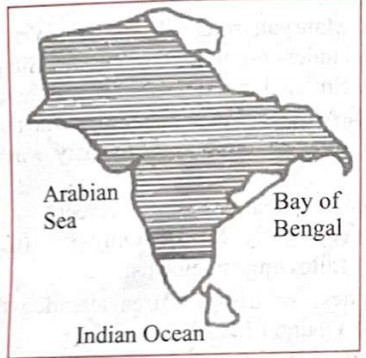
- Options:
(a) Kanishka at the time of his death
(b) Samudragupta after the close of his South Indian campaign
(c) Ashoka towards close of his reign
(d) Empire of Thaneswar on the eve of Harsha's accession
- Answer:
(c) Ashoka towards close of his reign
- Analysis:
- Historical Context:
- Ancient Indian empires varied in scope, from the northwest-focused Kushanas (1st-2nd century CE) to the pan-Indian Mauryas (3rd century BCE) and Guptas (4th century CE), and the regional Thaneswar (7th century CE). Without the map, the answer hinges on typical UPSC patterns and territorial logic.
- Evaluation of Options:
- (a) Kanishka at the time of his death:
- Kanishka (r. c. 127-150 CE), a Kushana ruler, controlled Northwest India (modern Punjab, Kashmir, parts of Uttar Pradesh), Central Asia, and parts of the Gangetic plains (e.g., Mathura). His empire didn't extend deep into South India or the Deccan.
- (b) Samudragupta after the close of his South Indian campaign:
- Samudragupta (r. 335-375 CE), a Gupta king, conquered much of North India and conducted a South Indian campaign (c. 350 CE), subduing kings in the Deccan and Tamil regions (e.g., Prayaga-prasasti). His empire spanned the Gangetic plains, parts of Central India, and had tributary states in the south, but not direct control over the far south.
- (c) Ashoka towards close of his reign:
- Ashoka (r. 268-232 BCE), Mauryan emperor, ruled a vast empire after the Kalinga War (c. 261 BCE), covering modern North India (Punjab to Bengal), the Deccan (up to Karnataka), and Kalinga (Odisha). Edicts (e.g., Dhauli, Odisha; Girnar, Gujarat) and references to Sangam Kingdoms (Edict 13) suggest influence, not control, in the far south (Tamil Nadu, Kerala).
- (d) Empire of Thaneswar on the eve of Harsha's accession:
- Thaneswar (c. 606 CE), under Prabhakaravardhana, was a smaller North Indian kingdom (modern Haryana, parts of Punjab, Uttar Pradesh) before Harsha (r. 606-647 CE) expanded it. It didn't span the Deccan or South India at accession.
- Why Not Others?:
- (a) Kanishka:
- Incorrect—His empire was northwest-centric, lacking the pan-Indian reach of Ashoka or Samudragupta's southern campaigns.
- (b) Samudragupta:
- Incorrect—While extensive, his direct control didn't match Ashoka's breadth (e.g., no Gujarat or full Deccan), and southern gains were tributary, not annexed.
- (d) Thaneswar:
- Incorrect—Far smaller, limited to North India pre-Harsha, unlike the broader empires of others.
- Territorial Extents:
- Kanishka:
- Northwest India, Central Asia, parts of Gangetic plains (c. 1st-2nd century CE).
- Samudragupta:
- North India, Deccan, tributary South India (c. 350 CE).
- Ashoka:
- Pan-Indian (Punjab to Odisha, down to Karnataka), influence in Tamil regions (c. 232 BCE).
- Thaneswar:
- Haryana, parts of Punjab, Uttar Pradesh (c. 606 CE).
- Map Deduction:
- Map shows a vast empire from Northwest India to the Deccan, with influence (not control) in the far south, Ashoka's reign (c. 232 BCE) fits best, as per his edict locations (e.g., Junagadh, Gujarat; Bhubaneswar, Odisha) and Edict 13's southern references (Cholas, Pandyas).
- Related Figures:
- Kanishka:
- Kushana ruler (r. c. 127-150 CE), northwest empire, Buddhist patron (e.g., Q32 [1998]).
- Samudragupta:
- Gupta king (r. 335-375 CE), South Indian campaign, Prayaga-prasasti (e.g., Q38 [1998]).
- Ashoka:
- Mauryan emperor (r. 268-232 BCE), widest empire, edict-based governance (e.g., Q33 [1998]).
- Harsha:
- Thaneswar ruler (r. 606-647 CE), expanded post-accession, not pre- (e.g., Q34 [1998]).
- Broader Connection:
- Links to questions on Ashokan edicts (e.g., Q33 [1998]), Gupta conquests (e.g., Q38 [1998]), or Kushana rule (e.g., Q32 [1998]).
- Key Takeaway:
- Ashoka's empire towards his reign's end (c. 232 BCE) likely matches the map's pan-Indian scope, outstripping Kanishka's northwest focus, Samudragupta's tributary south, and Thaneswar's initial small size.
- [1999]
- Q41: From the third century AD when the Hun invasion ended the Roman Empire, the Indian merchants relied more and more on the:
- Options:
(a) African trade
(b) West-European trade
(c) South-East Asian trade
(d) Middle-Eastern trade
- Answer:
(c) South-East Asian trade
- Analysis:
- Historical Context:
- The Huns' invasions (e.g., under Attila, c. 5th century CE) disrupted the Western Roman Empire, collapsing by 476 CE. This ended the lucrative Indo-Roman trade (c. 1st century BCE-3rd century CE) via the Red Sea and Mediterranean, pushing Indian merchants to seek new markets from the 3rd century CE onward.
- Correct Option Explained:
- (c) South-East Asian trade:
- Correct—From the 3rd-4th centuries CE, Indian merchants increasingly focused on South-East Asia (e.g., Funan, Champa, Srivijaya in modern Cambodia, Vietnam, Indonesia). Archaeological evidence (e.g., Oc Eo port) and texts (e.g., Buddhist accounts) show trade in spices, textiles, and cultural exchange, boosted by the rise of Indianized kingdoms.
- Why Not Others?:
- (a) African trade:
- Incorrect—Trade with East Africa (e.g., Axum, modern Ethiopia) existed via the Red Sea, but it declined post-Roman collapse and was less significant than South-East Asian routes.
- (b) West-European trade:
- Incorrect—Western Europe was fragmented after Rome's fall (e.g., Dark Ages), with no direct maritime trade replacing the Roman network until much later.
- (d) Middle-Eastern trade:
- Incorrect—Middle Eastern trade (e.g., via Persian Gulf) persisted with Sassanids, but it was a conduit, not a primary market, and didn't match South-East Asia's growing demand.
- Shift in Trade Patterns:
- Pre-3rd Century:
- Indo-Roman trade dominated (e.g., pepper, gems via Muziris, Kerala to Rome).
- Post-3rd Century:
- South-East Asian trade rose, with Indian goods (e.g., cotton, beads) and culture (e.g., Hinduism, Buddhism) spreading to Funan and beyond.
- Evidence of South-East Asian Trade:
- Archaeological:
- Indian pottery, beads at Oc Eo (Vietnam), Kedah (Malaysia).
- Literary:
- Buddhist Jatakas and Chinese records (e.g., Fa-Hien, 5th century CE) note Indian ships in South-East Asia.
- Cultural:
- Angkor Wat (Cambodia), Borobudur (Indonesia) reflect Indian influence from this period.
- Related Figures:
- Fa-Hien:
- Chinese pilgrim (c. 399-414 CE), documented Indian maritime activity in South-East Asia.
- Ashoka:
- Mauryan emperor (r. 268-232 BCE), earlier spread Buddhism, laying cultural trade foundations (e.g., Q33 [1998]).
- Samudragupta:
- Gupta king (r. 335-375 CE), his era saw trade shift east as Roman links waned (e.g., Q40 [1998]).
- Kanishka:
- Kushana ruler (r. c. 127-150 CE), earlier Indo-Roman trade peak, pre-Hun disruption (e.g., Q32 [1998]).
- Broader Connection:
- Links to questions on Ashokan cultural spread (e.g., Q33 [1998]), Gupta trade (e.g., Q40 [1998]), or Buddhist influence (e.g., Q39 [1998]).
- Key Takeaway:
- Post-3rd century CE, with Roman trade disrupted by Huns, Indian merchants pivoted to South-East Asia, fostering economic and cultural ties evident in archaeology and Indianized kingdoms.
- Q42: The following persons came to India at one time or another: 1. Fa-Hien, 2. I-Tsing, 3. Megasthanese, 4. Hieun-Tsang. The correct chronological sequence of their visits is:
- Options:
(a) 3, 1, 2, 4
(b) 3, 1, 4, 2
(c) 1, 3, 2, 4
(d) 1, 3, 4, 2
- Answer:
(b) 3, 1, 4, 2
- Analysis:
- Historical Context:
- Foreign travelers visited India across centuries, documenting its culture, politics, and religion. This question spans the Seleucid (4th century BCE) to Tang (7th century CE) periods, testing chronological awareness.
- Chronological Sequence Explained:
- 3. Megasthanese:
- Earliest—c. 302-298 BCE, Greek ambassador from Seleucus I to Chandragupta Maurya's court, wrote Indica about Mauryan India.
- 1. Fa-Hien:
- Next—c. 399-414 CE, Chinese Buddhist pilgrim during Chandragupta II's Gupta reign, visited Buddhist sites (e.g., Sarnath).
- 4. Hieun-Tsang (Xuanzang):
- Followed—c. 629-645 CE, Chinese monk during Harsha's rule, documented Nalanda and other centers.
- 2. I-Tsing (Yijing):
- Latest—c. 671-695 CE, Chinese pilgrim in the late 7th century, studied at Nalanda during its post-Harsha decline.
- Why Not Others?:
- (a) 3, 1, 2, 4:
- Incorrect—I-Tsing (2) before Hieun-Tsang (4) reverses their order (671 CE vs. 629 CE).
- (c) 1, 3, 2, 4:
- Incorrect—Fa-Hien (399 CE) before Megasthanese (302 BCE) is out of sequence.
- (d) 1, 3, 4, 2:
- Incorrect—Fa-Hien before Megasthanese is wrong, as 399 CE follows 302 BCE.
- Timeline of Visits:
- Megasthanese:
- c. 302-298 BCE, Mauryan period.
- Fa-Hien:
- c. 399-414 CE, Gupta period.
- Hieun-Tsang:
- c. 629-645 CE, Harsha's reign.
- I-Tsing:
- c. 671-695 CE, post-Harsha.
- Purpose and Records:
- Megasthanese:
- Political account (Indica) of Mauryan court (Pataliputra, Bihar).
- Fa-Hien:
- Buddhist pilgrimage, recorded Gupta prosperity (e.g., Q41 [1998]).
- Hieun-Tsang:
- Detailed Buddhist study, Nalanda focus (Bihar) (e.g., Q37 [1998]).
- I-Tsing:
- Monastic rules and Nalanda's later phase.
- Related Figures:
- Scylax of Caryanda (Greek, c. 515 BCE)
- Time Period:
- Under Persian Emperor Darius I
- Observations:
- Sent by Darius I to explore the Indus River and its tributaries (modern-day Pakistan).
- His accounts contributed to early Greek knowledge of India.
- Described Indian customs, trade routes, and geography.
- Megasthenes (Greek, c. 302-298 BCE)
- Time Period:
- Chandragupta Maurya's reign
- Book:
- Indica (Now lost, but referenced by later historians like Strabo and Arrian)
- Observations:
- First detailed Greek account of India.
- Described the Mauryan capital Pataliputra, administration, caste system, and agriculture.
- Mentioned mythical creatures (gold-digging ants, mouthless people).
- Deimachus (Greek, c. 300 BCE)
- Time Period:
- Bindusara's reign (Son of Chandragupta Maurya)
- Observations:
- Greek envoy sent by Antiochus I (Seleucid ruler) to Bindusara's court.
- Descriptions of Indian society, but fewer records than Megasthenes.
- Dionysius (Greek, c. 2nd century BCE)
- Time Period:
- Ptolemaic Dynasty's ambassador to Maurya or post-Maurya rulers.
- Observations:
- Sent by Ptolemy II Philadelphus (Egyptian-Greek ruler).
- Limited records, but provided insights on trade and diplomacy.
- Apollonius of Tyana (Greek, c. 1st century CE)
- Time Period:
- Kushan era or Indo-Parthian rule
- Observations:
- Greek philosopher and mystic, visited Taxila (Punjab).
- Described Indian ascetics (yogis, sages) and their spiritual practices.
- His journey recorded by Philostratus, but contains mystical elements.
- Fa-Hien (Chinese, c. 399-414 CE)
- Time Period:
- Gupta Empire (Chandragupta II's reign)
- Book:
- Fo-Kuo-Ki (Account of Buddhist Kingdoms)
- Observations:
- Documented Buddhist practices, monasteries, and social conditions.
- Described Sarnath, Nalanda, Pataliputra, and Bodh Gaya.
- Noted a decline in Buddhist influence in some regions.
- Hieun Tsang (Xuanzang) (Chinese, c. 629-645 CE)
- Time Period:
- Harsha's reign
- Book:
- Si-Yu-Ki (Records of the Western World)
- Observations:
- Most detailed account of early medieval India.
- Described Nalanda University, Buddhism, and Hinduism.
- Documented Harsha's rule, governance, and religious tolerance.
- I-Tsing (Chinese, c. 671-695 CE)
- Time Period:
- Late Nalanda phase
- Book:
- A Record of Buddhist Practices
- Observations:
- Studied Buddhism in Nalanda and documented monastic traditions.
- Provided linguistic notes on Sanskrit and its use in Buddhist texts.
- Broader Connection:
- Links to questions on Mauryan records (e.g., Q34 [1998]), Gupta culture (e.g., Q41 [1998]), or Buddhist sites (e.g., Q37 [1998]).
- Key Takeaway:
- The correct sequence—Megasthanese (302 BCE), Fa-Hien (399 CE), Hieun-Tsang (629 CE), I-Tsing (671 CE)—spans India's ancient travelers from Greek to Chinese Buddhist perspectives.
- Q43: Which one of the following was initially the most powerful city-state of India in the 6th century B.C.?
- Options:
(a) Gandhar
(b) Kamboj
(c) Kashi
(d) Magadh
- Answer:
(d) Magadh
- Analysis:
- Historical Context:
- The 6th century B.C. marked the emergence of Mahajanapadas, powerful states that shaped early Indian history.
- Magadh became the dominant force, leading to Mauryan and later imperial expansions.
- Why Magadh?
- Strategic Location:
- Fertile Gangetic plains supported agriculture and population growth.
- Rivers like the Ganga and Son facilitated trade and communication.
- Military Strength:
- Early rulers, including Bimbisara and Ajatashatru, expanded Magadh through conquests.
- Use of war elephants and fortified capital cities gave it a military edge.
- Political Expansion:
- Magadh annexed Anga, Kashi, and Vajji, weakening its rivals.
- Later, it formed the foundation for the Mauryan Empire.
- Why Not Others?
- (a) Gandhar:
- Important for Indo-Greek trade and culture but not the most dominant state in the 6th century B.C.
- (b) Kamboj:
- A significant warrior tribe but remained semi-nomadic with less centralization.
- (c) Kashi:
- Initially powerful but later absorbed by Magadh.
- Key Takeaway:
- Magadh's early dominance in the 6th century B.C. laid the foundation for imperial unification under the Mauryas.
- Q44: The Indo-Greek Kingdom set up in north Afghanistan in the beginning of the second century B.C. was:
- Options:
(a) Bactria
(b) Scythia
(c) Zedrasia
(d) Aria
- Answer:
(a) Bactria
- Analysis:
- Historical Context:
- The Indo-Greek Kingdom emerged after the collapse of Alexander the Great's empire.
- Greek satraps in Bactria declared independence from the Seleucid Empire, forming the Greco-Bactrian Kingdom.
- Why Bactria?
- Location:
- North Afghanistan and parts of Central Asia, including modern Uzbekistan and Tajikistan.
- Founding:
- Established by Diodotus I around 250 BCE but expanded in the early 2nd century BCE.
- Euthydemus I and Demetrius I led Greek expansion into India.
- Significance:
- Key center for Hellenistic culture, trade, and fusion of Greek and Indian influences.
- Indo-Greek rulers like Menander I (Milinda) promoted Buddhism and issued bilingual coins.
- Why Not Others?
- (b) Scythia:
- Region of Central Asia but associated with nomadic Scythians, not Indo-Greeks.
- (c) Zedrasia:
- Not a historically recorded Indo-Greek kingdom.
- (d) Aria:
- Ancient region in modern Afghanistan but never a separate Indo-Greek kingdom.
- Key Takeaway:
- Bactria was the Indo-Greek stronghold in north Afghanistan and played a major role in Greco-Indian interactions.
- Q45: The term 'Aryan' denotes:
- Options:
(a) an ethnic group
(b) a nomadic people
(c) a speech group
(d) a superior race
- Answer:
(c) a speech group
- Analysis:
- Historical Context:
- The term "Aryan" originates from the Sanskrit word Ārya, meaning "noble" or "honorable."
- It was used in the Vedic texts to describe cultural and linguistic identity rather than racial or ethnic distinctions.
- Why a Speech Group?
- Linguistic Classification:
- Aryans spoke an early form of Sanskrit, classified under the Indo-Iranian branch of the Indo-European language family.
- Migration and Spread:
- The Indo-Aryan language speakers migrated into the Indian subcontinent around 1500 BCE.
- No Racial Connotation:
- Modern studies confirm that Aryans were identified by language, not physical characteristics.
- Why Not Others?
- (a) an ethnic group:
- Incorrect, as Aryans were linguistically diverse and not a homogenous ethnic group.
- (b) a nomadic people:
- Partially correct, as early Aryans were pastoralists, but the term refers primarily to language.
- (d) a superior race:
- Incorrect, as the "Aryan race" theory was a later European misinterpretation with no historical basis.
- Key Takeaway:
- The term "Aryan" is best understood as a linguistic category, referring to speakers of Indo-Aryan languages rather than a distinct racial or ethnic group.
- Q46: Which one of the following ports handled the North Indian trade during the Gupta period?
- Options:
(a) Tamralipti
(b) Broach
(c) Kalyan
(d) Cambray
- Answer:
(a) Tamralipti
- Analysis:
- Historical Context:
- The Gupta period (c. 319-550 CE) saw significant trade expansion, both inland and overseas.
- Ports played a crucial role in connecting North India with international markets.
- Why Tamralipti?
- Location:
- Tamralipti (modern Tamluk, West Bengal) was a major port on the eastern coast of India.
- Trade Routes:
- Served as a key maritime outlet for goods from Pataliputra and northern India.
- Facilitated trade with Southeast Asia, Sri Lanka, and China.
- Buddhist Influence:
- Chinese travelers like Fa-Hien (early 5th century CE) noted its importance as a Buddhist center and trade hub.
- Why Not Others?
- (b) Broach (Bharuch):
- Important port in Gujarat, but primarily handled Western India's trade.
- (c) Kalyan:
- A key Deccan port (Maharashtra), not associated with North Indian trade.
- (d) Cambray (Khambhat):
- Significant in later medieval trade but not prominent during the Gupta era.
- Important Ports of Ancient India
- North and East India:
- Tamralipti (West Bengal)
- Gupta period, a major hub for trade with Sri Lanka, China, and Southeast Asia.
- Chandrakatugarh (West Bengal)
- Mauryan to Gupta periods, important for regional trade.
- Manikpatna (Odisha)
- Early historic period, linked to Southeast Asia.
- Ghantashala (Andhra Pradesh)
- Satavahana period, a Buddhist trade center.
- Western India:
- Bharuch (Broach, Gujarat)
- Satavahana and Gupta periods, key for Roman trade.
- Khambhat (Cambray, Gujarat)
- Gupta period, important for maritime trade.
- Sopara (Maharashtra)
- Maurya to Satavahana periods, a major trading hub.
- Dwaraka (Gujarat)
- Mentioned in ancient texts, possible historical significance.
- South India:
- Arikamedu (Puducherry)
- Sangam Age (1st century BCE - 2nd century CE), Indo-Roman trade hub.
- Puhar/Kaveripattinam (Tamil Nadu)
- Sangam Age (3rd century BCE - 3rd century CE), Chola port.
- Korkai (Tamil Nadu)
- Sangam Age, Pandya kingdom's main port, famous for pearls.
- Nagapattinam (Tamil Nadu)
- Chola period, linked to Southeast Asia and China.
- West Coast:
- Muziris (Kerala)
- Sangam Age (1st century BCE - 3rd century CE), Indo-Roman trade center.
- Kalyan (Maharashtra)
- Satavahana and Chalukya periods, a key port in the Konkan region.
- Bhatkal (Karnataka)
- Chalukya period, maritime trade with Arabia and Persia.
- Goa (Gopakapattana, Goa)
- Kadamba period, significant for Arab and Persian trade.
- Other Notable Ports:
- Lothal (Gujarat) - Harappan period (2400-1900 BCE), earliest known dockyard in India.
- Dholavira (Gujarat) - Harappan period, evidence of trade links with Mesopotamia.
- Barbarikon (Pakistan, ancient Gandhara region) - Indo-Greek and Kushana periods, mentioned in Periplus of the Erythraean Sea.
- Debal (Sindh, Pakistan) - Pre-Islamic India, later taken over by Arabs in the 8th century.
- Key Takeaway:
- Tamralipti was the most important port for North Indian trade in the Gupta period, serving as a gateway to Southeast Asia and beyond.
- [2000]
- Q47: Statements
- Assertion (A): The Aham and Puram poems of the Padinen Kilukanakku group formed a continuation of the Sangam composition.
- Reason (R): They were included under the post-Sangam works as against the Sangam works proper.
- Options:
(a) Both A and R are true and R is the correct explanation of A
(b) Both A and R are true but R is not a correct explanation of A
(c) A is true but R is false
(d) A is false but R is true
- Answer:
(a) Both A and R are true and R is the correct explanation of A
- Analysis:
- Historical Context:
- Tamil literary tradition is divided into Sangam and post-Sangam periods.
- The Sangam age (c. 300 BCE - 300 CE) produced classical Tamil literature, while later works continued its themes.
- Explanation of Assertion (A):
- The Aham (love) and Puram (war and ethics) poems belong to the Padinen Kilukanakku (Eighteen Lesser Texts) group.
- These texts reflect Sangam-era themes but were written in the post-Sangam period (c. 300-600 CE).
- Explanation of Reason (R):
- While the Padinen Kilukanakku texts continue the themes of Sangam literature, they are not classified as Sangam works proper but as post-Sangam texts.
- This distinction is why they are considered a continuation rather than part of the original corpus.
- Why Option (a) is Correct:
- Both A and R are true: The Aham and Puram poems do extend Sangam traditions.
- R correctly explains A: They are post-Sangam works but thematically linked to Sangam poetry.
- Why Not Others?
- (b) Incorrect: R is not independent; it directly explains A.
- (c) Incorrect: R is true, making this option invalid.
- (d) Incorrect: A is true, ruling out this choice.
- Key Takeaway:
- The Padinen Kilukanakku texts continue Sangam themes but are post-Sangam compositions.
- Q48: Statements
- Assertion (A): The emphasis of Jainism on non-violence (ahimsa) prevented agriculturalists from embracing Jainism.
- Reason (R): Cultivation involved killing of insects and pests.
- Options:
(a) Both A and R are true and R is the correct explanation of A
(b) Both A and R are true but R is not a correct explanation of A
(c) A is true but R is false
(d) A is false but R is true
- Answer:
(a) Both A and R are true and R is the correct explanation of A
- Analysis:
- Historical Context:
- Jainism, founded by Mahavira in the 6th century BCE, emphasized strict non-violence (ahimsa) towards all living beings.
- This principle influenced lifestyle choices, including professions.
- Why Agriculturalists Avoided Jainism:
- Ahimsa and Farming:
- Jainism forbade harming any life, including insects and microorganisms.
- Plowing fields and harvesting crops inherently led to the destruction of small creatures.
- Alternative Professions:
- Many Jains adopted trade and commerce to avoid agricultural activities.
- Merchants and artisans played a major role in Jain communities.
- Why Not Other Options?
- (b) Both A and R are true but R is not a correct explanation of A:
- Incorrect because R directly explains why agriculturalists hesitated to adopt Jainism.
- (c) A is true but R is false:
- Incorrect because R is factually correct.
- (d) A is false but R is true:
- Incorrect because A is historically valid.
- Broader Impact:
- Jainism's strict adherence to non-violence led to its prominence in urban centers, where trade and craftsmanship thrived.
- This also influenced dietary habits, with strict vegetarianism being a core Jain practice.
- Key Takeaway:
- The Jain principle of ahimsa made agricultural professions unsuitable for its followers, pushing them toward trade and commerce.
- Q49: Statements
Assertion (A): The origin of the feudal system in ancient India can be traced to military campaigns.
Reason (R): There was considerable expansion of the feudal system during the Gupta period.
- Options:
(a) Both A and R are true and R is the correct explanation of A
(b) Both A and R are true but R is not a correct explanation of A
(c) A is true but R is false
(d) A is false but R is true
- Answer:
(b) Both A and R are true but R is not a correct explanation of A
- Analysis:
- Historical Context:
- The feudal system in ancient India evolved gradually, with land grants playing a crucial role.
- It was marked by the decentralization of power, where landholders (samantas) gained autonomy over time.
- Military Campaigns and Feudalism:
- After wars, victorious rulers often rewarded military officers and nobles with land instead of salaries.
- These landholders (feudatories) later became politically powerful, leading to a feudal structure.
- Expansion During the Gupta Period:
- The Gupta Empire (c. 319-550 CE) saw increased land grants to Brahmins and officials (Brahmadeya and Agrahara).
- Local rulers and feudatories (samantas) gained more autonomy, marking the rise of Indian feudalism.
- Why Not Other Options?
- (a) Both A and R are true and R is the correct explanation of A:
- Incorrect because the feudal system's origins predate the Gupta period.
- (c) A is true but R is false:
- Incorrect because R is factually correct.
- (d) A is false but R is true:
- Incorrect because A is partially correct.
- Key Takeaway:
- While military campaigns contributed to feudal structures, land grants and administrative decentralization were the primary causes of feudalism in India.
- Q50: Statements
Assertion (A): Ashoka annexed Kalinga to the Mauryan Empire.
Reason (R): Kalinga controlled the land and sea routes to South India.
- Options:
(a) Both A and R are true and R is the correct explanation of A
(b) Both A and R are true but R is not a correct explanation of A
(c) A is true but R is false
(d) A is false but R is true
- Answer:
(a) Both A and R are true and R is the correct explanation of A
- Analysis:
- Historical Context:
- The Kalinga War (261 BCE) was one of the bloodiest conflicts fought by Ashoka.
- After his victory, Ashoka incorporated Kalinga into the Mauryan Empire.
- Why Did Ashoka Annex Kalinga?
- Kalinga was an independent and prosperous region, strategically located on the eastern coast.
- It had strong maritime connections and a flourishing trade network with Southeast Asia.
- Ashoka’s conquest was driven by both imperial expansion and the strategic importance of controlling these routes.
- Kalinga's Strategic Importance:
- Kalinga controlled coastal trade routes, linking India to Southeast Asia.
- It also had overland connections to South India, and these routes made it a crucial target for Ashoka’s empire-building.
- Why Not Other Options?
- (b) Both A and R are true but R is not a correct explanation of A:
- Incorrect, because the strategic importance of Kalinga’s routes directly motivated Ashoka’s annexation of the region.
- (c) A is true but R is false:
- Incorrect because R is true about Kalinga’s control over important trade routes.
- (d) A is false but R is true:
- Incorrect because Ashoka did annex Kalinga.
- Key Takeaway:
- Ashoka’s annexation of Kalinga was primarily driven by both its strategic location and its control over vital trade routes, which were crucial for the expansion and consolidation of the Mauryan Empire.
- Q51: The practice of military governorship was first introduced in India by the:
- Options:
(a) Greeks
(b) Shakas
(c) Parthians
(d) Mughals
- Answer:
(a) Greeks
- Analysis:
- Historical Context:
- The Greeks (Yavanas) were the first foreign rulers to establish military governorship in India.
- This system was introduced after Alexander the Great's invasion (327-325 BCE).
- Why the Greeks?
- After Alexander's retreat, his generals controlled northwestern India through military governors (Satraps).
- Seleucus Nicator, one of Alexander's successors, appointed satraps in his Indian territories.
- Later, the Indo-Greek rulers also continued this practice.
- Why Not Others?
- (b) Shakas (Scythians):
- Entered India around the 1st century BCE after defeating the Indo-Greeks.
- Introduced the Kshatrapa system (provincial governors).
- Notably ruled Gujarat and Malwa under leaders like Rudradaman I.
- (c) Parthians:
- Came to India in the 1st century CE, following the Indo-Scythians.
- Had decentralized rule but continued the Kshatrapa system from the Shakas.
- Famous ruler Gondophernes is linked to the arrival of St. Thomas in India.
- (d) Mughals:
- Introduced the Mansabdari System, a hierarchical military-administrative system under Akbar.
- Unlike the Greeks, Mughal mansabdars were not military governors but ranked officials.
- Other Notable Administrative Contributions:
- Mauryas (321 - 185 BCE):
- Chandragupta Maurya established a centralized administration under the guidance of Kautilya.
- Ashoka appointed Rajukas (officials) for justice and governance.
- Guptas (4th - 6th century CE):
- Introduced decentralized feudal governance through land grants to officials and Brahmins.
- Local administration was managed by vishayapatis (district governors).
- Cholas (9th - 13th century CE):
- Introduced an advanced local self-government system (Uttaramerur inscriptions).
- Divided villages into Ur (common villages), Sabha (Brahmin settlements), and Nagaram (urban trade centers).
- Key Takeaway:
- The Greeks were the first to introduce military governorship in India, mainly in northwestern regions.
- Later rulers like the Shakas, Parthians, and Mughals introduced their own unique administrative systems.
- Q52: Which one of the following dynasties was ruling over North India at the time of Alexander's invasion?
- Options:
(a) Nanda
(b) Maurya
(c) Sunga
(d) Kanva
- Answer:
(a) Nanda
- Analysis:
- Historical Context:
- Alexander the Great invaded northwestern India in 327-325 BCE.
- At that time, the Nanda dynasty ruled over a vast empire in North India.
- Why the Nanda Dynasty?
- The Nandas were a powerful ruling dynasty, known for their large army and centralized administration.
- Dhana Nanda was the last ruler of this dynasty, later overthrown by Chandragupta Maurya.
- Why Not Others?
- (b) Maurya:
- The Maurya dynasty was established after Alexander's invasion, around 321 BCE by Chandragupta Maurya.
- (c) Sunga:
- The Sunga dynasty emerged much later, around 185 BCE, after the fall of the Mauryas.
- (d) Kanva:
- The Kanva dynasty replaced the Sungas around 73 BCE, long after Alexander's time.
- Key Takeaway:
- The Nanda dynasty was ruling North India during Alexander's invasion, with Dhana Nanda as its ruler.
- Q53: Hoysala monuments are found in:
- Options:
(a) Hampi and Hospet
(b) Halebid and Belur
(c) Mysore and Bangalore
(d) Sringeri and Dharwar
- Answer:
(b) Halebid and Belur
- Analysis:
- Historical Context:
- The Hoysalas ruled Karnataka from the 10th to 14th centuries, with their capital at Dwarasamudra (modern Halebid).
- They are known for their distinctive Vesara-style architecture, which blends Nagara (North Indian) and Dravidian (South Indian) styles.
- Why Halebid and Belur?
- Halebid (Dwarasamudra):
- Home to the Hoysaleswara Temple (built in the 12th century).
- Known for intricate carvings and detailed sculptures.
- Belur:
- Houses the Chennakesava Temple (built in 1117 CE by King Vishnuvardhana).
- Famous for its star-shaped layout and ornate pillars.
- Why Not Others?
- (a) Hampi and Hospet:
- These are associated with the Vijayanagara Empire (14th - 16th century), not the Hoysalas.
- (c) Mysore and Bangalore:
- Mysore is known for Wodeyar architecture, while Bangalore has later-period monuments.
- (d) Sringeri and Dharwar:
- Sringeri is a religious center (linked to Adi Shankaracharya), and Dharwar has Chalukyan-era monuments.
- Other Notable Hoysala Temples:
- Somanathapura (Karnataka): Keshava Temple, an example of late Hoysala architecture.
- Arasikere and Doddagaddavalli: Smaller yet detailed Hoysala shrines.
- Key Takeaway:
- The Hoysalas left their architectural legacy mainly in Halebid and Belur, known for their intricately carved temples.
- [2001]
- Q54: Which one of the following pairs is correctly matched? [Harappan-Related]
- Pairs:
(a) The Harappan civilization — Painted Greyware
(b) The Kushans — Gandhara School of Art
(c) The Mughals — Ajanta Paintings
(d) The Marathas — Pahari School of Painting
- Answer:
(b) The Kushans — Gandhara School of Art
- Analysis:
- Why the Kushans and Gandhara School of Art?
- The Gandhara School of Art developed during the Kushan rule (1st-3rd century CE).
- It was influenced by Greco-Roman styles due to the interaction with Hellenistic cultures.
- Major patron: Kanishka the Great (c. 127 - 150 CE).
- Famous for Buddhist sculptures with Greco-Roman features (e.g., Buddha with wavy hair, draped robes).
- Why Not Others?
- (a) The Harappan civilization — Painted Greyware (Incorrect)
- The Harappans (2600 - 1900 BCE) used Red and Black pottery, not Painted Greyware (PGW).
- PGW culture (c. 1200 - 600 BCE) is associated with the Vedic period and later settlements like Hastinapura.
- (c) The Mughals — Ajanta Paintings (Incorrect)
- Ajanta Caves (2nd century BCE - 6th century CE) belong to the Satavahana and Vakataka periods, not the Mughals (16th-18th century CE).
- Mughals are known for miniature paintings (e.g., Akbarnama, Padshahnama).
- (d) The Marathas — Pahari School of Painting (Incorrect)
- The Pahari School (17th - 19th century CE) developed in Himalayan hill states (e.g., Kangra, Guler, Basohli).
- The Marathas (17th - 19th century CE) were primarily associated with Deccan and Western India, not Pahari art.
- Key Takeaway:
- The Kushans and Gandhara School of Art is the correct match, highlighting the Greco-Buddhist artistic legacy.
- Q55: Statements
Assertion (A): Harshavardhana convened the Prayag Assembly.
Reason (R): He wanted to popularize only the Mahayana form of Buddhism.
- Options:
(a) Both A and R are true and R is the correct explanation of A
(b) Both A and R are true but R is not a correct explanation of A
(c) A is true but R is false
(d) A is false but R is true
- Answer:
(b) Both A and R are true but R is not a correct explanation of A
- Analysis:
- Why is Assertion (A) true?
- Harshavardhana (606 - 647 CE), the ruler of Thanesar and Kannauj, organized the Prayag Assembly (also called the Maha Moksha Parishad) at Prayag (modern-day Allahabad).
- The assembly was held every five years at the confluence of the Ganga and Yamuna rivers.
- Purpose of the Assembly:
- To distribute wealth among the poor and religious institutions.
- To encourage religious discussions among Hindus, Jains, and Buddhists.
- To perform Dana (charity), considered a virtuous act.
- Why is Reason (R) false?
- Harshavardhana was a follower of Mahayana Buddhism, but he was tolerant of all religions.
- He did not aim to promote only Mahayana Buddhism, but supported various religious traditions, including Shaivism and Jainism.
- The Chinese traveler Xuanzang (Hiuen Tsang), who attended the assembly, noted that Harsha honored all religions.
- Key Takeaway:
- Harshavardhana convened the Prayag Assembly primarily to promote charity and religious harmony, not to propagate only Mahayana Buddhism.
- Q56: Which one of the Chola kings conquered Ceylon?
- Options:
(a) Aditya-I
(b) Rajaraja-I
(c) Rajendra
(d) Vijayalaya
- Answer:
(b) Rajaraja-I (Answer can be both B and C, because they Rajaraja initiated and established chola rule while Rajendra conquered remaining souther parts of Ceylon)
- Analysis:
- Who was Rajaraja Chola-I?
- Rajaraja Chola-I (985 - 1014 CE) was one of the greatest rulers of the Chola dynasty, known for his military expansion and administrative efficiency.
- He launched successful military campaigns, including the invasion and annexation of northern Sri Lanka (Ceylon).
- Rajaraja Chola-I’s Conquest of Ceylon:
- Around 993 CE, Rajaraja Chola invaded Sri Lanka and captured Anuradhapura, the ancient capital of the island.
- He replaced Anuradhapura with Polonnaruwa as the administrative center, marking the beginning of Chola rule in Sri Lanka.
- The Cholas controlled northern Sri Lanka and ruled it as a province of their empire for several decades.
- Rajaraja Chola’s victory led to the installation of a Chola governor in Sri Lanka, solidifying Chola dominance.
- Why Not Others?
- (a) Aditya-I (c. 870 - 907 CE):
- Aditya-I was the first significant Chola ruler after Vijayalaya and focused on consolidating power in Tamil Nadu.
- He defeated the Pallavas but did not conduct campaigns in Sri Lanka.
- (c) Rajendra Chola-I (1014 - 1044 CE):
- Rajendra Chola-I, son of Rajaraja-I, expanded the Chola Empire further but did not initiate the conquest of Sri Lanka.
- He led campaigns deeper into Southeast Asia, including the Srivijaya Empire.
- (d) Vijayalaya Chola (c. 850 CE):
- Vijayalaya Chola was the founder of the Chola dynasty and established Chola rule in Tamil Nadu after defeating the Pandyas.
- He did not conduct any military campaigns in Sri Lanka.
- Other Prominent Chola Kings:
- Rajadhiraja Chola (1044 - 1054 CE):
- Expanded the Chola Empire and engaged in conflicts with the Western Chalukyas.
- Rajendra Chola II (1054 - 1063 CE):
- Continued military campaigns and defended Chola territories in Sri Lanka and South India.
- Kulottunga Chola I (1070 - 1122 CE):
- Strengthened Chola rule and focused on economic and cultural development, especially in Southeast Asia.
- Key Takeaway:
- Rajaraja Chola-I was the Chola king who successfully conquered and annexed northern Sri Lanka, establishing Chola rule on the island.
- His victory marked a significant expansion of Chola power in South Asia.
- Q57: Who among the following presided over the Buddhist Council held during the reign of Kanishka at Kashmir?
- Options:
(a) Parsva
(b) Nagarjuna
(c) Sudraka
(d) Vasumitra
- Answer:
(d) Vasumitra
- Analysis:
- Historical Context:
- Kanishka, the most prominent Kushana ruler (c. 127 – 150 CE), was a great patron of Buddhism.
- He convened the Fourth Buddhist Council around 78 – 101 CE in Kundalvana (Kashmir).
- This council was instrumental in the development of the Mahayana sect of Buddhism.
- Role of Vasumitra:
- Vasumitra, a renowned Buddhist scholar, presided over the council.
- Ashvaghosha, another major Buddhist thinker, played a key role in the discussions.
- The council aimed to compile and systematize Buddhist scriptures, leading to a clearer division between Mahayana and Hinayana Buddhism.
- Why Not Others?
- (a) Parsva:
- Parsva was a Jain Tirthankara, not a Buddhist scholar, and was not associated with Buddhist councils.
- (b) Nagarjuna:
- Nagarjuna was a famous Mahayana Buddhist philosopher, but he was active after the council.
- (c) Sudraka:
- Sudraka is not historically linked to Buddhist councils.
- Important Buddhist Councils:
- First Buddhist Council (c. 483 BCE, Rajagriha)
- Organizer: Mahakashyapa (after Buddha’s Mahaparinirvana)
- Patron: Ajatashatru (Haryanka dynasty)
- Outcome: Compilation of Vinaya Pitaka and Sutta Pitaka (earliest Buddhist scriptures).
- Second Buddhist Council (c. 383 BCE, Vaishali)
- Organizer: Sabakami
- Patron: Kalashoka (Shishunaga dynasty)
- Outcome: Split between Sthaviravadins (Theravada) and Mahasanghikas over monastic rules.
- Third Buddhist Council (c. 250 BCE, Pataliputra)
- Organizer: Moggaliputta Tissa
- Patron: Emperor Ashoka (Maurya dynasty)
- Outcome: Compilation of Abhidhamma Pitaka, spread of Buddhism to Sri Lanka, Burma, and other regions.
- Fourth Buddhist Council (c. 78 – 101 CE, Kundalvana, Kashmir)
- Organizer: Vasumitra
- Patron: Kanishka (Kushana dynasty)
- Outcome: Formal division of Mahayana and Hinayana Buddhism, Sanskrit used for Buddhist texts.
- Additional Notes:
- Ashoka’s role in the Third Buddhist Council led to the spread of Buddhism outside India.
- The Fourth Council solidified Mahayana Buddhism, which later spread to China, Korea, and Japan.
- These councils were crucial in shaping Buddhist philosophy, scriptures, and sectarian divisions.
- Key Takeaway:
- The Fourth Buddhist Council marked the consolidation of Mahayana Buddhism.
- Kanishka’s patronage significantly contributed to the spread of Buddhism to Central Asia and China.
- Q58: Which one of the following animals was not represented on seals and terracotta art of the Harappan culture? [Harappan-Related]
- Options:
(a) Cow
(b) Elephant
(c) Rhinoceros
(d) Tiger
- Answer:
(a) Cow
- Analysis:
- Historical Context:
- The Harappan culture (c. 2600-1900 BCE), part of the Indus Valley Civilization, is known for its urban settlements (e.g., Harappa, Mohenjo-Daro) and artistic expressions, including seals and terracotta figurines. These artifacts often depict animals, reflecting their environment and possibly symbolic roles.
- Correct Option Explained:
- (a) Cow:
- Correct—Despite cattle being domesticated and economically vital (e.g., bones found at sites), the cow is conspicuously absent from Harappan seals and terracotta art, unlike other animals. This contrasts with later Vedic reverence for the cow.
- Why Not Others?:
- (b) Elephant:
- Incorrect—Elephants appear on seals (e.g., Mohenjo-Daro finds), depicted with trunks, suggesting their presence in the region (modern Gujarat, Punjab).
- (c) Rhinoceros:
- Incorrect—Rhinoceros images are rare but present on seals (e.g., a famous one-horned rhino seal from Harappa), indicating their habitat in the Indus plains.
- (d) Tiger:
- Incorrect—Tigers are depicted on seals (e.g., Harappa), reflecting the fauna of the northwest forests or symbolic significance.
- Animals in Harappan Art:
- Common Depictions:
- Bull (humped cattle), elephant, rhinoceros, tiger, buffalo, and mythical creatures (e.g., unicorn) dominate seals.
- Terracotta:
- Includes bulls, dogs, and birds, but no cows.
- Absence of Cow:
- Possibly cultural—cows were utilitarian (milk, labor) but not symbolic on seals, unlike bulls linked to strength or fertility.
- Archaeological Evidence:
- Seals:
- Over 2,000 found (e.g., Lothal, Gujarat; Dholavira, Gujarat), featuring elephants, rhinos, tigers, but no cows.
- Terracotta:
- Figurines from Kalibangan (Rajasthan) and Banawali (Haryana) show bulls, not cows.
- Cattle Bones:
- Abundant at sites (e.g., Harappa, Punjab), proving their domestication, yet artistic exclusion.
- Related Figures:
- John Marshall:
- Archaeologist (1920s), led Harappan excavations, noted animal motifs on seals (e.g., Q1 [1995]).
- Mortimer Wheeler:
- Excavator (1940s), refined Harappan chronology, observed seal iconography.
- Ashoka:
- Mauryan emperor (r. 268-232 BCE), later cow protection (Edict 1), contrasting Harappan art (e.g., Q33 [1998]).
- Broader Connection:
- Links to questions on Harappan urbanism (e.g., Q1 [1995]), trade (e.g., Q37 [1998] on Lothal), or later cultural shifts (e.g., Q35 [1998] on urban culture).
- Key Takeaway:
- The cow, though domesticated, was not represented on Harappan seals or terracotta, unlike elephants, rhinoceroses, and tigers, highlighting a unique artistic choice in the Indus Valley Civilization.
- [2002]
- Q59: Match List-I (Ancient site) with List-II (Archaeological finding) and select the correct answer using the codes given below the lists: [Harappan-Related]
- List-I (Ancient site):
A. Lothal
B. Kalibangan
C. Dholavira
D. Banawali
- List-II (Archaeological finding):
1. Ploughed field
2. Dockyard
3. Terracotta replica of a plough
4. An inscription comprising ten large sized signs of the Harappan script
- Options:
(a) A-1, B-2, C-4, D-3
(b) A-2, B-1, C-4, D-3
(c) A-1, B-2, C-3, D-4
(d) A-2, B-1, C-3, D-4
- Answer:
(b) A-2, B-1, C-4, D-3
- Analysis:
- Historical Context:
- The Harappan culture (c. 2600-1900 BCE), part of the Indus Valley Civilization, left diverse archaeological remains across sites in modern India and Pakistan. This question tests knowledge of key findings at major sites.
- Correct Matches Explained:
- A. Lothal - 2. Dockyard:
- Lothal (Gujarat) is famed for its dockyard, possibly the world’s earliest, linked to maritime trade with Mesopotamia (c. 2400 BCE) (e.g., Q37 [1998]).
- B. Kalibangan - 1. Ploughed field:
- Kalibangan (Rajasthan) revealed a ploughed field with furrows, one of the earliest evidence of agriculture (c. 2500 BCE).
- C. Dholavira - 4. An inscription comprising ten large sized signs of the Harappan script:
- Dholavira (Gujarat) features a unique signboard with ten large Harappan script characters, suggesting public display (c. 2500 BCE).
- D. Banawali - 3. Terracotta replica of a plough:
- Banawali (Haryana) yielded a terracotta plough model, indicating agricultural tools (c. 2300 BCE).
- Why Not Others?:
- (a) A-1, B-2, C-4, D-3:
- Incorrect—Lothal with ploughed field (1) is wrong; its dockyard (2) is iconic, and Kalibangan’s ploughed field (1) is misplaced as dockyard (2).
- (c) A-1, B-2, C-3, D-4:
- Incorrect—Lothal as ploughed field (1) and Kalibangan as dockyard (2) are swapped; Dholavira’s plough (3) and Banawali’s inscription (4) don’t fit.
- (d) A-2, B-1, C-3, D-4:
- Incorrect—Dholavira with plough (3) and Banawali with inscription (4) are reversed; Dholavira’s signboard (4) and Banawali’s plough (3) are specific.
- Significance of Findings:
- Dockyard (Lothal):
- Maritime trade hub, brick-lined structure (Gujarat).
- Ploughed Field (Kalibangan):
- Early farming evidence, grid-patterned furrows (Rajasthan).
- Inscription (Dholavira):
- Largest Harappan script example, undeciphered (Gujarat).
- Terracotta Plough (Banawali):
- Miniature model, agricultural insight (Haryana).
- Archaeological Context:
- Lothal:
- Coastal site, trade-focused (Junagadh district, Gujarat).
- Kalibangan:
- Inland, agricultural evidence (Hanumangarh, Rajasthan).
- Dholavira:
- Arid island site, urban planning (Kutch, Gujarat).
- Unique three-part city layout with a middle-town section
- Banawali:
- Rural settlement, farming tools (Fatehabad, Haryana).
- Other Notable Harappan Sites and Findings:
- Harappa:
- Granaries and Great Bath, early urban center (Sahiwal, Punjab, Pakistan).
- Mohenjo-Daro:
- Great Bath and seal with "Pashupati" figure, advanced drainage (Larkana, Sindh, Pakistan).
- Rakhigarhi:
- Largest Harappan site, cemetery with burials (Hisar, Haryana).
- Surkotada:
- Horse remains (disputed), fortified citadel (Kutch, Gujarat).
- Chanhudaro:
- Bead-making workshop, no citadel (Nawabshah, Sindh, Pakistan).
- Ropar (Rupar):
- Dog buried with human, early Harappan evidence (Rupnagar, Punjab, India).
- Related Figures:
- John Marshall:
- Archaeologist (1920s), oversaw early Harappan digs (e.g., Q1 [1995]).
- Mortimer Wheeler:
- Excavator (1940s), excavated Lothal, Kalibangan, noted dockyard (e.g., Q58 [1998]).
- S.R. Rao:
- Archaeologist (1950s-60s), excavated Lothal, confirmed dockyard.
- B.B. Lal:
- Excavated Kalibangan, Banawali, identified ploughed field, plough.
- Broader Connection:
- Links to Harappan trade (e.g., Q37 [1998] on Lothal), agriculture (e.g., Q35 [1998] on iron plough context), or script mysteries (e.g., Q58 [1998]).
- Key Takeaway:
- Correct matches (Lothal-Dockyard, Kalibangan-Ploughed field, Dholavira-Inscription, Banawali-Terracotta plough) reflect diverse Harappan advancements in trade, farming, and writing.
- Q60: Which one of the following statements is not correct?
- Options:
(a) The statue of Gomateshwara at Shravana Belagola represents the last Tirthankara of Jains
(b) India's largest Buddhist monastery is in Arunachal Pradesh
(c) Khajuraho temples were built under Chandela kings
(d) Hoysaleswara temple is dedicated to Siva
- Answer:
(a) The statue of Gomateshwara at Shravana Belagola represents the last Tirthankara of Jains
- Analysis:
- Historical Context:
- This question spans Jain, Buddhist, and Hindu heritage across India, from ancient to medieval periods (c. 3rd century BCE to 13th century CE), testing accuracy of cultural and architectural facts.
- Evaluation of Statements:
- (a) The statue of Gomateshwara at Shravana Belagola represents the last Tirthankara of Jains:
- Incorrect—Gomateshwara (Bahubali) at Shravana Belagola (Karnataka), built c. 983 CE under the Ganga dynasty, is a Jain figure but not a Tirthankara. He was the son of the first Tirthankara, Rishabhanatha. The last (24th) Tirthankara is Mahavira (c. 6th century BCE).
- (b) India's largest Buddhist monastery is in Arunachal Pradesh:
- Correct—Tawang Monastery in Arunachal Pradesh, founded c. 17th century CE, is India’s largest Buddhist monastery, though this is a later period beyond ancient times.
- (c) Khajuraho temples were built under Chandela kings:
- Correct—Khajuraho temples (Madhya Pradesh), built c. 9th-11th centuries CE under the Chandela dynasty, are renowned for Hindu and Jain architecture (e.g., Kandariya Mahadeva).
- (d) Hoysaleswara temple is dedicated to Siva:
- Correct—Hoysaleswara temple (Halebidu, Karnataka), built c. 12th century CE under the Hoysala dynasty, is a Shiva temple known for its intricate carvings.
- Why (a) is Incorrect:
- Bahubali (Gomateshwara) was a Jain prince who renounced his kingdom, achieving liberation, but he’s not among the 24 Tirthankaras. The statue symbolizes his penance, not Tirthankara status, unlike Mahavira, the last Tirthankara.
- Details of Correct Statements:
- Tawang Monastery:
- Largest in India, 17th-century Buddhist site (Arunachal Pradesh).
- Khajuraho Temples:
- Chandela patronage, Hindu-Jain mix (Chhatarpur, Madhya Pradesh).
- Hoysaleswara Temple:
- Hoysala Shiva temple, architectural peak (Hassan, Karnataka).
- Jain Tirthankaras Context:
- 24 Tirthankaras, from Rishabhanatha (1st) to Mahavira (24th), are spiritual teachers. Bahubali, though revered, is distinct as a Kevalin (liberated soul), not a Tirthankara.
- Related Figures:
- Mahavira:
- 24th Jain Tirthankara (c. 6th century BCE), last in the lineage (e.g., Q32 [1998] context).
- Ganga Dynasty:
- Chavundaraya, minister (c. 983 CE), commissioned Gomateshwara statue.
- Chandela Kings:
- Yashovarman, Dhanga (9th-11th centuries CE), built Khajuraho temples.
- Hoysala Kings:
- Vishnuvardhana (r. 1108-1152 CE), patron of Hoysaleswara temple.
- Broader Connection:
- Links to Jainism (e.g., Q32 [1998] on Buddhism contrast), temple architecture (e.g., Q37 [1998] on Sarnath), or regional dynasties (e.g., Q40 [1998] on empires).
- Key Takeaway:
- The Gomateshwara statue at Shravana Belagola represents Bahubali, not the last Tirthankara (Mahavira), making (a) incorrect, while Buddhist, Chandela, and Hoysala statements hold true.
- Q61: In ancient Indian Buddhist monasteries, a ceremony called Pavarana used to be held. It was the:
- Options:
(a) occasion to elect the Sanghparinayaka and two speakers one on Dhamma and the other on Vinaya
(b) confession by monks of their offences committed during their stay in the monasteries during the rainy season
(c) ceremony of initiation of new person into the Buddhist Sangha in which the head is shaved and yellow robes are offered
(d) gathering of Buddhist monks on the next day to the full-moon day of Ashadha when they take up a fixed abode for the next four months of the rainy season
- Answer:
(b) confession by monks of their offences committed during their stay in the monasteries during the rainy season
- Analysis:
- Historical Context:
- Buddhist monastic traditions, rooted in the 5th century BCE with Gautama Buddha, developed rituals like Pavarana to maintain discipline and community harmony within the Sangha, especially during the rainy season retreat (Vassavasa).
- Correct Option Explained:
- (b) confession by monks of their offences committed during their stay in the monasteries during the rainy season:
- Correct—Pavarana, held at the end of Vassavasa (rainy season retreat, typically July-October), was a ceremony where monks confessed any breaches of monastic rules (Vinaya) to each other, seeking forgiveness to restore harmony. It traditionally occurs on the full-moon day of Kartika (October-November).
- Why Not Others?:
- (a) occasion to elect the Sanghparinayaka and two speakers one on Dhamma and the other on Vinaya:
- Incorrect—No evidence in Buddhist texts (e.g., Vinaya Pitaka) links Pavarana to elections; it’s about confession, not leadership selection.
- (c) ceremony of initiation of new person into the Buddhist Sangha in which the head is shaved and yellow robes are offered:
- Incorrect—This describes Upasampada (ordination), not Pavarana, which is a post-retreat ritual for existing monks.
- (d) gathering of Buddhist monks on the next day to the full-moon day of Ashadha when they take up a fixed abode for the next four months of the rainy season:
- Incorrect—This refers to the start of Vassavasa (on Ashadha full-moon, June-July), not Pavarana, which marks its end.
- Buddhist Monastic Rituals:
- Vassavasa:
- Rainy season retreat (3-4 months), begins Ashadha full-moon, monks stay in fixed abodes (e.g., Nalanda, Bihar).
- Pavarana:
- End of retreat, Kartika full-moon, mutual confession and reconciliation.
- Uposatha:
- Bi-monthly recitation of Patimokkha (rules), distinct from Pavarana’s annual focus.
- Purpose of Pavarana:
- Ensures Sangha unity by addressing offences (e.g., minor rule violations) openly, fostering trust after months of close confinement during rains.
- Related Figures:
- Gautama Buddha:
- Founder (c. 5th century BCE), established Pavarana and Vassavasa (e.g., Q39 [1998]).
- Ashoka:
- Mauryan emperor (r. 268-232 BCE), supported monasteries where such rituals thrived (e.g., Q33 [1998]).
- Hieun-Tsang:
- Chinese pilgrim (c. 629-645 CE), described monastic life, including retreat practices (e.g., Q42 [1998]).
- Mahinda:
- Ashoka’s son (c. 3rd century BCE), spread Buddhism to Sri Lanka, where Pavarana continued.
- Broader Connection:
- Links to Buddhist practices (e.g., Q39 [1998] on Eight-fold Path), monastic sites (e.g., Q37 [1998] on Sarnath), or travelers’ accounts (e.g., Q42 [1998]).
- Key Takeaway:
- Pavarana was the end-of-retreat confession ceremony for monks, distinct from initiation, elections, or the start of Vassavasa, emphasizing Sangha discipline.
- Q62: The ancient Indian play Mudrarakshasa of Vishakhadatta has its subject on:
- Options:
(a) a conflict between Gods and Demons of ancient Hindu lore
(b) a romantic story of an Aryan prince and a tribal woman
(c) the story of the power struggle between two Aryan tribes
(d) the court intrigues at the time of Chandragupta
- Answer:
(d) the court intrigues at the time of Chandragupta
- Analysis:
- Historical Context:
- Mudrarakshasa, a Sanskrit play by Vishakhadatta (c. 4th-5th century CE, Gupta period), is a political drama reflecting the Mauryan era (c. 321-297 BCE). It showcases intrigue and strategy, a hallmark of ancient Indian literature.
- Correct Option Explained:
- (d) the court intrigues at the time of Chandragupta:
- Correct—The play centers on the political maneuvers of Chanakya (Kautilya) to secure Chandragupta Maurya’s throne against rivals, notably Rakshasa, the last Nanda minister. It dramatizes the overthrow of the Nanda dynasty and the establishment of Mauryan rule through cunning diplomacy (e.g., forging alliances, using spies).
- Why Not Others?:
- (a) a conflict between Gods and Demons of ancient Hindu lore:
- Incorrect—This theme fits mythological epics like the Mahabharata, not Mudrarakshasa, which is historical and political.
- (b) a romantic story of an Aryan prince and a tribal woman:
- Incorrect—No romance drives the plot; it’s about power, not love, unlike plays like Kalidasa’s Abhijnanashakuntalam.
- (c) the story of the power struggle between two Aryan tribes:
- Incorrect—It’s not a tribal conflict but a dynastic struggle between the Nandas and Mauryas, centered at Pataliputra (modern Patna, Bihar).
- Plot Summary:
- Chanakya, Chandragupta’s advisor, uses a signet ring (mudra) to outwit Rakshasa, turning him into an ally. The play highlights statecraft, not mythology or romance, aligning with Kautilya’s Arthashastra principles.
- Literary Significance:
- Genre:
- Nataka (heroic drama), focusing on historical figures and political strategy.
- Style:
- Sanskrit prose and verse, with intrigue as the central theme.
- Period:
- Written later (Gupta era), but set in the Mauryan founding (c. 321 BCE).
- Other Notable Ancient Indian Plays:
- Mrichchakatikam (The Little Clay Cart) - Shudraka:
- c. 4th-5th century CE (Gupta period), a social drama blending romance and realism, about a Brahmin and a courtesan (e.g., Q34 [1998]).
- Abhijnanashakuntalam (The Recognition of Shakuntala) - Kalidasa:
- c. 4th-5th century CE (Gupta period), a romantic play about King Dushyanta and Shakuntala, blending love and mythology.
- Malavikagnimitram - Kalidasa:
- c. 4th-5th century CE, a romantic drama about King Agnimitra (Shunga dynasty) and Malavika, with courtly intrigue.
- Ratnavali - Harsha:
- c. 7th century CE, a romantic play by King Harsha, about Princess Ratnavali and King Udayana.
- Swapnavasavadatta - Bhasa:
- c. 2nd century BCE (pre-Mauryan or early Mauryan), a romantic drama about King Udayana and Vasavadatta, one of 13 plays attributed to Bhasa.
- Related Figures:
- Vishakhadatta:
- Playwright (c. 4th-5th century CE), also linked to fragments of Devi-Chandraguptam (e.g., Q34 [1998]).
- Chandragupta Maurya:
- Mauryan founder (r. 321-297 BCE), protagonist of the play (e.g., Q42 [1998]).
- Chanakya (Kautilya):
- Mauryan advisor, mastermind in Mudrarakshasa, authored Arthashastra.
- Megasthanese:
- Greek envoy (c. 302-298 BCE), documented Mauryan court, contemporary context (e.g., Q42 [1998]).
- Broader Connection:
- Links to Mauryan history (e.g., Q34 [1998] on literature), political strategy (e.g., Q38 [1998] on records), or Gupta-era works (e.g., Q41 [1998]).
- Key Takeaway:
- Mudrarakshasa by Vishakhadatta portrays court intrigues during Chandragupta Maurya’s rise, focusing on Chanakya’s political genius, not myths, romance, or tribal wars.
- Q63: Emperor Harsha's southward march was stopped on the Narmada river by:
- Options:
(a) Pulakesin-I
(b) Pulakesin-II
(c) Vikramaditya-I
(d) Vikramaditya-II
- Answer:
(b) Pulakesin-II
- Analysis:
- Historical Context:
- Harsha (r. 606-647 CE), ruler of Thaneswar and later Kanauj, sought to expand his North Indian empire southward. This event, c. 620 CE, marks a key clash with the Chalukyas of Badami, a dominant Deccan power.
- Correct Option Explained:
- (b) Pulakesin-II:
- Correct—Pulakesin-II (r. 610-642 CE), Chalukya king of Vatapi (modern Badami, Karnataka), defeated Harsha on the Narmada river (c. 620 CE), halting his southern expansion. This is recorded in Pulakesin-II’s Aihole inscription (634 CE) and corroborated by Hieun-Tsang’s account of Harsha’s limits.
- Why Not Others?:
- (a) Pulakesin-I:
- Incorrect—Pulakesin-I (r. 543-566 CE), founder of the Chalukya dynasty, predates Harsha by decades and died before this conflict.
- (c) Vikramaditya-I:
- Incorrect—Vikramaditya-I (r. 655-680 CE), a later Chalukya king, succeeded Pulakesin-II and fought the Pallavas, not Harsha, who died in 647 CE.
- (d) Vikramaditya-II:
- Incorrect—Vikramaditya-II (r. 733-746 CE), another Chalukya ruler, lived a century after Harsha, clashing with Pallavas, not Harsha.
- Event Details:
- Harsha’s Campaign:
- After unifying North India (e.g., Kanauj, modern Uttar Pradesh), Harsha marched south, reaching the Narmada (modern Madhya Pradesh-Maharashtra border).
- Pulakesin-II’s Victory:
- Chalukya forces repelled Harsha, preserving Deccan autonomy. The Aihole inscription boasts Pulakesin-II’s triumph over Harsha’s "innumerable army."
- Historical Evidence:
- Aihole Inscription:
- Sanskrit eulogy (634 CE) by Ravikirti, claims Pulakesin-II made Harsha’s "war-elephants retreat" (Badami, Karnataka).
- Hieun-Tsang:
- Chinese pilgrim (c. 629-645 CE) notes Harsha’s power stopped at the Narmada, implying a military check.
- Notable Chalukya Rulers: Pulakesins and Vikramadityas:
- Western Chalukyas of Badami:
- Pulakesin-I:
- r. 543-566 CE, founded the dynasty at Vatapi (Badami, Karnataka).
- Pulakesin-II:
- r. 610-642 CE, defeated Harsha (c. 620 CE), Aihole inscription (Badami, Karnataka).
- Vikramaditya-I:
- r. 655-680 CE, recaptured Vatapi from Pallavas after their sack in 642 CE.
- Vikramaditya-II:
- r. 733-746 CE, defeated Pallavas, sacked Kanchi (Tamil Nadu).
- Eastern Chalukyas of Vengi:
- Pulakesin (Pulikesi):
- c. 7th century CE, lesser-known ruler in the Vengi branch (Andhra Pradesh), postdates Harsha.
- Later Chalukyas of Kalyani:
- Vikramaditya-VI:
- r. 1076-1126 CE, famous for Chalukya resurgence, patron of Bilhana’s Vikramankadevacharita (Kalyani, Karnataka).
- Other Dynasties:
- Vikramaditya (Chandragupta II):
- Gupta king (r. 375-415 CE), took the title "Vikramaditya," predates Chalukyas (e.g., Mehrauli Pillar, Delhi).
- Related Figures:
- Harsha:
- Emperor (r. 606-647 CE), North Indian ruler, patron of Hieun-Tsang (e.g., Q42 [1998]).
- Pulakesin-II:
- Chalukya king (r. 610-642 CE), victor at Narmada, Aihole inscription author.
- Hieun-Tsang:
- Traveler (c. 629-645 CE), documented Harsha’s reign and limits (e.g., Q42 [1998]).
- Chandragupta II:
- Gupta king (r. 375-415 CE), earlier southern reach, contrast to Harsha (e.g., Q38 [1998]).
- Broader Connection:
- Links to Harsha’s reign (e.g., Q40 [1998]), Chalukya power (e.g., Q60 [1998] context), or travelers’ accounts (e.g., Q42 [1998]).
- Key Takeaway:
- Pulakesin-II stopped Harsha’s southward march at the Narmada (c. 620 CE), a pivotal moment marking the Chalukya-Mauryan divide, unlike the unrelated reigns of Pulakesin-I or Vikramadityas.
- [2003]
- Q64: Consider the following statements:
- Statements:
1. The Cholas defeated Pandya and Chera rulers and established their domination over peninsular India in the early medieval times
2. The Cholas sent an expedition against Sailendra empire of South-East Asia and conquered some of the areas
- Options:
(a) Only 1
(b) Only 2
(c) Both 1 and 2
(d) Neither 1 nor 2
- Answer:
(c) Both 1 and 2
- Analysis:
- Historical Context:
- The Chola dynasty (c. 9th-13th centuries CE), based in Tamil Nadu, rose as a dominant power in South India during the early medieval period (c. 600-1200 CE), excelling in warfare, trade, and maritime expansion.
- Evaluation of Statements:
- 1. The Cholas defeated Pandya and Chera rulers and established their domination over peninsular India in the early medieval times:
- True—Under Rajaraja I (r. 985-1014 CE) and Rajendra I (r. 1012-1044 CE), the Cholas defeated the Pandyas (Madurai region) and Cheras (Kerala coast) by the early 11th century, dominating peninsular India (modern Tamil Nadu, Kerala, parts of Karnataka, Andhra Pradesh). This is evident from inscriptions like the Thiruvalangadu plates.
- 2. The Cholas sent an expedition against Sailendra empire of South-East Asia and conquered some of the areas:
- True—In 1025 CE, Rajendra I launched a naval expedition against the Sailendra empire (Srivijaya, modern Indonesia, Malaysia), capturing areas like Kedah and parts of Sumatra. The Tanjore inscription (c. 1030 CE) lists these conquests, reflecting Chola maritime prowess.
- Why Both Are Correct?:
- Statement 1:
- Chola victories over Pandyas (e.g., Battle of Velur, c. 985 CE) and Cheras (e.g., Rajaraja’s campaigns) solidified their control over South India by the 11th century, a peak of early medieval power.
- Statement 2:
- The 1025 CE expedition targeted Sailendra ports to secure trade routes (e.g., Malacca Straits), with conquests like Kadaram (Kedah) noted in Chola records, showing overseas influence.
- Chola Achievements:
- Peninsular Domination:
- Unified Tamil Nadu, subdued Pandyas and Cheras, built temples (e.g., Brihadeeswara, Thanjavur).
- Maritime Expansion:
- Naval raids on Srivijaya, control over Bay of Bengal trade, cultural spread (e.g., Hindu temples in Kedah).
- Evidence:
- Thiruvalangadu Plates:
- Copper-plate grant (c. 1018 CE) details Rajendra I’s victories over Pandyas and Cheras (Thanjavur, Tamil Nadu).
- Tanjore Inscription:
- Rajendra I’s record (c. 1030 CE) lists South-East Asian conquests (Gangaikonda Cholapuram, Tamil Nadu).
- Related Figures:
- Rajaraja I:
- Chola king (r. 985-1014 CE), began Pandya-Chera conquests, built Brihadeeswara temple.
- Rajendra I:
- Chola king (r. 1012-1044 CE), completed South Indian domination, led Sailendra expedition.
- Harsha:
- North Indian ruler (r. 606-647 CE), earlier peninsular limit (e.g., Q63 [1998]).
- Ashoka:
- Mauryan emperor (r. 268-232 BCE), earlier South Indian ties (e.g., Q33 [1998]).
- Broader Connection:
- Links to Chola power (e.g., Q63 [1998] context), maritime trade (e.g., Q41 [1998] on South-East Asia), or South Indian history (e.g., Q40 [1998]).
- Key Takeaway:
- Both statements are correct: the Cholas dominated peninsular India by defeating Pandyas and Cheras (Statement 1) and conquered Sailendra regions in South-East Asia (Statement 2) under Rajaraja I and Rajendra I.
- Q65: ‘Mrichchhakatika' an ancient Indian book written by Shudraka deals with:
- Options:
(a) the love affair of a rich merchant with the daughter of a courtesan
(b) the victory of Chandragupta II over the Shaka Kshatrapas of western India
(c) the military expeditions and exploits of Samudragupta
(d) the love affairs between a Gupta king and a princess of Kamarupa
- Answer:
(a) the love affair of a rich merchant with the daughter of a courtesan
- Analysis:
- Historical Context:
- Mrichchhakatika (The Little Clay Cart), a Sanskrit play by Shudraka (c. 4th-5th century CE, Gupta period), is a notable work of ancient Indian literature, blending romance, social commentary, and drama from the post-Mauryan or Gupta era.
- Correct Option Explained:
- (a) the love affair of a rich merchant with the daughter of a courtesan:
- Correct—The play revolves around Charudatta, a poor but noble merchant, and his love for Vasantasena, a courtesan’s daughter, set against a backdrop of intrigue and a political uprising in Ujjain (modern Madhya Pradesh). It’s a human story, not a royal epic.
- Why Not Others?:
- (b) the victory of Chandragupta II over the Shaka Kshatrapas of western India:
- Incorrect—This historical event (c. 400 CE) is linked to the Mehrauli Pillar inscription, not Mrichchhakatika, which is fictional and lacks military focus.
- (c) the military expeditions and exploits of Samudragupta:
- Incorrect—Samudragupta’s campaigns (c. 335-375 CE) are detailed in the Prayaga-prasasti, not this play, which avoids martial themes.
- (d) the love affairs between a Gupta king and a princess of Kamarupa:
- Incorrect—No Gupta king or Kamarupa (Assam) princess features; the play’s characters are commoners and courtesans, not royalty.
- Plot Summary:
- Charudatta, once wealthy, loves Vasantasena, who leaves her courtesan life for him. A subplot involves a thief and a revolt against a tyrant, Palaka, blending romance with social tension. The title refers to a child’s toy cart pivotal to the climax.
- Literary Significance:
- Genre:
- Prakarana (social drama), distinct from heroic Natakas like Mudrarakshasa.
- Themes:
- Love, poverty, justice, and urban life in ancient India.
- Period:
- Likely Gupta era (c. 4th-5th century CE), reflecting a cosmopolitan society.
- Other Similar Ancient Indian Plays:
- Mudrarakshasa - Vishakhadatta:
- c. 4th-5th century CE (Gupta period), political drama about Chanakya and Chandragupta Maurya’s court intrigues (e.g., Q62 [1998]).
- Abhijnanashakuntalam - Kalidasa:
- c. 4th-5th century CE (Gupta period), romantic play about King Dushyanta and Shakuntala, blending love and mythology.
- Malavikagnimitram - Kalidasa:
- c. 4th-5th century CE, romantic drama about King Agnimitra (Shunga dynasty) and Malavika, with courtly intrigue.
- Ratnavali - Harsha:
- c. 7th century CE, romantic play by King Harsha about Princess Ratnavali and King Udayana.
- Swapnavasavadatta - Bhasa:
- c. 2nd century BCE (pre-Mauryan or early Mauryan), romantic drama about King Udayana and Vasavadatta, one of Bhasa’s 13 plays.
- Related Figures:
- Shudraka:
- Playwright (c. 4th-5th century CE), attributed author, possibly a king or poet (e.g., Q34 [1998]).
- Kalidasa:
- Gupta-era poet (c. 4th-5th century CE), wrote romantic plays (e.g., Abhijnanashakuntalam), contemporary of Shudraka.
- Vishakhadatta:
- Author of Mudrarakshasa (c. 4th-5th century CE), contrast with political focus (e.g., Q62 [1998]).
- Chandragupta II:
- Gupta king (r. 375-415 CE), unrelated but from the play’s possible era (e.g., Q38 [1998]).
- Broader Connection:
- Links to Gupta literature (e.g., Q34 [1998]), social themes (e.g., Q62 [1998] on Mudrarakshasa contrast), or urban culture (e.g., Q35 [1998]).
- Key Takeaway:
- Mrichchhakatika by Shudraka narrates the love story of a merchant and a courtesan’s daughter, not royal victories or expeditions, showcasing everyday life in ancient India.
- Q66: Consider the following statements:
- Statements:
1. Vardhaman Mahavira's mother was the daughter of Lichchhavi chief Chetaka
2. Gautama Buddha's mother was a princess from the Koshalan dynasty
3. Parshvanatha, the twenty-third Tirthankara, belonged to Benaras
- Options:
(a) Only 1
(b) Only 2
(c) 2 and 3
(d) 1, 2 and 3
- Answer:
(c) 2 and 3
- Analysis:
- Historical Context:
- This question examines key figures of Jainism and Buddhism from the 6th-5th centuries BCE, a period of spiritual ferment in ancient India’s Gangetic plains, involving the Lichchhavis, Koshalans, and Kashi (Benaras).
- Evaluation of Statements:
- 1. Vardhaman Mahavira's mother was the daughter of Lichchhavi chief Chetaka:
- False — Mahavira (c. 599-527 BCE), the 24th Jain Tirthankara, was born to Trishala (or Trishaladevi), however she was not dauther but sister of Chetaka, a powerful Lichchhavi chief of Vaishali (modern Bihar). Jain texts (e.g., Kalpa Sutra) confirm this lineage.
- 2. Gautama Buddha's mother was a princess from the Koshalan dynasty:
- True — Gautama Buddha (c. 563-483 BCE) was born to Maya (Mayadevi), a princess of the Koliya clan, closely tied to the Koshalan (Kosala) dynasty through her marriage to Suddhodana, a Shakya chief under Kosala’s influence (modern Uttar Pradesh). Buddhist texts (e.g., Mahavastu) support this.
- 3. Parshvanatha, the twenty-third Tirthankara, belonged to Benaras:
- True — Parshvanatha (c. 877-777 BCE), the 23rd Jain Tirthankara, was born in Varanasi (Benaras, modern Uttar Pradesh) to King Ashvasena and Queen Vama of the Ikshvaku dynasty, as per Jain tradition (e.g., Uttarapurana).
- Why only 2 and 3 are Correct?:
- Statement 1:
- Trishala’s connection to Chetaka ties Mahavira to the Lichchhavi republic, a key political entity in Magadha. But she was not daughter of Chetaka, but sister
- Statement 2:
- Maya’s Koliya origin aligns with Kosala’s regional dominance, though the Shakyas were vassals; "Koshalan dynasty" is broadly accurate in this context.
- Statement 3:
- Parshvanatha’s birth in Benaras (Kashi) predates Mahavira by centuries, marking an early Jain presence there.
- Biographical Details:
- Mahavira:
- Born in Kundagrama (near Vaishali, Bihar), mother Trishala, father Siddhartha of the Jnatrika clan.
- Buddha:
- Born in Lumbini (modern Nepal), mother Maya, father Suddhodana of the Shakya clan under Kosala.
- Parshvanatha:
- Born in Varanasi (Uttar Pradesh), preached non-violence, influenced Mahavira’s teachings.
- Related Figures:
- Vardhaman Mahavira:
- 24th Tirthankara (c. 599-527 BCE), founded modern Jainism (e.g., Q60 [1998]).
- Gautama Buddha:
- Founder of Buddhism (c. 563-483 BCE), First Sermon at Sarnath (e.g., Q39 [1998]).
- Parshvanatha:
- 23rd Tirthankara (c. 877-777 BCE), early Jain leader, Benaras origin.
- Chetaka:
- Lichchhavi chief (c. 6th century BCE), Mahavira’s grandfather, allied with Magadha.
- Broader Connection:
- Links to Jainism (e.g., Q60 [1998]), Buddhism (e.g., Q39 [1998]), or Gangetic kingdoms (e.g., Q42 [1998] on travelers).
- Key Takeaway:
- All statements are correct: Mahavira’s mother was Chetaka’s daughter, Buddha’s mother was a Koshalan princess, and Parshvanatha hailed from Benaras, reflecting their historical roots.
- Q67: Consider the following statements:
- Statements:
1. The last Mauryan ruler, Brihadratha was assassinated by his commander-in-chief, Pushyamitra Sunga
2. The last Sunga king, Devabhuti was assassinated by his Brahmana Minister Vasudeva Kanva who usurped the throne
3. The last ruler of the Kanva dynasty was deposed by the Andhras
- Options:
(a) 1 and 2
(b) Only 2
(c) Only 3
(d) 1, 2 and 3
- Answer:
(d) 1, 2 and 3
- Analysis:
- Historical Context:
- This question traces the decline of three successive dynasties in ancient India: the Mauryas (c. 321-185 BCE), Sungas (c. 185-73 BCE), and Kanvas (c. 73-28 BCE), culminating in the rise of the Andhras (Satavahanas), centered in Magadha (modern Bihar).
- Evaluation of Statements:
- 1. The last Mauryan ruler, Brihadratha was assassinated by his commander-in-chief, Pushyamitra Sunga:
- True—Brihadratha, the final Mauryan king (r. c. 187-185 BCE), was killed by Pushyamitra Sunga, his general, in 185 BCE during a military review in Pataliputra (Patna, Bihar). This ended Mauryan rule, as per the Harshacharita and Puranas.
- 2. The last Sunga king, Devabhuti was assassinated by his Brahmana Minister Vasudeva Kanva who usurped the throne:
- True—Devabhuti (or Devabhumi), the last Sunga ruler (r. c. 83-73 BCE), was murdered by his minister Vasudeva Kanva around 73 BCE, who then founded the Kanva dynasty. This is noted in the Vishnu Purana and Bana’s Harshacharita.
- 3. The last ruler of the Kanva dynasty was deposed by the Andhras:
- True—The last Kanva king, Susharman (r. c. 38-28 BCE), was overthrown by Simuka, founder of the Andhra (Satavahana) dynasty, around 28 BCE, marking the end of Kanva rule, as per the Matsya Purana and archaeological evidence (e.g., Nasik inscriptions).
- Why All Are Correct?:
- Statement 1:
- Pushyamitra’s coup in 185 BCE shifted power from the Mauryas to the Sungas, ending Ashoka’s lineage.
- Statement 2:
- Vasudeva’s assassination of Devabhuti in 73 BCE reflects internal betrayal, a pattern in dynastic transitions.
- Statement 3:
- The Andhras’ rise c. 28 BCE displaced the Kanvas, establishing Satavahana dominance in the Deccan and Magadha.
- Dynastic Transitions:
- Mauryas to Sungas:
- 185 BCE, assassination of Brihadratha by Pushyamitra (Pataliputra, Bihar).
- Sungas to Kanvas:
- 73 BCE, Vasudeva kills Devabhuti, brief Kanva rule begins.
- Kanvas to Andhras:
- 28 BCE, Simuka deposes Susharman, Satavahanas rise (Pratishthana, Maharashtra).
- Related Figures:
- Brihadratha:
- Last Mauryan king (r. c. 187-185 BCE), killed by Pushyamitra.
- Pushyamitra Sunga:
- Sunga founder (r. 185-149 BCE), overthrew Mauryas (e.g., Q34 [1998] context).
- Vasudeva Kanva:
- Kanva founder (r. 73-64 BCE), assassinated Devabhuti.
- Simuka:
- Andhra (Satavahana) founder (r. c. 28 BCE), ended Kanva rule.
- Broader Connection:
- Links to Mauryan decline (e.g., Q34 [1998]), Sunga rule (e.g., Q42 [1998] context), or Satavahana rise (e.g., Q41 [1998] trade).
- Key Takeaway:
- All statements are correct: Brihadratha’s assassination by Pushyamitra (1), Devabhuti’s murder by Vasudeva (2), and the Kanvas’ fall to the Andhras (3) mark successive dynastic upheavals in ancient India.
- [2004]
- Q68: Consider the following statements:
- Statements:
1. The Chinese pilgrim Fa-Hien attended the fourth Great Buddhist Council held by Kanishka
2. The Chinese pilgrim Hiuen-Tsang met Harsha and found him to be antagonistic to Buddhism
- Options:
(a) 1 only
(b) 2 only
(c) Both 1 and 2
(d) Neither 1 nor 2
- Answer:
(d) Neither 1 nor 2
- Analysis:
- Historical Context:
- This question involves Chinese pilgrims Fa-Hien (c. 399-414 CE) and Hiuen-Tsang (c. 629-645 CE), who documented Buddhist India, and their relation to key figures like Kanishka (c. 127-150 CE) and Harsha (r. 606-647 CE).
- Evaluation of Statements:
- 1. The Chinese pilgrim Fa-Hien attended the fourth Great Buddhist Council held by Kanishka:
- False—Fa-Hien visited India during the Gupta period (c. 399-414 CE), under Chandragupta II (r. 375-415 CE), centuries after Kanishka’s reign (c. 127-150 CE). The Fourth Buddhist Council, held under Kanishka in Kashmir (c. 100 CE), predates Fa-Hien by about 300 years, making attendance impossible.
- 2. The Chinese pilgrim Hiuen-Tsang met Harsha and found him to be antagonistic to Buddhism:
- False—Hiuen-Tsang visited India during Harsha’s reign (c. 629-645 CE) and met him in Kanauj (modern Uttar Pradesh). His accounts (e.g., Si-Yu-Ki) praise Harsha as a Buddhist patron who held assemblies (e.g., Prayag, 643 CE) and supported monasteries like Nalanda, contradicting any antagonism.
- Why Neither Is Correct?:
- Statement 1:
- Chronological mismatch: Kanishka’s council (c. 100 CE) was Kushana-era, while Fa-Hien arrived in the Gupta period (c. 399 CE), visiting sites like Pataliputra (Bihar) post-Mauryan decline.
- Statement 2:
- Historical inaccuracy: Hiuen-Tsang describes Harsha’s generosity to Buddhists (e.g., donating villages to Nalanda), not hostility, despite Harsha’s initial Shaivite leanings before embracing Buddhism.
- Key Events and Timelines:
- Fourth Buddhist Council:
- c. 100 CE, under Kanishka, Kashmir, codified Sarvastivada texts (e.g., Q32 [1998]).
- Fa-Hien’s Visit:
- c. 399-414 CE, Gupta era, observed Buddhist sites (e.g., Sarnath, Uttar Pradesh).
- Hiuen-Tsang’s Visit:
- c. 629-645 CE, Harsha’s reign, detailed Nalanda’s flourishing (Bihar).
- Notable Ancient Travelers to India:
- Scylax of Caryanda:
- When: c. 515 BCE
- Purpose: Explored Indus River under Persian king Darius I.
- Writings: Lost accounts, fragments in Herodotus, described northwest India (modern Pakistan).
- Megasthanese:
- When: c. 302-298 BCE
- Purpose: Greek ambassador from Seleucus I to Chandragupta Maurya’s court.
- Writings: Indica, detailed Mauryan society, Pataliputra (Bihar) (e.g., Q42 [1998]).
- Deimachus:
- When: c. 300 BCE
- Purpose: Greek envoy from Antiochus I to Bindusara’s court.
- Writings: Lost works, supplemented Megasthanese, less detailed.
- Dionysius:
- When: c. 2nd century BCE
- Purpose: Ptolemaic ambassador to Maurya or post-Maurya court.
- Writings: Scant records, minor notes on India.
- Apollonius of Tyana:
- When: c. 1st century CE
- Purpose: Greek philosopher’s journey to study Indian wisdom.
- Writings: Life of Apollonius by Philostratus, describes Taxila (Punjab).
- Fa-Hien:
- When: c. 399-414 CE
- Purpose: Buddhist pilgrimage to collect scriptures.
- Writings: Record of Buddhistic Kingdoms, notes Gupta prosperity, sites like Sarnath (Uttar Pradesh).
- Hiuen-Tsang (Xuanzang):
- When: c. 629-645 CE
- Purpose: Buddhist study, visited Nalanda, met Harsha.
- Writings: Si-Yu-Ki (Great Tang Records), detailed Harsha’s reign, Nalanda (Bihar).
- I-Tsing (Yijing):
- When: c. 671-695 CE
- Purpose: Buddhist monk studying monastic rules at Nalanda.
- Writings: Record of Buddhist Practices, describes late 7th-century India (Bihar).
- Related Figures:
- Fa-Hien:
- Chinese pilgrim (c. 399-414 CE), Gupta-era traveler (e.g., Q42 [1998]).
- Hiuen-Tsang:
- Chinese pilgrim (c. 629-645 CE), Harsha’s contemporary (e.g., Q42 [1998]).
- Kanishka:
- Kushana king (r. c. 127-150 CE), Buddhist patron, Fourth Council (e.g., Q40 [1998]).
- Harsha:
- Ruler (r. 606-647 CE), supported Buddhism, met Hiuen-Tsang (e.g., Q63 [1998]).
- Broader Connection:
- Links to Buddhist councils (e.g., Q32 [1998]), Harsha’s reign (e.g., Q63 [1998]), or pilgrims’ accounts (e.g., Q42 [1998]).
- Key Takeaway:
- Neither statement is correct: Fa-Hien couldn’t attend Kanishka’s council due to timing (1), and Hiuen-Tsang found Harsha supportive, not antagonistic, to Buddhism (2).
- Q69: With reference to ancient Jainism, which one of the following statements is correct?
- Options:
(a) Jainism was spread in South India under the leadership of Sthalabahu
(b) The Jainas who remained under the leadership of Bhadrabahu were called Shvetambaras after the council held at Pataliputra
(c) Jainism enjoyed the patronage of the Kalinga king Kharavela in the first century BC
(d) In the initial stage of Jainism, the Jainas worshipped images unlike the Buddhist
- Answer:
(c) Jainism enjoyed the patronage of the Kalinga king Kharavela in the first century BC
- Analysis:
- Historical Context:
- Ancient Jainism, founded by Mahavira (c. 599-527 BCE), evolved through schisms, regional spread, and royal patronage in the post-Mauryan period (c. 3rd century BCE-1st century CE).
- Evaluation of Options:
- (a) Jainism was spread in South India under the leadership of Sthalabahu:
- Incorrect—No figure named Sthalabahu is historically linked to Jainism’s spread in South India. Bhadrabahu led Jains south (c. 3rd century BCE) to Shravanabelagola (Karnataka) during a famine, as per Jain texts (e.g., Bhadrabahu Charita).
- (b) The Jainas who remained under the leadership of Bhadrabahu were called Shvetambaras after the council held at Pataliputra:
- Incorrect—After the council at Pataliputra (c. 3rd century BCE), Bhadrabahu’s followers, who migrated south, became Digambaras (sky-clad), while those under Sthulabhadra in the north became Shvetambaras (white-clad). The statement reverses this.
- (c) Jainism enjoyed the patronage of the Kalinga king Kharavela in the first century BC:
- Correct—Kharavela (r. c. 1st century BCE), king of Kalinga (modern Odisha), was a Jain patron, as per his Hathigumpha inscription (c. 1st century BCE), which records his support for Jain monks and repairs to Jain caves (e.g., Udayagiri, Odisha).
- (d) In the initial stage of Jainism, the Jainas worshipped images unlike the Buddhist:
- Incorrect—Early Jainism (c. 6th-3rd centuries BCE), like Buddhism, was aniconic, focusing on Tirthankaras’ teachings, not images. Image worship emerged later (c. 1st century CE), similar to Buddhist iconography.
- Why (c) Is Correct?:
- Kharavela’s Hathigumpha inscription explicitly mentions his Jain faith, his protection of Jain monks, and his victory over Magadha, aligning with 1st-century BCE patronage in Kalinga.
- Jainism’s Evolution:
- Schism:
- Post-Mahavira, Bhadrabahu (Digambaras) and Sthulabhadra (Shvetambaras) split after the Pataliputra council (c. 3rd century BCE).
- Spread:
- Bhadrabahu’s migration south (Karnataka), Kharavela’s support east (Odisha).
- Worship:
- Aniconic initially, icons later (e.g., Mathura, 1st century CE).
- Related Figures:
- Mahavira:
- 24th Tirthankara (c. 599-527 BCE), founded Jainism (e.g., Q66 [1998]).
- Bhadrabahu:
- Jain leader (c. 3rd century BCE), led Digambaras south, died in Shravanabelagola.
- Kharavela:
- Kalinga king (c. 1st century BCE), Jain patron, Hathigumpha inscription.
- Sthulabhadra:
- Jain monk (c. 3rd century BCE), led Shvetambaras at Pataliputra council.
- Broader Connection:
- Links to Jainism’s spread (e.g., Q66 [1998]), Kalinga history (e.g., Q40 [1998] Ashoka context), or schisms (e.g., Q60 [1998]).
- Key Takeaway:
- Kharavela’s patronage of Jainism in Kalinga (c. 1st century BCE) is correct, unlike errors about Sthalabahu, Bhadrabahu’s followers, or early image worship.
- Q70: Which one of the following four Vedas contains an account of magical charms and spells?
- Options:
(a) Rigveda
(b) Yajurveda
(c) Atharvaveda
(d) Samaveda
- Answer:
(c) Atharvaveda
- Analysis:
- Historical Context:
- The Vedas, composed c. 1500-1200 BCE in the Vedic period, are the foundational texts of ancient Indian religion, originating in the northwest (modern Punjab, Haryana). Each Veda serves a distinct purpose in ritual and philosophy.
- Correct Option Explained:
- (c) Atharvaveda:
- Correct—The Atharvaveda uniquely contains hymns, incantations, and spells for magical purposes, such as healing, protection from evil, and curses, alongside domestic rituals. Composed later (c. 1200-1000 BCE), it reflects a practical, folk-oriented tradition.
- Why Not Others?:
- (a) Rigveda:
- Incorrect—The oldest Veda (c. 1500 BCE), it consists of hymns praising deities (e.g., Indra, Agni) for cosmic order, not magical spells.
- (b) Yajurveda:
- Incorrect—Focused on sacrificial rituals (c. 1200 BCE), it provides mantras and prose for priests, lacking magical charms.
- (d) Samaveda:
- Incorrect—A musical Veda (c. 1200 BCE), it adapts Rigvedic hymns for chanting in rituals, not spells or magic.
- Contents of the Vedas:
- Rigveda:
- 1,028 hymns, deity worship (e.g., Soma, Varuna).
- Yajurveda:
- Sacrificial formulas, two recensions (Shukla, Krishna).
- Atharvaveda:
- 731 hymns, spells for health, longevity, and warding off evil (e.g., against snakes, demons).
- Samaveda:
- Melodic chants, ritual performance.
- Distinctive Features of the Vedas:
- Rigveda:
- Oldest text, 10 mandalas (books), Mandala 10 includes the Purusha Sukta (cosmic man). Famous for the Nasadiya Sukta (creation hymn) questioning existence. Associated with Hotri priests.
- Yajurveda:
- Two branches: Shukla (White, e.g., Vajasaneyi Samhita) and Krishna (Black, e.g., Taittiriya Samhita). Contains prose and verse for Adhvaryu priests. Includes the Isha Upanishad in Shukla recension.
- Atharvaveda:
- Two recensions: Shaunaka and Paippalada. Known for Bhaishajya (healing) and Kshudra (minor magic) hymns. Linked to Angiras and Atharvan families, used by Brahmin priests for household rites.
- Samaveda:
- Smallest Veda (1,875 verses), mostly Rigvedic hymns set to music. Three recensions (e.g., Kauthuma). Used by Udgatri priests for Soma rituals. Includes the Chandogya Upanishad, a key philosophical text.
- Significance of Atharvaveda:
- Unlike the other three (Trayi Vidya: Rig, Yajur, Sama), it addresses everyday concerns—disease, marriage, enmity—through magic, reflecting a broader societal role in Vedic life.
- Related Figures:
- Vyasa:
- Sage (mythical, c. 1500 BCE), traditionally credited with compiling the Vedas.
- Atharvan:
- Legendary priest linked to Atharvaveda, associated with fire and magic rituals.
- Angiras:
- Sage family, co-contributors to Atharvaveda’s hymns.
- Pippalada:
- Later sage (c. 1000 BCE), linked to Atharvaveda’s Paippalada recension.
- Broader Connection:
- Links to Vedic religion (e.g., Q35 [1998] on urban culture context), ritual practices (e.g., Q66 [1998] on Jain/Buddhist contrast), or ancient texts (e.g., Q34 [1998]).
- Key Takeaway:
- The Atharvaveda stands out among the four Vedas for its magical charms and spells, contrasting with the liturgical focus of Rigveda, Yajurveda, and Samaveda.
- [2005]
- Q71: Who among the following was not a contemporary of the other three?
- Options:
(a) Bimbisara
(b) Gautama Buddha
(c) Milinda
(d) Prasenjit
- Answer:
(c) Milinda
- Analysis:
- Historical Context:
- This question spans the 6th century BCE to the 2nd century BCE, covering rulers and figures from Magadha, Kosala, and the Indo-Greek kingdom during ancient India’s Gangetic and post-Mauryan periods.
- Chronological Assessment:
- (a) Bimbisara:
- Ruled Magadha (c. 543-491 BCE), founded the Haryanka dynasty, contemporary of Buddha and Prasenjit.
- (b) Gautama Buddha:
- Lived c. 563-483 BCE, founder of Buddhism, active during Bimbisara’s and Prasenjit’s reigns.
- (c) Milinda:
- Refers to Menander I (r. c. 165-130 BCE), Indo-Greek king, post-Mauryan figure, centuries after the others.
- (d) Prasenjit:
- Ruled Kosala (c. 6th century BCE, roughly 550-470 BCE), contemporary of Bimbisara and Buddha.
- Why (c) Milinda Is Not Contemporary?:
- Bimbisara, Buddha, and Prasenjit lived in the 6th-5th centuries BCE, overlapping in the Gangetic plains. Milinda (Menander I), a Hellenistic ruler from the 2nd century BCE, existed over 300 years later, after the Mauryan Empire’s fall (185 BCE).
- Timeline Comparison:
- Bimbisara:
- c. 543-491 BCE, allied with Prasenjit, met Buddha (Rajgir, Bihar).
- Gautama Buddha:
- c. 563-483 BCE, preached during Bimbisara’s and Prasenjit’s reigns (Sarnath, Uttar Pradesh).
- Prasenjit:
- c. 550-470 BCE, Kosala king, Buddha’s patron (Shravasti, Uttar Pradesh).
- Milinda:
- c. 165-130 BCE, Indo-Greek king, debated Buddhist monk Nagasena (Milindapanha) (Sagala, modern Pakistan).
- Key Interactions:
- Bimbisara and Prasenjit:
- Rulers of neighboring kingdoms, Bimbisara married Prasenjit’s sister, both supported Buddha.
- Buddha:
- Contemporary of both kings, died during Ajatashatru’s reign (Bimbisara’s son).
- Milinda:
- No overlap; his era follows Alexander’s invasions (326 BCE) and Mauryan decline.
- Related Figures:
- Bimbisara:
- Magadha king (c. 543-491 BCE), early Buddhist patron (e.g., Q66 [1998]).
- Gautama Buddha:
- Founder of Buddhism (c. 563-483 BCE), First Sermon at Sarnath (e.g., Q39 [1998]).
- Milinda (Menander I):
- Indo-Greek king (r. c. 165-130 BCE), Milindapanha dialogue.
- Prasenjit:
- Kosala king (c. 550-470 BCE), Buddha’s contemporary, father of Virudhaka.
- Broader Connection:
- Links to Buddhism (e.g., Q66 [1998]), Magadha-Kosala ties (e.g., Q42 [1998]), or Indo-Greek era (e.g., Q40 [1998]).
- Key Takeaway:
- Milinda (Menander I, c. 165-130 BCE) was not a contemporary of Bimbisara, Buddha, and Prasenjit, who lived in the 6th-5th centuries BCE, separated by over 300 years.
- [2006]
- Q72: Who among the following laid the foundation of Rashtrakuta Empire?
- Options:
(a) Amoghavarsha I
(b) Dantidurga
(c) Dhruva
(d) Krishna I
- Answer:
(b) Dantidurga
- Analysis:
- Historical Context:
- The Rashtrakuta Empire (c. 753-982 CE) emerged in the Deccan (modern Karnataka, Maharashtra) during the early medieval period, overthrowing the Chalukyas of Badami and dominating South India.
- Correct Option Explained:
- (b) Dantidurga:
- Correct—Dantidurga (r. c. 735-756 CE), also known as Dantivarman, founded the Rashtrakuta Empire by defeating the Chalukya king Kirtivarman II around 753 CE. His Ellora inscription (c. 753 CE) records this victory, marking the empire’s establishment at Manyakheta (modern Malkhed, Karnataka).
- Why Not Others?:
- (a) Amoghavarsha I:
- Incorrect—Amoghavarsha I (r. c. 814-878 CE), a later ruler, expanded cultural influence (e.g., Jainism patronage) but inherited an established empire.
- (c) Dhruva:
- Incorrect—Dhruva (r. c. 780-793 CE), Dantidurga’s uncle or successor, consolidated power by defeating the Pallavas and Gangas, but he built on Dantidurga’s foundation.
- (d) Krishna I:
- Incorrect—Krishna I (r. c. 756-774 CE), Dantidurga’s successor, strengthened the empire (e.g., Kailasa temple at Ellora), but did not found it.
- Founding Event:
- Dantidurga, initially a Chalukya feudatory, rebelled and overthrew Kirtivarman II (c. 753 CE), shifting the capital to Manyakheta. His Dashavatara cave inscription at Ellora (Maharashtra) confirms his role as the empire’s founder.
- Rashtrakuta Succession:
- Dantidurga:
- r. c. 735-756 CE, founder, defeated Chalukyas.
- Krishna I:
- r. c. 756-774 CE, built Kailasa temple (Ellora, Maharashtra).
- Dhruva:
- r. c. 780-793 CE, expanded north and south.
- Amoghavarsha I:
- r. c. 814-878 CE, long reign, literary patron (e.g., Kavirajamarga).
- Related Figures:
- Dantidurga:
- Rashtrakuta founder (r. c. 735-756 CE), Chalukya overthrower.
- Krishna I:
- Successor (r. c. 756-774 CE), Ellora temple patron.
- Amoghavarsha I:
- Later ruler (r. c. 814-878 CE), Jain scholar-king.
- Kirtivarman II:
- Last Chalukya king (r. c. 746-753 CE), defeated by Dantidurga (e.g., Q63 [1998] Chalukya context).
- Broader Connection:
- Links to Deccan powers (e.g., Q63 [1998] Chalukyas), temple architecture (e.g., Q60 [1998]), or medieval dynasties (e.g., Q64 [1998] Cholas).
- Key Takeaway:
- Dantidurga laid the foundation of the Rashtrakuta Empire by defeating the Chalukyas (c. 753 CE), unlike later rulers Amoghavarsha I, Dhruva, and Krishna I who built upon it.
- Q73: Between which of the following was the ancient town of Takshasila located?
- Options:
(a) Indus and Jhelum
(b) Jhelum and Chenab
(c) Chenab and Ravi
(d) Ravi and Beas
- Answer:
(a) Indus and Jhelum
- Analysis:
- Historical Context:
- Takshasila (Taxila), a major ancient city (c. 6th century BCE-5th century CE), was a center of learning and trade in northwest India, flourishing under Achaemenid, Mauryan, and Kushana rule (modern Pakistan).
- Correct Option Explained:
- (a) Indus and Jhelum:
- Correct—Takshasila is located between the Indus River to its west and the Jhelum River to its east, near modern Rawalpindi (Punjab, Pakistan). Archaeological sites like Sirkap and Bhir Mound confirm its position in this region.
- Why Not Others?:
- (b) Jhelum and Chenab:
- Incorrect—Takshasila lies west of the Jhelum, not between it and the Chenab, which flows further southeast.
- (c) Chenab and Ravi:
- Incorrect—The Chenab and Ravi are south and east of Takshasila, closer to modern Lahore, not its location.
- (d) Ravi and Beas:
- Incorrect—The Ravi and Beas are even further southeast, near Punjab, India, far from Takshasila.
- Geographical Placement:
- Takshasila:
- Situated in the Gandhara region, approximately 30 km northwest of modern Islamabad, between the Indus (west) and Jhelum (east), key rivers of the Punjab plains.
- Rivers:
- Indus: Western boundary of Gandhara.
- Jhelum: Eastern boundary, flowing into the Chenab.
- Chenab, Ravi, Beas: Progressively southeast, beyond Takshasila.
- Other Notable Ancient Towns and Their Locations:
- Pataliputra:
- Between Ganga and Son rivers, capital of Mauryas and Guptas (Patna, Bihar).
- Ujjain:
- On the Shipra River, Malwa region, Gupta and pre-Gupta center (Ujjain, Madhya Pradesh).
- Shravasti:
- Near Rapti River, Kosala kingdom, Buddhist site (Sahet-Mahet, Uttar Pradesh).
- Vaishali:
- Near Gandak River, Lichchhavi republic, Jain and Buddhist hub (Vaishali, Bihar).
- Mathura:
- On the Yamuna River, art and religious center (Mathura, Uttar Pradesh).
- Sagala (Sialkot):
- Between Chenab and Ravi rivers, Indo-Greek capital under Menander (Sialkot, Punjab, Pakistan).
- Historical Significance:
- Takshasila was a university town (c. 5th century BCE), hosting scholars like Panini and Chanakya, and a trade hub on the Uttarapatha route. It saw Persian (6th century BCE), Mauryan (3rd century BCE), and Indo-Greek (2nd century BCE) influence.
- Related Figures:
- Panini:
- Grammarian (c. 5th century BCE), wrote Ashtadhyayi at Takshasila.
- Chanakya:
- Mauryan advisor (c. 4th century BCE), possibly studied/taught there (e.g., Q62 [1998]).
- Milinda (Menander I):
- Indo-Greek king (r. c. 165-130 BCE), ruled nearby Sagala (e.g., Q71 [1998]).
- Ashoka:
- Mauryan emperor (r. 268-232 BCE), built stupas at Takshasila (e.g., Q33 [1998]).
- Broader Connection:
- Links to Gandhara (e.g., Q71 [1998]), Mauryan rule (e.g., Q67 [1998]), or ancient education (e.g., Q42 [1998] travelers).
- Key Takeaway:
- Takshasila was located between the Indus and Jhelum rivers, distinguishing it from regions defined by Jhelum-Chenab, Chenab-Ravi, or Ravi-Beas.
- Q74: With reference to the invaders in ancient India, which one of the following is the correct chronological order?
- Options:
(a) Greeks-Sakas-Kushanas
(b) Greeks-Kushanas-Sakas
(c) Sakas-Greeks-Kushanas
(d) Sakas-Kushanas-Greeks
- Answer:
(a) Greeks-Sakas-Kushanas
- Analysis:
- Historical Context:
- Ancient India faced successive invasions from the northwest (modern Pakistan, Afghanistan) between the 4th century BCE and 2nd century CE, shaping its post-Mauryan history.
- Correct Option Explained:
- (a) Greeks-Sakas-Kushanas:
- Correct—This reflects the historical sequence:
- Greeks (Indo-Greeks): c. 326-100 BCE, starting with Alexander’s invasion (326 BCE) and followed by successors like Menander I (r. c. 165-130 BCE).
- Sakas (Indo-Scythians): c. 2nd century BCE-1st century CE, arrived after the Greeks, with rulers like Maues (c. 85-60 BCE).
- Kushanas: c. 1st-3rd centuries CE, rose later with Kujula Kadphises (c. 30-80 CE) and peaked under Kanishka (r. c. 127-150 CE).
- Why Not Others?:
- (b) Greeks-Kushanas-Sakas:
- Incorrect—Kushanas came after Sakas, not before; Sakas preceded Kushanas in northwest India.
- (c) Sakas-Greeks-Kushanas:
- Incorrect—Greeks invaded first (326 BCE), long before Sakas (c. 2nd century BCE).
- (d) Sakas-Kushanas-Greeks:
- Incorrect—Greeks were the earliest (4th century BCE), not last; Sakas and Kushanas followed.
- Chronological Timeline:
- Greeks:
- c. 326-100 BCE, Alexander’s invasion (Punjab, Pakistan), Indo-Greek kingdoms until c. 100 BCE.
- Sakas:
- c. 2nd century BCE-1st century CE, ruled western India (e.g., Ujjain, Madhya Pradesh).
- Kushanas:
- c. 1st-3rd centuries CE, unified northwest (e.g., Mathura, Uttar Pradesh).
- Chronology of Major Invaders in Ancient India:
- Persians (Achaemenids):
- c. 530-330 BCE, Darius I annexed northwest (Gandhara, Punjab, Pakistan), pre-Greek control.
- Greeks (Macedonians/Indo-Greeks):
- c. 326-100 BCE, Alexander (326 BCE), Indo-Greeks like Menander I (Taxila, Pakistan).
- Sakas (Indo-Scythians):
- c. 2nd century BCE-1st century CE, displaced Indo-Greeks (e.g., Maues, Gujarat).
- Parthians (Indo-Parthians):
- c. 1st century BCE-1st century CE, overlapped with Sakas, ruled Gandhara (e.g., Gondophares, Taxila).
- Kushanas:
- c. 1st-3rd centuries CE, Kanishka’s empire (Mathura, Uttar Pradesh; Peshawar, Pakistan).
- Sassanids:
- c. 3rd-4th centuries CE, brief incursions into northwest post-Kushana (Afghanistan border).
- Hunas (Hephthalites):
- c. 5th-6th centuries CE, invaded Gupta Empire (e.g., Mihirakula, Malwa, Madhya Pradesh).
- Arabs:
- c. 712 CE, Muhammad bin Qasim conquered Sindh (modern Pakistan), early medieval shift.
- Key Invasions:
- Greeks:
- Alexander defeated Porus (Jhelum, 326 BCE); Indo-Greeks like Menander ruled Gandhara.
- Sakas:
- Overthrew Indo-Greeks, established Saka satraps (e.g., Rudradaman, c. 130-150 CE, Junagadh inscription).
- Kushanas:
- Displaced Sakas, expanded to Ganga plains, promoted Buddhism (e.g., Kanishka’s council, Kashmir).
- Related Figures:
- Alexander the Great:
- Macedonian king (r. 336-323 BCE), invaded India (326 BCE) (e.g., Q71 [1998]).
- Menander I (Milinda):
- Indo-Greek king (r. c. 165-130 BCE), Milindapanha (e.g., Q71 [1998]).
- Maues:
- Saka king (r. c. 85-60 BCE), first major Saka ruler in India.
- Kanishka:
- Kushana king (r. c. 127-150 CE), Buddhist patron (e.g., Q68 [1998]).
- Broader Connection:
- Links to northwest invasions (e.g., Q71 [1998]), Kushana rule (e.g., Q68 [1998]), or post-Mauryan transitions (e.g., Q67 [1998]).
- Key Takeaway:
- The correct chronological order of invaders is Greeks (4th century BCE), Sakas (2nd century BCE-1st century CE), and Kushanas (1st-3rd centuries CE), as per historical sequence.
- Q75: Consider the following statements:
- Statements:
1. The Ikshvaku rulers of Southern India were antagonistic towards Buddhism
2. The Pala rulers of Eastern India were patrons of Buddhism
- Options:
(a) 1 only
(b) 2 only
(c) Both 1 and 2
(d) Neither 1 nor 2
- Answer:
(b) 2 only
- Analysis:
- Historical Context:
- This question contrasts the religious policies of two dynasties: the Ikshvakus of South India (c. 3rd-4th centuries CE) and the Palas of East India (c. 8th-12th centuries CE), spanning post-Mauryan and medieval periods.
- Evaluation of Statements:
- 1. The Ikshvaku rulers of Southern India were antagonistic towards Buddhism:
- False—The Ikshvaku dynasty (c. 225-340 CE), ruling from Nagarjunakonda (modern Andhra Pradesh), were not antagonistic to Buddhism. Archaeological evidence, like stupas and inscriptions at Nagarjunakonda and Amaravati, shows they patronized Buddhism alongside Hinduism (e.g., King Vashishthiputra Chamulamula’s grants to Buddhist monasteries).
- 2. The Pala rulers of Eastern India were patrons of Buddhism:
- True—The Pala dynasty (c. 750-1174 CE), based in Bengal and Bihar (modern West Bengal, Bihar), were staunch Buddhist patrons. Rulers like Dharmapala (r. c. 770-810 CE) and Devapala (r. c. 810-850 CE) revived Nalanda and Vikramashila universities and built monasteries (e.g., Somapura Mahavihara, Bangladesh).
- Why Only 2 Is Correct?:
- Statement 1:
- Ikshvakus supported Buddhist sites (e.g., Nagarjunakonda stupa inscriptions mention donations), coexisting with Shaivism and Vaishnavism, not opposing Buddhism.
- Statement 2:
- Palas’ patronage is well-documented: Dharmapala founded Vikramashila, and Gopala I (r. c. 750-770 CE) supported Buddhist viharas, sustaining Buddhism amid Hindu revivalism.
- Dynastic Contributions:
- Ikshvakus:
- Post-Satavahana rulers, built Buddhist stupas and Hindu temples (Nagarjunakonda, Andhra Pradesh).
- Palas:
- Revived Mahayana Buddhism, funded universities (Nalanda, Bihar), resisted Brahmanical dominance.
- Major Empires and Dynasties in Ancient India:
- Native Dynasties:
- Magadha (Haryanka):
- c. 543-413 BCE, Bimbisara (Rajgir, Bihar), supported Buddhism and Jainism.
- Mauryas:
- c. 321-185 BCE, Ashoka (Pataliputra, Bihar), Buddhism after Kalinga War (e.g., Q67 [1998]).
- Sungas:
- c. 185-73 BCE, Pushyamitra (Vidisha, Madhya Pradesh), favored Hinduism, less Buddhist support.
- Kanvas:
- c. 73-28 BCE, Vasudeva (Pataliputra, Bihar), Hinduism, minimal religious focus.
- Satavahanas (Andhras):
- c. 1st century BCE-3rd century CE, Simuka (Pratishthana, Maharashtra), Buddhism and Hinduism.
- Ikshvakus:
- c. 225-340 CE, Chamulamula (Nagarjunakonda, Andhra Pradesh), Buddhism and Hinduism.
- Guptas:
- c. 320-550 CE, Chandragupta II (Ujjain, Madhya Pradesh), Hinduism, tolerant of Buddhism.
- Vakatakas:
- c. 3rd-5th centuries CE, Pravarasena (Vidarbha, Maharashtra), Hinduism, some Buddhist caves (Ajanta).
- Chalukyas of Badami:
- c. 543-753 CE, Pulakesin II (Badami, Karnataka), Hinduism, Jainism (e.g., Q63 [1998]).
- Rashtrakutas:
- c. 753-982 CE, Dantidurga (Manyakheta, Karnataka), Jainism, Hinduism (e.g., Q72 [1998]).
- Palas:
- c. 750-1174 CE, Dharmapala (Bengal, Bihar), Buddhism, some Hinduism.
- Cholas:
- c. 9th-13th centuries CE, Rajendra I (Thanjavur, Tamil Nadu), Hinduism, some Buddhism (e.g., Q64 [1998]).
- Invader Dynasties:
- Persians (Achaemenids):
- c. 530-330 BCE, Darius I (Gandhara, Pakistan), Zoroastrianism, local tolerance.
- Greeks (Indo-Greeks):
- c. 326-100 BCE, Menander I (Taxila, Pakistan), Buddhism (e.g., Q74 [1998]).
- Sakas (Indo-Scythians):
- c. 2nd century BCE-1st century CE, Maues (Gujarat), Hinduism, some Buddhism.
- Parthians (Indo-Parthians):
- c. 1st century BCE-1st century CE, Gondophares (Taxila), Zoroastrianism, Buddhism.
- Kushanas:
- c. 1st-3rd centuries CE, Kanishka (Mathura, Uttar Pradesh), Buddhism (e.g., Q74 [1998]).
- Hunas (Hephthalites):
- c. 5th-6th centuries CE, Mihirakula (Malwa, Madhya Pradesh), Hinduism, anti-Buddhist.
- Arabs:
- c. 712 CE, Muhammad bin Qasim (Sindh, Pakistan), Islam, early incursions.
- Evidence:
- Ikshvaku Inscriptions:
- Nagarjunakonda pillars (c. 3rd century CE) record Buddhist grants (Andhra Pradesh).
- Pala Records:
- Copper plates (e.g., Devapala’s grants) and traveler accounts (e.g., I-Tsing, c. 671-695 CE) confirm Buddhist support.
- Related Figures:
- Vashishthiputra Chamulamula:
- Ikshvaku king (c. 3rd century CE), Buddhist patron.
- Dharmapala:
- Pala king (r. c. 770-810 CE), founded Vikramashila (Bihar).
- Gopala I:
- Pala founder (r. c. 750-770 CE), Buddhist supporter.
- Kanishka:
- Kushana king (r. c. 127-150 CE), earlier Buddhist patron (e.g., Q68 [1998]).
- Broader Connection:
- Links to Buddhism’s spread (e.g., Q68 [1998]), South Indian dynasties (e.g., Q64 [1998]), or Pala rule (e.g., Q63 [1998] context).
- Key Takeaway:
- Only Statement 2 is correct: Ikshvakus were not antagonistic to Buddhism (1 is false), while Palas were notable Buddhist patrons (2 is true).
- Q76: The Allahabad Pillar inscription is associated with which one of the following?
- Options:
(a) Mahapadma Nanda
(b) Chandragupta Maurya
(c) Ashoka
(d) Samudragupta
- Answer:
(d) Samudragupta
- Analysis:
- Historical Context:
- The Allahabad Pillar inscription, also known as the Prayaga-prasasti, is a significant Gupta-era record (c. 4th century CE) on an Ashokan pillar in Allahabad (modern Prayagraj, Uttar Pradesh), reflecting India’s dynastic history.
- Correct Option Explained:
- (d) Samudragupta:
- Correct—The inscription, composed by Harisena (c. 375 CE), eulogizes Samudragupta (r. c. 335-375 CE), detailing his conquests across India (e.g., Aryavarta, Dakshinapatha) and his title "Kaviraja" for poetic skill. It’s engraved on a pillar originally erected by Ashoka.
- Why Not Others?:
- (a) Mahapadma Nanda:
- Incorrect—Mahapadma Nanda (r. c. 345-329 BCE), founder of the Nanda dynasty, predates the pillar and has no associated inscriptions; his era lacks such epigraphic evidence.
- (b) Chandragupta Maurya:
- Incorrect—Chandragupta Maurya (r. c. 321-297 BCE) founded the Mauryan Empire, but the Allahabad Pillar’s original Ashokan edicts (c. 250 BCE) are unrelated to him; Samudragupta’s inscription is later.
- (c) Ashoka:
- Incorrect—Ashoka (r. c. 268-232 BCE) erected the pillar with his edicts (e.g., Major Pillar Edict), but the Samudragupta inscription was added centuries later (c. 375 CE) by the Guptas.
- Inscription Details:
- Location:
- Allahabad Pillar, originally from Kaushambi, moved to Prayagraj (Uttar Pradesh).
- Content:
- Ashokan Edicts: Earlier layer, in Prakrit, promote Dhamma (c. 250 BCE).
- Samudragupta’s Prasasti: Sanskrit, lists victories (e.g., 12 southern kings), cultural patronage (c. 375 CE).
- Additional Layers:
- Jahangir’s Persian inscription (c. 1605 CE) added later.
- Prominent Inscriptions of Key Figures:
- Mahapadma Nanda:
- No Known Inscriptions:
- c. 345-329 BCE, Pataliputra (Bihar), no surviving epigraphic records; legacy via Puranas, not inscriptions.
- Chandragupta Maurya:
- Junagadh Rock Inscription (via Ashoka):
- c. 250 BCE, Girnar, Gujarat, mentions his governor Pushyagupta’s dam; originally his, later Ashokan edicts added.
- Note:
- Direct inscriptions rare; Megasthanese’s Indica (lost) supplements his reign (Pataliputra, Bihar).
- Ashoka:
- Major Rock Edicts:
- c. 257-250 BCE, multiple sites (e.g., Girnar, Gujarat; Dhauli, Odisha), Prakrit, outline Dhamma and conquests.
- Pillar Edicts:
- c. 250 BCE, Allahabad (Prayagraj, Uttar Pradesh), Sarnath (Uttar Pradesh), promote ethical governance.
- Minor Rock Edicts:
- c. 260 BCE, Bairat (Rajasthan), Brahmagiri (Karnataka), early Buddhist conversion.
- Samudragupta:
- Allahabad Pillar Inscription (Prayaga-prasasti):
- c. 375 CE, Prayagraj (Uttar Pradesh), Sanskrit, details conquests and cultural feats.
- Eran Inscription:
- c. 375 CE, Eran (Madhya Pradesh), records victories and Gupta power.
- Historical Significance:
- Demonstrates Gupta power under Samudragupta, dubbed "Indian Napoleon" for conquests, and continuity of Mauryan monumental tradition repurposed by later rulers.
- Related Figures:
- Samudragupta:
- Gupta king (r. c. 335-375 CE), conqueror, poet (e.g., Q65 [1998]).
- Ashoka:
- Mauryan emperor (r. c. 268-232 BCE), pillar’s original creator (e.g., Q67 [1998]).
- Harisena:
- Samudragupta’s court poet (c. 375 CE), composed Prayaga-prasasti.
- Chandragupta II:
- Samudragupta’s son (r. c. 375-415 CE), continued Gupta glory (e.g., Q38 [1998]).
- Broader Connection:
- Links to Gupta achievements (e.g., Q65 [1998]), Mauryan legacy (e.g., Q67 [1998]), or epigraphy (e.g., Q42 [1998] travelers).
- Key Takeaway:
- The Allahabad Pillar inscription is associated with Samudragupta (c. 375 CE), not Mahapadma Nanda, Chandragupta Maurya, or Ashoka, though it builds on Ashoka’s earlier pillar.
- [2008]
- Q77: What does Baudhayan theorem (Baudhayan Sulva Sutras) relate to?
- Options:
(a) Lengths of sides of a right angled triangle
(b) Calculation of the value of pi
(c) Logarithmic calculations
(d) Normal distribution curve
- Answer:
(a) Lengths of sides of a right angled triangle
- Analysis:
- Historical Context:
- The Baudhayan Sulva Sutras (c. 800-600 BCE), attributed to Baudhayana, are part of the Vedic Shrauta Sutras, composed in ancient India (northwest, modern Punjab-Haryana) to guide ritual geometry for altar construction.
- Correct Option Explained:
- (a) Lengths of sides of a right angled triangle:
- Correct—The Baudhayan theorem, found in the Baudhayan Sulva Sutras (1.48), states a precursor to the Pythagorean theorem: "The diagonal of a rectangle produces an area equal to the sum of the areas produced by its two sides," effectively describing the relationship a² + b² = c² for a right-angled triangle. Example: 3² + 4² = 5² (9 + 16 = 25).
- Why Not Others?:
- (b) Calculation of the value of pi:
- Incorrect—While Sulva Sutras approximate √2 (e.g., 1.4142), they don’t calculate π explicitly; π approximations (e.g., 3.14) appear later in Indian mathematics (e.g., Aryabhata, c. 499 CE).
- (c) Logarithmic calculations:
- Incorrect—Logarithms emerged much later (17th century CE, John Napier); Vedic texts lack such concepts.
- (d) Normal distribution curve:
- Incorrect—Normal distribution is a modern statistical concept (18th century CE, Gauss); Sulva Sutras focus on geometry, not probability.
- Details of Baudhayan Sulva Sutras:
- Purpose:
- Geometric rules for constructing Vedic altars (e.g., square, falcon-shaped) with precise measurements.
- Key Theorem:
- Right triangle rule (e.g., 3, 4, 5 or 5, 12, 13), predating Pythagoras (c. 570-495 BCE) by centuries.
- Other Contributions:
- Approximations like √2 ≈ 1 + 1/3 + 1/(3·4) - 1/(3·4·34), used for altar diagonals.
- Other Related Sulva Sutras and Contributions:
- Apastamba Sulva Sutras:
- Author: Apastamba (c. 600 BCE)
- Features: Includes Pythagorean theorem (e.g., 3, 4, 5), methods to square a circle, √2 approximation (1.4142156), altar designs (South India tradition).
- Manava Sulva Sutras:
- Author: Manu (c. 700-500 BCE)
- Features: Focus on altar geometry, right triangle properties (e.g., 15, 36, 39), simpler √2 estimate, linked to Manava Shrauta tradition.
- Katyayana Sulva Sutras:
- Author: Katyayana (c. 500-400 BCE)
- Features: Advanced geometric constructions, Pythagorean triples, √2 and √3 approximations, detailed altar scaling (later Vedic period).
- Common Elements:
- All Sulva Sutras tied to Vedic rituals, predate Greek geometry, emphasize practical applications over abstract theory.
- Mathematical Significance:
- Earliest known statement of the Pythagorean theorem in India, highlighting Vedic mathematics’ practical and ritualistic focus, later refined by mathematicians like Bhaskara (c. 12th century CE).
- Related Figures:
- Baudhayana:
- Vedic sage (c. 800-600 BCE), author of Sulva Sutras, mathematician-priest.
- Apastamba:
- Vedic scholar (c. 600 BCE), wrote related Sulva Sutras with geometric rules.
- Aryabhata:
- Astronomer-mathematician (c. 476-550 CE), calculated π ≈ 3.1416 (Pataliputra, Bihar).
- Pythagoras:
- Greek mathematician (c. 570-495 BCE), later credited with the theorem in Western tradition.
- Broader Connection:
- Links to Vedic knowledge (e.g., Q70 [1998]), ancient mathematics (e.g., Q35 [1998] urban context), or Indian intellectual history (e.g., Q42 [1998] travelers).
- Key Takeaway:
- The Baudhayan theorem in the Sulva Sutras relates to the lengths of sides of a right-angled triangle (a² + b² = c²), not pi, logarithms, or normal distribution.
- [2009]
- Q78: Anekantavada is a core theory and philosophy of which one of the following?
- Options:
(a) Buddhism
(b) Jainism
(c) Sikhism
(d) Vaishnavism
- Answer:
(b) Jainism
- Analysis:
- Historical Context:
- Anekantavada, meaning "many-sidedness," emerged in ancient India (c. 6th century BCE) as a philosophical doctrine tied to the Gangetic plains, particularly associated with Jainism’s development under Mahavira.
- Correct Option Explained:
- (b) Jainism:
- Correct—Anekantavada is a fundamental Jain principle asserting that reality is multifaceted and truth is relative, depending on perspective. It underpins Jain epistemology and ethics, complementing Syadvada (conditional predication) and Nayavada (partial viewpoints). Mahavira (c. 599-527 BCE) formalized it to promote non-absolutism and tolerance.
- Why Not Others?:
- (a) Buddhism:
- Incorrect—Buddhism emphasizes the Middle Path and Four Noble Truths, not Anekantavada. While it shares non-dogmatism, its focus is impermanence (Anicca) and no-self (Anatta), not multi-perspectivism.
- (c) Sikhism:
- Incorrect—Sikhism (c. 15th century CE), founded by Guru Nanak, centers on monotheism and devotion (e.g., Ik Onkar), not Jain-style relativism.
- (d) Vaishnavism:
- Incorrect—Vaishnavism, a Hindu sect, focuses on Vishnu worship and Bhakti (devotion), lacking Anekantavada’s relativistic framework.
- Anekantavada Explained:
- Concept:
- Reality has infinite attributes; no single view captures it fully (e.g., the blind men and elephant parable).
- Application:
- Syadvada: "In some ways, it is" (conditional truth).
- Nayavada: Partial truths from different standpoints (e.g., substance, function).
- Purpose:
- Promotes non-violence (Ahimsa) by avoiding absolutist conflicts.
- Core Philosophies of Listed Religions:
- Buddhism:
- Four Noble Truths: Life is suffering (Dukkha), suffering’s cause (Tanha), cessation possible (Nirodha), path to cessation (Eightfold Path). Key concepts: Impermanence (Anicca), no-self (Anatta), Middle Way. Founded by Gautama Buddha (c. 563-483 BCE).
- Jainism:
- Anekantavada: Many-sided truth. Syadvada: Conditional predication. Five Vows: Non-violence (Ahimsa), truth (Satya), non-stealing (Asteya), chastity (Brahmacharya), non-attachment (Aparigraha). Soul liberation (Moksha) via asceticism. Formalized by Mahavira (c. 599-527 BCE).
- Sikhism:
- Ik Onkar: One Supreme Reality. Core tenets: Monotheism, equality, service (Seva), meditation on God’s name (Nam Japna), honest living (Kirat Karna). Goal: Union with God. Founded by Guru Nanak (c. 1469-1539 CE), codified in Guru Granth Sahib.
- Vaishnavism:
- Bhakti: Devotional love for Vishnu (or avatars like Krishna, Rama). Key texts: Bhagavad Gita, Vishnu Purana. Concepts: Dharma (duty), Moksha (liberation through devotion), personal God. Prominent in medieval Bhakti movement (c. 7th-17th centuries CE).
- Philosophical Significance:
- Unique to Jainism, Anekantavada distinguishes it from Buddhism’s pragmatism, Sikhism’s monotheism, and Vaishnavism’s devotionalism, reflecting Jainism’s emphasis on intellectual humility and coexistence.
- Related Figures:
- Mahavira:
- 24th Tirthankara (c. 599-527 BCE), formalized Anekantavada (e.g., Q66 [1998]).
- Gautama Buddha:
- Founder of Buddhism (c. 563-483 BCE), contemporary, focused on suffering (e.g., Q66 [1998]).
- Guru Nanak:
- Sikh founder (c. 1469-1539 CE), preached monotheism (Punjab).
- Ramanuja:
- Vaishnava philosopher (c. 1017-1137 CE), developed Vishishtadvaita (qualified non-dualism).
- Broader Connection:
- Links to Jainism (e.g., Q66 [1998]), philosophical debates (e.g., Q68 [1998] Buddhism context), or ancient Indian thought (e.g., Q70 [1998] Vedas).
- Key Takeaway:
- Anekantavada, a core Jain philosophy of many-sided truth, is exclusive to Jainism, not Buddhism, Sikhism, or Vaishnavism.
- [2010]
- Q79: There are only two known examples of cave paintings of the Gupta period in ancient India. One of these is paintings of Ajanta caves. Where is the other surviving example of Gupta paintings?
- Options:
(a) Bagh caves
(b) Ellora caves
(c) Lomas Rishi cave
(d) Nasik caves
- Answer:
(a) Bagh caves
- Analysis:
- Historical Context:
- The Gupta period (c. 320-550 CE), often called India’s "Golden Age," saw a peak in art and architecture, including cave paintings, centered in northern and central India (modern Uttar Pradesh, Madhya Pradesh).
- Correct Option Explained:
- (a) Bagh caves:
- Correct—The Bagh caves (c. 5th-6th centuries CE), located in Dhar district (Madhya Pradesh), contain Gupta-era paintings alongside Ajanta (Maharashtra). These depict Buddhist themes (e.g., Jataka tales), with vibrant colors and fluid figures, though less preserved than Ajanta’s.
- Why Not Others?:
- (b) Ellora caves:
- Incorrect—Ellora (Maharashtra) spans c. 6th-10th centuries CE, primarily Rashtrakuta period (e.g., Kailasa temple, c. 756-773 CE), post-Gupta, with sculptures, not Gupta paintings.
- (c) Lomas Rishi cave:
- Incorrect—Lomas Rishi (Barabar Hills, Bihar), c. 3rd century BCE, Mauryan period, features polished rock architecture, not paintings.
- (d) Nasik caves:
- Incorrect—Nasik (Maharashtra), c. 1st-2nd centuries CE, Satavahana period, has Buddhist rock-cut caves with carvings, not Gupta paintings.
- Gupta Cave Paintings:
- Ajanta Caves:
- c. 2nd century BCE-6th century CE (Gupta phase: 5th-6th centuries), Aurangabad, Maharashtra; Buddhist murals (e.g., Padmapani, Cave 1).
- Bagh Caves:
- c. 5th-6th centuries CE, Dhar, Madhya Pradesh; Buddhist scenes, similar style to Ajanta, less intact due to sandstone decay.
- Cave Paintings and Artifacts Across Ancient Indian Periods:
- Prehistoric Period (c. 10,000-2500 BCE):
- Bhimbetka Caves:
- Rock shelters, Madhya Pradesh; paintings of hunting, dancing (e.g., bison, human figures), ochre and white pigments.
- Artifacts:
- Stone tools, microliths (e.g., Bagor, Rajasthan).
- Mauryan Period (c. 321-185 BCE):
- Barabar Caves (e.g., Lomas Rishi):
- Bihar; polished rock surfaces, no paintings, Ashokan inscriptions (c. 250 BCE).
- Artifacts:
- Ashokan Pillars (e.g., Sarnath Lion Capital, Uttar Pradesh), punch-marked coins.
- Satavahana Period (c. 1st century BCE-3rd century CE):
- Nasik Caves:
- Maharashtra; Buddhist carvings, no extensive paintings.
- Karle and Bhaja Caves:
- Maharashtra; rock-cut chaityas, minimal painting traces.
- Artifacts:
- Amaravati Stupa carvings (Andhra Pradesh), lead coins.
- Kushana Period (c. 1st-3rd centuries CE):
- Mathura School:
- Uttar Pradesh; sculptures (e.g., Buddha images), no cave paintings.
- Artifacts:
- Gandhara-style Buddha statues (Pakistan), gold coins of Kanishka.
- Gupta Period (c. 320-550 CE):
- Ajanta Caves:
- Maharashtra; Buddhist paintings (e.g., Cave 16, royal scenes).
- Bagh Caves:
- Madhya Pradesh; Buddhist murals, Gupta style.
- Artifacts:
- Iron Pillar (Delhi), Gupta gold coins (e.g., Chandragupta II).
- Post-Gupta (Rashtrakuta, c. 753-982 CE):
- Ellora Caves:
- Maharashtra; sculptures (e.g., Kailasa temple), Jain/Buddhist/Hindu themes, minimal paintings.
- Artifacts:
- Elephanta Caves carvings (Maharashtra).
- Artistic Significance:
- Gupta paintings at Ajanta and Bagh mark a high point in Indian art, blending realism and spirituality, influencing later medieval styles (e.g., Ellora’s evolution).
- Related Figures:
- Chandragupta II:
- Gupta king (r. c. 375-415 CE), patron of arts (e.g., Q76 [1998]).
- Ashoka:
- Mauryan emperor (r. c. 268-232 BCE), early cave patron (e.g., Q76 [1998]).
- Dantidurga:
- Rashtrakuta founder (r. c. 735-756 CE), post-Gupta cave patron (e.g., Q72 [1998]).
- Kanishka:
- Kushana king (r. c. 127-150 CE), earlier art patron (e.g., Q74 [1998]).
- Broader Connection:
- Links to Gupta art (e.g., Q76 [1998]), Buddhist sites (e.g., Q68 [1998]), or ancient caves (e.g., Q73 [1998] Takshasila context).
- Key Takeaway:
- The other surviving Gupta-period cave paintings, besides Ajanta, are at Bagh caves (Madhya Pradesh), not Ellora, Lomas Rishi, or Nasik.
- [2011-I]
- Q80: India maintained its early cultural contacts and trade links with Southeast Asia across the Bay of Bengal. For this pre-eminence of early maritime history of Bay of Bengal, which of the following could be the most convincing explanation/explanations?
- Options:
(a) As compared to other countries, India had a better ship-building technology in ancient and medieval times
(b) The rulers of southern India always patronized traders, Brahmin priests and Buddhist monks in this context
(c) Monsoon winds across the Bay of Bengal facilitated sea voyages
(d) Both (a) and (b) are convincing explanations in this context
- Answer:
(d) Both (a) and (b) are convincing explanations in this context
- Analysis:
- Historical Context:
- India’s maritime connections with Southeast Asia (e.g., Indonesia, Thailand, Malaysia) began in the 1st millennium BCE, growing under the Mauryas (c. 321-185 BCE), Satavahanas (c. 1st century BCE-2nd century CE), and peaking with the Cholas (c. 9th-13th centuries CE). Ports like Tamralipti (Bengal) and Nagapattinam (Tamil Nadu) facilitated trade and cultural exchange across the Bay of Bengal.
- Correct Option Explained:
- (d) Both (a) and (b) are convincing explanations in this context:
- Correct—India’s maritime pre-eminence relied on a synergy of advanced ship-building technology (a) and consistent patronage from southern rulers (b). Together, these factors enabled sustained trade and cultural links with Southeast Asia, supported by evidence like Chola naval expeditions (c. 1025 CE) and ancient ship designs.
- Evaluation of Options:
- (a) As compared to other countries, India had a better ship-building technology in ancient and medieval times:
- Correct—India’s ship-building was advanced, with stitched-plank ships (e.g., Chola vessels) and early docks (e.g., Lothal, c. 2400 BCE). Texts like the Yuktikalpataru (c. 11th century CE) detail sophisticated designs, giving India an edge over some contemporaries (e.g., less durable Southeast Asian outriggers), crucial for Bay of Bengal voyages.
- (b) The rulers of southern India always patronized traders, Brahmin priests and Buddhist monks in this context:
- Correct—Southern dynasties, notably the Cholas (e.g., Rajaraja I, Rajendra I), Pallavas, and Pandyas, supported maritime trade and cultural missions. Chola expeditions to Srivijaya (c. 1025 CE) and Ashoka’s Buddhist outreach (c. 3rd century BCE) exemplify this, though patronage varied over time.
- (c) Monsoon winds across the Bay of Bengal facilitated sea voyages:
- Also Correct but Not Included in (d)—Monsoon winds (northeast: October-March, southwest: June-September) were essential, enabling predictable navigation (e.g., Periplus of the Erythraean Sea, c. 1st century CE). While foundational, the question’s focus on "convincing explanations" in (d) prioritizes human factors (a and b) over natural ones.
- Why (d)?:
- Ship-building (a) provided the means, and patronage (b) provided the will, forming a robust framework for India’s maritime dominance. Chola naval power and trade networks (c. 9th-13th centuries CE) exemplify this combination, though monsoon winds (c) were a critical enabler not explicitly included in (d).
- Maritime Elements:
- Technology:
- Stitched ships, navigational aids (e.g., star-based reckoning).
- Patronage:
- Chola navy, Buddhist missions (e.g., Nagapattinam monastery).
- Winds:
- Monsoon cycles shaped voyage timing.
- Maritime Cultural Exchanges with Southeast Asia:
- Religion:
- Buddhism spread (e.g., Ashoka’s missions, c. 3rd century BCE); Hindu temples in Angkor Wat (c. 12th century CE).
- Art:
- Pallava-style architecture in Champa (Vietnam, c. 7th century CE).
- Language:
- Sanskrit inscriptions (e.g., Vo Canh stele, Vietnam, c. 3rd century CE).
- Trade Goods:
- Spices, textiles, pearls (e.g., Pandya pearls to Java).
- Historical Significance:
- The interplay of technology and patronage, amplified by monsoon winds, made India a maritime hub, influencing Southeast Asia’s culture and economy for centuries.
- Related Figures:
- Ashoka:
- Mauryan king (r. c. 268-232 BCE), Buddhist missions (e.g., Q117 [1998]).
- Rajaraja I:
- Chola king (r. c. 985-1014 CE), naval patron (e.g., Q64 [1998]).
- Rajendra I:
- Chola king (r. c. 1014-1044 CE), Srivijaya conqueror.
- Bhoja:
- Paramara king (c. 11th century CE), Yuktikalpataru author.
- Broader Connection:
- Ties to trade networks (e.g., Q35 [1998]), Gupta economy (e.g., Q79 [1998]), or Buddhist diffusion (e.g., Q118 [1998]).
- Key Takeaway:
- India’s maritime pre-eminence in the Bay of Bengal stemmed from superior ship-building (a) and southern ruler patronage (b), making (d) the book’s correct answer, though monsoon winds (c) were a vital underlying factor.
- Q81: The Jain philosophy holds that the world is created and maintained by:
- Options:
(a) Universal Law
(b) Universal Truth
(c) Universal Faith
(d) Universal Soul
- Answer:
(a) Universal Law ( The book is saying option d, but option A is most relevant)
- Analysis:
- Historical Context:
- Jainism, originating in ancient India (c. 6th century BCE), was formalized by Mahavira (599-527 BCE), the 24th Tirthankara, in the Gangetic plains. It emerged alongside Buddhism, emphasizing non-violence (Ahimsa) and a rejection of Vedic rituals. Jain cosmology posits an eternal, uncreated universe governed by natural principles rather than a creator deity.
- Correct Option Explained:
- (a) Universal Law:
- Correct—In Jain philosophy, the world is eternal, without beginning or end, and operates under Dravya (substances) and Tattvas (principles), collectively forming a "Universal Law." Key concepts include Karma (action and its consequences), Dharma (motion), and Adharma (rest), which govern the cosmos naturally. No supreme deity creates or maintains it; instead, it’s a self-sustaining system of cause and effect.
- Why Not Others?:
- (b) Universal Truth:
- Incorrect—While Jainism values truth (Satya), "Universal Truth" implies an abstract, absolute principle (e.g., Buddhist Four Noble Truths). Jainism focuses on operational laws (Karma, Tattvas), not a singular truth creating the world.
- (c) Universal Faith:
- Incorrect—Faith (Shraddha) is a personal quality in Jainism, not a cosmic force. The universe’s functioning doesn’t depend on belief but on inherent laws.
- (d) Universal Soul:
- Incorrect—Jainism recognizes infinite individual souls (Jivas), each eternal and uncreated. There’s no singular "Universal Soul" (e.g., Brahman in Advaita Vedanta) responsible for creation or maintenance.
- Jain Cosmology Explained:
- Universe:
- Eternal, uncreated, infinite; consists of Loka (cosmos) and Aloka (non-cosmic space).
- Key Principles:
- Dravya: Six substances (soul, matter, motion, rest, space, time).
- Tattvas: Nine realities (e.g., soul, non-soul, karma, liberation).
- Karma: Material particles binding to the soul, driving the cycle of birth and death.
- Purpose:
- Souls achieve liberation (Moksha) by shedding karma through asceticism, not through divine intervention.
- Philosophies of Major Religions:
- Jainism:
- Core: Universal Law (Karma, Tattvas); eternal universe, no creator. Five vows: Ahimsa (non-violence), Satya (truth), Asteya (non-stealing), Brahmacharya (chastity), Aparigraha (non-attachment). Goal: Moksha via self-effort. Key figure: Mahavira (c. 599-527 BCE).
- Buddhism:
- Core: Four Noble Truths (suffering, cause, cessation, path); impermanence (Anicca), no-self (Anatta), dependent origination (Pratityasamutpada). Universe: Cyclical, no creator. Goal: Nirvana. Founder: Gautama Buddha (c. 563-483 BCE).
- Hinduism:
- Core: Diverse schools—Advaita (Brahman as Universal Soul), Dvaita (Vishnu as creator), Samkhya (dualism of Purusha-Prakriti). Texts: Vedas, Upanishads, Gita. Universe: Created/maintained by gods (e.g., Brahma, Vishnu) or eternal cycles (Yugas). Goal: Moksha. Key figures: Shankaracharya (c. 788-820 CE), Ramanuja (c. 1017-1137 CE).
- Sikhism:
- Core: Ik Onkar (One Supreme Reality); monotheism, equality, devotion. Universe: Created and sustained by Waheguru (God). Goal: Union with God via Nam Japna (meditation), Kirat Karna (honest work), Vand Chakna (sharing). Founder: Guru Nanak (c. 1469-1539 CE).
- Vaishnavism (Hindu Sect):
- Core: Bhakti (devotion to Vishnu/Krishna). Universe: Created/maintained by Vishnu. Texts: Bhagavad Gita, Vishnu Purana. Goal: Moksha through devotion. Key figure: Ramanuja (c. 1017-1137 CE).
- Shaivism (Hindu Sect):
- Core: Shiva as supreme deity; universe created/maintained by Shiva’s cosmic dance (Tandava). Goal: Liberation via devotion/knowledge. Key text: Shaiva Agamas. Key figure: Lakulisha (c. 2nd century CE).
- Christianity:
- Core: Monotheism; God as creator and sustainer. Universe: Created by God (Genesis). Goal: Salvation through faith in Jesus Christ. Founder: Jesus (c. 4 BCE-30 CE).
- Islam:
- Core: Tawhid (oneness of Allah); Allah creates and maintains the universe. Goal: Submission to Allah’s will, paradise. Text: Quran. Founder: Prophet Muhammad (c. 570-632 CE).
- Philosophical Significance:
- Jainism’s rejection of a creator deity and emphasis on natural laws (Karma, Dharma) distinguish it from theistic traditions (e.g., Sikhism, Islam) and truth-centric philosophies (e.g., Buddhism). Its cosmology aligns with a scientific-like view of a self-regulating universe.
- Related Figures:
- Mahavira:
- 24th Tirthankara (c. 599-527 BCE); codified Jain philosophy, emphasized Universal Law.
- Rishabhanatha:
- 1st Tirthankara (mythical); early proponent of Jain teachings.
- Gautama Buddha:
- Contemporary (c. 563-483 BCE); focused on suffering, not cosmic laws.
- Shankaracharya:
- Hindu philosopher (c. 788-820 CE); proposed Brahman as Universal Soul.
- Broader Connection:
- Links to Jainism (e.g., Q66 [1998]), philosophical debates (e.g., Q68 [1998] Buddhism), or Indian thought (e.g., Q70 [1998] Vedas).
- Key Takeaway:
- Jain philosophy holds that the world is created and maintained by Universal Law (a), a system of natural principles (Karma, Tattvas), not truth, faith, or a universal soul.
- Q82: Regarding the Indus Valley Civilization, consider the following statements: [Harappan-Related]
- Statements:
1. It was predominantly a secular civilization and the religious element, though present, did not dominate the scene
2. During this period, cotton was used for manufacturing textiles in India
- Options:
(a) 1 only
(b) 2 only
(c) Both 1 and 2
(d) Neither 1 nor 2
- Answer:
(c) Both 1 and 2
- Analysis:
- Historical Context:
- The Indus Valley Civilization (IVC), also known as the Harappan Civilization (c. 3300-1300 BCE), flourished in the northwestern Indian subcontinent (modern Pakistan and northwest India). Major sites include Harappa, Mohenjo-Daro, Dholavira, and Lothal. It was a Bronze Age urban culture known for advanced city planning, trade, and craftsmanship.
- Statement Analysis:
- Statement 1: It was predominantly a secular civilization and the religious element, though present, did not dominate the scene:
- Correct—Evidence suggests the IVC was largely secular in its public life. Unlike Mesopotamia or Egypt, there are no grand temples or monumental religious structures dominating city layouts. Artifacts like seals (e.g., Pashupati seal), terracotta figurines, and fire altars indicate religious practices (possibly proto-Shiva worship or fertility cults), but these appear secondary to urban infrastructure (e.g., Great Bath, granaries). The lack of priest-king palaces or elaborate burials further supports a less theocratic society.
- Statement 2: During this period, cotton was used for manufacturing textiles in India:
- Correct—Archaeological finds, such as cotton fragments from Mohenjo-Daro and spindle whorls, confirm cotton textile production. The IVC is credited with early cotton cultivation and weaving (c. 2500 BCE), evidenced by trade with Mesopotamia, where Harappan cotton was identified (e.g., Sumerian texts mention "Sindhu cloth"). This predates cotton use in other civilizations like Egypt.
- Why Not Other Options?:
- (a) 1 only:
- Incorrect—Statement 2 is also true, as cotton textile production is archaeologically verified.
- (b) 2 only:
- Incorrect—Statement 1 is also true, given the secular emphasis in IVC urban planning and governance.
- (d) Neither 1 nor 2:
- Incorrect—Both statements are supported by evidence, making this option invalid.
- Key Features of the Indus Valley Civilization:
- Urban Planning:
- Grid-patterned cities, standardized baked bricks, advanced drainage systems (e.g., Mohenjo-Daro’s covered sewers).
- Economy:
- Trade with Mesopotamia (e.g., carnelian beads, seals found in Ur), agriculture (wheat, barley, cotton), metallurgy (bronze, copper).
- Technology:
- Cotton textiles, standardized weights/measures, dockyard at Lothal (possibly world’s earliest).
- Religion:
- No dominant temples; possible worship of nature (trees, animals), proto-Shiva (Pashupati seal), mother goddess figurines.
- Decline:
- c. 1900-1300 BCE; theories include climate change (drying of Sarasvati River), Aryan migration, or trade collapse.
- Other Ancient Civilizations:
- Mesopotamian Civilization (c. 3500-539 BCE):
- Region: Tigris-Euphrates (modern Iraq)
- Features: City-states (Uruk, Ur), ziggurats (religious centers), cuneiform writing, theocracy (priest-kings), trade (barley, wool), laws (Hammurabi’s Code, c. 1750 BCE).
- Religion: Polytheistic (Anu, Enlil, Ishtar); temples dominated cities.
- Egyptian Civilization (c. 3100-30 BCE):
- Region: Nile River (modern Egypt)
- Features: Pyramids, hieroglyphs, centralized monarchy (pharaohs as gods), agriculture (wheat, papyrus), trade (gold, incense).
- Religion: Polytheistic (Ra, Osiris); theocracy, afterlife focus (mummification).
- Chinese Civilization (Yellow River, c. 2070 BCE onward):
- Region: Huang He (Yellow River, modern China)
- Features: Shang dynasty (bronze, oracle bones), Zhou dynasty (Mandate of Heaven), silk production, agriculture (rice, millet).
- Religion: Ancestor worship, animism; less theocratic than Egypt/Mesopotamia.
- Aegean Civilization (Minoan, c. 2700-1450 BCE):
- Region: Crete (modern Greece)
- Features: Palaces (Knossos), frescoes, maritime trade (pottery, saffron), Linear A script.
- Religion: Polytheistic (snake goddess); palaces had ritual significance.
- Mesoamerican Civilization (Olmec, c. 1200-400 BCE):
- Region: Gulf of Mexico (modern Mexico)
- Features: Colossal heads, jade work, agriculture (maize), early writing.
- Religion: Polytheistic (jaguar gods); ritualistic, less urban than IVC.
- Philosophical/Cultural Significance:
- The IVC’s secular bent and technological advancements (e.g., cotton textiles) contrast with the temple-centric societies of Mesopotamia and Egypt, highlighting diverse paths of early urban development. Its trade networks (e.g., with Sumer) underscore its economic sophistication.
- Related Evidence:
- Seals:
- Over 400 symbols (undeciphered script), depict animals, rituals (e.g., Pashupati seal).
- Cotton:
- Fragments at Mohenjo-Daro, trade links in Mesopotamian records.
- Sites:
- Mohenjo-Daro (Great Bath), Harappa (granaries), Dholavira (water reservoirs).
- Broader Connection:
- Links to ancient urbanism (e.g., Q35 [1998]), trade networks (e.g., Q79 [1998]), or Indian history (e.g., Q70 [1998] Vedas).
- Key Takeaway:
- Both statements are true: The IVC was predominantly secular with subdued religious dominance (1), and it pioneered cotton textile production (2), making (c) the correct answer.
- Q83: The "Dharma" and "Rita" depict a central idea of ancient Vedic civilization of India. In this context, consider the following statements:
- Statements:
1. Dharma was a conception of obligations and of the discharge of one's duties to oneself and to others
2. Rita was the fundamental moral law governing the functioning of the universe and all it contained
- Options:
(a) 1 only
(b) 2 only
(c) Both 1 and 2
(d) Neither 1 nor 2
- Answer:
(c) Both 1 and 2
- Analysis:
- Historical Context:
- The Vedic civilization (c. 1500-500 BCE) emerged in the northwest Indian subcontinent (modern Punjab, Haryana) during the composition of the Rigveda (c. 1500-1200 BCE). This Indo-Aryan culture, rooted in pastoralism and later urbanism, centered on rituals, hymns, and cosmological ideas preserved in the Vedas (Rigveda, Samaveda, Yajurveda, Atharvaveda).
- Statement Analysis:
- Statement 1: Dharma was a conception of obligations and of the discharge of one's duties to oneself and to others:
- Correct—In the Vedic context, Dharma (from dhri, "to hold") initially meant duties tied to rituals and social roles (e.g., Rta-guided sacrifices, familial obligations). The Rigveda (e.g., 10.90) links it to maintaining cosmic and social order through actions. Later, in texts like the Mahabharata and Manusmriti (post-Vedic), it evolved into a broader ethical framework, but in the Vedic period, it primarily denoted obligations to self (e.g., purity) and others (e.g., community).
- Statement 2: Rita was the fundamental moral law governing the functioning of the universe and all it contained:
- Correct—Rita (or Rta, "truth/order") is the cosmic principle in the Rigveda (e.g., 1.105, 10.85) that regulates the universe’s natural and moral order—seasons, celestial movements, and human conduct. Gods like Varuna and Mitra uphold Rita, ensuring harmony. It’s the precursor to later concepts like Dharma but is more universal and abstract, governing all existence.
- Why Not Other Options?:
- (a) 1 only:
- Incorrect—Statement 2 is also true, as Rita is a well-documented Vedic concept of universal order.
- (b) 2 only:
- Incorrect—Statement 1 is also true, as Dharma reflects duty-based obligations in Vedic texts.
- (d) Neither 1 nor 2:
- Incorrect—Both statements align with Vedic philosophy, supported by textual and historical evidence.
- Vedic Concepts Explained:
- Dharma:
- Duty and righteousness; context-specific (e.g., priest’s ritual duty, warrior’s protection). Rooted in Rita, it ensures societal stability.
- Rita:
- Cosmic order; regulates nature (e.g., dawn, seasons) and morality. Sacrifices (Yajna) align human actions with Rita.
- Connection:
- Rita is the universal law; Dharma is its human application. Together, they form the Vedic worldview of harmony between cosmos and society.
- Similar Concepts in Other Ancient Cultures:
- Ma’at (Egyptian Civilization, c. 3100-30 BCE):
- Meaning: Truth, balance, order.
- Role: Governs cosmic and social harmony; upheld by pharaohs and gods (e.g., Osiris). Judged in afterlife (heart vs. feather).
- Text: Book of the Dead.
- Tao (Chinese Civilization, c. 500 BCE onward):
- Meaning: The "Way" or natural order.
- Role: Universal principle in Taoism; guides nature and human life (e.g., yin-yang balance). Non-intervention (Wu Wei) aligns with it.
- Text: Tao Te Ching (Laozi).
- Asha (Zoroastrianism, Persian Civilization, c. 1200 BCE):
- Meaning: Truth, righteousness, order.
- Role: Cosmic law upheld by Ahura Mazda; opposes Druj (falsehood). Humans align via good thoughts, words, deeds.
- Text: Avesta (Gathas).
- Nomos (Greek Civilization, c. 1200-300 BCE):
- Meaning: Law, custom, order.
- Role: Social and natural laws in philosophy (e.g., Plato’s Laws); less cosmic than Rita but governs human conduct.
- Context: Emerged in polis societies.
- Dharma (Later Hinduism, post-Vedic):
- Meaning: Evolved into universal duty/ethics (e.g., Bhagavad Gita, c. 200 BCE-200 CE).
- Role: Personal and societal righteousness; caste-specific duties (Varna-Dharma).
- Philosophical Significance:
- Rita and Dharma reflect the Vedic emphasis on order at both cosmic and human levels, distinguishing it from theistic creation (e.g., Christianity) or chaos-accepting philosophies (e.g., early Buddhism). Rita’s universality parallels Ma’at and Asha, while Dharma’s duty focus is unique to Indian thought.
- Related Evidence:
- Rigveda:
- Rita: “Varuna upholds Rita” (1.23); “The sun follows Rita” (1.50).
- Dharma: “He who performs his duty” (10.90, Purusha Sukta).
- Rituals:
- Yajna aligns human actions with Rita (e.g., Agni as mediator).
- Broader Connection:
- Links to Vedic knowledge (e.g., Q70 [1998]), Indian philosophy (e.g., Q81 [Jainism]), or ancient thought (e.g., Q82 [IVC]).
- Key Takeaway:
- Both statements are true: Dharma as obligations to self and others (1) and Rita as the universal moral law (2) define Vedic ideology, making (c) the correct answer.
- [2012-I]
- Q84: With reference to the scientific progress of ancient India, which of the statements given below are correct?
- Statements:
1. Different kinds of specialized surgical instruments were in common use by 1st century AD
2. Transplant of internal organs in the human body had begun by the beginning of 3rd century AD
3. The concept of sine of an angle was known in 5th century AD
4. The concept of cyclic quadrilaterals was known in 7th century AD
- Options:
(a) 1 and 2 only
(b) 3 and 4 only
(c) 1, 3 and 4 only
(d) 1, 2, 3 and 4
- Answer:
(c) 1, 3 and 4 only
- Analysis:
- Historical Context:
- Ancient India made significant contributions to science, particularly in medicine, mathematics, and astronomy, from the Vedic period (c. 1500-500 BCE) through the classical age (c. 1st-12th centuries AD). Texts like the Sushruta Samhita, Charaka Samhita, Aryabhatiya, and Brahmasphutasiddhanta document these advancements, often linked to urban centers like Pataliputra, Taxila, and Ujjain.
- Statement Analysis:
- Statement 1: Different kinds of specialized surgical instruments were in common use by 1st century AD:
- Correct—The Sushruta Samhita (c. 6th century BCE-1st century AD), attributed to Sushruta, describes over 120 surgical instruments (e.g., scalpels, forceps, probes) used for procedures like cataract surgery, rhinoplasty, and lithotomy. By the 1st century AD, these were refined and widely practiced, as evidenced by Taxila’s medical tradition and Greek accounts (e.g., Megasthenes, c. 300 BCE).
- Statement 2: Transplant of internal organs in the human body had begun by the beginning of 3rd century AD:
- Incorrect—No evidence exists of internal organ transplants (e.g., heart, liver) by the 3rd century AD (c. 201-300 AD). The Sushruta Samhita details skin grafts (e.g., rhinoplasty using cheek flaps), but organ transplantation requires advanced anatomical knowledge and antiseptics, unavailable until modern times (19th-20th centuries). This statement overstates ancient Indian capabilities.
- Statement 3: The concept of sine of an angle was known in 5th century AD:
- Correct—Aryabhata (476-550 AD) introduced the sine concept in his Aryabhatiya (499 AD), calling it "jya" (chord half-angle). He provided a sine table for astronomical calculations (e.g., 3.1416 for pi), predating its formalization in Europe. This marks a key mathematical advancement by the 5th century AD.
- Statement 4: The concept of cyclic quadrilaterals was known in 7th century AD:
- Correct—Brahmagupta (598-668 AD) in his Brahmasphutasiddhanta (628 AD) defined cyclic quadrilaterals (quadrilaterals inscribed in a circle) and gave the area formula: Area = √((s-a)(s-b)(s-c)(s-d)), where s is the semi-perimeter. This was a significant geometric insight by the 7th century AD.
- Why Not Other Options?:
- (a) 1 and 2 only:
- Incorrect—Statement 2 is false; organ transplants were not performed by the 3rd century AD.
- (b) 3 and 4 only:
- Incorrect—Statement 1 is true; surgical instruments were in use by the 1st century AD.
- (d) 1, 2, 3 and 4:
- Incorrect—Statement 2 is false, invalidating this option.
- (c) 1, 3 and 4 only:
- Correct—Statements 1, 3, and 4 are supported by historical evidence, while 2 is not.
- Key Scientific Contributions:
- Medicine:
- Sushruta Samhita: Surgery (e.g., rhinoplasty, cataract removal), instruments, anatomy (c. 6th century BCE-1st century AD).
- Charaka Samhita: Internal medicine, diagnostics (c. 2nd century BCE-2nd century AD).
- Mathematics:
- Aryabhata: Sine, zero as a placeholder, pi approximation (499 AD).
- Brahmagupta: Cyclic quadrilaterals, zero operations, negative numbers (628 AD).
- Astronomy:
- Aryabhatiya: Earth’s rotation, eclipses; Siddhantas: planetary models.
- Related Figures:
- Sushruta:
- Surgeon (c. 6th century BCE-1st century AD); pioneer of plastic surgery.
- Aryabhata:
- Mathematician-astronomer (476-550 AD); sine and pi contributions.
- Brahmagupta:
- Mathematician (598-668 AD); cyclic quadrilaterals, algebra.
- Charaka:
- Physician (c. 2nd century BCE-2nd century AD); holistic medicine.
- Broader Connection:
- Links to ancient Indian knowledge (e.g., Q70 [1998] Vedas), mathematics (e.g., Q77 [Baudhayan]), or intellectual history (e.g., Q81 [Jainism]).
- Key Takeaway:
- Statements 1 (surgical instruments by 1st century AD), 3 (sine by 5th century AD), and 4 (cyclic quadrilaterals by 7th century AD) are correct, while 2 (organ transplants by 3rd century AD) is not, making (c) the correct answer.
- Q85: With reference to the history of ancient India, which of the following was/were common to both Buddhism and Jainism?
- Statements:
1. Avoidance of extremities of penance and enjoyment
2. Indifference to the authority of the Vedas
3. Denial of efficacy of rituals
- Options:
(a) 1 only
(b) 2 and 3 only
(c) 1 and 3 only
(d) 1, 2 and 3
- Answer:
(b) 2 and 3 only
- Analysis:
- Historical Context:
- Buddhism and Jainism emerged in ancient India (c. 6th-5th centuries BCE) in the Gangetic plains during the Second Urbanization, challenging Vedic orthodoxy. Buddhism was founded by Gautama Buddha (c. 563-483 BCE), while Jainism was formalized by Mahavira (c. 599-527 BCE), the 24th Tirthankara. Both arose as Shramana movements, emphasizing personal liberation over Vedic ritualism.
- Statement Analysis:
- Statement 1: Avoidance of extremities of penance and enjoyment:
- Incorrect for both—Buddhism advocates the Middle Path, avoiding extremes of asceticism and indulgence (e.g., Buddha rejected severe penance after his early austerities). Jainism, however, embraces extreme penance (e.g., Mahavira’s 12 years of harsh asceticism, fasting in Digambara tradition). Thus, this is not common to both.
- Statement 2: Indifference to the authority of the Vedas:
- Correct—Both rejected Vedic authority. Buddhism dismissed the Vedas as irrelevant to liberation (e.g., Four Noble Truths focus on suffering, not scripture). Jainism also disregarded Vedic texts, emphasizing its own Agamas and Tattvas (e.g., karma, soul liberation) over Brahminical traditions.
- Statement 3: Denial of efficacy of rituals:
- Correct—Both opposed Vedic rituals’ efficacy. Buddhism criticized sacrificial rites (e.g., Dhammapada rejects external acts for salvation). Jainism denied rituals’ salvific power, focusing on internal purification (e.g., Ahimsa, asceticism) rather than Yajnas.
- Why Not Other Options?:
- (a) 1 only:
- Incorrect—Statement 1 is not common; Jainism’s extreme penance contrasts with Buddhism’s Middle Path.
- (c) 1 and 3 only:
- Incorrect—Statement 1 is not common, though 3 is true for both.
- (d) 1, 2 and 3:
- Incorrect—Statement 1 is not shared; only 2 and 3 align.
- (b) 2 and 3 only:
- Correct—Both Buddhism and Jainism share indifference to Vedic authority and denial of ritual efficacy.
- Key Philosophical Differences and Commonalities:
- Buddhism:
- Core: Four Noble Truths, Eightfold Path, Anatta (no-self), Nirvana.
- Approach: Middle Path, pragmatic rejection of extremes.
- Texts: Pali Canon (e.g., Tripitaka).
- Jainism:
- Core: Anekantavada, Syadvada, Five Vows (e.g., Ahimsa), Moksha.
- Approach: Extreme asceticism for karma removal.
- Texts: Agamas.
- Commonalities:
- Rejection of Vedic authority and rituals; focus on personal effort for liberation; non-theistic; karma-driven cosmology.
- Differences:
- Buddhism’s moderation vs. Jainism’s ascetic rigor; Anatta vs. eternal Jivas (souls).
- Historical Evidence:
- Buddhism:
- Buddha’s rejection of Vedic sacrifices (e.g., Sutta Pitaka); preached in Pali, not Sanskrit.
- Jainism:
- Mahavira’s nudity and fasting (e.g., Acaranga Sutra); Agamas over Vedas.
- Context:
- Both thrived in Magadha (e.g., Ashoka’s patronage of Buddhism, Jain presence in Bihar).
- Broader Connection:
- Links to Shramana traditions (e.g., Q81 [Jainism]), philosophical debates (e.g., Q68 [1998]), or Vedic critique (e.g., Q83 [Dharma/Rita]).
- Key Takeaway:
- Statements 2 (indifference to Vedas) and 3 (denial of rituals) were common to Buddhism and Jainism, while 1 (avoidance of extremes) was not, making (b) the correct answer.
- Q86: The Nagara, the Dravida and the Vesara are the:
- Options:
(a) three main racial groups of the Indian subcontinent
(b) three main linguistic divisions into which the languages of India can be classified
(c) three main styles of Indian temple architecture
(d) three main musical Gharanas prevalent in India
- Answer:
(c) three main styles of Indian temple architecture
- Analysis:
- Historical Context:
- Indian temple architecture evolved from the Gupta period (c. 4th-6th centuries AD) onward, reflecting regional styles and religious traditions (Hinduism, Jainism, Buddhism). The Nagara, Dravida, and Vesara styles emerged as distinct architectural forms between the 5th and 13th centuries AD, documented in texts like the Shilpa Shastras and visible in temples across India.
- Correct Option Explained:
- (c) three main styles of Indian temple architecture:
- Correct—Nagara, Dravida, and Vesara are the three primary styles of Indian temple architecture. Nagara (northern India) features a curvilinear shikhara (tower), Dravida (southern India) has a pyramidal vimana (tower), and Vesara (central/deccan India) blends elements of both. These styles are defined by their superstructure, layout, and regional development.
- Why Not Others?:
- (a) three main racial groups of the Indian subcontinent:
- Incorrect—Racial classifications (e.g., Australoid, Mongoloid, Caucasoid) exist in anthropology, but Nagara, Dravida, and Vesara are unrelated; they are architectural terms, not ethnic categories.
- (b) three main linguistic divisions into which the languages of India can be classified:
- Incorrect—Indian languages are grouped into families like Indo-Aryan, Dravidian, and Tibeto-Burman (per the Constitution and linguistic surveys), not Nagara, Dravida, and Vesara. Dravida overlaps with Dravidian languages, but the terms here denote architecture, not linguistics.
- (d) three main musical Gharanas prevalent in India:
- Incorrect—Gharanas (e.g., Gwalior, Agra, Kirana) are schools of Hindustani classical music, unrelated to Nagara, Dravida, or Vesara, which pertain to temple design.
- Details of Temple Architecture Styles:
- Nagara:
- Region: Northern India (e.g., Uttar Pradesh, Rajasthan).
- Features: Curved, beehive-like shikhara; square plan; examples include Kandariya Mahadeva Temple (Khajuraho, c. 11th century AD) and Sun Temple (Konark, c. 13th century AD).
- Period: Dominant from Gupta period (5th century AD) onward.
- Dravida:
- Region: Southern India (e.g., Tamil Nadu, Karnataka).
- Features: Pyramidal vimana, gopuram (tower gateway); rectangular plan; examples include Brihadeeswara Temple (Thanjavur, c. 1010 AD) and Shore Temple (Mamallapuram, c. 7th century AD).
- Period: Pallava (6th-9th centuries AD) to Chola (9th-13th centuries AD).
- Vesara:
- Region: Deccan/Central India (e.g., Karnataka, Andhra Pradesh).
- Features: Hybrid of Nagara and Dravida; shorter shikhara with Dravidian elements; examples include Hoysaleswara Temple (Halebidu, c. 12th century AD) and Chennakesava Temple (Belur, c. 12th century AD).
- Period: Chalukya (6th-12th centuries AD) and Hoysala influence.
- Architectural Significance:
- These styles reflect regional diversity, technological skill (e.g., stone carving), and religious patronage (e.g., Chola temples for Shiva). Nagara emphasizes verticality, Dravida horizontal elaboration, and Vesara synthesis, showcasing India’s cultural adaptability.
- Related Evidence:
- Texts:
- Shilpa Shastras (e.g., Manasara) codify temple design rules.
- Examples:
- Nagara: Lingaraja Temple (Bhubaneswar), Dravida: Meenakshi Temple (Madurai), Vesara: Lad Khan Temple (Aihole).
- Broader Connection:
- Links to ancient Indian culture (e.g., Q80 [maritime trade]), Gupta legacy (e.g., Q84 [science]), or regional history (e.g., Q82 [IVC]).
- Key Takeaway:
- Nagara, Dravida, and Vesara are the three main styles of Indian temple architecture (c), not racial, linguistic, or musical categories, making (c) the correct answer.
- Q87: Lord Buddha's image is sometimes shown with the hand gesture called 'Bhumisparsha Mudra'. It symbolizes:
- Options:
(a) Buddha's calling of the Earth to watch over Mara and to prevent Mara from disturbing his meditation
(b) Buddha's calling of the Earth to witness his purity and chastity despite the temptations of Mara
(c) Buddha's reminder to his followers that they all arise from the Earth and finally dissolve into the Earth, and thus this life is transitory
(d) Both the statements (a) and (b) are correct in this context
- Answer:
(b) Buddha's calling of the Earth to witness his purity and chastity despite the temptations of Mara
- Analysis:
- Historical Context:
- The Bhumisparsha Mudra ("Earth-touching gesture") is tied to Gautama Buddha’s enlightenment under the Bodhi tree in Bodh Gaya (c. 5th century BCE). As per Buddhist texts (e.g., Nidana Katha, Lalitavistara), this gesture occurred during his confrontation with Mara, the demon of desire and death, just before attaining Nirvana.
- Correct Option Explained:
- (b) Buddha's calling of the Earth to witness his purity and chastity despite the temptations of Mara:
- Correct—Bhumisparsha Mudra symbolizes Buddha touching the Earth with his right hand to call it as a witness to his past virtuous deeds (e.g., generosity, discipline) over countless lives, proving his worthiness for enlightenment. Mara challenged Buddha’s merit, tempting him with desire and fear. Buddha’s gesture signifies his triumph over Mara by invoking the Earth as testimony to his purity and moral steadfastness, not merely to "watch over" Mara.
- Why Not Others?:
- (a) Buddha's calling of the Earth to watch over Mara and to prevent Mara from disturbing his meditation:
- Incorrect—The gesture isn’t about asking the Earth to guard against Mara but to affirm Buddha’s own merit. The Earth’s role is as a witness, not a protector, per texts like the Buddhacarita (c. 2nd century AD).
- (c) Buddha's reminder to his followers that they all arise from the Earth and finally dissolve into the Earth, and thus this life is transitory:
- Incorrect—While impermanence (Anicca) is a Buddhist teaching, Bhumisparsha Mudra specifically relates to the Mara episode, not a general lesson on transience. This interpretation lacks textual support in this context.
- (d) Both the statements (a) and (b) are correct in this context:
- Incorrect—Only (b) aligns with the traditional narrative; (a) misrepresents the gesture’s purpose.
- Details of Bhumisparsha Mudra:
- Gesture:
- Right hand touches the ground, palm inward; left hand rests in lap, palm upward.
- Event:
- Mara’s daughters tempted Buddha with desire; Mara then demanded proof of his merit. Buddha’s Earth-touching gesture silenced Mara, leading to enlightenment.
- Symbolism:
- Victory over temptation, affirmation of resolve, connection to Earth as a universal witness.
- Other Buddhist Mudras:
- Dhyana Mudra:
- Gesture: Both hands in lap, right over left, palms up, thumbs touching.
- Meaning: Meditation, concentration; associated with Buddha’s ascetic phase.
- Example: Meditating Buddha statues (e.g., Sarnath).
- Abhaya Mudra:
- Gesture: Right hand raised, palm outward; left hand down.
- Meaning: Fearlessness, protection; linked to Buddha calming a mad elephant.
- Example: Standing Buddha images.
- Vitarka Mudra:
- Gesture: Right hand raised, thumb and index finger forming a circle.
- Meaning: Teaching, discussion; represents the First Sermon at Sarnath.
- Example: Dharmachakra Buddha.
- Anjali Mudra:
- Gesture: Palms pressed together at chest level.
- Meaning: Greeting, respect; common in Buddhist devotion.
- Example: Worshipping monks.
- Gestures of Other Important Figures:
- Mahavira (Jainism):
- Gesture: Standing upright (Kayotsarga), hands relaxed by sides.
- Meaning: Renunciation, meditation; reflects Jain asceticism.
- Example: Statues at Shravanabelagola.
- Shiva (Hinduism):
- Gesture: Abhaya (right hand up) or Nataraja pose (dance with raised leg).
- Meaning: Protection or cosmic creation/destruction.
- Example: Nataraja bronze (Chola art).
- Vishnu (Hinduism):
- Gesture: Varada Mudra (right hand down, palm open).
- Meaning: Boon-giving, compassion.
- Example: Vishnu icons with conch and discus.
- Guru Nanak (Sikhism):
- Gesture: Hand raised in blessing or holding mala.
- Meaning: Divine guidance, devotion.
- Example: Paintings in Sikh tradition.
- Philosophical Significance:
- Bhumisparsha Mudra underscores Buddhism’s emphasis on self-reliance and moral victory, distinguishing it from theistic reliance (e.g., Hinduism’s divine aid) or Jainism’s extreme penance.
- Related Evidence:
- Texts:
- Pali Canon (e.g., Digha Nikaya) narrates the Mara episode.
- Art:
- Buddha statues at Sarnath, Ajanta (c. 5th-6th centuries AD) depict this mudra.
- Broader Connection:
- Links to Buddhism (e.g., Q85 [Buddhism/Jainism]), Indian art (e.g., Q86 [temple styles]), or philosophy (e.g., Q81 [Jainism]).
- Key Takeaway:
- Bhumisparsha Mudra symbolizes Buddha calling the Earth to witness his purity against Mara’s temptations (b), not protection or transience, making (b) the correct answer.
- Q88: The religion of early Vedic Aryans was primarily of:
- Options:
(a) Bhakti
(b) image worship and Yajnas
(c) worship of nature and Yajnas
(d) worship of nature and Bhakti
- Answer:
(c) worship of nature and Yajnas
- Analysis:
- Historical Context:
- The early Vedic Aryans (c. 1500-1000 BCE) were Indo-Aryan pastoralists who migrated into northwest India (modern Punjab, Haryana) during the Rigvedic period. Their religion, preserved in the Rigveda (c. 1500-1200 BCE), revolved around oral hymns, rituals, and a pantheon of deities tied to natural forces, performed through sacrificial rites known as Yajnas.
- Correct Option Explained:
- (c) worship of nature and Yajnas:
- Correct—The early Vedic religion centered on worshipping natural elements personified as gods (e.g., Indra for rain, Agni for fire, Surya for sun) and conducting Yajnas (fire sacrifices) to appease them. The Rigveda (e.g., 1.1 to Agni, 1.50 to Surya) reflects this nature-centric polytheism, with Yajnas (e.g., Agnihotra, Soma rituals) as the primary means of connecting with deities for prosperity and cosmic order (Rita).
- Why Not Others?:
- (a) Bhakti:
- Incorrect—Bhakti (devotional worship) emerged later, during the post-Vedic period (c. 500 BCE-1000 CE), with texts like the Bhagavad Gita and the Bhakti movement (e.g., Alvars, Nayanars, 7th-12th centuries AD). Early Vedic religion lacked personal devotion, focusing instead on ritualistic offerings.
- (b) image worship and Yajnas:
- Incorrect—Image worship (e.g., idols, murtis) is absent in the early Vedic period. The Rigveda mentions no temples or icons; deities were invoked through hymns and fire altars. Image worship developed later, in the Puranic period (c. 300 BCE onward).
- (d) worship of nature and Bhakti:
- Incorrect—While nature worship was central, Bhakti was not part of early Vedic practice. This option mixes an early trait (nature worship) with a later development (Bhakti).
- Key Features of Early Vedic Religion:
- Nature Worship:
- Deities: Indra (rain/thunder), Agni (fire), Surya (sun), Vayu (wind), Varuna (sky/water), Usha (dawn).
- Purpose: Sought natural benefits (rain, cattle, health) and cosmic harmony (Rita).
- Yajnas:
- Types: Simple (e.g., daily Agnihotra) to complex (e.g., Ashvamedha, horse sacrifice).
- Ritual: Offerings (ghee, soma) into consecrated fire, led by priests (e.g., Hotri, Adhvaryu).
- Texts: Rigveda hymns chanted during sacrifices.
- Belief:
- Polytheistic, no supreme deity; gods anthropomorphized natural forces.
- Evolution of Vedic Religion:
- Later Vedic Period (c. 1000-500 BCE):
- Shift to philosophical speculation (Upanishads), rituals grew elaborate (Shrauta Sutras).
- Post-Vedic Period:
- Bhakti and image worship emerged with Puranas and temple culture (e.g., Gupta period, 4th-6th centuries AD).
- Related Evidence:
- Rigveda:
- "Agni, the chosen priest" (1.1); "Surya rises in the east" (1.50); "Indra slays Vritra" (1.32).
- Artifacts:
- Fire altars at sites like Kalibangan (c. 2000 BCE) suggest continuity with Harappan practices.
- Broader Connection:
- Links to Vedic concepts (e.g., Q83 [Dharma/Rita]), ancient India (e.g., Q82 [IVC]), or religious evolution (e.g., Q85 [Buddhism/Jainism]).
- Key Takeaway:
- The early Vedic Aryans’ religion was primarily worship of nature and Yajnas (c), focused on natural deities and sacrificial rites, not Bhakti or image worship, making (c) the correct answer.
- Q89: With reference to the guilds (Shreni) of ancient India that played a very important role in the country's economy, which of the following statements is/are correct?
- Statements:
1. Every guild was registered with the central authority of the State and the king was the chief administrative authority on them
2. The wages, rules of work, standards and prices were fixed by the guild
3. The guild had judicial powers over its own members
- Options:
(a) 1 and 2 only
(b) 3 only
(c) 2 and 3 only
(d) 1, 2 and 3
- Answer:
(c) 2 and 3 only
- Analysis:
- Historical Context:
- Guilds, known as Shrenis, were prominent in ancient India from the Mauryan period (c. 321-185 BCE) through the Gupta period (c. 4th-6th centuries AD). These were associations of artisans, traders, and craftsmen (e.g., weavers, potters, metalworkers) that regulated economic activities in urban centers like Pataliputra, Taxila, and Ujjain. Texts like the Arthashastra (c. 3rd century BCE), Jataka tales, and inscriptions (e.g., Nashik caves, c. 2nd century AD) highlight their role.
- Statement Analysis:
- Statement 1: Every guild was registered with the central authority of the State and the king was the chief administrative authority on them:
- Incorrect—No definitive evidence shows mandatory registration of every guild with a central state authority or the king as their direct overseer. The Arthashastra (e.g., Book II) mentions state oversight of trade and taxes, but Shrenis operated semi-autonomously under their own leaders (Shreshthin or Jetthaka). Kings intervened only in disputes or taxation, not as chief administrators of all guilds.
- Statement 2: The wages, rules of work, standards and prices were fixed by the guild:
- Correct—Shrenis had internal autonomy to set wages, work conditions, quality standards, and prices. The Jataka tales and inscriptions (e.g., Mathura guild seals) describe guilds regulating apprenticeship, production norms (e.g., silk weaving), and market rates, ensuring economic stability and member welfare.
- Statement 3: The guild had judicial powers over its own members:
- Correct—Guilds exercised judicial authority over internal disputes (e.g., breaches of contract, misconduct). The Arthashastra (Book III) and Smritis (e.g., Yajnavalkya Smriti) recognize Shreni-dharma, allowing guilds to enforce rules and settle member conflicts, reducing state burden.
- Why Not Other Options?:
- (a) 1 and 2 only:
- Incorrect—Statement 1 is false; guilds weren’t centrally registered or directly administered by the king.
- (b) 3 only:
- Incorrect—Statement 2 is also true; guilds controlled wages and standards alongside judicial powers.
- (d) 1, 2 and 3:
- Incorrect—Statement 1 is false, invalidating this option.
- (c) 2 and 3 only:
- Correct—Statements 2 and 3 accurately reflect the guilds’ economic and judicial autonomy.
- Key Features of Shrenis:
- Organization:
- Led by a head (Shreshthin); included members of specific trades (e.g., carpenters, jewelers).
- Economic Role:
- Controlled production, trade (e.g., silk to Rome), banking (loans, deposits); issued seals/coins.
- Autonomy:
- Set rules, resolved disputes; paid taxes to the state but retained self-governance.
- Examples:
- Nashik inscription (c. 2nd century AD): Guilds donated to Buddhist caves; Mathura lion capital (c. 1st century AD): Guild seals.
- Decline:
- Weakened post-Gupta (c. 7th century AD) due to invasions, feudalism, and reduced urban trade.
- Related Evidence:
- Texts:
- Arthashastra: Guilds under Kautilya’s economic oversight; Jataka tales: Guild disputes and norms.
- Archaeology:
- Guild seals (e.g., Basarh, Vaishali); donations to stupas (e.g., Sanchi).
- Broader Connection:
- Links to ancient economy (e.g., Q80 [maritime trade]), urbanism (e.g., Q82 [IVC]), or governance (e.g., Q84 [science]).
- Key Takeaway:
- Shrenis fixed wages, rules, standards, and prices (2) and had judicial powers over members (3), but were not centrally registered under the king (1), making (c) the correct answer.
- [2013-I]
- Q90: Some Buddhist rock-cut caves are called Chaityas, while the others are called Viharas. What is the difference between the two?
- Options:
(a) Vihara is a place of worship, while Chaitya is the dwelling place of the monks
(b) Chaitya is a place of worship, while Vihara is the dwelling place of the monks
(c) Chaitya is the stupa at the far end of the cave, while Vihara is the hall axial to it
(d) There is no material difference between the two
- Answer:
(b) Chaitya is a place of worship, while Vihara is the dwelling place of the monks
- Analysis:
- Historical Context:
- Buddhist rock-cut caves emerged during the Mauryan period (c. 3rd century BCE) and flourished under the Satavahanas, Guptas, and later dynasties (c. 2nd century BCE-6th century AD). Found in sites like Ajanta, Ellora, Bhaja, and Karla (western India), these caves served the Buddhist monastic community (Sangha) and reflect early architectural innovation.
- Correct Option Explained:
- (b) Chaitya is a place of worship, while Vihara is the dwelling place of the monks:
- Correct—Chaityas are prayer halls or shrines, typically containing a stupa (relic mound) for worship and meditation, designed with an apsidal (semicircular) end and vaulted roof (e.g., Karla Chaitya, c. 1st century BCE). Viharas are residential quarters for monks, featuring cells around a central hall for living and study (e.g., Ajanta Cave 1). The distinction lies in their function: Chaityas for devotion, Viharas for habitation.
- Why Not Others?:
- (a) Vihara is a place of worship, while Chaitya is the dwelling place of the monks:
- Incorrect—This reverses the roles. Viharas were monastic residences, not worship spaces; Chaityas housed stupas for rituals.
- (c) Chaitya is the stupa at the far end of the cave, while Vihara is the hall axial to it:
- Incorrect—Chaitya refers to the entire cave structure (hall + stupa), not just the stupa. Vihara is a separate residential cave, not a hall within a Chaitya.
- (d) There is no material difference between the two:
- Incorrect—Chaityas and Viharas differ significantly in purpose and design: worship vs. living, apsidal vs. rectangular layout.
- Details of Chaityas and Viharas:
- Chaitya:
- Structure: Apsidal hall, vaulted ceiling, stupa at the rear, often with pillars and a facade (e.g., rock-cut arches).
- Purpose: Worship, circumambulation (pradakshina) around the stupa.
- Examples: Bhaja (c. 2nd century BCE), Karla (c. 1st century BCE), Ajanta Cave 19 (c. 5th century AD).
- Vihara:
- Structure: Rectangular hall with small cells along the walls, sometimes with a shrine later added.
- Purpose: Monks’ residence, meditation, study.
- Examples: Ajanta Cave 1 (c. 5th century AD), Ellora Cave 5 (c. 6th century AD).
- Evolution:
- Early Chaityas (e.g., Lomas Rishi, 3rd century BCE) were simple; later ones (e.g., Ajanta) became ornate. Viharas grew complex with Gupta patronage.
- Cultural Significance:
- Chaityas reflect Buddhist devotion to the stupa (symbolizing Buddha’s presence), while Viharas highlight the Sangha’s communal life, supporting the spread of Buddhism across India and beyond (e.g., Ashokan edicts, 3rd century BCE).
- Related Evidence:
- Inscriptions:
- Nashik caves (c. 2nd century AD) mention Chaitya donations by guilds; Ajanta inscriptions note Vihara use.
- Archaeology:
- Karla Chaitya’s wooden ribs; Ajanta Vihara’s painted cells.
- Broader Connection:
- Links to Buddhist history (e.g., Q85 [Buddhism/Jainism]), Indian architecture (e.g., Q86 [temple styles]), or ancient economy (e.g., Q89 [guilds]).
- Key Takeaway:
- Chaityas are places of worship with stupas, while Viharas are monks’ dwellings, making (b) the correct answer, distinct in function and form.
- Q91: With reference to the history of philosophical thought in India, consider the following statements regarding Sankhya school:
- Statements:
1. Sankhya does not accept the theory of rebirth or transmigration of soul
2. Sankhya holds that it is the self-knowledge that leads to liberation and not any exterior influence or agent
- Options:
(a) 1 only
(b) 2 only
(c) Both 1 and 2
(d) Neither 1 nor 2
- Answer:
(b) 2 only
- Analysis:
- Historical Context:
- The Sankhya (or Samkhya) school, one of the six orthodox (Astika) Indian philosophical systems, emerged around the 4th-3rd centuries BCE, attributed to sage Kapila. It is detailed in the Sankhya Karika by Ishvarakrishna (c. 4th century AD) and influenced texts like the Bhagavad Gita. Sankhya is a dualistic philosophy focusing on Purusha (consciousness) and Prakriti (matter).
- Statement Analysis:
- Statement 1: Sankhya does not accept the theory of rebirth or transmigration of soul:
- Incorrect—Sankhya accepts rebirth and transmigration. It posits that the soul (Purusha) is eternal and bound to Prakriti through ignorance, undergoing cycles of birth and death until liberation (Kaivalya). The Sankhya Karika (e.g., verse 19) implies karma-driven transmigration, consistent with broader Indian thought (e.g., Upanishads).
- Statement 2: Sankhya holds that it is the self-knowledge that leads to liberation and not any exterior influence or agent:
- Correct—Sankhya emphasizes self-knowledge (Viveka) as the path to liberation. Realizing the distinction between Purusha (pure consciousness) and Prakriti (material nature) frees the soul from bondage. Unlike theistic schools (e.g., Nyaya, Yoga), Sankhya is atheistic, rejecting divine intervention or external agents for salvation (Sankhya Karika, verse 64).
- Why Not Other Options?:
- (a) 1 only:
- Incorrect—Statement 1 is false; Sankhya accepts rebirth.
- (c) Both 1 and 2:
- Incorrect—Statement 1 is false, though 2 is true.
- (d) Neither 1 nor 2:
- Incorrect—Statement 2 is true, aligning with Sankhya’s core tenets.
- (b) 2 only:
- Correct—Only statement 2 reflects Sankhya’s focus on self-knowledge for liberation.
- Key Features of Sankhya:
- Dualism:
- Purusha (conscious, inactive) vs. Prakriti (unconscious, active with three gunas: Sattva, Rajas, Tamas).
- Cosmology:
- Prakriti evolves into 23 tattvas (e.g., intellect, ego, senses, elements); Purusha is unchanging.
- Liberation:
- Kaivalya (isolation) via discriminative knowledge, ending rebirth cycle.
- Atheism:
- No God; liberation is self-realized, not granted.
- Other Indian Philosophical Schools:
- Nyaya:
- Founder: Gautama (c. 2nd century BCE).
- Core: Logic, epistemology; accepts God as efficient cause. Liberation via valid knowledge (pramana).
- Text: Nyaya Sutras.
- Vaisheshika:
- Founder: Kanada (c. 2nd century BCE).
- Core: Atomism, realism; categories (e.g., substance, quality). Liberation via understanding reality, later theistic.
- Text: Vaisheshika Sutras.
- Yoga:
- Founder: Patanjali (c. 2nd century BCE-4th century AD).
- Core: Sankhya-based dualism + theistic practice (Ishvara). Liberation via meditation (Ashtanga Yoga).
- Text: Yoga Sutras.
- Mimamsa:
- Founder: Jaimini (c. 3rd-2nd century BCE).
- Core: Vedic ritualism; duty (dharma) over liberation initially. Later (Kumarila Bhatta) includes Moksha.
- Text: Mimamsa Sutras.
- Vedanta:
- Founder: Badarayana (Vyasa); key figures: Shankara (Advaita), Ramanuja (Vishishtadvaita).
- Core: Upanishadic monism/qualified monism; Brahman as ultimate reality. Liberation via knowledge/devotion.
- Text: Brahma Sutras.
- Charvaka (Nastika):
- Core: Materialism, atheism; rejects afterlife, karma. Liberation as pleasure in this life.
- Text: Lost; known via critiques (e.g., Madhavacharya’s Sarvadarshanasangraha).
- Philosophical Significance:
- Sankhya’s atheistic, knowledge-driven liberation contrasts with theistic schools (e.g., Yoga, Vedanta) and ritualistic Mimamsa, influencing later Indian thought (e.g., Gita’s Sankhya-Yoga synthesis).
- Related Evidence:
- Texts:
- Sankhya Karika: “Knowledge of Purusha-Prakriti distinction ends suffering” (verse 64).
- Influence:
- Bhagavad Gita (Chapter 2) reflects Sankhya dualism.
- Broader Connection:
- Links to Indian philosophy (e.g., Q81 [Jainism]), Vedic thought (e.g., Q83 [Dharma/Rita]), or intellectual history (e.g., Q84 [science]).
- Key Takeaway:
- Sankhya accepts rebirth (1 is false) but holds self-knowledge as the path to liberation (2 is true), making (b) the correct answer.
- Q92: Which one of the following describes best the concept of Nirvana in Buddhism?
- Options:
(a) The extinction of the flame of desire
(b) The complete annihilation of self
(c) A state of bliss and rest
(d) A mental stage beyond all comprehension
- Answer:
(a) The extinction of the flame of desire
- Analysis:
- Historical Context:
- Nirvana (or Nibbana in Pali) is the ultimate goal in Buddhism, articulated by Gautama Buddha (c. 563-483 BCE) in the Gangetic plains. Rooted in the Four Noble Truths and Eightfold Path, it represents liberation from the cycle of birth and death (Samsara), as described in texts like the Pali Canon (e.g., Dhammapada, Sutta Pitaka).
- Correct Option Explained:
- (a) The extinction of the flame of desire:
- Correct—Nirvana literally means "blowing out" or "extinction" (from Sanskrit nir + va, "to cease blowing"). In Buddhism, it signifies the extinguishing of the three fires—desire (raga), hatred (dosa), and delusion (moha)—that fuel suffering (Dukkha). The Dhammapada (verse 87) and Samyutta Nikaya describe it as the cessation of craving (Tanha), leading to liberation. This is the most precise definition.
- Why Not Others?:
- (b) The complete annihilation of self:
- Incorrect—Buddhism rejects a permanent self (Anatta), but Nirvana isn’t annihilation of an entity. It’s the end of clinging to a false notion of self, not a destruction of existence. The Milinda Panha (c. 100 BCE) clarifies Nirvana as freedom, not non-existence.
- (c) A state of bliss and rest:
- Partially Correct but Incomplete—Nirvana includes peace (Shanti) and freedom from suffering, often described as blissful (e.g., Theragatha). However, "bliss and rest" oversimplifies it, missing the core idea of extinguishing desire, which is more fundamental in Buddhist doctrine.
- (d) A mental stage beyond all comprehension:
- Incorrect—While Nirvana transcends ordinary understanding (e.g., Udana 8.1: "There is an unborn, unoriginated"), it’s not merely incomprehensible. Buddha taught it as an attainable state through the Path, with clear causes (e.g., cessation of craving), not an abstract mystery.
- Details of Nirvana:
- Types:
- Nirvana with remainder (Sopadhishesha): Attained in life (e.g., Buddha at Bodh Gaya).
- Nirvana without remainder (Parinirvana): After death, no rebirth (e.g., Buddha at Kushinagar).
- Process:
- Achieved via Eightfold Path, ending the Three Poisons (desire, hatred, delusion).
- Symbolism:
- Flame extinguished; coolness (Sita) replacing the heat of Samsara.
- Similar Concepts in Other Religions and Philosophies:
- Moksha (Hinduism):
- Meaning: Liberation from Samsara.
- Context: Union with Brahman (Advaita) or eternal service to God (Vaishnavism). Achieved via knowledge (Jnana), devotion (Bhakti), or action (Karma).
- Text: Upanishads, Bhagavad Gita.
- Kaivalya (Jainism):
- Meaning: Isolation of soul (Jiva) from matter (Ajiva).
- Context: End of karma through asceticism; eternal solitude of the soul. Non-theistic.
- Text: Tattvartha Sutra.
- Kaivalya (Sankhya/Yoga):
- Meaning: Isolation of Purusha from Prakriti.
- Context: Liberation via self-knowledge (Sankhya) or meditation (Yoga). Atheistic in Sankhya, theistic in Yoga.
- Text: Sankhya Karika, Yoga Sutras.
- Salvation (Christianity):
- Meaning: Eternal life with God.
- Context: Redemption from sin through faith in Jesus Christ. Theistic and afterlife-focused.
- Text: New Testament (e.g., John 3:16).
- Fana (Sufism, Islam):
- Meaning: Annihilation of ego in Allah.
- Context: Mystical union with the divine via love and devotion. Theistic.
- Text: Poetry of Rumi, Attar.
- Wu Wei (Taoism):
- Meaning: Non-action, alignment with the Tao.
- Context: Harmony with natural order, not liberation from rebirth. Non-theistic.
- Text: Tao Te Ching.
- Philosophical Significance:
- Nirvana’s focus on extinguishing desire distinguishes it from Moksha’s union, Kaivalya’s isolation, or Salvation’s divine grace, reflecting Buddhism’s unique emphasis on psychological liberation over metaphysical states.
- Related Evidence:
- Texts:
- “The fire of lust, hatred, delusion extinguished” (Samyutta Nikaya 35.28).
- Events:
- Buddha’s enlightenment (c. 528 BCE) exemplifies Nirvana in life.
- Broader Connection:
- Links to Buddhism (e.g., Q85 [Buddhism/Jainism]), Indian philosophy (e.g., Q91 [Sankhya]), or spiritual goals (e.g., Q81 [Jainism]).
- Key Takeaway:
- Nirvana in Buddhism is best described as the extinction of the flame of desire (a), the cessation of craving leading to liberation, making (a) the correct answer.
- Q93: Which of the following characterizes/characterize the people of Indus Civilization? [Harappan-Related]
- Statements:
1. They possessed great palaces and temples
2. They worshipped both male and female deities
3. They employed horse-drawn chariots in warfare
- Options:
(a) 1 and 2 only
(b) 2 only
(c) 1, 2 and 3
(d) None of the statements given above is correct
- Answer:
(b) 2 only
- Analysis:
- Historical Context:
- The Indus Valley Civilization (IVC), or Harappan Civilization (c. 3300-1300 BCE), thrived in the northwestern Indian subcontinent (modern Pakistan, northwest India). Known for urban planning, trade, and craftsmanship, its major sites include Harappa, Mohenjo-Daro, Dholavira, and Lothal. It was a Bronze Age culture with a peak during the Mature Harappan phase (c. 2600-1900 BCE).
- Statement Analysis:
- Statement 1: They possessed great palaces and temples:
- Incorrect—No definitive evidence exists of grand palaces or large temples in the IVC. Unlike Mesopotamia (e.g., ziggurats) or Egypt (e.g., pyramids), Harappan sites lack monumental religious or royal structures. The Great Bath (Mohenjo-Daro) may have had ritual use, but it’s not a temple. Citadels (e.g., Harappa) suggest administration, not palatial residences.
- Statement 2: They worshipped both male and female deities:
- Correct—Archaeological finds suggest worship of male and female deities. The Pashupati seal (Mohenjo-Daro) depicts a horned figure, possibly a male deity (proto-Shiva), surrounded by animals. Terracotta figurines of a Mother Goddess indicate female deity worship, linked to fertility cults. These imply a polytheistic or animistic tradition.
- Statement 3: They employed horse-drawn chariots in warfare:
- Incorrect—No evidence supports horse-drawn chariots in the IVC. Horses were rare; skeletal remains are absent or post-date the Mature phase (c. 1900 BCE onward). Chariots appear later with Indo-Aryans (c. 1500 BCE, Rigveda). IVC warfare, if any, likely used simpler means (e.g., copper weapons), with no chariot iconography.
- Why Not Other Options?:
- (a) 1 and 2 only:
- Incorrect—Statement 1 is false; no great palaces or temples are evident.
- (c) 1, 2 and 3:
- Incorrect—Statements 1 and 3 are false; only 2 is correct.
- (d) None of the statements given above is correct:
- Incorrect—Statement 2 is true, supported by archaeological evidence.
- (b) 2 only:
- Correct—Only statement 2 accurately characterizes IVC religious practices.
- Key Features of IVC Religion and Culture:
- Religion:
- Polytheistic/animistic; Pashupati seal (male), Mother Goddess figurines (female), tree worship (e.g., pipal motifs).
- No large temples; possible ritual sites (e.g., fire altars at Kalibangan).
- Society:
- Urban, egalitarian tendencies; no clear royal elite or palaces.
- Technology:
- Advanced drainage, standardized bricks, weights; no horse-drawn vehicles.
- Characteristics of Other Ancient Civilizations:
- Mesopotamian Civilization (c. 3500-539 BCE):
- Region: Tigris-Euphrates (modern Iraq).
- Traits: City-states (Uruk, Ur), ziggurats (temples), cuneiform writing, palaces (e.g., Mari), chariots (post-2000 BCE), polytheism (e.g., Anu, Ishtar).
- Egyptian Civilization (c. 3100-30 BCE):
- Region: Nile River (modern Egypt).
- Traits: Pyramids (tombs), temples (e.g., Karnak), hieroglyphs, pharaohs’ palaces, chariots (New Kingdom, c. 1550 BCE), polytheism (e.g., Ra, Isis).
- Chinese Civilization (Yellow River, c. 2070 BCE onward):
- Region: Huang He (modern China).
- Traits: Shang palaces (Anyang), oracle bones, bronze weapons, chariots (c. 1200 BCE), ancestor worship, no large temples initially.
- Aegean Civilization (Minoan, c. 2700-1450 BCE):
- Region: Crete (modern Greece).
- Traits: Palaces (Knossos), no temples, frescoes, maritime trade, bull worship, no chariots evidenced.
- Mesoamerican Civilization (Olmec, c. 1200-400 BCE):
- Region: Gulf of Mexico (modern Mexico).
- Traits: Ceremonial centers (La Venta), no palaces, colossal heads, jaguar deities, no chariots, maize-based economy.
- Related Evidence:
- Artifacts:
- Seals (e.g., Pashupati, c. 2500 BCE), terracotta figurines (Mohenjo-Daro), fire altars (Lothal).
- Absence:
- No horse bones or chariot depictions in Mature Harappan phase; contrast with Vedic spoked wheels (c. 1500 BCE).
- Broader Connection:
- Links to IVC (e.g., Q82 [secular traits]), ancient India (e.g., Q88 [Vedic Aryans]), or trade (e.g., Q80 [maritime links]).
- Key Takeaway:
- The IVC people worshipped male and female deities (2) but lacked great palaces/temples (1) and horse-drawn chariots (3), making (b) the correct answer.
- Q94: Which of the following statements is/are applicable to Jain doctrine?
- Statements:
1. The surest way of annihilating Karma is to practice penance
2. Every object, even the smallest particle has a soul
3. Karma is the bane of the soul and must be ended
- Options:
(a) 1 only
(b) 2 and 3 only
(c) 1 and 3 only
(d) 1, 2 and 3
- Answer:
(d) 1, 2 and 3
- Analysis:
- Historical Context:
- Jainism, formalized by Mahavira (c. 599-527 BCE), the 24th Tirthankara, emerged in ancient India (Gangetic plains) as a Shramana tradition alongside Buddhism. Rooted in earlier Tirthankaras (e.g., Rishabhanatha), it emphasizes non-violence (Ahimsa), asceticism, and liberation (Moksha) through its scriptures, the Agamas, and texts like the Tattvartha Sutra (c. 2nd-5th centuries AD).
- Statement Analysis:
- Statement 1: The surest way of annihilating Karma is to practice penance:
- Correct—Jain doctrine holds that penance (Tapas) is a primary means to burn off accumulated karma. Practices like fasting, meditation, and Sallekhana (voluntary death by fasting) purify the soul (Jiva) by shedding karmic matter (Acaranga Sutra, Tattvartha Sutra 9.19). Mahavira’s 12-year penance exemplifies this path to liberation.
- Statement 2: Every object, even the smallest particle has a soul:
- Correct—Jainism posits that all entities—living (plants, animals, humans) and elemental (earth, water, fire, air)—possess a soul (Jiva). Even the smallest particle (nigoda, microscopic life forms) has consciousness, reflecting Jainism’s animistic worldview and strict Ahimsa (Tattvartha Sutra 2.11-13).
- Statement 3: Karma is the bane of the soul and must be ended:
- Correct—Karma is seen as material particles that bind to the soul, obscuring its purity and causing rebirth (Samsara). Ending karma through ethical living (Five Vows) and asceticism leads to Moksha (liberation), a core tenet of Jainism (Tattvartha Sutra 10.1-3).
- Why Not Other Options?:
- (a) 1 only:
- Incorrect—Statements 2 and 3 are also true, integral to Jain metaphysics and soteriology.
- (b) 2 and 3 only:
- Incorrect—Statement 1 is true; penance is a key method to annihilate karma in Jain practice.
- (c) 1 and 3 only:
- Incorrect—Statement 2 is true; the universal presence of souls underpins Jain ethics.
- (d) 1, 2 and 3:
- Correct—All three statements accurately reflect Jain doctrine.
- Key Elements of Jain Doctrine:
- Karma:
- Material substance binding the soul; eight types (e.g., knowledge-obscuring, feeling-producing).
- Soul (Jiva):
- Eternal, present in all matter; infinite souls exist, seeking liberation.
- Penance (Tapas):
- Internal (meditation) and external (fasting); burns karma, aids Moksha.
- Five Vows:
- Ahimsa (non-violence), Satya (truth), Asteya (non-stealing), Brahmacharya (chastity), Aparigraha (non-attachment).
- Doctrines of Other Major Religions:
- Buddhism:
- Core: Four Noble Truths (suffering, cause, cessation, path); Anatta (no-self), Anicca (impermanence).
- Karma: Action’s consequences, not material; ended via Eightfold Path, not penance alone.
- Liberation: Nirvana (extinction of desire), not soul-based.
- Text: Pali Canon (e.g., Dhammapada).
- Hinduism (Vedanta):
- Core: Brahman as ultimate reality; Atman (soul) unites with Brahman (Advaita) or serves God (Dvaita).
- Karma: Influences rebirth; ended via Jnana (knowledge), Bhakti (devotion), or Karma Yoga.
- Liberation: Moksha; soul eternal, not in all objects.
- Text: Upanishads, Bhagavad Gita.
- Sankhya:
- Core: Dualism (Purusha vs. Prakriti); atheistic.
- Karma: Binds Purusha to Prakriti; ended by self-knowledge (Viveka), not penance.
- Liberation: Kaivalya; souls distinct, not universal in matter.
- Text: Sankhya Karika.
- Christianity:
- Core: Monotheism; God as creator, Jesus as savior.
- Karma: Sin, not rebirth; overcome by faith, not penance alone.
- Liberation: Salvation (eternal life); soul eternal, not in objects.
- Text: Bible (New Testament).
- Islam:
- Core: Tawhid (oneness of Allah); submission to God’s will.
- Karma: Deeds judged on Day of Judgment, no rebirth.
- Liberation: Paradise; soul eternal, not in all matter.
- Text: Quran.
- Related Evidence:
- Texts:
- Acaranga Sutra: Mahavira’s penance; Tattvartha Sutra: “Souls render services to one another” (5.21).
- Practices:
- Monks’ austere lifestyle, Paryushana festival (penance).
- Broader Connection:
- Links to Jainism (e.g., Q81 [Anekantavada]), Shramana traditions (e.g., Q85 [Buddhism/Jainism]), or Indian philosophy (e.g., Q91 [Sankhya]).
- Key Takeaway:
- All statements—penance annihilating karma (1), souls in every object (2), and karma as the soul’s bane (3)—apply to Jain doctrine, making (d) the correct answer.
- Q95: With reference to the history of Indian rock-cut architecture, consider the following statements:
- Statements:
1. The caves at Badami are the oldest surviving rock-cut caves in India
2. The Barabar rock-cut caves were originally made for Ajivikas by Emperor Chandragupta Maurya
3. At Ellora, caves were made for different faiths
- Options:
(a) 1 only
(b) 2 and 3 only
(c) 3 only
(d) 1, 2 and 3
- Answer:
(c) 3 only
- Analysis:
- Historical Context:
- Indian rock-cut architecture, spanning from c. 3rd century BCE to 10th century CE, reflects the evolution of religious and artistic traditions. It includes Buddhist viharas and chaityas, Jain temples, and Hindu shrines, showcasing advanced engineering and patronage from rulers like the Mauryas, Satavahanas, Chalukyas, and Rashtrakutas. Major sites include Barabar, Badami, Ellora, Ajanta, and Elephanta.
- Statement Analysis:
- Statement 1: The caves at Badami are the oldest surviving rock-cut caves in India:
- Incorrect—The Badami caves (Karnataka), carved during the Chalukya dynasty (c. 6th century CE), are significant for Hindu (Vishnu, Shiva) and Jain iconography. However, they are not the oldest. The Barabar caves (Bihar), dated to the Mauryan period (c. 3rd century BCE under Ashoka), predate Badami by centuries, making them the earliest surviving rock-cut caves in India.
- Statement 2: The Barabar rock-cut caves were originally made for Ajivikas by Emperor Chandragupta Maurya:
- Incorrect—The Barabar caves (c. 3rd century BCE) were indeed carved for the Ajivikas, a heterodox sect contemporary with Jainism and Buddhism. Inscriptions (e.g., at Sudama and Lomas Rishi caves) attribute them to Emperor Ashoka (r. 268-232 BCE) and his grandson Dasharatha, not Chandragupta Maurya (r. 321-297 BCE), who was Ashoka’s grandfather. Chandragupta is linked to Jainism (e.g., his abdication and death at Shravanabelagola), not Ajivika patronage or cave construction.
- Statement 3: At Ellora, caves were made for different faiths:
- Correct—The Ellora caves (Maharashtra), carved between the 6th and 10th centuries CE under the Rashtrakutas, exemplify religious syncretism. Of the 34 caves, 17 are Hindu (e.g., Kailasa Temple, Cave 16), 12 are Buddhist (e.g., Cave 10, Vishvakarma), and 5 are Jain (e.g., Cave 32, Indra Sabha). This diversity reflects patronage across faiths, unlike Ajanta (primarily Buddhist).
- Why Not Other Options?:
- (a) 1 only:
- Incorrect—Statement 1 is false; Badami caves are not the oldest (Barabar predates them).
- (b) 2 and 3 only:
- Incorrect—Statement 2 is false (Chandragupta Maurya didn’t commission Barabar caves; Ashoka did), though 3 is true.
- (c) 3 only:
- Correct—Only statement 3 accurately describes Ellora’s multi-faith caves.
- (d) 1, 2 and 3:
- Incorrect—Statements 1 and 2 are false; only 3 is correct.
- Key Features of Indian Rock-Cut Architecture:
- Barabar Caves (c. 3rd century BCE):
- Location: Bihar; Mauryan period.
- Purpose: Ajivika ascetic shelters; polished interiors (e.g., Lomas Rishi’s arched facade).
- Patron: Ashoka, not Chandragupta Maurya.
- Badami Caves (c. 6th century CE):
- Location: Karnataka; Chalukya period.
- Purpose: Hindu (e.g., Cave 3, Vishnu) and Jain worship.
- Features: Ornate carvings, structural pillars.
- Ellora Caves (c. 6th-10th century CE):
- Location: Maharashtra; Rashtrakuta period.
- Purpose: Hindu, Buddhist, Jain worship.
- Features: Monolithic Kailasa Temple, viharas, chaityas.
- Other Notable Sites:
- Ajanta (c. 2nd century BCE-6th century CE): Buddhist; paintings, chaityas (e.g., Cave 1).
- Elephanta (c. 5th-8th century CE): Hindu (Shiva); Trimurti sculpture.
- Comparative Timeline:
- 3rd century BCE: Barabar (Mauryan, Ajivika).
- 2nd century BCE onward: Ajanta, Udayagiri (early Buddhist, Hindu).
- 6th century CE: Badami (Chalukya).
- 6th-10th century CE: Ellora (Rashtrakuta).
- Related Evidence:
- Inscriptions:
- Barabar: Ashoka’s edicts (e.g., “for Ajivikas”); no mention of Chandragupta.
- Ellora: Rashtrakuta inscriptions (e.g., Cave 16).
- Artifacts:
- Badami: Vishnu reliefs; Ellora: Buddha statues, Jain Tirthankaras.
- Broader Connection:
- Links to Mauryan art (e.g., Q87 [Ashokan pillars]), Chalukya architecture (e.g., Q89 [temple styles]), or religious pluralism (e.g., Q92 [syncretism]).
- Key Takeaway:
- Only Ellora’s multi-faith caves (3) are correctly described; Badami isn’t the oldest (1), and Barabar wasn’t made by Chandragupta (2), making (c) the correct answer.
- Q96: The Chinese traveller Yuan Chwang (Hiuen Tsang) who visited India recorded the general conditions and culture of India at that time. In this context, which of the following statements is/are correct?
- Statements:
1. The roads and river-routes were completely immune from robbery
2. As regards punishment for offences, ordeals by fire, water and poison were the instruments for determining the innocence or guilt of a person
3. The tradesmen had to pay duties at ferries and barrier stations
- Options:
(a) 1 only
(b) 2 and 3 only
(c) 1 and 3 only
(d) 1, 2 and 3
- Answer:
(b) 2 and 3 only
- Analysis:
- Historical Context:
- Yuan Chwang (Hiuen Tsang), a Chinese Buddhist monk, traveled to India between 629-645 CE during Harsha’s reign (606-647 CE) of the Pushyabhuti dynasty. His work, Si-Yu-Ki (Buddhist Records of the Western World), details India’s socio-political conditions, culture, and Buddhist sites like Nalanda, Taxila, and Prayag, offering a 7th-century snapshot under Harsha’s rule and smaller kingdoms.
- Statement Analysis:
- Statement 1: The roads and river-routes were completely immune from robbery:
- Incorrect—Hiuen Tsang notes relative safety due to Harsha’s strict governance, but not absolute immunity. He mentions occasional banditry in less-controlled areas, contradicting the claim of complete safety.
- Statement 2: As regards punishment for offences, ordeals by fire, water and poison were the instruments for determining the innocence or guilt of a person:
- Correct—Hiuen Tsang describes trials by ordeal (fire, water, poison) as judicial methods, consistent with Dharmashastras (e.g., Manu Smriti) and observed in Harsha’s era for divine judgment.
- Statement 3: The tradesmen had to pay duties at ferries and barrier stations:
- Correct—Hiuen Tsang records tolls and duties at ferries and checkpoints for tradesmen, reflecting Harsha’s taxation system, also supported by the Arthashastra and trade evidence.
- Why Not Other Options?:
- (a) 1 only:
- Incorrect—Statement 1 is false; robbery wasn’t entirely absent.
- (b) 2 and 3 only:
- Correct—Statements 2 and 3 align with Hiuen Tsang’s account; 1 does not.
- (c) 1 and 3 only:
- Incorrect—Statement 1 is false; only 3 holds among this pair.
- (d) 1, 2 and 3:
- Incorrect—Statement 1’s exaggeration rules this out.
- Key Observations from Hiuen Tsang’s Account:
- Governance:
- Harsha’s rule: Efficient, centralized, but not robbery-free.
- Judicial System:
- Ordeals alongside fines; minimal imprisonment.
- Economy:
- Trade flourished; duties levied at crossings.
- Accounts of Other Travelers:
- Faxian (c. 399-414 CE):
- Period: Gupta Empire.
- Observations: Roads relatively safe under Gupta peace; no explicit mention of ordeals; trade duties lighter, reflecting prosperous economy (A Record of Buddhistic Kingdoms).
- Al-Biruni (c. 1030 CE):
- Period: Ghaznavid invasions.
- Observations: Roads less secure due to turmoil; judicial system varied (Islamic influence); trade duties persisted but disrupted (Kitab al-Hind).
- Ibn Battuta (c. 1333-1345 CE):
- Period: Tughlaq dynasty.
- Observations: Roads often unsafe (bandits, rebellions); punishments included mutilation, not ordeals; heavy taxation on trade (Rihla).
- Marco Polo (c. 1292 CE):
- Period: Pandya/Chola trade peak (South India).
- Observations: Coastal routes busy, some piracy; no judicial ordeal mention; trade regulated with tolls.
- Related Evidence:
- Texts:
- Si-Yu-Ki: Ordeals (Book II), duties (Book IV).
- Inscriptions:
- Harsha’s Banskhera inscription: Administrative efficiency, not absolute safety.
- Archaeological:
- Nalanda seals, coins: Taxed trade under Harsha.
- Broader Connection:
- Links to Harsha’s reign (e.g., Q90 [administration]), Buddhist sites (e.g., Q84 [Nalanda]), or trade networks (e.g., Q80 [Silk Road]).
- Key Takeaway:
- Hiuen Tsang confirms ordeals (2) and trade duties (3), but roads weren’t robbery-free (1), making (b) correct.
- Q97: In the context of cultural history of India, a pose in dance and dramatics called ‘Tribhanga' has been a favourite of Indian artists from ancient times till today. Which one of the following statements best describes this pose?
- Options:
(a) One leg is bent and the body is slightly but oppositely curved at waist and neck
(b) Facial expressions, hand gestures and make-up are combined to symbolize certain epic or historic characters
(c) Movements of body, face and hands are used to express oneself or to tell a story
(d) A little smile, slightly curved waist and certain hand gestures are emphasized to express the feelings of love or eroticism
- Answer:
(a) One leg is bent and the body is slightly but oppositely curved at waist and neck
- Analysis:
- Historical Context:
- Tribhanga (Sanskrit: "three bends") is a classical pose in Indian art, dance, and sculpture, prominent since ancient times (c. 2nd century BCE onward). It features in temple sculptures (e.g., Khajuraho, Konark), classical dance forms (e.g., Odissi, Bharatanatyam), and medieval paintings. Rooted in the Natyashastra (c. 200 BCE-200 CE) by Bharata Muni, it symbolizes grace, fluidity, and aesthetic balance, often depicting deities (Krishna, Vishnu) or apsaras.
- Option Analysis:
- (a) One leg is bent and the body is slightly but oppositely curved at waist and neck:
- Correct—Tribhanga is defined by three distinct bends: one leg bent at the knee, the torso curved oppositely at the waist, and the neck tilted in the opposite direction. This S-shaped posture creates a dynamic, harmonious form, as seen in Odissi’s iconic stance or sculptures like Krishna playing the flute (e.g., Chola bronzes, c. 10th century CE).
- (b) Facial expressions, hand gestures and make-up are combined to symbolize certain epic or historic characters:
- Incorrect—This describes Abhinaya (expression) in Indian dance/drama (Natyashastra, Ch. 8-13), not Tribhanga. Abhinaya uses mudras (hand gestures), bhavas (emotions), and makeup, but Tribhanga is a specific physical pose, not an expressive technique.
- (c) Movements of body, face and hands are used to express oneself or to tell a story:
- Incorrect—This broadly describes Nritya (expressive dance) in Indian tradition, not Tribhanga specifically. Tribhanga is a static pose, not a narrative movement sequence.
- (d) A little smile, slightly curved waist and certain hand gestures are emphasized to express the feelings of love or eroticism:
- Incorrect—While Tribhanga can convey sensuality (e.g., in Radha-Krishna depictions), it’s not defined by a smile, gestures, or eroticism. The pose’s essence lies in its triple curvature, not specific emotions or mudras.
- Why Not Other Options?:
- (b): Refers to Abhinaya, not a pose like Tribhanga.
- (c): Too general; describes dance storytelling, not a specific stance.
- (d): Partially overlaps (curved waist), but adds unrelated elements (smile, love), missing Tribhanga’s full definition.
- Key Features of Tribhanga:
- Structure:
- Three bends: leg (knee), waist (torso), neck (head).
- Usage:
- Dance: Odissi (e.g., Batu Nritya), Bharatanatyam (subtle variations).
- Sculpture: Gupta era (e.g., Sarnath Buddha), Chola bronzes, Khajuraho figures.
- Symbolism:
- Grace, balance; often divine or feminine figures (Krishna, Gopis).
- Related Concepts in Indian Art:
- Bhanga Poses (Natyashastra):
- Samabhanga: Straight, symmetrical (e.g., standing deities).
- Abhanga: Single bend (slight tilt).
- Tribhanga: Triple bend (most dynamic).
- Atibhanga: Extreme bend (rare, e.g., cosmic dance).
- Mudras:
- Hand gestures (e.g., Abhaya, Varada) complement poses but aren’t Tribhanga.
- Related Evidence:
- Texts:
- Natyashastra: Defines poses like Tribhanga (Ch. 4, sculptural context).
- Artifacts:
- Didarganj Yakshi (c. 3rd century BCE): Early Tribhanga prototype.
- Khajuraho (c. 10th century CE): Apsaras in Tribhanga.
- Broader Connection:
- Links to Indian dance (e.g., Q83 [classical forms]), temple art (e.g., Q89 [Chola bronzes]), or aesthetics (e.g., Q91 [Rasa theory]).
- Key Takeaway:
- Tribhanga is best described as a pose with one bent leg and opposite curves at waist and neck (a), distinguishing it from expressive or narrative elements in other options.
- Q98: Consider the following historical places:
- Places:
1. Ajanta Caves
2. Lepakshi Temple
3. Sanchi Stupa
- Question: Which of the above places is/are also known for mural paintings?
- Options:
(a) 1 only
(b) 1 and 2 only
(c) 1, 2 and 3
(d) None
- Answer:
(b) 1 and 2 only
- Analysis:
- Historical Context:
- Mural paintings in India, created with natural pigments on walls or rock surfaces, span ancient to medieval periods, reflecting Buddhist, Hindu, and Jain themes. Ajanta, Lepakshi, and Sanchi highlight diverse artistic traditions.
- Place Analysis:
- 1. Ajanta Caves:
- Correct—In Maharashtra, Ajanta (c. 2nd century BCE-6th century CE) is a Buddhist site famous for murals depicting Jataka tales and Buddha’s life, painted in caves like 1 and 2.
- 2. Lepakshi Temple:
- Correct—In Andhra Pradesh, Lepakshi (c. 16th century CE), a Vijayanagara-era temple, features ceiling murals of Ramayana and Shiva stories.
- 3. Sanchi Stupa:
- Incorrect—In Madhya Pradesh, Sanchi (c. 3rd century BCE, expanded under Guptas) is known for stone carvings on its gateways, not murals.
- Why Not Other Options?:
- (a) 1 only:
- Excludes Lepakshi’s murals.
- (b) 1 and 2 only:
- Correct—Captures both mural sites.
- (c) 1, 2 and 3:
- Sanchi lacks murals.
- (d) None:
- Ajanta and Lepakshi disprove this.
- Key Features:
- Ajanta: Buddhist narratives, tempera style.
- Lepakshi: Hindu epics, fresco-secco technique.
- Sanchi: Sculptural reliefs, no paintings.
- Related Figures:
- Vakataka Rulers (Ajanta):
- Patrons like Harishena (c. 5th century CE) supported Ajanta’s murals.
- Hiuen Tsang (Ajanta context):
- Traveler (c. 629-645 CE); notes Buddhist cave art, likely Ajanta’s painted figures.
- Vijayanagara Kings (Lepakshi):
- Krishnadevaraya (r. 1509-1529 CE) or governors funded Lepakshi’s art.
- Ashoka (Sanchi):
- Mauryan emperor (r. 268-232 BCE); Sanchi patron, tied to carvings.
- Broader Connection:
- Links to Buddhist art (Q95 [Ellora]), Vijayanagara style (Q89), or painting traditions.
- Key Takeaway:
- Ajanta (1) and Lepakshi (2) are mural sites, Sanchi (3) is not, making (b) correct.
- [2014-I]
- Q99: With reference to the Indian history of art and culture, consider the following pairs:
- Pairs (Famous work of sculpture : Site):
1. A grand image of Buddha's Mahaparinirvana with numerous celestial musicians above and the sorrowful figures of his followers below: Ajanta
2. A huge image of Varaha Avatar (boar incarnation) of Vishnu, as he rescues Goddess Earth from the deep and chaotic waters, sculpted on rock: Mount Abu
3. “Arjuna's Penance”/“Descent of Ganga” sculpted on the surface of huge boulders: Mamallapuram
- Question: Which of the pairs given above is/are correctly matched?
- Options:
(a) 1 and 2 only
(b) 3 only
(c) 1 and 3 only
(d) 1, 2 and 3
- Answer:
(c) 1 and 3 only
- Analysis:
- Historical Context:
- Indian sculptural art, spanning ancient to medieval periods, reflects religious and cultural narratives through rock-cut and free-standing works, often patronized by dynasties like the Vakatakas, Pallavas, and others. Ajanta, Mount Abu, and Mamallapuram are key sites showcasing this heritage.
- Pair Analysis:
- 1. A grand image of Buddha's Mahaparinirvana with numerous celestial musicians above and the sorrowful figures of his followers below: Ajanta:
- Correct—At Ajanta Caves (Maharashtra, c. 2nd century BCE-6th century CE), Cave 26 features a large reclining Buddha sculpture (c. 5th century CE) depicting his Mahaparinirvana (final nirvana at death). It includes celestial figures above and grieving disciples below, aligning with Buddhist iconography.
- 2. A huge image of Varaha Avatar (boar incarnation) of Vishnu, as he rescues Goddess Earth from the deep and chaotic waters, sculpted on rock: Mount Abu:
- Incorrect—Mount Abu (Rajasthan) is known for Jain Dilwara Temples (c. 11th-13th century CE) with marble carvings, not Vishnu’s Varaha Avatar. The described Varaha sculpture is at Udayagiri Caves (Madhya Pradesh, c. 5th century CE, Gupta period), a rock-cut relief showing Vishnu lifting Goddess Earth (Prithvi).
- 3. “Arjuna's Penance”/“Descent of Ganga” sculpted on the surface of huge boulders: Mamallapuram:
- Correct—Mamallapuram (Tamil Nadu, c. 7th-8th century CE), a Pallava-era site, features the massive rock relief known as “Arjuna’s Penance” or “Descent of Ganga.” Carved on two boulders, it depicts either Arjuna’s austerity or the Ganga’s descent, with gods, sages, and animals.
- Why Not Other Options?:
- (a) 1 and 2 only:
- Incorrect—Pair 2 mismatches; Varaha is at Udayagiri, not Mount Abu.
- (b) 3 only:
- Incorrect—Pair 1 is also correct (Ajanta’s Mahaparinirvana).
- (c) 1 and 3 only:
- Correct—Pairs 1 (Ajanta) and 3 (Mamallapuram) match; 2 does not.
- (d) 1, 2 and 3:
- Incorrect—Pair 2 is wrong.
- Key Features:
- Ajanta (Pair 1): Buddhist rock-cut, Mahaparinirvana scene.
- Mount Abu (Pair 2): Jain marble work, not Varaha; correct site is Udayagiri.
- Mamallapuram (Pair 3): Hindu rock relief, narrative complexity.
- Related Figures:
- Vakataka Rulers (Ajanta):
- Patrons like Harishena (c. 5th century CE) oversaw Ajanta’s art, including the Mahaparinirvana sculpture.
- Hiuen Tsang (Ajanta context):
- Traveler (c. 629-645 CE); describes Buddhist caves with sculptures, likely Ajanta’s.
- Gupta Rulers (Varaha context):
- Patrons (c. 5th century CE) of Udayagiri’s Varaha relief, not Mount Abu.
- Pallava Kings (Mamallapuram):
- Narasimhavarman I (r. 630-668 CE) commissioned Mamallapuram’s rock art, including “Arjuna’s Penance.”
- Broader Connection:
- Links to Buddhist art (Q95 [Ellora]), Gupta sculpture (Q88), or Pallava style (Q89).
- Key Takeaway:
- Pairs 1 (Ajanta) and 3 (Mamallapuram) are correctly matched, but 2 (Varaha at Mount Abu) is not, making (c) correct.
- Q100: With reference to Buddhist history, tradition and culture in India, consider the following pairs:
- Pairs (Famous shrine : Location):
1. Tabo monastery and temple complex: Spiti Valley
2. Lhotsava Lhakhang temple, Nako: Zanskar Valley
3. Alchi temple complex: Ladakh
- Question: Which of the pairs given above is/are correctly matched?
- Options:
(a) 1 only
(b) 2 and 3 only
(c) 1 and 3 only
(d) 1, 2 and 3
- Answer:
(c) 1 and 3 only
- Analysis:
- Historical Context:
- Buddhist shrines in India, particularly in the Himalayan region, reflect the spread of Buddhism from the Mauryan period (c. 3rd century BCE) onward, flourishing under various patrons. Sites like Tabo, Lhotsava Lhakhang, and Alchi are tied to Indo-Tibetan traditions, showcasing ancient art and architecture.
- Pair Analysis:
- 1. Tabo monastery and temple complex: Spiti Valley:
- Correct—Tabo Monastery, founded in 996 CE, is located in the Spiti Valley, Himachal Pradesh. Known as the “Ajanta of the Himalayas,” it features ancient murals and stupas, preserved as a UNESCO tentative site.
- 2. Lhotsava Lhakhang temple, Nako: Zanskar Valley:
- Incorrect—Lhotsava Lhakhang Temple is in Nako village, Kinnaur district, Himachal Pradesh, not Zanskar Valley (Jammu and Kashmir). Built in the 11th century, it’s distinct from Zanskar’s Buddhist sites.
- 3. Alchi temple complex: Ladakh:
- Correct—Alchi Temple Complex, in Alchi village, Ladakh, dates to the 10th-12th centuries. Famous for its Kashmiri-style murals, it’s part of the Leh region, correctly matched here.
- Why Not Other Options?:
- (a) 1 only:
- Misses Alchi’s correct match (3).
- (b) 2 and 3 only:
- Pair 2 is wrong; Nako isn’t in Zanskar Valley.
- (c) 1 and 3 only:
- Correct—Pairs 1 (Tabo) and 3 (Alchi) match; 2 does not.
- (d) 1, 2 and 3:
- Pair 2’s mismatch rules this out.
- Key Features:
- Tabo: Oldest Himalayan monastery, Indo-Tibetan art.
- Lhotsava Lhakhang: Kinnaur’s 11th-century temple, wooden carvings.
- Alchi: Unique murals, Vajrayana Buddhism influence.
- Related Figures:
- Rinchen Zangpo (Tabo and Alchi):
- Tibetan translator (958-1055 CE); founded Tabo and influenced Alchi’s construction, spreading Vajrayana Buddhism.
- Yeshe-O (Tabo):
- Guge king (10th century CE); patron of Tabo’s establishment.
- Hiuen Tsang (Buddhist context):
- Traveler (c. 629-645 CE); notes Buddhist sites, though not these specifically.
- Other Important Monasteries and Temples:
- Sanchi Stupa (Madhya Pradesh):
- Mauryan-era (c. 3rd century BCE), carvings, no murals.
- Ajanta Caves (Maharashtra):
- Buddhist rock-cut (c. 2nd century BCE-6th century CE), murals.
- Key Monastery (Spiti Valley):
- 11th century CE, overlooks Spiti River, Tibetan Buddhism.
- Dhankar Monastery (Spiti Valley):
- Cliffside, c. 12th century CE, ancient thangkas.
- Thiksey Monastery (Ladakh):
- 15th century CE, resembles Potala Palace, vibrant festivals.
- Broader Connection:
- Ties to Buddhist art (Q95 [Ellora]), Himalayan culture (Q98), or patronage (Q99).
- Key Takeaway:
- Tabo (1) in Spiti Valley and Alchi (3) in Ladakh are correct; Lhotsava Lhakhang (2) is in Kinnaur, not Zanskar, making (c) the answer.
- Q101: Which one of the following pairs does not form part of the six systems of Indian Philosophy?
- Options:
(a) Mimamsa and Vedanta
(b) Nyaya and Vaisheshika
(c) Lokayata and Kapalika
(d) Sankhya and Yoga
- Answer:
(c) Lokayata and Kapalika
- Analysis:
- Historical Context:
- The six systems of Indian philosophy, known as Shad-Darshanas, are orthodox (Astika) schools that accept Vedic authority: Nyaya, Vaisheshika, Sankhya, Yoga, Mimamsa, and Vedanta. Emerging between c. 1000 BCE and 500 CE, they offer frameworks for understanding reality, ethics, and liberation (Moksha).
- Pair Analysis:
- (a) Mimamsa and Vedanta:
- Correct Pair—Both are Shad-Darshanas. Mimamsa (Purva Mimamsa) focuses on Vedic rituals and karma, while Vedanta (Uttara Mimamsa) interprets the Upanishads for metaphysical liberation.
- (b) Nyaya and Vaisheshika:
- Correct Pair—Both belong to the six systems. Nyaya emphasizes logic and epistemology, while Vaisheshika focuses on atomistic metaphysics; they often complement each other.
- (c) Lokayata and Kapalika:
- Incorrect Pair—Lokayata (Charvaka), a materialist, heterodox (Nastika) school rejecting Vedic authority, is not part of the Shad-Darshanas. Kapalika, a Shaivite tantric sect, is a religious tradition, not a philosophical system, and also falls outside the six.
- (d) Sankhya and Yoga:
- Correct Pair—Both are Shad-Darshanas. Sankhya provides a dualistic metaphysics (Purusha-Prakriti), while Yoga offers practical methods (e.g., Patanjali’s eight limbs) for liberation based on Sankhya.
- Why (c) Is the Answer?:
- Lokayata and Kapalika don’t align with the six orthodox systems. Lokayata denies the Vedas, and Kapalika is a ritualistic sect, not a Darshana.
- The Six Systems (Shad-Darshanas):
- Nyaya: Logic, epistemology (Gautama).
- Vaisheshika: Atomism, categories (Kanada).
- Sankhya: Dualism, enumeration (Kapila).
- Yoga: Practice, meditation (Patanjali).
- Mimamsa: Ritual, duty (Jaimini).
- Vedanta: Metaphysics, unity (Badarayana).
- Related Figures:
- Gautama (Nyaya):
- Founder (c. 2nd century CE), authored Nyaya Sutras.
- Kanada (Vaisheshika):
- Founder (c. 6th century BCE), Vaisheshika Sutras.
- Kapila (Sankhya):
- Sage (c. 6th century BCE), Sankhya philosophy.
- Patanjali (Yoga):
- Codifier (c. 2nd century CE), Yoga Sutras.
- Jaimini (Mimamsa):
- Founder (c. 4th century BCE), Mimamsa Sutras.
- Badarayana (Vedanta):
- Author (c. 4th century BCE), Brahma Sutras.
- Brihaspati (Lokayata):
- Attributed founder (pre-6th century BCE), materialist school.
- Broader Connection:
- Ties to Indian philosophy (Q94 [Jainism]), Vedic traditions (Q88), or heterodox schools (Q85).
- Key Takeaway:
- Lokayata and Kapalika (c) don’t belong to the six systems, unlike the orthodox pairs in (a), (b), and (d).
- Q102: The national motto of India, ‘Satyameva Jayate' inscribed below the Emblem of India is taken from:
- Options:
(a) Katha Upanishad
(b) Chandogya Upanishad
(c) Aitareya Upanishad
(d) Mundaka Upanishad
- Answer:
(d) Mundaka Upanishad
- Analysis:
- Historical Context:
- ‘Satyameva Jayate’ ("Truth Alone Triumphs") became India’s national motto on January 26, 1950, inscribed below the Emblem of India. The Upanishads, philosophical texts from the Vedic period (c. 1200-600 BCE), influenced India’s cultural and national identity.
- Option Analysis:
- (a) Katha Upanishad:
- Incorrect—Focuses on Nachiketa’s dialogue with Yama about the soul and liberation, not ‘Satyameva Jayate.’
- (b) Chandogya Upanishad:
- Incorrect—Known for ‘Tat Tvam Asi,’ not the motto.
- (c) Aitareya Upanishad:
- Incorrect—Covers creation and consciousness, no mention of the phrase.
- (d) Mundaka Upanishad:
- Correct—Mundaka Upanishad (3.1.6) states "Satyameva jayate nanritam" ("Truth alone triumphs, not falsehood"), the source of the motto.
- Why (d) Is Correct?:
- The Mundaka Upanishad’s emphasis on truth reflects India’s constitutional ethos, chosen by the Constituent Assembly.
- Key Features of Mundaka Upanishad:
- Part of Atharva Veda; distinguishes higher (Para) and lower (Apara) knowledge, advocating truth as supreme.
- Related Figures:
- Badarayana:
- Compiler of Brahma Sutras (c. 4th century BCE), systematized Upanishadic philosophy.
- Shankaracharya:
- Philosopher (c. 8th century CE), commented on Mundaka, enhancing its legacy.
- B.R. Ambedkar:
- Key figure in India’s Constitution (1950), linked to motto adoption.
- Other National Symbols from Ancient India:
- Ashoka’s Lion Capital:
- From Sarnath (c. 250 BCE), adopted as the Emblem of India (1950), symbolizing righteousness and unity.
- ‘Satyameva Jayate’:
- From Mundaka Upanishad, inscribed below the Emblem, reflects Vedic truth.
- Dharma Chakra:
- Ashokan wheel on the Lion Capital, featured in the National Flag, signifies law and progress.
- Jana Gana Mana:
- National Anthem by Rabindranath Tagore (1911), inspired by ancient cultural unity, not directly Vedic but rooted in heritage.
- Lotus:
- National Flower, symbol of purity in ancient texts (e.g., Bhagavad Gita).
- Broader Connection:
- Links to Vedic thought (Q101 [Darshanas]), national symbols (Q87 [Ashoka]), or philosophy (Q94).
- Key Takeaway:
- ‘Satyameva Jayate’ is from Mundaka Upanishad (d), a Vedic root of India’s identity.
- Q103: Which of the following Kingdoms were associated with the life of the Buddha?
- Kingdoms:
1. Avanti
2. Gandhara
3. Kosala
4. Magadha
- Options:
(a) 1, 2 and 3
(b) 2 and 4
(c) 3 and 4 only
(d) 1, 3 and 4
- Answer:
(c) 3 and 4 only
- Analysis:
- Historical Context:
- Gautama Buddha (c. 563-483 BCE) lived during the Mahajanapada era (c. 6th-4th centuries BCE) in northern India. His life events—birth, enlightenment, teaching, and death—occurred in specific kingdoms, as documented in Buddhist texts like the Pali Canon.
- Kingdom Analysis:
- 1. Avanti:
- Incorrect—Avanti (modern Madhya Pradesh, capital: Ujjain) was a major kingdom but not directly tied to Buddha’s core life events. His disciples (e.g., Mahakaccana) later preached there.
- 2. Gandhara:
- Incorrect—Gandhara (modern northwest Pakistan/Afghanistan) became a Buddhist hub post-Buddha (e.g., Kushan period, c. 1st century CE), not during his lifetime.
- 3. Kosala:
- Correct—Kosala (modern Uttar Pradesh, capital: Shravasti) hosted Buddha’s birth (Lumbini, then part of Kosala) and much of his teaching (Shravasti), supported by King Prasenajit.
- 4. Magadha:
- Correct—Magadha (modern Bihar, capitals: Rajgir, Pataliputra) was central: enlightenment (Bodh Gaya), first sermon (Sarnath), and death (Kushinagar, under Magadha’s influence), backed by Kings Bimbisara and Ajatashatru.
- Why Not Other Options?:
- (a) 1, 2 and 3:
- Avanti (1) and Gandhara (2) lack direct association.
- (b) 2 and 4:
- Misses Kosala (3); Gandhara (2) is unrelated.
- (c) 3 and 4 only:
- Correct—Kosala and Magadha were key.
- (d) 1, 3 and 4:
- Avanti (1) isn’t directly linked.
- Key Associations:
- Kosala: Birth, teaching hub.
- Magadha: Enlightenment, preaching, death.
- Related Figures:
- Gautama Buddha:
- Lived and taught in Kosala and Magadha (c. 563-483 BCE).
- Bimbisara:
- Magadha king (r. c. 543-491 BCE), early patron.
- Prasenajit:
- Kosala king (c. 6th century BCE), contemporary supporter.
- Ajatashatru:
- Magadha king (r. c. 491-459 BCE), post-death council host.
- Other Significant Places in Buddhist and Jain Contexts:
- Lumbini (Kosala):
- Buddha’s birthplace (c. 563 BCE), now Nepal.
- Bodh Gaya (Magadha):
- Buddha’s enlightenment (c. 528 BCE).
- Sarnath (Magadha):
- First sermon (c. 528 BCE), Dhamek Stupa.
- Kushinagar (Magadha):
- Buddha’s death (c. 483 BCE), Parinirvana site.
- Shravasti (Kosala):
- Teaching center, Jetavana Monastery.
- Rajgir (Magadha):
- Early teachings, Gridhrakuta Hill.
- Vaishali (Vajji):
- Second Buddhist Council (c. 383 BCE), Jainism link (Mahavira’s death).
- Pataliputra (Magadha):
- Third Buddhist Council (c. 250 BCE), Jain council (c. 3rd century BCE).
- Shravanabelagola (South India):
- Jain site, Bhadrabahu’s death (c. 3rd century BCE).
- Udayagiri-Khandagiri (Kalinga):
- Jain caves, Kharavela’s patronage (c. 1st century BCE).
- Broader Connection:
- Ties to Buddhist history (Q100 [shrines]), Ashokan legacy (Q87), or Mahajanapadas (Q88).
- Key Takeaway:
- Kosala (3) and Magadha (4) were directly associated with Buddha’s life, making (c) correct.
- Q104: With reference to the art and archaeological history of India, which one among the following was made earliest?
- Options:
(a) Lingaraja Temple at Bhubaneswar
(b) Rock-cut Elephant at Dhauli
(c) Rock-cut Monuments at Mahabalipuram
(d) Varaha Image at Udayagiri
- Answer:
(b) Rock-cut Elephant at Dhauli
- Analysis:
- Historical Context:
- Indian art and archaeology span millennia, from Mauryan rock-cut works (c. 3rd century BCE) to medieval temple architecture (c. 11th century CE), reflecting diverse patronage and styles across dynasties.
- Option Analysis:
- (a) Lingaraja Temple at Bhubaneswar:
- Incorrect—Built c. 11th century CE (Somavamshi dynasty) in Bhubaneswar, Odisha, this Hindu temple is a late example of Kalinga architecture, featuring a towering deul (spire).
- (b) Rock-cut Elephant at Dhauli:
- Correct—Carved c. 3rd century BCE (Mauryan period) near Dhauli, Odisha, this rock-cut elephant is part of Ashoka’s edict site, post-Kalinga War (c. 261 BCE), making it the earliest.
- (c) Rock-cut Monuments at Mahabalipuram:
- Incorrect—Created c. 7th-8th centuries CE (Pallava dynasty) in Mahabalipuram, Tamil Nadu, these include the “Descent of Ganga” relief and rathas, much later than Dhauli.
- (d) Varaha Image at Udayagiri:
- Incorrect—Sculpted c. 5th century CE (Gupta period) at Udayagiri Caves, Madhya Pradesh, this rock-cut Varaha (Vishnu’s boar avatar) rescuing Earth is early but postdates Dhauli.
- Why (b) Is Correct?:
- The Dhauli Elephant (c. 3rd century BCE) predates the others by centuries, tied to Ashoka’s reign and the Mauryan era’s earliest surviving rock art.
- Timeline:
- Rock-cut Elephant, Dhauli: c. 3rd century BCE.
- Varaha Image, Udayagiri: c. 5th century CE.
- Rock-cut Monuments, Mahabalipuram: c. 7th-8th centuries CE.
- Lingaraja Temple, Bhubaneswar: c. 11th century CE.
- Other Important Ancient Indian Artworks:
- Sanchi Stupa (Madhya Pradesh):
- c. 3rd century BCE, Mauryan carvings, gateways added later.
- Ajanta Caves (Maharashtra):
- c. 2nd century BCE-6th century CE, Buddhist murals and sculptures.
- Didarganj Yakshi (Bihar):
- c. 3rd century BCE, Mauryan polished stone statue.
- Ellora Caves (Maharashtra):
- c. 6th-10th centuries CE, multi-faith rock-cut temples.
- Khajuraho Temples (Madhya Pradesh):
- c. 9th-11th centuries CE, Chandela dynasty, erotic sculptures.
- Related Figures:
- Ashoka (Dhauli):
- Mauryan emperor (r. 268-232 BCE), commissioned Dhauli’s elephant and edicts.
- Gupta Rulers (Udayagiri):
- Patrons like Chandragupta II (r. c. 375-415 CE), oversaw Varaha sculpture.
- Narasimhavarman I (Mahabalipuram):
- Pallava king (r. 630-668 CE), key figure in Mahabalipuram’s rock art.
- Somavamshi Kings (Bhubaneswar):
- Rulers (c. 9th-11th centuries CE), built Lingaraja Temple.
- Broader Connection:
- Links to Mauryan art (Q87 [Ashoka]), Gupta sculpture (Q99), or Pallava style (Q95).
- Key Takeaway:
- The Rock-cut Elephant at Dhauli (b), from c. 3rd century BCE, is the earliest among the options.
- [2015-I]
- Q105: Which one of the following books of ancient India has the love story of the son of the founder of Sunga dynasty?
- Options:
(a) Swapnavasavadatta
(b) Malavikagnimitra
(c) Meghadoota
(d) Ratnavali
- Answer:
(b) Malavikagnimitra
- Analysis:
- Historical Context:
- The Sunga dynasty (c. 185-73 BCE) succeeded the Mauryas in northern India (Magadha, modern Bihar), founded by Pushyamitra Sunga (r. c. 185-149 BCE). Ancient Indian literature, especially Sanskrit plays, often wove historical figures into romantic narratives.
- Correct Option Explained:
- (b) Malavikagnimitra:
- Correct—Malavikagnimitra, a Sanskrit play by Kalidasa (c. 4th-5th century CE, Gupta period), narrates the love story of Agnimitra, son of Pushyamitra Sunga, and Malavika, a princess. Set in the Sunga court (Vidisha, Madhya Pradesh), it blends romance with court intrigue.
- Why Not Others?:
- (a) Swapnavasavadatta:
- Incorrect—Swapnavasavadatta by Bhasa (c. 2nd century BCE) tells the love story of King Udayana (pre-Mauryan) and Vasavadatta, unrelated to the Sungas.
- (c) Meghadoota:
- Incorrect—Meghadoota by Kalidasa (c. 4th-5th century CE) is a lyrical poem about a Yaksha’s longing for his wife, not a Sunga narrative.
- (d) Ratnavali:
- Incorrect—Ratnavali by Harsha (c. 7th century CE) depicts the romance of King Udayana and Princess Ratnavali, post-Sunga, unrelated to Pushyamitra’s lineage.
- Plot Summary:
- Malavikagnimitra:
- Agnimitra, a Sunga prince, falls for Malavika, a disguised princess. Despite queenly opposition, their love triumphs, reflecting Gupta-era romantic drama (Prakarana genre).
- Other Relevant Ancient Indian Books and Plays:
- Mrichchhakatika:
- Author: Shudraka (c. 4th-5th century CE, Gupta period)
- Theme: Love between Charudatta (merchant) and Vasantasena (courtesan), social drama (e.g., Q65 [1998]).
- Location: Ujjain (Madhya Pradesh).
- Mudrarakshasa:
- Author: Vishakhadatta (c. 4th-5th century CE, Gupta period)
- Theme: Political intrigue, Chanakya’s alliance with Chandragupta Maurya, not romance (e.g., Q62 [1998]).
- Location: Pataliputra (Bihar).
- Abhijnanashakuntalam:
- Author: Kalidasa (c. 4th-5th century CE, Gupta period)
- Theme: Love between King Dushyanta and Shakuntala, mythological romance.
- Location: Hastinapura (Uttar Pradesh context).
- Priyadarshika:
- Author: Harsha (c. 7th century CE)
- Theme: Love story of King Udayana and Priyadarshika, romantic drama.
- Location: Kaushambi (Uttar Pradesh).
- Uttararamacharita:
- Author: Bhavabhuti (c. 8th century CE)
- Theme: Rama’s later life and love for Sita, post-Ramayana narrative.
- Location: Ayodhya (Uttar Pradesh context).
- Literary Significance:
- Malavikagnimitra reflects Gupta-era idealization of Sunga history, blending historical figures with poetic license, a hallmark of Kalidasa’s dramatic style.
- Related Figures:
- Pushyamitra Sunga:
- Sunga founder (r. c. 185-149 BCE), overthrew Mauryas (e.g., Q67 [1998]).
- Agnimitra:
- Sunga prince (r. c. 149-141 BCE), son of Pushyamitra, Malavikagnimitra’s hero.
- Kalidasa:
- Gupta poet (c. 4th-5th century CE), authored Malavikagnimitra (e.g., Q65 [1998]).
- Bhasa:
- Playwright (c. 2nd century BCE), wrote Swapnavasavadatta.
- Broader Connection:
- Links to Sunga history (e.g., Q67 [1998]), Gupta literature (e.g., Q65 [1998]), or ancient plays (e.g., Q62 [1998] Mudrarakshasa).
- Key Takeaway:
- Malavikagnimitra by Kalidasa features the love story of Agnimitra, son of Sunga founder Pushyamitra, unlike Swapnavasavadatta, Meghadoota, or Ratnavali.
- [2016-I]
- Q106: In the context of the history of India, consider the following pairs:
- Pairs:
1. Eripatti: Land, revenue from which was set apart for the maintenance of the village tank
2. Taniyurs: Villages donated to a single Brahmin or a group of Brahmins
3. Ghatikas: Colleges generally attached to the temples
- Question: Which of the pairs given above is/are correctly matched?
- Options:
(a) 1 and 2
(b) 3 only
(c) 2 and 3
(d) 1 and 3
- Answer:
(d) 1 and 3
- Analysis:
- Historical Context:
- These terms relate to land revenue and institutional practices in ancient and medieval South India, particularly under dynasties like the Cholas (c. 9th-13th centuries CE), reflecting agrarian and educational systems.
- Evaluation of Pairs:
- 1. Eripatti: Land, revenue from which was set apart for the maintenance of the village tank:
- Correct—Eripatti (or Eri-patti) refers to land in South India (e.g., Tamil Nadu) whose revenue was earmarked for maintaining village irrigation tanks (eris), a practice noted in Chola inscriptions (e.g., Thanjavur records, c. 10th century CE).
- 2. Taniyurs: Villages donated to a single Brahmin or a group of Brahmins:
- Incorrect—Taniyurs (or Taniyur) were large, self-governing villages or settlements in Chola administration, not specifically Brahmin donations. Villages donated to Brahmins were called Brahmadeya or Agrahara, not Taniyurs.
- 3. Ghatikas: Colleges generally attached to the temples:
- Correct—Ghatikas were educational institutions, often temple-attached, in ancient South India (e.g., Kanchipuram, Tamil Nadu), functioning as centers of Vedic and secular learning (c. 4th-10th centuries CE, Pallava-Chola periods).
- Why (d) 1 and 3?:
- Pair 1:
- Eripatti aligns with Chola irrigation management, ensuring water supply for agriculture (e.g., Rajendra I’s inscriptions).
- Pair 2:
- Taniyurs were autonomous units, not Brahmin-specific; Brahmadeya fits the description instead (e.g., Uttaramerur inscriptions).
- Pair 3:
- Ghatikas, like those at Kanchi, were temple-linked colleges, training scholars (e.g., referenced in Pallava grants).
- Clarification of Terms:
- Eripatti:
- Revenue for tanks, community welfare (Tamil Nadu, Chola period).
- Taniyurs:
- Large villages, often with multiple hamlets, not Brahmin grants (Chola records).
- Ghatikas:
- Educational hubs, Sanskrit learning (e.g., Kanchi Ghatika, Pallava era).
- Other Notable Land and Institutional Terms in Ancient India:
- Brahmadeya:
- Villages donated to Brahmins, tax-free (e.g., Chola period, Tamil Nadu, c. 10th century CE).
- Agrahara:
- Brahmin settlements with land grants (e.g., Gupta period, North India, c. 4th century CE).
- Devadana:
- Land gifted to temples (e.g., Vijayanagara period, Karnataka, c. 14th century CE).
- Sabhaiyars:
- Village assembly members managing Brahmadeya lands (e.g., Uttiramerur, Tamil Nadu, Chola period).
- Salabhoga:
- Land grants for educational institutions (e.g., Pallava period, Tamil Nadu, c. 7th century CE).
- Vellanvagai:
- Non-Brahmin peasant lands, taxable (e.g., Chola period, Tamil Nadu, c. 11th century CE).
- Historical Significance:
- These terms reflect South India’s sophisticated land revenue and educational systems, balancing agrarian needs (Eripatti) and intellectual growth (Ghatikas), distinct from misapplied terms like Taniyurs.
- Related Figures:
- Rajendra Chola I:
- Chola king (r. c. 1014-1044 CE), Eripatti in inscriptions (e.g., Q64 [1998]).
- Parantaka I:
- Chola king (r. c. 907-955 CE), Brahmadeya grants (Tamil Nadu).
- Mahendravarman I:
- Pallava king (r. c. 600-630 CE), early Ghatika patron (Kanchipuram).
- Samudragupta:
- Gupta king (r. c. 335-375 CE), Agrahara context (e.g., Q76 [1998]).
- Broader Connection:
- Links to Chola administration (e.g., Q64 [1998]), Gupta land grants (e.g., Q76 [1998]), or ancient education (e.g., Q73 [1998] Takshasila).
- Key Takeaway:
- Pairs 1 (Eripatti) and 3 (Ghatikas) are correctly matched, while 2 (Taniyurs) is not, as it misrepresents Brahmin village donations.
- [2017-I]
- Q107: With reference to the religious history of India, consider the following statements:
- Statements:
1. Sautrantika and Sammitiya were the sects of Jainism
2. Sarvastivadin held that the constituents of phenomena were not wholly momentary, but existed forever in a latent form
- Options:
(a) 1 only
(b) 2 only
(c) Both 1 and 2
(d) Neither 1 nor 2
- Answer:
(b) 2 only
- Analysis:
- Historical Context:
- This question examines sectarian developments in ancient Indian religions, particularly Buddhism and Jainism, from the post-Mauryan period (c. 3rd century BCE) to the Gupta era (c. 5th century CE), centered in the Gangetic plains and northwest India.
- Evaluation of Statements:
- 1. Sautrantika and Sammitiya were the sects of Jainism:
- False—Sautrantika and Sammitiya (or Sammatiya) were Buddhist sects, not Jain. Sautrantika emphasized direct perception over scriptural authority, while Sammitiya, a sub-sect of Pudgalavada, believed in a quasi-permanent self (pudgala). Jainism’s main sects are Digambara and Shvetambara (e.g., Q69 [1998]).
- 2. Sarvastivadin held that the constituents of phenomena were not wholly momentary, but existed forever in a latent form:
- True—Sarvastivadin (or Sarvastivada), a prominent Buddhist sect, held that dharmas (phenomena’s constituents) exist in past, present, and future (sarvam asti, "all exists"), in a latent form when not manifest. This contrasts with Theravada’s momentariness (e.g., Kanishka’s council, c. 100 CE).
- Why Only 2 Is Correct?:
- Statement 1:
- Misattributes Buddhist sects to Jainism; Sautrantika and Sammitiya emerged post-Buddha (c. 3rd-2nd centuries BCE), distinct from Jainism’s schism (c. 3rd century BCE).
- Statement 2:
- Accurately reflects Sarvastivadin doctrine, codified in texts like the Abhidharma-kosha by Vasubandhu (c. 4th-5th century CE), influential in Kashmir and Gandhara.
- Sectarian Details:
- Sautrantika:
- Rejected Abhidharma’s authority, favored sutras (c. 2nd century BCE).
- Sammitiya:
- Pudgalavada offshoot, prominent in Magadha (c. 3rd century CE).
- Sarvastivadin:
- Dominant in northwest India, debated at Fourth Buddhist Council (e.g., Q68 [1998]).
- Major Sects and Philosophical Schools in Ancient Indian Religions:
- Jainism:
- Digambara: Naked ascetics, total renunciation (c. 3rd century BCE, Bhadrabahu).
- Shvetambara: White-clad, scriptural focus (c. 3rd century BCE, Sthulabhadra).
- Buddhism:
- Theravada: Momentary phenomena, Pali canon (c. 3rd century BCE, Ashoka’s era).
- Mahayana: Bodhisattva ideal, eternal Buddha-nature (c. 1st century CE, Nagarjuna).
- Vajrayana: Tantric practices (c. 7th century CE, Pala period).
- Sthaviravada: Early orthodox school, split into Sarvastivadin, etc. (c. 3rd century BCE).
- Hinduism:
- Samkhya: Dualism (Purusha-Prakriti), Kapila (c. 6th century BCE).
- Yoga: Meditation, union with divine, Patanjali (c. 2nd century BCE).
- Nyaya: Logic, Gautama (c. 2nd century BCE).
- Vaisheshika: Atomism, Kanada (c. 2nd century BCE).
- Mimamsa: Ritual exegesis, Jaimini (c. 3rd century BCE).
- Vedanta: Non-dualism (Advaita), Shankara (c. 8th century CE).
- Philosophical Significance:
- Sarvastivadin’s eternalism contrasts with Jain anekantavada (multi-perspectivism) and Buddhist momentariness, highlighting diverse metaphysical debates in ancient India.
- Related Figures:
- Mahavira:
- Jain Tirthankara (c. 599-527 BCE), shaped Jain sects (e.g., Q69 [1998]).
- Kanishka:
- Kushana king (r. c. 127-150 CE), Sarvastivadin patron (e.g., Q68 [1998]).
- Vasubandhu:
- Buddhist philosopher (c. 4th-5th century CE), Sarvastivadin scholar.
- Ashoka:
- Mauryan emperor (r. c. 268-232 BCE), early Buddhist patron (e.g., Q76 [1998]).
- Broader Connection:
- Links to Buddhist councils (e.g., Q68 [1998]), Jain sects (e.g., Q69 [1998]), or philosophical traditions (e.g., Q78 [1998] Anekantavada).
- Key Takeaway:
- Only Statement 2 is correct: Sautrantika and Sammitiya were Buddhist, not Jain, sects (1 is false), while Sarvastivadin’s latent existence view is accurate (2 is true).
- Q108: The painting of Bodhisattva Padmapani is one of the most famous and oft-illustrated paintings at:
- Options:
(a) Ajanta
(b) Badami
(c) Bagh
(d) Ellora
- Answer:
(a) Ajanta
- Analysis:
- Historical Context:
- The painting of Bodhisattva Padmapani, a masterpiece of Gupta-period art (c. 5th-6th centuries CE), reflects the peak of Buddhist cave art in ancient India, centered in the Deccan (modern Maharashtra).
- Correct Option Explained:
- (a) Ajanta:
- Correct—The Bodhisattva Padmapani painting, located in Cave 1 at Ajanta (Aurangabad, Maharashtra), is a renowned Gupta-era mural (c. 5th century CE). Depicting the compassionate Bodhisattva holding a lotus (padma), it’s celebrated for its elegance, expressive eyes, and detailed ornamentation.
- Why Not Others?:
- (b) Badami:
- Incorrect—Badami caves (Badami, Karnataka), c. 6th-7th centuries CE (Chalukya period), feature Hindu and Jain rock-cut sculptures (e.g., Vishnu), not prominent paintings like Padmapani.
- (c) Bagh:
- Incorrect—Bagh caves (Dhar, Madhya Pradesh), c. 5th-6th centuries CE (Gupta period), have Buddhist paintings similar to Ajanta, but none as iconic or specifically identified as Padmapani (e.g., Q79 [1998]).
- (d) Ellora:
- Incorrect—Ellora caves (Maharashtra), c. 6th-10th centuries CE (Rashtrakuta period), are known for sculptures (e.g., Kailasa temple), not paintings like Ajanta’s Padmapani (e.g., Q79 [1998]).
- Painting Details:
- Location:
- Ajanta Cave 1, a vihara (monastery), Maharashtra.
- Features:
- Padmapani (Avalokiteshvara), serene expression, lotus symbol, rich colors (red, green, white), Gupta style.
- Period:
- c. 450-500 CE, late Gupta phase of Ajanta (Caves 1-2, 16-17).
- Notable Paintings and Sculptures from Ancient Indian Cave Sites:
- Ajanta:
- Vajrapani (Cave 1): Companion to Padmapani, thunderbolt bearer, c. 5th century CE.
- Dying Princess (Cave 16): Emotional Jataka scene, c. 5th century CE.
- Bagh:
- Buddhist Processions (Cave 4): Faded murals, Gupta style, c. 5th-6th centuries CE.
- Ellora:
- Kailasa Temple (Cave 16): Monolithic Shiva temple, Rashtrakuta, c. 756-773 CE.
- Vishnu as Narasimha (Cave 15): Sculpture, c. 7th century CE.
- Badami:
- Vishnu on Ananta (Cave 1): Relief sculpture, Chalukya, c. 6th century CE.
- Jain Tirthankara (Cave 4): Sculpture, c. 7th century CE.
- Bhimbetka:
- Hunting Scenes: Prehistoric rock art, c. 10,000 BCE, Madhya Pradesh.
- Sanchi:
- Great Stupa Gateway: Sculpted narratives (Jataka tales), c. 1st century BCE, Madhya Pradesh.
- Artistic Significance:
- Padmapani exemplifies Gupta art’s refinement—fluid lines, spiritual depth—contrasting with later sculptural focus at Ellora and Badami, or Bagh’s lesser-known murals.
- Related Figures:
- Chandragupta II:
- Gupta king (r. c. 375-415 CE), art patron (e.g., Q79 [1998]).
- Dantidurga:
- Rashtrakuta founder (r. c. 735-756 CE), Ellora patron (e.g., Q72 [1998]).
- Pulakeshin II:
- Chalukya king (r. c. 610-642 CE), Badami patron (e.g., Q63 [1998]).
- Ashoka:
- Mauryan emperor (r. c. 268-232 BCE), early Buddhist art (e.g., Q76 [1998]).
- Broader Connection:
- Links to Gupta art (e.g., Q79 [1998]), Buddhist caves (e.g., Q68 [1998]), or Deccan architecture (e.g., Q72 [1998] Rashtrakutas).
- Key Takeaway:
- The Bodhisattva Padmapani painting is famously located at Ajanta, not Badami, Bagh, or Ellora, marking a Gupta artistic pinnacle.
- Q109: Which of the following is/are famous for Sun temples?
- Options:
1. Arasavalli
2. Amarakantak
3. Omkareshwar
- Options:
(a) 1 only
(b) 2 and 3 only
(c) 1 and 3 only
(d) 1, 2 and 3
- Answer:
(a) 1 only
- Analysis:
- Historical Context:
- Sun temples, dedicated to Surya (the Hindu Sun God), emerged in ancient India from the Gupta period (c. 4th century CE) onward, with notable examples flourishing under regional dynasties like the Eastern Gangas and Cholas, primarily in eastern and southern India.
- Evaluation of Options:
- 1. Arasavalli:
- Correct—Arasavalli (Srikakulam, Andhra Pradesh) hosts the Suryanarayana Temple, a 7th-century CE Sun temple built by the Eastern Ganga dynasty. Known for its architecture and the phenomenon where Sun rays touch the deity’s feet twice yearly (March and October), it’s a prominent pilgrimage site.
- 2. Amarakantak:
- Incorrect—Amarakantak (Anuppur, Madhya Pradesh) is a pilgrimage town at the source of the Narmada River, famous for Shiva and Narmada temples (e.g., Narmada Udgam), not Sun temples.
- 3. Omkareshwar:
- Incorrect—Omkareshwar (Khandwa, Madhya Pradesh) is renowned for the Omkareshwar Jyotirlinga, one of the 12 Shiva shrines, on an island in the Narmada River, not a Sun temple.
- Why (a) 1 only?:
- Option 1:
- Arasavalli’s Sun temple is historically and culturally significant, one of India’s oldest surviving Surya shrines.
- Option 2:
- Amarakantak lacks any notable Sun temple; its religious focus is on Shiva and the Narmada River.
- Option 3:
- Omkareshwar’s fame rests on its Shiva Jyotirlinga, not Surya worship.
- Temple Details:
- Arasavalli:
- Suryanarayana Temple, Andhra Pradesh; 7th century CE, Kalinga architecture, Sun rays phenomenon.
- Amarakantak:
- Narmada Udgam and Shiva temples, Madhya Pradesh; no Sun temple association.
- Omkareshwar:
- Omkareshwar Temple, Madhya Pradesh; 11th century CE, Shiva Jyotirlinga, Nagara style.
- Other Notable Sun Temples in India:
- Konark Sun Temple:
- Konark, Odisha; 13th century CE, Eastern Ganga dynasty, UNESCO site, chariot-shaped.
- Modhera Sun Temple:
- Modhera, Gujarat; 11th century CE, Chaulukya dynasty, stepwell and Sabha Mandapa.
- Martand Sun Temple:
- Anantnag, Jammu and Kashmir; 8th century CE, Karkota dynasty, ruined but architecturally significant.
- Surya Pahar:
- Goalpara, Assam; ancient rock-cut Surya images, pre-medieval, lesser-known.
- Gwalior Sun Temple:
- Gwalior, Madhya Pradesh; 20th century, inspired by Konark, modern replica.
- Cultural Significance:
- Sun temples reflect Surya worship’s prominence in medieval India, blending astronomy (e.g., Arasavalli’s ray alignment) and art, distinct from Shiva-centric sites like Omkareshwar or Amarakantak’s riverine focus.
- Related Figures:
- Devendra Varma:
- Eastern Ganga king (c. 7th century CE), built Arasavalli Sun Temple.
- Narasimhadeva I:
- Eastern Ganga king (r. c. 1238-1264 CE), constructed Konark Sun Temple.
- Bhimdev I:
- Chaulukya king (r. c. 1022-1064 CE), patron of Modhera Sun Temple.
- Lalitaditya Muktapida:
- Karkota king (r. c. 724-760 CE), built Martand Sun Temple.
- Broader Connection:
- Links to Gupta art (e.g., Q79 [1998] Ajanta), Chola temples (e.g., Q64 [1998]), or medieval architecture (e.g., Q72 [1998] Rashtrakutas).
- Key Takeaway:
- Only Arasavalli (1) is famous for a Sun temple, while Amarakantak (2) and Omkareshwar (3) are not, making (a) 1 only the correct answer.
- Q110: With reference to the difference between the culture of Rigvedic Aryans and Indus Valley people, which of the following statements is/are correct? [Harappan-Related]
- Statements:
1. Rigvedic Aryans used the coat of mail and helmet in warfare whereas the people of Indus Valley Civilization did not leave any evidence of using them
2. Rigvedic Aryans knew gold, silver and copper whereas Indus Valley people knew only copper and iron
3. Rigvedic Aryans had domesticated the horse whereas there is no evidence of Indus Valley people having been aware of this animal
- Options:
(a) 1 only
(b) 2 and 3 only
(c) 1 and 3 only
(d) 1, 2 and 3
- Answer:
(c) 1 and 3 only
- Analysis:
- Historical Context:
- The Rigvedic Aryans (c. 1500-1200 BCE) were a pastoral, semi-nomadic people in northwest India (Punjab-Haryana), described in the Rigveda, while the Indus Valley Civilization (c. 3300-1300 BCE) was an urban, sedentary culture (Harappa, Mohenjo-Daro, modern Pakistan-India).
- Evaluation of Statements:
- 1. Rigvedic Aryans used the coat of mail and helmet in warfare whereas the people of Indus Valley Civilization did not leave any evidence of using them:
- Correct—Rigveda (e.g., 1.103.2) mentions armor (varman) and helmets in battle, indicating militaristic gear. Indus Valley sites (e.g., Harappa) show weapons (e.g., spears, arrows) but no armor or helmets, suggesting less militarized culture.
- 2. Rigvedic Aryans knew gold, silver and copper whereas Indus Valley people knew only copper and iron:
- False—Rigveda references gold (hiranya), silver (rajata), and copper (ayas), but Indus Valley people used gold (e.g., jewelry, Mohenjo-Daro), silver (e.g., ornaments), copper (e.g., tools), and possibly tin (bronze), not iron (Iron Age begins c. 1200 BCE, post-Harappan decline).
- 3. Rigvedic Aryans had domesticated the horse whereas there is no evidence of Indus Valley people having been aware of this animal:
- Correct—Rigveda frequently mentions horses (ashva, e.g., 1.162), central to chariots and rituals. Indus Valley sites lack horse remains or depictions; rare finds (e.g., Surkotada) are debated, with no conclusive evidence of domestication.
- Why (c) 1 and 3 only?:
- Statement 1:
- Archaeological absence of armor in Harappa contrasts with Rigvedic textual evidence.
- Statement 2:
- Indus Valley knew gold, silver, and copper, not just copper and iron (iron is anachronistic).
- Statement 3:
- Horse domestication is Rigvedic, absent in Harappan material culture.
- Cultural Distinctions:
- Rigvedic Aryans:
- Pastoral, horse-driven, warrior ethos, Vedic rituals (Punjab, c. 1500 BCE).
- Indus Valley:
- Urban, trade-focused, no horse or armor evidence (Sindh-Punjab, c. 2500 BCE).
- Cultural Features of Other Ancient Indian Civilizations:
- Vedic Period (Later, c. 1200-600 BCE):
- Iron use (ayas = iron), cattle-centric, fire altars (e.g., Atharvaveda, Haryana).
- Painted Grey Ware (PGW, c. 1200-600 BCE):
- Horse remains, iron tools, semi-urban (e.g., Hastinapur, Uttar Pradesh).
- Megalithic South India (c. 1000-300 BCE):
- Iron weapons, no horses, burial urns (e.g., Adichanallur, Tamil Nadu).
- Early Historic (Mauryan, c. 321-185 BCE):
- Urban revival, Buddhism, Ashokan pillars (e.g., Pataliputra, Bihar).
- Sangam Period (c. 300 BCE-300 CE):
- Tin-bronze, no horses, Tamil poetry (e.g., Madurai, Tamil Nadu).
- Archaeological Evidence:
- Rigvedic:
- Texts only (Rigveda), no direct sites; horse bones in Swat Valley (c. 1500 BCE).
- Indus Valley:
- Gold beads (Lothal), copper tools (Harappa), no iron or horse skeletons.
- Related Figures:
- Vyasa:
- Mythical sage (c. 1500 BCE), Rigveda compiler (e.g., Q70 [1998]).
- John Marshall:
- Archaeologist (c. 1920s CE), excavated Harappa, Mohenjo-Daro.
- B.B. Lal:
- Archaeologist (c. 1950s CE), studied PGW-Harappan overlap.
- Ashoka:
- Mauryan king (r. c. 268-232 BCE), post-Harappan urban patron (e.g., Q76 [1998]).
- Broader Connection:
- Links to Vedic culture (e.g., Q70 [1998]), Harappan decline (e.g., Q35 [1998]), or horse debates (e.g., Q73 [1998] Takshasila).
- Key Takeaway:
- Statements 1 and 3 correctly highlight Rigvedic use of armor and horses versus Indus Valley’s lack thereof, while 2 is incorrect due to Harappan metal diversity, making (c) 1 and 3 only the answer.
- Q111: Which one of the following was a very important seaport in the Kakatiya kingdom?
- Options:
(a) Kakinada
(b) Motupalli
(c) Machilipatnam (Masulipatnam)
(d) Nelluru
- Answer:
(b) Motupalli
- Analysis:
- Historical Context:
- The Kakatiya kingdom (c. 1163-1323 CE), a medieval Telugu dynasty in the Deccan (modern Telangana and Andhra Pradesh), thrived on inland power (Warangal) and coastal trade, notably along the eastern Coromandel Coast.
- Correct Option Explained:
- (b) Motupalli:
- Correct—Motupalli (near Chirala, Andhra Pradesh) was a vital Kakatiya seaport during the 12th-13th centuries CE. Inscriptions, like the 1302 CE Motupalli Abhaya inscription by Ganapati Deva, grant trade privileges to merchants, highlighting its role in maritime commerce with Southeast Asia and China.
- Why Not Others?:
- (a) Kakinada:
- Incorrect—Kakinada (Andhra Pradesh), a modern port, gained prominence under British rule (19th century CE), not during the Kakatiya period.
- (c) Machilipatnam (Masulipatnam):
- Incorrect—Machilipatnam (Andhra Pradesh) rose as a major port later, under the Qutb Shahis and Europeans (16th-17th centuries CE), post-Kakatiya decline.
- (d) Nelluru (Nellore):
- Incorrect—Nellore (Andhra Pradesh) was a regional center under Cholas and later Vijayanagara (c. 14th century CE), not a primary Kakatiya seaport.
- Seaport Details:
- Motupalli:
- Andhra Pradesh; Kakatiya period (c. 12th-13th centuries CE); trade in pearls, textiles, and spices; linked to Warangal via coastal routes.
- Kakinada:
- Andhra Pradesh; modern port, no Kakatiya significance.
- Machilipatnam:
- Andhra Pradesh; post-Kakatiya, Golconda Sultanate hub (c. 16th century CE).
- Nellore:
- Andhra Pradesh; minor port, more inland-focused under Cholas.
- Other Notable Seaports in Ancient and Medieval India:
- Lothal:
- Gujarat; Indus Valley (c. 2400 BCE), dockyard, trade with Mesopotamia.
- Muziris:
- Kerala; Sangam period (c. 1st-3rd centuries CE), Roman trade, pepper export.
- Tamralipti (Tamluk):
- West Bengal; Mauryan-Gupta period (c. 3rd century BCE-5th century CE), Bay of Bengal hub.
- Sopara (Nalasopara):
- Maharashtra; Satavahana period (c. 1st century BCE-2nd century CE), western coast trade.
- Nagapattinam:
- Tamil Nadu; Chola period (c. 9th-13th centuries CE), Southeast Asian trade.
- Calicut (Kozhikode):
- Kerala; Vijayanagara-Zamorin period (c. 14th-15th centuries CE), Arab trade.
- Trade Significance:
- Motupalli’s prominence under Kakatiyas reflects their economic strategy, connecting inland resources (e.g., diamonds) to global maritime networks, distinct from later ports like Machilipatnam or modern Kakinada.
- Related Figures:
- Ganapati Deva:
- Kakatiya king (r. c. 1199-1262 CE), issued Motupalli inscription.
- Rudrama Devi:
- Kakatiya queen (r. c. 1262-1289 CE), sustained trade networks.
- Rajendra Chola I:
- Chola king (r. c. 1014-1044 CE), Nagapattinam patron (e.g., Q64 [1998]).
- Chandragupta Maurya:
- Mauryan king (r. c. 321-297 BCE), early trade context (e.g., Q76 [1998]).
- Broader Connection:
- Links to Kakatiya history (e.g., Q72 [1998] Rashtrakuta context), Chola ports (e.g., Q64 [1998]), or Harappan trade (e.g., Q110 [1998]).
- Key Takeaway:
- Motupalli was a key Kakatiya seaport, unlike Kakinada, Machilipatnam, or Nellore, making (b) the correct answer.
- [2018-I]
- Q112: With reference to the religious practices in India, the "Sthanakvasi" sect belongs to:
- Options:
(a) Buddhism
(b) Jainism
(c) Vaishnavism
(d) Shaivism
- Answer:
(b) Jainism
- Analysis:
- Historical Context:
- The Sthanakvasi sect emerged in medieval India (c. 17th century CE) as a reform movement within Jainism, reflecting debates over idol worship and monastic practices, primarily in western India (Gujarat, Rajasthan).
- Correct Option Explained:
- (b) Jainism:
- Correct—Sthanakvasi (or Sthanakavasi) is a non-idolatrous Jain sect founded by Lonka Shah (c. 1476 CE), formalized later by Lavaji (c. 1650 CE). Rejecting temple worship and images, they emphasize scripture (e.g., 32 Agamas) and inner spirituality, aligning with Shvetambara Jainism but opposing Murtipujaka (idol-worshipping) traditions.
- Why Not Others?:
- (a) Buddhism:
- Incorrect—Buddhism has sects like Theravada and Mahayana (e.g., Q107 [1998]), but Sthanakvasi is unrelated, lacking Buddhist doctrines like the Four Noble Truths.
- (c) Vaishnavism:
- Incorrect—Vaishnavism, a Hindu tradition, focuses on Vishnu worship (e.g., Q78 [1998]), not Jain asceticism or non-idolatry.
- (d) Shaivism:
- Incorrect—Shaivism centers on Shiva devotion (e.g., Kashmir Shaivism), distinct from Jainism’s anekantavada and Sthanakvasi’s practices.
- Sect Details:
- Sthanakvasi:
- Origin: Gujarat, c. 17th century CE.
- Beliefs: No idol worship, monks cover mouths (muhapatti) to avoid harming air-borne life, strict Ahimsa.
- Contrast: Unlike Digambara (naked) or Murtipujaka Shvetambara (idol-centric).
- Other Notable Sects in Indian Religious Traditions:
- Jainism:
- Digambara: Naked ascetics, total renunciation (c. 3rd century BCE, Bhadrabahu).
- Shvetambara Murtipujaka: Idol worship, white-clad (c. 3rd century BCE, Sthulabhadra).
- Terapanthi: Strict discipline, non-idolatrous, founded by Acharya Bhikshu (c. 1760 CE, Rajasthan).
- Buddhism:
- Theravada: Conservative, Pali canon (c. 3rd century BCE, Sri Lanka influence).
- Mahayana: Bodhisattva path (c. 1st century CE, Nagarjuna).
- Vajrayana: Tantric, ritualistic (c. 7th century CE, Pala period).
- Vaishnavism:
- Sri Sampradaya: Ramanuja’s Vishishtadvaita (c. 11th century CE, Tamil Nadu).
- Gaudiya Vaishnavism: Chaitanya’s Krishna devotion (c. 16th century CE, Bengal).
- Shaivism:
- Kashmir Shaivism: Non-dualistic, Trika system (c. 9th century CE, Abhinavagupta).
- Lingayat: Shiva-worshipping reformists (c. 12th century CE, Basavanna, Karnataka).
- Religious Significance:
- Sthanakvasi’s rejection of idols reflects Jainism’s diversity, paralleling broader Indian reform movements against ritualism, distinct from Buddhist pragmatism or Hindu devotionalism.
- Related Figures:
- Lonka Shah:
- Jain reformer (c. 1476 CE), Sthanakvasi precursor (Gujarat).
- Lavaji:
- Monk (c. 1650 CE), formalized Sthanakvasi sect.
- Mahavira:
- 24th Tirthankara (c. 599-527 BCE), Jainism founder (e.g., Q78 [1998]).
- Nagarjuna:
- Mahayana philosopher (c. 150-250 CE), Buddhist context (e.g., Q107 [1998]).
- Broader Connection:
- Links to Jain sects (e.g., Q78 [1998] Anekantavada), Buddhist divisions (e.g., Q107 [1998]), or Hindu traditions (e.g., Q64 [1998] Chola context).
- Key Takeaway:
- The Sthanakvasi sect belongs to Jainism, not Buddhism, Vaishnavism, or Shaivism, making (b) the correct answer.
- Q113: With reference to Indian history, who among the following is a future Buddha, yet to come to save the world?
- Options:
(a) Avalokiteshvara
(b) Lokesvara
(c) Maitreya
(d) Padmapani
- Answer:
(c) Maitreya
- Analysis:
- Historical Context:
- In Indian Buddhist tradition, the concept of future Buddhas emerged with Mahayana Buddhism (c. 1st century CE), rooted in texts like the Lotus Sutra, promising a savior figure after Gautama Buddha (c. 563-483 BCE), particularly in northern India (e.g., Gandhara).
- Correct Option Explained:
- (c) Maitreya:
- Correct—Maitreya, the "Future Buddha," is prophesied to appear in a distant future to restore dharma and save humanity, as per Mahayana and some Theravada texts (e.g., Cakkavatti-Sihanada Sutta). Depicted as a Bodhisattva now in Tushita Heaven, he’s a key eschatological figure in Buddhist cosmology.
- Why Not Others?:
- (a) Avalokiteshvara:
- Incorrect—Avalokiteshvara, the Bodhisattva of Compassion (e.g., Q108 [1998]), aids beings in the present, not a future Buddha.
- (b) Lokesvara:
- Incorrect—Lokesvara (or Lokeshvara) is another name for Avalokiteshvara, not a distinct future savior.
- (d) Padmapani:
- Incorrect—Padmapani ("Lotus-Bearer") is an epithet of Avalokiteshvara, famous in Ajanta paintings (e.g., Q108 [1998]), not a future Buddha.
- Maitreya Details:
- Role:
- Successor to Gautama Buddha, born in a utopian era to renew Buddhism.
- Iconography:
- Often shown seated, legs down (not crossed), with a stupa in his headdress (e.g., Gandhara art, c. 2nd century CE).
- Texts:
- Mahayana’s Maitreya-vyakarana, Theravada’s Digha Nikaya (c. 3rd century BCE).
- Eschatological and Key Figures Across Indian Philosophies:
- Buddhism:
- Gautama Buddha: Historical Buddha (c. 563-483 BCE), current era’s enlightener (e.g., Q66 [1998]).
- Maitreya: Future Buddha, utopian restorer (c. 1st century CE, Mahayana).
- Dipankara: Past Buddha, preceded Gautama (pre-5th century BCE lore).
- Amitabha: Pure Land Buddha, eternal salvation (c. 1st century CE).
- Jainism:
- Mahavira: 24th Tirthankara (c. 599-527 BCE), last of current cycle (e.g., Q78 [1998]).
- Future Tirthankaras: No named future savior; next cycle’s 24 Tirthankaras prophesied after cosmic decline (Jain cosmology, Kalpa Sutra, c. 3rd century BCE).
- Rishabhanatha: First Tirthankara of current cycle (mythical past).
- Hinduism:
- Kalki: Future 10th avatar of Vishnu, end of Kali Yuga (c. 5th century CE, Puranas), destroyer of evil.
- Krishna: Current-era avatar (c. 1200 BCE, Mahabharata), divine teacher.
- Rama: Past avatar (Treta Yuga, Ramayana), ideal king.
- Sikhism:
- Guru Gobind Singh: 10th Guru (c. 1666-1708 CE), final human guru; no future savior, eternal Guru Granth Sahib guides (c. 1708 CE).
- Ajivika:
- Makkhali Gosala: Founder (c. 5th century BCE), deterministic fate (Niyati), no future savior figure (e.g., Q66 [1998] context).
- Religious Significance:
- Maitreya’s future role contrasts with Avalokiteshvara’s present aid, paralleling Hindu Kalki but differing from Jainism’s cyclical renewal without a named savior, showcasing diverse Indian eschatologies.
- Related Figures:
- Maitreya:
- Future Buddha (prophesied c. 1st century CE, Mahayana).
- Avalokiteshvara:
- Compassion Bodhisattva (e.g., Q108 [1998] Padmapani).
- Nagarjuna:
- Mahayana philosopher (c. 150-250 CE), shaped Maitreya’s theology (e.g., Q107 [1998]).
- Vishnu:
- Hindu god, Kalki’s source (e.g., Q109 [1998] temple context).
- Broader Connection:
- Links to Buddhist art (e.g., Q108 [1998] Ajanta), sects (e.g., Q107 [1998]), or Indian eschatology (e.g., Q78 [1998] Jainism).
- Key Takeaway:
- Maitreya is the future Buddha, unlike Avalokiteshvara, Lokesvara, or Padmapani, making (c) the correct answer.
- Q114: Consider the following pairs Craft vs Heritage of:
- Pairs:
1. Puthukkuli shawls: Tamil Nadu [2018 - I]
2. Sujni embroidery: Maharashtra
3. Uppada Jamdani saris: Karnataka
- Question: Which of the pairs given above is/are correct?
- Options:
(a) 1 only
(b) 1 and 2
(c) 3 only
(d) 2 and 3
- Answer:
(a) 1 only
- Analysis:
- Historical Context:
- India’s craft heritage reflects regional diversity, with techniques and traditions evolving over centuries (c. 1st millennium BCE onward), often tied to local communities and geographies, as seen in Tamil Nadu’s tribal crafts, Bihar’s embroidery, and Andhra Pradesh’s weaving.
- Evaluation of Pairs:
- 1. Puthukkuli shawls: Tamil Nadu:
- Correct—Puthukkuli shawls (also spelled Puthukuli or Poothkuli) are a traditional craft of the Toda tribe in the Nilgiri Hills, Tamil Nadu. Known as "Pugur" (flower), this intricate embroidery on shawls, using red and black threads on white cloth, is a GI-tagged heritage (2013), symbolizing Toda culture.
- 2. Sujni embroidery: Maharashtra:
- Incorrect—Sujni (or Sujani) embroidery originates from Bihar, not Maharashtra. A form of quilting from Bhusura village, it uses layered stitching and simple designs, gaining GI status, tied to Bihar’s rural heritage, not Maharashtra’s.
- 3. Uppada Jamdani saris: Karnataka:
- Incorrect—Uppada Jamdani saris are woven in Uppada, East Godavari district, Andhra Pradesh, not Karnataka. These lightweight silk saris with intricate extra-weft designs are a GI-tagged craft, distinct from Karnataka’s weaving traditions (e.g., Ilkal saris).
- Why (a) 1 only?:
- Pair 1:
- Puthukkuli shawls align with Tamil Nadu’s Toda heritage, historically documented and recognized.
- Pair 2:
- Sujni embroidery is misattributed; Maharashtra’s crafts include Paithani weaving, not Sujni (Bihar).
- Pair 3:
- Uppada Jamdani belongs to Andhra Pradesh, not Karnataka, which has its own distinct crafts.
- Craft Details:
- Puthukkuli Shawls:
- Tamil Nadu; Toda tribe, Nilgiris; embroidery, GI 2013.
- Sujni Embroidery:
- Bihar; Bhusura village; quilting, GI-tagged.
- Uppada Jamdani Saris:
- Andhra Pradesh; Uppada; silk weaving, GI-tagged.
- Other Notable Craft Traditions of India:
- Banarasi Sarees:
- Uttar Pradesh; Varanasi; silk weaving, c. 14th century CE, GI-tagged.
- Chanderi Fabric:
- Madhya Pradesh; Chanderi; lightweight silk-cotton, c. 13th century CE.
- Kutch Embroidery:
- Gujarat; Kutch; mirror work, tribal heritage, c. centuries old.
- Kanjeevaram Sarees:
- Tamil Nadu; Kanchipuram; silk weaving, c. Pallava era, GI-tagged.
- Phulkari:
- Punjab; floral embroidery, c. 15th century CE, folk tradition.
- Patola Sarees:
- Gujarat; Patan; double ikat weaving, c. 12th century CE, GI-tagged.
- Cultural Significance:
- Puthukkuli shawls reflect Tamil Nadu’s tribal identity, while misplacements of Sujni and Uppada highlight India’s regional craft specificity, a key aspect of its cultural heritage.
- Related Figures:
- Mahavira:
- Jain Tirthankara (c. 599-527 BCE), Bihar context (Sujni link, Q78 [1998]).
- Rajaraja I:
- Chola king (r. c. 985-1014 CE), Tamil Nadu crafts patron (e.g., Q64 [1998]).
- Krishnadevaraya:
- Vijayanagara king (r. c. 1509-1529 CE), Andhra Pradesh crafts (e.g., Q120 [1998]).
- Broader Connection:
- Ties to Tamil Nadu heritage (e.g., Q64 [1998] Chola), craft geography (e.g., Q106 [1998]), or tribal traditions (e.g., Q115 [1998]).
- Key Takeaway:
- Only Puthukkuli shawls match Tamil Nadu, while Sujni (Bihar) and Uppada Jamdani (Andhra Pradesh) are mispaired, making (a) 1 only the correct answer.
- Q115: Consider the following pairs of Tradition vs State:
- Pairs:
1. Chapchar Kut festival: Mizoram
2. Khongjom Parba ballad: Manipur
3. Thang-Ta dance: Sikkim
- Question: Which of the pairs given above is/are correct?
- Options:
(a) 1 only
(b) 1 and 2
(c) 3 only
(d) 2 and 3
- Answer:
(b) 1 and 2
- Analysis:
- Historical Context:
- Northeast India’s cultural traditions, rooted in indigenous practices and historical events, reflect the region’s diversity, spanning precolonial times to the present, with states like Mizoram, Manipur, and Sikkim showcasing unique identities.
- Evaluation of Pairs:
- 1. Chapchar Kut festival: Mizoram:
- Correct—Chapchar Kut is a major spring festival of the Mizo people in Mizoram, celebrated post-jhum (shifting cultivation) harvest (March), featuring folk dances (e.g., Cheraw) and community feasts, dating back centuries.
- 2. Khongjom Parba ballad: Manipur:
- Correct—Khongjom Parba is a traditional Manipuri ballad commemorating the 1891 Anglo-Manipuri War’s Battle of Khongjom, honoring warriors like Paona Brajabashi, sung in Meitei language with Pena (musical instrument).
- 3. Thang-Ta dance: Sikkim:
- Incorrect—Thang-Ta (Huyen Langlon) is a martial art-dance form from Manipur, not Sikkim, combining sword (thang) and spear (ta) techniques, tied to Meitei heritage. Sikkim’s dances include Maruni and Bhutia folk styles.
- Why (b) 1 and 2?:
- Pair 1:
- Chapchar Kut is Mizoram’s cultural hallmark, linked to agricultural cycles.
- Pair 2:
- Khongjom Parba reflects Manipur’s historical resistance, a regional oral tradition.
- Pair 3:
- Thang-Ta’s association with Sikkim is incorrect; it’s distinctly Manipuri, not Sikkimese.
- Tradition Details:
- Chapchar Kut:
- Mizoram; spring festival, bamboo dance (Cheraw), pre-Christian roots adapted post-1900s.
- Khongjom Parba:
- Manipur; 19th-century ballad, heroic narrative, Pena accompaniment.
- Thang-Ta:
- Manipur (not Sikkim); martial art, Meitei tradition, ritualistic performances.
- Other Notable Traditions and Festivals of Northeast India:
- Hornbill Festival:
- Nagaland; December, celebrates Naga tribes (e.g., Angami), post-2000 state initiative.
- Losar:
- Sikkim; Tibetan New Year (February-March), Buddhist Bhutia tradition, mask dances.
- Bihu:
- Assam; harvest festival (April, January, October), Assamese folk dances (e.g., Bihu dance).
- Wangala:
- Meghalaya; Garo tribe harvest festival (November), drum-based, pre-Christian origins.
- Moatsu:
- Nagaland; Ao tribe post-sowing festival (May), log drum music, community bonding.
- Nongkrem Dance:
- Meghalaya; Khasi tribe thanksgiving (November), ritual dance for harvest.
- Cultural Significance:
- Chapchar Kut and Khongjom Parba exemplify Northeast India’s blend of agrarian and martial heritage, while Thang-Ta’s misplacement highlights the need to distinguish Manipur’s martial arts from Sikkim’s Buddhist-influenced culture.
- Related Figures:
- Paona Brajabashi:
- Manipuri warrior (d. 1891 CE), Khongjom Parba hero.
- Rani Gaidinliu:
- Naga leader (c. 1915-1993 CE), cultural icon (Hornbill context).
- Tirot Sing:
- Khasi chief (d. 1835 CE), resistance figure (Nongkrem context).
- Lachit Borphukan:
- Ahom general (c. 1622-1672 CE), Assam hero (Bihu martial roots).
- Broader Connection:
- Links to Northeast culture (e.g., Q115-like regional questions), martial traditions (e.g., Q110 [1998] warfare), or oral histories (e.g., Q105 [1998] ballads).
- Key Takeaway:
- Pairs 1 (Chapchar Kut - Mizoram) and 2 (Khongjom Parba - Manipur) are correct, but 3 (Thang-Ta - Sikkim) is not, as Thang-Ta belongs to Manipur, making (b) 1 and 2 the answer.
- [2019-I]
- Q116: Which one of the following is not a Harappan Site? [Harappan-Related]
- Options:
(a) Chanhudaro
(b) Kot Diji
(c) Sohgaura
(d) Desalpur
- Answer:
(c) Sohgaura
- Analysis:
- Historical Context:
- The Harappan (Indus Valley) Civilization (c. 3300-1300 BCE) spanned northwest India and Pakistan, with urban sites like Harappa and Mohenjo-Daro (Sindh-Punjab), characterized by seals, brick cities, and trade networks.
- Correct Option Explained:
- (c) Sohgaura:
- Correct (Not Harappan)—Sohgaura (Gorakhpur, Uttar Pradesh) is an early historic site, known for a Mauryan copper plate inscription (c. 3rd century BCE) about granaries, not part of the Harappan culture.
- Why Others Are Harappan?:
- (a) Chanhudaro:
- Harappan—Located in Sindh, Pakistan (c. 2600-1900 BCE), known for bead-making and small-scale industry, excavated by N.G. Majumdar (1930s).
- (b) Kot Diji:
- Harappan—In Sindh, Pakistan (c. 2800-2600 BCE), a pre-Harappan and mature Harappan site, showing early fortification and pottery.
- (d) Desalpur:
- Harappan—In Kutch, Gujarat, India (c. 2500-1900 BCE), a smaller site with seals and Harappan pottery, excavated by K.K. Shastri (1960s).
- Site Details:
- Chanhudaro:
- Sindh, Pakistan; mature Harappan, craft center (e.g., shell, carnelian work).
- Kot Diji:
- Sindh, Pakistan; transitional site, pre- and mature Harappan phases.
- Sohgaura:
- Uttar Pradesh, India; Mauryan period, copper plate (c. 3rd century BCE), post-Harappan.
- Desalpur:
- Gujarat, India; mature Harappan, coastal trade links.
- Major Harappan Sites in Ancient India:
- Harappa:
- Punjab, Pakistan; c. 2600-1900 BCE, major city, granaries, cemetery R-37.
- Mohenjo-Daro:
- Sindh, Pakistan; c. 2600-1900 BCE, Great Bath, citadel, urban planning.
- Dholavira:
- Kutch, Gujarat, India; c. 2650-2100 BCE, water reservoirs, large signboard.
- Lothal:
- Gujarat, India; c. 2400-1900 BCE, dockyard, bead factory, trade hub.
- Rakhigarhi:
- Haryana, India; c. 2600-1900 BCE, largest Harappan site, planned streets.
- Kalibangan:
- Rajasthan, India; c. 2600-1900 BCE, plowed fields, fire altars.
- Surkotada:
- Kutch, Gujarat, India; c. 2300-1900 BCE, citadel, debated horse remains.
- Banawali:
- Haryana, India; c. 2500-1900 BCE, barley grains, toy carts.
- Alamgirpur:
- Uttar Pradesh, India; c. 2500-1900 BCE, easternmost site, pottery.
- Rupnagar (Ropar):
- Punjab, India; c. 2600-1900 BCE, seals, riverine site.
- Other Notable Archaeological Sites of Ancient India (Non-Harappan):
- Taxila:
- Punjab, Pakistan; c. 1000 BCE-5th century CE, Vedic to Gupta, university site (e.g., Q73 [1998]).
- Sanchi:
- Madhya Pradesh, India; c. 3rd century BCE-12th century CE, Buddhist stupa, Mauryan-Sunga.
- Arikamedu:
- Puducherry, India; c. 2nd century BCE-2nd century CE, Roman trade port, Sangam period.
- Bhimbetka:
- Madhya Pradesh, India; c. 10,000 BCE, prehistoric rock shelters, paintings (e.g., Q79 [1998]).
- Hastinapur:
- Uttar Pradesh, India; c. 1200-600 BCE, Painted Grey Ware, Mahabharata context.
- Nagarjunakonda:
- Andhra Pradesh, India; c. 3rd-4th centuries CE, Ikshvaku Buddhist site (e.g., Q75 [1998]).
- Archaeological Significance:
- Sohgaura’s Mauryan context contrasts with the Bronze Age Harappan sites, highlighting temporal and cultural shifts from urban Harappan to early historic India.
- Related Figures:
- John Marshall:
- Archaeologist (c. 1920s CE), excavated Harappa, Chanhudaro (e.g., Q110 [1998]).
- Ashoka:
- Mauryan king (r. c. 268-232 BCE), Sohgaura inscription era (e.g., Q76 [1998]).
- N.G. Majumdar:
- Archaeologist (c. 1930s CE), excavated Chanhudaro.
- R.D. Banerji:
- Archaeologist (c. 1920s CE), discovered Mohenjo-Daro.
- Broader Connection:
- Links to Harappan culture (e.g., Q110 [1998]), Mauryan sites (e.g., Q76 [1998]), or ancient archaeology (e.g., Q35 [1998]).
- Key Takeaway:
- Sohgaura is not a Harappan site, unlike Chanhudaro, Kot Diji, and Desalpur, making (c) the correct answer.
- Q117: In which of the following relief sculpture inscriptions is 'Ranyo Ashoka' (King Ashoka) mentioned along with the stone portrait of Ashoka?
- Options:
(a) Kanganahalli
(b) Sanchi
(c) Shahbazgarhi
(d) Sohgaura
- Answer:
(a) Kanganahalli
- Analysis:
- Historical Context:
- Ashoka (r. c. 268-232 BCE), the Mauryan emperor, is renowned for his edicts and Buddhist patronage, with inscriptions and sculptures spread across India (c. 3rd century BCE), reflecting his reign’s extent from Gandhara to Karnataka.
- Correct Option Explained:
- (a) Kanganahalli:
- Correct—Kanganahalli (near Sannati, Karnataka) features a relief sculpture from a stupa (c. 1st century BCE-1st century CE, post-Mauryan Satavahana period) with a stone portrait of Ashoka, labeled "Ranyo Ashoka" (King Ashoka in Prakrit). Excavated by ASI (1994-2001), it’s one of the rare depictions of Ashoka himself.
- Why Not Others?:
- (b) Sanchi:
- Incorrect—Sanchi (Madhya Pradesh), a Mauryan-Satavahana Buddhist site (c. 3rd century BCE-1st century CE), has Ashokan pillars (e.g., broken Lion Capital) and edicts, but no portrait or "Ranyo Ashoka" inscription with a figure.
- (c) Shahbazgarhi:
- Incorrect—Shahbazgarhi (Khyber Pakhtunkhwa, Pakistan) contains a Major Rock Edict of Ashoka (c. 250 BCE) in Kharoshthi script, but it’s text-only, with no relief sculpture or portrait.
- (d) Sohgaura:
- Incorrect—Sohgaura (Uttar Pradesh) has a Mauryan copper plate (c. 3rd century BCE) about granaries (e.g., Q116 [1998]), but no sculpture or Ashokan portrait.
- Sculpture Details:
- Kanganahalli:
- Karnataka; Satavahana stupa relief, Ashoka with queens, "Ranyo Ashoka" label, c. 1st century BCE-CE.
- Sanchi:
- Madhya Pradesh; Ashokan pillar stump, no portrait, c. 3rd century BCE.
- Shahbazgarhi:
- Pakistan; rock edict, Kharoshthi, no relief, c. 250 BCE.
- Sohgaura:
- Uttar Pradesh; copper plate, no sculpture, c. 3rd century BCE.
- Other Notable Ashokan Inscriptions and Sculptures:
- Sarnath Pillar:
- Uttar Pradesh; c. 250 BCE, Lion Capital (national emblem), edict on schism.
- Lauriya-Nandangarh:
- Bihar; c. 250 BCE, single lion pillar, polished sandstone.
- Dhauli Edict:
- Odisha; c. 250 BCE, rock edict with elephant relief, Kalinga war context.
- Allahabad Pillar:
- Uttar Pradesh; c. 250 BCE, Pillar Edicts, later Samudragupta inscription (e.g., Q76 [1998]).
- Maski Edict:
- Karnataka; c. 250 BCE, minor rock edict, first to name "Devanampiya Ashoka."
- Girnar Edict:
- Gujarat; c. 250 BCE, major rock edict, multilingual (later additions).
- Historical Significance:
- Kanganahalli’s rare portrait and inscription of Ashoka bridge Mauryan epigraphy with post-Mauryan art, contrasting with purely textual edicts (Shahbazgarhi, Sohgaura) or symbolic pillars (Sanchi).
- Related Figures:
- Ashoka:
- Mauryan emperor (r. c. 268-232 BCE), Kanganahalli subject (e.g., Q76 [1998]).
- Gautama Buddha:
- Inspiration for Ashoka’s edicts (c. 563-483 BCE, e.g., Q66 [1998]).
- Satavahana Rulers:
- Post-Mauryan kings (c. 1st century BCE-CE), Kanganahalli patrons.
- Samudragupta:
- Gupta king (r. c. 335-375 CE), reused Allahabad Pillar (e.g., Q76 [1998]).
- Broader Connection:
- Links to Mauryan art (e.g., Q76 [1998]), Buddhist sites (e.g., Q108 [1998] Ajanta), or Harappan-Mauryan transition (e.g., Q116 [1998]).
- Key Takeaway:
- Kanganahalli uniquely features "Ranyo Ashoka" with Ashoka’s portrait, unlike Sanchi, Shahbazgarhi, or Sohgaura, making (a) the correct answer.
- Q118: Consider the following:
- Statements:
1. Deification (process of elevating a person, object, or concept to the status of a deity (god)) of the Buddha
2. Treading (walking or stepping on something) the path of Bodhisattvas
3. Image worship and rituals
- Question: Which of the above is/are the feature/features of Mahayana Buddhism?
- Options:
(a) 1 only
(b) 1 and 2 only
(c) 2 and 3 only
(d) 1, 2 and 3
- Answer:
(d) 1, 2 and 3
- Analysis:
- Historical Context:
- Mahayana Buddhism emerged in India (c. 1st century CE), evolving from earlier traditions post-Gautama Buddha (c. 563-483 BCE), flourishing in northern India (e.g., Gandhara, Kashmir) with a focus on universal salvation.
- Evaluation of Statements:
- 1. Deification of the Buddha:
- Correct—Mahayana deifies the Buddha as a transcendent, eternal figure (e.g., Amitabha, cosmic Buddhas), beyond the historical Gautama, unlike Theravada’s human teacher focus (e.g., Lotus Sutra, c. 1st century CE).
- 2. Treading the path of Bodhisattvas:
- Correct—Mahayana emphasizes the Bodhisattva ideal—beings who delay Nirvana to aid others (e.g., Avalokiteshvara, Maitreya)—central to its soteriology, contrasting with Theravada’s Arhat goal.
- 3. Image worship and rituals:
- Correct—Mahayana embraces image worship (e.g., Buddha statues, Gandhara art) and elaborate rituals (e.g., puja, mantra recitation), unlike Theravada’s simpler practices rooted in Pali Canon (c. 3rd century BCE).
- Why (d) 1, 2 and 3?:
- Statement 1:
- Deification reflects Mahayana’s metaphysical expansion (e.g., Trikaya doctrine: Dharmakaya, Sambhogakaya, Nirmanakaya).
- Statement 2:
- Bodhisattva path is Mahayana’s ethical core, seen in texts like the Prajnaparamita (c. 1st century CE).
- Statement 3:
- Image worship and rituals mark Mahayana’s devotional shift, evident in sites like Ajanta (e.g., Q108 [1998]).
- Mahayana Features:
- Deification:
- Buddha as divine (e.g., Amitabha’s Pure Land).
- Bodhisattvas:
- Compassionate saviors (e.g., Maitreya, Q113 [1998]).
- Rituals:
- Statues, stupas, chanting (e.g., Gandhara, c. 2nd century CE).
- Key Features of Other Buddhist Schools:
- Theravada:
- Human Buddha (historical Gautama), Arhat ideal, minimal rituals, Pali Canon focus (c. 3rd century BCE, Sri Lanka influence).
- Vajrayana:
- Tantric rituals, deity yoga, Buddha as cosmic force, Bodhisattva path intensified (c. 7th century CE, Pala period, Tibet).
- Sarvastivada:
- Eternal dharmas, Abhidharma emphasis, less ritualistic (c. 3rd century BCE-5th century CE, Kashmir, e.g., Q107 [1998]).
- Sautrantika:
- Perception-based, rejects Abhidharma excess, simple practice (c. 2nd century BCE, e.g., Q107 [1998]).
- Philosophical Significance:
- Mahayana’s inclusivity (deification, Bodhisattvas, rituals) contrasts with Theravada’s austerity and Vajrayana’s esotericism, shaping Buddhism’s spread across Asia (e.g., China, Japan).
- Related Figures:
- Nagarjuna:
- Mahayana philosopher (c. 150-250 CE), Madhyamaka founder (e.g., Q107 [1998]).
- Gautama Buddha:
- Historical Buddha (c. 563-483 BCE), Mahayana’s root (e.g., Q66 [1998]).
- Maitreya:
- Future Buddha, Mahayana figure (c. 1st century CE, Q113 [1998]).
- Ashoka:
- Mauryan king (r. c. 268-232 BCE), early Buddhist patron (e.g., Q117 [1998]).
- Broader Connection:
- Links to Buddhist sects (e.g., Q107 [1998]), art (e.g., Q108 [1998] Padmapani), or eschatology (e.g., Q113 [1998] Maitreya).
- Key Takeaway:
- All three—deification, Bodhisattva path, and image worship—are Mahayana features, making (d) 1, 2 and 3 the correct answer.
- Q119: With reference to forced labour (Vishti) in India during the Gupta period, which one of the following statements is correct?
- Options:
(a) It was considered a source of income for the State, a sort of tax paid by the people
(b) It was totally absent in the Madhya Pradesh and Kathiawar regions of the Gupta Empire
(c) The forced labourer was entitled to weekly wages
(d) The eldest son of the labourer was sent as the forced labourer
- Answer:
(a) It was considered a source of income for the State, a sort of tax paid by the people
- Analysis:
- Historical Context:
- The Gupta period (c. 320-550 CE), often termed India’s "Golden Age," spanned northern and central India (e.g., Magadha, Malwa), with a sophisticated economy including land revenue and labour obligations like Vishti.
- Correct Option Explained:
- (a) It was considered a source of income for the State, a sort of tax paid by the people:
- Correct—Vishti (forced labour) was a Gupta-era practice where peasants and lower classes performed unpaid work (e.g., building roads, forts) for the state, treated as a tax in kind. Texts like the Narada Smriti (c. 4th-5th century CE) and inscriptions (e.g., Junagadh Rock Inscription of Skandagupta) indicate it supplemented monetary revenue.
- Why Not Others?:
- (b) It was totally absent in the Madhya Pradesh and Kathiawar regions of the Gupta Empire:
- Incorrect—Vishti was widespread across the Gupta Empire, including Madhya Pradesh (Malwa) and Kathiawar (Saurashtra), as evidenced by administrative needs (e.g., Bhitari Pillar Inscription, c. 5th century CE), with no regional exemption noted.
- (c) The forced labourer was entitled to weekly wages:
- Incorrect—Vishti was unpaid compulsory labour, not wage-based; wages contradict its nature as a state-imposed obligation (e.g., contrasted with hired labour in Kautilya’s Arthashastra).
- (d) The eldest son of the labourer was sent as the forced labourer:
- Incorrect—No evidence specifies the eldest son; Vishti applied broadly to able-bodied villagers, not a familial rule (e.g., Gupta inscriptions lack such detail).
- Vishti Details:
- Definition:
- Compulsory, unpaid labour for public works, distinct from voluntary service.
- Evidence:
- Gupta inscriptions (e.g., Skandagupta’s records) and Smriti texts mention Vishti as a duty alongside bhaga (land tax).
- Purpose:
- State projects (e.g., irrigation, defense), reducing monetary expenditure.
- Labour and Taxation Practices in Other Ancient Indian Periods:
- Harappan (c. 3300-1300 BCE):
- Labour: Organized urban construction (e.g., Mohenjo-Daro), likely communal, no Vishti evidence (e.g., Q116 [1998]).
- Taxation: Trade-based, inferred from seals, warehouses.
- Vedic (c. 1500-600 BCE):
- Labour: Voluntary community work (e.g., Rigveda), no forced system.
- Taxation: Bali (tribute to chiefs), cattle-based (e.g., Q110 [1998]).
- Mauryan (c. 321-185 BCE):
- Labour: State-controlled (e.g., Arthashastra), paid and forced labour (not named Vishti).
- Taxation: Land tax (1/6th), trade duties (e.g., Q76 [1998]).
- Chola (c. 9th-13th centuries CE):
- Labour: Vetti (forced labour), similar to Vishti, for temples (e.g., Q106 [1998]).
- Taxation: Land revenue, Brahmadeya grants (e.g., Q64 [1998]).
- Mughal (c. 16th-18th centuries CE):
- Labour: Begar (forced labour), corvée system.
- Taxation: Zamindari, jizya (e.g., Q72 [1998] context).
- Economic Significance:
- Vishti under the Guptas reflects a feudal-like system, balancing centralized power with local obligations, differing from Mauryan wage labour or Chola’s temple-focused Vetti.
- Broader Connection:
- Links to Gupta economy (e.g., Q79 [1998]), Mauryan systems (e.g., Q76 [1998]), or Chola taxation (e.g., Q106 [1998]).
- Key Takeaway:
- Vishti was a state income source via forced labour, not absent regionally, wage-based, or son-specific, making (a) the correct answer.
- Q120: Building 'Kalyana Mandapas' was a notable feature in the temple construction in the kingdom of:
- Options:
(a) Chalukya
(b) Chandela
(c) Rashtrakuta
(d) Vijayanagara
- Answer:
(d) Vijayanagara
- Analysis:
- Historical Context:
- Temple architecture in India evolved across dynasties (c. 6th-16th centuries CE), with southern kingdoms like Vijayanagara (c. 1336-1646 CE) emphasizing grand structures and ritual spaces in the Deccan and South India.
- Correct Option Explained:
- (d) Vijayanagara:
- Correct—Kalyana Mandapas (marriage halls) were prominent in Vijayanagara temples (e.g., Hampi, Karnataka), built as open pillared pavilions for divine marriage rituals (e.g., Krishna and Rukmini), reflecting the kingdom’s Dravidian style and Bhakti focus (c. 14th-16th centuries CE).
- Why Not Others?:
- (a) Chalukya:
- Incorrect—Chalukya temples (e.g., Badami, Karnataka, c. 6th-8th centuries CE) featured Vesara style (e.g., stepped pyramids), but Kalyana Mandapas were not a notable feature; focus was on sanctums and cave temples.
- (b) Chandela:
- Incorrect—Chandela temples (e.g., Khajuraho, Madhya Pradesh, c. 9th-11th centuries CE) in Nagara style emphasized erotic sculptures and shikharas, not Kalyana Mandapas.
- (c) Rashtrakuta:
- Incorrect—Rashtrakuta temples (e.g., Ellora, Maharashtra, c. 6th-10th centuries CE) showcased rock-cut monolithic structures (e.g., Kailasa Temple), not Kalyana Mandapas.
- Kalyana Mandapa Details:
- Definition:
- Open halls with ornate pillars for ritual weddings of deities (e.g., Tirumalai-Tirupati tradition).
- Example:
- Vitthala Temple, Hampi (c. 15th century CE), Vijayanagara, musical pillars alongside Kalyana Mandapa.
- Period:
- Vijayanagara peak (c. 14th-16th centuries CE), under Krishna Deva Raya.
- Distinctive Temple Features of Other Indian Kingdoms:
- Gupta (c. 4th-6th centuries CE):
- Early Nagara style, brick temples (e.g., Dashavatara, Deogarh, Uttar Pradesh).
- Pallava (c. 6th-9th centuries CE):
- Rock-cut rathas, shore temples (e.g., Mahabalipuram, Tamil Nadu).
- Chola (c. 9th-13th centuries CE):
- Gopurams, bronze icons (e.g., Brihadeeswara, Thanjavur, Tamil Nadu, Q64 [1998]).
- Hoysala (c. 11th-14th centuries CE):
- Star-shaped bases, soapstone carvings (e.g., Chennakeshava, Belur, Karnataka).
- Eastern Ganga (c. 11th-15th centuries CE):
- Tall shikharas, chariot motifs (e.g., Konark Sun Temple, Odisha, Q109 [1998]).
- Kakatiya (c. 12th-14th centuries CE):
- Open mandapas, stellate plans (e.g., Ramappa Temple, Telangana).
- Architectural Significance:
- Vijayanagara’s Kalyana Mandapas reflect a shift to elaborate public ritual spaces, contrasting with Chalukya’s cave focus, Chandela’s sculptural emphasis, and Rashtrakuta’s monolithic innovation.
- Related Figures:
- Krishna Deva Raya:
- Vijayanagara king (r. c. 1509-1529 CE), temple patron (e.g., Hampi).
- Pulakeshin II:
- Chalukya king (r. c. 610-642 CE), Badami temples (e.g., Q63 [1998]).
- Raja Raja Chola:
- Chola king (r. c. 985-1014 CE), Brihadeeswara builder (e.g., Q64 [1998]).
- Dantidurga:
- Rashtrakuta founder (r. c. 735-756 CE), Ellora patron (e.g., Q72 [1998]).
- Broader Connection:
- Links to Vijayanagara art (e.g., Q72 [1998] Rashtrakuta context), temple styles (e.g., Q109 [1998] Sun temples), or Chola architecture (e.g., Q64 [1998]).
- Key Takeaway:
- Kalyana Mandapas were a Vijayanagara temple feature, not Chalukya, Chandela, or Rashtrakuta, making (d) the correct answer.
- [2020-I]
- Q121: With reference to the cultural history of India, which one of the following is the correct description of the term ‘paramitas'?
- Options:
(a) The earliest Dharmashastra texts written in aphoristic (sutra) style
(b) Philosophical schools that did not accept the authority of Vedas
(c) Perfections whose attainment led to the Bodhisattva path
(d) Powerful merchant guilds of early medieval south India
- Answer:
(c) Perfections whose attainment led to the Bodhisattva path
- Analysis:
- Historical Context:
- The term ‘paramitas’ originates in Buddhist philosophy, particularly Mahayana Buddhism (c. 1st century CE), reflecting India’s rich tradition of spiritual and ethical concepts emerging from the Gangetic plains and beyond.
- Correct Option Explained:
- (c) Perfections whose attainment led to the Bodhisattva path:
- Correct—‘Paramitas’ (Sanskrit: perfections) are virtues or qualities (e.g., generosity, morality, patience) cultivated by Bodhisattvas to achieve enlightenment and aid others, central to Mahayana texts like the Prajnaparamita Sutras (c. 1st-2nd centuries CE).
- Why Not Others?:
- (a) The earliest Dharmashastra texts written in aphoristic (sutra) style:
- Incorrect—Dharmashastra texts (e.g., Manusmriti, c. 200 BCE-200 CE) are Hindu legal sutras, not Buddhist paramitas.
- (b) Philosophical schools that did not accept the authority of Vedas:
- Incorrect—These are Nastika schools (e.g., Buddhism, Jainism, Charvaka), not a definition of paramitas, which are specific to Buddhist practice.
- (d) Powerful merchant guilds of early medieval south India:
- Incorrect—Guilds like Ayyavole 500 (c. 9th-13th centuries CE) were economic entities, unrelated to paramitas (e.g., Q106 [1998] Chola context).
- Paramitas Details:
- Meaning:
- "Perfections" (e.g., dana: generosity, shila: morality, kshanti: patience, virya: effort, dhyana: meditation, prajna: wisdom).
- Number:
- Six (Mahayana) or ten (Theravada variant), per texts like the Dasabhumika Sutra.
- Context:
- Bodhisattva path, aiding self and others toward Nirvana (e.g., Q118 [1998]).
- Other Key Philosophical and Cultural Terms in Indian History:
- Dharma:
- Duty/righteousness; Vedic (c. 1500 BCE), Hindu-Buddhist-Jain usage (e.g., Q70 [1998]).
- Karma:
- Action and consequence; Vedic (c. 1200 BCE), pan-Indian concept.
- Moksha:
- Liberation; Upanishadic (c. 800 BCE), goal across traditions.
- Nirvana:
- Enlightenment; Buddhist (c. 5th century BCE), cessation of suffering (e.g., Q66 [1998]).
- Anekantavada:
- Many-sided truth; Jain (c. 6th century BCE, Q78 [1998]).
- Sankhya:
- Dualistic philosophy; Hindu (c. 6th century BCE, Kapila, Q107 [1998] context).
- Philosophical Significance:
- Paramitas distinguish Mahayana’s altruistic Bodhisattva ideal from Theravada’s Arhat focus, contrasting with Hindu Dharmashastra norms or Nastika rejections, enriching India’s philosophical tapestry.
- Related Figures:
- Gautama Buddha:
- Founder of Buddhism (c. 563-483 BCE), paramitas’ root (e.g., Q66 [1998]).
- Nagarjuna:
- Mahayana philosopher (c. 150-250 CE), Prajnaparamita exponent (e.g., Q107 [1998]).
- Mahavira:
- Jain Tirthankara (c. 599-527 BCE), Nastika context (e.g., Q78 [1998]).
- Manu:
- Dharmashastra author (mythical, c. 200 BCE-200 CE), option (a) link.
- Broader Connection:
- Links to Mahayana Buddhism (e.g., Q118 [1998]), Jain philosophy (e.g., Q78 [1998]), or Vedic culture (e.g., Q70 [1998]).
- Key Takeaway:
- ‘Paramitas’ are perfections for the Bodhisattva path in Mahayana Buddhism, not Dharmashastras, Nastika schools, or guilds, making (c) the correct answer.
- Q122: With reference to the scholars/litterateurs of ancient India, consider the following statements:
- Statements:
1. Panini is associated with Pushyamitra Shunga
2. Amarasimha is associated with Harshavardhana
3. Kalidasa is associated with Chandra Gupta-II
- Options:
(a) 1 and 2 only
(b) 2 and 3 only
(c) 3 only
(d) 1, 2 and 3
- Answer:
(c) 3 only
- Analysis:
- Historical Context:
- Ancient India’s intellectual tradition spans Vedic to medieval periods (c. 5th century BCE-7th century CE), with scholars and poets flourishing under various dynasties across the subcontinent (e.g., Magadha, Gupta Empire).
- Evaluation of Statements:
- 1. Panini is associated with Pushyamitra Shunga:
- Incorrect—Panini, the grammarian who authored the Ashtadhyayi (c. 5th-4th century BCE), predates Pushyamitra Shunga (r. c. 185-149 BCE, Sunga dynasty). Panini likely lived in the northwest (Gandhara) during the late Vedic or post-Vedic period, not the Sunga era.
- 2. Amarasimha is associated with Harshavardhana:
- Incorrect—Amarasimha, author of the Amarakosha (Sanskrit lexicon, c. 4th-6th centuries CE), is traditionally linked to the Gupta period, possibly under Chandragupta II or later Guptas, not Harshavardhana (r. c. 606-647 CE, Pushyabhuti dynasty).
- 3. Kalidasa is associated with Chandra Gupta-II:
- Correct—Kalidasa, the renowned poet and playwright (e.g., Shakuntala, Meghadoota), is widely associated with the court of Chandragupta II (r. c. 375-415 CE, Gupta dynasty), during the cultural peak of the Gupta "Golden Age" (e.g., Q105 [1998]).
- Why (c) 3 only?:
- Statement 1:
- Panini’s timeline (c. 5th-4th century BCE) precedes Pushyamitra by centuries; no evidence ties him to the Sungas.
- Statement 2:
- Amarasimha’s Gupta-era context (c. 4th-6th centuries CE) doesn’t align with Harshavardhana’s later rule (c. 7th century CE).
- Statement 3:
- Kalidasa’s works and Gupta patronage under Chandragupta II are well-supported by tradition and historical inference.
- Scholar Details:
- Panini:
- Ashtadhyayi (c. 5th-4th century BCE), Sanskrit grammar, northwest India.
- Amarasimha:
- Amarakosha (c. 4th-6th centuries CE), lexicon, Gupta period.
- Kalidasa:
- Plays and poems (c. 4th-5th centuries CE), Gupta court, Ujjain context.
- Other Notable Scholars and Litterateurs of Ancient India:
- Kautilya:
- Arthashastra (c. 321 BCE), political treatise, Mauryan era (e.g., Q62 [1998]).
- Patanjali:
- Mahabhashya (c. 2nd century BCE), grammar commentary, post-Panini.
- Bharata Muni:
- Natyashastra (c. 200 BCE-200 CE), dramaturgy, early historic period.
- Banabhatta:
- Harshacharita (c. 7th century CE), biography, Harshavardhana’s court.
- Bhavabhuti:
- Uttararamacharita (c. 8th century CE), drama, post-Gupta era.
- Varahamihira:
- Brihat Samhita (c. 6th century CE), astronomy, Gupta period.
- Cultural Significance:
- Kalidasa’s Gupta association underscores the era’s literary zenith, contrasting with Panini’s foundational grammar (pre-Sunga) and Amarasimha’s lexical contribution (Gupta, not Harsha), reflecting evolving patronage patterns.
- Related Figures:
- Chandragupta II:
- Gupta king (r. c. 375-415 CE), Kalidasa’s patron (e.g., Q105 [1998]).
- Pushyamitra Shunga:
- Sunga king (r. c. 185-149 BCE), post-Mauryan ruler (e.g., Q67 [1998]).
- Harshavardhana:
- Pushyabhuti king (r. c. 606-647 CE), Banabhatta’s patron (e.g., Q65 [1998]).
- Panini:
- Grammarian (c. 5th-4th century BCE), Vedic scholar.
- Broader Connection:
- Links to Gupta literature (e.g., Q105 [1998]), Sunga history (e.g., Q67 [1998]), or Harsha’s court (e.g., Q65 [1998]).
- Key Takeaway:
- Only Kalidasa’s association with Chandragupta II is correct, not Panini with Pushyamitra or Amarasimha with Harshavardhana, making (c) 3 only the answer.
- Q123: With reference to the religious history of India, consider the following statements:
- Statements:
1. Sthaviravadins belong to Mahayana Buddhism
2. Lokottaravadin sect was an offshoot of Mahasanghika sect of Buddhism
3. The deification of Buddha by Mahasanghikas fostered Mahayana Buddhism
- Options:
(a) 1 and 2 only
(b) 2 and 3 only
(c) 3 only
(d) 1, 2 and 3
- Answer:
(b) 2 and 3 only
- Analysis:
- Historical Context:
- Buddhism split into various sects after Gautama Buddha’s death (c. 483 BCE), notably during the Second Buddhist Council (c. 383 BCE) at Vaishali. The early schism between Mahasanghikas ("Great Assembly") and Sthaviravadins ("Elders") laid the groundwork for Theravada (from Sthaviravadins) and Mahayana traditions. These developments unfolded in India between the 4th century BCE and 1st century AD, documented in texts like the Pali Canon, Mahayana sutras, and chronicles like the Dipavamsa (c. 4th century CE).
- Evaluation of Statements:
- Statement 1: Sthaviravadins belong to Mahayana Buddhism:
- Incorrect—Sthaviravadins emerged from the Second Council as a conservative faction emphasizing strict monastic discipline (Vinaya) and the historical Buddha as a human exemplar. They rejected Mahasanghika innovations, eventually evolving into Theravada Buddhism, preserved in Sri Lanka and Southeast Asia (e.g., Pali Canon, Tripitaka). Mahayana Buddhism (c. 1st century AD) developed separately with a focus on a deified Buddha, bodhisattvas, and universal salvation, contrasting sharply with Sthaviravadin principles.
- Statement 2: Lokottaravadin sect was an offshoot of Mahasanghika sect of Buddhism:
- Correct—The Lokottaravadins ("Transcendentalists") branched from the Mahasanghikas around the 3rd-2nd century BCE. They held that the Buddha was a supramundane (lokottara) being, transcending ordinary human limitations, a view articulated in their text, the Mahavastu (c. 2nd century BCE-4th century CE). This reflects the Mahasanghikas’ broader, less orthodox approach, distinguishing them from Sthaviravadins.
- Statement 3: The deification of Buddha by Mahasanghikas fostered Mahayana Buddhism:
- Correct—Mahasanghikas began deifying the Buddha by the 1st century BCE, portraying him as an eternal, cosmic figure rather than merely historical (e.g., Mahavastu’s descriptions of his divine attributes). This shift influenced Mahayana Buddhism’s emergence (c. 1st century AD), which expanded on these ideas with concepts like the Trikaya (three bodies of Buddha) and bodhisattva ideals, seen in texts like the Lotus Sutra and Prajnaparamita Sutras.
- Why Not Other Options?:
- (a) 1 and 2 only:
- Incorrect—Statement 1 is false; Sthaviravadins align with Theravada, not Mahayana, while 2 is true.
- (c) 3 only:
- Incorrect—Statement 2 is also true; Lokottaravadins’ Mahasanghika origin is well-documented.
- (d) 1, 2 and 3:
- Incorrect—Statement 1 is false, invalidating this option despite 2 and 3 being correct.
- (b) 2 and 3 only:
- Correct—Statements 2 and 3 accurately reflect historical developments, while 1 does not.
- Buddhist Sect Details:
- Mahasanghikas:
- Origin: Post-Second Council; favored broader Sangha inclusion, opposed Sthaviravadin rigidity.
- Beliefs: Deified Buddha, early bodhisattva concepts; sub-sects include Lokottaravadins, Gokulikas.
- Period: c. 4th century BCE-1st century AD.
- Sthaviravadins:
- Origin: Conservative faction at Second Council; focused on original teachings.
- Beliefs: Human Buddha, Arhat ideal; sub-sects like Sarvastivadins, Vibhajyavadins led to Theravada.
- Period: c. 4th century BCE onward.
- Mahayana:
- Emergence: c. 1st century AD; built on Mahasanghika foundations.
- Features: Cosmic Buddha, bodhisattvas (e.g., Avalokiteshvara), salvation for all.
- Texts: Lotus Sutra, Heart Sutra.
- Theravada:
- Evolution: From Sthaviravadins; dominant in Sri Lanka, Myanmar, Thailand.
- Features: Monastic focus, Pali Canon, individual liberation.
- Religious Significance:
- Mahasanghikas’ deification and Lokottaravadin offshoot bridged early Buddhism to Mahayana’s expansive theology, contrasting with Sthaviravadin orthodoxy that preserved a simpler, monastic tradition. This divergence enriched India’s religious landscape, influencing art (e.g., Buddha statues) and philosophy (e.g., Nagarjuna’s Madhyamaka).
- Related Evidence:
- Texts:
- Mahavastu: Lokottaravadin view of Buddha’s transcendence.
- Dipavamsa: Chronicles schism origins.
- Pali Canon (Vinaya Pitaka): Sthaviravadin council proceedings.
- Archaeology:
- Sanchi Stupa (c. 3rd century BCE): Early Buddhist art; Ajanta Caves (c. 5th century AD): Mahayana influence.
- Related Figures:
- Gautama Buddha:
- Founder (c. 563-483 BCE); root of all sects.
- Ashoka:
- Mauryan king (r. c. 268-232 BCE); supported councils, spread Buddhism.
- Nagarjuna:
- Mahayana philosopher (c. 150-250 CE); built on Mahasanghika ideas.
- Broader Connection:
- Links to Buddhist history (e.g., Q85 [Buddhism/Jainism]), architecture (e.g., Q90 [Chaityas]), or philosophy (e.g., Q92 [Nirvana]).
- Key Takeaway:
- Lokottaravadins were a Mahasanghika offshoot (2), and Mahasanghika deification fostered Mahayana (3), but Sthaviravadins were not Mahayana (1), making (b) the correct answer.
- Q124: Consider the following events in the history of India:
- Events:
1. Rise of Pratiharas under King Bhoja
2. Establishment of Pallava power under Mahendravarman-I
3. Establishment of Chola power under Parantaka-I
4. Pala dynasty founded by Gopala
- Question: What is the correct chronological order of the above events, starting from the earliest time?
- Options:
(a) 2-1-4-3
(b) 3-1-4-2
(c) 2-4-1-3
(d) 3-4-1-2
- Answer:
(c) 2-4-1-3
- Analysis:
- Historical Context:
- The events span India’s early medieval period (c. 6th-10th centuries CE), a time of regional dynastic powers emerging post-Gupta Empire (c. 6th century CE). These dynasties—Pallavas (south), Palas (east), Pratiharas (northwest), and Cholas (south)—shaped political, cultural, and religious landscapes, documented in inscriptions, texts, and archaeological records.
- Chronological Evaluation:
- Event 2: Establishment of Pallava power under Mahendravarman-I:
- Time: c. 600-630 CE—Mahendravarman I (r. c. 600-630 CE) consolidated Pallava rule in Tamil Nadu, succeeding Simhavishnu (c. 575 CE). His reign marks the Pallavas’ rise, with contributions like rock-cut temples (e.g., Mahabalipuram) and conflicts with Chalukyas (e.g., Vatapi campaign).
- Earliest event.
- Event 4: Pala dynasty founded by Gopala:
- Time: c. 750 CE—Gopala (r. c. 750-770 CE) founded the Pala dynasty in Bengal after a period of anarchy (Matsyanyaya), elected by local chiefs. His rule began the Pala Buddhist patronage, evidenced by Nalanda inscriptions.
- Second in sequence.
- Event 1: Rise of Pratiharas under King Bhoja:
- Time: c. 836-885 CE—King Bhoja (r. c. 836-885 CE), also called Mihira Bhoja, elevated the Gurjara-Pratiharas to prominence in northwest India (e.g., Malwa, Gujarat). His reign countered Arab invasions and saw cultural flourishing (e.g., Teli ka Mandir).
- Third in sequence.
- Event 3: Establishment of Chola power under Parantaka-I:
- Time: c. 907-955 CE—Parantaka I (r. c. 907-955 CE) established Chola dominance in south India, defeating Pandyas and Pallavas (e.g., 949 CE inscription). His reign marked the Chola imperial phase, with naval expeditions and temple-building (e.g., Chidambaram).
- Latest event.
- Correct Order:
- 2 (c. 600-630 CE) → 4 (c. 750 CE) → 1 (c. 836-885 CE) → 3 (c. 907-955 CE)
- Matches option (c) 2-4-1-3.
- Why Not Other Options?:
- (a) 2-1-4-3:
- Incorrect—Places 1 (Pratiharas, 9th century) before 4 (Palas, 8th century), reversing their order.
- (b) 3-1-4-2:
- Incorrect—Starts with 3 (Cholas, 10th century), the latest, and ends with 2 (Pallavas, 7th century), the earliest.
- (d) 3-4-1-2:
- Incorrect—Begins with 3 (Cholas, 10th century) and places 2 (Pallavas, 7th century) last, inverting the timeline.
- Dynasty Details:
- Pallavas (Event 2):
- Region: Tamil Nadu; peak c. 6th-9th centuries CE.
- Features: Rock-cut architecture (e.g., Shore Temple), Chalukya rivalry.
- Palas (Event 4):
- Region: Bengal-Bihar; c. 8th-12th centuries CE.
- Features: Buddhist viharas (e.g., Vikramashila), tripartite struggle participant.
- Pratiharas (Event 1):
- Region: Northwest India; c. 8th-11th centuries CE.
- Features: Gurjara origins, resisted Arab incursions, tripartite struggle.
- Cholas (Event 3):
- Region: Tamil Nadu; c. 9th-13th centuries CE.
- Features: Naval power, Brihadeeswara Temple, conquered Sri Lanka.
- Historical Significance:
- These dynasties represent India’s transition from Gupta centralization to regional powers, influencing art (Pallava temples), religion (Pala Buddhism), defense (Pratihara resistance), and imperialism (Chola expansion), shaping medieval India’s diversity.
- Related Evidence:
- Inscriptions:
- Velvikudi (Pallava grants), Uttaramerur (Chola administration), Gwalior Prasasti (Bhoja’s reign).
- Texts:
- Buddhist chronicles (Palas), Rajatarangini (Pratihara context).
- Archaeology:
- Mahabalipuram (Pallavas), Nalanda (Palas), Tanjore (Cholas).
- Related Figures:
- Mahendravarman I:
- Pallava king (r. c. 600-630 CE); poet, architect.
- Gopala:
- Pala founder (r. c. 750-770 CE); elected ruler.
- Bhoja:
- Pratihara king (r. c. 836-885 CE); cultural patron.
- Parantaka I:
- Chola king (r. c. 907-955 CE); empire builder.
- Broader Connection:
- Links to temple architecture (e.g., Q86 [Nagara/Dravida]), guilds (e.g., Q89 [economy]), or Buddhism (e.g., Q123 [sects]).
- Key Takeaway:
- The correct chronological order—Pallavas (2), Palas (4), Pratiharas (1), Cholas (3)—is 2-4-1-3 (c), reflecting India’s early medieval dynastic sequence.
- Q125: Which of the following phrases defines the nature of the ‘Hundi' generally referred to in the sources of the post-Harsha period?
- Options:
(a) An advisory issued by the king to his subordinates
(b) A diary to be maintained for daily accounts
(c) A bill of exchange
(d) An order from the feudal lord to his subordinates
- Answer:
(c) A bill of exchange
- Analysis:
- Historical Context:
- The post-Harsha period (c. 7th-12th centuries CE) follows Harshavardhana’s reign (r. c. 606-647 CE), a transitional era of regional powers like the Palas, Pratiharas, and Rashtrakutas. This period saw economic growth, with trade networks expanding across north India, the Deccan, and the south, supported by guilds (Shrenis) and financial tools like the Hundi, as evidenced in inscriptions, texts, and later medieval records.
- Correct Option Explained:
- (c) A bill of exchange:
- Correct—Hundi was a traditional Indian financial instrument functioning as a bill of exchange. It was a written document promising payment of a specified sum, used by merchants for trade, loans, or remittances across regions. Sources like the Lekhapaddhati (c. 8th-12th centuries CE, Gujarat) and later texts (e.g., Ain-i-Akbari, 16th century CE) describe Hundis as negotiable tools, facilitating commerce akin to modern promissory notes or cheques.
- Why Not Other Options?:
- (a) An advisory issued by the king to his subordinates:
- Incorrect—Royal advisories were edicts (e.g., Ashokan edicts, c. 3rd century BCE) or inscriptions, not Hundis, which served economic purposes.
- (b) A diary to be maintained for daily accounts:
- Incorrect—Daily accounts were kept in ledgers or bahi-khatas, not termed Hundi, which was a transactional instrument, not a record.
- (d) An order from the feudal lord to his subordinates:
- Incorrect—Feudal orders were administrative commands or land grants (e.g., copper-plate inscriptions), unrelated to Hundi’s commercial role.
- Hundi Details:
- Nature:
- A bill of exchange, typically written in vernacular scripts (e.g., Devanagari, Gujarati), specifying payer, payee, and amount.
- Types:
- Darshani (payable on sight), Mudati (payable after a term), Sahajog (endorsable by a third party).
- Usage:
- Enabled long-distance trade (e.g., silk, spices), credit by sarrafs (moneylenders), and remittances.
- Period:
- Prominent post-Harsha (c. 8th century CE onward), peaking in medieval India (e.g., Rajput, Sultanate periods).
- Other Economic Instruments and Terms:
- Tankha:
- Meaning: Assignment of revenue or land grant, common in post-Harsha and Sultanate periods (e.g., Rashtrakuta inscriptions).
- Context: Administrative, not trade-focused like Hundi.
- Dramma:
- Meaning: Silver coin used in trade (c. 6th-12th centuries CE), notably by Pratiharas and Chalukyas.
- Context: Physical currency, complementing Hundi’s paper transactions.
- Rupaka/Rupiya:
- Meaning: Silver coin (e.g., Gupta rupaka, later rupiya under Sher Shah Suri, 16th century CE).
- Context: Evolved as a standard currency, used alongside Hundis.
- Shroff/Sarraf:
- Meaning: Moneylender or banker handling Hundis and currency exchange.
- Context: Key economic figures in medieval trade (e.g., Lekhapaddhati references).
- Bahi-Khata:
- Meaning: Ledger or account book maintained by merchants.
- Context: Record-keeping tool, distinct from Hundi’s transactional role.
- Economic Significance:
- Hundis highlight the sophistication of India’s medieval economy, enabling secure trade without cash movement, supporting guilds (e.g., Q89 [Shrenis]), and linking urban centers (e.g., Taxila, Madurai) to international markets (e.g., Persian Gulf, Southeast Asia). They prefigured modern banking systems.
- Related Evidence:
- Texts:
- Lekhapaddhati: Describes Hundis as trade instruments (c. 8th-12th centuries CE).
- Manasollasa (c. 12th century CE): Notes financial practices under Someshvara III.
- Inscriptions:
- Gujarat merchant records (c. 10th century CE) suggest Hundi use.
- Later Continuity:
- Mughal-era Hundis (e.g., Ain-i-Akbari) trace back to post-Harsha origins.
- Related Figures:
- Harshavardhana:
- King (r. c. 606-647 CE); pre-Hundi peak, fostered economic stability.
- Banabhatta:
- Harsha’s biographer (c. 7th century CE); Harshacharita lacks Hundi mention, indicating later prominence.
- Merchant Guilds:
- Post-Harsha Shrenis (e.g., Ayyavole 500, c. 9th-13th centuries CE) likely utilized Hundis.
- Broader Connection:
- Links to economic history (e.g., Q89 [guilds]), trade networks (e.g., Q80 [maritime trade]), or medieval dynasties (e.g., Q124 [Cholas, Palas]).
- Key Takeaway:
- Hundi, in the post-Harsha period, is best defined as a bill of exchange (c), a vital trade tool, not an advisory, diary, or feudal order.
- Q126: With reference to the history of India, the terms “kulyavapa” and “dronavapa” denote:
- Options:
(a) measurement of land
(b) coins of different monetary value
(c) classification of urban land
(d) religious rituals
- Answer:
(a) measurement of land
- Analysis:
- Historical Context:
- The terms “kulyavapa” and “dronavapa” originate from ancient India, notably during the Gupta period (c. 4th-6th centuries CE), though their use extends to earlier and later periods. They are associated with agrarian society, where land measurement was critical for revenue, grants, and agriculture. Evidence comes from copper-plate inscriptions (e.g., Bengal, Gupta era) and texts like the Arthashastra (c. 3rd century BCE), reflecting India’s sophisticated land administration systems.
- Correct Option Explained:
- (a) measurement of land:
- Correct—“Kulyavapa” and “dronavapa” denote land area based on the amount of seed required for sowing. “Kulyavapa” refers to land sown with one kulya (a volume measure, roughly 12-16 acres), and “dronavapa” with one drona (about 1½-2 acres). The suffix “vapa” (from “vap,” to sow) ties these terms to agricultural land measurement, as seen in Gupta inscriptions (e.g., Dhanaidaha plate, 432 CE).
- Why Not Other Options?:
- (b) coins of different monetary value:
- Incorrect—Coins in ancient India included drammas (silver), rupakas (Gupta era), or karshapanas (Mauryan), not kulyavapa or dronavapa, which are land-specific terms.
- (c) classification of urban land:
- Incorrect—Urban land classification used terms like “vasti” (habitable land) or “grama” (village), not kulyavapa or dronavapa, which applied to cultivable fields.
- (d) religious rituals:
- Incorrect—Rituals involved terms like “yajna” (Vedic sacrifice) or “puja,” not agricultural measures like kulyavapa or dronavapa.
- Land Measurement Details:
- Kulyavapa:
- Area: Approx. 12-16 acres; sown with one kulya of grain (volume varies regionally).
- Context: Larger unit, often in eastern India (e.g., Bengal inscriptions).
- Dronavapa:
- Area: Approx. 1½-2 acres; sown with one drona of grain.
- Context: Smaller unit, alongside adhavapa (3/8-½ acre).
- Usage:
- Revenue assessment, land grants (e.g., brahmadeya to Brahmins), agricultural planning.
- Evidence:
- Gupta copper plates (e.g., Baigram, 448 CE) mention these terms for donated land.
- Other Related Terms and Concepts:
- Nivartana:
- Meaning: Land measure (c. 20-30 acres), used in western and central India.
- Context: Larger than kulyavapa, seen in inscriptions (e.g., Junagadh, 2nd century CE).
- Pataka:
- Meaning: Larger land unit (60-80 acres), noted in Bengal records.
- Context: Revenue-based, post-Gupta usage.
- Adhavapa:
- Meaning: Smallest unit (3/8-½ acre), sown with one adhaka of grain.
- Context: Gupta-era Bengal inscriptions (e.g., Paharpur, 479 CE).
- Hundi:
- Meaning: Bill of exchange (e.g., Q125); economic tool, not land measure.
- Context: Post-Harsha trade (c. 8th century CE onward).
- Kshetra/Khila:
- Meaning: Cultivable (kshetra) vs. uncultivable (khila) land classifications.
- Context: Land types, not measures, in inscriptions.
- Historical Significance:
- Kulyavapa and dronavapa reflect ancient India’s advanced agrarian economy, standardizing land for taxation (e.g., Gupta land grants) and supporting rural life, contrasting with urban coin-based systems or ritual practices.
- Related Evidence:
- Inscriptions:
- Dhanaidaha plate (432 CE): Kulyavapa in land grant.
- Baigram plate (448 CE): Dronavapa specified.
- Texts:
- Arthashastra: Mentions seed-based land measures.
- Raghuvamsa (Kalidasa): Hints at revenue on cultivated land.
- Archaeology:
- Bengal sites (e.g., Paharpur) align with these units.
- Related Figures:
- Gupta Kings:
- Kumaragupta I (r. c. 415-455 CE); issued inscriptions with these terms.
- Kautilya:
- Author of Arthashastra (c. 3rd century BCE); early land measure context.
- Ashoka:
- Mauryan king (r. c. 268-232 BCE); pre-Gupta land administration influence.
- Broader Connection:
- Links to Gupta economy (e.g., Q93 [IVC]), guilds (e.g., Q89 [Shrenis]), or medieval trade (e.g., Q125 [Hundi]).
- Key Takeaway:
- “Kulyavapa” and “dronavapa” denote measurement of land (a), tied to seed-sowing capacity in ancient India, not coins, urban classification, or rituals.
- Q127: Who among the following rulers advised his subjects through this inscription?: “Whosoever praises his religious sect or blames other sects out of excessive devotion to his own sect, with the view of glorifying his own sect, he rather injures his own sect very severely.”
- Options:
(a) Ashoka
(b) Samudragupta
(c) Harshavardhana
(d) Krishna Deva Raya
- Answer:
(a) Ashoka
- Analysis:
- Historical Context:
- The inscription reflects a policy of religious tolerance and social harmony, characteristic of India’s ancient rulers during periods of multi-religious coexistence. It aligns with the Mauryan Empire under Ashoka (r. c. 268-232 BCE), a transformative figure who shifted from conquest (e.g., Kalinga War, c. 261 BCE) to Buddhist-inspired governance, promoting ethical conduct across sects.
- Correct Option Explained:
- (a) Ashoka:
- Correct—The quote is from Ashoka’s Rock Edict XII (c. 256 BCE), found at sites like Girnar and Shahbazgarhi. It advises against sectarian fanaticism, urging respect for all religions (e.g., Buddhism, Jainism, Brahmanism) to foster unity. Ashoka’s edicts, inscribed in Prakrit (Brahmi script), emphasize Dhamma (moral law) over divisive praise or criticism of sects.
- Why Not Other Options?:
- (b) Samudragupta:
- Incorrect—Samudragupta (r. c. 335-375 CE, Gupta Empire) was a conqueror and patron of Hinduism (e.g., Allahabad Pillar, c. 375 CE), but no inscriptions attribute such tolerance-focused advice to him. His records focus on victories, not religious ethics.
- (c) Harshavardhana:
- Incorrect—Harshavardhana (r. c. 606-647 CE) supported Buddhism, Hinduism, and Jainism (e.g., Banabhatta’s Harshacharita), but his known inscriptions (e.g., Banskhera, 628 CE) lack this specific wording or emphasis on sectarian harmony.
- (d) Krishna Deva Raya:
- Incorrect—Krishna Deva Raya (r. c. 1509-1529 CE, Vijayanagara) was a Hindu ruler who patronized temples (e.g., Tirupati inscriptions), but his records (e.g., Amuktamalyada) focus on administration and devotion, not inter-sectarian advice like Ashoka’s.
- Inscription Details:
- Source:
- Rock Edict XII, part of Ashoka’s 14 Major Rock Edicts, engraved post-Kalinga War.
- Content:
- Promotes “samyama” (restraint) in praising one’s sect and “bhasha” (respectful speech) toward others, aiming for “Dhamma-samavaya” (concord).
- Purpose:
- To unite diverse religious groups (e.g., Ajivikas, Buddhists, Brahmins) under a common ethical framework.
- Language:
- Prakrit, in Brahmi script; regional variations (e.g., Kharoshthi in northwest).
- Other Related Concepts and Inscriptions:
- Dhamma:
- Meaning: Ashoka’s moral law—non-violence, tolerance, charity (e.g., Rock Edict I bans animal sacrifices).
- Context: Core of Ashoka’s policy, distinct from sectarian doctrines.
- Samavaya:
- Meaning: Concord or harmony; goal of Edict XII’s advice.
- Context: Social cohesion in a multi-faith empire.
- Pillar Edict VII:
- Meaning: Another Ashokan inscription (c. 243 BCE) promoting tolerance and Dhamma officers (Dhamma-mahamattas).
- Context: Complements Rock Edict XII’s message.
- Gupta Tolerance:
- Meaning: Samudragupta’s patronage of arts and religion (e.g., Allahabad Pillar).
- Context: Less explicit than Ashoka’s edicts, more celebratory.
- Vijayanagara Grants:
- Meaning: Krishna Deva Raya’s temple donations (e.g., Hampi inscriptions).
- Context: Devotional, not tolerance-focused like Ashoka.
- Historical Significance:
- Ashoka’s edict reflects a pioneering approach to governance, prioritizing ethical unity over religious dominance, influencing later rulers (e.g., Akbar’s Sulh-i-Kul, 16th century CE) and India’s secular tradition.
- Related Evidence:
- Inscriptions:
- Rock Edict XII (Girnar, c. 256 BCE): Exact quote source.
- Pillar Edict IV: Supports tolerance with administrative roles.
- Texts:
- Divyavadana (c. 2nd century CE): Chronicles Ashoka’s Buddhist shift.
- Archaeology:
- Sanchi Stupa (c. 3rd century BCE): Ashokan patronage of Buddhism.
- Related Figures:
- Ashoka:
- Mauryan emperor (r. c. 268-232 BCE); author of edicts.
- Samudragupta:
- Gupta king (r. c. 335-375 CE); warrior-poet, Hindu patron.
- Harshavardhana:
- Pushyabhuti king (r. c. 606-647 CE); multi-faith supporter.
- Krishna Deva Raya:
- Vijayanagara king (r. c. 1509-1529 CE); temple builder.
- Broader Connection:
- Links to Mauryan history (e.g., Q124 [dynasties]), Buddhism (e.g., Q123 [sects]), or tolerance (e.g., Q85 [Buddhism/Jainism]).
- Key Takeaway:
- Ashoka (a) advised against sectarian excess in Rock Edict XII, promoting harmony, unlike Samudragupta, Harshavardhana, or Krishna Deva Raya.
- Q128: With reference to the history of India, consider the following pairs:
- Pairs (Famous place : Present State):
1. Bhilsa: Madhya Pradesh
2. Dwarasamudra: Maharashtra
3. Girinagar: Gujarat
4. Sthaneshwara: Uttar Pradesh
- Question: Which of the pairs given above are correctly matched?
- Options:
(a) 1 and 3 only
(b) 1 and 4 only
(c) 2 and 3 only
(d) 2 and 4 only
- Answer:
(a) 1 and 3 only
- Analysis:
- Historical Context:
- The places listed are significant in India’s historical landscape, spanning ancient to medieval periods. They are associated with political, religious, and cultural developments, often mentioned in inscriptions, texts, and archaeological records. Their modern locations reflect India’s current state boundaries, requiring precise identification.
- Evaluation of Pairs:
- 1. Bhilsa: Madhya Pradesh:
- Correct—Bhilsa (ancient Vidisha) is in Madhya Pradesh, near Sanchi (c. 3rd century BCE). It was a major city in the Mauryan and Gupta periods, known for Buddhist stupas and trade (e.g., Besnagar pillar, c. 2nd century BCE).
- 2. Dwarasamudra: Maharashtra:
- Incorrect—Dwarasamudra (modern Halebidu), the Hoysala capital (c. 11th-14th centuries CE), is in Karnataka, not Maharashtra. Famous for temples like Hoysaleswara (c. 12th century CE), it was a medieval power center.
- 3. Girinagar: Gujarat:
- Correct—Girinagar (modern Junagadh) is in Gujarat, near Girnar Hill. It’s linked to Ashokan edicts (c. 3rd century BCE) and Jain pilgrimage sites, historically significant under Mauryas and later dynasties.
- 4. Sthaneshwara: Uttar Pradesh:
- Incorrect—Sthaneshwara (modern Thanesar) is in Haryana, not Uttar Pradesh. It was Harshavardhana’s capital (c. 7th century CE) and a religious center (e.g., Sthaneshwara Mahadev Temple).
- Why (a) 1 and 3 only?:
- Pair 1:
- Bhilsa (Vidisha) correctly matches Madhya Pradesh; archaeological evidence (e.g., Sanchi Stupa) confirms its location.
- Pair 2:
- Dwarasamudra (Halebidu) is in Karnataka, not Maharashtra; Hoysala inscriptions (e.g., Halebidu, 1121 CE) disprove this.
- Pair 3:
- Girinagar (Junagadh) correctly matches Gujarat; Ashokan Rock Edict at Girnar validates this.
- Pair 4:
- Sthaneshwara (Thanesar) is in Haryana, not Uttar Pradesh; Harsha’s records (e.g., Banskhera plate) confirm its location.
- Place Details:
- Bhilsa (Vidisha):
- Location: Madhya Pradesh; ancient trade hub, Buddhist center.
- Period: Mauryan-Gupta (c. 3rd century BCE-6th century CE).
- Dwarasamudra (Halebidu):
- Location: Karnataka; Hoysala capital, temple architecture.
- Period: c. 11th-14th centuries CE.
- Girinagar (Junagadh):
- Location: Gujarat; Mauryan edicts, Jain temples.
- Period: c. 3rd century BCE onward.
- Sthaneshwara (Thanesar):
- Location: Haryana; Harsha’s capital, Shiva worship.
- Period: c. 7th century CE.
- Other Related Historical Places:
- Pataliputra:
- Location: Bihar (modern Patna); Mauryan capital.
- Context: Ashokan and Gupta center (c. 3rd century BCE-6th century CE).
- Ujjayini:
- Location: Madhya Pradesh (Ujjain); Gupta cultural hub.
- Context: Astronomy, trade (c. 4th-6th centuries CE).
- Kanchipuram:
- Location: Tamil Nadu; Pallava capital.
- Context: Temples, trade (c. 6th-9th centuries CE).
- Prayaga:
- Location: Uttar Pradesh (Allahabad); Gupta pilgrimage site.
- Context: Kumbh Mela, Samudragupta’s pillar (c. 4th century CE).
- Taxila:
- Location: Punjab, Pakistan; ancient university.
- Context: Mauryan-Greek influence (c. 3rd century BCE).
- Historical Significance:
- These places highlight India’s regional diversity—Bhilsa and Girinagar tied to Mauryan legacy, Dwarasamudra to medieval south India, and Sthaneshwara to early medieval north—reflecting shifts in power and culture over centuries.
- Related Evidence:
- Inscriptions:
- Girnar Edict (c. 256 BCE): Girinagar’s Mauryan link.
- Halebidu inscription (1121 CE): Dwarasamudra’s Hoysala rule.
- Texts:
- Harshacharita (c. 7th century CE): Sthaneshwara as Harsha’s base.
- Archaeology:
- Sanchi Stupa (Bhilsa), Hoysaleswara Temple (Dwarasamudra).
- Related Figures:
- Ashoka:
- Mauryan king (r. c. 268-232 BCE); linked to Bhilsa, Girinagar.
- Harshavardhana:
- Pushyabhuti king (r. c. 606-647 CE); ruled from Sthaneshwara.
- Hoysala Kings:
- Vishnuvardhana (r. c. 1108-1152 CE); built Dwarasamudra.
- Broader Connection:
- Links to Mauryan sites (e.g., Q127 [Ashoka]), medieval dynasties (e.g., Q124 [Pratiharas]), or architecture (e.g., Q86 [temple styles]).
- Key Takeaway:
- Bhilsa (Madhya Pradesh) and Girinagar (Gujarat) are correctly matched (1 and 3), while Dwarasamudra and Sthaneshwara are not, making (a) the correct answer.
- Q129: With reference to the period of Gupta dynasty in ancient India, the towns Ghantasala, Kadura and Chaul were well known as:
- Options:
(a) ports handling foreign trade
(b) capitals of powerful kingdoms
(c) places of exquisite stone art and architecture
(d) important Buddhist pilgrimage centres
- Answer:
(a) ports handling foreign trade
- Analysis:
- Historical Context:
- The Gupta dynasty (c. 4th-6th centuries CE) marked a golden age in ancient India, with flourishing trade, culture, and urban centers. Ruling from Pataliputra (modern Bihar), the Guptas fostered maritime and inland commerce, connecting India to Rome, Southeast Asia, and China via ports along the eastern and western coasts, as evidenced by archaeological finds, inscriptions, and texts like the Periplus of the Erythraean Sea (c. 1st century CE, with Gupta continuity).
- Correct Option Explained:
- (a) ports handling foreign trade:
- Correct—Ghantasala, Kadura, and Chaul were prominent ports during the Gupta period. Ghantasala (Andhra Pradesh) on the eastern coast traded with Southeast Asia (e.g., Buddhist artifacts). Kadura (likely Kaveripattinam, Tamil Nadu) was a Chola-Gupta trade hub on the Coromandel Coast (e.g., Roman coins). Chaul (Maharashtra) on the western coast linked to Arabian and Roman trade (e.g., Periplus mentions). These ports facilitated exports like spices, textiles, and gems, and imports like gold and glass.
- Why Not Other Options?:
- (b) capitals of powerful kingdoms:
- Incorrect—Gupta capitals included Pataliputra and Ujjayini, not these towns. Ghantasala, Kadura, and Chaul were trade centers, not political capitals, though regionally significant.
- (c) places of exquisite stone art and architecture:
- Incorrect—While Gupta art thrived (e.g., Sanchi, Ajanta), these towns are not primarily known for stone architecture. Ghantasala has Buddhist remains, but its fame lies in trade, not art.
- (d) important Buddhist pilgrimage centres:
- Incorrect—Major Buddhist sites were Sarnath, Bodh Gaya, and Nalanda, not these ports. Ghantasala had Buddhist stupas, but its trade role overshadowed pilgrimage status.
- Port Details:
- Ghantasala:
- Location: Andhra Pradesh, Krishna River delta.
- Role: Eastern trade with Southeast Asia (e.g., beads, pottery finds).
- Period: Gupta and post-Gupta (c. 4th-7th centuries CE).
- Kadura (Kaveripattinam):
- Location: Tamil Nadu, Kaveri River mouth.
- Role: Coromandel trade with Rome, Southeast Asia (e.g., Sangam texts, Roman amphorae).
- Period: Early historic to Gupta (c. 2nd century BCE-6th century CE).
- Chaul:
- Location: Maharashtra, near Mumbai.
- Role: Western trade with Arabia, Rome (e.g., Periplus, c. 1st century CE).
- Period: Pre-Gupta to medieval (c. 1st-10th centuries CE).
- Other Related Gupta-Era Concepts:
- Tamralipti:
- Meaning: Port in Bengal (modern Tamluk), Gupta trade hub.
- Context: Eastern maritime link, complementing Ghantasala.
- Sopara:
- Meaning: Port in Maharashtra (near Chaul), early trade center.
- Context: Western coast trade, Ashokan edict site.
- Rupaka:
- Meaning: Gupta silver coin used in trade.
- Context: Facilitated commerce at ports like Chaul.
- Shrenis:
- Meaning: Guilds managing trade (e.g., Q89).
- Context: Organized port activities in Gupta era.
- Kulyavapa:
- Meaning: Land measure (e.g., Q126).
- Context: Agrarian support for trade goods at ports.
- Historical Significance:
- These ports underscore the Gupta economy’s global reach, linking inland production (e.g., Magadha textiles) to foreign markets, boosting prosperity and cultural exchange (e.g., Buddhist spread to Southeast Asia).
- Related Evidence:
- Archaeology:
- Ghantasala stupa (c. 4th century CE): Trade goods like beads.
- Kaveripattinam: Roman pottery (c. 1st-5th centuries CE).
- Chaul: Imported glassware (c. 4th-6th centuries CE).
- Texts:
- Periplus of the Erythraean Sea: Mentions western ports like Chaul.
- Fa-Hsien (c. 399-414 CE): Notes Gupta maritime activity.
- Inscriptions:
- Gupta copper plates: Trade references (e.g., Bengal grants).
- Related Figures:
- Chandragupta II:
- Gupta king (r. c. 375-415 CE); expanded maritime trade.
- Fa-Hsien:
- Chinese monk (c. 399-414 CE); documented Gupta ports.
- Samudragupta:
- Gupta king (r. c. 335-375 CE); set trade foundation.
- Broader Connection:
- Links to Gupta trade (e.g., Q80 [maritime]), economy (e.g., Q126 [land measure]), or Buddhism (e.g., Q90 [Chaityas]).
- Key Takeaway:
- Ghantasala, Kadura, and Chaul were well known as ports handling foreign trade (a) in the Gupta period, not capitals, art centers, or pilgrimage sites.
- Q130: With reference to cultural history of India consider the following pairs:
- Pairs:
1. Parivrajaka: Renunciant and Wanderer
2. Shramana: Priest with a high status
3. Upasaka: Lay follower of Buddhism
- Question: Which of the pairs given above are correctly matched?
- Options:
(a) 1 and 2 only
(b) 1 and 3 only
(c) 2 and 3 only
(d) 1, 2 and 3
- Answer:
(b) 1 and 3 only
- Analysis:
- Historical Context:
- India’s cultural history features diverse religious traditions, particularly during the post-Vedic period (c. 6th century BCE onward), when Shramana movements (e.g., Buddhism, Jainism) emerged alongside Vedic Brahmanism. Terms like Parivrajaka, Shramana, and Upasaka reflect roles within these traditions, documented in texts like the Upanishads, Pali Canon, and Jain Agamas.
- Evaluation of Pairs:
- 1. Parivrajaka: Renunciant and Wanderer:
- Correct—Parivrajaka (Sanskrit: “wanderer”) refers to a renunciant or ascetic who abandons worldly life to seek spiritual truth, wandering without fixed abode. Common in Upanishadic (c. 800-500 BCE) and Buddhist texts (e.g., Vinaya Pitaka), it describes monks or seekers like early Buddhist bhikshus.
- 2. Shramana: Priest with a high status:
- Incorrect—Shramana means “striver” or ascetic, not a priest with high status. It denotes practitioners of non-Vedic traditions (e.g., Buddhists, Jains) who reject Vedic rituals and pursue liberation through effort (e.g., Mahavira, Buddha). Priests with high status were Vedic Brahmins, not Shramanas.
- 3. Upasaka: Lay follower of Buddhism:
- Correct—Upasaka (Pali/Sanskrit: “one who sits near”) refers to a lay follower of Buddhism who supports the Sangha (monastic community) without taking monastic vows. Mentioned in the Pali Canon (e.g., Sigalovada Sutta), upasakas like Anathapindika (c. 5th century BCE) followed the Five Precepts.
- Why (b) 1 and 3 only?:
- Pair 1:
- Parivrajaka as “renunciant and wanderer” aligns with its ascetic, itinerant nature (e.g., Upanishadic seekers).
- Pair 2:
- Shramana as “priest with high status” is incorrect; Shramanas were anti-Vedic ascetics, not priests (e.g., contrast with Brahmin purohitas).
- Pair 3:
- Upasaka as “lay follower of Buddhism” matches its role in Buddhist society (e.g., lay donors in Sanchi inscriptions).
- Term Details:
- Parivrajaka:
- Meaning: Renunciant wanderer; root “parivraj” (to roam).
- Context: Vedic ascetics, Buddhist monks (c. 6th century BCE onward).
- Shramana:
- Meaning: Striver/ascetic; root “shram” (to toil).
- Context: Non-Vedic traditions (e.g., Q85 [Buddhism/Jainism]).
- Upasaka:
- Meaning: Lay Buddhist follower; includes upasika (female).
- Context: Supported Sangha (e.g., Gupta-era donors, c. 4th-6th centuries CE).
- Other Related Cultural Terms:
- Bhikshu:
- Meaning: Buddhist monk, fully ordained renunciant.
- Context: Contrasts with upasaka; follows Vinaya (e.g., Pali Canon).
- Brahmin:
- Meaning: Vedic priest with high status.
- Context: Opposite of Shramana; performs yajnas (e.g., Rigveda, c. 1500 BCE).
- Sannyasi:
- Meaning: Hindu renunciant, often sedentary later.
- Context: Post-Vedic, linked to Parivrajaka (e.g., Shankaracharya, 8th century CE).
- Ajivika:
- Meaning: Shramana sect follower, deterministic beliefs.
- Context: Contemporary of Buddhism/Jainism (c. 5th century BCE).
- Grihastha:
- Meaning: Householder, contrasts with renunciants.
- Context: Vedic ashramas (e.g., Manusmriti, c. 200 BCE-200 CE).
- Cultural Significance:
- These terms highlight India’s dual spiritual paths: Shramana asceticism (Parivrajaka, Shramana) versus Vedic ritualism, with Upasaka bridging monastic and lay Buddhist life, shaping a pluralistic religious culture.
- Related Evidence:
- Texts:
- Upanishads: Parivrajakas as seekers (e.g., Mundaka Upanishad).
- Pali Canon: Upasakas in Sutta Pitaka; Shramanas in Vinaya.
- Inscriptions:
- Sanchi (c. 3rd century BCE): Upasaka donations.
- Archaeology:
- Jetavana (Sravasti): Upasaka support sites.
- Related Figures:
- Gautama Buddha:
- Founder (c. 563-483 BCE); Shramana leader, Parivrajaka exemplar.
- Mahavira:
- Jain Tirthankara (c. 599-527 BCE); Shramana tradition.
- Ashoka:
- Mauryan king (r. c. 268-232 BCE); Upasaka supporter (e.g., Q127).
- Broader Connection:
- Links to Shramana traditions (e.g., Q85 [Buddhism/Jainism]), Buddhism (e.g., Q123 [sects]), or Vedic culture (e.g., Q88 [Aryans]).
- Key Takeaway:
- Parivrajaka (1) and Upasaka (3) are correctly matched as renunciant/wanderer and lay Buddhist follower, respectively, while Shramana (2) is not a priest, making (b) the correct answer.
- [2021-I]
- Q131: With reference to the history of ancient India, Bhavabhuti, Hastimalla and Kshemeshwara were famous:
- Options:
(a) Jain monks
(b) Playwrights
(c) temple architects
(d) philosophers
- Answer:
(b) Playwrights
- Analysis:
- Historical Context:
- Ancient India’s cultural landscape, spanning the post-Vedic to medieval periods (c. 6th century BCE-13th century CE), was rich with literary figures, particularly playwrights who contributed to Sanskrit and regional literature. The Gupta period (c. 4th-6th centuries CE) and subsequent centuries saw a flourishing of drama, often patronized by kings, reflecting diverse traditions across regions like Kashmir, Kannauj, and the Deccan.
- Correct Option Explained:
- (b) Playwrights:
- Correct—Bhavabhuti, Hastimalla, and Kshemeshwara (also spelled Kshemeshvara) were renowned playwrights in ancient India. Bhavabhuti (c. 8th century CE) wrote Sanskrit plays like Malatimadhava, Mahaviracharita, and Uttararamacharita, noted for their emotional depth and poetic brilliance, possibly under King Yashovarman of Kannauj. Hastimalla (c. 13th century CE), a Kannada poet in the Hoysala Empire, authored works like Purvapurana and plays reflecting Jain themes. Kshemeshwara (c. 990-1070 CE), a Kashmir Sanskrit poet, is known for Dasavataracharita, showcasing narrative drama.
- Why Not Other Options?:
- (a) Jain monks:
- Incorrect—While Hastimalla was a Jain poet, he was a lay writer, not a monk. Bhavabhuti (Brahmin) and Kshemeshwara (court poet) had no monastic roles. Jain monks like Siddhasena (c. 6th century CE) focused on doctrine, not plays.
- (c) temple architects:
- Incorrect—No evidence links these figures to architecture. Temple architects like those of Khajuraho (c. 10th century CE) were distinct professionals, not playwrights.
- (d) philosophers:
- Incorrect—Philosophers like Shankaracharya (c. 8th century CE) or Nagarjuna (c. 2nd century CE) wrote treatises, not dramas. These three were literary artists, not philosophical theorists.
- Playwright Details:
- Bhavabhuti:
- Period: c. 8th century CE; Vidarbha/Kannauj.
- Works: Malatimadhava (romance), Uttararamacharita (Ramayana sequel).
- Style: Emotional intensity, rival to Kalidasa.
- Hastimalla:
- Period: c. 13th century CE; Hoysala Empire.
- Works: Purvapurana, eight plays (e.g., Vikrantakaurava).
- Style: Jain-influenced Kannada drama.
- Kshemeshwara:
- Period: c. 990-1070 CE; Kashmir.
- Works: Dasavataracharita (Vishnu’s avatars).
- Style: Narrative Sanskrit poetry.
- Other Related Cultural Figures:
- Kalidasa:
- Role: Sanskrit playwright (c. 4th-5th centuries CE).
- Context: Shakuntala, Meghadoota; Gupta-era benchmark.
- Banabhatta:
- Role: Prose writer (c. 7th century CE).
- Context: Harshacharita; Harsha’s court, narrative style.
- Rajasekhara:
- Role: Sanskrit playwright (c. 9th-10th centuries CE).
- Context: Karpuramanjari; Prakrit drama innovator.
- Somadeva:
- Role: Storyteller (c. 11th century CE).
- Context: Kathasaritsagara; Kashmir narrative tradition.
- Vishakhadatta:
- Role: Playwright (c. 6th century CE).
- Context: Mudrarakshasa; political drama.
- Cultural Significance:
- These playwrights enriched India’s literary tradition, blending regional languages (Hastimalla) and Sanskrit (Bhavabhuti, Kshemeshwara), reflecting patronage from Gupta successors, Hoysalas, and Kashmiri courts, and influencing later drama (e.g., Marathi theatre).
- Related Evidence:
- Texts:
- Malatimadhava (Bhavabhuti): Manuscript tradition.
- Hoysala inscriptions: Hastimalla’s patronage.
- Kalhana’s Rajatarangini (c. 12th century CE): Kashmir literary context.
- Archaeology:
- Kannauj ruins: Bhavabhuti’s cultural milieu.
- Halebidu temples: Hoysala artistic parallel.
- Related Figures:
- Yashovarman:
- King of Kannauj (c. 8th century CE); Bhavabhuti’s possible patron.
- Vishnuvardhana:
- Hoysala king (r. c. 1108-1152 CE); Hastimalla’s era.
- Kalhana:
- Historian (c. 12th century CE); chronicled Kashmir’s poets.
- Broader Connection:
- Links to Gupta culture (e.g., Q129 [ports]), literature (e.g., Q122 [scholars]), or medieval dynasties (e.g., Q124 [Pratiharas]).
- Key Takeaway:
- Bhavabhuti, Hastimalla, and Kshemeshwara were famous as playwrights (b), not monks, architects, or philosophers, shaping ancient India’s dramatic heritage.
- Q132: Which one of the following statements is correct?
- Options:
(a) Ajanta Caves lie in the gorge of Waghora river
(b) Sanchi Stupa lies in the gorge of Chambal river
(c) Pandu-lena Cave Shrines lie in the gorge of Narmada River
(d) Amaravati Stupa lies in the gorge of Godavari river
- Answer:
(a) Ajanta Caves lie in the gorge of Waghora river
- Analysis:
- Historical Context:
- Ancient India’s rock-cut architecture and stupa-building traditions, spanning the Mauryan (c. 3rd century BCE) to Gupta periods (c. 6th century CE), reflect Buddhist patronage and regional geography. Sites like Ajanta, Sanchi, Pandu-lena, and Amaravati, located across modern Maharashtra, Madhya Pradesh, and Andhra Pradesh, highlight this cultural legacy, tied to natural features like rivers and hills.
- Evaluation of Statements:
- (a) Ajanta Caves lie in the gorge of Waghora river:
- Correct—The Ajanta Caves (c. 2nd century BCE-6th century CE), a UNESCO site in Maharashtra, are carved into a horseshoe-shaped gorge along the Waghora River (also called Waghur), a tributary of the Tapti. This location in the Deccan Traps facilitated 30 Buddhist caves with paintings and sculptures (e.g., Cave 1, Gupta-era murals).
- (b) Sanchi Stupa lies in the gorge of Chambal river:
- Incorrect—Sanchi Stupa (c. 3rd century BCE, expanded under Guptas) is in Madhya Pradesh, on a hill near the Betwa River, not in the Chambal River gorge. The Chambal flows further north, unrelated to Sanchi’s plateau setting.
- (c) Pandu-lena Cave Shrines lie in the gorge of Narmada River:
- Incorrect—Pandu-lena Caves (c. 3rd century BCE-5th century CE), near Nashik, Maharashtra, are carved into Trivashmi Hill near the Godavari River’s tributaries, not the Narmada, which flows westward, south of these caves.
- (d) Amaravati Stupa lies in the gorge of Godavari river:
- Incorrect—Amaravati Stupa (c. 3rd century BCE-3rd century CE), in Andhra Pradesh, is on the Krishna River’s south bank, not the Godavari (which lies further northeast). It’s a flatland site, not a gorge.
- Why (a) only?:
- Option (a):
- Ajanta’s location in the Waghora gorge is archaeologically verified (e.g., British surveys, 19th century CE).
- Option (b):
- Sanchi’s hilltop near Betwa disproves Chambal association.
- Option (c):
- Pandu-lena’s proximity to Godavari, not Narmada, invalidates this.
- Option (d):
- Amaravati’s Krishna River setting, not Godavari gorge, rules this out.
- Site Details:
- Ajanta Caves:
- Location: Maharashtra, Waghora River gorge.
- Features: 30 Buddhist caves, rock-cut art (e.g., Padmapani painting).
- Period: c. 2nd century BCE-6th century CE.
- Sanchi Stupa:
- Location: Madhya Pradesh, near Betwa River.
- Features: Mauryan stupa, Gupta gateways (e.g., Torana).
- Period: c. 3rd century BCE-5th century CE.
- Pandu-lena Caves:
- Location: Maharashtra, near Godavari tributaries.
- Features: 24 Buddhist caves, chaitya and vihara.
- Period: c. 3rd century BCE-5th century CE.
- Amaravati Stupa:
- Location: Andhra Pradesh, Krishna River bank.
- Features: Great Stupa, intricate carvings (e.g., British Museum slabs).
- Period: c. 3rd century BCE-3rd century CE.
- Other Related Archaeological Sites:
- Ellora Caves:
- Location: Maharashtra, near Elapura River.
- Context: Buddhist-Hindu-Jain caves (c. 6th-10th centuries CE).
- Karla Caves:
- Location: Maharashtra, near Indrayani River.
- Context: Buddhist chaitya (c. 2nd century BCE).
- Nagarjunakonda:
- Location: Andhra Pradesh, Krishna River valley.
- Context: Buddhist stupa, monastic site (c. 3rd century CE).
- Bhaja Caves:
- Location: Maharashtra, near Malavali River.
- Context: Early Buddhist caves (c. 2nd century BCE).
- Barabar Caves:
- Location: Bihar, near Phalgu River.
- Context: Mauryan rock-cut shelters (c. 3rd century BCE).
- Cultural Significance:
- Ajanta’s Waghora gorge setting exemplifies India’s rock-cut tradition, integrating natural landscapes with Buddhist art, contrasting with Sanchi’s hilltop stupa and Amaravati’s riverbank monument, showcasing diverse architectural adaptations.
- Related Evidence:
- Archaeology:
- Ajanta: Waghora gorge caves (e.g., Cave 19, 5th century CE).
- Sanchi: Betwa proximity (e.g., ASI surveys).
- Texts:
- Hiuen Tsang (c. 630 CE): Describes Ajanta, Sanchi regions.
- Periplus (c. 1st century CE): Coastal trade near Chaul, not these sites.
- Inscriptions:
- Ashokan edicts (e.g., Sanchi): Hill context, not gorge.
- Related Figures:
- Ashoka:
- Mauryan king (r. c. 268-232 BCE); patron of Sanchi, Pandu-lena.
- Gupta Kings:
- Chandragupta II (r. c. 375-415 CE); Ajanta’s peak patron.
- Satavahanas:
- Rulers (c. 2nd century BCE-3rd century CE); Amaravati, Pandu-lena backers.
- Broader Connection:
- Links to Buddhist sites (e.g., Q90 [Chaityas]), Gupta art (e.g., Q129 [ports]), or Mauryan legacy (e.g., Q127 [Ashoka]).
- Key Takeaway:
- Ajanta Caves lie in the Waghora River gorge (a), the only correct statement, unlike Sanchi, Pandu-lena, and Amaravati’s distinct locations.
- Q133: With reference to Chausath Yogini Temple situated near Morena, consider the following statements:
- Statements:
1. It is a circular temple built during the reign of Kachchhapaghata Dynasty
2. It is the only circular temple built in India
3. It was meant to promote the Vaishnava cult in the region
4. Its design has given rise to a popular belief that it was the inspiration behind the Indian Parliament building
- Options:
(a) 1 and 2
(b) 2 and 3 only
(c) 1 and 4
(d) 2, 3 and 4
- Answer:
(c) 1 and 4
- Analysis:
- Historical Context:
- The Chausath Yogini Temple, located in Mitaoli near Morena, Madhya Pradesh, is an 11th-century structure tied to the Yogini cult, a tantric tradition venerating 64 female deities (yoginis) associated with Shakti and Shiva worship. Built during India’s medieval period, it reflects the architectural and religious diversity of the time, under regional dynasties like the Kachchhapaghatas, who ruled parts of central India (c. 10th-12th centuries CE).
- Evaluation of Statements:
- 1. It is a circular temple built during the reign of Kachchhapaghata Dynasty:
- Correct—According to an inscription dated Vikram Samvat 1383 (1323 CE), the temple was constructed by King Devapala of the Kachchhapaghata Dynasty (r. c. 1055-1075 CE). Its circular design, with 64 chambers and a central Shiva shrine, is well-documented by the Archaeological Survey of India (ASI) and aligns with its historical attribution.
- 2. It is the only circular temple built in India:
- Incorrect—While rare, it is not the only circular temple. Other examples include the Chausath Yogini Temple near Jabalpur (Madhya Pradesh), the Bheraghat Yogini Temple, and circular Sun temples like Konark (Odisha, though primarily square with circular elements). The Mitaoli temple is one of several, not unique in its shape.
- 3. It was meant to promote the Vaishnava cult in the region:
- Incorrect—Known as the Ekattarso Mahadeva Temple, it features 64 chambers once housing yogini idols (now Shiva lingas) and a central Shiva shrine, indicating a Shaivite and Yogini focus, not Vaishnavism (Vishnu worship). No evidence suggests a Vaishnava purpose; its tantric roots contrast with Vaishnava traditions.
- 4. Its design has given rise to a popular belief that it was the inspiration behind the Indian Parliament building:
- Correct—The temple’s circular layout (170-foot radius) and pillared structure resemble the Indian Parliament (designed by Edwin Lutyens and Herbert Baker, 1921-1927). Though no direct evidence confirms Lutyens visited Mitaoli, the similarity has fueled widespread belief, noted by historians like K.K. Muhammed (former ASI director) and popularized in cultural discourse.
- Why (c) 1 and 4?:
- Statement 1:
- Accurate per inscription and ASI records tying it to the Kachchhapaghata Dynasty.
- Statement 2:
- False due to multiple circular temples in India’s history.
- Statement 3:
- False as it aligns with Shaivism/Yogini cult, not Vaishnavism.
- Statement 4:
- True as a popular belief, despite lacking definitive proof, is widely acknowledged.
- Temple Details:
- Location: Mitaoli, Morena, Madhya Pradesh; atop a 100-foot hill.
- Structure: Circular, hypaethral (open-roofed), 64 yogini chambers, central Shiva shrine.
- Period: c. 11th century CE, Kachchhapaghata reign.
- Features: Earthquake-resistant design, rainwater drainage system.
- Other Related Temples:
- Chausath Yogini Temple, Jabalpur:
- Location: Madhya Pradesh; also circular, 10th century CE.
- Context: Similar Yogini worship, Shaivite elements.
- Hirapur Yogini Temple:
- Location: Odisha; circular, 9th century CE.
- Context: 64 yoginis, tantric tradition.
- Ranipur-Jharial Yogini Temple:
- Location: Odisha; circular, 9th-10th centuries CE.
- Context: Yogini cult, regional variation.
- Konark Sun Temple:
- Location: Odisha; circular chariot wheel design, 13th century CE.
- Context: Solar worship, not Yogini, but architecturally notable.
- Bateshwar Temples:
- Location: Morena, Madhya Pradesh; nearby, 8th-10th centuries CE.
- Context: Shaivite cluster, Kachchhapaghata influence.
- Cultural Significance:
- The temple reflects the Yogini cult’s prominence (c. 7th-15th centuries CE), blending tantric mysticism with Shaivism, and its design’s perceived influence on the Parliament symbolizes a bridge between ancient Indian architecture and modern identity.
- Related Evidence:
- Inscriptions:
- Vikram Samvat 1383 (1323 CE): Confirms Devapala’s construction.
- Texts:
- Agni Purana (9th century CE): Mentions Yogini worship.
- Kalhana’s Rajatarangini (12th century CE): Contextualizes regional dynasties.
- Archaeology:
- Mitaoli site: Circular layout, Shiva lingas in chambers.
- Related Figures:
- Devapala:
- Kachchhapaghata king (r. c. 1055-1075 CE); temple patron.
- Edwin Lutyens:
- Architect (1869-1944); designed Parliament, possible inspiration.
- K.K. Muhammed:
- ASI archaeologist; noted architectural similarity.
- Broader Connection:
- Links to medieval architecture (e.g., Q86 [temple styles]), Yogini cult (e.g., Q85 [Buddhism/Jainism]), or Gupta legacy (e.g., Q129 [ports]).
- Key Takeaway:
- Statements 1 and 4 are correct—Chausath Yogini Temple is a Kachchhapaghata-era circular structure with a popular link to the Parliament—making (c) the right answer.
- Q134: Which one of the following ancient towns is well-known for its elaborate system of water harvesting and management by building a series of dams and channelizing water into connected reservoirs? [Harappan-Related]
- Options:
(a) Dholavira
(b) Kalibangan
(c) Rakhigarhi
(d) Ropar
- Answer:
(a) Dholavira
- Analysis:
- Historical Context:
- The Harappan Civilization (c. 3300-1300 BCE), also known as the Indus Valley Civilization (IVC), thrived in the northwestern Indian subcontinent (modern India and Pakistan). Renowned for urban planning and hydraulic engineering, its towns like Dholavira, Kalibangan, Rakhigarhi, and Ropar showcase advanced water management, crucial in the semi-arid regions of Gujarat, Rajasthan, Haryana, and Punjab during the Mature Harappan phase (c. 2600-1900 BCE).
- Correct Option Explained:
- (a) Dholavira:
- Correct—Dholavira, located in the Rann of Kutch, Gujarat, is celebrated for its sophisticated water harvesting system. Excavations (1990s, Archaeological Survey of India) reveal a network of dams, channels, and reservoirs, including the eastern reservoir (300m x 60m) and southern reservoir, connected by stone-cut channels. This system captured seasonal rainwater and runoff from the Manhar and Mansar streams, sustaining the town in an arid environment, as noted by archaeologist R.S. Bisht.
- Why Not Other Options?:
- (b) Kalibangan:
- Incorrect—Kalibangan (Rajasthan) has a well-planned drainage system and wells (e.g., Ghaggar River vicinity), but no evidence of an elaborate dam-reservoir network like Dholavira’s. Its water management was simpler, focused on domestic use.
- (c) Rakhigarhi:
- Incorrect—Rakhigarhi (Haryana), one of the largest Harappan sites, features drains and wells near the Drishadvati River, but lacks the extensive dam-and-reservoir system seen at Dholavira, as per excavations by Amarendra Nath (1998-2001).
- (d) Ropar:
- Incorrect—Ropar (Punjab), near the Sutlej River, has evidence of drains and water storage pits, but not a series of dams or connected reservoirs, making it less notable for elaborate water harvesting compared to Dholavira.
- Dholavira Water System Details:
- Location: Kutch, Gujarat; between Manhar and Mansar streams.
- Features:
- Reservoirs (e.g., eastern, 10m deep), rock-cut channels, check dams.
- Three divisions: Citadel, Middle Town, Lower Town, all with water access.
- Purpose: Rainwater harvesting, flood control, year-round water supply.
- Evidence: Stone inscriptions (e.g., 10-sign board), reservoir masonry.
- Other Related Harappan Water Management Features:
- Mohenjo-Daro:
- Feature: Great Bath, extensive brick-lined drains.
- Context: Urban sanitation, Sindh (c. 2600 BCE).
- Harappa:
- Feature: Wells, covered drains, granary water channels.
- Context: Punjab, Ravi River proximity (c. 2600 BCE).
- Lothal:
- Feature: Dockyard, tidal water management.
- Context: Gujarat, Sabarmati River (c. 2400 BCE).
- Banawali:
- Feature: Wells, moat-like drainage.
- Context: Haryana, Ghaggar-Hakra system (c. 2500 BCE).
- Surkotada:
- Feature: Citadel water tank, small channels.
- Context: Gujarat, Kutch region (c. 2300 BCE).
- Historical Significance:
- Dholavira’s water system exemplifies Harappan ingenuity, adapting to arid conditions with engineering rivaling modern techniques, supporting a population of thousands and sustaining trade (e.g., beads, seals) in a challenging ecology.
- Related Evidence:
- Archaeology:
- Dholavira reservoirs: Excavated by R.S. Bisht (1990-2005).
- Kalibangan drains: B.B. Lal’s findings (1960s).
- Texts:
- No direct IVC texts; later Vedic references (e.g., Rigveda) to water control differ.
- Artifacts:
- Dholavira seals: Trade links supported by water surplus.
- Related Figures:
- R.S. Bisht:
- Archaeologist; led Dholavira excavations (1990s).
- B.B. Lal:
- Excavated Kalibangan (1961-1969); drainage focus.
- John Marshall:
- IVC pioneer (1920s); Mohenjo-Daro context.
- Broader Connection:
- Links to IVC urbanism (e.g., Q93 [Harappan]), trade (e.g., Q129 [ports]), or ecology (e.g., Q126 [land measure]).
- Key Takeaway:
- Dholavira (a) is well-known for its elaborate water harvesting system with dams and reservoirs, unmatched among Kalibangan, Rakhigarhi, and Ropar.
- Q135: From the decline of Guptas until the rise of Harshavardhana in the early seventh century, which of the following kingdoms were holding power in Northern India?
- Kingdoms:
1. The Guptas of Magadha
2. The Paramaras of Malwa
3. The Pushyabhutis of Thanesar
4. The Yadavas of Devagiri
5. The Maitrakas of Valabhi
- Options:
(a) 1, 2 and 5
(b) 1, 3, and 5
(c) 2, 3 and 4
(d) 5 and 6
- Answer:
(b) 1, 3, and 5
- Analysis:
- Historical Context:
- The decline of the Gupta Empire (c. mid-6th century CE) followed invasions by the Huns (e.g., Toramana, Mihirakula, c. 510-530 CE) and internal weakening after Skandagupta (r. c. 455-467 CE). Until Harshavardhana’s rise (r. c. 606 CE), Northern India saw fragmented regional powers. This period (c. 550-606 CE) spans modern Bihar, Haryana, Gujarat, and parts of Madhya Pradesh, documented by Hiuen Tsang (c. 630 CE) and inscriptions.
- Evaluation of Kingdoms:
- 1. The Guptas of Magadha:
- Correct—After the main Gupta line weakened, a later Gupta branch persisted in Magadha (eastern Bihar) as a minor power (c. 550-700 CE). Inscriptions (e.g., Aphsad, 567 CE) and Hiuen Tsang’s accounts confirm their rule in parts of Bihar, though diminished, until Harsha’s expansion.
- 2. The Paramaras of Malwa:
- Incorrect—The Paramaras rose later, consolidating power in Malwa (modern Madhya Pradesh) from the 9th century CE (e.g., Siyaka II, c. 949 CE), not in the 6th-early 7th centuries. Earlier, Malwa was under Hun or local control, not Paramaras.
- 3. The Pushyabhutis of Thanesar:
- Correct—The Pushyabhutis ruled Thanesar (modern Haryana) from the late 6th century CE. Prabhakaravardhana (r. c. 580-605 CE), Harsha’s father, established power, as per Banabhatta’s Harshacharita and the Madhuban inscription (c. 606 CE), leading to Harsha’s reign.
- 4. The Yadavas of Devagiri:
- Incorrect—The Yadavas of Devagiri (modern Daulatabad, Maharashtra) emerged in the 12th century CE (e.g., Bhillama V, c. 1187 CE), far later than this period. The Deccan was under Chalukyas or Rashtrakutas, not Yadavas, in the 6th-7th centuries.
- 5. The Maitrakas of Valabhi:
- Correct—The Maitrakas ruled Valabhi (Saurashtra, Gujarat) from c. 475-776 CE, flourishing post-Gupta decline. Founded by Bhatarka, their power peaked under Shiladitya I (c. 606 CE), as noted by Hiuen Tsang, controlling western India until Arab incursions.
- Why (b) 1, 3, and 5?:
- Kingdom 1:
- Later Guptas held Magadha (e.g., Mahasenagupta’s rule, c. 560 CE).
- Kingdom 2:
- Paramaras absent; Malwa not unified until later (e.g., Q124 [Pratiharas]).
- Kingdom 3:
- Pushyabhutis active in Thanesar, pre-Harsha (e.g., Rajyavardhana, 605-606 CE).
- Kingdom 4:
- Yadavas irrelevant; too late for this timeframe.
- Kingdom 5:
- Maitrakas dominant in Valabhi (e.g., Valabhi grants, c. 6th century CE).
- Note on (d): Typo “5 and 6” likely means “5 only,” but (b) fits all evidence.
- Kingdom Details:
- Guptas of Magadha:
- Region: Bihar; weakened post-Huns.
- Period: c. 550-700 CE.
- Paramaras of Malwa:
- Region: Madhya Pradesh; later rise.
- Period: c. 9th-13th centuries CE.
- Pushyabhutis of Thanesar:
- Region: Haryana; Harsha’s precursor.
- Period: c. 580-606 CE.
- Yadavas of Devagiri:
- Region: Maharashtra; medieval power.
- Period: c. 12th-14th centuries CE.
- Maitrakas of Valabhi:
- Region: Gujarat; trade, Buddhist hub.
- Period: c. 475-776 CE.
- Other Related Post-Gupta Powers:
- Gaudas of Bengal:
- Region: Bengal; Shashanka’s rule (c. 590-625 CE).
- Context: Rival to Harsha, post-Gupta east.
- Maukharis of Kannauj:
- Region: Uttar Pradesh; c. 550-606 CE.
- Context: Allied with Pushyabhutis (e.g., Grahavarman).
- Later Chalukyas:
- Region: Deccan; post-543 CE.
- Context: Southern influence, not Northern India.
- Huns (Huna):
- Region: Northwest; c. 5th-6th centuries CE.
- Context: Gupta decline catalyst, transient rule.
- Pratiharas:
- Region: Rajasthan; early stirrings (c. 6th century CE).
- Context: Rise later (e.g., Q124 [Bhoja]).
- Historical Significance:
- This transitional period saw regional kingdoms like the Guptas, Pushyabhutis, and Maitrakas filling the power vacuum post-Gupta, setting the stage for Harsha’s unification, reflecting Northern India’s political fragmentation and resilience.
- Related Evidence:
- Inscriptions:
- Aphsad stone (567 CE): Later Guptas.
- Madhuban plate (606 CE): Pushyabhutis.
- Texts:
- Harshacharita: Pushyabhuti rise.
- Hiuen Tsang: Valabhi, Magadha notes (c. 630 CE).
- Archaeology:
- Valabhi ruins: Maitraka prosperity.
- Related Figures:
- Harshavardhana:
- Pushyabhuti king (r. c. 606-647 CE); unifier.
- Prabhakaravardhana:
- Pushyabhuti king (r. c. 580-605 CE); Thanesar ruler.
- Shiladitya I:
- Maitraka king (c. 606 CE); Valabhi peak.
- Broader Connection:
- Links to Gupta decline (e.g., Q129 [ports]), Harsha’s rise (e.g., Q124 [dynasties]), or regional powers (e.g., Q128 [Sthaneshwara]).
- Key Takeaway:
- The Guptas of Magadha (1), Pushyabhutis of Thanesar (3), and Maitrakas of Valabhi (5) held power in Northern India post-Gupta until Harsha, making (b) correct.
- Q136: Consider the following pairs:
- Pairs:
1. Burzahom: Rock-cut shrines
2. Chandra-ketugarh: Terracotta art
3. Ganeshwar: Copper artefacts
- Question: Which of the pairs given above is correctly matched?
- Options:
(a) 1 only
(b) 1 and 2
(c) 3 only
(d) 2 and 3
- Answer:
(d) 2 and 3
- Analysis:
- Historical Context:
- The pairs span India’s prehistoric to early historic periods, reflecting diverse archaeological cultures. Burzahom (Neolithic, c. 3000 BCE) is in Kashmir, Chandra-ketugarh (c. 3rd century BCE-3rd century CE) in West Bengal, and Ganeshwar (Chalcolithic, c. 2800-1800 BCE) in Rajasthan. These sites highlight regional technological and artistic developments, excavated by the Archaeological Survey of India (ASI) and documented in works like those of B.B. Lal and H.D. Sankalia.
- Evaluation of Pairs:
- 1. Burzahom: Rock-cut shrines:
- Incorrect—Burzahom, near Srinagar, Jammu & Kashmir, is a Neolithic site known for pit dwellings, stone tools, and burials (e.g., dog buried with human, c. 2700 BCE), not rock-cut shrines. Rock-cut architecture (e.g., Ajanta, c. 2nd century BCE) is unrelated to this site’s mud-and-timber structures.
- 2. Chandra-ketugarh: Terracotta art:
- Correct—Chandra-ketugarh, near Kolkata, West Bengal, is an early historic site (c. 3rd century BCE-3rd century CE) famed for terracotta plaques and figurines (e.g., Yakshi figures, mother goddesses), reflecting Sunga-Kushana artistry and trade links with the Ganga Delta.
- 3. Ganeshwar: Copper artefacts:
- Correct—Ganeshwar, in Sikar, Rajasthan, is a Chalcolithic site (c. 2800-1800 BCE) of the Ganeshwar-Jodhpura culture, renowned for copper tools (e.g., arrowheads, fishhooks), pre-dating Harappan metallurgy and linked to the Ahar-Banas culture.
- Why (d) 2 and 3?:
- Pair 1:
- Burzahom lacks rock-cut shrines; it’s Neolithic with pit dwellings (e.g., ASI excavations, 1960s).
- Pair 2:
- Chandra-ketugarh’s terracotta art is well-documented (e.g., ASI finds, 1950s-60s).
- Pair 3:
- Ganeshwar’s copper artefacts align with Chalcolithic evidence (e.g., B.B. Lal’s reports).
- Site Details:
- Burzahom:
- Location: Jammu & Kashmir, Kashmir Valley.
- Features: Pit dwellings, polished stone tools, burials.
- Period: Neolithic, c. 3000-1500 BCE.
- Chandra-ketugarh:
- Location: West Bengal, near Ganga Delta.
- Features: Terracotta plaques, beads, seals.
- Period: c. 3rd century BCE-3rd century CE.
- Ganeshwar:
- Location: Rajasthan, Sikar district.
- Features: Copper tools, microliths, pottery.
- Period: Chalcolithic, c. 2800-1800 BCE.
- Other Related Archaeological Features:
- Mehrgarh:
- Feature: Early farming, mud-brick structures.
- Context: Balochistan, Neolithic (c. 7000 BCE).
- Bhirrana:
- Feature: Pre-Harappan pottery, hearths.
- Context: Haryana, c. 7500-2600 BCE.
- Ahar:
- Feature: Copper tools, black-and-red ware.
- Context: Rajasthan, Chalcolithic (c. 2500 BCE).
- Tamluk:
- Feature: Terracotta art, trade goods.
- Context: West Bengal, early historic (c. 3rd century BCE).
- Barabar Caves:
- Feature: Rock-cut shelters.
- Context: Bihar, Mauryan (c. 3rd century BCE).
- Historical Significance:
- These sites illustrate India’s cultural evolution—Burzahom’s Neolithic transition, Chandra-ketugarh’s artistic trade hub, and Ganeshwar’s metallurgical advancements—bridging prehistoric to historic phases and regional diversity.
- Related Evidence:
- Archaeology:
- Burzahom: Pit dwellings (T.N. Khazanchi, 1960s).
- Chandra-ketugarh: Terracotta (ASI, 1956-67).
- Ganeshwar: Copper hoard (H.D. Sankalia, 1960s).
- Texts:
- No direct texts; later Vedic references (e.g., Atharvaveda) unrelated.
- Artifacts:
- Chandra-ketugarh plaques, Ganeshwar tools in museums.
- Related Figures:
- B.B. Lal:
- Archaeologist; excavated Ganeshwar, Kalibangan.
- H.D. Sankalia:
- Pioneered Ganeshwar studies (1960s).
- T.N. Khazanchi:
- Led Burzahom excavations (1960s).
- Broader Connection:
- Links to Neolithic (e.g., Q93 [IVC]), Harappan (e.g., Q134 [Dholavira]), or early historic art (e.g., Q129 [ports]).
- Key Takeaway:
- Chandra-ketugarh (2) and Ganeshwar (3) are correctly matched with terracotta art and copper artefacts, respectively, while Burzahom (1) is not rock-cut shrines, making (d) the correct answer.
- Q137: With reference to the history of ancient India, which of the following statements is/are correct?
- Statements:
1. Mitakshara was the civil law for upper castes and Dayabhaga was the civil law for lower castes
2. In the Mitakshara system, the sons can claim the right to the property during the lifetime of the father whereas, in the Dayabhaga system, it is only after the death of the father that the sons can claim the right to the property
3. The Mitakshara system deals with the matters related to the property held by male members only of a family, whereas the Dayabhaga system deals with the matters related to the property held by both male and female members of a family
- Options:
(a) 1 and 2
(b) 2 only
(c) 1 and 3
(d) 3 only
- Answer:
(b) 2 only
- Analysis:
- Historical Context:
- Mitakshara and Dayabhaga are two major schools of Hindu law in ancient India, rooted in the Dharmashastra tradition (c. 200 BCE-1200 CE). Mitakshara, authored by Vijnaneshwara (c. 11th century CE), and Dayabhaga, by Jimutavahana (c. 12th century CE), emerged as commentaries on earlier texts like the Yajnavalkya Smriti (c. 2nd century CE). They governed property inheritance and family law, influencing Hindu society across regions, particularly from the medieval period onward.
- Evaluation of Statements:
- 1. Mitakshara was the civil law for upper castes and Dayabhaga was the civil law for lower castes:
- Incorrect—Mitakshara and Dayabhaga were regional, not caste-based, systems. Mitakshara prevailed across most of India (e.g., north, west, south), except Bengal, where Dayabhaga dominated. Both applied to Hindus regardless of caste (e.g., Brahmins to Shudras), as per legal texts and historical practice (e.g., British colonial records, 19th century CE).
- 2. In the Mitakshara system, the sons can claim the right to the property during the lifetime of the father whereas, in the Dayabhaga system, it is only after the death of the father that the sons can claim the right to the property:
- Correct—Mitakshara recognizes coparcenary, where sons have a birthright to ancestral property, enforceable even during the father’s lifetime (e.g., joint family estate). Dayabhaga treats property as individual ownership, with sons inheriting only after the father’s death, as per Jimutavahana’s emphasis on succession over coparcenary.
- 3. The Mitakshara system deals with the matters related to the property held by male members only of a family, whereas the Dayabhaga system deals with the matters related to the property held by both male and female members of a family:
- Incorrect—Mitakshara traditionally limited coparcenary to male members (sons, grandsons), but females could inherit under specific conditions (e.g., widows, pre-1956 Hindu Succession Act). Dayabhaga also prioritized males (sons as heirs), though widows had stronger succession rights post-husband’s death; it wasn’t uniquely inclusive of females as a system. Both evolved over time, but this distinction is inaccurate for ancient India.
- Why (b) 2 only?:
- Statement 1:
- False—Regional, not caste-specific; Mitakshara and Dayabhaga cut across castes (e.g., Bengal Brahmins followed Dayabhaga).
- Statement 2:
- True—Mitakshara’s coparcenary vs. Dayabhaga’s succession aligns with textual and legal evidence (e.g., Vijnaneshwara’s commentary).
- Statement 3:
- False—Both systems primarily favored males; Dayabhaga’s female inclusion (e.g., widows) wasn’t systemic enough to distinguish it as stated.
- Legal System Details:
- Mitakshara:
- Origin: Vijnaneshwara, 11th century CE, Kalyana (Karnataka).
- Features: Coparcenary, joint family property, sons’ birthright.
- Scope: Most of India except Bengal.
- Dayabhaga:
- Origin: Jimutavahana, 12th century CE, Bengal.
- Features: Individual ownership, succession post-death.
- Scope: Bengal and parts of eastern India.
- Other Related Legal Concepts:
- Smriti:
- Meaning: Traditional law texts (e.g., Manu Smriti, c. 200 BCE).
- Context: Foundation for Mitakshara, Dayabhaga.
- Stridhana:
- Meaning: Women’s property (e.g., gifts, jewelry).
- Context: Recognized in both systems, separate from coparcenary.
- Sapinda:
- Meaning: Kinship for inheritance.
- Context: Key in Dayabhaga succession, less so in Mitakshara.
- Dharmashastra:
- Meaning: Legal-ethical texts (e.g., Yajnavalkya Smriti).
- Context: Basis for both schools’ property laws.
- Karta:
- Meaning: Head of joint family in Mitakshara.
- Context: Manages coparcenary property.
- Historical Significance:
- Mitakshara and Dayabhaga shaped Hindu inheritance, reflecting regional diversity—Mitakshara’s joint family ethos vs. Dayabhaga’s individualistic succession—enduring into modern India (e.g., Hindu Succession Act, 1956, modified these rules).
- Related Evidence:
- Texts:
- Mitakshara: Vijnaneshwara’s commentary on Yajnavalkya Smriti.
- Dayabhaga: Jimutavahana’s treatise (Navya Nyaya school).
- Inscriptions:
- None direct; legal practice inferred from land grants (e.g., Gupta plates).
- Colonial Records:
- British courts (19th century CE) codified regional applications.
- Related Figures:
- Vijnaneshwara:
- Jurist (c. 11th century CE); Mitakshara author.
- Jimutavahana:
- Scholar (c. 12th century CE); Dayabhaga author.
- Manu:
- Mythical lawgiver (c. 200 BCE); Smriti tradition.
- Broader Connection:
- Links to Gupta society (e.g., Q129 [ports]), medieval law (e.g., Q135 [dynasties]), or cultural norms (e.g., Q130 [Shramana]).
- Key Takeaway:
- Only statement 2 is correct—Mitakshara allows sons’ property rights during the father’s lifetime, unlike Dayabhaga—making (b) the right answer.
- Q138: Consider the following pairs:
- Pairs (Site of Ashoka's major rock edicts : Location in the state of):
1. Dhauli: Odisha
2. Erragudi: Andhra Pradesh
3. Jaugada: Madhya Pradesh
4. Kalsi: Karnataka
- Question: How many pairs given above are correctly matched?
- Options:
(a) Only one pair
(b) Only two pairs
(c) Only three pairs
(d) All four pairs
- Answer:
(b) Only two pairs
- Analysis:
- Historical Context:
- Ashoka’s Major Rock Edicts (c. 256 BCE), numbering 14, were inscribed across the Mauryan Empire (c. 321-185 BCE) to propagate his Dhamma policy post-Kalinga War (c. 261 BCE). These edicts, in Prakrit (Brahmi script, some Kharoshthi), are found in modern India, Pakistan, and Afghanistan, reflecting his vast domain. Sites like Dhauli, Erragudi, Jaugada, and Kalsi highlight regional distribution, as documented by the Archaeological Survey of India (ASI).
- Evaluation of Pairs:
- 1. Dhauli: Odisha:
- Correct—Dhauli, near Bhubaneswar, Odisha, hosts Major Rock Edicts (I-IX, XI-XIV) and a separate Kalinga Edict, on a hillside overlooking the Daya River. It’s a key site linked to Ashoka’s remorse after the Kalinga War (e.g., ASI records).
- 2. Erragudi: Andhra Pradesh:
- Correct—Erragudi (or Yerragudi), in Kurnool district, Andhra Pradesh, contains all 14 Major Rock Edicts, inscribed on granite boulders. Excavated by ASI, it reflects Ashoka’s southern outreach (e.g., Hultzsch’s translations, 1925).
- 3. Jaugada: Madhya Pradesh:
- Incorrect—Jaugada is in Ganjam district, Odisha, not Madhya Pradesh. It features Major Rock Edicts (I-IX, XI-XIV) and a separate Kalinga Edict, near the Rushikulya River, similar to Dhauli (e.g., ASI surveys).
- 4. Kalsi: Karnataka:
- Incorrect—Kalsi is in Dehradun district, Uttarakhand (historically Uttar Pradesh pre-2000), not Karnataka. It bears all 14 Major Rock Edicts, near the Yamuna River, marking Ashoka’s northern frontier (e.g., Cunningham’s reports, 19th century).
- Count of Correct Pairs:
- Pair 1: Dhauli - Odisha (Correct).
- Pair 2: Erragudi - Andhra Pradesh (Correct).
- Pair 3: Jaugada - Madhya Pradesh (Incorrect; should be Odisha).
- Pair 4: Kalsi - Karnataka (Incorrect; should be Uttarakhand).
- Total: 2 pairs correctly matched (1 and 2).
- Why (b) Only two pairs?:
- Only Dhauli (Odisha) and Erragudi (Andhra Pradesh) match their states. Jaugada (Odisha, not Madhya Pradesh) and Kalsi (Uttarakhand, not Karnataka) are mismatched, aligning with option (b).
- Site Details:
- Dhauli:
- Location: Odisha, near Bhubaneswar.
- Features: Edicts I-IX, XI-XIV, Kalinga Edict; elephant sculpture.
- Erragudi:
- Location: Andhra Pradesh, Kurnool district.
- Features: Full set of 14 edicts, boulder inscriptions.
- Jaugada:
- Location: Odisha, Ganjam district.
- Features: Edicts I-IX, XI-XIV, Kalinga Edict; fort ruins.
- Kalsi:
- Location: Uttarakhand, Dehradun district.
- Features: Full set of 14 edicts, riverside rock.
- Other Related Ashokan Sites:
- Girnar:
- Location: Gujarat, Junagadh.
- Context: 14 Major Rock Edicts (e.g., Q128 [Girinagar]).
- Shahbazgarhi:
- Location: Khyber Pakhtunkhwa, Pakistan.
- Context: 14 edicts in Kharoshthi script.
- Sopara:
- Location: Maharashtra, near Mumbai.
- Context: Edict fragments, coastal trade link.
- Maski:
- Location: Karnataka, Raichur district.
- Context: Minor Rock Edict naming Ashoka.
- Sannathi:
- Location: Karnataka, Gulbarga district.
- Context: Edict site, Buddhist remains.
- Historical Significance:
- Ashoka’s edicts, including those at Dhauli and Erragudi, reflect his governance through Dhamma, promoting ethics and unity across diverse regions, with accurate locations critical to understanding Mauryan reach (e.g., Q127 [Ashoka’s tolerance]).
- Related Evidence:
- Inscriptions:
- Dhauli: Kalinga Edict (ASI, 19th century).
- Erragudi: Full edict set (Hultzsch, 1925).
- Texts:
- Divyavadana (c. 2nd century CE): Ashoka’s reign context.
- Archaeology:
- Kalsi rock: Cunningham’s documentation.
- Related Figures:
- Ashoka:
- Mauryan king (r. c. 268-232 BCE); edict issuer.
- Alexander Cunningham:
- ASI founder (1861); mapped edict sites.
- E. Hultzsch:
- Epigraphist (1925); deciphered edicts.
- Broader Connection:
- Links to Mauryan policy (e.g., Q127 [edict quote]), sites (e.g., Q132 [Sanchi]), or trade (e.g., Q129 [ports]).
- Key Takeaway:
- Only two pairs—Dhauli (Odisha) and Erragudi (Andhra Pradesh)—are correctly matched, making (b) the correct answer.
- Ashoka's rock edicts already discussed in detail in previous PYQ's
- [2022-I]
- Q139: Which one of the following statements about Sangam literature in ancient South India is correct?
- Options:
(a) Sangam poems are devoid of any reference to material culture
(b) The social classification of Varna was known to Sangam poets
(c) Sangam poems have no reference to warrior ethic
(d) Sangam literature refers to magical forces as irrational
- Answer:
(b) The social classification of Varna was known to Sangam poets
- Analysis:
- Historical Context:
- Sangam literature, composed in Tamil between c. 300 BCE and 300 CE, represents the earliest secular poetry of South India, compiled during the Sangam Age by poets in academies (Sangams) in Madurai, Tamil Nadu. Preserved in anthologies like Ettuthokai and Pattuppattu, and the Tolkappiyam (grammar text), it reflects the culture of the Pandya, Chola, and Chera kingdoms, blending Dravidian traditions with northern influences.
- Evaluation of Statements:
- (a) Sangam poems are devoid of any reference to material culture:
- Incorrect—Sangam poems are rich with material culture references, detailing agriculture (e.g., Purananuru 18 on rice fields), trade (e.g., Pattinappalai on Kaveripattinam port), jewelry, and weapons (e.g., Akananuru 73 on iron swords), showcasing a vibrant society.
- (b) The social classification of Varna was known to Sangam poets:
- Correct—While Sangam society was primarily tribal and occupation-based (e.g., Kuravar hunters, Velalar farmers), Varna (Brahmin, Kshatriya, Vaishya, Shudra) appears in poems, indicating Aryan influence. For example, Purananuru 166 mentions Brahmins (Andanar) and kings (Kshatriya-like), and Tolkappiyam references Vedic rituals, showing familiarity with the system.
- (c) Sangam poems have no reference to warrior ethic:
- Incorrect—Warrior ethic is central to Sangam poetry, especially in Purananuru, which glorifies bravery, honor, and death in battle (e.g., Poem 74 on a warrior’s valor). Kings and chieftains (e.g., Chera’s Neduncheralathan) are celebrated for martial prowess.
- (d) Sangam literature refers to magical forces as irrational:
- Incorrect—Sangam poems embrace magical forces as part of life, not irrational. Akananuru 59 describes omens and spirits (e.g., Anangu), and Tolkappiyam integrates supernatural elements into cosmology, reflecting a worldview where magic coexists with reality.
- Why (b) only?:
- Option (a): False—Material culture abounds (e.g., trade goods in Silappadikaram).
- Option (b): True—Varna is evident (e.g., Brahmin priests in Purananuru 15).
- Option (c): False—Warrior ethic is pervasive (e.g., Purananuru 278).
- Option (d): False—Magic is revered, not dismissed (e.g., Akananuru 149).
- Sangam Literature Details:
- Period: c. 300 BCE-300 CE.
- Texts: Ettuthokai (Eight Anthologies), Pattuppattu (Ten Songs), Tolkappiyam.
- Themes: Love (Akam), war (Puram), kingship, nature.
- Language: Old Tamil, preserved by Tamil Sangams.
- Other Related Sangam Concepts:
- Tinai:
- Meaning: Ecological zones (e.g., Kurinji hills, Marudam plains).
- Context: Framework for Akam poetry (e.g., Akananuru).
- Akam and Puram:
- Meaning: Inner (love) and outer (war) themes.
- Context: Dual structure of Sangam poetry.
- Velir:
- Meaning: Chieftains or minor kings.
- Context: Warrior patrons (e.g., Purananuru 201).
- Anangu:
- Meaning: Sacred forces or spirits.
- Context: Supernatural beliefs (e.g., Akananuru 59).
- Kaveripattinam:
- Meaning: Port city (Puhar).
- Context: Trade hub in Pattinappalai.
- Other period literature basics
-
| Period |
Key Literature |
Language |
Themes |
| Vedic Period (1500–600 BCE) |
Rigveda, Samaveda, Yajurveda, Atharvaveda |
Sanskrit |
Hymns, rituals, philosophy |
| Later Vedic Period (1000–600 BCE) |
Brahmanas, Aranyakas, Upanishads |
Sanskrit |
Sacrifices, metaphysics, spirituality |
| Jain Literature (6th Century BCE–onward) |
Agamas, Uttaradhyayana Sutra, Kalpasutra |
Prakrit, Sanskrit |
Jain philosophy, ethics, asceticism |
| Buddhist Period (5th Century BCE–onward) |
Tripitaka (Vinaya, Sutta, Abhidhamma Pitaka), Jataka Tales |
Pali, Sanskrit |
Teachings of Buddha, philosophy |
| Mauryan Period (321–185 BCE) |
Arthashastra (Kautilya), Ashokan Edicts |
Sanskrit, Prakrit |
Statecraft, administration, Buddhism |
| Sangam Age (300 BCE–300 CE) |
Sangam Poetry (Tolkappiyam, Silappadikaram, Manimekalai) |
Tamil |
Heroism, love, society, trade |
| Indo-Greek Period (2nd Century BCE–1st Century CE) |
Milindapanho |
Pali |
Dialogue between King Menander and a Buddhist monk |
| Shunga-Satavahana Period (2nd Century BCE–3rd Century CE) |
Gathasaptashati (Hala) |
Prakrit |
Love, nature, daily life |
| Kushan Period (1st–3rd Century CE) |
Buddhacharita (Ashvaghosha), Mahayana Sutras |
Sanskrit |
Buddhism, life of Buddha |
| Saka-Kshatrapa Period (1st–4th Century CE) |
Junagadh Rock Inscription (Rudradaman I) |
Sanskrit |
Royal achievements, irrigation |
| Gupta Period (319–550 CE) |
Kalidasa’s Plays (Abhijnanashakuntalam, Meghaduta), Puranas, Kamasutra (Vatsyayana) |
Sanskrit |
Poetry, drama, aesthetics, mythology |
| Vakataka Period (4th–5th Century CE) |
Dashakumaracharita (Dandin), Harivamsa |
Sanskrit |
Court literature, mythology |
| Harsha Period (606–647 CE) |
Harshacharita (Banabhatta), Ratnavali |
Sanskrit |
Biography, drama, political history |
| Chalukya-Pallava Period (6th–8th Century CE) |
Natyashastra (Bharata), Kiratarjuniya (Bharavi) |
Sanskrit |
Drama, epic poetry |
- Cultural Significance:
- Sangam literature reflects a syncretic South Indian society, integrating Dravidian tribalism with Vedic Varna concepts, while celebrating material life, martial valor, and spiritual beliefs, distinct from northern Sanskrit traditions.
- Related Evidence:
- Texts:
- Purananuru: Varna, warrior ethic (e.g., Poem 166).
- Akananuru: Material culture, magic (e.g., Poem 73).
- Archaeology:
- Keezhadi (Tamil Nadu): Urban finds (c. 6th century BCE-3rd century CE).
- Inscriptions:
- Tamil-Brahmi (e.g., Pugalur): Early Sangam-era script.
- Related Figures:
- Kapilar:
- Sangam poet; Purananuru contributor (c. 1st century CE).
- Tolkappiyar:
- Grammarian; authored Tolkappiyam (c. 2nd century BCE).
- Neduncheralathan:
- Chera king; celebrated in Pattuppattu.
- Broader Connection:
- Links to Tamil culture (e.g., Q129 [ports]), warrior traditions (e.g., Q124 [dynasties]), or Vedic influence (e.g., Q130 [Varna]).
- Key Takeaway:
- The correct statement is (b)—Sangam poets knew the Varna system, unlike the false claims about material culture, warrior ethic, or magical forces.
- Q140: With reference to Indian history, consider the following texts:
- Texts:
1. Nettipakarana
2. Parishishtaparvan
3. Avadanashataka
4. Trishashtilakshana Mahapurana
- Question: Which of the above are Jaina texts?
- Options:
(a) 1, 2 and 3
(b) 2 and 4 only
(c) 1, 3 and 4
(d) 2, 3 and 4
- Answer:
(b) 2 and 4 only
- Analysis:
- Historical Context:
- Ancient Indian texts from Buddhist and Jain traditions, composed between c. 5th century BCE and 12th century CE, reflect their distinct philosophies and narratives, often in Pali, Prakrit, or Sanskrit.
- Text Analysis:
- 1. Nettipakarana:
- Incorrect—A Buddhist text in Pali (c. 1st century BCE-1st century CE), part of the Theravada Khuddaka Nikaya, it provides scriptural analysis, not Jain in origin.
- 2. Parishishtaparvan:
- Correct—A Jain text in Sanskrit by Hemachandra (c. 12th century CE), also called Sthaviravalicharitra, it chronicles Jain elders and Tirthankaras.
- 3. Avadanashataka:
- Incorrect—A Buddhist text in Sanskrit (c. 2nd century CE), part of the Sarvastivada Avadana literature, it narrates 100 tales of virtuous deeds, not Jain.
- 4. Trishashtilakshana Mahapurana:
- Correct—A Jain text in Sanskrit by Jinasena and Gunabhadra (c. 9th century CE), it details the lives of 63 illustrious Jain figures (Tirthankaras, Chakravartins, Vasudevas).
- Why Not Other Options?:
- (a) 1, 2 and 3:
- Nettipakarana (1) and Avadanashataka (3) are Buddhist.
- (b) 2 and 4 only:
- Correct—Parishishtaparvan (2) and Trishashtilakshana Mahapurana (4) are Jain.
- (c) 1, 3 and 4:
- Nettipakarana (1) and Avadanashataka (3) are not Jain.
- (d) 2, 3 and 4:
- Avadanashataka (3) is Buddhist.
- Key Features:
- Nettipakarana: Buddhist commentary.
- Parishishtaparvan: Jain historical narrative.
- Avadanashataka: Buddhist moral stories.
- Trishashtilakshana Mahapurana: Jain epic biography.
- Related Figures:
- Buddhaghosa (Nettipakarana context):
- Buddhist scholar (c. 5th century CE), linked to Pali commentaries.
- Hemachandra (Parishishtaparvan):
- Jain scholar (1089-1172 CE), authored Parishishtaparvan.
- Jinasena (Trishashtilakshana Mahapurana):
- Jain monk (c. 9th century CE), began the Mahapurana.
- Gunabhadra (Trishashtilakshana Mahapurana):
- Jain monk (c. 9th century CE), completed Jinasena’s work.
- Other Notable Jain Texts:
- Tattvartha Sutra:
- By Umasvati (c. 2nd-5th century CE), foundational Jain philosophy text.
- Kalpa Sutra:
- By Bhadrabahu (c. 3rd century BCE), biographies of Tirthankaras.
- Acaranga Sutra:
- Early Jain canonical text (c. 5th-4th century BCE), ethical teachings.
- Samayasara:
- By Kundakunda (c. 1st-2nd century CE), metaphysical treatise.
- Other Notable Buddhist Texts:
- Tripitaka (Pali Canon):
- Vinaya, Sutta, Abhidhamma (c. 3rd century BCE), Theravada core.
- Dhammapada:
- Part of Khuddaka Nikaya (c. 3rd century BCE), Buddha’s sayings.
- Mahavastu:
- Mahasanghika text (c. 2nd century BCE), Buddha’s life stories.
- Lotus Sutra:
- Mahayana text (c. 1st century CE), metaphysical teachings.
- Broader Connection:
- Links to Jainism (Q94 [doctrines]), Buddhist texts (Q100 [shrines]), or Indian literature (Q102 [Upanishads]).
- Key Takeaway:
- Parishishtaparvan (2) and Trishashtilakshana Mahapurana (4) are Jain texts, making (b) correct.
- Q141: With reference to Indian history, consider the following pairs:
- Pairs (Historical person : Known as):
1. Aryadeva: Jaina scholar
2. Dignaga: Buddhist scholar
3. Nathamuni: Vaishnava scholar
- Question: How many pairs given above are correctly matched?
- Options:
(a) None of the pairs
(b) Only one pair
(c) Only two pairs
(d) All three pairs
- Answer:
(c) Only two pairs
- Analysis:
- Historical Context:
- Indian history is rich with scholars from Jain, Buddhist, and Hindu traditions, active between c. 2nd century BCE and 10th century CE, shaping philosophy, logic, and theology.
- Pair Analysis:
- 1. Aryadeva: Jaina scholar:
- Incorrect—Aryadeva (c. 2nd-3rd century CE) was a Buddhist scholar, disciple of Nagarjuna, known for Madhyamaka philosophy (Catuḥśataka), not Jainism.
- 2. Dignaga: Buddhist scholar:
- Correct—Dignaga (c. 5th-6th century CE) was a Buddhist scholar, pioneer of logic and epistemology, authoring Pramana-samuccaya in the Yogachara tradition.
- 3. Nathamuni: Vaishnava scholar:
- Correct—Nathamuni (c. 9th-10th century CE) was a Vaishnava scholar, key to Sri Vaishnavism, compiling the Divya Prabandham from Alwar hymns.
- Why Not Other Options?:
- (a) None of the pairs:
- Pairs 2 and 3 are correct.
- (b) Only one pair:
- Two pairs (2 and 3) are correct.
- (c) Only two pairs:
- Correct—Dignaga (2) and Nathamuni (3) match; Aryadeva (1) is Buddhist, not Jain.
- (d) All three pairs:
- Pair 1 is incorrect.
- Key Contributions:
- Aryadeva: Buddhist Madhyamaka philosophy.
- Dignaga: Buddhist logic and epistemology.
- Nathamuni: Vaishnava devotional literature.
- Related Figures:
- Nagarjuna (Aryadeva’s teacher):
- Buddhist philosopher (c. 2nd century CE), Madhyamaka founder.
- Aryadeva:
- Buddhist scholar (c. 2nd-3rd century CE), Catuḥśataka.
- Dignaga:
- Buddhist logician (c. 5th-6th century CE), Pramana-samuccaya.
- Nathamuni:
- Vaishnava scholar (c. 9th-10th century CE), Divya Prabandham.
- Vasubandhu (Dignaga’s influence):
- Buddhist scholar (c. 4th-5th century CE), Yogachara pioneer.
- Other Notable Scholars in Indian History:
- Kapila (Sankhya):
- c. 6th century BCE, founded Sankhya philosophy.
- Gautama (Nyaya):
- c. 2nd century CE, authored Nyaya Sutras on logic.
- Kanada (Vaisheshika):
- c. 6th century BCE, Vaisheshika Sutras on atomism.
- Patanjali (Yoga):
- c. 2nd century CE, codified Yoga Sutras.
- Jaimini (Mimamsa):
- c. 4th century BCE, Mimamsa Sutras on rituals.
- Badarayana (Vedanta):
- c. 4th century BCE, Brahma Sutras for Vedanta.
- Bhadrabahu (Jain):
- c. 3rd century BCE, Jain scholar, Kalpa Sutra.
- Shankaracharya (Advaita Vedanta):
- c. 8th century CE, unified Vedantic thought.
- Broader Connection:
- Links to Indian philosophy (Q101 [Darshanas]), Buddhist thought (Q100), or Vaishnava tradition (Q102).
- Key Takeaway:
- Two pairs—Dignaga (Buddhist) and Nathamuni (Vaishnava)—are correct; Aryadeva is Buddhist, not Jain, making (c) the answer.
- Q142: According to Kautilya's Arthashastra, which of the following are correct?
- Statements:
1. A person could be a slave as a result of a judicial punishment
2. If a female slave bore her master a son, she was legally free
3. If a son born to a female slave was fathered by her master, the son was entitled to the legal status of the master's son
- Options:
(a) 1 and 2 only
(b) 2 and 3 only
(c) 1 and 3 only
(d) 1, 2 and 3
- Answer:
(b) 1 and 3 only
- Analysis:
- Historical Context:
- The Arthashastra, attributed to Kautilya (c. 4th century BCE), is a Mauryan-era treatise on statecraft, economics, and law, reflecting the socio-political norms of ancient India under Chandragupta Maurya’s reign. It includes detailed rules on slavery (dasa), distinguishing it from other contemporary systems.
- Statement Analysis:
- 1. A person could be a slave as a result of a judicial punishment:
- While Arthashastra does mention various forms of slavery (including war captives, debt bondage, and voluntary servitude), there is no strong evidence that judicial punishment directly resulted in slavery.
- 2. If a female slave bore her master a son, she was legally free:
- Correct—According to Arthashastra (Book 3, Chapter 13), a female slave (dasi) who bore her master’s child was granted freedom (moksha), reflecting a legal provision to protect her status post-childbirth.
- 3. If a son born to a female slave was fathered by her master, the son was entitled to the legal status of the master's son:
- Correct—Arthashastra (Book 3, Chapter 13) states that a son born to a female slave by her master was considered free and could inherit the legal status of the master’s legitimate son, ensuring his rights within the household.
- Why Not Other Options?:
- (a) 1 and 2 only:
- Incorrect—Statement 3 is also true.
- (b) 2 and 3 only:
- Correct—Both statements are true.
- (c) 1 and 3 only:
- Incorrect—Statement 2 is correct.
- (d) 1, 2 and 3:
- Incorrect—All three statements do not align with Arthashastra provisions.
- Key Features of Slavery in Arthashastra:
- Types: Temporary (e.g., debt bondage), permanent (e.g., war captives).
- Rights: Slaves could earn freedom; children’s status depended on parentage.
- Regulation: State oversight on sale, treatment, and emancipation.
- Related Figures:
- Kautilya (Chanakya):
- Author (c. 4th century BCE), advisor to Chandragupta Maurya, wrote Arthashastra.
- Chandragupta Maurya:
- Mauryan king (r. c. 321-297 BCE), implemented Kautilya’s policies.
- Megasthenes:
- Greek ambassador (c. 3rd century BCE), wrote Indica, corroborates Mauryan social structure, including slavery.
- Broader Connection:
- Links to Mauryan governance (Q87 [Ashoka]), ancient law (Q96 [Hiuen Tsang]), or socio-economic systems (Q103).
- Key Takeaway:
- Only two statements 2 and 3 statements—freedom for a female slave bearing her master’s son (2), and legal status for such a son (3)—are correct per Arthashastra, making (b) the answer.
- [2023-I]
- Q143: With reference to ancient South India, Korkai, Poompuhar and Muchiri were well known as:
- Options:
(a) capital cities
(b) ports
(c) centres of iron-and-steel making
(d) shrines of Jain Tirthankaras
- Answer:
(b) ports
- Analysis:
- Historical Context:
- During the Sangam period (c. 3rd century BCE-3rd century CE), South India under the Chola, Chera, and Pandya dynasties was a maritime powerhouse, with ports like Korkai, Poompuhar, and Muchiri facilitating trade with Rome, Southeast Asia, and the Middle East, as evidenced by Sangam literature, Roman texts, and archaeology.
- Option Analysis:
- (a) capital cities:
- Incorrect—Capitals were Madurai (Pandya), Uraiyur (Chola), and Karur/Vanchi (Chera), not these trade hubs.
- (b) ports:
- Correct:
- Korkai: Early Pandya port (Tamil Nadu), famed for pearls, cited in Akananuru.
- Poompuhar (Kaveripattinam): Chola port (Tamil Nadu), Kaveri Delta, noted in Silappadikaram and Roman accounts.
- Muchiri (Muziris): Chera port (Kerala), a spice trade center, detailed in Periplus of the Erythraean Sea (c. 1st century CE).
- (c) centres of iron-and-steel making:
- Incorrect—No primary evidence ties these to metalworking; South Indian metallurgy (e.g., Kodumanal) was elsewhere.
- (d) shrines of Jain Tirthankaras:
- Incorrect—Jain sites like Shravanabelagola existed, but these were commercial ports, not religious centers.
- Why (b) Is Correct?:
- Archaeological finds (Roman coins, amphorae) and texts (Sangam, Periplus) confirm Korkai, Poompuhar, and Muchiri as thriving ports, pivotal to South India’s economy.
- Key Features:
- Korkai: Pearl trade, coastal hub.
- Poompuhar: Literary and commercial fame.
- Muchiri: Roman trade, monsoon route.
- Related Figures:
- Sangam Poets:
- Authors (c. 3rd century BCE-3rd century CE), e.g., in Pattinappalai, praised Poompuhar’s wealth.
- Chera Kings:
- Rulers like Cheraman Perumal (c. 1st century CE), linked to Muchiri’s trade.
- Pliny the Elder:
- Roman writer (c. 1st century CE), described Muziris in Natural History.
- Unknown Author (Periplus):
- Greek sailor (c. 1st century CE), documented South Indian ports in Periplus.
- Other Notable Ports in Ancient India:
- Sopara (Maharashtra):
- c. 3rd century BCE, Satavahana port, traded with West Asia.
- Arikamedu (Pondicherry):
- c. 2nd century BCE-2nd century CE, Chola/Pandya port, Roman trade site.
- Bharuch (Gujarat):
- c. 3rd century BCE, Western India port (Barygaza), Greco-Roman trade.
- Tondi (Tamil Nadu):
- Chera port, Sangam-era, maritime link.
- Kaveripattinam (Puhar alternative name):
- Chola port, overlaps with Poompuhar, significant in Sangam texts.
- Broader Connection:
- Ties to Sangam trade (Q96 [Hiuen Tsang]), South Indian art (Q104), or maritime history (Q143).
- Key Takeaway:
- Korkai, Poompuhar, and Muchiri were renowned as ports (b), central to ancient South India’s maritime legacy.
- Q144: Which one of the following explains the practice of ‘Vattakirutal' as mentioned in Sangam poems?
- Options:
(a) Kings employing women bodyguards
(b) Learned persons assembling in royal courts to discuss religious and philosophical matters
(c) Young girls keeping watch over agricultural fields and driving away birds and animals
(d) A king defeated in a battle committing ritual suicide by starving himself to death
- Answer:
(d) A king defeated in a battle committing ritual suicide by starving himself to death
- Analysis:
- Historical Context:
- Sangam literature (c. 3rd century BCE-3rd century CE) from Tamil Nadu reflects the culture, warfare, and social norms of ancient South India under the Chola, Chera, and Pandya dynasties. Practices like ‘Vattakirutal’ highlight martial honor and societal values.
- Option Analysis:
- (a) Kings employing women bodyguards:
- Incorrect—No evidence in Sangam poems like Purananuru or Akananuru supports kings using women as bodyguards. Women had roles (e.g., poets), but not this.
- (b) Learned persons assembling in royal courts to discuss religious and philosophical matters:
- Incorrect—This reflects Sangam academies (e.g., Madurai Tamil Sangam), but ‘Vattakirutal’ is unrelated; it’s a martial practice, not intellectual.
- (c) Young girls keeping watch over agricultural fields and driving away birds and animals:
- Incorrect—This describes ‘Kuravar’ girls guarding fields (e.g., in Tolkappiyam), a separate rural practice, not ‘Vattakirutal.’
- (d) A king defeated in a battle committing ritual suicide by starving himself to death:
- Correct—‘Vattakirutal’ (or Vadakkiruthal, "facing north") is a ritual suicide by fasting, practiced by defeated Tamil kings or warriors to preserve honor, as noted in Sangam poems like Purananuru (e.g., Pandya king Nedunchezhiyan after defeat).
- Why (d) Is Correct?:
- Sangam texts describe ‘Vattakirutal’ as a heroic act where a defeated king or chieftain faced north (direction of death) and starved to death, often with retainers, to avoid disgrace. It’s tied to Tamil martial ethos.
- Key Features:
- Ritualistic fasting, public act of honor, distinct from other suicide forms (e.g., self-immolation).
- Related Figures:
- Sangam Poets:
- Authors (c. 3rd century BCE-3rd century CE), e.g., Kapilar, recorded ‘Vattakirutal’ in Purananuru.
- Nedunchezhiyan:
- Pandya king (c. 2nd century BCE), linked to such rituals in Sangam lore.
- Cheran Senguttuvan:
- Chera king (c. 2nd century CE), Silappadikaram hero, reflects Sangam honor codes.
- Other Notable Practices in Sangam Literature:
- Kuravar Field Guarding:
- Young girls protecting crops, seen in Tolkappiyam.
- Avvaiyar’s Mediation:
- Poetess Avvaiyar resolving disputes, in Purananuru.
- Kanji Drinking:
- Warriors consuming rice gruel before battle, a pre-war ritual.
- Nadukal Worship:
- Erecting hero stones for fallen warriors, in Akananuru.
- Tondi Oath:
- Loyalty pledges by chieftains, martial bonding.
- Broader Connection:
- Links to Sangam culture (Q143 [ports]), South Indian history (Q104), or honor codes (Q142 [Arthashastra]).
- Key Takeaway:
- ‘Vattakirutal’ refers to a defeated king’s ritual suicide by starvation (d), a distinct Sangam practice of honor.
- Q145: In which one of the following regions was Dhanyakataka, which flourished as a prominent Buddhist centre under the Mahasanghikas, located?
- Options:
(a) Andhra
(b) Gandhara
(c) Kalinga
(d) Magadha
- Answer:
(a) Andhra
- Analysis:
- Historical Context:
- Dhanyakataka (modern Amaravati, Andhra Pradesh) was a major Buddhist center from c. 3rd century BCE to 3rd century CE, flourishing under the Mahasanghikas, an early Buddhist sect that split from the Theravadas post-Second Buddhist Council (c. 383 BCE). It thrived during the Satavahana period in South India.
- Option Analysis:
- (a) Andhra:
- Correct—Dhanyakataka, identified with Amaravati in the Andhra region (modern Andhra Pradesh), was a Mahasanghika hub, known for its grand stupa and Buddhist art, as noted by travelers like Hiuen Tsang (7th century CE).
- (b) Gandhara:
- Incorrect—Gandhara (modern northwest Pakistan/Afghanistan) was a Buddhist center (e.g., Taxila) under the Kushans (c. 1st century CE), but it’s associated with Greco-Buddhist art, not Mahasanghikas or Dhanyakataka.
- (c) Kalinga:
- Incorrect—Kalinga (modern Odisha) had Buddhist sites (e.g., Dhauli, post-Ashokan edicts), but Dhanyakataka was not located here; it’s distinctly Andhra.
- (d) Magadha:
- Incorrect—Magadha (modern Bihar) was the heartland of early Buddhism (e.g., Bodh Gaya, Sarnath), but Dhanyakataka was far south in Andhra, not Magadha.
- Why (a) Is Correct?:
- Archaeological evidence (Amaravati Stupa) and historical accounts (e.g., Hiuen Tsang’s Si-Yu-Ki) place Dhanyakataka in Andhra, a key Mahasanghika center under Satavahana patronage, distinct from other regions.
- Key Features:
- Dhanyakataka: Amaravati Stupa, Mahasanghika base, intricate carvings, trade links.
- Related Figures:
- Gautama Buddha:
- Founder (c. 563-483 BCE), context for Mahasanghika origins.
- Satavahana Kings:
- Rulers (c. 2nd century BCE-3rd century CE), e.g., Gautamiputra Satakarni, patronized Dhanyakataka.
- Hiuen Tsang:
- Traveler (c. 629-645 CE), described Dhanyakataka’s stupa and monastic glory.
- Mahasanghika Leaders:
- Early sect founders (c. 4th century BCE), shaped Dhanyakataka’s doctrine.
- Other Notable Buddhist Centers in Ancient India:
- Sarnath (Magadha):
- First sermon (c. 528 BCE), Dhamek Stupa.
- Bodh Gaya (Magadha):
- Enlightenment (c. 528 BCE), Mahabodhi Temple.
- Nalanda (Magadha):
- University (c. 5th century CE), monastic learning.
- Taxila (Gandhara):
- c. 5th century BCE-5th century CE, Greco-Buddhist hub.
- Ajanta (Deccan):
- c. 2nd century BCE-6th century CE, Buddhist caves, murals.
- Broader Connection:
- Links to Buddhist history (Q103 [kingdoms]), Andhra art (Q104 [Dhauli]), or sects (Q100 [shrines]).
- Key Takeaway:
- Dhanyakataka, a Mahasanghika Buddhist center, was located in Andhra (a), not Gandhara, Kalinga, or Magadha.
- Q146: With reference to ancient India, consider the following statements:
- Statements:
1. The concept of Stupa is Buddhist in origin
2. Stupa was generally a repository of relics
3. Stupa was a votive and commemorative structure in Buddhist tradition
- Options:
(a) Only one
(b) Only two
(c) All three
(d) None
- Answer:
(b) Only two
- Analysis:
- Historical Context:
- Stupas emerged in ancient India (c. 3rd century BCE onward) as significant Buddhist structures, evolving during the Mauryan period under Ashoka’s patronage. They reflect Buddhist cosmology, devotion, and commemoration, with roots tied to relic veneration.
- Statement Analysis:
- 1. The concept of Stupa is Buddhist in origin:
- Incorrect – The practice of building burial mounds existed before Buddhism. Pre-Buddhist cultures, including the Vedic tradition, had similar structures. However, Buddhism institutionalized and expanded the stupa tradition as a key religious monument.
- 2. Stupa was generally a repository of relics:
- Correct – Stupas typically housed relics (sharira) of the Buddha or revered monks, as seen in Sanchi, Piprahwa, and Amaravati. The Mahaparinibbana Sutta describes dividing Buddha’s relics among eight stupas, establishing this purpose.
- 3. Stupa was a votive and commemorative structure in Buddhist tradition:
- Correct – Beyond relics, stupas served as votive offerings (e.g., devotees donating small stupas) and commemorative markers (e.g., Ashoka’s stupas honoring Buddha’s life events), evident in sites like Sarnath and Vaishali.
- Why Not Other Options?:
- (a) Only one:
- Incorrect – Two statements are correct.
- (b) Only two:
- Correct – Statements 2 and 3 are correct, while statement 1 is incorrect.
- (c) All three:
- Incorrect – Statement 1 is incorrect, making this choice wrong.
- (d) None:
- Incorrect – Two statements are correct.
- Key Features:
- Origin: Pre-Buddhist burial mounds influenced Buddhist stupas.
- Function: Relic repository, votive offerings, commemoration.
- Design: Hemispherical, symbolic (e.g., anda, harmika, yasti).
- Related Figures:
- Gautama Buddha:
- Founder (c. 563-483 BCE), his relics initiated the stupa tradition.
- Ashoka:
- Mauryan king (r. 268-232 BCE), built 84,000 stupas, per Ashokavadana.
- Hiuen Tsang:
- Traveler (c. 629-645 CE), documented stupas (e.g., Sanchi, Amaravati).
- Other Notable Buddhist Centers in Ancient India:
- Sanchi (Madhya Pradesh):
- c. 3rd century BCE, Ashokan stupa, relic site.
- Amaravati (Andhra):
- c. 3rd century BCE-3rd century CE, Dhanyakataka, Mahasanghika stupa.
- Sarnath (Magadha):
- c. 3rd century BCE, first sermon, Dhamek Stupa.
- Piprahwa (Kapilavastu):
- c. 5th century BCE, possible Buddha relic stupa.
- Vaishali (Vajji):
- c. 5th century BCE, relic stupa, Second Council site.
- Broader Connection:
- Links to Buddhist history, Ashokan legacy, or art and architecture.
- Key Takeaway:
- Statements 2 and 3 are correct, making (b) the answer.
- Q147: With reference to ancient Indian History, consider the following pairs:
- Pairs (Literary work : Author):
1. Devichandragupta: Bilhana
2. Hammira-Mahakavya: Nayachandra Suri
3. Milinda-Panha: Nagarjuna
4. Nitivakyamrita: Somadeva Suri
- Question: How many of the above pairs are correctly matched?
- Options:
(a) Only one
(b) Only two
(c) Only three
(d) All four
- Answer:
(b) Only two
- Analysis:
- Historical Context:
- Ancient Indian literature spans religious, philosophical, and historical works from c. 5th century BCE to 12th century CE, authored by scholars across Buddhist, Jain, and Hindu traditions, reflecting diverse intellectual currents.
- Pair Analysis:
- 1. Devichandragupta: Bilhana:
- Incorrect—Devichandragupta, a historical play about Chandragupta II’s queen, is traditionally attributed to Vishakhadatta (c. 6th century CE), author of Mudrarakshasa. Bilhana (c. 11th century CE) wrote Vikramankadevacharita, a biography of Chalukya king Vikramaditya VI.
- 2. Hammira-Mahakavya: Nayachandra Suri:
- Correct—Hammira-Mahakavya (c. 14th century CE), a Sanskrit epic on Rajput king Hammira Chauhan, was authored by Nayachandra Suri, a Jain poet, celebrating heroism and Jain values.
- 3. Milinda-Panha: Nagarjuna:
- Incorrect—Milinda-Panha (c. 2nd century BCE-1st century CE), a Pali Buddhist text of dialogues between King Milinda (Menander) and monk Nagasena, is not attributed to Nagarjuna (c. 2nd century CE), who wrote Mulamadhyamakakarika for the Madhyamaka school.
- 4. Nitivakyamrita: Somadeva Suri:
- Correct—Nitivakyamrita (c. 10th century CE), a Jain text on ethics and governance, was written by Somadeva Suri, a prominent Jain scholar, akin to Kautilya’s Arthashastra but with Jain principles.
- Why Not Other Options?:
- (a) Only one:
- Incorrect—Two pairs (2 and 4) are correct.
- (b) Only two:
- Correct—Pairs 2 (Nayachandra Suri) and 4 (Somadeva Suri) match; 1 and 3 do not.
- (c) Only three:
- Incorrect—Only two are correct, not three.
- (d) All four:
- Incorrect—Pairs 1 and 3 are mismatched.
- Key Features:
- Devichandragupta: Historical drama, Gupta era.
- Hammira-Mahakavya: Jain epic, Rajput valor.
- Milinda-Panha: Buddhist dialogue, Indo-Greek context.
- Nitivakyamrita: Jain ethics, political wisdom.
- Related Figures:
- Vishakhadatta (Devichandragupta):
- Playwright (c. 6th century CE), correct author.
- Bilhana:
- Poet (c. 11th century CE), wrote Vikramankadevacharita.
- Nayachandra Suri:
- Jain poet (c. 14th century CE), Hammira-Mahakavya.
- Nagasena (Milinda-Panha):
- Buddhist monk (c. 2nd century BCE), dialogue participant.
- Nagarjuna:
- Buddhist philosopher (c. 2nd century CE), Mulamadhyamakakarika.
- Somadeva Suri:
- Jain scholar (c. 10th century CE), Nitivakyamrita.
- Other Notable Literary Works in Ancient India:
- Arthashastra (Kautilya):
- c. 4th century BCE, Mauryan statecraft.
- Mudrarakshasa (Vishakhadatta):
- c. 6th century CE, Gupta political drama.
- Kalpa Sutra (Bhadrabahu):
- c. 3rd century BCE, Jain biographies.
- Dhammapada (Anonymous):
- c. 3rd century BCE, Buddhist sayings.
- Meghaduta (Kalidasa):
- c. 5th century CE, Sanskrit poetry.
- Broader Connection:
- Links to ancient texts (Q142 [Arthashastra]), Buddhist works (Q140), or Jain literature (Q141).
- Key Takeaway:
- Only two pairs—Hammira-Mahakavya (2) and Nitivakyamrita (4)—are correctly matched, making (b) the answer.
- Q148: “Souls are not only the property of animal and plant life, but also of rocks, running water and many other natural objects not looked on as living by other religious sects.” The above statement reflects one of the core beliefs of which one of the following religious sects of ancient India?
- Options:
(a) Buddhism
(b) Jainism
(c) Shaivism
(d) Vaishnavism
- Answer:
(b) Jainism
- Analysis:
- Historical Context:
- Ancient Indian religious sects (c. 6th century BCE onward) like Buddhism, Jainism, Shaivism, and Vaishnavism developed distinct metaphysical views. Jainism uniquely emphasizes the omnipresence of souls (jiva) across all existence, influencing its ethical practices.
- Option Analysis:
- (a) Buddhism:
- Incorrect—Buddhism (c. 5th century BCE) denies a permanent soul (anatta), focusing on consciousness and rebirth without attributing souls to inanimate objects like rocks or water.
- (b) Jainism:
- Correct—Jainism (c. 6th century BCE, Mahavira’s era) holds that all entities—animals, plants, and even inanimate objects like rocks, water, air, and fire—possess souls (jiva). This animistic belief, detailed in texts like Tattvartha Sutra, underpins its strict non-violence (ahimsa) toward all forms.
- (c) Shaivism:
- Incorrect—Shaivism (c. 5th century BCE onward), a Hindu sect, worships Shiva and views the soul (atman) as eternal but limits it to living beings, not rocks or water, aligning with Vedic distinctions between sentient and insentient.
- (d) Vaishnavism:
- Incorrect—Vaishnavism (c. 4th century BCE onward), another Hindu sect, venerates Vishnu and similarly restricts the soul (atman) to living entities, not extending it to natural objects like Jainism does.
- Why (b) Is Correct?:
- Jainism’s core doctrine of jivastikaya posits souls in five elements (earth, water, fire, air, space), distinguishing it from Buddhism’s soul-less view and Hinduism’s living-only soul concept, perfectly matching the statement.
- Key Features:
- Jainism: Souls in all matter, basis for ahimsa and asceticism.
- Related Figures:
- Mahavira:
- 24th Tirthankara (c. 599-527 BCE), formalized Jain soul doctrine.
- Umasvati:
- Jain scholar (c. 2nd-5th century CE), wrote Tattvartha Sutra on jiva.
- Gautama Buddha:
- Founder (c. 563-483 BCE), rejected permanent souls in Buddhism.
- Shankaracharya (Shaivism/Vaishnavism context):
- c. 8th century CE, unified Hindu atman concepts, distinct from Jainism.
- Other Core Beliefs of Major Ancient Indian Sects:
- Buddhism:
- Anatta (no soul), Nirvana (cessation), Four Noble Truths.
- Jainism:
- Ahimsa (non-violence), Anekantavada (many-sided truth), souls in all.
- Shaivism:
- Shiva as supreme, Pashupati (lord of souls), liberation via devotion.
- Vaishnavism:
- Vishnu as supreme, Bhakti (devotion), Moksha via grace.
- Broader Connection:
- Links to Jainism (Q141 [scholars]), Buddhism (Q145 [Dhanyakataka]), or Hindu sects (Q102 [Upanishads]).
- Key Takeaway:
- The belief in souls in rocks, water, and all objects reflects Jainism (b), not Buddhism, Shaivism, or Vaishnavism.
- Q149: Consider the following pairs:
- Pairs (Site : Well known for):
1. Besnagar: Shaiva cave shrine
2. Bhaja: Buddhist cave shrine
3. Sittanavasal: Jain cave shrine
- Question: How many of the above pairs are correctly matched?
- Options:
(a) Only one
(b) Only two
(c) All three
(d) None
- Answer:
(b) Only two
- Analysis:
- Historical Context:
- Ancient India (c. 3rd century BCE-7th century CE) saw the rise of rock-cut cave shrines across Buddhist, Jain, and Hindu traditions, reflecting architectural and religious diversity, often under royal patronage like the Mauryas, Satavahanas, and Pallavas.
- Pair Analysis:
- 1. Besnagar: Shaiva cave shrine:
- Incorrect—Besnagar (modern Vidisha, Madhya Pradesh) is famous for the Heliodorus Pillar (c. 2nd century BCE), a Vaishnava monument linked to Vishnu worship, not a Shaiva cave shrine. No significant Shaiva caves are noted here.
- 2. Bhaja: Buddhist cave shrine:
- Correct—Bhaja (Maharashtra, c. 2nd century BCE) is a Buddhist rock-cut cave complex, part of the early Hinayana phase, known for its stupas, chaityas, and viharas, similar to nearby Karle.
- 3. Sittanavasal: Jain cave shrine:
- Correct—Sittanavasal (Tamil Nadu, c. 7th-9th century CE) is a Jain cave shrine, renowned for its rock-cut monastery and frescoes depicting Jain monks and deities, linked to Pandya patronage.
- Why Not Other Options?:
- (a) Only one:
- Incorrect—Two pairs (2 and 3) are correct.
- (b) Only two:
- Correct—Bhaja (2) and Sittanavasal (3) match; Besnagar (1) does not.
- (c) All three:
- Incorrect—Besnagar (1) is mismatched.
- (d) None:
- Incorrect—Pairs 2 and 3 are accurate.
- Key Features:
- Besnagar: Heliodorus Pillar, Vaishnava site.
- Bhaja: Buddhist chaitya hall, early rock art.
- Sittanavasal: Jain frescoes, monastic caves.
- Related Figures:
- Heliodorus (Besnagar):
- Indo-Greek ambassador (c. 2nd century BCE), erected Vishnu pillar.
- Satavahana Kings (Bhaja):
- Rulers (c. 2nd century BCE-3rd century CE), patronized Bhaja caves.
- Pandya Kings (Sittanavasal):
- Rulers (c. 7th-9th century CE), supported Jain caves.
- Mahavira (Jain context):
- 24th Tirthankara (c. 599-527 BCE), inspired Sittanavasal’s tradition.
- Other Notable Cave Shrines in Ancient India:
- Ajanta (Maharashtra):
- c. 2nd century BCE-6th century CE, Buddhist, murals and stupas.
- Ellora (Maharashtra):
- c. 6th-10th century CE, Buddhist, Jain, and Shaiva caves (e.g., Kailasa).
- Udayagiri (Madhya Pradesh):
- c. 5th century CE, Gupta-era, Vaishnava and Shaiva caves.
- Elephanta (Maharashtra):
- c. 5th-7th century CE, Shaiva, Trimurti sculpture.
- Karle (Maharashtra):
- c. 2nd century BCE, Buddhist, grand chaitya hall.
- Broader Connection:
- Links to Buddhist art (Q145 [Dhanyakataka]), Jain sites (Q148), or Gupta architecture (Q104 [Udayagiri]).
- Key Takeaway:
- Only two pairs—Bhaja (Buddhist) and Sittanavasal (Jain)—are correctly matched; Besnagar is Vaishnava, not Shaiva, making (b) the answer.
- [2024-I]
- Q150: Which one of the following is a work attributed to playwright Bhasa?
- Options:
(a) Kavyalankara
(b) Natyashastra
(c) Madhyama-vyayoga
(d) Mahabhashya
- Answer:
(c) Madhyama-vyayoga
- Analysis:
- Historical Context:
- Ancient Indian drama flourished between c. 2nd century BCE and 5th century CE, with playwrights like Bhasa contributing to Sanskrit theater. Bhasa, active around c. 2nd century BCE-2nd century CE, is known for plays based on epics like the Mahabharata and Ramayana, predating Kalidasa.
- Option Analysis:
- (a) Kavyalankara:
- Incorrect—Kavyalankara is a treatise on poetics by Bhamaha (c. 7th century CE), not a play or by Bhasa.
- (b) Natyashastra:
- Incorrect—Natyashastra, the foundational text on dramaturgy, is attributed to Bharata Muni (c. 2nd century BCE-2nd century CE), not Bhasa, though it influenced his works.
- (c) Madhyama-vyayoga:
- Correct—Madhyama-vyayoga is a one-act play attributed to Bhasa, based on the Mahabharata, depicting Bhima’s quest for his son Ghatotkacha. It’s one of 13 plays discovered in 1912, linked to Bhasa’s style.
- (d) Mahabhashya:
- Incorrect—Mahabhashya is a grammatical commentary on Panini’s Ashtadhyayi by Patanjali (c. 2nd century BCE), not a dramatic work or by Bhasa.
- Why (c) Is Correct?:
- Madhyama-vyayoga matches Bhasa’s known corpus of Sanskrit plays, characterized by simple language and epic themes, distinct from poetics, dramaturgy, or grammar in the other options.
- Key Features:
- Madhyama-vyayoga: Short play, Mahabharata-based, Bhasa’s direct style.
- Related Figures:
- Bhasa:
- Playwright (c. 2nd century BCE-2nd century CE), authored Madhyama-vyayoga, Svapnavasavadatta.
- Bharata Muni:
- Sage (c. 2nd century BCE-2nd century CE), wrote Natyashastra.
- Bhamaha:
- Poet (c. 7th century CE), authored Kavyalankara.
- Patanjali:
- Grammarian (c. 2nd century BCE), wrote Mahabhashya.
- Other Notable Works by Ancient Indian Playwrights:
- Svapnavasavadatta (Bhasa):
- c. 2nd century BCE-2nd century CE, romantic play on Udayana.
- Abhijnanashakuntala (Kalidasa):
- c. 5th century CE, love story of Shakuntala and Dushyanta.
- Mudrarakshasa (Vishakhadatta):
- c. 6th century CE, political drama on Chandragupta Maurya.
- Mrichchhakatika (Shudraka):
- c. 3rd-5th century CE, social play on Charudatta’s love.
- Ratnavali (Harsha):
- c. 7th century CE, romantic drama by King Harsha.
- Broader Connection:
- Links to Sanskrit literature (Q147 [literary works]), ancient theater (Q142 [Arthashastra context]), or epic traditions (Q104).
- Key Takeaway:
- Madhyama-vyayoga (c) is a work by Bhasa, unlike the others, which are not plays or his creations.
- Q151: Sanghabhuti, an Indian Buddhist monk, who travelled to China at the end of the fourth century AD, was the author of a commentary on:
- Options:
(a) Prajnaparamita Sutra
(b) Visuddhimagga
(c) Sarvastivada Vinaya
(d) Lalitavistara
- Answer:
(c) Sarvastivada Vinaya
- Analysis:
- Historical Context:
- In the late 4th century CE (c. 380-400 CE), Indian Buddhist monks like Sanghabhuti traveled to China, contributing to the spread of Buddhism during the Eastern Jin dynasty. This period saw translations and commentaries on key texts, facilitated by monks and Chinese patrons.
- Option Analysis:
- (a) Prajnaparamita Sutra:
- Incorrect—The Prajnaparamita Sutra, a Mahayana text on "Perfection of Wisdom" (c. 1st century BCE-1st century CE), was translated by figures like Kumarajiva (c. 401 CE), not commented on by Sanghabhuti.
- (b) Visuddhimagga:
- Incorrect—The Visuddhimagga, a Theravada meditation manual (c. 5th century CE), was authored by Buddhaghosa in Sri Lanka, not linked to Sanghabhuti or China.
- (c) Sarvastivada Vinaya:
- Correct—The Sarvastivada Vinaya, the monastic code of the Sarvastivada school (c. 2nd century BCE), was commented on by Sanghabhuti. He arrived in China c. 381 CE and worked on this text, which was translated into Chinese around 404-405 CE under supervision of Faxian and Buddhabhadra.
- (d) Lalitavistara:
- Incorrect—The Lalitavistara, a Mahayana biography of the Buddha (c. 3rd century CE), was translated later (e.g., by Divakara, 7th century CE), not associated with Sanghabhuti’s work.
- Why (c) Is Correct?:
- Historical records (e.g., Chinese Buddhist chronicles like the Gaoseng Zhuan) confirm Sanghabhuti’s commentary on the Sarvastivada Vinaya, a key disciplinary text, aligning with his mission to propagate monastic rules in China.
- Key Features:
- Sarvastivada Vinaya: Monastic regulations, Sarvastivada sect, translated into Chinese.
- Related Figures:
- Sanghabhuti:
- Indian monk (fl. c. 381-405 CE), authored Sarvastivada Vinaya commentary.
- Faxian:
- Chinese monk (c. 337-422 CE), collaborated on Sarvastivada Vinaya translation.
- Buddhabhadra:
- Indian monk (c. 359-429 CE), co-translated with Sanghabhuti.
- Kumarajiva:
- Monk (344-413 CE), translated Prajnaparamita, contemporary context.
- Other Notable Buddhist Texts Translated or Commented in China:
- Lotus Sutra:
- Mahayana, translated by Kumarajiva (c. 406 CE).
- Heart Sutra:
- Part of Prajnaparamita, translated by Xuanzang (c. 649 CE).
- Diamond Sutra:
- Mahayana, translated by Kumarajiva (c. 402 CE).
- Abhidharma-kosa:
- Sarvastivada, translated by Xuanzang (c. 651-654 CE).
- Vinaya Pitaka (Dharmaguptaka):
- Translated by Buddhayashas (c. 408 CE).
- Broader Connection:
- Links to Buddhist texts (Q147 [Milinda-Panha]), travel accounts (Q96 [Hiuen Tsang]), or sects (Q145 [Mahasanghikas]).
- Key Takeaway:
- Sanghabhuti’s commentary was on the Sarvastivada Vinaya (c), not the other listed texts.
- Q152: With reference to ancient India, Gautama Buddha was generally known by which of the following epithets?
- Epithets:
1. Nayaputta
2. Shakyamuni
3. Tathagata
- Options:
(a) 1 only
(b) 2 and 3 only
(c) 1, 2 and 3
(d) None of the above are epithets of Gautama Buddha
- Answer:
(b) 2 and 3 only
- Analysis:
- Historical Context:
- In ancient India (c. 6th century BCE onward), epithets were used to denote identity, lineage, or spiritual status for religious leaders and rulers, as seen in Buddhist, Jain, and royal traditions. Gautama Buddha (c. 563-483 BCE) earned titles reflecting his enlightenment and origins.
- Epithet Analysis:
- 1. Nayaputta:
- Incorrect—"Nayaputta" (or Jnatiputra), meaning "son of the Naya clan," is an epithet for Mahavira, the Jain Tirthankara (c. 599-527 BCE), not Buddha.
- 2. Shakyamuni:
- Correct—"Shakyamuni" ("Sage of the Shakya clan") refers to Buddha’s birth in the Shakya tribe, widely used in Pali Canon (e.g., Digha Nikaya) and Mahayana texts.
- 3. Tathagata:
- Correct—"Tathagata" ("Thus Gone/Come") is a title Buddha used for himself in scriptures (e.g., Majjhima Nikaya), denoting an enlightened being, common across traditions.
- Why Not Other Options?:
- (a) 1 only:
- Incorrect—Nayaputta is Mahavira’s, not Buddha’s.
- (b) 2 and 3 only:
- Correct—Shakyamuni and Tathagata are Buddha’s epithets; Nayaputta is not.
- (c) 1, 2 and 3:
- Incorrect—Nayaputta is misapplied.
- (d) None of the above are epithets of Gautama Buddha:
- Incorrect—Shakyamuni and Tathagata are accurate.
- Key Features:
- Shakyamuni: Lineage-based, historical.
- Tathagata: Spiritual, self-referential.
- Related Figures:
- Gautama Buddha:
- Founder (c. 563-483 BCE), known as Shakyamuni, Tathagata.
- Mahavira:
- Jain Tirthankara (c. 599-527 BCE), called Nayaputta.
- Ananda:
- Disciple (c. 5th century BCE), preserved Buddha’s epithets in teachings.
- Ashoka:
- Mauryan king (r. 268-232 BCE), used Buddha’s titles in edicts.
- Other Notable Epithets of Gautama Buddha:
- Bhagavan:
- "Blessed One," reverential title in sutras.
- Siddhartha:
- Birth name, "He who achieves his goal."
- Sasta Devamanusyanam:
- "Teacher of Gods and Men," Pali Canon.
- Samyak Sambuddha:
- "Perfectly Enlightened One," Mahayana.
- Lokavidu:
- "Knower of the World," Theravada.
- Notable Epithets of Other Ancient Indian Figures:
- Ashoka: Devanampiya Piyadasi:
- "Beloved of the Gods, He Who Looks with Kindness," Mauryan king (r. 268-232 BCE), from edicts.
- Chandragupta Maurya: Sandrocottus:
- Greek name (c. 321-297 BCE), from Megasthenes’ Indica.
- Mahavira: Vardhamana:
- "One Who Grows," Jain Tirthankara (c. 599-527 BCE), birth name.
- Ajatashatru: Kunika:
- Magadha king (r. c. 491-459 BCE), from Buddhist texts.
- Harsha: Shiladitya:
- "Lord of Virtue," king (r. 606-647 CE), from Hiuen Tsang.
- Broader Connection:
- Links to Buddhist history (Q145 [Dhanyakataka]), Jainism (Q148 [souls]), or rulers (Q103 [kingdoms]).
- Key Takeaway:
- Gautama Buddha was known as Shakyamuni (2) and Tathagata (3), but not Nayaputta, making (b) the answer.
- Q153: Consider the following information:
- Rows (Archaelogical site : State : Description):
1. Chandraketugarh: Odisha: Trading Port town
2. Inamgaon: Maharashtra: Chalcolithic site
3. Mangadu: Kerala: Megalithic site
4. Salihundam: Andhra Pradesh: Rock-cut cave shrines
- Question: In which of the above rows is the given information correctly matched?
- Options:
(a) 1 and 2
(b) 2 and 3
(c) 3 and 4
(d) 1 and 4
- Answer:
(b) 2 and 3
- Analysis:
- Historical Context:
- Ancient India’s archaeological sites (c. 3000 BCE-5th century CE) reflect diverse cultural phases—trading ports, Chalcolithic settlements, Megalithic burials, and Buddhist shrines—spanning regions and periods, excavated by modern archaeology.
- Row Analysis:
- 1. Chandraketugarh: Odisha: Trading Port town:
- Incorrect—Chandraketugarh is in West Bengal (near Kolkata), not Odisha. It’s a trading port town (c. 3rd century BCE-12th century CE) with terracotta art and maritime links, but the state is wrong.
- 2. Inamgaon: Maharashtra: Chalcolithic site:
- Correct—Inamgaon (Maharashtra, c. 1400-700 BCE) is a Chalcolithic site of the Jorwe culture, known for its farming settlements, houses, and burials.
- 3. Mangadu: Kerala: Megalithic site:
- Correct—Mangadu (Kerala, c. 1000 BCE-100 CE) is a Megalithic site with burial urns and stone circles, typical of South Indian Iron Age archaeology.
- 4. Salihundam: Andhra Pradesh: Rock-cut cave shrines:
- Incorrect—Salihundam (Andhra Pradesh, c. 2nd century BCE-5th century CE) is a Buddhist site with stupas and monasteries, not primarily rock-cut cave shrines (though some caves exist, it’s better known for stupas).
- Why Not Other Options?:
- (a) 1 and 2:
- Incorrect—Row 1 mismatches state (Chandraketugarh is West Bengal, not Odisha).
- (b) 2 and 3:
- Correct—Rows 2 (Inamgaon) and 3 (Mangadu) are fully accurate.
- (c) 3 and 4:
- Incorrect—Row 4 mislabels Salihundam (stupas, not primarily caves).
- (d) 1 and 4:
- Incorrect—Both rows 1 and 4 are incorrect.
- Key Features:
- Chandraketugarh: Port, urban, West Bengal.
- Inamgaon: Chalcolithic, rural, Maharashtra.
- Mangadu: Megalithic, burial, Kerala.
- Salihundam: Buddhist, stupas, Andhra Pradesh.
- Related Figures:
- Archaeological Survey of India (ASI):
- Excavated sites like Inamgaon, Salihundam (19th-20th century).
- Satavahana Kings (Salihundam context):
- Rulers (c. 2nd century BCE-3rd century CE), patronized Buddhist sites.
- H.D. Sankalia:
- Archaeologist (20th century), excavated Inamgaon, Chalcolithic expert.
- Other Notable Archaeological Sites in Ancient India:
- Lothal (Gujarat):
- c. 2400-1900 BCE, Harappan port, dockyard.
- Dholavira (Gujarat):
- c. 3000-1500 BCE, Harappan city, water management.
- Arikamedu (Pondicherry):
- c. 2nd century BCE-2nd century CE, Roman trading port.
- Maski (Karnataka):
- c. 3rd century BCE, Ashokan rock edict site.
- Kodumanal (Tamil Nadu):
- c. 4th century BCE-3rd century CE, Megalithic-industrial site.
- Broader Connection:
- Links to Buddhist sites (Q149 [Bhaja]), ports (Q143 [Poompuhar]), or ancient culture (Q104 [Dhauli]).
- Key Takeaway:
- Rows 2 (Inamgaon) and 3 (Mangadu) are correctly matched, making (b) the answer.
- Q154: Consider the following statements:
- Statements:
1. There are no parables in Upanishads
2. Upanishads were composed earlier than the Puranas
- Options:
(a) 1 only
(b) 2 only
(c) Both 1 and 2
(d) Neither 1 nor 2
- Answer:
(b) 2 only
- Analysis:
- Historical Context:
- Hindu literature in ancient India spans the Vedic period (c. 1500-500 BCE) to the medieval era (c. 3rd century CE onward). The Upanishads, as philosophical Vedic texts (c. 1200-600 BCE), predate the narrative-heavy Puranas (c. 3rd century CE-10th century CE), reflecting an evolution from abstract inquiry to mythological synthesis.
- Statement Analysis:
- 1. There are no parables in Upanishads:
- Incorrect—Parables are present in several Upanishads to illustrate complex ideas. Examples include Nachiketa’s dialogue with Yama on death and the soul in Katha Upanishad (c. 5th century BCE), Svetaketu’s salt-water analogy for Brahman in Chandogya Upanishad (c. 8th century BCE), and Prajapati’s teaching on the self via birds in Chandogya.
- 2. Upanishads were composed earlier than the Puranas:
- Correct—The Upanishads, as end portions (Vedanta) of the Vedas, date to c. 1200-600 BCE, while the Puranas, compiled later (c. 3rd century CE onward, e.g., Gupta period), draw from earlier oral traditions but postdate the Vedic corpus, focusing on cosmology and devotion.
- Why Not Other Options?:
- (a) 1 only:
- Incorrect—Statement 1 is false due to parables.
- (b) 2 only:
- Correct—Statement 2 is true; 1 is not.
- (c) Both 1 and 2:
- Incorrect—Only 2 is correct.
- (d) Neither 1 nor 2:
- Incorrect—Statement 2 is valid.
- Key Features:
- Upanishads:
- Philosophical core of Vedanta, exploring Atman (soul) and Brahman (universal reality).
- Composed in Sanskrit, often as dialogues (e.g., Yajnavalkya-Maitreyi in Brihadaranyaka).
- Contain parables, metaphors (e.g., two birds in Mundaka Upanishad), and meditative practices (e.g., Om in Mandukya).
- Number over 100, with 13 principal ones (e.g., Isha, Kena, Katha).
- Puranas:
- 18 major texts (e.g., Vishnu, Shiva, Bhagavata), blending mythology, history, and theology.
- Focus on five topics (Pancha Lakshana): creation, dissolution, genealogies, Manvantaras, and dynasties.
- Devotional narratives (e.g., Krishna in Bhagavata Purana), often linked to temple traditions.
- Later compilations, reflecting Gupta and post-Gupta Bhakti movements.
- Related Figures:
- Yajnavalkya:
- Sage (c. 8th century BCE), Brihadaranyaka Upanishad, taught Atman-Brahman unity.
- Nachiketa:
- Katha Upanishad (c. 5th century BCE), parable figure on mortality.
- Vyasa:
- Legendary sage (c. 3rd century CE), credited with compiling Puranas.
- Badarayana:
- Sage (c. 4th century BCE), Brahma Sutras, systematized Upanishadic thought.
- Other Notable Hindu Texts in Ancient India:
- Rig Veda:
- c. 1500-1200 BCE, hymns to deities (e.g., Indra, Agni), earliest Vedic text.
- Brahmanas:
- c. 1000-800 BCE, ritual explanations attached to Vedas (e.g., Shatapatha Brahmana).
- Aranyakas:
- c. 1000-700 BCE, forest treatises bridging rituals and philosophy.
- Bhagavad Gita:
- c. 5th-2nd century BCE, part of Mahabharata, Krishna’s teachings on duty and yoga.
- Manusmriti:
- c. 2nd century BCE-3rd century CE, legal and social code by Manu.
- Ramayana (Valmiki):
- c. 5th century BCE, epic of Rama, moral and devotional narrative.
- Broader Connection:
- Links to Vedic literature (Q102 [Mundaka]), philosophy (Q101 [Darshanas]), or texts (Q147 [literary works]).
- Key Takeaway:
- Statement 2 (Upanishads predate Puranas) is correct, but 1 (no parables) is false, making (b) the answer.
- Add the marks for each main's PYQ in the bracket alongside before practicing
- Remove this line after adding
- Ancient India mains PYQs
- 2025
- Discuss the salient features of the Harappan architecture. (Answer in 150 words)
- 2024
- Underline the changes in the field of society and economy from the Rig Vedic to the Later Vedic period.
- 2023
- Explain the role of geographical factors towards the development of Ancient India.
- 2021, 2022
- Add the left out questions
- 2020
- Pala period is the most significant phase in the history of Buddhism in India. Enumerate.
- 2019
- Add the left out questions
- 2018
- Assess the importance of the accounts of the Chinese and Arab travellers in the reconstruction of the history of India.
- 2016, 2017
- Add the left out questions
- 2015
- The ancient civilization in Indian sub-continent differed from those of Egypt, Mesopotamia and Greece in that its culture and traditions have been preserved without a breakdown to the present day. Comment.
- 2014
- To what extent has the urban planning and culture of the Indus Valley Civilization provided inputs to the present day urbanization? Discuss.
- Taxila university was one of the oldest universities of the world with which were associated a number of renowned learned personalities of different disciplines. Its strategic location caused its fame to flourish, but unlike Nalanda, it is not considered as a university in the modern sense. Discuss.
- 2013
- Though not very useful from the point of view of a connected political history of South India, the Sangam literature portrays the social and economic conditions of its time with remarkable vividness. Comment.