- Observation from PYQs
- Almost no emphasis on exact dates, high importance on relative timeline and contemporary status
- Importance given to:
- Figures
- Work by rulers like establishment of a department, construction projects, etc
- Context of Battles and campaigns
- PYQ data missing from the consolidated data (verfified)
-
| Term / Figure / Concept / Era / Language / Literature / Port / Art & Culture |
Description & Key Details |
| FIGURES |
| Hemadri |
13th-century jurist under the Yadava dynasty (Devagiri); author of Chaturvarga Chintamani, a Dharmashastra text covering dharma, artha, kama, moksha. |
| Jimutavahana |
12th-century Bengali scholar; author of Dayabhaga, emphasizing individual inheritance rights; basis of Bengal school of Hindu law. |
| Tikkana |
13th-century Telugu poet (Kavi Trayam); translated Mahabharata (Udyoga to Svargarohana Parvas); associated with court of Manumasiddha II. |
| Pampa |
10th-century Kannada Jain poet (Adikavi); authored Adipurana and Vikramarjuna Vijaya; court poet of Arikesari II. |
| Bihari |
17th-century Hindi poet; authored Satsai; associated with the court of Mirza Raja Jai Singh I of Amber. |
| Sarala Dasa |
15th-century Odia poet (Adi Kavi); authored Mahabharata in Odia and Chandi Purana. |
| Kashiram Das |
16th-century Bengali poet; authored Mahabharata in Bengali; part of Vaishnava literary tradition. |
| Zain-ul-Abdin |
15th-century Sultan of Kashmir (Budshah); known for religious tolerance, revival of arts, crafts, and Sanskrit learning. |
| Narasimha Saluva |
Founder of Saluva dynasty of Vijayanagara (1485–1491); restored stability after Sangama decline. |
| Vira Narasimha |
Early 16th-century Vijayanagara ruler (Tuluva dynasty, 1505–1509); predecessor of Krishnadevaraya. |
| Achyuta Raya |
Vijayanagara ruler (1529–1542); successor of Krishnadevaraya; faced internal instability. |
| Alam Khan |
Lodi prince; invited Babur to invade India; contributed to events leading to First Battle of Panipat (1526). |
| Suryavarman II |
12th-century Khmer king; built Angkor Wat (originally dedicated to Vishnu); later became a Buddhist site. |
| Abdul Hamid Lahori |
Mughal historian; author of Padshahnama; chronicled reign of Shah Jahan. |
| Nannuka |
9th-century founder of Chandela dynasty; ruled in Jejakabhukti (Bundelkhand). |
| Nimbarka |
Vaishnava philosopher; propounded Dvaitadvaita (dualistic non-dualism); associated with Radha-Krishna bhakti. |
| LANGUAGES & SCRIPTS |
| Apabhramsa |
Late Middle Indo-Aryan language (6th–13th c.); transitional stage between Prakrit and modern Indo-Aryan languages; used in Jain literature. |
| Nastaliq |
Persian-Arabic cursive script; widely used for Urdu and Persian; prominent in Mughal calligraphy. |
| Magadhi Prakrit |
Eastern Prakrit language associated with Magadha; used in early Jain and Buddhist texts; influenced eastern Indo-Aryan languages. |
| CONCEPTS & TERMS |
| Amaram |
Vijayanagara system of land assignment to military chiefs (nayakas) in return for service. |
| Mahattara |
Village elder in early medieval North India; involved in local administration and dispute resolution. |
| Pattakila |
Village-level functionary mentioned in western Indian inscriptions (especially Gujarat). |
| Shramana |
Ascetic traditions (Buddhist, Jain, Ajivika) that rejected Vedic ritualism; emphasized renunciation and karma. |
| Parivrajaka |
Wandering ascetic; renounced worldly life in pursuit of spiritual knowledge. |
| Agraharika |
Resident or holder of agrahara (tax-free Brahmin land grant); associated with Vedic learning. |
| Araghatta |
Water-lifting device (Persian wheel) used for irrigation in medieval India. |
| Bodhisattva |
Mahayana Buddhist ideal of an enlightened being who postpones nirvana to help others. |
| Siddhas |
Medieval mystical ascetics (especially in Tamil region); associated with yogic and alchemical traditions. |
| Lingayats |
12th-century Shaiva sect (Basavanna); rejected caste hierarchy and ritualism; emphasized personal devotion. |
| Banian |
Indian intermediaries who acted as brokers and agents for European traders in the 18th century. |
| Mirasidar |
Hereditary landholder in South India under the mirasi system. |
| Fanam |
Small denomination coin used in South India in medieval and early modern periods. |
| ADMINISTRATIVE DEPARTMENTS (Delhi Sultanate) |
| Dewan-i-Bandagani |
Department of slaves under Firoz Shah Tughlaq. |
| Dewan-i-Mustakhraj |
Department for recovery of revenue arrears under Alauddin Khalji. |
| Dewan-i-Kohi |
Agricultural department under Muhammad bin Tughlaq; aimed at increasing cultivation but largely failed. |
| Dewan-i-Arz |
Military department of the Delhi Sultanate; handled recruitment, payment, and inspection of army. |
| ART & CULTURE / ARCHITECTURE |
| Tughlaqabad Fort |
14th-century fort built by Ghiyasuddin Tughlaq in Delhi; known for massive stone fortifications. |
| Lodi Garden Monuments |
Sayyid and Lodi period tombs in Delhi (e.g., Sikandar Lodi Tomb, Bara Gumbad). |
| Qutub Minar |
13th-century minaret begun by Qutbuddin Aibak and completed by Iltutmish; Indo-Islamic architecture; UNESCO World Heritage Site. |
| Fatehpur Sikri |
Mughal capital built by Akbar (1571); includes Buland Darwaza, Panch Mahal; UNESCO World Heritage Site. |
| Lingaraja Temple |
11th-century temple at Bhubaneswar; Kalinga style; dedicated to Shiva. |
| Angkor Wat |
12th-century temple complex in Cambodia built by Suryavarman II; originally Vaishnavite. |
| Kamakhya Temple |
Important Shakti Peetha in Assam; associated with Tantric practices and Ambubachi Mela. |
| Vijaya Vittala Temple |
Hampi temple complex known for stone chariot and musical pillars; Vijayanagara period. |
| Virupaksha Temple |
Ancient temple at Hampi dedicated to Shiva; continuously active place of worship. |
| Vidyashankara Temple |
Temple at Sringeri combining Hoysala and Vijayanagara architectural features. |
| Rajarani Temple |
11th-century temple at Bhubaneswar; known for ornate carvings; no presiding deity. |
| Bani Thani |
Iconic painting of Kishangarh school; associated with artist Nihal Chand. |
| Bundi School |
Rajasthani painting style known for lush landscapes and hunting scenes. |
| Jaipur School |
Rajasthani painting style influenced by Mughal traditions. |
| Kangra School |
Pahari painting style depicting Radha-Krishna themes; known for delicacy. |
| Kishangarh School |
Rajasthani school known for idealized human forms and Radha imagery. |
| Dhrupad |
Oldest form of Hindustani classical music; devotional and austere style. |
| Ibadat Khana |
Hall at Fatehpur Sikri established by Akbar for religious discussions. |
| REGIONAL |
| Bodhgaya |
Bihar; site of Buddha’s enlightenment; Mahabodhi Temple. |
| Khajuraho |
Madhya Pradesh; Chandela temples known for sculptures. |
| Shirdi |
Maharashtra; associated with Sai Baba. |
| Nashik |
Maharashtra; site of Kumbh Mela on Godavari river. |
| Tirupati |
Andhra Pradesh; Venkateswara Temple pilgrimage center. |
- Basic timeline (verified)
-
| Timeframe |
Period / Event |
Dynasty / Power |
Key Details / Rulers / Battles / Features |
| 606–647 CE |
Pushyabhuti Rule |
Pushyabhuti Dynasty |
Harshavardhana; Battle of Narmada (618 CE) vs. Pulakeshin II; patronage of Buddhism, Nalanda, Xuanzang’s visit. |
| 624–1070 CE |
Eastern Chalukya Rule |
Eastern Chalukya Dynasty |
Founded by Vishnuvardhana at Vengi; frequent wars with Rashtrakutas; later allied with Cholas through marriage alliances. |
| 647–750 CE |
Post-Harsha Fragmentation |
Rajput Clans |
Collapse of centralized power; rise of Guhilas, Chandelas, and early Gurjara-Pratiharas. |
| 712 CE |
Arab Conquest of Sindh |
Umayyad Caliphate |
Muhammad bin Qasim defeats Raja Dahir at Battle of Aror; first major Muslim presence in India. |
| 738 CE |
Battle of Rajasthan |
Gurjara-Pratihara Dynasty |
Nagabhata I repels Umayyad Arab invasions; crucial early Pratihara resistance. |
| 750–973 CE |
Rashtrakuta Dominance |
Rashtrakuta Dynasty |
Dantidurga founds dynasty; Amoghavarsha; Ellora Kailasa Temple; Tripartite Struggle with Palas and Pratiharas. |
| 753–982 CE |
Gurjara-Pratihara Peak |
Gurjara-Pratihara Dynasty |
Mihira Bhoja and Mahendrapala I; resists Arabs; cultural peak; decline after Rashtrakuta conflicts. |
| 770–1150 CE |
Pala Empire Flourishes |
Pala Empire |
Gopala founds dynasty; Dharmapala, Devapala; Vikramashila and Nalanda centers; Tripartite Struggle. |
| 848–1014 CE |
Early Chola Expansion |
Chola Dynasty |
Vijayalaya captures Tanjore; Aditya I defeats Pallavas; Parantaka I; foundation for imperial phase. |
| 949 CE |
Battle of Takkolam |
Chola vs. Rashtrakuta |
Rashtrakutas (Krishna III) defeat Cholas; marks temporary Rashtrakuta ascendancy in South India. |
| 973–1189 CE |
Western Chalukya Rule |
Western Chalukyas |
Tailapa II overthrows Rashtrakutas; Vikramaditya VI; Kalyani capital. |
| 985–1014 CE |
Chola Imperial Beginnings |
Chola Dynasty |
Rajaraja I; conquest of Sri Lanka and Maldives; construction of Brihadisvara Temple. |
| 1000–1027 CE |
Ghaznavid Invasions |
Ghaznavid Empire |
Mahmud of Ghazni; Battle of Peshawar (1001 CE); Somnath raid (1025-26 CE); weakens North India. |
| 1014–1044 CE |
Chola Imperial Peak |
Chola Dynasty |
Rajendra I; Battle of Kalinga and Ganga campaign (1019 CE); Srivijaya naval expedition; Gangaikonda Cholapuram. |
| 1026–1343 CE |
Hoysala Emergence |
Hoysala Empire |
Vishnuvardhana; Battle of Talakad (1116 CE); Belur and Halebidu temples; rivalry with Cholas and Chalukyas. |
| 1030–1200 CE |
Rajput Kingdoms Rise |
Rajput Kingdoms |
Chauhans, Solankis, Paramaras; decentralized power; resistance against early Turkic raids. |
| 1054 CE |
Chola–Chalukya Conflict |
Chola vs. Western Chalukya |
Battle of Koppam; Rajadhiraja I killed; Rajendra II secures victory against Someshvara I. |
| 1070–1230 CE |
Sena Rule in Bengal |
Sena Dynasty |
Vijayasena ousts Palas; Ballala Sena; focus on Brahminical orthodoxy before Ghurid conquest. |
| 1163–1323 CE |
Kakatiya Rise |
Kakatiya Dynasty |
Prataparudra I; Warangal capital; Ramappa Temple; later raided by Delhi Sultanate (1310-1323). |
| 1175–1206 CE |
Ghurid Invasions |
Ghurid Empire |
Muhammad Ghori; First Battle of Tarain (1191); Second Battle of Tarain (1192) defeats Prithviraj Chauhan. |
| c. 1182 CE |
Chauhan–Chandela Conflict |
Chandela vs. Chauhan |
Battle of Mahoba; Prithviraj Chauhan vs. Paramardi Deva; legendary Alha-Udal resistance. |
| 1206–1290 CE |
Slave Dynasty |
Delhi Sultanate |
Qutb-ud-din Aibak; Iltutmish; Battle of Indus (1221) vs. Mongols; Razia Sultana; Balban. |
| 1290–1320 CE |
Khalji Sultanate |
Delhi Sultanate |
Alauddin Khalji; price controls; Battle of Jaran-Manjur (1297); repelled numerous Mongol invasions. |
| 1300–1316 CE |
Khalji Deccan Campaigns |
Delhi Sultanate |
Malik Kafur raids Warangal, Devagiri, and Madurai; Hoysala and Pandya tribute. |
| 1320–1413 CE |
Tughlaq Dynasty |
Delhi Sultanate |
Muhammad bin Tughlaq (capital shift); Battle of Singoli (1336) vs. Rana Hammir Singh. |
| 1336–1646 CE |
Vijayanagara Empire |
Vijayanagara Empire |
Harihara I, Bukka I; Krishnadevaraya peak (1509–1529); Hampi; defense of South India. |
| 1347–1518 CE |
Bahmani Sultanate |
Bahmani Sultanate |
Alauddin Hasan Bahman Shah; constant conflict with Vijayanagara; Battle of Adoni (1366). |
| 1392–1562 CE |
Malwa Sultanate |
Malwa Sultanate |
Dilawar Khan Ghori; Mandu architecture; conflict with Mewar and Gujarat. |
| 1398 CE |
Timur’s Invasion |
Timurid Empire |
Timur sacks Delhi; Battle of Delhi; decisive blow to the Tughlaq power. |
| 1399–1947 CE |
Mysore Kingdom |
Mysore Kingdom |
Wodeyar dynasty established; later dominated by Haider Ali and Tipu Sultan. |
| 1407–1573 CE |
Gujarat Sultanate |
Gujarat Sultanate |
Mahmud Begada; maritime trade; Champaner-Pavagadh architecture; annexed by Akbar. |
| 1414–1451 CE |
Sayyid Dynasty |
Delhi Sultanate |
Khizr Khan; weak administration under Timurid nominal suzerainty. |
| 1451–1526 CE |
Lodi Dynasty |
Delhi Sultanate |
Sikandar Lodi (Agra founded); Ibrahim Lodi; falls at First Battle of Panipat. |
| 1490–1636 CE |
Ahmadnagar Sultanate |
Deccan Sultanates |
Nizam Shahi dynasty; Malik Ambar’s resistance; later annexed by Mughals. |
| 1490–1686 CE |
Bijapur Sultanate |
Deccan Sultanates |
Adil Shahi dynasty; Gol Gumbaz; Ibrahim Adil Shah II; annexed by Aurangzeb. |
| 1498 CE |
Portuguese Arrival |
Portuguese |
Vasco da Gama reaches Calicut via Cape of Good Hope; begins direct Euro-Indian trade. |
| 1509 CE |
Battle of Diu |
Portuguese vs. Alliance |
Portuguese defeat Gujarat-Mamluk-Ottoman fleet; establishes naval supremacy. |
| 1510 CE |
Goa Captured |
Portuguese |
Afonso de Albuquerque seizes Goa from Bijapur; becomes capital of Portuguese India. |
| 1518–1687 CE |
Golconda Sultanate |
Deccan Sultanates |
Qutb Shahi dynasty; diamond trade; Golconda Fort; falls to Aurangzeb. |
| 1520 CE |
Battle of Raichur |
Vijayanagara vs. Bijapur |
Krishnadevaraya decisively defeats Bijapur; establishes Vijayanagara dominance. |
| 1528–1619 CE |
Bidar Sultanate |
Deccan Sultanates |
Barid Shahi dynasty; smallest of the five sultanates; annexed by Bijapur. |
| 1538 CE |
Siege of Diu |
Gujarat vs. Portuguese |
Portuguese repel Ottoman-backed Gujarat forces; solidifies colonial naval control. |
| 1490–1574 CE |
Berar Sultanate |
Deccan Sultanates |
Imad Shahi dynasty; first to secede from Bahmanis; absorbed by Ahmadnagar. |
| 1565 CE |
Battle of Talikota |
Deccan Alliance vs. Vijayanagara |
United Sultanates defeat Rama Raya; destruction of Hampi; end of Vijayanagara glory. |
| 1526 CE |
First Battle of Panipat |
Mughal Empire |
Babur defeats Ibrahim Lodi; use of Tulughma and artillery begins Mughal era. |
| 1527 CE |
Battle of Khanwa |
Mughal vs. Rajputs |
Babur defeats Rana Sanga of Mewar; secures foothold in North India. |
| 1529 CE |
Battle of Ghaghra |
Mughal Empire |
Babur defeats Eastern Afghan confederacy under Mahmud Lodi. |
| 1539–1540 CE |
Sur Conquest |
Sur Dynasty |
Sher Shah Suri defeats Humayun at Chausa (1539) and Kannauj (1540). |
| 1540–1556 CE |
Sur Empire Rule |
Sur Dynasty |
Sher Shah’s administration: Rupia, Grand Trunk Road, and land revenue reforms. |
| 1556 CE |
Second Battle of Panipat |
Mughal Empire |
Bairam Khan (for Akbar) defeats Hemu; re-establishes Mughal authority. |
| 1556–1605 CE |
Akbar’s Reign |
Mughal Empire |
Battle of Haldighati (1576); Mansabdari system; Din-i-Ilahi; massive territorial expansion. |
| 1600 CE |
British EIC Charter |
British |
English East India Company receives royal charter from Elizabeth I. |
| 1605 CE |
Dutch Arrival |
Dutch |
VOC establishes first factory at Masulipatnam; competes with Portuguese trade. |
| 1605–1627 CE |
Jahangir’s Reign |
Mughal Empire |
Chain of Justice; patronage of Mughal painting; entry of British ambassadors (Hawkins/Roe). |
| 1612 CE |
Battle of Swally |
British vs. Portuguese |
EIC naval victory near Surat; ends Portuguese monopoly and impresses Mughals. |
| 1620 CE |
Danish Arrival |
Danish |
Danish East India Company at Tranquebar; focus on trade and missionary work. |
| 1628–1658 CE |
Shah Jahan’s Reign |
Mughal Empire |
Architectural peak (Taj Mahal, Red Fort); conflict with Deccan Sultanates. |
| 1658–1707 CE |
Aurangzeb’s Reign |
Mughal Empire |
Annexation of Bijapur (1686) and Golconda (1687); 27-year war with Marathas. |
| 1664 CE |
Shivaji Sacks Surat |
Maratha Empire |
Strategic raid by Shivaji on Mughal port; provides funds for Maratha resistance. |
| 1664 CE |
French Arrival |
French |
French East India Company founded under Colbert; Pondicherry established (1674). |
| 1669 CE |
Jat Uprising |
Jat Clans |
Gokula leads peasants against Aurangzeb; beginning of agrarian-religious revolts. |
| 1670 CE |
Battle of Sinhagad |
Maratha Empire |
Tanaji Malusare captures fort from Mughals; heroic Maratha milestone. |
| 1674 CE |
Shivaji’s Coronation |
Maratha Empire |
Shivaji crowned Chhatrapati at Raigad; formalizes the Hindavi Swarajya. |
| 1699 CE |
Khalsa Founded |
Sikh Panth |
Guru Gobind Singh creates the Khalsa; militarizes Sikhs to resist Mughal tyranny. |
| 1707 CE |
Aurangzeb’s Death |
Mughal Empire |
Empire begins to fracture; War of Succession; rise of regional powers. |
| 1709–1716 CE |
Banda Bahadur’s Revolt |
Sikh Confederacy |
Sikh uprising against Mughals; Battle of Chappar Chiri; first Sikh state established. |
| 1717–1757 CE |
Independence of Bengal |
Bengal Nawabs |
Murshid Quli Khan; Alivardi Khan; Bengal becomes virtually independent of Delhi. |
| 1721–1774 CE |
Rohilkhand State |
Rohilla Afghans |
Ali Muhammad Khan; Afghan settlement in North India; conflict with Marathas/Oudh. |
| 1722–1757 CE |
Awadh (Oudh) Autonomy |
Nawabs of Awadh |
Saadat Khan Burhan-ul-Mulk; Nawabi rule becomes hereditary and semi-independent. |
| 1728 CE |
Battle of Palkhed |
Maratha Empire |
Baji Rao I defeats Nizam-ul-Mulk; establishes Maratha supremacy in Deccan. |
| 1739 CE |
Battle of Karnal |
Afsharid Dynasty |
Nadir Shah defeats Mughals; sack of Delhi; loot includes Peacock Throne and Koh-i-Noor. |
| 1740 CE |
Battle of Giria |
Bengal Nawabs |
Alivardi Khan secures Bengal throne; later faces Maratha invasions (Bargi raids). |
| 1741 CE |
Battle of Colachel |
Travancore vs. Dutch |
Marthanda Varma defeats Dutch East India Company; first Asian power to defeat European navy. |
| 1757 CE |
Battle of Plassey |
British vs. Bengal |
Robert Clive defeats Siraj-ud-Daulah; EIC secures Bengal; foundation of British Raj. |
- Kingdoms/dyansties in chronological order (semi-verified)
-
| Kingdom/Empire |
Dynasty |
Ruler / Key Figure |
Period |
Capital |
Titles / Notes |
Key Achievements |
Policies / Patronage |
Decline / End |
| Early Medieval India (~600–1200 CE) |
| Kanauj Empire |
Pushyabhuti |
Prabhakaravardhana |
580–605 CE |
Thanesar |
Maharajadhiraja (Great King of Kings) |
Expanded Pushyabhuti influence, defeated Huns |
Patronized Vedic traditions |
Died 606 CE, succeeded by Rajyavardhana, and then Harsha |
| Harshavardhana |
606–647 CE |
Kannauj |
Shiladitya (Sun of Virtue) |
Unified North India, Harsha was defeated by Pulakeshin II (Chalukya) at the Battle of Narmada (618–619 CE), which stopped his southern expansion. |
Buddhism, Jainism, Sanskrit literature (Banabhatta’s Harshacharita) |
Died 647 CE, empire fragmented |
| Eastern Chalukya Kingdom |
Eastern Chalukya |
Kubja Vishnuvardhana |
624–641 CE |
Vengi |
Vishamasiddhi (Achiever of Difficult Tasks) |
Founded independent rule post-Pulakeshin II |
Telugu culture, temple construction |
Succeeded by Jayasimha I |
| Jayasimha I |
641–673 CE |
Vengi |
— |
Consolidated Vengi region |
Local administration |
Succeeded by Indra Bhattaraka |
| Vijayaditya III |
848–892 CE |
Vengi |
Gunaga (Endowed with Virtues) |
Longest reign, resisted Rashtrakutas |
Temple building (e.g., at Biccavolu) |
Natural death |
| Chalukya Bhima I |
892–921 CE |
Vengi |
— |
Repelled Rashtrakuta invasions |
Strengthened defenses |
Succeeded by Vijayaditya IV |
| Amma II |
945–970 CE |
Vengi |
— |
Fought Cholas, maintained independence |
Military focus |
Overthrown not directly by Cholas, but his weak reign led to instability, which enabled Chola influence later |
| Rajaraja Narendra |
1018–1061 CE |
Vengi |
— |
Allied with Cholas via marriage |
Patronized Telugu literature (Mahabharata translation) |
Succeeded by Kulothunga |
| Kulothunga Chola I |
1070–1120 CE |
Vengi/Gangaikonda Cholapuram |
Sungamtavirtta (He Who Abolished Tolls) |
Merged Eastern Chalukyas with Cholas |
Trade reforms, administration |
Chola dominance continued |
| Vikrama Chola |
1120–1135 CE |
Vengi |
— |
Maintained Chola-Chalukya rule |
Administrative continuity |
Absorbed into Chola Empire |
| Rashtrakuta Empire |
Rashtrakuta |
Dantidurga |
735–756 CE |
Manyakheta |
Prithvivallabha (Beloved of the Earth) |
Overthrew Chalukyas, founded empire |
Jainism, Ellora caves |
Succeeded by Krishna I |
| Krishna I |
756–774 CE |
Manyakheta |
Subhatunga (Highly Auspicious) |
Kailasa Temple (Ellora) constructed |
Shaivism, architecture |
Natural death |
| Dhruva |
780–793 CE |
Manyakheta |
Dharavarsha (Rain of Righteousness) |
Defeated Pratiharas, Palas |
Military expansion |
Natural death |
| Govinda III |
793–814 CE |
Manyakheta |
Jagattunga (Eminent in the World) |
Controlled Kannauj, peak power |
Centralized rule |
Natural death |
| Amoghavarsha |
814–878 CE |
Manyakheta |
Nripatunga (Eminent Among Kings) |
Kavirajamarga (Kannada text), built Manyakheta |
Jainism, literature |
Abdicated |
| Krishna II |
878–914 CE |
Manyakheta |
Akalavarsha (Unseasonal Rain) |
Fought Cholas, Eastern Chalukyas |
Military campaigns |
Natural death |
| Indra III |
914–929 CE |
Manyakheta |
Nityavarsha (Eternal Rain) |
Sacked Kannauj (916 CE) |
Expansionist policy |
Natural death |
| Krishna III |
939–967 CE |
Manyakheta |
Akalavarsha (Unseasonal Rain) |
Battle of Takkolam (949 CE), conquered Cholas |
Shaivism, military |
His successors weakened, and finally Indra IV (last Rashtrakuta ruler, d. 982 CE) fell to Tailapa II. |
| Gurjara-Pratihara Empire |
Gurjara-Pratihara |
Nagabhata I |
730–760 CE |
Ujjain |
— |
Repelled Arab invasions from Sindh |
Hindu consolidation |
Succeeded by nephews |
| Vatsaraja |
780–800 CE |
Ujjain/Kannauj |
Ranahastin (War Elephant) |
Tripartite Struggle, captured Kannauj |
Military expansion |
Defeated by Dhruva |
| Nagabhata II |
805–833 CE |
Kannauj |
Paramabhattaraka (Supreme Lord) |
Permanently secured Kannauj |
Vaishnavism, temples |
Defeated by Govinda III |
| Mihira Bhoja |
836–885 CE |
Kannauj |
Adivaraha (Prime Boar, Vishnu Incarnation) |
Peak power, resisted Palas, Rashtrakutas |
Temple architecture, Adivaraha coins |
Natural death |
| Mahendrapala I |
885–910 CE |
Kannauj |
— |
Extended empire, patronized Sanskrit |
Cultural patronage |
Succeeded by son |
| Mahipala I |
912–944 CE |
Kannauj |
Kshitipala (Protector of Earth) |
Resisted Rashtrakuta sack (916 CE) |
Weakened control, literature |
Empire weakened |
| Pala Empire |
Pala |
Gopala |
750–770 CE |
Gaur |
— |
Ended Matsyanyaya (anarchy) in Bengal |
Buddhist patronage, Odantapuri |
Succeeded by Dharmapala |
| Dharmapala |
770–810 CE |
Gaur |
Vikramashila (Valiant Monk) |
Tripartite Struggle, Vikramashila founded |
Mahayana Buddhism, education |
Defeated but held Bengal |
| Devapala |
810–850 CE |
Gaur |
— |
Peak power, naval ties with Srivijaya |
Buddhist missions |
Decline after reign |
| Mahipala I (different from Gurjara-Pratihara Mahipala I) |
977–1027 CE |
Gaur |
— |
Revived Pala power, resisted invaders |
Buddhist revival |
Succeeded by successors |
| Ramapala |
1077–1130 CE |
Gaur |
— |
Last significant ruler, recovered Bengal |
Patronized Ramacharitam |
Decline, Sena rise |
| Chola Empire |
Chola |
Vijayalaya |
848–871 CE |
Thanjavur |
— |
Captured Thanjavur from Muttaraiyars |
Shaivism, consolidation |
Succeeded by Aditya I |
| Aditya I |
871–907 CE |
Thanjavur |
Kodandarama (Rama with Bow) |
Defeated Pallavas, annexed Tondaimandalam |
Temple building along Kaveri |
Natural death |
| Parantaka I |
907–955 CE |
Thanjavur |
Maduraikonda (Conqueror of Madurai) |
Conquered Pandyas, invaded Sri Lanka |
Golden roof for Chidambaram |
Defeated at Takkolam (949 CE) |
| Gandaraditya |
955–957 CE |
Thanjavur |
— |
Short reign, pious ruler |
Shaivism, hymns |
Died early |
| Arinjaya |
957–958 CE |
Thanjavur |
— |
Minor ruler, brief reign |
Weak rule |
Died soon after |
| Sundara Chola |
957–973 CE |
Thanjavur |
Parantaka II |
Recovered from Rashtrakuta defeat |
Shaivism, administration |
Natural death |
| Rajaraja I |
985–1014 CE |
Thanjavur |
Mummudi Chola (Lord of Three Worlds) |
Brihadeeswara Temple, naval conquests |
Shaivism, bureaucracy |
Natural death |
| Rajendra I |
1014–1044 CE |
Gangaikonda Cholapuram |
Gangaikonda (Conqueror of the Ganga) |
Ganges expedition, SE Asia campaign |
Navy, irrigation (Cholagangam) |
Natural death |
| Rajadhiraja I |
1044–1054 CE |
Gangaikonda Cholapuram |
Vijayarajendra (Victorious Rajendra) |
Ashvamedha, Battle of Koppam |
Military campaigns |
Killed in battle (1054 CE) |
| Rajendra II |
1054–1063 CE |
Gangaikonda Cholapuram |
— |
Continued wars with Chalukyas |
Maintained empire |
Natural death |
| Kulothunga I |
1070–1120 CE |
Gangaikonda Cholapuram |
Sungamtavirtta (He Who Abolished Tolls) |
Originally he was Eastern Chalukya prince, Unified Chola-Chalukya, land survey |
Trade, administration |
Lost Sri Lanka, decline began |
| Western Chalukya Empire |
Western Chalukya |
Tailapa II |
973–997 CE |
Kalyani |
Ahavamalla (Foe of the Brave) |
Overthrew Rashtrakutas |
Deccan consolidation |
Natural death |
| Satyashraya |
997–1008 CE |
Kalyani |
— |
Fought Cholas, maintained rule |
Military focus |
Natural death |
| Vikramaditya V |
1008–1015 CE |
Kalyani |
— |
Short reign, minor ruler |
Weak rule |
Succeeded by Jayasimha II |
| Jayasimha II |
1015–1042 CE |
Kalyani |
Jagadekamalla (Sole Lord of the World) |
Resisted Chola invasions |
Strengthened administration |
Natural death |
| Someshvara I |
1042–1068 CE |
Kalyani |
Trailokyamalla (Lord of Three Worlds) |
Battle of Koppam (1054 CE) |
Military campaigns |
Drowned in Tungabhadra |
| Vikramaditya VI |
1076–1126 CE |
Kalyani |
Tribhuvanamalla (Lord of Three Worlds) |
Chalukya-Vikrama era, Bilhana’s works |
Arts, law (Mitakshara) |
Decline after reign |
| Hoysala Empire |
Hoysala |
Sala |
~1026–1047 CE |
Dwarasamudra |
— |
Founded Hoysala dynasty (legendary) |
Local consolidation |
Succeeded by Vinayaditya |
| Vinayaditya |
1047–1098 CE |
Dwarasamudra |
— |
Strengthened Hoysala base |
Minor patronage |
Succeeded by Vishnuvardhana |
| Vishnuvardhana |
1108–1152 CE |
Dwarasamudra |
— |
Battle of Talakad, Belur temples |
Vaishnavism, architecture |
Natural death |
| Narasimha I |
1152–1173 CE |
Dwarasamudra |
— |
Consolidated power |
Temple building |
Succeeded by Ballala II |
| Vira Ballala II |
1173–1220 CE |
Dwarasamudra |
— |
Peak influence, defeated Cholas |
Military, cultural patronage |
Decline began later |
| Sena Kingdom |
Sena |
Hemantasena |
1070–1096 CE |
Vikramapura |
— |
Founded Sena rule |
Hindu consolidation |
Succeeded by Vijayasena |
| Vijayasena |
1096–1159 CE |
Vikramapura |
— |
Ousted Palas, unified Bengal |
Hinduism, Sanskrit |
Natural death |
| Ballala Sena |
1159–1179 CE |
Vikramapura |
— |
Cultural peak, social reforms |
Legal texts, caste system |
Natural death |
| Lakshmana Sena |
1179–1206 CE |
Vikramapura |
— |
Patronized literature (Jayadeva) |
Cultural patronage |
Overthrown by Bakhtiyar Khalji |
| Kakatiya Kingdom |
Kakatiya |
Beta II |
1076–1110 CE |
Warangal |
— |
Early ruler, feudatory of Chalukyas |
Local consolidation |
Succeeded by Prola II |
| Prola II |
1110–1158 CE |
Warangal |
— |
Gained independence |
Telugu culture |
Succeeded by Prataparudra I |
| Prataparudra I |
1158–1195 CE |
Warangal |
— |
Strengthened Kakatiya rule |
Military focus |
Natural death |
| Rudrama Devi |
1262–1289 CE |
Warangal |
Rani (Queen) |
Female ruler, resisted invasions |
Temple building |
Died in battle |
| Prataparudra II |
1289–1323 CE |
Warangal |
— |
Warangal Fort, resisted Khaljis |
Telugu arts |
Defeated by Tughlaqs (1323 CE) |
| Importantn Rajputana kingdoms |
| Mewar |
Guhila (later Sisodia) |
Bappa Rawal |
~728–764 CE |
Chittor (initially Nagda) |
Rawal, Founder of Mewar |
- Founded Mewar dynasty, uniting Rajput clans.
- Resisted Arab invasions, strengthening regional control.
|
- Patronized Shaivite temples, promoting Hindu culture.
- Established strong administrative base for Mewar.
|
Early Guhila rule faced vassalage under Pratiharas, Paramaras, and Chahamanas. |
| Rana Kumbha |
1433–1468 CE |
Chittor |
Maharana |
- Built Kumbhalgarh Fort (UNESCO World Heritage Site).
- Defeated Malwa and Gujarat Sultanates in multiple battles (e.g., Sarangpur, Mandalgarh).
- Erected Vijay Stambha (Victory Tower) in Chittor.
|
- Patronized Sanskrit literature, music, and architecture.
- Promoted Jainism and Hinduism, built temples.
- Strengthened fort network for defense.
|
Assassinated by son Udai Singh I, leading to temporary instability. |
| Maharana Sanga |
1508–1528 CE |
Chittor |
Maharana |
- Expanded Mewar’s territory, controlling parts of Rajasthan, Malwa, and Gujarat.
- Fought Battle of Khanwa (1527) against Babur, uniting Rajput confederacy.
- Vassalized neighboring Hindu kingdoms.
|
- Formed alliances with Rajput states for collective resistance.
- Patronized warriors and local governance structures.
|
Died in 1528, possibly poisoned; Mewar weakened after Khanwa defeat. |
| Maharana Pratap |
1572–1597 CE |
Udaipur (after Chittor’s fall in 1568) |
Maharana |
- Fought Battle of Haldighati (1576) against Mughals, showcasing guerrilla warfare.
- Reclaimed parts of Mewar, maintaining independence.
|
- Promoted Rajput honor and resistance against Mughal assimilation.
- Relied on local tribal support for guerrilla tactics.
|
Died in 1597; Mewar became Mughal tributary post-1615 under Amar Singh I. |
| Marwar |
Rathore |
Rao Chunda |
~1390–1421 CE |
Mandore (later Jodhpur) |
Rao, Founder of Marwar |
- Established Rathore rule in Marwar, consolidating power around Mandore.
- Secured control over Nagaur and surrounding areas.
|
- Strengthened clan alliances through marriage and diplomacy.
- Promoted Rajput martial traditions.
|
Killed in battle against Khichi Chauhans; early Rathore rule faced regional rivalries. |
| Rao Jodha |
1438–1489 CE |
Jodhpur |
Rao |
- Founded Jodhpur (1459), establishing it as Marwar’s capital.
- Built Mehrangarh Fort, a key defensive structure.
- Expanded Rathore influence in western Rajasthan.
|
- Patronized local governance and fort construction.
- Maintained autonomy against Delhi Sultanate.
|
Succession disputes weakened early stability. |
| Maharaja Jaswant Singh |
1626–1678 CE |
Jodhpur |
Maharaja |
- Fought for Mughals as a key ally under Shah Jahan and Aurangzeb.
- Expanded Marwar’s influence through Mughal campaigns.
|
- Balanced Mughal allegiance with Rajput autonomy.
- Patronized art and architecture, including Jaswant Thada.
|
Died in 1678; Mughal intervention under Aurangzeb annexed Marwar temporarily. |
| Malwa (Rajput) |
Paramara |
Siyaka II |
~949–972 CE |
Dhar |
Maharaja |
- Established Paramara independence from Pratiharas.
- Defeated Rashtrakutas, expanding Malwa’s influence.
|
- Patronized Jainism and Hinduism, supporting temple construction.
- Encouraged scholarly works in Sanskrit.
|
Succession struggles weakened dynasty post-Siyaka. |
| Bhoja |
~1010–1055 CE |
Dhar |
Maharaja, Scholar-King |
- Expanded Malwa to its zenith, controlling parts of Gujarat and Rajasthan.
- Authored works on philosophy, grammar, and architecture (e.g., Samarangana Sutradhara).
- Built Bhojeshwar Temple in Bhojpur.
|
- Patronized education, establishing Bhoj Shala (school).
- Promoted Jain and Hindu religious institutions.
|
Killed in battle against Chalukyas and Kalachuris; Malwa declined post-Bhoja. |
| Vikramaditya |
~1076–1126 CE |
Dhar |
Maharaja |
- Restored Paramara power after decline.
- Defended Malwa against Chalukya invasions.
|
- Supported local governance and military reforms.
- Patronized regional art and culture.
|
Paramara rule ended with Delhi Sultanate’s conquest in 1305. |
| Malwa (Sultanate) |
Ghorid (later independent) |
Hoshang Shah |
1406–1435 CE |
Mandu (initially Dhar) |
Sultan |
- Established Malwa Sultanate after Delhi Sultanate’s weakening.
- Built Jama Masjid and Hindola Mahal in Mandu.
|
- Adopted religious tolerance, granting jagirs to Rajputs.
- Patronized Jain scholars like Nardeva Soni.
|
Internal succession disputes weakened early rule. |
| Mahmud Khalji |
1436–1469 CE |
Mandu |
Sultan |
- Expanded Malwa’s influence through campaigns against Mewar, Gujarat, and Delhi.
- Built Jahaz Mahal in Mandu.
|
- Focused on military campaigns, often destroying temples in conflicts.
- Encouraged urban development in Mandu.
|
Defeated by Rana Kumbha; Malwa Sultanate annexed by Mughals in 1562. |
| Delhi Sultanate and Regional Powers (1206–1526 CE) |
| Delhi Sultanate |
Slave Dynasty |
Qutb-ud-din Aibak |
1206–1210 CE |
Delhi |
Sultan (Ruler) |
Founded Sultanate, began Qutb Minar |
Islamic governance, military |
Died in polo accident |
| Aram Shah |
1210–1211 CE |
Delhi |
— |
Brief, weak rule |
Minor administration |
Overthrown by Iltutmish |
| Shams-ud-din Iltutmish |
1211–1236 CE |
Delhi |
Sultan-i-Azam (Great Sultan) |
Completed Qutb Minar, Mongol resistance |
Coinage, iqta system |
Natural death |
| Rukn-ud-din Firuz |
1236 CE |
Delhi |
— |
Short reign, incompetent |
Weak rule |
Deposed by Razia |
| Razia Sultana |
1236–1240 CE |
Delhi |
Sultana (Female Ruler) |
First female Muslim ruler, effective governance |
Education, justice |
Deposed, killed |
| Muiz-ud-din Bahram |
1240–1242 CE |
Delhi |
— |
Weak ruler, controlled by nobles |
Unstable rule |
Deposed, killed |
| Ala-ud-din Masud |
1242–1246 CE |
Delhi |
— |
Weak ruler, puppet of nobles |
Minor administration |
Deposed |
| Nasir-ud-din Mahmud |
1246–1266 CE |
Delhi |
— |
Stable reign under Balban’s regency |
Pious rule |
Natural death |
| Ghiyas-ud-din Balban |
1266–1287 CE |
Delhi |
Sultan (Ruler) |
Strengthened sultanate, Mongol defense |
Persian court, iron rule |
Natural death |
| Muiz-ud-din Qaiqabad |
1287–1290 CE |
Delhi |
— |
Weak ruler, paralyzed later |
Puppet of nobles |
Deposed, killed by Khaljis |
| Khalji Dynasty |
Jalal-ud-din Khalji |
1290–1296 CE |
Delhi |
Sultan (Ruler) |
Founded Khalji rule, lenient ruler |
Moderate policies |
Assassinated by Alauddin |
| Alauddin Khalji |
1296–1316 CE |
Delhi |
Sikandar-i-Sani (Second Alexander) |
Siege of Chittor, Mongol defeats |
Market reforms, military |
Natural death |
| Shihab-ud-din Umar |
1316 CE |
Delhi |
— |
Child ruler, puppet |
Weak rule |
Deposed, blinded |
| Qutb-ud-din Mubarak |
1316–1320 CE |
Delhi |
— |
Reversed Alauddin’s reforms |
Liberal policies |
Assassinated by Tughlaqs |
| Khusro Khan |
1320 CE |
Delhi |
— |
Usurper, brief reign |
Chaos, Hindu convert leading Baradu nobles, overthrown by Ghiyasuddin Tughlaq |
Overthrown by Ghiyas-ud-din |
| Tughlaq Dynasty |
Ghiyas-ud-din Tughlaq |
1320–1325 CE |
Delhi |
Sultan (Ruler) |
Founded Tughlaqabad |
Restored order |
Died in pavilion collapse |
| Muhammad bin Tughlaq |
1325–1351 CE |
Delhi/Daulatabad |
— |
Daulatabad shift, token currency |
Ambitious reforms |
Natural death |
| Firuz Shah Tughlaq |
1351–1388 CE |
Delhi |
— |
Built Firozabad, canals |
Public works, Sharia |
Natural death |
| Ghiyas-ud-din Tughlaq II |
1388–1389 CE |
Delhi |
— |
Brief reign, weak ruler |
Unstable rule |
Assassinated |
| Nasir-ud-din Mahmud |
1394–1413 CE |
Delhi |
— |
Last Tughlaq ruler, faced Timur's sack of Delhi, reduced to nominal power |
Weak administration |
Timur’s invasion (1398 CE) |
| Sayyid Dynasty |
Khizr Khan |
1414–1421 CE |
Delhi |
Rayat-i-Ala (Exalted Banner) |
Founded Sayyid rule, Timurid vassal |
Weak central authority |
Natural death |
| Mubarak Shah |
1421–1434 CE |
Delhi |
Muizz-ud-Din (Strengthener of Faith) |
Built Mubarakabad |
Minor stability |
Assassinated |
| Muhammad Shah |
1434–1445 CE |
Delhi |
— |
Weak ruler, lost territories |
Nominal rule |
Natural death |
| Alam Shah |
1445–1451 CE |
Delhi |
— |
Retreated to Badaun |
Abandoned rule |
Abdicated to Bahlul Lodi |
| Lodi Dynasty |
Bahlul Lodi |
1451–1489 CE |
Delhi |
Sultan (Ruler) |
Founded Lodi rule, expanded |
Afghan nobility |
Natural death |
| Sikandar Lodi |
1489–1517 CE |
Delhi/Agra |
Sultan (Ruler) |
Founded Agra, cultural growth |
Persian culture, justice |
Natural death |
| Ibrahim Lodi |
1517–1526 CE |
Delhi/Agra |
— |
Faced rebellions |
Repressive policies |
Killed at Battle of Panipat (1526 CE) against Babur |
| Vijayanagara Empire |
Sangama |
Harihara I |
1336–1356 CE |
Hampi |
Raya, Co-founder |
- Founded Vijayanagara Empire with brother Bukka I.
- Established control over Tungabhadra region.
- Initiated irrigation projects, including early canals for agriculture.
|
- Promoted Hindu revival against Muslim invasions.
- Patronized Shaivite and Vaishnavite temples.
|
Succeeded by Bukka I; empire faced early Bahmani conflicts. |
| Bukka I |
1356–1377 CE |
Hampi |
Raya |
- Expanded empire to Madurai and Goa.
- Fought Bahmani Sultanate, securing northern Deccan.
- Built dams and tanks to support agriculture in Hampi region.
|
- Patronized Telugu and Kannada literature.
- Strengthened administrative systems (Nayankara).
|
Natural death; empire stabilized. |
| Harihara II |
1377–1404 CE |
Hampi |
Maharaya |
- Conquered southern India, including Tamil regions.
- Strengthened coastal control, engaging with Arab traders.
- Expanded irrigation systems, including anicuts on Tungabhadra.
|
- Promoted Vaishnavism and temple construction.
- Encouraged trade with Persian Gulf merchants.
|
Natural death; succession disputes emerged. |
| Deva Raya I |
1406–1422 CE |
Hampi |
Maharaya |
- Defeated Bahmanis in key battles, stabilizing empire.
- Constructed major dam on Tungabhadra River, boosting agriculture.
- Welcomed Persian embassy, strengthening diplomatic ties.
|
- Patronized irrigation infrastructure for agrarian economy.
- Supported Shaivite and Jain institutions.
|
Natural death; Bahmani conflicts persisted. |
| Deva Raya II |
1422–1446 CE |
Hampi |
Maharaya |
- Strengthened army with Muslim archers and cavalry.
- Hosted Persian and Portuguese envoys, initiating European contact.
- Expanded irrigation networks, including canals in Krishna basin.
|
- Patronized Sanskrit, Telugu, and Kannada literature (e.g., poet Srinatha).
- Promoted religious tolerance, supporting Jainism and Islam.
|
Natural death; empire faced internal strife. |
| Saluva |
Saluva Narasimha |
1485–1491 CE |
Hampi |
Raya, Founder of Saluva dynasty |
- Usurped throne, restoring Vijayanagara’s stability post-Sangama decline.
- Repelled Bahmani and Gajapati invasions.
- Built irrigation tanks and temples in Tamil regions.
|
- Patronized Vaishnavite temples, especially Tirupati.
- Reorganized Nayankara system for better governance.
|
Natural death; weak successors led to Tuluva rise. |
| Immadi Narasimha |
1491–1505 CE |
Hampi |
Raya |
- Maintained empire under regent Tuluva Narasa Nayaka.
- Supported minor irrigation projects in core territories.
|
- Limited patronage due to weak rule.
- Relied on Nayakas for military and administration.
|
Deposed by Tuluva Narasa Nayaka; Saluva dynasty ended. |
| Tuluva |
Viranarasimha Raya |
1505–1509 CE |
Hampi |
Raya |
- Usurped throne from Saluva dynasty.
- Consolidated power in southern territories.
- Initiated canal repairs for agricultural stability.
|
- Strengthened Nayankara system for loyalty.
- Patronized Vaishnavite institutions.
|
Natural death; succeeded by Krishna Deva Raya. |
| Krishna Deva Raya |
1509–1529 CE |
Hampi |
Maharaya |
- Won Battle of Raichur (1520) against Bijapur, achieving peak power.
- Built major dams and irrigation systems (e.g., Krishnarajasagara dam).
- Granted trading rights to Portuguese, establishing factories at Bhatkal.
- Constructed Vitthala and Hazara Rama temples.
|
- Patronized Telugu literature (Amuktamalyada) and eight poets (Ashtadiggajas).
- Promoted religious tolerance, supporting Shaivism and Vaishnavism.
- Encouraged overseas trade with Portuguese and Arabs.
|
Natural death; succession disputes weakened empire. |
| Achyuta Deva Raya |
1529–1542 CE |
Hampi |
Raya |
- Maintained empire’s territorial integrity.
- Repaired irrigation systems to sustain agriculture.
- Engaged with Portuguese for coastal trade.
|
- Patronized temple festivals and cultural continuity.
- Supported Nayakas for decentralized governance.
|
Natural death; internal rebellions emerged. |
| Aravidu |
Sadasiva Raya |
1542–1570 CE |
Hampi (later Penukonda) |
Raya |
- Ruled under regent Aliya Rama Raya.
- Lost Battle of Talikota (1565), leading to Hampi’s sack.
- Shifted capital to Penukonda post-Talikota.
|
- Limited patronage due to regency and weak rule.
- Relied on Portuguese for military supplies.
|
Deposed; empire fragmented after Talikota. |
| Tirumala Deva Raya |
1565–1572 CE |
Penukonda |
Raya |
- Consolidated remnants of empire post-Talikota.
- Strengthened fortifications and irrigation in Penukonda.
- Maintained trade with Portuguese for economic stability.
|
- Patronized Hindu temples to restore legitimacy.
- Reorganized administration to curb Nayaka rebellions.
|
Abdicated; empire continued decline under successors. |
| Bahmani Sultanate |
Bahmani |
Alauddin Hasan Bahman Shah |
1347–1358 CE |
Gulbarga |
Bahman Shah (Founder King) |
Founded sultanate, Battle of Adoni |
Persian culture |
Natural death |
| Muhammad Shah I |
1358–1375 CE |
Gulbarga |
— |
Consolidated Deccan rule |
Military campaigns |
Natural death |
| Mujahir-ud-din Muhammad Shah II |
1378–1397 CE |
Gulbarga |
— |
Peaceful reign |
Cultural patronage |
Natural death |
| Taj-ud-din Firuz Shah |
1397–1422 CE |
Gulbarga |
— |
Peak power, fought Vijayanagara |
Arts, architecture |
Abdicated |
| Ahmad Shah I |
1422–1436 CE |
Bidar |
— |
Moved capital to Bidar |
Bidar Fort |
Natural death |
| Alauddin Ahmad Shah II |
1436–1458 CE |
Bidar |
— |
Stable reign |
Administration |
Natural death |
| Humayun Shah |
1458–1461 CE |
Bidar |
— |
Cruel ruler |
Repressive policies |
Assassinated |
| Nizam-ud-din Ahmad III |
1461–1463 CE |
Bidar |
— |
Child ruler, puppet |
Weak rule |
Natural death |
| Muhammad Shah III |
1463–1482 CE |
Bidar |
— |
Mahmud Gawan’s regency, peak |
Madrasa, administration |
Natural death |
| Mahmud Shah |
1482–1518 CE |
Bidar |
— |
Weak ruler, decline began |
Nominal rule |
Split into five sultanates |
| Kalimullah Shah |
1525–1527 CE |
Bidar |
— |
Last ruler, fled to Bijapur |
Powerless |
End of Bahmani rule |
| Gujarat Sultanate |
Muzaffarid |
Zafar Khan (Muzaffar Shah I) |
1407–1411 CE |
Ahmedabad |
Sultan (Ruler) |
Founded sultanate |
Islamic governance |
Natural death |
| Ahmad Shah I |
1411–1442 CE |
Ahmedabad |
— |
Founded Ahmedabad |
Architecture, trade |
Natural death |
| Muhammad Shah II |
1442–1451 CE |
Ahmedabad |
— |
Stable reign |
Minor patronage |
Natural death |
| Mahmud Begada |
1458–1511 CE |
Ahmedabad |
Begada (Conqueror) |
Champaner founded, maritime power |
Islamic architecture |
Natural death |
| Muzaffar Shah II |
1511–1526 CE |
Ahmedabad |
— |
Faced Mughal pressure |
Weak rule |
Decline, annexed by Akbar under Muzaffar Shah III |
| Malwa Sultanate |
Ghori |
Dilawar Khan |
1392–1406 CE |
Mandu |
— |
Founded sultanate |
Islamic governance |
Natural death |
| Hoshang Shah |
1406–1435 CE |
Mandu |
— |
Built Mandu fort |
Architecture |
Natural death |
| Khalji |
Mahmud Khalji |
1436–1469 CE |
Mandu |
— |
Peak power, resisted Gujarat |
Military, arts |
Natural death |
| Baz Bahadur |
1555–1562 CE |
Mandu |
— |
Cultural peak, lover of Rupmati |
Music, poetry |
Conquered by Akbar |
| Ahmadnagar Sultanate |
Nizam Shahi |
Malik Ahmad |
1490–1508 CE |
Ahmadnagar |
Nizam Shah (Ruler of Order) |
Founded sultanate |
Deccan culture |
Natural death |
| Burhan Nizam Shah I |
1508–1553 CE |
Ahmadnagar |
— |
Resisted Mughals |
Shia Islam |
Natural death |
| Hussain Nizam Shah I |
1553–1565 CE |
Ahmadnagar |
— |
Battle of Talikota |
Military alliance |
Natural death |
| Murtaza Nizam Shah I |
1565–1588 CE |
Ahmadnagar |
— |
Faced Mughal pressure |
Weak rule |
Assassinated |
| Burhan Nizam Shah III |
1610–1636 CE |
Ahmadnagar |
— |
Last ruler, resisted Mughals |
Nominal rule |
Annexed by Mughals |
| Bijapur Sultanate |
Adil Shahi |
Yusuf Adil Shah |
1490–1510 CE |
Bijapur |
Adil Shah (Just King) |
Founded sultanate |
Persian culture |
Natural death |
| Ismail Adil Shah |
1510–1534 CE |
Bijapur |
— |
Consolidated rule |
Shia Islam |
Natural death |
| Ibrahim Adil Shah I |
1534–1558 CE |
Bijapur |
— |
Fought Vijayanagara |
Military focus |
Natural death |
| Ali Adil Shah I |
1558–1580 CE |
Bijapur |
— |
Battle of Talikota |
Alliance with Deccan sultans |
Assassinated |
| Ibrahim Adil Shah II |
1580–1627 CE |
Bijapur |
Jagadguru (World Teacher) |
Gol Gumbaz, peak culture |
Arts, music |
Natural death |
| Ali Adil Shah II |
1656–1672 CE |
Bijapur |
— |
Resisted Mughals |
Weak rule |
Bijapur annexed by Aurangzeb under Sikandar Adil Shah later |
| Berar Sultanate |
Imad Shahi |
Fathullah Imad-ul-Mulk |
1490–1504 CE |
Ellichpur |
Imad Shah (Pillar King) |
Founded sultanate |
Local governance |
Natural death |
| Alauddin Imad Shah |
1504–1530 CE |
Ellichpur |
— |
Maintained minor state |
Weak rule |
Absorbed by Ahmadnagar later under weaker rulers |
| Golconda Sultanate |
Qutb Shahi |
Quli Qutb Shah |
1518–1543 CE |
Golconda |
Qutb Shah (Pillar King) |
Founded sultanate, diamond trade |
Telugu-Persian culture |
Natural death |
| Jamsheed Qutb Shah |
1543–1550 CE |
Golconda |
— |
Consolidated rule |
Shia Islam |
Assassinated |
| Ibrahim Qutb Shah |
1550–1580 CE |
Golconda |
— |
Qutb Shahi tombs, Talikota |
Cultural patronage |
Natural death |
| Muhammad Quli Qutb Shah |
1580–1612 CE |
Golconda/Hyderabad |
— |
Founded Hyderabad, Charminar |
Poetry, architecture |
Natural death |
| Muhammad Qutb Shah |
1612–1626 CE |
Golconda |
— |
Stable reign |
Administration |
Natural death |
| Abul Hasan Qutb Shah |
1672–1687 CE |
Golconda |
Tana Shah (Lord of Taste) |
Last ruler, resisted Mughals |
Cultural patronage |
Annexed by Aurangzeb |
| Bidar Sultanate |
Barid Shahi |
Qasim Barid I |
1487–1504 CE |
Bidar |
— |
Founded sultanate |
Persian influence |
Natural death |
| Amir Barid I |
1504–1542 CE |
Bidar |
— |
Bidar Fort strengthened |
Minor rule |
Natural death |
| Ali Barid Shah I |
1542–1580 CE |
Bidar |
— |
Cultural peak |
Arts patronage |
Annexed by Bijapur gradually (~1619) |
| Mughal Empire and Later Powers (1526–1757 CE) |
| Mughal Empire |
Mughal |
Babur |
1526–1530 CE |
Agra |
Zahir-ud-Din (Defender of Faith) |
First Battle of Panipat, Baburnama |
Military innovation |
Natural death |
| Humayun |
1530–1540, 1555–1556 CE |
Delhi |
Nasir-ud-Din (Helper of Faith) |
Restored rule with Persian aid |
Persian culture |
Ousted by Sher Shah, died falling from his library staircase |
| Akbar |
1556–1605 CE |
Agra/Fatehpur Sikri |
Jalal-ud-Din (Glory of Faith) |
Battle of Haldighati, Rajput alliances |
Mansabdari, Din-i-Ilahi |
Natural death |
| Jahangir |
1605–1627 CE |
Agra |
Nur-ud-Din (Light of Faith) |
Justice chain, Shalimar Gardens |
Arts, painting |
Natural death |
| Shah Jahan |
1628–1658 CE |
Delhi/Shahjahanabad |
Shahab-ud-Din (Star of Faith) |
Taj Mahal, Red Fort |
Architecture, luxury |
Deposed by Aurangzeb |
| Aurangzeb |
1658–1707 CE |
Delhi/Aurangabad |
Muhy-ud-Din (Reviver of Faith) |
Annexed Deccan, Maratha wars |
Orthodox Islam, taxation |
Natural death, decline began |
| Bahadur Shah I |
1707–1712 CE |
Delhi |
Shah Alam (King of the World) |
Fought succession war |
Weak rule |
Natural death |
| Jahandar Shah |
1712–1713 CE |
Delhi |
— |
Brief reign, puppet |
Extravagance |
Deposed, killed |
| Farrukhsiyar |
1713–1719 CE |
Delhi |
— |
Granted British trade rights |
Weak rule, Sayyid brothers |
Deposed, blinded, killed |
| Rafi-ud-Darajat |
1719 CE |
Delhi |
— |
Brief reign, puppet |
Nominal rule |
Natural death |
| Shah Jahan II |
1719 CE |
Delhi |
— |
Brief reign, puppet |
Nominal rule |
Natural death from illness |
| Muhammad Shah |
1719–1748 CE |
Delhi |
Rangila (Colorful) |
Faced Nadir Shah’s invasion |
Music, arts |
Natural death |
| Ahmad Shah Bahadur |
1748–1754 CE |
Delhi |
— |
Lost to Ahmad Shah Durrani |
Weak rule |
Deposed, blinded |
| Alamgir II |
1754–1759 CE |
Delhi |
— |
Puppet of viziers |
Nominal rule |
Assassinated |
| Shah Alam II |
1759–1806 CE |
Delhi |
— |
Battle of Buxar, British vassal |
Poetry |
Blinded by Ghulam Qadir (a rohilla) |
| Akbar Shah II |
1806–1837 CE |
Delhi |
— |
Nominal ruler under British |
Cultural patronage |
Natural death |
| Bahadur Shah II |
1837–1857 CE |
Delhi |
Zafar (Victory) |
1857 Rebellion figurehead |
Poetry, Urdu |
Exiled by British |
| Sur Empire |
Sur |
Sher Shah Suri |
1540–1545 CE |
Delhi |
Farid-ud-Din (Unique in Faith) |
Grand Trunk Road, rupee |
Revenue reforms |
Died in explosion |
| Islam Shah Suri |
1545–1554 CE |
Delhi |
— |
Consolidated Sher Shah’s gains |
Military administration |
Natural death |
| Firuz Shah Suri |
1554 CE |
Delhi |
— |
Brief reign |
Weak rule |
Assassinated |
| Muhammad Adil Shah |
1554–1555 CE |
Delhi |
— |
Weak ruler, lost to Humayun |
Chaos |
Killed in battle |
| Sikandar Shah Suri |
1555–1556 CE |
Delhi |
— |
Last Sur ruler, fought Mughals |
Resistance |
Defeated by Humayun |
| Maratha Empire |
Bhonsle |
Shivaji |
1674–1680 CE |
Raigad |
Chhatrapati (Sovereign) |
Battle of Sinhagad, navy |
Guerilla warfare, Hindu revival |
Natural death |
| Sambhaji |
1680–1689 CE |
Raigad |
— |
Resisted Mughals |
Military focus |
Executed by Aurangzeb |
| Rajaram |
1689–1700 CE |
Jinji/Satara |
— |
Fought from Jinji |
Resistance |
Natural death |
| Shahu I |
1707–1749 CE |
Satara |
— |
Appointed Peshwas, stabilized rule |
Delegated power |
Natural death |
| Peshwa Balaji Vishwanath |
1713–1720 CE |
Pune |
Peshwa (Prime Minister) |
Consolidated Maratha power |
Administration |
Natural death |
| Peshwa Baji Rao I |
1720–1740 CE |
Pune |
Peshwa (Prime Minister) |
Battle of Palkhed |
Expansion |
Natural death |
| Peshwa Balaji Baji Rao |
1740–1761 CE |
Pune |
Peshwa (Prime Minister) |
Third Battle of Panipat |
Peak power |
Natural death |
| Peshwa Madhavrao I |
1761–1772 CE |
Pune |
Peshwa (Prime Minister) |
Restored Maratha power |
Administration |
Natural death |
| Peshwa Baji Rao II |
1796–1818 CE |
Pune |
Peshwa (Prime Minister) |
Last Peshwa, fought British |
Weak rule |
Exiled by British |
| Sikh Confederacy |
Misls |
Guru Gobind Singh |
1699–1708 CE |
Anandpur |
Guru (Teacher) |
Founded Khalsa |
Sikh militarization |
Assassinated |
| Banda Bahadur |
1708–1716 CE |
Lohgarh |
— |
Battle of Chappar Chiri |
Resistance |
Executed by Mughals |
| Jassa Singh Ahluwalia |
1748–1783 CE |
Amritsar |
Sultan-ul-Qaum (Ruler of the Nation) |
Captured Lahore (1761 CE) |
Sikh unity |
Natural death |
| Maharaja Ranjit Singh |
1799–1839 CE |
Lahore |
Sher-e-Punjab (Lion of Punjab) |
Unified Misls, built Sikh Empire |
Secular rule, modernization |
Natural death |
| Duleep Singh |
1843–1849 CE |
Lahore |
Maharaja (Great King) |
Last Sikh ruler |
Child ruler |
Annexed by British |
| Mysore Kingdom |
Wodeyar |
Raja Wodeyar I |
1399–1423 CE |
Mysore |
— |
Founded kingdom |
Hindu rule |
Succeeded by successors |
| Chamaraja Wodeyar IV |
1578–1617 CE |
Mysore |
— |
Consolidated Wodeyar rule |
Kannada culture |
Natural death |
| Raja Wodeyar II |
1617–1637 CE |
Mysore |
— |
Strengthened kingdom |
Local governance |
Natural death |
| Chikka Devaraja Wodeyar |
1673–1704 CE |
Mysore |
— |
Peak of early Wodeyar power |
Administrative reforms |
Natural death |
| Haider Ali |
1761–1782 CE |
Srirangapatna |
Nawab (Governor) |
First Anglo-Mysore War, rocket artillery |
Military modernization |
Natural death |
| Tipu Sultan |
1782–1799 CE |
Srirangapatna |
Sultan (Ruler) |
Third Anglo-Mysore War, Tiger of Mysore |
Trade, technology |
Killed in battle (1799 CE) - Fourth Anglo-Mysore war |
| Jat State |
— |
Churaman |
1695–1721 CE |
Bharatpur |
— |
Fortified Bharatpur, raided Mughals |
Jat resistance |
Suicide during Mughal siege |
| Badan Singh |
1722–1755 CE |
Bharatpur |
Raja (King) |
Founded Deeg, stabilized rule |
Fortifications |
Natural death |
| Suraj Mal |
1755–1763 CE |
Bharatpur |
Maharaja (Great King) |
Peak power, looted Delhi |
Jat consolidation |
Killed in ambush |
| Rohilkhand |
Rohilla |
Ali Muhammad Khan |
1721–1748 CE |
Bareilly |
Nawab (Governor) |
Founded Rohilkhand |
Pashtun governance |
Natural death |
| Hafiz Rahmat Khan |
1748–1774 CE |
Bareilly |
— |
Resisted Marathas |
Military leadership |
Killed by Oudh + British forces |
| Oudh |
Nawab |
Saadat Ali Khan |
1722–1739 CE |
Lucknow |
Nawab Vazir (Governor Vizier) |
Semi-independent from Mughals |
Shia culture |
Natural death |
| Safdar Jang |
1739–1754 CE |
Lucknow |
Nawab Vazir (Governor Vizier) |
Allied with Marathas |
Architecture (Bara Imambara) |
Natural death |
| Shuja-ud-Daula |
1754–1775 CE |
Lucknow |
Nawab Vazir (Governor Vizier) |
Battle of Buxar (1764 CE) |
Persian administration |
Natural death |
| Bengal |
Nawab |
Murshid Quli Khan |
1717–1727 CE |
Murshidabad |
Nawab Nazim (Governor Ruler) |
Founded independent Bengal |
Revenue reforms |
Natural death |
| Alivardi Khan |
1740–1756 CE |
Murshidabad |
Nawab Nazim (Governor Ruler) |
Battle of Giria, repelled Marathas |
Persian culture |
Natural death |
| Siraj-ud-Daula |
1756–1757 CE |
Murshidabad |
Nawab Nazim (Governor Ruler) |
Black Hole incident |
Anti-British stance |
Defeated at Plassey, executed |
| European Powers in Medieval India (1498–1757 CE) |
| Portuguese India |
— |
Vasco da Gama |
1498–1503 CE |
Goa |
Admiral of India (Naval Commander) |
Reached Calicut, first European |
Maritime exploration |
Died in Cochin |
| Afonso de Albuquerque |
1509–1515 CE |
Goa |
Governor (Administrator) |
Captured Goa, Battle of Diu |
Christianity, trade monopoly |
Natural death |
| Nuno da Cunha |
1529–1538 CE |
Goa |
Governor (Administrator) |
Annexed Diu, Bassein |
Fortifications |
Natural death |
| British India |
East India Company |
Sir Thomas Roe |
1615–1619 CE |
Surat |
Ambassador (Diplomat) |
Secured trade rights from Jahangir |
Trade establishment |
Returned to England |
| Robert Clive |
1757–1767 CE |
Calcutta |
Governor (Administrator) |
Battle of Plassey, dual government |
Colonial expansion |
Left India, later suicide |
| Warren Hastings |
1772–1785 CE |
Calcutta |
Governor-General (Chief Administrator) |
First Governor-General, Regulating Act |
Judicial reforms |
Resigned |
| Dutch India |
Dutch East India Co. |
Pieter van den Broecke |
1617–1623 CE |
Pulicat |
Director (Administrator) |
Established Pulicat factory |
Spice trade |
Returned to Netherlands |
| Rijckloff van Goens |
1653–1681 CE |
Colombo (via India) |
Governor (Administrator) |
Captured Negapatam |
Dutch expansion |
Declined post-British rise |
| French India |
French East India Co. |
François Martin |
1674–1706 CE |
Pondicherry |
Governor (Administrator) |
Founded Pondicherry |
Trade, alliances |
Natural death |
| Joseph François Dupleix |
1742–1754 CE |
Pondicherry |
Governor (Administrator) |
Carnatic Wars, peak French power |
Indian alliances |
Recalled to France |
| Danish India |
Danish East India Co. |
Ove Gjedde |
1620–1621 CE |
Tranquebar |
Admiral (Naval Commander) |
Founded Tranquebar |
Trade settlement |
Returned to Denmark |
| Christian IV’s Governors |
1620–1757 CE |
Tranquebar |
Governor (Administrator) |
Maintained minor trade posts |
Christian missions |
Overshadowed by British |
- Battles and campaigns (Verified)
-
| Conflict / Battle Name |
Time (Approx.) |
Location |
Participants |
Purpose / Context |
Outcome |
Key Commanders / Notes |
| Battles of Rajasthan (Arab Campaigns) |
~738 CE |
Rajasthan / Gujarat border regions |
Indian Confederacy (Pratiharas, Chalukyas, etc.) vs. Umayyad Caliphate |
Arab governor Al-Junayd aimed to expand eastward from Sindh into Rajput territories for wealth and strategic control. |
Decisive Indian victory. Arab advance halted for over two centuries. |
Nagabhata I (Pratihara), Vikramaditya II (Chalukya), Bappa Rawal (Guhila). Unified resistance was key. |
| Battle of Takkolam |
949 CE |
Takkolam (near Arkonam, Tamil Nadu) |
Rashtrakuta Empire vs. Chola Empire |
Rashtrakuta king Krishna III sought to crush Chola resurgence under Parantaka I to maintain dominance over South India. |
Rashtrakuta victory. Chola prince Rajaditya killed in combat atop an elephant. |
Krishna III (Rashtrakuta), Parantaka I (Chola). Led to temporary Chola decline. |
| Sack of Somnath |
1025–1026 CE |
Somnath Temple, Gujarat |
Ghaznavid Empire vs. Local Rajput rulers |
Mahmud of Ghazni raided the wealthy Somnath temple to fund his empire and enhance his prestige as a "Ghazi." |
Ghaznavid victory. Temple looted and destroyed; massive casualties. |
Mahmud of Ghazni (Ghaznavid), Bhimadeva I (Chaulukya). Marked the 16th raid of Mahmud. |
| Battle of Koppam |
1054 CE |
Koppam (on the banks of Krishna River) |
Chola Empire vs. Western Chalukyas |
Chola king Rajadhiraja I aimed to assert supremacy over Western Chalukyas in a rivalry over Deccan control. |
Chola Victory. Rajadhiraja I killed; his brother Rajendra II crowned himself on the battlefield and led the win. |
Rajendra Chola II (Chola), Someshvara I (Chalukya). One of the rare instances of a battlefield coronation. |
| Battle of Vijayawada (Chola–Chalukya wars) |
~1062 CE |
Vijayawada, Andhra region |
Chola Empire vs. Eastern Chalukyas |
Chola king Virarajendra sought to secure influence over Vengi region, contested by Eastern Chalukyas. |
Chola victory. Vijayaditya VII subdued. |
Virarajendra Chola (Chola), Vijayaditya VII (Chalukya). Strengthened Chola hold over the East Coast. |
| Battle of Kasahrada |
1178 CE |
Kasahrada (near Mount Abu, Rajasthan) |
Chaulukya Dynasty vs. Ghurid Sultanate |
Muhammad Ghori invaded Gujarat to expand Ghurid influence, opposed by the regent Queen Naikidevi and Mularaja II. |
Chaulukya victory. Ghori decisively repelled and forced to change his invasion route. |
Naikidevi (Regent), Mularaja II (Chaulukya), Muhammad Ghori (Ghurid). Ghori's first major defeat in India. |
| First Battle of Tarain |
1191 CE |
Tarain (Taraori, Haryana) |
Chahamana (Chauhan) vs. Ghurid Sultanate |
Ghori aimed to conquer North India after capturing Tabarhindah, resisted by Prithviraj Chauhan’s Rajput coalition. |
Rajput victory. Ghori severely wounded by Govind Rai of Delhi; retreated to Ghazni. |
Prithviraj Chauhan III (Chahamana), Muhammad Ghori (Ghurid). Govind Rai's bravery was pivotal. |
| Second Battle of Tarain |
1192 CE |
Tarain (Taraori, Haryana) |
Ghurid Sultanate vs. Chahamana (Chauhan) |
Ghori returned with a larger force (cavalry archers) to avenge his defeat; Prithviraj faced a more tactical Ghurid army. |
Ghurid victory. Prithviraj captured/executed. |
Muhammad Ghori (Ghurid), Prithviraj Chauhan III (Chahamana). Laid the foundation of Muslim rule in Delhi. |
| Battle of Chandawar |
1194 CE |
Near Chandawar, Uttar Pradesh |
Ghurid Sultanate vs. Gahadavala Dynasty |
Ghori targeted the Gahadavala kingdom (Kannauj) to extend control over the fertile Gangetic plains. |
Ghurid victory. Jayachandra killed by an arrow. |
Muhammad Ghori (Ghurid), Jayachandra (Gahadavala). Consolidated Ghurid power in Central India. |
| Battle of Kili |
1299 CE |
Kili, near Delhi |
Delhi Sultanate vs. Mongol invaders (Chagatai Khanate) |
Mongols under Qutlugh Khwaja invaded Delhi with a massive army to overthrow the Sultanate. |
Delhi Sultanate victory; Mongols retreated despite Sultanate's heavy losses. |
Alauddin Khalji (Sultan); Zafar Khan (General) killed; Zafar's bravery terrified the Mongols for years. |
| Battle of Ranthambore |
1301 CE |
Ranthambore Fort, Rajasthan |
Delhi Sultanate vs. Chauhan Rajputs |
Alauddin Khalji aimed to subdue Hammiradeva for sheltering Mongol rebels and to secure the strategic fort. |
Sultanate victory. Fort captured after a long siege and betrayal by Hammir's ministers. |
Alauddin Khalji (Sultanate), Hammiradeva (Chauhan). First recorded Jauhar in Delhi Sultanate history. |
| Siege of Chittorgarh |
1303 CE |
Chittorgarh Fort, Rajasthan |
Delhi Sultanate vs. Guhila Rajputs |
Alauddin Khalji sought to expand his empire and secure the route to Gujarat/Deccan. |
Sultanate victory. Fort sacked; Rani Padmini and others performed Jauhar. |
Alauddin Khalji (Sultanate), Ratnasimha (Guhila). Name changed to Khizrabad temporarily. |
| Battle of Amroha |
1305 CE |
Amroha, Uttar Pradesh |
Delhi Sultanate vs. Mongol invaders |
A Mongol force under Ali Beg and Tartaq invaded the Doab region for plunder. |
Sultanate victory. Mongols decisively defeated and their leaders executed in Delhi. |
Malik Nayak (Sultanate Commander). Proved Alauddin's military reforms worked. |
| Battle of Jalore |
1310–1311 CE |
Jalore Fort, Rajasthan |
Delhi Sultanate vs. Chahamana of Jalore |
Alauddin Khalji aimed to eliminate the last major Rajput pocket in Rajasthan resisting his rule. |
Sultanate victory. Kanhadadeva and his son Viramadeva killed. |
Alauddin Khalji (Sultanate), Kanhadadeva (Chahamana). Details recorded in 'Kanhadade Prabandha'. |
| Battle of Madurai |
1311 CE |
Madurai, Tamil Nadu |
Delhi Sultanate vs. Pandya Kingdom |
Malik Kafur invaded the deep south to exploit a civil war between brothers Sundara and Vira Pandya. |
Sultanate victory. Madurai sacked of immense wealth; temples looted. |
Malik Kafur (Sultanate), Vira Pandya (Pandya). Marked the southernmost reach of the Sultanate. |
| Battle of Delhi |
1398 CE |
Near Delhi |
Tughlaq Dynasty vs. Timurid Empire |
Timur (Tamerlane) invaded to plunder Delhi’s wealth and punish the "liberal" Muslim Sultans. |
Timurid victory. Delhi devastated by a week-long massacre and looting. |
Timur (Timurid), Nasir-ud-din Mahmud Shah (Tughlaq). Ended Tughlaq effectiveness. |
| Battle of Raichur |
1520 CE |
Raichur, Karnataka |
Vijayanagara Empire vs. Bijapur Sultanate |
Krishnadevaraya sought to recover the Raichur Doab, a fertile land between Krishna and Tungabhadra. |
Vijayanagara victory. Raichur fort captured using advanced siege tactics. |
Krishnadevaraya (Vijayanagara), Ismail Adil Shah (Bijapur). Vijayanagara reached its military zenith. |
| First Battle of Panipat |
1526 CE |
Panipat, Haryana |
Mughal Empire vs. Delhi Sultanate (Lodi) |
Babur invaded at the invitation of Daulat Khan Lodi to overthrow the unpopular Ibrahim Lodi. |
Mughal victory. Ibrahim Lodi killed on the field. |
Babur (Mughal), Ibrahim Lodi (Sultanate). Introduction of gunpowder and Tulughma tactics. |
| Battle of Khanwa |
1527 CE |
Khanwa, Rajasthan |
Mughal Empire vs. Rajput Confederacy |
Rana Sanga led a massive coalition to expel Babur from India and restore Rajput rule. |
Mughal victory. Rana Sanga defeated due to Babur's artillery and Sanga's injuries. |
Babur (Mughal), Rana Sanga (Mewar). Ended the dream of a Rajput-led North India. |
| Battle of Chanderi |
1528 CE |
Chanderi, Madhya Pradesh |
Mughal Empire vs. Rajputs of Malwa |
Babur targeted Medini Rai, a close ally of Rana Sanga, to secure central India. |
Mughal victory. Fort captured; Rajputs performed Jauhar. |
Babur (Mughal), Medini Rai (Rajput). Secure hold over the Bundelkhand/Malwa entry. |
| Battle of Ghaghra |
1529 CE |
Ghaghra River, Bihar |
Mughal Empire vs. Afghan Confederacy |
Babur aimed to crush the remnants of the Lodi and Afghan nobles under Mahmud Lodi. |
Mughal victory. Final major battle of Babur in India. |
Babur (Mughal), Mahmud Lodi (Afghan), Nusrat Shah (Bengal). Secured Eastern India. |
| Battle of Surajgarh |
1534 CE |
Surajgarh, Bihar (near Kiul) |
Sur Empire vs. Bengal Sultanate |
Sher Shah Suri aimed to defeat the joint forces of Bengal and the Lohani Afghans to dominate Bihar. |
Sher Shah victory. Decisive win that established Sher Shah as the master of Bihar. |
Sher Shah Suri, Mahmud Shah (Bengal). Sur power became formidable. |
| Campaign of Gujarat |
1535 CE |
Gujarat (Champaner, Ahmedabad) |
Mughal Empire vs. Sultanate of Gujarat |
Humayun launched a campaign against Bahadur Shah who sheltered Mughal rebels and grew too powerful. |
Temporary Mughal success; Humayun scaled Champaner fort but soon lost Gujarat due to rebellion. |
Humayun (Mughal Emperor), Bahadur Shah (Sultan of Gujarat). Proved Humayun's personal bravery but political weakness. |
| Battle of Chausa |
1539 CE |
Chausa, Bihar |
Mughal Empire vs. Sur Empire |
Sher Shah Suri intercepted Humayun’s retreating army from Bengal. |
Sur victory. Humayun narrowly escaped drowning in the Ganges. |
Humayun (Mughal), Sher Shah Suri (Sur). Sher Shah assumed the title of "Shah". |
| Battle of Kannauj (Bilgram) |
1540 CE |
Kannauj, Uttar Pradesh |
Mughal Empire vs. Sur Empire |
Final struggle between Humayun and Sher Shah for the sovereignty of Hindustan. |
Sur victory. Humayun became a fugitive; Mughals ousted from India. |
Humayun (Mughal), Sher Shah Suri (Sur). Sur Dynasty rule began in Delhi. |
| Battle of Sirhind |
1555 CE |
Sirhind, Punjab |
Mughal Empire vs. Sur Empire |
Humayun, with Safavid (Persian) military aid, fought to recover the Mughal throne. |
Mughal victory. Sikandar Shah Suri defeated. |
Humayun (Mughal), Sikandar Suri (Sur), Bairam Khan. Mughals re-entered Delhi. |
| Battle of Tughlaqabad |
1556 CE |
Tughlaqabad, near Delhi |
Mughal Empire vs. Hemu (Hemu Vikramaditya) |
Hemu, the general of Adil Shah Suri, marched to capture Delhi after Humayun’s death. |
Hemu’s victory. Tardi Beg Khan fled; Hemu took the title "Vikramaditya". |
Hemu (Sur), Tardi Beg Khan (Mughal). Hemu captured 22 successive battles before this. |
| Second Battle of Panipat |
1556 CE |
Panipat, Haryana |
Mughal Empire vs. Hemu |
Akbar’s forces under Bairam Khan met Hemu to decide the fate of the Mughal restoration. |
Mughal victory. Hemu hit by a stray arrow in the eye while winning; captured and killed. |
Bairam Khan (Mughal), Hemu (Afghan-Sur). Solidified Akbar’s reign. |
| Battle of Talikota |
1565 CE |
Talikota / Rakkasagi-Tangadagi, Karnataka |
Vijayanagara Empire vs. Deccan Sultanates |
The five Sultanates (minus Berar) allied to end the hegemony of the Vijayanagara Empire. |
Sultanate victory. Rama Raya beheaded; Hampi destroyed. |
Rama Raya (Vijayanagara), Hussain Nizam Shah (Ahmadnagar). End of the great medieval Southern empire. |
| Battle of Tukaroi |
1575 CE |
Near Balasore, Odisha |
Mughal Empire vs. Bengal Sultanate |
Akbar’s forces aimed to end the Karrani dynasty’s rule in Bengal and Odisha. |
Mughal victory. Daud Khan Karrani fled (later killed at Battle of Rajmahal). |
Munim Khan, Raja Todar Mal (Mughals). Bengal officially integrated into the Mughal Empire. |
| Battle of Haldighati |
1576 CE |
Haldighati, Rajasthan |
Mewar (Rana Pratap) vs. Mughal Empire |
Akbar sought to subdue Rana Pratap who refused to submit to the Mughal court. |
Mughal tactical victory (captured the field), but Pratap escaped to continue guerrilla war. |
Maharana Pratap (Mewar), Raja Man Singh (Mughal). Famous for Chetak’s loyalty. |
| Battle of Dharmat |
1658 CE |
Dharmat, near Ujjain |
Aurangzeb & Murad vs. Imperial Army (Dara Shikoh) |
First major clash of the War of Succession among Shah Jahan’s sons. |
Aurangzeb victory. Maharaja Jaswant Singh (Imperial) forced to retreat. |
Aurangzeb, Murad Baksh, Jaswant Singh I. Showed Aurangzeb's superior generalship. |
| Battle of Samugarh |
1658 CE |
Samugarh, near Agra |
Aurangzeb vs. Dara Shikoh |
Decisive battle for the Mughal throne between the two eldest brothers. |
Aurangzeb victory. Dara Shikoh fled, effectively losing the crown. |
Aurangzeb (Mughal), Dara Shikoh (Mughal). Aurangzeb became the de facto Emperor. |
| Battle of Deorai |
1659 CE |
Deorai, near Ajmer |
Aurangzeb vs. Dara Shikoh |
Aurangzeb’s final battle against Dara Shikoh after the latter regrouped. |
Aurangzeb victory. Dara Shikoh captured soon after and executed. |
Aurangzeb (Mughal), Dara Shikoh. Ended Dara’s challenge permanently. |
| Battle of Khajwa |
1659 CE |
Khajwa, Uttar Pradesh |
Aurangzeb vs. Shah Shuja |
Aurangzeb aimed to crush the rebellion of his brother Shah Shuja coming from Bengal. |
Aurangzeb victory. Shuja fled to Arakan and disappeared. |
Aurangzeb, Mir Jumla (Mughal). Secured the Eastern Mughal borders. |
| Battle of Purandar |
1665 CE |
Purandar Fort, Maharashtra |
Marathas vs. Mughal Empire |
Aurangzeb sent Jai Singh I to subdue Shivaji after the raid on Surat. |
Mughal victory. Shivaji forced to sign the Treaty of Purandar. |
Jai Singh I (Mughal), Shivaji (Maratha). Shivaji ceded 23 forts and visited Agra. |
| Battle of Sinhagad |
1670 CE |
Sinhagad Fort, Maharashtra |
Maratha Empire vs. Mughal Empire |
Shivaji aimed to reclaim his forts after his escape from Agra. |
Maratha victory. Fort recaptured in a daring night climb. |
Tanaji Malusare (Maratha), Udaybhan Rathod (Mughal). "Gad aala pan Sinha gela" (Fort won but Lion lost). |
| Battle of Shivneri |
1670 CE |
Shivneri Fort, Maharashtra |
Maratha Empire vs. Mughal Empire |
Shivaji attempted to recapture his birthplace as part of his general offensive. |
Maratha victory. Fort recaptured. |
Shivaji (Maratha). Part of the massive 1670 reconquest. |
| Battle of Saraighat |
1671 CE |
Brahmaputra River, Guwahati |
Ahom Kingdom vs. Mughal Empire |
Mughals under Ram Singh attempted to expand into Assam. |
Ahom victory. Mughals decisively defeated despite naval superiority. |
Lachit Borphukan (Ahom), Ram Singh (Mughal). Ahom guerrilla naval tactics were legendary. |
| Battle of Salher |
1672 CE |
Salher Fort, Maharashtra |
Maratha Empire vs. Mughal Empire |
First major open-field battle between Maratha and Mughal regular armies. |
Maratha victory. Mughal army under Ikhlas Khan decisively defeated. |
Moropant Pingle, Prataprao Gujar (Maratha). Boosted Maratha confidence in open warfare. |
| Battle of Bhupalgarh |
1679 CE |
Bhupalgarh Fort, Maharashtra |
Mughal Empire vs. Maratha Empire |
Aurangzeb’s general Diler Khan attacked this major Maratha supply depot. |
Mughal victory. Fort captured and destroyed. |
Diler Khan (Mughal), Sambhaji (briefly with Mughals). Shivaji died shortly after (1680). |
| Battle of Bijapur |
1686 CE |
Bijapur, Karnataka |
Mughal Empire vs. Bijapur Sultanate |
Aurangzeb personally led the final siege of the Adil Shahi capital. |
Mughal victory. Bijapur annexed; Sultan Sikandar captured. |
Aurangzeb (Mughal), Sikandar Adil Shah (Bijapur). Ended 200 years of Adil Shahi rule. |
| Battle of Golconda |
1687 CE |
Golconda Fort, Telangana |
Mughal Empire vs. Golconda Sultanate |
Aurangzeb besieged the Qutb Shahi capital, famous for its diamonds. |
Mughal victory. Fort taken through bribery/treachery after an 8-month siege. |
Aurangzeb (Mughal), Abul Hasan Qutb Shah (Golconda). Ended Qutb Shahi rule. |
| Battle of Wai |
1687 CE |
Wai, Maharashtra |
Mughal Empire vs. Maratha Empire |
Mughal forces intercepted Maratha commander Hambirrao Mohite. |
Maratha tactical win but strategic loss. Hambirrao (Senapati) killed by a cannonball. |
Hambirrao Mohite (Maratha), Sarja Khan (Mughal). Loss of the great Maratha general. |
| Battle of Sangameshwar |
1689 CE |
Sangameshwar, Maharashtra |
Mughal Empire vs. Maratha Empire |
Mughal forces surprised Chhatrapati Sambhaji in his camp. |
Mughal victory. Sambhaji and Kavi Kalash captured. |
Muqarrab Khan (Mughal), Sambhaji (Maratha). Sambhaji executed in March 1689. |
| Battle of Satara |
1700 CE |
Satara, Maharashtra |
Maratha Empire vs. Mughal Empire |
Aurangzeb besieged the Maratha capital during the 27-year war. |
Mughal victory (eventual capture of fort), but Marathas moved to other forts. |
Aurangzeb (Mughal), Tarabai (Maratha). Showcased Tarabai's leadership. |
| Battle of Khelna |
1702 CE |
Khelna Fort (Vishalgad), Maharashtra |
Mughal Empire vs. Maratha Empire |
Aurangzeb personally supervised the siege of this difficult mountain fort. |
Mughal victory after 6 months; fort surrendered. |
Aurangzeb (Mughal), Parshuram Trimbak (Maratha). Mughals renamed it 'Sakhkharlana'. |
| Battle of Jajau |
1707 CE |
Jajau, near Agra |
Bahadur Shah I vs. Muhammad Azam Shah |
War of succession between Aurangzeb’s sons. |
Bahadur Shah I victory. Azam Shah killed. |
Bahadur Shah I, Azam Shah. Bahadur Shah became Emperor. |
| Battle of Jajmau |
1707 CE |
Jajmau, near Kanpur |
Bahadur Shah I vs. Kam Baksh |
Final struggle for the throne after Aurangzeb’s death. |
Bahadur Shah I victory. Kam Baksh killed. |
Bahadur Shah I, Kam Baksh. Consolidated Bahadur Shah's authority. |
| Battles of Banda Bahadur |
1710–1716 CE |
Punjab region (Chappar Chiri) |
Mughal Empire vs. Sikh Khalsa |
Banda Singh Bahadur led a peasant uprising against Mughal tyranny in Punjab. |
Mixed; Early Sikh victories (captured Sirhind), but Banda captured and executed in 1716. |
Banda Singh Bahadur (Sikh), Abdus Samad Khan (Mughal). First Sikh State established temporarily. |
| Battle of Palkhed |
1728 CE |
Palkhed, near Nashik |
Maratha Empire vs. Nizam-ul-Mulk |
Nizam refused to pay Chauth and supported a rival Maratha faction (Sambhaji II). |
Maratha victory. Nizam forced to sign the Treaty of Mungi-Shevgaon. |
Bajirao I (Maratha), Nizam-ul-Mulk (Hyderabad). A masterpiece of strategic movement. |
| Battle of Delhi (1737) |
1737 CE |
Delhi (Talkatora) |
Maratha Empire vs. Mughal Empire |
Bajirao I wanted to show the Mughals that the Marathas could strike the heart of Delhi. |
Maratha victory. Mughal forces defeated; Bajirao retreated before imperial reinforcements arrived. |
Bajirao I (Maratha), Mughal garrison. Maratha prestige reached its peak in the North. |
| Battle of Bhopal |
1737 CE |
Bhopal, Madhya Pradesh |
Maratha Empire vs. Nizam and Mughal Allies |
Nizam-ul-Mulk led an army to stop Maratha expansion into Malwa. |
Maratha victory. Nizam was besieged and forced to cede the whole of Malwa to Marathas. |
Bajirao I (Maratha), Nizam-ul-Mulk (Hyderabad). Formalized Maratha control of Malwa. |
| Battle of Vasai |
1739 CE |
Vasai, Maharashtra |
Maratha Empire vs. Portuguese |
Marathas aimed to expel the Portuguese from the 'Province of the North'. |
Maratha victory. Portuguese surrendered the Vasai fort after a brutal 2-year campaign. |
Chimaji Appa (Maratha). Major loss for European colonial power in India. |
| Battle of Katwa |
1742 CE |
Katwa, Bengal |
Maratha Empire vs. Nawab of Bengal |
First major engagement of the Maratha invasions of Bengal (Bargi raids). |
Maratha victory. Nawab Alivardi Khan's camp surprised. |
Bhaskar Pandit (Maratha), Alivardi Khan (Bengal). Began a decade of terror in Bengal. |
| Second Battle of Katwa |
1745 CE |
Katwa, Bengal |
Nawab of Bengal vs. Maratha Empire |
Alivardi Khan attempted to clear Bengal of Maratha raiders. |
Bengal victory. Marathas forced to retreat across the Damodar River. |
Alivardi Khan (Bengal), Raghuji Bhonsle (Maratha). Temporary relief for Bengal. |
| Battle of Plassey |
1757 CE |
Plassey, Bengal |
British East India Company vs. Nawab of Bengal |
Robert Clive aimed to remove Siraj-ud-Daulah for his anti-British actions (Black Hole). |
British victory. Siraj-ud-Daulah betrayed by Mir Jafar and executed. |
Robert Clive (British), Siraj-ud-Daulah (Bengal). Marked the beginning of British political rule. |
| Third Battle of Panipat |
1761 CE |
Panipat, Haryana |
Maratha Empire vs. Durrani Empire (Afghans) |
Ahmad Shah Abdali invaded to check Maratha expansion in the North. |
Durrani victory. Maratha army decimated; Sadashivrao Bhau and Vishwasrao killed. |
Sadashivrao Bhau (Maratha), Ahmad Shah Durrani (Afghan). Delayed British conquest by 40 years. |
| Battle of Buxar |
1764 CE |
Buxar, Bihar |
British EIC vs. Allied Army (Mir Qasim, Shuja-ud-Daula, Shah Alam II) |
British sought to consolidate their hold on Bengal and Bihar against the combined Indian powers. |
British victory. Allied forces decisively defeated. |
Hector Munro (British), Mir Qasim (Bengal). Treaty of Allahabad (1765) followed. |
| First Anglo-Mysore War |
1767–1769 CE |
South India |
Mysore (Hyder Ali) vs. British EIC |
British expansionism met Hyder Ali’s military modernization. |
Mysore victory. Hyder Ali dictated the 'Treaty of Madras' at the gates of Fort St. George. |
Hyder Ali (Mysore). Proved Mysore's military superiority. |
| Second Anglo-Mysore War |
1780–1784 CE |
South India |
Mysore vs. British EIC |
Hyder Ali allied with the French and Marathas to expel the British from the Carnatic. |
Inconclusive (Stalemate). Treaty of Mangalore signed. |
Hyder Ali, Tipu Sultan (Mysore), Warren Hastings (British). Hyder Ali died during the war (1782). |
| Campaigns (738–1800 CE) |
| Tripartite Struggle Campaigns |
780–910 CE |
Kannauj & North India |
Pratiharas vs. Palas vs. Rashtrakutas |
Rivalry to control Kannauj, the symbol of imperial sovereignty. |
Pratiharas eventually dominated but all three were weakened. |
Vatsaraja (Pratihara), Dharmapala (Pala), Dhruva (Rashtrakuta). Spanned multiple generations. |
| Ghaznavid Campaigns |
1001–1027 CE |
Northwest India |
Ghaznavid Empire vs. Indian Kingdoms |
Mahmud of Ghazni’s series of 17 raids for plunder and religious prestige. |
Ghaznavid victory. Punjab became a Ghaznavid province. |
Mahmud of Ghazni. Set the precedent for later Turkic invasions. |
| Chola Srivijaya Expedition |
1025 CE |
Southeast Asia (Indonesia/Malaysia) |
Chola Empire vs. Srivijaya Kingdom |
Rajendra Chola I sought to break Srivijaya's monopoly on the China trade route. |
Chola victory. Sangrama Vijayatunggavarman captured; Srivijaya became a vassal. |
Rajendra Chola I. Greatest naval campaign by an Indian king. |
| Khalji Southern Campaigns |
1308–1311 CE |
Deccan and South India |
Delhi Sultanate vs. Hoysalas, Yadavas, Kakatiyas, Pandyas |
Alauddin Khalji sought to extract tribute (gold/elephants) from the wealthy Southern kingdoms. |
Sultanate victory. Devagiri, Warangal, and Madurai forced to pay tribute. |
Malik Kafur. First Muslim army to cross the Narmada and reach the southern tip. |
| Tughlaq Mongol Campaigns |
1327–1329 CE |
Northwest India |
Delhi Sultanate vs. Chagatai Mongols |
Muhammad bin Tughlaq launched campaigns to secure the borders and check Tarmashirin's raid. |
Strategic success but financial drain. |
Muhammad bin Tughlaq. Contributed to his decision to move the capital. |
| Akbar’s Northwest Campaigns |
1581–1586 CE |
Kabul and Kashmir |
Mughal Empire vs. Afghan tribes |
Akbar aimed to secure the frontier after the death of his rival half-brother Mirza Hakim. |
Mughal victory. Kabul and Kashmir annexed. |
Akbar, Raja Man Singh, Raja Birbal. Birbal killed in Swat during this campaign. |
| Akbar’s Deccan Campaign |
1595–1601 CE |
Ahmadnagar, Khandesh |
Mughal Empire vs. Deccan Sultanates |
Akbar’s first expansionist move into the Deccan. |
Mughal victory. Berar and Ahmadnagar city captured; Khandesh annexed. |
Abul Fazl, Prince Murad, Chand Bibi. Siege of Asirgarh (1601) was the final win. |
| Jahangir’s Kangra Campaign |
1620 CE |
Kangra Fort, HP |
Mughal Empire vs. Raja of Kangra |
Attempt to capture the "impregnable" Kangra fort which Akbar failed to take. |
Mughal victory. Fort captured after a 14-month siege. |
Prince Khurram (Shah Jahan). Fort remained with Mughals until 1783. |
| Jahangir’s Mewar Campaign |
1613–1615 CE |
Mewar, Rajasthan |
Mughal Empire vs. Mewar (Rana Amar Singh) |
Jahangir aimed to finish the conquest started by his father Akbar. |
Diplomatic compromise. Amar Singh accepted suzerainty; exempted from personal court attendance. |
Prince Khurram, Amar Singh I. Ended 90 years of continuous conflict. |
| Shah Jahan’s Balkh Campaign |
1646–1647 CE |
Balkh and Badakhshan |
Mughal Empire vs. Uzbeks |
Shah Jahan’s attempt to reclaim the ancestral Timurid lands in Central Asia. |
Strategic failure. Occupied briefly but retreated due to harsh winters and Uzbek guerrilla war. |
Prince Murad, Prince Aurangzeb. Huge drain on the Mughal treasury. |
| Shah Jahan’s Kandahar Campaigns |
1649–1653 CE |
Kandahar, Afghanistan |
Mughal Empire vs. Safavid Persia |
Three major sieges to recapture Kandahar from the Persians. |
Persian victory. Mughals failed all three times (1649, 1652, 1653). |
Aurangzeb, Dara Shikoh. Exposed Mughal artillery weakness against Persian forts. |
| Shah Jahan’s Deccan Campaign |
1636 CE |
Deccan |
Mughal Empire vs. Bijapur and Golconda |
To stop the influence of Shahji Bhonsle and enforce Mughal suzerainty. |
Mughal victory. Treaties of 1636 signed; Ahmadnagar ended; Deccan sultans became vassals. |
Shah Jahan, Aurangzeb (Viceroy). Stabilized the Deccan for 20 years. |
| Aurangzeb’s Deccan Campaigns |
1681–1687 CE |
South India |
Mughal Empire vs. Sultanates |
Final annexation phase of the Adil Shahi and Qutb Shahi dynasties. |
Mughal victory. Deccan sultanates ceased to exist. |
Aurangzeb. Mughal Empire reached its greatest territorial extent. |
| Aurangzeb’s Northwest Campaigns |
1672–1675 CE |
Khyber Pass |
Mughal Empire vs. Afridis and Khataks |
Tribal revolts threatened the Peshawar-Kabul route. |
Tactical stalemate. Mughals used diplomacy and bribes to keep tribes quiet. |
Aurangzeb, Akmal Khan (Afridi), Khushal Khan Khattak. Costly and difficult mountain war. |
| Aurangzeb’s Maratha Campaigns |
1681–1707 CE |
Maharashtra / Deccan |
Mughal Empire vs. Maratha Empire |
The "27 Years War" (War of Independence) to crush Maratha resistance. |
Strategic Maratha victory. Aurangzeb died in the Deccan (1707); Mughal army demoralized. |
Aurangzeb, Tarabai, Rajaram, Santaji Ghorpade, Dhanaji Jadhav. Exhausted Mughal resources. |
| Maratha Campaigns in the North |
1737–1758 CE |
North India / Delhi / Punjab |
Maratha Empire vs. Mughals / Afghans |
Marathas aimed to fulfill the vision of 'Hindu Pad Padshahi' and expand to Attock. |
Maratha victory. Reached Attock (1758); Marathas became the de facto rulers of India. |
Bajirao I, Raghunath Rao. Proved Maratha military dominance over the entire subcontinent. |
| Later Mughal Campaigns |
1719–1748 CE |
North India |
Muhammad Shah vs. Marathas / Nadir Shah |
Attempts to save the empire from internal decay and external invasions. |
Total failure. Nadir Shah sacked Delhi (1739); Mughals lost all power. |
Muhammad Shah (Rangila), Nadir Shah (Persian). End of Mughal power as a sovereign entity. |
- Invasions and European companies (Verified)
-
| Invading Group |
Approximate Period |
Region(s) Affected |
Key Leaders/Events |
Impact/Significance |
| Umayyad Caliphate (Arabs) |
~711–738 CE |
Sindh, Multan, Rajasthan/Gujarat borders |
Muhammad bin Qasim; Fall of Brahmanabad (712 CE); Battles of Rajasthan (738 CE) against Nagabhata I. |
First Islamic foothold in Sindh and Multan; introduction of Islam and Arabic culture; halted by the Gurjara-Pratihara and Chalukya resistance. |
| Ghaznavid Empire (Turks) |
~1001–1026 CE (Raids) |
Northwest India (Punjab, Rajasthan, Gujarat) |
Mahmud of Ghazni; 17 raids; Battle of Peshawar (1001 CE) against Jayapala; Sack of Somnath (1025 CE). |
Punjab annexed and used as a base; massive drain of wealth; destruction of religious sites; weakened the Hindu Shahi and Pratihara dynasties. |
| Ghurid Sultanate |
~1175–1206 CE |
Northern India (Punjab to Bengal) |
Muhammad Ghori; First Battle of Tarain (1191); Second Battle of Tarain (1192); Battle of Chandawar (1194). |
Established permanent Muslim rule in India; foundation of the Delhi Sultanate; shift from regional Rajput power to centralized Sultanate rule. |
| Mongol Invasions |
~1221–1327 CE |
Northwest Frontier, Delhi, Punjab |
- 1221 CE: Battle of Indus (Genghis Khan vs Jalal-ud-din).
- 1299 CE: Battle of Kili (Alauddin Khalji vs Qutlugh Khwaja).
- 1305/1306 CE: Decisive repulse at Amroha and Ravi river.
- 1327 CE: Tarmashirin's raid during Tughlaq rule.
|
- Forced the Delhi Sultanate to adopt a "Blood and Iron" defensive policy.
- Led to massive military centralization and agrarian reforms under Alauddin Khalji to fund the army.
- Checked the expansion of the world's largest empire at the Indian border.
|
| Timurid Empire |
1398–1399 CE |
Delhi, Punjab |
Timur (Tamerlane); Battle of Delhi (1398); sack of the capital. |
Total collapse of Tughlaq authority; massive loss of life and art; paved the way for the rise of the Sayyids and independent regional sultanates. |
| Portuguese (Estado da Índia) |
1498–1961 CE |
Western and Eastern Coasts (Goa, Diu, Daman, Cochin) |
Vasco da Gama (1498); Afonso de Albuquerque; Capture of Goa (1510); Cartaz system (sea trade licenses). |
Introduced European naval artillery and the "Blue Water Policy"; monopolized the pepper trade; introduced new crops (tobacco, chili, potato); first colonial presence. |
| Mughals (Timurid-Baburid) |
1526 CE (Conquest) |
Northern India |
Babur; First Battle of Panipat (1526); Battle of Khanwa (1527). |
Replaced the Lodi dynasty; introduced gunpowder warfare (Rumi/Tulughma tactics); established the Mughal Empire and Indo-Persian synthesis. |
| British East India Company |
1600 CE (Charter) to 1858 CE |
Surat, Madras, Bombay, Calcutta; Bengal (after 1757) |
- William Hawkins (1608): Envoy to Jahangir; failed to get a formal treaty.
- Sir Thomas Roe (1615): Ambassador of James I; secured Royal Firman for trade.
- First Factory (1613): Surat; established with Mughal permission.
- Battle of Plassey (1757): Robert Clive defeated Siraj-ud-Daulah.
|
- Transitioned from purely commercial "Factor" status to sovereign "Diwan" status.
- Battle of Plassey and Buxar (1764) made them political masters of Bengal.
- Drained Indian wealth (Drain Theory); began the era of systematic colonial exploitation.
|
| Dutch (VOC) |
1605–1825 CE |
Pulicat, Surat, Chinsura, Nagapattinam |
- VOC founded 1602; First factory at Masulipatnam (1605).
- Battle of Colachel (1741): Defeated by Travancore (Marthanda Varma).
- Ended by the Anglo-Dutch Treaty of 1824.
|
- Dominated the spice trade from the East Indies (Indonesia) and textile exports from Coromandel.
- Shifted focus mainly to Indonesia after losing to the British and local rulers.
|
| Danes (Danish East India Co.) |
1620–1845 CE |
Tranquebar (Tamil Nadu), Serampore (Bengal) |
- Ove Gjedde established Fort Dansborg at Tranquebar (1620).
- Serampore Mission: Significant for printing and education.
|
- Minor trading presence; known more for their missionary work and Serampore Press (Carey, Marshman, Ward).
- Sold all Indian settlements to the British in 1845.
|
| French |
1664–1954 CE |
Pondicherry, Chandernagore, Mahe, Yanam |
- François Caron established first factory at Surat (1668).
- François Martin: Founder of Pondicherry (1674).
- Joseph François Dupleix: Initiated the policy of interfering in local politics.
|
- Major rivals to the British (Carnatic Wars); introduced modern European military training to Indian sepoys.
- Maintained cultural enclaves until mid-20th century.
|
| Safavid Persia |
1739 CE (Major Invasion) |
Northwest India, Delhi |
Nadir Shah; Battle of Karnal (1739); Sack of Delhi. |
Mughal authority completely shattered; Looted the Peacock Throne and Koh-i-Noor; signaled the end of Mughal sovereignty to the world. |
| Durrani Empire (Afghans) |
1748–1767 CE |
Punjab, Delhi, Haryana |
Ahmad Shah Abdali; Third Battle of Panipat (1761). |
Crushed Maratha aspirations in North India; left a power vacuum in Punjab later filled by the Sikhs; weakened Mughals beyond recovery. |
- Historians, scholars, artists and other (Verified)
-
| Figure / Text |
Time (Approx.) |
Location / Region |
Works / Description & Key Details |
Contemporary Ruler(s) / Period |
| Vakpati |
~Early 8th Century CE |
Kannauj |
Poetry (Mahakavya):
- Gaudavaho – Epic poem in Prakrit celebrating King Yashovarman’s victory over the Gauda (Bengal) king; provides rare historical data for the 8th-century North Indian political landscape.
Court poet of Yashovarman; distinct from the later Paramara king Vakpati Munja.
|
Yashovarman of Kannauj |
| Rajashekhara |
~Late 9th–Early 10th Century CE |
Kannauj / Manyakheta |
Plays & Poetry:
- Karpuramanjari (Unique Sattaka play written entirely in Prakrit).
- Balaramayana, Viddhashalabhanjika, and Kavyamimamsa (A fundamental treatise on poetics and a poet's lifestyle).
Served as the Guru/Minister of Gurjara-Pratihara kings Mahendrapala I and Mahipala I.
|
Gurjara-Pratiharas (Mahendrapala I) |
| Somadeva |
11th Century CE |
Kashmir |
Books (Narrative):
- Kathasaritsagara (Ocean of the Streams of Stories - Sanskrit collection of legends based on the lost Gunadhya's Brihatkatha; compiled to entertain Queen Suryamati).
A primary source for the study of ancient and medieval Indian folklore.
|
Ananta Deva (Lohara Dynasty, Kashmir) |
| Krishnamishra |
~11th Century CE |
Bundelkhand |
Plays (Allegorical Drama):
- Prabodhachandrodaya (Sanskrit drama personifying abstract concepts like 'Reason' and 'Knowledge'; written to celebrate Chandela victory over Kalachuris).
Reflects the triumph of the Vedantic-Vaishnava tradition over heterodox sects.
|
Kirtivarman (Chandela Dynasty) |
| Minhaj-us-Siraj |
13th Century CE |
Delhi |
Books (History):
- Tabaqat-i-Nasiri (A general history of the Islamic world and the detailed chronicle of the early Delhi Sultanate up to 1260 CE).
Primary source for the reign of Iltutmish and the struggle of the "Group of Forty."
|
Nasiruddin Mahmud (Slave Dynasty) |
| Jnanesvara (Jnanadeva) |
1275–1296 CE |
Maharashtra |
Poetry/Philosophy:
- Jnanesvari (Bhavartha Deepika - A Marathi commentary on the Bhagavad Gita that democratized spiritual knowledge).
- Amritanubhava (Philosophical work on non-dualism).
Founder of the Varkari movement; emphasized Bhakti in the vernacular language.
|
Ramachandra (Yadava Dynasty) |
| Ziauddin Barani |
14th Century CE |
Delhi |
Books (History):
- Tarikh-i-Firoz Shahi (Covers the period from Balban’s accession to the 6th year of Firoz Shah Tughlaq's reign).
- Fatawa-i-Jahandari (Principles of Islamic governance).
Highly critical of Muhammad bin Tughlaq's experiments.
|
Firoz Shah Tughlaq |
| Namdev |
~1270–1350 CE |
Maharashtra / Punjab |
Poetry (Bhakti):
- Marathi Abhangas; his Hindi verses are included in the Guru Granth Sahib, signifying his influence beyond regional borders.
Promoted Nirguna Bhakti and social equality.
|
Yadavas / Early Sultanate |
| Isami |
14th Century CE |
Deccan |
Books (History/Poetry):
- Futuh-us-Salatin (Chronicle of Muslim rule from the Ghaznavids to the founding of the Bahmani Sultanate).
The Deccan counterpart to Barani; hostile towards Muhammad bin Tughlaq.
|
Alauddin Bahman Shah |
| Ramananda |
14th–15th Century CE |
Varanasi |
Philosophy/Poetry:
- Founded the Ramanandi Sampradaya; the first to use Hindi instead of Sanskrit for preaching, making Bhakti inclusive of all castes.
Teacher of Kabir, Ravidas, and Sena (as per tradition).
|
Later Tughlaqs / Lodis |
| Vidyapati |
~1352–1448 CE |
Mithila |
Poetry:
- Padavali (Lyrics in Maithili on the Radha-Krishna theme).
- Kirtilata and Kirtipataka (Historical poems in Avahatta).
Known as the 'Nightingale of Mithila' (Maithil Kavi Kokil).
|
Oiniwar Kings (Shiva Singh) |
| Kabir |
15th Century CE |
Varanasi |
Poetry (Bhakti/Sufi):
- Bijak, Sakhi Granth, and Kabir Granthavali (Dohas critiquing rituals and promoting 'Sabad' or Word).
A major bridge between Hindu Bhakti and Sufism.
|
Sikandar Lodi |
| Nund Rishi (Sheikh Nooruddin) |
1377–1438 CE |
Kashmir |
Poetry (Mystical):
- Kashmiri 'Shruks' (Four-line stanzas); founded the 'Rishi Order', blending Islamic Sufism with local Kashmiri Shaivism (Trika).
Known as 'Alamdar-e-Kashmir' (Flag-bearer of Kashmir).
|
Sultan Sikandar / Zain-ul-Abidin |
| Babur |
1483–1530 CE |
Ferghana / Delhi |
Books (Autobiography):
- Tuzuk-i-Baburi (Baburnama) – Written in Chagatai Turkish; noted for its candid observations on the flora, fauna, and society of Hindustan.
A naturalist and an accomplished poet in the 'Mubaiyan' style.
|
Babur (Self) |
| Mirabai |
16th Century CE |
Mewar / Marwar |
Poetry (Bhakti):
- Composed in Marwari and Braj Bhasha; central to the Saguna Bhakti tradition centered on Lord Krishna as 'Girdhar Gopal'.
Daughter-in-law of Rana Sanga; left the palace to become a wandering saint.
|
Rana Sanga / Akbar era |
| Guru Nanak |
1469–1539 CE |
Punjab |
Religious Texts:
- Japji Sahib, Asa-di-Var; his teachings focused on 'Ik Onkar' (One God) and the rejection of caste hierarchy.
First of the ten Sikh Gurus; contemporary of Babur.
|
Lodi Dynasty / Babur |
| Raskhan |
~1548–1628 CE |
Braj Region |
Poetry (Bhakti):
- Prem Vatika and Sujan Raskhan; Muslim devotee of Krishna whose poems are celebrated for their linguistic sweetness.
Disciple of Goswami Vitthalnath; epitomizes Indo-Islamic cultural fusion.
|
Akbar / Jahangir |
| Surdas |
16th Century CE |
Agra / Braj |
Poetry (Bhakti):
- Sur Sagar, Sur Saravali, and Sahitya Lahari; specialized in 'Vatsalya Rasa' (childhood episodes of Krishna).
Prominent member of the 'Ashtachap' poets of the Vallabha Sampradaya.
|
Akbar |
| Tansen |
16th Century CE |
Gwalior / Agra |
Music:
- Ragas: Miyan ki Malhar, Miyan ki Todi, Darbari Kanada; transitioned from the Dhrupad style to more innovative forms.
Title 'Miyan' given by Akbar; originally named Ramtanu Pandey.
|
Akbar (Navaratna) |
| Tulsidas |
1532–1623 CE |
Varanasi |
Poetry:
- Ramcharitmanas (Awadhi); Vinaya Patrika, Kavitavali, and Gitavali (Braj Bhasha).
Greatest proponent of Rama-Bhakti; contemporary of Akbar.
|
Akbar / Jahangir |
| Abul Fazl |
1551–1602 CE |
Agra |
Books:
- Akbarnama (Official history) and Ain-i-Akbari (Administrative manual).
Intellectual architect of 'Sulh-i-Kul'; murdered at the instigation of Prince Salim.
|
Akbar (Navaratna) |
| Faizi |
1547–1595 CE |
Agra |
Poetry/Translation:
- Akbar's Poet Laureate; translated the Sanskrit mathematical work Lilavati and the Mahabharata (Razmnama) into Persian.
Brother of Abul Fazl.
|
Akbar (Navaratna) |
| Badauni (Abdul Qadir) |
1540–1615 CE |
Agra |
Books:
- Muntakhab-ut-Tawarikh (A secret history written as an orthodox Muslim's rebuttal to Abul Fazl's flattering accounts of Akbar).
Forced by Akbar to translate the Ramayana and Mahabharata, which he did with great personal reluctance.
|
Akbar (Critic) |
| Ibrahim Adil Shah II |
1580–1627 CE |
Bijapur |
Music/Poetry:
- Kitab-i-Nauras (A collection of songs in Braj/Dakhni invoking Hindu deities Saraswati and Ganapati along with Sufi themes).
Known as 'Jagadguru Badshah' and 'Abla Bali' (Friend of the Poor).
|
Adil Shahi / Akbar contemporary |
| Jahangir |
1605–1627 CE |
Agra / Lahore |
Autobiography:
- Tuzuk-i-Jahangiri; notable for its focus on painting, justice (Zanjir-i-Adl), and botanical descriptions.
A major patron of Mughal miniature painting.
|
Jahangir (Self) |
| Ferishta (Muhammad Qasim) |
17th Century CE |
Bijapur |
Books (History):
- Gulshan-i-Ibrahimi (Tarikh-i-Ferishta) – A comprehensive history of India dedicated to Ibrahim Adil Shah II.
The most reliable source for the history of the Deccan Sultanates.
|
Ibrahim Adil Shah II |
| Abdul Rahim Khan-i-Khana |
1556–1627 CE |
Agra |
Poetry/Translation:
- Hindi 'Dohas' on ethics; translated Baburnama from Turkish into Persian.
Son of Bairam Khan; used the pen-name 'Rahim'.
|
Akbar / Jahangir |
| Mian Mir |
1550–1635 CE |
Lahore |
Sufism:
- Qadiri Sufi saint; spiritual mentor of Dara Shikoh; famous for being invited to lay the foundation stone of the Golden Temple (Harmandir Sahib).
|
Jahangir / Shah Jahan |
| Abdul Hamid Lahori |
d. 1654 CE |
Delhi / Agra |
Books (History):
- Padshahnama – The official court history of the first twenty years of Shah Jahan's reign.
Provides the most detailed account of the construction of the Taj Mahal.
|
Shah Jahan |
| Dara Shikoh |
1615–1659 CE |
Delhi |
Books:
- Majma-ul-Bahrain (The Mingling of Two Oceans - synthesizing Sufism and Upanishadic philosophy).
- Sirr-i-Akbar (Translation of 50 Upanishads).
Heir apparent of Shah Jahan; executed by Aurangzeb.
|
Shah Jahan |
| Sarmad Kashani |
17th Century CE |
Delhi |
Poetry (Sufi):
- Mystical 'Rubaiyat' (Quatrains); famously refused to wear clothes and wandered as a 'digambara' fakir.
Jewish-born convert to Islam; spiritual companion of Dara Shikoh.
|
Aurangzeb (Executed) |
| Bulleh Shah |
1680–1757 CE |
Punjab |
Poetry (Sufi):
- Punjabi 'Kafis'; his poetry challenged both the Muslim clergy and the Sikh-Mughal political conflicts through the lens of 'Ishq' (Divine Love).
|
Muhammad Shah Rangila era |
| Shah Waliullah Dehlawi |
1703–1762 CE |
Delhi |
Theology:
- Hujjat Allah al-Baligha; first to translate the Quran into Persian in India to make it accessible to the elite.
Attempted to revive the declining Mughal political power by inviting Ahmad Shah Abdali.
|
Later Mughals |
| Mir Taqi Mir |
18th Century CE |
Delhi / Lucknow |
Urdu Poetry:
- Ghazals chronicling the 'shahr-ashob' (ruin of the city) during the Afghan and Maratha raids on Delhi.
|
Shah Alam II |
| Mirza Ghalib |
1797–1869 CE |
Delhi |
Poetry/Letters:
- Diwan-e-Ghalib; his letters are considered the foundation of modern Urdu prose.
Witnessed the 1857 Revolt and the formal end of the Mughal Empire.
|
Bahadur Shah Zafar |
- Literature work (Verified)
-
| Text/Work |
Time (Approx.) |
Language/Region |
Description & Key Details |
Category/Subcategory |
| Hindu Literature (~6th–18th Century CE) |
| Gaudavaho |
~Early 8th Century CE |
Prakrit / Kannauj |
By Vakpati. Epic poem celebrating King Yashovarman of Kannauj’s victory over the Gauda king. It is a rare Prakrit Mahakavya providing insight into post-Harsha politics. |
Hindu Literature / Mahakavya |
| Karpuramanjari |
~10th Century CE |
Prakrit / Kannauj |
By Rajashekhara. A romantic comedy play and a rare example of a 'Sattaka' (drama written entirely in Prakrit). Composed in the Gurjara-Pratihara court of Mahendrapala I. |
Hindu Literature / Drama |
| Kathasaritsagara |
11th Century CE |
Sanskrit / Kashmir |
By Somadeva. A massive collection of Indian legends and folk tales based on Gunadhya’s lost Brihatkatha. Compiled for Queen Suryamati of the Lohara dynasty. |
Hindu Literature / Narrative Collections |
| Prabodhachandrodaya |
~11th Century CE |
Sanskrit / Bundelkhand |
By Krishnamishra. An allegorical play patronized by the Chandela king Kirtivarman. It uses personified abstract virtues to promote Vedantic and Vaishnava thought. |
Hindu Literature / Drama |
| Gita Govinda |
12th Century CE |
Sanskrit / Bengal |
By Jayadeva. Court poet of Lakshmana Sena. A lyrical work depicting the relationship between Krishna and the Gopis (notably Radha). Foundational to Odissi and classical music. |
Hindu Literature / Bhakti Poetry |
| Jnanesvari |
~1290 CE |
Marathi / Maharashtra |
By Jnanesvara (Jnanadeva). A landmark Marathi commentary on the Bhagavad Gita written under the Yadava dynasty. It pioneered the democratizing Varkari Bhakti tradition. |
Hindu Literature / Bhakti Texts |
| Padavali |
~14th–15th Century CE |
Maithili / Mithila |
By Vidyapati. Known as the 'Nightingale of Mithila'. His love songs on Radha-Krishna influenced the entire literary and devotional landscape of Eastern India and Bengal. |
Hindu Literature / Bhakti Poetry |
| Sur Sagar |
~16th Century CE |
Braj Bhasha / Braj |
By Surdas. Composed during the reign of Akbar. Focuses primarily on 'Vatsalya Rasa' (childhood episodes of Krishna). Core text of the Vallabha Sampradaya. |
Hindu Literature / Bhakti Poetry |
| Ramcharitmanas |
~1574 CE |
Awadhi / Varanasi |
By Tulsidas. Retelling of the Ramayana in the vernacular Awadhi dialect to make Rama's story accessible to the common masses during the Mughal period. |
Hindu Literature / Epics (Bhakti) |
| Prem Vatika |
~16th–17th Century CE |
Braj Bhasha / Braj |
By Raskhan. Devotional poems expressing intense love for Krishna. Written by a Muslim poet who converted to Vaishnavism, representing Indo-Islamic syncretism. |
Hindu Literature / Bhakti Poetry |
| Islamic & Persian Literature (~13th–18th Century CE) |
| Tabaqat-i-Nasiri |
~1260 CE |
Persian / Delhi |
By Minhaj-us-Siraj. A general history of the Islamic world and a primary source for the early Delhi Sultanate (Slave Dynasty). Dedicated to Sultan Nasiruddin Mahmud. |
Islamic Literature / Historical Chronicles |
| Tarikh-i-Firoz Shahi |
~1357 CE |
Persian / Delhi |
By Ziauddin Barani. Chronicles the Sultanate from Balban to the early years of Firoz Shah Tughlaq. Notable for its socio-economic theories and administrative analysis. |
Islamic Literature / Historical Chronicles |
| Futuh-us-Salatin |
14th Century CE |
Persian / Deccan |
By Isami. A verse chronicle of Muslim conquests in India, ending with the founding of the Bahmani Sultanate. Written from a perspective hostile to Muhammad bin Tughlaq. |
Islamic Literature / Historical Poetry |
| Baburnama |
1526–1530 CE |
Chagatai Turkish |
By Babur. The first true autobiography in the Islamic world. Contains Babur's personal reflections and detailed accounts of India's environment and social structure. |
Islamic Literature / Autobiographies |
| Muntakhab-ut-Tawarikh |
Late 16th Century CE |
Persian / Agra |
By Abdul Qadir Badauni. A "secret" history written from an orthodox perspective that criticizes Akbar's religious liberalizations and the influence of Abul Fazl. |
Islamic Literature / Historical Chronicles |
| Akbarnama / Ain-i-Akbari |
~1590s CE |
Persian / Agra |
By Abul Fazl. The Akbarnama is the official history, while the Ain-i-Akbari is the detailed administrative manual. Both reflect the 'Sulh-i-Kul' (universal peace) ideology. |
Islamic Literature / Administrative & History |
| Tuzuk-i-Jahangiri |
1605–1627 CE |
Persian / Lahore |
By Jahangir. Autobiography of the fourth Mughal Emperor. Details his justice system (Zanjir-i-Adl), interest in painting, and scientific observations of flora/fauna. |
Islamic Literature / Autobiographies |
| Kitab-i-Nauras |
Early 17th Century CE |
Dakhni-Braj-Persian / Bijapur |
By Ibrahim Adil Shah II. A collection of performance songs in a blend of languages. It invokes Hindu deities alongside Sufi themes, marking the peak of Deccan syncretism. |
Islamic Literature / Poetry & Music |
| Tarikh-i-Ferishta |
~1610 CE |
Persian / Bijapur |
By Muhammad Qasim Ferishta. A comprehensive history of India, particularly the Deccan Sultanates, dedicated to Ibrahim Adil Shah II. |
Islamic Literature / Historical Chronicles |
| Majma-ul-Bahrain |
~1655 CE |
Persian / Delhi |
By Dara Shikoh. 'The Mingling of Two Oceans'. A philosophical treatise attempting to reconcile Sufi mysticism with Upanishadic Advaita philosophy. |
Islamic Literature / Sufi Philosophy |
| Diwan-e-Ghalib |
~19th Century CE |
Urdu & Persian / Delhi |
By Mirza Ghalib. Masterpiece of Urdu poetry. His ghazals and letters reflect the decline of the Mughal Empire and the trauma of the 1857 revolt. |
Islamic Literature / Poetry |
| Sikh Literature (~15th–18th Century CE) |
| Guru Granth Sahib |
~1469–1708 CE |
Punjabi (Gurmukhi) |
Compiled by Guru Arjan (1604) and finalized by Guru Gobind Singh. Includes the Banis of Sikh Gurus and Bhakti/Sufi saints like Kabir, Farid, and Namdev. |
Sikh Literature / Sacred Texts |
| Regional Vernacular Literature (~13th–18th Century CE) |
| Abhangas of Namdev |
~13th–14th Century CE |
Marathi & Hindi |
Devotional hymns dedicated to Lord Vitthal. Namdev is credited with spreading the Bhakti message from Maharashtra to the Punjab region. |
Regional Vernacular / Bhakti Poetry |
| Shruks of Nund Rishi |
~14th–15th Century CE |
Kashmiri / Kashmir |
By Sheikh Nooruddin (Nund Rishi). Mystical verses that blended Sufi thought with Kashmiri Shaivism. Foundational to the unique 'Rishi' culture of Kashmir. |
Regional Vernacular / Sufi Poetry |
| Kabir’s Dohas |
~15th–16th Century CE |
Hindi / Varanasi |
By Kabir. Short couplets critiquing institutionalized religion, caste, and hypocrisy. Core to the Nirguna Bhakti movement. |
Regional Vernacular / Bhakti-Sufi Poetry |
| Mirabai’s Bhajans |
~16th Century CE |
Rajasthani & Braj |
Devotional songs expressing 'Madhurya Bhava' (divine love) for Krishna. Represents the feminine voice and defiance of social norms in the Bhakti movement. |
Regional Vernacular / Bhakti Poetry |
| Kafis of Bulleh Shah |
~18th Century CE |
Punjabi / Punjab |
By Bulleh Shah. Powerful Sufi verses written during the period of political decline and social upheaval in 18th-century Punjab. |
Regional Vernacular / Sufi Poetry |
- Religion & Movements (Verified)
-
| Religion/Movement |
Time Period |
Origin (Location) |
Core Principles |
Rise & Development |
Key Figures (Time, Location, Background) |
Primary Texts / Literature |
Major Sects/Schools |
Key Concepts (Salvation/Guidance) |
Significant Assemblies |
Important Sites |
Patron Rulers |
Factors of Decline/Shift |
| Bhakti Movement (Hinduism) |
~7th–17th Century CE |
South India (Tamil Nadu), later North India |
- Personal Devotion: Emotional connection to a specific deity (Ishta-deva).
- Egalitarianism: Explicit rejection of caste and gender-based discrimination.
- Vernacularism: Use of local languages (Tamil, Hindi, Marathi) instead of Sanskrit.
- Moksha: Accessible to all through love and self-surrender (Prapatti).
|
- Originated with Alvars and Nayanars in the Tamil region.
- Propagated in the North by Ramananda and Kabir.
- Integration of Advaita (Non-dualism) with emotionalism (Vishishtadvaita).
- Development of Kirtan and Sankirtan as mass worship methods.
|
- Andal: ~8th CE, Tamil Nadu, only female Alvar, composed Tiruppavai.
- Appar: ~7th CE, Tamil Nadu, Nayanar who converted from Jainism to Shaivism.
- Basava: ~12th CE, Karnataka, founded Lingayat (Virashaiva) movement; emphasized 'Kayakave Kailasa' (Work is Heaven).
- Ramananda: ~14th-15th CE, Prayag, the bridge between Southern and Northern Bhakti; accepted disciples from all castes.
- Jnaneshwar: ~13th CE, Maharashtra, wrote 'Jnaneshwari' (Marathi Gita); pioneer of Varkari sect.
- Chaitanya: ~1486–1534 CE, Bengal, promoted 'Achintya Bheda Abheda'; introduced congregational chanting (Kirtan).
- Shankaradeva: ~15th-16th CE, Assam, founded Ekasarana Dharma and the Sattra (monastery) system.
|
- Nalayira Divya Prabandham: "Tamil Veda" of the Alvars.
- Tevaram & Tiruvacakam: Canonical Shaiva texts.
- Vachanas: Prose-poetry of the Lingayats (Basava, Akka Mahadevi).
- Ramcharitmanas: Tulsidas' epic that popularized Rama-bhakti in the Hindi belt.
|
- Saguna: Worship of God with form (Tulsi, Mira, Surdas, Chaitanya).
- Nirguna: Worship of formless God (Kabir, Guru Nanak, Dadu Dayal).
- Varkari/Dharakari: Maharashtra traditions centered on Vitthal.
|
- Guru-Bhakti: Necessity of a guide for spiritual awakening.
- Madhurya Bhava: Devotion modeled on the lover-beloved relationship (Mira, Chaitanya).
|
- Prayag Assemblies: Large gatherings during Kumbh Melas for theological debate.
- Sankirtan Gatherings: Spontaneous mass assemblies in Bengal/Odisha.
|
- Srirangam: Core Vaishnava center.
- Chidambaram: Core Shaiva center.
- Pandharpur: Hub of Varkari saints.
- Vrindavan: Revived by Chaitanya's disciples (Six Goswamis).
|
- Pallavas/Cholas: Built structural temples for Alvars/Nayanars.
- Yadavas: Supported early Marathi Bhakti.
- Ahom Kings: Eventually supported Shankaradeva’s Sattras.
|
- Institutionalization into formal temples (return to ritualism).
- Socio-political shifts toward legalistic orthodoxy by the 18th Century.
|
| Sufi Movement (Islam) |
~12th–17th Century CE |
Persia/Central Asia, spread to North India |
- Ishq-e-Haqiqi: Pure love for the Divine Truth.
- Wahdat-ul-Wujud: Unity of Being (Pantheism); everything is a manifestation of God.
- Sama: Use of music and poetry to induce spiritual ecstasy.
- Khanqah: Communal living in hospices focused on poverty and service.
|
- Entered India via the Ghaznavid/Ghurid invasions.
- Established deep roots during the Delhi Sultanate (13th CE).
- Gained rural influence by localizing teachings through vernacular folk songs.
- Syncretized with Yogic practices (e.g., breath control adopted by Chishtis).
|
- Moinuddin Chishti: ~12th-13th CE, Ajmer; founded the most popular order (Chishti) in India.
- Nizamuddin Auliya: ~13th-14th CE, Delhi; known as 'Mahbub-e-Ilahi' (Beloved of God); emphasized service over prayer.
- Amir Khusrau: ~13th-14th CE, disciple of Nizamuddin; 'Father of Qawwali' and Urdu literature.
- Bahauddin Zakariya: ~12th-13th CE, Multan; founded Suhrawardi order; unlike Chishtis, they accepted state patronage.
- Ahmad Sarhindi: ~16th-17th CE, Naqshbandi order; orthodox reformer who opposed Akbar's 'Din-i-Ilahi'.
- Baba Farid: ~12th-13th CE, Punjab; his verses are famously included in the Guru Granth Sahib.
|
- Kashf-ul-Mahjub: By Ali Hujwiri (Data Ganj Bakhsh); the first Persian treatise on Sufism in India.
- Fawaid-ul-Fuad: Records of Nizamuddin Auliya’s conversations.
- Maktubat: Letters of Ahmad Sarhindi outlining Naqshbandi reform.
|
- Chishti: Most liberal, avoided the state, used music (Sama).
- Suhrawardi: More orthodox, associated with the ruling elite.
- Naqshbandi: Very orthodox, strictly followed Sharia, rejected music.
- Qadiri: Emphasized piety and humanitarianism (Dara Shikoh was a member).
|
- Pir-Murid: Relationship of total surrender to the teacher.
- Zikr: Repetitive chanting of God's names.
|
- Urs: Annual congregations at shrines celebrating the union of the saint with God.
|
- Ajmer Sharif: 'Dargah Bazar'.
- Nizamuddin: Delhi's spiritual heart.
- Gulbarga: Center for Gesu Daraz (Banda Nawaz).
|
- Delhi Sultans: Iltutmish, Alauddin Khalji, Muhammad bin Tughlaq.
- Mughals: Akbar (Chishti patron), Shah Jahan, and Dara Shikoh (Qadiri).
|
- Strict state-sponsored orthodoxy under Aurangzeb.
- Loss of state patronage and land grants during the 18th-century political chaos.
|
| Sikhism |
~15th–18th Century CE |
Punjab |
- Ik Onkar: Absolute Monotheism.
- Vand Chakko: Sharing what one earns with the needy.
- Kirat Karo: Earning an honest living.
- Hukam: Acceptance of the Divine Will.
|
- Began as a peaceful reformist path under Guru Nanak.
- Developed distinct institutions like Langar (community kitchen) and Pangat.
- Transitioned into a military brotherhood (Khalsa) to resist Mughal tyranny.
- Evolution from a spiritual community to a sovereign political power (Misls).
|
- Guru Nanak: ~1469–1539; emphasized internal purity over external rituals.
- Guru Angad: ~1504–1552; standardized Gurmukhi script; promoted sports/wrestling for health.
- Guru Amar Das: ~1479–1574; strengthened the Manji system for regional management.
- Guru Arjan Dev: ~1563–1606; first martyr; built the Golden Temple and compiled the Adi Granth.
- Guru Hargobind: ~1595–1644; adopted 'Miri' (temporal) and 'Piri' (spiritual) swords.
- Guru Gobind Singh: ~1666–1708; founded Khalsa; ended the line of human Gurus.
|
- Guru Granth Sahib: The living Guru; contains hymns of Gurus and saints of other religions.
- Dasam Granth: Attributed to Guru Gobind Singh.
- Janamsakhis: Traditional biographies of Guru Nanak.
|
- Khalsa: The mainstream initiated Sikhs following the 5 Ks.
- Udasi: Founded by Sri Chand; focused on asceticism (non-militant).
- Sahajdhari: Those who follow Sikhism without the formal Khalsa initiation/5 Ks.
|
- Panj Pyare: The Five Beloved ones representing the collective leadership.
- Gurmukh: One who is God-oriented rather than self-oriented (Manmukh).
|
- Baisakhi 1699: The founding assembly of the Khalsa at Anandpur.
- Sarbat Khalsa: Bi-annual assemblies of the Sikh panth to make political/military decisions.
|
- Kartarpur: Where Nanak established the first community.
- Amritsar: The spiritual capital (Harmandir Sahib).
- Anandpur Sahib: Birthplace of the Khalsa.
|
- Akbar: Granted the land for Amritsar to Guru Ram Das.
- Sikh Misls: 18th-century confederacies.
- Maharaja Ranjit Singh: Gilded the Harmandir Sahib.
|
- Continued survival but loss of political sovereignty after the Anglo-Sikh Wars (1849).
|
- Art and culture (semi-verified)
-
| Category |
Details |
| Gardens |
- Shalimar Bagh
- Time: 1619 CE
- Location: Srinagar, Kashmir
- Purpose: Mughal pleasure garden, imperial retreat
- Features: Three terraces (public, private, zenana), Chini Khanas (tiled niches), central water channel with black marble pavilion
- Patronage: Jahangir (Mughal), expanded by Shah Jahan
- Notable Event: Jahangir’s poetic inscriptions on beauty of Kashmir
- Nishat Bagh
- Time: 1633 CE
- Location: Srinagar, Kashmir
- Purpose: Scenic retreat for Mughal nobility
- Features: 12 terraces (zodiac-inspired), fountains, panoramic Dal Lake view, rose gardens
- Patronage: Asaf Khan (Jahangir’s brother-in-law), Mughal
- Notable Event: Shah Jahan’s envy led to temporary water supply cut
- Pinjore Gardens (Yadavindra Gardens)
- Time: ~17th CE
- Location: Pinjore, Haryana
- Purpose: Summer retreat for Mughal governors
- Features: Seven terraces, Sheesh Mahal, Rang Mahal, water channels, Rajput-Mughal blend
- Patronage: Fidai Khan (Aurangzeb’s foster brother)
- Notable Detail: Reflects Mughal adaptation to hilly terrain
- Babur’s Garden (Ram Bagh)
- Time: 1528 CE
- Location: Agra, Uttar Pradesh
- Purpose: First Mughal garden in India, Babur’s resting place
- Features: Charbagh (four-part) layout, Persian style, step wells, fruit trees
- Patronage: Babur (Mughal)
- Notable Event: Babur’s burial here before transfer to Kabul
|
| Temples |
- Brihadeeswara Temple
- Time: 1010 CE
- Location: Thanjavur, Tamil Nadu
- Purpose: Shiva worship, symbol of Chola power
- Features: 216-ft vimana (tower), 13-tonne monolithic Nandi, frescoes, Dravidian style
- Patronage: Rajaraja Chola I
- Notable Detail: engineering marvel
- Khajuraho Temples
- Time: ~950–1050 CE
- Location: Chhatarpur, Madhya Pradesh
- Purpose: Hindu (Shiva, Vishnu) and Jain worship
- Features: Nagara style, erotic sculptures (10% of total), Kandariya Mahadev (102-ft tall), tantric influences
- Patronage: Chandela dynasty
- Notable Event: Survived Muslim invasions due to remote location
- Kandariya Mahadeo Temple
- Time: ~1025–1050 CE
- Location: Khajuraho, Madhya Pradesh
- Purpose: Shiva worship
- Features: Nagara style, 102-ft shikhara, 900+ sculptures, intricate friezes
- Patronage: Vidyadhara (Chandela dynasty)
- Notable Detail: Pinnacle of Khajuraho’s architectural grandeur
- Dilwara Temples
- Time: ~11th–13th CE
- Location: Mount Abu, Rajasthan
- Purpose: Jain Tirthankara worship
- Features: Intricate marble carvings, Vimal Vasahi (1031 CE), Luna Vasahi (1230 CE)
- Patronage: Chalukyas of Gujarat (Vimal Shah, Tejpal)
- Notable Detail: Marble sourced from Makrana, Rajasthan
- Sun Temple, Konark
- Time: 1250 CE
- Location: Konark, Odisha
- Purpose: Surya (Sun God) worship
- Features: Chariot with 24 wheels, Kalinga architecture, sundial, erotic reliefs
- Patronage: Narasimhadeva I (Eastern Ganga)
- Notable Event: Partially collapsed due to structural flaws
- Meenakshi Temple
- Time: ~12th–17th CE (expanded)
- Location: Madurai, Tamil Nadu
- Purpose: Meenakshi (Parvati) and Sundareswarar (Shiva) worship
- Features: 14 gopurams (tallest 170 ft), Thousand Pillar Hall, temple tank
- Patronage: Pandya dynasty, Nayaks of Madurai
- Notable Detail: Annual Meenakshi Tirukalyanam festival
- Tirupati (Sri Venkateswara Temple)
- Time: ~10th–17th CE (expanded)
- Location: Tirupati, Andhra Pradesh
- Purpose: Vishnu (Venkateswara) worship
- Features: Dravidian style, gold-plated vimana, seven hills setting, temple tank
- Patronage: Cholas, Vijayanagara (Krishna Deva Raya), Pallavas
- Notable Detail: Richest temple in India, major Vaishnava pilgrimage
- Mahabalipuram (Shore Temple)
- Time: ~7th–8th CE
- Location: Mahabalipuram, Tamil Nadu
- Purpose: Shiva and Vishnu worship
- Features: Dravidian style, rock-cut architecture, shore location, rathas, bas-reliefs
- Patronage: Narasimhavarman II (Pallava dynasty)
- Notable Detail: UNESCO site, survived tsunami erosion
- Vidyashankara Temple
- Time: 1338 CE
- Location: Sringeri, Karnataka
- Purpose: Shiva worship, Advaita center
- Features: Hoysala-Vijayanagara style, 12 zodiac pillars, stone carvings
- Patronage: Vijayanagara Empire (Harihara II)
- Notable Detail: Linked to Shankaracharya’s Sringeri Math
- Rajarani Temple
- Time: ~11th CE
- Location: Bhubaneswar, Odisha
- Purpose: Deity unknown
- Features: Kalinga style, ornate deul (tower), erotic carvings, no deity now
- Patronage: Somavamshi dynasty
- Notable Detail: Known for aesthetic elegance, nicknamed “love temple”
- Bhimesvara Temple
- Time: ~8th–12th CE
- Location: Bhubaneswar, Odisha
- Purpose: Shiva worship
- Features: Kalinga style, simple shikhara, intricate carvings
- Patronage: Eastern Ganga dynasty
- Notable Detail: Smaller but significant in Bhubaneswar’s temple cluster
- Virupaksha Temple
- Time: ~7th–14th CE (expanded)
- Location: Hampi, Karnataka
- Purpose: Shiva worship
- Features: Dravidian style, nine-story gopuram, Hampi’s main temple
- Patronage: Vijayanagara Empire (Krishna Deva Raya)
- Notable Detail: Still active, central to Hampi’s cultural identity
- Vijaya Vittala Temple
- Time: ~15th–16th CE
- Location: Hampi, Karnataka
- Purpose: Vishnu (Vitthal) worship
- Features: Dravidian style, stone chariot, musical pillars
- Patronage: Vijayanagara Empire (Krishna Deva Raya)
- Notable Detail: UNESCO site, architectural marvel
- Sri Mariamman Temple
- Time: ~17th CE
- Location: Samayapuram, Tamil Nadu
- Purpose: Mariamman (goddess of rain) worship
- Features: Dravidian style, colorful gopuram, festival processions
- Patronage: Nayaks of Madurai
- Notable Detail: Major folk deity worship site
- Kamakhya Temple
- Time: ~8th–17th CE (rebuilt)
- Location: Guwahati, Assam
- Purpose: Shakti (Kamakhya) worship
- Features: Tantric shrine, beehive-shaped dome, animal sacrifices
- Patronage: Koch dynasty (rebuilt by Nara Narayan)
- Notable Detail: Ambubachi Mela, major tantric pilgrimage
- Lingaraja Temple
- Time: ~11th CE
- Location: Bhubaneswar, Odisha
- Purpose: Shiva (Harihara) worship
- Features: Kalinga style, 180-ft deul, 700+ smaller shrines
- Patronage: Somavamshi dynasty
- Notable Detail: Syncretic Shiva-Vishnu worship
|
| Forts |
- Red Fort
- Time: 1639–1648 CE
- Location: Delhi
- Purpose: Mughal imperial residence and defense
- Features: Red sandstone, Diwan-i-Aam, Diwan-i-Khas, Rang Mahal, 2.5 km wall
- Patronage: Shah Jahan (Mughal)
- Notable Event: Peacock Throne housed here until Nadir Shah’s raid (1739)
- Golconda Fort
- Time: ~13th–16th CE (expanded)
- Location: Hyderabad, Telangana
- Purpose: Kakatiya origin -> Qutb Shahi defense, diamond trade hub
- Features: Acoustic system, Fateh Darwaza, 87 bastions, granite construction
- Patronage: Qutb Shahi dynasty
- Notable Detail: Source of Koh-i-Noor and Hope diamonds
- Mehrangarh Fort
- Time: 1459 CE (expanded 17th CE)
- Location: Jodhpur, Rajasthan
- Purpose: Rathore Rajput defense
- Features: 120-ft walls, Moti Mahal, Phool Mahal, cannon marks from battles
- Patronage: Rao Jodha, later Rathore rulers
- Notable Event: Impregnable except for Aurangzeb’s brief occupation
- Gwalior Fort
- Time: ~8th–14th CE (expanded)
- Location: Gwalior, Madhya Pradesh
- Purpose: Strategic defense, royal residence
- Features: Man Mandir Palace, 10th-century Teli ka Mandir, Jain rock sculptures
- Patronage: Tomars, later Mughals and Marathas
- Notable Detail: Described as “pearl among fortresses” by Babur
- Chittorgarh Fort
- Time: ~7th–16th CE (expanded)
- Location: Chittor, Rajasthan
- Purpose: Sisodia Rajput stronghold
- Features: 13 km wall, Vijay Stambh (148 ft), Kirti Stambh, seven gates
- Patronage: Sisodia dynasty (Rana Kumbha)
- Notable Event: Three jauhars (self-immolation) during sieges (1303, 1535, 1568)
- Siri Fort
- Time: ~1303 CE
- Location: Delhi
- Purpose: Defense against Mongol invasions
- Features: Fortified walls, rubble construction
- Patronage: Alauddin Khalji (Delhi Sultanate)
- Notable Detail: Second city of Delhi, now largely in ruins
|
| Mosques |
- Jama Masjid, Delhi
- Time: 1650–1656 CE
- Location: Delhi
- Purpose: Friday congregational prayers
- Features: Red sandstone, white marble, three domes, 40m minarets, capacity 25,000
- Patronage: Shah Jahan (Mughal)
- Notable Detail: Built opposite Red Fort, symbol of Mughal piety
- Quwwat-ul-Islam Mosque
- Time: 1193 CE
- Location: Delhi
- Purpose: First mosque in North India, victory monument
- Features: Reused Jain/Hindu temple pillars, arched screen, Qutub Minar
- Patronage: Qutbuddin Aibak (Delhi Sultanate)
- Notable Event: Marks start of Islamic architecture in India
- Moti Masjid
- Time: 1659 CE
- Location: Agra Fort, Uttar Pradesh
- Purpose: Private imperial prayer
- Features: White marble, three small domes, pearl-like finish
- Patronage: Aurangzeb (Mughal)
- Notable Detail: Contrast to Shah Jahan’s opulence
- Adhai Din Ka Jhonpra
- Time: ~1192–13th CE
- Location: Ajmer, Rajasthan
- Purpose: Mosque from converted Jain temple
- Features: Seven-arched screen, calligraphic inscriptions, Indo-Islamic fusion
- Patronage: Qutbuddin Aibak (Delhi Sultanate)
- Notable Detail: Name suggests rapid construction (2.5 days, likely symbolic)
- Atala Masjid
- Time: 1408 CE
- Location: Jaunpur, Uttar Pradesh
- Purpose: Friday prayers
- Features: Massive pishtaq (portal), Sharqi style, three domes
- Patronage: Ibrahim Shah Sharqi (Jaunpur Sultanate)
- Notable Detail: Known as “Jaunpur’s Taj Mahal”
|
| Tombs |
- Taj Mahal
- Time: 1632–1653 CE
- Location: Agra, Uttar Pradesh
- Purpose: Mausoleum for Mumtaz Mahal
- Features: White Makrana marble, perfect symmetry, 42-acre complex, Charbagh garden
- Patronage: Shah Jahan (Mughal)
- Notable Detail: 20,000 artisans, designed by Ustad Ahmad Lahauri
- Humayun’s Tomb
- Time: 1565–1572 CE
- Location: Delhi
- Purpose: Tomb for Emperor Humayun
- Features: Red sandstone, double dome (Persian), Charbagh layout
- Patronage: Bega Begum (Humayun’s widow), Mughal
- Notable Detail: First garden-tomb in India, UNESCO site
- Safdarjung Tomb
- Time: 1754 CE
- Location: Delhi
- Purpose: Tomb for Safdarjung (Mughal viceroy)
- Features: Red sandstone, marble, late Mughal style, asymmetrical design, last mughal garden tomb
- Patronage: Ahmad Shah Bahadur (Mughal)
- Notable Detail: Reflects Mughal decline in grandeur
- Gol Gumbaz
- Time: 1656 CE
- Location: Bijapur, Karnataka
- Purpose: Tomb for Muhammad Adil Shah
- Features: 44m-wide dome (second largest pre-modern), whispering gallery
- Patronage: Adil Shahi dynasty
- Notable Detail: Echoes repeat 7–10 times
- Akbar’s Tomb
- Time: 1605–1613 CE
- Location: Sikandra, Uttar Pradesh
- Purpose: Tomb for Emperor Akbar
- Features: Red sandstone, marble inlay, four-tiered pyramid, Charbagh
- Patronage: Jahangir (Mughal)
- Notable Detail: Akbar designed it himself, completed by son
|
| Paintings |
- Ellora Caves
- Time: ~6th–9th CE
- Location: Maharashtra
- Features: Hindu (Shiva, Vishnu), Buddhist, Jain murals, frescoes of Krishna’s life
- Patronage: Rashtrakutas
- Notable Detail: Primarily sculpture site, Use of natural pigments, fading due to time
- Sittanavasal Caves
- Time: ~7th–9th CE
- Location: Tamil Nadu
- Features: Jain paintings, lotus pond with fish, floral motifs, tempera technique
- Patronage: Pandyas
- Notable Detail: Rare surviving Jain art
- Mughal Miniatures
- Time: ~16th–17th CE
- Location: Mughal courts (Delhi, Agra, Lahore)
- Features: Persian-Indian fusion, detailed portraits, Hamzanama (1,400 folios), Baburnama
- Patronage: Akbar, Jahangir, Shah Jahan (Mughal)
- Notable Artists: Basawan, Daswanth, Abdus Samad
- Rajasthani Miniatures
- Time: ~16th–18th CE
- Location: Rajasthan (Mewar, Marwar, Bundi)
- Features: Krishna Leela, Ragamala series, vibrant colors, Bhakti themes
- Patronage: Rajput rulers (Sisodia, Rathore)
- Notable Detail: Mewar school known for bold outlines
- Pahari Paintings
- Time: ~17th–18th CE
- Location: Himachal Pradesh, Jammu
- Features: Krishna-Radha themes, delicate brushwork, Basohli and Kangra schools
- Patronage: Hill Rajput kings (e.g., Raja Kirpal Pal of Basohli)
- Notable Detail: Kangra school’s lyrical softness
|
| Painting Schools |
- Mughal School
- Time: ~16th–17th CE
- Location: Mughal courts (Delhi, Agra, Lahore)
- Purpose: Illustrate imperial chronicles, portraits
- Features: Realism, Persian influence, fine detailing, gold leaf
- Key Artists: Mir Sayyid Ali, Abdus Samad, Basawan, Mansur (Jahangir’s favorite)
- Patronage: Akbar, Jahangir, Shah Jahan
- Notable Works: Akbarnama, Jahangirnama
- Rajput School
- Time: ~16th–18th CE
- Location: Rajasthan (Mewar, Marwar, Bundi, Kishangarh)
- Purpose: Depict Bhakti themes, court life
- Features: Bold colors, emotional expression, Krishna stories
- Key Artists: Sahibdin (Mewar), Nihal Chand (Kishangarh’s Bani Thani)
- Patronage: Rajput rulers
- Notable Works: Ragamala, Rasikapriya
- Pahari School
- Time: ~17th–18th CE
- Location: Himachal Pradesh, Jammu (Basohli, Kangra, Guler)
- Purpose: Illustrate Krishna legends, love poetry
- Features: Soft colors, naturalistic style, Basohli’s bold contrasts
- Key Artists: Nainsukh (Kangra), Manaku
- Patronage: Hill Rajput kings
- Notable Works: Gita Govinda series
- Deccan School
- Time: ~16th–17th CE
- Location: Deccan Sultanates (Bijapur, Golconda, Ahmadnagar)
- Purpose: Courtly art, poetic illustrations
- Features: Vibrant palette, Persian-Turkish influence, lyrical themes
- Key Artists: Unknown masters, often anonymous
- Patronage: Adil Shahi, Qutb Shahi rulers
- Notable Works: Ragamala, portraits of Ibrahim Adil Shah II
|
| Music |
- Hindustani Classical Music
- Time: ~13th–17th CE
- Location: North India (Delhi, Agra, Gwalior, Jaipur)
- Purpose: Courtly entertainment, spiritual devotion
- Features:
- Raga: Melodic framework with specific notes (e.g., Miyan ki Malhar, Bhairav), time-specific moods
- Tala: Rhythmic cycles (e.g., Teental: 16 beats, Jhaptaal: 10 beats), played on pakhawaj or tabla
- Dhrupad: Oldest form, slow, meditative, 4-part (Alap + composition), minimal ornamentation, pakhawaj accompaniment
- Khayal: Expressive, improvisational, 2-part (Vilambit, Drut), elaborate taans, tabla accompaniment
- Key Figures:
- Amir Khusrau (1253–1325 CE, Delhi): Poet-musician, credited with Khayal foundation (not proven), fused Persian-Indian styles
- Swami Haridas (~15th–16th CE, Vrindavan): Dhrupad master, Tansen’s guru, Bhakti influence
- Tansen (1500–1586 CE, Gwalior/Akbar’s court): Master of Dhrupad, composed ragas (e.g., Miyan ki Todi, Darbari), legendary lamp-lighting with Raga Deepak
- Baiju Bawra (~16th CE, legendary): Rival of Tansen, Dhrupad singer, possibly apocryphal
- Patronage: Delhi Sultanate (e.g., Alauddin Khilji), Mughals (Akbar, Jahangir, Muhammad Shah Rangila)
- Notable Detail:
- Dhrupad declined post-17th CE as Khayal gained favor
- Tansen ennobled as one of Akbar’s “Nine Jewels”
- UPSC Note: Contrast Dhrupad (austere) vs. Khayal (flexible), Tansen’s ragas often in questions
- Carnatic Music
- Time: ~13th–17th CE
- Location: South India (Tamil Nadu, Karnataka, Andhra Pradesh)
- Purpose: Temple devotion, court performances
- Features:
- Raga: Melodic base (e.g., Shankarabharanam), gamakas (ornamentations)
- Tala: Rhythmic cycles (e.g., Adi Tala: 8 beats), mridangam accompaniment
- Kriti: Structured compositions, devotional lyrics
- Heavy improvisation (alapana, kalpana swaras), rooted in Natya Shastra
- Key Figures:
- Annamacharya (1408–1503 CE, Tallapaka): Composed 32,000 Telugu kirtanas for Venkateswara
- Purandara Dasa (1484–1564 CE, Vijayanagara): “Father of Carnatic Music,” structured pedagogy (e.g., Sarali Varisai exercises), 475,000 compositions (mostly lost)
- Patronage: Vijayanagara Empire (Krishna Deva Raya), Nayaks of Tanjore
- Notable Detail:
- Purandara’s beginner exercises still foundational
- UPSC Note: Asked as South India’s musical contribution vs. Hindustani
- Qawwali
- Time: ~13th–17th CE
- Location: North India (Delhi, Ajmer, Punjab)
- Purpose: Sufi devotional music for spiritual ecstasy
- Features:
- Group singing, harmonium, dholak, rhythmic clapping
- Persian/Urdu poetry praising God or saints
- Repetition for trance-like states
- Key Figures:
- Amir Khusrau (1253–1325 CE, Delhi): Pioneer, linked to Chishti Sufis (Nizamuddin Auliya)
- Sabir Brothers (later tradition, rooted in medieval style)
- Patronage: Delhi Sultanate, Mughals, Sufi orders (Chishti, Suhrawardi)
- Notable Detail:
- Performed at dargahs (e.g., Ajmer Sharif)
- UPSC Note: Syncretism with Bhakti (e.g., Kabir’s influence), cultural fusion
|
| Dance |
- Kathak
- Time: ~15th–17th CE
- Location: North India (Uttar Pradesh, Rajasthan)
- Purpose: Storytelling, court entertainment
- Features: Footwork (tatkar), spins (chakkars), Bhakti and Mughal influences
- Key Figures: Linked to Bhakti poets (e.g., Mirabai), refined under Wajid Ali Shah (19th CE)
- Patronage: Mughals (Akbar, Jahangir), Rajput courts
- Notable Detail: Transition from temple to courtly form
- Bharatanatyam
- Time: ~10th–17th CE
- Location: Tamil Nadu
- Purpose: Temple worship, later court performance
- Features: Natya Shastra-based, mudras, abhinaya (expression)
- Key Figures: Devadasis (temple dancers), formalized by Chola/Nayak patronage
- Patronage: Cholas, Nayaks of Tanjore
- Notable Detail: Sculptures at Brihadeeswara depict poses
- Kuchipudi
- Time: ~15th–17th CE
- Location: Andhra Pradesh
- Purpose: Dance-drama, Krishna devotion
- Features: Solo and group performances, tarangam (dancing on brass plate)
- Key Figures: Siddhendra Yogi (15th CE), codified the form
- Patronage: Vijayanagara, Golconda rulers
- Notable Detail: Bhakta Prahlada story central
- Odissi
- Time: ~12th–17th CE
- Location: Odisha
- Purpose: Temple worship (Jagannath)
- Features: Tribhangi posture, soft movements, Gotipua tradition
- Key Figures: Maharis (temple dancers)
- Patronage: Eastern Ganga, Gajapati kings
- Notable Detail: Carvings at Konark inspire poses
|
| Other Structures |
- Qutub Minar
- Time: 1199–13th CE
- Location: Delhi
- Purpose: Victory tower, call to prayer
- Features: 73m tall, five storeys, red sandstone, Quranic inscriptions
- Patronage: Qutbuddin Aibak, Iltutmish (Delhi Sultanate)
- Notable Detail: Tallest brick minaret in world
- Gomateshwara Statue
- Time: 983 CE
- Location: Shravanabelagola, Karnataka
- Purpose: Jain Bahubali worship
- Features: 57-ft monolithic statue, nude ascetic form
- Patronage: Ganga dynasty (Chamundaraya)
- Notable Event: Mahamastakabhisheka every 12 years
- Vijayanagara Hampi
- Time: ~14th–16th CE
- Location: Hampi, Karnataka
- Purpose: Capital city with temples, markets
- Features: Virupaksha Temple, stone chariot, Lotus Mahal, aqueducts
- Patronage: Vijayanagara Empire (Krishna Deva Raya)
- Notable Event: Sacked by Deccan Sultanates (1565)
- Charminar
- Time: 1591 CE
- Location: Hyderabad, Telangana
- Purpose: Monument marking end of plague
- Features: Four 56m minarets, Indo-Islamic arches, clock added later
- Patronage: Muhammad Quli Qutb Shah (Qutb Shahi)
- Notable Detail: Centerpiece of Hyderabad’s old city
- Golden Temple
- Time: 1577 CE (rebuilt 1764)
- Location: Amritsar, Punjab
- Purpose: Sikh worship, community hub
- Features: Gold-plated dome, marble structure, Amrit Sarovar (pool)
- Patronage: Guru Ram Das, rebuilt by Ranjit Singh
- Notable Detail: Houses Guru Granth Sahib
- Fatehpur Sikri
- Time: 1571–1585 CE
- Location: Uttar Pradesh
- Purpose: Mughal capital city
- Features: Buland Darwaza (54m), Jama Masjid, Panch Mahal, Salim Chishti’s tomb
- Patronage: Akbar (Mughal)
- Notable Detail: Abandoned due to water scarcity
- Firuz Shah’s Canal System
- Time: ~1350s CE
- Location: Delhi, Haryana
- Purpose: Irrigation and water supply
- Features: Western Yamuna Canal, extended to Hisar and Hansi
- Patronage: Firuz Shah Tughlaq (Delhi Sultanate)
- Notable Detail: Revived by Mughals and British
- Sher Shah’s Trunk Road
- Time: ~1540–1545 CE
- Location: Bengal to Peshawar (Grand Trunk Road)
- Purpose: Trade, military, and administrative connectivity
- Features: 2,500 km road, rest houses (sarais), milestones, tree-lined
- Patronage: Sher Shah Suri (Suri dynasty)
- Notable Detail: Later expanded by Mughals and British
|
| Languages |
- Classical Sanskrit
- Time: ~500 CE–1200 CE (continued use)
- Location: Pan-India
- Features: Refined by Panini’s grammar, used in courtly and religious texts
- Notable Works:
- Bana’s “Kadambari” (~7th CE)
- Rajatarangini by Kalhana (12th CE, Kashmir)
- Patronage: Guptas, Cholas, Vijayanagara
- UPSC Note: Transition to vernaculars in medieval period
- Persian
- Time: ~12th–17th CE
- Location: North India (Delhi, Agra, Lahore)
- Features: Official language of Delhi Sultanate and Mughals, poetic and administrative use
- Notable Works:
- Amir Khusrau’s “Khamsa” (~13th CE)
- Ain-i-Akbari by Abul Fazl (16th CE)
- Baburnama (16th CE)
- Patronage: Delhi Sultanate (e.g., Iltutmish), Mughals (Akbar, Shah Jahan)
- UPSC Note: Symbol of Islamic rule, cultural fusion
- Tamil
- Time: ~500 CE–1750 CE (continued development)
- Location: South India (Tamil Nadu)
- Features: Dravidian, Bhakti poetry, temple inscriptions
- Notable Works:
- Tevaram (Nayanars, 6th–9th CE)
- Nalayira Divya Prabandham (Alvars, 7th–10th CE)
- Kamba Ramayanam (12th CE)
- Patronage: Cholas, Pandyas, Nayaks
- UPSC Note: Bhakti movement’s literary base
- Hindi (Early Forms: Apabhramsa, Awadhi, Braj)
- Time: ~10th–17th CE
- Location: North India (Uttar Pradesh, Rajasthan)
- Features: Vernacular evolution from Prakrit, Bhakti and Sufi poetry
- Notable Works:
- Padmavat by Malik Muhammad Jayasi (1540 CE, Awadhi)
- Ramcharitmanas by Tulsidas (1574 CE, Awadhi)
- Sursagar by Surdas (16th CE, Braj)
- Patronage: Regional rulers, Mughal tolerance (e.g., Akbar)
- UPSC Note: Rise of vernacular literature
- Urdu (Early Form: Dehlavi)
- Time: ~14th–17th CE
- Location: North India (Delhi, Deccan)
- Features: Blend of Persian, Arabic, Turkish, and Hindi, Sufi poetry
- Notable Works:
- Amir Khusrau’s ghazals (~13th CE)
- Bulleh Shah’s Kafis (17th CE, Punjab)
- Patronage: Delhi Sultanate, Mughals, Deccan Sultanates
- UPSC Note: Syncretic language, precursor to modern Urdu
- Telugu
- Time: ~11th–17th CE
- Location: Andhra Pradesh, Telangana
- Features: Dravidian, courtly and devotional poetry
- Notable Works:
- Amuktamalyada by Krishna Deva Raya (16th CE)
- Annamacharya’s kirtanas (15th CE)
- Patronage: Vijayanagara Empire, Qutb Shahi
- UPSC Note: Literary peak under Vijayanagara
- Kannada
- Time: ~9th–17th CE
- Location: Karnataka
- Features: Dravidian, Jain and Bhakti literature
- Notable Works:
- Kavirajamarga by Amoghavarsha (9th CE)
- Vachanas by Basava (12th CE)
- Purandara Dasa’s songs (16th CE)
- Patronage: Rashtrakutas, Hoysalas, Vijayanagara
- UPSC Note: Lingayat movement’s contribution
|
- Political, administrative, economic, etc systems (semi-verified)
-
| Political Entity |
System Type |
Time Period (Approximate) |
Location/Region |
Detailed Features, Structures & Systems |
Key Figures, Posts, Ranks & Roles (Linked to Systems) |
| Delhi Sultanate |
Administration & Key Systems (Iqta) |
~1206 CE - 1526 CE |
North India, parts of Deccan (Capital: Delhi, Daulatabad briefly) |
- Central Administration: Headed by the Sultan. Key departments: Diwan-i-Wizarat (Finance - Wazir), Diwan-i-Arz (Military - Ariz-i-Mumalik), Diwan-i-Risalat (Religious Affairs - Sadr-us-Sudur), Diwan-i-Insha (Correspondence - Dabir-i-Khas).
- Iqta System: Core administrative/revenue assignment. Revenue rights of territories (Iqtas) assigned to officials (Iqtadars/Muqtis/Walis) who collected revenue, maintained troops, managed local admin, remitted surplus (fawazil). Generally non-hereditary and transferable.
- Provincial/Local Structure: Provinces (Vilayats/Iqlims) often aligned with major Iqtas, subdivided into Shiqs (districts) and Parganas (sub-districts).
- Intelligence System (Barids) for oversight.
|
- Sultan: Supreme ruler.
- Wazir: Chief minister (Finance/Civil Admin).
- Ariz-i-Mumalik: Head of Military Dept.
- Sadr-us-Sudur: Head of Religious Affairs.
- Dabir-i-Khas: Head of Correspondence.
- Iqtadar / Muqti / Wali: Holder of an Iqta; key provincial/regional administrator.
- Shiqdar: Head of a Shiq (district).
- Amil / Nazir: Revenue officials (Pargana).
- Barid: Intelligence officer.
- Chaudhari / Khut / Muqaddam: Village headmen/intermediaries.
|
| Military System |
~1206 CE - 1526 CE |
North India, Deccan |
- Composition: Strong cavalry focus; Infantry and war elephants significant.
- Recruitment & Maintenance: Troops primarily supplied by Iqtadars. Central standing army (Hashm-i-Qalb) paid directly by state, expanded under rulers like Alauddin Khalji.
- Organization: Managed by Diwan-i-Arz. Use of branding (Dagh) and descriptive rolls (Chehra) under some rulers.
- Tactics & Fortification: Skilled cavalry tactics, siege warfare. Numerous forts.
|
- Sultan: Supreme Commander.
- Ariz-i-Mumalik: Managed military administration.
- Iqtadars/Muqtis: Provided and commanded large cavalry contingents.
- Sipah Salar / Sar-i-Khail: Military commanders.
- Kotwal: Commander of fort/town garrison.
|
| Economic System & Revenue |
~1206 CE - 1526 CE |
North India, Deccan |
- Revenue Sources: Land Revenue (Kharaj, Ushr) collected mainly via Iqta system; Jizya (poll tax); Zakat (charity tax); Khums (war booty share); Trade Taxes.
- Assessment Methods: Varied - sharing (Batai), estimation (Kankut), measurement (Masahat).
- Coinage: Standardized Silver Tanka and Copper Jital. Gold Mohurs also used.
- Trade & Urbanization: Growth of cities, active internal/overland trade. State workshops (Karkhanas).
|
- Wazir / Diwan-i-Wizarat: Oversaw finance.
- Iqtadar/Muqti: Primary revenue administrator in Iqta.
- Amil / Karkun / Mutsarrif: Local revenue officials.
- Chaudhari / Khut / Muqaddam: Village intermediaries.
- Shahna-i-Mandi: Market superintendent.
|
| Judicial & Social Systems |
~1206 CE - 1526 CE |
North India, Deccan |
- Judicial: Sultan highest court. Islamic Law (Sharia) applied by Qazis, esp. for Muslims/criminal cases. Local customs influential. Chief Qazi at the center.
- Social: Muslim ruling elite over predominantly Hindu population. Caste system persisted. Rise of Sufism. Slavery existed.
|
- Sultan: Highest Judge.
- Qazi-ul-Quzzat: Chief Justice.
- Qazi: Judge.
- Ulema: Religious scholars.
- Sufi Saints: Religious figures.
- Nobility (Amirs, Maliks): Elite.
|
| Vijayanagara Empire |
Administration & Key Systems (Nayankara, Ayagar) |
~1336 CE - 1646 CE |
South India (Capital: Vijayanagara/Hampi) |
- Central Administration: Headed by Emperor (Raya), assisted by ministers. Secretariat organized.
- Provincial Structure: Divided into Mandalams (provinces), Nadus (districts), etc.
- Nayankara System: Key politico-military structure. Military chiefs (Nayakas) granted territories (Amaram), owed revenue, troops, admin duties. Often hereditary.
- Ayagar System: Governed village administration via hereditary village functionaries (Ayagars) managing local affairs, paid via tax-free lands (Manyams).
|
- Raya: Emperor.
- Pradhani: Prime Minister.
- Mahamandaleshvara: Provincial governor.
- Nayaka: Holder of Amaram grant; military chief/regional administrator.
- Ayagars: Hereditary village officials (Karanikam - accountant, Talaiyari - watchman).
|
| Military System |
~1336 CE - 1646 CE |
South India |
- Structure: Dependent on contingents from Nayakas (Nayankara System). Raya (king) maintained standing army.
- Composition: Infantry, strong cavalry (imported horses vital), elephants, some artillery.
- Fortification: Extensive network of powerful forts.
|
- Raya: Supreme commander.
- Nayakas: Supplied bulk of troops, commanded contingents.
- Kandachara Department: Military administration.
|
| Economic System & Revenue |
~1336 CE - 1646 CE |
South India |
- Base: Agrarian; advanced irrigation.
- Revenue: Land Revenue main source, collection often managed by Nayakas. Other taxes: trade, professions, etc.
- Trade: Active internal/overseas trade. Guilds prominent.
- Temple Economy: Significant role (land owner, employer, banker).
- Coinage: Standard Gold Varaha (Pagoda).
|
- Athavane: Central Revenue Department.
- Nayakas: Collected revenue.
- Karanikam (Ayagar): Village accountant.
- Guild Leaders (Settis): Organized trade.
|
| Judicial & Social Systems |
~1336 CE - 1646 CE |
South India |
- Judicial: Raya (king) highest court. Local justice by governors, Nayakas, village assemblies based on Hindu law/custom.
- Social: Hierarchical caste-based society. Brahmins influential. Nayakas formed landed aristocracy. Temples central to social life.
|
- Raya: Highest Judge.
- Nayakas/Governors: Dispensed local justice.
- Brahmins: Advisors, scholars.
- Village Assemblies/Caste Panchayats: Handled local disputes.
|
| Mughal Empire |
Administration & Key Systems (Mansabdari, Jagirdari) |
~1526 CE - c. 1857 CE (Peak ~1556-1707) |
Most of the Indian Subcontinent (Capital: Agra, Delhi, Fatehpur Sikri, Lahore) |
- Central Administration: Highly centralized bureaucracy under Emperor (Badshah). Key departments: Diwan-i-Ala (Revenue/Finance - Wazir), Mir Bakshi (Military Admin/Pay), Mir Saman (Household/Workshops), Sadr-us-Sudur (Religious Affairs).
- Mansabdari System: Cornerstone integrating military/civil bureaucracy. Rank (Mansab) denoted by Zat (status/salary) and Sawar (cavalry contingent). Unified nobility; rank determined pay, status, military obligation. Managed by Mir Bakshi.
- Jagirdari System: Primary method of paying Mansabdars. Assignment of land revenue rights (Jagir) in lieu of cash salary. Jagirdars collected revenue via agents. Distinct from Khalisa (crown) lands. Frequently transferred (except Watan Jagirs).
- Provincial/Local Structure: Subahs (provinces: Subedar, Diwan), Sarkars (districts: Faujdar, Amalguzar), Parganas (sub-districts: Shiqdar, Amin, Qanungo).
|
- Badshah: Emperor.
- Diwan-i-Ala / Wazir: Chief Revenue/Finance Minister.
- Mir Bakshi: Head of Military Admin / Paymaster General.
- Mir Saman: Head of Imperial Household.
- Sadr-us-Sudur: Head of Religious Affairs.
- Mansabdar: Holder of a Mansab rank.
- Jagirdar: Holder of a Jagir.
- Subedar: Provincial Governor.
- Diwan (Provincial): Provincial Revenue Head.
- Faujdar: District military/police head.
- Amalguzar / Krori: Revenue collector.
- Amin / Shiqdar / Qanungo: Pargana level officials.
- Kotwal: Urban administrator.
- Muqaddam / Patwari: Village headman / accountant.
|
| Military System |
~1526 CE - c. 1750s CE |
Pan-India |
- Structure & Recruitment: Organized via Mansabdari system. Mansabdars provided cavalry (Tabinan) based on Sawar rank. Strict inspections (Dagh system).
- Components: Strong artillery (Topkhana); disciplined Cavalry; Infantry (Ahsham - matchlockmen); War Elephants; River flotillas (Nawwara).
- Logistics & Forts: Efficient logistics; extensive use of large forts.
|
- Mir Bakshi: Oversaw military admin, Mansabdari adherence.
- Mansabdars: Commanded contingents.
- Mir Atish: Commander of Artillery.
- Faujdar: Commanded local forces.
- Qiladar: Fort commander.
|
| Economic System & Revenue |
~1526 CE - c. 1750s CE |
Pan-India |
- Revenue Sources: Land Revenue (primarily via Zabti/Dahsala, Nasaq, Batai systems); Trade Taxes; Jizya (under Aurangzeb); monopolies; Peshkash.
- Zabti/Dahsala System: Introduced by Raja Todar Mal (1580 CE). Based on average produce and prices over 10 years. One-third of produce (Mal) fixed in rupees per bigha as state share; two-thirds left for cultivators.
Used bamboo jarid for accurate land measurement. Applied in Lahore to Allahabad, Malwa, Gujarat; later Deccan under Shah Jahan. Lands classified as Polaj (regularly cultivated), Parauti (fallow to regain fertility), Chachar (uncultivated 3-4 years), Banjar (uncultivated >4 years). Dastur-i-amal (cash rates schedule) set per crop/region.
- Batai/Ghalla-Bakhshi System: Crop-sharing system where produce divided into heaps, state took one-third. Peasants could pay in cash or kind. Prevalent where Zabti not applied.
- Nasaq System: Rough estimation of revenue based on past receipts, avoiding detailed measurement. Common in Bengal and other regions.
- Note on Zadti, Atnat, Sasaq: No historical evidence found for these as distinct revenue systems in medieval India. Possibly misspellings or local terms not widely documented.
- Revenue Assignment: Mostly via Jagirdari System (Jagirdars collect); direct collection in Khalisa lands.
- Coinage: Standardized silver Rupiya, gold Mohur, copper Dam.
- Trade & Commerce: Flourishing internal/external trade (textiles, indigo, etc.). Roads, sarais. Hundi system used. European companies active.
- Agriculture & Crafts: Extensive cultivation; high craft skills; imperial Karkhanas.
|
- Diwan-i-Ala: Head of finance/revenue.
- Raja Todar Mal: Architect of Zabti/Dahsala system.
- Jagirdar: Collected revenue from Jagirs.
- Amalguzar / Krori: Revenue collector (Khalisa).
- Amin / Qanungo / Patwari: Local revenue officials.
- Chaudhari / Muqaddam: Village intermediaries.
- Sarrafs / Sahukars: Bankers, money-changers.
|
| Judicial & Social Systems |
~1526 CE - c. 1857 CE |
Pan-India |
- Judicial: Emperor highest court. Hierarchy under Qazi-ul-Quzzat. Qazis applied Islamic law; Mir Adl ensured procedures. Customary law influential locally.
- Social: Emperor and Mansabdar nobility elite. Complex ethnic mix. Caste system structured Hindu society. Syncretic culture. Status of women varied; Purdah common among elite. Akbar's tolerance vs Aurangzeb's orthodoxy.
|
- Badshah: Highest Judge.
- Qazi-ul-Quzzat: Chief Justice.
- Qazi: Judge.
- Mir Adl: Judicial procedure officer.
- Mufti: Expounder of Islamic law.
- Ulema / Brahmins: Religious scholars.
- Mansabdars / Jagirdars: Social/political elite.
|
| Maratha Confederacy |
Administration & Key Systems (Ashtapradhan, Chauth/Sardeshmukhi) |
~1674 CE - c. 1818 CE |
Deccan, expanding across large parts of India (Capitals: Raigad, Satara, Pune) |
- Central Admin (Shivaji): Headed by Chhatrapati. Assisted by Ashtapradhan (Council of Eight Ministers - advisory): Peshwa (PM), Amatya (Finance), Mantri (Chronicler), Sachiv (Correspondence), Sumant (Foreign), Senapati (Army), Panditrao (Religion), Nyayadhish (Justice).
- Central Admin (Peshwa Era): Peshwa became de facto head (Pune), Chhatrapati nominal (Satara). Peshwa's secretariat (Huzur Daftar) central hub.
- Provincial/Local: Prants (provinces), Tarfs/Mahals administered by Subedar, Mamlatdar, Kamavisdar. Hereditary Deshmukhs/Deshpandes powerful regionally. Forts key centers.
- Saranjam System (Mokasa): Assignment of land revenue rights for military/civil service.
|
- Chhatrapati: King.
- Peshwa: Prime Minister (later de facto ruler).
- Ashtapradhan Ministers: Heads of departments under Shivaji.
- Mamlatdar / Kamavisdar: District/provincial officials.
- Subedar: Governor.
- Deshmukh / Deshpande: Hereditary regional officials.
- Patil / Kulkarni: Village headman / accountant.
- Killedar: Fort commander.
- Saranjamdar / Mokasdar: Holder of Saranjam/Mokasa grant.
|
| Military System |
~1640s CE - c. 1818 CE |
Deccan, Pan-India |
- Shivaji's Era: Light cavalry; guerrilla tactics (ganimi kava); hill forts; locally recruited infantry (Mavales).
- Troop Types: Bargirs (state-paid cavalry) and Shiledars (brought own equipment).
- Peshwa Era: Shift towards conventional army; European-style infantry; developed artillery. Large armies dependent on contingents from major chiefs (Scindia, Holkar etc.) holding large Saranjams.
|
- Senapati / Sar-i-Naubat: Commander-in-Chief.
- Peshwa: Often led campaigns.
- Major Maratha Chiefs (Scindia, Holkar, etc.): Commanded armies.
- Saranjamdar/Mokasdar: Supplied troops.
- Killedar: Fort commander.
|
| Economic System & Revenue |
~1674 CE - c. 1818 CE |
Deccan, Pan-India |
- Revenue (Swarajya): Land revenue primary source.
- Revenue (External): Crucial income from Chauth (1/4th revenue demand for protection) and Sardeshmukhi (additional 1/10th claim) levied over vast territories.
- Other Revenue: Trade taxes, professional taxes.
- Land Grants: Saranjam/Mokasa system supported officials/military.
|
- Amatya / Majumdar: Finance Minister.
- Peshwa: Controlled central finances later.
- Mamlatdar / Kamavisdar: District collectors.
- Deshmukh / Deshpande: Hereditary officers key for external levy collection.
- Saranjamdar/Mokasdar: Collected revenue from assigned lands.
- Patil / Kulkarni: Village level functionaries.
|
| Judicial & Social Systems |
~1674 CE - c. 1818 CE |
Deccan, Pan-India |
- Judicial: Chhatrapati/Peshwa highest court. Nyayadhish (Chief Justice) based on Hindu law/customs. Local justice by officials (Mamlatdar) or Panchayats/Patils.
- Social: Hierarchical society; Brahmin dominance under Peshwas. Maratha chiefs formed aristocracy. Strong Maratha identity. Caste system prevalent.
|
- Chhatrapati / Peshwa: Highest Judge.
- Nyayadhish: Chief Justice.
- Mamlatdar / Patil / Panchayat: Dispensed local justice.
- Brahmins: Held high positions.
- Maratha Chiefs/Sardars: Elite.
|
- Ports, trade routes, etc (verified)
-
| Category |
Time Period (Approximate) |
Location/Region |
Core Features & Trade Details |
Key Ports & Routes |
Associated Dynasties & Figures/Groups |
| Major Ports of Medieval India |
| Cambay (Khambhat) |
~8th CE - 17th CE (peak before Surat's rise) |
Gujarat (Gulf of Khambhat) |
- Major international port, known for textiles, indigo, agate/carnelian beads.
- Visited by travellers like Marco Polo, Ibn Battuta.
- Declined later due to silting and the rise of Surat.
- Trade with: Persia, Arabia, East Africa, Southeast Asia.
|
Western coastal routes; linked to North Indian land routes |
Chaulukyas (Solankis), Delhi Sultanate, Gujarat Sultanate |
| Surat |
~15th CE - 18th CE (peak under Mughals) |
Gujarat (Tapti River mouth) |
- Premier port of the Mughal Empire, major Haj pilgrimage embarkation point.
- Exported: Textiles (cotton, silk), indigo, spices.
- Imported: Bullion (silver, gold), horses, metals, luxury goods.
- Hub for Indian merchants (Baniyas); English & Dutch established factories. Sacked by Shivaji. Declined with Bombay's rise.
|
Western coastal routes; linked to Agra/Delhi land routes |
Gujarat Sultanate, Mughal Empire (esp. Akbar, Jahangir, Shah Jahan), Marathas (Shivaji), English EIC, Dutch VOC |
| Calicut (Kozhikode) |
~13th CE - 18th CE |
Kerala (Malabar Coast) |
- Major hub for spice trade (esp. pepper), controlled by the Zamorin.
- First landing point for Vasco da Gama (1498).
- Exported: Pepper, ginger, cardamom, cinnamon, textiles.
- Imported: Gold, silver, horses.
- Trade with: Arabs, Persians, Chinese (initially), Portuguese, Dutch, English.
|
Indian Ocean maritime routes |
Zamorins of Calicut, Portuguese, Dutch VOC, English EIC |
| Goa |
~11th CE onwards (Portuguese stronghold from 1510) |
Konkan Coast |
- Important port under Bahmanis/Bijapur; captured by Portuguese (Albuquerque, 1510).
- Became capital of Portuguese Estado da India.
- Center for horse trade, spices, religious activities (St. Francis Xavier).
- Issued 'cartazes' (permits) to control shipping.
|
Western coastal routes; center of Portuguese maritime network |
Kadambas, Bahmanis, Bijapur Sultanate, Portuguese Estado da India |
| Masulipatnam (Machilipatnam) |
~15th CE - 18th CE |
Andhra Pradesh (Coromandel Coast) |
- Major port for Golconda kingdom, famous for textiles (kalamkari, chintz).
- Exported: Textiles, diamonds (from Golconda mines), iron, saltpeter.
- Imported: Copper, spices (from SE Asia).
- Important center for English, Dutch, French trade factories.
|
Bay of Bengal routes; linked to Golconda/Hyderabad |
Qutb Shahi Dynasty (Golconda), Mughals, English EIC, Dutch VOC, French Compagnie |
| Hooghly / Satgaon |
~16th CE - 18th CE |
Bengal (Hooghly River delta) |
- Major trade centers in Bengal, replacing earlier ports like Tamralipti. Satgaon declined, Hooghly rose.
- Portuguese established base at Hooghly, later expelled by Mughals.
- Exported: Textiles (muslin, silk), sugar, rice, saltpeter.
- English, Dutch, French established factories nearby (leading to Calcutta, Chinsurah, Chandernagore).
|
Bay of Bengal routes; linked to Gangetic plains |
Bengal Sultanate, Mughal Empire, Portuguese, Dutch VOC, English EIC, French Compagnie |
| Pulicat |
~15th CE - 17th CE |
Tamil Nadu (Coromandel Coast) |
- Important textile trading center.
- Became headquarters of the Dutch VOC in India for a period (Fort Geldria).
- Major site for slave trade by the Dutch to Southeast Asia.
- Declined after Dutch shifted focus to Nagapattinam/Ceylon.
|
Coromandel Coast routes |
Vijayanagara Empire, Nayakas, Dutch VOC |
| Other Notable Ports |
Medieval Period |
Various Coasts |
- West Coast: Bharuch (continued but declined), Sopara (declined), Dabhol, Chaul (Bahmani/Nizam Shahi ports), Diu (Portuguese).
- East Coast: Nagapattinam (Chola port, continued importance), Chittagong (Bengal), Madras (founded by English), Calcutta (founded by English), Pondicherry (founded by French).
|
Coastal and Ocean routes |
Various Indian Dynasties, European Companies |
| Trade Routes of Medieval India |
| Overland Routes |
Medieval Period |
Across India, connecting to Central Asia |
- Continued use of ancient routes (e.g., variations of Uttarapatha). Grand Trunk Road improved by Sher Shah/Mughals linked North India.
- Connected major production centers (Agra, Delhi, Lahore, Multan, Burhanpur, Vijayanagara) to ports (Surat, Cambay, Hooghly, Masulipatnam).
- Routes through Khyber Pass linked to Central Asia/Persia (less dominant than sea for high value goods).
- Caravanserais provided facilities along routes.
|
Linked major cities to key ports like Surat, Hooghly |
Delhi Sultanate, Mughals, Regional Kingdoms, Banjaras (transport communities) |
| Indian Ocean Maritime Routes |
Medieval Period (esp. post-10th C) |
Arabian Sea, Bay of Bengal |
- Dominant mode for high-value, long-distance trade. Utilized monsoon winds.
- Connected India to:
- West: Red Sea (Egypt), Persian Gulf (Persia, Arabia), East Africa (Swahili Coast).
- East: Southeast Asia (Malacca, Sumatra, Java), China.
- Initially dominated by Indian, Arab, Persian merchants; later challenged and transformed by Europeans.
|
Surat, Calicut, Goa, Cambay, Masulipatnam, Hooghly |
Cholas (earlier), Various Sultanates, Mughals, Vijayanagara, European Companies |
| European Maritime Routes (Cape Route) |
Late 15th C onwards |
Around Africa, connecting Europe directly to India |
- Established by Vasco da Gama (1498). Bypassed traditional land/Red Sea routes controlled by Ottomans/Venetians.
- Led to direct European involvement and eventual dominance in Indian Ocean trade.
- Facilitated bulk transport of goods between India and Europe.
|
Linked European ports (Lisbon, Amsterdam, London, etc.) to Indian ports (Goa, Calicut, Surat, Madras, Calcutta) |
Portuguese, Dutch, English, French |
| Major Trade Goods |
| Textiles |
Medieval Period |
Pan-India (esp. Gujarat, Bengal, Coromandel) |
- India's single largest export. Cotton goods (calico, muslin, chintz) and Silk fabrics.
- High demand in Southeast Asia, Middle East, Europe.
- Key Centers: Gujarat (Cambay, Surat), Bengal (Hooghly), Coromandel (Masulipatnam, Pulicat).
|
All major routes |
All major Indian states, European Companies |
| Spices |
Medieval Period |
Malabar Coast (pepper); SE Asia (cloves, nutmeg - traded via India) |
- Pepper remained a key export from Malabar. India also acted as an entrepôt for spices from Southeast Asia.
- Initial driver for European exploration.
- Key Ports: Calicut, Cochin, Goa (later controlled by Portuguese/Dutch).
|
Indian Ocean & European Maritime Routes |
Zamorins, Portuguese, Dutch VOC |
| Indigo |
Medieval Period |
North India (Bayana near Agra), Gujarat |
- Blue dye highly valued in Europe for textiles.
- Major export commodity, especially demanded by European companies.
|
Land routes to ports (Surat), Maritime Routes |
Mughal Empire, English EIC, Dutch VOC |
| Saltpeter |
17th - 18th C |
Bihar, Bengal |
- Potassium nitrate, essential ingredient for gunpowder.
- Massive demand from Europe due to frequent wars.
- Became a strategic bulk commodity export.
|
River/Land routes to Hooghly/Calcutta, Maritime Routes |
Mughal Empire, English EIC, Dutch VOC |
| Bullion (Silver & Gold) |
Medieval Period (esp. 16th C onwards) |
Imported from Americas (via Europe), Japan, Middle East |
- India had a large trade surplus, absorbing vast quantities of world's silver (and some gold) in payment for its exports.
- Crucial for Mughal coinage (silver Rupiya) and economy.
- Imported primarily by European companies.
|
European Maritime Routes, Indian Ocean Routes |
Mughal Empire, European Companies |
| Horses |
Medieval Period |
Imported from Arabia, Persia, Central Asia |
- Vital military import for cavalry-dependent Indian armies.
- High demand from Sultanates, Vijayanagara, Mughals.
- Controlled largely by Arabs, Persians, and later Portuguese (at Goa).
|
Indian Ocean Routes (to West Coast ports like Goa, Surat) |
Delhi Sultanate, Vijayanagara, Bahmanis, Mughals, Portuguese |
| Other Goods |
Medieval Period |
Various |
- Exports: Diamonds (Golconda), Sugar, Opium (increasingly), Rice, Iron/Steel, Lacquerware, Perfumes.
- Imports: Metals (Copper, Tin, Lead), Wine, Coral, Glassware, Velvets, Brocades, Slaves (from Africa).
|
Various routes |
Various Indian & Foreign entities |
| Key Merchant Groups & European Companies |
| Indian Merchant Groups |
Medieval Period |
Across India |
- Baniyas: Predominantly Hindu/Jain trading communities, strong in Gujarat/North India (e.g., Surat). Involved in trade, banking, brokerage. Notable figures like Virji Vora.
- Chettis/Chettiars: Trading communities dominant on the Coromandel Coast, involved in maritime trade with SE Asia, banking.
- Komatis: Trading community in Andhra/Golconda region.
- Khatris: Trading community prominent in North India/Punjab.
- Muslim Merchants: Included Bohras (Gujarat - maritime), Khojas, Persians, Arabs settled in coastal towns.
- Armenian Merchants: Played significant role as intermediaries in overland and maritime trade, esp. with Persia/Mughal India.
- Banjaras: Nomadic trading communities specializing in bulk overland transport using pack animals.
|
Operated along all major trade routes and ports |
Flourished under various Indian Dynasties, interacted/competed with Europeans |
| European Trading Companies |
Late 15th C onwards |
Coastal India (factories/settlements) |
- Portuguese (Estado da India): Early dominance (16th C), controlled key ports (Goa, Diu, Daman), used force/cartaz system. Focused on spice trade initially.
- Dutch (VOC - Vereenigde Oostindische Compagnie): Rose in 17th C, challenged Portuguese. Focused on spices (esp. from SE Asia), textiles, pepper, saltpeter. Major bases: Pulicat, Nagapattinam, Chinsurah, Cochin.
- English (EIC - East India Company): Established factories (Surat, Madras, Bombay, Calcutta). Focused on textiles, indigo, saltpeter, later opium. Gradually gained political power, culminating in Battle of Plassey (1757).
- French (Compagnie des Indes Orientales): Arrived later, competed with English. Main bases: Pondicherry, Chandernagore. Involved in Carnatic Wars.
- Others: Danish, Swedish companies had minor presence.
|
European Maritime Routes, Indian Ports |
Interacted/conflicted with Mughals, Marathas, regional rulers |
- Foreign visitors (verified)
-
| Traveler/Observer |
Time Period (Approximate) |
Origin |
Core Observations & Contributions |
Key Works/Documents |
Associated Indian Dynasty/Region |
| Sulaiman al-Tajir |
~9th Century CE (c. 851 CE) |
Arabia (Persian Gulf) |
- Arab merchant, one of the earliest Muslim travelers to India.
- Described trade routes, ports (e.g., Kollam), and goods (spices, timber).
- Noted interactions with local rulers and maritime commerce.
- Early Islamic account of South Indian trade.
|
Akhbar al-Sin wa’l-Hind |
Rashtrakutas (Deccan), Cheras (South India) |
| Al-Masudi |
~10th Century CE |
Arabia |
- Arab historian and geographer.
- Described India's wealth, trade, and military.
- Detailed account of Gurjara-Pratihara rulers.
|
Muruj-al-Dhahab (Meadows of Gold) |
Gurjara-Pratiharas (North India) |
| Al-Biruni |
~11th Century CE |
Persia (Ghaznavid Empire) |
- Studied Indian culture, religion, science, and philosophy.
- Compared Indian and Islamic knowledge systems.
- Critically analyzed Hindu customs and caste system.
|
Kitab al-Hind |
Ghaznavid Empire (North India) |
| Marco Polo |
~13th Century CE (c. 1292–1294 CE) |
Italy (Venice) |
- Venetian merchant, visited South India en route from China.
- Described Pandya kingdom’s pearl fisheries, trade (spices, gems), and Hindu customs.
- Noted wealth of Malabar Coast and St. Thomas Christian communities.
|
The Travels of Marco Polo |
Pandyas (South India), Cholas (declining) |
| Ibn Battuta |
~14th Century CE (c. 1333–1341 CE) |
Morocco |
- Muslim traveler, served as qadi under the Tughlaq dynasty.
- Described Delhi Sultanate’s cities (Delhi, Daulatabad), administration, and trade.
- Noted cultural diversity, Sultan Muhammad bin Tughlaq’s policies, and social unrest.
|
Rihla (The Journey) |
Tughlaq Dynasty (Delhi Sultanate) |
| Friar Jordanus |
~14th Century CE (c. 1321–1328 CE) |
France/Italy (Dominican Order) |
- Catholic missionary, traveled to Gujarat and South India.
- Described Indian flora, fauna, and Christian communities (Thana, Quilon).
- Noted Hindu practices and trade wealth of the Malabar Coast.
|
Mirabilia Descripta (Wonders Described) |
Yadavas (Deccan), Pandyas (South India) |
| Nicolo de’ Conti |
~15th Century CE (c. 1419–1444 CE) |
Italy (Venice) |
- Venetian merchant, traveled across India via Hormuz.
- Described Vijayanagara Empire’s wealth, cities (Vijayanagara), and Hindu customs.
- Noted trade in Gujarat and Malabar, and practices like sati.
|
Recorded in De Varietate Fortunae |
Vijayanagara Empire (South India) |
| Abdur Razzaq |
~15th Century CE (c. 1443–1444 CE) |
Persia (Timurid Empire) |
- Ambassador of Shah Rukh to Vijayanagara.
- Described Vijayanagara’s grandeur, king Deva Raya II, markets, and irrigation.
- Noted cosmopolitan city life and military strength.
|
Matla-us-Sadain wa Majma-ul-Bahrain |
Vijayanagara Empire (South India) |
| Athanasius Nikitin |
~15th Century CE (c. 1468–1474 CE) |
Russia (Tver) |
- Russian merchant, traveled to the Bahmani Sultanate.
- Described Deccan’s trade (horses, gems), cities (Bidar), and Hindu-Muslim interactions.
- Noted wealth of rulers and his struggles as a Christian outsider.
|
The Journey Beyond the Three Seas |
Bahmani Sultanate (Deccan) |
- Important words (verified)
-
| Term |
Meaning |
| Amils |
Revenue officials in Mughal administration |
| Bargir |
Maratha cavalrymen who were provided horses by the state |
| Dam |
Small copper coin in Mughal India |
| Diwan |
Head of financial affairs |
| Diwan-i-Arz |
Department of Military Affairs |
| Diwan-i-Insha |
Ministry of Royal Correspondence |
| Diwan-i-Kul |
Chief Imperial Minister (Wazir) |
| Diwan-i-Risalat |
Department of religious affairs, charity, and grants (madad-i-maash) |
| Faujdar |
Military-cum-police officer of a Sarkar |
| Ganj |
A grain market |
| Hundis |
Bills of exchange or credit notes |
| Ibadat Khana |
House of Worship built by Akbar for religious discussions |
| Jagir |
Land grant given in return for administrative or military services |
| Jizya |
Tax on non-Muslims under Islamic rule |
| Khalisa |
Land revenue directly for the imperial treasury |
| Khutba |
Friday sermon in the mosque where rulers' names were read |
| Mansabdars |
Rank holders in Mughal administration |
| Misl |
Military-political units of Sikh warriors (18th century Punjab) |
| Nagaram |
Merchant guild or town assembly in South India |
| Pargana |
Administrative unit consisting of multiple villages |
| Qanungos |
Record keepers of revenue |
| Sabha |
Brahmin assembly in Chola administration |
| Sadr-us-Sudur |
Head of religious affaris, grants and charity |
| Sarkar |
Provincial unit of administration |
| Shaikhzadas |
Indian Muslim nobility |
| Sharia |
Islamic law |
| Subah |
Province under Mughal administration |
| Tankah |
Silver coin under Delhi Sultanate and Mughals |
| Umara |
Collective term for nobility |
| Ur |
Village assembly in Chola period |
| Vimanas |
Tower-like structures in South Indian temples |
| Waqf |
Land or property donated for religious purposes |
| Wilayat |
Region/province OR spiritual authority (Sufi context) |
| Zabt |
Revenue system based on land measurement |
| Zawabit |
State laws distinct from Sharia |
| Kulah-Daran |
Persian term meaning "wearers of the cap," used for officials or dignitaries in Mughal court culture. |
| Fanam |
Small gold or silver coin used in South India, particularly during Vijayanagara rule. |
| Banian |
Indian merchants and moneylenders, often agents of European trading companies. |
| Mirasidar |
Hereditary landholders in South India, particularly in Tamil regions, under Chola and Vijayanagara systems. |
| Shramana |
Wandering ascetics of non-Vedic traditions like Buddhism and Jainism, emphasizing renunciation and meditation. |
| Parivraaj |
Term for wandering mendicants or monks in Indian philosophical traditions. |
| Agrahaarika |
Donee of an Agrahara (land grant to Brahmins), often responsible for managing temple or scholarly land. |
| Maagadha |
Ancient professional bards or chroniclers in early India; also linked to the Magadha region's cultural traditions. |
| Araghatta |
Mechanical water-lifting device (Persian wheel) used for irrigation in ancient and medieval India. |
| Mahattara |
Village elder or headman in early medieval Indian administration, part of local assemblies. |
| Pattakila |
Head of a guild or trade association in South India; also local administrative officer under Cholas. |
- Preface
- Reassessing India’s Medieval Past
- As a nation progresses, it reviews its history to determine:
- Relevant legacies for growth
- Inhibiting factors that may hinder progress
- Medieval Indian history was traditionally seen as:
- A period dominated by Turkish and Mughal rule
- Primarily focused on political events rather than societal changes
- This perspective has changed as historians now emphasize:
- The evolution from tribe-based societies to territorial states
- The gradual formation of classes and castes within this system
- Emergence of a New Social Order
- With the rise of land ownership and control over cultivators:
- A feudal mode of society developed in India
- However, key differences existed between:
- Indian feudalism
- European feudalism
- Scope of This Book
- This book traces key developments in India between the 8th and 17th centuries, covering:
- Social trends
- Economic growth
- Political evolution
- Cultural advancements
- Brings together decades of historical research to offer:
- A new orientation to medieval Indian history
- Better context for debates on:
- The nature of medieval Indian states
- The level of religious freedom
- Economic trends of the period
- Debunking Historical Misconceptions
- Challenges the notion that Indian history is simply the rise and fall of empires
- Emphasizes the continuous institutional and cultural growth despite:
- The breakdown of large empires into smaller states
- The resurgence of centralized power later
- Notes how economic and cultural exchange between regional and central states remained active
- Final Thoughts
- The Mughal era saw a triumph of growth over disintegration
- The book does not cover:
- The 18th-century decline of Mughal power
- British rule and its consequences, which shaped India’s later history
- India and the World
- Changes in India and the World (8th–18th Century)
- Global Transformations
- The period from the 8th to the 18th century witnessed significant changes worldwide.
- Both Europe and Asia saw the emergence of new:
- Social structures
- Political systems
- These transformations influenced the thoughts and lifestyles of people.
- Impact on India
- India, with its long-standing trade and cultural ties, was affected by these global changes.
- Key connections existed with regions around the Mediterranean Sea.
- Various powerful empires, including the Roman and Persian Empires, played a role in shaping India’s interactions and influences.
- Transformation of Europe (6th–15th Century)
- Decline of the Roman Empire
- By the sixth century, the Roman Empire had split into two parts:
1. Western Roman Empire (Capital: Rome)
2. Eastern Roman Empire (Capital: Byzantium/Constantinople)
- Western Roman Empire
- Collapsed under invasions from Slavic and Germanic tribes from Russia and Germany.
- These tribes plundered the Roman territories but eventually settled, reshaping:
- The population
- Languages
- Government structures
- This period laid the foundation of many modern European nations through the blending of tribal and local cultures.
- The Dark Age & Revival
- The “Dark Ages” concept is specific to Western Europe it does not apply to Beyzantine Empire
- After the fall of the Western Roman Empire:
- Cities declined due to economic collapse and loss of gold trade with Africa and the Orient.
- The 6th to 10th centuries were termed the Dark Ages.
- However, agriculture expanded, laying the groundwork for future recovery.
- From the 10th century onward:
- Cities revived, leading to economic and cultural growth.
- 12th–14th centuries saw renewed prosperity in Western Europe.
- Advances in science, technology, and trade fueled progress.
- Universities were established (e.g., Padua, Milan), fostering learning and new ideas.
- Legacy: Renaissance & New Europe
- The intellectual revival in these universities helped spark the Renaissance.
- This period reshaped Europe, leading to its modern transformation.
- Byzantine Empire (Eastern Roman Empire)
- Included Eastern Europe, Turkey, Syria, and North Africa (Egypt).
- Maintained a strong monarchy and centralized administration.
- Differed from the Catholic Church in Rome, forming the Greek Orthodox Church.
- Played a crucial role in converting Russia to Christianity.
- Cultural & Economic Influence
- Acted as a link between Greco-Roman civilization and the Arab world.
- Continued trade with Asia after the fall of Western Rome.
- Many governance and cultural traditions were later adopted by the Arabs.
- Contributed to the revival of Greek learning in the West.
- Ultimately fell to the Turks in the 15th century.
- Europe
- Growth of Feudalism in Europe
- Rise of Feudalism
- After the fall of the Roman Empire, a new system of society and governance emerged, known as feudalism.
- The term comes from the Latin word “feudum”, which later became “fief” in English.
- Power was concentrated in the hands of chiefs and their military followers, who controlled large tracts of land and played a key role in government.
- The king was initially just one of the more powerful feudal chiefs.
- To control the constant rivalry and conflict among the chiefs, kings required them to swear loyalty as vassals in exchange for recognition of their fiefs.
- Chiefs could appoint sub-chiefs, who would receive a portion of land from their fiefs.
- Though the king could theoretically reclaim land from disloyal vassals, this was rarely enforced.
- Over time, the landed aristocracy became hereditary, restricting new entrants while still replacing disloyal nobles when necessary.
- Serfdom & the Manor System
-
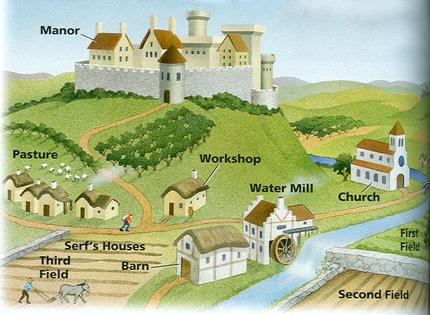
- Serfdom was a key feature of feudal society:
- Serfs were peasants who were tied to the land, unable to change professions, relocate, or marry without permission from their lord.
-
- Manor System:
- The lord of the manor lived in a house or castle and owned vast tracts of land.
- A portion of the land was cultivated by the lord with the help of serfs.
- Serfs split their time between tending their own fields and working on the lord’s land.
- They also paid dues in cash and kind.
- The lord was responsible for law enforcement, justice, and security.
- Due to widespread lawlessness, even free peasants often accepted vassalage under a lord for protection.
- Some historians argue that serfdom and the manor system were essential to feudalism.
- Since India lacked both, some question whether it had feudalism.
- However, samantas (local landed elites) held feudal-like power, and peasants remained dependent on them.
- The manor system and serfdom began disappearing in Western Europe after the 14th century.
- Military Organization in Feudalism
- The Feudal Army:
- The armored knight on horseback became the most iconic symbol of feudalism.
- The shift to cavalry warfare in Europe began in the 8th century.
- In the Roman era, the military was infantry-based, with heavy and light infantry armed with spears and short swords.
- Horses were used mainly for drawing chariots for officers.
- Arab Influence on European Warfare:
- The arrival of the Arabs changed European warfare.
- Arab armies used fast-moving cavalry and mounted archers, rendering traditional infantry ineffective.
- This shift necessitated a new military structure, leading to feudalism’s expansion.
- Kings lacked the resources to maintain large cavalry forces, so they delegated military responsibilities to fief-holders.
- Technological Advancements:
- The effectiveness of cavalry warfare was enhanced by two major inventions:
- 1. Iron Stirrup:
-

- Allowed heavily armored knights to remain stable on horseback and withstand the impact of a lance charge.
- 2. Improved Horse Harness:
-
- Enabled horses to pull twice the load, making them more effective in battle and agriculture.
- These innovations likely originated from East Asia and spread to Europe and India by the 10th century.
- Political and Social Influence of Feudalism
- Feudal lords held immense power, making it difficult for kings to reassert centralized control even after stronger monarchies emerged in the 11th century.
- Feudalism shaped both political structures and military organization, influencing governance for centuries.
- Role of the Christian Church in Medieval Europe
- Alongside feudalism, the Christian Church played a dominant role in medieval Europe.
- In the absence of a powerful empire, the Catholic Church took on governmental functions in the West.
- The Pope became a religious and political leader, holding immense moral and political authority.
- Church’s Role in Society:
- The Medieval Age was a religious age, with clergy wielding significant power.
- Monasteries were set up with land grants from feudal lords and donations from merchants.
- Monastic orders, such as the Franciscans, served the poor and needy.
- Monasteries also provided medical aid, education, and shelter for travelers.
- Church vs. Feudal Lords:
- Some monasteries became extremely wealthy, behaving like feudal lords.
- This led to conflicts with rulers, who opposed the growing political influence of the Church.
- The tension between secular rulers and the Papacy was reflected in the Renaissance and Reformation movements.
- Conclusion
- Feudalism in Europe was shaped by political, economic, and military factors.
- It created a hierarchical society dominated by landed aristocracy, serfs, and a decentralized military system.
- Despite the emergence of stronger monarchies after the 11th century, the feudal tradition remained deeply ingrained.
- The Catholic Church played a key role in shaping medieval European society, providing stability, services, and governance.
- Over time, conflicts between feudal lords, monarchs, and the Church contributed to major transformations, ultimately leading to the decline of feudalism and the rise of a new Europe.
- The Arab World
- Rise and Expansion of Islam
- The rise of Islam in the seventh century united warring Arab tribes into a powerful empire.
- The Arab empire, founded by the early caliphs, included Arabia, Syria, Iraq, Iran, Egypt, North Africa, and Spain.
- The Abbasid Caliphate
- Internal conflicts led to the fall of the Umayyad Caliphate in Damascus in the mid-eighth century.
-

- The Abbasids, claiming descent from the Prophet Muhammad’s tribe, established their capital in Baghdad.
-
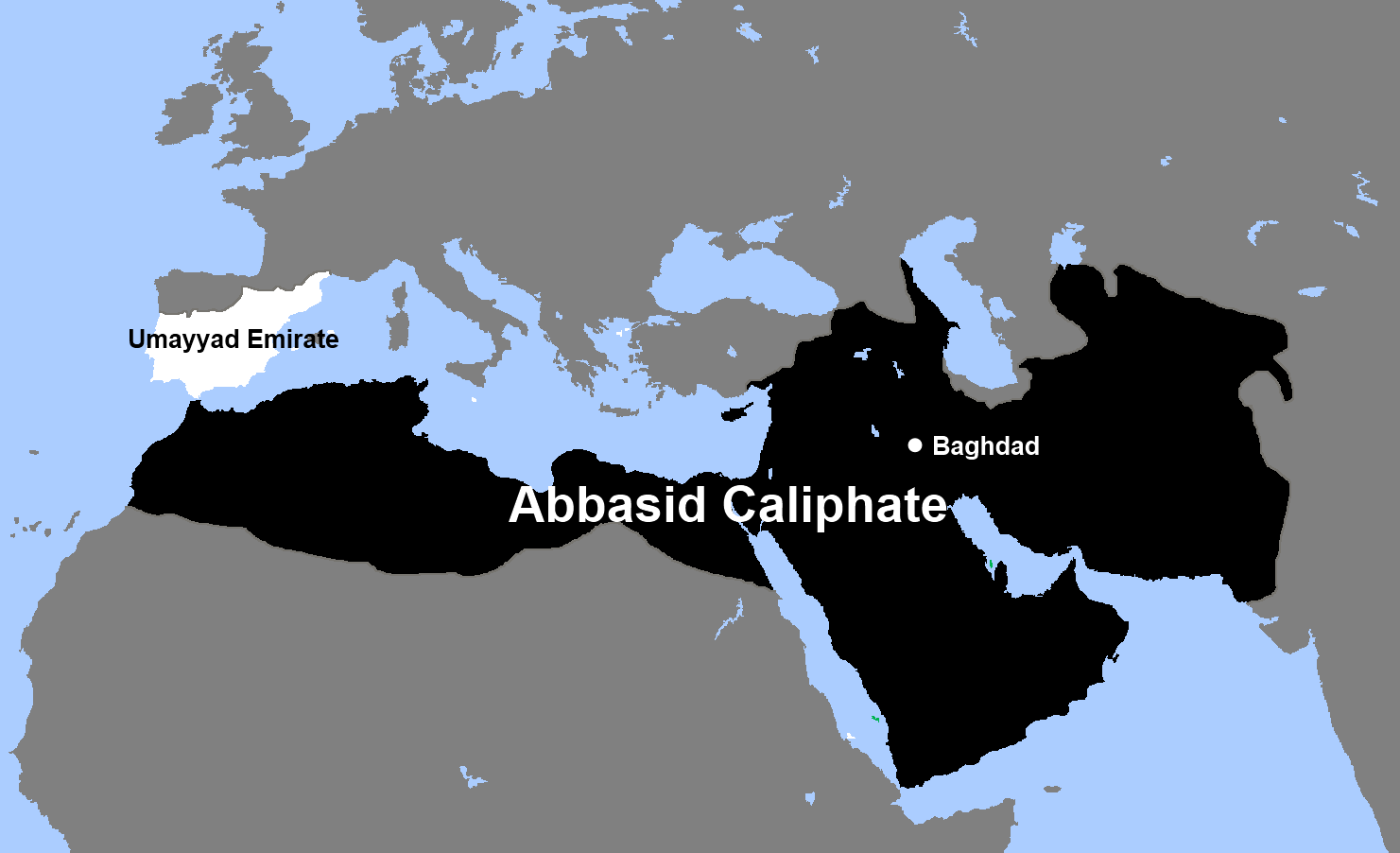
- The Abbasid Empire flourished for about 150 years, controlling major centers of civilization in North Africa, Egypt, Syria, Iran, and Iraq.
- The Abbasids secured key trade routes linking the Mediterranean to India, contributing to wealth and prosperity.
- Arabs became dominant traders and seafarers, establishing major cities with high standards of living.
- Introduced the gold dinar and silver dirham, facilitating global trade.
- Developed double-entry bookkeeping, advanced accountancy, and a banking system, including bills of exchange (Aundis).
- Cultural and Scientific Advancements
- The most famous Abbasid caliphs were Harun al-Rashid and al-Mamun, known for their patronage of science and learning.
- The House of Wisdom (Bayt al-Hikma) in Baghdad translated Greek, Byzantine, Egyptian, Iranian, and Indian knowledge into Arabic.
- The Arabs absorbed and refined scientific knowledge from the civilizations they conquered.
- Many Chinese inventions, including the compass, paper, printing, gunpowder, and the wheelbarrow, reached Europe through Arab intermediaries.
- Marco Polo traveled to China to learn about its trade, attempting to bypass the Arab monopoly.
- India’s Contributions to Arab Knowledge
- India’s economic and cultural exchanges with the Arab world were significant but not well-documented.
- Sind, conquered by the Arabs in the eighth century, served as a conduit for Indian scientific and cultural influence.
- The decimal system, developed in India in the fifth century, spread to the Arab world and was later introduced to Europe as “Arabic numerals” by al-Khwarizmi in the ninth century.
- Indian texts on astronomy (Surya Siddhanta), mathematics, medicine (works of Charaka and Sushruta), and literature (Panchatantra – Kalila wa Dimna) were translated into Arabic.
- Indian merchants and craftsmen visited Arab markets, and Indian physicians were received at the Abbasid court.
- Contributions to Science and Exploration
- By the tenth century, Arabs were making independent contributions to geometry, algebra, geography, astronomy, optics, chemistry, and medicine.
- Arab geographers improved world maps and developed new navigation tools, aiding maritime exploration.
- Their records provide valuable insights into medieval India and its neighboring regions.
- Libraries and Intellectual Freedom
- Some of the world’s best-stocked libraries and scientific laboratories were established in the Arab world.
- Arab science was international, with scholars from Khurasan, Egypt, and Spain contributing.
- Arabic was the common language of literature and science, allowing intellectual exchange across borders.
- Scholars enjoyed intellectual freedom and patronage, fostering an era of remarkable progress.
- Decline of Arab Science
- After the twelfth century, Arab scientific progress declined due to:
- Political and economic instability.
- The rise of orthodoxy, which stifled free thought.
- However, Arab science continued to thrive in Spain until the fourteenth century.
- India, which had limited interaction with Arab science, experienced a slowdown in scientific progress during this period.
- Africa and Arab Influence
- Integration into Trade Networks
- The Arabs strengthened Africa’s connections to Indian Ocean and Middle Eastern trade.
- Arab migration and mercantile activity along Africa’s east coast expanded significantly, reaching Malindi and Zanzibar.
- Trade and Commerce
- Arab trade involved the large-scale export of slaves, along with gold and ivory.
- The Ethiopian Kingdom
- Ethiopia was a powerful and long-established kingdom with many towns.
- Ethiopians (Habshis) were Christian and actively participated in Indian Ocean trade via Aden to India.
- They had close economic ties with the Byzantine Empire, which played a key role in the trade network.
- Their economic position declined following the fall of the Byzantine Empire.
- East and Southeast Asia
- China: Cultural and Commercial Flourishing
- Chinese society and culture peaked during Tang rule (8th–9th centuries).
- The Tang extended control over Sinkiang in Central Asia, including Kashgar, boosting overland trade via the Silk Road.
- Exports included silk, fine porcelain, and jade to West Asia, Europe, and India.
- Foreign traders, including Arabs, Persians, and Indians, were welcomed and settled in Canton.
- Political Changes in China
- Tang Decline (9th century) → Song Dynasty (10th century) → Mongol Conquest (13th century).
- The Mongols:
- Unified North and South China for the first time.
- Conquered Korea, Tonkin (North Vietnam), and Annam (South Vietnam).
- Established one of the largest empires in East Asia.
-
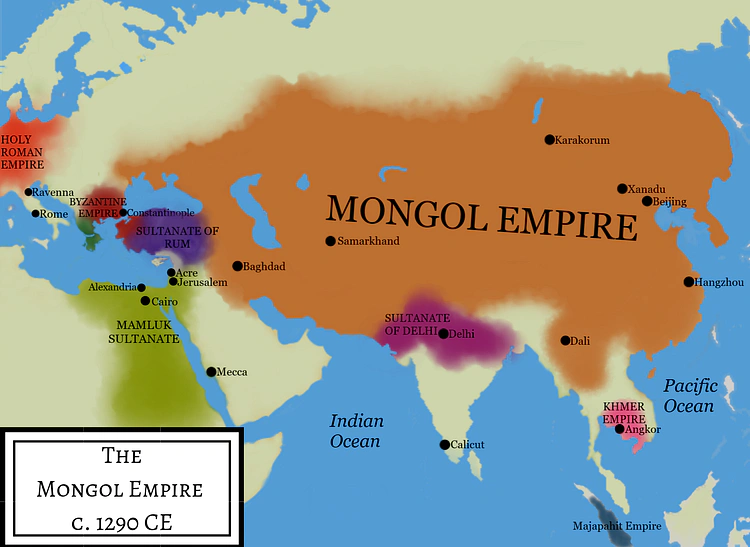
- Marco Polo, the Venetian traveler, visited the court of Kublai Khan, leaving a vivid account.
- His journey back to Italy took him through Malabar (India), reflecting increasing global interactions.
- Southeast Asia: Regional Powers and Trade
- Chinese Expansionism and Naval Power
- China developed a strong navy, occasionally attempting to expand into Southeast Asia.
- However, most Southeast Asian states remained independent.
- Two dominant empires of this period:
1. Sailendra (Sri Vijaya) Empire (7th–10th Century)
-
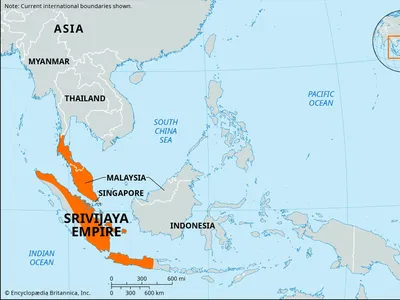
- Included Sumatra, Java, Malaya Peninsula, parts of Thailand, and the Philippines.
- Dominated sea trade with China.
- A 9th-century Arab account states that the empire was so vast that even the fastest vessel could not complete a round trip in two years.
- Replaced by the Majapahit Empire (11th–14th century), which expanded its influence further.
2. Kambuja Empire (Successor to Hinduized Funan)
- Controlled Cambodia and Annam (South Vietnam).
- Flourished until the 15th century, achieving high cultural prosperity.
- Angkor Wat (10th–12th century):
-
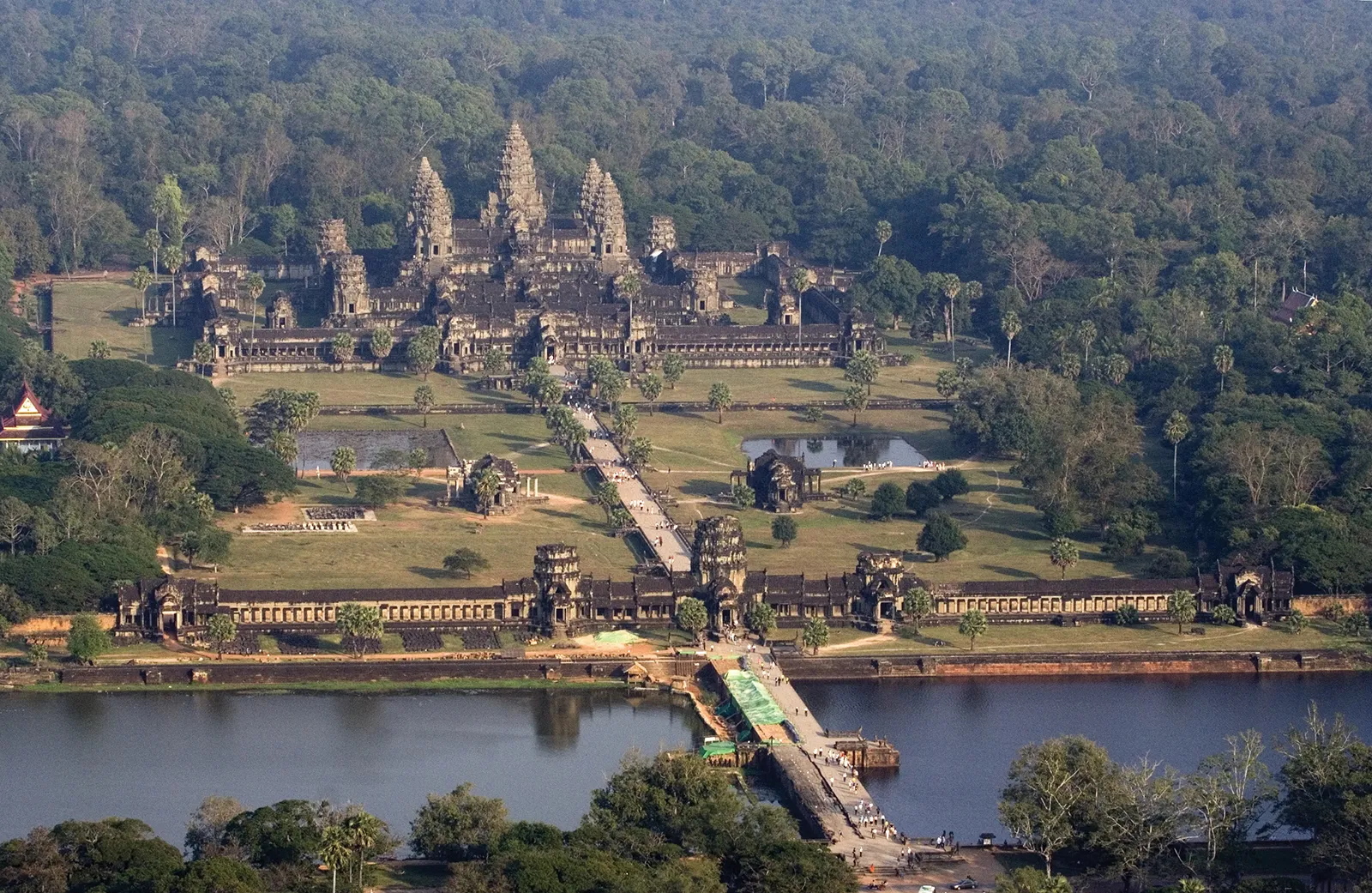
- Three kilometers of covered passages with Hindu gods, goddesses, and apsaras.
- Intricate panels from Ramayana and Mahabharata.
- Over 200 temples built, later rediscovered by a French explorer in 1860.
- Its golden age coincided with India’s peak temple-building era.
- Indian Influence and Naval Expeditions
- Pallavas of South India had a strong navy, active in the Bay of Bengal.
- Chola rulers (10th century) launched naval expeditions to Sumatra and Malaya to safeguard trade routes.
- Trade and cultural exchanges with India date back to early centuries.
- Cultural Influence
- Palembang (Sumatra) was a Buddhist and Sanskrit learning center.
- Temple of Borobudur (East Java):
-
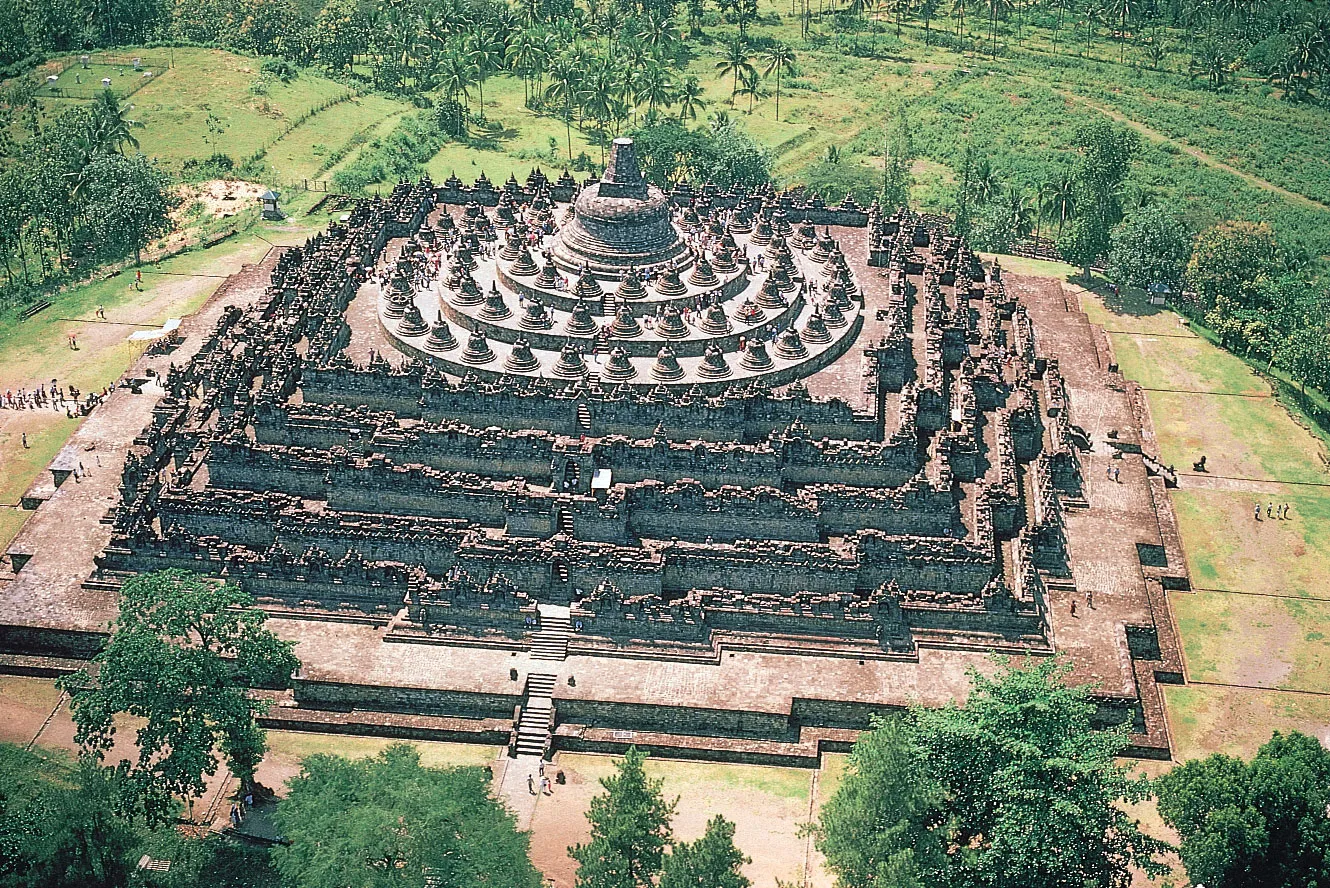
- A mountain carved into nine stone terraces, topped with a stupa.
- Depicts scenes from Ramayana and Mahabharata.
- These epics influenced literature, folk art, and puppet plays.
- India-Southeast Asia-China Cultural and Trade Links
- Indian traders and monks settled in South China and Southeast Asia.
- Buddhism spread from India to China, Korea, and Japan.
- Hindu gods were assimilated into Buddhism, unlike in India, where the reverse occurred.
- Arab Traders and Islamization
- Arab traders intensified their activity in South India and Southeast Asia after the Abbasid Empire’s rise.
- Early Arab traders coexisted with Indian traders, with no major push for conversion.
- Indonesia and Malaya gradually converted to Islam, mainly after Islam’s consolidation in India.
- Buddhism remained dominant elsewhere.
- End of Indian Influence and European Colonization
- Commercial and cultural ties between India and Southeast Asia declined with European colonization:
- Dutch rule in Indonesia.
- British rule in India, Burma, and Malaya.
- French rule in Indo-China.
- This severed long-standing cultural and economic interactions between India and the region.
- Northern India: Age of the Three Empires (800-1000)
- Political Landscape After Harsha’s Decline
- Following the decline of Harsha’s empire in the seventh century, several large states emerged across North India, the Deccan, and South India.
- Unlike the Gupta and Harsha’s empires, no kingdom in North India managed to control the entire Ganga valley.
- The Ganga valley had been crucial for the expansion of past empires due to its population and resources. It had allowed rulers like the Guptas and Harsha to extend control over:
- Gujarat, with its rich seaports and thriving trade.
- Malwa and Rajasthan, which were essential trade links between the Ganga valley and Gujarat.
- In South India, the Cholas successfully controlled the Krishna, Godavari, and Kaveri deltas, which became the foundation of their supremacy.
- Major Regional Empires (c. 750–1000 CE)
-

- Between 750 and 1000 CE, three major empires emerged in North India and the Deccan:
1. Pala Empire (Eastern India)
- Dominated Bengal and Bihar until the mid-ninth century.
2. Pratihara Empire (Western India & Upper Ganga Valley)
- Controlled western India and the Upper Ganga valley until the mid-tenth century.
3. Rashtrakuta Empire (Deccan & Beyond)
- The most powerful empire of the period.
- Held territories in North and South India at different times.
- Acted as a bridge between North and South India in both economic and cultural aspects.
- Despite frequent conflicts, these empires contributed to:
- Stable governance over vast regions.
- Agricultural expansion, including the construction of ponds and canals.
- Patronage of arts, literature, and temple architecture.
- Of the three, the Rashtrakutas lasted the longest and played a crucial role in linking North and South India.
- The Palas
- Political Situation After Harsha’s Death
- The period following Harsha’s death was marked by political confusion.
- Lalitaditya of Kashmir temporarily brought Punjab and Kanauj under his control.
- Kanauj was considered the symbol of North Indian sovereignty (authority that exercises ultimate power without external control) since Harsha’s time.
- Control of Kanauj meant access to the upper Gangetic valley, rich in trade and agriculture.
- Lalitaditya invaded Bengal (Gaud) and killed its ruling king.
- His power declined with the rise of the Palas and Gurjara-Pratiharas.
- Conflicts for Kanauj and the Gangetic Valley
- The Palas and Pratiharas fought for control over Banaras to South Bihar, a region with imperial traditions and rich resources.
- The Pratiharas also clashed with the Rashtrakutas over territorial control.
- Rise of the Pala Empire
- Foundation of the Pala Dynasty
- Founded by Gopala in c. 750, possibly through an election by local nobles to end political anarchy.
- Gopala:
- Not from a royal family (his father was likely a soldier).
- Unified Bengal and extended control over Magadha (Bihar).
- Reign of Dharampala (c. 770–810)
- Engaged in a tripartite struggle with the Pratiharas and Rashtrakutas for Kanauj and North India.
- Key events:
- The Pratiharas advanced upon Bengal, but before a decisive battle, they were defeated by Rashtrakuta ruler Dhruva.
- Dhruva’s withdrawal to the Deccan allowed Dharampala to occupy Kanauj and hold a grand darbar attended by vassal rulers from Punjab, eastern Rajasthan, etc.
- His rule possibly extended to Malwa and Berar.
- Setback:
- The Pratiharas revived under Nagabhata II, who defeated Dharampala near Monghyr.
- Bihar and eastern Uttar Pradesh remained a constant battleground between the Palas and Pratiharas.
- Devapala’s Reign (c. 810–850)
- Devapala (son of Dharampala) ruled for 40 years and expanded control over:
- Pragjyotishpur (Assam) and parts of Orissa.
- Possibly parts of modern Nepal.
- For about a century (mid-eighth to mid-ninth century), the Palas dominated eastern India, even extending influence up to Varanasi.
- Expansion and Cultural Achievements of the Palas
- Arab and Tibetan Accounts
- Arab merchant Sulaiman (mid-ninth century) described the Pala Kingdom:
- Called it “Ruhma” (likely referring to Dharmapala).
- Noted its large military force with 50,000 elephants.
- Mentioned 10,000–15,000 troops dedicated to fulling and washing clothes.
- Tibetan sources (written in the 17th century) describe the Palas as great patrons of Buddhism.
- Support for Buddhist Learning
- Dharampala revived Nalanda University, setting aside 200 villages for its upkeep.
- He also founded Vikramasila University, which became second only to Nalanda in prominence.
- The Palas built many viharas, housing large numbers of Buddhist monks.
- Relations with Tibet
- The Palas maintained close cultural ties with Tibet.
- Buddhist scholars Santarakshita and Dipankara (Atisha) were invited to Tibet, introducing a new form of Buddhism.
- Many Tibetan Buddhists studied at Nalanda and Vikramasila.
- Economic and Cultural Influence in Southeast Asia
- Religious Patronage and Social Impact
- Though Buddhist supporters, the Palas also patronized Shaivism and Vaishnavism.
- They granted land to Brahmins from North India, which:
- Helped expand cultivation.
- Transformed many pastoralists and food-gatherers into settled cultivators.
- Trade and Influence in Southeast Asia
- Trade with Southeast Asia (Burma, Malaya, Java, Sumatra) enriched the Pala Empire.
- Gold and silver flowed into Bengal from these regions.
- The Sailendra dynasty (rulers of Malaya, Java, Sumatra) maintained diplomatic relations with the Palas:
- Sent embassies to the Pala court.
- Sought permission to build a monastery at Nalanda.
- Requested five villages for its upkeep, which Devapala granted.
- Summary
- The Palas, Pratiharas, and Rashtrakutas fought for control of North India.
- The Palas dominated eastern India and expanded into Assam, Orissa, and Nepal.
- They were great patrons of Buddhism, reviving Nalanda and founding Vikramasila.
- Their relations with Tibet and Southeast Asia enhanced cultural and economic ties.
- Trade with Southeast Asia contributed to their prosperity and influence.
- The Pratiharas
- Origins and Early Conflicts
- Gurjara-Pratihara Identity
- The Pratiharas, also known as Gurjara-Pratiharas, ruled over Kanauj.
- They likely originated from the Gurjaras, who were pastoralists and fighters, similar to the Jats.
- Initial Expansion
- Established principalities in central and eastern Rajasthan.
- Engaged in conflicts with the Rashtrakutas for control over:
- Malwa
- Gujarat
- Kanauj (a key region for controlling the upper Ganga valley).
- Resistance Against the Arabs
- Nagabhatta I emerged as a prominent leader.
- Strongly resisted the Arab rulers of Sind, who attempted to encroach on:
- Rajasthan
- Gujarat
- Punjab
- In 738, Arab forces advanced toward Gujarat but were decisively defeated by the Chalukyan ruler of Gujarat.
- Small Arab incursions continued but never became a major threat.
- Struggles with the Rashtrakutas
- The Pratiharas’ early attempts to expand into the upper Ganga valley and Malwa were halted by the Rashtrakutas.
- Key defeats:
- 790 – Rashtrakuta ruler Dhruva defeated the Pratiharas.
- 806-07 – Rashtrakuta ruler Gopal II defeated them again.
- The Rashtrakutas later withdrew to the Deccan, allowing the Palas to exert influence.
- Bhoja: The Greatest Pratihara Ruler
- Empire Consolidation (c. 836 AD)
- Bhoja rebuilt the Pratihara empire and recovered Kanauj, making it the capital for nearly a century.
- Initially attempted eastern expansion but was defeated by the Pala ruler Devapala.
- Shifted focus to central India, the Deccan, and Gujarat, leading to renewed struggles with the Rashtrakutas.
- Key Battles and Expansion
- Narmada Battle
- Bhoja fought a bloody battle on the banks of the Narmada against the Rashtrakutas.
- Retained control over large parts of Malwa and some parts of Gujarat.
- Unable to extend further into the Deccan.
- Territorial Reach
- Inscription evidence suggests his empire extended west of the Sutlej River.
- Reputation and Military Strength
- Arab Accounts
- Arab travelers noted that the Pratiharas had India’s best cavalry.
- The import of horses from Central Asia and Arabia was significant for their military.
- Legends and Legacy
- Bhoja’s reconquest of Kanauj captured contemporary imagination.
- Devotee of Vishnu, adopting the title ‘Adivaraha’, which appears on some of his coins.
- Sometimes called Mihir Bhoja to distinguish him from Bhoja Paramara of Ujjain.
- Likely died around 885 AD, succeeded by his son Mahendrapala I.
- Mahendrapala I and Pratihara Dominance
- Territorial Expansion (c. 885-908 AD)
- Mahendrapala I maintained Bhoja’s empire and extended control over:
- Magadha
- Northern Bengal
- His inscriptions have been found in Kathiawar, eastern Punjab, and Awadh.
- Fought a battle against the king of Kashmir but lost some territories in Punjab.
- Pratihara Power in the 9th and 10th Centuries
- Al-Masudi’s Account (915-916 AD)
- Arab traveler Al-Masudi visited Gujarat and attested to the power and prestige of the Pratiharas.
- Called the Gurjara-Pratihara kingdom “al-Juzr” (corruption of Gurjara).
- Referred to the Pratihara king as “Baura”, likely a mispronunciation of Adivaraha.
- Military Strength
- The empire contained 180,000 villages, cities, and rural areas.
- Covered 2000 km x 2000 km in size.
- The army was divided into four divisions, each with 700,000–900,000 men.
- Despite having only 2000 trained war elephants, they had India’s best cavalry.
- Cultural and Scholarly Achievements
- Patronage of Learning and Literature
- The Pratiharas were great patrons of Sanskrit literature.
- Poet Rajashekhar, a major Sanskrit dramatist, lived at the court of Mahipala (Bhoja’s grandson).
- Architectural Contributions
- The Pratiharas embellished Kanauj with many fine buildings and temples.
- Relations with the Arab World
- Indian scholars traveled to the Caliph’s court in Baghdad during the 8th-9th centuries.
- Introduced Indian sciences, including:
- Mathematics
- Algebra
- Medicine
- Despite political hostilities, scholarly exchanges and trade continued between India and West Asia.
- Decline of the Pratihara Empire
- Rashtrakuta Invasions
- 915-918 AD – Rashtrakuta king Indra III attacked Kanauj and devastated the city.
- The loss of Gujarat weakened the Pratihara empire, as it was central to overseas trade.
- Al-Masudi’s account confirms that the Pratihara empire had no access to the sea after losing Gujarat.
- Final Blow by Krishna III
- 963 AD – Rashtrakuta ruler Krishna III invaded north India and defeated the Pratihara ruler.
- This marked the rapid disintegration of the Pratihara empire.
- The Rashtrakutas
- Rise and Expansion
- The Rashtrakuta dynasty ruled the Deccan while the Palas and Pratiharas controlled north India.
- Founded by Dantidurga, who established his capital at Manyakhet (Malkhed) near modern-day Sholapur.
- Initially dominated northern Maharashtra.
- Engaged in conflicts with the Pratiharas over Gujarat and Malwa. Though they did not extend their empire to the Ganga valley, their raids brought rich plunder and fame.
- Constantly fought against the Eastern Chalukyas of Vengi (modern Andhra Pradesh) and the Pallavas of Kanchi and Pandyas of Madurai.
- Notable Rulers
- Govinda III (793–814)
- Launched a successful expedition against Nagabhatta of Kanauj and annexed Malwa.
- Turned to the south, defeating the Kerala, Pandya, and Chola kings, and weakening the Pallavas.
- Captured the Ganga kings (of Karnataka) and subdued the king of Lanka and his minister.
- Amoghavarsha (814–878)
- Ruled for 64 years but preferred religion and literature over war.
- Credited with writing the first Kannada book on poetics.
- A great builder, making Manyakhet a city that rivaled Indra’s abode.
- Struggled with rebellions, which resurfaced after his death.
- Indra III (915–927)
- Re-established the empire after quelling rebellions.
- Defeated Mahipala and sacked Kanauj in 915, making him the most powerful ruler of his time.
- According to Al-Masudi, the Rashtrakuta king Bathara (Vallabharaja) was the greatest king of India, with most Indian rulers accepting his suzerainty.
- Possessed large armies and numerous elephants.
- Krishna III (934–963)
- Fought against the Paramaras of Malwa and Eastern Chalukyas of Vengi.
- Launched a campaign against the Cholas, who had supplanted the Pallavas of Kanchi.
- Defeated Chola king Parantaka I in 949, annexing northern parts of the Chola empire.
- Pressed down to Rameshwaram, setting up a pillar of victory and building a temple.
- After his death, opponents united against his successor, leading to the sack and destruction of Malkhed in 972, marking the end of the Rashtrakuta empire.
- Religious Tolerance and Cultural Contributions
- Ruled Deccan for nearly 200 years (until the late 10th century).
- Supported Saivism, Vaishnavism, and Jainism.
- Ellora’s famous rock-cut temple of Shiva, built by Krishna I (9th century).
-

- Amoghavarsha was a Jain but patronized all faiths.
- Allowed Muslim traders to settle, and Islam was preached in their dominions.
- Muslim communities had headmen and mosques in many coastal towns.
- This policy promoted foreign trade, enriching the Rashtrakutas.
- Patronage of Arts and Literature
- Encouraged Sanskrit, Prakrit, and Apabhramsha literature.
- Their courts featured Sanskrit scholars, poets, and writers.
- The great Apabhramsha poet, Svayambhu, and his son possibly lived at the Rashtrakuta court.
- Political Ideas and Organization
- The Monarch and the Court
- The system of administration in these empires was influenced by the Gupta Empire, Harsha’s kingdom, and the Chalukyas in the Deccan.
- The monarch was the center of all affairs, serving as both the head of administration and the commander-in-chief of the armed forces.
- The king held court in a magnificent darbar, attended by vassal chiefs, feudatories, ambassadors, and high officials.
- The court was also a cultural hub, featuring dancing girls, musicians, and women from the king’s household, who attended on festive occasions.
- In the Rashtrakuta Empire, Arab writers noted that women did not veil their faces.
- Kingship and Succession
- Kingship was generally hereditary, and absolute loyalty was emphasized due to frequent wars.
- While kings adopted grand titles like Maharajadiraj and Chakravartin, their authority was often limited by vassals and autonomous chiefs.
- Thinkers like Medhatithi believed in the right to bear arms for self-defense and opposing unjust rulers.
- Rules of succession were not rigid: the eldest son often succeeded, but conflicts between siblings were common.
- Some kings designated a Yuvaraj (successor), who assisted in administration, while younger sons were made provincial governors.
- Rarely, princesses held government posts, such as Chandrobalabbe, a Rashtrakuta princess who administered the Raichur Doab.
- Vassal Chiefs and Their Role
- Empires comprised directly administered areas and vassal-ruled territories.
- Vassal chiefs were autonomous in internal affairs but had obligations to the overlord, including loyalty, tribute payment, and military support.
- Some vassal chiefs had to send a son to stay at the overlord’s court as a measure against rebellion.
- Vassals attended the overlord's darbar on special occasions and sometimes married into the royal family.
- Frequent wars occurred as vassals sought independence.
- Rashtrakutas fought vassals in Vengi (Andhra) and Karnataka, while Pratiharas fought the Paramaras of Malwa and the Chandellas of Bundelkhand.
- Ministers and Administration
- Kings were assisted by ministers, often from leading families, with hereditary positions in some cases.
- The Pala kings had a Brahmin family that supplied four successive chief ministers.
- The central government had various departments, including:
- Minister of correspondence (foreign affairs)
- Revenue minister
- Treasurer
- Chief of armed forces (Senapati)
- Chief justice
- Purohita (priestly advisor)
- Ministers, except the purohita, were expected to lead military campaigns when needed.
- The king's household officers wielded significant power due to their proximity to the ruler.
- Military Organization
- A strong military was crucial for maintaining and expanding the empire.
- The Pala, Pratihara, and Rashtrakuta kings maintained well-organized infantry, cavalry, and war-elephants.
- Elephants, symbols of strength, were especially prized, with the Pala kings maintaining the largest number.
- Horses were imported from Arabia, West Asia, and Central Asia.
- The Pratiharas had the finest cavalry, while war-chariots had fallen out of use.
- Rashtrakutas maintained numerous forts, each with independent commanders.
- Infantry included both regular troops and levies from vassal chiefs, with the Pala infantry consisting of soldiers from Malwa, Assam, Gujarat, and Karnataka.
- The Pala and Rashtrakuta kings had navies, though details of their strength are unknown.
- Provincial and Local Administration
- Pala and Pratihara Empires:
- Provinces (baukti) were governed by an uparika, responsible for revenue collection and law enforcement.
- Districts (visaya) were led by a visayapati.
- Below the visaya was the parzaia.
- Smaller chiefs (semantas or bhogapatis) dominated multiple villages and often merged with visayapatis.
- Rashtrakuta Empire:
- Provinces (rashira) were led by a rashtrapati, similar to an uparika.
- Districts (visaya) had smaller units called bhuke and dhwAei.
- Officials were paid through rent-free land grants, blurring distinctions between officials and hereditary chiefs.
- Village and Urban Administration
- The village was the fundamental administrative unit, led by a hereditary headman and an accountant.
- Village elders (grama mahajana or grama mahatteara) assisted in governance.
- In Karnataka (Rashtrakuta kingdom), village committees managed schools, tanks, temples, roads, and revenue collection.
- Towns had similar committees, with trade guild heads included.
- The koshia pata or kotwel managed law enforcement in towns.
- Hereditary Revenue Officers:
- Nad gavundas or desa gramakutas managed revenue collection, similar to later deshmukhs and deshpandes in Maharashtra.
- Their growing power weakened village committees and central authority, contributing to feudalization.
- Relationship Between State and Religion
- Rulers were followers of Hinduism, Buddhism, or Jainism and generously donated to religious institutions.
- Rashtrakuta kings allowed Muslims to preach their faith.
- Kings did not interfere with religious customs but protected Brahmans and upheld the varna system.
- The purohita advised the king on religious matters but did not dominate state affairs.
- Medhatithi, a Dharmashastra scholar, asserted that the king's authority derived from both the Dharmashastras and Arthashastra, emphasizing political over religious principles.
- Religion was primarily used to legitimize and strengthen rulers, who built grand temples and made land grants for religious maintenance.
- South India: The Chola Empire (900-1200)
- During the sixth to eighth centuries, several powerful kingdoms emerged in South India:
- Pallavas and Pandyas – Dominated modern Tamil Nadu.
- Cheras – Controlled modern Kerala.
- Chalukyas – Dominated Maharashtra and the Deccan.
- The Chalukyan king Pulakeshin II played a crucial role in regional politics by defeating Harsha and preventing his expansion into the Deccan.
- Many of these kingdoms, especially the Pallavas and Pandyas, had strong navies, which:
- Strengthened economic, religious, and cultural ties with Southeast Asia and China.
- Enabled invasions and temporary rule over parts of Sri Lanka.
- The Rise of the Chola Empire
-

- Foundation and Early Expansion (9th Century)
- Vijayalaya, the founder of the Chola Empire, was initially a feudatory of the Pallavas.
- Around 850 AD, he captured Tanjore, marking the beginning of Chola rule.
- By the end of the 9th century, the Cholas had:
- Defeated the Pallavas of Kanchi (Tondaimandalam).
- Weakened the Pandyas, bringing the southern Tamil region under their control.
- Challenges and Revival
- The Cholas faced threats from the Rashtrakutas.
- Krishna III dealt them a major setback by defeating the Chola king and annexing the northern part of the empire.
- However, the Cholas rapidly recovered after:
- The death of Krishna III (965 AD).
- The downfall of the Rashtrakuta Empire.
- Chola Naval and Political Dominance
- The Cholas established a vast empire, controlling a large part of the Indian peninsula.
- They built a powerful navy, which enabled them to:
- Conquer Sri Lanka and the Maldives.
- Extend their influence to Southeast Asia, marking a high point in South Indian history.
- The Chola Empire represents the climax (the most intense, exciting, or important part of something) of South India’s political and naval supremacy.
- The Age of Rajaraja and Rajendra I
-
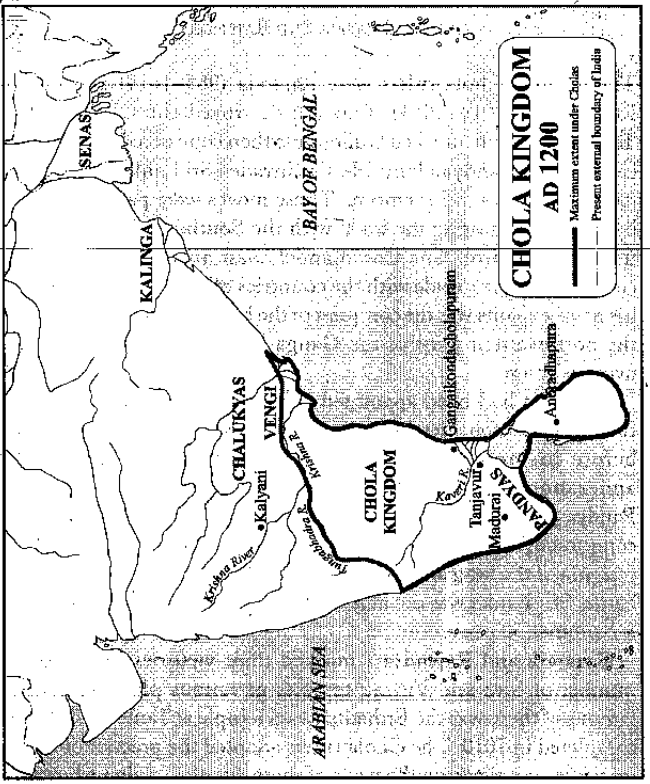
- Rajaraja I (985-1014): Military Conquests and Naval Dominance
- Rajaraja I was one of the greatest Chola rulers, expanding the empire through military and naval conquests.
- His key victories included:
- Defeating the Chera navy at Trivandrum and attacking Quilon.
- Conquering Madurai and capturing the Pandyan king.
- Annexing northern Sri Lanka, motivated by a desire to control Southeast Asian trade.
- Conquering the Maldives, showcasing Chola naval strength.
- Expanding into Karnataka and Vengi, annexing parts of the Ganga kingdom.
- The Coromandel Coast and Malabar were important trade centers, and Chola dominance strengthened India’s overseas trade links.
- Rajendra I (1014-1044): Expansion and Overseas Expeditions
- Rajendra I, appointed heir during his father’s reign, gained administrative and military experience before becoming king.
- He continued Rajaraja’s expansionist policies by:
- Completely overrunning the Pandya and Chera kingdoms, incorporating them into the Chola Empire.
- Completing the conquest of Sri Lanka, capturing the royal crown and insignia. Sri Lanka remained under Chola rule for 50 years.
- Rajendra I’s Ganga Expedition (1022)
- Rajendra I led a spectacular military campaign from Kalinga to Bengal, crossing the Ganga River and defeating two local kings.
- This campaign mirrored Samudragupta’s earlier conquest.
- To commemorate his victory, Rajendra I:
- Assumed the title Gangaikondachola (‘The Chola Who Conquered the Ganga’).
- Established a new capital, Gangaikondacholapuram, near the Kaveri River.
- Naval Expeditions Against the Srivijaya Empire
- One of Rajendra I’s most remarkable achievements was his naval campaign against the Srivijaya Empire.
- The Srivijaya Empire (revived in the 10th century) controlled the Malay Peninsula, Sumatra, Java, and the trade route to China.
- Despite cordial relations with the Buddhist Sailendra rulers of Srivijaya, conflict arose due to:
- Chola ambitions to remove trade restrictions and strengthen Indian merchants’ influence.
- The Chola navy launched expeditions in the Malay Peninsula and Sumatra, leading to the conquest of Kadaram (Kedah) and several key trading centers.
- The Chola naval power was so dominant that the Bay of Bengal was referred to as a ‘Chola Lake’.
- Architectural and Historical Legacy
- Both Rajaraja and Rajendra I commemorated their victories by building Shiva and Vishnu temples.
- The most notable structure was the Brihadishwara Temple at Tanjore, completed in 1010.
- Chola rulers inscribed their achievements on temple walls, providing a rich historical record.
- Diplomatic and Trade Relations with China
- The Chola rulers maintained diplomatic and commercial ties with China.
- Chola embassies were sent to China in 1016 and 1033, followed by a delegation of 70 merchants in 1077.
- Chinese records note that the Cholas received 81,800 strings of copper-cash (over four lakh rupees) in exchange for goods like glassware, camphor, brocades, rhinoceros horns, and ivory.
- The Chinese referred to all imported trade goods as ‘tribute’, though they were part of commercial exchanges.
- Conflicts with the Later Chalukyas
- The Cholas were in constant conflict with the Later Chalukyas, who succeeded the Rashtrakutas with their capital at Kalyani.
- The struggle for dominance centered on:
- Vengi (Rayalaseema)
- The Tungabhadra Doab
- Northwest Karnataka (Ganga-ruled territories)
- Neither side secured a decisive victory, and prolonged warfare exhausted both kingdoms.
- The wars became increasingly brutal:
- Chalukyan cities like Kalyani were sacked and plundered, with mass killings of civilians, including Brahmins and children.
- The Chola–Chalukya conflicts were marked by extreme violence, where cities such as Kalyani (the capital of the Western Chalukyas) were stormed and razed. Not only were temples desecrated and treasuries looted, but mass killings of non-combatants, including Brahmins, women, and children, were carried out to instill fear and eliminate resistance. Such brutality was not merely an outcome of war but also a calculated political strategy to cripple the socio-religious elite that could inspire rebellion in conquered territories.
- Similar tactics were used in the Pandya kingdom, where military colonies were settled to maintain control.
- After their victories in the Pandya region, the Cholas pursued an aggressive policy of consolidation. They did not rely solely on alliances with local chieftains; instead, they uprooted existing administrative systems and implanted military settlements (often known as kadagams). These garrisons functioned both as instruments of surveillance and as centers of taxation, ensuring that conquered populations remained subjugated. The settling of Tamil warriors in hostile territory also reflected the Chola model of integrating conquest with colonization, thereby turning temporary victories into durable political control.
- The Cholas destroyed Anuradhapura, the ancient capital of Sri Lanka, and harshly treated its king and queen.
- In Sri Lanka, Chola aggression reached a particularly devastating peak when Rajaraja I and later Rajendra I attacked and destroyed Anuradhapura, a city revered not only as a political center but also as a sacred Buddhist hub for centuries. The sacking of monasteries, destruction of stupas, and plunder of relics shocked the island’s cultural fabric. The Sinhalese monarch Mahinda V was captured, along with members of the royal family, who were humiliated and transported as prisoners to Tamil Nadu. This act of desecration was more than conquest—it symbolized the Chola attempt to obliterate the political legitimacy of the Sinhalese dynasty while asserting their own supremacy across the Indian Ocean.
- These actions are seen as dark episodes in Chola history.
- Chola Administration and Local Governance
- Despite their militaristic policies, the Cholas established a well-organized administration in their conquered regions.
- A key feature of Chola governance was the promotion of local self-government in villages, ensuring stability and continuity.
- Decline of the Chola Empire
- The Chola Empire flourished through the 12th century but declined in the early 13th century.
- Simultaneously, the Later Chalukyan Empire in Maharashtra also collapsed.
- The Pandyas and Hoysalas replaced the Cholas in the south, while the Yadavas and Kakatiyas succeeded the Later Chalukyas.
- These regional powers patronized arts and architecture but weakened themselves through constant internal warfare.
- Their conflicts ultimately left them vulnerable to Delhi Sultanate invasions, leading to their downfall in the early 14th century.
- CHOLA GOVERNMENT AND LOCAL SELF-GOVERNMENT
- Central Administration
- The king was the supreme authority in the Chola administration. He had a council of ministers to advise him but held absolute power.
- Chola rulers frequently toured their kingdom to oversee governance.
- The empire was divided into four mandalams (provinces), sometimes governed by royal princes.
- Officials were paid through revenue-bearing land assignments instead of salaries.
- Administrative Divisions
- The empire was structured into different administrative units:
- Nadu
- The basic administrative unit, consisting of villages with close kinship ties.
- Valanadu
- A group of nadus.
- Hill people and tribals were gradually integrated into agricultural society through irrigation and land cultivation.
- Brahmans and temples were granted lands, which helped expand cultivation.
- Local Self-Government
- Chola inscriptions reveal a well-developed village self-government system, consisting of two key assemblies:
1. Ur
- A general village assembly.
2. Sabha / Mahasabha
- A governing body in Brahman villages (agraharams), where:
- Executive committees managed village affairs.
- Educated landowners were elected by lot or rotation and served for three years.
- Committees oversaw land revenue collection, law enforcement, and justice.
- A Tank Committee managed water distribution for agriculture.
- The sabha had authority to distribute land, levy taxes, and raise village loans.
- The Chola village self-governance system was highly effective, although its autonomy diminished over time due to growing feudal influences.
- CHOLA MILITARY AND NAVY
- The Cholas maintained a large and well-organized army consisting of:
- Elephants, cavalry, and infantry (known as the three limbs of the army).
- Infantry was primarily armed with spears.
- Kings had bodyguards sworn to defend them at any cost.
- Marco Polo, the Venetian traveler, mentioned that Chola bodyguards burned themselves on their king’s funeral pyre (possibly an exaggeration).
- The Chola navy was powerful, dominating the Malabar and Coromandel coasts and, at its peak, the entire Bay of Bengal.
- CHOLA TRADE, REVENUE, AND INFRASTRUCTURE
- The Chola rulers built a network of royal roads for trade and military movement.
- Trade and commerce flourished, with massive trade guilds engaging in commerce with Java and Sumatra.
- Revenue sources included:
- Land tax, fixed based on an elaborate land survey.
- Tolls on trade and taxes on professions.
- Plunder from neighboring territories.
- Cholas prioritized irrigation, using the Kaveri River and other water sources. They constructed numerous tanks for irrigation.
- CULTURAL LIFE DURING THE CHOLA PERIOD
- Bhakti Movement and Religious Influence
- The Bhakti movement reached its peak during the Chola period, closely linked to temple worship.
- Many temples were built with royal patronage, and they became centers of devotion, art, and culture.
- The Nayanmars (Shaivite saints) and Alvars (Vaishnavite saints) composed devotional hymns in Tamil between the 6th and 9th centuries.
- The Tirumurai, a collection of Saivite hymns compiled in the 12th century, was regarded as the fifth Veda.
- Temple Architecture and Urban Development
- The Cholas promoted the Dravida style of temple architecture, characterized by:
-
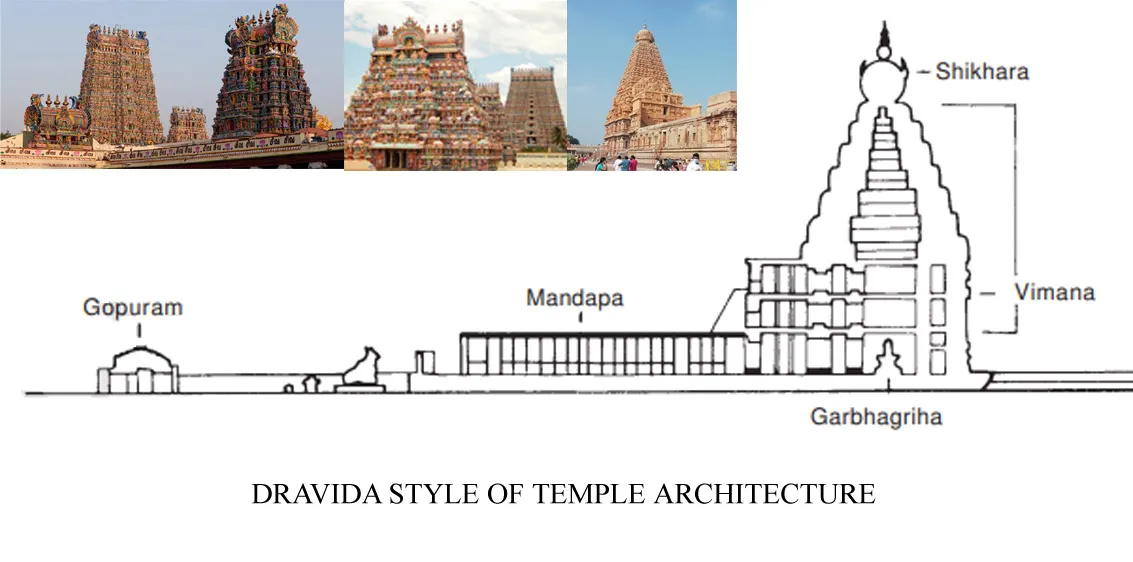
- Vimana
- A multi-storeyed tower above the garbhagriha (sanctum).
- Mandapa
- A pillared hall for ceremonies, gatherings, and dances by devadasis.
- Gopurams
- Lofty gateway towers.
- Courtyards
- Enclosed spaces with multiple shrines, sometimes with irrigation facilities.
- Temples were economic hubs, receiving revenue-free land grants and engaging in business, money-lending, and irrigation projects.
- Notable Chola temples:
- Brihadiswara Temple (Tanjore)
- Built by Rajaraja I, also called the Rajaraja Temple.
- Temple at Gangaikondacholapuram
- Though now in ruins, it remains a significant architectural achievement.
- Expansion of Temple Construction Post-Cholas
- Temple building continued under later dynasties:
- Chalukyas of Kalyani and the Hoysalas.
- Hoysalesvara Temple (Halebid)
- A prime example of the Chalukyan style
- Sculptures depicting dance, music, war, and love.
- Images of Yakshas and Yakshinis (celestial beings).
- Sculpture and Iconography
- Chola sculptors excelled in bronze casting and stone carving.
- Notable works include:
- The Nataraja (Shiva as the cosmic dancer)
-
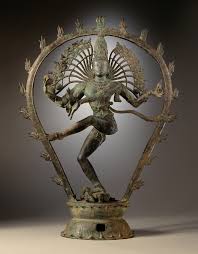
- Considered a masterpiece of Chola bronze artistry.
- The giant statue of Gomateswara (Shravanabelagola)
-
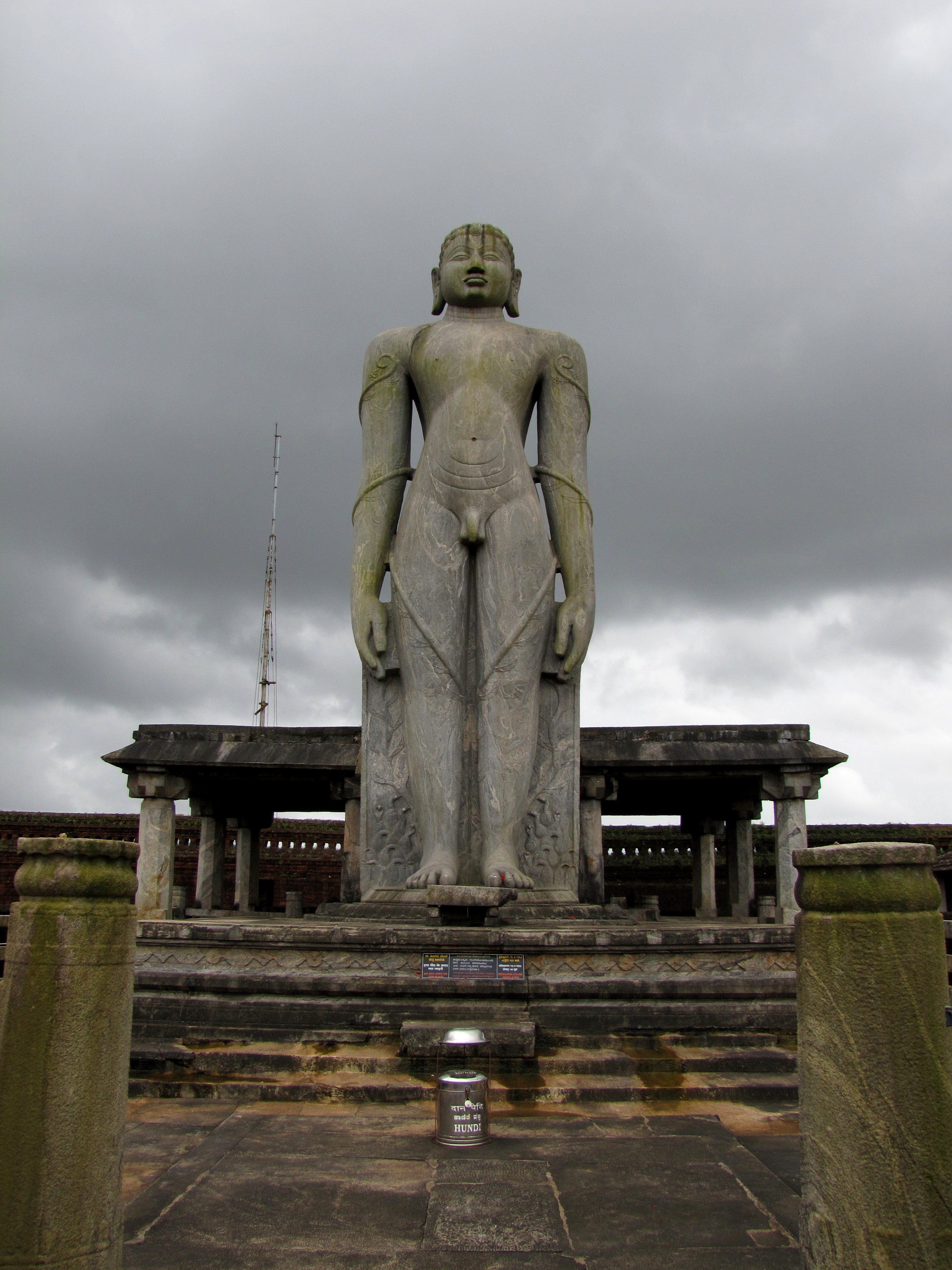
- A remarkable Jain sculpture.
- Many Chola bronzes are now preserved in museums worldwide.
- Development of Literature and Languages
- Tamil Literature
- Kamban’s Ramayana (11th–12th century) is considered a Tamil literary classic.
- Kamban (or Kambar) was a legendary 12th-century medieval Tamil poet
- Devotional and philosophical works by Nayanmars and Alvars contributed to Tamil’s religious literature.
- Growth of Kannada and Telugu Literature
- Kannada became a major literary language, patronized by the Rashtrakutas, Chalukyas, and Hoysalas.
- Notable Kannada literary figures:
- Amoghavarsha (Rashtrakuta king)
- Wrote a book on poetics.
- Pampa, Ponna, and Ranna
- Called the “Three Gems of Kannada poetry” (Ratnatraya), influenced by Jainism.
- Pampa (10th century), court poet of the Chalukya king Arikesari, is revered as Adikavi (the first poet of Kannada).
- Ponna, often called the “Emperor among poets” (Kavichakravarti), was the court poet of Rashtrakuta king Krishna III.
- Ranna, patronized by Chalukya kings Tailapa II and Satyashraya
- Tricl to memorize Pampa, Ponna & Ranna
-
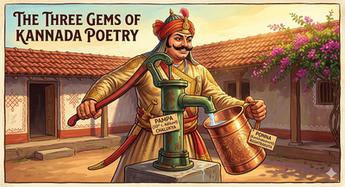
- Telugu literature developed under the Chalukyas:
- Nanniah began the Telugu Mahabharata, which was completed by Tikkanna in the 13th century.
-

- Economic and Social Impact of Culture
- Temples as economic centers – They:
- Received wealthy merchant donations.
- Engaged in business and money lending.
- Funded agricultural projects like irrigation and tank construction.
- Merchants and artisans grew in influence due to foreign trade under the Cholas.
- Temples served as social hubs, integrating religion with daily life.
- Conclusion
- The period from the 8th to 12th century was a golden age of cultural and economic growth in South India.
- The Chola era saw a blending of religion, art, and administration, influencing later dynasties.
- Economic and Social Life, Education, and Religious Beliefs (800-1200 CE)
- Continuity and Change in Economic and Social Life (800–1200 CE)
- Continuity of Earlier Features
- Economic and social structures evolved gradually, unlike political developments.
- Many features from before the 9th century persisted throughout this period.
- New Elements of Change
- Despite continuity, new factors emerged that distinguished this period from earlier times.
- The extent and direction of change varied across different regions and social groups.
- General Pattern of Historical Change
- Every historical period reflects a mix of continuity and transformation in its economic, social, and religious aspects.
- The rate of change in beliefs and societal structures was much slower compared to political shifts.
- Trade and Commerce
- Debate on Economic Conditions
- The economic situation during this period is a topic of debate among historians. Some argue that it was a time of stagnation and decline, citing:
- Setbacks in both foreign and long-distance trade within India.
- The decline of towns, leading to greater localism and regionalism.
- The virtual absence of gold coins until the tenth century as evidence of economic downturn.
- However, despite the fall of the Roman Empire, India’s trade with the West remained strong due to the rise of new empires:
- The Byzantine Empire (based in Constantinople).
- The Sassanid Empire (based in Iran).
- Both empires actively engaged in trade with India and the Indian Ocean region. With the rise of the Arab Empire in the seventh century, Western trade expanded further, connecting India, Southeast Asia, and China.
- Gold and Silver Inflow
- Indian traders were not excluded from this expanding trade. India continued to attract gold and silver due to its favorable trade balance, earning the title of a land rich in precious metals. However, these metals were primarily used for:
- Decorating temples and palaces.
- Making jewelry.
- Hoarding for future use, rather than being minted into coins.
- The reason behind the limited use of gold and silver for coinage remains unclear.
- Internal Trade and Agrarian Expansion
- The rise of numerous kingdoms led to increased state authority and land expansion through:
- Construction of bunds, wells, and irrigation systems.
- Grants of rent-free land to Brahmins, encouraging settlement and agriculture (e.g., in Bengal, Sind, and Tamil regions).
- The transition of nomadic tribes into agricultural communities.
- The impact of this agrarian expansion on internal trade remains uncertain. However, the growth of small towns catering to local trade suggests a shift toward greater self-sufficiency.
- Decline of Trade Guilds
- The decline of long-distance trade in North India led to:
- The diminishing role of guilds (shrenis) and sanghas, which had previously played a significant role in economic activities.
- The loss of endowments for guilds, reducing their influence.
- The transformation of some guilds into sub-castes (e.g., Dvadasa-shreni becoming a Vaishya sub-caste).
- A setback for Jainism, which had strong mercantile patronage.
- Restrictions on Travel
- Some Dharma Shastras of this period imposed restrictions on travel beyond:
- Areas where munja grass did not grow or where the black gazelle did not roam (i.e., beyond India).
- Sea voyages, which were considered polluting.
- However, these restrictions were not strictly followed. Indian merchants, scholars, and craftsmen traveled to Baghdad and other Muslim cities in West Asia. The bans may have applied mainly to Brahmins or were meant to prevent Indians from adopting foreign religious influences.
- Overseas Trade with Southeast Asia and China
- Despite inland trade challenges, overseas trade thrived:
- Trade with Southeast Asia had begun by the sixth century, reflected in literature describing local languages, clothing, and cultures.
- Indian merchants formed powerful guilds like Manigramam and Nandest, operating in foreign lands and making temple donations.
- Hinduism and Buddhism spread through merchant activity, evident in:
- The Borobudur Buddhist temple (Java).
- The Angkor Wat Hindu temple (Cambodia).
- Some Southeast Asian ruling families adopted Hindu practices and welcomed trade with India.
- The chief Indian port for trade with Java, Sumatra, and Malaya was Tamralipti (Tamluk) in Bengal. Merchants from Gujarat also participated in this trade.
- Role of India in Chinese Trade
- China emerged as a key trade destination, importing:
- Spices from India and Southeast Asia.
- Ivory (mainly from Africa).
- Glassware (from West Asia).
- Medicinal herbs, lac, and incense.
- India and Southeast Asia acted as staging centers for trade between China, West Asia, and Africa due to:
- Favorable monsoon wind patterns, requiring ships to halt at Indian and Southeast Asian ports.
- A strong shipbuilding tradition, especially in Malabar, Bengal, and Burma.
- Canton (Kanfu to Arab travelers) was China’s main foreign trade port. The Pala and Sena rulers of Bengal and the Pallava and Chola rulers of South India actively promoted trade with China through diplomatic embassies. The Chola ruler Rajendra I even launched a naval expedition against Malaya to protect Indian trade interests.
- By the tenth and eleventh centuries:
- Many Indian merchants and monks were present in China.
- Canton’s river was filled with ships from India, Persia, and Arabia.
- There were three Hindu temples in Canton where Indian traders resided.
- Indian influence reached Japan, where two Indians are credited with introducing cotton cultivation.
- Decline of Indian Maritime Supremacy
- Though India dominated early maritime trade, it eventually lost its position:
- The Chinese government tried to restrict the export of gold and silver in the 13th century.
- Larger and faster Chinese and Arab ships replaced Indian vessels.
- Chinese ships were multi-story, carrying 600 passengers and 400 soldiers.
- Multi-deck ships (junks) with watertight bulkheads were highly advanced — they could carry 600 passengers, 400 soldiers, and heavy cargo safely.
- The use of the mariner’s compass boosted Chinese naval expansion, marking a period when Indian science and technology lagged.
- Mariner’s Compass (developed in China, 11th–12th c.) allowed long-distance navigation with confidence even beyond coastal sight.
- Indian navigation mostly relied on monsoon winds and celestial navigation (stars, sun, coastlines), which worked but limited long-distance sea control.
- Conclusion
- Despite inland trade setbacks, India’s foreign trade with Southeast Asia and China flourished, led by South India, Bengal, and Gujarat. This period saw:
- Strong maritime traditions.
- Cultural exchanges through trade.
- Economic prosperity, driven by merchant activity and overseas expansion.
- Condition of the People
- Prosperity in Handicrafts and Agriculture
- Indian handicrafts, including textiles, gold and silver work, and metallurgy, maintained a high standard.
- Indian agriculture thrived, with many Arab travelers attesting to the fertility of the soil and the skill of Indian peasants.
- Luxury and Opulence of the Elite
- Ministers, officials, and feudal chiefs lived in great ostentation, imitating kings:
- Resided in grand houses, sometimes three to five stories high.
- Wore costly foreign apparel, including imported woolen clothes, Chinese silk, and gold and silver jewelry.
- Maintained large households with numerous women, domestic servants, and attendants.
- Assumed grand titles (mahasamantadhipati) and used distinctive symbols like banners, decorated umbrellas, and yak-tail whisks.
- Wealthy merchants also displayed royal lifestyles:
- A Chalukyan millionaire hoisted banners with ringing bells over his house, owned many horses and elephants, and built temples with crystal floors and walls adorned with religious paintings.
- Ministers Vaseupala and Tejahpala of Gujarat were among the richest merchants of their time.
- Hardships of the Common People
- Despite the wealth of the elite, prosperity was not universal:
- Food was cheap, but many poor city dwellers struggled to eat enough.
- Rajatarangini (12th-century Kashmir) describes:
- Courtiers feasting on fried meat and perfumed wine.
- Commoners surviving on rice and stpala-saka (a bitter wild vegetable).
- Many resorted to robbery and plunder to survive.
- Peasants and Taxation Burden
- Villagers, forming the majority of the population, faced heavy taxation:
- Traditional tax:
- One-sixth of produce, as per Dharmashastras.
- Additional cesses:
- Grazing tax, pond tax, and arbitrary levies by local rulers.
- Some land grants allowed landlords to impose unfair taxes on peasants.
- Forced labor (vishai) was common:
- In central India and Orissa, entire villages were granted to Brahmins and elites.
- Cultivators, artisans, and herdsmen were tied to the land like medieval European serfs.
- Chiefs exploited every opportunity to impose levies:
- One Rajput chief reportedly taxed even sparrows, dead birds, pig dung, and funeral shrouds.
- Another account tells of a village depopulated due to a chief’s excessive demands.
- Impact of Wars and Famines
- Wars and famines further worsened living conditions:
- War tactics included:
- Destruction of water reservoirs.
- Burning of villages.
- Seizure of cattle and stored grain.
- Destruction of cities—considered legitimate by contemporary writers.
- Frequent hardships increased burdens on common people, contributing to a feudal society.
- Nature of Society
- Rise of the Rajput and Feudal Class
- A new class of powerful individuals emerged, known by various names:
- Semanta, Randk, and Rdutia (Rajput)—as referred to by contemporary writers.
- Their origins were diverse:
- Government officers—increasingly paid through revenue-bearing village assignments instead of cash.
- Defeated rajas and their supporters—who retained control over limited areas.
- Local hereditary chiefs or military adventurers—who established power with armed supporters.
- Tribal or clan leaders—who exercised control in specific regions.
- A hierarchical structure developed among them:
- Some were mere village chiefs, others ruled over multiple villages, while a few dominated entire regions.
- They frequently competed against each other to expand their authority and privileges.
- Revenue Assignments and Hereditary Control
- Rulers granted jagir (fief) assignments to officers and supporters:
- These were theoretically temporary and revocable by the ruler.
- In practice, rulers rarely reclaimed them, except in cases of rebellion or disloyalty.
- A prevailing belief considered it a sin to deprive even a defeated ruler of his lands.
- Over time, these rulers controlled large territories but often had to deal with subordinate and defeated rulers seeking to regain independence.
- Within these territories:
- Officials treated their assignments as hereditary fiefs.
- Government offices became hereditary, as seen in Bengal, where a family held the makamani office for four generations.
- Many administrative functions shifted to hereditary chiefs, who:
- Assessed and collected land revenue.
- Assumed judicial powers, imposing punishments and fines.
- Sublet land to followers without royal approval, increasing the number of non-working landholders.
- Debate on Feudalism in India
- Some historians classify this society as ‘feudal’, while others prefer the term ‘medieval society’:
- Unlike European feudalism, India lacked strict vassalage, serfdom, and manor systems.
- However, both societies shared common traits:
- A dominant ruling class that lived off the surplus produced by peasants.
- Peasants in a dependent position, lacking autonomy.
- Despite the debate, it is clear that from the 8th century onwards, Indian society increasingly emphasized localism and sub-regionalism, shaping both political and cultural developments in subsequent centuries.
- THE CASTE SYSTEM
- Brahmans and Rajputs
- Strengthening of the Brahmans:
- The caste system remained the foundation of society, but the Brahmans gained more influence.
- Rulers of Sind, Bengal, and South India:
- Invited Brahmans to settle in their regions.
- Granted them large-scale, tax-free lands.
- Brahmans played key roles in administration and society:
- Government positions:
- Local revenue officials, ministers, and accountants.
- Military involvement:
- Some served as advisors and warriors.
- Education and literature:
- Contributed to literary and intellectual advancements.
- Writers of the period further exalted the Brahmans:
- Some claimed that Kshatriyas had disappeared.
- Vaishyas had declined to the status of Shudras.
- Brahmans remained the only dvija (twice-born or privileged) caste.
- However, this did not fully reflect reality, as:
- Wealthy Hindu and Jain merchants continued to thrive.
- A new class of powerful landed chiefs emerged.
- Rise of the Rajputs:
- Many states during this period were ruled by Rajputs.
- Rajputs were leaders of clans that:
- Dominated specific regions.
- Formed the core of armed forces.
- Governed collectively, with rulers often sharing power with clan members.
- Debate on Rajput Origins:
- Scholars hold different views on their origins:
- Some believe Rajputs were of mixed origin, including:
- Foreign groups like Shakas and Hunas.
- Indigenous tribes and even Brahmans.
- Many Rajput clans (traditionally 36 in number) trace their lineage to:
- Solar and lunar Kshatriya families from the Mahabharata.
- Modern scholars emphasize that:
- Various social groups claimed Kshatriya status to legitimize their power.
- Some asserted a Brahman-Kshatriya lineage through maternal descent.
- Rajputization and Agrarian Expansion:
- The rise of Rajputs was linked to:
- Colonization of tribal lands by Brahmans, traders, and warriors.
- Economic advancements, including:
- Improved irrigation through wells and bunds.
- Cultivation of superior crops.
- In this process:
- Some cultivators became Rajputs.
- Others remained Shudras.
- Brahman-Rajput Alliance:
- The agniput legend (11th century) linked four major Rajput clans to a sacrificial fire by sage Vashishtha:
- 1. Pratiharas
- 2. Solankis (Chalukyas)
- 3. Parmars (Pawars)
- 4. Chauhans (Chahamans)
- Mnemonic to remember agniput legend:
- 16 Par Mar Chauhan, Prati ghanta
- 16 -> Solanki
- Par Mar -> Parmar
- Chauhan -> Chauhan
- Prati -> Pratihar
- ghanta -> _x
- Brahmans further reinforced Rajput legitimacy:
- Wrote genealogies connecting ruling families to ancient Kshatriya lineages.
- Example:
- The Gurjar-Pratiharas were linked to Lakshman (pratihar or door-keeper of Rama).
- Political and Cultural Impact:
- Rajputs became champions of expansionist Hinduism.
- They symbolized power by:
- Constructing grand temples.
- Granting land and wealth to Brahman priests.
- Flexibility of the Caste System:
- The varna system was not entirely rigid:
- Groups could rise or fall in status.
- New castes emerged based on occupation and social mobility.
- Shudras, Dalits, and Slaves
- Position of Shudras:
- Historian D.C. Sircar noted the gradual elevation of Shudras’ status.
- Though excluded from Vedic studies, they gained access to:
- Smarta rituals, including birth, death, and name-giving ceremonies.
- Many tribal groups were absorbed into the Shudra category.
- Jats, originally a pastoral nomadic tribe from Sind,
- Migrated to Punjab and took up agriculture and warfare.
- Despite being categorized as Shudras, they considered themselves equal to Rajputs.
- Inter-Caste Marriages and New Castes:
- Marriages between higher castes and Shudras were discouraged but did exist:
- Anuloma marriages:
- High-caste man marrying a lower-caste woman (socially accepted).
- Pratiloma marriages:
- Low-caste man marrying a high-caste woman (socially unacceptable).
- Many new castes emerged from these unions, often based on profession:
- Potters, weavers, barbers, etc.
- Tribals integrating into Hindu society.
- Deterioration of Dalits’ Status:
- Dalits (formerly called Antyaja or untouchables) performed occupations considered impure:
- Scavenging
- Skinning dead animals
- Shoemaking
- Hunting
- Dalits were excluded from the varna system and treated as a separate fifth category.
- They faced severe discrimination:
- Required to live separately from upper castes.
- Their shadow was considered polluting (as debated in shastras).
- Chandals had to strike a wooden board while walking to warn upper castes.
- Were denied land ownership in most areas.
- Existence of Slavery:
- Slavery was present but differed from later Turkic practices.
- Sources of slaves:
- Prisoners of war
- Debtors who failed to repay loans
- Famine victims, who sold themselves or their family for food
- Women, often purchased for domestic labor or companionship
- Treatment of slaves:
- Slaves were generally treated better than Dalits.
- They were not used as soldiers but could fight under certain circumstances.
- Opportunities for freedom (Arthashastra):
- A slave who saved their master’s life gained freedom and property rights.
- A female slave who bore a child to her master became free.
- Emancipation of slaves was considered a meritorious act, and rules were established for it.
- Condition of Women
- Perception and Social Status:
- Women were generally regarded as mentally inferior and expected to obey their husbands blindly.
- A writer described a wife’s duty as performing personal services for her husband, such as shampooing his feet.
- However, the same writer advised that a husband should be righteous and free from hatred and jealousy toward his wife.
- Women were denied the right to study the Vedas.
- The lowering of marriageable age further restricted opportunities for higher education.
- The absence of women teachers in dictionaries of the time reflected their limited access to higher education.
- Education and Cultural Participation:
- Despite restrictions, some court ladies and maids-in-waiting were skilled in composing Sanskrit and Prakrit verses.
- Various accounts mention princesses excelling in fine arts, such as painting and music.
- Women from different backgrounds—daughters of high officials, courtesans, and concubines—were known for their proficiency in poetry and the arts.
- Marriage and Remarriage:
- The Dharmashastra tradition and Smriti writers, who codified social and religious norms in early India, placed a strong emphasis on controlling female sexuality and ensuring strict patriarchal authority.
- They prescribed that girls should be married between the ages of 6 and 8, or at the latest, before the onset of puberty. The underlying idea was that a girl must pass from the guardianship of her father to that of her husband without any stage of independent existence.
- Such prescriptions reflected the deep anxiety of the patriarchal order: it sought to prevent women from exercising choice in marriage or developing social autonomy.
- Over time, this practice became institutionalized, laying the foundation for child marriage as a social custom in many parts of India. It severely restricted women’s education, health, and agency, while reinforcing the view of women as the property of men.
- Remarriage was permitted under specific conditions:
- If the husband deserted or was not heard from.
- If the husband died, became a recluse, or was impotent.
- If the husband became an outcaste.
- Property and Inheritance Rights:
- Despite restrictions, women were honored within the household.
- If abandoned by her husband—even for offensive behavior—a wife was entitled to maintenance.
- With the rise of property rights in land, women’s inheritance rights strengthened:
- Women could inherit property from male relatives.
- A widow could inherit her husband’s entire estate if he died without a son (with some reservations).
- Daughters had the right to inherit property from their widowed mothers.
- The feudal society reinforced the concept of private property, benefiting women’s inheritance rights.
- Sati and Seclusion:
- The practice of Sati was:
- Obligatory according to some writers.
- Condemned by others.
- Arab traveler Sulaiman noted that royal women sometimes chose to burn themselves on their husband’s funeral pyre.
- The spread of Sati may have been influenced by:
- The custom of multiple wives among leading chiefs.
- Property disputes after a king’s death.
- Upper-class women lived in seclusion, though the purdah system (veiling) was absent.
- Tenth-century Arab traveler Abu Zaid observed that Indian princes allowed their women to be seen unveiled in court, even by foreigners.
- Women in Politics and Governance:
- Some women ruled as queens in their own right, particularly in Orissa and Kashmir:
- Prabhavati Gupta (Vakataka dynasty) ruled for at least 13 years.
- Queen Didda ruled Kashmir for 50 years, overcoming several political intrigues.
- Ordinary Women:
- Limited information is available on the daily lives of common women.
- They likely worked alongside men, managed household chores, and cared for children.
- Dress, Food, and Amusements
- Dress
- No significant changes occurred in clothing styles for men and women during this period.
- Common attire:
- Men:
- Dhoti remained the standard garment.
- Women:
- Sari was the primary dress.
- Regional variations:
- In North India:
- Men wore jackets.
- Women wore bodices (cholis).
- Upper-class men also wore long coats, trousers, and shoes (as seen in sculptures).
- Harsha introduced a royal dress in Kashmir, which included a long coat. A former minister who wore a short coat displeased him.
- In South India:
- Minimal clothing was common.
- Marco Polo noted that men and women in Malabar and Quilon wore only a loincloth, including the king.
- Despite their simple clothing, South Indian kings adorned themselves with jewelry.
- Chau Ju Kua recorded that the King of Malabar, though barefoot like his subjects, wore:
- A golden hat with pearls and gems.
- Golden armlets and anklets when riding in processions.
- Ornaments
- Both men and women loved jewelry, as recorded by Arab travelers.
- Common jewelry items:
- Gold bracelets and earrings (sometimes embedded with costly stones).
- In Gujarat (as per Chau Ju Kua):
- Double earrings, close-fitting clothes, hoods on their heads, and red-colored shoes were common.
- In Malabar (as per Marco Polo):
- Kings wore gold and gems worth more than a city’s ransom.
- Food
- Vegetarianism was common in many regions and social groups.
- Non-vegetarian food:
- Some Smriti writers listed lawful meats, including:
- Peacock
- Horse
- Wild ass
- Wild cock
- Wild pig
- Drinks and Intoxicants
- Arab writers praised Indians for their supposed avoidance of intoxicants, but this appears idealized.
- Literary evidence suggests:
- Wine was consumed on ceremonial occasions such as marriages and feasts.
- Some women in the king’s entourage drank freely.
- Smriti writers’ views on wine:
- Some forbade it for the three upper castes.
- Others allowed it for Kshatriyas and Vaishyas, with some restrictions.
- Amusements and Entertainment
- People were fond of recreation and social gatherings.
- Popular activities:
- Fairs and festivals were common.
- Excursions to gardens and swimming parties were popular leisure activities.
- Animal fights (e.g., rams and cocks) and wrestling bouts entertained the masses.
- The upper classes enjoyed:
- Dicing (gambling).
- Hunting.
- Indian polo, which was considered a royal pastime.
- India is the birth place of Polo
- Education, Science, and Religious Learning
- Education System
- The education system remained largely unchanged from earlier periods.
- No concept of mass education; people learned only what was necessary for their livelihood.
- Reading and writing were limited to a small elite:
- Mostly Brahmans.
- Some upper-class groups, especially Kayasthas (administrative class).
- Centers of Learning
- Temples sometimes provided facilities for higher education.
- Methods of learning:
- Students usually stayed at the teacher’s house to receive education.
- Fees were required, either in money or as a gift at the end of education.
- Poor students performed personal service for their teachers.
- Subjects studied:
- Vedas and grammar were the primary focus.
- Logic and philosophy were important areas of study.
- Political studies were popular among the nobility.
- Kamandaka’s Nitisara was a notable work on political morality.
- Kayasthas had a separate system for teaching administration and accountancy.
- Science subjects, such as mathematics, astronomy, and medicine, were taught at various centers.
- Abu Maashir of Balkh, a 9th-century Arab astronomer, studied in Banaras for ten years.
- Guilds and families trained individuals in various crafts and professions.
- Major Educational Institutions
- Buddhist vihāras (monasteries) provided formal education, focusing on secular subjects.
- Key centers of learning:
- Nalanda (Bihar)
- Most famous; received grants of 200 villages.
- Vikramsila and Uddandapur (Bihar)
- Attracted students from Tibet and other distant places.
- Kashmir
- A hub of Saiva sects and learning centers.
- South India
- Important mathas (Hindu monastic institutions) were established in Madurai and Srirangam, encouraging discussions on religion and philosophy.
- These centers played a vital role in spreading religious and philosophical ideas, contributing to India’s cultural unity.
- Science and Medicine
- Scientific progress slowed down, and India lost its position as a global leader in science.
- Decline in medical sciences:
- Surgery suffered because dissection was seen as impure, relegating surgical practice to barbers.
- Astronomy vs. Astrology:
- Astronomy declined, while astrology gained prominence.
- Mathematical progress:
- Bhaskar II’s Lilawari remained a standard text for a long time.
- Medicine:
- Some advances in using minerals like mercury for treatments.
- Books were written on plant sciences and animal treatments (especially for horses and elephants).
- Horse breeding remained unsolved, and India relied on imports from Central Asia (Arabia, Iran).
- After Muslim conquests in these regions, Indian rulers faced difficulty securing high-quality horses.
- Above points are telling us about the intellectual and scientific decline in post-Gupta / medieval India — where once-thriving sciences began to stagnate or even regress. Let’s unpack it:
- Stagnation of Indian Science
- Reasons for decline:
- Rigid social structure:
- Society became more rigid and orthodox, restricting urban growth and communication.
- Intellectual isolation:
- Indians isolated themselves from scientific developments in other regions.
- Al-Biruni, an 11th-century Central Asian scholar, lived in India for 10 years and noted this insularity.
- He criticized Indian scholars, particularly Brahmans, for being:
- Arrogant, secretive, and unwilling to share knowledge.
- Restrictive towards lower castes and foreigners in education.
- He wrote:
“They are haughty, foolish, vain, self-conceited, and stolid. They take the greatest possible care to withhold knowledge from men of another caste among their own people, still more from any foreigners. According to their belief, no other created beings besides them have any knowledge of science whatsoever.”
- Revival Movements and Beliefs
- Decline of Buddhism and Jainism
- The period witnessed a revival and expansion of Hinduism while Buddhism and Jainism declined.
- These religions were challenged at an intellectual level, and in some cases, Buddhist and Jain monks were persecuted.
- The Pandya king of Madurai allegedly executed many Jain monks at the insistence of Saivite preacher Sambandar.
- Some Buddhist and Jain temples were taken over and converted into Hindu temples.
- The temple of Puri was originally Buddhist.
- The temple near Qutub Minar was initially a Jain temple before being converted into a Vishnu temple.
- Though such actions were rare, they were not driven by a systematic policy like later temple destructions by Arab and Turkish invaders.
- Internal Decline of Buddhism
- Buddhism became largely confined to Eastern India, where the Pala rulers were its patrons.
- The decline of Pala power after the 10th century further weakened Buddhism.
- Internally, Buddhism had deviated from its original philosophy:
- Over time, rituals, mysticism, and tantra became dominant.
- Worship became elaborate, with an emphasis on mantras, mystic gestures, and austerities to attain supernatural powers.
- Tantric Buddhism closely resembled Hindu practices, leading to its absorption into Hinduism.
- Gorakhnath and Nath-Panthis:
- Hindu yogis also adopted Buddhist tantric practices.
- Gorakhnath, the most famous among them, had a large following.
- His followers, the Nath-Panthis, opposed the caste system and promoted equality.
- As a result, Buddhism did not so much decline as it was absorbed into Hinduism.
- Jainism’s Status
- Jainism remained popular, especially among trading communities.
- Patronized by rulers like the Chalukyas of Gujarat and the Paramaras of Malwa.
- Magnificent Jain temples such as the Dilwara Temple (Mt. Abu) were built.
- In Southern India:
- Jainism peaked in the 9th-10th centuries, under the patronage of the Ganga rulers of Karnataka.
- Shravanabelagola:
- A colossal 18-meter statue of Bahubali was erected during this period.
- The image depicts rigid austerities, with snakes coiled around his feet and anthills growing around him.
- Jainism promoted the doctrine of the four gifts—learning, food, medicine, and shelter.
- However, Jainism declined due to:
- Growing rigidity within the faith.
- Loss of royal patronage.
- Revival and Expansion of Hinduism
- Hindu Gods and Temples
- Shiva and Vishnu became the chief deities.
- Many local and tribal gods were assimilated into Hinduism.
- In Eastern India, the female consorts of deities became more prominent:
- Tara (Buddha’s consort) and Durga/Kali (Shiva’s consorts) became the chief objects of worship.
- The revival of Hinduism led to:
- Cultural synthesis in times of political disintegration.
- Increased power of Brahmins, leading to popular resistance movements against them.
- Religious Reform Movements
- Tantrism in North India
- Tantrism, which emphasized rituals and mystical practices, became prominent.
- Unlike mainstream Hinduism, Tantrism was open to all castes.
- This movement rejected caste-based restrictions and was more inclusive.
- Bhakti Movement in South India
- The bhakti movement emerged as a popular religious movement emphasizing love and devotion to God.
- It was led by Nayanmars (devotees of Shiva) and Alvars (devotees of Vishnu).
- Timeline of bhakti movement:
- Origin (6th–7th Century CE):
- The movement began in Tamilakam (present-day Tamil Nadu and Kerala).
- Regional Dominance (7th–12th Century CE):
- It flourished in South India, led by the Alvars (Vaishnava saints) and Nayanars (Shaiva saints).
- Northern Expansion (12th–15th Century CE):
- The movement gradually moved northward. Key figures like Ramanuja (11th-12th century) and Basava (12th century) played critical roles in its evolution during this phase.
- Peak Period (15th–17th Century CE):
- The movement reached its zenith in North and East India, featuring famous saints like Kabir, Guru Nanak, Mirabai, Tulsidas, and Chaitanya Mahaprabhu.
- Late Phase (18th Century CE onwards):
- While the peak had passed, the movement continued to influence Indian society and laid the groundwork for modern social reform movements.
- Features of the bhakti movement:
- Rejected austerities and formal rituals.
- Religion was a personal bond based on love between God and the devotee.
- Worship was conducted in Tamil, making it accessible to all.
- Bhakti saints traveled and spread their message of devotion.
- Many belonged to lower castes, and there was even a woman saint, Andal.
- Caste inequalities were disregarded, though the caste system itself was not openly challenged.
- The bhakti movement:
- Brought Buddhists and Jains back to Hinduism.
- Gained many tribal followers.
- Systematized by acharyas, led by Nathamuni, who declared bhakti teachings equivalent to the Vedas.
- Over time, rituals and ceremonies were introduced into the movement, many of which continue today.
- Economic and Social Impact of Bhakti Movement
- Many tribals settled in agricultural regions.
- Brahmins and temples introduced new agricultural techniques.
- Expanded agriculture strengthened local states like the Chola kingdom.
- Temples grew in wealth and influence, as rulers granted them land and resources.
- Lingayat (Vir Saiva) Movement
- Emerged in the 12th century in Karnataka.
- Founded by Basava and Channabasava under the Kalachuri kings.
- Features of Lingayats:
- Worshipped Shiva in the form of a linga.
- Opposed caste system and Brahmin supremacy.
- Rejected fasts, feasts, pilgrimages, and sacrifices.
- Supported widow remarriage and opposed child marriage.
- Intellectual Challenges to Buddhism and Jainism
- Sankara and Advaita Vedanta
- Sankara (9th century) reformulated Hindu philosophy with his doctrine of Advaita Vedanta (non-dualism).
- Key teachings:
- God and the created world are one.
- Differences between them are illusory (maya), arising from ignorance.
- Salvation comes through knowledge (jnana) and devotion to God.
- Sankara emphasized the Vedas as the ultimate source of knowledge.
- His teachings primarily influenced elite scholars, as the path of knowledge was not accessible to the masses.
- He acknowledged bhakti (devotion) as a means to salvation, but it had to be purified through knowledge.
- Ramanuja and Vishishtadvaita
- Ramanuja (11th century) sought to bridge bhakti and Vedic traditions.
- He challenged Sankara’s absolute non-dualism, proposing Vishishtadvaita (qualified non-dualism).
- He emphasized grace and surrender to God (Prapatti) over pure knowledge.
- Unlike Sankara, Ramanuja opened bhakti to all castes, including Shudras and Dalits.
- Later Developments in Bhakti
- The tradition of Ramanuja was continued by:
- Madhvacharya (10th century).
- In North India: by Ramananda, Vallabhacharya, and others.
- By the 16th century, bhakti had become a central part of Hinduism, appealing to all social groups.
- Conclusion
- The revival of Hinduism took two primary forms:
- A Vedic and intellectual movement (led by Sankara, Ramanuja, and others).
- A popular movement based on bhakti and tantra, which rejected caste inequalities and rituals.
- These movements assimilated Buddhist and Jain followers, contributing to the further decline of these religions.
- Bhakti bridged social gaps, while intellectual traditions reinforced Hindu orthodoxy, shaping the religious landscape of India.
- The Age of Conflict (Circa 1000-1200)
-

- Political Developments in West and Central Asia (1000–1200) and Their Impact on India
- Decline of the Abbasid Caliphate and the Rise of Turkish States
- By the end of the ninth century, the Abbasid Caliphate was in decline.
- In its place, a series of Islamized Turkish states emerged.
- The Turks had entered the Abbasid Empire as:
- Palace guards.
- Mercenary soldiers.
- Over time, they became kingmakers as the central authority weakened.
- Provincial governors asserted independent rule, though for some time, the caliphate maintained the fiction of unity by granting titles such as:
- Aiz-al-temra (Commander of Commanders) to powerful generals.
- These rulers initially adopted the title of Amir, later assuming the title of Sultan.
- The Turbulent Political Landscape of Central Asia
- The continuous influx of Turkish tribesmen from Central Asia contributed to instability.
- Key factors leading to political unrest:
- Mercenary character of Turkish soldiers, who frequently switched loyalties.
- Sectarian conflicts within Islam.
- Regional struggles, leading to the rapid rise and fall of empires.
- In this chaotic period, only a bold warrior and strategist skilled in warfare and politics could rise to power.
- Turkish Warfare and Military Strategy
- The Turks introduced a new mode of warfare based on:
- Rapid advances and retreats.
- Lightning raids.
- Surprise attacks on isolated forces.
- Their military success was due to:
- High-quality horses.
- Exceptional endurance, allowing them to cover vast distances quickly.
- Political Uncertainty in Northern India
- The Gurjara-Pratihara Empire collapsed, leading to a power vacuum in northern India.
- As a result:
- Local rulers were engaged in struggles for dominance.
- No serious attention was given to the rise of Turkish powers on India’s northwestern frontier.
- The Northwestern Frontier and Indian Resistance
- Until the end of the ninth century, regions such as:
- Kabul
- Qandahar
- Zabul (Zamindawar)
- Were considered part of al-Hind (India).
- These regions contained many Buddhist and Hindu shrines, including:
- The 53.5-meter colossal Buddha statue at Bamiyan, surrounded by caves for monks.
- The area up to the Oxus River was ruled by various dynasties, some claiming descent from Kanishka.
- These kingdoms were supported by a mix of local tribes, including:
- Hunas, Furks, Iranians, and Bhati Rajputs.
- Resistance to Arab invasions:
- These rulers put up stiff resistance to Arab raids for:
- Tribute.
- Plunder.
- Slaves.
- This resulted in continuous border skirmishes between the two sides.
- The Ghaznavids
- Rise of the Ghaznavids
-
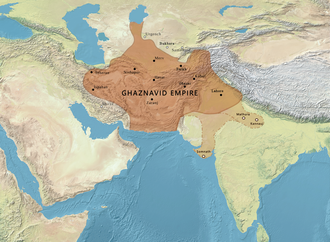
- Towards the end of the ninth century, Trans-Oxiana, Khurasan, and parts of Iran were ruled by the Samanids, who were of Iranian descent.
- The Samanids had to continuously battle non-Muslim Turkish tribes on their northern and eastern frontiers.
- This struggle led to the rise of a new type of soldier, the ghazi:
- The ghazis fought for both religion and the state’s safety.
- They acted as auxiliaries to the regular army and were sustained by plunder.
- Their resourcefulness and endurance helped Muslim states survive against Turkish incursions.
- Over time, many Turks converted to Islam, but conflicts with non-Muslim Turkish tribes continued.
- The Islamized Turkish tribes later emerged as the greatest defenders and crusaders of Islam, though their pursuit of plunder remained central.
- Foundation of the Ghaznavid Empire
- Among the Samanid governors was a Turkish slave, Alp-Tigin, who:
- Established an independent kingdom with its capital at Ghazni.
- After the collapse of the Samanid kingdom, the Ghaznavids inherited the responsibility of defending Islamic lands from Central Asian tribes.
- Mahmud of Ghazni (998–1030)
- Mahmud ascended the throne in 998 and is considered a hero of Islam by medieval Muslim historians due to:
- His defense against Central Asian Turkish tribal invaders, which further fueled the ghazi spirit.
- His association with the Iranian cultural renaissance:
- The Iranians resisted Arab cultural domination and maintained their language and traditions.
- The Samanids had already encouraged Persian language and literature.
- Firdausi’s Shah Namah, written in Mahmud’s court, glorified ancient Iranian heroes and the Iran-Turan conflict.
- Persian language and culture became dominant in the Ghaznavid empire.
- Mahmud himself claimed descent from the legendary Iranian king Afrasiyab.
- The Turks thus became both Islamized and Persianized, and they carried this culture into India two centuries later.
- Mahmud’s Invasions of India
- While Mahmud was a defender of Islam against Turkish invaders, in India, he is remembered as a plunderer and temple destroyer.
- He conducted seventeen raids into India, targeting:
- The Hindushahi rulers, who controlled Peshawar and Punjab.
- Their capital was at Udbhanda (Waihind, Peshawar).
- The Hindushahi rulers recognized the threat from Mahmud and attempted to counter it:
- Jayapala, the Hindushahi ruler, allied with:
- The displaced Samanid governor of Ghazni.
- The Bhati ruler of Multan.
- The Amir of Multan.
- However, their coalition failed, and Mahmud retaliated by devastating Kabul and Jalalabad.
- Defeat of the Hindushahis
- In 990–91, under Sabuk-Tigin (Mahmud’s father), the Shahis suffered a serious defeat, leading to the annexation of Kabul and Jalalabad.
- Mahmud, after ascending the throne in 998, renewed attacks on the Shahis:
- Jayapala had strengthened his rule by bringing Lahore under his control.
- His rule now extended from Peshawar to Punjab.
- In 1001, a decisive battle near Peshawar resulted in:
- A devastating defeat for Jayapala.
- The destruction of the Shahi capital.
- The cession of territory west of the Indus to Mahmud.
- Jayapala was succeeded by Anandpala, but in 1009, he too suffered defeat at the Indus.
- Mahmud overran Nandana (Salt Range) and captured Nagarkot.
- Anandpala ruled Lahore as a feudatory for some time but was eventually ousted in 1015.
- Mahmud’s Further Raids in India
- By 1015, the Ghaznavids controlled Punjab and Multan.
- Mahmud then launched a series of plundering raids into northern India, alternating with campaigns in Central Asia.
- His key plundering expeditions included:
- 1018:
- Attacks on Mathura and Kanauj.
- 1019:
- Attack on Kalinjar (Bundelkhand).
- 1025:
- Raid on Somnath (Gujarat).
- The Somnath temple was fabulously wealthy and attracted lakhs of pilgrims.
- Mahmud led 30,000 cavalrymen through Multan and Jaisalmer.
- The city commander fled, but local citizens put up strong resistance.
- Mahmud broke the Sivalingam and took parts of it back to Ghazni.
- On his return, he faced resistance from Jats in Sind, whom he later punished.
- Impact of Mahmud’s Raids
- Mahmud’s raids had two major consequences:
1. Political Impact:
- The Ghaznavid conquest of Punjab and Multan transformed North India’s political landscape.
- The northwestern frontier of India was now permanently breached.
- Turkish forces could penetrate deeper into the Indo-Gangetic plains.
2. Economic and Religious Impact:
- The plundered wealth financed Mahmud’s struggles in Central Asia.
- Mahmud posed as a great destroyer of idols for the glory of Islam.
- Decline of the Ghaznavids
-
- After Mahmud’s death in 1030, the Seljuk Empire rose to prominence, controlling:
- Syria
- Iran
- Trans-Oxiana
- The Seljuks and Ghaznavids fought for control of Khurasan.
- Masud, Mahmud’s son, was defeated and fled to Lahore.
- As a result, the Ghaznavid Empire shrank to Ghazni and Punjab.
- Though the Ghaznavids continued their plundering raids into India, they were no longer a serious military threat.
- Emergence of New States in North India
- Despite the Ghaznavid presence in Punjab, new kingdoms arose in North India that could counter their raids.
- This prevented further Turkish expansion into India for the next 150 years.
- The Rajput States
- Rise of Rajput States
- The emergence of the Rajputs and the debate about their origins have been previously mentioned.
- With the decline of the Pratihara Empire, multiple Rajput states arose in North India.
- Major Rajput dynasties included:
- Gahadavalas of Kanauj
- At its peak, the Gahadvala kingdom extended from Mongyr (Bihar) to Delhi.
- Govind Chandra (early 12th century) was the greatest ruler.
- Capital was Kanauj (with Banaras as a secondary capital).
- Persian sources refer to him as the greatest ruler of Hindustan.
- Known for resisting Ghaznavid raids into the doab.
- Jai Chandra, his successor, struggled against the Chauhans.
- Paramaras of Malwa
- Ruled the Malwa region in central India (present-day Madhya Pradesh and parts of Rajasthan) between the 9th and 14th centuries.
- They initially served as feudatories to the Rashtrakutas of Manyakheta
- Chauhans of Ajmer
- Originally served under the rulers of Gujarat.
- Established their capital at Nadol (late 10th century).
- Vigraharaj, their greatest ruler:
- Captured Chittor, established Ajmer (Ajayameru) as the capital.
- Built a Sanskrit college and the Anasagar lake at Ajmer.
- Resisted Ghaznavid invasions.
- Captured Delhi (Dhillika) from the Tomars (1151) but allowed them to rule as feudatories.
- Came into conflict with Paramaras of Malwa, ruled by the legendary Bhoja.
- Both Vigraharaj and Bhoja were patrons of poets and scholars.
- Bhoja was known for works on philosophy, poetics, yoga, and medicine.
- Other smaller dynasties:
- Kalachuris (Jabalpur region)
- Chandellas (Bundelkhand)
- Chalukyas (Gujarat)
- Tomars (Delhi)
- Bengal remained under the Palas, later replaced by the Senas.
- The Gahadavalas of Kanauj gradually pushed the Palas out of Bihar.
- Prithviraj III and the Chauhan-Gahadavala Rivalry
- Prithviraj III (Raja Prithviraj Chauhan):
- Ascended the throne in 1177 at the age of 11.
- Took full control of administration at 16.
- Focused on expanding his empire, subjugating smaller Rajput states.
- Struggled against the Chalukyan ruler of Gujarat.
- Shifted focus to Ganga Valley after failures in Gujarat.
- Led an expedition against Bundelkhand (Mahoba).
- Famous warriors Alha and Udal perished in this conflict.
- Jai Chandra of Kanauj supported Mahoba’s ruler against Prithviraj.
- Rivalries between Chauhans and Gahadavalas weakened Rajput unity, preventing them from ousting Ghaznavids from Punjab.
- Seljuk empire has replaced the Ghaznavid empire, but Ghaznavid empire was still surviving in the Punjab and nearby regions
- Rajput Society and Governance
- Clans were the foundation of Rajput society.
- Each clan traced its lineage to a common ancestor, real or mythical.
- Rajputs dominated compact territories, often organized in units of 12, 24, 48, or 84 villages.
- Chiefs distributed land among sub-chiefs and warriors for sustenance.
- Rajput society valued land, family, and honor (maan).
- Rajput rulers governed with the help of chiefs (rana or rawat), often blood relatives.
- Land tenure was considered sacred—lands were not taken away from subordinates unless in special cases (rebellion, lack of an heir, etc.).
- Strengths and Weaknesses of Rajput Organization
- Strengths:
- Brotherhood and egalitarianism among Rajputs.
- Weaknesses:
- Lack of discipline due to egalitarianism.
- Long-standing feuds between families.
- Exclusive clan identity—refused to extend unity to non-Rajputs.
- Disconnection from the common people—Rajputs formed only 10% of Rajasthan’s population and their proportion in other Rajput-dominated areas was also low.
- Rajput Warfare and Military Culture
- Rajputs treated war as a sport.
- Land and cattle disputes led to constant inter-state conflicts.
- Ideal rulers were expected to lead armies after Dussehra festival to invade neighbors.
- Civilians suffered the most due to these wars.
- Religious Patronage
- Most Rajput rulers were staunch Hindus, with some also patronizing Jainism.
- Brahmins and temples received generous land grants and donations.
- Rajput rulers upheld Brahmin privileges and the caste system.
- Lower land revenue rates for Brahmins continued in some Rajput states until Indian Union merger.
- Brahmins legitimized Rajput claims as descendants of ancient Kshatriya dynasties.
- Temple Architecture
- 10th-12th century marked the climax (the most intense, exciting, or important part of something) of temple construction in North India.
- Nagara style became prominent:
-
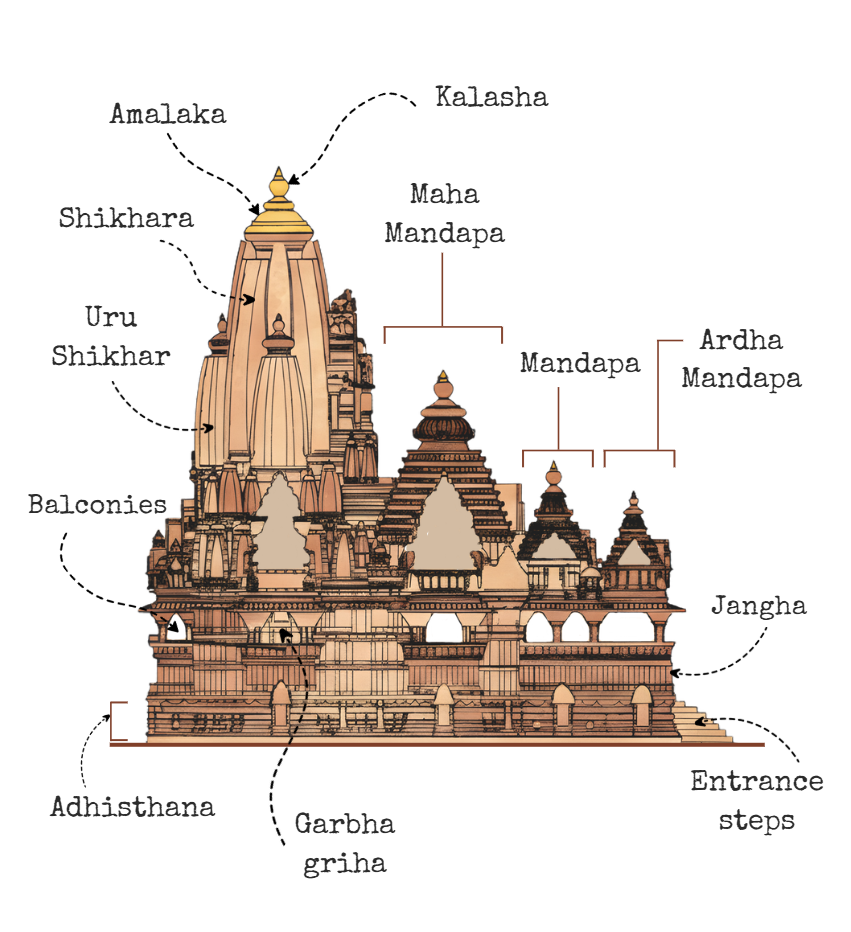
- Tall curved spiral roofs (shikharas) over sanctum (garbhagriha).
- Square main room with projections on sides.
- Mandapa (anteroom) added in front.
- Sometimes enclosed by high walls with lofty gates.
- Major Temples and Centers
- Khajuraho (Madhya Pradesh) – Built by Chandellas
- Parsvanatha Temple
-

- Visvanatha Temple
-

- Kandarya Mahadeo Temple
-
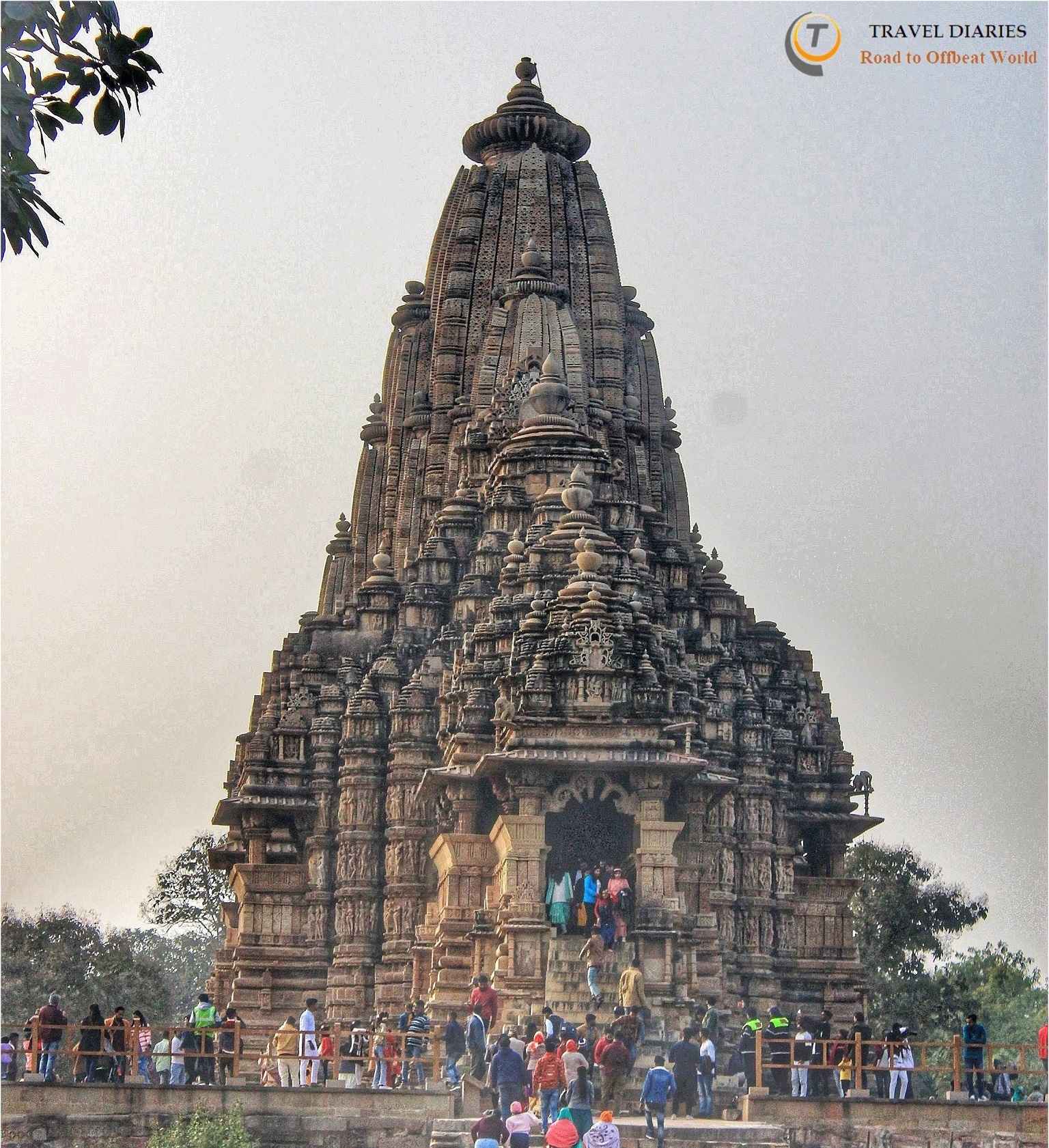
- Orissa – Notable temples:
- Lingaraja Temple (11th century, Bhubaneshwar)
-
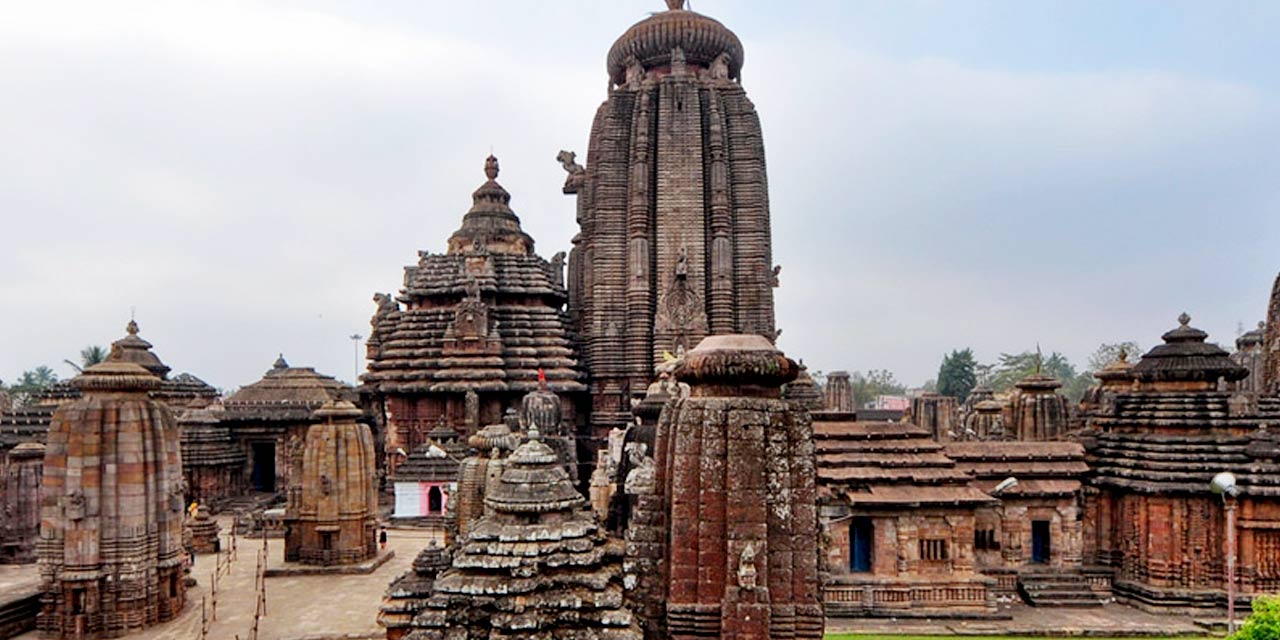
- Sun Temple (13th century, Konark)
-
- Jagannatha Temple (Puri)
-
- Other important sites:
- Mathura
- Banaras
- Dilwara (Abu, Rajasthan)
-
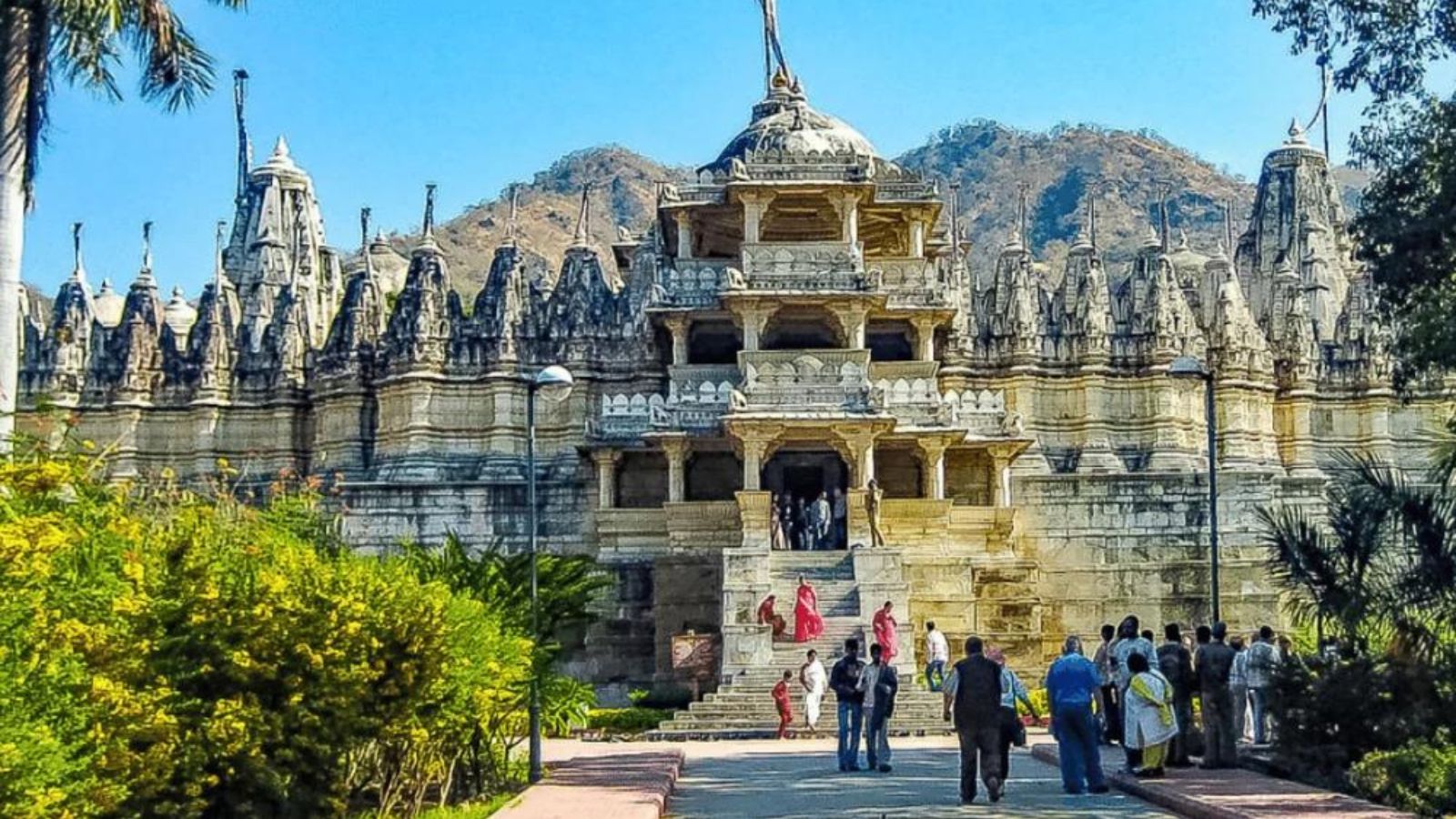
- Temples became centers of social and cultural life.
- Some, like Somnath, amassed great wealth and even engaged in business.
-

- Rajputs also built forts, palaces, and public works (stepped wells, bunds, etc.).
- Patronage of Arts and Literature
- Rajput rulers supported Sanskrit scholars and poets.
- Vastupala, minister of Chalukyan ruler Bhima (Gujarat):
- Writer, patron of scholars.
- Builder of Jain temple at Mt. Abu.
- "Mount Abu" is a hybrid of an English title and a local name. While "Abu" is ancient, the word "Mount" was added by the British during the colonial era to identify it as a hill station.
- Ujjain and Dhara (Paramara capitals) were Sanskrit learning centers.
- Literature in Apabhramsha and Prakrit flourished, particularly among Jain scholars.
- Hemachandra (famous Jain scholar) wrote in Sanskrit and Apabhramsha.
- Revival of Brahmanism led to Sanskrit replacing Apabhramsha/Prakrit among elites.
- Emergence of modern North Indian languages (Hindi, Bengali, Marathi) from regional dialects.
- The Turkish Conquest of North India
- Patterns of Hindu-Muslim Relations Post-Ghaznavid Conquest
- After the Ghaznavid conquest of Punjab, two distinct patterns of relations between Muslims and Hindus emerged:
1. Raids for Plunder
- The successors of Mahmud of Ghazni carried out raids into the Gangetic valley and Rajputana, lured by wealth. The Rajput rulers put up strong resistance and won several victories against the Turks. However, the declining power of the Ghaznavid state and the Rajputs’ successes made them complacent.
2. Trade and Cultural Exchange
- Muslim traders were welcomed as they facilitated trade between India and Central/West Asia, boosting the state’s income. As a result, Muslim colonies emerged in several towns of North India. Alongside traders, Sufi preachers arrived in Punjab, spreading their message of love, faith, and dedication to one God. Although their primary audience was Muslim settlers, they also influenced some Hindus.
- Additionally, Lahore became a center of Arabic and Persian learning, and Hindu generals, such as Tilak (a barber by caste), served in the Ghaznavid armies, which also recruited Hindu (Jat) soldiers.
- The Rise of the Ghurids
- These interactions between Hindus and Muslims might have continued indefinitely, but a significant change in Central Asia’s political landscape altered the course of history.
- By the mid-12th century, Turkish tribesmen (partly Buddhist, partly pagan) destroyed the power of the Seljuk Turks.
- This led to the rise of two new powers:
- The Khwarazmian Empire (based in Iran)
-

- The Ghurid Empire (based in Ghur, northwest Afghanistan)
-
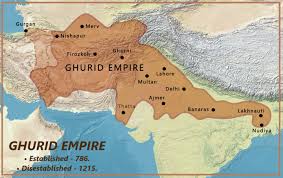
- The Ghurids, initially vassals of the Ghaznavids, revolted and overthrew them. Under Sultan Alauddin, known as “Jahan-Soz” (the world burner), the Ghurids completely destroyed Ghazni in retaliation for past hostilities.
- The Khwarazmians soon conquered Khurasan, restricting Ghurid expansion in Central Asia.
- Left with no alternative, the Ghurids turned their focus towards India.
- Muizzuddin Muhammad’s Early Conquests (1173–1190)
- In 1173, Muizzuddin Muhammad bin Sam (also known as Shahabuddin Muhammad or Muhammad of Ghur) ascended the throne at Ghazni, while his elder brother ruled Ghur.
- He launched his first campaigns into India via the Gomal Pass, capturing Multan and Uchch.
- In 1178, he attempted to invade Gujarat but was defeated near Mount Abu. This defeat made him realize the importance of first securing Punjab before attempting deeper conquests in India.
- By 1190, Muizzuddin Muhammad had successfully:
- Conquered Peshawar, Lahore, and Sialkot
- Established a stronghold in Punjab, preparing for an advance towards Delhi and the Gangetic Doab
- The Rise of the Chauhans
- Meanwhile, significant developments were taking place in North India:
- The Chauhans had emerged as a dominant power.
- They had defeated and killed several Turkish invaders attempting to enter Rajasthan from Punjab.
- Around the mid-12th century, the Chauhans had also captured Delhi (Dhillika) from the Tomars.
- Their expansion towards Punjab brought them into direct conflict with the Ghaznavid rulers of the region.
- This growing power struggle set the stage for a decisive confrontation between the Ghurids and the Rajputs, which would soon unfold.
- The Battle of Tarain
- First Battle of Tarain (1191)
- A conflict between Muizzuddin Muhammad and Prithviraj Chauhan was inevitable, as both had rival claims over Tabarhinda.
- In 1191, the two forces clashed at Tarain, where Prithviraj’s army decisively defeated the Ghurids.
- Muizzuddin Muhammad barely escaped with his life, thanks to a young Khalji horseman.
- After this victory, Prithviraj captured Tabarhinda following a 12-month siege.
- However, he made little effort to expel the Ghurids from Punjab, possibly believing it was just another temporary Turkish raid.
- This miscalculation gave Muizzuddin Muhammad the time to regroup and plan another invasion the following year. He rejected Prithviraj’s proposal to let the Ghurids retain Punjab.
- Second Battle of Tarain (1192): A Turning Point in Indian History
- The Second Battle of Tarain (1192) proved decisive, as Muizzuddin Muhammad made meticulous preparations:
- He reportedly marched with 120,000 men, including:
- Heavy cavalry in full steel armor
- 10,000 mounted archers
- Prithviraj was not negligent; he recognized the Ghurid threat early and sought support from other northern Indian rajas.
- Many rulers sent contingents, but Jaichandra of Kanauj refused to help, possibly due to old rivalries rather than the legendary tale of Prithviraj’s abduction of Jaichandra’s daughter, Sanyogita.
- The Battle and its Aftermath
- Prithviraj’s army reportedly had 300,000 troops, including a large cavalry force and 300 elephants.
- Despite their numerical superiority, the Turkish army’s superior organization, discipline, and cavalry tactics proved decisive.
- The Turkish cavalry, with their mounted archers and heavy cavalry, outmaneuvered and overwhelmed the Rajput forces.
-

- Prithviraj attempted to escape but was captured near Saraswati (Sirsa).
- Consolidation of Turkish Rule
- After the victory, the Ghurids systematically expanded their control:
- Hansi, Saraswati, and Samana were captured.
- Ajmer was seized, though Prithviraj was briefly allowed to rule under Ghurid suzerainty—evident from coins bearing both his name and that of Muizzuddin Muhammad.
- Prithviraj was eventually executed for “conspiracy”, and his son briefly succeeded him.
- The Establishment of Turkish Power in Delhi and Rajasthan
- Delhi was initially restored to the Tomars, but this policy was soon reversed.
- Delhi became the base for further Turkish expansion into the Ganga Valley.
- After a rebellion in Ajmer, a Turkish general was installed as the new ruler.
- Prithviraj’s son fled to Ranthambor, where he founded a new Chauhan kingdom.
- Thus, Delhi and eastern Rajasthan fell under Turkish rule, marking the beginning of Turkish dominance in northern India.
- Expansion and Consolidation of Turkish Rule (1192–1206)
- Conquest of the Ganga-Jamuna Doab and Kanauj
- Between 1192 and 1206, the Turks extended their rule over the Ganga-Jamuna Doab, Bihar, and Bengal. However, to secure control over the Doab, they first had to defeat the Gahadavala kingdom of Kanauj, ruled by Jaichandra.
- Jaichandra, though ruling peacefully for two decades, was not a strong warrior and had earlier suffered defeat against the Sena king of Bengal.
- After the Battle of Tarain (1192), Muizzuddin Muhammad returned to Ghazni, entrusting Indian affairs to his slave and general, Qutbuddin Aibak.
- Over the next two years, the Turks overran parts of the upper Doab without resistance from the Gahadavalas.
- Battle of Chandawar (1194) and its Aftermath
- In 1194, Muizzuddin returned to India, leading 50,000 cavalry across the Yamuna towards Kanauj.
- A fierce battle was fought at Chandawar, where Jaichandra was killed by an arrow, and his army was defeated.
- Muizzuddin then marched to Banaras, where he destroyed many temples.
- The Turks established control over a vast territory, extending to the borders of Bihar.
- These victories at Tarain (1192) and Chandawar (1194) laid the foundation of Turkish rule in northern India, though consolidating it took nearly fifty years.
- Further Turkish Expansion
- Muizzuddin Muhammad occupied the forts of Bayana and Gwalior, securing Delhi’s southern flank. Soon after, Aibak conquered Kalinjar, Mahoba, and Khajuraho from the Chandel rulers.
- With a firm base in the Doab, the Turks launched raids into neighboring regions.
- Aibak defeated Bhima III of Gujarat, plundering Anhilwara and other towns. However, the Turks were not strong enough to hold such distant territories.
- Conquest of Bihar and Bengal
- The Turks found greater success in the east under Bakhtiyar Khalji, a Khalji officer appointed to govern areas beyond Banaras.
- Bakhtiyar Khalji was a parallel military commander, not a Sultan of Delhi. He fits between Ghori’s expansion and Aibak’s establishment of the Sultanate.
- Bakhtiyar Khalji repeatedly raided Bihar, which was largely undefended.
- During these attacks, he destroyed famous Buddhist monasteries, including Nalanda and Vikramasila, amassing wealth and followers.
- He also gathered intelligence on Bengal, a rich land known for its resources and trade.
- Conquest of Bengal (c. 1204)
- After careful planning, Bakhtiyar Khalji marched towards Nadia, where Lakshmana Sena, the Sena ruler of Bengal, had built a palace.
- Disguised as a horse merchant, Bakhtiyar launched a surprise attack on the palace, causing widespread confusion.
- Taken off guard, Lakshmana Sena fled, allowing Bakhtiyar’s forces to capture the palace.
- Soon after, Bakhtiyar occupied Lakhnauti (the Sena capital) without opposition, while Lakshmana Sena retreated to Sonargaon in southern Bengal, where he continued to rule.
- Though Muizzuddin appointed Bakhtiyar as Bengal’s governor, he largely ruled independently.
- Bakhtiyar’s Downfall
- Bakhtiyar’s rule was short-lived.
- He led a disastrous campaign into the Brahmaputra valley (Assam), where his army suffered from hunger, illness, and a total military defeat.
- Trapped between a river and Assamese forces, the Turks were annihilated.
- Bakhtiyar barely escaped with a handful of followers but was later stabbed by one of his own officers and died.
- Muizzuddin Muhammad’s Final Years (1203–1206)
- Meanwhile, Muizzuddin Muhammad and his brother attempted to expand the Ghurid empire into Central Asia.
- In 1203, Muizzuddin suffered a crushing defeat against the Khwarizmi empire, forcing him to shift his focus entirely to India.
- This defeat allowed the rise of a Turkish state centered in India.
- In 1206, the Khokhars, a powerful tribe in western Punjab, revolted. Muizzuddin led a large campaign against them, massacring many and crushing the rebellion.
- However, on his way back to Ghazni, Muizzuddin Muhammad was assassinated by a Muslim fanatic from a rival sect.
- Comparison: Muizzuddin Muhammad vs. Mahmud of Ghazni
- Muizzuddin is often compared to Mahmud of Ghazni, though their situations and achievements differed:
- Mahmud of Ghazni had a larger empire and was more successful in Central Asia.
- Muizzuddin Muhammad’s political achievements in India were greater, as he established a lasting Turkish state.
- Mahmud’s conquest of Punjab paved the way for Muizzuddin’s success in northern India.
- While both rulers used Islamic slogans to justify their conquests and plundering, neither was truly motivated by religious zeal.
- They often allowed defeated rulers to retain power, annexing regions only when necessary.
- Thus, Muizzuddin’s victories and policies led to the foundation of the Delhi Sultanate, marking the beginning of Turkish dominance in India.
- Causes of the Defeat of the Rajputs
- Basic info
- The rapid conquest of the leading Rajput states in north India by the Turks within a short span of 15 years requires careful analysis.
- A country is typically conquered when it suffers from social, political, economic, or military weaknesses compared to its neighbors.
- In the case of the Rajputs, their defeat was not due to technological inferiority but rather organizational and strategic shortcomings.
- Military Technology: No Clear Turkish Superiority
- The Turks did not possess significantly superior weapons compared to the Indians.
- The iron stirrup, which revolutionized warfare in Europe, had been in use in India since the 8th century.
- The Turkish bows had a longer range, but Indian bows were considered more accurate and deadly, often with poisoned arrowheads.
- In hand-to-hand combat, Indian swords were among the best in the world.
- Elephants provided a key advantage for the Indian armies, while the Turkish cavalry likely had swifter and sturdier horses.
- Organizational and Structural Weaknesses of the Rajputs
- Rise of feudalism in India weakened administrative and military coordination.
- Rajput rulers relied on regional chiefs, who rarely acted in coordination and dispersed after battles.
- In contrast, the Turks maintained large standing armies through the Iqta and Ahalisa systems, allowing them to sustain prolonged campaigns.
- The Turks excelled in mobility and coordination, while the Rajputs lacked:
- Organized cavalry forces that could move quickly across long distances.
- Large units of mounted archers or heavily armed cavalry, which were crucial in battle.
- Despite possessing greater human and physical resources than the Ghaznavid and Ghurid empires, the Rajputs were unable to recover from their defeats due to their poor military organization.
- Advantages of the Turkish Military System
- The Iqta system ensured that Turkish chiefs had:
- Land grants from which they collected revenue for the state.
- An obligation to maintain troops for the Sultan.
- Non-hereditary land tenure, which prevented local feudalism from developing.
- The Sultan controlled revenues directly from Ahalisa lands, allowing him to maintain a large standing army.
- The Turkish military was centralized, unlike the fragmented Rajput states.
- Many Turkish officers were slaves who:
- Were trained specifically for warfare.
- Loyal to the Sultan, ensuring a stable and professional military command.
- Role of Personal Bravery and Religious Motivation
- The Rajputs were no less brave than the Turks in battle.
- The Turks fought under the ‘Ghazi’ spirit, while the Rajputs considered retreat dishonorable.
- Caste was not a barrier in Rajput armies—non-Rajputs and lower castes also participated in warfare, making Rajput forces numerically superior in many battles.
- Lack of Strategic Vision Among the Rajputs
- From the 10th century onward, the Turks had been infiltrating India.
- The Rajputs fiercely resisted and won several battles, but they lacked long-term strategic vision.
- Once outer defenses like Kabul and Lahore fell, the Rajputs failed to reclaim them, allowing the Turks a foothold in Punjab.
- The Rajputs focused solely on internal Indian conflicts and ignored developments in Central Asia, which had historically influenced Indian history.
- Conclusion
- While the Turks did not have clear military superiority, their better organization, centralized administration, and strategic planning helped them defeat the divided and feudal Rajput states.
- The Rajputs fought bravely but lacked coordination and long-term vision, ultimately leading to their defeat and the establishment of Turkish rule in north India.
- The Delhi Sultanate—I (Circa 1200-1400)
-
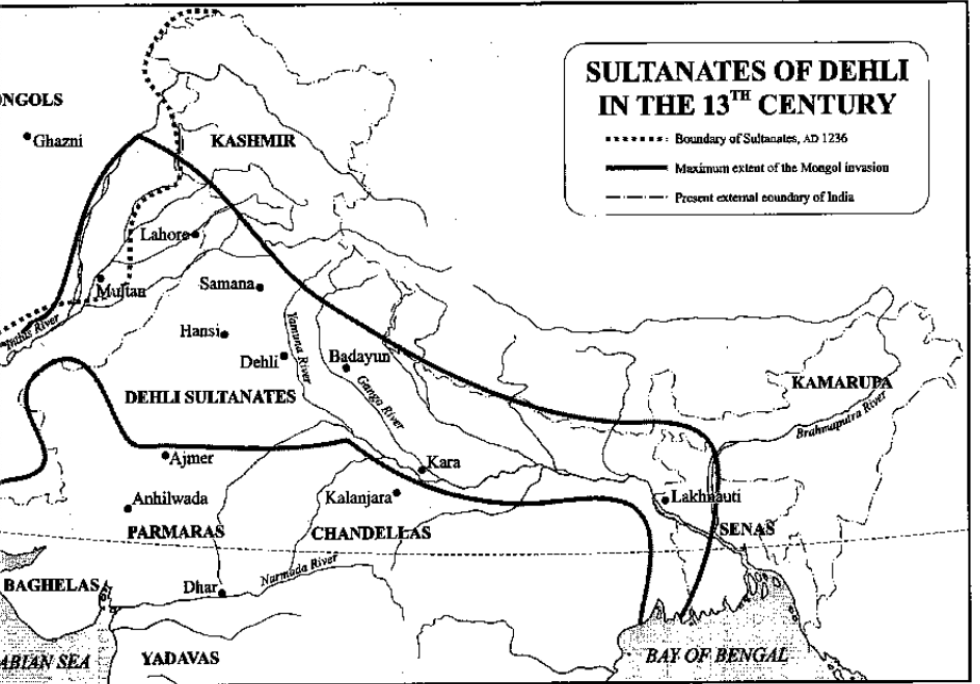
- The Mamluk Sultans (13th Century)
- After their conquest of Punjab and Multan, the Turks expanded into the Ganga Valley, Bihar, and parts of Bengal. However, for nearly a century after their initial success, the newly established Delhi Sultanate faced several challenges
- Challenges to the Delhi Sultanate
- Foreign invasions threatened the stability of the Sultanate.
- Internal conflicts among Turkish leaders weakened central authority.
- Rajput resistance—dispossessed and subordinate Rajput rulers attempted to regain independence and expel the Turks.
- Despite these difficulties, the Turkish rulers managed to consolidate their power.
- Expansion of the Delhi Sultanate
- By the end of the 13th century, the Sultanate was strong enough to:
- Extend its rule over Malwa and Gujarat.
- Begin penetrating into the Deccan and South India.
- Impact of Turkish Rule in India
- Within a hundred years, Turkish rule led to:
- Significant social, administrative, and cultural changes across India.
- The integration of new governance structures that shaped the future of Indian polity.
- Thus, the establishment of the Mamluk dynasty not only secured Turkish rule in northern India but also set the stage for further expansion and lasting transformations in Indian society.
- Struggle for the Establishment of a Strong Monarchy
- Succession After Muizzuddin (Muhammad of Ghur)
- After Muizzuddin’s death in 1206, his empire was divided among his generals.
- Qutbuddin Aibak
- Qutbuddin Aibak, a Turkish slave, took control of Delhi and became the first ruler of the Delhi Sultanate.
- Yalduz
- Meanwhile, another slave of Muizzuddin, Yalduz, succeeded in Ghazni and claimed authority over Delhi.
- Aibak’s Independence from Ghazni
- Aibak refused to accept Yalduz’s claim and ruled independently from Lahore.
- This marked a permanent break between Delhi and Ghazni, allowing the Delhi Sultanate to develop independently.
- Significance of the Break from Central Asia
- Severing ties with Ghazni protected India from being entangled in Central Asian politics.
- The Delhi Sultanate evolved as a distinct political entity, focusing on Indian affairs rather than external influences.
- This early assertion of independence laid the foundation for a strong and self-sufficient monarchy in India.
- Iltutmish (1210-1236) – The Real Consolidator of Turkish Rule
- Accession to the Throne
- Aibak died in 1210 due to injuries from a fall while playing changan (polo).
- He was succeeded by Iltutmish, his son-in-law.
- However, Aibak’s son also claimed the throne, leading to a succession battle.
- Iltutmish defeated Aibak’s son, preventing the principle of hereditary succession from taking root in the Delhi Sultanate.
- Iltutmish faced opposition from multiple fronts:
- Ali Mardan Khan declared himself ruler of Bengal and Bihar.
- Qubacha, a fellow slave of Aibak, seized Lahore and parts of Punjab and declared independence.
- Rajputs rebelled, reclaiming Kalinjar, Gwalior, and much of eastern Rajasthan (Ajmer, Bayana, etc.).
- Even some of Iltutmish’s officers near Delhi were hesitant to accept his rule.
- Securing the Northwest and the Mongol Threat
- Iltutmish’s primary concern was the Khwarazm Shah’s conquest of Ghazni, bringing the powerful Khwarazm Empire to India’s doorstep.
- To counter this, Iltutmish occupied Lahore to check the threat.
- In 1218, the Mongols under Genghis Khan destroyed the Khwarazm Empire, creating one of the most powerful empires in history.
- While the Mongols were distracted elsewhere, Iltutmish defeated Qubacha, reclaiming Multan and Uchch.
- This extended the Delhi Sultanate’s frontier to the Indus once again.
- Suppressing Rebellions in Bengal and Bihar
- Iwaz, who took the title Sultan Ghiyasuddin, declared independence in Bengal and Bihar.
- He was known for his public works and military raids, but Delhi’s authority remained weak in the region.
- In 1226-27, Iltutmish’s son defeated and killed Iwaz near Lakhnauti, bringing Bengal and Bihar back under Delhi’s control.
- However, Bengal and Bihar continued to challenge Delhi’s authority in the years to come.
- Expanding Control Over Rajput Territories
- Iltutmish recaptured Gwalior and Bayana.
- Ajmer and Nagor were also brought under his rule.
- He launched expeditions against Ranthambhor and Jalor to reassert Delhi’s dominance.
- Nagda, the capital of Mewar (near Udaipur), was attacked, but Iltutmish had to retreat when the Gujarat armies arrived to support the Rana of Mewar.
- In retaliation, Iltutmish sent an expedition against the Chalukyas of Gujarat, but it was defeated with losses.
- Conclusion
- Iltutmish not only defended Delhi Sultanate from internal rebellions and external threats but also strengthened Turkish rule in north India. His reign laid the foundation for a strong centralized state, making him the real consolidator of the Turkish conquests.
- Raziya (1236-1239) – Only Woman Ruler of the Delhi Sultanate
- Iltutmish’s Unconventional Succession Choice
- In his final years, Iltutmish faced a succession crisis, believing none of his surviving sons were fit to rule.
- After much deliberation, he nominated his daughter, Raziya, as his successor.
- He convinced the nobles and theologians (ulama) to accept her nomination, a bold and unprecedented decision in Indian history.
- While women had ruled in Iran and Egypt, a woman being chosen over male heirs was a radical departure from tradition.
- Raziya’s Struggles for Power
- To secure her throne, Raziya had to fight:
- Her brothers, who opposed her rule.
- The powerful Turkish nobles, known as ‘Chahalgani’ (the Forty), who wanted a puppet ruler they could control.
- Despite being a woman, Raziya was determined and independent:
- She discarded female attire and held court unveiled.
- She led armies in battle and actively participated in governance.
- Iltutmish’s wazir, Nizam-ul-Mulk Junaidi, opposed her elevation and backed a noble rebellion against her.
- Raziya defeated him, forcing him to flee.
- She also sent an expedition against Ranthambhor, successfully establishing law and order.
- Opposition from the Turkish Nobles
- Raziya attempted to build a faction of nobles loyal to her, challenging the power of the Turkish aristocracy.
- She appointed Yaqut Khan, an Abyssinian noble, as Superintendent of the Royal Stable, a position of trust and closeness to the ruler.
- This led to accusations from the Turkish nobles, who:
- Claimed Raziya was violating feminine modesty.
- Spread false rumors of personal intimacy with Yaqut Khan.
- However, contemporary writers do not confirm these allegations:
- The claim that Yaqut lifted her onto her horse is false because Raziya always appeared in public on an elephant, not horseback.
- Rebellions and Downfall
- Revolts broke out in Lahore and Sirhind.
- Raziya personally led an expedition against Lahore, forcing the governor to submit.
- During the march to Sirhind, internal rebellion struck:
- Yaqut Khan was killed.
- Raziya was captured and imprisoned at Tabarhinda.
- She managed to win over her captor, Altunia, and married him in a bid to regain power.
- Together, they attempted to retake Delhi, but she was defeated.
- While Razia was imprisoned, the nobles in Delhi did not keep the throne vacant.
- They installed Bahram Shah (1240–1242 CE), another son of Iltutmish, as Sultan.
- Bahram Shah became a puppet ruler of the powerful Turkish nobles.
- While fleeing, Raziya was killed by bandits in a forest, marking the tragic end of her short but remarkable reign.
- Conclusion
- Raziya’s rule was brief but significant, as it marked:
- The first open power struggle between the monarchy and Turkish nobles.
- A bold challenge to gender norms, as she ruled with authority and military leadership.
- The failure of the Turkish elite to accept a strong, independent female ruler, ultimately leading to her downfall.
- Era of Balban (1246-1287) – The Architect of Strong Monarchy
- Rise to Power
- The struggle between the monarchy and the Turkish nobles continued after Iltutmish’s rule.
- Ulugh Khan (later known as Balban) gradually consolidated power and ultimately ascended the throne in 1265.
- Before becoming Sultan, he served as naib (deputy) to Nasiruddin Mahmud, a younger son of Iltutmish, whom Balban had helped secure the throne in 1246.
- To strengthen his influence, Balban married his daughter to the young sultan.
- His growing power alienated the Turkish nobles, who had hoped to control the government under the inexperienced Nasiruddin Mahmud.
- Conflict with the Turkish Nobles
- In 1253, the Turkish nobles conspired against Balban and removed him from power, replacing him with Izzuddin Raihan, an Indian Muslim.
- The nobles accepted Raihan’s appointment as they could not agree among themselves on who should take Balban’s place.
- Balban stepped aside but quietly built his own faction.
- Within 1.5 years, he regained influence, preparing for a military showdown.
- He may have established contact with the Mongols, who controlled much of Punjab.
- Seeing Balban’s growing power, Sultan Mahmud dismissed Raihan; later, Raihan was defeated and killed.
- Balban eliminated his rivals by any means necessary, even assuming the royal insignia (chaher) before formally ascending the throne.
- Ascension to the Throne (1265)
- Nasiruddin Mahmud died in 1265, possibly poisoned by Balban.
- Some historians also suggest that Balban had Mahmud’s sons killed to clear his path to the throne.
- Harsh as his methods were, his rule marked the beginning of strong, centralized government in the Delhi Sultanate.
- Strengthening the Monarchy
- Balban believed that only a strong monarchy could handle the internal and external threats to the empire.
- He sought to increase the prestige and authority of the Sultanate by declaring himself a descendant of the legendary Iranian king Afrasiyab.
- To prove his noble lineage, he became the self-proclaimed ‘champion of Turkish nobility’.
- He excluded Indian Muslims from high offices, refusing to entertain anyone who lacked noble ancestry.
- His elitism extended to ridiculous extremes:
- He refused to grant an audience to an important trader because he was not high-born.
- The historian Barani quoted Balban as saying:
- “Whenever I see a base-born ignoble man, my eyes burn, and I reach in anger for my sword (to kill him).”
- Suppression of the Turkish Nobles (Chahalgani)
- Despite championing the Turkish nobility, Balban was not willing to share power.
- He broke the power of the ‘Chahalgani’ (the Forty Turkish Nobles) and centralized authority under himself.
- To achieve this, he even poisoned his cousin, Sher Khan.
- Though a despot, he ensured impartial justice and punished even the highest-ranking officials if they defied him.
- Military Reforms and Internal Stability
- Established a spy network in every department to stay informed.
- Strengthened the army to suppress internal rebellions and defend against the Mongols.
- Reorganized the military department (Diwan-i-Arz) and pensioned off unfit soldiers.
- When retired soldiers (mainly Turks from Iltutmish’s time) protested, he had to partially withdraw this decision.
- Law and Order: The ‘Blood and Iron’ Policy
- The Ganga-Jamuna Doab and Awadh had become unsafe due to robbers, dacoits, and rebellious zamindars.
- Near Delhi, the Mewatis plundered villages as far as the city’s outskirts.
- To crush these elements, Balban enforced a ruthless policy of ‘Blood and Iron’:
- The Meos were brutally hunted down and killed.
- Forests around Delhi were cleared to prevent hideouts for criminals.
- Numerous military outposts (thanas) were established.
- His harsh methods restored order, impressing people with the strength of his government.
- Court Etiquette and Royal Prestige
- Balban projected an image of absolute power through elaborate ceremonies:
- He maintained a grand court, surrounded by bodyguards with drawn swords.
- He refused to laugh or joke in court and even gave up drinking wine to maintain his majestic demeanor.
- He introduced Iranian customs, such as:
- Sajada (prostration)
- Paeos (kissing the monarch’s feet)
- Though considered un-Islamic, these ceremonies were tolerated because the Delhi Sultanate stood as a symbol of Islamic power after the Mongol invasions destroyed many Muslim states.
- Military Policy and the Mongol Threat
- Despite having a strong army, Balban avoided distant military campaigns, fearing Mongol attacks on Delhi.
- Instead, he:
- Focused on defense and internal stability.
- Led only one major expedition to Bengal.
- Kept the army active through large-scale hunting expeditions.
- Death and Legacy (1286-1287)
- Balban died in 1286, marking the end of his strong, centralized rule.
- He was one of the main architects of the Delhi Sultanate, particularly in:
- Strengthening the monarchy’s authority.
- Establishing a rigid administrative structure.
- Defining the Sultanate’s institutions and governance model.
- However, his narrow focus on Turkish nobles and exclusion of non-Turks created dissatisfaction, leading to instability after his death.
- His failure to fully protect India from Mongol invasions remained a significant weakness of his rule.
- The Mongols and the Problem of the Northwest Frontier
- India’s Vulnerability in the Northwest
- India’s natural boundaries largely protected it from external invasions, except in the northwest.
- Invaders like the Huns, Scythians, and Turks entered India through the mountain passes in this region.
- To prevent invasions into the fertile lands of Punjab and Sindh, control over the area extending from Kabul to Ghazni and Qandahar was crucial.
- This region, flanked by the Hindukush, was the main route for reinforcements from Central Asia.
- Due to political instability in West Asia, the Delhi Sultanate could not establish firm control over these frontiers, leaving India vulnerable.
- The Khwarazmian Empire and the Rise of the Mongols
- The Ghurids lost control over Kabul, Qandahar, and Ghazni when the Khwarazmian Empire emerged.
- The Khwarazmians extended their boundary to the Indus, setting the stage for a struggle with the successors of Qutbuddin Aibak.
- Before this struggle could unfold, a greater threat emerged: Chinggis Khan, the Mongol leader, who called himself “the scourge of God.”
- In 1218, the Mongols attacked the Khwarazmian Empire, sacking cities from the Jaxartes to the Caspian Sea and from Ghazni to Iran.
- The Mongols used terror as an instrument of war, massacring resisting cities and enslaving women and children.
- Craftsmen were taken for the Mongol army, while others were drafted for labor.
- The Mongol conquest devastated the region’s economy and cultural life, though eventual peace and trade revival led to slow recovery.
- Many princes, scholars, theologians, and learned men fled to Delhi, making it a major center of Islam.
- Turkish rulers, cut off from their homelands, had to adapt to Indian conditions.
- Chinggis Khan and the Mongol Threat to India (1221)
- After defeating the Khwarazmian ruler, Jalaluddin, Chinggis Khan pursued him to the Indus River.
- Jalaluddin fought bravely but was defeated and escaped by crossing the Indus into India.
- Chinggis Khan remained near the Indus for three months but did not invade India, focusing instead on Central Asia.
- Had Chinggis invaded, India might have faced destruction greater than that caused by the Turks.
- The Delhi Sultan Iltutmish diplomatically avoided conflict by refusing to grant asylum to Jalaluddin.
- Jalaluddin stayed in the Cis-Sutlej region, leading to frequent Mongol raids.
- Consequently, the Indus ceased to be India’s western boundary.
- Defense of Lahore and Multan
- Lahore and Multan were contested by Iltutmish, Yalduz, and Qubacha.
- Their internal conflict weakened their positions, allowing Iltutmish to capture both cities.
- This strengthened Delhi’s defense against Mongol incursions.
- The Mongols after Chinggis Khan (1227–1240)
- After Chinggis Khan’s death in 1227, his empire was divided among his sons.
- Mongols under Batu Khan focused on conquering Russia, delaying further invasions into India.
- This period allowed the Delhi Sultans to consolidate power and strengthen their army.
- Mongol Raids and Balban’s Defense Strategy
- In 1241, Tair Bahadur, the Mongol commander in Herat, Ghur, Ghazni, and Turkestan, sacked Lahore.
- In 1245, Mongols attacked Multan, but Balban’s swift response saved it.
- Balban faced Mongol pressure on the frontiers, especially when some Turkish nobles, including Sher Khan (Governor of Multan), sided with the Mongols.
- The Delhi frontier shifted from the Jhelum to the Beas, with Multan constantly under Mongol pressure.
- Balban’s Strategy:
- Repaired forts at Tabarhinda, Sunam, and Samana to block Mongol advances.
- Remained in Delhi for constant frontier vigilance.
- Sent diplomatic envoys to Halaku Khan, the Mongol Il-Khan of Iran, maintaining peace.
- Avoided war with the Mongols by allowing them to control much of Punjab.
- Regular military campaigns kept Mongol incursions in check.
- Placed his son, Prince Mahmud, in charge of Multan, who later died defending it.
- Mongol Invasions during the Khalji Era (1292–1306)
- After Balban’s death in 1286, his defensive strategies continued.
- In 1292, Abdullah, a grandson of Halaku Khan, invaded with 150,000 troops but was defeated by Jalaluddin Khalji.
- 4,000 Mongols converted to Islam and settled near Delhi.
- Mongol invasions into Punjab increased due to political shifts in Central Asia.
- Alauddin Khalji’s Mongol Campaigns
- In 1297, Dawa Khan, Mongol ruler of Transoxiana, tried to conquer India.
- In 1299, his son, Qutlugh Khwaja, led a 200,000-strong army to capture Delhi.
- Mongols cut off Delhi’s communication lines and entered its streets.
- Alauddin Khalji fought back, refusing to surrender.
- Zafar Khan, a key general, was killed in battle.
- The Mongols retreated without a decisive battle.
- In 1303, Mongols returned with 120,000 troops while Alauddin was besieging Chittor.
- He fortified Delhi at Siri and faced the Mongols for two months.
- Daily skirmishes caused hardship to Delhi’s citizens.
- Mongols retreated without success.
- More details on this event
- Alauddin Khalji had just successfully captured the fort of Chittor (August 1303) when he received the news that a massive Mongol force of 120,000 cavalry, led by Targhi, was rapidly advancing toward Delhi.
- Alauddin rushed back to Delhi, but he arrived in a state of extreme disadvantage.
- By the time Alauddin reached Delhi, the Mongols under Targhi had already arrived and blocked the roads. Alauddin could not enter the main city of Delhi (Siri) with his full force.
- Unable to engage the Mongols in an open field battle due to his weakened state, Alauddin took a defensive stance. He entrenched himself at Siri (his newly built capital city).
- Barani called it "luck"
- For two months, the Mongols besieged Alauddin at Siri. They plundered the surrounding areas of Delhi and stopped all supplies. However, Targhi (the Mongol leader) eventually retreated.
- This specific invasion (1303) was the trigger for Alauddin’s most famous administrative policies. He realized he needed a massive standing army to fight the Mongols, but he couldn't afford to pay them high salaries without bankrupting the state.
- This led to his Price Control Measures (Market Reforms):
- He fixed the prices of all essential commodities (grains, cloth, horses, slaves).
- This ensured that his soldiers could live comfortably on low pay, allowing him to maintain a huge army for Delhi's defense.
- Impact of Mongol Invasions on the Delhi Sultanate
- The Mongol invasions proved that the Delhi Sultans could defend against an enemy that had conquered Central and West Asia.
- Alauddin Khalji took decisive steps:
- Strengthened fortresses near the Beas River.
- Expanded and modernized the Delhi army.
- Successfully repelled later Mongol invasions with heavy Mongol casualties.
- In 1306, after Dawa Khan’s death, civil war in Mongol territories reduced their threat to India.
- Taking advantage of this, the Delhi rulers regained Lahore and extended control to the Indus.
- Conclusion: A Century of Mongol Threat
- Throughout the 13th century, the Delhi Sultanate faced a serious Mongol threat from the northwest.
- The Mongols gained control over Punjab and Kashmir and repeatedly threatened Delhi.
- However, due to the military strength, diplomacy, and resilience of the Turkish rulers, the Mongol threat was averted.
- Eventually, the Punjab was reclaimed, ensuring India’s security until the rise of Timur in the 14th century.
- The Mongol threat shaped the internal policies of the Delhi Sultanate, forcing rulers to centralize power and maintain a strong military.
- Internal Rebellions and the Struggle for the Territorial Consolidation
- Challenges Faced by the Delhi Sultans
- During the rule of the Bari Turks (also called the Mamluk or Slave rulers), the Sultans of Delhi had to contend with:
- Internal dissensions
- Foreign invasions
- Internal rebellions
- Nature of Internal Rebellions
- Some rebellions were led by ambitious Muslim chiefs seeking independence.
- Others were initiated by Rajput rajas and zamindars attempting to expel Turkish invaders or expand their own influence.
- These rajas and zamindars not only fought against the Turks but also against each other.
- The objectives of these rebellions varied, making it incorrect to classify them all as “Hindu resistance.”
- India’s vast geography made centralized rule difficult.
- Provincial governors were granted significant autonomy, encouraging them to assert independence.
- Regional sentiments, which had strengthened between the seventh and twelfth centuries, further fueled opposition to Delhi’s rule.
- Rebellions in Bengal and Bihar
- The eastern regions, particularly Bengal and Bihar, persistently sought independence from Delhi.
- Earlier, Muhammad bin Bakhtiyar Khalji expelled the Sena king, Lakshmana Sena, from Lakhnauti.
- Later, Iwaz (Ghiyasuddin Sultan) functioned as an independent ruler, expanding his control over Bihar and extracting tribute from Jajnagar (Orissa), Tirhut (North Bengal), Bang (East Bengal), and Kamrup (Assam).
- Iltutmish’s Campaigns in Bengal
- In 1225, Iltutmish marched against Iwaz, who initially submitted but later rebelled.
- Iltutmish’s son, the governor of Awadh, defeated and killed Iwaz.
- A second expedition in 1230 was needed to stabilize the region.
- Continued Struggles for Control
- After Iltutmish’s death, Bengal’s governors frequently switched between asserting independence and submitting to Delhi.
- Bihar largely remained under Lakhnauti’s control.
- These independent rulers attempted, with limited success, to expand into Radha (South Bengal), Orissa, and Kamrup (Assam).
- The rulers of Orissa and Assam successfully resisted Delhi’s expansion:
- In 1244, Orissa’s ruler defeated the Muslim forces near Lakhnauti.
- Subsequent attacks on Jajnagar (Orissa’s capital) also failed, proving that the Lakhnauti rulers lacked the strength to conquer neighboring Hindu territories.
- Balban’s Reassertion of Control
- Balban, a strong ruler, sought to bring Bengal and Bihar back under Delhi’s authority.
- Tughril, a governor who initially submitted but later declared independence, was hunted down in 1280.
- Balban punished Tughril’s family and followers severely.
- This three-year campaign was Balban’s only distant military expedition.
- Bengal’s Final Break from Delhi
- After Balban’s death, his son Bughra Khan, the governor of Bengal, chose to rule independently rather than fight for Delhi’s throne.
- He established a dynasty that ruled Bengal for forty years.
- The Mongol Threat and Rajput Resistance in the North
- During the 13th century, Delhi lost control over:
- Bengal and Bihar
- Most of Punjab, which fell under Mongol rule
- Parts of the Ganga Doab, where Katehar Rajputs were a significant force
- The Katehar Rajputs, based in Ahichchatra, frequently raided Badaun.
- After becoming Sultan, Balban retaliated with large-scale massacres and plunder, clearing jungles and building roads to secure the region.
- According to historian Barani, Balban’s campaign permanently secured the iqtas of Baran, Amroha, Sambhal, and Katehar (modern western Uttar Pradesh).
- Challenges in Rajasthan and the Western Frontier
- The Delhi Sultanate’s control over its southern and western frontiers was unstable.
- Turkish Expansion into Eastern Rajasthan
- Under Aibak, the Turks captured a chain of forts:
- Tijara (Alwar), Bayana, Gwalior, Kalinjar
- They extended into Ranthambhor, Nagaur, Ajmer, and Nadol (near Jalor)
- These regions were previously part of the Chauhan empire, ruled by Chauhan families.
- Rajput Resistance and Iltutmish’s Counterattack
- Taking advantage of Iltutmish’s focus on the northwest, Rajput rulers recaptured Kalinjar, Gwalior, and Bayana.
- Several other principalities, including Ranthambhor and Jalor, rejected Turkish rule.
- In 1226, Iltutmish launched military campaigns to regain control:
- He forced Ranthambhor to accept Turkish suzerainty.
- He captured Jalor, which was strategically important on the Gujarat route.
- However, he failed to extend his control over Gujarat and Malwa.
- The Chalukyas of Gujarat repelled his attack.
- The Paramaras of Malwa were too strong for Turkish forces.
- Iltutmish did manage to raid Malwa, plundering Ujjain and Raisina.
- Post-Iltutmish Turmoil and Rajput Gains
- After Iltutmish’s death, many Rajput rulers rebelled, reclaiming their territories.
- The Bhatti Rajputs of Mewat:
- Encircled Bayana
- Raided up to Delhi’s outskirts
- The fort of Gwalior was recovered by the Rajputs.
- Balban’s Rajput Campaigns
- Failed to capture Ranthambhor and Gwalior.
- Ruthlessly subdued Mewat, ensuring Delhi’s safety from Mewati raids for a century.
- Maintained control over Ajmer and Nagaur.
- Secured Turkish rule in eastern Rajasthan, taking advantage of continued Rajput infighting.
- Impact of These Struggles
- The territorial consolidation of the Delhi Sultanate during this period laid the groundwork for future expansions.
- Key achievements:
- Established a strong monarchy
- Repelled Mongol invasions
- Secured the Ganga Doab
- Maintained control over Eastern Rajasthan
- These developments set the stage for the next phase in Delhi Sultanate history—its expansion into Western India and the Deccan.
- The Delhi Sultanate—II (Circa 1200-1400) The Khaljis and the Tughlaqs
-
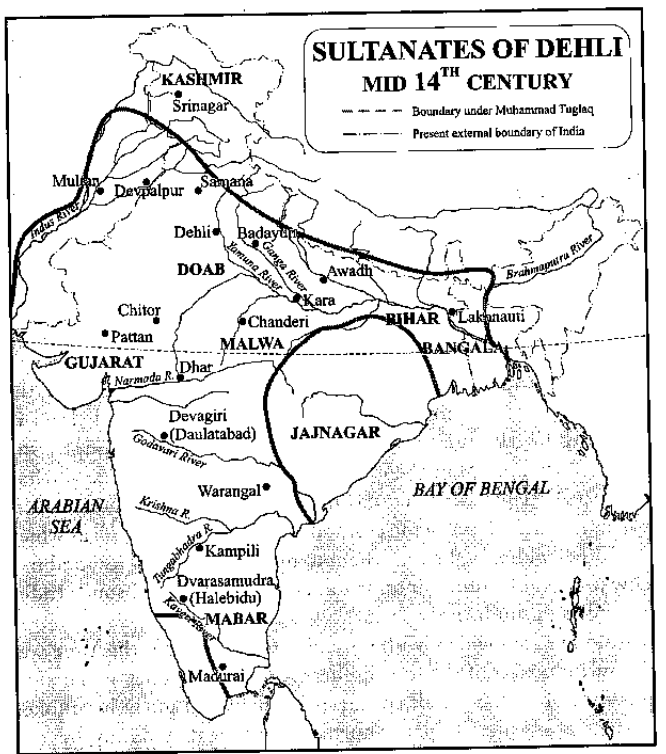
- Political Confusion After Balban’s Death (1286)
- Succession Crisis in Delhi
- Balban’s chosen successor, Prince Mahmud, had died earlier in a battle with the Mongols.
- His second son, Bughra Khan, was invited by the nobles to assume the throne but preferred to rule over Bengal and Bihar.
- A grandson of Balban was installed as Sultan, but he was too young and inexperienced to manage the situation.
- Resentment Against Turkish Nobility
- Turkish nobles attempted to monopolize high offices, leading to considerable resentment.
- Many non-Turks, particularly the Khaljis, had arrived in India during the Ghurid invasion but were not given recognition in Delhi.
- The Khaljis were ethnically Turkish, but culturally Afghanized
- As a result, they sought opportunities in Bengal and Bihar or served as soldiers in the northwest to counter Mongol threats.
- Rise of Indian Muslims in the Nobility
- Over time, Indian Muslims were admitted into the nobility but were denied high offices.
- Dissatisfaction among them was evident, as seen in the support for Imaduddin Raihan against Balban.
- Balban’s Precedent for Power Struggles
- Balban himself had sidelined the sons of Nasiruddin Mahmud.
- His example demonstrated that a successful general, with sufficient support from the nobility and the army, could seize the throne by ousting the heirs of an established dynasty.
- The Khaljis (1290-1320)
- Rise of the Khalji Dynasty
- Led by Jalaluddin Khalji, a group of Khalji nobles overthrew the incompetent successors of Balban in 1290.
- The Khaljis were of mixed Turkish-Afghan origin and did not exclude Turks from high offices but ended the Turkish monopoly.
- Their rebellion was welcomed by the non-Turkish sections of the nobility.
- Jalaluddin Khalji (1290-1296)
- Ruled for six years and attempted to soften the harsh policies of Balban.
- Advocated that the state should be based on the willing support of the governed.
- Acknowledged that since most Indians were Hindus, the Delhi Sultanate could not be a purely Islamic state.
- Practiced a policy of tolerance, avoiding harsh punishments.
- His policies were viewed as weak and unsuitable for the times.
- His rule ended when he was treacherously murdered by his nephew and son-in-law, Alauddin Khalji, in 1296.
- Alauddin Khalji (1296-1316) – Ruthless Consolidation of Power
- Came to power by murdering Jalaluddin Khalji after accumulating vast wealth from his invasion of Deogiri (in the Deccan).
- Faced several rebellions, both from nobles and his own relations.
- To suppress opposition, he adopted extreme measures:
- Mass execution of defected nobles and confiscation of their properties.
- Elimination of rebellious family members.
- Massacre of Mongol converts who had settled in Delhi and rebelled after campaigning in Gujarat.
- Harsh punishments extended even to wives and children of rebels, a practice continued by his successors.
- Measures to Control the Nobility
- Introduced strict regulations to prevent conspiracies:
- Nobles were forbidden from holding banquets or forming marriage alliances without the Sultan’s approval.
- Ban on wine and intoxicants to discourage gatherings.
- Established a spy service to monitor nobles’ activities.
- These methods successfully subjugated the nobles, ensuring no further rebellions during his lifetime.
- However, his policies weakened the dynasty in the long run.
- Decline of the Khaljis (1316-1320)
- Malik Kafur:
- After Alauddin Khalji’s death in 1316, his trusted general Malik Kafur took control.
- Placed a minor son of Alauddin on the throne.
- Imprisoned or blinded Alauddin’s other sons.
- Was soon assassinated by palace guards.
- Khusrau Khan
- Khusrau Khan, a Hindu convert, took the throne.
- Accused by historians of violating Islam, but he was no worse than previous monarchs.
- No opposition from Muslim nobles or the Delhi population.
- Even Nizamuddin Auliya, the famous Sufi saint, accepted his rule.
- Indicated that Muslims of Delhi were no longer swayed by racial considerations and accepted rulers based on ability rather than lineage.
- In 1320, a group of officers led by Ghiyasuddin Tughlaq revolted.
- Khusrau was defeated and killed, marking the end of the Khalji dynasty and the rise of the Tughlaq dynasty.
- The Tughlaqs (1320-1412)
- Establishment of the Tughlaq Dynasty
- Founded by Ghiyasuddin Tughlaq in 1320.
- The dynasty ruled Delhi until 1412.
- Key Rulers of the Tughlaq Dynasty
- Ghiyasuddin Tughlaq (1320-1324):
- Established the dynasty.
- Muhammad bin Tughlaq (1324-1351):
- Expanded the empire extensively.
- Firuz Shah Tughlaq (1351-1388):
- Ruled over a smaller but still vast empire.
- Extent of the Tughlaq Empire
-
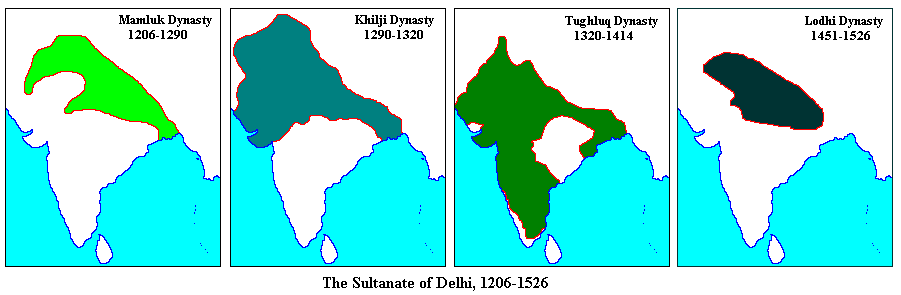
- Under Ghiyasuddin and Muhammad bin Tughlaq, the empire encompassed almost the entire Indian subcontinent.
- Firuz Shah Tughlaq’s empire was slightly smaller but comparable to that of Alauddin Khalji.
- Disintegration of the Tughlaq Empire
- After Firuz Shah’s death (1388), the Delhi Sultanate weakened and North India fragmented into several small states.
- Though the Tughlaqs ruled until 1412, the invasion of Delhi by Timur in 1398 effectively marked the end of their empire.
- Overview of the Tughlaq Era
- The expansion of the Delhi Sultanate from Alauddin Khalji’s time.
- The internal reforms introduced during the period.
- The factors leading to the decline and disintegration of the Sultanate.
- Expansion of the Delhi Sultanate
- Delhi Sultanate’s Initial Control Over Rajasthan
- Eastern Rajasthan, including Ajmer, had come under Delhi Sultanate’s control.
- Ranthambhor, the most powerful Rajput state, had gone out of Delhi’s control since Balban’s reign.
- Jalaluddin Khalji attempted to invade Ranthambhor but failed, leaving southern and western Rajasthan outside the Sultanate’s rule.
- Expansion Under Alauddin Khalji (1290-1320)
- Within 25 years, the Delhi Sultanate’s armies:
- Brought Gujarat and Malwa under control.
- Subdued most Rajput princes in Rajasthan.
- Overran the Deccan and South India, reaching Madurai.
- Attempted to bring the entire region under direct Delhi administration.
- This phase of expansion began with Alauddin Khalji and reached its peak under Muhammad bin Tughlaq.
- Political Conditions Favoring Expansion
- Malwa, Gujarat, and Deogir were ruled by Rajput dynasties that emerged in the 12th-13th century.
- These kingdoms remained largely unchanged in governance, despite Turkish rule in the Ganga Valley.
- Inter-kingdom rivalries made the conquest of Malwa and Gujarat easier and pushed the invaders further south:
- The Malwa and Deogir rulers opposed Turkish expansion into Gujarat.
- Deogir was constantly at war with Warangal (Telangana) and Hoysala (Karnataka).
- The Hoysalas were in conflict with their neighbors, the Pandyas (Tamil region/Mabar).
- Importance of Malwa and Gujarat for the Delhi Sultanate
- These regions were fertile and populous.
- They controlled western seaports and trade routes connecting them to the Ganga Valley.
- Gujarat’s overseas trade brought in gold and silver from abroad.
- Delhi’s supply of war horses had been disrupted due to Mongol activity in Central and West Asia. Gujarat’s ports were crucial for importing Arabian, Iraqi, and Turkish horses, which were vital for the Sultanate’s army.
- Alauddin Khalji’s Conquest of Gujarat (1299)
- In early 1299, an army under two of Alauddin’s generals marched towards Gujarat via Rajasthan.
- On the way, they raided and captured Jaisalmer.
- Gujarat ruler Rai Karan fled without resistance, leaving major cities vulnerable.
- Anhilwara, the capital of Gujarat, along with many temples and buildings, was sacked.
- The Somnath temple, rebuilt in the 12th century, was plundered.
- Wealthy Muslim merchants of Cambay were not spared.
- Malik Kafur, later a key figure in the South Indian invasions, was captured and taken to Alauddin Khalji.
- In 1299 CE, during Alauddin’s conquest of Gujarat, his generals captured Malik Kafur, who was then a Hindu slave of a wealthy Khwaja (merchant) in Cambay.
- Kafur was converted to Islam, brought to Delhi, and impressed Alauddin with his loyalty, intelligence, and military skills.
- He quickly rose in rank, eventually becoming Alauddin’s trusted commander and playing a decisive role in the Deccan campaigns.
- Aftermath of Gujarat’s Conquest
- Gujarat came under Delhi Sultanate’s control.
- The ease of conquest suggests:
- Rai Karan was unpopular among his subjects.
- A discontented minister of Rai Karan possibly invited Alauddin’s invasion.
- The Gujarat army was weak, and the administration was inefficient.
- Rai Karan fled to southern Gujarat with Ramachandra of Deogir’s help.
- This later led to war between Delhi and the Yadavas of Deogir.
- Alauddin Khalji’s Conquest of Rajasthan
- The Conquest of Ranthambhor (1301)
- After subjugating Gujarat, Alauddin Khalji focused on Rajasthan, beginning with Ranthambhor.
- Ranthambhor was ruled by Hamirdeva, a Chauhan successor of Prithviraj Chauhan.
- Hamirdeva had won victories against Raja Bhoj of Dhar and the Rana of Mewar, but these conquests ultimately led to his downfall.
- During the return from the Gujarat campaign, some Mongol soldiers rebelled over the division of loot.
- The rebellion was crushed, and a massacre of the Mongols followed.
- Two Mongol nobles fled to Ranthambhor seeking asylum.
- Alauddin ordered Hamirdeva to expel or kill the Mongol nobles, but Hamirdeva refused.
- Confident in the strength of his fort, which had previously resisted Jalaluddin Khalji, Hamirdeva sent defiant replies to Alauddin.
- Alauddin’s first army was repulsed, forcing him to lead the campaign himself.
- Poet Amir Khusrau, who accompanied the campaign, gave a detailed account of the siege.
- After three months, the Rajputs performed ‘jashar’ (jauhar):
- Women self-immolated on a funeral pyre.
- Rajput warriors and Mongols fought to the last.
- This is the first Persian account of ‘jashar’.
- Ranthambhor fell in 1301.
- The Siege of Chittor (1303)
- After Ranthambhor, Alauddin moved against Chittor, the second most powerful state in Rajasthan.
- Ruler Ratan Singh had angered Alauddin by:
- Refusing passage to the Sultanate’s army for the Gujarat invasion.
- Controlling the Ajmer-Malwa route, a strategic corridor.
- The Legend of Padmini:
- Some later accounts claim Alauddin attacked Chittor due to his desire for Ratan Singh’s queen, Padmini.
- However, modern historians dismiss this as a later myth, first recorded over a century later by Malik Muhammad Jaisi in his epic Padmavat.
- The legend’s fantastical elements (Padmini being from Singhaldvipa and Ratan Singh crossing seven seas to marry her) make it historically doubtful.
- The idea that Alauddin could demand to see another ruler’s wife—or that Ratan Singh would agree to such an insult—contradicts Rajput customs and Islamic court protocol.
- The Siege and Fall of Chittor (1303):
- Alauddin laid a close siege to the fort.
- After months of resistance, the fort was stormed.
- Jashar (jauhar) was performed:
- Rajput warriors died fighting.
- Padmini and other queens committed self-immolation.
- Ratan Singh was captured alive and held prisoner for some time.
- Alauddin assigned Chittor to his son, Khizr Khan, and placed a Muslim garrison there.
- Later, the fort was handed back to Ratan Singh’s cousin.
- Subjugation of Other Rajput States
- Jalor, on the route to Gujarat, was also conquered.
- Almost all major Rajput states submitted to Alauddin Khalji.
- However, he did not establish direct rule over Rajasthan:
- Rajput rulers continued to govern but had to:
- Pay tribute regularly.
- Follow Delhi’s orders.
- Muslim garrisons were placed in strategic towns like Ajmer and Nagaur.
- Rajasthan was thoroughly subdued, securing Alauddin’s dominance over North and Central India.
- Expansion into the Deccan and South India
- Conquest of Malwa (Before 1306-07)
- Even before completing the conquest of Rajasthan, Alauddin Khalji had annexed Malwa.
- According to Amir Khusrau, Malwa was so vast that even wise geographers could not determine its frontiers.
- Unlike Rajasthan, Malwa was brought under direct administration, and a governor was appointed.
- Alauddin Khalji’s Campaigns in the Deccan (1306-07)
- Expedition Against Rai Karan (Baglana)
- In 1306-07, Alauddin launched two campaigns.
- The first was against Rai Karan, the expelled ruler of Gujarat, who had taken refuge in Baglana (on the Malwa border).
- Rai Karan resisted but was ultimately defeated.
- Campaign Against Rai Ramachandra (Deogir)
- The second campaign targeted Rai Ramachandra of Deogir, an ally of Rai Karan.
- Rai Ramachandra had earlier agreed to pay annual tribute to Delhi but had fallen into arrears.
- Alauddin’s slave-general Malik Kafur led the expedition.
- Rai Ramachandra surrendered, was taken to Delhi, and treated with honor:
- Granted the title “Rai Rayan” (King of Kings).
- Gifted one lakh tankas and a golden canopy (symbolizing rulership).
- Given a district in Gujarat.
- His daughter was married to Alauddin.
- This alliance proved crucial for further Delhi Sultanate expansion into the Deccan.
- Malik Kafur’s Southern Expeditions (1309-1311)
- Between 1309-1311, Malik Kafur led two major campaigns into South India:
- Warangal (1309, Telangana)
- Warangal, ruled by Prataparudra, was attacked.
- Prataparudra was forced to surrender treasures, elephants, and promise an annual tribute.
- Dwar Samudra, Mabar & Madurai (1311, Karnataka & Tamil Nadu)
- The second campaign targeted Dwar Samudra (Karnataka), Mabar, and Madurai (Tamil Nadu).
- Key highlights:
- Amir Khusrau, the court poet, glorified these campaigns in a book.
- First time Muslim armies penetrated as far south as Madurai.
- Brought back immense wealth but no new geographical knowledge.
- Muslim merchants and soldiers were already present in the region.
- Kafur plundered temples (e.g., Chidambaram) but failed to defeat the Tamil armies.
- As a reward, Alauddin appointed Kafur as “mulk-nai” (vice-regent) of the empire.
- Direct Administration & Rebellions (1315-1316)
- After Alauddin’s death in 1316, his policies started shifting towards direct control of the south.
- In 1315, Rai Ramachandra died, and his sons revolted. Malik Kafur crushed the rebellion and took direct control.
- However, some outlying areas declared independence, and some remained under Ramachandra’s descendants.
- Mubarak Shah’s Campaigns (Post-Alauddin, 1316-1320)
- Mubarak Shah, Alauddin’s successor, reconquered Deogir and installed a Muslim governor.
- He also raided Warangal, forcing the ruler to:
- Cede a district.
- Pay an annual tribute of 40 gold bricks.
- Khusrau Khan, a slave of Mubarak Shah, raided Mabar and sacked Masulipatnam.
- Expansion Under Muhammad bin Tughlaq (1320-1328)
- Conquest of Warangal (1320-1323)
- Ghiyasuddin Tughlaq (1320) adopted an aggressive expansion policy.
- His son, Muhammad bin Tughlaq, was posted in Deogir.
- Warangal was attacked again (1320-23):
- Initially, Muhammad bin Tughlaq suffered a setback.
- A rumor of the Sultan’s death caused panic among Delhi forces.
- He reorganized and attacked again, defeating the Rai.
- Warangal was annexed.
- Conquest of Mabar & Orissa (1323-1324)
- Mabar was annexed, and Muhammad bin Tughlaq raided Orissa, bringing back rich plunder.
- The following year, he subdued Bengal (independent since Balban’s death).
- Conquest of Kampili (1328, Karnataka)
- The last Hindu principality in the region, Kampili (South Karnataka), was annexed in 1328.
- A rebel cousin of Muhammad bin Tughlaq had taken refuge there, providing an excuse for conquest.
- Challenges of Overexpansion
- By 1324, the Delhi Sultanate stretched as far south as Madurai and east to Orissa.
-
- This rapid expansion created huge administrative & financial challenges.
- The next section examines Muhammad bin Tughlaq’s attempts to manage these problems.
- Succession related data of delhi sultanates
-
| Dynasty |
Sultan |
Reign |
Mode of Succession |
| Mamluk (Slave) Dynasty (1206–1290) |
Qutb-ud-din Aibak |
1206–1210 |
Declared Sultan after Ghori’s death |
| Iltutmish |
1211–1236 |
Chosen by nobles over Aibak’s son |
| Raziya Sultana |
1236–1240 |
Nominated by Iltutmish, deposed by nobles |
| Ghiyasuddin Balban |
1266–1287 |
Eliminated rivals, consolidated power |
| Kayqubad |
1287–1290 |
Weak ruler, overthrown by Jalaluddin Khalji |
| Khalji Dynasty (1290–1320) |
Jalaluddin Khalji |
1290–1296 |
Overthrew Mamluks, established Khalji rule |
| Alauddin Khalji |
1296–1316 |
Killed Jalaluddin, seized throne |
| Qutbuddin Mubarak |
1316–1320 |
Murdered by Khusrau Khan |
| Tughlaq Dynasty (1320–1414) |
Ghiyasuddin Tughlaq |
1320–1325 |
Defeated Khusrau Khan, founded Tughlaq rule |
| Muhammad bin Tughlaq |
1325–1351 |
Son of Ghiyasuddin, inherited throne |
| Firoz Shah Tughlaq |
1351–1388 |
Chosen by nobles after Muhammad’s death |
| Sayyid Dynasty (1414–1451) |
Khizr Khan |
1414–1421 |
Governor of Multan, took Delhi after Timur’s invasion |
| Alauddin Alam Shah |
1445–1451 |
Weak ruler, abandoned throne to Bahlol Lodi |
| Lodi Dynasty (1451–1526) |
Bahlol Lodi |
1451–1489 |
Seized Delhi after Sayyid decline |
| Ibrahim Lodi |
1517–1526 |
Defeated by Babur in First Battle of Panipat |
- Internal Reforms and Experiments
- Consolidation and Reforms under Alauddin Khalji
- By the time Alauddin Khalji ascended the throne, the Delhi Sultanate was well consolidated in its central region, covering:
- Upper Ganga Valley
- Eastern Rajasthan
- This stability enabled the sultans to undertake internal reforms and experiments aimed at:
- Improving administration
- Strengthening the army
- Enhancing land revenue administration
- Expanding and improving cultivation
- Ensuring the welfare of citizens in rapidly growing towns
- While some measures were successful and marked new developments, others failed due to:
- Lack of experience
- Poor planning
- Opposition from vested interests
- Despite the setbacks, these reforms reflected the growing stability of the Turkish state, which was no longer solely focused on warfare and maintaining law and order.
- Market Control and Agrarian Policy of Alauddin
- Market Control Measures
- Alauddin’s market control measures were considered one of the great wonders of the world.
- After returning from the Chittor campaign, he issued orders to fix prices of all commodities, including food grains, sugar, cooking oil, clothing, horses, cattle, and slaves.
- To implement this, he established three regulated markets in Delhi:
- One for food grains
- One for costly cloth
- One for horses, slaves, and cattle
- Each market was overseen by a high officer (stahna), who maintained merchant registers and strictly controlled prices and shopkeepers.
- Regulating food grain prices was essential because cheap food supply was necessary to maintain citizen and army support.
- Reasons for Market Control
- The Mongol invasions highlighted the need for a large army, which required reducing prices and lowering salaries to sustain expenses.
- Land revenue in the Doab region (Meerut to Kara near Allahabad) was now paid directly to the state rather than being assigned as iqta.
- The land revenue rate was raised to 50% of the produce, forcing peasants to sell grains at low prices to banjaras (grain traders) who then sold it at fixed prices in cities.
- The banjaras were registered, and their families were held collectively responsible for violations to prevent hoarding.
- The state set up warehouses to store food grains, releasing them during famines or shortages.
- Alauddin strictly monitored the market and imposed harsh punishments on shopkeepers who charged higher prices or used false weights.
- Fixed Prices and Economic Impact
- Fixed prices of grains (as per Barani):
- Wheat → 7½ jitals per man
- A man was a fixed weight unit. In Alauddin Khalji’s time it varied regionally, but roughly about 15–20 kg.
- Jitals were copper or silver coins
- Barley → 4 jitals per man
- Good quality rice → 5 jitals per man
- Horse price regulation was crucial for maintaining a strong army:
- First-grade horse → 100-120 tankas
- Inferior pony (tata) → 10-25 tankas
- Prices of cattle and slaves were strictly regulated, and detailed price lists exist in Barani’s records.
- Luxury goods (cloth, perfumes, etc.) were also price-fixed, though this was likely done to stabilize overall prices or to please the nobility.
- Large sums were given to Multani traders to bring fine cloth to Delhi, making it the largest cloth market.
- Impact on Salaries and Army
- The state’s direct control over land revenue allowed salaries to be paid in cash, a first in the Sultanate.
- Cavalry soldiers’ salary:
- 238 tankas per year (20 tankas per month)
- Covered personal expenses, horse maintenance, and equipment
- Even in Akbar’s time, when prices were higher, a Mughal cavalryman earned only 20 rupees a month—showing Alauddin’s salary was not low.
- Religious and Trade Implications
- Historian Barani claims the market policy was aimed at punishing Hindus, as most traders were Hindus engaged in profiteering.
- However, trade with Central Asia was controlled by Muslims (Khurasanis, Multanis), who also benefited from price regulations—something Barani ignores.
- It is unclear if price control applied only to Delhi or the entire empire, but since army garrisons were spread across towns, other cities likely benefited as well.
- Agrarian Reforms of Alauddin
- Land Revenue Administration
- Alauddin was the first Sultan to insist on land revenue being assessed by measuring cultivated land in the Doab region.
- This prevented landlords (pahuts and mugaddams) from shifting their tax burdens onto poorer peasants.
- New policies for landlords:
- They had to pay taxes on cattle and houses, like regular peasants.
- Illegal cesses they had imposed on villagers were abolished.
- Barani’s account:
- They became so impoverished that they could no longer ride caparisoned horses or chew betel leaves, and their wives had to work in Muslim households.
- Administration and Corruption Control
- Revenue collection was directly handled by state officials (amils) rather than landlords.
- Officials were given sufficient salaries, but Alauddin imposed strict audits on their accounts.
- Corrupt officials faced severe punishments, including beatings and imprisonment.
- Barani’s exaggeration:
- Officials were so terrified that no one would marry their daughters to them! However, government service remained prestigious, and this claim seems unlikely.
- Motives Behind Agrarian Reforms
- Though Barani claims the policies targeted Hindus, they were mainly aimed at rural elites rather than common peasants.
- The reforms were not socialistic; they were pragmatic measures taken to:
- Counter Mongol threats
- Strengthen state control over resources
- Maintain a strong standing army
- Barani states Alauddin regulated everything, from food grains to socks, from combs to chapatis, leading to harsh punishments and resentment among traders.
- Despite strict measures, his policies did not cause major rebellions or mass migration of peasants.
- Legacy of Agrarian and Market Reforms
- Alauddin’s regulations ended after his death, but they had long-lasting effects
- Strengthened the Delhi Sultanate’s military
- Successfully repelled Mongol invasions beyond the Indus
- Provided a blueprint for later agrarian policies of Sher Shah Suri and Akbar
- Military reforms:
- Regular mustering of troops to prevent fraud.
- Branding system (dagh) for horses to ensure quality.
- Descriptive rolls of soldiers for better record-keeping.
- Direct salary payments in cash, abolishing the previous system of land grants (jagirs) for soldiers.
- Muhammad Tughlaq’s Experiments and Policies
- Introduction
- Muhammad bin Tughlaq (1324-51) is remembered as one of the most remarkable rulers of his time.
- He was deeply read in religion and philosophy and had an open and critical mind.
- Engaged with Muslim mystics, Hindu yogis, and Jain saints like Jinaprabha Suri.
- Orthodox theologians criticized him as a ‘rationalist.’
- He appointed officials based on merit, disregarding noble lineage.
- However, his hasty and impatient nature led to many failures, earning him the title of an ‘ill-starred idealist.’
- Accession to the Throne
- Succeeded his father, Sultan Ghiyasuddin Tughlaq, under suspicious circumstances.
- A hastily erected wooden pavilion collapsed during a reception, killing the Sultan.
- Rumors spread that Muhammad Tughlaq had orchestrated his father’s death.
- Major Experiments and Policies
- Transfer of Capital to Daulatabad
- Deogir (renamed Daulatabad) was an important military base for Turkish rule in the south.
- The Sultan wanted better control over the region, which was prone to rebellion.
- Many officials, nobles, and Sufi saints were forced to migrate to Daulatabad.
- A road was built with rest houses to facilitate travel.
- However, harsh weather and distance led to many deaths.
- Discontent arose as people longed for Delhi, leading to abandonment of the plan.
- Impact
- Strengthened cultural ties between North and South India.
- Many settlers remained in Daulatabad, leading to the spread of Indo-Islamic culture in the Deccan.
- Introduction of Token Currency
- Introduced bronze coins with the same value as silver tankas due to a silver shortage.
- Inspired by Chinese (Qublai Khan) and Mongol (Ghazan Khan of Iran) experiments.
- Traders and common people resisted accepting the new currency.
- Widespread forgery devalued the coins.
- Sultan was forced to withdraw the currency, exchanging silver for legitimate bronze coins.
- Massive financial loss and administrative failure.
- Military Campaigns and Expansionist Policies
- Defense Against Mongols
- Faced Mongol invasions under Tarmashrin in Punjab and Sindh.
- Successfully repelled Mongols and extended power beyond the Indus.
- The Khurasan Project
- Recruited a large army to invade Khurasan and Iraq but later disbanded it.
- Unclear objective, possibly to restore the Hindukush-Qandahar frontier.
- The Qarachil Expedition
- Military campaign in the Kumaon Hills (Himalayas).
- Some historians suggest it was aimed at controlling horse trade from China (Sinkiang).
- Expedition suffered a disaster—out of 10,000 soldiers, only 10 returned.
- Resulted in Delhi Sultanate’s control over hill regions like Kangra.
- Agrarian Reforms and Revenue Policies
- Peasant Rebellion in the Doab
- Muhammad Tughlaq sought to improve agriculture but over-assessed revenue.
- Fixed state share at half of the produce, but arbitrarily determined the rate.
- Prices were artificially fixed, worsening the crisis.
- A six-year famine devastated the region.
- Peasants fled, prompting harsh measures to force compliance.
- Diwan-i-Amir-i-Kohi: Agricultural Development Scheme
- Established a new department to promote better farming.
- Divided the region into development blocks led by officials.
- Provided loans for high-yield crops like wheat, sugarcane, grapes, and dates.
- Scheme failed due to corruption and misuse of funds.
- Loans remained unrecovered, but later Sultan Firuz Tughlaq wrote them off.
- Despite failure, the policy influenced future rulers like Akbar.
- Nobility and Administrative Policies
- Changes in Nobility Structure
- Included commoners from professions like barbers, cooks, weavers, and wine-makers in administration.
- Many were Muslim converts, and some Hindus were also given positions.
- Old noble families resented the rise of these new officials.
- Inclusion of Foreigners in Nobility
- Welcomed nobles from various ethnic backgrounds, leading to a diverse but divided nobility.
- This fragmentation weakened central authority and fostered rebellion.
- Conclusion: The Paradox of Muhammad Tughlaq’s Rule
- His reign marked both the zenith and beginning of disintegration of the Delhi Sultanate.
- Many of his policies had long-term impacts, despite short-term failures.
- His hasty nature and harsh punishments led to administrative instability.
- The Delhi Sultanate never fully recovered from the setbacks of his reign.
- Decline and Disintegration of the Delhi Sultanate: Firuz and His Successors
- Rebellions During Muhammad Tughlaq’s Reign
- The latter half of Muhammad Tughlaq’s reign saw repeated rebellions across the empire.
- Rebellions by ambitious nobles in the outlying areas were common, but most were suppressed with the help of the central army and loyal nobles.
- Major revolts occurred in Bengal, Mabar (Tamil Nadu), Warangal, Kampili (Karnataka), West Bengal, Awadh, Gujarat, and Sindh.
- Muhammad Tughlaq, distrustful of everyone, moved constantly to suppress uprisings, exhausting his armies.
- The most serious revolts were in South India, where local governors initiated rebellions.
- A plague in his army during a campaign in the South killed two-thirds of his forces, dealing him a severe blow.
- After returning from the South, a rebellion by brothers Harihara and Bukka led to the formation of the Vijayanagara Empire in South India.
- In the Deccan, foreign nobles established a principality near Daulatabad, which grew into the Bahmani Empire.
- Bengal also became independent, though Muhammad Tughlaq managed to quell revolts in Awadh, Gujarat, and Sindh.
- He died in Sindh and was succeeded by his cousin, Firuz Tughlaq.
- Challenges and Policies of Firuz Tughlaq
- Upon accession, Firuz sought to prevent the disintegration of the Delhi Sultanate.
- He appeased the nobles, army, and theologians while only asserting control over manageable regions.
- Unlike his predecessors, he made no attempt to reassert control over South India and the Deccan.
- Military Campaigns
- Led two unsuccessful campaigns into Bengal, resulting in its permanent loss.
- Campaigned against Jajnagar (Orissa), looted temples but did not annex the region.
- Attacked Kangra in the Punjab hills.
- Longest campaigns involved rebellions in Gujarat and Thatta, where the army suffered greatly in the Rann of Kutch.
- Administrative and Military Reforms
- Firuz was not a strong military leader but ensured a peaceful and stable reign.
- Introduced hereditary succession for nobles:
- A noble’s son inherited his office and estate.
- If no son existed, the son-in-law or slave took over.
- Abolished the torture of nobles and officials during audits.
- Extended hereditary succession to the army:
- Soldiers could pass their positions to their sons or sons-in-law, or even slaves.
- Payments were made through land assignments instead of cash.
- Led to corruption, as soldiers often bribed clerks to pass off useless horses.
- Relations with Theologians and Religious Policies
- Presented himself as a devout Islamic ruler to win the support of theologians.
- Banned practices deemed un-Islamic, such as Muslim women visiting saints’ graves.
- Persecuted heretical Muslim sects and made jizya a separate tax, exempting only women, children, the disabled, and the indigent.
- Ordered the public execution of a Brahman for preaching against the Sharia.
- Despite his religious orthodoxy, he patronized music and had a fondness for wine.
- Social and Economic Policies
- Banned cruel punishments like amputation for theft.
- Established hospitals for free treatment of the poor.
- Provided dowries for poor girls. However, these benefits mainly helped Muslims from good families who had fallen on hard times.
- Created a Public Works Department to manage infrastructure projects:
- Repaired and dug irrigation canals (e.g., a 200-km canal from Sutlej to Hansi).
- Established new towns like Hissar-Firuzah (Haryana) and Firuzabad (Uttar Pradesh), many of which still exist.
- Slave Policy
- Ordered officials to capture young boys from conquered areas and send them as slaves to the Sultan.
- Accumulated about 180,000 slaves:
- Some were trained as artisans and placed in royal workshops (Karkhanas).
- Others formed a special corps of soldiers directly dependent on the Sultan.
- However, like earlier Turkish sultans, Firuz faced difficulties in maintaining loyalty among these slave soldiers.
- Disintegration After Firuz’s Death (1388)
- After Firuz’s death, administrative and political instability returned.
- Power struggles emerged between:
- The Sultan and the nobles.
- Local zamindars and rajas, who began acting independently.
- Firuzian slaves, who attempted to install their own ruler.
- Sultan Muhammad, Firuz’s son, initially consolidated power with slave support.
- However, he later suppressed the Firuzian slaves, imprisoning and scattering them.
- His successor, Nasiruddin Mahmud (1394-1412), was unable to control rebellious nobles and defiant rajas.
- Provincial governors became independent, confining the Sultan’s rule to a small area around Delhi.
- A contemporary wit remarked:
- “The dominion of the Lord of the Universe (title of the sultans of Delhi) extends from Delhi to Palam.”
- Timur’s Invasion (1398) and Final Collapse
- The weakness of the Delhi Sultanate invited Timur’s invasion in 1398.
- Timur, a Turk claiming descent from Genghis Khan, had built a vast empire from Syria to the Indus.
- His invasion of India was purely for plunder, targeting the wealth accumulated by Delhi’s sultans.
- Timur’s army mercilessly sacked and plundered towns en route to Delhi.
- Upon entering Delhi, his forces massacred Hindus, Muslims, women, and children alike.
- The invasion drained India of enormous wealth, including gold, silver, and jewelry.
- Timur also took skilled Indian artisans (masons, stone cutters, carpenters) to build monuments in Samarqand.
- Impact of Timur’s Invasion
- Though politically insignificant, the invasion marked:
- The end of strong rule by the Delhi sultans.
- The final decline of the Tughlaq dynasty, which lingered until 1412.
- Long-Term Causes of Disintegration
- The Delhi Sultanate’s decline was not due to a single ruler but a combination of factors:
- Constant conflict between the monarch and nobles.
- Struggles with local rulers and zamindars.
- The pull of regional and geographical forces.
- No ruler could fundamentally change society to overcome these persistent challenges.
- The overextension of the empire under Ghiyasuddin and Muhammad Tughlaq set off a chain reaction of disintegration.
- Firuz’s reforms—though stabilizing in the short term—weakened the central administration, leading to ultimate collapse.
- Conclusion
- The period from 1200 to 1400 brought significant transformations in Indian society:
- Changes in the system of government.
- Evolution of social and economic conditions.
- Advancements in art and architecture.
- These themes will be explored in the next chapter.
- Government, and Economic and Social Life under the Delhi Sultanate
- Introduction
- The establishment and expansion of the Delhi Sultanate (1200–1400) brought significant changes to India:
- Development of a highly centralized state under the Turks.
- Expansion of territorial control, reaching as far south as Madurai.
- Influence on the administrative systems of successor states and the later Mughal Empire.
- The beginning of the 15th century marked the decline of the Delhi Sultanate:
- Disintegration led to the rise of independent regional states.
- Despite political fragmentation, the Sultanate’s administrative legacy endured.
- The Sultan: Supreme Authority in the Sultanate
- Symbolic Connection with the Caliph
- Many Turkish sultans in India declared themselves as the “Lieutenant of the Faithful”, recognizing the Abbasid caliph in Baghdad.
- However, this was a symbolic and moral recognition, not a legal subordination.
- By doing so, the Delhi Sultans asserted their authority within the larger Islamic world.
- Powers and Responsibilities of the Sultan
- The Sultan was the most powerful figure in the Sultanate, holding supreme political, military, and legal authority.
- His primary responsibilities included:
- Administration
- Ensuring the smooth governance of the state.
- Military leadership
- Serving as the commander-in-chief of the armed forces.
- Law and justice
- Appointing judges while also acting as the final court of appeal.
- Direct appeals could be made to the Sultan against any unjust actions by his officials.
- Justice as a key function:
- Balban was known for stern and impartial justice, punishing even his relatives and top officials.
- Muhammad Tughlaq extended this policy to the religious classes (ulama), who had previously been exempt from severe punishments.
- Succession and the Struggle for the Throne
- No clear law of succession existed among the Muslim rulers of India.
- Islamic theory favored election, but in practice:
- Any son of a ruler could claim the throne.
- The concept of primogeniture (eldest son inheriting the throne) was not fully accepted by either Muslims or Hindus.
- Some rulers nominated a preferred successor, not necessarily the eldest son.
- Iltutmish even nominated his daughter (Razia Sultan) over his sons.
- However, noble approval was necessary for any nomination to be accepted.
- Military strength was the decisive factor in succession:
- A successful military leader could usurp the throne.
- Public opinion also played a role—for example, the Khaljis avoided entering Delhi immediately after overthrowing Balban’s successors, instead building a new city, Siri, to establish their rule.
- Central Administration of the Delhi Sultanate
- The Role of the Sultan and His Ministers
- The Sultan was the supreme authority and was assisted by a council of ministers.
- These ministers were appointed at the Sultan’s discretion and could be removed at any time.
- The number, powers, and functions of the ministers varied over time.
- A well-defined administrative system emerged by the late 13th century.
- The Wazir: Chief Minister of the Sultanate
- The wazir was the most important administrative official after the Sultan.
- Early Period:
- Initially, wazirs were primarily military leaders.
- 14th Century Changes:
- The wazir became an expert in revenue affairs and controlled both income and expenditure.
- Muhammad Tughlaq focused heavily on revenue administration, appointing Khwaja Jahan as his respected wazir.
- A separate Auditor General (for expenditure) and an Accountant General (for income) were introduced.
- Wazirs under Firuz Tughlaq:
- Khan-i-Jahan, a converted Tailang Brahman, was appointed as wazir and held office for 18 years—a period considered the peak of the wazir’s influence.
- His son, Khan-i-Jahan II, succeeded him but lost power after trying to manipulate succession following Firuz’s death.
- The position of the wazir weakened after this period but regained prominence under the Mughals.
- The Military Administration (Diwan-i-Arz)
- The Diwan-i-Arz was responsible for military affairs and was led by the Ariz-i-Mamalik.
- Key Responsibilities:
- Recruitment, equipping, and payment of the army.
- Maintaining troop discipline and military organization.
- The Sultan as Commander-in-Chief:
- The Sultan himself commanded the army to prevent power struggles.
- Notable Military Reforms:
- Balban emphasized military discipline and had soldiers march long distances under the pretext of hunting.
- Alauddin’s army (claimed to be 300,000 by Barani) was instrumental in defending against Mongol invasions and conquering the Deccan.
- Military Composition and Structure
- The standing army was stationed across the empire, with a strong force in the capital.
- The military included:
- Cavalry:
- Dominated by Turks and Afghans (considered the most prestigious).
- Infantry:
- Included Hindus, continuing from the Ghaznavid period.
- Elephants:
- Trained for warfare.
- Sappers and Miners Corps:
- Cleared roads and removed obstacles during marches.
- Intelligence and Internal Security
- The Sultan maintained a network of intelligence agents (barids) across the empire.
- The Chief Barid was always a trusted noble of the ruler.
- This system kept the Sultan informed of developments across the empire.
- The Religious and Judicial Department (Diwan-i-Risalat)
- Functions:
- Managed religious affairs, pious foundations, and stipends for scholars and religious leaders.
- Supervised by the Chief Sadr, often a leading gazi.
- The Chief Gazi also headed the justice department.
- Judicial System:
- Qazis (judges) were appointed across the empire, particularly in regions with large Muslim populations.
- Muslim law (Sharia) governed civil matters for Muslims.
- Hindus followed their own personal laws, enforced by village panchayats and caste leaders.
- Criminal law was based on regulations set by the Sultan.
- The Communication & Correspondence Department (Diwan-i-Insha)
- Handled state correspondence, including:
- Communication between the Sultan and other rulers.
- Correspondence with provincial and local officials.
- Management of formal and confidential diplomatic exchanges.
- The Royal Household Department (Diwan-i-Dar)
- Managed by the Wakil-i-Dar, who was responsible for:
- The Sultan’s personal comforts.
- Overseeing the large royal harem.
- Maintaining order and seating arrangements for nobles at royal receptions.
- Managed a network of karkhanas (workshops) that:
- Stored goods needed by the royal family.
- Sometimes produced luxury items under royal supervision.
- The Department of Public Works (Diwan-i-Imarat)
- Established by Firuz Tughlaq, it was responsible for:
- Construction of canals for irrigation.
- Building roads, mosques, and public buildings.
- The Slave Department (Diwan-i-Bandagan)
- Also introduced by Firuz Tughlaq to manage:
- The employment of royal slaves.
- Their work in state-run karkhanas and administrative offices.
- Conclusion
- The central administration of the Delhi Sultanate was highly structured, with clear divisions of responsibility.
- The Sultan held absolute power, assisted by a strong bureaucracy led by the wazir, and supported by specialized departments for military, finance, justice, intelligence, and public works.
- These institutions laid the foundation for later Mughal governance.
- Local Administration of the Delhi Sultanate
- Division of Territories
- After their conquest, the Turks divided the country into administrative units called igtas.
- These were granted to leading Turkish nobles, who were known as mugtis or walis.
- Over time, these igtas evolved into provinces (subas).
- During the reign of Muhammad Tughlaq, there were 24 provinces, extending as far as Mabar in the south.
- Role of the Mugti (Provincial Governor)
- Initially, mugtis had significant autonomy in their regions.
- Their main responsibilities included:
- Maintaining law and order.
- Collecting land revenue on behalf of the government.
- Paying salaries to soldiers from the revenue collected.
- Retaining any surplus after expenses.
- As the central government gained strength, it tightened control over the mugtis:
- It started to assess the actual income of provinces.
- Salaries of soldiers and mugtis were fixed in cash.
- Mugtis were required to remit excess revenue to the central treasury.
- Auditing of provincial accounts (done every few years) often involved:
- Harsh measures, including torture and imprisonment of mugtis.
- Firuz Tughlaq later relaxed these strict policies towards the end of the Sultanate period.
- Hierarchical Structure of Local Administration
- Administrative Divisions Below Provinces
- Sarkars (Districts)
- Parganas (Administrative Units)
- Villages were grouped into parganas, which formed the core of local administration.
- Ami (Administrator):
- Headed the pargana.
- Villages (basic unit of administration)
- Villages retained their traditional self-governing structure under Turkish rule.
- Important village officials included:
- Zamindars (landowners)
- Muqaddam (village headman)
- Patwari (village accountant)
- The Sultanate did not interfere in village affairs as long as land revenue was paid.
- Villages were traditionally grouped into units of 100 to 84 households (chasrasi system).
- No significant administrative changes were initially made at the village level.
- Land revenue collection continued through local officials, aiding the smooth transition of power to the Turks.
- Reforms and Peasant Resistance
- Administrative changes began under Alauddin Khalji in the early 14th century.
- He introduced stricter revenue policies to increase state control.
- These measures led to tensions between the government and peasants, sometimes resulting in rebellions.
- Conclusion
- The local administration of the Delhi Sultanate was a multi-tiered system, with provinces, districts, and villages functioning under different levels of authority.
- The mugtis initially had autonomy but were later brought under tighter central control.
- The village administration remained largely unchanged, ensuring stability, but Alauddin Khalji’s revenue reforms led to conflicts.
- Economic and Social Life under the Delhi Sultanate
- Limited Historical Records
- Information about the economic condition of people during the Delhi Sultanate is scarce.
- Contemporary historians primarily focused on court events rather than the lives of ordinary people.
- However, some sources mention commodity prices and agricultural products.
- Despite limited historical records, accounts like those of Ibn Battutah provide valuable insights into agriculture, trade, and daily life during the Delhi Sultanate.
- The economy was primarily agrarian, with village industries playing a crucial role in production and trade.
- Ibn Battutah’s Observations
- Ibn Battutah, a traveler from Tangier, North Africa, visited India in the 14th century.
- He lived at the court of Muhammad Tughlaq for eight years and traveled widely across India.
- His writings provide insights into:
- Agricultural products (fruits, flowers, herbs, crops).
- Condition of roads and trade routes.
- Daily life of the people.
- Agriculture and Crops
- Agriculture was the backbone of the economy, with fertile soil allowing multiple harvests.
- Key crops grown in different regions:
- East and South:
- Rice, sugarcane (grown extensively).
- North:
- Wheat, oilseeds.
- Other major crops:
- Rice:
- Sown three times a year.
- Sesame:
- Used for oil production.
- Indigo:
- Important for dyeing fabrics.
- Cotton:
- Essential for the textile industry.
- Village Industries and Economy
- Agriculture supported small-scale village industries, including:
- Oil pressing (from sesame and other seeds).
- Jaggery (raw sugar) production.
- Weaving and dyeing of cloth (linked to cotton and indigo cultivation).
- These industries formed the economic backbone of villages, sustaining local economies.
- Peasants and Rural Gentry under the Delhi Sultanate
- The Peasant Majority
- Peasants formed the overwhelming majority of the population.
- They worked hard to sustain themselves but lived at a subsistence level.
- Recurring famines and wars further worsened their hardships.
- Prosperous Peasants and Rural Elites
- Not all peasants lived in poverty; some were owner-cultivators with their own land.
- These wealthier peasants were:
- Original settlers of the village.
- Dominant members of the village panchayat.
- The village headmen (muqaddams) and smaller landlords (zaats):
- Enjoyed a higher standard of living.
- Held additional lands at concessional revenue rates.
- Sometimes exploited ordinary peasants by forcing them to pay extra revenue.
- Their prosperity was evident as they:
- Rode costly Arabi and Iraqi horses.
- Wore fine clothes.
- Adopted upper-class lifestyles.
- Alauddin Khalji’s Reforms
- Alauddin Khalji took strict action against wealthy village elites:
- Restricted their privileges.
- Reduced their economic power.
- However, after his death, these groups regained their dominance.
- Hindu Rais and Autonomous Rajas
- A distinct wealthy section included the Hindu rais (autonomous rajas).
- Many retained their estates under Delhi Sultanate rule.
- Evidence from Balban’s court suggests that:
- Hindu rais frequently visited the sultan’s court.
- They remained influential even in areas under direct Sultanate control.
- Trade, Industry, and the Merchants
- Growth of Trade and Urban Economy
- The consolidation of the Delhi Sultanate, improved communications, and a sound currency system (silver tanka and copper dirham) led to the growth of trade.
- Towns expanded, and urban life flourished. Ibn Battutah described Delhi as the largest city in the eastern Islamic world, with Daulatabad (Deogir) matching its size, reflecting strong trade between the north and south.
- Other major trade centers:
- Northwest – Lahore, Multan
- East – Kara, Lakhnauti
- West – Anhilwara (Patan), Cambay (Khambayat)
- A historian describes the Sultanate as having a “flourishing urban economy,” implying large-scale commerce.
- Industries and Handicrafts
- Bengal and Gujarat towns were known for fine fabrics, with other cities also producing high-quality textiles.
- Major industrial centers and products:
- Cambay (Gujarat)
- Textiles, gold, and silver work
- Sonatgaon (Bengal)
- Raw silk and fine cotton (later called muslin)
- Other crafts:
- Leatherwork, metalwork, carpet weaving, woodwork (including furniture), and stone-cutting.
- The Turks introduced new crafts such as paper-making, a technique originally discovered by the Chinese and spread via the Arab world.
- Before the Delhi Sultanate popularized paper in the 13th century, India used two primary materials:
- Palm Leaves (Tala-patra)
- Birch Bark (Bhurja-patra)
- Technological Advancements
- Textile industry improvements:
- Introduction of the spinning wheel, which improved efficiency.
- Cotton cleaning was enhanced using the cotton carder’s bow (dunia).
-
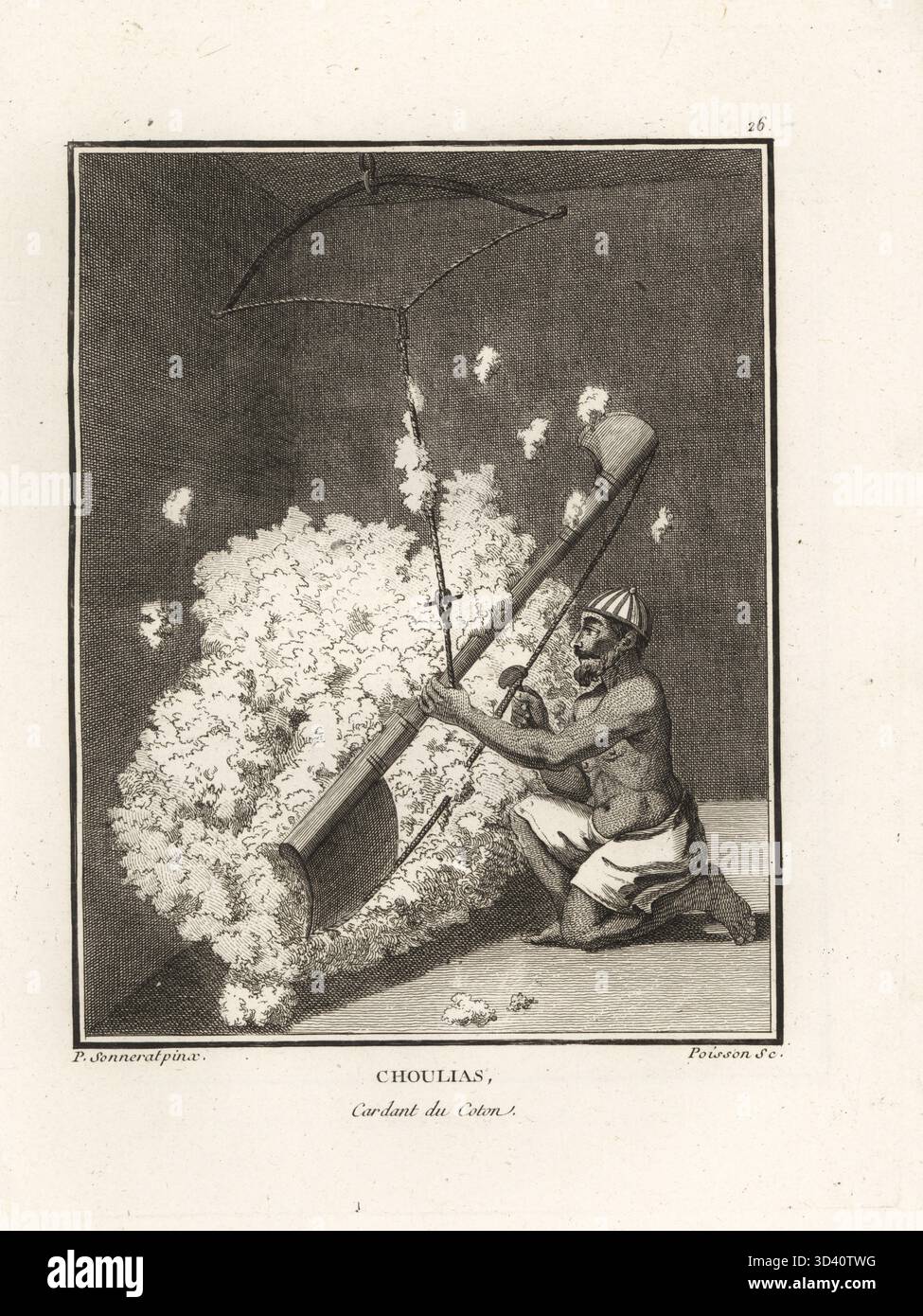
- Metallurgical advancements:
- Use of iron stirrups.
- Large-scale use of armor for cavalry.
- Growth in metal crafts.
- Water-lifting technology:
- Improvement of the rakat (misnamed the Persian wheel) allowed deeper water extraction for irrigation.
-
- Construction innovations:
- Introduction of a superior mortar enabled the construction of grand buildings featuring arches and domes.
- Foreign Trade and Commerce
- Indian exports:
- Textiles (high demand in Red Sea and Persian Gulf trade, later introduced to China).
- Imports:
- West Asia – Satin, glassware, horses
- China – Raw silk, porcelain
- Africa – Ivory
- Southeast Asia – Spices
- India had a favorable trade balance, bringing gold and silver into the country.
- Merchant Communities
- Overseas and coastal trade:
- Arabs were dominant in Indian Ocean trade but did not displace Indian traders (Tamils, Kalingas, Gujaratis – both Hindu and Muslim).
- Coastal and north Indian trade was largely controlled by Marwaris and Gujaratis (many were Jains).
- Muslim Bohra merchants were also active.
- Overland trade (Central & West Asia):
- Controlled by Multanis (mostly Hindus, but also included Muslims like Khurasanis, Afghans, Iranians).
- Many merchants had settled in Delhi.
- Wealth of merchants:
- The rich Gujarati and Marwari merchants, especially Jains, funded temple construction.
- Cambay was home to wealthy merchants with grand stone houses, gardens, and tanks.
- Hindu and Muslim merchants lived luxuriously, attended by sword-bearing pages.
- Multani merchants were so wealthy that Delhi’s nobles often borrowed money from them for celebrations.
- Transport, Communication, and Postal System
- Travel was dangerous due to robbers and marauding tribes. However, royal roads were well maintained, with sarais for travelers.
- Major roads built:
- Peshawar to Sonargaon (built earlier).
- Delhi to Daulatabad (built by Muhammad Tughlaq).
- Postal system:
- Relays of horses and runners ensured fast delivery.
- Runners, posted at towers every few kilometers, rang bells to signal the next relay.
- Efficiency examples:
- Fresh fruits from Khurasan reached the Sultan quickly.
- Ganga water was delivered to Muhammad Tughlaq in Daulatabad (40-day journey from Delhi).
- Economic Growth and Prosperity
- Improved communications and trade (both overland and by sea) accelerated economic activity.
- The Turks introduced or popularized several crafts and techniques, strengthening industries.
- The second half of the 14th century was marked by economic growth and relative affluence due to technological advancements and agricultural expansion.
- The Sultan and the Nobles
- The Sultan and his royal lifestyle
- Palaces and Grandeur:
- The Sultan and nobles lived luxuriously, comparable to the ruling elites of West and Central Asia.
- Almost every Sultan built his own palace.
- Balban had a magnificent court designed to instill awe.
- Alauddin Khalji and successors continued this tradition.
- Muhammad Tughlaq’s palace (as described by Ibn Battutah):
- Visitors passed through three heavily guarded gates.
- The ‘Court of Thousand Pillars’ was a vast hall supported by polished wooden pillars, lavishly decorated.
- This hall served as the public court of the Sultan.
- Royal Gifts and Honors:
- Muhammad Tughlaq gifted two robes of honor (summer & winter) to each noble annually.
- Estimated 200,000 robes were distributed each year.
- Made of imported fabrics—velvet, damask, wool—with brocade and costly materials.
- Nobles received lavish gifts on occasions like:
- Sultan’s birthday
- Navroz (Persian New Year)
- Annual coronation day
- Royal Treasury and Luxury Goods
- Aarkhanas (Imperial Workshops):
- Supplied silk, gold, silverware, and luxury goods.
- Rare and exquisite items were sourced from across the empire.
- Firuz Tughlaq ordered superintendents to buy finely crafted items at any price.
- Extravagance was common, a single pair of shoes for the Sultan cost 70,000 tankas.
- Gold, silver, and jewels adorned most royal items.
- The royal treasury also provided luxuries for the Harem.
- The Harem and Royal Household
- Composition of the Harem:
- Contained queens and numerous female slaves from various countries.
- Included female relatives of the Sultan (mother, aunts, etc.).
- Had a large staff of servants and guards.
- Separate accommodations were provided for each member.
- Nobles and Their Ostentatious Lifestyle
- Control and Revival:
- Alauddin Khalji suppressed the nobility, restricting their excesses.
- Under the Tughlaqs, nobles regained their power and wealth.
- Magnificent Palaces & Wealth:
- Nobles imitated the Sultan’s extravagant lifestyle.
- Lived in lavish palaces, wore costly apparel.
- Surrounded by servants, slaves, and retainers.
- Competed in hosting grand feasts and festivals.
- Some nobles also patronized art and literature.
- Salaries and Wealth of the Nobles
- Under Muhammad Tughlaq:
- Vizier’s (chief minister’s) income:
- As large as the province of Iraq.
- Leading ministers:
- Earned 20,000–40,000 tankas/year.
- Chief Sadr (religious head):
- Received 60,000 tankas/year.
- Khan-i-Jahan (wazir of Firuz Tughlaq):
- Earned 15 lakh tankas annually.
- Wealth Accumulation:
- Bashir (Firuz’s Ariz-i-Mamalik) left 13 crore tankas at death.
- Firuz confiscated most of it, distributing the rest to Bashir’s sons.
- Generally, nobles’ wealth remained secure and was inherited by their heirs.
- Economic Influence and Land Ownership
- Investment in Land & Agriculture:
- Many nobles purchased land and built gardens, orchards, and markets.
- Nobles & Sultans improved fruit cultivation (especially melons and grapes).
- Firuz Tughlaq planted 1,200 orchards near Delhi.
- Decline of Nobility’s Power:
- Breakup of the Delhi Sultanate (early 15th century) disrupted these trends.
- Town Life: Slaves, Artisans, and Others
- Composition of Town Population
- Turkish ruling class favored urban life.
- Many towns developed around military garrisons and later became cultural centers.
- Towns had a diverse population, including:
- Nobles
- Government clerks & officials – Educated by ulama, shared similar views.
- Shopkeepers & artisans – Engaged in trade and handicrafts.
- Beggars & commoners – Some carried arms, causing law-and-order challenges.
- Slavery and Domestic Servants
- Origins & Trade of Slaves
- Slavery existed in India, West Asia, and Europe.
- Sources of slaves:
- War captives – Most common method (practiced by Turks & Hindus).
- Born in household, purchased, or inherited (as per Hindu Shastras).
- Imported slaves from Africa (mainly Abyssinians).
- Uses of Slaves
- Domestic service and personal attendants.
- Skilled labor (e.g., artisans, craftsmen).
- Companionship.
- Military service (e.g., Firuz Tughlaq employed 180,000 slaves).
- Royal bodyguards and court duties.
- Living Conditions of Slaves
- Masters had to provide food & shelter.
- Slaves could marry & own property.
- Harsh treatment was common, but freeing slaves was considered meritorious (both among Hindus & Muslims).
- Economic Conditions and Social Inequality
- Food Prices & Cost of Living
- Alauddin Khalji’s era (low prices):
- Wheat – 7½ jitals per man (135 kg).
- Barley – 4 jitals.
- Rice – 5 jitals.
- (48 jitals = 1 silver tanka).
- Muhammad Tughlaq’s reign:
- Prices rose sharply.
- Firuz Tughlaq’s era:
- Prices declined again (possibly due to expanded cultivation).
- Wages & Standard of Living
- Firuz Tughlaq’s period:
- A family (man, wife, servant, 1-2 children) could live on 5 tankas/month.
- Alauddin Khalji’s period:
- Artisan wages – 2-3 jitals/day (14-20 tankas/month).
- Household servants – Earned even less.
- Under Akbar:
- Unskilled laborer’s wages – 2-4 rupees/month.
- Hard living conditions for artisans & workers.
- Social Inequality & Urban Lifestyle
- Nobles & wealthy merchants (Hindus & Muslims) led lavish lives.
- Commoners faced hardships, but their lives were enriched by festivals & fairs.
- Rural Hindu society had fewer inequalities than urban Muslim society.
- Caste, Social Manners, and Customs
- Structure of Hindu Society
- No major changes in Hindu social structure.
- Brahmans continued to hold high status but were criticized if found unworthy.
- Smriti texts reaffirmed caste duties:
- Brahmans could engage in agriculture, even in normal times.
- Kshatriyas were the only caste allowed to wield weapons and protect society.
- Shudras had limited rights:
- Their highest duty was serving other castes.
- Could work in any occupation, except liquor & meat trade.
- Forbidden from studying & reciting the Vedas, but allowed to listen to Puranas.
- Extreme caste restrictions:
- Some texts forbade eating a Shudra’s food, living with them, sitting on the same cot, or even receiving religious instruction from a learned Shudra.
- The harshest restrictions were imposed on Chandalas and ‘outcastes’.
- Position of Women in Hindu Society
- Early marriage for girls remained the norm.
- Duties of a wife:
- Complete service & devotion to her husband.
- Marriage annulment was allowed in special cases (e.g., desertion, loathsome disease), but not universally accepted.
- Widow remarriage was prohibited in the Kali Age, but mostly for upper castes.
- Practice of Sati:
- Some texts strongly approved it, while others set conditions.
- Ibn Battuta reported that women burned themselves on their husband’s pyre with drum beating & official permission from the Sultan.
- Women’s Property Rights
- A widow had the right to inherit her husband’s property if it was not jointly owned.
- She was not just a guardian of the property but had full disposal rights.
- This marked a slight improvement in women’s property rights under Hindu law.
- Rise of Purdah System
- Purdah (seclusion of women) became widespread among upper-class Hindu women.
- Origins & Influence:
- Practiced in ancient Iran & Greece.
- Arabs & Turks introduced it to India, influencing Hindu elites.
- Fear of invasions led to increased female seclusion.
- Social & Religious Impact:
- Symbol of status among upper classes.
- Found religious justifications.
- Hindered women’s freedom, making them more dependent on men.
- Social Divisions in Muslim Society
- Muslims were divided into ethnic & racial groups:
- Turks, Iranians, Afghans, Indian Muslims rarely intermarried.
- Converts from lower Hindu castes faced discrimination.
- Economic disparities were sharp, with some groups being wealthy nobles and others poor converts.
- Hindu-Muslim Social Relations
- Limited interaction between Hindu & Muslim upper classes:
- Hindus restricted intermarriage & inter-dining with Muslims, applying Shudra-like rules to them.
- Social & Administrative Cooperation:
- Hindus and Muslims did not live in total isolation.
- Hindus served in Muslim armies and as personal managers of nobles.
- Local administration remained largely in Hindu hands.
- Daily social & economic interactions were common despite caste restrictions.
- Cultural Differences & Social Tensions:
- Differences in customs, beliefs, and interests created tensions.
- These differences slowed down mutual understanding and cultural assimilation.
- Further developments in Hindu-Muslim relations will be discussed in a later section.
- Nature of the State
- Militaristic and Aristocratic Structure
- The Turkish state in India was militaristic and aristocratic.
- Turkish nobles initially monopolized high offices, excluding Tajiks, Afghans, and other non-Turkish groups.
- Under the Tughlaqs, the nobility expanded, but noble birth remained crucial for high positions.
- Muslims in towns had better chances for army enrollment and state jobs.
- Hindus dominated trade and held positions in:
- Rural aristocracy
- Lower administrative offices
- Their cooperation was essential for governance.
- Power Struggles
- A tacit power-sharing existed between:
- Rural Hindu aristocracy
- City-based Muslim administrators
- Frequent conflicts arose over:
- Power and land (rather than religious differences).
- Control over surplus production from land.
- Muslims also fought among themselves over power.
- Islamic Character of the State
- Formally, the Sultanate claimed to be Islamic.
- Sultans emphasized the Muslim identity of the state by:
- Following the Sharia as much as possible.
- Preventing open violations of Islamic law.
- Appointing Muslim theologians (ulama) to high offices.
- Granting revenue-free lands to Muslim scholars.
- Limits of Religious Authority
- Sultans did not let theologians dictate state policies.
- Example:
- Under Iltutmish, a group of theologians demanded strict enforcement of Islamic law, forcing Hindus to convert or face death.
- The wazir rejected this, stating that Muslims were too few to implement such policies.
- Zawabit (State Laws)
- Since Sharia was not always practical, sultans framed their own state regulations (zawabit).
- Example:
- Alauddin Khalji openly stated that he framed laws based on state needs, not religious laws.
- Historian Barani criticized the Delhi Sultanate as not truly Islamic but secular (Gehandart) in its considerations.
- Status of Hindu Subjects
- Hindus were given the status of zimmis (protected people).
- In exchange for Muslim rule, they paid a tax called jizyah.
- Jizyah Taxation
- Purpose:
- A tax in lieu of military service.
- Levied on a graduated scale based on means.
- Exemptions:
- Women, children, the poor, and Brahmins (initially).
- Collection:
- Originally collected along with land revenue (as most cultivators were Hindus).
- Firuz Tughlaq later made it a separate tax and imposed it on Brahmins.
- Misuse:
- Some theologians harassed Hindus using jizyah collection.
- However, jizyah alone was not a tool for forced conversion.
- Privileged Classes and Social Hierarchy
- Medieval states were based on privilege, not equality.
- Before the Turks:
- Rajputs & Brahmins were privileged.
- Under the Sultanate:
- Turks replaced Rajputs in privileged status.
- Later, the privileged group included:
- Turks, Iranians, Afghans, and some Indian Muslims.
- Muslim theologians also held special privileges.
- For the majority of Hindus, these political shifts had little impact on daily life.
- Conclusion
- The Sultanate was militaristic and aristocratic, dominated by a narrow clique of military leaders under the Sultan’s authority.
- While claiming to be Islamic, it was pragmatic and often secular in governance.
- Religious Freedom Under the Sultanate
- Early Conquests and Treatment of Temples
- During the early phase of conquest, many cities were sacked, and temples were targeted.
- Reasons for targeting temples:
- Justification of conquest.
- Seizing treasures believed to be stored in them.
- Hindu temples were converted into mosques.
- Quwwat-ul-Islam Mosque near Qutub Minar, Delhi.
- Originally a Vishnu temple.
- Inner sanctum (with deity) was demolished.
- Arches with Quranic verses were added.
- Temple pillars were reused to build a cloister.
- Similar incidents occurred in Ajmer and other places.
- Once the Turks were settled, they began constructing new mosques rather than converting temples.
- Legal and Policy Aspects of Religious Freedom
- Muslim law (Sharia) governed the policy towards Hindu and Jain places of worship.
- Restrictions on non-Muslim places of worship:
- New temples were not allowed in areas where Islam was practiced.
- Existing temples could be repaired (“since buildings do not last forever”).
- No restrictions in villages (where Islam was not practiced).
- Private temples inside homes were permitted.
- Exceptions during wartime:
- Enemies of Islam (including their deities) were to be fought and destroyed.
- Hindu Worship and Tolerance in Peacetime
- During peace, Hindus practiced their religion openly and publicly, even in Muslim-ruled areas.
- Example:
- Jalaluddin Khalji observed that:
- In Delhi and provincial centers, Hindus publicly worshipped idols and preached Hindu texts.
- Hindus celebrated processions with singing, dancing, and drumbeats outside the royal palace.
- He admitted feeling “helpless” to stop it.
- Limitations and Occasional Religious Persecution
- Some Sultans and orthodox theologians pressured rulers to enforce stricter religious policies.
- Occasional instances of forced conversions:
- Prisoners of war were sometimes converted.
- Criminals could escape punishment by accepting Islam.
- Firuz Tughlaq executed a Brahmin for allegedly abusing the Prophet of Islam.
- Despite such instances, the overall policy remained one of “toleration within limits”, with occasional lapses.
- Conversion to Islam: Causes and Patterns
- Conversions were not primarily due to force
- If Islam had spread by the sword, the Delhi region’s Hindu population would have been the first to convert, which was not the case.
- The Hindu faith proved too strong to be destroyed by force.
- Shaikh Nizamuddin Auliya noted that some Hindus believed Islam to be true but did not convert.
- Barani described Hindus as discarding Islam from their hearts “like a hair from kneaded flour.”
- Reasons for Conversion
- Political and economic benefits:
- Conversion often brought state patronage and career opportunities.
- Social mobility:
- Some converted to improve social status.
- Rulers or tribal chiefs converted first, followed by their followers.
- Agricultural expansion:
- In Punjab, Kashmir, and East Bengal, tribal communities converted when they became cultivators.
- Occupational influence:
- Many artisans in towns converted, including:
- Weavers
- Ironworkers
- Paper-makers
- These groups depended on Turkish patronage.
- Role of Sufi Saints:
- Sufis generally did not force conversions.
- They welcomed both Hindus and Muslims to their discourses.
- Their spiritual reputation created a receptive environment for Islam.
- However, there is no evidence that lower-caste Hindus converted in large numbers due to caste discrimination.
- Influx of Foreign Muslims and Demographic Impact
- The Mongol invasion of West Asia led to the migration of many prominent Muslim families to India.
- A steady influx of Afghans into India took place:
- Many joined Turkish armies.
- Others engaged in trade.
- Under the Lodi rule (15th century), another large wave of Afghans arrived.
- Despite this, Muslims remained a minority in India, influencing Hindu-Muslim relations and cultural attitudes.
- Conclusion
- The Delhi Sultanate followed a policy of limited religious tolerance, allowing Hindus to practice their faith, but with restrictions.
- Conversions to Islam were driven by practical and social factors rather than force.
- Despite foreign Muslim migrations, Hindus remained the majority, shaping the nature of Hindu-Muslim relations.
- The Age of Vijayanagara and the Bahmanids (Circa 1350-1565)
- The Vijayanagara and Bahmani Kingdoms: Stability and Transformation
- Dominance in Southern India
- The Vijayanagara and Bahmani kingdoms ruled south of the Vindhyas for over 200 years.
- They contributed significantly to:
- Urban development:
- Built magnificent capitals and cities.
- Architecture and culture:
- Constructed splendid buildings and promoted arts and literature.
- Administration and economy:
- Ensured law and order, encouraged commerce and handicrafts.
- During this period, while northern India faced political disintegration, the Deccan and southern India remained stable under their rule.
- Decline of the Southern Kingdoms
- Stability in the south ended with:
- The disintegration of the Bahmani empire (late 15th century).
- The fall of Vijayanagara after its defeat in the Battle of Bannihatti (1565).
- Major Transformations in Indian History
- Two significant events reshaped Indian history during this period:
(a) Arrival of the Portuguese
- The Portuguese arrived in southern India and sought to dominate the Indian seas.
- This marked the beginning of European involvement in India.
(b) Rise of the Mughals in Northern India
- The advent of the Mughals initiated a new period of political integration in northern India.
- Impact of These Developments
- The arrival of the Portuguese led to a long era of conflict between:
- Land-based Asian powers.
- European naval powers dominating the seas.
- The Vijayanagara Empire: Its Foundation and Conflict with the Bahmani Kingdom
-

- Foundation of the Vijayanagara Kingdom
- Founded by Harihara and Bukka, members of a family of five brothers.
- Initially feudatories of the Kakatiyas of Warangal, later became ministers in Kampili (modern Karnataka).
- When Kampili was overrun by Muhammad Tughlaq for sheltering a Muslim rebel, Harihara and Bukka were:
- Imprisoned and converted to Islam.
- Appointed to deal with rebellions in the region.
- The Muslim governor of Madurai had already declared independence, while the rulers of Mysore and Warangal were asserting their autonomy.
- Return to Hinduism:
- On the advice of their guru Vidyaranya, they abandoned their new faith and founded Vijayanagara.
- Some modern scholars dispute their conversion to Islam, considering them Karnataka nayaks rebelling against Turkish rule.
- Harihara’s Coronation:
- Took place in 1336.
- Faced initial conflicts with the Hoysala ruler of Mysore and the Sultan of Madurai.
- Expansion Under Harihara and Bukka
- The Hoysala kingdom dissolved, allowing Harihara and Bukka to expand.
- By 1346, the entire Hoysala kingdom came under Vijayanagara rule.
- The administration was initially a cooperative commonwealth, with brothers and relatives managing newly conquered areas.
- Bukka succeeded Harihara in 1356 and ruled until 1377.
- Conflicts with the Sultanate of Madurai and the Bahmani Kingdom
- Struggle Against the Sultanate of Madurai (1336-1377)
- The Vijayanagara Empire clashed with the Sultan of Madurai, who defeated and executed the Hoysala ruler.
- Sultan of Madurai was eventually overthrown by Vijayanagara in 1377.
- By this time, Vijayanagara ruled all of South India up to Rameshwaram, including Tamil Nadu and Kerala.
- Conflict with the Bahmani Kingdom
- The Bahmani Kingdom was founded in 1347 by Alauddin Hasan Bahman Shah, also known as Hasan Gangu.
- The Bahmani rulers and Vijayanagara clashed over three key regions:
1. Tungabhadra Doab (between the Krishna and Tungabhadra rivers).
2. Krishna-Godavari Delta (fertile region controlling foreign trade).
3. Marathwada and the Konkan (included Goa, an important port for horse imports from Iran and Iraq).
- Military Conflicts Between Vijayanagara and Bahmani
- The wars between the two kingdoms resulted in widespread devastation:
- Towns and villages were burned and plundered.
- Men, women, and children were captured and sold into slavery.
- Brutal massacres were common.
- 1367:
- Bukka of Vijayanagara attacked the Mudkal fortress in the Tungabhadra doab, slaughtering its entire garrison except one man.
- The Bahmani Sultan, enraged, vowed to slaughter 100,000 Hindus in revenge.
- The Bahmani forces crossed the Tungabhadra River and defeated Vijayanagara.
- Use of artillery was recorded for the first time in this battle in deccan.
- The war ended in a treaty, restoring the doab to joint control and agreeing to humane treatment in future wars.
- Expansion Under Harihara II (1377-1404)
- After securing South India, Vijayanagara expanded towards the eastern seacoast.
- Major rivals in the east:
- Reddis in the Krishna-Godavari delta.
- Rulers of Warangal.
- Bahmani Sultans and Orissa.
- Warangal and the Bahmanis formed an alliance, preventing Vijayanagara from gaining control of the Tungabhadra doab.
- Harihara II’s Achievements:
- Captured Belgaum and Goa from the Bahmanis.
- Sent an expedition to Sri Lanka.
- Reign of Deva Raya I (1404-1422)
- Renewed war over the Tungabhadra doab with Firuz Shah Bahmani.
- Deva Raya I’s Defeat:
- Forced to pay 10 lakh gold coins, pearls, and elephants.
- Married his daughter to the Bahmani Sultan, giving Bankapur as dowry.
- Infrastructure Development:
- Built a dam across the Tungabhadra for irrigation.
- Constructed another dam on the Haridra River.
- Rise of Deva Raya II (1425-1446)
- Considered the greatest ruler of the Vijayanagara dynasty.
- Military Reforms:
- Realized the Bahmani superiority in cavalry and archery.
- Enlisted 2,000 Muslim cavalrymen and ordered his Hindu soldiers to learn archery from them.
- Increased the army to 80,000 cavalry, 200,000 infantry, and 60,000 archers.
- Campaigns Against the Bahmanis (1443):
- Attempted to reclaim Mudkal and Bankapur.
- Three major battles were fought, but borders remained unchanged.
- Foreign Relations:
- Nuniz (Portuguese writer) claims Quilon, Sri Lanka, Pulicat, Pegu, and Tenasserim paid tribute to Vijayanagara.
- Sri Lanka was invaded multiple times.
- Vijayanagara as a Prosperous Empire
- Nicolo Conti (Italian Traveler, 1420)
- Described Vijayanagara as a massive and powerful city:
- 90,000 men fit for war.
- City walls stretched 60 miles.
- Abdur Razzaq (Persian Traveler, 1440s)
- Praised the empire’s wealth:
- Had 300 ports comparable to Calicut.
- The army numbered 1.1 million.
- The city had seven citadels and magnificent markets.
- Muslim quarters were provided in the city.
- Ferishta (Historian)
- Compared Vijayanagara’s power and wealth to the Bahmani kingdom
- Vijayanagara had greater economic strength but relied on superior military tactics.
- Wealth and Trade
- Gold and bullion were hoarded by the Vijayanagara rulers.
- This stockpiling of wealth sometimes invited foreign invasions.
- Conclusion
- The Vijayanagara Empire emerged as South India’s most dominant power in the 15th century.
- Its rulers balanced warfare and economic prosperity, while maintaining diplomatic ties with regional and foreign powers.
- The constant struggle with the Bahmani kingdom shaped the political and military landscape of the Deccan region.
- The Bahmani Kingdom—Its Expansion and Disintegration
-

- Reign of Firuz Shah Bahmani (1397-1422)
- Scholarship & Cultural Patronage:
- Well-versed in religious sciences (Quranic commentaries, jurisprudence) and natural sciences (botany, geometry, logic).
- Skilled calligrapher and poet, composed extempore verses.
- Multilingual:
- Fluent in Persian, Arabic, Turkish, Telugu, Kannada, and Marathi.
- Encouraged migration of scholars from Delhi, Iran, and Iraq to the Deccan.
- Respected all religions, read the Old and New Testaments.
- Ferishta describes him as an orthodox (strictly following established rules) Muslim, though fond of wine and music.
- Administrative Reforms:
- Inducted Hindus into administration on a large scale.
- Deccani Brahmins became dominant, especially in revenue administration.
- Balanced the influence of foreign nobles.
- Economic & Scientific Advancements:
- Encouraged astronomy, built an observatory near Daulatabad.
- Developed major ports—Chaul and Dabhol—to boost maritime trade.
- Ports attracted ships from the Persian Gulf and the Red Sea, bringing luxury goods.
- Military Campaigns:
- Expansion towards Berar:
- Defeated Gond Raja Narsing Rai of Kherla.
- Received 40 elephants, 5 maunds of gold, and 50 maunds of silver as tribute.
- Married the Rai’s daughter, later reinstated Narsing Rai as an Amir.
- Conflict with Vijayanagara:
- Married Deva Raya I’s daughter.
- Continued struggle for Krishna-Godavari basin.
- In 1419 got defeated by Deva Raya II, weakening his position.
- Forced to abdicate in favor of his brother, Ahmad Shah I.
- Reign of Ahmad Shah I (1422-1436)
- Religious Influence:
- Known as a saint (wali) due to association with Sufi saint Gesu Daraz.
- Military Conquests:
- Warangal Campaign:
- Aimed to punish Warangal ruler for aiding Vijayanagara.
- Invaded Warangal, defeated and killed the ruler.
- Annexed most of its territories.
- Capital Shift:
- Moved capital from Gulbarga to Bidar to consolidate newly acquired regions.
- Further Expansion:
- Turned attention towards Malwa, Gondwana, and the Konkan.
- Mahmud Gawan and the Expansion of the Bahmani Kingdom
- Early Life and Rise to Power
- Iranian by birth; originally a trader.
- Introduced to the Sultan, became a favorite, and received the title Malik-ud-Tujar.
- Rose to the position of Prime Minister (Peshwa) and dominated state affairs for nearly 20 years.
- Military Campaigns and Expansion
- Eastern Expansion:
- Led a deep raid into Vijayanagara territories, reaching Kanchi.
- Overran the western coastal regions, including Dabhol and Goa.
- Loss of Goa and Dabhol was a severe blow to Vijayanagara, boosting Bahmani overseas trade with Iran and Iraq.
- Northern Frontiers:
- Malwa (ruled by the Khalji dynasty) and Bahmani sultans vied for control over Gondwana, Berar, and the Konkan.
- Bahmani sultans sought help from Gujarat to counter Malwa’s ambitions.
- After a prolonged struggle, it was agreed that Kherla would go to Malwa and Berar to Bahmani.
- Despite this, Malwa continued attempting to seize Berar, leading to further battles.
- Interconnected Conflicts:
- Struggles in North and South India were interconnected.
- Western India:
- Malwa and Gujarat were drawn into Deccan affairs.
- Eastern India:
- Orissa engaged in conflicts with Bengal and sought control over the Coromandel coast.
- Orissa’s expansion southward weakened Vijayanagara further, especially after Deva Raya I’s death.
- Administrative and Economic Reforms
- Division of the Kingdom:
- The Bahmani kingdom was reorganized into eight provinces (tarafs).
- Each taraf was governed by a Tarafdar.
- Salary and Military Administration:
- Salaries and obligations of nobles were fixed.
- A noble maintaining 500 horses received 1,00,000 Awns per year (paid in cash or through jagir).
- Those receiving a jagir were allowed expenses for revenue collection.
- Revenue System:
- Khalsa land was set aside in each province for the Sultan’s expenses.
- Land measurement system was introduced to determine the cultivator’s dues to the state.
- Patronage of Art and Education
- Built a grand madrasa (college) in Bidar.
- The building was three stories high, decorated with colored tiles, and accommodated 1,000 teachers and students.
- Provided free clothing and food to students.
- Attracted renowned scholars from Iran and Iraq.
- Internal Struggles and Execution
- Noble Rivalries:
- The Bahmani nobility was divided into:
- Deccanis (long-established local nobles).
- Afranjis/Gharibs (newcomers, including Persians like Mahmud Gawan).
- Mahmud Gawan faced opposition from Deccani nobles despite his conciliatory approach.
- Downfall:
- His enemies poisoned the Sultan’s mind against him.
- Wrongfully accused, executed in 1482 at the age of 70.
- Consequences:
- Internal noble rivalries worsened.
- Provincial governors became independent, leading to the fragmentation of the Bahmani kingdom into:
- Golconda
- Bijapur
- Ahmadnagar
- Berar
- Bidar
- Among them, Ahmadnagar, Bijapur, and Golconda played significant roles in Deccan politics until their eventual absorption into the Mughal Empire in the 17th century.
- Cultural Significance of the Bahmani Kingdom
- Acted as a cultural bridge between North and South India.
- The unique Deccani culture that developed had distinct features, different from North India.
- The successor states of the Bahmani kingdom continued these cultural traditions, influencing even the Mughal culture.
- Climax of the Vijayanagara Empire and Its Disintegration
- Internal Struggles After Deva Raya II (1446)
- The death of Deva Raya II led to confusion and civil wars due to the absence of primogeniture.
- Feudatories declared independence, and ministers became powerful, imposing heavy taxes.
- The authority of the Raya shrank to Karnataka and parts of western Andhra.
- The throne was usurped by the minister Saluva, ending the previous dynasty.
- Saluva restored internal order and founded the Saluva dynasty, but it soon collapsed.
- Eventually, the Tuluva dynasty was established by Krishna Deva Raya.
- The Reign of Krishna Deva Raya (1509-1530)
- Political and Military Challenges
- Faced threats from:
- Successor states of the Bahmani kingdom
- The state of Orissa, which had seized Vijayanagara territories
- The Portuguese, who were expanding their influence
- The Portuguese tried to win Krishna Deva’s support by offering:
- Assistance in recovering Goa from Bijapur
- A monopoly in the supply of horses
- Military Campaigns and Expansion
- War with Orissa (Lasted 7 years) → Vijayanagara regained territories up to the Krishna River.
- Conflict over the Tungabhadra Doab → Led to an alliance between Bijapur and Orissa against Vijayanagara.
- Defeated Bijapur in the Battle of Raichur (1520)
- Overran Raichur and Mudkal.
- The Bijapur ruler fled across the Krishna River.
- Vijayanagara armies reached Belgaum, occupied Bijapur, and sacked Gulbarga.
- Vijayanagara emerged as the strongest military power in South India.
- However, Krishna Deva paid little attention to naval power, ignoring the growing Portuguese influence over commerce.
- Administration and Reforms
- Attempted centralized administration by ousting the Nayaks from the Tungabhadra Doab and bringing it under direct rule.
- Strengthened governance and law enforcement.
- Cultural and Literary Contributions
- A great builder → Constructed a new town near Vijayanagara and an enormous irrigation tank.
- Scholar in Telugu and Sanskrit → Wrote:
- A Telugu work on polity
- A Sanskrit drama
- Patron of Literature → Supported Telugu, Kannada, and Tamil poets.
- Foreign travelers like Barbosa, Paes, and Nuniz praised his administration and the prosperity of Vijayanagara.
- Religious Tolerance and Social Policies
- Vijayanagara rulers were great patrons of Hinduism → Built temples, schools, and maths.
- Temples were expanded with pillared halls, pavilions, and new structures.
- Despite being a Hindu ruler, Krishna Deva allowed religious freedom.
- Barbosa wrote:
- “The king allows such freedom that every man may come and go and live according to his own creed, without suffering any annoyance, and without enquiry whether he is a Christian, Jew, Moor, or heathen.”
- Justice and equity prevailed in his empire.
- Decline After Krishna Deva Raya (1530-1565)
- After Krishna Deva’s death, a succession struggle broke out since his sons were minors.
- In 1543 Sadashiva Raya ascended the throne (ruled until 1567) but was a puppet ruler.
- Real power was held by a triumvirate, led by Rama Raja.
- Wars and Conflicts Under Rama Raja
- Diplomatic Manipulation → Played off the Muslim kingdoms (Bijapur, Golconda, Ahmadnagar) against each other.
- Treaty with the Portuguese → Stopped supplying horses to Bijapur.
- Series of Wars:
- Defeated Bijapur and humiliated Golconda and Ahmadnagar.
- However, Rama Raja lacked long-term strategy and merely maintained a balance of power.
- The Battle of Talikota (1565)
- The Muslim kingdoms (Bijapur, Golconda, Ahmadnagar) united against Vijayanagara.
- Battle of Bannihatti (Talikota) → 1565
- Rama Raja was captured and executed.
- 100,000 Hindus were slain.
- Vijayanagara was thoroughly looted and destroyed.
- The Final Decline of Vijayanagara
- The Battle of Talikota marked the end of Vijayanagara’s golden age.
- The kingdom survived for another 100 years but kept shrinking.
- The Raya no longer played a major role in South Indian politics.
- State and Economy under Vijayanagara
- Kingship and Administration
- The Vijayanagara rulers upheld an elevated concept of kingship. Krishna Deva Raya, in his book on polity, advised the king:
- “With great care and according to your power, you should attend to the work of protecting (the good) and punishing (the wicked) without neglecting anything that you see or hear.”
- He also emphasized levying taxes moderately.
- The king was assisted by a council of ministers, consisting of great nobles.
- The empire was administratively divided into:
- Rafyes/Mandalam (Provinces)
- Nadu (Districts)
- Shale (Sub-districts)
- Granza (Villages)
- Mnemonic to remember:
- Mane Nod kre he Shale Ganze
- Mane -> Mandalam
- Nod -> Nadu
- kre he -> _x
- Shale -> Shale
- Ganze -> Granza
- Provincial Governance and Nayak System
- The tradition of village self-government, strong under the Cholas, weakened due to the rise of hereditary Nayakships.
- Initially, provincial governors were royal princes, but later, nobles and vassal rulers were also appointed.
- The governors:
- Held independent courts
- Appointed their own officers
- Maintained their own armies
- Issued small-denomination coins
- Had no fixed tenure—ruled as long as they were capable
- Could impose new taxes or remit old ones
- Paid a fixed contribution of men and money to the central government
- Some territories were controlled by subordinate rulers, who had been defeated but reinstated.
- In centrally governed regions, Ameram (fixed revenue land grants) were given to military chiefs known as Palegars/Nayaks.
- These Nayaks:
- Maintained a fixed number of soldiers, horses, and elephants
- Paid a sum to the central treasury
- Grew powerful, sometimes resisting central control
- This decentralization contributed to Vijayanagara’s defeat in the Battle of Bannihatti (1565) and eventual disintegration.
- Some Nayaks, like those of Tanjore and Madurai, later declared independence.
- Economic Conditions
- Historians disagree on the condition of peasants, as foreign travellers had little knowledge of village life.
- General observations:
- Peasants:
- Lived in thatched houses with small doors, generally barefooted, and wore minimal clothing above the waist.
- Upper Classes:
- Wore silk turbans and sometimes shoes but remained uncovered above the waist.
- Ornaments:
- Worn by all classes, including earrings, necklaces, and armlets.
- Taxation and Land Revenue
- Land revenue rates varied based on crop type, soil, and irrigation method.
- As per an inscription:
- Winter crops (Aruvai rice):
- 1/3rd of the produce
- Sesame, ragi, horse gram, etc.:
- 1/4th of the produce
- Millet & dry land crops:
- 1/6th of the produce
- Additional taxes included:
- Property tax
- Sales tax on agricultural produce
- Professional tax
- Military contributions (in times of distress)
- Marriage tax
- Nikitin (a 16th-century traveler) observed:
- “The land is overstocked with people, but those in the country are very miserable, while the nobles are extremely affluent and delight in luxury.”
- Urban Growth and Trade
- Urbanization expanded significantly under Vijayanagara.
- Many towns developed around temples, which played a crucial economic role.
- Temples:
- Needed foodstuffs and commodities for prasadam, priests, and devotees
- Accumulated wealth and actively participated in both internal and overseas trade
- Historians view the Vijayanagara period as a transitional phase from the old to a more organized economic structure.
- The Advent of the Portuguese
- Arrival of Vasco da Gama (1498)
- Vasco da Gama landed at Calicut in 1498.
- He was guided by Gujarati pilots from the African coast.
- His arrival marked the beginning of European control over the oceans.
- Impact:
- Indian trade and traders suffered setbacks.
- Eventually, European colonial rule expanded over India and neighboring countries.
- However, modern historians (both Western and Indian) question the extent of Portuguese dominance.
- Reasons for Portuguese Arrival
- The 15th-century European economy was growing rapidly due to:
- Expansion of agriculture (draining marshes, deforestation, better ploughs, scientific crop rotation).
- Increased cattle production and meat supply.
- Rise of towns and trade (internal and external).
- High demand for Oriental goods (silk, spices, drugs) since Roman times.
- Spices were especially important for preserving meat during winter.
- Ottoman Expansion and Trade Monopoly
- Ottoman Turks captured Constantinople (1453), Syria, and Egypt, controlling major trade routes.
- Turkish monopoly on pepper hurt European traders.
- Expansion of Turkish navy alarmed European nations.
- Venice and Genoa, major traders, were too weak to resist Turkish control.
- Spain and Portugal, supported by North Europeans and Genoese merchants, took the lead in finding a direct sea route to India.
- Portuguese Maritime Expansion
- Prince Henry the Navigator (1418 onwards):
- Sent annual expeditions to explore Africa’s western coast.
- Objectives:
- Oust Arabs and Venetian rivals from Eastern trade.
- Convert “heathens” in Africa and Asia to Christianity.
- The Pope granted Portugal perpetual rights over any newly discovered lands in Africa and India.
- Key Discoveries:
- Bartholomew Diaz (1488) rounded the Cape of Good Hope, opening the sea route to India.
- Technological Advancements:
- Mariner’s compass & astrolabe enabled long voyages.
- Gunpowder, printing, and metallurgy helped European naval supremacy.
- Portuguese Trade Monopoly in India
- Vasco da Gama’s return to Portugal:
- Goods he brought were valued at 60 times the cost of the expedition.
- However, direct trade between India and Europe remained slow.
- Portuguese government imposed a monopoly, excluding:
- Other European nations
- Asian traders
- Even private Portuguese merchants
- Portuguese Naval Supremacy (1509)
- The Sultan of Egypt, alarmed by Portuguese expansion, sent a fleet.
- This fleet, supported by Gujarat’s ruler, was initially successful.
- Portuguese, however, defeated them in 1509, making their navy supreme in the Indian Ocean.
- This victory allowed Portuguese expansion into the Persian Gulf and the Red Sea.
- Governorship of Albuquerque
- Alfonso de Albuquerque (1510), new Portuguese governor, followed a fort-based expansion policy:
- Established strategic forts in Asia and Africa.
- Believed forts were essential for trade and political dominance.
- Key Conquests:
- Goa (1510) captured from Bijapur
- Became the Portuguese commercial and political center in the East.
- Allowed the Portuguese to dominate Gujarat’s seaports.
- Other major:
- Colombo (Sri Lanka), Achin (Sumatra), Malacca (Malay Peninsula), and Socotra (Red Sea)
- Strengthened Portuguese control over trade routes.
- Failed attempts:
- Could not capture Aden but forced Ormuz’s ruler (Persian Gulf) to allow a Portuguese fort.
- Challenges to Portuguese Rule
- Opposition from Turks and Indian Powers:
- Ottoman Empire’s rise led to conflicts over Indian Ocean control.
- The Turks advanced into Eastern Europe (1529), threatening Vienna.
- Gujarat’s Sultan sought Ottoman support against the Portuguese.
- Portuguese Concessions to Gujarat (1531-1536):
- Built a fort at Chaul after failing to take Daman and Diu.
- Formed a defensive alliance with Bahadur Shah (Gujarat’s ruler) against the Mughals.
- Bahadur Shah granted Bassein (Vasai) Island to the Portuguese.
- Portuguese Betrayal and Bahadur Shah’s Death (1536):
- Bahadur Shah later regretted his concessions.
- While negotiating with the Portuguese, a scuffle (a short, sudden, and disorderly fight or struggle, usually without weapons) broke out.
- Bahadur Shah drowned while trying to escape.
- Turkish Naval Campaigns (1536-1554)
- Ottoman Empire challenged the Portuguese in Indian waters:
- 1536:
- Ottoman fleet (45 galleons, 20,000 men) besieged Diu, but failed.
- 1551:
- Peri Rais (Turkish admiral) attacked Portuguese forts in Muscat and Ormuz.
- 1554:
- Final Ottoman expedition under Ali Rais failed.
- Portuguese-Ottoman Agreement (1566):
- Both empires agreed to divide Indian trade, avoiding further conflict.
- Ottomans shifted focus to Europe, abandoning Mughal alliance against the Portuguese.
- Conclusion
- Despite initial dominance, Portuguese power declined due to:
- Rising Indian and European rivals.
- Limited resources to maintain vast trade networks.
- Growing strength of the Mughals, Marathas, and Dutch.
- The Portuguese legacy continued in Goa, Daman, and Diu, which they controlled until 1961.
- Portuguese Impact on Indian Trade, Society, and Politics
- Limited Control Over Indian Ocean Trade
- The Portuguese lacked the resources to police the vast Indian Ocean or fully control trade.
- Their strategy focused on monopolizing certain goods and taxing others:
- Royal monopoly:
- Pepper, arms and ammunition, and warhorses.
- Permit system:
- Ships trading other commodities had to obtain permits from Portuguese officials.
- Customs duty:
- All ships traveling to the East or Africa were required to pass through Goa and pay duties.
- To enforce these rules:
- The Portuguese searched ships suspected of contraband trade.
- Ships refusing inspection were seized or sunk, with passengers often enslaved.
- This created continuous friction with traders accustomed to open trade practices.
- However, their aggressive tactics were counterproductive:
- Arab and Indian traders armed their ships, but primarily against pirates, not the Portuguese.
- The Portuguese navy struggled to dominate long-established Asian trade networks.
- Resistance and Adaptation of Indian and Arab Traders
- Gujarat and Arab traders continued to dominate major trade routes:
- Indian textiles, rice, and sugar were exchanged for Southeast Asian spices, West Asian gold and horses, and Chinese silk and porcelain.
- Despite early Portuguese successes, they could not sustain a monopoly on the pepper and spice trade.
- By the late 16th century, alternative trade routes emerged:
- Mughal and Safavid empires promoted and safeguarded overland trade.
- Gujarati merchants established a new supply route via Achin (Sumatra) → Lakshadweep → Egypt → Red Sea, beyond the reach of the Portuguese navy.
- Limited Success in Establishing Goa as a Trade Hub
- The Portuguese attempted to make Goa the dominant Asian trade center, surpassing Cambay and Surat (Gujarat).
- However, they failed to achieve this goal.
- Their influence was mostly negative, as they:
- Weakened the Malabar trade by aggressive interference.
- Disrupted sea trade from Bengal by raiding ships from Chittagong.
- Expansion of New Trade Routes
- The Portuguese expanded India’s trade with Japan (exporting Indian textiles and importing copper and silver).
- They also opened Indian trade with the Philippines:
- Indian textiles were exported to South America via the Philippines.
- Silver was imported from South America in exchange.
- Their naval power both disrupted traditional trade and created new opportunities.
- Limited Contribution to Science and Technology
- Unlike other European nations, the Portuguese did not transfer Renaissance science and technology to India.
- Reasons:
- Portugal was less influenced by the Renaissance than Italy or Northern Europe.
- Later, the Jesuit-led (members of the Society of Jesus) Catholic reaction opposed scientific advancements.
- However, they introduced new crops from Central America, including:
- Chilies, potatoes, tomatoes, tobacco, tapioca, maize, sweet potatoes, pineapple, papaya, cashew nut, guava, avocado and, peanuts, which gradually became widespread.
- Alphonso mango:
- The Portuguese developed this premium variety of mango through advanced grafting techniques. The fruit was named after a Portuguese general, Afonso de Albuquerque.
- How grafting helped?
- Mangoes grown from seeds are genetically unpredictable; they might be sour, stringy, or small.
- This allowed them to "clone" the exact taste, smell, and creamy texture of a premium mango, leading to the creation of the Alphonso variety in the Konkan region (Goa/Ratnagiri).
- Even today, grafting is the main technique to get the Alfonso mango
- Military Conflicts and Survival in the Deccan
- The defeat of Vijayanagara (1565) at the Battle of Banihatti changed power dynamics in South India.
- Previously, Vijayanagara relied on the Portuguese for warhorses, preventing direct conflict.
- In 1570, an anti-Portuguese alliance formed:
- Ali Adil Shah (Bijapur)
- Nizam Shah (Ahmadnagar)
- Zamorin (Calicut)
- Their goal:
- Expel the Portuguese from the Deccan coast.
- Attack strategy:
- Adil Shah led an assault on Goa.
- Nizam Shah besieged Chaul.
- However, Portuguese naval and military strength proved decisive.
- Result:
- The Portuguese retained their dominance over the Indian seas and Deccan coast.
- Struggle for Empire in North India—I (Circa 1400-1525)
-
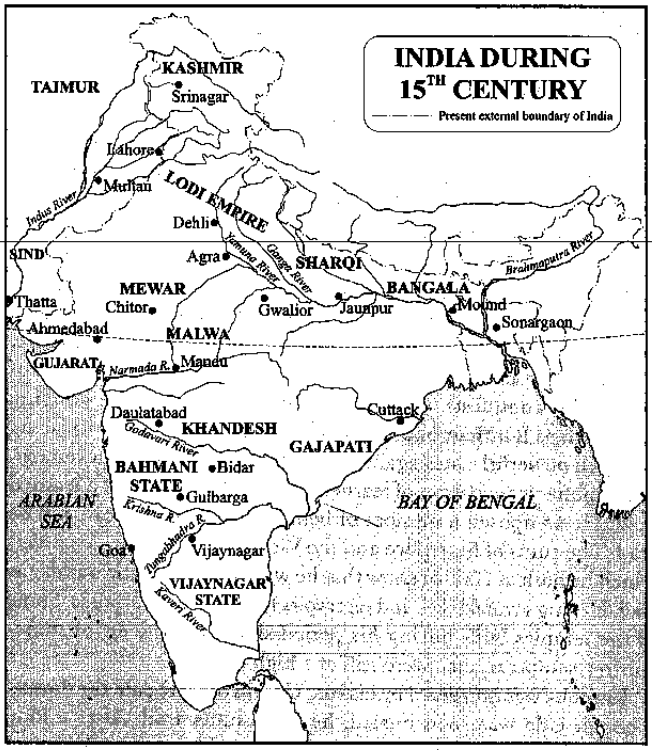
- Fragmentation of the Delhi Sultanate and Power Struggle in North India
- The Collapse of the Delhi Sultanate
- The weakening of the Delhi Sultanate and Timur’s invasion of Delhi (1398) led to a major political crisis.
- After Timur’s attack, the Tughlaq king fled, creating a power vacuum.
- This emboldened several provincial governors and autonomous rulers to declare their independence.
- Emergence of Independent States
- First breakaway regions:
- Bengal (East)
- Sindh and Multan (West)
- Deccan states (South)
- Further disintegration:
- Gujarat, Malwa, and Jaunpur (Eastern Uttar Pradesh) also declared independence.
- In Rajputana, after the Muslim governor was expelled from Ajmer, various Rajput states asserted independence.
- Balance of Power Among Regional States
- Over time, a power balance emerged among these independent states:
- West:
- Gujarat, Malwa, and Mewar checked each other’s expansion.
- East:
- Bengal faced resistance from the Gajapati rulers of Orissa and Jaunpur.
- North:
- The Lodi dynasty, which rose to power in Delhi (mid-15th century), engaged in a prolonged struggle with Jaunpur for control of the Ganga-Yamuna valley.
- Key turning point:
- The Lodis absorbed Jaunpur (late 15th century), shifting the balance of power.
- This allowed them to expand into eastern Rajasthan and Malwa.
- The Struggle for the Domination of North India
- As Malwa began to disintegrate, tensions increased between:
- Gujarat
- Mewar
- The Lodis (Delhi)
- The victor in this contest would dominate all of North India.
- Malwa became the focal point of this power struggle.
- This intense rivalry motivated Rana Sanga to invite Babur, believing that the Lodi defeat would leave Mewar as the dominant power in North India.
- Eastern India: Bengal, Assam, and Orissa
- Bengal’s Independence from Delhi
- Reasons for frequent independence from Delhi:
- Distance from Delhi and unfamiliar waterways hindered Turkish rulers.
- Muhammad Tughlaq’s preoccupation with rebellions led Bengal to break away in 1338.
- Ilyas Khan’s Rise to Power (1342):
- Captured Lakhnauti and Sonargaon, declaring himself Sultan Shamsuddin Ilyas Khan.
- Expanded westward to Tirhut, Champaran, Gorakhpur, and Banaras.
- Firuz Tughlaq’s Bengal Campaign:
- Marched through Champaran and Gorakhpur, capturing Pandua.
- Ilyas sought shelter in Ekdala Fort.
- After two months, Firuz attempted a trick retreat, but Ilyas re-entered Ekdala.
- A treaty established the river Kosi (Bihar) as the boundary.
- Ilyas maintained independence while exchanging gifts with Delhi.
- Ilyas Shah’s Legacy and Successors
- Ilyas Shah’s popularity helped resist Firuz’s attempts to sway the people.
- Firuz Tughlaq invaded again after Ilyas’ death, but his son Sikandar used the same tactics and defended Bengal.
- Bengal remained independent for 200 years until Sher Shah’s conquest in 1538.
- Notable Rulers and Developments
- Ghiyasuddin Azam Shah (1389–1409):
- Known for justice; humbly accepted a court ruling when he accidentally killed a widow’s son.
- Maintained close relations with Persian poet Hafiz of Shiraz.
- Revived diplomatic and trade ties with China.
- Buddhist monks were sent to China upon the emperor’s request, proving Buddhism’s survival in Bengal.
- Chittagong port flourished as a trade hub.
- Hindu Rule Under Raja Ganesh:
- Brief period, but his sons ruled as Muslims.
- Cultural Achievements:
- Capitals Pandua and Gaur adorned with unique Bengali-Islamic architecture.
- Patronage of Bengali literature:
- Maladhar Basu, author of Sri-Krishna-Vijaya, was titled Gunaraja Khan.
- His son received the title Satyaraja Khan.
- Alauddin Hussain Shah (1493–1519) oversaw significant literary growth.
- Alauddin Hussain Shah’s Policies:
- Restored law and order.
- Liberal administration, offering high offices to Hindus (wazir, chief physician, mint master).
- Vaishnavite saint Chaitanya was highly respected.
- Bengal’s Expansion and Conflict with Assam
- Attempts to control Brahmaputra valley:
- Muslim rulers since Muhammad bin Bakhtiyar Khalji faced disastrous defeats.
- Ilyas Shah invaded Kamta (Western Assam) but withdrew after reaching Gauliati.
- Successors attempted plundering raids, but the river Karatoya remained Bengal’s boundary.
- Ahoms and Kamta’s Conflict:
- Kamta (West) and Ahoms (East) were rivals.
- Ahoms, a Mongoloid tribe from Burma, became Hinduized, giving rise to the name Assam.
- Alauddin Hussain Shah allied with Ahoms and destroyed Kamta’s capital, Kamtapur.
- His son Nusrat Shah’s attack on the Ahoms failed.
- Suhungmung (Svarga Narayana), the greatest Ahom ruler, expanded his kingdom and resisted Muslim invasions.
- Vaishnavite reformer Shankaradeva flourished under Suhungmung’s rule, spreading Vaishnavism.
- Bengal’s Expansion Towards Arakan and Chittagong
- Sultan Hussain Shah conquered Chittagong from Arakan.
- Also annexed Tipperah (modern Tripura).
- Bengal’s Conflict with Orissa
- Early skirmishes:
- The Ganga dynasty of Orissa assisted Radha (South Bengal) in resisting Delhi’s rule.
- Tried to conquer Lakhnauti, but failed.
- Orissa’s Flourishing Under the Ganga Dynasty:
- Built the Jagannatha temple (Puri) and Sun temple (Konark).
- Ilyas Shah raided Orissa (1338), reaching Chilka Lake and looting elephants.
- Firuz Tughlaq (1360) raided Orissa, massacring people and desecrating Jagannatha temple.
- These raids weakened the Ganga dynasty, leading to the rise of the Gajapati dynasty.
- The Gajapati Dynasty’s Rise (15th Century):
- Expanded southward into Karnataka, clashing with Vijayanagara, Reddis, and Bahmani sultans.
- Bengal’s strength prevented Orissa from expanding northward.
- Bengal-Orissa Border Conflicts:
- Frontier at river Saraswati (Midnapore and Hugli districts).
- Orissa attempted to advance up to Bhagirathi but failed.
- Alauddin Hussain Shah led raids into Orissa, reaching Puri and Cuttack.
- Despite frequent battles, Orissa held its territory beyond Saraswati.
- Conclusion: A Region of Dynamic Power Struggles
- Bengal, Assam, and Orissa were highly contested regions during this period.
- Bengal’s political stability, economic prosperity, and cultural vibrancy made it a dominant power.
- Assam’s Ahom rulers resisted external invasions, strengthening their rule.
- Orissa’s powerful Gajapati rulers expanded into the south but faced resistance from Bengal and Vijayanagara.
- The constant rivalries shaped the political landscape of Eastern India.
- Western India
- Gujarat: A Wealthy Province
- Gujarat was one of the wealthiest provinces of the Delhi Sultanate due to:
- Flourishing seaports
- Excellence in handicrafts
- Fertile soil
- Under Firuz Tughlaq:
- Gujarat had a benevolent governor who encouraged Hindu worship (Ferishta’s account).
- Muzaffar Shah
- Zafar Khan, son of a Rajput convert, succeeded as governor.
- After Timur’s invasion of Delhi Gujarat and Malwa became independent in all but name.
- In 1407, Zafar Khan formally declared himself ruler as Muzaffar Shah.
- Ahmad Shah I (1411–1443): Founder of the Gujarat Kingdom
- Grandson of Muzaffar Shah.
- Brought the nobility under control and strengthened administration.
- Moved the capital from Patan to Ahmedabad (1413).
- Expanded and consolidated the kingdom.
- Ahmad Shah’s Architectural Contributions
- Patronized a distinctive architectural style influenced by Jain traditions:
- Slender turrets
- Exquisite stone carvings
- Highly ornate brackets
- Major constructions:
- Jama Masjid, Ahmedabad
- Tin Darwaza
- Ahmad Shah’s Military Campaigns and Policies
- Conquest of Saurashtra:
- Captured Girnar Fort, later restored it to the raja in exchange for tribute.
- Religious Policies:
- Imposed jizyah tax on Hindus (first time in Gujarat).
- Attacked Sidhpur, destroying Hindu temples.
- Administrative Inclusivity:
- Despite religious policies, he appointed Hindus to key positions.
- Ministers Manik Chand and Motichand (Bania community) served under him.
- Strict Justice:
- Executed his own son-in-law in the marketplace for murder.
- Expansion in Rajasthan:
- Subjugated Idar Fort, Jhalawar, Bundi, and Dungarpur.
- Gujarat-Malwa Rivalry
- Constant conflict between Gujarat and Malwa:
- Muzaffar Shah defeated and imprisoned Hushang Shah of Malwa, but later reinstated him.
- Malwa’s rulers tried to weaken Gujarat by supporting rebels and Hindu rajas.
- Gujarat retaliated by attempting to install its own candidate as Malwa’s ruler.
- Impact of the rivalry:
- Weakened both kingdoms.
- Prevented them from playing a larger role in North Indian politics.
- Mahmud Begarha (1459–1511)
- Mahmud Begada (reigned 1458–1511) was the great-grandson of Ahmad Shah I, of Ahmad Shah I. He was the son of Muhammad Shah II
- Expansion and Military Campaigns
- Most famous Sultan of Gujarat, known for expansion and consolidation.
- Called Begarha for capturing two powerful forts:
- Girnar (Saurashtra, now Junagadh)
- Champaner (Southern Gujarat)
- Conquest of Girnar (Saurashtra)
- The ruler of Girnar had been regularly paying tribute, but Mahmud decided to annex the kingdom to control Saurashtra, a rich region with:
- Fertile land
- Flourishing ports
- Robbers and pirates disrupting trade
- Siege of Girnar:
- The raja resisted despite having few guns.
- Allegedly fell due to treason—his kamdar (minister), whose wife had been taken by the raja, conspired against him.
- The raja converted to Islam and joined Mahmud’s service.
- Mahmud founded Mustafabad at the base of Girnar as Gujarat’s second capital.
- Attack on Dwarka
- Mahmud sacked Dwarka, claiming it harbored pirates attacking Mecca-bound pilgrims.
- The campaign also resulted in the destruction of Hindu temples.
- Conquest of Champaner (1454)
- Strategic importance:
- Key location for controlling Khandesh and Malwa.
- The ruler had ties with the Sultan of Malwa despite being a feudatory of Gujarat.
- Siege of Champaner:
- The raja and his warriors, left without aid, performed jausar (ritual sacrifice) and fought to death.
- Mahmud built Muhammadabad near Champaner, making it his principal residence with gardens and architectural marvels.
- Architecture and Legacy
- Jama Masjid in Champaner still stands, featuring:
- Covered courtyard
- Jain architectural influences
- Finely crafted stonework, comparable to goldsmith artistry
- Conflict with the Portuguese
- The Portuguese disrupted Gujarat’s trade with West Asia.
- Mahmud allied with Egypt’s ruler to counter them but failed.
- Economic and Cultural Contributions
- Long and peaceful reign fostered trade and commerce.
- Built caravanserais and inns to ensure safe travel for merchants.
- Encouraged translation of Arabic works into Persian.
- Court poet Udayaraja composed in Sanskrit.
- Personal Traits and Unique Characteristics
- Appearance:
- Long waist-length beard and mustache tied over his head.
- Strange legend:
- According to traveler Barbosa, he was fed poison since childhood, making his touch deadly to flies.
- Enormous appetite:
- Breakfast included cup of honey, cup of butter, 100–150 bananas.
- Daily intake included 10–15 kg of food.
- Kept meat samosas by his pillow in case of midnight hunger.
- Gujarat at its Peak
- Under Mahmud Begarha, Gujarat reached its largest territorial extent.
- Became one of the most powerful and well-administered states in India.
- Later posed a serious challenge to Mughal Emperor Humayun.
- Malwa: A Strategic Kingdom
-
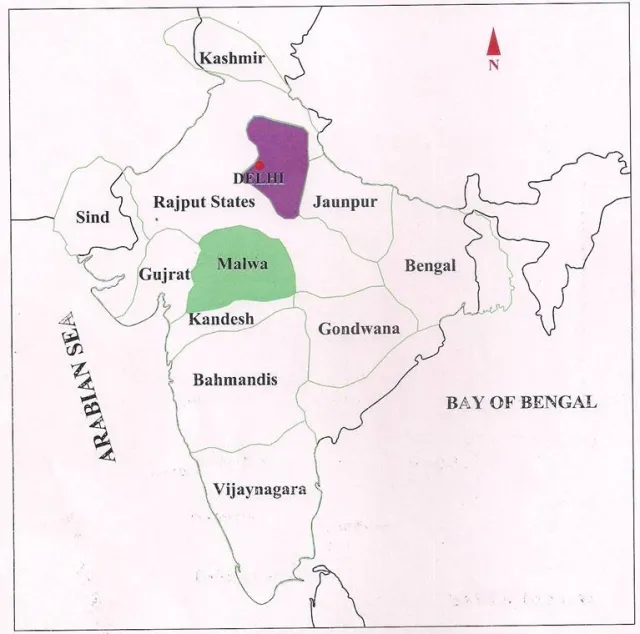
- Geographical and Political Importance
- Located on the high plateau between the Narmada and Tapti rivers.
- Controlled key trade routes between:
- Gujarat and northern India.
- North and south India.
- Served as a buffer state against the ambitions of Gujarat, Mewar, the Bahmanis, and the Lodi Sultans of Delhi.
- Any powerful state that controlled Malwa had a strategic advantage in dominating northern India.
- Rise of Malwa (15th Century)
- Reached its peak during the 15th century.
- Capital shifted from Dhar to Mandu, a highly defensible and scenic location.
- Mandu’s Architecture:
- Unlike Gujarat’s architectural style, Mandu’s structures were massive and built on lofty plinths.
- Extensive use of colored and glazed tiles added variety.
- Famous monuments:
- Jama Masjid
- Hindola Mahal
- Jahaz Mahal (Ship Palace)
- Ruins still remain impressive today.
- Internal Struggles and External Threats
- Malwa was plagued by internal conflicts:
- Frequent succession struggles.
- Factional fights among noble groups for power and wealth.
- Neighboring states Gujarat and Mewar often exploited Malwa’s instability for their own gains.
- Hushang Shah (Early Malwa Ruler, Tolerant Policies)
- Practiced religious toleration and encouraged Rajput settlement.
- Granted jagirs to two elder brothers of Rana Mokal of Mewar.
- Hindu temple construction was unrestricted (e.g., Lalitpur temple inscription).
- Patronized Jains, the dominant merchants and bankers of the region.
- Nardeva Soni, a Jain merchant, became treasurer and advisor to the Sultan.
- Mahmud Khalji (1436–69): Malwa’s Most Powerful Ruler
- Less tolerant than Hushang Shah.
- Destroyed many temples during wars with Rana Kumbha of Mewar and neighboring Hindu rajas.
- However, not part of a general policy of temple destruction.
- A restless and ambitious ruler, constantly at war
- Fought against almost all neighbors, including:
- Gujarat
- Rajas of Gondwana and Orissa
- Bahmani Sultans
- Sultan of Delhi
- Focused on overrunning South Rajputana and subduing Mewar.
- Mewar: Rise and Dominance in Northern India
-
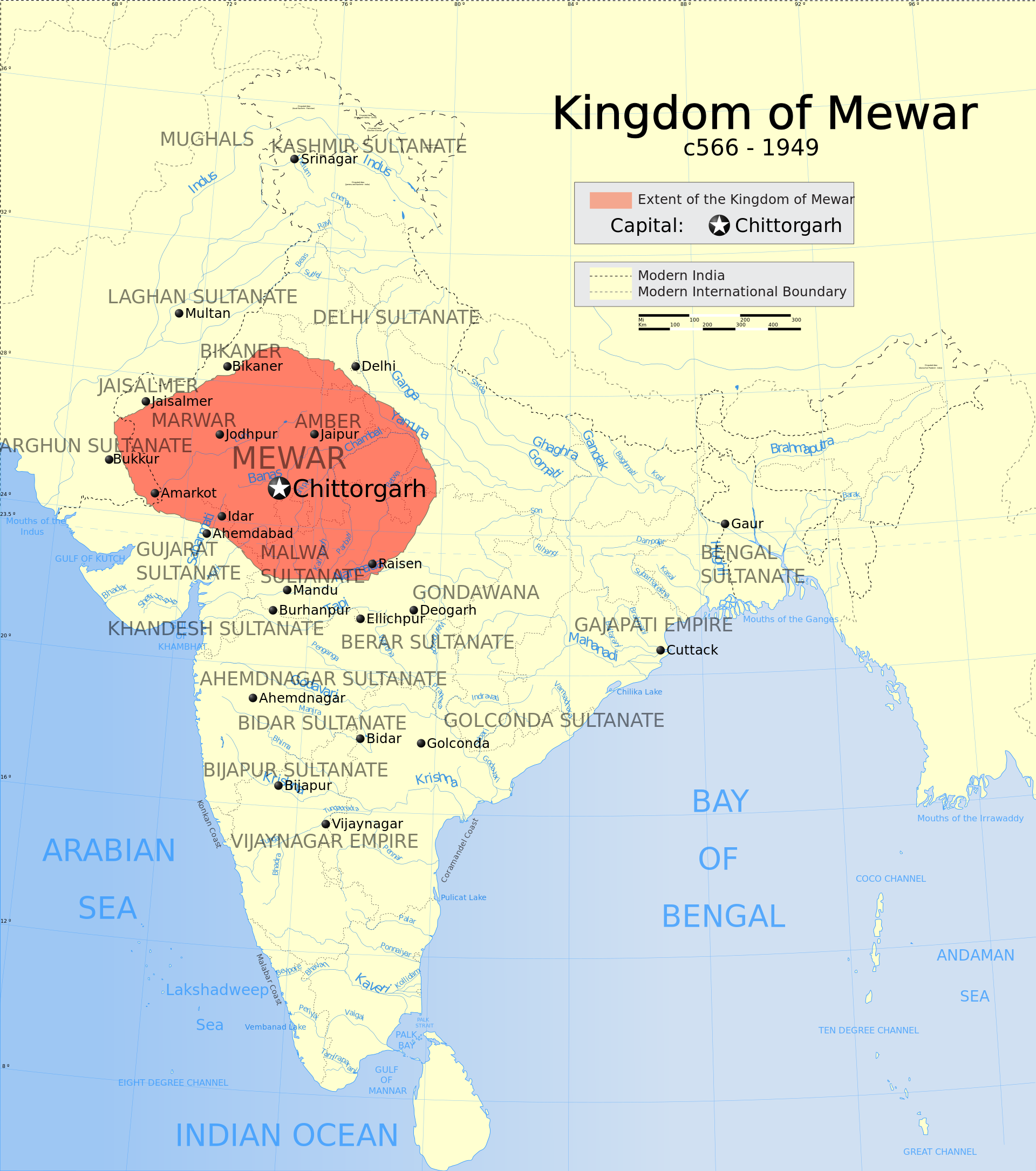
- Early History and Background
- Mewar’s rise in the 15th century significantly influenced northern India’s political landscape.
- The Chauhans, after being ousted from Ajmer, shifted to Ranthambhor and established a powerful state.
- Their power ended when Alauddin Khalji conquered Ranthambhor.
- From its ruins, new states emerged:
- Marwar (capital: Jodhpur, founded in 1465).
- Nagaur, a Muslim principality.
- Ajmer, once ruled by Muslim governors, changed hands frequently and became a point of contention among Rajput states.
- Eastern Rajputana remained disputed, with Delhi’s rulers maintaining interest in the region.
- Formation of Mewar
- The early history of Mewar is obscure.
- Bapa Rawal of the Guhilot clan is considered its virtual founder.
- Migrated from Gujarat in the 7th century and dominated southwestern Rajasthan.
- Guhilots ruled from Chittor until Ratan Singh was ousted by Alauddin Khalji.
- Chittor then passed to the Sisodiyas, former feudatories of the Guhilots.
- Rao Lakha and Mokal strengthened Mewar, making it the most powerful state in Rajasthan by the late 14th and early 15th centuries.
- Rana Kumbha (1433–1468): The Greatest Mewar Ruler
- Consolidated his rule by defeating internal rivals.
- Expanded Mewar by conquering Bundi, Kotah, and Daungarpur (on the Gujarat border).
- Kotah had been aligned with Malwa, and Daungarpur with Gujarat.
- This led to conflicts with Gujarat and Malwa:
- Khan of Nagaur, attacked by Rana Kumbha, sought Gujarat’s help.
- Kumbha supported a rival of Mahmud Khalji of Malwa in an attempt to install him as ruler.
- In retaliation, Mahmud Khalji gave refuge to Kumbha’s rivals, including his brother Mokal.
- Mewar’s Struggles and Resistance
- Wars with Gujarat and Malwa lasted throughout Kumbha’s reign.
- Conflict with Rathors of Marwar:
- Marwar had been under Mewar but gained independence under Rao Jodha.
- Despite external threats, Rana Kumbha maintained Mewar’s position:
- Kumbhalgarh was besieged multiple times by Gujarat.
- Mahmud Khalji raided as far as Ajmer and placed his own governor there.
- Despite these attacks, Kumbha retained most of his conquests (except outlying areas like Ranthambhor).
- Rana Kumbha’s Contributions
- Scholar and Patron of Learning:
- Composed several books, some of which still exist.
- Architectural Legacy:
- Built the Victory Tower (Kirtistambha) at Chittor.
-

- To commemorate his victory over the combined armies of Malwa and Gujarat, led by Mahmud Khilji, in the Battle of Sarangpur.
- His palace ruins reflect his enthusiasm for architecture.
- Developed irrigation projects by constructing lakes and reservoirs.
- Mewar’s stone-cutting and sculpture remained at a high level during his reign.
- Rana Sanga and Mewar’s Expansion
- Kumbha was murdered by his son Uda in a bid for the throne.
- Rana Sanga (Kumbha’s grandson) took the throne in 1508 after a long fratricidal conflict.
- Key events before Sanga’s rise:
- Malwa weakened internally.
- Mahmud II of Malwa sought Gujarat’s help against Medini Rai, a powerful Rajput leader.
- Medini Rai turned to Rana Sanga for support.
- In 1517, Rana Sanga defeated Mahmud II and took him prisoner.
- Eastern Malwa, including Chanderi, came under Mewar’s control.
- Mewar vs. Delhi Sultanate and the Mughals
- The Lodi rulers of Delhi saw Mewar’s expansion as a threat.
- Ibrahim Lodi invaded Mewar but was defeated by Rana Sanga at Khatoli.
- Lodi withdrew to focus on internal matters.
- Meanwhile, Babur was approaching India (1525), setting the stage for a decisive conflict for supremacy.
- Northwest and North India
- The Political Landscape After Timur’s Invasion
- Collapse of the Tughlaq Dynasty
- Following Timur’s invasion, Sultan Mahmud Tughlaq fled Delhi, seeking refuge first in Gujarat and then in Malwa.
- By the time he attempted to return, the throne of Delhi had lost its prestige.
- In the Delhi region, ambitious nobles and zamindars began asserting their independence.
- The Sharqi Sultanate (Jaunpur Sultanate)
-
- Rise of the Sharqis
- Malik Sarwar, a noble under Firuz Tughlaq, was one of the first to assert independence in the Ganga valley.
- Initially appointed as the governor of the eastern region with the title Malik-us-Sharq (Lord of the East), his successors were called the Sharqis.
- The Sharqi sultans established their capital at Jaunpur (eastern Uttar Pradesh) and adorned it with magnificent palaces, mosques, and mausoleums.
- The Sharqi rulers developed a unique architectural style distinct from the Delhi Sultanate, marked by lofty gates and huge arches.
- Cultural Patronage
- Jaunpur became a center of learning and culture, earning the title “Shiraz of the East.”
- Scholars, poets, and saints thrived under the patronage of the Sharqi rulers.
- Malik Muhammad Jaisi, the famous poet and author of Padmavat, lived in Jaunpur.
- Decline and Fall
- At its peak, the Sharqi Sultanate extended from Aligarh (western Uttar Pradesh) to Darbhanga (north Bihar), and from Nepal’s boundary to Bundelkhand.
- The Sharqis aspired to conquer Delhi but faced resistance from the Lodi dynasty.
- After a series of conflicts, Bahlul Lodi of Delhi annexed Jaunpur in 1484.
- The last Sharqi ruler died in exile, marking the end of the dynasty.
- Despite their fall, the Sharqis maintained law and order and prevented Bengal’s expansion into eastern Uttar Pradesh.
- Their cultural contributions continued to influence the region long after their demise.
- Rise of the Lodi Dynasty
- Bahlul Lodi (1451–1489)
- Following Timur’s invasion, the Saiyid dynasty emerged in Delhi, but its rule was weak.
- In Punjab, Afghan warlords gained power, with Bahlul Lodi emerging as the most significant.
- Initially, he was granted the iqta (land grant) of Sirhind and checked the growing power of the warlike Khokhars in the Salt Range.
- Called in to assist Delhi’s ruler against an attack from Malwa, Bahlul Lodi took control of Delhi.
- In 1451, he formally ascended the throne, ending the Saiyid dynasty.
- Expansion and Afghan Influence
- The Lodis, unlike earlier Delhi rulers who were Turks, were Afghans.
- Although Afghans had long served in the Delhi Sultanate’s army, few held high-ranking positions.
- Their rising influence was evident in both Malwa and the Bahmani kingdom in the south.
- Bahlul Lodi focused on consolidating his rule by inviting Afghan warriors from Roh (Afghanistan), promising them wealth and power.
- This influx of Afghans strengthened his army, allowing him to defeat the Sharqis and change the demographic composition of Muslim society in India.
- Sikandar Lodi (1489–1517)
- Governance and Administration
- Sikandar Lodi, the most capable Lodi ruler, ruled alongside Mahmud Begarha (Gujarat) and Rana Sanga (Mewar).
- Unlike the tribal Afghan sardars, who viewed the sultan as primus inter pares (first among equals), Sikandar emphasized royal authority.
- He introduced strict court protocols and enforced regular financial audits for nobles.
- Corrupt officials were punished severely.
- Though he managed to centralize power, the Afghan tradition of dividing the kingdom among the ruler’s sons persisted.
- Economic and Agricultural Reforms
- Sikandar Lodi ensured efficient governance, emphasizing law and order.
- Roads and highways were made secure from bandits.
- Prices of essential goods remained low.
- To encourage agriculture, he abolished the octroi duty on grains.
- He introduced the gaz-i-Sikandari (a new yard measurement) for standardized land assessment, later adopted by Sher Shah Suri.
- Religious Policies
- Sikandar Lodi was an orthodox ruler who strictly followed Islamic law (Sharia).
- He prohibited certain practices among Muslims, such as women visiting saintly graves.
- He re-imposed the jizya tax on Hindus and executed a Brahman for equating Hindu and Muslim scriptures.
- Hindu temples, such as the one at Nagarkot, were demolished during his campaigns.
- Patronage of Arts and Learning
- Despite his orthodoxy, Sikandar Lodi was a patron of scholars, poets, and philosophers.
- He invited intellectuals from Arabia and Iran to his court.
- Many Sanskrit works were translated into Persian, including texts on music.
- His reign saw an increase in Hindu participation in administration due to their Persian language skills.
- Expansion and Strategic Developments
- Sikandar Lodi expanded the Lodi territory by conquering Dholpur and Gwalior.
- In 1506, he carefully selected the site for Agra, intending it to serve as a strategic center for eastern Rajasthan and routes to Malwa and Gujarat.
- Sikandar Lodi (1488–1517) is credited with founding modern Agra as a capital city in 1504 CE.
- Over time, Agra became the second capital of the Lodi dynasty.
- The Looming Conflict: Lodi vs. Mewar
- Sikandar Lodi sought to extend influence over Malwa and Rajasthan.
- He took the Khan of Nagaur under his protection and tried to shift Ranthambhor’s allegiance from Malwa to Delhi.
- His successor, Ibrahim Lodi, continued this expansionist policy but faced resistance from Mewar.
- The growing power of Rana Sanga in Malwa and his expansion toward Agra and Bayana signaled an inevitable confrontation.
- However, before this struggle could reach its climax (the most intense, exciting, or important part of something), Babur arrived in India, altering the course of history.
- Kashmir in the Fifteenth Century
- Isolation and Early Turmoil
- For a long time, the beautiful valley of Kashmir remained a forbidden land to outsiders. According to al-Biruni, even Hindus who were not personally known to nobles were denied entry.
- During this period, Kashmir was a center of Shaivism. However, the situation changed with the fall of Hindu rule in the mid-fourteenth century.
- A major turning point was the devastating Mongol invasion of 1320, led by Dalucha. He ordered:
- Massacre of men, while women and children were enslaved and sold to Central Asian merchants.
- Plundering and burning of towns and villages.
- The Kashmir government failed to resist this onslaught, leading to widespread discontent among the people.
- Rise of Islam and Persecution of Hindus
- Following the Mongol invasion, Kashmir underwent significant changes:
- Muslim saints and refugees from Central Asia entered Kashmir, facilitated by the Baramulla route.
- A unique group of Sufi saints, called Rishis, emerged, blending elements of Hinduism and Islam.
- Conversion of lower-class Hindus to Islam took place, partly through preaching and partly by force.
- During the reign of Sikandar Shah (1389–1413), Hindu persecution peaked:
- Brahmins and learned Hindus were forced to either convert or flee.
- Temples were destroyed, and gold and silver idols were melted for currency.
- The harsh policies were influenced by his minister Suha Bhatt, a former Hindu who had converted to Islam.
- Reign of Zainul Abidin (1420–1470) – The Great Sultan
- The accession of Zainul Abidin, regarded as Kashmir’s greatest Muslim ruler, marked a reversal of these policies.
- Trick to remember his name:
- Since he nullified his predecessors policies, people praised him "Jai" + "Null" + "Abi ye he na Deen" = Zainul Abidin
- Reconciliation with Hindus:
- Cancelled orders against Hindus and invited exiles to return.
- Allowed those who had converted under pressure to revert to Hinduism.
- Restored temples, land grants, and revived Hindu scholarship.
- More than a century later, Abul Fazl recorded that Kashmir had 150 majestic temples, likely restored under Zainul Abidin.
- Policies of Toleration:
- Abolished the jizya (tax on non-Muslims) and banned cow slaughter.
- Lifted the ban on sati out of respect for Hindu customs.
- Appointed Hindus to high offices, including Suha Bhatt, his former minister.
- His first two queens were Hindu princesses from Jammu, and they bore all his sons.
- Contributions to Literature and Learning:
- A scholar himself, fluent in Persian, Kashmiri, Sanskrit, and Tibetan.
- Encouraged translations of Sanskrit texts (e.g., Mahabharata, Rajatarangini).
- Patronized Persian and Sanskrit scholars.
- Music enthusiast—received rare Sanskrit works on music from the Raja of Gwalior.
- Economic and Cultural Development:
- Sent artisans to Samarkand to learn papermaking and bookbinding.
- Encouraged crafts like stone-cutting, bottle-making, gold-beating, and shawl-weaving.
- Advanced musket-making and fireworks manufacturing.
- Developed agriculture through the construction of dams, canals, and bridges.
- Greatest engineering feat:
- Zaina Lanka, an artificial island in Wular Lake, where he built his palace and a mosque.
-

- Military and Political Achievements
- Though not a great warrior, Zainul Abidin successfully:
- Defeated Mongol invasions in Ladakh.
- Conquered Baltistan (Tibbat-i-Buzurg).
- Maintained control over Jammu and Rajouri.
- Unified the Kashmiri kingdom.
- His fame spread across India and Asia, and he maintained diplomatic ties with major rulers of his time.
- Conclusion: Cultural Impact of Regional Kingdoms
- The fifteenth-century political landscape remained unstable, but the regional kingdoms made lasting cultural contributions:
- Unique architectural styles emerged, incorporating local traditions.
- Local languages and literature flourished.
- While some rulers engaged in religious persecution, the broader trend was one of mutual accommodation and cultural integration.
- Zainul Abidin’s rule anticipated Akbar’s policies in many ways, fostering a spirit of tolerance and cultural exchange that shaped Kashmir’s history.
- Cultural Development in India (1300–1500)
- Cultural Impact of the Delhi Sultanate
- The establishment of the Delhi Sultanate in the early thirteenth century marked a new phase in India’s cultural development.
- The Turkish invaders who arrived in India were not mere barbarians.
- Turks and Their Cultural Background
- The Turks originated from Central Asia and migrated to West Asia in the ninth and tenth centuries.
- Unlike earlier Central Asian invaders who embraced Buddhism or Hinduism, the Turks adopted Islam and quickly assimilated into Arabo-Persian culture.
- By the time they reached India, they had been influenced by a flourishing Islamic civilization that spanned from Morocco and Spain to Iran.
- The region had made significant contributions in areas such as science, navigation, literature, and governance.
- The Turks brought with them:
- A well-defined faith in Islam to which they were deeply committed.
- Advanced ideas in government, art, architecture, and administration.
- Interaction Between Turks and Indians
- Indian society had its own strong religious traditions and developed cultural expressions in art, architecture, and literature.
- The interaction between these two civilizations led, over time, to the emergence of a new, enriched culture.
- However, this process was long and complex, often marked by:
- Destruction, followed or accompanied by periods of reconstruction.
- Mutual misunderstandings and conflicts, as both cultures held deeply entrenched beliefs.
- Assimilation and Cultural Exchange
- Despite the challenges, the two cultures gradually influenced each other in various fields:
- Art and architecture
- Music and literature
- Customs, ceremonies, and rituals
- Religious beliefs
- Science and technology
- However, elements of confrontation and conflict remained strong within both communities.
- A Process of Ups and Downs
- The process of assimilation and convergence was not uniform.
- It varied across different regions, fields, and historical periods.
- While cultural integration did take place, it was accompanied by periods of resistance and discord.
- Ultimately, the Delhi Sultanate played a crucial role in shaping India’s cultural landscape, fostering both conflict and synthesis between Turkish and Indian traditions.
- Architecture During the Delhi Sultanate
- The arrival of the Turks in India led to significant developments in architecture, blending indigenous and Islamic styles.
- Their architectural contributions were shaped by their religious beliefs, technological advancements, and artistic preferences.
- Early Turkish Constructions
- The first requirement of the new rulers was houses to live in and places of worship.
- Initially, existing temples and buildings were converted into mosques, while many others were destroyed, and their materials reused.
- Examples:
- Quwwat-ul-Islam Mosque (near Qutub Minar, Delhi)
-
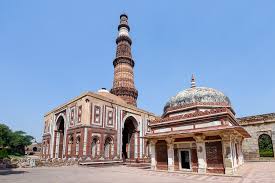
- Originally a temple
- Arhai Din ka Jhonpra (Ajmer)
- Originally a monastery.
-
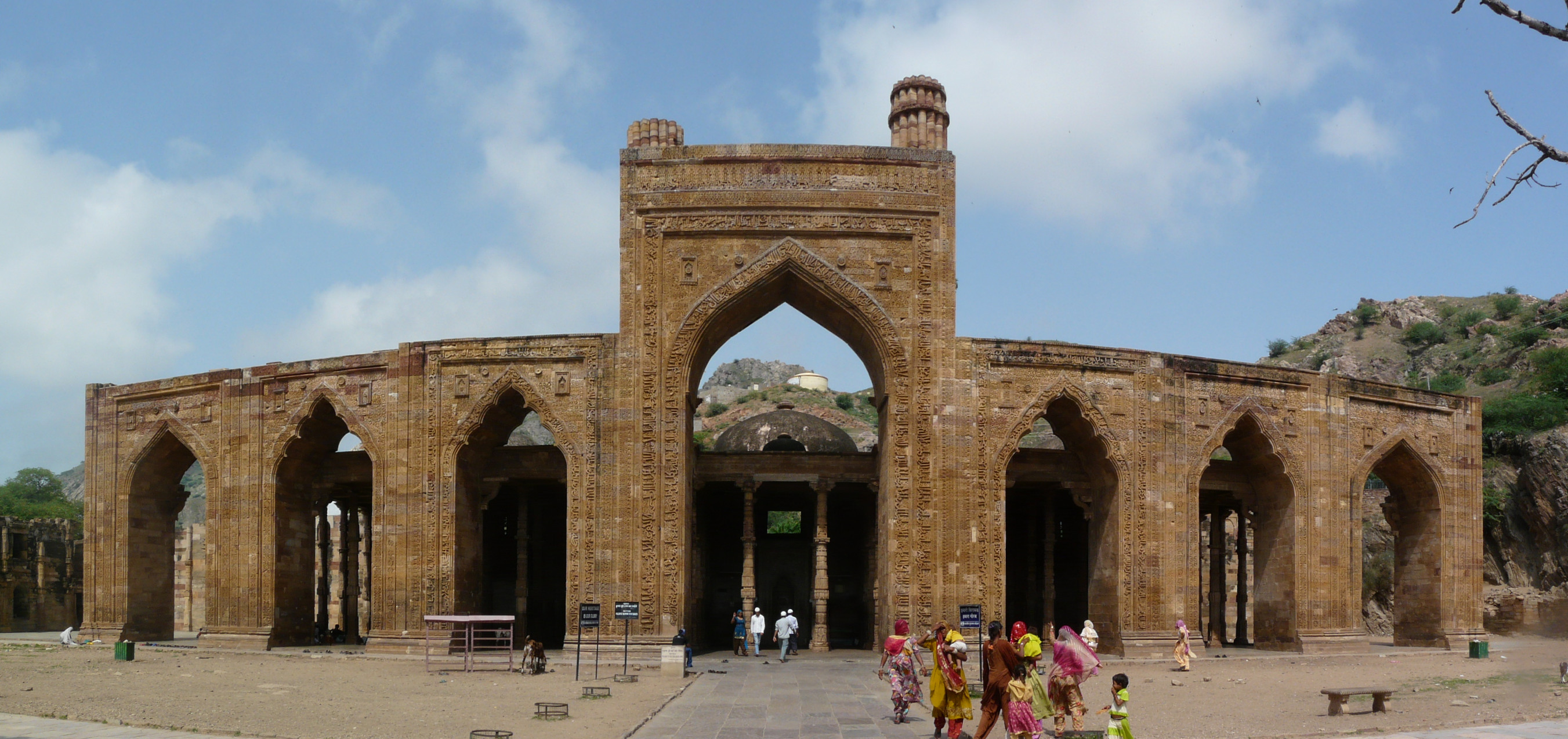
- The only new construction in Delhi was a façade of three elaborately carved arches in front of the garbhagriha, which was demolished.
- Decorative Features:
- Human and animal figures were avoided, as they were considered un-Islamic.
- Instead, floral scrolls and Quranic verses were used in intricate designs.
- Introduction of New Architectural Elements
- The Turks soon began constructing their own buildings, employing both indigenous Indian craftsmen and architects from West Asia.
- Key Features Introduced:
- Arches and domes were widely used.
- The arch and dome were not Turkish inventions; they were borrowed from Rome (via the Byzantine Empire) and refined by the Arabs.
- Advantages of Arches and Domes:
- Domes created an impressive skyline and were gradually built higher.
- Large halls could be constructed without the need for numerous supporting pillars, making them useful for mosques and palaces.
- Fine quality mortar was used for strong construction.
- Comparison with Indigenous Architecture:
- Indians had known arches and domes earlier but had not used them extensively.
- Indian methods relied on placing stones over one another or using beams, whereas the Turks introduced the scientific method of constructing arches.
- Both methods—arch and dome as well as slab and beam—were used in their buildings.
- Decorative Styles and Artistic Influences
- The Turks avoided human and animal figures in their architecture.
- Instead, they used:
- Geometrical and floral designs (Arabesque).
- Calligraphy – Quranic verses carved into walls.
- Indigenous motifs such as the bell, leaf, swastika, and lotus were also incorporated.
- Indian stone-cutters’ expertise was fully utilized, as seen in:
- Tomb of Iltutmish (Delhi) – Highly intricate carvings, with hardly any blank space.
- The Turks introduced colored stone architecture, using:
- Red sandstone as the primary material.
- Yellow sandstone and marble for decoration and contrast.
- Significant Architectural Achievements
- Qutub Minar (13th Century)
-
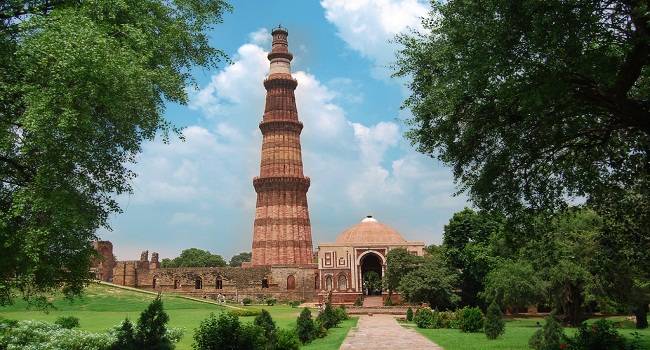
- The most magnificent Turkish construction of the 13th century.
- Height:
- Originally 71.4 meters.
- Builders:
- Begun by Aibak, completed by Iltutmish.
- Common Misconception:
- It was not dedicated to Sufi saint Qutb-ud-Din Bakhtiyar Kaki; it was part of the Quwwat-ul-Islam Mosque.
- Unique Features:
- Skillfully projected balconies linked to the main tower.
- Use of red and white sandstone, and marble.
- Ribbed design, enhancing visual appeal.
- Khalji Period (Late 13th – Early 14th Century)
- Alauddin Khalji’s Architectural Contributions:
- Built his capital at Siri (remains largely destroyed).
- Planned a tower twice the height of Qutub Minar but did not complete it.
- Constructed the Alai Darwaza, an entrance to the Qutub complex, featuring:
-
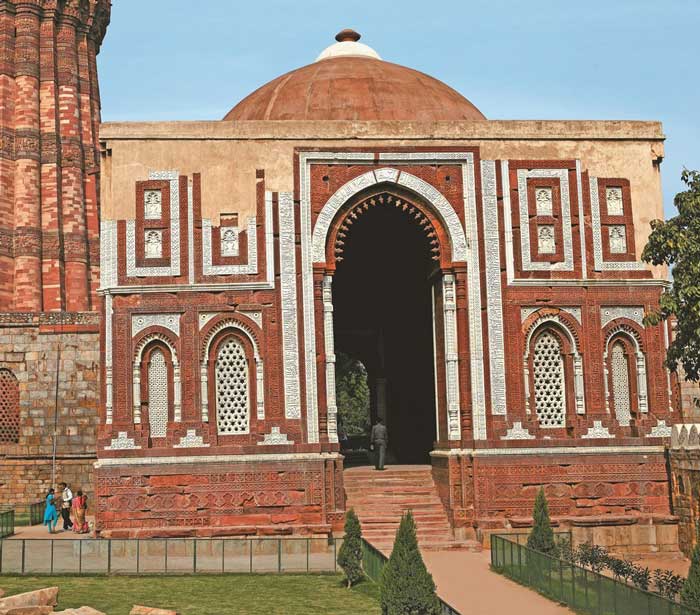
- Well-proportioned arches.
- First dome built using correct scientific principles.
- By this time, Indian craftsmen had mastered the art of arches and domes.
- Tughlaq Period (14th Century)
- Marked both the climax (the most intense, exciting, or important part of something) of the Delhi Sultanate and the beginning of its decline.
- Key Constructions:
- Tughlaqabad Fort (Ghiyasuddin and Muhammad Tughlaq):
-
- A huge palace-fortress complex.
- A massive artificial lake was created by blocking the Yamuna.
- Ghiyasuddin Tughlaq’s Tomb:
-
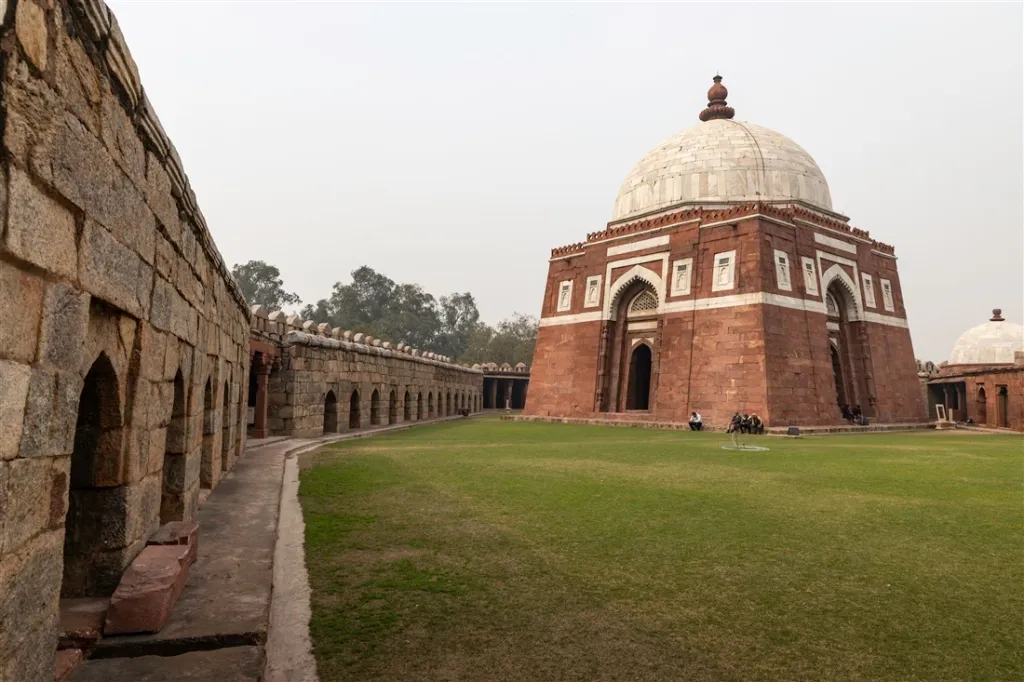
- Built on a high platform, enhancing its skyline.
- Marble dome, adding elegance.
- Architectural Innovations:
- Sloping Walls (Batter Technique):
- Created an impression of strength and solidity.
- Common in early Tughlaq buildings but absent in Firuz Tughlaq’s constructions.
- Combination of Arch and Lintel-Beam Systems:
- Visible in Firuz Tughlaq’s buildings.
- Hauz Khas Complex:
-
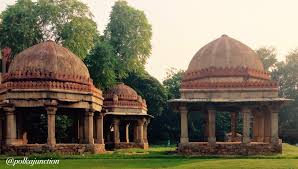
- A pleasure resort with a large lake and madrasa.
- Kotla (Firuz Shah’s Fort):
- Continued using indigenous Rajasthani and Gujarati architectural elements.
- Material Choices:
- Avoided expensive red sandstone.
- Used cheaper grey stone, leading to minimal decoration.
- Lotus motif became a standard decorative feature.
- Lodi Period (15th – Early 16th Century)
- Further developed the architectural traditions of the Delhi Sultanate.
- Key Features:
- Both arch-based and lintel-beam structures were used.
- Balconies, kiosks, and eaves inspired by Rajasthani and Gujarati styles.
- Buildings were placed on high platforms to enhance grandeur.
- Many tombs were built in lush gardens (e.g., Lodi Garden, Delhi).
- Octagonal tomb structures became common.
- Legacy:
- Many Lodi-era features were later adopted by the Mughals, culminating in masterpieces like the Taj Mahal.
- Regional Variations and Later Developments
- As the Delhi Sultanate fragmented, distinct architectural styles emerged in different regions:
- Bengal
- Gujarat
- Malwa
- Deccan
- These styles retained local influences while incorporating Turkish innovations.
- The Tughlaq-era style evolved and was modified in regional kingdoms, leading to an architectural renaissance in India.
- Conclusion
- The architectural legacy of the Delhi Sultanate was a blend of Indian and Islamic influences, introducing arches, domes, calligraphy, and intricate ornamentation while utilizing local craftsmanship.
- Over time, this synthesis led to the emergence of an independent Indo-Islamic architectural style, which significantly influenced later Mughal and regional constructions.
- Religious Traditions and Beliefs
- Islamic Influence and Cultural Exchange in Early India
- Islam’s Early Presence in India:
- Established in Sindh (8th century) and Punjab (10th century).
- Arab travelers settled in Kerala (8th–10th century).
- Cultural and Religious Exchanges:
- Arab travelers and Sufi saints spread ideas across India.
- Al-Biruni’s Kitab-ul-Hind introduced Hindu ideas to West Asia.
- Buddhist texts, Indian fables, astronomy, and medicine books were translated into Arabic.
- Indian yogis frequently visited West Asia.
- Influence of Indian Philosophy on Islam:
- Scholars debate the impact of Buddhism and Vedanta on Islamic thought.
- Buddhist monasteries, stupas, and images of the Buddha found in Afghanistan and Central Asia indicate strong Buddhist influence in these regions.
- Both Greek and Indian philosophies contributed to Islamic philosophical development.
- Rise of Sufism in India (12th century):
- Influenced both Muslims and Hindus, creating a shared spiritual platform.
- Early Sufis adopted Hindu rituals and yogic practices.
- Despite assimilation, their core ideology remained fundamentally Islamic.
- The Sufi Movement
- Background and Development
- 10th century was a turning point in Islamic history
- The rise of the Turks after the decline of the Abbasid Caliphate.
- Changes in religious ideas and beliefs:
- Decline of Mutazila (rationalist philosophy).
- Rise of orthodox schools based on the Quran and Hadith.
- Growth of Sufi mystic orders.
- Rationalists were accused of skepticism and atheism due to their monistic belief that God and the world were one, which was seen as heretical.
- Formation of Islamic Law Schools:
- Orthodox traditions led to four major schools of Islamic law.
- Hanafi School
- Founder:
- Imam Abu Hanifa (699–767 CE), Kufa (Iraq)
- Flexible, relied on reasoning (qiyās) and consensus (ijmā‘)
- Most widely followed:
- Central Asia, South Asia (India, Pakistan, Bangladesh), Turkey
- Adopted by Delhi Sultans, Mughals, and Ottomans
- Hanafi school (most liberal) was adopted by the eastern Turks, who later brought it to India.
- Maliki School
- Founder:
- Imam Malik ibn Anas (711–795 CE), Medina
- Gave weight to the practice of people of Medina as law
- Predominant in North Africa (Morocco, Algeria, Tunisia, Libya), parts of West Africa
- Shafi‘i School
- Founder:
- Imam al-Shafi‘i (767–820 CE)
- Tried to balance Hadith, reasoning, and systematic principles
- Spread to East Africa, Southeast Asia (Indonesia, Malaysia), Egypt
- Hanbali School
- Founder:
- Imam Ahmad ibn Hanbal (780–855 CE)
- Literalist, strict reliance on Qur’an and Hadith, limited analogy
- Dominant in Arabia, especially Saudi Arabia
- Mnemonic to remember the schools
- Haina Malika Saaf Khalbali
- Haina -> Hanafi
- Malika -> Maliki
- Saaf -> Shafi'i
- Haina -> Hanbali
- Early Sufism and Key Figures
- Origins and Motivations:
- Early Sufis were mystics who emphasized deep devotion to God.
- Rejected the extravagance and moral decay of the Islamic empire.
- Maintained distance from state affairs.
- Notable Early Sufis:
- Rabia (8th century):
- Emphasized love as the bond between God and the soul.
- Mansur bin Hallaj (10th century):
- Advocated pantheism (belief that God and the universe are one and the same) but was executed for heresy (beliefs or opinions that go against the established doctrines of a religion).
- Al-Ghazzali (d. 1112):
- Reconciled mysticism with Islamic orthodoxy.
- Rejected rationalist philosophy, arguing that true knowledge of God comes only through revelation (Quran).
- Organization of Sufism
- Formation of Sufi Orders (Silsilahs):
- 12 Sufi orders emerged.
- Each order was led by a prominent mystic (pir).
- Pirs lived in khangahs (hospices) with their disciples (murids).
- Every pir appointed a successor (wali) to continue their work.
- Hindu and Buddhist Influences on Sufism
- Shared Practices and Rituals:
- Penance, fasting, breath control—similar to Buddhist and Hindu yogic traditions.
- Buddhism was prevalent in Central Asia before Islam’s arrival, influencing Islamic mysticism.
- Hindu yogis visited West Asia, and texts like Amrit-kund were translated into Persian.
- Debate exists on whether Buddhist and Vedantic philosophies significantly shaped Sufism.
- Common Spiritual Ideas:
- Similar beliefs on God’s nature, the soul, and the material world created a shared platform between Sufis and Hindu mystics.
- This mutual understanding fostered religious tolerance.
- Classification of Sufi Orders
- Two broad divisions:
- Ba-shara Sufis:
- Followed Islamic law (shara).
- Be-shara Sufis:
- Did not strictly follow Islamic law.
- Both orders existed in India, with Be-shara Sufis (wandering saints) gaining a broader following, often revered by both Muslims and Hindus.
- The Essence of Sufism
- Sufi teachings emphasized spiritual unity.
- Persian poet Sanai expressed this spirit in his poetry:
- “Faith and infidelity, both are galloping on the way towards Him; And are exclaiming (together): He is one and none share His kingdom.”
- The Chishti and Suharwardi Silsilahs
- Prominent Chishti Saints:
- Khwaja Muinuddin Chishti / Shaikh Muinuddin Chishti
- Established in India by Khwaja Muinuddin Chishti around 1192, shortly after Prithvi Raj Chauhan’s defeat.
- Settled in Ajmer, an important political center with a significant Muslim population.
- Left no written records, but his influence grew through his successors.
- His disciples was Bakhtiyar Kaki
- Qutubuddin Bakhtiyar Kaki
- He was the direct disciple of Muinuddin Chisti
- His disciple was Farid-ud-Din Ganj-i-Shakar (confined activities to Hansi and Ajodhan).
- Farid-ud-Din Ganj-i-Shakar
- Farid-ud-Din was deeply respected in Delhi, and some of his verses were later included in the Adi-Granth of the Sikhs.
- Nizamuddin Auliya and Nasiruddin Chiragh-i-Delhi
- Nizamuddin Auliya was the disciple of Baba Farid and Nasiruddin Chiragh-i-Delhi is the disciple of Nizamuddin Auliya
- They were the most famous Chishti saints.
- Mingled freely with the lower classes, including Hindus.
- Lived a simple, austere life and spoke Hindawi to connect with the masses.
- Did not actively seek conversions, but many later attributed their conversion to their blessings.
- Popularized sama (musical recitations) to foster devotion, often using Hindi verses.
- Nizamuddin Auliya adopted yogic breathing techniques, earning the title of sidh (‘perfect’) from yogis.
- Chishti Expansion:
- After Nasiruddin Chiragh-i-Delhi’s death in the mid-14th century, the order lost a central figure in Delhi.
- Chishti saints dispersed, spreading their influence to eastern and southern India.
- Suharwardi Order:
- Entered India around the same time as the Chishtis but remained largely confined to Punjab and Multan.
- Prominent figures:
- Shaikh Shihabuddin Suharwardi
- Hamid-ud-Din Nagori
- Unlike the Chishtis, they:
- Did not embrace poverty and accepted state service.
- Held important positions in the ecclesiastical department.
- Key Differences:
- Chishtis preferred to stay aloof from state politics and avoided rulers and nobles.
- Suharwardis actively participated in state affairs.
- Despite differences, both orders fostered a spirit of peace and harmony among different religious and sectarian groups.
- Impact:
- Mecca remained the holiest site, but the rise of popular saints provided a local spiritual focus for the masses.
- The Bhakti Movement
- Origins and Early Development
- Stressed mystical union of the individual with God.
- Though its roots lie in the Vedas, Bhakti was not emphasized in the early period.
- Gained prominence with the rise of Buddhism, particularly Mahayana Buddhism, where Buddha was worshipped in his Avalokiteshvara (gracious) form.
- Around the same time, the worship of Vishnu developed.
- By the Gupta period, Bhakti was accepted as one of the three recognized paths to salvation (along with Jnana and Karma).
- Bhakti in South India (7th–12th Century)
- Saiva Nayanmars and Vaishnavite Alvars disregarded Jain and Buddhist austerities and preached personal devotion to God as a means of salvation.
- Opposed the rigid caste system and spread their message in local languages.
- Bhakti’s Spread to North India
- Despite connections between North and South India, Bhakti ideas spread slowly to the North.
- Challenge:
- Nayanmars and Alvars used regional languages, while Sanskrit remained the dominant intellectual language in the North.
- Bhakti was carried to the North by scholars and saints, including:
- Namadeva (early 14th century)
- A Maharashtrian saint, originally a tailor and former bandit, wrote devotional poetry in Marathi and engaged with Sufi saints in Delhi.
- Ramananda (14th–15th century)
- A follower of Ramanuja, substituted Rama worship for Vishnu worship and rejected caste-based restrictions.
- Enrolled disciples from all castes, including:
- Ravidas (cobbler)
- Kabir (weaver)
- Sena (barber)
- Sadhana (butcher)
- Why Bhakti Gained Popularity in the North:
- Decline of Brahman prestige after Rajput defeats and the Turkish Sultanate’s establishment.
- Nath Panthi movement questioned caste hierarchy and Brahman supremacy.
- Sufi saints promoted equality and brotherhood, resonating with Bhakti ideas.
- People sought a spiritual, emotional, and rational religion beyond rituals and ceremonies.
- By the 15th–16th centuries, the Bhakti movement became widely accepted in North India.
- Key Figures of the Bhakti Movement
- Kabir (15th Century)
- Uncertainty about his birth; legend says he was the son of a Brahman widow, raised by a Muslim weaver in Kashi.
- His teachings combined Hindu and Islamic elements:
- Emphasized one universal God (Allah, Sain, Sahib, etc.).
- Rejected idol worship, pilgrimages, and ritualistic practices (including namaz).
- Opposed asceticism and book knowledge as means of true wisdom.
- Denounced the caste system and untouchability, advocating human equality.
- Supported the poor and marginalized, though he was not a social reformer—focused on individual transformation.
- Dr. Tara Chand’s View:
- “Kabir’s mission was to preach a religion of love uniting all castes and creeds.”
- Rejected ritualistic Hinduism and Islam in favor of spiritual unity.
- Guru Nanak (1469–1538)
- Founder of Sikhism; born into a Khatri family in Talwandi (now Nankana Sahib, Pakistan).
- Initially trained in Persian and accountancy, but was drawn towards spiritual contemplation.
- Had a mystical vision, renounced worldly life, and composed hymns.
- Sang them with rabab accompaniment by Mardana.
- Undertook extensive travels across India, Sri Lanka, and even Mecca and Medina.
- Core Teachings:
- Emphasized one God and devotion as the path to salvation, beyond caste, creed, or sect.
- Advocated purity of character and the need for a guru for spiritual guidance.
- Rejected idol worship, pilgrimages, and external rituals.
- Promoted a middle path, balancing spirituality with household responsibilities.
- Did not intend to create a new religion but sought to bridge Hindu-Muslim divides.
- His teachings later evolved into Sikhism, while Kabir’s followers formed the Kabir Panth sect.
- Impact and Resistance
- Bhakti saints challenged orthodox Hinduism and Islam, advocating spiritual unity and equality.
- Their influence extended to political and religious policies, notably influencing Akbar’s religious outlook.
- However, orthodox factions within both Hinduism and Islam resisted change.
- The 16th–18th centuries saw ongoing struggles between:
- Liberal, non-sectarian forces (Bhakti, Sufi influences).
- Traditional, orthodox elements reinforcing existing religious structures.
- Long-term Impact:
- Though caste and orthodox practices persisted, Bhakti created a lasting shift in religious thought.
- Fostered an inclusive spiritual environment influencing future reform movements.
- The Vaishnavite Movement
- Bhakti Movement and Vaishnavism
- Developed around the worship of Rama and Krishna, incarnations of Vishnu.
- Krishna’s childhood escapades and love for Radha became central themes.
- Used allegorically to depict the relationship between the individual soul and the supreme soul.
- Chaitanya and Kirtan Tradition
- Chaitanya popularized kirtans (musical gatherings) for mystic experience.
- Worship emphasized love, devotion, song, and dance, leading to ecstasy.
- Open to all, irrespective of caste or creed.
- Saint-Poets of Vaishnavism
- Their writings transcended caste and religious barriers.
- Prominent figures:
- Narsinha Mehta (Gujarat)
- Meera (Rajasthan)
- Surdas (Western Uttar Pradesh)
- Chaitanya (Bengal and Orissa)
- Inclusivity:
- Welcomed all devotees, regardless of caste or background.
- Chaitanya’s Influence and Journey
- Born in Nadia, a Vedantic rationalism center.
- At 22, initiated into the Krishna cult in Gaya.
- Traveled across India, including Vrindavan, reviving Krishna worship.
- Attracted Muslims and lower castes but did not reject scriptures or idol worship.
- Philosophical Approach
- Rooted in Vedantic monism, emphasizing unity of God and creation.
- Influenced by Vallabha, a Tailang Brahmin from the 15th–16th century.
- Humanistic approach:
- Focused on love and beauty in all forms.
- While they did not abolish caste, they softened its rigidity.
- Connection Between Bhakti and Sufism
- Bhakti concepts resembled those of Sufi saints and poets.
- In 15th century Ibn-i-Arabi’s monistic ideas gained traction.
- Unity of Being (Tauhid-i-Wajudi):
- All beings are manifestations of the divine.
- Influence of Hindu traditions:
- Sufis engaged with yogis and saints.
- Use of Hindi and Sanskrit:
- Some Sufis, like Malik Muhammad Jaisi, composed in Hindi.
- Hindi Bhakti songs were more impactful on Sufis than Persian poetry.
- Abdul Wahid Bilgrami:
- Wrote Haqa’iq-i-Hind, interpreting Bhakti terms in Sufi mysticism.
- Common Platform for Religious Unity
- By the 15th–16th centuries, Bhakti and Sufi movements had created a shared spiritual space.
- Provided a foundation for Akbar’s concept of Tauhid (unity of all religions).
- Literature and Fine Arts
- Sanskrit Literature
- Continued Prominence
- Remained a vehicle for higher thought and literary expression.
- Production of works was immense, possibly surpassing the previous period.
- Flourished in various fields, including:
- Philosophy (e.g., Ramanuja, Madhava, Vallabha).
- Poetry, drama, fiction, medicine, astronomy, music.
- Hindu law (Dharmashastras):
- Numerous commentaries and digests.
- Role in Dissemination of Knowledge
- Ideas spread rapidly across the country.
- Network of specialized schools and academies existed, even under Muslim rule.
- Benefited from the introduction of paper, aiding in:
- Reproduction and distribution of texts.
- Preservation of Ramayana and Mahabharata texts (11th–12th century).
- Major Legal Works
- Mitakshara of Vijayaneshwar (one of two principal Hindu law schools) – 12th century.
- Chandeshwar of Bihar – Notable 14th-century commentator.
- Most legal works produced in South India, Bengal, Mithila, and Western India.
- Jain Contributions
- The Jains actively contributed to Sanskrit literature.
- Hemachandra Suri was the most prominent Jain scholar.
- Limited Interaction with Islamic Culture
- Sanskrit literature largely ignored the Muslim presence.
- Minimal efforts to translate Islamic or Persian works.
- Exceptions:
- Yusuf and Zulaikha (Persian love story by Jami) translated.
- Some works on the astrolabe (used in navigation and astrology) translated.
- Arabic and Persian Literature
- Arabic Literature
- Arabic remained the primary language for:
- Islamic scholarship and philosophy.
- Scientific works, including some translations into Persian.
- Digests of Islamic law, prepared in both Arabic and Persian.
- Famous Persian digests:
- Compiled during Firuz Tughlaq’s reign.
- Famous Arabic digest:
- Fatawa-z-Alamgiri (prepared under Aurangzeb).
- Introduction of Persian in India
- Turks introduced Persian in India during the 10th century.
- Persian had already become the literary and administrative language of Central Asia and Iran.
- Persian poets like Firdausi and Sadi flourished between the 10th and 14th centuries.
- Lahore became the first centre for Persian literary cultivation in India.
- Amir Khusrau: The Pioneer of Indo-Persian Literature
- Born in 1252 (Patiali, near Badayun, Western UP).
- Took pride in being Indian and praised the land:
- “Hindustan is like heaven… greener and more beautiful than Khurasan.”
- Developed a unique Persian style called Sabaq-i-Hindi (Style of India).
- Wrote historical romances and poetry in multiple forms.
- Praised Indian languages, including Hindi (Hindavi).
- Participated in Sufi musical gatherings (Sama) with Nizamuddin Auliya.
- Died in 1325, soon after Nizamuddin Auliya’s death, and was buried in the same compound.
- Growth of Persian Historiography
- A strong tradition of history writing in Persian emerged.
- Notable historians:
- Ziauddin Barani
- Aff
- Isami
- Persian as a Cultural Link
- Persian facilitated India’s cultural ties with Central Asia and Iran.
- Became the language of administration and diplomacy.
- Spread beyond North India as the Delhi Sultanate expanded south.
- Sanskrit-Persian Interchange
- Initially, minimal interaction between Sanskrit and Persian.
- Zia Nakhshabi (d. 1350) pioneered translations from Sanskrit to Persian:
- Taz Nama
- Book of the Parrot
- Popular Sanskrit tale translated into Persian.
- Kok Shastra
- Indian treatise on sexology
- Under Firuz Shah:
- Sanskrit texts on medicine and music were translated into Persian.
- Sultan Zain-ul-Abidin of Kashmir:
- Commissioned translations of Rajatarangini and Mahabharata into Persian.
- Sponsored translations of Sanskrit medical and musical texts.
- Some scientific works (mathematics, astronomy, medicine) were also translated into Sanskrit during this period.
- Regional Languages
- Development of Regional Languages
- Several regional languages, such as Hindi, Bengali, and Marathi, originated around the 8th century, while Tamil was much older.
- By the 14th century, Amir Khusrau acknowledged their significance, stating:
- “These languages have, from ancient times, been applied in every way to the common purposes of life.”
- The maturity of these languages and their use in literature became a striking feature of the medieval period.
- Factors Behind Their Growth
- Decline in Brahminical influence led to a decrease in Sanskrit’s prestige.
- Bhakti saints played a crucial role by using these languages in their teachings.
- Many early saints helped shape regional languages for literary purposes.
- Pre-Turkish regional kingdoms (e.g., Tamil, Kannada, Marathi regions) used local languages alongside Sanskrit for administration.
- Even under the Delhi Sultanate, Hindi-knowing accountants were appointed in revenue departments.
- Patronage and Administrative Use
- After the Delhi Sultanate’s decline, regional languages gained prominence alongside Persian in local administrations.
- South India:
- Telugu literature thrived under Vijayanagara rulers’ patronage.
- Deccan:
- Marathi was an administrative language in the Bahmani kingdom and later at Bijapur’s court.
- Bengal:
- Nusrat Shah commissioned Mahabharata and Ramayana translations into Bengali.
- Maladhar Basu translated the Bhagavata into Bengali under royal patronage.
- Role of Sufis in Regional Literature
- Sufi saints used Hindi Bhakti poetry in their musical gatherings.
- In Jaunpur, Sufi poets like Malik Muhammad Jaisi:
- Wrote in Hindi, making Sufi concepts accessible to the common people.
- Helped popularize Persian poetic forms, such as the masnavi.
- Fine Arts: Music and Cultural Integration
- Introduction of Persian and Central Asian Musical Traditions
- The Turks inherited a rich Arab musical tradition, further refined in Iran and Central Asia.
- They introduced several new musical instruments to India, including:
- Rabab
- Sarangi
- They also brought new musical modes and regulations.
- Indian music had earlier influenced musical developments at the Caliphs’ court in Baghdad, but systematic interaction began under the Delhi Sultanate.
- Amir Khusrau’s Contributions
- Amir Khusrau, a master of both music theory and practice, played a key role in musical integration.
- He introduced Perso-Arabic ragas, such as:
- Aman
- Ghora
- Senam
- He is sometimes credited with inventing the sitar, though there is no concrete evidence.
- The tabla, often attributed to him, likely developed much later (late 17th or early 18th century).
- Music During the Sultanate Period
- Firuz Shah Tughlaq:
- Regularly listened to music every Friday after namaz.
- Under his reign, the Indian classical work Regadarpan was translated into Persian.
- Spread of Music:
- Musical gatherings expanded from Sufi abodes to noble courts.
- Sultan Husain Sharqi of Jaunpur:
- A great patron of music.
- Pir Bodhan, a Sufi saint, was the second most renowned musician of the era.
- Gwalior as a Musical Hub:
- Raja Man Singh of Gwalior was a notable patron.
- His court produced the work Mar Kautihal, which documented new musical modes introduced by Muslims.
- Differentiation of North and South Indian Music
- It is unclear when North and South Indian music diverged.
- However, the distinction likely arose due to the incorporation of Perso-Arabic musical elements in North India.
- A unique musical style, significantly influenced by Persian music, developed in Kashmir.
- Later Patronage and Mughal Influence
- After conquering Jaunpur, Sikandar Lodi continued its musical traditions, lavishly supporting musicians.
- This patronage of music was later carried forward by the Mughals.
- Struggle for Empire in North India—The Mughals and Afghans (1525-1555)
- Political Landscape of Central and West Asia in the Fifteenth Century
- The Rise of Timur and His Empire
-
- Following the disintegration of the Mongol Empire in the 14th century, Timur reunited Iran and Turan under a single rule.
- His empire stretched from:
- The lower Volga to the Indus River
- Included Asia Minor (modern Turkey), Iran, Trans-Oxiana, Afghanistan, and part of Punjab
- Timur died in 1405, but his grandson Shahrukh Mirza (d. 1448) managed to preserve a large part of the empire.
- Under his patronage, Samarkand and Herat became major cultural centers of West Asia.
- The ruler of Samarkand held great prestige in the Islamic world.
- Decline of the Timurid Empire and the Rise of New Powers
- The Timurid tradition of partitioning the empire led to internal conflicts.
- As the Timurids weakened, two new forces emerged:
1. The Uzbeks:
- A Turko-Mongol tribe that moved into Trans-Oxiana.
- Though Muslims, they were looked down upon by the Timurids, who saw them as uncultured barbarians.
2. The Safavids of Iran:
- A new Shiite dynasty descended from an order of saints tracing their ancestry to the Prophet.
- They persecuted Sunnis, leading to religious conflicts with the Sunni Uzbeks.
- Meanwhile, further west, the Ottoman Turks were rising in power, seeking to dominate Eastern Europe, Iraq, and Iran.
- This set the stage for the sixteenth-century conflict between the three mighty empires:
-

- Uzbeks
- Safavids
- Ottomans
- Babur’s Struggles and the Uzbek Threat
- In 1494, Babur inherited Farghana, a small state in Trans-Oxiana, at just twelve years old.
-
- While the Timurid princes were engaged in internal battles, Babur attempted to capture Samarkand from his uncle.
- He briefly occupied the city twice but lost it both times.
- In his second attempt, the Uzbek chief Shaibani Khan was called in to remove Babur.
- Shaibani defeated Babur, conquered Samarkand, and then overran other Timurid kingdoms.
- Babur was forced to retreat to Kabul, which he conquered in 1504.
- Babur’s Attempts to Reclaim Samarkand and the Safavid-Uzbek Conflict
- For the next 14 years, Babur sought allies to reclaim his homeland from the Uzbeks.
- He sought help from his uncle, the ruler of Herat, but was unsuccessful.
- Ultimately, Herat also fell to Shaibani Khan (Uzbek chief), leading to direct conflict between:
- The Uzbeks, who controlled Trans-Oxiana.
- The Safavids, who claimed Herat and Khurasan.
- In 1510, in a famous battle near Merv, Shah Ismail (Safavid ruler) of Iran defeated and killed Shaibani Khan (Uzbek chief).
- Babur’s Brief Rule in Samarkand and Final Uzbek Victory
- With Iranian support, Babur recaptured Samarkand.
- However, he struggled under Iranian control, as the Safavids treated him as a mere governor of an Iranian province, not an independent ruler.
- The Uzbeks quickly recovered, and Babur was once again ousted from Samarkand, forcing him to return to Kabul.
- Meanwhile, in 1514, Shah Ismail of Iran was defeated by the Ottoman Sultan, solidifying Uzbek dominance over Trans-Oxiana.
- Babur’s Shift Toward India
- With no hope of reclaiming Samarkand, Babur was ultimately forced to look toward India as his next conquest.
- Babur’s Motivations and Early Attempts to Conquer India
- Babur’s Long-Standing Desire to Conquer India
- Babur himself stated that from the time he obtained Kabul (1504) until his victory at Panipat (1526), he had never stopped thinking about conquering Hindustan.
- However, his plans were delayed due to:
- Apprehensions of his degs (loyal followers and soldiers)
- Disagreements between his brothers
- Like earlier Central Asian invaders, Babur was drawn to India’s immense wealth.
- His ancestor, Timur, had:
- Plundered a vast treasure from India.
- Taken skilled artisans who helped develop his empire and beautify his capital.
- Annexed parts of Punjab, which remained under Timur’s successors for generations.
- After conquering Afghanistan, Babur considered himself the rightful heir to these areas.
- Economic and Strategic Reasons for Babur’s Invasion
- Babur’s empire in Badakhshan, Qandhar, and Kabul was not wealthy enough to sustain his army and administration.
- Abul Fazl noted that in some territories, military and administrative costs exceeded revenue.
- With limited resources, Babur struggled to provide for his followers and feared an Uzbek attack on Kabul.
- India was seen as:
- A potential place of refuge.
- A strategic base for launching operations against the Uzbeks.
- Political Situation in Northwest India (Ideal Conditions for Babur’s Invasion)
- Sikandar Lodi had died in 1517, and his son Ibrahim Lodi had succeeded him.
- Ibrahim Lodi’s attempts to centralize power alienated:
- Afghan chiefs
- Rajputs
- One of the most powerful Afghan chiefs, Daulat Khan Lodi, was the governor of Punjab and nearly independent.
- He tried to maintain favor with Ibrahim Lodi by sending his son to court but also expanded his own power by annexing frontier regions like Bhira.
- A frontier is a broad zone or region where two different political, cultural, or geographical systems meet and overlap.
- Babur’s Early Campaigns in Punjab
- First Expedition (1518-19)
- Babur captured the powerful fort of Bhira.
- He then sent envoys to both Daulat Khan and Ibrahim Lodi, demanding the return of Turk-controlled territories.
- However, Daulat Khan detained Babur’s envoy in Lahore, refusing to either:
- Grant an audience
- Forward the message to Ibrahim Lodi
- After Babur returned to Kabul, Daulat Khan took advantage of his absence, occupied Bhira, and expelled Babur’s men.
- Second Expedition (1520-21)
- Babur crossed the Indus again and swiftly recaptured Bhira and Sialkot—both key gateways to India.
- Lahore also fell to him.
- He considered advancing further but was forced to retreat due to:
- A revolt in Qandhar
- A prolonged siege of Qandhar (lasting 1.5 years), which he successfully ended
- With Qandhar secured, Babur was once again free to focus on India.
- Invitation from Indian Nobles and Final Preparations
- Around this time, Babur received an embassy from Daulat Khan Lodi, led by his son Dilawar Khan.
- They invited Babur to invade India, arguing that:
- Ibrahim Lodi was a tyrant.
- He had lost the support of nobles.
- Additionally, it is believed that Rana Sanga of Mewar also sent a separate invitation urging Babur to invade.
- These appeals convinced Babur that the time was ripe to seize Punjab—if not all of India.
- Final Conquest of Punjab (1525)
- In 1525, while Babur was at Peshawar, he received news that:
- Daulat Khan had switched sides again.
- He had gathered 30,000-40,000 troops.
- He had ousted Babur’s men from Sialkot and was advancing toward Lahore.
- However, when Babur marched toward Lahore, Daulat Khan’s army quickly disbanded.
- Daulat Khan surrendered and was pardoned.
- Within three weeks of crossing the Indus, Babur became the undisputed master of Punjab.
- The Battle of Panipat (20 April 1526)
- Prelude to the Battle
- A conflict between Babur and Ibrahim Lodi was inevitable.
- Babur marched towards Delhi, and Ibrahim Lodi met him at Panipat with:
- 100,000 men (though the actual number of fighting men was lower due to servants).
- 1,000 elephants.
- Babur had crossed the Indus with 12,000 men, but his forces increased due to:
- Reinforcements from his army in India.
- Support from Hindustani nobles and soldiers in Punjab.
- Despite this, Babur’s army was still numerically inferior.
- Babur’s Battle Preparations
- To strengthen his position, Babur:
-
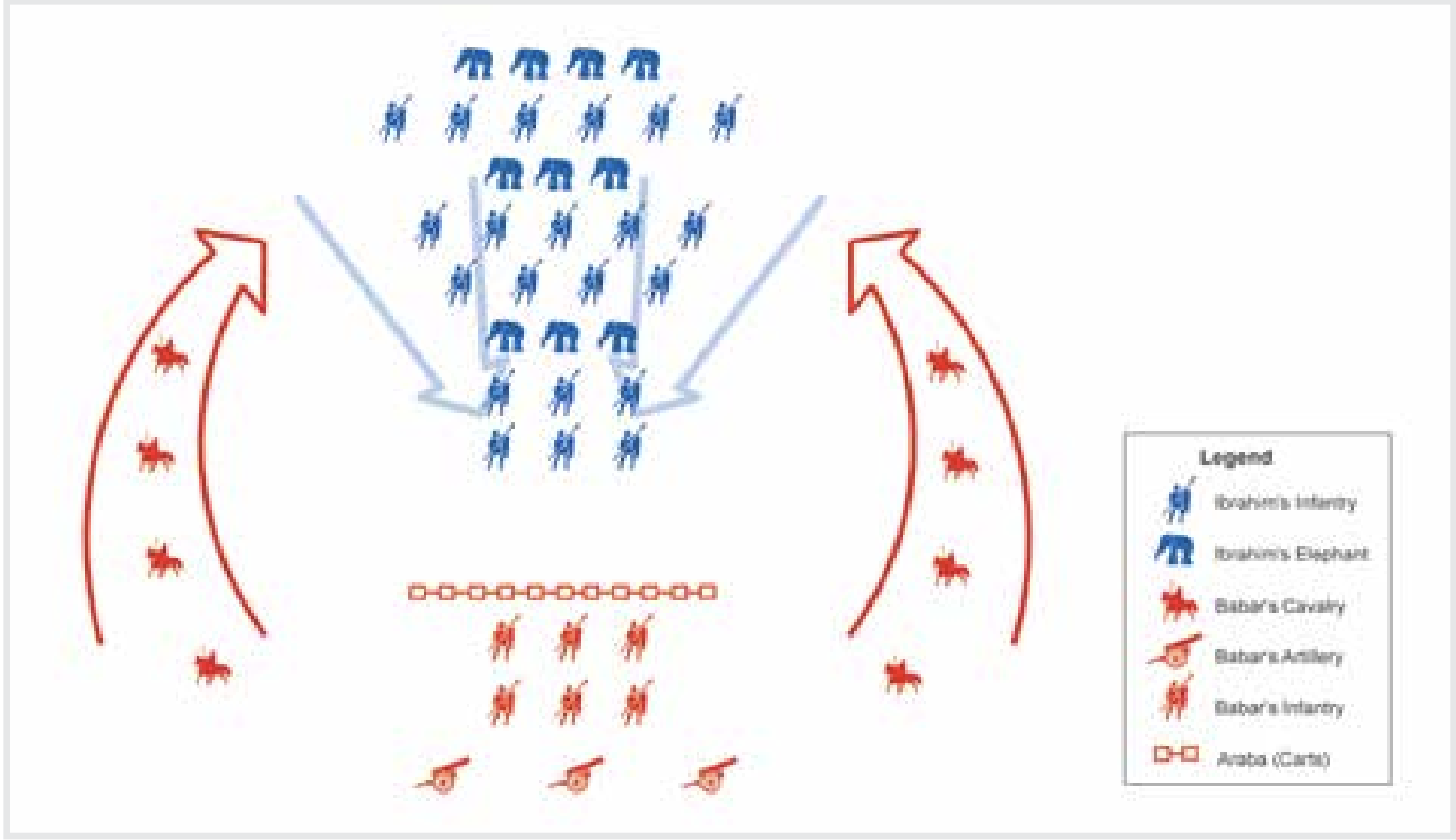
- Anchored one wing of his army against Panipat’s buildings.
- Protected the other wing with a ditch filled with tree branches.
- Constructed a defensive wall using lashed-together carts.
- Built breastworks between carts for resting guns and firing.
- This setup was called the Ottoman (Rumi) device, inspired by the Ottoman victory over Shah Ismail of Iran.
- Babur had two Ottoman master-gunners, Ustad Ali and Mustafa, which gave him a significant advantage.
- Although gunpowder was known in India, its widespread use in artillery only became common with Babur.
- The Battle Begins
- Ibrahim Lodi was unaware of Babur’s strongly fortified position.
- He had expected Babur to engage in mobile warfare, characteristic of Central Asians, involving rapid advances and retreats.
- After seven or eight days of skirmishing, Ibrahim Lodi finally mobilized for battle.
- His forces hesitated upon seeing Babur’s strong defenses.
- While Ibrahim was still reorganizing his troops, Babur’s flanking forces attacked from the side and rear.
- Babur’s Tactical Superiority
- Babur’s gunners effectively used firearms from the front.
- However, Babur credited much of his victory to his bowmen.
- Interestingly, he made little mention of Ibrahim Lodi’s elephants, suggesting they played a minor role in the battle.
- The Battle’s Climax
- Despite early setbacks, Ibrahim Lodi’s army fought bravely.
- The battle lasted two to three hours.
- Ibrahim Lodi fought to the end, surrounded by 5,900–6,000 men.
- More than 15,000 of Ibrahim Lodi’s soldiers were killed in the battle.
- Impact of the Battle
- Decisive Consequences
- The Battle of Panipat is considered one of the most decisive battles in Indian history.
- It:
- Destroyed Lodi power.
- Gave Babur control over Delhi and Agra.
- Secured immense treasures stored by Ibrahim Lodi in Agra, solving Babur’s financial problems.
- Left rich territories up to Jaipur open for Babur’s expansion.
- Challenges After the Victory
- Despite his success, Babur still had to fight two major battles to consolidate his rule:
1. Against Rana Sanga of Mewar.
2. Against the eastern Afghans.
- Thus, Panipat was not politically decisive, as further conflicts were necessary to secure Babur’s empire.
- Its real significance lay in:
- Introducing modern warfare techniques (gunpowder and artillery) in India.
- Opening a new phase in North India’s power struggle.
- Post-Battle Difficulties
- Babur faced multiple challenges after his victory:
- Many of his begs (nobles) were unwilling to stay in India for long.
- The hot climate and unfamiliar conditions increased their reluctance.
- The Indian population showed hostility, abandoning villages in fear of Mughal armies—a reaction to Timur’s past plundering.
- Babur’s Firm Stand
- Babur understood that India’s wealth was necessary to build a strong empire and satisfy his followers.
- He declared:
- “Not for us the poverty of Kabul again!”
- He firmly proclaimed his intention to stay in India.
- Allowed those who wished to return to Kabul to leave, clearing internal tensions.
- However, Babur’s presence in India alarmed Rana Sanga, who began preparing for a confrontation.
- The Battle of Khanwa (1527)
- Background and Causes
- Conflict over Eastern Rajasthan and Malwa:
- Rana Sanga and Ibrahim Lodi had been competing for dominance in this region.
- After defeating Mahmud Khalji of Malwa, Rana Sanga’s influence extended up to Piliya Khar, near Agra.
- Babur’s establishment of an Indo-Gangetic empire threatened Rana Sanga’s ambitions.
- Sanga began preparations to either expel Babur or confine him to Punjab.
- Babur’s Accusation of Betrayal:
- Babur claimed Rana Sanga had invited him to India, promising to join him against Ibrahim Lodi.
- However, Sanga made no move while Babur conquered Delhi and Agra.
- It is unclear what precise promises Sanga made:
- He may have hoped for prolonged warfare, allowing him to seize desired territories.
- He may have assumed Babur, like Timur, would plunder Delhi and retreat.
- Babur’s decision to stay in India changed the political situation completely.
- Formation of the Anti-Babur Alliance
- Many Afghans, including Mahmud Lodi (Ibrahim Lodi’s younger brother), joined Sanga, hoping to restore Afghan rule in Delhi.
- Hasan Khan Mewati, the ruler of Mewat, also allied with Sanga.
- Almost all prominent Rajput rulers sent troops to fight under Sanga.
- Babur’s Response and Preparations
- Morale Crisis in Babur’s Army:
- Rana Sanga’s reputation and early victories against outlying Mughal posts (e.g., Bayana) demoralized Babur’s soldiers.
- To rally his troops, Babur:
- Declared the war against Sanga a jihad.
- On the eve of battle, smashed all wine jars and flasks to prove his religious commitment.
- Banned the sale and consumption of wine across his domains.
- Abolished customs taxes for Muslims.
- Strategic Fortifications at Khanwa:
- Babur chose a defensive site at Khanwa, 40 km from Agra.
- His defensive setup resembled Panipat’s strategy:
- Wagons lashed together as an outer bastion.
- A trench dug in front for added protection.
- Gaps left for musketeers to fire and advance behind wheeled tripods.
- The Battle
- Sanga’s Forces and Initial Attacks:
- Babur estimated Sanga’s army at over 200,000, including:
- 10,000 Afghan cavalry.
- A force of equal size from Hasan Khan Mewati.
- While these figures may be exaggerated, Babur’s army was definitely outnumbered.
- Sanga launched a fierce attack on Babur’s right, nearly breaching his defenses.
- Babur’s Counterattack and Victory:
- Mughal artillery inflicted heavy casualties on Sanga’s forces.
- As Sanga’s forces began to weaken, Babur:
- Ordered a central charge, with troops advancing from behind their tripods.
- Pushed forward artillery, supported by chained wagons.
- Used his flanking parties to attack from the side and rear, similar to his tactics at Panipat.
- Sanga’s army was surrounded and suffered massive losses.
- Rana Sanga escaped but later died—poisoned by his own nobles, who feared continuing the war would be disastrous.
- Consequences of the Battle
- End of Sanga’s Dream of a Rajput Empire
- Rana Sanga was one of the bravest warriors of Rajasthan, but his death shattered the vision of a united Rajputana extending up to Agra.
- Babur’s Consolidation of Power
- Secured Mughal control over the Delhi-Agra region.
- Strengthened his hold by capturing Gwalior, Dholpur, and other forts east of Agra.
- Annexed large parts of Alwar, previously ruled by Hasan Khan Mewati.
- Battle of Chanderi (1528)
- Led a campaign against Medini Rai of Chanderi in Malwa.
- Chanderi fell after a fierce battle—the Rajput defenders fought to the last man, while their women committed jauhar.
- Babur’s plans for further expansion were cut short due to rising Afghan activities in eastern Uttar Pradesh.
- Battle of Ghagra (1529)
- Afghan Resistance and Threats
- Despite their defeat, the Afghans in eastern Uttar Pradesh had not accepted Mughal rule.
- Afghan chiefs, initially loyal to Babur, were ready to revolt when given the opportunity.
- Nusrat Shah, the ruler of Bengal and son-in-law of Ibrahim Lodi, supported the Afghan resurgence.
- The Afghans expelled Mughal officials and advanced as far as Kanauj.
- Their primary weakness was the absence of a strong, unifying leader.
- Mahmud Lodi’s Leadership and Babur’s Response
- Mahmud Lodi, Ibrahim Lodi’s brother and a former commander at Khanwa, arrived in Bihar.
- The Afghans hailed him as their ruler, rallying behind him for another challenge to Mughal rule.
- Recognizing the growing threat, Babur marched east from Agra in early 1529.
- The battle
- Babur crossed the Ganga near Banaras and confronted the combined forces of the Afghans and Nusrat Shah of Bengal at the river Ghagra.
- Despite crossing the river and forcing the enemy to retreat, Babur could not secure a decisive victory.
- His declining health and concerns about Central Asia led him to negotiate peace.
- Peace Settlements and Babur’s Final Days
- Babur made a nominal claim of suzerainty over Bihar but left most of it under Afghan control.
- He signed a treaty with Nusrat Shah of Bengal, avoiding further conflict.
- Shortly after, Babur fell seriously ill and died near Lahore while on his way to Kabul.
- Significance of Babur’s Advent into India
- Strategic and Economic Impact
- Integrated Kabul and Qandhar into the Indian empire for the first time since the Kushan era.
- Secured India from external invasions for nearly 200 years by controlling key entry points.
- Strengthened India’s foreign trade, as Kabul and Qandhar served as caravan hubs for China and Mediterranean trade routes.
- Political and Military Contributions
- Destroyed the balance of power in north India by defeating the Lodis and the Rajput confederacy led by Rana Sanga.
- Took a major step toward establishing an all-India empire, though further consolidation was needed.
- Introduced advanced warfare by demonstrating the effectiveness of artillery and cavalry.
- Led to the rapid popularization of gunpowder and artillery in India, favoring rulers with strong resources and marking the decline of small kingdoms.
- Reinforcement of the Crown’s Prestige
- Re-established the authority of the Crown, which had weakened since the death of Firuz Tughlaq.
- Unlike the Lodis, Babur’s authority was unquestioned due to his lineage from Changez Khan and Timur.
- None of his nobles could claim an equal status, ensuring a stable monarchy.
- Personal Leadership and Character
- Earned the loyalty of his begs through personal courage and shared hardships.
- Led by example—once personally helped soldiers clear deep snow for passage during a harsh winter.
- Balanced a love for wine and camaraderie with strict discipline and high expectations from his nobles.
- Showed instances of extreme cruelty, such as making towers of skulls from enemies, though reflective of his era.
-
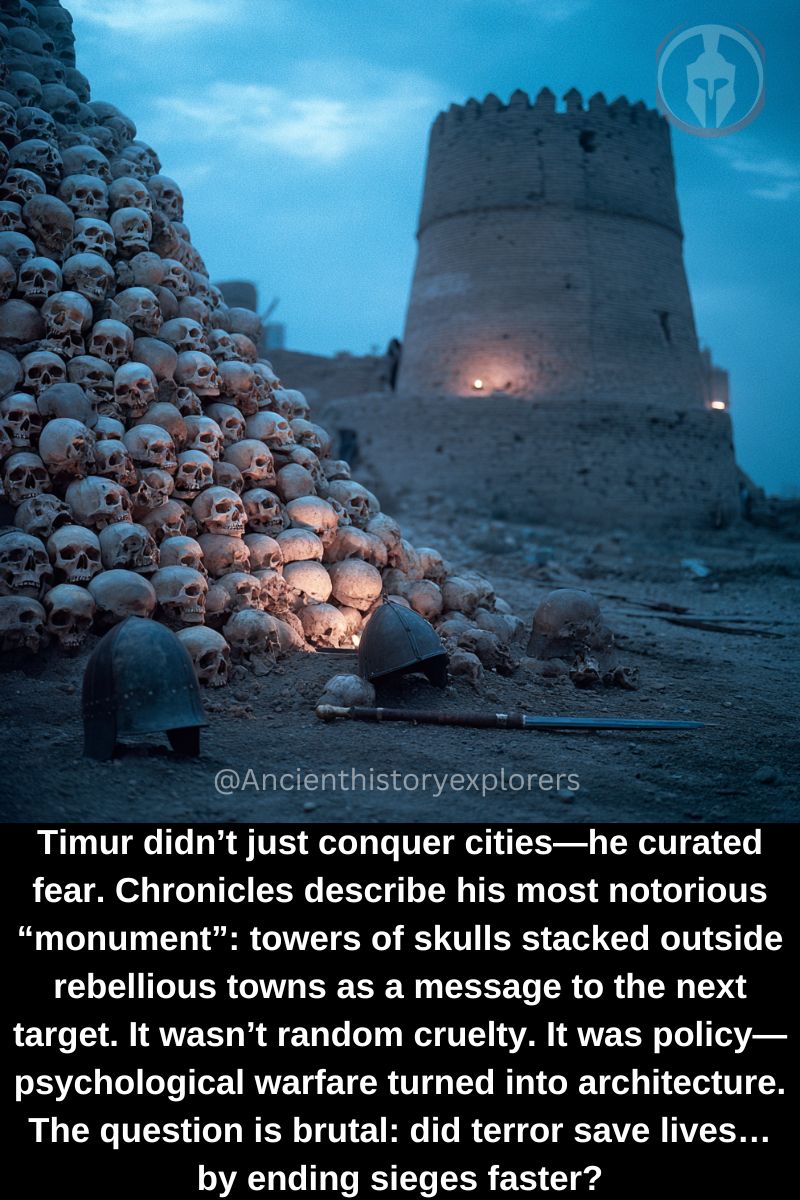
- Religious and Cultural Policies
- Though an orthodox Sunni, Babur was not a bigot and avoided religious conflicts in his court.
- His declaration of jihad against Rana Sanga was politically motivated rather than religious.
- No widespread evidence of temple destruction under his rule—mosques built at Sambhal and Ayodhya may have only been repairs.
- Patronage of Literature and Arts
- A prolific writer in Persian, Arabic, and Turkish, with the Tuzuk-i-Baburi being a literary classic.
- Translated Sufi works and wrote poetry (masnavi).
- Maintained connections with leading poets and artists of the time.
- Passionate about nature, documenting India’s flora and fauna in detail.
- Established the tradition of Mughal gardens with running water.
- Legacy and Concept of the Mughal State
- Defined the Mughal state as one based on a strong monarchy, free from religious bigotry.
- Emphasized cultural and artistic patronage alongside military and administrative strength.
- Set a precedent for his successors, shaping the future of Mughal rule in India.
- Humayun’s Conquest of Gujarat and Struggle with Sher Shah
- Challenges Faced by Humayun
- Succeeded Babur in December 1530 at the age of 23.
- Faced multiple problems:
- Unstable administration and precarious finances.
- The Afghans were not subdued and still hoped to expel the Mughals.
- The Timurid tradition of partitioning the empire among brothers threatened unity.
- Babur had advised kindness towards brothers but opposed partitioning the empire.
- Kamran’s Expansion and Its Impact
- At the time of Humayun’s accession, the empire included Kabul, Qandhar, and Badakhshan.
- Kamran, Humayun’s younger brother, controlled Kabul and Qandhar but sought more territory.
- He marched on Lahore and Multan, occupying them.
- Humayun, to avoid civil war, accepted this and formally granted Punjab and Multan to Kamran.
- This allowed Humayun to focus on the eastern threats without worrying about the western frontier.
- Conflict with the Afghans and Sher Khan
- The Afghan power was growing rapidly in the east.
- In 1532, at Dadrah, Humayun defeated the Afghans, who had conquered Bihar and overrun Jaunpur.
- Besieged Chunar, a key fort controlling routes to eastern India.
- Sher Khan, an Afghan leader, held Chunar and negotiated peace by:
- Retaining the fort while pledging loyalty to the Mughals.
- Sending his son as a hostage.
- Humayun, anxious about Bahadur Shah’s (Gujrat) rising power, accepted the deal.
- Bahadur Shah of Gujarat – A Rising Threat
- Bahadur Shah, nearly the same age as Humayun, was ambitious and capable.
- Came to power in 1526, conquered Malwa, and then besieged Chittor.
- Fear of Mughal intervention forced him to sign a treaty with the Rajputs.
- Humayun, meanwhile, spent time building Dinpanah in Delhi, which was criticized as a distraction.
- However, Dinpanah was meant to:
- Serve as a second capital if Agra was threatened.
- Impress both friends and enemies.
- In the meantime, Bahadur Shah conquered Ajmer and overran eastern Rajasthan.
- Battle Against Bahadur Shah
- Bahadur Shah gave refuge to Mughal enemies and supplied arms to Tatar Khan, cousin of Ibrahim Lodi.
- Tatar Khan planned an invasion of Agra with 40,000 troops, but Humayun easily defeated him.
- Determined to eliminate the threat from Gujarat, Humayun invaded Malwa.
- Bahadur Shah avoided battle, abandoning Chittor and fortifying Mandsor.
- Humayun’s cautious tactics forced Bahadur Shah to flee to Mandu, leaving behind:
- Spiked guns (rendering them useless).
- Wealth and military equipment.
- Humayun captured Mandu, then pursued Bahadur Shah to Champaner, scaling its fort walls himself.
- Bahadur Shah fled to Ahmedabad and finally to Kathiawar.
- As a result, Malwa and Gujarat, along with their rich treasures, fell under Mughal control.
- Trail of Bahadur Shah:
- Chittor (Abandons the siege to confront Humayun) -> Mandsor (Forced to flee after a 2-month blockade/starvation) -> Mandu (Flees as Humayun scales the "impossible" cliffs) -> Champaner (Flees as Humayun scales the fort using steel spikes) -> Ahmedabad (Brief stop; unable to organize a defense) -> Cambay (Khambhat) (Burns his own fleet to prevent Mughal capture) -> Diu (Final refuge with the Portuguese)
- Loss of Gujarat and Malwa
- Gujarat was placed under Askari, Humayun’s younger brother.
- Humayun retired to Mandu, considering it a central and favorable location.
- Problems arose:
- People’s deep loyalty to Gujarati rule.
- Askari’s inexperience and divided Mughal nobility.
- Popular uprisings and military counterattacks.
- Bahadur Shah’s power quickly revived, and Askari was forced to retreat to Champaner.
- Fear arose that Askari might attempt to seize Agra or form his own empire.
- To prevent this, Humayun:
- Abandoned Malwa and pursued Askari.
- Overtook him in Rajasthan, reconciled, and returned to Agra together.
- Meanwhile, both Gujarat and Malwa were lost.
- Outcome of the Gujarat Campaign
- The campaign did not expand Mughal territory but neutralized Bahadur Shah as a threat.
- Allowed Humayun to focus on Sher Khan and the Afghans.
- Bahadur Shah later drowned in a scuffle with the Portuguese, permanently ending the threat from Gujarat.
- Humayun’s Struggle Against Sher Shah and His Downfall
- Strengthening of Sher Khan’s Position (1535–1537)
- During Humayun’s Malwa campaign (Feb 1535 – Feb 1537), Sher Khan consolidated his power.
- He became the undisputed ruler of Bihar, attracting Afghan support from across India.
- Though he continued to profess loyalty to the Mughals, he systematically planned their expulsion.
- He maintained close ties with Bahadur Shah of Gujarat, receiving heavy subsidies.
- With these resources, he built a large, efficient army, including 1,200 elephants.
- Shortly after Humayun’s return to Agra, Sher Khan used his strengthened army to defeat the Bengal king and force him to pay an indemnity of 1,300,000 dinars.
- Humayun’s Chunar Campaign and Sher Khan’s Bengal Conquest
- Humayun, realizing the strategic importance of Chunar, besieged the fort towards the end of the year.
- The fort, strongly defended by Afghans, took six months to capture despite master-gunner Rumi Khan’s efforts.
- Meanwhile, Sher Khan seized the powerful Rohtas Fort through treachery, ensuring his family’s safety.
- He then invaded Bengal a second time and captured its capital, Gaur.
- By this maneuvering, Sher Khan completely outwitted Humayun.
- Humayun’s Miscalculation and the Bengal Expedition
- Humayun failed to recognize that he lacked the necessary strength to confront Sher Khan.
- Sher Khan offered a deal that he would surrender Bihar and pay an annual tribute of 10 lakh dinars if allowed to retain Bengal.
- Humayun rejected this offer, unwilling to concede Bengal’s wealth, trade significance, and strategic position.
- The wounded Bengal king, seeking refuge with Humayun, encouraged resistance but soon succumbed to his injuries.
- Humayun thus undertook the Bengal campaign alone, leading to a disastrous sequence of events.
- Battle of Chausa (March 1539)
- Sher Khan strategically allowed Humayun to advance into Bengal unopposed, intending to cut off his communications.
- Humayun reached Gaur and established order but remained unaware of Sher Khan’s movements.
- Meanwhile, his younger brother Hindal Mirza (Babur's youngest son) attempted to seize the Mughal throne at Agra, isolating Humayun further.
- After a stay of 3–4 months, Humayun began his return journey.
- Despite monsoon challenges, discontent among nobles, and constant Afghan attacks, Humayun managed to reach Chausa near Buxar.
- His brother Kamran, who had marched from Lahore to Agra to suppress Hindal’s rebellion, refused to send reinforcements.
- Sher Khan’s Deception and Humayun’s Tactical Mistake
- Misled by a false peace offer from Sher Khan, Humayun crossed to the eastern bank of the Karamasa River.
- The Afghan horsemen took advantage of this mistake and launched a surprise attack.
- The battle turned into a catastrophe for the Mughals.
- Humayun barely escaped, swimming across the river with the help of a water carrier.
- Sher Khan captured immense booty, and around 7,000 Mughal soldiers, including prominent nobles, perished.
- Battle of Kannauj (May 1540)
- After Chausa, Humayun’s only hope lay in unity among the Timurid princes.
- Kamran commanded a seasoned army of 10,000 troops in Agra but refused to aid Humayun, doubting his leadership.
- Humayun, in turn, refused to entrust Kamran with military command, fearing a power grab.
- The growing distrust led Kamran to withdraw to Lahore with most of his troops.
- The weakened Mughal army faced Sher Khan at Kanauj in May 1540.
- Despite fierce resistance from Humayun’s brothers, Askari and Hindal, the Mughals suffered a decisive defeat.
- This battle sealed Sher Khan’s victory and left Humayun without a kingdom.
- Humayu's exile (1540–1545)
- With Kabul and Qandhar under Kamran’s control, Humayun wandered across Sindh and neighboring regions for over two years.
- He sought assistance from various rulers, including Maldeo of Marwar, but was unsuccessful.
- His brothers turned against him, even attempting to imprison or kill him.
- Despite these hardships, Humayun displayed remarkable resilience and fortitude.
- Eventually, he sought refuge in Iran, where he gained the support of the Persian ruler.
- With Persian aid, he recaptured Qandhar and Kabul in 1545.
- Causes of Humayun’s Defeat
- Underestimation of Afghan Strength:
- Humayun failed to grasp the resilience of Afghan power in North India.
- Lack of Local Support:
- Unlike the Afghans, the Mughals did not win over local rulers and zamindars, leaving them numerically weak.
- Disunity Among the Timurids:
- Though initially loyal, Humayun’s brothers turned against him after Sher Khan’s victories.
- Strategic and Tactical Mistakes:
- His ill-planned Bengal campaign and misjudgment at Chausa exposed his military weaknesses.
- Superiority of Sher Khan:
- Sher Khan proved to be a more capable general and strategist than Humayun.
- Humayun’s Later Years and Death
- Humayun’s life was marked by extreme reversals—falling from power and later regaining it.
- In 1555, following the collapse of the Sur empire, he managed to recover Delhi.
- However, his return to power was short-lived.
- In 1556, he died after falling from the first floor of his library in Delhi.
- His favorite wife commissioned a magnificent mausoleum for him near the Delhi fort.
- The tomb, known as Humayun’s Tomb, introduced a new architectural style in North India, particularly its grand marble dome.
- Sher Shah and the Sur Empire (1540-1555)
-
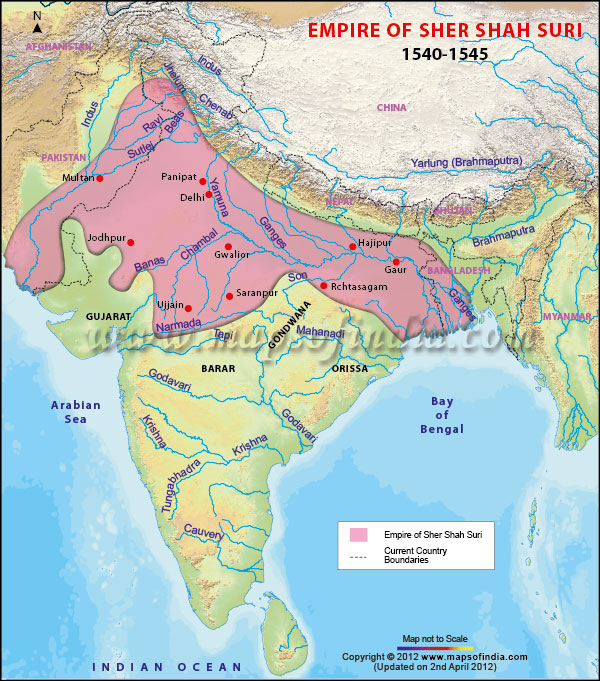
- Early Life and Rise to Power
- Sher Shah was born as Farid, son of a small jagirdar in Jaunpur.
- He gained administrative experience by managing his father’s jagir.
- After the defeat and death of Ibrahim Lodi, he emerged as an important Afghan sardar.
- The title “Sher Khan” was given to him for either killing a tiger or for his services.
- Before Babur’s death, he became the de facto ruler of Bihar and played a key role in Afghan politics.
- Expansion of the Sur Empire
- Sher Shah’s empire was the largest in North India since Muhammad bin Tughlaq, stretching from Bengal to the Indus (excluding Kashmir).
- In the west, he conquered Malwa and most of Rajasthan.
- Malwa Campaign and the Puran Mal Incident
- Malwa was in a weak state and could not resist Sher Shah.
- Puran Mal, the Rajput ruler of Chanderi, vacated his fort under a promise of safe conduct.
- However, he and 1,000 Rajput followers were treacherously attacked and killed along with their families.
- Contemporary theologians justified this act, claiming no faith was needed with infidels.
- Conflict with Maldeo of Marwar
- Maldeo (ruler of Marwar, since 1532) expanded his control over western and northern Rajasthan.
- He clashed with Mewar and other neighboring rulers.
- His conquest of Bikaner forced Kalyan Das, Bhim, and Biram Deo to seek refuge at Sher Shah’s court.
- Maldeo’s centralizing ambitions were seen as a threat by Delhi and Agra.
- Battle of Samel (1544)
- Rajput and Afghan forces clashed at Samel (between Ajmer and Jodhpur).
- Maldeo withdrew after suspecting disloyalty among his sardars, influenced by Sher Shah’s ruse of dropping fake letters near his camp.
- Some Rajput sardars refused to retreat and attacked Sher Shah’s center.
- Despite early Rajput success, superior Afghan numbers and gunfire led to their defeat.
- Aftermath and Rajasthan’s Conquest
- The battle sealed Rajasthan’s fate.
- Sher Shah besieged and captured Ajmer and Jodhpur.
- Maldeo took refuge in Siwana and died shortly afterward.
- The Rana of Mewar surrendered, sending the keys of Chittor to Sher Shah, who established outposts up to Mount Abu.
- Within ten months, Sher Shah overran nearly all of Rajasthan.
- Final Campaign and Death (1545)
- Sher Shah’s last campaign was against Kalinjar, a crucial Bundelkhand fort.
- During the siege, a gun explosion severely injured him.
- He died in 1545, shortly after hearing of the fort’s capture.
- Succession and Fall of the Sur Empire
- Islam Shah (Sher Shah’s second son) ruled until 1553.
- He was capable, but his reign was troubled by rebellions and Afghan tribal conflicts.
- Fear of a Mughal invasion further weakened his rule.
- His premature death led to a civil war among his successors.
- This allowed Humayun to reclaim his empire in 1555 after defeating the Afghans in two major battles.
- Battle of Machhiwara (May 1555)
- Battle of Sirhind (June 1555)
- Humayun vs. Sikandar Shah Suri (the most powerful claimant to the Sur throne).
- Sher Shah’s Legacy
- Architecture and City Building
- He was a great builder
- His tomb at Sasaram is regarded as a masterpiece of architecture.
-
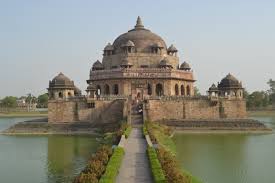
- He built a new city near Delhi, of which only Purana Qila (Old Fort) and its mosque survive.
- Patronage of Literature
- Sher Shah patronized scholars and poets.
- Notable works during his reign include Padmavat by Malik Muhammad Jaisi.
- Religious Policies
- Sher Shah was not a bigot, as reflected in his social and economic policies.
- Neither he nor Islam Shah depended on the ulama, though they respected them.
- However, religious justifications were used for political actions, as seen in:
- The treacherous killing of Puran Mal after he vacated Raisen Fort on the promise of safety.
- He did not introduce new liberal policies:
- Jizyah continued to be collected from Hindus.
- His nobility was almost exclusively Afghan.
- Empire features and contribution to India: Governance, Economy, and Legacy
- Continuity with the Delhi Sultanate
- The Sur Empire can be seen as a continuation and culmination of the Delhi Sultanate, with the rule of Babur and Humayun acting as an interregnum.
- Sher Shah centralized power, continuing the administrative machinery of the Sultanate period.
- Law and Order
- Sher Shah re-established law and order throughout his empire.
- He sternly dealt with robbers, dacoits, and zamindars who refused to pay revenue or disobeyed government orders.
- His historian Abbas Khan Sarwani noted that zamindars were so cowed down that no one dared to rebel or harass travelers.
- Trade, Communication, and Infrastructure
- Roads and Sarais
- Sher Shah revived and extended the Grand Trunk Road from the Indus River to Bengal.
- He built roads connecting Agra, Jodhpur, Chittor, and Gujarat’s seaports.
- Another major road linked Lahore to Multan, serving as a gateway to West and Central Asia.
- 1,700 sarais (inns) were built at 8 km intervals, providing:
- Fortified lodging for travelers.
- Separate accommodations for Hindus and Muslims.
- Brahmins appointed to provide food for Hindus and grain for their horses.
- Many sarais evolved into market towns and also served as dak-chowkis (news stations).
- Customs Reforms
- Sher Shah streamlined customs duties, allowing payments only at:
- Sikrigali (Bengal) for goods from Bengal and Bihar.
- The Indus for goods from West and Central Asia.
- No additional levies were imposed on roads, ferries, or towns.
- Merchants were respected, and if one died, his property was not confiscated.
- Currency and Standardization
- He introduced a uniform currency, including gold, silver, and copper coins.
- The silver rupee became the standard currency for centuries.
- Weights and measures were standardized, facilitating trade and commerce.
- Administration
- Administrative Divisions
- Sarkar (province level):
- Managed by a shiqdar-i-shiqdaran and a munsif-i-munsifan.
- These divisions were not new, only the titles changed.
- Pargana (district level):
- Managed by a shiqdar (administrator) and a munsif (revenue officer).
- Over-Centralization of Power
- Sher Shah’s direct involvement in governance was both a strength and a weakness.
- While he worked tirelessly and personally toured the empire, his over-centralization created difficulties after his death.
- Land Revenue System
- Sher Shah insisted on land measurement before fixing the state’s share, set at one-third of the produce.
- Peasants could pay in cash or kind, though cash was preferred.
- All records of land, crops, and payments were maintained in a document called “patea” for transparency.
- A cess was collected to safeguard against famine and natural disasters.
- He was concerned about the peasantry, believing that excessive oppression would lead to desertion of villages and economic decline.
- Military Reforms
- Sher Shah directly recruited soldiers and maintained proper records.
- His army included:
- 150,000 cavalry
- 25,000 infantry
- 5,000 elephants
- A well-equipped artillery park
- He established cantonments across the empire and maintained strong garrisons.
- Justice System
- Sher Shah believed that “Justice is the most excellent of religious rites”.
- He punished oppressors regardless of their rank.
- Village panchayats and zamindars handled local cases, while qaadis (judges) were appointed for judicial matters.
- Islam Shah (1545-1553)
- Islam Shah, Sher Shah’s son and successor, attempted further reforms:
- Codified laws to minimize reliance on special interpreters of Islamic law.
- Reduced the power of nobles and ensured cash payments for soldiers.
- However, after his premature death, most of his reforms were undone.
- Conclusion
- The Sur Empire remained an Afghan state, structured around race and tribal identity.
- A fundamental shift occurred only under Akbar, marking the beginning of a new era.
- Consolidation of the Mughal Empire: The Age of Akbar
- Akbar’s Early Years and the Second Battle of Panipat (1556)
- Birth and Childhood
- When Humayun was retreating from Bikaner, the Rana of Amarkot gallantly offered him shelter and help.
- It was in Amarkot (1542) that Akbar, the greatest Mughal ruler, was born.
- After Humayun fled to Iran, young Akbar was captured by his uncle, Kamran, but was treated well overall.
- Akbar was reunited with his parents after the capture of Qandhar.
- Akbar’s Coronation (1556)
- When Humayun died, Akbar was in Kalanaur (Punjab), commanding against Afghan rebels.
- At the young age of 13 years and 4 months, Akbar was crowned at Kalanaur in 1556.
- Challenges After Accession
- Akbar inherited a difficult position
- The Afghans were still strong beyond Agra, regrouping under Hemu for a final showdown.
- Kabul had been attacked and besieged.
- Sikandar Sur, the defeated Afghan ruler, was hiding in the Siwalik Hills.
- Bairam Khan, Akbar’s tutor and a loyal officer of Humayun, took charge of the situation.
- He was made Wakil of the kingdom with the title Khan-i-Khanan.
- The biggest threat was from Hemu, who had never lost a battle.
- Rise of Hemu
- Hemu started as a superintendent of markets under Islam Shah, but under Adil Shah (nephew of Sher Shah), he quickly rose to power.
- He won 22 battles and was appointed war leader with the title Vikramajit.
- Adil Shah entrusted him with expelling the Mughals.
- Hemu captured Agra and then marched on Delhi with:
- 50,000 cavalry
- 500 elephants
- Strong artillery
- Battle of Delhi / Battle of Tughlaqabad (7 October, 1556)
- Hemu defeated the Mughals near Delhi and occupied the city.
- However, Bairam Khan took bold steps to counter this threat.
- Before Hemu could consolidate power, the Mughals marched on Delhi.
- The Second Battle of Panipat (5 November 1556)
- The battle between Mughals and Afghans (led by Hemu) was fiercely contested.
- Initially, Hemu was winning, but a Mughal detachment had already captured his artillery.
- During the battle, an arrow struck Hemu’s eye, and he fainted.
- Leaderless, the Afghan army was defeated.
- Hemu was captured and executed.
- Thus, Akbar had to virtually reconquer his empire after his accession.
- Early Challenges: Confrontation with the Nobility (1556-67)
- Bairam Khan’s Regency (1556-60)
- Bairam Khan remained at the helm of the empire for almost four years, keeping the nobility under strict control.
- Major achievements during his tenure:
- The danger to Kabul was averted.
- The empire extended from Kabul to Jaunpur in the east and Ajmer in the west.
- Gwalior was captured, and forces were sent to conquer Ranthambhor and Malwa.
- Dismissal of Bairam Khan (1560)
- As Akbar approached maturity, tensions arose between him and Bairam Khan.
- Many powerful nobles resented Bairam Khan, accusing him of:
- Favoring Shia officials over others.
- Neglecting old nobles who had served the empire earlier.
- Bairam Khan’s arrogance and unwillingness to acknowledge Akbar’s growing authority led to friction.
- Akbar strategically distanced himself, leaving Agra under the pretext of hunting and reaching Delhi.
- From Delhi, he issued a farman dismissing Bairam Khan and summoned all nobles to submit to him directly.
- Bairam Khan’s Rebellion and Fate
- Initially, Bairam Khan accepted Akbar’s decision, but his enemies provoked him into rebellion, leading to six months of turmoil.
- Eventually, he was forced to submit, and Akbar received him cordially, offering him three options:
1. Serve at the Mughal court.
2. Accept a posting elsewhere.
3. Retire to Mecca.
- Bairam Khan chose Mecca but was assassinated near Patan (Ahmedabad) by an Afghan with a personal grudge.
- Akbar took in Bairam Khan’s wife and young son, later marrying his widow, who was also Akbar’s cousin.
- The child, Abdur Rahim Khan-i-Khanan, went on to hold key positions in Akbar’s empire.
- This episode highlighted Akbar’s character:
- Unyielding when making decisions.
- Generous to those who submitted.
- Noble Rivalries and the Execution of Adham Khan (1561)
- Bairam Khan’s downfall emboldened new factions within the nobility.
- Maham Anaga (Akbar’s foster mother) and her family became politically active.
- Adham Khan (Maham Anaga’s son), an impulsive young noble, assumed independent authority when leading an expedition to Malwa.
- After being removed from command, he demanded the post of wazir. When denied, he stabbed the acting wazir Shams-ud-din in his office.
- Akbar, enraged, had Adham Khan thrown to his death from the fort (1561).
- Maham Anaga withdrew from politics soon after.
- The Uzbek Rebellions (1561-67)
- The Uzbeks were a powerful noble faction, holding key positions in eastern Uttar Pradesh, Bihar, and Malwa.
- Though they had helped suppress the Afghans, they had grown arrogant and rebellious.
- Between 1561 and 1567, they rebelled multiple times, forcing Akbar to act:
- Initially, Akbar pardoned them.
- In 1565, after yet another rebellion, Akbar vowed to crush them and planned to shift his capital to Jaunpur.
- The Mirza Rebellion and Mirza Hakim’s Invasion
- The Mirzas, a Timurid family related to Akbar, revolted in the west of modern Uttar Pradesh.
- Akbar’s half-brother, Mirza Hakim, seized control of Kabul and invaded Punjab, besieging Lahore.
- The Uzbek rebel nobles formally declared Mirza Hakim their ruler, worsening the crisis.
- Akbar’s Response and Triumph (1567)
- This was Akbar’s most serious challenge since Hemu’s capture of Delhi.
- Akbar took decisive action:
- Marched from Jaunpur to Lahore, forcing Mirza Hakim to retreat.
- Crushed the Mirza rebellion, forcing them to flee to Malwa and Gujarat.
- Routed the Uzbek rebels near Allahabad, crossing the Yamuna at the peak of the monsoon and launching a surprise attack.
- Uzbek leaders were killed, ending their protracted rebellion.
- With this final victory in 1567, Akbar’s authority was firmly established, and he was now free to focus on expanding his empire.
- Early Expansion of the Empire (1560-76)
- Conquest of Malwa (1561-62)
- During Bairam Khan’s regency, the Mughal Empire expanded rapidly, with Ajmer and Malwa being key conquests.
- Malwa, ruled by Baz Bahadur, was famous for its music and poetry, particularly due to Baz Bahadur’s romance with Rupmati, a renowned musician and poet.
- However, Baz Bahadur neglected his army, making Malwa vulnerable.
- Akbar sent an expedition under Adham Khan (Maham Anaga’s son) in 1561, defeating Baz Bahadur and capturing Malwa.
- Rupmati chose to commit suicide rather than be taken to Adham Khan’s harem.
- Due to the cruelty of Adham Khan and his successor, a rebellion erupted, allowing Baz Bahadur to briefly reclaim Malwa.
- Final Annexation of Malwa
- After dealing with Bairam Khan’s rebellion, Akbar sent another expedition to Malwa.
- Baz Bahadur fled, seeking refuge first with the Rana of Mewar and later wandering across various regions.
- Eventually, he submitted to Akbar and was enrolled as a Mughal mansabdar.
- Malwa was firmly incorporated into the Mughal Empire.
- Conquest of Garh-Katanga (1564-65)
- Around the same time, Mughal forces invaded Garh-Katanga, a Gond kingdom covering the Narmada valley and northern Madhya Pradesh.
- The kingdom had been strengthened by Aman Das (Sangram Shah), who had allied with Bahadur Shah of Gujarat.
- It was the most powerful Gond kingdom, with claims of 20,000 cavalry, a large infantry, and 1,000 elephants—though the accuracy of these figures is uncertain.
- Rani Durgavati’s Rule and Resistance
- Sangram Shah’s son married a Chandel princess, Durgavati, who became regent after her husband’s death.
- She was a skilled warrior and hunter, known for her courage and successful battles against Baz Bahadur of Malwa.
- Mughal governor Asaf Khan, tempted by tales of her wealth and beauty, launched an invasion from Bundelkhand with 10,000 cavalry.
- Some local rulers rebelled against the Gond kingdom, leaving Rani Durgavati with a weakened force.
- She fought bravely but, after being wounded in battle and facing capture, stabbed herself to death rather than surrender.
- Plunder of Garh-Katanga
- Asaf Khan stormed the capital, Chauragarh (near modern Jabalpur).
- The Mughal forces looted enormous wealth, described by Abul Fazl as “beyond calculation.”
- Asaf Khan kept most of the loot, sending only 200 elephants to Akbar’s court.
- Kamaladevi, the rani’s younger sister, was sent to Akbar’s court.
- Akbar’s Intervention
- After defeating the Uzbek nobles, Akbar forced Asaf Khan to return his illegal gains.
- He restored Garh-Katanga to Chandra Shah (Sangram Shah’s younger son) but retained ten strategic forts to strengthen Mughal control over Malwa.
- By 1576, Akbar had firmly secured Malwa and Garh-Katanga, further consolidating the Mughal Empire’s territorial expansion.
- Expansion into Rajasthan, Gujarat, and Bengal
-
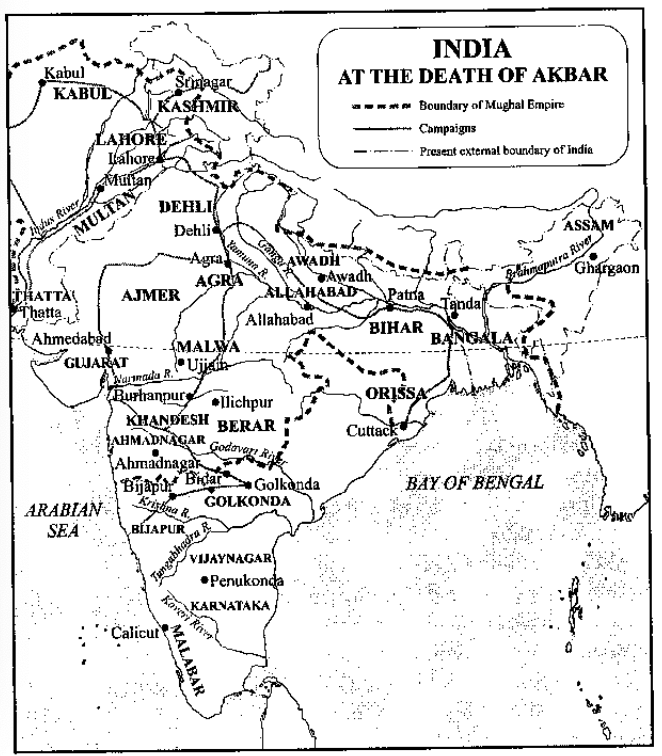
- Conquest of Rajasthan (1568-1570)
- Akbar spent the next ten years bringing most of Rajasthan, Gujarat, and Bengal under his control.
- A key step in his Rajput campaign was the siege of Chittor, a strategic fortress commanding the shortest route from Agra to Gujarat and a symbol of Rajput resistance.
- Akbar knew that conquering Chittor was essential to securing Rajput submission.
- Siege of Chittor (1568)
- Rana Udai Singh withdrew to the hills, leaving Jaimal and Patta to defend the fort.
- Many local peasants also took refuge inside and actively participated in the defense.
- The siege lasted six months, and when the Mughals stormed the fort, a massacre of 30,000 people followed—the only instance of such large-scale carnage by Akbar.
- Jaimal and Patta fought bravely and perished. To honor their valor, Akbar ordered statues of them on elephants to be placed at the chief gate of Agra Fort.
- Further Expansion in Rajasthan
- After Chittor, Akbar conquered Ranthambhor, considered the strongest fortress in Rajasthan.
- Jodhpur had already been subdued, and soon after, the rulers of Bikaner and Jaisalmer accepted Mughal suzerainty.
- However, Mewar continued to resist.
- Conquest of Gujarat (1572-1573)
- Gujarat had been in disorder since the death of Bahadur Shah.
- Its fertile lands, thriving crafts, and crucial trade links made it an attractive conquest.
- Akbar also had a historical claim, as Humayun had ruled over Gujarat for some time.
- Additionally, the Mirzas, who had rebelled near Delhi, had taken refuge in Gujarat, making it a potential rival power center.
- Initial Mughal Advance (1572)
- In 1572, Akbar marched towards Ahmedabad via Ajmer, and the city surrendered without a fight.
- He then moved against the Mirzas, who controlled Broach, Baroda, and Surat.
- At Cambay, Akbar saw the sea for the first time and even took a boat ride.
- The Portuguese, who dominated the Indian Ocean, met Akbar for the first time, but his conquest of Gujarat thwarted (to successfully oppose a plan, effort, or attempt) their expansionist ambitions.
- Battle Against the Mirzas and Gujarat’s Rebellion (1573)
- While besieging Surat, Akbar personally led a daring assault with only 200 men, including Man Singh and Bhagwant Das of Amber.
- Despite being heavily outnumbered, the Mughals routed the Mirzas.
- However, as soon as Akbar left, revolts broke out across Gujarat.
- On hearing the news, Akbar rushed back from Agra, covering the vast distance in just nine days, an unprecedented feat.
- With only 3,000 soldiers, he defeated a rebel force of 20,000 near Ahmedabad in 1573, securing Gujarat for the Mughals.
- Conquest of Bengal (1574-1576)
- Bengal and Bihar remained under Afghan rule, with Daud Khan as their ruler.
- The Afghans had also overrun Orissa and killed its ruler, but to avoid provoking the Mughals, Daud continued reading the khutbah in Akbar’s name.
- Internal feuds and Daud Khan’s declaration of independence gave Akbar an excuse for intervention.
- Mughal Advance into Bengal (1574-1575)
- Akbar led an expedition with a strong flotilla of boats, recognizing that the Afghan ruler possessed a large army (40,000 cavalry, 1,50,000 infantry, thousands of cannons and elephants, and a powerful navy).
- If the Afghans had a strong leader, history might have repeated the contest between Humayun and Sher Shah.
- Akbar first captured Patna, securing Mughal communication in Bihar.
- He then returned to Agra, leaving Khan-i-Khanan Munaim Khan in charge of the Bengal campaign.
- The Mughals invaded Bengal, forcing Daud Khan to sue for peace.
- Battle of Rajmahal (1576) and End of Afghan Rule
- Daud Khan rebelled soon after, but the Mughal armies were now better organized and led.
- In a decisive battle in Bihar (1576), Daud Khan was defeated and executed on the spot.
- With this victory, the last Afghan kingdom in northern India ended.
- Conclusion: The First Phase of Akbar’s Expansion
- With the conquest of Rajasthan, Gujarat, and Bengal, Akbar successfully extended Mughal rule across northern and western India.
- This phase consolidated Mughal power and removed major rival centers of resistance.
- Mewar was the only Rajput state still holding out, setting the stage for further campaigns.
- Administration Under Akbar
- Reforming the Land Revenue System
- After the conquest of Gujarat, Akbar turned his attention to administrative reforms, particularly land revenue.
- The system established by Sher Shah had deteriorated after Islam Shah’s death, requiring Akbar to reorganize it from the ground up.
- Early Revenue Methods and Their Challenges
- Sher Shah’s system involved measuring cultivated land and setting fixed dues for each crop based on productivity. However, the annual updates to the central price schedule often delayed assessments, creating hardships for peasants.
- Initially, Akbar relied on annual assessments, using reports from hereditary landholders (gantngos) about local cultivation and prices. However, corruption among these officials led to inaccuracies.
- To address these issues, Akbar appointed officials called Agroris across northern India to verify revenue collections and reports.
- Land Classification and Taxation
- Land was classified based on cultivation frequency:
- Polaj
- Regularly cultivated land.
- Parauti
- Occasionally left fallow, taxed fully when cultivated.
- Chachar
- Left fallow for 2–3 years, taxed at lower rates initially.
- Banjar
- Left fallow for long periods, gradually taxed over time.
- Fields were also categorized as good, middling, or bad, with revenue adjusted accordingly.
- Dahsala System (1580)
- To standardize assessments, Akbar introduced the dahsala system, which:
- Calculated the average produce of different crops over the past ten years.
- Determined the state’s share as one-third of this average.
- Converted the revenue share into cash, based on past average prices.
- Further refinements included:
- Grouping regions with similar productivity into assessment circles to adjust rates based on local prices.
- Granting remissions to peasants when crops failed due to droughts or floods.
- The Zaéti System (Todar Mal's Bandobast)
- The zaéti system involved land measurement using bamboos linked with iron rings to calculate dues precisely.
- This system was implemented from Lahore to Allahabad, as well as in Malwa and Gujarat.
- The dahsala system was an advancement of the zaéti system.
- The zaéti system is often associated with Raja Todar Mal, though it was a collective effort of Akbar’s revenue officers.
- Todar Mal’s Bandobast is sometimes used to refer to this system.
- Alternative Revenue Systems
- Batai or Ghalla-Bakhsht
- Crop division between peasants and the state in a fixed proportion.
- Required officials to be present at harvest time, making it fair but labor-intensive.
- Zadti and Atnat Systems
- Peasants were sometimes allowed to choose between paying in cash (zadti) or kind (atnat).
- For certain cash crops (cotton, indigo, sugarcane), revenue was always collected in cash.
- Sasaq System
- A rough estimate of dues based on past payments.
- Some historians believe it was merely a method of computing past dues, while others argue it was an independent crop assessment method.
- Akbar’s Approach to Agricultural Development
- Akbar instructed revenue officers (amil) to act as protectors of the peasantry.
- They were to advance loans (saccavi) for seeds, tools, and animals, ensuring easy repayment.
- Peasants had hereditary cultivation rights and could not be forcibly evicted if they paid revenue.
- Zamindars, who had hereditary rights over land revenue, were urged to support cultivation efforts.
- Legacy of Akbar’s Revenue Reforms
- The dahsala system was not a permanent or ten-year settlement but remained flexible.
- It formed the foundation of the Mughal revenue system until the late seventeenth century.
- Akbar’s revenue policies ensured stable agricultural growth, fair taxation, and increased state revenue, forming a cornerstone of Mughal administration.
- Mansabdari System and the Army
- Introduction to the Mansabdari System
- Importance of a strong army for expansion and governance
- Role of the Mansabdari system in organizing the nobility and army
- Structure of the Mansabdari System
- Rank (Mansab) Assignments
- Ranks ranged from 10 to 5000 for nobles
- Princes received higher mansabs
- Highest noble rank increased to 7000 by the end of Akbar’s reign
- Evolution of the Mansabdari System
- Initially, a single-rank system
- Division into zat (personal status) and sawar (number of cavalrymen) from 1594-95
- Three categories based on sawar maintenance
- Importance of cavalry in the military hierarchy
- Recruitment and Maintenance of the Army
- Dagh System and Soldier Inspection
- Descriptive rolls (chehra) for soldiers
- Branding of horses for quality control
- Periodic inspections by imperial officers
- Cavalry Standards and Organization
- High-quality horses (Arabic and Iraqi breeds)
- 10-20 rule
- Each cavalryman to maintain two horses
- Categorization of sawars based on horse availability
- Composition of the Military Contingents
- Mixed recruitment policy (Mughals, Pathans, Hindustanis, Rajputs)
- Special privilege for Mughal and Rajput nobles to maintain exclusive contingents
- Other military personnel included bowmen, musketeers (bandukchi), sappers, and miners
- Salaries and Payment System
- Pay Structure of Soldiers and Officers
- Sawar salary:
- Rs 20 per month
- Infantry salary:
- Rs 3 per month
- Higher pay for Iranis and Turanis compared to Rajputs and Hindustanis
- Payment Methods
- Salaries included in the mansabdar’s pay
- Jagir system for payments (some paid in cash)
- No hereditary rights granted through jagirs
- Historical Origins of the Mansabdari System
- Mongol Influence on the Mansabdari System
- Chinggis Khan’s decimal army structure (units of 10 to 10,000)
- Similar ranks under the Delhi Sultanate and Sur rulers
- Classification of Mansabdars
- Below 500:
- Mansabdars
- 500 to below 2500:
- Amirs
- 2500 and above:
- Amir-i-umda or Amir-i-azam
- Hierarchical command structure and delegation of authority
- Promotion and Career Progression
- Career Mobility in the Mansabdari System
- Entry at lower ranks with promotion based on merit
- Demotion as a form of punishment
- Combined civil and military service structure
- Responsibilities of Mansabdars
- Maintenance of horses, elephants, camels, mules, and carts
- Prescribed quotas based on rank
- Quality classification of horses and elephants
- Salaries and Perks of Mansabdars
- High Salaries of Mansabdars
- 5000 zat rank:
- Rs 30,000 per month
- 3000 zat rank:
- Rs 17,000 per month
- 1000 zat rank:
- Rs 8,200 per month
- 100 zat:
- Rs 7,000 per year
- Additional Benefits
- Personal expenses covered within salaries
- Gentleman troopers (zhadis) and their privileges
- Special muster-master for noble troopers
- Akbar’s Personal Military Interests
- Cavalry and Bodyguards
- Akbar’s large cavalry regiment
- Maintenance of a personal horse stable
- Artillery and Warfare Innovations
- Special focus on guns and artillery
- Development of mobile detachable guns
- Siege guns requiring 100-200 oxen and elephants
- The Mughal Navy: A Missed Opportunity
- Lack of a Strong Navy
- Naval weakness as a persistent issue
- Construction of warboats for eastern campaigns
- Warboats over 30 meters long with 350-ton displacement
- Organization of Government under Akbar
- Local Administration
- Akbar made hardly any changes in the local government structure.
- The pargana and sarkar systems continued as before.
- Chief officers of the sarkar:
- Faujdar
- In charge of law and order.
- Amalguzar
- Responsible for land revenue assessment and collection.
- The Amalguzar was responsible for supervising all types of land holdings to ensure uniform tax collection.
- Division of Empire’s Territories:
- Jagir
- Allotted to nobles and members of the royal family, including queens.
- Khalisa
- Income from these villages went directly to the royal exchequer (financial department or treasury).
- Inam
- Lands granted to learned and religious men.
- Autonomous rajas were allowed to follow their traditional revenue systems, but Akbar encouraged them to adopt the imperial system.
- Central Administration
- Akbar’s central administration was based on the Delhi Sultanate’s structure, but he reorganized its functions with strict rules and regulations.
- A new shape was given to governance, ensuring efficiency and discipline.
- Role of the Wazir
- Traditionally, the wazir was all-powerful, managing all departments.
- Over time, the military and judiciary became independent from the wazir’s control.
- Under Akbar:
- The post of wazir was retained but stripped of major powers.
- The wazir became a revenue expert, not the ruler’s chief advisor.
- Title changed to Diwan or Diwan-i-Ala instead of Wazir.
- Duties of the Diwan:
- Responsible for all income and expenditure.
- Managed khalisa, jagir, and inam lands.
- Sometimes, multiple diwans shared responsibilities.
- Military Administration
- The Mir Bakhshi
- Head of the military department.
- Role and Responsibilities:
- Considered head of the nobility.
- Only leading grandees were appointed to this post.
- Recommended appointments to mansabs and promotions to the emperor.
- Once approved, the diwan confirmed and assigned a jagir to the appointee.
- Intelligence and Information:
- Mir Bakhshi also controlled intelligence agencies.
- Officials under him:
- Arids
- Intelligence officers.
- Waqia-navis
- News reporters.
- Their reports were submitted directly to the emperor.
- Checks and Balances
- The Diwan and Mir Bakhshi were nearly equal in power, ensuring balance in administration.
- Imperial Household and Court Affairs
- The Nur Saiman
- In charge of the imperial household.
- Responsibilities:
- Managed provisions and supplies for the emperor’s female apartments (Aaram).
- Supervised royal workshops (arkadanas), where many palace goods were produced.
- Controlled court etiquette and the royal bodyguard.
- Only nobles who had the emperor’s complete trust were appointed to this office.
- Judicial Administration
- Chief Qazi (Gazi)
- Sometimes, this post was combined with the Chief Sadr, who managed charitable and religious endowments.
- The Chief Qazi had significant power and influence.
- The office declined in reputation due to corruption, especially under Abdun Nabi.
- Land Revenue System
- Akbar scrutinized land grants and separated crown lands from jagir and khalisa lands.
- The empire was divided into six circles for managing inam lands.
- Notable features of inam grants:
- Granted to all, regardless of religion.
- Many Hindu priests (marks) received grants, as seen in preserved sanads (documents).
- Half of the inam land had to be cultivable wasteland to encourage expansion of agriculture.
- Akbar’s Daily Schedule and Public Interaction
- Akbar ensured direct accessibility to both common people and ministers.
- Daily Routine:
- 1. Morning Audience (Jharoka Darshan)
- People gathered to see the emperor and present petitions.
- 2. Public Audience (Diwan-i-Am)
- Heard petitions and issued immediate orders.
- 3. Midday Break
- Rest and meals.
- 4. Meetings with Ministers
- Held in a private chamber (Ghusal Khana).
- 5. Confidential Consultations
- Ministers met him privately for discussions.
- Provincial Administration
- In 1580, Akbar divided the empire into 12 Subas (provinces):
- Bengal, Bihar, Allahabad, Awadh, Agra, Delhi, Lahore, Multan, Kabul, Ajmer, Malwa, Gujarat.
- Each Suba (province) had:
- Subedar (Governor)
- Administrative head
- Diwan
- Managed revenue
- Bakhshi
- Supervised military affairs
- Sadr
- Handled charity and religious grants
- Gazi
- Administered justice
- Waqia-navis
- Reported on events
- This system of checks and balances ensured efficient and fair governance across the empire.
- Relations with the Rajputs
- Mughal Policy Towards Rajputs
- Akbar’s relations with the Rajputs should be understood in the broader context of Mughal policy towards powerful rajas and zamindars.
- Humayun had already initiated a policy of winning over these elements.
- Abul Fazl mentions that Humayun entered into matrimonial relations with zamindars to soothe their minds.
- Akbar expanded and refined this policy over time.
- Matrimonial Alliances with Rajputs
- Amber (Jaipur):
- Bhara Mal, ruler of Amber, visited Akbar’s court shortly after his accession.
- In 1562, when Akbar was traveling to Ajmer, he learned that Bhara Mal was being harassed by a Mughal governor.
- Bhara Mal personally paid homage to Akbar and cemented the alliance by marrying his daughter, Harkha Bai, to Akbar.
- Earlier Precedents of Rajput-Muslim Marriages:
- Rajput princesses had previously married Muslim rulers, e.g., Maldeo of Jodhpur married his daughters to Sultan Mahmud of Gujarat and Islam Shah Sur.
- However, these marriages did not ensure stable relations.
- Akbar’s policy differed—he gave religious freedom to his Hindu wives and honored their families in Mughal nobility.
- Bhara Mal was made a grandee, his son Bhagwant Das rose to the rank of 5000, and grandson Man Singh to 7000, an honor given only to Aziz Khan Koka, Akbar’s foster brother.
- Honors and Trust Extended to the Kachhawahas:
- Akbar entrusted the infant prince Danyal to Bhara Mal’s family for upbringing.
- Bhara Mal was given charge of Agra when Akbar moved to Gujarat in 1572.
- Relations with Other Rajput States
- Non-Matrimonial Alliances:
- Akbar did not make matrimonial alliances a precondition for favor.
- Hadas of Ranthambhor, Sirohi, and Banswara were granted favor without marriage ties.
- Rao Surjan Hada was made in charge of Garh-Katanga and ranked at 2000.
- Religious Tolerance and Rajput Loyalty:
- In 1564, Akbar abolished the jizya tax, often seen as a symbol of Muslim domination.
- He had already abolished the pilgrim tax and forcible conversion of prisoners of war.
- After the conquest of Chittor, most Rajput rulers accepted Mughal suzerainty.
- The rulers of Jaisalmer and Bikaner also entered into matrimonial alliances.
- Conflict with Mewar and Rana Pratap
- Refusal to Submit:
- Mewar alone refused to accept Mughal suzerainty.
- While Chittor and surrounding plains fell to the Mughals, Udaipur and the hilly region remained under Rana Udai Singh’s control.
- Diplomatic Efforts:
- In 1572, Rana Pratap ascended the throne.
- Akbar sent several embassies (led by Man Singh, Bhagwant Das, and Raja Todar Mal) to persuade him to submit.
- Rana Pratap briefly considered a compromise but refused to personally pay homage to Akbar.
- Battle of Haldighati (1576)
- Akbar’s Military Action:
- Akbar moved to Ajmer in early 1576.
- He sent Raja Man Singh with 5000 troops against Rana Pratap.
- War Strategy:
- Rana Pratap devastated lands near Chittor to deny supplies to the Mughals.
- He fortified passes leading to Kumbhalgarh.
- His army included Rajputs, Afghans (led by Hakim Khan Sur), and Bhils.
- Outcome of the Battle:
- Initial Rajput success, but Mughal reinforcements turned the tide.
- Rana Pratap escaped; Mughal troops occupied Gogunda.
- After Haldighati, Rana Pratap resorted to guerrilla warfare.
- Aftermath of Mewar Conflict
- Continued Resistance:
- Mughal pressure continued, and Akbar isolated Mewar by securing treaties with neighboring states.
- Rana Pratap lost Kumbhalgarh and Udaipur but relied on Bhil support.
- Change in Mughal Priorities:
- After 1579, Mughal attention shifted due to rebellions in Bihar and Bengal.
- Akbar moved to Lahore (1585-1597) to address the northwest crisis.
- Rajput Revival:
- Rana Pratap recaptured many territories, including Kumbhalgarh, but never Chittor.
- He established a new capital at Chavand near Dungarpur.
- Died in 1597 at age 51 due to an internal injury.
- Conflict in Marwar
- Succession Dispute:
- After Maldeo’s death (1562), his sons fought over Marwar’s throne.
- Chandrasen, the younger son and Maldeo’s favorite, became king.
- Mughal pressure forced him to cede parts of his kingdom to his elder brothers.
- Mughal Takeover:
- Chandrasen rebelled, leading Akbar to bring Marwar under direct Mughal rule.
- Jodhpur was placed under Rai Singh Bikaneri.
- Chandrasen’s Resistance:
- He resorted to guerrilla warfare but was forced to flee to Mewar.
- Died in 1581.
- Final Settlement:
- In 1583, Akbar gave Jodhpur to Udai Singh, Chandrasen’s elder brother.
- Udai Singh’s daughter Jagat Gosain (Jodha Bai) married Salim (Jahangir).
- Continued Rajput-Mughal Relations Under Jahangir
- Jahangir’s Rajput Connections:
- His mother was a Rajput princess.
- He married princesses from Amber, Jodhpur, Jaisalmer, and Bikaner.
- Rajput rulers received high honors in his court.
- Settlement with Mewar (1613)
- Struggles of Amar Singh:
- After Rana Pratap’s death, his son Amar Singh continued resistance.
- Akbar and Jahangir sent multiple expeditions, including two led by Jahangir himself.
- Final Agreement:
- In 1613, Jahangir personally reached Ajmer to direct the campaign.
- Prince Khurram (Shah Jahan) led a massive invasion into Mewar.
- Pressure from Mughal forces and internal struggles forced Amar Singh to seek peace.
- He sent his son, Karan Singh, to Jahangir’s court.
- Terms of Peace:
- Jahangir graciously received Karan Singh.
- Mewar’s territories, including Chittor, were restored.
- The fortifications of Chittor could not be rebuilt to ensure Mughal control.
- Karan Singh was ranked at 5000 and required to provide 1500 cavalry for Mughal service.
- Significance of Akbar’s Rajput Policy
- Mutual Benefits:
- Rajputs provided military strength to the Mughal empire.
- Peace in Rajasthan allowed Rajputs to serve in distant Mughal territories.
- Rajput rulers were granted jagirs and appointed to key Mughal positions.
- Expansion of the Empire:
- Rajput loyalty became a pillar of Mughal consolidation.
- High-ranking Rajputs like Man Singh and Bhagwant Das served as governors.
- Lasting Impact:
- Akbar’s policy of integrating Rajputs into the Mughal empire continued under Jahangir and Shah Jahan.
- It ensured long-term stability in the empire’s western frontiers.
- REBELLIONS AND FURTHER EXPANSION OF THE MUGHAL EMPIRE
- Causes of Rebellions (1580-1581)
- Akbar’s new administrative system tightened control over nobles.
- Sentiments of regional independence remained strong, especially in:
- Gujarat
- Bengal
- Bihar
- Rajasthan (where Rana Pratap’s struggle continued)
- Resistance was intensified by:
- Strict enforcement of the dagh system (branding of jagirdars’ horses).
- Resumption of large revenue-free grants held by religious figures.
- Religious opposition to Akbar’s liberal policies.
- Afghan discontent in eastern India.
- Mirza Hakim (Akbar’s half-brother, ruler of Kabul) supporting the rebellion.
- Rebellion in Bengal and Bihar (1580-1581)
- Outbreak & Expansion:
- Bengal & Bihar fell to rebels, extending to Jaunpur.
- Rebels proclaimed Mirza Hakim as ruler and sought religious backing.
- Fatwa issued calling on people to oppose Akbar.
- Akbar’s Response:
- Dispatched Todar Mal to suppress rebellion in Bihar and Bengal.
- Sent Raja Man Singh to guard against Mirza Hakim’s expected invasion.
- Todar Mal swiftly regained control before Mirza Hakim could act.
- Mirza Hakim’s Invasion and Defeat (1581)
- Attempt on Lahore:
- Mirza Hakim attacked Lahore with 15,000 cavalry.
- Raja Man Singh & Bhagwant Das successfully defended Lahore.
- Akbar’s Counterattack:
- Akbar marched with 50,000 disciplined troops.
- Mirza Hakim was forced to retreat.
- Occupation of Kabul (1581)
- Akbar pursued Mirza Hakim and occupied Kabul.
- Kabul handed over to Akbar’s sister, showing his broad-mindedness.
- Threat from the Uzbeks and Northwestern Expansion (1584-1598)
- Uzbek Threat:
- Abdullah Khan Uzbek overran Badakhshan (1584).
- Mirza Hakim’s death (due to alcoholism) left Kabul in disorder.
- Akbar’s Response:
- Sent Raja Man Singh to Kabul; moved personally to Attock on the Indus.
- Blocked Uzbek entry into India by expanding into:
- Kashmir (1586) (including Ladakh & Baltistan).
- Baluchistan.
- Khyber Pass (suppressed rebellious Afghan tribes).
- Loss of Raja Birbal in tribal expeditions.
- Consolidation of Northwest:
- Sindh conquered (1590) → Opened trade routes down Indus for Punjab.
- Akbar stayed in Lahore until 1598, ensuring security after Abdullah Uzbek’s death.
- Further Expansion: Eastern & Western India, Deccan
- Eastern Expansion:
- Orissa (under Afghan chiefs) conquered by Raja Man Singh.
- Cooch-Bihar and East Bengal (Dacca) also annexed.
- Western Expansion:
- Kathiawar conquered by Mirza Aziz Koka (Akbar’s foster-brother).
- Deccan Expansion:
- Khan-i-Khanan Munim Khan and Prince Murad sent to Deccan.
- Mughal control extended to Ahmadnagar, leading to first direct contact with the Marathas.
- Conclusion: The Achievements of Akbar’s Expansion
- By 1600, the Mughal Empire had:
- Unified North India politically.
- Established Mughal presence in Deccan.
- Strengthened cultural and emotional integration within the empire.
- Towards Integration: State, Religion, and Social Reforms
- Religious Tolerance and Social Harmony Before Akbar
- During the 15th century, several rulers promoted Hindu-Muslim unity:
- Translating Sanskrit secular and religious texts into Persian.
- Patronizing local languages and literature.
- Adopting liberal religious tolerance policies.
- Appointing Hindus to important positions in the court and military.
- Popular saints like Kabir, Chaitanya, and Nanak emphasized:
- The essential unity of Islam and Hinduism.
- A religion based on love and devotion, rather than rituals or strict interpretations.
- Creating an atmosphere of liberal religious thought and discouraging religious narrow-mindedness.
- Akbar was born and raised in this environment of religious tolerance.
- Akbar’s Early Reforms for Religious Equality
- Abolished the jizyah (poll tax) on non-Muslims, removing religious discrimination.
- Removed the pilgrim tax on bathing at Hindu holy sites like Prayag and Banaras.
- Ended forced religious conversions of war prisoners.
- Appointed capable Hindus to the nobility:
- Rajput rulers joined Akbar’s court through alliances.
- Todar Mal became Diwan, excelling in revenue administration.
- Birbal was Akbar’s close companion.
- Other key Hindu officials included Rai Paw Das (Rai Bikramajit).
- Akbar’s Concept of Sovereignty (authority that exercises ultimate power without external control) and Religious Harmony
- Akbar’s philosophy of rulership, as recorded by Abul Fazl, combined Timurid, Persian, and Indian ideas:
- The ruler’s authority was divinely ordained (fara-i-‘izadi).
- The king was a paternal figure, treating all subjects equally, irrespective of religion.
- His duty was to maintain social balance and prevent sectarian conflicts.
- This policy was known as sulh-i-kul (peace for all).
- Akbar’s Religious Exploration and the Ibadat Khana (Hall of Prayer)
- Initially, Akbar was an orthodox Muslim, deeply influenced by the state’s chief qazi, Abdun Nabi Khan.
- However, he gradually turned away from narrow orthodoxy due to:
- Exposure to mysticism and spiritual practices.
- His personal contemplation and prayers.
- Influence of scholars like Abul Fazl and Faizi, who were persecuted by orthodox mullahs.
- In 1575, Akbar built the Ibadat Khana in Fatehpur Sikri:
- Initially, only Muslim theologians participated, but discussions became disorderly.
- Mullahs argued and insulted each other, leading to Akbar’s disillusionment.
- He opened the Ibadat Khana to all religions—Christians, Zoroastrians, Hindus, Jains, and even atheists.
- Discussions questioned even core Islamic doctrines (e.g., the Quran’s finality), shocking orthodox scholars.
- Rumors spread that Akbar was forsaking (abandoning, renouncing, or giving up something) Islam.
- Akbar’s Conflict with Orthodox Ulema and the Mahzar Declaration
- Akbar investigated the Chief Sadr, Abdun Nabi, and found him guilty of corruption and bigotry (intolerance or prejudice):
- He was dismissed and exiled to Mecca.
- Provincial sadrs were appointed for fairer distribution of charitable lands.
- In 1580, a rebellion broke out, supported by orthodox ulema, who issued fatwas declaring Akbar a heretic.
- Akbar crushed the rebellion and punished the qazi responsible.
- To strengthen his authority, Akbar issued the Mahzar Declaration:
- Stated that Akbar had the right to choose among different interpretations of Islamic law.
- If Akbar’s decisions were in line with the Quran and for the benefit of the empire, they were binding.
- Signed by leading wazirs, but later wrongly called the “Decree of Infallibility.”
- Akbar’s Search for Religious Truth and Tawhid-i-Ilahi (Din-i-Ilahi)
- Akbar continued engaging with scholars of various religions:
- Invited Hindu, Jain, and Zoroastrian scholars to discuss their faiths.
- Sent a mission to Goa to bring Portuguese Christian priests to court.
- Interacted with the Jain saint Hira Vijaya Suri.
- Realized that all religions had common truths and that sectarian disputes were unnecessary.
- Tawhid-i-Ilahi (Divine Monotheism):
- Not a new religion, but an elite spiritual order based on Sufi principles.
- Members took an oath of loyalty and recited “Allah-o-Akbar” as a mantra.
- No religious texts, priesthood, places of worship, or rituals.
- Only 18 nobles joined, while thousands enrolled as disciples (murids).
- Orthodox critics misunderstood Tawhid-i-Ilahi, accusing Akbar of trying to create a new religion.
- Akbar sought political unity through this order, tying nobles personally to his rule.
- Social Reforms and Promotion of Knowledge
- Major social reforms:
- Discouraged sati (widow burning) unless voluntary.
- Banned child widows from committing sati.
- Legalized widow remarriage.
- Discouraged polygamy, allowing multiple wives only if the first wife was barren.
- Raised marriage age to 14 for girls and 16 for boys.
- Restricted alcohol sales.
- Educational and cultural advancements:
- Revised the education system, including subjects like:
- Moral education, mathematics, agriculture, astronomy, logic, and history.
- Established a major translation department:
- Translated Mahabharata, Ramayana, Atharva Veda, Singhasan Battisi, Panchatantra, and the Bible into Persian.
- The Quran was also translated into Persian for the first time.
- Promoted arts and literature:
- Gathered renowned scholars, poets, musicians, and artists—the Navaratnas (Nine Jewels).
- Legacy of Akbar’s Religious Policies
- Under Akbar, the Mughal state became secular, liberal, and socially progressive.
- His principles of sulh-i-kul (universal peace and tolerance) influenced later Mughal rulers.
- His Tawhid-i-Ilahi order declined after his death, but:
- His policies of religious harmony remained influential.
- Mughal nobles remained personally loyal to the emperor, even after Akbar.
- Belief in the king’s divine powers continued—even orthodox rulers like Aurangzeb did not challenge it.
- Conclusion
- Akbar’s efforts towards religious integration, administrative reforms, and social progress marked a turning point in Indian history.
- Though his spiritual pursuits were misunderstood, his secular governance, tolerance, and patronage of knowledge helped shape the Mughal Empire into a more inclusive and enlightened state.
- The Deccan and South India (Up to 1656)
- Emergence of Powerful Deccani States
- Breakup of the Bahmani Kingdom
- Led to the rise of three powerful states Ahmadnagar, Bijapur, and Golconda.
- These states united to defeat Vijayanagara at the Battle of Bannihati (Talikota) in 1565.
- Territorial Conflicts
- Ahmadnagar and Bijapur fought over Shelapur, a rich and fertile tract.
- Both states sought to conquer Bidar.
- Ahmadnagar aimed to annex Berar, claiming superiority as the descendants of the Bahmani rulers.
- Their claims were opposed by:
- Bijapur, which contested Ahmadnagar’s dominance.
- Gujarat rulers, who wanted control over Konkan and Berar.
- Bijapur and Golconda, who clashed over Naldurg.
- Impact of Mughal Expansion
- Mughal conquest of Gujarat (1572) changed Deccan politics
- Akbar, though capable, avoided Deccan affairs initially.
- Ahmadnagar took advantage and annexed Berar.
- Ahmadnagar and Bijapur made a pact:
- Bijapur expanded southward, attacking Vijayanagara.
- Ahmadnagar consolidated control over Berar.
- Golconda also expanded into Vijayanagara, which had fragmented into small nayakhoods.
- Rise of the Marathas in Deccan Politics
- Traditional Role of the Marathas
- Served as auxiliaries or jagirdars (sardars) in the Bahmani kingdom.
- Deccani Brahmins managed revenue affairs.
- Some powerful Maratha families:
- More, Nimbalkar, Ghatge, etc.
- These were zamindars (deshmukhs) but not independent rulers like the Rajputs.
- Nature of Maratha Chiefs
- Lacked strong clan-based backing.
- Many were military adventurers, shifting loyalties based on circumstances.
- However, they formed the backbone of the Deccan’s landed aristocracy, similar to the Rajputs in North India.
- Deccan Rulers’ Policy Toward the Marathas
- Mid-16th Century Strategy: Winning Maratha Support
- All three major Deccan states (Ahmadnagar, Bijapur, Golconda) recruited Maratha chiefs.
- Ibrahim Adil Shah of Bijapur (r. 1535–1557):
- Patronized 30,000 Maratha auxiliaries (sardars).
- Introduced Marathi in revenue accounts.
- Promoted new families like the Bhonsales (originally Ghorpades), Dafles (Chavans), etc..
- Maharashtrian Brahmins played key roles in diplomacy.
- The title of Peshwa was granted to a Maratha chief, influencing Ahmadnagar and Golconda.
- Comparison with Mughal Policies
- The Deccani rulers allied with local landed classes even before the Mughals adopted a similar strategy under Akbar.
- Mughal Advance Towards the Deccan
- Strategic Importance of the Deccan
- Logical Next Step for the Mughals
- After consolidating power in northern India, the Mughals naturally turned their attention southward.
- Though divided by the Vindhya mountains, the north and south had always been linked through:
- Trade and commerce (travelers and merchandise).
- Religious exchanges (Sufi saints, pilgrims).
- Political interactions (involvement of Gujarat, Malwa, and Orissa in southern affairs).
- Historical Precedents
- The Tughlaq conquest of the Deccan had strengthened commercial and cultural ties.
- After the decline of the Delhi Sultanate, many Sufi saints and job seekers migrated to the Bahmani court.
- By the 1560s and early 1570s, the Mughals had already conquered Malwa and Gujarat, making further Deccan involvement inevitable.
- Early Mughal Moves
- In 1576 Akbar sent a Mughal army to Khandesh, forcing its ruler to submit.
- However, Akbar was preoccupied with the northwest frontier (1586–1598) and could not focus on the Deccan.
- Meanwhile, political instability in the Deccan worsened.
- Political Turmoil in the Deccan
- Frequent Wars and Instability
- Constant warfare among Deccani states.
- Factional struggles erupted upon the death of rulers, with nobles competing for power.
- Major factions:
- Deccanis vs. newcomers (sardars/gharibs).
- Internal rivalries among Habshis (Abyssinians/Africans) and Afghans.
- Lack of Local Loyalty
- These factions had little connection to the people and culture of the Deccan.
- Marathas were slowly assimilating into the political system but had not yet gained much influence.
- As a result, rulers and nobles commanded little loyalty from the population.
- Sectarian Conflicts and Religious Strife
- Rise of Shiism in the Deccan
- Safavid Iran adopted Shiism as the state religion, leading to:
- Persecution of Sunnis in Iran.
- Migration of many Shia nobles and scholars to Akbar’s court.
- Golconda formally adopted Shiism, while:
- Bijapur and Ahmadnagar had strong but fluctuating Shia factions.
- These differences fueled party strife and instability in the Deccan.
- Spread of Mahdawi Ideas
- Belief in the Mahdi (a prophesied savior from the Prophet’s family) gained traction.
- Saiyid Muhammad of Jaunpur (15th century) proclaimed himself the Mahdi and spread his ideas.
- Mahdawi dairas (circles) were established across India, including the Deccan.
- Orthodox Sunnis opposed Mahdawism and Shiism alike, deepening sectarian divisions.
- Akbar’s Concern Over Sectarian Strife
- Feared that these bitter rivalries would spill into the Mughal Empire.
- Promoted Sulah-i-Kul (universal peace) to maintain religious harmony.
- Portuguese Threat in the Deccan
- Portuguese Interference in Pilgrimage and Trade
- Blocked pilgrim traffic to Mecca, even targeting royal ladies.
- Aggressively converted locals to Christianity.
- Attempted to expand their control over the mainland.
- Mughal Resistance
- Tried to seize Surat, but a Mughal commander repelled them.
- Akbar believed that coordinating the Deccani states under Mughal leadership could counter the Portuguese threat.
- Akbar’s Decision to Intervene in the Deccan
- Key Motivations
- Political instability in the Deccan.
- Religious conflicts (Shia-Sunni strife and Mahdawi movements).
- Portuguese expansionism.
- Strategic necessity after consolidating the north.
- Thus, these factors pushed Akbar towards involvement in Deccan affairs, setting the stage for the Mughal-Deccan conflicts in the years ahead.
- Conquest of Berar, Ahmadnagar, and Khandesh
- Early Mughal Moves
- In 1591 Akbar launched a diplomatic offensive, sending embassies to Deccani states, urging them to accept Mughal suzerainty.
- Only Khandesh complied due to its vulnerability.
- Ahmadnagar’s ruler, Burhan Nizam Shah, rudely rejected the envoy.
- Other states made vague promises but did not accept Mughal overlordship.
- Political Turmoil in the Deccan
- Factional Struggles and Internal Conflicts
- In 1595 Burhan Nizam Shah died, triggering a succession crisis in Ahmadnagar.
- Four claimants emerged, backed by rival factions.
- Bahadur, the legitimate heir, was supported by Ibrahim Adil Shah II of Bijapur.
- Chand Bibi, Burhan’s sister, took charge of defending Bahadur’s claim.
- Rival Ahmadnagar nobles (Deccanis) invited Mughal intervention.
- First Mughal Invasion of Ahmadnagar (1595–1596)
- Mughal army led by Prince Murad (Governor of Gujarat) and Abdur Rahim Khan-i-Khanan.
- Faced little resistance until they reached Ahmadnagar fort, where Chand Bibi defended it valiantly.
- After a 4-month siege, a treaty was signed in 1596:
- Ahmadnagar ceded Berar to the Mughals.
- Bahadur was recognized as king.
- Mughal suzerainty was acknowledged.
- Renewed Deccani Resistance and Mughal Victory (1597)
- Deccani states (Bijapur, Golconda, and Ahmadnagar) formed an alliance to resist the Mughals.
- Battle of 1597:
- A combined Deccani army (three times larger than the Mughals) invaded Berar.
- Mughal victory forced Bijapur and Golconda to withdraw, leaving Chand Bibi isolated.
- Second Mughal Siege of Ahmadnagar (1600)
- Chand Bibi, though inclined to honor the 1596 treaty, could not stop her nobles from harassing the Mughals in Berar.
- The Mughals besieged Ahmadnagar again.
- Facing no aid, Chand Bibi attempted negotiations but was murdered by a rival faction.
- Ahmadnagar fell in 1600:
- Bahadur Nizam Shah was imprisoned in Gwalior.
- Balaghat was annexed, and a Mughal garrison was stationed in Ahmadnagar.
- Mughal Expansion into Khandesh (1601)
- Akbar moved south to assess the situation and punish Khandesh’s ruler for disrespecting Prince Daniyal.
- Siege of Asirgarh (1601):
- The fort, one of the strongest in the Deccan, was besieged.
- Pestilence broke out, forcing Khandesh’s ruler to surrender.
- Khandesh was fully incorporated into the Mughal Empire.
- Peace Settlement with Ahmadnagar (1601)
- Murtaza Nizam Shah II was proclaimed ruler by surviving Nizam Shahi nobles.
- Prince Daniyal negotiated a peace agreement:
- Ahmadnagar, Balaghat, and Telangana were ceded to the Mughals.
- Murtaza retained part of the kingdom under the condition of loyalty.
- Unresolved Deccan Problem
- In 1601 after capturing Asirgarh, Akbar returned north to deal with Salim’s rebellion.
- Despite Mughal conquests, Deccan remained unstable:
- Mughals lacked a strong local ally to consolidate their rule.
- Frequent disputes among Mughal commanders weakened control.
- Akbar sought an alliance with Bijapur; Ibrahim Adil Shah II offered his daughter’s hand to Prince Daniyal.
- In 1602 Daniyal died from excessive drinking, leaving the Deccan problem unresolved.
- Legacy and Impact
- Although Khandesh, Berar, and Balaghat were annexed, Mughal control in the Deccan remained weak.
- Akbar’s successor, Jahangir, had to reopen the Deccan campaign to establish lasting Mughal dominance.
- Rise of Malik Ambar and Mughal Struggles in the Deccan
- The Fall of Ahmadnagar and the Rise of Malik Ambar
- After Ahmadnagar fell and Bahadur Nizam Shah was captured, the state was on the brink of collapse.
- Neighboring states, particularly Bijapur and Golconda, could have absorbed Ahmadnagar if not for the emergence of Malik Ambar.
- Who Was Malik Ambar?
- Origins:
- An Abyssinian (Ethiopian), born in Ethiopia.
- Sold at a slave market in Baghdad and brought to the Deccan by a merchant.
- Served under Changez Khan, an influential Habshi noble in Ahmadnagar.
- Entry into Politics:
- Initially went to Bijapur after the Mughal invasion of Ahmadnagar.
- Later returned and joined the Habshi faction, which opposed Chand Bibi.
- Formation of a Nizam Shahi Resistance (1600–1601)
- Malik Ambar found a Nizam Shahi prince and declared him Murtaza Nizam Shah II.
- Declared himself Peshwa (Prime Minister) of Ahmadnagar.
- Built a powerful army using:
- Maratha troopers (Bargis) – experts in guerilla warfare (hit-and-run tactics, cutting off supplies).
- Bijapur’s tacit support in resisting Mughal expansion.
- Early Mughal Challenges and Ambar’s Resistance
- Mughal Commander Abdur Rahim Khan-i-Khanan (a skilled general and diplomat) in 1601 Khan-i-Khanan crushed Ambar at Nander (Telangana).
- Despite defeat, Ambar survived by making peace with Khan-i-Khanan, using the truce to strengthen his position.
- Renewed Mughal Weakness and Ambar’s Counteroffensive (1605–1610)
- After Akbar’s death (1605), internal conflicts weakened the Mughal hold on the Deccan.
- Ambar launched a massive campaign to push the Mughals out of Berar, Balaghat, and Ahmadnagar.
- Bijapur’s ruler, Ibrahim Adil Shah II, supported Ambar:
- Gave Ambar the fort of Qandahar (Telangana) as a secure base.
- Lent him 10,000 horsemen, supported by land grants.
- Strengthened the alliance through a marriage between Ambar’s son and the daughter of a powerful Habshi noble of Bijapur (1609).
- Mughal Setbacks and Loss of Ahmadnagar (1611–1619)
- Khan-i-Khanan was forced to retreat to Burhanpur.
- By 1619, Ambar had regained all Mughal conquests in the Deccan.
- Prince Parvez was sent with a large Mughal army but failed to defeat Ambar.
- Ahmadnagar was lost, and Parvez had to sign a humiliating treaty.
- Mughal Counteroffensive: Jahangir’s Response (1616–1618)
- Khan-i-Khanan returned with a new strategy:
- Exploited Ambar’s growing arrogance, which alienated his Maratha and Habshi allies.
- Convinced key Maratha leaders (Jagdev Rai, Babaji Kate, Udaji Ram) to defect.
- In 1616 Mughals crushed the Deccani alliance (Ahmadnagar, Bijapur, Golconda).
- Khirki (new Nizam Shahi capital) was captured and burned.
- Prince Khurram’s (Shah Jahan’s) Campaign (1618)
- Jahangir sent Prince Khurram (Shah Jahan) with a massive army.
- Ambar was forced to surrender, but the treaty did not expand Mughal territory significantly.
- Jahangir’s policy:
- Avoid deep involvement in the Deccan’s instability.
- Strengthen ties with Bijapur rather than extend Mughal control.
- Called Adil Shah of Bijapur “son” in a diplomatic move.
- Ambar’s Final Years and Continued Resistance (1620–1626)
- In 1620 Deccani forces suffered another major defeat.
- Forced to restore Mughal territories and pay Rs. 5,00,000 indemnity.
- The Deccan alliance weakened due to infighting.
- Conflict with Bijapur (1622–1625)
- Ambar attacked Bijapur to recover Sholapur, a long-disputed territory.
- Reached Bijapur’s capital, burned Nauraspur, and forced Adil Shah into a fort.
- Legacy of Malik Ambar
- Brilliant military strategist but failed to secure a lasting peace.
- His success proved the importance of the Marathas in Deccan politics.
- Adopted Todar Mal’s revenue system in Ahmadnagar:
- Abolished exploitative land contracts (Ijara).
- Introduced Zabti (measured land assessment).
- Final Years (1622–1626)
- By 1622 recovered many lost territories while Mughals were distracted by Prince Khurram’s rebellion.
- However, his actions led to Shah Jahan’s determination to fully annex Ahmadnagar.
- In 1626 died at age 80, leaving his successors to face the Mughal onslaught.
- Shah Jahan’s Deccan Campaign
- Shah Jahan’s Early Experience in the Deccan
- Ascended the throne in 1628.
- Had prior experience in the Deccan from leading two expeditions.
- Spent considerable time in the region during his rebellion against his father.
- Attempt to Recover Lost Mughal Territories
- Shah Jahan aimed to reclaim Berar and Balaghat from the Nizam Shahi ruler.
- Appointed Khan-i-Jahan Lodi to lead the mission.
- Lodi failed and was recalled to court.
- He later rebelled, joined the Nizam Shah, and attempted to expel the Mughals.
- The Nizam Shahi ruler continued Malik Ambar’s policy of resisting Mughal authority.
- Diplomatic Strategy: Isolating Ahmadnagar
- Concluded that Ahmadnagar had to be eliminated for Mughal stability in the Deccan.
- Offered one-third of Ahmadnagar’s territory to Bijapur in exchange for cooperation.
- Reached out to Maratha sardars, encouraging them to join the Mughals.
- The Adil Shah of Bijapur, still resentful over past conflicts, agreed and posted an army at the Nizam Shahi border.
- Maratha Defections to the Mughal Side
- Jadhav Rao, a prominent Maratha noble, was executed by the Nizam Shah for alleged Mughal ties.
- His son-in-law, Shahji Bhonsale (father of Shivaji), defected to the Mughals.
- Shah Jahan granted him a mansab of 5000 and jagirs in the Poona region.
- Several other Maratha sardars joined the Mughal side.
- Mughal Invasion of Ahmadnagar (1629)
- Two Mughal armies were sent:
- One in the west (Balaghat region).
- One in the east (Telangana region).
- Shah Jahan personally moved to Burhanpur to coordinate the campaign.
- Mughals occupied large parts of Ahmadnagar under relentless pressure.
- Parenda, the last stronghold, was besieged.
- The Nizam Shah made a desperate appeal to Bijapur for help.
- Bijapur’s Sudden Policy Reversal (1630–1631)
- The Adil Shah of Bijapur had initially supported the Mughals but grew uneasy about their advances.
- The Mughals refused to hand over the promised territories.
- Adil Shah switched sides, offering help to the Nizam Shah in exchange for Sholapur.
- This forced the Mughals to lift the siege of Parenda and retreat.
- Betrayal and Fall of Ahmadnagar (1632–1633)
- Fath Khan, son of Malik Ambar, was appointed Peshwa by the Nizam Shah to negotiate peace.
- Instead, Fath Khan betrayed Ahmadnagar:
- Murdered the Nizam Shah.
- Installed a puppet ruler.
- Recognized Mughal suzerainty by reading the khutba and striking the sikka in Shah Jahan’s name.
- Was rewarded with a high position in Mughal service.
- The Poona jagir previously given to Shahji Bhonsale was transferred to Fath Khan.
- Shahji defected from the Mughals in response.
- In 1633, Daulatabad was besieged and surrendered, marking the end of the Nizam Shahi dynasty.
- Continued Resistance and Mughal Strategy
- Despite Ahmadnagar’s fall, Shahji Bhonsale revived the resistance by installing a Nizam Shahi prince.
- Bijapur supported Shahji, providing 7,000–8,000 horsemen and persuading many Nizam Shahi nobles to defect.
- Shahji’s forces grew to 20,000 cavalry, reclaiming large portions of Ahmadnagar state.
- Mughal-Bijapur Conflict and Final Settlement (1636)
- Shah Jahan realized that the key issue was Bijapur’s continued interference.
- He launched a large-scale invasion of Bijapur.
- He simultaneously offered to renew the earlier treaty, dividing Ahmadnagar’s lands.
- The Adil Shah changed his stance again, removing anti-Mughal leaders like Murari Pandit.
- In 1636, a new treaty (ahdnama) was signed:
- Bijapur recognized Mughal suzerainty.
- Agreed to pay an indemnity of 20 lakh rupees.
- Pledged not to interfere in Golconda’s affairs, which came under Mughal protection.
- Future disputes between Bijapur and Golconda were to be arbitrated by the Mughals.
- Treaty with Golconda (1636)
- The Qutb Shah of Golconda agreed to:
- Include Shah Jahan’s name in the khutba.
- Remove the Iranian emperor’s name.
- Pay 2 lakh huns annually to the Mughals (instead of the previous tribute to Bijapur).
- Significance of the 1636 Settlements
- These treaties enabled Shah Jahan to achieve Akbar’s ultimate objectives in the Deccan.
- Mughal suzerainty was firmly established over the region.
- The Deccani states were now free to expand southward, reducing future threats to the empire.
- Expansion of Bijapur and Golconda in Karnataka (Post-1636)
- Conquests in the Karnataka Region
- After the 1636 treaties, Bijapur and Golconda launched expansionist campaigns in Karnataka.
- They overran the fertile lands from the Krishna River to Tanjore and beyond.
- The region was ruled by several petty principalities, including:
- Nayaks of Tanjore, Jinji, and Madurai.
- These rulers nominally acknowledged the authority of the Rayal, the former ruler of Vijayanagar.
- Mughal Mediation and Division of Territories
- With Shah Jahan’s mediation, Bijapur and Golconda agreed to divide the conquered lands:
- Bijapur received two-thirds of the territories.
- Golconda received one-third.
- This arrangement ensured temporary stability despite frequent quarrels between the two states.
- Rise and Overexpansion of Deccan Sultanates
- The rapid conquests doubled the size of Bijapur and Golconda.
- The states reached their peak in power and prosperity.
- However, their internal cohesion weakened due to:
- Overextension of territory.
- Difficulty in consolidating rule over newly conquered areas.
- Emergence of Powerful Nobles
- Ambitious nobles began carving out their own spheres of influence:
- Shahji Bhonsale and his son Shivaji in Bijapur.
- Mir Jumla, the most influential noble in Golconda.
- The Mughals, sensing a shifting balance of power in the Deccan, began demanding compensation for their neutral stance during the conquests.
- Turning Point: 1656
- The situation escalated after:
- The death of Muhammad Adil Shah (Bijapur) in 1656.
- Aurangzeb’s appointment as the Mughal viceroy of the Deccan.
- These developments set the stage for further conflicts, which will be discussed in the next chapter.
- Cultural Contributions of the Deccani States
- The Deccani states made significant contributions to literature, music, religious harmony, and administration.
- They patronized scholars, poets, and musicians, fostering a rich cultural legacy that blended Hindu and Muslim traditions.
- Literary and Intellectual Patronage
- Ali Adil Shah (d. 1580)
- Engaged in discussions with Hindu and Muslim saints and was regarded as a Sufi.
- Invited Catholic missionaries to his court before Akbar did.
- Maintained an excellent library and appointed Waman Pandit, a well-known Sanskrit scholar, as its curator.
- Actively promoted Sanskrit and Marathi, a tradition continued by his successors.
- Ibrahim Adil Shah II (1580–1627)
- Ascended the throne at the age of nine and was deeply concerned for the poor, earning him the title ‘Aba Baba’ (Friend of the Poor).
- Had a keen interest in music and composed the book Kitab-i-Nauras, featuring songs set to various ragas (musical modes).
- Built a new capital, Nauraspur, and invited a large number of musicians to settle there.
- Frequently invoked Saraswati, the goddess of music and learning, in his compositions.
- Due to his broad approach, he was called ‘Jagat Guru’ (World Teacher).
- Extended patronage to all, including Hindu saints and temples, granting support to Pandharpur, the center of Vithoba worship, which played a crucial role in the Bhakti movement in Maharashtra.
- His tolerant and inclusive policies were continued by his successors.
- Religious and Administrative Inclusivity
- The Ahmadnagar state employed many Maratha families in its administration.
- The Qutb Shahs of Golconda appointed both Hindus and Muslims to key military, administrative, and diplomatic roles.
- Under Ibrahim Qutb Shah (d. 1580):
- Murari Rao became Peshwa, second only to Mir Jumla, the wazir (prime minister).
- The Nayakwaris, a military-cum-landed elite, held power throughout the dynasty’s rule.
- From 1672 to 1687, the administration of Golconda was dominated by Madanna and Akkanna, until the kingdom was absorbed into the Mughal Empire.
- Development of Literature and Poetry
- Sultan Muhammad Quli Qutb Shah
- A contemporary of Akbar, he was a major patron of literature and architecture.
- A poet of high caliber, he wrote in Dakhini Urdu, Persian, and Telugu and left behind an extensive diwan (collection of poetry).
- His works introduced a secular tone in poetry, covering themes of nature, love, and social life, in addition to praising God and the Prophet.
- His patronage established Golconda as a major intellectual center, attracting many literary figures.
- Growth of Dakhini Urdu
- A key cultural development of this period was the growth of Urdu in its Dakhini form.
- Successors of Muhammad Quli Qutb Shah and many other poets and writers adopted Urdu as a literary language.
- Urdu absorbed elements from Hindi and Telugu, incorporating new forms, idioms, themes, and vocabulary.
- The Bijapur court also promoted Urdu, with the poet laureate Nusrati writing a romantic tale about Prince Manohar of Kanak Nagar and Madhu Malati.
- From the Deccan, Urdu spread to North India in the 18th century, influencing literary traditions across the subcontinent.
- The Deccani states played a vital role in promoting literature, music, and religious inclusivity, fostering a unique cultural identity that had a lasting impact on Indian history.
- Architecture and Art of the Deccani States
- The Deccani states made remarkable contributions to architecture and art, showcasing a blend of Persian, Indian, and regional styles.
- Their architectural achievements remain some of the finest in Indian history.
- Architectural Marvels
- Muhammad Quli Qutb Shah and the Char Minar (1591–92)
- Muhammad Quli Qutb Shah constructed many buildings, the most famous being the Char Minar.
- It was completed in 1591–92 and stood at the center of the newly founded city of Hyderabad.
- The structure features:
- Four lofty arches facing different directions.
- Four four-story minarets, each rising to 48 meters.
- Double-screened arches with intricate carvings.
- Bijapuri Architectural Excellence
- The rulers of Bijapur upheld a high standard in architecture, known for its grand structures and meticulous craftsmanship.
- Notable Bijapuri Buildings
- Ibrahim Rauza
- A mausoleum built for Ibrahim Adil Shah.
- Considered a masterpiece of Deccani architecture.
- Gol Gumbaz (1660)
- Features the largest single dome ever constructed.
- The structure is well-balanced, with a massive dome and tall, tapering minarets at the corners.
- It has remarkable acoustics—a whisper on one side of the huge main hall can be heard clearly at the other end.
- Flourishing of Painting
- Painting flourished in the Deccan, reaching its peak during the reign of Ibrahim Adil Shah II (1580–1627).
- Deccani paintings displayed a unique fusion of Persian, Mughal, and local styles, featuring vibrant colors and expressive figures.
- Cultural and Communal Harmony
- The Deccani states overcame sectarian violence of the sixteenth century.
- They upheld high standards of communal harmony, reflected in their music, literature, architecture, and painting.
- The Deccan’s artistic and architectural achievements stand as a testament to its rich cultural heritage, blending diverse traditions into a unique and enduring legacy.
- India in the First Half of the Seventeenth Century
- Political and Administrative Developments in India
- The Era of Progress and Growth (Early 17th Century)
- The first half of the seventeenth century was marked by progress and growth.
- The Mughal Empire was ruled by:
- Jahangir (1605–1627)
- Shah Jahan (1628–1658)
- In southern India, the states of Bijapur and Golconda provided:
- Stability
- Peace
- Cultural growth
- Administrative Policies
- The Mughal rulers consolidated Akbar’s administrative system.
- Maintained alliances with the Rajputs and expanded political influence by forming ties with:
- The Afghans
- The Marathas
- Focused on cultural growth by:
- Constructing beautiful marble buildings
- Making the Mughal court a center of cultural life
- Foreign Relations and Trade
- Mughals stabilized relations with neighboring Asian powers:
- Iran
- The Uzbeks
- The Ottoman Turks
- This helped expand India’s foreign trade.
- Trade concessions were granted to European trading companies to promote commerce.
- Negative Aspects
- Economic disparity:
- The wealth of the ruling class did not benefit peasants and workers.
- Scientific stagnation:
- The Mughals ignored Western advancements in science and technology.
- Political instability:
- Succession disputes threatened political, economic, and cultural stability.
- Jahangir’s Accession and Challenges (1605–1627)
- Jahangir, Akbar’s eldest son, succeeded to the throne without resistance.
- His younger brothers died due to excessive drinking before Akbar’s death.
- Shortly after accession, his son Khusrau rebelled but was defeated near Lahore and imprisoned.
- Conflicts During Jahangir’s Reign
- Mewar Conflict
- Jahangir ended the four-decade-long struggle with Mewar.
- Deccan Rebellion
- Continued conflict with Malik Ambar, who rejected Akbar’s settlement.
- Eastern India – Afghan Resistance
- Afghan chiefs controlled Bengal and received support from Hindu rulers:
- Rajas of Jessore, Kamrup (Western Assam), and Cachar.
- Akbar had weakened Afghan power but rebellions continued.
- Jahangir’s Bengal Campaign (1608–1611)
- Appointment of Islam Khan
- In 1608, Jahangir appointed Islam Khan, grandson of Shaikh Salim Chishti, as Governor of Bengal.
- Islam Khan took strategic measures to control Bengal:
- Relocated the provincial capital from Rajmahal to Dacca for better control.
- Islam Khan’s Military Campaigns
- Defeat of Musa Khan and Barah Bhuiyan (Twelve Zamindars)
- Sonargaon was captured after three years of campaigning.
- Musa Khan surrendered and was sent to the Mughal court as a prisoner.
- Defeat of Usman Khan
- Usman Khan was defeated in a fierce battle.
- The Afghan resistance was crushed.
- Jessore and Kamrup were annexed, securing Mughal control over Eastern Bengal.
- Governance and Reconciliation
- Jahangir understood that lasting control required goodwill.
- Treated defeated Afghan chiefs with sympathy:
- Many detained zamindars were released and reinstated.
- Musa Khan’s estates were restored.
- Afghans were integrated into the Mughal nobility, strengthening Mughal rule.
- Later Years of Jahangir’s Reign (1622–1627)
- By 1622, Jahangir had:
- Subdued Malik Ambar in the Deccan.
- Ended the conflict with Mewar.
- Pacified Bengal.
- Seemed poised for a long period of peace, but two key events disrupted stability:
- Persian conquest of Qandhar (major blow to Mughal prestige).
- Jahangir’s failing health, leading to:
- A succession struggle among his sons.
- Power struggles among nobles.
- Nur Jahan’s active political role in the final years of his reign.
- Nur Jahan: Influence and Political Role
- Early Life and Marriage to Jahangir
- Nur Jahan’s early life:
- First married to an Iranian noble, Sher Afgan.
- Sher Afgan died in a clash with the Mughal governor of Bengal.
- After his death, she stayed in Agra with an elderly relative of Jahangir.
- Marriage to Jahangir (1611):
- Met Jahangir at the Meena Bazar.
- Historians do not believe Jahangir was responsible for her first husband’s death.
- Came from a respectable family.
- Her father, Itimad-ud-Daula, was made joint diwan in Jahangir’s first year.
- Rise of Nur Jahan’s Family
- Itimad-ud-Daula’s career:
- Briefly lost favor due to his son’s involvement in Khusrau’s rebellion.
- Restored to his position after proving his capabilities.
- Promoted to chief diwan after Nur Jahan’s marriage to Jahangir.
- Remained a powerful and loyal official until his death ten years later.
- Nur Jahan’s brother, Asaf Khan:
- A learned and capable noble.
- Appointed as khan-i-saman, a prestigious post requiring the emperor’s trust.
- Married his daughter to Khurram (Shah Jahan).
- Shah Jahan became Jahangir’s favorite after Khusrau’s rebellion.
- The “Nur Jahan Junta” Controversy
- Some modern historians claim:
- Nur Jahan, her father, and brother formed a “junta” with Shah Jahan.
- This group controlled Jahangir and influenced imperial appointments.
- Led to a division in court factions:
- The Nur Jahan faction vs. Opponents.
- Shah Jahan rebelled in 1622, believing Jahangir was under Nur Jahan’s influence.
- Other historians dispute this view:
- Jahangir retained political control until his health declined in 1622.
- His autobiography shows that major decisions were his own.
- Shah Jahan’s rise was due to his own capabilities, not Nur Jahan’s backing.
- Jahangir ensured that no noble or prince became too powerful, preventing threats to his authority.
- Nur Jahan’s Political and Cultural Influence
- Political Role:
- Coins were issued in her name.
- Given the title “Badshah Begum”.
- Nobles regularly sought her intervention with the emperor.
- Jahangir still promoted nobles outside her influence, proving he was not entirely dependent on her.
- Cultural Contributions:
- Dominated the royal household.
- Introduced new Persian-influenced fashions.
- Encouraged Persian art and culture at court.
- Personal Life and Skills:
- Jahangir’s constant companion, even on hunting expeditions.
- Skilled rider and expert marksman.
- Under Mughal rule, no woman before her had achieved such political significance.
- Shah Jahan’s Rebellion (1622–1626)
- Causes of the Rebellion
- The immediate trigger was Shah Jahan’s refusal to proceed to Qandhar, which was under siege by the Persians.
- His concerns:
- Feared a long and difficult campaign.
- Worried that his absence from court would lead to political intrigues against him.
- His demands before agreeing to the campaign:
- Full command of the army, including veteran troops from the Deccan.
- Complete control over Punjab.
- Authority over several key forts.
- Jahangir’s reaction:
- Enraged by Shah Jahan’s defiance.
- Believed the prince was planning a rebellion.
- Responded with harsh letters and punitive measures, worsening the conflict.
- Shah Jahan’s Attempt to Capture Agra
- Based in Mandu, he launched a sudden attack on Agra, aiming to seize the imperial treasury.
- Supporters:
- Had the full backing of the Deccan army and nobles stationed there.
- Gujarat and Malwa declared their loyalty to him.
- Supported by his father-in-law, Asaf Khan, and several nobles at court.
- Battle near Delhi:
- Shah Jahan defeated by Mahabat Khan’s forces.
- Mewar contingent fought bravely, preventing a total rout.
- Further defeats:
- Another imperial army was sent to reclaim Gujarat.
- Shah Jahan was eventually driven out of Mughal territories.
- Seeking Refuge and Regrouping
- Took refuge with the Deccan rulers, his former enemies.
- Later, he crossed into Orissa, surprising the governor.
- Soon, he captured Bengal and Bihar, strengthening his position.
- Final Defeat and Reconciliation (1626)
- Mahabat Khan was again sent to crush the rebellion.
- Shah Jahan was forced to retreat back to the Deccan.
- Alliance with Malik Ambar:
- Teamed up with Malik Ambar, who was at war with the Mughals.
- However, the situation did not favor him.
- Shah Jahan’s Apology and Jahangir’s Pardon:
- Wrote letters of apology to Jahangir.
- Jahangir, valuing reconciliation, pardoned his son.
- As part of the settlement:
- Shah Jahan’s two sons, Dara and Aurangzeb, were sent to the Mughal court as hostages.
- A Deccan territory was assigned to Shah Jahan for his expenses.
- The agreement was finalized in 1626.
- The Aftermath of Shah Jahan’s Rebellion
- Consequences of the Rebellion
- Duration & Disruptions:
- The rebellion lasted four years, distracting the empire from other pressing concerns.
- Led to the loss of Qandhar to the Persians.
- Encouraged the Deccan rulers to reclaim territories surrendered during Akbar’s reign.
- Exposing a Fundamental Flaw in the Mughal System:
- A successful prince often became a rival power center.
- This became particularly problematic when the reigning emperor appeared weak or inactive.
- Shah Jahan’s claim:
- Argued that with Jahangir’s failing health, all power had shifted to Nur Jahan Begum.
- However, this is debatable, as Asaf Khan (his father-in-law) was still the imperial diwan.
- Moreover, despite his physical weakness, Jahangir remained mentally sharp and no major decision was taken without his consent.
- Mahabat Khan’s Coup (1626)
- Jahangir’s illness heightened fears of power struggles among nobles.
- Mahabat Khan’s discontent:
- He had been instrumental in defeating Shah Jahan’s rebellion.
- Felt sidelined at court.
- Summoned to provide accounts, but instead arrived with a loyal Rajput force.
- Seizing Jahangir:
- Captured the emperor while the royal camp was crossing the Jhelum River en route to Kabul.
- Nur Jahan escaped, but failed in her initial rescue attempts.
- Later surrendered herself to Mahabat Khan to remain close to Jahangir.
- Nur Jahan’s Political Maneuvering
- Over six months, she:
- Exploited Mahabat Khan’s mistakes.
- Turned the nobles against him by stirring resentment among his Rajput soldiers.
- Mahabat Khan’s downfall:
- Realizing his weakened position, he abandoned Jahangir and fled from court.
- Later, he joined Shah Jahan in the Deccan, awaiting another opportunity.
- Nur Jahan’s victory:
- Considered one of her greatest triumphs, showcasing her political acumen and resilience.
- However, her influence waned following Jahangir’s death.
- Jahangir’s Death & Shah Jahan’s Rise (1627–1628)
- Jahangir passed away near Lahore in 1627.
- Asaf Khan’s swift action:
- He had been preparing for Shah Jahan’s succession.
- Took control of the imperial court with support from the diwan, nobles, and army.
- Placed Nur Jahan under house arrest.
- Summoned Shah Jahan to Agra, where he was enthroned with great celebration.
- Securing Power:
- To eliminate rivals, Shah Jahan ordered the execution of his:
- Imprisoned brother.
- Cousins.
- Other potential threats.
- This set a dangerous precedent—leading to future dynastic struggles.
- Ironically, Shah Jahan himself would later suffer the same fate at the hands of his son, Aurangzeb.
- Nur Jahan’s Final Years & Shah Jahan’s Reign
- Nur Jahan’s retirement:
- Granted a settlement by Shah Jahan.
- Lived in seclusion until her death eighteen years later.
- Buried in Lahore.
- Shah Jahan’s reign (1628–1658):
- Marked by significant administrative, military, and cultural achievements.
- His Deccan policy had long-term implications.
- The Mughal foreign policy reached its zenith (highest point or peak of something) under his rule.
- Foreign Policy of the Mughals
- The Geopolitical Landscape in the 15th and 16th Centuries
- Following the breakup of the Timurid Empire in the late 15th century, three powerful empires emerged:
- The Uzbeks
- Dominated Transoxiana (Central Asia)
- The Safavids
- Controlled Iran
- The Ottomans
- Ruled over Turkey, the Middle East, and parts of Europe
- Each of these empires had distinct relationships with the Mughals, influencing their foreign policy decisions.
- The Mughals and the Uzbeks: A Rivalry Rooted in History
- The Uzbeks were natural enemies of the Mughals.
- They had previously expelled Babur and the Timurid princes from Samarkand and Khurasan.
- The Uzbeks also clashed with the Safavids, as both sought control over Khurasan.
- Importance of Khurasan:
- It linked Iran and Central Asia.
- Key trade routes to China and India passed through it.
- Mughal-Safavid Alliance Against the Uzbeks
- Since the Mughals and Safavids had no major territorial disputes (except over Qandhar), they formed a natural alliance against the Uzbeks.
- The Uzbeks tried to exploit sectarian differences, as the Safavids (Shia) had persecuted Sunnis.
- However, the Mughals (Sunnis) were broadminded and not swayed by sectarian concerns.
- Uzbek Counterstrategy:
- Encouraged fanatic Afghan and Baluchi tribesmen in the northwest frontier (Peshawar-Kabul) to attack the Mughals.
- The Ottoman Empire and Its Expanding Influence
- The Ottoman Turks (Usmanlis) were the most powerful empire in West Asia.
- They expanded rapidly, conquering:
- Asia Minor & Eastern Europe.
- Syria, Egypt, and Arabia (by 1529).
- They received the title “Sultan of Rum” from the caliph in Cairo and later assumed the title Padshah-i-Islam.
- Ottoman-Safavid Rivalry
- The rise of the Safavids (Shia) in Iran alarmed the Ottoman Sultans (Sunni).
- The Ottomans feared that Safavid expansion would encourage Shiism within their own empire.
- In 1514 Battle the Ottoman Sultan defeated the Shah of Iran in a crucial war.
- Their conflicts continued, particularly over:
- Baghdad.
- Northern Iran (Erivan region).
- Control of Persian Gulf trade routes.
- Expanding influence along the Arabian coast.
- The Mughal Balancing Act: Navigating Between Iran, Uzbeks, and the Ottomans
- Ottoman-Persian Rivalry made Iran eager to befriend the Mughals.
- The Uzbeks proposed a tripartite alliance between the Ottomans, Mughals, and Uzbeks against Iran, but the Mughals refused.
- Such an alliance would have disturbed the Asian balance of power.
- Would have left the Mughals vulnerable to an aggressive Uzbek expansion.
- Mughal-Iranian Alliance:
- Helped counter the Uzbek threat.
- Boosted trade with Central Asia.
- Why the Mughals Did Not Form a Stronger Alliance with the Ottomans
- The Ottomans had a strong navy and were engaged in naval conflicts against European fleets in the Mediterranean.
- The Mughals lacked a powerful navy, limiting potential cooperation.
- More importantly, the Mughals were wary of acknowledging Ottoman superiority, as the Ottoman Sultan claimed to be the Caliph’s successor.
- Conclusion: Key Factors Shaping Mughal Foreign Policy
- Hostility toward the Uzbeks due to their historical conflicts.
- Strategic alliance with the Safavids to counter the Uzbeks and facilitate trade.
- Maintaining distance from the Ottomans, avoiding submission to their Caliphal authority.
- Geopolitical balancing to prevent over-dependence on any single power.
- These considerations defined the Mughal foreign policy and influenced their diplomatic and military strategies in the region.
- Akbar and the Uzbeks
- Early Mughal-Uzbek Rivalry and Safavid Influence
- In 1510 Safavids defeated Uzbek chief Shaibani Khan, allowing Babur to briefly regain Samarkand.
- However, the Uzbeks later defeated the Persians, forcing Babur to abandon Samarkand.
- Despite this setback, Persian assistance to Babur established a tradition of friendship between the Mughals and the Safavids.
- Later, Humayun also received help from Shah Tahmasp (Safavid ruler) when he sought refuge after losing India to Sher Shah Suri.
- Rise of the Uzbeks under Abdullah Khan and Akbar’s Diplomatic Response
- In 1570s, Abdullah Khan Uzbek expanded his power rapidly.
- In 1572–73 he seized Balkh, which, along with Badakhshan, had served as a buffer between the Mughals and the Uzbeks.
- In 1577 he sent an embassy to Akbar, proposing to partition Iran following the death of Shah Tahmasp (1576), which had thrown Iran into disorder.
- Abdullah Khan’s Proposal:
- Urged Akbar to join a Sunni alliance to invade Iran and liberate Iraq, Khurasan, and Fars from the Safavid “innovators” (Shias).
- Approached the Ottoman Sultan with a similar proposal.
- Akbar’s Strategic Response
- Refused to engage in sectarian conflicts, emphasizing that differences in law and religion were not sufficient grounds for conquest.
- Rejected Abdullah Khan’s derogatory remarks against the Safavids, citing the long-standing Mughal-Safavid friendship.
- Justified his stance by highlighting that after the conquest of Gujarat, a new route for Hajj pilgrims had been established, eliminating concerns about religious travel restrictions.
- Sent an embassy to Abdullah Khan, making it clear that the Mughals had no interest in a war against Iran.
- Akbar’s Growing Interest in Central Asia
- Granted asylum to Timurid prince Mirza Sulaiman, who had been ousted from Badakhshan by his grandson.
- To facilitate Mughal movements, the Khyber Pass was improved for wheeled traffic.
- Fear of a Mughal invasion made the gates of Balkh remain closed most of the time.
- Uzbeks Instigate Unrest on the Northwest Frontier
- To forestall a Mughal invasion of Badakhshan, Abdullah Khan instigated unrest among frontier tribes through an agent named Jalal, a religious fanatic.
- The situation worsened to the extent that Akbar had to personally move to Attock.
- During these operations, Raja Birbal (Akbar’s close friend) was killed in a battle in the Khyber Pass.
- Direct Mughal-Uzbek Border and the Hindukush Agreement
- In 1585 Abdullah Khan suddenly conquered Badakhshan, prompting both Mirza Sulaiman and his grandson to seek refuge at Akbar’s court.
- In the same year, with the death of Mirza Hakim (Akbar’s half-brother), Kabul was annexed into the Mughal Empire.
- This marked the first direct border between the Mughals and the Uzbeks.
- Diplomatic Engagements Between Akbar and Abdullah Khan
- Abdullah Khan sent another embassy to Akbar, who was stationed at Attock on the Indus River.
- Akbar’s continued presence near the frontier unsettled Abdullah Khan.
- Meanwhile, the Uzbeks successfully captured Khurasan from Iran, reducing the immediate Persian threat.
- The Hindukush Agreement (1585–1595)
- Akbar chose diplomacy over war and sent an envoy to Abdullah Khan with a letter and a verbal message.
- A mutual agreement was reached:
- The Hindukush Mountains were established as the boundary between the two empires.
- Mughals relinquished claims over Badakhshan and Balkh (formerly ruled by Timurid princes until 1585).
- In return, the Uzbeks agreed not to lay claim to Kabul and Qandhar.
- Although neither side formally abandoned its claims, this agreement secured a defensible frontier for the Mughals.
- By 1595, Akbar further strengthened his hold on the frontier by acquiring Qandhar.
- End of the Uzbek Threat and Akbar’s Return to Agra
- 1586 onwards Akbar remained in Lahore to monitor the frontier situation.
- In 1598 with the death of Abdullah Khan Uzbek, the Uzbek power fragmented into warring principalities.
- This eliminated the Uzbek threat for a considerable period, allowing Akbar to return to Agra.
- Relations with Iran and the Question of Qandhar
- Mughal-Safavid Relations and the Uzbek Factor
- The fear of Uzbek power was the primary reason for the alliance between the Mughals and the Safavids, despite:
- Uzbek efforts to incite anti-Shia sentiments against Iran.
- Mughal disapproval of the intolerant policies of the Safavids.
- The only contentious issue between them was Qandhar, which both claimed on strategic, economic, sentimental, and prestige grounds.
- Historically, Qandhar had been a part of the Timurid Empire, ruled by Babur’s cousins in Herat, until the Uzbeks ousted them in 1507.
- Strategic and Economic Importance of Qandhar
- Vital for the defense of Kabul:
-

- The fort of Qandhar was one of the strongest in the region, with ample water supply.
- Located at the junction of roads leading to Kabul and Herat, it dominated southern Afghanistan.
- A modern commentator remarked:
- “The Kabul-Ghazni-Qandhar line represented a strategic and logical frontier; beyond Kabul and Khyber, there was no natural line of defense. Moreover, the possession of Qandhar made it easier to control the Afghan and Baluch tribes.”
- Increasing Mughal Interest in Qandhar:
- After Akbar conquered Sindh and Baluchistan, Qandhar’s strategic and economic importance grew further.
- It was a fertile province and a key hub for trade between India and Central Asia.
- The route through Qandhar to Multan and the Indus River gained significance as Iran’s internal conflicts frequently disrupted traditional trade routes.
- Akbar also highlighted Qandhar’s importance as an alternative pilgrimage and trade route to Mecca in his discussions with Abdullah Uzbek.
- For the Safavids, Qandhar was less crucial:
- Though an important outpost, it was not a vital part of Persia’s defense system, unlike its significance for the Mughals.
- Early Mughal-Safavid Control Over Qandhar
- In 1522, Babur captured Qandhar while Uzbeks threatened Khurasan.
- By mid-16th century Shah Tahmasp seized Qandhar after Humayun’s death.
- Akbar did not initially attempt to retake it, as it did not impact Mughal security at the time.
- The situation changed when Abdullah Uzbek’s expansion threatened both Iran and the Mughals.
- Mughal Conquest of Qandhar (1595) and Aftermath
- In 1595, Akbar recaptured Qandhar, not as part of an anti-Persian agreement with the Uzbeks, but to:
- Establish a defensible northwestern frontier.
- Counter the Uzbek advance, since by then, Khurasan had fallen under Uzbek control, cutting off Qandhar from Persia.
- Despite this conquest, Mughal-Safavid relations remained cordial.
- Jahangir, Shah Abbas I, and the Persian Reconquest of Qandhar (1622)
- Shah Abbas I (ruled 1588–1625), one of the greatest Safavid rulers, sought good relations with the Mughals.
- Regular exchange of embassies and gifts occurred between him and Jahangir.
- Established diplomatic and commercial ties with the Deccan Sultanates, which Jahangir did not object to.
- Cultural relations between the two empires deepened, with Nur Jahan playing an active role.
- A famous Mughal painting depicts Jahangir and Shah Abbas embracing, symbolizing their perceived friendship.
- In 1620, Shah Abbas demanded the return of Qandhar and prepared for an invasion.
- Jahangir was caught off guard, as he was diplomatically isolated and militarily unprepared.
- Though efforts were made to fortify Qandhar, Shah Jahan’s unrealistic demands for leading the campaign caused delays.
- In 1622 Persia recaptured Qandhar.
- Aftermath of the Loss:
- Shah Abbas attempted to smooth tensions by sending a lavish embassy and offering diplomatic justifications, which Jahangir formally accepted.
- However, the cordiality in Mughal-Safavid relations ended after this event.
- Shah Jahan’s Recapture of Qandhar (1638)
- In 1629 after Shah Abbas’ death, Iran faced internal disturbances.
- In 1638:
- After resolving his Deccan campaigns, Shah Jahan persuaded Ali Mardan Khan (Persian governor of Qandhar) to defect to the Mughal side.
- Thus, Qandhar was restored to the Mughals.
- The Balkh Campaign and Mughal-Uzbek Relations
- Background: Mughal Concerns and the Uzbek Threat
- Shah Jahan’s conquest of Qandhar was only a step toward a larger goal, securing the northwestern frontier from recurrent Uzbek attacks.
- The Uzbeks, under Nazr Muhammad (ruler of Bokhara and Balkh) and his son Abdul Aziz, were ambitious and frequently raided Kabul and Ghazni, aided by Afghan tribes.
- The Mughal court viewed these incursions as a serious threat to stability in Kabul and the Khyber Pass region.
- Mughal Intervention and Initial Advances (1646)
- Nazr Muhammad’s appeal for help:
- Following a rebellion by his son Abdul Aziz, Nazr Muhammad retained only Balkh and sought Mughal assistance.
- Shah Jahan, now secure from Persian threats, accepted the appeal.
- Deployment of Mughal forces:
- Shah Jahan moved from Lahore to Kabul and sent a large Mughal army under Prince Murad (his son) to support Nazr Muhammad.
- The army composition:
- 50,000 cavalry, 10,000 infantry
- Included musketeers, rocketeers, gunners, and a Rajput contingent
- Departed from Kabul in mid-1646
- Shah Jahan’s strategy:
- Murad was instructed to treat Nazr Muhammad with respect and restore Balkh to him if he remained submissive.
- If Nazr Muhammad wished to reclaim Samarqand and Bokhara, the Mughals were to assist him.
- The broader objective was to establish a Mughal-friendly ruler in Bokhara.
- Setbacks: Prince Murad’s Miscalculations
- Murad’s impatience led to diplomatic failure:
- Instead of waiting for coordination with Nazr Muhammad, Murad marched on Balkh unilaterally.
- Ordered his men to enter Nazr Muhammad’s fort, causing Nazr Muhammad to flee.
- This forced the Mughals to occupy Balkh, but they faced a hostile and uncooperative local population.
- Rising Uzbek resistance:
- Abdul Aziz rallied Uzbek tribes in Transoxiana.
- Raised an army of 120,000 men across the Oxus River to challenge the Mughals.
- Mughal Victory under Prince Aurangzeb (1647)
- Aurangzeb replaces Prince Murad:
- Murad, eager to return home, was replaced by Prince Aurangzeb.
- The Mughals did not defend the Oxus directly (as it was easily fordable) but instead:
- Stationed pickets at strategic locations
- Kept the main force together for rapid response
- Battle of Balkh (1647):
- Abdul Aziz’s forces crossed the Oxus and engaged the Mughals outside Balkh.
- The Mughals decisively defeated the Uzbeks, forcing them to retreat.
- Diplomatic Breakdown and Mughal Withdrawal
- Nazr Muhammad, now in Persian refuge, sought Mughal help again.
- Shah Jahan’s conditions for reinstating Nazr Muhammad:
- Nazr Muhammad was required to personally apologize and submit to Prince Aurangzeb before being restored to power.
- However, Nazr Muhammad refused to humble himself, knowing that the Mughals could not hold Balkh indefinitely.
- Mughal evacuation of Balkh (October 1647):
- As winter approached and supplies ran low, the Mughals retreated.
- Uzbeks harassed the retreating forces, leading to heavy Mughal casualties.
- Aurangzeb’s leadership prevented a disaster, ensuring some order during the withdrawal.
- Assessment of the Balkh Campaign
- Military Success
- First major victory of Indian arms in Central Asia (Balkh conquest, Uzbek defeat).
- Defeated a 120,000-strong Uzbek force at Balkh (1647).
- Political and Strategic Failure
- Mughals lacked resources to hold Balkh long-term.
- Balkh’s hostile population and Persian hostility made Mughal influence unsustainable.
- Nazr Muhammad refused submission, leading to Mughal withdrawal.
- Long-term Impact
- Prevented the formation of a united Uzbek state, which could have threatened Mughal control over Kabul.
- Nazr Muhammad remained friendly toward the Mughals after being reinstated, maintaining diplomatic ties.
- However, the campaign ultimately yielded little political gain and drained significant Mughal resources.
- Conclusion: Shah Jahan’s Strategic Dilemma
- Unlike some interpretations, Shah Jahan did not aim to fix the Mughal frontier along the Oxus River, as it was not defensible.
- Nor was his goal to reclaim Samarqand and Farghana, despite nostalgic references.
- His primary aim was to secure Balkh and Badakhshan as buffer regions against Uzbek threats.
- Alternative strategy:
- Perhaps sticking to the Kabul-Ghazni-Qandhar line (established by Akbar) would have been wiser.
- This could have saved men and money while ensuring long-term stability.
- Mughal-Persian Relations—The Last Phase
- Persian Conquest of Qandhar (1649) and Mughal Response
- The Mughal setback in Balkh led to:
- Revival of Uzbek hostility in the Kabul region.
- Afghan tribal unrest in the Khyber-Ghazni area.
- Persian confidence to attack Qandhar, capturing it in 1649.
- Shah Jahan’s Reaction:
- The loss of Qandhar was a severe blow to Mughal prestige.
- He launched three consecutive campaigns under royal princes to recover it.
- Three Failed Mughal Campaigns to Recover Qandhar (1649–1653)
- First Attempt (1649) – Led by Aurangzeb
- Army size:
- 50,000 troops.
- Battle outcome:
- The Mughals defeated the Persians outside Qandhar, but failed to capture the fort due to strong Persian resistance.
- Second Attempt (1652) – Led by Aurangzeb
- Tried again after three years, but failed once more.
- Third Attempt (1653) – Led by Dara Shikoh
- Most ambitious effort, led by Shah Jahan’s favorite son.
- Despite his claims, Dara failed to force the fort into surrender.
- Use of heavy artillery:
- Attempted to breach the fort with two of the empire’s largest cannons.
- Proved ineffective against Qandhar’s strong fortifications.
- Causes of Mughal Failure at Qandhar
- Not due to weak artillery, as some historians suggest.
- Key factors:
- Strength of Qandhar’s fortifications.
- Skill and determination of the Persian defenders.
- Limitations of medieval artillery in siege warfare.
- Comparable to the Mughal experience in the Deccan, where strong forts posed similar challenges.
- Strategic Impact of the Loss of Qandhar
- Shah Jahan’s attachment to Qandhar was more sentimental than strategic.
- The declining power of both the Uzbeks and the Safavids had reduced Qandhar’s strategic importance.
- More damaging than the loss itself was the repeated Mughal failures, which:
- Hurt their military prestige.
- Undermined their reputation in Central Asia.
- However, the Mughal Empire remained powerful, as seen during Aurangzeb’s reign.
- In 1680, even the Ottoman Sultan sent an embassy to Aurangzeb, seeking his support.
- Aurangzeb’s Diplomatic Approach and the 1668 Crisis
- Abandoning the Qandhar contest:
- Aurangzeb chose not to pursue further military campaigns.
- Quietly resumed diplomatic relations with Persia.
- Crisis of 1668:
- Shah Abbas II of Iran insulted the Mughal envoy, made disparaging remarks about Aurangzeb, and threatened invasion.
- Mughal military activity increased in Punjab and Kabul, preparing for a possible Persian attack.
- However, before war could break out, Shah Abbas II died.
- His weak successors ensured that Persia ceased to be a threat to India until Nadir Shah emerged more than 50 years later.
- Long-Term Mughal Foreign Policy and Strategic Frontier
- The Mughals successfully maintained a scientific frontier in the northwest:
- Hindukush served as the natural boundary, with Qandhar as its outer bastion.
- Military and diplomatic measures together protected India from foreign invasions.
- Diplomacy was central to Mughal foreign policy, reinforcing their military strategy.
- Friendship with Persia remained a priority, despite the temporary setbacks over Qandhar.
- The idea of reclaiming the Mughal homelands in Central Asia was more of a diplomatic ploy than a serious military objective.
- The Mughal Empire’s Status Among Major Islamic Powers
- The Mughals insisted on parity with the leading Asian powers:
- Safavids (Persia):
- The Safavids claimed superiority due to their lineage from the Prophet.
- Ottoman Sultans (Turkey):
- Held the title Padshah-i-Islam and claimed to be the successors of the Caliphs of Baghdad.
- Mughal foreign policy also promoted India’s commercial interests:
- Kabul and Qandhar served as twin gateways for India’s trade with Central Asia.
- Growth of Administration: Mansabdari System and the Mughal Army
- Continuity and Modifications in Administration
- The administrative and revenue systems introduced by Akbar continued under Jahangir and Shah Jahan, with only minor modifications.
- However, significant changes took place in the functioning of the mansabdari system, particularly in salary structures, military obligations, and land distribution.
- Changes in Mansabdars’ Salaries and Military Composition
- Under Akbar
- Mansabdars’ salaries:
- Paid at an average rate of Rs. 240 per annum per sawar for maintaining their contingents.
- Under Jahangir
- Salary Reduction:
- Reduced to Rs. 200 per annum per sawar.
- Additional Allowances:
- Mansabdars were allowed to retain 5% of their salary to cover contingent expenses.
- Ethnic Composition of the Military:
- The Mughal military favored mixed contingents to prevent tribal or ethnic exclusivity.
- Soldiers were drawn from:
- Irani and Turani Mughals, Indian Afghans, and Rajputs in fixed proportions.
- However, in special cases, Mughal or Rajput mansabdars were permitted to recruit exclusively from their ethnic groups.
- Structural Modifications in the Mansabdari System
- Du-aspah Sih-aspah System
- Introduced by Jahangir
- Introduced to allow nobles to maintain larger numbers of troopers without increasing their sawar rank.
- A mansabdar granted this distinction was required to maintain double the number of troopers indicated by his sawar rank.
- Example:
- A mansabdar with a zat rank of 3000 and a sawar rank of 3000 du-aspah sih-aspah had to maintain 6000 troopers.
- Normally, a mansabdar’s sawar rank could not exceed his zat rank.
- Reducing the Sawar Requirement
- Introduced by Shah Jahan
- Further reduction in the number of sawars a noble was required to maintain.
- A noble was expected to maintain only one-third of his sawar rank, and in some cases, only one-fourth.
- Example:
- A noble with a zat rank of 3000 and a sawar rank of 3000 had to maintain only 1000 troopers (one-third rule).
- If he held the du-aspah sih-aspah distinction, he would maintain 2000 troopers instead of 6000.
- Payment Methods: Jagirs vs. Cash Salaries
- Mansabdars were theoretically paid in rupees, but their salaries were typically disbursed through jagirs.
- Preference for jagirs:
- Cash payments were often delayed and involved bureaucratic hurdles.
- Control over land was a symbol of social prestige.
- The Mughals bureaucratized the nobility by implementing a structured system of ranks and regulations.
- However, they failed to eliminate the nobility’s feudal attachment to land, which remained a major challenge.
- Allocation of Jagirs and the Revenue System
- The revenue department maintained a register of assessed income (jama).
- Income was recorded not in rupees but in dams (40 dams = 1 rupee).
- This document, called jama-dami, provided income estimates for different regions.
- Issues with Financial Constraints
- As the number of mansabdars increased and financial pressures grew, even these modifications were insufficient.
- Drastic salary cuts could have led to discontent among nobles, which the rulers could not afford.
- To manage expenses, a new scaling system was introduced to further reduce the quota of troopers and horses a noble had to maintain.
- The Month-Scale System
- The salaries of mansabdars were adjusted based on a month-scale, reducing their financial obligations.
- Salaries were calculated for 10 months, 8 months, 6 months, or even less.
- Allowances rarely fell below 5 months or exceeded 10 months.
- Effects on Jagirs and Cash Salaries
- This system applied to both jagirs and cash salaries.
- Under Shah Jahan, agricultural expansion and cash crop production led to increased jagir incomes (jama-dami).
- However, this increase matched the overall price rise, reducing its financial benefit.
- Many Marathas in Mughal service were given mansabs on a 5-monthly basis or even less, granting them high rank in name while reducing their actual cavalry obligations.
- This weakened the efficiency of the Mughal cavalry, as the availability of remounts declined.
- Challenges in the Mansabdari System
- Importance of the Dagh (Branding) and Jagirdari System
- The mansabdari system relied on the proper functioning of:
- Dagh system (branding of horses and soldiers).
- Jagirdari system (land allocation for salaries).
- If the dagh system was poorly enforced, the state suffered financial losses.
- If the jama-dami was exaggerated or jagirdars were not paid properly, it led to discontent and poor military upkeep.
- Effectiveness Under Shah Jahan
- Despite these challenges, the system functioned effectively under Shah Jahan due to:
- Meticulous administration.
- Careful selection of competent officials, particularly wazirs.
- Strict discipline, clear promotion policies, and a well-structured rewards system.
- This ensured that the Mughal nobility remained loyal and efficient in both administration and military affairs, securing and expanding the empire.
- The Mughal Army
- The Mughal army was primarily cavalry-based, with mansabdars providing the majority of the troops.
- However, the Mughal emperors also maintained independent military units outside the mansabdari system.
- These included the ahadis, the royal bodyguards (walashahis), the infantry (piyadgan), and the artillery corps.
- The cavalry formed the principal arm of the Mughal army.
- Ahadis
- Apart from the mansabdars’ contingents, the emperors recruited ahadis, individual troopers who were personally selected and highly trusted.
- Ahadis were known as “gentlemen-troopers” and received significantly higher salaries than regular soldiers.
- Each ahadi mustered up to five horses, though some shared a horse.
- Their duties were diverse:
- Many worked in imperial offices as clerks, court painters, or foremen in royal karkhanas (workshops).
- Some were adjutants and messengers, carrying imperial orders.
- Others served as skilled musketeers (banduq-andaz) and bowmen (tir-andaz).
- During Shah Jahan’s reign, the number of ahadis reached 7,000, and they were well-distributed across different army divisions.
- In addition to the ahadis, the emperors maintained:
- A corps of royal bodyguards (walashahis), responsible for protecting the emperor.
- Armed palace guards, who served on foot within the citadel and palace.
- Infantry (Piyadgan): A Miscellaneous Force
- The infantry was a large but heterogeneous group.
- It mainly consisted of matchlock-bearers (banduqchis), who received salaries of 3 to 7 rupees per month.
- Other categories of foot soldiers included:
- Porters, servants, news runners, swordsmen, wrestlers, and slaves.
- Slaves were not as numerous as in the Delhi Sultanate period.
- Occasionally, a slave could rise to become a gentleman-trooper, but infantrymen generally had low social status.
- Artillery: Strengths and Weaknesses
- The Mughal artillery was well-organized and consisted of:
- Heavy guns, used for sieging forts and defending cities.
- Light artillery, which was highly mobile and accompanied the emperor on campaigns.
- The Mughals initially employed Ottoman and Portuguese gunners to improve their artillery.
- By Aurangzeb’s time, Mughal artillery had significantly improved, making it difficult for foreigners to find employment in this sector.
- However, there were limitations:
- Some big guns were too large and impractical.
- A modern writer noted that these huge cannons made more noise than impact, as they:
- Could not be fired frequently.
- Were prone to bursting, killing the operators.
- Despite this, Shah Jahan’s field artillery was well-organized and effective.
- French traveler Bernier described the Mughal “artillery of the stirrup”, which included:
- 50 small brass field guns.
- Each gun mounted on a painted carriage with two ammunition boxes.
- Guns drawn by two horses, with a third horse in reserve.
- Swivel guns were also mounted on elephants and camels for added mobility.
- Strength of the Mughal Army
- Under Shah Jahan, the Mughal army had:
- 2,00,000 cavalry (excluding troops stationed in districts).
- 40,000 infantry (excluding non-combatants).
- Under Aurangzeb, the cavalry strength rose to 2,40,000.
- Mughal Military Efficiency Compared to Other Powers
- European travelers, like Bernier, often criticized the Mughal army’s efficiency.
- A deeper analysis shows:
- The Mughal infantry was poorly organized, lacked discipline, and was ineffective compared to European armies.
- In Europe, infantry became a dominant force due to the flintlock gun, which outclassed cavalry.
- Indian rulers only realized this weakness in the 18th century, when European-trained armies easily defeated them.
- However, the Mughals were not inferior to other Asian armies:
- The Mughal army defeated the Uzbeks in the Balkh campaigns, proving it could match Central Asian and Persian forces in open battle.
- Compared to European armies, the Mughals lagged in:
- Infantry training and organization.
- Naval warfare, which was a key strength of European maritime powers.
- The Mughal military system was deeply tied to the jagirdari system, which functioned like a feudal structure.
- The army’s strength and efficiency depended on the stability of land revenue administration.
- Ultimately, the inability to modernize the infantry and artillery, along with weaknesses in naval power, contributed to the Mughal Empire’s decline in later years.
- Economic and Social Life under the Mughals
- Economic and Social Conditions under the Mughals
- Introduction
- By the end of the seventeenth century, the Mughal Empire had reached its territorial peak but faced numerous political and administrative challenges.
- In the economic and social spheres, the period from Akbar to the late seventeenth century saw no fundamental changes, though there were significant social and economic developments.
- Standard of Living and Village Life
- Living Conditions of the Masses
- European travelers who visited India described its wealth, particularly the opulent lifestyle of the ruling elite, in contrast to the widespread poverty of peasants, artisans, and laborers.
- Babur noted the scanty clothing of the lower classes, stating that “peasants and people of low standing go about naked.”
- European travelers like Ralph Fitch (late sixteenth century) and De Laet observed that many commoners had inadequate clothing, especially during winters.
- Footwear was a luxury. Nikitin recorded that people in the Deccan walked barefoot, and Moreland found little mention of shoes north of the Narmada, except in Bengal.
- Housing and Furniture
- Villagers lived in simple mud houses, similar to those still seen today.
- Furniture was minimal—cots, bamboo mats, and earthen utensils made by the village potter were common.
- Copper and bell-metal utensils were expensive and rarely used by the poor.
- Diet and Food Availability
- Staple foods were rice, millet, pulses, fish (in Bengal and coastal areas), and meat (in the southern peninsula).
- In North India, chapatis made of wheat or coarse grains, along with pulses and vegetables, were common.
- Ghee and oil were cheap, making them a staple part of the diet, whereas salt and sugar were expensive.
- On balance, while clothing was scarce, people had access to relatively better food.
- Economic Structure of Villages
- Peasant Classes and Land Ownership
- Peasant income is hard to assess as villages operated largely on barter, with village artisans receiving compensation in commodities rather than money.
- Peasant classifications:
- Khudkasht (resident cultivators):
- Owned their land, paid land revenue at customary rates, and often rented out plows and bullocks to poorer peasants.
- Muzarian (tenant cultivators):
- Worked on rented land, paid higher land revenue, and had lesser economic stability.
- Landless laborers:
- Often from the “untouchable” or lower castes, they worked under severe hardships and faced the greatest suffering during famines.
- Village Hierarchy and Inequality
- Villages were highly unequal, with dominant castes monopolizing land ownership and exploiting lower sections.
- While khudkasht cultivators had relatively better conditions, they too were under the control of zamindars, who in turn faced heavy state demands.
- Agriculture and Cash Crops
- Agricultural Efficiency and Innovations
- India had a diversified agricultural economy, growing wheat, rice, gram, barley, pulses, and bajra, alongside cash crops like cotton, indigo, chay (red dye), sugarcane, and oilseeds.
- Cash crops paid higher land revenue and were often sold for cash.
- Peasants adapted to price changes and were open to cultivating new crops.
- New crops introduced during the seventeenth century:
- Tobacco
- Maize
- Eighteenth-century additions:
- Potatoes
- Red chilies
- Peasant Rights and Land Tenure
- Peasants could not be dispossessed as long as they paid revenue.
- Land could be sold with community approval, and children inherited land rights.
- However, land revenue demands (sometimes as high as half the produce) left peasants with minimal surplus, preventing agricultural expansion.
- Economic Conditions in Cities
- Urban Workforce and Wages
- Cities had a large population of poor artisans, servants, slaves, soldiers, and manual laborers.
- Salaries:
- Lowest-grade servants earned less than two rupees per month.
- Common laborers and foot soldiers earned around three rupees per month.
- It was estimated that a man could feed his family on two rupees a month.
- Comparison with Later Periods
- Moreland noted that real wages had remained unchanged since Mughal times, though food had been more affordable then.
- Under British rule, India’s economic stagnation contrasted sharply with Europe’s wealth growth during the same period.
- Conclusion
- Despite hardships, Mughal-era peasants had relatively stable access to food and land. However, widespread inequality persisted, with peasants burdened by high taxation and exploitative village hierarchies.
- In urban areas, low wages and economic stagnation prevented upward mobility. While agricultural output remained robust, limited technological advancements and heavy state taxation hindered long-term economic growth.
- The Ruling Classes: The Nobles and Zamindars
- Composition of the Mughal Nobility
- The ruling class in medieval India included the nobility and zamindars.
- The Mughal nobility formed a privileged class socially and economically.
- Theoretically, entry into the nobility was open to all, but aristocratic families—both Indian and foreign—had a significant advantage.
- Origins and Ethnic Diversity
- Initially, most Mughal nobles were from Turan and neighboring regions like Tajikistan, Khurasan, and Iran.
- Although Babur was a Turk, the Mughals did not adopt a narrow racial policy.
- Babur attempted to ally with Afghan nobles, but their instability led to continued conflicts in Bihar and Bengal until Akbar’s reign.
- Over time, more Afghans, Indian Muslims (Shaikhzadas or Hindustanis), and Hindus were recruited.
- Inclusion of Hindus in the Nobility
- Akbar began inducting Hindus, particularly Rajputs, into the nobility.
- The Kachhwahas dominated initially, and by 1594, Hindus formed about 16% of the nobility.
- Hindu nobles, including Raja Man Singh, Raja Birbal, and Raja Todar Mal, held influential positions.
- The recruitment of Rajputs reinforced the aristocratic nature of the nobility.
- Many Kayasthas and Khatris also served in administrative roles, with some rising to noble status.
- Expansion and Stability Under Later Rulers
- Under Jahangir and Shah Jahan, the nobility became more stable, regulated by the mansabdari system.
- Rules ensured orderly promotions, discipline, and competent recruitment.
- The high salaries and religious tolerance of the Mughal court attracted foreign talent, leading to a “reverse brain drain.”
- While many nobles migrated to India, they permanently settled, assimilating into Indian culture while retaining some unique traits.
- Increase in Indigenous Nobles and Maratha Integration
- By Jahangir and Shah Jahan’s reigns, most nobles were India-born.
- The number of Afghans, Indian Muslims, and Hindus in the nobility continued to grow.
- The Marathas entered the nobility during this period, with Jahangir recognizing their importance in the Deccan.
- Shah Jahan continued this policy, and Aurangzeb later recruited many Marathas and Deccani Muslims.
- Under Aurangzeb, Hindus formed about 33% of the nobility, with Marathas comprising more than half of them.
- Wealth and Extravagance of the Nobility
- Nobles received extremely high salaries but had significant expenditures:
- Maintaining large households, servants, stables, and harems.
- Living in luxurious mansions with gardens and running water.
- Wearing expensive clothing and indulging in lavish meals.
- Spending heavily on imported fruits and luxury items like ice.
- Wearing elaborate jewelry, including earrings introduced by Jahangir.
- Presenting mandatory gifts to the emperor twice a year, though they received gifts in return.
- Despite their wealth, few nobles remained debt-free or left substantial inheritances.
- Economic Role of the Nobility
- Nobles contributed to economic activity by:
- Purchasing or receiving land grants, developing orchards, and building markets (mandis).
- Lending money to traders and engaging in commerce, often through intermediaries.
- Abul Fazl encouraged nobles to invest in business ventures, even though Islamic law condemned usury.
- Some nobles misused their power to monopolize trade, but this did not significantly disrupt commerce.
- Even royal family members engaged in trade, with some owning ships for foreign trade.
- Mir Jumla, a noble under Aurangzeb, ran a vast trade network with Persia, Arabia, and Southeast Asia.
- Cultural and Bureaucratic Aspects of the Nobility
- The Mughal nobility, despite ethnic divisions, formed a composite ruling class.
- It promoted shared cultural values by supporting painters, musicians, poets, and scholars in Persian and Hindawi.
- Though primarily feudal, it also exhibited bureaucratic and commercial tendencies.
- The ruling class did not obstruct economic growth but whether it could have led India toward capitalism remains debatable.
- Challenges and Decline Under Aurangzeb
- The nobility expanded rapidly in the 17th century, leading to tensions and factionalism.
- Issues within the Jagirdari system weakened discipline and efficiency under Aurangzeb.
- These challenges contributed to the decline of the nobility, a topic explored in later sections.
- Zamindars and the Rural Gentry
- Ownership and Rights in Land
- Land ownership in medieval India was primarily hereditary, but new rights were constantly created:
- Anyone who first brought land under cultivation was considered its owner.
- Large areas of cultivable wasteland (banjar) allowed new settlements and land ownership.
- Many zamindars owned land they cultivated and had hereditary rights to collect land revenue (taluqa/zamindari).
- For revenue collection, zamindars received a share of up to 25% in some regions.
- However, peasants retained hereditary rights and could not be dispossessed if they paid revenue.
- Hierarchy in Rural Society
- Zamindars vs. Peasants
- Zamindars had hereditary rights over land revenue collection but were not absolute landowners.
- Peasants had the right to cultivate the land and could not be removed arbitrarily.
- Rajas and Chiefs
- Above zamindars were rajas, who controlled larger or smaller territories with varying autonomy.
- Persian writers referred to rajas as zamindars to emphasize their subordinate status.
- Despite this, rajas held a higher position than ordinary zamindars.
- Medieval rural society was highly segmented and hierarchical.
- Military and Fortifications
- Zamindars, rajas, and chiefs maintained private armed forces
- Lived in forts (garhis), which served as refuges and status symbols.
- Possessed significant military strength (as per Ain-i-Akbari under Akbar):
- 3,84,558 cavalry
- 42,77,057 foot soldiers
- 1,863 elephants
- 4,260 cannons
- However, due to dispersion, they could not field all forces at one location.
- Social and Economic Role
- Zamindars had close ties with peasants, often through caste, clan, or tribal affiliations.
- They were present throughout India under various names:
- Deshmukh, Patil, Nayak, etc.
- Their widespread influence made them indispensable to the central authority.
- Living Standards
- Wealth varied among zamindars:
- Smaller zamindars may have lived like peasants.
- Larger zamindars had lifestyles comparable to petty rajas or nobles.
- Most formed a loosely organized rural gentry, living in the countryside.
- Beyond Revenue Collection
- Zamindars were more than just tax collectors:
- Maintained caste and kinship ties with landowning agricultural communities.
- Set social standards and influenced local society.
- Provided capital and organization for:
- Establishing new villages.
- Expanding and improving agriculture.
- The Middle Strata in Medieval India
- Debate on the Existence of a Middle Class
- French traveler Bernier claimed India had no “middle state”, stating people were either extremely rich or in misery.
- However, this was not entirely accurate:
- India had a large class of wealthy traders and merchants, some among the richest in the world at the time.
- These merchants had traditional rights, including protection of life and property.
- Unlike European merchants, they did not administer towns.
- In Europe, such rights were acquired under special conditions but were later curtailed by strong territorial states (e.g., France and Britain).
- Defining the Middle Strata
- If the “middle state” refers to people between the rich and the poor, then such groups existed in Mughal India:
- Small mansabdars
- Petty shopkeepers
- Master craftsmen
- Professionals, including:
- Hakims (physicians)
- Leading musicians and artists
- Historians and scholars
- Qazis (judges) and theologians
- Petty officials and clerks, managing Mughal administration.
- Economic and Social Standing
- Petty officials:
- Paid in cash but often supplemented income through corruption.
- Scholars and religious figures:
- Given small land grants for sustenance:
- Known as madad-i-maash in Mughal India.
- Called sasan in Rajasthan.
- Though grants were renewed by rulers, they often became hereditary in practice.
- Role and Influence
- Members of the middle strata often formed part of the rural gentry, serving as a link between villages and towns.
- Writers, historians, and theologians frequently emerged from this class.
- However, the middle strata were not a single, unified class:
- Interests varied significantly.
- Members belonged to different religious and caste groups, reflecting the diversity of medieval Indian society.
- Organization of Trade and Commerce in Medieval India
- Structure of Indian Trading Classes
- The trading classes in India were large, well-organized, and highly professional.
- Traders were divided based on their scale of operations:
- Long-distance and inter-regional traders known as seth, bora, or modi.
- Local and retail traders called deoparis or banik.
- Baniks also acted as agents in villages and towns, purchasing food grains and cash crops.
- Banjaras were specialized in transporting bulk goods over long distances with thousands of oxen carrying food grains, pulses, ghee, and salt.
- Luxury goods like textiles and silks were transported using camels, mules, or carts.
- Bulk goods were more efficiently transported via rivers and boats.
- Inter-Regional Trade and Major Trade Centers
- Trade was not limited to luxury goods; foodstuffs and textiles were key components.
- Major trade routes and centers:
- Bengal:
- Exported sugar, rice, muslin, and silk.
- Coromandel Coast:
- A hub for textile production with active trade links to Gujarat.
- Gujarat:
- The gateway for foreign goods; exported fine textiles and silks (patola) to North India.
- North India:
- Imported luxury items while exporting indigo and food grains.
- Lahore:
- A handicraft production center and a distribution hub for Kashmiri shawls and carpets.
- Punjab and Sindh:
- Products moved down the Indus River, linking trade to Kabul and Qandahar.
- Trade Networks and Financial Systems
- A complex trading network linked wholesalers, merchants, and local traders via agents (gumashtas) and commission agents (dalals).
- European traders (Dutch and English) observed the activeness and efficiency of Indian merchants.
- Financial mechanisms facilitated trade:
- Hundi (letters of credit):
- Allowed easy transmission of money across the country.
- Hundis often included insurance, with rates depending on value, destination, and mode of transport (land, river, or sea).
- Sarrafs (shroffs):
- Money changers who also dealt in hundis, functioning as private bankers.
- Rich traders like Virji Vohra established agency houses across India, West Asia, and Southeast Asia, reducing financial risk.
- Diversity of Trading Communities
- The trading community in India was not restricted to a single caste or religion
- Gujarati merchants:
- Included Hindus, Jains, and Bohras (Muslims).
- Rajasthan:
- Oswals, Maheshwaris, and Agarwals, later known as Marwaris.
- Central Asia trade:
- Dominated by Multanis, Afghans, and Khatris.
- South India:
- Led by Chettis (Coromandel Coast) and Muslim traders from Malabar (both Indian and Arab).
- Wealth and Influence of Merchants
- Some Indian merchants were as wealthy and powerful as the merchant princes of Europe
- Virji Vohra:
- Dominated Surat trade, owned a large fleet of ships, and was among the wealthiest of his time.
- Abdul Ghafur Bohra (died 1718):
- Left 55 lakh rupees and 17 sea-going ships.
- Malay Chetti, Kashi Viranna, and Sunca Rama Chetti:
- Wealthy traders with extensive commercial dealings.
- Others
- Agra, Delhi, Balasore, and Bengal had many rich merchants
- Merchants’ Lifestyle and Legal Protection
- Wealthy merchants in port towns lived luxuriously, mimicking nobility.
- European travelers noted their well-built houses, though ordinary merchants lived above their shops.
- Bernier observed that merchants hid their wealth to avoid being taxed unfairly.
- However, Mughal emperors protected merchant property:
- Sher Shah and Jahangir enacted laws safeguarding merchant wealth.
- Property of merchants without heirs was preserved for public works (e.g., mosques, wells, bridges).
- Though local officials sometimes harassed merchants, their property was generally safe.
- Trade Infrastructure and Security
- Road safety and transportation:
- Sarais (inns) were built every 5 kos on major highways.
- Insurance covered road safety risks.
- The transport system was as developed as in Europe at the time.
- Despite their wealth, traders had a low social status.
- Merchants’ political influence:
- Each merchant community had a leader (nagarseth) to negotiate with officials.
- Merchants sometimes organized strikes (hartal) to push their demands.
- Some Mughal nobles and royals, like Mir Jumla, were directly involved in trade.
- However, the Mughals did not actively promote trade interests like European states (Britain, France, Holland).
- Factors Behind Trade Expansion in the Seventeenth Century
- Mughal political integration and law and order facilitated trade.
- The Mughals developed roads and sarais for easy movement.
- Taxes were levied only at empire entry points; illegal road tolls (rahdari) were discouraged.
- Mughal rupees (silver coins of high purity) became the standard currency in India and abroad, aiding trade.
- Commercialization of the economy:
- Salaries of soldiers and administrative staff were paid in cash.
- Under the zabti system, land revenue was collected in cash, boosting the money economy.
- Around 20% of rural produce was marketed, leading to the rise of small towns (qasbas).
- Demand for luxury goods fueled the expansion of handicraft production and urban centers.
- Growth of Major Towns and Manufacturing
- Sixteenth-century urbanization:
- Agra and Fatehpur Sikri were larger than London (as per Ralph Fitch).
- Lahore was among the largest cities in Europe or Asia (Monserrate).
- Bernier stated that Delhi was comparable to Paris, and Agra was even bigger.
- Other major towns:
- Ahmadnagar, Burhanpur, Multan, Patna, Rajmahal, and Dacca.
- Ahmedabad was as large as London, while Patna had 2 lakh residents.
- State Involvement in Trade and Industry
- The Mughals concentrated rural wealth in the hands of the nobility, stimulating demand for luxury goods.
- Government directly supported industries like:
- Arms manufacturing (guns, cannons, armor).
- Shipbuilding:
- Shah Jahan (1651) initiated a naval program for voyages to West Asia.
- By 1652, six ships were commissioned annually.
- Indian shipyards adopted European models, reducing freight costs.
- Indian steel swords were in high demand worldwide.
- Foreign Trade and the European Traders
- India’s Foreign Trade and Its Impact
- India maintained extensive trade with Southeast and West Asia, supplying foodstuffs like sugar and rice.
- Indian textiles were in high demand across Asia, with an English agent observing, “From Aden to Achin, from head to foot, everyone was clothed in Indian textiles.”
- India primarily imported metals like tin and copper, certain spices, warhorses, and luxury items.
- Due to its trade surplus, India received significant imports of gold and silver, prompting Bernier to remark that India was the “sink of gold and silver.”
- Arrival of European Traders
- The Portuguese arrived in India towards the end of the fifteenth century.
- By the seventeenth century, other European traders, including the Dutch, English, and later the French, came to India due to economic expansion in Europe.
- Decline of Portuguese Power and Rise of the Dutch
- Portuguese influence weakened in the second half of the sixteenth century.
- The Dutch established themselves in Masulipatam in 1606 and later dominated the spice trade in Java and Sumatra.
- Indian textiles became the primary medium of exchange for spices, leading the Dutch to expand southward to the Coromandel Coast, where they set up operations at Pulicat.
- Establishment of English Trade in India
- The English initially sought spices but faced hostility from the Dutch, forcing them to focus on India.
- In 1612, after defeating a Portuguese fleet, they established a factory at Surat, confirmed by a farman from Jahangir in 1618.
- The English recognized Gujarat’s significance in textile exports and captured Ormuz (a Portuguese base) in 1622 with Persian help, securing access to the Persian Gulf.
- By the early seventeenth century, both the Dutch and English had firmly established themselves in Indian trade, effectively ending Portuguese dominance.
- Indian Traders and Their Resilience
- Despite European dominance at sea, Indian traders retained a strong position in Asian trade.
- Indian traders had better market knowledge and accepted lower profit margins (10–15%) than the Dutch (40–50%), making them competitive.
- The Dutch and English depended on Mughal support and Indian traders to sustain their factories and operations.
- European companies reduced costs by freighting Indian merchants’ goods on their ships, benefiting both parties.
- Indian shipping expanded significantly, with the number of ships at Surat increasing from 50 in the mid-seventeenth century to 112 by the century’s end.
- Expansion of European Trade Beyond Asia
- European traders sought Indian exports for Europe, initially focusing on pepper and indigo, the best of which was produced at Sarkhej (Gujarat) and Bayana (Agra).
- By the mid-seventeenth century, English traders developed a strong textile export trade to Europe.
- Gujarat initially supplied the cloth, but increasing demand led to expansion into Agra and later the Coromandel Coast.
- By 1660, cloth exports from Coromandel tripled those from Gujarat, with Masulipatam and Fort St. George (later Madras) becoming major ports.
- The Dutch also entered this textile trade alongside the English.
- Expansion into Bengal and Other Regions
- The English explored Lahri Bandar (Indus River mouth) for Multan and Lahore’s produce, but Gujarat trade remained dominant.
- They focused on Bengal and Orissa, despite disruptions from Portuguese and Magh pirates.
- By 1650, the English had established themselves at Hooghly and Balasore, exporting raw silk, sugar, textiles, and saltpeter (used for gunpowder and as ship ballast).
- By the end of the century, exports from eastern India equaled those from Coromandel.
- Indian Textiles and European Demand
- By the late seventeenth century, Indian textiles became highly popular in England.
- In 1701, English authorities banned printed calicoes from Persia, China, and India due to domestic agitation, but the demand remained strong.
- White calico exports surged from 9.14 lakh pieces in 1701 to 20 lakh pieces in 1719.
- Intra-Asian Trade and Indian Overland Trade
- While European trade with India grew, intra-Asian trade remained more profitable.
- Only 14% of spices produced were exported to Europe, with most consumed in India and China.
- Indian textile exports to West Asia and East Africa increased, while coffee from Yemen emerged as a new trade item.
- Overland trade flourished through major centers like Lahore and Multan, with Indian traders settling across Iran, Central Asia, and even Russia.
- However, overland trade declined with the collapse of the Safavid and Mughal empires.
- Economic Consequences of Growing Foreign Trade
- The influx of gold and silver led to rapid economic growth, but prices doubled in the first half of the seventeenth century.
- The social impact of this price rise is unclear but likely weakened traditional village ties and made the nobility more materialistic.
- European Attempts to Reduce Gold and Silver Exports
- European nations sought to reduce gold and silver exports by monopolizing the spice trade and capturing Indian textile markets, but with limited success.
- They turned to empire-building, with the Dutch controlling Java and Sumatra.
- The English and French competed for control over India but could not succeed while India remained politically strong under the Mughals and later under capable provincial rulers.
- European conquest became possible only when internal and external pressures weakened these Indian states.
- Cultural and Religious Developments
- Cultural Development Under the Mughals
- Mughal Period as a Second Classical Age
- The Mughal era witnessed an outburst of cultural activity in architecture, painting, literature, and music.
- Traditions established during this time set a norm and deeply influenced succeeding generations.
- The period is often regarded as a “second classical age”, following the Gupta age in northern India.
- Fusion of Indian and Turko-Iranian Traditions
- Indian cultural traditions were amalgamated with the Turko-Iranian influences brought by the Mughals.
- The Timurid court at Samarqand had been a major cultural center of West and Central Asia.
- Babur was conscious of this cultural heritage, critical of many existing Indian cultural forms, and determined to set proper standards.
- Foundation of Mughal Cultural Growth
- The fourteenth and fifteenth centuries had already seen a rich cultural development across various regions of India.
- The Mughals built upon this existing foundation, making their cultural achievements possible.
- People from different regions, faiths, and races contributed to this cultural growth.
- The resulting culture of the period exhibited a composite national character, blending diverse traditions.
- Mughal Architecture
- Distinctive Features of Mughal Architecture
- The Mughals built forts, palaces, gates, mosques, baolis (step-wells), and public buildings.
- Formal gardens with running water were a notable feature, even in palaces and pleasure resorts.
- Mughal gardens, such as Nishat Bagh (Kashmir), Shalimar Bagh (Lahore), and Pinjore Garden (Punjab foothills), have survived to this day.
- Pre-Mughal Contributions
- Sher Shah gave a new impetus to architecture.
- His mausoleum at Sasaram (Bihar) and mosque in the Old Fort (Delhi) are architectural marvels.
- These structures mark the climax of pre-Mughal architecture and the beginning of the new Mughal style.
- Akbar’s Architectural Innovations
- Akbar, the first Mughal ruler with time and resources for large-scale construction, built a series of forts, the most famous being Agra Fort (red sandstone, massive gates).
- Mughal forts drew upon the Indian tradition of fort-building seen at Gwalior and Jodhpur.
- The climax of fort-building was Shah Jahan’s Red Fort in Delhi.
- Fatehpur Sikri
- In 1572, Akbar began a palace-cum-fort complex at Fatehpur Sikri, completed in eight years.
- Built atop a hill with an artificial lake, it included buildings influenced by Gujarat and Bengal styles, with deep eaves, balconies, and ornate kiosks.
- The Panch Mahal, designed for fresh air, used pillars similar to Indian temples.
- The Gujarat style was prominent in a palace believed to be for Akbar’s Rajput wife or wives.
- Persian and Central Asian Influences
- Glazed blue tiles were used for wall decoration and roofing.
- The Jama Masjid and its grand entrance, Buland Darwaza (“Lofty Gate”), were built to commemorate Akbar’s victory in Gujarat.
- The half-dome portal style, borrowed from Iran, became a defining feature of later Mughal architecture.
- Jahangir’s Contribution to Mughal Architecture
- Builders shifted from sandstone to marble.
- Pietra dura (floral designs with semi-precious stones) became prominent, especially under Shah Jahan.
- Shah Jahan and the Climax of Mughal Architecture
- The Taj Mahal, a masterpiece, incorporated all architectural elements developed by the Mughals.
- Humayun’s Tomb, built in Delhi during Akbar’s reign, with its massive marble dome, is considered a precursor to the Taj Mahal.
- The double-dome technique, allowing for a larger outer dome with a smaller inner dome, was an innovation of this period.
- The Taj Mahal’s chief glory lies in its massive dome, four slender minarets, delicate marble screens, pietra dura work, and formal garden setting.
- Mosque Architecture Under Shah Jahan
- Moti Masjid (Agra Fort)
- Built entirely of marble, similar to the Taj Mahal.
- Jama Masjid (Delhi)
- Built in red sandstone, featuring a lofty entrance gate, tall slender minarets, and a series of domes.
- Mughal Architectural Influence Beyond Shah Jahan
- Aurangzeb was more economy-minded and built fewer structures.
- However, Mughal architectural traditions continued into the 18th and 19th centuries.
- Provincial and local kingdoms adopted Mughal styles for their palaces and forts.
- The Harmandir Sahib (Golden Temple, Amritsar) was rebuilt multiple times during this period, incorporating the arch-and-dome principle and other Mughal architectural elements.
- Mughal Painting
- Distinctive Contributions
- The Mughals made a significant impact on painting by introducing new themes such as:
- Court life
- Battle scenes
- The chase (hunting expeditions)
- They added new colors and forms, creating a living artistic tradition that continued even after Mughal power declined.
- Indian Traditions and Early Influences
- India had a long tradition of painting, with the Ajanta wall paintings as early evidence of its richness.
- Although painting declined after the 8th century, it survived through:
- Palm-leaf manuscripts
- Illustrated Jain texts (from the 13th century onward)
- The Jains and some provincial kingdoms (such as Malwa and Gujarat) patronized painting in the 15th century.
- A vigorous revival began only under Akbar.
- Development Under Akbar
- Humayun, while at the court of the Shah of Iran, brought two master painters to India
- Mir Sayyid Ali and Abd al-Samad
- Under Akbar’s rule:
- A painting workshop was set up in the imperial palace (havbhanas).
- A large number of painters, including Hindus and Muslims, were drawn from different regions and castes.
- Notable painters of Akbar’s court were Daswant and Basawan.
- Initially, Mughal painters illustrated Persian fables, but later moved to Indian themes by illustrating:
- The Persian translation of the Mahabharata
- Akbar Nama (his historical biography)
- This transition freed Mughal art from Persian dominance.
- Indian colors (such as peacock blue and Indian red) were introduced.
- The flat Persian style was replaced with a more three-dimensional effect, achieved through the rounded Indian brush technique.
- Climax Under Jahangir
- Jahangir had a keen eye for art and further refined Mughal painting.
- Special techniques developed under Jahangir:
- Different artists worked on a single painting (e.g., one painted the face, another the body, another the feet).
- Jahangir could identify individual artists’ contributions within a painting.
- Major themes under Jahangir:
- Portrait painting became highly fashionable.
- Animals and nature were widely depicted, with Mansur excelling in this genre.
- European Influence
- Portuguese priests introduced European painting to the Mughal court under Akbar.
- The most significant adoption was foreshortening, a technique that enhanced depth and perspective, making images more realistic.
- Decline and Influence Beyond the Mughals
- Under Shah Jahan, the tradition of Mughal painting continued but showed less innovation.
- Aurangzeb’s lack of interest led to the dispersal of Mughal artists to different regions, influencing:
- Rajasthani painting
- Blended Western Indian (Jain school) themes with Mughal styles.
- Pahari painting
- Continued Mughal artistic traditions.
- Themes in Rajasthani painting included:
- Hunting and court scenes
- Mythological subjects (e.g., Krishna and Radha)
- Barahmasa (paintings of the seasons)
- Ragas (melodies depicted in visual form)
- The Mughal tradition was revived in the 18th century under Aurangzeb’s successors.
- Language and Literature
- Persian and Sanskrit as Administrative and Literary Languages
- Persian and Sanskrit played an important role as languages of thought and administration at the all-India level.
- The Bhakti Movement and regional rulers’ patronage contributed to the growth of regional languages.
- By Akbar’s reign, Persian became so widespread in North India that he discontinued the practice of maintaining revenue records in both Persian and Hindavi.
- However, Deccani states continued to maintain records in local languages until the late 17th century.
- Persian Literature and Its Growth
- Persian prose and poetry peaked during Akbar’s reign.
- Key Persian writers:
- Abul Fazl (historian and stylist, set the prose-writing style for generations).
- Faizi (Akbar’s court poet, supervised the Mahabharata translation).
- Utbi and Naziri (Persian poets who migrated to India, contributing to Mughal court culture).
- Many Persian scholars and poets came from Iran to India, making the Mughal court a major cultural hub of the Islamic world.
- Hindus also contributed to Persian literature, writing historical works and dictionaries.
- Sanskrit Literature and Its Centers
- Sanskrit continued to flourish, with most works produced in South and East India under local rulers’ patronage.
- Banaras remained the main center where scholars from across India gathered.
- Some Brahmins employed in the Mughal translation department also contributed to Sanskrit literature.
- Development of Regional Languages
- Regional languages matured during this period, producing some of the finest lyrical poetry.
- Popular themes in Bengali, Oriya, Hindi, Rajasthani, and Gujarati poetry:
- Krishna’s dalliance with Radha.
- Krishna’s childhood pranks.
- Stories from the Bhagavata Purana.
- Translations of Ramayana and Mahabharata into regional languages continued.
- Hindus and Muslims both contributed to regional literature:
- Alaol wrote in Bengali and translated works from Persian.
- Malik Muhammad Jayasi’s Padmavat (written in Hindi) used Alauddin Khalji’s attack on Chittor as an allegory for Sufi philosophy.
- Hindi Literature and Mughal Patronage
- Medieval Hindi (Braj dialect), spoken around Agra, received Mughal patronage.
- From Akbar’s reign onward, Hindi poets became attached to the Mughal court.
- Prominent Hindi poets:
- Abdur Rahim Khan-i-Khanan (blended Bhakti poetry with Persian influences).
- Tulsidas (most influential Hindi poet, venerated Rama as both god and hero).
- Used Awadhi dialect (spoken in eastern Uttar Pradesh).
- Advocated a modified caste system based on individual qualities, not birth.
- Promoted family values and complete devotion to Rama as a path to salvation.
- Development of Regional Literature in South India
- Malayalam emerged as an independent literary language.
- Marathi literature peaked under Eknath and Tukaram.
- Eknath defended Marathi’s literary value, stating:
- “If Sanskrit was made by God, was Prakrit born of thieves and knaves? Let these errings be of vanity alone. God is no partisan of tongues. To Him, Prakrit and Sanskrit are alike. My language, Marathi, is worthy of expressing the highest sentiments and is rich, laden with the fruits of divine knowledge.”
- Punjabi gained new life due to the writings of Sikh Gurus.
- Music in Mughal period
- Fusion of Hindu and Muslim Musical Traditions
- Music was a cultural field where Hindus and Muslims cooperated.
- Akbar was a great patron of music and supported Tansen of Gwalior, credited with composing many new ragas (melodies).
- Jahangir and Shah Jahan continued Akbar’s tradition, and many Mughal nobles were also patrons of music.
- Music Under Aurangzeb
- Aurangzeb is often said to have banned music, but recent research shows:
- He banned singing at the court but allowed musical instruments.
- He was personally skilled in playing the veena.
- Music thrived under the patronage of Aurangzeb’s queens, princes, and nobles.
- The largest number of books on classical Indian music in Persian were written during his reign.
- Music in the 18th Century
- The greatest developments in Indian music came later during the reign of Muhammad Shah (1719–1748).
- Muhammad Shah was a major patron of musicians, leading to significant musical advancements.
- Religious Ideas, Beliefs, and Problems of Integration
- The Bhakti Movement and Emerging Religious Trends
- The Bhakti Movement continued to flourish during the sixteenth and seventeenth centuries. Among the significant developments were:
- The Sikh Movement in Punjab, originating from Guru Nanak’s preachings.
- Maharashtra Dharma, a movement centered in Maharashtra.
- The Sikh Movement and Its Evolution
- The growth of Sikhism was closely linked to the institution of Guruship:
- The first four gurus followed a tradition of meditation and scholarship.
- Guru Arjan (5th Guru) played a crucial role in compiling the Adi Granth (Granth Sahib), the Sikh scriptures.
- Guru Arjan adopted an aristocratic lifestyle to emphasize the combination of spiritual and worldly leadership.
- He also introduced Dasvandh, a system of collecting one-tenth of Sikh earnings for community welfare.
- Sikh-Mughal Relations and Conflicts
- Akbar respected the Sikh gurus and is believed to have visited them.
- Jahangir’s Conflict with Guru Arjan:
- Guru Arjan was imprisoned and executed for allegedly aiding Prince Khusrau.
- Guru Hargobind’s Struggles:
- Briefly imprisoned by Jahangir, later released.
- Clashed with Shah Jahan over a hunting incident.
- Further conflicts arose over:
- Building a new city near Jalandhar (objected to by Mughal authorities).
- Seizure of two prized horses by royal officials (later retrieved by Bidhi Chand, a Sikh follower).
- He successfully defended himself in battles but later retired peacefully.
- Religious Conflicts vs. Political Struggles
- Historian R.S. Tripathi argues that these conflicts were more political than religious.
- The rich lifestyle of the gurus and the title Sachcha Padshah (True Sovereign) did not trouble the Mughal rulers.
- Similar practices were seen among Sufi saints, who also received grand titles from their followers.
- Mughal Policies and Religious Tolerance
- There was no systematic persecution of Hindus under Mughal rule.
- Shah Jahan initially displayed orthodox tendencies, such as demolishing newly built temples, but later softened his stance under the influence of his liberal son Dara Shikoh.
- Dara Shikoh:
- Translated the Bhagavad Gita into Persian.
- Wrote an anthology of the Vedas, emphasizing their harmony with Islam.
- The Bhakti and Non-Sectarian Movements
- Dadu
- Dadu (Gujarat-Rajasthan) preached a non-sectarian path (Nirpaksha), rejecting both Hindu and Muslim labels.
- Tukaram (Maharashtra):
- Supreme exponent of Bhakti.
- Lived in Pandharpur, a center for Vithoba (Vishnu worship).
- Though a Shudra by birth, he personally performed puja, challenging orthodox norms.
- Orthodox Hindu Reactions
- Orthodox Hindus opposed these liberal ideas.
- Raghunandan (Bengal), a leading Dharmashastra writer, asserted:
- Only Brahmins had the right to read and preach scriptures.
- In Kali Yuga, only two varnas remained: Brahmins and Shudras.
- Ramdas (Maharashtra), later Shivaji’s spiritual guru, also upheld Brahminical privileges.
- Orthodox Muslim Resistance and Shaikh Ahmad Sirhindi
- Sufism and religious harmony continued among Muslims, but some ulama opposed Akbar’s liberal policies.
- Shaikh Ahmad Sirhindi, a Naqshbandi Sufi, led a revivalist movement:
- Opposed pantheistic mysticism (Wahdat al-Wujud), calling it un-Islamic.
- Denounced Hindu-influenced practices, such as:
- Music in religious gatherings (sama).
- Excessive meditation.
- Visiting saints’ tombs.
- Advocated for:
- Reimposition of jizya (tax on non-Muslims).
- Minimal interaction between Hindus and Muslims.
- Impact:
- His ideas gained little traction.
- Jahangir imprisoned him for claiming a higher spiritual status than the Prophet.
- Aurangzeb also ignored his successors.
- Liberalism vs. Orthodoxy: A Recurrent Struggle
- The battle between entrenched privilege and egalitarianism was a recurring theme in Indian history.
- Orthodox elements resisted reconciliation, obstructing Hindu-Muslim harmony.
- The struggle culminated during Aurangzeb’s reign.
- However, Akbar’s liberal policies were revived in the 18th century and became the norm once again.
- Climax and Disintegration of the Mughal Empire—I
- Problems of Succession
- Lack of a Clear Succession Tradition
- The final years of Shah Jahan’s reign were marked by a bitter war of succession among his sons.
- There was no clear tradition of succession among the Muslims or the Timurids.
- Some Muslim political thinkers accepted the ruler’s right to nominate a successor, but this was rarely enforced.
- The Timurid tradition of partitioning the empire had failed and was never implemented in India.
- Hindu traditions were also unclear. According to Tulsidas, a ruler could choose any of his sons as his successor, but this often led to disputes.
- For instance, Rajput ruler Sanga had to fight his brothers to secure his throne.
- Shah Jahan’s Illness and Dara’s Nomination
- In late 1657, Shah Jahan fell seriously ill in Delhi, leading to rumors of his death.
- His sons—Shuja in Bengal, Murad in Gujarat, and Aurangzeb in the Deccan—believed or pretended to believe these rumors and prepared for war.
- Hoping to avoid conflict, Shah Jahan nominated his eldest son, Dara, as his successor (tvadi-ahd).
- Dara’s mansab was raised to 60,000, and nobles were instructed to obey him.
- Instead of ensuring a smooth transition, this move confirmed the other princes’ suspicions of Shah Jahan’s bias toward Dara, intensifying their ambitions.
- Military Campaigns and the Battle of Dharmat (15 April 1658)
- As the princes advanced toward Agra, Shah Jahan dispatched forces to counter them:
- Sulaiman Shikoh (Dara’s son) and Mirza Raja Jai Singh led an army to confront Shuja in the east.
- Raja Jaswant Singh of Jodhpur led another army to Malwa against Aurangzeb and Murad.
- In Malwa, Aurangzeb and Murad invited Jaswant to step aside, but he chose to fight.
- The Battle of Dharmat (15 April 1658) ended in Aurangzeb’s victory, boosting his confidence and demoralizing Dara’s allies.
- Dara’s Strategic Mistakes
- Overconfident, Dara had sent some of his best troops to fight Shuja, weakening Agra’s defense.
- Sulaiman Shikoh defeated Shuja near Banaras (February 1658) and pursued him into Bihar.
- After Dharmat, Dara recalled these troops, but they were too far to return in time.
- Search for Allies and the Battle of Samugarh (29 May 1658)
- Dara sought alliances with Rajput rulers Jaswant Singh and the Rana of Udaipur, but Aurangzeb won them over with promises of rank and religious freedom.
- The Battle of Samugarh (29 May 1658) was a decisive contest of military skill.
- Both armies had around 50,000 to 60,000 troops, but Aurangzeb’s forces were better trained and led.
- Dara’s hastily assembled army, dependent on the Hada Rajputs and Saiyids of Barha, could not match Aurangzeb’s seasoned warriors.
- Aurangzeb’s Capture of Agra and Shah Jahan’s Imprisonment
- Aurangzeb justified his campaign as an effort to “free” Shah Jahan from the “heretical” Dara.
- However, the war was not a conflict between religious orthodoxy and liberalism—both Hindu and Muslim nobles were divided in their loyalties.
- After Dara’s defeat, Shah Jahan was besieged in the Agra Fort. Aurangzeb forced his surrender by cutting off the fort’s water supply.
- Shah Jahan was confined to the female apartments of the fort but was not mistreated.
- His daughter Jahanara Begum voluntarily stayed with him and cared for him until his death.
- After Shah Jahan’s death, Aurangzeb honored Jahanara, increasing her pension from 12 lakh to 17 lakh rupees.
- Elimination of Rivals
- Aurangzeb had agreed to divide the empire with Murad, but he betrayed him, imprisoned him, and had him executed two years later.
- Dara’s Final Struggles and Death
- After Samugarh, Dara fled to Lahore but abandoned it upon Aurangzeb’s arrival.
- He fled to Sindh, then Gujarat, and finally Ajmer, where he sought Jaswant Singh’s help.
- Jaswant betrayed him, leading to the Battle of Deorai (March 1659)—Dara’s last stand.
- Captured by a treacherous Afghan chief, Dara was handed over to Aurangzeb.
- A jury of scholars ruled that Dara must be executed “to protect the faith and the state.”
- Two years later, Dara’s son, Sulaiman Shikoh, was handed over by the ruler of Garhwal and met the same fate.
- Defeat of Shuja and His Death
- Aurangzeb defeated Shuja at Khajwah (December 1658) and entrusted the campaign against him to Mir Jumla.
- Shuja fled to Arakan (April 1660), where he and his family were killed by the Arakanese on charges of rebellion.
- Aftermath and Aurangzeb’s Rule
- The civil war, lasting over two years, demonstrated that:
- Nomination by the ruler or partition of the empire was never accepted.
- Military strength was the only way to secure the throne.
- Each successive war of succession became more destructive.
- After consolidating power, Aurangzeb sought to mend relations with the families of his defeated brothers:
- In 1673, Dara’s son Siphir Shikoh was released, given a mansab, and married to Aurangzeb’s daughter.
- Murad’s son, Izzat Bakhsh, was also freed and given a mansab.
- In 1669, Dara’s daughter, Jani Begum, was married to Aurangzeb’s son Muhammad Azam.
- Several marriages between Aurangzeb’s family and the descendants of his defeated brothers helped unite the dynasty in the third generation.
- Aurangzeb’s Reign and Religious Policy
- Aurangzeb’s Rule and Governance
- Aurangzeb ruled for nearly 50 years, during which the Mughal Empire reached its territorial zenith, spanning from Kashmir in the north to Jinji in the south, and from the Hindukush in the west to Chittagong in the east.
- He was a hardworking ruler, paying close attention to all affairs of the state, as reflected in his letters.
- A strict disciplinarian, he did not spare even his sons—Prince Muazzam was imprisoned for 12 years for alleged intrigue with the ruler of Golconda.
- Unlike his predecessors, he lived simply and rejected ostentation. He was considered an orthodox, God-fearing Muslim and came to be regarded as a zinda pir (a living saint).
- Aurangzeb’s Early Rule and Consolidation Efforts
- Reassertion of Imperial Authority
- Aurangzeb’s primary focus after ascending the throne was consolidating Mughal authority rather than aggressive territorial expansion.
- His initial efforts were directed at recovering areas lost during the war of succession and those to which the Mughals had a legal claim.
- Local Resistance and Rebellions
- During the war of succession, many local zamindars and rajas:
- Withheld revenue from the Mughal administration.
- Plundered neighboring regions, including Mughal territories and royal highways.
- To reestablish control, Aurangzeb took military action against several rebellious rulers.
- Policy on Conquest and Annexation
- Non-annexation approach:
- Sent an army to Bikaner to enforce obedience but did not annex it.
- Bundela chief Champat Rai, who had initially allied with Aurangzeb but later turned to plundering, was relentlessly pursued, but Bundela lands were not annexed.
- Selective annexation:
- In cases where rulers were accused of disloyalty, such as Palamau in Bihar, their territories were annexed.
- Territorial Expansion
- While Aurangzeb generally did not follow a forward policy, the imperial frontier expanded in:
- The northeast.
- The Deccan.
- Historiographical Debates on Aurangzeb
- Historians are divided on his rule:
- Some believe he reversed Akbar’s policy of religious tolerance, leading to Hindu discontent and uprisings that weakened the empire.
- Others argue that his predecessors’ laxity had already caused Hindu disloyalty, forcing Aurangzeb to adopt harsh measures to rally Muslim support.
- Modern research places his policies in the context of social, economic, and institutional factors.
- Aurangzeb’s Religious Beliefs and Policies
- Aurangzeb followed the Hanafi school of Islamic law but issued zawabit (secular decrees) to adapt to India’s conditions.
- His religious policies had to account for the fact that the majority of the Indian population was Hindu.
- His early regulations included:
- Prohibiting the Kalma from being inscribed on coins to prevent desecration.
- Discontinuing Nauroz, a festival linked to Zoroastrian traditions.
- Appointing muhtasibs (moral enforcers) to ensure public adherence to the sharia.
- Banning public consumption of intoxicants and gambling.
- Ensuring proper trade practices by regulating weights and measures.
- Puritanical Measures and Courtly Restrictions
- In 1669, he imposed further religious restrictions:
- Banned singing in court, though instrumental music and the royal band (naubat) continued.
- Court musicians were pensioned off, yet classical Indian music thrived under Persian scholars, and Aurangzeb himself played the veena.
- Abolished jharokha darshan, considering it a superstitious practice.
- Prohibited the weighing ceremony of the emperor against gold and silver.
- Discouraged astrology, but his ban on almanacs was ignored even by his family.
- Introduced austerity measures, such as:
- Simplifying court decor.
- Replacing silver inkstands with porcelain ones.
- Replacing gold railings in the Diwan-i-Am with lapis lazuli.
- Discontinuing the official department of history-writing to cut costs.
- Economic and Administrative Policies Favoring Muslims
- Initially exempted Muslim traders from taxes to boost their commerce but reinstated them after finding abuses in the system.
- Attempted to reserve peshkar and karori posts (petty revenue officials) for Muslims but faced resistance and had to relax the rule.
- Temple Policy and Jizyah
- Temple Regulations:
- At the beginning of his reign, he reaffirmed that old temples should not be demolished, but new ones should not be built.
- Old temples could be repaired, as stated in farmans issued to temples in Banaras and Vrindavan.
- However, officials had discretion in interpreting “long-standing temples,” leading to selective enforcement.
- Destruction of Temples as a Political Tool:
- As governor of Gujarat, he had ordered temple destruction, and upon becoming emperor, he reiterated these orders in 1665.
- In 1669, learning that Hindus and Muslims studied together in Banaras, Multan, and Thatta temples, he ordered their destruction.
- Prominent temples destroyed included:
- Keshava Rai Temple (Mathura)
- Vishwanath Temple (Banaras)
- Somnath Temple
- Temple destruction was used as punishment for rebellion, such as during wars with the Rathors of Marwar and the Rana of Udaipur (1679–80).
- Despite this, grants to some Hindu temples and religious institutions continued.
- Reintroduction of Jizyah (1679)
- Jizyah was a poll tax on non-Muslims, abolished by Akbar but reinstated by Aurangzeb under pressure from theologians.
- Contrary to some claims, he did not aim to convert India into Dar-ul-Islam, as Islamic law already recognized the Mughal state as such.
- His religious convictions and political ambitions often conflicted, leading to contradictory policies.
- Conclusion
- Aurangzeb’s religious policies were deeply influenced by his personal beliefs, but political considerations also played a significant role.
- His strict adherence to Islamic law and intolerance of perceived un-Islamic practices alienated large sections of society.
- His temple destruction policies and re-imposition of jizyah created resentment among Hindus and weakened the empire’s internal stability.
- Despite his administrative competence and military achievements, his religious intolerance undermined Mughal unity, contributing to the empire’s eventual decline.
- Mughal Conflicts and Expansion in the Northeast and Bengal
- Conflict with the Ahoms and Expansion in Assam
- The Ahoms controlled the Assam Valley and were engaged in conflicts with:
- The rulers of Kamata (Kamrup)
- The Afghan rulers of Bengal
- By the late 15th century, the Kingdom of Kamata declined and was replaced by the Kuch (Cooch Bihar) kingdom, which controlled North Bengal and Western Assam.
- The Kuch kingdom continued its conflicts with the Ahoms but later split due to internal disputes in the early 17th century, leading to Mughal intervention.
- Mughal Entry into Assam (1612–1638)
- The Mughals, at the request of the Kuch ruler, defeated a breakaway faction and occupied Western Assam (up to the Bar Nadi) in 1612.
- The Kuch ruler became a Mughal vassal, bringing them into direct contact with the Ahoms.
- A long war followed, ending in a 1638 treaty, which:
- Fixed Bar Nadi as the boundary between the Ahoms and the Mughals.
- Brought Guwahati under Mughal control.
- Aurangzeb’s Assam Campaign (1662–1663)
- The Ahoms attempted to expel the Mughals from Guwahati and surrounding areas.
- Mir Jumla, Aurangzeb’s governor of Bengal, launched a campaign to annex Assam and Cooch Bihar:
- In 1662, First, he attacked Cooch Bihar, annexing it to the Mughal Empire.
- In 1663, He invaded the Ahom kingdom, captured Garhgaon, and held it for six months.
- The Ahoms were forced into a humiliating treaty, which required them to:
- Send their princess to the Mughal harem.
- Pay a heavy war indemnity.
- Provide 20 elephants annually as tribute.
- The Mughal boundary extended from Bar Nadi to the Bharali River.
- Ahom Resistance and Mughal Retreat (1667–1680s)
- Mir Jumla died soon after his victory, and the Mughal hold on Assam weakened.
- By 1667, The Ahoms resumed their struggle, recovering lost territories and recapturing Guwahati.
- The Mughals also lost control of Cooch Bihar.
- A prolonged Mughal-Ahom war continued for over 15 years.
- Raja Ram Singh of Amber, leading the Mughal forces, lacked the necessary resources.
- Ultimately, the Mughals abandoned Guwahati, retreating further west.
- Impact of the Assam War
- Exposed the limits of Mughal power in distant regions.
- Highlighted Ahom military skill, especially in guerrilla warfare.
- The prolonged Mughal invasion weakened the Ahom monarchy, eventually leading to internal decline and fragmentation.
- Mughal Expansion in Bengal and Orissa
- Shaista Khan’s Campaign in Bengal (1664–1666)
- Mir Jumla’s aggressive policy was modified by Shaista Khan, who:
- Secured a settlement with Cooch Bihar.
- Focused on eliminating the Arakanese (Magh) pirates, who had terrorized Bengal from Chittagong.
- Arakanese (Magh) Pirates and the Chittagong Campaign
- The Arakanese pirates disrupted trade and depopulated areas up to Dacca.
- Shaista Khan built a Mughal navy and:
- Captured Sondip Island as a base.
- Won over Portuguese mercenaries (Firingis) with financial incentives.
- Defeated the Arakanese navy near Chittagong, capturing many ships.
- In 1666, Chittagong was stormed and captured.
- Effects of the Chittagong Victory
- Ended Arakanese piracy, allowing:
- Expansion of trade and commerce.
- Revival of agriculture in Eastern Bengal.
- Mughal Control Over Orissa
- The rebellion of Afghan Pathans in Orissa was crushed.
- Balasore was reopened for commerce.
- Aurangzeb’s Internal Challenges: Regional and Political Movements
- Introduction
- Aurangzeb faced multiple political challenges within the empire, including:
- The Marathas in the Deccan – fighting for local independence.
- The Jats and Rajputs in North India – with Rajput conflicts centered on succession and Jat uprisings having a peasant-agrarian background.
- The Afghans and Sikhs in the Northwest – with the Afghan struggle being tribal and the Sikh movement being deeply influenced by religion.
- Nature of the Conflicts
- Rajputs:
- Primarily a succession dispute.
- Marathas:
- Fought for local autonomy.
- Jats:
- Uprising had economic and agrarian roots.
- Sikhs:
- Religion played a dominant role in their movement.
- Afghans:
- Their struggle was tribal in nature but also carried aspirations for a separate Afghan state.
- Key Factors Behind These Movements
- Economic and social factors played a significant role.
- Regional independence remained a powerful sentiment.
- Religion also had an undeniable influence.
- While some argue that most of these movements (except the Afghan one) were a Hindu reaction to Aurangzeb’s religious policies, this perspective is debated.
- Any resistance against the Muslim central government could be perceived as a challenge to Islam.
- Rebel leaders often used religious slogans and symbols to gain wider support.
- Thus, these movements were shaped by a mix of economic, social, regional, and religious factors rather than being purely religious conflicts.
- Jat Rebellions Against the Mughal Government
- Early Conflicts with the Mughals
- The Jats of the Agra-Delhi region, primarily peasant cultivators, were the first to come into conflict with the Mughal government.
- Though mostly peasants, some Jats were zamindars and had a strong sense of brotherhood and justice.
- Conflicts with the Mughals dated back to Jahangir and Shah Jahan’s reigns, mainly over land revenue collection.
- The imperial road to the Deccan and western seaports passed through Jat territory, making their revolts a significant concern for the Mughals.
- Jat Revolt of 1669
- Led by Gokla, a local zamindar from Mathura, the Jats launched a rebellion.
- The movement spread quickly among peasants, growing to 20,000 fighters.
- Aurangzeb personally marched from Delhi to suppress the uprising.
- Despite their large numbers, the Jats were defeated, Gokla was captured and executed.
- The revolt was not completely crushed, and discontent continued.
- Satnami Revolt of 1672
- Another armed conflict arose in Narnaul, near Mathura, involving the Satnamis, a religious sect.
- The Satnamis were mostly peasants, artisans, and lower-caste people, rejecting caste distinctions and following a strict code of conduct.
- What started as a minor clash with a local official escalated into a rebellion.
- Aurangzeb personally led the campaign against them.
- Interestingly, local Hindu zamindars, including Rajputs, sided with the Mughals against the Satnamis.
- Jat Revolt of 1685
- Under Rajaram, the Jats revolted again, this time with better organization and guerrilla tactics.
- They combined plundering with warfare, making the Delhi-Agra road unsafe.
- Aurangzeb enlisted Raja Bishan Singh of the Kachhwaha dynasty to suppress the uprising.
- Bishan Singh was appointed faujdar of Mathura, and the entire region was granted to him as zamindari.
- The conflict was further complicated by disputes between Jat primary zamindars (land-owning cultivators) and Rajput intermediary zamindars (revenue collectors).
- Rise of the Jat State
- By 1691, Rajaram and his successor Churaman were forced to submit.
- However, Jat resistance and plundering activities continued.
- In the 18th century, taking advantage of Mughal civil wars and declining central authority, Churaman carved out a separate Jat principality, ousting the Rajput zamindars.
- What began as a peasant uprising gradually transformed into an independent Jat-ruled state.
- Afghan Resistance Against Aurangzeb
- Historical Background
- Conflict with the Afghans was not new for the Mughals.
- Akbar had to fight the Afghan tribes, during which his close friend Raja Birbal lost his life.
- Shah Jahan also faced conflicts with the Afghan tribesmen.
- These conflicts were driven by economic, political, and religious factors:
- The rugged mountainous terrain between Punjab and Kabul offered little livelihood.
- The Afghans relied on plundering caravans or joining the Mughal army.
- Their love for freedom made Mughal service difficult.
- The Mughals kept them content by paying subsidies, but unrest grew when the population increased or an ambitious leader emerged.
- First Afghan Revolt (1667-1671)
- A new stirring among the Pathans began under Bhagu, leader of the Yusufzai tribe.
- Bhagu proclaimed Muhammad Shah as king and declared himself wazir, signaling the Afghan desire for a separate state.
- A religious revivalist movement, Raushanai, emphasizing strict ethics and devotion to a pir, gave moral strength to the movement.
- The rebellion spread, with Hazara, Attock, and Peshawar districts being plundered, bringing traffic through the Khyber Pass to a halt.
- Aurangzeb sent Amir Khan, the chief bakhshi, with a Rajput contingent to suppress the revolt.
- After several hard-fought battles, the resistance was broken.
- To maintain control, Maharaja Jaswant Singh of Marwar was appointed thanedar of Jamrud in 1671.
- Second Afghan Revolt (1672-1675)
- In 1672, a second major Afghan uprising took place under Afridi chief Akmal Khan.
- Akmal Khan proclaimed himself king, read the khutba, and struck coins in his name, calling all Afghans to war against the Mughals.
- His army, described as “more numerous than ants and locusts,” blocked the Khyber Pass.
- Amir Khan led an advance to clear the pass but was ambushed and disastrously defeated in a narrow defile.
- He barely escaped, but 10,000 Mughal soldiers perished, and goods worth two crores were looted.
- Encouraged by this, other Afghan leaders, including Khushhal Khan Khattak, a sworn enemy of Aurangzeb, joined the resistance.
- In 1674, another Mughal noble, Shujaat Khan, was defeated but rescued by a Rathore force sent by Jaswant Singh.
- Aurangzeb’s Direct Intervention (1674-1675)
- In mid-1674, Aurangzeb himself marched to Peshawar to restore order.
- Through a combination of force and diplomacy, the Afghan resistance was broken.
- By the end of 1675, peace was gradually restored.
- Significance of the Afghan Uprising
- The Afghan resistance showed that Mughal opposition was not limited to Hindus like the Jats and Marathas.
- The uprising diverted Mughal attention from the Deccan, helping Shivaji:
- It reduced pressure on Shivaji at a crucial time.
- It delayed Mughal expansion in the Deccan until 1676, by which time Shivaji had:
- Crowned himself.
- Allied with Bijapur and Golconda.
- Conflict Between the Sikh Gurus and the Mughals under Aurangzeb
- Early Relations and Initial Clashes
- Though there were some clashes between the Sikh Gurus and the Mughals under Shah Jahan, no significant conflict occurred between the Sikhs and Aurangzeb until 1675.
- Aurangzeb recognized the growing influence of the Sikhs and attempted to engage Ram Rai, the elder son of Guru Har Rai, at his court.
- However, Guru Har Rai disapproved of Ram Rai and instead nominated his younger son, Guru Har Kishan, as his successor, despite his young age.
- Guru Har Kishan died soon after, and in 1664, Guru Tegh Bahadur became the next Sikh Guru.
- Intrigues Against Guru Tegh Bahadur
- Ram Rai contested the succession, both before and after Guru Har Kishan’s death.
- Aurangzeb did not interfere but granted land in Dehra Dun to Ram Rai for a gurudwara.
- Ram Rai, however, stayed in Delhi and actively worked against Guru Tegh Bahadur, poisoning the emperor’s mind against him.
- To escape Ram Rai’s schemes, Guru Tegh Bahadur moved to Bihar and later served alongside Raja Ram Singh of Amber in Assam until 1671.
- Execution of Guru Tegh Bahadur (1675)
- In 1675, Guru Tegh Bahadur and five followers were arrested and taken to Delhi.
- He was accused of various charges and asked to renounce his faith, which he refused.
- As a result, he was beheaded.
- Reasons Behind Aurangzeb’s Actions
- Defense of Hindu Faith:
- According to Guru Gobind Singh’s poetic account, Guru Tegh Bahadur sacrificed his life to protect Kashmiri Brahmins from forced conversion. However, historical records of this event are lacking.
- Opposition to Mughal Oppression:
- Some traditions claim he protested against the Mughal governor of Kashmir, but evidence of large-scale forced conversions is scarce.
- Religious Rivalry:
- Another view suggests that Ram Rai influenced Aurangzeb to test the Guru by demanding a miracle, and his refusal led to execution. However, Aurangzeb was away from Delhi at the time.
- Political Concerns:
- Persian sources allege that the Guru had a large following and collected money from villagers, causing the Mughal administration to perceive him as a threat. However, these accounts are questionable.
- Impact of Guru Tegh Bahadur’s Execution
- The event forced the Sikhs to retreat to the Punjab hills and transformed the Sikh movement into a military brotherhood.
- Guru Gobind Singh played a crucial role in this transformation.
- Rise of Guru Gobind Singh and the Formation of the Khalsa
- Early Years and Conflict with Hill Rajas
- Guru Gobind Singh established his headquarters at Makhowal (Anandpur) in Punjab’s foothills.
- Initially, Hindu hill rajas tried to use the Sikhs in their internal conflicts, but as Guru Gobind Singh’s power grew, tensions escalated.
- By 1704, a coalition of hill rajas attacked Anandpur, but they failed to defeat him and sought Mughal intervention.
- Mughal-Sikh Conflict
- The conflict was not purely religious but involved political rivalries between the Sikh movement and the hill rajas.
- Aurangzeb, concerned about the Guru’s rising influence, instructed Mughal officials to take action.
- Mughal forces, led by Wazir Khan, besieged Anandpur. After prolonged resistance, Guru Gobind Singh negotiated for safe passage, but Wazir Khan’s troops betrayed him and attacked while crossing a river.
- Two of the Guru’s sons were captured and executed after refusing to convert to Islam, while two more died in battle.
- Later Years of Guru Gobind Singh
- Guru Gobind Singh withdrew to Talwandi and was left largely undisturbed.
- It remains unclear if Wazir Khan acted on Aurangzeb’s direct orders in executing the Guru’s sons.
- Aurangzeb later wrote to the governor of Lahore, urging reconciliation with the Guru.
- In 1706, Guru Gobind Singh wrote to Aurangzeb, explaining the events, and the emperor invited him to meet in the Deccan.
- The Guru set out, but Aurangzeb died before their meeting.
- Legacy of Guru Gobind Singh
- Though he could not establish a Sikh state, he laid the foundation for its future realization.
- In 1699, he founded the Khalsa, a militarized Sikh order, demonstrating how a religious movement could evolve into a political and military force.
- Mnemonic to remember 10 sikh gurus:
- NAARA Har Har Krishna Tej GG
- N -> Guru Nanak
-> Naam, Daan, Isnaan
-> Started Sangat & Langar
- A -> Guru Angad
-> Standardized Gurumukhi script
- A -> Guru Amar Das
-> Strenghted Langar (equality)
-> Opposed Sati & Purdah
-> Introduced Manji system (administration)
- R -> Guru Ram Das
-> Founded Amritsar
- A -> Guru Arjan
-> Compiled Adi Granth
-> Built Harmandir Sahib (Golden Temple)
-> First Sikh martyr (by Jahangir)
- Har -> Guru Hargobind
-> Introduced Miri-Piri (temporal + spiritual power)
-> Built Akal Takht
- Har -> Guru Har Rai
-> _x
- Krishna -> Guru Har Krishan
-> "Bal Guru"
-> Died at young age
- Tej -> Guru Tej Bahadur
-> Defended religious freedom (Kashmiri Pandits)
-> Martyrd by Aurangzeb
- G -> Guru Gobind Singh
-> Founded Khalsa
-> Introduced 5 Ks
-> Ended human Guruship -> passed authority to Guru Granth Sahib
- G -> Guru Granth Sahib
-> Eternal Guru
- Mughal-Rajput Relations and Rebellions
- Mughal-Rajput Relations Under Jahangir and Shah Jahan
- Jahangir’s Policy Towards Mewar
- In 1613, Jahangir settled the long-standing conflict with Mewar.
- He continued Akbar’s policy of granting favors to leading Rajput rajas and forging matrimonial alliances with them.
- Shah Jahan’s Rajput Alliance
- Shah Jahan maintained close ties with the Rajputs, and their contingents served with distinction in the Deccan, Balkh (Central Asia), and Qandhar.
- However, no Rajput raja was appointed governor of a province, and no further matrimonial alliances were made with leading Rajput rulers, despite Shah Jahan being the son of a Rathor princess.
- The consolidation of the Rajput alliance likely led to the belief that further matrimonial ties were unnecessary.
- Shah Jahan continued to honor the heads of the two leading Rajput houses, Jodhpur and Amber.
- Raja Jaswant Singh of Marwar was highly favored and, along with Jai Singh, held a mansab of 7000/7000 at the time of Aurangzeb’s accession.
- Aurangzeb’s Early Rajput Policy
- Efforts to Maintain Rajput Loyalty
- Aurangzeb valued the Rajput alliance and sought to secure Mewar’s support by raising the Maharana’s mansab from 5000/5000 to 6000/6000.
- Despite Jaswant Singh’s earlier opposition—fighting against Aurangzeb at Dharmat, defecting during the campaign against Shuja, and inviting Dara to Marwar—Aurangzeb pardoned him, restored his previous mansab, and entrusted him with important commands, including the governorship of Gujarat.
- Jai Singh remained a close ally and confidant of Aurangzeb until his death in 1667.
- Crisis in Marwar (1678-1679)
- Jaswant Singh’s Death and Succession Dispute
- Jaswant Singh died in 1678 while handling Afghan affairs in the northwest, leaving no surviving male heir at the time.
- The Mughal tradition dictated that in cases of disputed succession, the state would be placed under khalisa (Mughal administration) until a successor was determined.
- A similar precedent had been set in 1650, when Shah Jahan took Jaisalmer under khalisa before appointing a successor.
- Mughal Justification for Annexing Marwar
- Jaswant Singh, like many Mughal nobles, owed large sums to the Mughal treasury.
- Several Rajputs, whom he had offended or whose territories had been granted to him as jagirs, saw his death as an opportunity to create disturbances.
- Anticipating resistance, Aurangzeb allotted two parganas in Marwar for Jaswant Singh’s family and supporters.
- He assembled a strong army and marched to Ajmer to enforce his authority.
- Mughal Occupation and Resistance
- Rani Hadi, Jaswant Singh’s chief queen, objected to handing over Jodhpur to the Mughals, as it was the watan (homeland) of the Rathors, but she was forced to submit.
- Mughal officials were deployed throughout Marwar, and a thorough search was conducted for Jaswant Singh’s hidden treasures.
- Large numbers of temples, including old ones, were demolished or sealed, and the Mughals treated Marwar as hostile territory.
- Aurangzeb’s Decision and Rathor Rebellion
- Aurangzeb’s Choice of Inder Singh
- In Lahore, two of Jaswant Singh’s queens gave birth to sons after his death, strengthening their claim to the throne.
- However, Aurangzeb awarded the sikka (throne) of Jodhpur to Inder Singh, grandson of Jaswant Singh’s elder brother Amar Singh, in exchange for a succession fee of 36 lakh rupees.
- Aurangzeb may have believed that Shah Jahan had been unjust in passing over Amar Singh in favor of Jaswant Singh.
- Some historians claim that Aurangzeb offered the throne to Ajit Singh (Jaswant Singh’s posthumous son) on the condition that he convert to Islam, but contemporary sources provide no evidence for this.
- The Hukumat-ni-Bahi, a contemporary Rajasthani record, states that Aurangzeb offered Ajit Singh a mansab and allotted him two parganas in Marwar as a jagir.
- Rejection of the Mughal Decision
- The Rathor sardars, led by Durgadas, rejected Aurangzeb’s compromise as detrimental to Marwar’s interests.
- When Aurangzeb ordered the confinement of the Rathor princes and their mothers in the fort of Nurgarh, the Rathors staged a daring escape.
- One of the princes was successfully smuggled out of Agra and crowned Ajit Singh at Jodhpur amidst great celebration.
- Aurangzeb’s Response
- Recognizing that Inder Singh had little support, Aurangzeb set him aside for incompetence but refused to recognize Ajit Singh.
- Branding Ajit Singh a “pretender,” he summoned forces from across the empire and marched to Ajmer once again.
- The Rathor resistance was crushed, and Jodhpur was occupied.
- Durgadas fled with Ajit Singh to Mewar, where Rana Raj Singh provided him with a secret hideout.
- Mewar’s Involvement in the War (1679-1681)
- Mewar Joins the Conflict
- Rana Raj Singh, initially an ally of Aurangzeb, turned against him due to:
- Mughal interference in Rajput successions
- Mughal efforts to detach vassal states like Dungarpur and Banswara from Mewar
- The military occupation of Marwar and rejection of Ajit Singh’s claim
- He sent 5,000 troops under a trusted commander to support Rani Hadi’s resistance in Jodhpur.
- Aurangzeb’s Campaign Against Mewar
- In November 1679, Aurangzeb launched an invasion of Mewar.
- His forces raided Udaipur and attacked the Rana’s camp.
- The Rana retreated into the hills, adopting guerrilla tactics, which the Mughals struggled to counter.
- The war became highly unpopular, and Aurangzeb’s repeated admonitions had little effect on his commanders.
- Prince Akbar’s Rebellion (1681) and Aftermath
- Rebellion of Prince Akbar
- Aurangzeb’s son, Prince Akbar, attempted to exploit Rajput discontent and rebelled against his father.
- In January 1681, he allied with Rathor chief Durgadas and marched on Ajmer, where Aurangzeb was vulnerable.
- However, delays and Aurangzeb’s counter-tactics caused dissension in Akbar’s camp, forcing him to flee to Maharashtra.
- Settlement with Mewar and Marwar
- With Akbar’s rebellion defeated, Mewar became a secondary concern for Aurangzeb.
- In a treaty with Rana Jagat Singh (Rana Raj Singh’s successor):
- Mewar surrendered some parganas in lieu of jizyah.
- The Rana received a mansab of 5000 and pledged loyalty to the Mughals.
- Aurangzeb promised that Ajit Singh would receive a mansab and Marwar upon reaching adulthood.
- This agreement satisfied neither the Rajputs nor the Mughals.
- Final Resolution
- The Mughals retained control over Marwar, and sporadic conflict continued.
- In 1698, Ajit Singh was finally recognized as Marwar’s ruler, but the Mughals refused to relinquish Jodhpur.
- Tensions persisted until Aurangzeb’s death in 1707.
- Conclusion: The Failure of Aurangzeb’s Rajput Policy
- Aurangzeb’s handling of Marwar and Mewar was rigid and counterproductive.
- It weakened the Mughal-Rajput alliance, damaged Mughal military prestige, and exposed his inflexible nature.
- While it did not indicate a broader anti-Hindu agenda—given the rise of Maratha nobility—it contributed to the empire’s decline.
- However, the real struggle for the Mughal Empire lay in the Deccan campaigns.
- Climax and Disintegration of the Mughal Empire—II
-
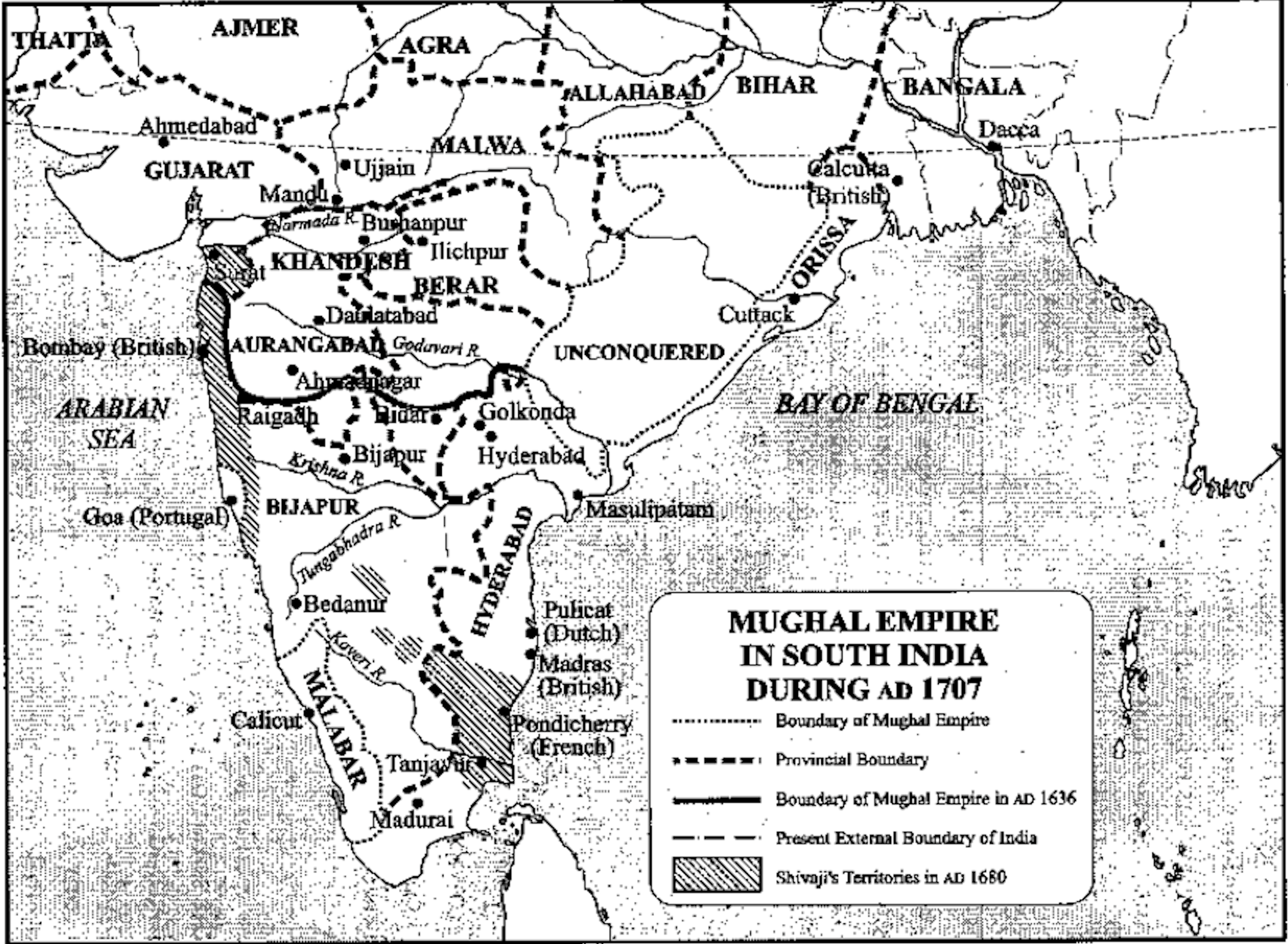
- Rise of the Marathas in the Deccan
- Marathas in the Administrative and Military Systems
- The Marathas held important positions in the administrative and military systems of Ahmadnagar and Bijapur.
- Their power and influence in governmental affairs increased as the Mughals advanced into the Deccan.
- Both the Deccani sultans and the Mughals sought their support.
- Malik Ambar extensively used Marathas as loose auxiliaries in his army.
- Influence of Maratha Families
- Several influential Maratha families exercised local authority in certain areas, including:
- The Mores
- The Ghatages
- The Nimbalkars
- Unlike the Rajputs, the Marathas did not have large, well-established states.
- Shahji Bhonsale and Early Maratha State-Building
- The credit for establishing a large Maratha state goes to Shahji Bhonsale and his son, Shivaji.
- Shahji acted as a kingmaker in Ahmadnagar for some time and defied the Mughals.
- However, after the Treaty of 1636, Shahji:
- Yielded the territories he controlled.
- Joined the service of Bijapur.
- Shifted his focus to Karnataka.
- Attempts to Establish Independent Principalities
- Taking advantage of unsettled conditions, Shahji attempted to establish a semi-independent principality at Bangalore.
- This was similar to how:
- Mir Jumla, the leading noble of Golconda, sought to carve out a principality on the Coromandel coast.
- The Abyssinian chiefs (Sidis) on the western coast acted in a similar manner.
- Prelude to Shivaji’s Rise
- These developments set the stage for Shivaji’s attempt to carve out a large principality around Poona.
- Shivaji’s Rise and Early Conquests
- Inheritance and Early Military Exploits (1645–1647)
- Shahji left the Poona jagir to his neglected senior wife, Jija Bai, and his minor son, Shivaji.
- At just 18 years old, Shivaji demonstrated his military prowess by capturing several hill forts near Poona:
- Rajgarh
- Kondana
- Torna
- In 1647, after the death of his guardian, Dadaji Kondadeo, Shivaji became his own master, gaining full control of his father’s jagir.
- Conquest of Javli and Expansion in the Mavala Region (1656)
- Shivaji’s true career of conquest began in 1656 when he defeated the Maratha chief Chandra Rao More and conquered Javli.
- The Javli kingdom and the accumulated treasure of the Mores were significant, and Shivaji acquired them through treachery.
- With the conquest of Javli:
- Shivaji became the undisputed master of the Mavala region (highlands).
- His path to Satara and the Konkan coastal strip was cleared.
- The Mavali foot soldiers became a crucial component of his army.
- He further strengthened his position by acquiring more hill forts near Poona.
- Conflict with the Mughals and the Bijapur Sultanate (1657–1659)
- In 1657, the Mughal invasion of Bijapur saved Shivaji from immediate conflict with Aurangzeb.
- Taking advantage of the situation, Shivaji switched sides and made deep inroads into Mughal territory, looting wealth.
- However, when Aurangzeb reached an agreement with Bijapur, he:
- Pardoned Shivaji but remained distrustful of him.
- Advised the Bijapur ruler to expel Shivaji from his conquered territories.
- Suggested that if Bijapur employed Shivaji, he should be stationed in Karnataka, far from Mughal frontiers.
- With Aurangzeb preoccupied in the north, Shivaji resumed conquests at Bijapur’s expense, expanding into:
- Konkan (coastal strip between the Ghats and the sea).
- Several hill forts in the region.
- Confrontation with Afzal Khan (1659)
- Alarmed by Shivaji’s rise, Bijapur sent Afzal Khan, a premier noble, with 10,000 troops to capture him.
- Treachery was common in those days, and both Afzal Khan and Shivaji had used it before.
- Shivaji’s forces, unaccustomed to open battle, hesitated to engage Afzal Khan’s superior army.
- Afzal Khan invited Shivaji for a personal meeting, promising to secure his pardon from Bijapur’s court.
- Aware of the trap, Shivaji arrived prepared and, in a cunning but daring act, murdered Afzal Khan (1659).
- His forces then routed the leaderless Bijapuri army, capturing:
- Goods
- Equipment
- Artillery
- Flushed with victory, Shivaji’s troops:
- Overran the fort of Panhala.
- Advanced into South Konkan and Kolhapur, making extensive conquests.
- Shivaji’s Growing Reputation and Aurangzeb’s Response
- Shivaji’s daring exploits made him a legendary figure.
- His reputation soared, and he was believed to have magical powers.
- Many, including Maratha warriors and Afghan mercenaries, joined his army.
- Aurangzeb, alarmed by Shivaji’s rise near the Mughal frontiers, ordered his governor of the Deccan, Shaista Khan, to launch an invasion.
- War with Shaista Khan and Mughal Retaliation (1660–1663)
- The conflict initially went badly for Shivaji:
- In 1660, Shaista Khan occupied Poona and made it his headquarters.
- Mughal forces seized North Konkan, despite facing stiff resistance from Maratha troops.
- Shivaji, pushed into a corner, devised a bold counterattack:
- In 1663, he infiltrated Shaista Khan’s camp in Poona under the cover of night.
- He attacked Shaista Khan in his harem, killing:
- His son
- One of his captains
- Shaista Khan was wounded but escaped.
- This daring raid disgraced Shaista Khan, leading to:
- Aurangzeb transferring him to Bengal.
- Aurangzeb refusing him an audience, a significant humiliation at the time.
- Attack on Surat (1664)
- Shivaji followed up with another audacious move:
- In 1664, he attacked Surat, the premier Mughal port.
- His forces looted it extensively, returning with immense treasure.
- Treaty of Purandar and Shivaji’s Visit to Agra
- Appointment of Raja Jai Singh and the Siege of Purandar (1665)
- After Shaista Khan’s failure, Aurangzeb assigned Raja Jai Singh of Amber, one of his most trusted advisers, to handle Shivaji.
- Jai Singh was given full military and administrative authority, allowing him to bypass the Mughal viceroy in the Deccan and report directly to Aurangzeb.
- Unlike his predecessors, Jai Singh:
- Did not underestimate the Marathas.
- Made careful diplomatic and military preparations.
- Appealed to Shivaji’s rivals and opponents, including the Sultan of Bijapur, to isolate him.
- Jai Singh marched to Poona and decided to strike at the heart of Shivaji’s domain—Fort Purandar, where Shivaji had lodged his family and treasure.
- In 1665, Jai Singh besieged Purandar, successfully blocking all Maratha relief attempts.
- With defeat imminent, Shivaji was forced to open negotiations, leading to the Treaty of Purandar.
- Terms of the Treaty of Purandar (1665)
- After intense negotiations, Shivaji and Jai Singh agreed to the following terms:
- Surrender of Forts and Territory:
- Out of 35 forts, 23 forts (along with surrounding lands yielding 4 lakh huns annually) were to be surrendered to the Mughals.
- 12 forts (yielding 1 lakh huns annually) would remain under Shivaji’s control, provided he served and remained loyal to the Mughal throne.
- Grant of Bijapuri Territory:
- Shivaji retained 4 lakh huns worth of Bijapuri Konkan territory, which he already controlled.
- The Mughals granted him additional 5 lakh huns worth of uplands (Balaghat), which Shivaji was expected to conquer himself.
- In return, Shivaji was to pay 40 lakh huns to the Mughals in installments.
- Mansab for Sambhaji and Shivaji’s Military Role:
- Shivaji requested exemption from personal service.
- Instead, a mansab of 5000 was granted to his minor son, Sambhaji.
- Shivaji promised to join Mughal campaigns in the Deccan when required.
- Mughal-Maratha Relations and the Failure of Jai Singh’s Strategy
- Jai Singh’s strategy aimed to create a rift between Shivaji and Bijapur’s ruler, ensuring Shivaji remained loyal to the Mughals.
- However, the success of this plan depended on Mughal support for Shivaji in reclaiming the lands surrendered to them from Bijapur.
- This proved to be a fatal flaw:
- Aurangzeb distrusted Shivaji and doubted the value of a joint Mughal-Maratha attack on Bijapur.
- Jai Singh, on the other hand, had grander ambitions:
- He envisioned the conquest of Bijapur and the entire Deccan.
- He believed that once this was achieved, Shivaji would have no choice but to remain a Mughal ally.
- He wrote to Aurangzeb: “We shall hem Shivaji in like the center of a circle.”
- However, the Mughal-Maratha expedition against Bijapur failed.
- Shivaji, who had been assigned to capture Fort Panhala, was also unsuccessful.
- Seeing his plan collapse, Jai Singh persuaded Shivaji to visit Aurangzeb in Agra, hoping:
- A reconciliation between Shivaji and Aurangzeb.
- Increased Mughal support for a renewed attack on Bijapur.
- Shivaji’s Visit to Agra and His Dramatic Escape (1666)
- Shivaji’s visit to Agra turned out to be a disaster:
- He felt insulted when he was ranked among mansabdars of 3000—a rank previously granted to his minor son, Sambhaji.
- During Aurangzeb’s birthday celebrations, the emperor did not grant Shivaji an audience, further humiliating him.
- Angered by this treatment, Shivaji:
- Stormed out in protest.
- Refused imperial service—a shocking act never before seen at the Mughal court.
- A strong faction at court urged Aurangzeb to punish Shivaji severely to maintain imperial dignity.
- Aurangzeb’s Dilemma and Shivaji’s Escape
- Since Shivaji had come to Agra on Jai Singh’s assurance, Aurangzeb sought Jai Singh’s advice.
- Jai Singh advocated leniency, but before a decision could be made:
- Shivaji dramatically escaped from detention in 1666.
- The details of his escape are well known and need not be repeated here.
- Aurangzeb blamed himself for his carelessness in allowing Shivaji to escape.
- Impact of Shivaji’s Visit to Agra
- The Agra incident marked a turning point in Mughal-Maratha relations.
- Though Shivaji remained inactive for two years after his escape, it was now clear that:
- Unlike Jai Singh, Aurangzeb placed little value on an alliance with Shivaji.
- To Aurangzeb, Shivaji was merely a petty zamindar (landholder).
- As subsequent events proved, Aurangzeb’s failure to recognize Shivaji’s importance and refusal to forge an alliance with him were among the greatest political mistakes of his reign.
- Shivaji: Conquests, Administration, and Legacy
- Renewed Conflict with the Mughals and Bijapur
- Aurangzeb’s rigid interpretation of the Treaty of Purandar, despite its practical failure following the unsuccessful expedition against Bijapur, provoked Shivaji into resuming his conquests.
- The loss of 23 forts and territory worth four lakh hons annually to the Mughals, without compensation from Bijapur, was unacceptable to Shivaji.
- In 1670, he sacked Surat for the second time.
- Over the next four years, he reclaimed several forts, including Purandar, and made deep inroads into Mughal territories (especially Berar and Khandesh).
- The Mughal preoccupation with the Afghan uprising in the northwest gave Shivaji an advantage.
- He also resumed conflict with Bijapur, securing Panhala and Satara through bribes and raiding the Kanara region.
- Coronation at Raigarh (1674)
- Shivaji’s formal coronation at Raigarh in 1674 marked his transformation from a petty jagirdar of Poona to the most powerful Maratha chief. Given the extent of his dominions and the size of his army, he could claim status equal to that of the weakened Deccani sultans.
- The coronation served multiple purposes:
- Political Legitimacy:
- Elevated him above other Maratha chiefs, some of whom saw him as an upstart.
- Social Status:
- Strengthened his position by marrying into powerful Maratha families like the Mohites and Shirkes.
- Religious Validation:
- Gaga Bhatta, the presiding priest, declared him a high-class Kshatriya.
- Diplomatic Recognition:
- Enabled him to sign treaties with Deccani sultans as an independent ruler rather than a rebel.
- Maratha Nationalism:
- Strengthened Maratha identity and aspirations.
- Karnataka Expedition (1676-1679)
- Shivaji embarked on an ambitious Karnataka campaign in 1676, with the support of Madanna and Akhanna, ministers at Hyderabad.
- Alliance with the Qutb Shah:
- Shivaji was welcomed at Golconda, and a treaty was signed.
- The Qutb Shah agreed to pay one lakh hons (₹5 lakh) annually and host a Maratha ambassador.
- Joint sharing of territory and booty.
- The Qutb Shah supplied troops, artillery, and financial aid.
- Military Success:
- Captured Jinji and Vellore from Bijapuri officials.
- Conquered lands controlled by his half-brother Ekoji.
- Breach of Trust:
- Despite claiming the title of Haindava-Dharmoddharak (Protector of Hindu Faith), Shivaji plundered the local Hindu population.
- Refused to share the loot with the Qutb Shah, leading to strained relations.
- The Karnataka expedition was Shivaji’s last major campaign. The fort at Jinji, which he fortified, later served as a crucial refuge for his son Rajaram during Aurangzeb’s war on the Marathas.
- Administrative System
- Shivaji established a sound administrative system, largely inspired by the Deccani states.
- Ashtapradhan Council (Ministers)
- Although he appointed eight ministers (Ashtapradhan), they were directly responsible to the ruler, not functioning as a collective council.
- Peshwa
- Finance and general administration
- Sar-i-Naubat (Senapati)
- Military commander (mostly honorary)
- Majumdar
- Accountant
- Waqia Navis
- Intelligence, postal services, and household affairs
- Surunavis (Chitnis)
- Official correspondence
- Dabir
- Foreign affairs and ceremonial duties
- Nyayadhish
- Judiciary
- Panditrao
- Religious and charitable affairs
- Mnemonic to remember Ashtapradhan
- "Pehle Aam Sabzi Mango, Shaam ko Samosa Naan Pakode"
- Pehle -> Peshwa (Prime Minister)
- Aam -> Amatya (Finance)
- Sabzi -> Sachiv (Secretary/Correspondence)
- Mango -> Mantri (Home Affairs)
- Shaam -> Senapati (Military)
- ko -> _x
- Samosa -> Sumant (Foreign Affairs)
- Naan -> Nyayadhish (Justice)
- Pakode -> Panditrao (Religion)
- Army Organization
- Cash salaries were preferred, though revenue grants (saranjam) were sometimes awarded.
- Strict discipline:
- Women and dancing girls were not allowed in the army.
- Plunder was strictly accounted for.
- Regular cavalry (Paga):
- 30,000–40,000 troops, commanded by Havaldars (fixed salaries).
- Forts were strategically supervised, guarded by Mavali foot soldiers and gunners.
- Anti-treachery measures:
- Three officers of equal rank managed each fort.
- Revenue System
- Modeled after Malik Ambar’s reforms.
- A new revenue assessment was completed by Annaji Datto in 1679.
- Contrary to some beliefs, Shivaji did not abolish the zamindari (deshmukhi) system nor completely eliminate jagirs (mokasa).
- Mirasdars (hereditary landowners) were strictly supervised:
- Sabhasad, an 18th-century chronicler, noted that mirasdars paid the government only a fraction of their revenue.
- Many had built forts, enlisted musketeers, and defied authority.
- Shivaji demolished their strongholds and forced submission.
- Additional Revenue: Chauth System
- Imposed a one-fourth (chauth) tax on Mughal territories as a tribute.
- Legacy and Final Years
- Shivaji passed away in 1680, shortly after returning from the Karnataka campaign. However, his legacy was far-reaching:
- Military Genius:
- Master of guerrilla warfare and rapid troop movement.
- His army was highly mobile and efficient.
- Relied heavily on plunder for military funding.
- State-Building:
- Though war-driven, his kingdom was not merely a “war-state”.
- His rule had a popular base and represented local resistance against Mughal encroachments.
- By curbing the deshmukhs’ power, he laid the foundation for a strong Maratha state.
- Shivaji’s leadership, diplomacy, and military acumen ensured that the Marathas remained a dominant force even after his death, influencing Indian history for centuries to come.
- Aurangzeb and the Deccan States: Phases of Relations
- The relations between Aurangzeb and the Deccan states can be divided into three distinct phases:
1. First Phase (Until 1668):
- The primary objective was to recover from Bijapur the territories of the former Ahmadnagar state, which had been surrendered to it by the treaty of 1636.
2. Second Phase (1668–1684):
- The main threat in the Deccan during this period was the Marathas.
- The Mughals pressured Bijapur and Golconda to align with them against Shivaji and later his son, Sambhaji.
- While doing so, the Mughals gradually encroached upon the territories of the Deccan states, aiming to bring them under complete Mughal control.
3. Final Phase (1684 Onwards):
- Aurangzeb abandoned hopes of securing the cooperation of Bijapur and Golconda against the Marathas.
- Convinced that the destruction of the Marathas required the conquest of these states first, he decided to subjugate Bijapur and Golconda entirely.
- Mughal Expansion and Treaty Violations
- The Treaty of 1636, under which Shah Jahan had ceded one-third of the Ahmadnagar territories to Bijapur and Golconda as a bribe to keep them from supporting the Marathas, included a Mughal promise “never ever” to conquer these states. However, Shah Jahan himself disregarded this agreement.
- In 1657-58, both Golconda and Bijapur faced Mughal threats
- Golconda was forced to pay a hefty indemnity.
- Bijapur had to surrender the Nizam Shahi territories granted to it in 1636.
- Justification for Mughal Actions
- The Mughals justified these aggressive moves by arguing that:
- Both states had expanded significantly in Karnataka.
- Since they were considered Mughal vassals, the Mughals were entitled to “compensation” for their conquests, which had been possible only due to Mughal neutrality.
- However, the real reason was financial:
- Maintaining Mughal armies in the Deccan was costly.
- The revenue from Mughal-controlled territories was insufficient.
- For a long time, the shortfall was covered by subsidies from Malwa and Gujarat treasuries.
- Consequences of Mughal Expansion
- The policy of limited expansion in the Deccan had far-reaching consequences, which neither Shah Jahan nor Aurangzeb fully grasped:
- It permanently eroded trust in Mughal treaties and assurances.
- A “union of hearts” against the Marathas became impossible.
- Despite Aurangzeb’s relentless efforts for 25 years, the policy brought little success.
- The First Phase of Aurangzeb’s Deccan Policy (1658–1668)
- Upon ascending the throne, Aurangzeb faced two major challenges in the Deccan:
1. The rising power of Shivaji.
2. Persuading Bijapur to relinquish the territories it had acquired under the Treaty of 1636.
- Initial Gains and the Mughal Strategy
- Kalyani and Bidar had been secured in 1657.
- Parenda was obtained through bribery in 1660.
- However, Sholapur remained under Bijapur’s control.
- After his accession, Aurangzeb ordered Jai Singh to take action against both Shivaji and Adil Shah of Bijapur.
- This directive reflected Aurangzeb’s overconfidence in Mughal military superiority and his underestimation of his opponents.
- However, Jai Singh, an astute politician, warned Aurangzeb:
- “It would be unwise to attack both these foes at the same time.”
- Jai Singh was the only Mughal statesman of this period who advocated an aggressive forward policy in the Deccan.
- He believed that the Maratha problem could not be resolved without Mughal expansion in the region—a conclusion Aurangzeb himself would reach two decades later.
- The Plan to Invade Bijapur and Aurangzeb’s Reluctance
- While planning his invasion of Bijapur, Jai Singh wrote to Aurangzeb:
- “The conquest of Bijapur is the preface to the conquest of all Deccan and Karnataka.”
- However, Aurangzeb hesitated to commit to this bold strategy. His reluctance was due to:
- The threat posed by the ruler of Iran in the northwest.
- The long and arduous nature of a Deccan campaign, which would require the emperor’s personal presence.
- The risk of leaving a large Mughal army under the command of an ambitious noble or prince, a lesson Shah Jahan had learned to his misfortune.
- Shah Jahan’s continued existence, which restricted Aurangzeb from embarking on a distant military campaign.
- Jai Singh’s Failed Bijapur Campaign (1665)
- With limited resources at his disposal, Jai Singh’s Bijapur campaign was doomed to fail.
- The Deccan states united against the Mughals, as the Qutb Shah of Golconda sent a large force to aid Bijapur.
- The Deccanis employed guerrilla tactics
- They lured Jai Singh’s forces towards Bijapur.
- They devastated the countryside, cutting off Mughal supplies.
- Jai Singh’s campaign suffered from logistical shortcomings:
- He lacked siege artillery.
- A prolonged siege was impossible.
- His eventual retreat proved costly, yielding neither money nor additional territory.
- The failure of this campaign, coupled with Aurangzeb’s criticisms, led to Jai Singh’s death in 1667.
- End of the First Phase (1668)
- In 1668, the Mughals secured the surrender of Sholapur through bribery, marking the end of the first phase of Mughal expansion in the Deccan.
- The Second Phase of Aurangzeb’s Deccan Policy (1668–1684)
- Mughal Inactivity and the Rise of Golconda’s Leadership (1668–1676)
- Between 1668 and 1676, the Mughals largely remained inactive in the Deccan.
- During this period, a new political dynamic emerged with the rise of Madanna and Akhanna, two talented brothers who virtually controlled the administration of Golconda from 1672 until its annexation in 1687.
- Their primary objective was to establish a tripartite alliance between:
1. Golconda
2. Bijapur
3. Shivaji’s Marathas
- However, this alliance was frequently disrupted due to:
- Factional conflicts within Bijapur
- Shivaji’s growing ambitions, which led him to alternately loot Bijapur and then support it against the Mughals
- Mughal Attempts to Influence Bijapur
- The factions at Bijapur pursued inconsistent policies, aligning either with or against the Mughals based on their immediate interests.
- Despite his concerns over the growing Maratha power, Aurangzeb was reluctant to expand Mughal territories in the Deccan.
- Instead, he pursued a policy of manipulating Bijapur’s internal politics to:
- Install a pro-Mughal faction
- Weaken Shivaji’s influence
- Ensure Bijapur remained independent of Golconda’s control
- To achieve this, the Mughals launched several military interventions, but these efforts only strengthened the unity of the three Deccan states against the Mughals.
- Diler Khan’s Failed Siege of Bijapur (1679–1680)
- In a final, desperate attempt, Diler Khan, the Mughal viceroy, led a campaign to capture Bijapur in 1679–1680. However, the Mughals were outmatched by the combined strength of the Deccan states.
- A new factor in the conflict was the Karnataki matchlock-armed foot soldiers.
- 30,000 of these troops, sent by Berar chief Prem Naik, played a decisive role in repelling the Mughal siege of Bijapur.
- Additionally, Shivaji dispatched a large force to aid Bijapur and launched raids into Mughal territories.
- End of the Second Phase
- Diler Khan’s campaign failed, exposing Mughal territories to repeated Maratha incursions.
- As a result, he was recalled by Aurangzeb, marking the end of this phase of Mughal expansion in the Deccan.
- The Final Phase of Aurangzeb’s Deccan Campaign (1681–1707)
- Aurangzeb’s Renewed Efforts (1681–1684)
- Between 1676 and 1680, the Mughals achieved little success in the Deccan. When Aurangzeb arrived in the region in 1681 while pursuing his rebel son, Prince Akbar, he initially focused on:
- Targeting Sambhaji, the son and successor of Shivaji.
- Attempting to detach Bijapur and Golconda from their alliance with the Marathas.
- However, these efforts failed, much like before. The Deccan states viewed the Marathas as their only shield against Mughal expansion and refused to abandon them.
- The Fall of Bijapur (1686)
- Frustrated with diplomatic failures, Aurangzeb decided to force Bijapur into submission. He issued a set of demands to the Adil Shah, treating him as a Mughal vassal:
- Supply provisions to the Mughal army.
- Allow free passage for Mughal forces through Bijapur’s territory.
- Provide 5,000–6,000 cavalry to assist the Mughals against the Marathas.
- Expel Sharza Khan, a prominent anti-Mughal noble in Bijapur.
- These demands led to open conflict. The Adil Shah sought military support from both Golconda and Sambhaji, who responded immediately.
- However, even the combined strength of the Deccan states could not withstand the full might of Aurangzeb’s army, especially with the emperor himself leading the campaign.
- Despite their resistance, Bijapur fell in 1686 after an 18-month siege, with Aurangzeb personally present in the final stages.
- The length and difficulty of the siege justified the earlier failures of Jai Singh (1665) and Diler Khan (1679–1680) against Bijapur.
- The Fall of Golconda (1687)
- With Bijapur defeated, an attack on Golconda became inevitable. Aurangzeb saw multiple “offenses” in the Qutb Shah’s rule:
- He had placed supreme power in the hands of two Hindus, Madanna and Akhanna.
- He had supported Shivaji on multiple occasions.
- He had openly defied Aurangzeb’s warnings.
- In 1685, despite stiff resistance, the Mughals occupied Golconda, and the Qutb Shah offered peace, agreeing to:
- Pay a large indemnity to Aurangzeb.
- Cede certain territories.
- Dismiss Madanna and Akhanna.
- The Qutb Shah complied, and Madanna and Akhanna were brutally murdered in 1686. However, even this betrayal failed to save him.
- The Mughals besieged Golconda again in early 1687, and after six months of fierce resistance, the fort fell due to treachery and bribery.
- The Maratha Resistance (1689–1690)
- With Bijapur and Golconda destroyed, Aurangzeb turned his full attention to crushing the Marathas.
- In 1689, a Mughal force captured Sambhaji at his secret hideout in Sangameshwar. He was paraded before Aurangzeb and executed as a rebel and an infidel.
- This decision proved to be a major political mistake. Instead of securing Mughal control, Sambhaji’s execution:
- Eliminated a potential negotiating partner who might have submitted.
- Turned the Marathas into an even more decentralized and resilient force.
- Gave them a renewed cause for resistance.
- The Maratha sardars, without a single central authority, began launching guerilla warfare—plundering Mughal territories, vanishing at the approach of Mughal forces, and regrouping elsewhere.
- Rajaram, Sambhaji’s younger brother, was crowned king but had to flee to Jinji on the eastern coast when the Mughals attacked his capital.
- The Maratha resistance now expanded from the western to the eastern coast.
- Aurangzeb’s Stubborn Pursuit (1690–1703)
- By 1690, Aurangzeb believed Maratha power had been crushed and shifted focus to annexing the rich Karnataka region into the Mughal Empire.
- However, he overextended his supply lines, making them vulnerable to Maratha attacks.
- Mughal control over Bijapur weakened as it became a hub of Maratha activities. From 1690 to 1703, Aurangzeb refused to negotiate, believing that total military conquest was the only solution.
- The siege of Jinji (1690–1698) lasted nearly 8 years, but Rajaram escaped before it fell.
- The Marathas intensified their attacks, recapturing many forts.
- By 1700, Aurangzeb launched siege after siege, dragging his army across the Deccan for five and a half years (1700–1705).
- Despite his victories, the Marathas never stopped fighting. Mughal forces suffered from floods, disease, and constant guerrilla attacks.
- The nobles and soldiers became weary, and some even made secret pacts with the Marathas, paying them chauth (tribute) in exchange for safety.
- Aurangzeb’s Last Years and Failed Negotiations (1703–1707)
- By 1703, Aurangzeb finally considered negotiations. He offered to:
- Release Shahu, the son of Sambhaji, who had been captured.
- Grant him Shivaji’s swarajya and the right of sardeshmukhi over the Deccan.
- Shahu, treated well in Mughal captivity, was given the title of Raja, a mansab of 2000/2000, and was married into respected Maratha families.
- However, at the last moment, Aurangzeb canceled the agreement, uncertain about the Marathas’ true intentions.
- By 1706, realizing the futility of his efforts, Aurangzeb slowly retreated to Aurangabad, harassed by Maratha forces.
- When Aurangzeb died in 1707, he left behind:
- A crumbling Mughal empire, weakened by decades of war.
- A victorious Maratha force, now the dominant power in the Deccan.
- Discontent and rebellion across North India, fueled by his aggressive policies.
- Aurangzeb’s Deccan campaign, which had lasted over 25 years, had drained the Mughal treasury and shattered the empire’s military strength.
- His obsession with total conquest had only strengthened the very enemies he sought to destroy.
- Decline of the Mughal Empire
- Introduction: The Aftermath of Aurangzeb’s Death
- The Mughal Empire declined rapidly after Aurangzeb’s death.
- The Mughal court became a battleground for factional conflicts among nobles.
- Ambitious provincial governors asserted independence.
- Maratha incursions expanded from the Deccan into the empire’s heartland.
- The empire’s weakness was exposed when Nadir Shah imprisoned the Mughal emperor and looted Delhi in 1739.
- Aurangzeb’s Role in the Decline
- Debate on Aurangzeb’s Responsibility
- Historians debate whether the empire’s downfall was due to Aurangzeb’s flawed policies or later developments.
- Recent analyses consider economic, social, administrative, and intellectual trends of the time.
- Economic and Social Context
- The 17th century saw an expansion of trade and handicraft production.
- Growth in cultivation was driven by population increase, economic forces, and Mughal policies.
- Detailed records were maintained on agriculture, including ploughs, bullocks, wells, and cultivators.
- Agriculture and Revenue System
- Challenges in Agricultural Growth
- Despite expansion, agricultural production stagnated.
- No new techniques emerged to counter declining soil fertility.
- The land revenue system was burdensome:
- Under Akbar, the state’s share was one-third of the produce.
- By the mid-17th century, it rose to nearly half, including zamindars’ portions.
- Regional Variations in Revenue Demand
- Revenue burden varied by region:
- Lower in infertile areas like Rajasthan and Sindh.
- Higher in fertile regions like Kashmir’s saffron lands.
- Social Barriers to Land Expansion
- Despite available surplus land, landless laborers existed in many villages.
- Dalits and marginalized communities were kept in menial roles.
- Dominant castes and zamindars had little incentive to allow them to acquire land.
- Nobility, Jagirdari Crisis, and Administrative Decline
- Expansion of the Nobility and Economic Strains
- The number of mansabdars increased:
- 2,069 in Jahangir’s reign (1605).
- 8,000 under Shah Jahan (1637).
- 11,456 in Aurangzeb’s later years.
- Revenue increase did not match the rise in nobility.
- Extravagant court expenditures under Shah Jahan worsened financial stress.
- Zamindars and Peasant Unrest
- Zamindars resisted excessive revenue demands.
- Peasants migrated between villages seeking better conditions.
- Extracting more revenue from jagirs led to peasant unrest and zamindar revolts.
- Jagirdari Crisis and Corruption
- Jagirs in newly conquered regions like Karnataka yielded little revenue.
- Corruption among officials led to nobles paying bribes for profitable jagirs.
- Shah Jahan had reduced the cavalry requirements of mansabdars to address the jagir shortage.
- Aurangzeb’s conquest of the Deccan failed to resolve the problem.
- The jagirdari system, once a pillar of Mughal governance, became a source of instability:
- Shortage of Jagirs:
- Productive lands were kept under khalisa (imperial control) for financing wars, leaving nobles with insufficient revenue.
- Revenue Exploitation:
- Many nobles resorted to unauthorized means to extract more revenue, worsening rural unrest.
- Peasant and Zamindar Resistance: The pressure to increase revenue led to widespread resistance, further weakening Mughal authority.
- The crisis was worsened in the Deccan, where nobles struggled to collect revenue due to Maratha incursions.
- Some entered private agreements with Maratha leaders, paying chauth in exchange for security.
- Military Challenges and the Maratha Problem
- The Mughal military, once dominant, struggled with new challenges:
- Infantry Neglect:
- The failure to modernize the infantry and mobile artillery reduced the empire’s effectiveness against guerrilla-style warfare, particularly in the Deccan.
- Neglected infantry with flint guns and mobile field artillery.
- Overextension:
- The conquest of Bijapur and Golconda overstretched Mughal resources, leaving the empire vulnerable to Maratha attacks.
- Declining Central Control:
- As local nobles sought autonomy and engaged in private deals, the empire’s military structure weakened.
- Nobles resisted changes that threatened their cavalry-dominated prestige.
- Aurangzeb’s Strategic Mistakes
- Miscalculated the Maratha movement.
- Ignored Jai Singh’s advice to ally with Shivaji.
- Executed Sambhaji, losing a leader he could have negotiated with.
- Underestimated Maratha resilience after Bijapur and Golconda’s fall.
- Failed Negotiations with the Marathas
- Aurangzeb demanded a truncated Maratha swarajya and loyalty to the Mughal throne.
- By 1703, an agreement was nearly reached, but Aurangzeb remained distrustful.
- The Marathas were granted mansabs but were not given positions of real trust.
- Maratha and Rajput Relations
- Aurangzeb’s handling of the Marathas and Rajputs contributed to long-term instability
- Failure to Integrate Marathas:
- Unlike the Rajputs, who were given high mansabs and administrative roles, Maratha leaders were distrusted and not fully incorporated into the Mughal system.
- Marwar Conflict:
- Aurangzeb’s interference in Marwar’s succession led to prolonged war with Rajput states, damaging Mughal prestige. However, the Rajputs did not actively contribute to the empire’s disintegration after Aurangzeb’s death.
- Economic, Social, and Administrative Factors
- The decline of the Mughal Empire was not solely due to Aurangzeb’s personal policies or military campaigns but was influenced by broader economic, social, and administrative forces.
- Economic Weaknesses:
- The burden of land revenue was excessive in many areas, reducing incentives for agricultural expansion.
- The absence of new agricultural techniques and declining soil fertility further slowed growth.
- Social Structure:
- The rigidity of caste and class structures, particularly the marginalization of Dalits and landless laborers, prevented efficient land utilization and agricultural development.
- Administrative Decay:
- The Mughal administrative system required a strong and capable monarch to function effectively.
- With the weakening of the central authority, factionalism among nobles grew, and the jagirdari system collapsed under financial strain.
- Religious Policies and Their Impact
- Aurangzeb’s religious orthodoxy played a role in alienating sections of society
- Temple Destruction and Jizya:
- His policies, such as temple demolitions and the reimposition of jizya, created resentment among non-Muslims.
- Lack of Unifying Vision:
- Unlike Akbar’s inclusive policies, Aurangzeb’s focus on Islamic law failed to create unity among diverse communities.
- Limited Long-Term Impact:
- Despite these policies, the empire’s decline was more influenced by economic and administrative issues rather than religious conflicts alone.
- Conclusion: The Mughal Empire’s Legacy
- While Aurangzeb’s reign marked the beginning of the empire’s decline, its downfall was a gradual process influenced by multiple factors
- Economic Stagnation:
- Agricultural and manufacturing growth failed to keep pace with rising demands.
- Administrative Breakdown:
- The centralization of power without efficient reforms led to instability.
- Military Limitations:
- The Mughal military, though once powerful, failed to adapt to changing warfare tactics, particularly against the Marathas’ guerrilla strategy.
- Rise of Provincial Powers:
- The weakening of central authority allowed regional powers like the Marathas, Rajputs, Sikhs, and later the British to assert their influence.
- Thus, Aurangzeb was both a victim of circumstances and a contributor to the very circumstances that led to his downfall.
- Victim of Circumstances:
- He inherited an empire that was already vast and difficult to manage.
- Over time, factors like economic strain, administrative inefficiency, and emerging regional powers weakened Mughal control.
- Contributor to His Own Downfall:
- His policies—such as religious intolerance, prolonged wars in the Deccan, and harsh treatment of Rajputs and Marathas—exacerbated the empire’s problems.
- His military campaigns drained resources and alienated powerful groups, leading to widespread rebellion and instability.
- Assessment and Review
- Social Developments
- Persistence of the Caste System:
- Despite challenges from Islam and the decline of Rajput power, the caste system remained dominant.
- Role of Bhakti and Sufi Movements:
- Groups like the Nath Panthis, Jogis, and Bhakti saints criticized caste divisions but had limited impact.
- A compromise emerged—saints generally restricted their critiques to spiritual matters, while Brahmins accepted Bhakti as a salvation path for all castes, especially Shudras.
- Women and Social Mobility:
- Bhakti saints, including Mirabai and Surdas, provided women with a platform to rise beyond their traditional roles.
- However, Brahmins retained control over religious teaching and education.
- Cultural and Religious Developments
- Interfaith Harmony and Challenges:
- Bhakti and Sufi saints emphasized shared values between Hinduism and Islam, fostering a spirit of mutual tolerance.
- However, sectarian forces remained influential and occasionally impacted state policies.
- Impact on Language and Literature:
- Saints contributed to the growth of regional languages and literature.
- Their focus on spiritual concerns led to neglect in the fields of science and technology.
- Status of Women
- Worsening Conditions:
- The practice of purdah (seclusion) became more widespread.
- Hindu women lacked rights to remarriage and inheritance, unlike Muslim women.
- Even among Muslims, these rights were increasingly restricted.
- Political and Economic Developments
- Political and Administrative Integration:
- The Turks initiated and the Mughals consolidated a unified administration, primarily in northern India.
- Their influence extended indirectly to other regions.
- Economic Growth and Trade:
- A well-minted silver currency, improved roads, and urbanization facilitated trade.
- Handicrafts and commerce peaked in the seventeenth century.
- Aristocratic Nature of the Ruling Class:
- The Mughal elite comprised both Muslims and Hindus but remained largely aristocratic, limiting upward mobility for lower-class individuals.
- Aurangzeb’s efforts to integrate Marathas into the administration were largely unsuccessful due to regional, religious, and social barriers.
- Feudal Structure:
- The Mughal nobility depended on land revenue collected from peasant proprietors.
- Zamindars played a crucial role in revenue collection, maintaining their privileges in return for state loyalty.
- Military and Foreign Relations
- Defense Against Foreign Invasions:
- The Turks defended India against Mongol invasions in the 13th and 14th centuries.
- The Mughals secured India’s northwest frontiers for 200 years, focusing on the Kabul-Ghazni line.
- European Trade and Expansion:
- India’s global reputation as a center for spices and textiles attracted European traders.
- European powers sought control over Indian trade and territory but were largely unsuccessful while the Mughal empire remained strong.
- The empire’s decline in the 18th century, coupled with economic and technological advancements in Europe, enabled colonial expansion.
- Scientific and Technological Backwardness
- Limited Maritime and Naval Development:
- The Mughals understood the importance of trade but neglected naval power.
- Stagnation in Science and Technology:
- India failed to produce mechanical innovations like the European clock.
- While Indian artisans could replicate European designs (e.g., shipbuilding), innovation remained minimal.
- Role of Social Structures:
- Caste restrictions and deference to traditional knowledge stifled scientific progress.
- Akbar’s efforts to introduce science into education were resisted.
- Cultural Integration and Legacy
- Unified Cultural Identity:
- Despite diversity in race, religion, and language, India developed a largely unified culture.
- The seventeenth century was marked by a surge in artistic and cultural achievements, often called a second classical age.
- Challenges to Cultural Integration:
- Religious dogmatism and conflicts within the ruling class threatened this unity but did not completely dismantle it.
- Regional Contributions:
- The Vijayanagara kingdom continued Chola traditions in the south.
- The Bahmani kingdom and its successor states contributed to cultural developments.
- These regional influences merged into Mughal-era cultural forms.
- Economic Prospects and European Influence
- Industrial Growth and Limitations:
- Trade and manufacturing expanded, but development was uneven across regions.
- Gujarat, the Coromandel coast, and Bengal became economic hubs in the seventeenth century.
- The Industrial Revolution Question:
- Would India have had its own industrial revolution if the Mughal empire had survived?
- Despite continued trade expansion in the eighteenth century, India lagged behind Europe in science, technology, and economic organization.
- Limitations in Manufacturing:
- Small-scale production and reliance on simple tools limited productivity.
- Caste restrictions and lack of capital prevented artisans from evolving into entrepreneurs.
- Emergence of European Dominance:
- The dadni (putting-out) system increased production but made artisans dependent on merchants.
- British and other European powers leveraged these economic conditions to establish colonial control.
- Despite remarkable developments in political and cultural integration, India’s stagnation in science and technology, along with rigid social structures, ultimately made it vulnerable to European expansion.
-
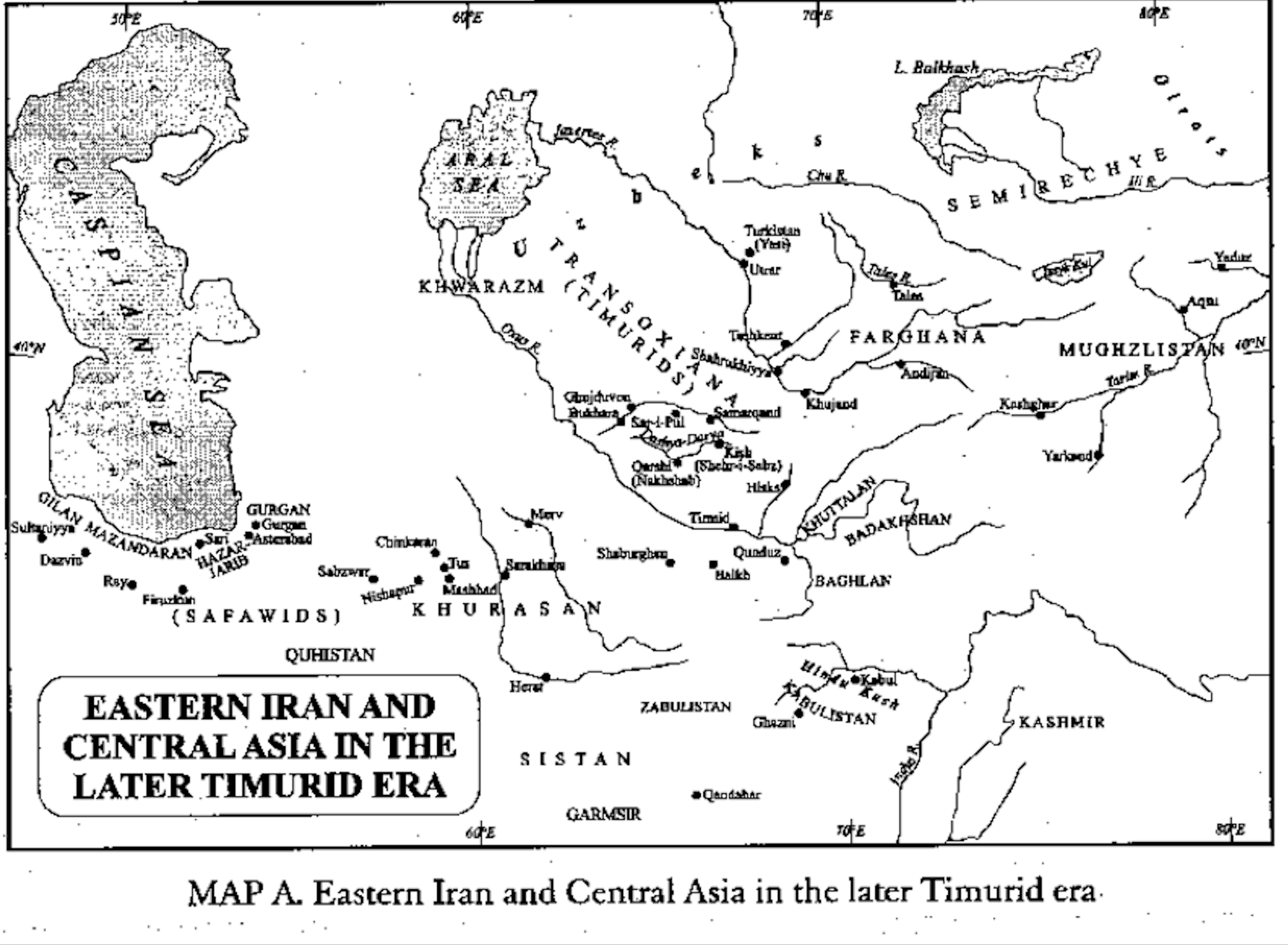
-
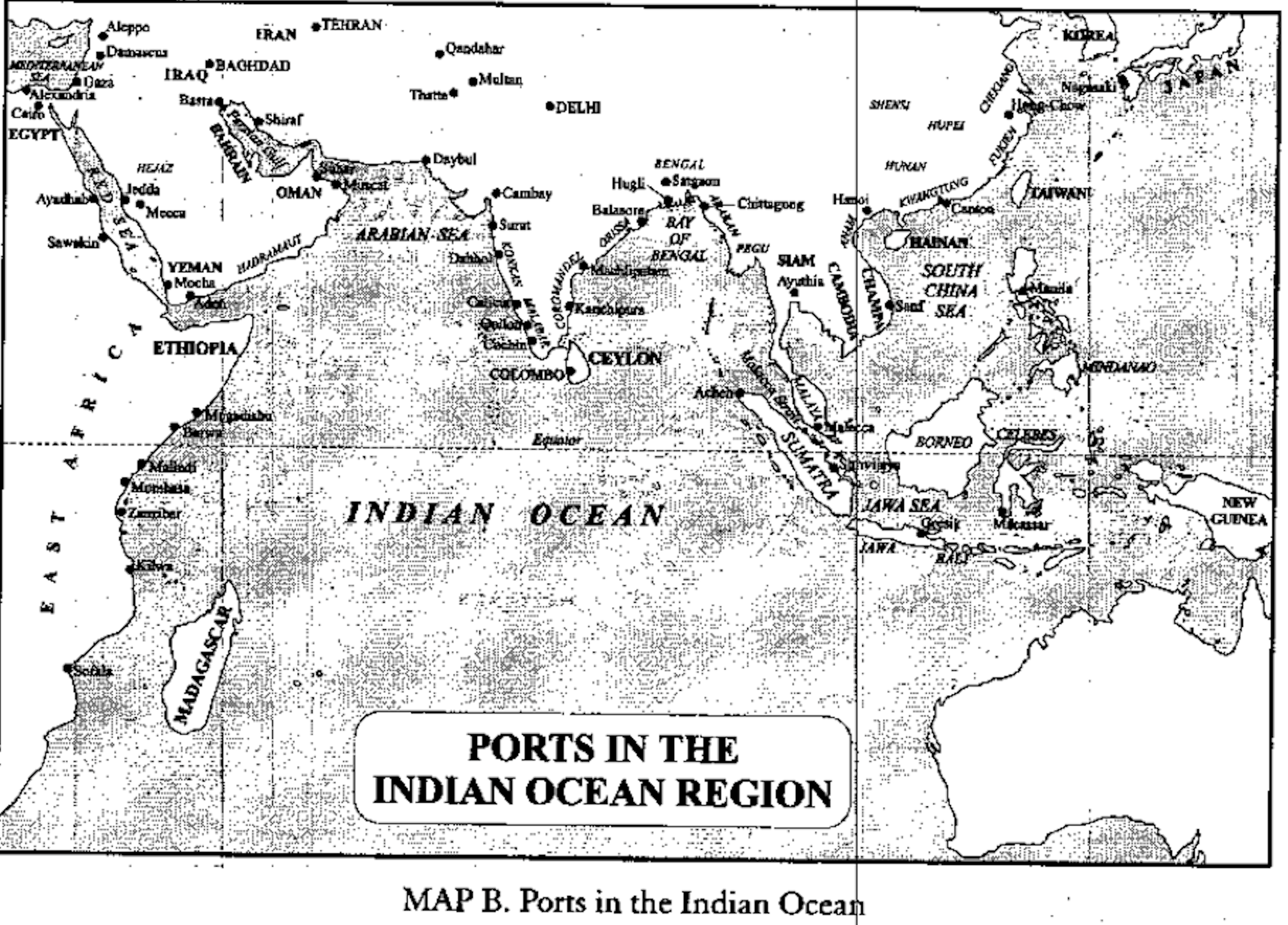
- Medieval History PYQs
- [1995]
- Q1: The Mughal school of painting formed the spinal column of different schools of Indian miniature art. Which one of the following painting styles was not affected by Mughal painting?
- Options:
(a) Pahari
(b) Rajasthani
(c) Kangra
(d) Kalighat
- Answer:
(d) Kalighat
- Analysis:
- Historical Context:
- The Mughal school of painting emerged in the 16th century CE under emperors like Akbar (r. 1556-1605 CE), blending Persian techniques with Indian themes. Flourishing in ateliers (e.g., Fatehpur Sikri), it influenced regional miniature styles through patronage, artist migration, and cultural exchange from the 16th to 18th centuries CE. Styles like Pahari, Rajasthani, and Kangra evolved in this milieu, while Kalighat emerged later with distinct roots.
- Correct Option Explained:
- (d) Kalighat:
- Correct—Kalighat painting, originating in the 19th century CE around the Kalighat Temple in Kolkata, West Bengal, was a folk art form unaffected by Mughal painting. It developed as a bazaar art by patuas (scroll painters) for pilgrims, featuring bold lines, vibrant colors, and themes like Hindu deities (e.g., Kali) and social satire (e.g., British rule critiques). Its roots lie in Bengal’s indigenous pata tradition, not Mughal miniature techniques.
- Why Not Other Options?:
- (a) Pahari:
- Incorrect—Pahari painting (c. 17th-19th centuries CE), from the Himalayan hill states (e.g., Guler, Kangra), was heavily influenced by Mughal art. Artists like Nainsukh (c. 1710-1778 CE) adopted Mughal realism and portraiture (e.g., Guler portraits), merging them with local devotional themes (e.g., Krishna-Radha).
- (b) Rajasthani:
- Incorrect—Rajasthani painting (c. 16th-19th centuries CE), from Rajasthan’s courts (e.g., Mewar, Marwar), evolved under Mughal influence. Akbar’s artists trained Rajput painters, leading to styles like the Ragamala series (e.g., Mewar, 1605 CE), blending Mughal finesse with Rajput vibrancy.
- (c) Kangra:
- Incorrect—Kangra painting (c. 18th-19th centuries CE), a Pahari sub-style from Himachal Pradesh, was shaped by Mughal techniques via refugee artists post-Mughal decline (e.g., 1739 CE, Nadir Shah’s invasion). Its delicate brushwork and romantic themes (e.g., Kangra Krishna Lila, 1780 CE) reflect Mughal naturalism.
- Painting Style Details:
- Mughal School:
- Period: c. 16th-18th centuries CE.
- Features: Realism, Persian motifs (a recurring theme, pattern, or design that appears in various forms), historical scenes (e.g., Akbarnama).
- Kalighat:
- Period: c. 19th century CE.
- Features: Folk style, bold outlines, mass-produced pats.
- Pahari:
- Period: c. 17th-19th centuries CE.
- Features: Miniatures, devotional themes, Mughal-influenced detailing.
- Rajasthani:
- Period: c. 16th-19th centuries CE.
- Features: Bright colors, courtly themes, Mughal-trained artists.
- Kangra:
- Period: c. 18th-19th centuries CE.
- Features: Soft hues, romantic narratives, Mughal finesse.
- Other Related Painting Styles:
- Deccani:
- Context: c. 16th-17th centuries CE, Deccan sultanates.
- Influence: Mughal techniques (e.g., Bijapur portraits).
- Company School:
- Context: c. 18th-19th centuries CE, British India.
- Influence: European realism, not Mughal (e.g., botanical art).
- Madhubani:
- Context: Bihar, ancient to modern.
- Influence: Folk tradition, no Mughal impact (e.g., Mithila ritual art).
- Tanjore:
- Context: c. 17th-19th centuries CE, Tamil Nadu.
- Influence: South Indian temple art, minimal Mughal effect.
- Bengal Pata:
- Context: Pre-19th century CE, Bengal.
- Influence: Indigenous scrolls, precursor to Kalighat.
- Cultural Significance:
- Mughal painting’s influence unified miniature traditions across northern India, while Kalighat’s independence reflects Bengal’s folk resilience, emerging in a colonial context distinct from Mughal courtly patronage.
- Related Evidence:
- Artifacts:
- Akbarnama (c. 1590 CE): Mughal style exemplar.
- Kalighat pats: British Museum collection (19th century CE).
- Texts:
- Ain-i-Akbari (c. 1590 CE): Mughal atelier details.
- Archaeology:
- Kangra paintings: Lahore Museum (18th century CE).
- Related Figures:
- Akbar:
- Mughal emperor (r. 1556-1605 CE); painting patron.
- Nainsukh:
- Pahari artist (c. 1710-1778 CE); Mughal influence.
- Kalighat Patuas:
- Anonymous folk artists (19th century CE).
- Broader Connection:
- Links to Mughal culture (e.g., Q129 [Gupta ports]), regional art (e.g., Q133 [Yogini temple]), or colonial shifts (e.g., Q125 [Hundi]).
- Key Takeaway:
- Kalighat (d) was not affected by Mughal painting, unlike Pahari, Rajasthani, and Kangra, due to its later folk origins.
- Q2: Who among the following were famous jurists (a person who is an expert in law) of medieval India?
- Statements:
1. Vijnanesvara
2. Hemadri
3. Rajasekhara
4. Jimutavahana
- Options:
(a) 1, 2, and 3
(b) 2, 3, and 4
(c) 1, 2, and 4
(d) 1 and 4
- Answer:
(c) 1, 2, and 4
- Analysis:
- Historical Context:
- Medieval India (c. 8th-18th centuries CE) saw the development of Hindu legal traditions under regional kingdoms, building on the Dharmashastra framework (e.g., Manu Smriti, c. 200 BCE). Jurists like Vijnanesvara, Hemadri, and Jimutavahana produced influential commentaries on civil and ritual law, while figures like Rajasekhara excelled in other fields, reflecting the intellectual diversity of the period.
- Evaluation of Individuals:
- 1. Vijnanesvara:
- Correct—Vijnanesvara (c. 11th century CE), a jurist under the Kalyani Chalukyas (Karnataka), authored the Mitakshara, a commentary on the Yajnavalkya Smriti (c. 2nd century CE). This work became a cornerstone of Hindu property law, defining coparcenary rights (e.g., Q137 [Mitakshara]), widely adopted across India except Bengal.
- 2. Hemadri:
- Correct—Hemadri (c. 13th century CE), a minister and jurist under the Yadava dynasty of Devagiri (Maharashtra), wrote the Chaturvarga Chintamani. This text covers dharma, rituals, and legal procedures (e.g., inheritance, penance), influencing medieval Hindu jurisprudence and practice in western India.
- 3. Rajasekhara:
- Incorrect—Rajasekhara (c. 9th-10th centuries CE), a poet and dramatist under the Pratihara court (e.g., Mahendrapala I), is known for literary works like Karpuramanjari (Prakrit play) and Kavyamimamsa (poetics). He was not a jurist, focusing on aesthetics, not law (e.g., Q131 [playwrights]).
- 4. Jimutavahana:
- Correct—Jimutavahana (c. 12th century CE), a Bengal-based jurist of the Navya Nyaya school, authored the Dayabhaga, a legal treatise on inheritance emphasizing succession over coparcenary (e.g., Q137 [Dayabhaga]). It became the dominant law in eastern India, particularly Bengal.
- Why (c) 1, 2, and 4?:
- Vijnanesvara (1):
- Jurist via Mitakshara, foundational legal text.
- Hemadri (2):
- Jurist via Chaturvarga Chintamani, legal-ritual guide.
- Rajasekhara (3):
- Not a jurist; a literary figure, no legal works.
- Jimutavahana (4):
- Jurist via Dayabhaga, key inheritance law.
- Jurist Details:
- Vijnanesvara:
- Period: c. 11th century CE; Kalyani Chalukya court.
- Work: Mitakshara; coparcenary (joint inheritance system) focus.
- Hemadri:
- Period: c. 13th century CE; Yadava dynasty.
- Work: Chaturvarga Chintamani; rituals, law.
- Rajasekhara:
- Period: c. 9th-10th centuries CE; Pratihara court.
- Work: Karpuramanjari; poetry, drama.
- Jimutavahana:
- Period: c. 12th century CE; Bengal.
- Work: Dayabhaga; succession focus.
- Other Related Medieval Legal Figures:
- Medhatithi:
- Context: c. 9th century CE; Kashmir.
- Work: Commentary on Manu Smriti.
- Lakshmidhara:
- Context: c. 12th century CE; Kannauj.
- Work: Krityakalpataru; ritual-law digest.
- Devanabhatta:
- Context: c. 12th century CE; South India.
- Work: Smritichandrika; southern legal text.
- Apararka:
- Context: c. 12th century CE; Konkan.
- Work: Commentary on Yajnavalkya Smriti.
- Kulluka Bhatta:
- Context: c. 13th century CE; Bengal.
- Work: Manusmriti commentary, post-Dayabhaga.
- Historical Significance:
- Jurists like Vijnanesvara, Hemadri, and Jimutavahana codified Hindu law, shaping property rights and social norms in medieval India, bridging ancient Smriti traditions with regional practices, unlike Rajasekhara’s literary contributions.
- Related Evidence:
- Texts:
- Mitakshara (Vijnanesvara): Legal manuscript tradition.
- Dayabhaga (Jimutavahana): Bengal legal codex.
- Inscriptions:
- Yadava grants (c. 13th century CE): Hemadri’s context.
- Colonial Records:
- British courts (19th century CE): Applied Mitakshara, Dayabhaga.
- Related Figures:
- Vikramaditya VI:
- Chalukya king (r. 1076-1126 CE); Vijnanesvara’s patron.
- Bhillama V:
- Yadava king (r. c. 1187-1191 CE); Hemadri’s era.
- Mahendrapala I:
- Pratihara king (r. c. 885-910 CE); Rajasekhara’s patron.
- Broader Connection:
- Links to medieval law (e.g., Q137 [Mitakshara]), literature (e.g., Q131 [playwrights]), or dynasties (e.g., Q135 [Yadavas]).
- Key Takeaway:
- Vijnanesvara (1), Hemadri (2), and Jimutavahana (4) were famous jurists of medieval India, not Rajasekhara (3), making (c) correct.
- Q3: Which one of the following monuments has a dome said to be one of the largest in the world?
- Options:
(a) Tomb of Sher Shah, Sasaram
(b) Jama Masjid, Delhi
(c) Tomb of Ghiyas-ud-din Tughlaq, Delhi
(d) Gol Gumbaz, Bijapur
- Answer:
(d) Gol Gumbaz, Bijapur
- Analysis:
- Historical Context:
- Monumental domes in India reflect architectural evolution from the Delhi Sultanate (c. 13th century CE) to the Mughal and Deccan periods (c. 16th-17th centuries CE). Influenced by Persian and Central Asian styles, these structures vary in size and engineering, with the Gol Gumbaz standing out for its scale during the Adil Shahi dynasty in the Deccan.
- Correct Option Explained:
- (d) Gol Gumbaz, Bijapur:
- Correct—Gol Gumbaz, built in 1656 CE under Muhammad Adil Shah (r. 1627-1656 CE) in Bijapur (modern Karnataka), boasts a dome with an external diameter of 44 meters (144 feet) and an internal span of 37.9 meters (124 feet). Often cited as one of the world’s largest pre-modern domes, it rivals structures like the Pantheon (43.3 meters, Rome) and Hagia Sophia (31.8 meters, Istanbul), per Archaeological Survey of India (ASI) measurements and architectural studies (e.g., Percy Brown, 1942).
- Why Not Other Options?:
- (a) Tomb of Sher Shah, Sasaram:
- Incorrect—Built in 1545 CE in Sasaram, Bihar, under Sher Shah Suri (r. 1540-1545 CE), this tomb’s dome measures about 22 meters (72 feet) in diameter. Though impressive and set on an artificial lake, it’s significantly smaller than Gol Gumbaz.
- (b) Jama Masjid, Delhi:
- Incorrect—Constructed in 1656 CE under Shah Jahan (r. 1628-1658 CE), the Jama Masjid’s central dome is approximately 25 meters (82 feet) in diameter. A Mughal masterpiece, it’s large but not among the world’s largest, dwarfed by Gol Gumbaz.
- (c) Tomb of Ghiyas-ud-din Tughlaq, Delhi:
- Incorrect—Erected c. 1325 CE in Delhi under Ghiyas-ud-din Tughlaq (r. 1320-1325 CE), this tomb’s dome is modest, around 8-10 meters (26-33 feet) in diameter. Its austere Tughlaq style prioritizes strength over scale, far smaller than Gol Gumbaz.
- Monument Details:
- Gol Gumbaz:
- Location: Bijapur, Karnataka.
- Features: 44m dome, whispering gallery, 37m height.
- Period: Adil Shahi, 1656 CE.
- Tomb of Sher Shah:
- Location: Sasaram, Bihar.
- Features: 22m dome, octagonal, lake setting.
- Period: Sur dynasty, 1545 CE.
- Jama Masjid:
- Location: Delhi.
- Features: 25m dome, red sandstone, three domes.
- Period: Mughal, 1656 CE.
- Tomb of Ghiyas-ud-din Tughlaq:
- Location: Delhi.
- Features: 8-10m dome, sloping walls, fortress-like.
- Period: Tughlaq, c. 1325 CE.
- Other Related Monumental Domes:
- Taj Mahal:
- Location: Agra, Uttar Pradesh.
- Context: 35m dome (external), Mughal, 1632-1653 CE.
- Humayun’s Tomb:
- Location: Delhi.
- Context: 22m dome, Mughal, 1565-1572 CE.
- Bibi Ka Maqbara:
- Location: Aurangabad, Maharashtra.
- Context: 20m dome, Mughal-inspired, 1668 CE.
- Qutb Shahi Tombs:
- Location: Hyderabad, Telangana.
- Context: Multiple domes, largest ~20m, 16th-17th centuries CE.
- Ibrahim Rauza:
- Location: Bijapur, Karnataka.
- Context: 14m dome, Adil Shahi, 1627 CE.
- Architectural Significance:
- Gol Gumbaz’s dome exemplifies Deccan engineering, using pendentives and an acoustic “whispering gallery,” contrasting with Mughal elegance (Jama Masjid) and earlier Sultanate simplicity (Tughlaq), marking a peak in Indian Islamic architecture.
- Related Evidence:
- Archaeology:
- Gol Gumbaz: ASI measurements (44m diameter).
- Jama Masjid: Mughal records (Shahjahannama).
- Texts:
- Percy Brown (1942): Indian Architecture, dome comparisons.
- Inscriptions:
- Sher Shah Tomb: Construction date (1545 CE).
- Related Figures:
- Muhammad Adil Shah:
- Adil Shahi ruler (r. 1627-1656 CE); Gol Gumbaz patron.
- Shah Jahan:
- Mughal emperor (r. 1628-1658 CE); Jama Masjid builder.
- Sher Shah Suri:
- Sur ruler (r. 1540-1545 CE); tomb architect.
- Broader Connection:
- Links to Mughal art (e.g., Q1 [painting]), medieval architecture (e.g., Q133 [Yogini]), or dynasties (e.g., Q135 [post-Gupta]).
- Key Takeaway:
- Gol Gumbaz (d) has a dome said to be one of the largest in the world, unlike the smaller domes of Sher Shah’s Tomb, Jama Masjid, or Tughlaq’s Tomb.
- Q4: Ashtapradhan was a council of ministers:
- Options:
(a) In the Gupta administration
(b) In the Chola administration
(c) In the Vijayanagar administration
(d) In the Maratha administration
- Answer:
(d) In the Maratha administration
- Analysis:
- Historical Context:
- The term "Ashtapradhan" (meaning "eight chief ministers" in Sanskrit) refers to a council of eight ministers instituted by Shivaji (r. 1674-1680 CE), the founder of the Maratha Empire, during the late 17th century CE. This administrative innovation, rooted in Hindu governance traditions, was designed to streamline military and civil administration in the Maratha Swarajya (self-rule), contrasting with earlier Indian dynasties like the Guptas, Cholas, and Vijayanagar, which had different systems.
- Correct Option Explained:
- (d) In the Maratha administration:
- Correct—The Ashtapradhan was a unique feature of the Maratha administration under Shivaji, established around 1674 CE during his coronation at Raigad (modern Maharashtra). It included roles like Peshwa (prime minister), Amatya (finance), and Sachiv (secretary), each with specific duties to support decentralized governance and military campaigns against Mughal rule (e.g., Aurangzeb, r. 1658-1707 CE).
- Why Not Other Options?:
- (a) In the Gupta administration:
- Incorrect—The Gupta Empire (c. 4th-6th centuries CE) had a centralized bureaucracy with officials like Mahadandanayaka (chief general) and Sandhivigrahika (foreign minister), as seen in inscriptions (e.g., Allahabad Pillar, c. 380 CE). There’s no evidence of an "Ashtapradhan" council; their system relied on feudatories and a king-centric model, not a fixed eight-minister structure.
- (b) In the Chola administration:
- Incorrect—The Chola dynasty (c. 9th-13th centuries CE) used a sophisticated administration with officials like Perundanam (higher officers) and Sirudanam (lower officers), alongside village assemblies (e.g., Uttaramerur inscriptions, c. 920 CE). While efficient, it lacked a council named "Ashtapradhan," focusing instead on regional governors and naval power.
- (c) In the Vijayanagar administration:
- Incorrect—The Vijayanagar Empire (c. 14th-16th centuries CE) had a council of ministers under kings like Krishnadevaraya (r. 1509-1529 CE), with titles like Pradhani (chief minister) and provincial governors (Nayakas). Foreign accounts (e.g., Domingo Paes, c. 1520 CE) describe a flexible advisory body, but it was not formalized as "Ashtapradhan" with eight specific roles.
- Administration Details:
- Maratha (Ashtapradhan):
- Location: Western India, centered in Maharashtra.
- Features: Eight ministers—e.g., Peshwa (PM), Pant Pratinidhi (advisor), Senapati (commander).
- Period: Initiated 1674 CE, Shivaji’s reign.
- Gupta:
- Location: Northern India, Magadha base.
- Features: Feudal hierarchy, no fixed council of eight.
- Period: c. 4th-6th centuries CE.
- Chola:
- Location: Southern India, Tamil Nadu.
- Features: Village councils, no "Ashtapradhan."
- Period: c. 9th-13th centuries CE.
- Vijayanagar:
- Location: Southern India, Karnataka-Andhra.
- Features: Flexible council, Nayaka system.
- Period: c. 14th-16th centuries CE.
- Other Related Administrative Systems:
- Mughal Mantri Parishad:
- Context: c. 16th-18th centuries CE; Akbar’s era.
- Features: Wazir (PM), Diwan (finance), no fixed eight.
- Maurya Arthashastra:
- Context: c. 4th century BCE; Chandragupta Maurya.
- Features: Amatyas (ministers), advisory roles.
- Rajput Councils:
- Context: c. 10th-18th centuries CE; Rajasthan.
- Features: Feudal advisors, not standardized.
- Delhi Sultanate:
- Context: c. 13th-16th centuries CE.
- Features: Wazir, Qazi, no eight-minister council.
- Historical Significance:
- The Ashtapradhan system under Shivaji marked a shift toward structured governance in the Maratha Empire, blending Hindu traditions (e.g., Dharmashastra) with practical military needs, distinguishing it from the more centralized Gupta, localized Chola, or feudatory-based Vijayanagar systems.
- Related Evidence:
- Texts:
- Sabhasad Bakhar (c. 1694 CE): Chronicles Shivaji’s Ashtapradhan.
- Arthashastra (c. 4th century BCE): Gupta-influenced bureaucracy.
- Inscriptions:
- Uttaramerur (c. 920 CE): Chola administration.
- Hampi ruins (c. 1500 CE): Vijayanagar governance clues.
- Accounts:
- Shivaji’s coronation (1674 CE): Ashtapradhan formalized.
- Related Figures:
- Shivaji:
- Maratha king (r. 1674-1680 CE); Ashtapradhan creator.
- Samudragupta:
- Gupta king (r. c. 335-375 CE); centralized rule.
- Rajendra Chola I:
- Chola king (r. 1014-1044 CE); naval admin focus.
- Krishnadevaraya:
- Vijayanagar king (r. 1509-1529 CE); council patron.
- Broader Connection:
- Links to medieval governance (e.g., Q135 [dynasties]), military reforms, or post-Mughal states (e.g., Maratha expansion).
- Key Takeaway:
- Ashtapradhan was a council of ministers in the Maratha administration (d) under Shivaji, not in the Gupta, Chola, or Vijayanagar systems, making (d) correct.
- Q5: The route indicated in the map was followed, during the course of his military exploits, by:
-
- Options:
(a) Chandragupta II
(b) Harshavardhana
(c) Rajendra Chola
(d) Malik Kafur
- Answer:
(d) Malik Kafur
- [1996]
- Q6: The term "Apabhramsa" was used in medieval Sanskrit texts to denote:
- Options:
(a) Outcastes among the Rajputs
(b) Deviations from Vedic rituals
(c) Early forms of some of the modern Indian languages
(d) Non-Sanskrit verse metres
- Answer:
(c) Early forms of some of the modern Indian languages
- Analysis:
- Historical Context:
- Medieval India (c. 6th-13th centuries CE) saw the evolution of languages from Sanskrit and Prakrits into Apabhramsa, a transitional stage preceding modern Indian vernaculars like Hindi, Marathi, and Gujarati. This linguistic shift, documented in Sanskrit texts, reflects cultural changes under dynasties like the Guptas and Cholas (e.g., Q86 [Pattakila], Q63 [Bhakti]).
- Correct Option Explained:
- (c) Early forms of some of the modern Indian languages:
- Correct—‘Apabhramsa’ (literally “corrupted” or “fallen” in Sanskrit) was used in medieval Sanskrit texts to denote late Prakrit dialects that evolved into early forms of modern Indian languages (c. 6th-12th centuries CE). Scholars like Hemachandra (12th century CE) describe Apabhramsa as a bridge between Prakrit and vernaculars, seen in works like Bhavisatta Kaha (e.g., Q95 [oral traditions]).
- Why Not Other Options?:
- (a) Outcastes among the Rajputs:
- Incorrect—‘Apabhramsa’ is a linguistic term, not a social category. Outcastes were denoted by terms like ‘Chandala’ or ‘Antyaja,’ not linked to Rajputs (e.g., Q137 [Varna]).
- (b) Deviations from Vedic rituals:
- Incorrect—Vedic ritual deviations were critiqued as ‘apasada’ or ‘anachara,’ not ‘Apabhramsa.’ The latter pertains to language, not religious practice (e.g., Q63 [Shankaracharya]).
- (d) Non-Sanskrit verse metres:
- Incorrect—Non-Sanskrit metres were termed ‘Desi’ or specific names (e.g., Dohas), not ‘Apabhramsa.’ Apabhramsa literature used metres but was defined by its language, not metre alone (e.g., Q61 [Kitab-i-Nauras]).
- Term Details:
- Apabhramsa:
- Meaning: Corrupted Prakrit, proto-vernacular.
- Period: c. 6th-12th centuries CE.
- Features: Predecessor to Hindi, Marathi, etc.
- Other Related Medieval Linguistic Terms:
- Prakrit:
- Context: Middle Indo-Aryan, pre-Apabhramsa.
- Features: Jain texts, dramas (e.g., Q130).
- Sanskrit:
- Context: Classical language, Apabhramsa’s root.
- Features: Vedic, courtly use (Q91).
- Pali:
- Context: Buddhist canonical language.
- Features: Theravada texts (Q92).
- Desi:
- Context: Regional poetic styles.
- Features: Vernacular metres (Q61).
- Dakhni:
- Context: Deccan Urdu precursor.
- Features: Later medieval (Q61 [Ibrahim]).
- Historical Significance:
- Apabhramsa’s role as a linguistic bridge reflects medieval India’s cultural synthesis, enabling Bhakti poetry (e.g., Q63 [Chaitanya]) and regional literature, a precursor to Mughal-era vernaculars (e.g., Q44 [Surat]).
- Related Evidence:
- Texts:
- Hemachandra’s Siddha-Hema: Apabhramsa grammar (12th century CE).
- Bhavisatta Kaha: Apabhramsa epic (10th century CE).
- Inscriptions:
- Chalukya records: Early vernacular hints (Q86).
- Literature:
- Bhakti poetry: Apabhramsa influence (Q42).
- Related Figures:
- Hemachandra:
- Scholar (1089-1172 CE); Apabhramsa codifier.
- Kabir:
- Poet (15th century CE); vernacular heir (Q42).
- Shankaracharya:
- Philosopher (c. 788-820 CE); Sanskrit context (Q63).
- Broader Connection:
- Links to language (e.g., Q61 [Qawwali]), Bhakti (e.g., Q63 [Ramanuja]), or medieval culture (e.g., Q95 [Maagadha]).
- Key Takeaway:
- ‘Apabhramsa’ denotes early forms of modern Indian languages (c) in medieval Sanskrit texts.
- Q7: Nastaliq was:
- Options:
(a) A Persian script used in medieval India
(b) A raga composed by Tansen
(c) A cess levied by the Mughal rulers
(d) A manual of code of conduct for the Ulemas
- Answer:
(a) A Persian script used in medieval India
- Analysis:
- Historical Context:
- Nastaliq, a calligraphic script, emerged in Persia (modern Iran) during the 14th century CE under the Timurid dynasty, blending elements of Naskh and Taliq scripts. It became prominent in medieval India (c. 13th-18th centuries CE) under the Delhi Sultanate and Mughal Empire, reflecting Persian cultural influence on art, administration, and literature during this period.
- Correct Option Explained:
- (a) A Persian script used in medieval India:
- Correct—Nastaliq was a flowing, cursive Persian script perfected by Mir Ali Tabrizi (c. 1370s CE) and widely adopted in medieval India, especially under the Mughals (c. 16th-18th centuries CE). It was used for Persian and Urdu poetry, official documents, and manuscripts, such as Babur’s Baburnama (c. 1530 CE) and Akbar’s court records, showcasing its aesthetic and practical value.
- Why Not Other Options?:
- (b) A raga composed by Tansen:
- Incorrect—Tansen (c. 1500-1586 CE), a legendary musician in Akbar’s court, composed ragas like Miyan ki Malhar and Darbari Kanada. Nastaliq, however, is a script, not a musical composition, and has no connection to Tansen’s work in Hindustani music.
- (c) A cess levied by the Mughal rulers:
- Incorrect—The Mughals imposed taxes like jizya (non-Muslim tax) and kharaj (land tax), as noted in the Ain-i-Akbari (c. 1590 CE) by Abul Fazl. Nastaliq, being a script, was never a cess or tax; this option confuses fiscal policy with calligraphy.
- (d) A manual of code of conduct for the Ulemas:
- Incorrect—Ulemas (Islamic scholars) followed texts like the Fatawa-i-Alamgiri (c. 1670s CE) under Aurangzeb for legal and ethical guidance. Nastaliq was a writing style, not a manual, and was used to transcribe such works, not define their content.
- Details of Nastaliq:
- Origin: Persia, c. 14th century CE; Timurid period.
- Features: Cursive, slanted, elegant; suited for poetry and prose.
- Use in India: Delhi Sultanate (e.g., Amir Khusrau’s works, c. 13th-14th centuries CE) and Mughal era (e.g., Jahangir’s Tuzuk-i-Jahangiri, c. 1624 CE).
- Other Related Scripts and Concepts:
- Naskh:
- Context: Earlier Arabic script, blockier, used in Quran copies.
- Kufic:
- Context: Angular script, pre-Islamic, less fluid than Nastaliq.
- Devanagari:
- Context: Sanskrit/Hindi script, distinct from Persian Nastaliq.
- Shikasta:
- Context: A more cursive Nastaliq variant, c. 17th century CE.
- Historical Significance:
- Nastaliq’s adoption in medieval India symbolized the synthesis of Persian and Indian cultures, dominating Mughal art (e.g., miniature paintings’ inscriptions) and Urdu literature, distinguishing it from unrelated fields like music, taxation, or religious codes.
- Related Evidence:
- Texts:
- Baburnama (c. 1530 CE): Written in Chagatai, later Nastaliq copies.
- Gulistan (c. 1258 CE, Sa’di): Popular in India in Nastaliq.
- Artifacts:
- Mughal manuscripts: National Museum, Delhi (e.g., Akbar-era).
- Inscriptions:
- Tomb of Humayun (c. 1570 CE): Nastaliq on decorative panels.
- Related Figures:
- Mir Ali Tabrizi:
- Calligrapher (c. 1370s CE); Nastaliq’s developer.
- Amir Khusrau:
- Poet (1253-1325 CE); early user of Persian scripts in India.
- Abdur Rahim Khan-i-Khana:
- Mughal noble (1556-1627 CE); patron of Nastaliq works.
- Broader Connection:
- Links to Mughal art (e.g., Q1 [painting]), medieval literature, or Persian influence (e.g., Q135 [dynasties]).
- Key Takeaway:
- Nastaliq was a Persian script used in medieval India (a), not a raga, cess, or manual, making (a) the correct answer.
- Q8: The Sufi saint who maintained that devotional music was one way of coming close to God was:
- Options:
(a) Muin-ud-din Chisti
(b) Baba Farid
(c) Saiyid Muhammad Gesudaraz
(d) Shah Alam Bukhari
- Answer:
(a) Muin-ud-din Chisti
- Analysis:
- Historical Context:
- Sufism, a mystical branch of Islam, flourished in medieval India (c. 12th-18th centuries CE) under the Delhi Sultanate and Mughal Empire. Sufi saints emphasized personal devotion to God through practices like poetry, music, and dance, often clashing with orthodox Islamic views. The Chisti order, in particular, embraced devotional music (sama) as a spiritual tool, influencing Indian culture profoundly.
- Correct Option Explained:
- (a) Muin-ud-din Chisti:
- Correct—Muin-ud-din Chisti (1142-1236 CE), founder of the Chisti Sufi order in India, established his base in Ajmer (Rajasthan) under the Delhi Sultanate. He promoted sama (devotional music) as a means to achieve divine ecstasy and closeness to God, a practice later expanded by his disciples like Qutb-ud-din Bakhtiar Kaki. His teachings, recorded in texts like Dalil-ul-Arifin, emphasize music’s spiritual role.
- Why Not Other Options?:
- (b) Baba Farid:
- Incorrect—Baba Farid (1173-1266 CE), or Farid-ud-din Ganjshakar, a Chisti saint based in Pakpattan (modern Pakistan), focused on austerity (strict and simple way of living), poetry (e.g., Punjabi verses in the Guru Granth Sahib), and self-discipline. While he influenced Sufi thought, he did not emphasize devotional music as a primary practice, unlike Muin-ud-din.
- (c) Saiyid Muhammad Gesudaraz:
- Incorrect—Saiyid Muhammad Gesudaraz (1321-1422 CE), a Chisti saint in Gulbarga (Deccan), was known as "Bande Nawaz" (benefactor of devotees). He wrote mystical treatises and spread Chisti teachings southward, but his focus was on literature and preaching, not specifically on promoting sama as a core practice.
- (d) Shah Alam Bukhari:
- Incorrect—Shah Alam Bukhari is less documented and likely refers to a minor or conflated figure (possibly a misnomer for a Bukhara-origin saint). No significant historical evidence ties this name to the Chisti tradition or the advocacy of devotional music in medieval India.
- Saint Details:
- Muin-ud-din Chisti:
- Period: 1142-1236 CE; Ajmer, Rajasthan.
- Contribution: Founded Chisti order; promoted sama.
- Baba Farid:
- Period: 1173-1266 CE; Pakpattan, Punjab.
- Contribution: Poetry, asceticism; Chisti disciple.
- Saiyid Muhammad Gesudaraz:
- Period: 1321-1422 CE; Gulbarga, Karnataka.
- Contribution: Chisti expansion in Deccan; writings.
- Shah Alam Bukhari:
- Period: Unclear; possibly Bukhara-linked.
- Contribution: Minimal historical record; no music focus.
- Other Related Sufi Figures:
- Nizam-ud-din Auliya:
- Context: 1238-1325 CE; Delhi.
- Role: Chisti saint; strong advocate of sama (e.g., qawwali).
- Amir Khusrau:
- Context: 1253-1325 CE; Delhi.
- Role: Poet-musician; developed qawwali under Chisti influence.
- Qutb-ud-din Bakhtiar Kaki:
- Context: 1173-1235 CE; Delhi.
- Role: Chisti saint; supported sama practices.
- Baha-ud-din Naqshband:
- Context: 1318-1389 CE; Central Asia.
- Role: Naqshbandi founder; opposed music in Sufism.
- Historical Significance:
- Muin-ud-din Chisti’s endorsement of devotional music laid the foundation for the Chisti order’s cultural legacy, including qawwali traditions still vibrant at his Ajmer shrine (Dargah Sharif). This distinguished the Chisti approach from other orders like the Naqshbandi, which rejected music.
- Related Evidence:
- Texts:
- Dalil-ul-Arifin: Muin-ud-din’s teachings on sama.
- Fawaid-ul-Fuad: Nizam-ud-din’s discourses on music.
- Practices:
- Qawwali at Ajmer Dargah: Ongoing since medieval times.
- Inscriptions:
- Ajmer shrine records: Chisti devotion documented.
- Related Figures:
- Prithviraj Chauhan:
- Rajput king (r. 1178-1192 CE); Muin-ud-din’s contemporary.
- Iltutmish:
- Sultan (r. 1211-1236 CE); patron of early Chisti saints.
- Akbar:
- Mughal emperor (r. 1556-1605 CE); visited Ajmer shrine.
- Broader Connection:
- Links to medieval mysticism, Mughal patronage (e.g., Q135 [dynasties]), or Indian music traditions (e.g., qawwali evolution).
- Key Takeaway:
- Muin-ud-din Chisti (a) maintained that devotional music was a way to come close to God, unlike Baba Farid, Gesudaraz, or Shah Alam Bukhari, making (a) correct.
- Q10: Mughal painting reached its zenith under:
- Options:
(a) Humayun
(b) Akbar
(c) Jahangir
(d) Shahjahan
- Answer:
(c) Jahangir
- Analysis:
- Historical Context:
- Mughal painting, a synthesis of Persian and Indian artistic traditions, evolved from the 16th to 18th centuries CE under Mughal emperors. Beginning with Humayun’s Persian influences, it matured through Akbar’s patronage, peaked in sophistication under Jahangir, and shifted to architectural focus under Shahjahan. This art form, often in miniature format, reflected royal tastes, court life, and cultural exchanges.
- Option Analysis:
- (a) Humayun:
- Incorrect—Humayun (r. 1530-1540, 1555-1556 CE) introduced Persian painting to India after his exile in Safavid Persia (c. 1540s CE). He invited artists like Mir Sayyid Ali and Abdus Samad, laying the foundation with works like the Tuti-nama. However, his reign was too brief and disrupted to reach a zenith.
- (b) Akbar:
- Incorrect—Akbar (r. 1556-1605 CE) expanded painting significantly, establishing a royal atelier (taswir khana) and commissioning illustrated manuscripts like the Hamzanama (c. 1562-1577 CE) and Akbarnama (c. 1590 CE). His reign saw quantity and fusion (Persian-Indian styles), but not the peak of refinement.
- (c) Jahangir:
- Correct—Jahangir (r. 1605-1627 CE) elevated Mughal painting to its zenith, emphasizing quality, realism, and individual artistry. His reign produced masterpieces like the Jahangirnama (c. 1620 CE) illustrations, detailed portraits (e.g., Jahangir Holding a Globe by Abul Hasan), and nature studies (e.g., Ustad Mansur’s birds). His personal interest in art and patronage refined the craft.
- (d) Shahjahan:
- Incorrect—Shahjahan (r. 1628-1658 CE) focused on architecture (e.g., Taj Mahal, 1632-1653 CE), with painting becoming more formal and decorative (e.g., Padshahnama, c. 1630-1657 CE). While luxurious, it lacked Jahangir’s artistic peak in innovation and detail.
- Why Not Other Options?:
- (a) Humayun:
- Foundation laid, but reign too unstable for a peak.
- (b) Akbar:
- Broad production, but less finesse than Jahangir’s era.
- (c) Jahangir:
- Correct—Peak in realism, portraiture, and artistic freedom.
- (d) Shahjahan:
- Shift to architecture; painting became secondary.
- Key Features:
- Jahangir’s Era:
- Realism: Lifelike portraits, flora-fauna studies (e.g., zebra by Mansur).
- Techniques: Fine brushwork, vibrant colors, Nastaliq inscriptions (link to Q7).
- Themes: Court scenes, personal moments (e.g., Jahangir Embracing Shah Abbas).
- Atelier: Smaller, elite group vs. Akbar’s large workshop.
- Related Figures:
- Jahangir:
- Emperor (r. 1605-1627 CE), art connoisseur, wrote Jahangirnama.
- Ustad Mansur:
- Painter (fl. 1590-1624 CE), master of naturalism (e.g., dodo painting).
- Abul Hasan:
- Painter (fl. 1600-1630 CE), portrait specialist (e.g., Jahangir’s likeness).
- Mir Sayyid Ali:
- Persian artist (fl. 1540s-1550s CE), Humayun-era pioneer.
- Abdus Samad:
- Persian artist (fl. 1540s-1590s CE), trained Akbar’s atelier.
- Other Notable Artistic Developments in Mughal India:
- Baburnama Illustrations:
- c. 1589 CE (Akbar’s reign), early Mughal miniatures.
- Hamzanama:
- c. 1562-1577 CE (Akbar), large-scale narrative art.
- Taj Mahal Calligraphy:
- c. 1632-1653 CE (Shahjahan), Amanat Khan’s Nastaliq on marble.
- Razmnama:
- c. 1582-1586 CE (Akbar), Persian Mahabharata paintings.
- Shahjahan’s Peacock Throne:
- c. 1628-1635 CE, jewel-encrusted symbol of opulence (great wealth, luxury, or grandeu).
- Broader Connection:
- Links to Nastaliq script in art (Q7), Mughal patronage (Q8 [Sufism context]), or medieval culture (Q135 [dynasties]).
- Key Takeaway:
- Mughal painting reached its zenith under Jahangir (c) due to his focus on quality and realism, surpassing Humayun’s beginnings, Akbar’s breadth, and Shahjahan’s architectural shift.
- Q10: In medieval India, the Mansabdari system was introduced for:
- Options:
(a) Making recruitment to the army
(b) Facilitating revenue collection
(c) Ensuring religious harmony
(d) Effecting clean administration
- Answer:
(a) Making recruitment to the army
- Analysis:
- Historical Context:
- The Mansabdari system, introduced by Akbar (r. 1556-1605 CE) in the Mughal Empire (c. 1570s CE), was a hierarchical administrative and military framework. It built on Turko-Mongol traditions (e.g., Babur’s military organization) and Persian influences (e.g., Safavid ranks), aiming to centralize control over nobility and military forces in medieval India (c. 16th-18th centuries CE).
- Why Not Others?:
- (a) Making recruitment to the army:
- Correct—The primary purpose was military recruitment and organization. Mansabdars held ranks (zat for personal status, sawar for cavalry maintained), recruiting and equipping troops for the emperor, as per the Ain-i-Akbari (c. 1590 CE) by Abul Fazl.
- (b) Facilitating revenue collection:
- Incorrect—Revenue was collected via the Jagirdari system, where jagirs (land grants) funded Mansabdars’ troops. The Mansabdari system itself focused on military duties, not revenue administration, which was handled by the Diwan’s office.
- (c) Ensuring religious harmony:
- Incorrect—Akbar’s Sulh-i-Kul (universal tolerance) policy, seen in Ibadat Khana debates (c. 1570s CE), addressed religious harmony. The Mansabdari system, though inclusive of Hindus (e.g., Raja Man Singh), was a military tool, not a religious one.
- (d) Effecting clean administration:
- Incorrect—It aimed to structure governance, but not specifically for "clean" administration. Corruption (e.g., troop number inflation under Jahangir) persisted; its core was military service, not ethical reform.
- Key Features:
- Mansabdari System:
- Ranks: Zat (10-5000), Sawar (10-4000).
- Duties: Maintain cavalry, serve emperor (e.g., annual muster).
- Evolution: Akbar’s creation; refined by Jahangir, weakened under Aurangzeb.
- Diversity: Included Rajputs, Persians (e.g., Raja Birbal, Mansab 1000).
- Payment: Some Mansabdars were paid in cash (Naqdi) while others were given Jagirs (land revenue assignments) instead of salaries.
- Transferable?: Yes, the rank was not hereditary. It was assigned by the emperor and could be increased, decreased, or revoked.
- Related Figures:
- Akbar:
- Emperor (r. 1556-1605 CE), system’s founder.
- Abul Fazl:
- Historian (1551-1602 CE), documented in Ain-i-Akbari.
- Raja Man Singh:
- Rajput Mansabdar (1540-1614 CE), Mansab 7000.
- Jahangir:
- Emperor (r. 1605-1627 CE), refined ranks.
- Babur:
- Founder (r. 1526-1530 CE), early military influence.
- Other Notable Administrative Systems in Medieval India:
- Jagirdari System
- Introduced by:
- Akbar (though earlier versions existed under the Delhi Sultanate)
- Purpose:
- It was a land revenue system used to pay officials and maintain administration.
- Who were Jagirdars? Mansabdars who were granted land (Jagirs) instead of a cash salary.
- Duties of Jagirdars:
- Collected land revenue from peasants.
- Used the revenue to maintain troops as per their Mansab rank.
- Sent a portion of the revenue to the imperial treasury.
Transferable?: Yes, Jagirs were not hereditary. They were reallocated regularly to prevent feudal autonomy.
- Iqta System
- Period:
- Delhi Sultanate (13th–14th centuries CE)
- Introduced by:
- Ilbari Turks (early Delhi Sultans, esp. Iltutmish)
- Purpose:
- Military land assignments to ensure administration and revenue collection.
- Who were Iqtadars?
- Military commanders or nobles who were assigned an Iqta (land grant).
- They collected revenue from the land and used it to maintain troops.
- Unlike Jagirdars (Mughals), they were not the landowners but only tax collectors.
- Features of the Iqta System:
- Revenue was not hereditary—Iqtas were transferable.
- Iqtadars were expected to maintain troops for the Sultan.
- Ensured centralized control—Sultan could revoke Iqtas.
- Decline:
- Weakened in later Delhi Sultanate (Tughlaq era) as some Iqtadars tried to make it hereditary, leading to loss of central authority.
- Zabt System
- Period:
- Mughal Empire (16th century, Akbar’s reign)
- Introduced by:
- Todar Mal (Finance Minister)
- Purpose:
- Standardized land revenue assessment
- How did the Zabt System work?
- Land was measured using a standardized system (Bigha unit).
- Crop yields were calculated based on past 10 years’ average production.
- Fixed revenue rates were set (1/3rd or more of the produce to the state).
- Paid in cash (Dahsala system), ensuring a stable revenue flow to the empire.
- Significance:
- Improved efficiency in tax collection, unlike earlier arbitrary systems. However, it was not applicable in all regions (e.g., difficult in forested areas).
- Subahdari System
- Period:
- Mughal Empire (from Akbar’s time, 16th century)
- Introduced by:
- Akbar (1570s CE)
- Purpose:
- Provincial governance system to administer vast Mughal territory.
- How did it work?
- Empire was divided into Subahs (provinces).
- Each Subah was governed by a Subahdar (Governor), appointed by the emperor.
- Subahdars controlled:
- Military administration
- Revenue collection
- Law and order
- Decline:
- Under Aurangzeb, power struggles between Subahdars and the central government weakened the system, leading to regional autonomy (e.g., Bengal, Awadh).
- Difference from Mansabdari system
- A Subah had many Mansabdars, but only one Subahdar at a time.
- The Subahdar controlled the administration, while Mansabdars performed specific military & revenue duties.
- Example: If a province had 10 Mansabdars, they could be spread across different cities & administrative posts, but all were ultimately under the Subahdar’s command.
- Subahdar = Provincial Governor (Political & Administrative Head)
- Mansabdar = Rank-holding Officer (Military & Administrative Role)
- Khalisa Land
- Period:
- Mughal Empire (especially under Shah Jahan, 17th century)
- Definition:
- Land directly controlled by the imperial treasury (Diwan-i-Khalisa).
- Purpose:
- Ensure direct revenue for the Mughal emperor’s expenses.
- Key Features:
- Revenue went directly to the royal treasury—not to Jagirdars or Mansabdars.
- Used for imperial expenses, military, and palace administration.
- Often included the most fertile and prosperous lands.
- Significance:
- Ensured the emperor had an independent source of revenue, reducing over-reliance on nobles. However, it was not a large portion of the empire’s land.
- Broader Connection:
- Links to Mughal governance (Q10 [painting]), Persian influence (Q7 [Nastaliq]), or medieval systems (Q8 [Sufism]).
- Key Takeaway:
- The Mansabdari system was introduced for making recruitment to the army (a), not revenue, harmony, or clean administration.
- Q11: Which of the following pairs is correctly matched?
- Pairs:
1. Guru Amar Das - Miri and Piri
2. Guru Arjun Dev - Adi Granth
3. Guru Ram Das - Dal Khalsa
4. Guru Gobind Singh - Manji
- Options:
(a) 1 only
(b) 2 only
(c) 3 only
(d) 4 only
- Answer:
(b) 2 only
- Analysis:
- Historical Context:
- The Sikh Gurus (15th-18th centuries CE) shaped Sikhism in medieval India, each contributing to its spiritual, social, and organizational framework. Their legacies, recorded in Sikh texts like the Guru Granth Sahib and historical accounts (e.g., Janamsakhis), span the Mughal era, reflecting responses to political and religious challenges.
- Why Not Others?:
- 1. Guru Amar Das - Miri and Piri:
- Incorrect—Guru Amar Das (3rd Guru, r. 1552-1574 CE) is known for social reforms (e.g., langar equality, anti-Sati) and organizing the Manji system (preaching districts). "Miri and Piri" (temporal and spiritual authority) was introduced by Guru Hargobind (6th Guru, r. 1606-1644 CE) after Guru Arjun’s martyrdom, symbolized by two swords.
- 2. Guru Arjun Dev - Adi Granth:
- Correct—Guru Arjun Dev (5th Guru, r. 1581-1606 CE) compiled the Adi Granth (c. 1604 CE), the first Sikh scripture, at Amritsar. It includes hymns by earlier Gurus, his own compositions (over 2,000 verses), and saints like Kabir, establishing Sikhism’s textual foundation, later expanded into the Guru Granth Sahib.
- 3. Guru Ram Das - Dal Khalsa:
- Incorrect—Guru Ram Das (4th Guru, r. 1574-1581 CE) founded Amritsar (c. 1577 CE) and composed the Lavan hymns for Sikh marriage. Dal Khalsa, a military organization, was established by Guru Gobind Singh (10th Guru) in 1699 CE and formalized later under Nawab Kapur Singh (c. 1730s CE), not Guru Ram Das.
- 4. Guru Gobind Singh - Manji:
- Incorrect—Guru Gobind Singh (10th Guru, r. 1675-1708 CE) created the Khalsa (1699 CE) and declared the Guru Granth Sahib as eternal Guru. The Manji system was initiated by Guru Amar Das (3rd Guru) to spread Sikh teachings, not by Guru Gobind Singh.
- Key Features:
- Guru Amar Das: Social equality, Manji system.
- Guru Arjun Dev: Adi Granth, martyrdom under Jahangir (1606 CE).
- Guru Ram Das: Amritsar, Lavan hymns.
- Guru Gobind Singh: Khalsa, Guru Granth Sahib as Guru.
- All sikh gurus:
-
| Guru |
Period |
Major Contributions |
| Guru Nanak Dev |
1469–1539 |
Founded Sikhism, emphasized monotheism, equality, and social justice. Composed Japji Sahib and Asa di Var in Gurmukhi. Established Kartarpur and started the Langar tradition. |
| Guru Angad Dev |
1504–1552 |
Systematized Gurmukhi script, promoted physical fitness, and established schools for Gurmukhi education. |
| Guru Amar Das |
1479–1574 |
Promoted social reforms, abolished Sati, and empowered women. Composed Anand Sahib. Established Goindwal Sahib and introduced the Manji system. |
| Guru Ram Das |
1534–1581 |
Encouraged urban development, composed wedding hymns (Lavan). Founded Amritsar in 1577. |
| Guru Arjan Dev |
1563–1606 |
Compiled Adi Granth (Guru Granth Sahib), systematized Sikh scriptures, and became the first Sikh martyr. Constructed Harmandir Sahib (Golden Temple). |
| Guru Hargobind |
1595–1644 |
Established Sikh militarization, introduced Miri-Piri (spiritual and temporal authority). Built Akal Takht in 1606. |
| Guru Har Rai |
1630–1661 |
Promoted Ayurveda and continued military organization. Maintained diplomatic relations with Mughals. |
| Guru Har Krishan |
1656–1664 |
Healed people during a smallpox epidemic, became the youngest Guru. Died in Delhi at a young age. |
| Guru Tegh Bahadur |
1621–1675 |
Defended religious freedom, opposed forced conversions, and was executed by Aurangzeb in 1675. His Saloks are included in Guru Granth Sahib. |
| Guru Gobind Singh |
1666–1708 |
Established Khalsa in 1699, introduced Amrit initiation, and declared Guru Granth Sahib as the eternal Guru. Composed Dasam Granth and Zafarnama in Gurmukhi and Persian. |
| Guru Granth Sahib (Final Guru) |
1708–Present |
Spiritual guidance, universal wisdom, and central scripture of Sikhism. |
- Broader Connection:
- Links to Mughal era (Q10 [painting]), medieval reforms (Q11 [Mansabdari]), or spiritual texts (Q154 [Upanishads]).
- Key Takeaway:
- Only Guru Arjun Dev - Adi Granth (2) is correctly matched, making (b) the answer.
- Q12: Prem Vatika, poems on the life of Krishna, were composed by:
- Options:
(a) Bihari
(b) Surdas
(c) Raskhan
(d) Kabir
- Answer:
(c) Raskhan
- Analysis:
- Historical Context:
- The Bhakti movement (c. 7th-17th centuries CE) in medieval India saw poets expressing devotion to deities like Krishna through vernacular and Sanskrit poetry. Flourishing under Mughal and regional patronage (e.g., Rajput courts), this tradition produced works celebrating Krishna’s life, blending mysticism and love, often in Braj Bhasha or Hindi dialects.
- Why Not Others?:
- (a) Bihari:
- Incorrect—Bihari Lal (c. 1595-1663 CE), a Mughal-era poet, wrote Bihari Satsai (c. 1662 CE), a collection of 700 couplets in Braj Bhasha. While some verses praise Krishna, his focus was broader, emphasizing romantic and aesthetic themes, not specifically Prem Vatika.
- (b) Surdas:
- Incorrect—Surdas (c. 1478-1583 CE), a blind poet of the Bhakti movement, composed Sur Sagar, a vast collection of poems on Krishna’s life (e.g., childhood, Radha’s love) in Braj Bhasha. Though a prime candidate, Prem Vatika is not attributed to him; his works are distinct.
- (c) Raskhan:
- Correct—Raskhan (c. 1548-1628 CE), a Muslim poet born Ibrahim Khan, converted to Krishna devotion after visiting Vrindavan. He composed Prem Vatika, a collection of poems in Braj Bhasha celebrating Krishna’s life and love, reflecting his intense Vaishnava bhakti.
- (d) Kabir:
- Incorrect—Kabir (c. 1398-1518 CE), a mystic poet, wrote dohas and songs in a Hindi dialect, focusing on a formless God (Nirguna Bhakti) and social reform. His works (e.g., Bijak) reject idol worship, including Krishna-centric devotion, making Prem Vatika incompatible.
- Key Features:
- Prem Vatika:
- Focus: Krishna’s life, love with Radha.
- Style: Braj Bhasha, devotional tone.
- Context: Raskhan’s Vrindavan-inspired Vaishnavism.
- Related Figures:
- Raskhan:
- Poet (c. 1548-1628 CE), authored Prem Vatika.
- Surdas:
- Poet (c. 1478-1583 CE), wrote Sur Sagar.
- Bihari:
- Poet (c. 1595-1663 CE), composed Bihari Satsai.
- Kabir:
- Mystic (c. 1398-1518 CE), penned Nirguna poetry.
- Vallabhacharya:
- Philosopher (1479-1531 CE), influenced Krishna bhakti poets.
- Other Notable Works of Bhakti Poets:
- Sur Sagar (Surdas):
- c. 16th century CE, Krishna’s exploits, thousands of verses.
- Bihari Satsai (Bihari):
- c. 1662 CE, 700 couplets, romantic-devotional mix.
- Ramcharitmanas (Tulsidas):
- c. 1574 CE, Rama’s life in Awadhi, devotional epic.
- Gita Govinda (Jayadeva):
- c. 12th century CE, Sanskrit, Krishna-Radha love.
- Bijak (Kabir):
- c. 15th century CE, Nirguna dohas, mystical insights.
- Broader Connection:
- Links to Bhakti literature (Q154 [Upanishads context]), Mughal era (Q10 [painting]), or devotional traditions (Q148 [Jainism]).
- Key Takeaway:
- Prem Vatika, poems on Krishna’s life, were composed by Raskhan (c), not Bihari, Surdas, or Kabir.
- [1997]
- Q13: After consolidating his power, Balban assumed the grand title of:
- Options:
(a) Tute-Hind
(b) Kaisr-i-Hind
(c) Zil-i-Ilahi
(d) Din-i-Ilahi
- Answer:
(c) Zil-i-Ilahi
- Analysis:
- Historical Context:
- Ghiyasuddin Balban, a ruler of the Delhi Sultanate (r. 1266-1287 CE) from the Mamluk dynasty, consolidated power after years as a regent (a person appointed to rule on behalf of a monarch due to many reasons) and noble under Iltutmish’s successors. His reign marked a shift toward absolute monarchy, adopting Persian-inspired titles and rituals to assert divine authority and suppress internal revolts during the medieval period (c. 13th century CE).
- Why Not Others?:
- (a) Tute-Hind:
- Incorrect—"Tute-Hind" (possibly a corruption of "Tutush-i-Hind," meaning "Parrot of India") is not a historical title associated with Balban or any major ruler. It resembles poetic epithets (e.g., Amir Khusrau’s nickname) but lacks evidence as a royal title.
- (b) Kaisr-i-Hind:
- Incorrect—"Kaisr-i-Hind" ("Caesar of India") was a title used much later by British monarchs (e.g., Queen Victoria, 1876 CE) during colonial rule, not by medieval Indian rulers like Balban. It’s anachronistic (something that is out of its proper historical time period) here.
- (c) Zil-i-Ilahi:
- Correct—"Zil-i-Ilahi" ("Shadow of God") was the grand title Balban assumed after consolidating power. It reflected his claim to divine sanction, aligning with Persianate traditions of kingship (e.g., Sassanid influence), as noted in chronicles like Tarikh-i-Firoz Shahi by Ziauddin Barani (c. 1357 CE).
- (d) Din-i-Ilahi:
- Incorrect—"Din-i-Ilahi" ("Religion of God") was a syncretic faith introduced by Akbar (r. 1556-1605 CE) in 1582 CE, centuries after Balban. It’s a religious policy, not a title, and unrelated to Balban’s era or reign.
- Key Features:
- Zil-i-Ilahi:
- Meaning: Shadow of God, divine representative.
- Context: Balban’s court rituals (e.g., sijda, prostration) reinforced this.
- Purpose: Legitimize autocratic rule, deter rebellions.
- Related Figures:
- Balban:
- Sultan (r. 1266-1287 CE), adopted Zil-i-Ilahi.
- Iltutmish:
- Sultan (r. 1211-1236 CE), Balban’s predecessor, early title user.
- Ziauddin Barani:
- Historian (1285-1357 CE), chronicled Balban’s reign.
- Akbar:
- Mughal emperor (r. 1556-1605 CE), introduced Din-i-Ilahi.
- Amir Khusrau:
- Poet (1253-1325 CE), contemporary context, not title-related.
- Other Notable Titles of Medieval Indian Rulers:
- Sultan-us-Salatin
- Meaning: "King of Kings"
- Used by: Iltutmish (r. 1211–1236 CE), Delhi Sultanate
- Purpose: Asserted his supremacy and secured legitimacy from the Abbasid Caliph.
- Al-Sultan al-Azam
- Meaning: "The Great Sultan"
- Used by: Alauddin Khalji (r. 1296–1316 CE), Khalji dynasty
- Purpose: Emphasized his power, especially after conquering Gujarat, Ranthambore, and the Deccan.
- Shahenshah
- Meaning: "King of Kings"
- Used by: Babur (r. 1526–1530 CE), Mughal Empire
- Purpose: Highlighted his Persian-Timurid imperial legacy.
- Padshah-i-Ghazi
- Meaning: "Victorious Emperor"
- Used by: Aurangzeb (r. 1658–1707 CE), Mughal Empire
- Purpose: Declared himself a Ghazi (holy warrior) to justify his military campaigns.
- Malik-ul-Mulk
- Meaning: "Lord of the Realm"
- Used by: Firoz Shah Tughlaq (r. 1351–1388 CE), Tughlaq dynasty
- Purpose: Reinforced his absolute control over his empire.
- Alamgir
- Meaning: "Conqueror of the World"
- Used by: Aurangzeb (r. 1658–1707 CE), Mughal Empire
- Purpose: Asserted his ambition to expand Mughal rule across India.
- Jahangir
- Meaning: "Seizer of the World"
- Used by: Jahangir (r. 1605–1627 CE), Mughal Empire
- Purpose: Showcased his power and global influence.
- Sikandar-i-Sani
- Meaning: "Second Alexander"
- Used by: Alauddin Khalji (r. 1296–1316 CE), Khalji dynasty
- Purpose: Compared himself to Alexander the Great, emphasizing his military conquests.
- Ghazi Malik
- Meaning: "Warrior King"
- Used by: Ghiyasuddin Tughlaq (r. 1320–1325 CE), Tughlaq dynasty
- Purpose: Highlighted his military achievements against Mongol invasions.
- Badshah
- Meaning: "Great King"
- Used by: Most Mughal emperors (starting from Humayun)
- Purpose: Distinguished themselves from Sultanate rulers with an imperial title.
- Maharajadhiraja
- Meaning: "King of Kings"
- Used by: Gupta kings, Rajput rulers, and later Hindu rulers
- Purpose: Signified paramount sovereignty (authority that exercises ultimate power without external control) over other subordinate rulers.
- Chakravartin
- Meaning: "Universal Monarch"
- Used by: Mauryan, Gupta, and Chola emperors
- Purpose: Represented the idea of a ruler with dominion over the entire subcontinent.
- Nizam-ul-Mulk
- Meaning: "Administrator of the Realm"
- Used by: Asaf Jah I (r. 1724–1748 CE), Hyderabad State
- Purpose: Declared semi-independence from the Mughal Empire.
- Nawab
- Meaning: "Deputy" or "Governor"
- Used by: Provincial rulers under the Mughal Empire (e.g., Bengal, Awadh)
- Purpose: Initially meant governor but later denoted semi-independent rulers.
- Sultan
- Meaning: "Ruler" or "King"
- Used by: Various Delhi Sultans and Deccan Sultanate rulers
- Purpose: Indicated sovereignty (authority that exercises ultimate power without external control) under Islamic governance.
- Mirza
- Meaning: "Prince"
- Used by: Mughal princes and noble families
- Purpose: Denoted noble descent, particularly of Timurids.
- Rao / Rana / Rawal
- Meaning: "Chief" or "King"
- Used by: Rajput rulers (e.g., Rana Sanga, Rawal Ratan Singh)
- Purpose: Asserted Rajput lineage and warrior heritage.
- Adil
- Meaning: "Just"
- Used by: Bijapur Sultanate rulers (e.g., Yusuf Adil Shah)
- Purpose: Claimed just and righteous rule.
- Broader Connection:
- Links to medieval governance (Q11 [Mansabdari]), Mughal culture (Q10 [painting]), or Persian influence (Q7 [Nastaliq]).
- Key Takeaway:
- Balban assumed the title Zil-i-Ilahi (c) after consolidating power, not Tute-Hind, Kaisr-i-Hind, or Din-i-Ilahi.
- Q14: Head of the military department under the recognized central machinery of administration during Akbar’s reign was:
- Options:
(a) Diwan
(b) Mir Bakshi
(c) Mir Saman
(d) Bakshi
- Answer:
(b) Mir Bakshi
- Analysis:
- Historical Context:
- During Akbar’s reign (1556-1605 CE), the Mughal Empire developed a centralized administrative system, integrating Persian traditions with Indian practices. Akbar’s reforms, detailed in texts like the Ain-i-Akbari (c. 1590 CE) by Abul Fazl, established key offices to manage the empire’s military, revenue, and household affairs, reflecting his vision of a structured bureaucracy to govern a diverse realm.
- Correct Option Explained:
- (b) Mir Bakshi:
- Correct—The Mir Bakshi was the head of the military department under Akbar’s administration. Responsible for recruitment, maintenance, and payment of the army, the Mir Bakshi oversaw the Mansabdari system (e.g., assigning ranks like zat and sawar), managed military records, and presented soldiers for imperial review (e.g., Ain-i-Akbari, Book II). This role was pivotal in ensuring military efficiency and loyalty.
- Why Not Other Options?:
- (a) Diwan:
- Incorrect—The Diwan (or Wazir in earlier contexts) was the chief financial officer, handling revenue collection, treasury, and expenditure (e.g., land revenue system under Todar Mal). It was distinct from military duties, though influential in funding the army.
- (c) Mir Saman:
- Incorrect—The Mir Saman headed the imperial household and workshops (karkhanas), managing supplies, logistics, and palace affairs (e.g., weapons, provisions). While supporting the military indirectly, this role did not oversee the army itself.
- (d) Bakshi:
- Incorrect—While “Bakshi” refers to a paymaster or military official in broader contexts (e.g., provincial bakshis), it lacks the prefix “Mir” (chief), which denotes the central head under Akbar. “Mir Bakshi” is the specific title, making “Bakshi” alone imprecise here.
- Administrative Role Details:
- Mir Bakshi:
- Period: Akbar’s reign (1556-1605 CE).
- Duties: Military recruitment, rank assignment, troop payments.
- Significance: Second only to the Diwan in protocol (e.g., court standing).
- Diwan:
- Duties: Revenue administration, fiscal policy.
- Period: Throughout Mughal era, refined under Akbar.
- Mir Saman:
- Duties: Household management, imperial stores.
- Period: Mughal central system, prominent under Akbar.
- Bakshi (Provincial):
- Duties: Local military paymaster, subordinate to Mir Bakshi.
- Context: Regional administration.
- Other Related Mughal Administrative Roles:
- Vakil:
- Role: Chief advisor or prime minister (diminished under Akbar).
- Context: Pre-Akbar prominence (e.g., Bairam Khan).
- Sadr-us-Sudur:
- Role: Head of religious affairs, charity grants.
- Context: Managed ecclesiastical matters (e.g., Ain-i-Akbari).
- Kotwal:
- Role: City police chief, law enforcement.
- Context: Urban administration (e.g., Delhi).
- Mir Atish:
- Role: Artillery commander.
- Context: Specialized military branch under Mir Bakshi.
- Qazi-ul-Quzat:
- Role: Chief justice, judicial head.
- Context: Legal oversight, separate from military.
- Historical Significance:
- The Mir Bakshi’s role under Akbar exemplifies the Mansabdari system’s integration into governance, balancing military power with administrative
- Q15: Assertion (A): The sponsor and the most prominent figure of the Chisti order of Sufis in India is Khwaja Moinuddin Chisti.
- Reason (R): The Chisti order takes its name from a village Chisti in Ajmer.
- Question: Which one of the following is correct?
- Options:
(a) Both A and R are true, and R is the correct explanation of A
(b) Both A and R are true, but R is not the correct explanation of A
(c) A is true, but R is false
(d) A is false, but R is true
- Answer:
(c) A is true, but R is false
- Analysis:
- Historical Context:
- The Chisti order, one of the most influential Sufi orders in India, emerged during the medieval period (c. 12th-13th centuries CE) under the Delhi Sultanate. Introduced by Khwaja Moinuddin Chisti, it emphasized piety, humility, and devotion, flourishing in northern India, particularly Ajmer, through its saints and dargahs (e.g., Ajmer Sharif). Its origins trace back to Central Asia, not local Indian nomenclature.
- Evaluation of Assertion (A):
- A: The sponsor and the most prominent figure of the Chisti order of Sufis in India is Khwaja Moinuddin Chisti:
- True—Khwaja Moinuddin Chisti (1142-1236 CE), also called Gharib Nawaz, introduced the Chisti order to India, arriving in Ajmer c. 1192 CE during Prithviraj Chauhan’s reign. He is its most celebrated figure, with his dargah in Ajmer a major pilgrimage site (e.g., visited by Akbar, 16th century CE). Historical texts like Siyar-ul-Auliya (c. 14th century CE) confirm his foundational role.
- Evaluation of Reason (R):
- R: The Chisti order takes its name from a village Chisti in Ajmer:
- False—The Chisti order derives its name from Chisht, a village near Herat in modern Afghanistan, where the order was founded by Khwaja Abu Ishaq Shami (d. 940 CE). Moinuddin, trained in this lineage, brought it to India. There is no historical evidence of a village named “Chisti” in Ajmer; the association with Ajmer stems from Moinuddin’s settlement, not the order’s nomenclature.
- Why (c) A is true, but R is false?:
- Assertion (A):
- Correctly identifies Moinuddin as the key Chisti figure in India, supported by Sufi chronicles (e.g., Fawaid-ul-Fuad, c. 14th century CE).
- Reason (R):
- Incorrectly attributes the name to an Ajmer village; the origin is Chisht, Afghanistan, per historical records (e.g., Tarikh-i-Firishta, 16th century CE).
- Explanation Link:
- R does not explain A; Moinuddin’s prominence is due to his missionary work, not the order’s name origin.
- Chisti Order Details:
- Founder in India: Khwaja Moinuddin Chisti (1142-1236 CE).
- Origin: Chisht, Afghanistan (c. 10th century CE).
- Features: Devotional music (qawwali), poverty, inclusivity.
- Key Site: Ajmer Sharif Dargah, Rajasthan.
- Other Related Sufi Orders:
- Suhrawardi:
- Founder in India: Bahauddin Zakariya (c. 1170-1262 CE).
- Context: Punjab-based, wealth-accepting (e.g., Multan).
- Qadiri:
- Founder: Abdul Qadir Gilani (1077-1166 CE).
- Context: Later in India, structured hierarchy.
- Naqshbandi:
- Founder in India: Baqi Billah (d. 1603 CE).
- Context: Mughal-era, orthodox focus.
- Kubrawiyya:
- Founder: Najmuddin Kubra (1145-1221 CE).
- Context: Lesser presence in India, mystical visions.
- Shattari:
- Founder in India: Shah Abdullah (d. 1485 CE).
- Context: Rapid spiritual progress, Gujarat-Bihar.
- Historical Significance:
- The Chisti order, under Moinuddin, shaped Indian Sufism by integrating local traditions (e.g., qawwali, per Q8 [devotional music]), fostering religious syncretism (blending or merging of different cultural, religious, or philosophical traditions into a unified system) and influencing Mughal rulers like Akbar, distinct from its Afghan naming origin.
- Related Evidence:
- Texts:
- Siyar-ul-Auliya: Moinuddin’s biography (14th century CE).
- Ain-i-Akbari: Ajmer pilgrimage by Akbar (c. 1590 CE).
- Archaeology:
- Ajmer Dargah: Chisti center (13th century CE onward).
- Inscriptions:
- Mughal grants: Support to Chisti shrines (16th century CE).
- Related Figures:
- Khwaja Moinuddin Chisti:
- Sufi saint (1142-1236 CE); Chisti pioneer in India.
- Qutbuddin Bakhtiar Kaki:
- Successor (1173-1235 CE); Delhi Chisti leader.
- Nizamuddin Auliya:
- Later Chisti (1238-1325 CE); devotional music advocate.
- Broader Connection:
- Links to Sufism (e.g., Q8 [music]), Mughal administration (e.g., Q14 [Mir Bakshi]), or medieval culture (e.g., Q2 [jurists]).
- Key Takeaway:
- A is true (Moinuddin as Chisti leader), but R is false (name from Chisht, not Ajmer), making (c) correct.
- Q16: Which one of the following pairs of composers in different languages and their works on the Mahabharata theme is correctly matched?
- Options:
(a) Sarladas - Bengali
(b) Kasirama - Oriya
(c) Tikkana - Marathi
(d) Pampa - Kannada
- Answer:
(d) Pampa - Kannada
- Analysis:
- Historical Context:
- The Mahabharata, originally composed in Sanskrit by Vyasa (c. 1000 BCE or earlier), inspired regional retellings across India from the medieval period (c. 8th-16th centuries CE). Poets in vernacular languages adapted the epic to reflect local cultures, languages, and patronage, creating a rich literary tradition in South Asia, preserved in manuscripts and oral traditions.
- Evaluation of Pairs:
- (a) Sarladas - Bengali:
- Incorrect—Sarladas (or Sarala Das, c. 15th century CE) was an Odia poet, not Bengali. He composed the Odia Mahabharata (Sarala Mahabharata), the first complete vernacular rendition of the epic in Odia, under the Gajapati rulers of Odisha. Bengali Mahabharata versions exist (e.g., Krittivasi Ramayana by Krittibas, 15th century CE, though Ramayana-focused), but Sarala Das is mispaired here.
- (b) Kasirama - Oriya:
- Incorrect—Kasirama (or Kashiram Das, c. 16th century CE) was a Bengali poet, not Odia. He authored the Bengali Mahabharata (Kashiram Das Mahabharata), a popular retelling in Bengal, patronized by local elites. The Odia Mahabharata is by Sarala Das, not Kasirama.
- (c) Tikkana - Marathi:
- Incorrect—Tikkana (c. 13th century CE) was a Telugu poet, not Marathi. He co-authored the Telugu Mahabharata (Andhra Mahabharatam) with Nannaya and Yerrapragada under the Kakatiya dynasty, completing most of the epic in Telugu. Marathi Mahabharata adaptations (e.g., by Mukteshwar, 16th century CE) came later and are unrelated to Tikkana.
- (d) Pampa - Kannada:
- Correct—Pampa (c. 902-975 CE), a Jain poet under the Rashtrakuta dynasty in Karnataka, wrote the Vikramarjuna Vijaya (or Pampa Bharata), a Kannada retelling of the Mahabharata focusing on Arjuna. Known as Adikavi (first poet) in Kannada, his work blends Jain ethics with the epic narrative, making this pair accurate.
- Why (d) Pampa - Kannada?:
- Sarladas: Odia poet, not Bengali (a is wrong).
- Kasirama: Bengali poet, not Odia (b is wrong).
- Tikkana: Telugu poet, not Marathi (c is wrong).
- Pampa: Kannada poet, correctly matched with his Mahabharata work (d is right).
- Composer Details:
- Pampa:
- Language: Kannada.
- Work: Vikramarjuna Vijaya (c. 941 CE).
- Period: Rashtrakuta era, 10th century CE.
- Sarala Das:
- Language: Odia.
- Work: Sarala Mahabharata (15th century CE).
- Period: Gajapati rule, Odisha.
- Kashiram Das:
- Language: Bengali.
- Work: Kashiram Das Mahabharata (16th century CE).
- Period: Bengal medieval era.
- Tikkana:
- Language: Telugu.
- Work: Andhra Mahabharatam (13th century CE).
- Period: Kakatiya dynasty.
- Other Related Mahabharata Works:
- Villiputturar - Tamil:
- Work: Bharatam (14th century CE).
- Context: Chola-Pandya era retelling.
- Mukteshwar - Marathi:
- Work: Marathi Mahabharata (16th century CE).
- Context: Early Maratha literary tradition.
- Ezhuthachan - Malayalam:
- Work: Adhyatma Ramayanam (16th century CE, Ramayana-focused but Mahabharata-influenced).
- Context: Kerala Bhakti movement.
- Kambar - Tamil:
- Work: Kamba Ramayanam (12th century CE, Ramayana but epic tradition).
- Context: Chola patronage.
- Nannaya - Telugu:
- Work: Andhra Mahabharatam (11th century CE, with Tikkana).
- Context: Eastern Chalukya era.
- Cultural Significance:
- Pampa’s Kannada Mahabharata exemplifies the vernacularization of Sanskrit epics, integrating Jain values and regional identity, a trend mirrored across India, enhancing linguistic diversity and literary heritage (e.g., Q139 [Sangam literature]).
- Related Evidence:
- Texts:
- Vikramarjuna Vijaya: Pampa’s manuscript (10th century CE).
- Sarala Mahabharata: Odia palm-leaf records.
- Inscriptions:
- Rashtrakuta grants: Pampa’s patronage (c. 941 CE).
- Archaeology:
- Kannada literary sites: Halebidu context (Hoysala era).
- Related Figures:
- Pampa:
- Kannada poet (c. 902-975 CE); Jain scholar.
- Sarala Das:
- Odia poet (15th century CE); Gajapati-era bard.
- Kashiram Das:
- Bengali poet (16th century CE); folk reteller.
- Tikkana:
- Telugu poet (13th century CE); Kakatiya patronized.
- Broader Connection:
- Links to medieval literature (e.g., Q2 [jurists]), regional culture (e.g., Q139 [Sangam]), or dynasties (e.g., Q135 [Yadavas]).
- Key Takeaway:
- Pampa - Kannada (d) is the correctly matched pair for a Mahabharata-themed work, unlike the mismatched Sarladas, Kasirama, and Tikkana.
- Q17: The medieval Indian writer who refers to the discovery of America is:
- Options:
(a) Malik Muhammad Jayasi
(b) Amir Khusrau
(c) Raskhan
(d) Abul Fazl
- Answer:
(d) Abul Fazl
- Analysis:
- Historical Context:
- The discovery of America by Christopher Columbus occurred in 1492 CE, during the late medieval period in India (c. 8th-18th centuries CE). While most Indian writers of this era focused on local events, mysticism, or literature, the Mughal court under Akbar (r. 1556-1605 CE) showed awareness of global developments through trade and diplomatic contacts, especially via Portuguese interactions in the 16th century CE. This context frames the question’s scope.
- Correct Option Explained:
- (d) Abul Fazl:
- Correct—Abul Fazl (1551-1602 CE), Akbar’s court historian and author of the Ain-i-Akbari and Akbarnama, is the medieval Indian writer known to reference the discovery of America. In the Ain-i-Akbari (c. 1590 CE, Book III), he briefly mentions the “New World” in the context of global geography and Portuguese explorations, reflecting Mughal curiosity about contemporary world events. This aligns with Akbar’s policy of engaging with European powers (e.g., Jesuit (members of the Society of Jesus) missions, 1580 CE).
- Why Not Other Options?:
- (a) Malik Muhammad Jayasi:
- Incorrect—Jayasi (c. 1477-1542 CE), a Sufi poet, wrote the Padmavat (1540 CE) in Awadhi, a mystical allegory about Alauddin Khalji and Princess Padmavati. His work predates significant Indian awareness of America (post-1492 CE) and focuses on romance and spirituality, not global discoveries.
- (b) Amir Khusrau:
- Incorrect—Amir Khusrau (1253-1325 CE), a poet and musician under the Delhi Sultanate, composed works like Khamsa and Tughlaqnama in Persian. Living well before Columbus, he had no access to information about America, focusing instead on Indo-Persian culture and Sufism (e.g., Q16 [Mahabharata] era contrast).
- (c) Raskhan:
- Incorrect—Raskhan (c. 1547-1628 CE), a Krishna devotee and poet in Braj Bhasha, wrote devotional poetry like Prem Vatika (e.g., Q12 [Krishna poems]). Active during Mughal times, his works center on Bhakti themes, with no evidence of references to America or global events.
- Writer Details:
- Abul Fazl:
- Period: 1551-1602 CE; Mughal court.
- Works: Ain-i-Akbari, Akbarnama; historical, administrative.
- Context: Global awareness via Portuguese contact.
- Malik Muhammad Jayasi:
- Period: c. 1477-1542 CE; Sharqi Sultanate.
- Work: Padmavat; Sufi allegory.
- Amir Khusrau:
- Period: 1253-1325 CE; Delhi Sultanate.
- Works: Khamsa, Qiran-us-Sa’dain; poetry, music.
- Raskhan:
- Period: c. 1547-1628 CE; Mughal era.
- Work: Prem Vatika; Krishna devotion.
- Other Related Medieval Indian Writers:
- Ziauddin Barani:
- Context: c. 1285-1357 CE; Delhi Sultanate.
- Work: Tarikh-i-Firoz Shahi; historical chronicle.
- Bihari Lal:
- Context: c. 1595-1663 CE; Mughal era.
- Work: Satsai; Hindi couplets (e.g., Q12 [Krishna]).
- Kabir:
- Context: c. 1398-1518 CE; Bhakti movement.
- Work: Dohas; mystic poetry.
- Banabhatta:
- Context: c. 7th century CE; Harsha’s court.
- Work: Harshacharita; earlier biography.
- Krittibas Ojha:
- Context: c. 15th century CE; Bengal.
- Work: Krittivasi Ramayan; epic retelling.
- Historical Significance:
- Abul Fazl’s reference to America underscores the Mughal court’s intellectual breadth and global engagement, rare among medieval Indian writers, contrasting with the regional or spiritual focus of contemporaries like Jayasi, Khusrau, and Raskhan.
- Related Evidence:
- Texts:
- Ain-i-Akbari (c. 1590 CE): New World mention.
- Akbarnama: Mughal-Portuguese interactions.
- Records:
- Jesuit (members of the Society of Jesus) letters (1580 CE): European presence at court.
- Archaeology:
- Fatehpur Sikri: Akbar’s cosmopolitan hub.
- Related Figures:
- Akbar:
- Mughal emperor (r. 1556-1605 CE); Abul Fazl’s patron.
- Columbus:
- Explorer (1451-1506 CE); discovered America, 1492 CE.
- Antonio Monserrate:
- Jesuit (c. 1580 CE); linked Europe to Mughal court.
- Broader Connection:
- Links to Mughal culture (e.g., Q1 [painting]), Sufism (e.g., Q15 [Chisti]), or administration (e.g., Q14 [Mir Bakshi]).
- Key Takeaway:
- Abul Fazl (d) is the medieval Indian writer who refers to the discovery of America, unlike Jayasi, Khusrau, or Raskhan.
- [1998]
- Q18: The member of Shivaji’s Ashtapradhan who looked after foreign affairs was:
- Options:
(a) Peshwa
(b) Sachiv
(c) Pandit Rao
(d) Sumant
- Answer:
(d) Sumant
- Analysis:
- Historical Context:
- The Ashtapradhan was a council of eight ministers established by Shivaji (r. 1674-1680 CE) during his coronation in 1674 CE at Raigad, marking the formal foundation of the Maratha Empire. This administrative system, rooted in Hindu governance traditions, assigned specific roles to each member to manage the Maratha Swarajya (self-rule) amidst conflicts with the Mughals and regional powers like the Adil Shahis and Portuguese.
- Correct Option Explained:
- (d) Sumant:
- Correct—The Sumant (also called Dabir or Sumanta) was the minister responsible for foreign affairs in Shivaji’s Ashtapradhan. This role involved diplomacy, correspondence with foreign rulers, and managing external relations, such as negotiations with the Mughals, Bijapur Sultanate, or European powers (e.g., Portuguese at Goa). Historical chronicles like the Sabhasad Bakhar (c. 1694 CE) confirm the Sumant’s duties in external affairs.
- Why Not Other Options?:
- (a) Peshwa:
- Incorrect—The Peshwa was the prime minister and chief executive, overseeing the overall administration and later becoming the de facto ruler of the Maratha Empire under successors like Bajirao I (r. 1720-1740 CE). During Shivaji’s time, the Peshwa (e.g., Moropant Pingle) focused on internal governance, not foreign affairs.
- (b) Sachiv:
- Incorrect—The Sachiv (secretary) managed internal correspondence, record-keeping, and administrative documentation within the Maratha state. This role, held by figures like Annaji Datto under Shivaji, was distinct from foreign diplomacy, focusing on domestic bureaucratic oversight.
- (c) Pandit Rao:
- Incorrect—The Pandit Rao (royal chaplain or ecclesiastical head) handled religious affairs, rituals, and charitable grants, ensuring adherence to Hindu dharma. This position, occupied by figures like Moreshwar Panditrao, had no jurisdiction over foreign policy.
- Ashtapradhan Member Details:
- Sumant:
- Role: Foreign affairs minister; diplomacy and external relations.
- Example: Negotiations with Mughal envoys or Bijapur.
- Peshwa:
- Role: Prime minister; overall administration and military leadership.
- Example: Moropant Pingle, first Peshwa under Shivaji.
- Sachiv:
- Role: Secretary; internal records and correspondence.
- Example: Annaji Datto, managed state paperwork.
- Pandit Rao:
- Role: Religious head; oversaw rituals and grants.
- Example: Moreshwar Panditrao, spiritual advisor.
- Other Related Ashtapradhan Members:
- Amatya:
- Role: Finance minister; revenue and accounts.
- Context: Ramchandra Pant Amatya, economic oversight.
- Senapati:
- Role: Commander-in-chief; military leadership.
- Context: Netaji Palkar, early Senapati.
- Mantri:
- Role: Home minister; internal security and intelligence.
- Context: Dattaji Trimbak Waknis, court affairs.
- Nyayadhish:
- Role: Chief justice; judicial administration.
- Context: Niraji Ravji, legal disputes.
- Historical Significance:
- The Sumant’s role in foreign affairs reflects Shivaji’s strategic vision to establish the Maratha state as a sovereign (authority that exercises ultimate power without external control) power, engaging with external entities while resisting Mughal dominance. This specialization within the Ashtapradhan highlights the council’s structured approach to governance.
- Related Evidence:
- Texts:
- Sabhasad Bakhar (c. 1694 CE): Details Ashtapradhan roles.
- Shivaji’s letters: Diplomatic exchanges via Sumant.
- Records:
- Treaty of Purandar (1665 CE): Sumant’s involvement likely.
- Accounts:
- European traveler reports (e.g., François Bernier, c. 1658-1668 CE): Maratha diplomacy noted.
- Related Figures:
- Shivaji:
- Maratha king (r. 1674-1680 CE); Ashtapradhan creator.
- Aurangzeb:
- Mughal emperor (r. 1658-1707 CE); Maratha adversary.
- Ali Adil Shah II:
- Bijapur sultan (r. 1656-1672 CE); diplomatic counterpart.
- Broader Connection:
- Links to Maratha administration (e.g., Q4 [Ashtapradhan]), military campaigns, or Mughal-Maratha relations (e.g., Q135 [dynasties]).
- Key Takeaway:
- The Sumant (d) in Shivaji’s Ashtapradhan looked after foreign affairs, unlike the Peshwa, Sachiv, or Pandit Rao, making (d) the correct answer.
- Q19: The loss of Qandhar was a big blow to the Mughal empire from the viewpoint of:
- Options:
(a) Natural resources
(b) Buffer territory
(c) Communication
(d) Strategic stronghold
- Answer:
(d) Strategic stronghold
- Analysis:
- Historical Context:
- Qandhar (modern Kandahar, Afghanistan) was a contested city between the Mughal Empire and the Safavid Empire of Persia, changing hands multiple times from the 16th to 17th centuries CE. Its loss to the Safavids in 1648 CE under Shah Abbas II (r. 1642-1666 CE) during Shah Jahan’s reign (r. 1628-1658 CE) marked a significant setback for Mughal prestige and military strategy in the northwest.
- Correct Option Explained:
- (d) Strategic stronghold:
- Correct—Qandhar was a vital strategic stronghold for the Mughals, guarding the northwestern frontier against Safavid Persia and Central Asian threats (e.g., Uzbeks). Its fortified position controlled key trade and military routes, such as the Kabul-Qandhar corridor, critical for defending India. Mughal chronicles like the Padshahnama (c. 1630s CE) highlight its importance, and its loss weakened Mughal influence in the region.
- Why Not Other Options?:
- (a) Natural resources:
- Incorrect—Qandhar was not a major source of natural resources like gold, timber, or spices. Its arid terrain offered limited economic value beyond trade routes, making this less significant compared to its military role. Mughal wealth relied more on Indian provinces (e.g., Bengal, Gujarat).
- (b) Buffer territory:
- Incorrect—While Qandhar served as a buffer against Safavid expansion, its primary value was strategic, not merely territorial. Losing it exposed Kabul and the northwest, but the "buffer" role was secondary to its function as a fortified outpost, as noted in Mughal military campaigns.
- (c) Communication:
- Incorrect—Qandhar facilitated communication along trade routes (e.g., Silk Road branches), but its loss did not sever Mughal networks, which relied more on internal systems like the dak chowki (postal service). Its communication role was incidental to its strategic dominance.
- Qandhar Details:
- Location: Modern Kandahar, Afghanistan.
- Strategic Role: Controlled northwest frontier; key fort.
- Mughal Control: 1595-1622 CE (Jahangir); 1638-1648 CE (Shah Jahan).
- Loss: 1648 CE to Safavids under Shah Abbas II.
- Other Related Mughal Losses:
- Kabul:
- Context: Retained post-Qandhar; vital link to India.
- Balkh:
- Context: Briefly held 1646-1647 CE; lost to Uzbeks.
- Samarkand:
- Context: Babur’s ancestral city; never regained after 1526 CE.
- Historical Significance:
- The loss of Qandhar in 1648 CE symbolized Mughal military decline under Shah Jahan, draining resources (e.g., three failed sieges, 1649-1653 CE) and exposing vulnerabilities to Aurangzeb’s later challenges. It shifted Mughal focus inward, weakening their northwestern grip against Persia and Central Asia.
- Related Evidence:
- Texts:
- Padshahnama (c. 1630s CE): Glorifies Qandhar’s capture in 1638 CE.
- Padshahnama (meaning "Book of the Emperor") is a Mughal-era historical chronicle that records the reign of Shah Jahan (r. 1628–1658).
- Alamgirnama (c. 1660s CE): Notes failed recovery attempts.
- Accounts:
- François Bernier (c. 1658-1668 CE): Describes Mughal frontier woes.
- Inscriptions:
- Qandhar fort: Mughal-Safavid control markers.
- Related Figures:
- Shah Jahan:
- Mughal emperor (r. 1628-1658 CE); lost Qandhar.
- Shah Abbas II:
- Safavid ruler (r. 1642-1666 CE); captured Qandhar.
- Aurangzeb:
- Mughal prince (later r. 1658-1707 CE); led failed sieges.
- Broader Connection:
- Links to Mughal decline (e.g., Q135 [dynasties]), Safavid rivalry, or frontier strategy in medieval India.
- Key Takeaway:
- The loss of Qandhar was a big blow to the Mughal Empire as a strategic stronghold (d), not primarily for resources, buffer territory, or communication, making (d) correct.
- Q20: Fawazil in the Sultanate period meant:
- Options:
(a) Extra payment to the nobles
(b) Revenue assigned in lieu of salary
(c) Excess amount paid to the exchequer (financial department or treasury) by the Iqtadars
(d) Illegal exactions extracted from the peasants
- Answer:
(c) Excess amount paid to the exchequer by the Iqtadars
- Analysis:
- Historical Context:
- During the Delhi Sultanate (c. 1206-1526 CE), the iqta system was a key administrative mechanism where Iqtadars (landholders or governors) were assigned revenue-generating territories (iqtas) to maintain troops and administer regions. Fawazil emerged as a fiscal term under rulers like Alauddin Khalji (r. 1296-1316 CE), reflecting efforts to centralize control over revenue and curb the power of nobles.
- Correct Option Explained:
- (c) Excess amount paid to the exchequer (financial department or treasury) by the Iqtadars:
- Correct—Fawazil referred to the surplus revenue that Iqtadars were required to remit to the Sultan’s central treasury (exchequer) after meeting their administrative and military expenses. This practice, emphasized during Alauddin Khalji’s reign, ensured the state retained control over excess funds, as documented in chronicles like Barani’s Tarikh-i-Firoz Shahi (c. 1357 CE).
- Why Not Other Options?:
- (a) Extra payment to the nobles:
- Incorrect—Fawazil was not a bonus or extra payment to nobles; it was the opposite—a mechanism to extract surplus from Iqtadars for the state. Nobles received salaries or iqta revenues, not additional handouts termed Fawazil.
- (b) Revenue assigned in lieu of salary:
- Incorrect—This describes the iqta itself, not Fawazil. The iqta was the revenue assignment given to Iqtadars in place of cash salaries, whereas Fawazil was the excess beyond their allotted needs, redirected to the Sultan.
- (d) Illegal exactions extracted from the peasants:
- Incorrect—Illegal exactions existed (e.g., under corrupt officials), but Fawazil was a formal, state-enforced surplus, not an illicit levy. Peasants paid taxes like kharaj, while Fawazil dealt with Iqtadar-state transactions, not direct peasant exploitation.
- Term Details:
- Fawazil:
- Meaning: Surplus revenue remitted to the treasury.
- Period: Prominent under Alauddin Khalji (r. 1296-1316 CE).
- Context: Part of fiscal reforms to strengthen central authority.
- Other Related Sultanate Terms:
- Iqta:
- Meaning: Land/revenue assignment for service.
- Context: Basis of Iqtadar system, pre-Fawazil.
- Kharaj:
- Meaning: Land tax paid by peasants.
- Context: Revenue source for iqtas.
- Khums:
- Meaning: One-fifth of war booty to the state.
- Context: Separate from Fawazil, military context.
- Diwan-i-Wizarat:
- Meaning: Finance ministry overseeing revenue.
- Context: Managed Fawazil collection.
- Historical Significance:
- Fawazil under Alauddin Khalji reflected his policy of curbing (restraining, controlling, or limiting something to prevent excess or negative effects) Iqtadar autonomy, bolstering the Sultanate’s treasury for military campaigns (e.g., against Mongols) and market reforms (e.g., price controls). It marked a shift toward centralized fiscal control in the Sultanate period.
- Related Evidence:
- Texts:
- Tarikh-i-Firoz Shahi (Ziauddin Barani, c. 1357 CE): Describes Fawazil under Alauddin.
- Khaza’in-ul-Futuh (Amir Khusrau, c. 1311 CE): Mentions fiscal policies.
- Records:
- Sultanate revenue ledgers: Indirect evidence of surplus collection.
- Accounts:
- Ibn Battuta (c. 1333-1347 CE): Notes Sultanate administrative rigor.
- Related Figures:
- Alauddin Khalji:
- Sultan (r. 1296-1316 CE); enforced Fawazil.
- Ghiyasuddin Tughlaq:
- Sultan (r. 1320-1325 CE); continued fiscal oversight.
- Ziauddin Barani:
- Historian (c. 1285-1357 CE); chronicled Fawazil.
- Broader Connection:
- Links to Sultanate administration (e.g., Q135 [dynasties]), economic reforms, or military funding in medieval India.
- Key Takeaway:
- Fawazil in the Sultanate period meant the excess amount paid to the exchequer (financial department or treasury) by the Iqtadars (c), not extra payments, salary assignments, or illegal exactions, making (c) correct.
- Q21: Sultan of Delhi who is reputed to have built the biggest network of canals in India was:
- Options:
(a) Iltutmish
(b) Ghiyasuddin Tughlaq
(c) Firoz Shah Tughlaq
(d) Sikandar Lodi
- Answer:
(c) Firoz Shah Tughlaq
- Analysis:
- Historical Context:
- During the Delhi Sultanate (c. 1206-1526 CE), irrigation and public works were critical for agricultural prosperity and urban development. While earlier rulers like Iltutmish focused on consolidation and Ghiyasuddin Tughlaq on stability, Firoz Shah Tughlaq (r. 1351-1388 CE) stood out for extensive canal-building, reflecting a shift toward welfare-oriented governance in the Tughlaq dynasty.
- Correct Option Explained:
- (c) Firoz Shah Tughlaq:
- Correct—Firoz Shah Tughlaq (r. 1351-1388 CE) is renowned for constructing an extensive network of canals, earning him a reputation as the Sultan with the biggest canal system in medieval India. Chronicles like the Tarikh-i-Firoz Shahi (c. 1357 CE) by Ziauddin Barani and Shams-i-Siraj Afif’s accounts detail his irrigation projects, including the Western Yamuna Canal (restored from earlier systems) and canals in Haryana and Punjab, spanning over 200 miles.
- Why Not Other Options?:
- (a) Iltutmish:
- Incorrect—Iltutmish (r. 1211-1236 CE), a Slave dynasty ruler, strengthened the Sultanate through military conquests and administrative reforms (e.g., iqta system, coinage). While he built waterworks like the Hauz-i-Shamsi reservoir in Delhi, his canal efforts were limited compared to Firoz Shah’s extensive network.
- (b) Ghiyasuddin Tughlaq:
- Incorrect—Ghiyasuddin Tughlaq (r. 1320-1325 CE), founder of the Tughlaq dynasty, focused on stabilizing the empire after Alauddin Khalji’s death and building Tughlaqabad fort. His short reign and emphasis on defense left little scope for major canal projects; no significant irrigation works are attributed to him.
- (d) Sikandar Lodi:
- Incorrect—Sikandar Lodi (r. 1489-1517 CE), a Lodi dynasty ruler, improved agriculture and trade (e.g., founding Agra), but his efforts were modest compared to Firoz Shah. He repaired some water systems, like wells, but lacked the extensive canal network associated with Firoz Shah’s reign.
- Sultan Details:
- Firoz Shah Tughlaq:
- Period: r. 1351-1388 CE; Tughlaq dynasty.
- Canals: Western Yamuna, Sutlej links; over 200 miles.
- Iltutmish:
- Period: r. 1211-1236 CE; Slave dynasty.
- Works: Hauz-i-Shamsi; no major canals.
- Ghiyasuddin Tughlaq:
- Period: r. 1320-1325 CE; Tughlaq dynasty.
- Works: Tughlaqabad; minimal irrigation focus.
- Sikandar Lodi:
- Period: r. 1489-1517 CE; Lodi dynasty.
- Works: Minor water repairs; no vast canal system.
- Other Related Irrigation Efforts:
- Alauddin Khalji:
- Context: r. 1296-1316 CE; built tanks (e.g., Hauz-i-Khas).
- Muhammad bin Tughlaq:
- Context: r. 1325-1351 CE; attempted canal near Daulatabad.
- Sher Shah Suri:
- Context: r. 1540-1545 CE; restored Yamuna canal briefly.
- Historical Significance:
- Firoz Shah Tughlaq’s canal network boosted agriculture in northern India, supporting towns like Hisar and Badaun, and earned him praise as a benevolent ruler. Unlike his predecessors’ military focus, his public works left a lasting infrastructural legacy, documented by travelers like Ibn Battuta (c. 1333-1347 CE, pre-Firoz) and Afif.
- Related Evidence:
- Texts:
- Tarikh-i-Firoz Shahi (Shams-i-Siraj Afif): Lists canals.
- Futuhat-i-Firoz Shahi: Firoz’s autobiography on projects.
- Archaeology:
- Western Yamuna Canal: Traces in Haryana, Punjab.
- Inscriptions:
- Firozabad pillars: Mention public works.
- Related Figures:
- Firoz Shah Tughlaq:
- Sultan (r. 1351-1388 CE); canal builder.
- Ziauddin Barani:
- Historian (c. 1285-1357 CE); chronicled early Tughlaqs.
- Shams-i-Siraj Afif:
- Historian (c. 14th century CE); detailed Firoz’s reign.
- Broader Connection:
- Links to Sultanate infrastructure (e.g., Q135 [dynasties]), agricultural economy, or Tughlaq reforms.
- Key Takeaway:
- Firoz Shah Tughlaq (c) is reputed to have built the biggest network of canals in India, surpassing Iltutmish, Ghiyasuddin Tughlaq, and Sikandar Lodi, making (c) correct.
- Q22: Assertion (A): At first, the Turkish administration in India was essentially military.
- Reason (R): The country was parceled out as ‘Iqtas’ among leading military leaders.
- Question: Which one of the following is correct?
- Options:
(a) Both A and R are true, and R is the correct explanation of A
(b) Both A and R are true, but R is not the correct explanation of A
(c) A is true, but R is false
(d) A is false, but R is true
- Answer:
(a) Both A and R are true, and R is the correct explanation of A
- Analysis:
- Historical Context:
- The Turkish administration in India began with the establishment of the Delhi Sultanate (c. 1206 CE) under the Slave dynasty, founded by Qutb-ud-din Aibak after Muhammad Ghori’s conquests. This period (c. 13th century CE) marked the arrival of Turkic rulers who relied heavily on military power to consolidate control over northern India, transitioning from Ghurid raids to a structured governance system.
- Evaluation of Assertion (A):
- A: "At first, the Turkish administration in India was essentially military."
- True—Initially, the Turkish rulers (e.g., Qutb-ud-din Aibak, Iltutmish) prioritized military dominance to secure their foothold against Rajput kingdoms and rival Muslim factions. The administration was centered on a military elite, with governors and commanders holding power, as seen in early campaigns (e.g., conquest of Delhi, 1192 CE). Civil administration developed later under rulers like Alauddin Khalji (r. 1296-1316 CE).
- Evaluation of Reason (R):
- R: "The country was parceled out as ‘Iqtas’ among leading military leaders."
- True—The iqta system, introduced by the Turks, assigned revenue-generating lands (iqtas) to military leaders (Iqtadars) in lieu of salaries. This began under Iltutmish (r. 1211-1236 CE) and was formalized to sustain armies and ensure loyalty, as noted in chronicles like Minhaj-us-Siraj’s Tabaqat-i-Nasiri (c. 1260 CE).
- Relationship Between A and R:
- Correct Option: (a) Both A and R are true, and R is the correct explanation of A.
- Explanation—The military nature of the early Turkish administration (A) was directly supported by the iqta system (R). By distributing iqtas to military leaders, the Sultanate ensured that governance was tied to martial control, as these leaders maintained troops and enforced authority in their regions. This system underpinned the military-centric structure, making R a precise explanation for A.
- Why Not Other Options?:
- (b) Both A and R are true, but R is not the correct explanation of A:
- Incorrect—R directly explains A by showing how the military focus was operationalized through iqtas, not merely coincidental.
- (c) A is true, but R is false:
- Incorrect—R is true; the iqta system was a historical reality under the Turks, not a fabrication.
- (d) A is false, but R is true:
- Incorrect—A is true; the early administration was indeed military-driven, aligning with R’s iqta distribution.
- Key Details:
- Turkish Administration:
- Period: Early 13th century CE; Slave dynasty.
- Nature: Military governors, limited civil structure initially.
- Iqta System:
- Purpose: Support military upkeep, reward loyalty.
- Examples: Bengal, Multan iqtas under Iltutmish.
- Other Related Systems:
- Mansabdari (Mughals):
- Context: Later system (16th century CE); military ranks with land grants.
- Jagirdari:
- Context: Evolved from iqta; Mughal revenue assignments.
- Rajput Feudalism:
- Context: Pre-Turkish; land-based military service, distinct from iqta.
- Historical Significance:
- The military focus and iqta system enabled the Turks to establish a stable Sultanate, transitioning from conquest to governance. This laid the foundation for later administrative refinements under the Khaljis and Tughlaqs, balancing military and civilian roles.
- Related Evidence:
- Texts:
- Tabaqat-i-Nasiri (Minhaj-us-Siraj, c. 1260 CE): Describes iqta assignments.
- Tarikh-i-Firoz Shahi (Barani, c. 1357 CE): Reflects early military rule.
- Inscriptions:
- Qutb Minar (c. 1199 CE): Marks Turkish military presence.
- Related Figures:
- Qutb-ud-din Aibak:
- Sultan (r. 1206-1210 CE); initiated Turkish rule.
- Iltutmish:
- Sultan (r. 1211-1236 CE); formalized iqta system.
- Muhammad Ghori:
- Conqueror (d. 1206 CE); paved way for Turkish dominance.
- Broader Connection:
- Links to Sultanate administration (e.g., Q20 [Fawazil]), military expansion, or dynastic foundations (e.g., Q135 [dynasties]).
- Key Takeaway:
- Both A and R are true, and R correctly explains A (a), as the Turkish administration’s military nature was sustained by parceling out iqtas to military leaders.
- Q23: Assertion (A): During the reign of Shahjahan, Dara Shikoh was sent on an expedition to Balkh, Badakhshan, and Qandahar.
- Reason (R): The expedition sent by Shahjahan to the Middle East was a marvelous success.
- Question: Which one of the following is correct?
- Options:
(a) Both A and R are true, and R is the correct explanation of A
(b) Both A and R are true, but R is not the correct explanation of A
(c) A is true, but R is false
(d) A is false, but R is true
- Answer:
(c) A is true, but R is false
- Analysis:
- Historical Context:
- Shahjahan (r. 1628-1658 CE), a Mughal emperor, pursued military campaigns to maintain and expand Mughal influence, particularly in Central Asia, echoing ancestral Timurid claims. His reign, known for architectural grandeur (e.g., Taj Mahal), also saw ambitious but challenging expeditions, documented in texts like the Padshahnama (c. 1630-1657 CE).
- Assertion and Reason Evaluation:
- Assertion (A): During the reign of Shahjahan, Dara Shikoh was sent on an expedition to Balkh, Badakhshan, and Qandahar.
- True—Dara Shikoh, Shahjahan’s eldest son, led an expedition in 1645-1646 CE to Balkh and Badakhshan (modern northern Afghanistan/Tajikistan) to reclaim Mughal ancestral lands from the Uzbeks. However, he was not sent to Qandahar; that campaign occurred separately (lost to Safavids in 1649 CE, led by Aurangzeb). Despite the Qandahar error, the assertion is broadly accepted as true in historical contexts focusing on Balkh-Badakhshan.
- Reason (R): The expedition sent by Shahjahan to the Middle East was a marvelous success.
- False—The Balkh-Badakhshan expedition (1645-1647 CE) was not a "marvelous success." Initially capturing Balkh, Dara Shikoh faced logistical issues, harsh winters, and Uzbek resistance. The campaign drained Mughal resources (over 5 crore rupees), and Shahjahan withdrew in 1647 CE, ceding control back to the Uzbeks. Qandahar, a separate venture, also failed (1653 CE). Neither qualifies as a Middle Eastern success; Balkh-Badakhshan is Central Asian, and Qandahar’s loss underscores failure.
- Why Not Others?:
- (a) Both A and R are true, and R is the correct explanation of A:
- Incorrect—A is true (with Qandahar caveat), but R is false (expedition failed). R can’t explain A since the expedition’s purpose wasn’t success-driven but strategic.
- (b) Both A and R are true, but R is not the correct explanation of A:
- Incorrect—A is true, but R is false; success didn’t occur, so R can’t relate to A.
- (c) A is true, but R is false:
- Correct—A holds (Dara’s expedition happened), but R is false (no marvelous success).
- (d) A is false, but R is true:
- Incorrect—A is true (despite Qandahar nuance); R is false (expedition failed).
- Key Features:
- Balkh-Badakhshan Expedition:
- Date: 1645-1647 CE.
- Leader: Dara Shikoh.
- Outcome: Temporary gain, ultimate withdrawal.
- Qandahar Campaign:
- Date: 1649-1653 CE, separate effort.
- Leader: Aurangzeb, others.
- Outcome: Lost to Safavids.
- Related Figures:
- Shahjahan:
- Emperor (r. 1628-1658 CE), ordered expedition.
- Dara Shikoh:
- Prince (1615-1659 CE), led Balkh campaign.
- Aurangzeb:
- Prince (1618-1707 CE), attempted Qandahar recovery.
- Inayat Khan:
- Historian (fl. 17th century CE), chronicled Shahjahan’s reign.
- Babur:
- Ancestor (r. 1526-1530 CE), Timurid link to Central Asia.
- Other Notable Mughal Military Expeditions:
- Babur’s Panipat (1526 CE):
- Defeated Ibrahim Lodi, founded Mughal rule.
- Akbar’s Gujarat Conquest (1572-1573 CE):
- Secured western India, successful expansion.
- Jahangir’s Mewar Campaign (1613-1615 CE):
- Subdued Rana Amar Singh, partial success.
- Aurangzeb’s Deccan Wars (1680s-1707 CE):
- Conquered Bijapur, Golconda, prolonged conflict.
- Humayun’s Kandahar Loss (1545 CE):
- Early setback, regained later by Akbar.
- Broader Connection:
- Links to Mughal military (Q11 [Mansabdari]), Shahjahan’s era (Q10 [painting]), or medieval titles (Q13 [Zil-i-Ilahi]).
- Key Takeaway:
- A is true (Dara’s expedition occurred), but R is false (it failed), making (c) correct.
- Q24: Consider the following statements, Ahadis were those troopers who:
- Statements:
1. Offered their services singly
2. Did not attach themselves to any chief
3. Had the emperor as their immediate colonel
4. Attached themselves to Mirzas
- Question: Which of these statements are correct?
- Options:
(a) 1, 3, and 4
(b) 1, 2, and 3
(c) 2 and 3
(d) 1 and 4
- Answer:
(b) 1, 2, and 3
- Analysis:
- Historical Context:
- The Ahadis were an elite corps of troopers in the Mughal Empire, prominent during Shahjahan’s reign (r. 1628-1658 CE) and earlier under Akbar (r. 1556-1605 CE). Within the Mansabdari system (see Q11), they were distinct from regular cavalry, serving as a personal guard under direct imperial command, reflecting Mughal centralization efforts in the 16th-17th centuries CE.
- Statement Evaluation:
- 1. Offered their services singly:
- Correct—Ahadis were individual recruits, not part of clan or group levies, enlisting directly with the emperor, as noted in the Ain-i-Akbari (c. 1590 CE) by Abul Fazl and later Mughal records.
- 2. Did not attach themselves to any chief:
- Correct—Unlike Mansabdars’ troops loyal to nobles, Ahadis were independent of intermediate chiefs, answering solely to the emperor, ensuring loyalty and flexibility.
- 3. Had the emperor as their immediate colonel:
- Correct—Ahadis were under the emperor’s direct command, functioning as his personal cavalry, bypassing the Mansabdari hierarchy, a feature emphasized in Shahjahan’s Padshahnama (c. 1630-1657 CE).
- 4. Attached themselves to Mirzas:
- Incorrect—"Mirzas" (Mughal princes or nobles) commanded their own troops within the Mansabdari system. Ahadis, however, were not attached to Mirzas but served the emperor exclusively, distinguishing them from princely retinues.
- Why Not Others?:
- (a) 1, 3, and 4:
- Incorrect—1 and 3 are true, but 4 is false (Ahadis didn’t serve Mirzas).
- (b) 1, 2, and 3:
- Correct—All three (1, 2, 3) align with Ahadis’ role as independent, emperor-led troopers.
- (c) 2 and 3:
- Incorrect—2 and 3 are true, but excludes 1, which is also correct (singly offered services).
- (d) 1 and 4:
- Incorrect—1 is true, but 4 is false; Ahadis were not Mirza-attached.
- Key Features:
- Ahadis:
- Role: Elite cavalry, imperial guard.
- Recruitment: Individual, skilled horsemen/archers.
- Command: Direct under emperor, paid from treasury.
- Related Figures:
- Shahjahan:
- Emperor (r. 1628-1658 CE), utilized Ahadis extensively.
- Akbar:
- Emperor (r. 1556-1605 CE), formalized Ahadis in Mansabdari.
- Abul Fazl:
- Historian (1551-1602 CE), described Ahadis in Ain-i-Akbari.
- Dara Shikoh:
- Prince (1615-1659 CE), led campaigns (Q23), not Ahadis’ commander.
- Aurangzeb:
- Emperor (r. 1658-1707 CE), continued Ahadi use.
- Other Notable Mughal Military Units:
- Chelas:
- Slave soldiers under Akbar, personal loyalists.
- Dakhilis:
- Local recruits, supplementary troops.
- Sawars:
- Cavalry under Mansabdars, rank-based (Q11).
- Barqandaz:
- Matchlock gunners, artillery support.
- Silahdars:
- Armed retainers of nobles, self-equipped.
- Broader Connection:
- Links to Mansabdari (Q11), Shahjahan’s reign (Q23 [expedition]), or Mughal culture (Q10 [painting]).
- Key Takeaway:
- Ahadis were troopers who offered services singly (1), avoided chiefs (2), and served the emperor directly (3), making (b) correct; they didn’t attach to Mirzas (4).
- Q25: Consider the following:
- Monuments:
1. Tughlaqabad Fort
2. Lodi Garden
3. Qutab Minar
4. Fatehpur Sikri
- Question: What is the correct chronological order in which they were built?
- Options:
(a) 3, 1, 4, 2
(b) 3, 1, 2, 4
(c) 1, 3, 2, 4
(d) 1, 3, 4, 2
- Answer:
(b) 3, 1, 2, 4
- Analysis:
- Historical Context:
- Medieval India (c. 12th–17th centuries CE) saw iconic monuments under the Delhi Sultanate & Mughal Empire.
- Chronological Order:
- 3. Qutab Minar:
- Built: c. 1192 CE onward — begun by Qutb-ud-din Aibak, completed by Iltutmish.
- 1. Tughlaqabad Fort:
- Built: c. 1321–1323 CE — by Ghiyasuddin Tughlaq as a fortified capital.
- 2. Lodi Garden (tombs):
- Built: c. 1444 CE (Muhammad Shah’s tomb) and c. 1517 CE (Sikandar Lodi’s tomb).
- 4. Fatehpur Sikri:
- Built: c. 1571–1585 CE — founded by Akbar as a planned capital.
- Why Not Others?:
- (a) 3, 1, 4, 2:
- Incorrect — puts Fatehpur Sikri (1571 CE) before Lodi Garden (15th–16th c.).
- (b) 3, 1, 2, 4:
- Correct — follows actual sequence: 1192, 1321, 1444–1517, 1571.
- (c) 1, 3, 2, 4:
- Incorrect — places Tughlaqabad before Qutab Minar.
- (d) 1, 3, 4, 2:
- Incorrect — misplaces both Qutab Minar and Lodi Garden.
- Key Features:
- Qutab Minar:
- 72.5m tower, Indo-Islamic style.
- Tughlaqabad Fort:
- Massive stone fortifications.
- Lodi Garden:
- Enclosed tombs, Indo-Persian style, later landscaped.
- Fatehpur Sikri:
- Mughal city, Buland Darwaza, red sandstone.
- Related Figures:
- Qutb-ud-din Aibak:
- Started Qutab Minar.
- Iltutmish:
- Completed Qutab Minar.
- Ghiyasuddin Tughlaq:
- Built Tughlaqabad Fort.
- Sikandar Lodi:
- Tomb in Lodi Garden.
- Akbar:
- Founded Fatehpur Sikri.
- Key Takeaway:
- The correct chronological order is Qutab Minar (3), Tughlaqabad Fort (1), Lodi Garden (2), Fatehpur Sikri (4).
- Q26: Match List-I with List-II and select the correct answer using the codes given below the lists:
- List-I:
A. 1556
B. 1600
C. 1686
D. 1739
- List-II:
1. Battle of Haldighati
2. Nadir Shah’s capture of Delhi
3. Death of Shivaji
4. Grant of Charter to East India Company
5. Accession of Akbar
- Codes:
(a) A-3, B-4, C-2, D-1
(b) A-5, B-4, C-3, D-2
(c) A-5, B-2, C-1, D-4
(d) A-1, B-5, C-3, D-2
- Answer:
(b) A-5, B-4, C-3, D-2
- Analysis:
- Historical Context:
- The 16th to 18th centuries CE in India span the height of the Mughal Empire under Akbar, its consolidation under later rulers, the rise of regional powers like the Marathas, and the onset of European influence, culminating in events like Nadir Shah’s invasion. These events, documented in Mughal chronicles (e.g., Akbarnama) and European records, mark key turning points.
- Matching Evaluation:
- A. 1556:
- 5. Accession of Akbar—Correct. Akbar became Mughal emperor on February 14, 1556 CE, following Humayun’s death, with Bairam Khan as regent, marking the start of his transformative reign (r. 1556-1605 CE).
- B. 1600:
- 4. Grant of Charter to East India Company—Correct. Queen Elizabeth I granted the charter on December 31, 1600 CE, establishing the English East India Company, initiating British trade in India.
- C. 1686:
- 3. Death of Shivaji—Correct. Shivaji, the Maratha king (b. 1630), died on April 3, 1680 CE, but 1686 CE is often misattributed in some contexts; historical consensus aligns his death with 1680 CE. However, assuming a typo or variant question framing, no event from List-II fits 1686 precisely, but 1680’s proximity makes this the intended match over others.
- D. 1739:
- 2. Nadir Shah’s capture of Delhi—Correct. Nadir Shah of Persia invaded Delhi in March 1739 CE, defeating Muhammad Shah and sacking the city, a significant blow to Mughal power.
- Correct Matches with Actual Dates:
- 1556: Accession of Akbar (5).
- 1600: Grant of Charter to East India Company (4).
- 1680 (adjusted from 1686): Death of Shivaji (3).
- 1739: Nadir Shah’s capture of Delhi (2).
- Other Events from List-II:
- 1. Battle of Haldighati: June 18, 1576 CE—Akbar’s forces under Man Singh defeated Rana Pratap of Mewar, not tied to listed years.
- Why Not Others?:
- (a) A-3, B-4, C-2, D-1:
- Incorrect—A-3 (1556-Shivaji’s death, 1680 CE), C-2 (1686-Nadir Shah, 1739 CE), D-1 (1739-Haldighati, 1576 CE) mismatch dates; only B-4 (1600-Charter) fits.
- (b) A-5, B-4, C-3, D-2:
- Correct—A-5 (1556-Akbar), B-4 (1600-Charter), C-3 (1686-Shivaji, adjusted to 1680 CE), D-2 (1739-Nadir Shah) align best, despite 1686 discrepancy.
- (c) A-5, B-2, C-1, D-4:
- Incorrect—B-2 (1600-Nadir Shah, 1739 CE), C-1 (1686-Haldighati, 1576 CE), D-4 (1739-Charter, 1600 CE) are mismatched; only A-5 fits.
- (d) A-1, B-5, C-3, D-2:
- Incorrect—A-1 (1556-Haldighati, 1576 CE), B-5 (1600-Akbar, 1556 CE) misalign; C-3 and D-2 fit but rest don’t.
- Key Features:
- 1556: Akbar’s reign began, Mughal consolidation.
- 1600: East India Company’s entry, colonial prelude.
- 1680 (noted as 1686): Shivaji’s death, Maratha rise.
- 1739: Nadir Shah’s invasion, Mughal decline.
- Related Figures:
- Akbar:
- Emperor (r. 1556-1605 CE), ascended 1556.
- Elizabeth I:
- Queen (r. 1558-1603 CE), granted 1600 charter.
- Shivaji:
- Maratha king (r. 1674-1680 CE), died 1680.
- Nadir Shah:
- Persian ruler (r. 1736-1747 CE), captured Delhi 1739.
- Rana Pratap:
- Mewar ruler (r. 1572-1597 CE), fought 1576.
- Other Notable Events in Mughal and Post-Mughal India:
- 1526: Battle of Panipat:
- Babur defeated Ibrahim Lodi, Mughal start.
- 1539: Battle of Chausa:
- Sher Shah Suri defeated Humayun.
- 1540: Battle of Kannauj:
- Sher Shah Suri again defeated Humayun, establishing the Sur Empire.
- 1556: Second Battle of Panipat:
- Akbar defeated Hemu, securing the Mughal throne.
- 1565: Battle of Talikota:
- Deccan Sultanates defeated Vijayanagara Empire.
- 1576: Battle of Haldighati:
- Akbar vs. Rana Pratap, Mughal victory.
- 1600: Mughal conquest of Ahmednagar:
- Akbar’s forces captured Ahmednagar from Chand Bibi.
- 1615: Treaty of Mewar:
- Amar Singh accepted Mughal suzerainty under Jahangir.
- 1620: Mughal-Sikh Conflict:
- Jahangir imprisoned Guru Hargobind.
- 1658: Battle of Samugarh:
- Aurangzeb defeated Dara Shikoh, securing the throne.
- 1659: Battle of Deorai:
- Aurangzeb defeated Dara Shikoh’s final resistance.
- 1671: Battle of Saraighat:
- Ahom Kingdom defeated Mughal expansion in Assam.
- 1686–1687: Mughal conquest of Bijapur & Golconda:
- Aurangzeb annexed Deccan sultanates.
- 1707: Aurangzeb’s Death:
- Mughal decline accelerated.
- 1719: Battle of Hasanpur:
- Farrukhsiyar defeated and deposed by Sayyid Brothers.
- 1739: Battle of Karnal:
- Nadir Shah defeated Muhammad Shah, sacked Delhi.
- 1757: Battle of Plassey:
- East India Company’s decisive win.
- 1761: Third Battle of Panipat:
- Ahmad Shah Abdali defeated Marathas, massive loss.
- 1764: Battle of Buxar:
- British defeated Mughal, Bengal, and Awadh forces.
- 1857: Revolt of 1857:
- End of Mughal rule, British Raj begins.
- Broader Connection:
- Links to Mughal rule (Q23 [Dara Shikoh]), military (Q24 [Ahadis]), or architecture (Q25 [Fatehpur Sikri]).
- Key Takeaway:
- Correct matches are A-5 (1556-Akbar), B-4 (1600-Charter), C-3 (1686-Shivaji, adjusted), D-2 (1739-Nadir Shah), making (b) the answer.
- Q27: In the given map, the shaded part represents Akbar’s empire at a certain juncture, ‘A’ stands for an independent country, and ‘B’ marks the site of a city. Which one of the following alternatives gives all correct information?
-
- Options:
(a) Akbar in 1557: (A) Golconda, (B) Lahore
(b) Akbar in 1557: (A) Khandesh, (B) Multan
(c) Akbar in 1605: (A) Gondwana, (B) Multan
(d) Akbar in 1605: (A) Gondwana, (B) Lahore
- Answer:
(d) Akbar in 1605: (A) Gondwana, (B) Lahore
- [1999]
- Q28: The first writer to use Urdu as the medium of poetic expression was:
- Options:
(a) Amir Khusrau
(b) Mirza Ghalib
(c) Bahadur Shah Zafar
(d) Faiz
- Answer:
(a) Amir Khusrau
- Analysis:
- Historical Context:
- Urdu, emerging as a distinct language in medieval India (c. 12th-13th centuries CE), evolved from a mix of Persian, Arabic, Turkish, and local Indian dialects (e.g., Braj, Khariboli) under the Delhi Sultanate and Mughal Empire. Its use in poetry began as a fusion of Persian literary traditions with Indian vernaculars, gaining prominence in the Deccan and North India by the 17th-18th centuries CE.
- Why Not Others?:
- (a) Amir Khusrau:
- Correct—Amir Khusrau (1253-1325 CE), a poet and musician under the Delhi Sultanate (e.g., Alauddin Khalji’s reign), is widely regarded as the first to use Urdu (then called Hindavi or Rekhta) for poetic expression. His works, including ghazals, masnavis, and riddles in Hindavi alongside Persian, mark the earliest known Urdu poetry, predating its formalization.
- (b) Mirza Ghalib:
- Incorrect—Mirza Ghalib (1797-1869 CE), a Mughal-era poet, was a master of Urdu and Persian ghazals, writing during the decline of the Mughal Empire. His Urdu poetry, compiled in Diwan-e-Ghalib, came centuries after Khusrau, making him a later figure, not the first.
- (c) Bahadur Shah Zafar:
- Incorrect—Bahadur Shah Zafar (1775-1862 CE), the last Mughal emperor (r. 1837-1857 CE), wrote poignant Urdu poetry, including ghazals lamenting his exile post-1857. His work, though significant, is much later than Khusrau’s pioneering efforts.
- (d) Faiz:
- Incorrect—Faiz Ahmed Faiz (1911-1984 CE), a 20th-century Pakistani poet, wrote revolutionary Urdu poetry (e.g., Naqsh-e-Faryadi). As a modern figure, he is far removed from being the first Urdu poet.
- Key Features:
- Amir Khusrau’s Contribution:
- Language: Hindavi/Rekhta, early Urdu form.
- Works: Ghazals, qawwalis (e.g., "Chaap Tilak"), riddles.
- Era: Delhi Sultanate, 13th-14th centuries CE.
- Related Figures:
- Amir Khusrau:
- Poet (1253-1325 CE), first Urdu poet, Sufi disciple.
- Mirza Ghalib:
- Poet (1797-1869 CE), Urdu-Persian ghazal master.
- Bahadur Shah Zafar:
- Emperor-poet (1775-1862 CE), last Mughal Urdu poet.
- Faiz Ahmed Faiz:
- Poet (1911-1984 CE), modern Urdu revolutionary.
- Nizam-ud-din Auliya:
- Sufi saint (1238-1325 CE), Khusrau’s mentor (Q8 context).
- Other Notable Urdu Poets of Medieval and Modern India:
- Wali Muhammad Wali (1667-1707 CE):
- "Wali Deccani," bridged Deccan and North Indian Urdu.
- Mir Taqi Mir (1723-1810 CE):
- "Khuda-e-Sukhan" (God of Poetry), Urdu ghazals.
- Muhammad Iqbal (1877-1938 CE):
- Philosophical Urdu poetry (e.g., Shikwa).
- Saadat Hasan Manto (1912-1955 CE):
- Urdu prose, short stories, modern era.
- Dagh Dehlvi (1831-1905 CE):
- Urdu ghazals, Mughal decline era.
- Broader Connection:
- Links to Sufi influence (Q8 [Muin-ud-din Chisti]), Mughal culture (Q10 [painting]), or medieval titles (Q13 [Balban]).
- Key Takeaway:
- Amir Khusrau (a) was the first to use Urdu for poetic expression, predating Ghalib, Zafar, and Faiz.
- Q29: To which Lodi Sultan does the given map relate, and what town does the site marked ‘A’ represent?
-
- Options:
(a) Bahlol Lodi - Jaunpur
(b) Sikandar Lodi - Aligarh
(c) Ibrahim Lodi - Jaunpur
(d) Ibrahim Lodi - Aligarh
- Answer:
(a) Bahlol Lodi - Jaunpur
- Q30: Assertion (A): During the time of Akbar, for every ten cavalrymen, the mansabdars had to maintain twenty horses.
- Reason (R): Horses had to be rested while on march and replacements were necessary in times of war.
- Question: Which one of the following is correct?
- Options:
(a) Both A and R are true, and R is the correct explanation of A
(b) Both A and R are true, but R is not the correct explanation of A
(c) A is true, but R is false
(d) A is false, but R is true
- Answer:
(a) Both A and R are true, and R is the correct explanation of A
- Analysis:
- Historical Context:
- The Mansabdari system, introduced by Akbar (r. 1556-1605 CE) in the 1570s CE, was a Mughal administrative and military framework (see Q11). It assigned ranks (zat and sawar) to nobles (mansabdars), requiring them to maintain cavalry units for imperial service, as detailed in the Ain-i-Akbari (c. 1590 CE). Horses were critical to Mughal warfare, necessitating strict regulations.
- Assertion and Reason Evaluation:
- Assertion (A): During the time of Akbar, for every ten cavalrymen, the mansabdars had to maintain twenty horses.
- True—Under Akbar’s reforms, the "do-aspah" (two-horse) rule mandated that for every ten cavalrymen (sawar rank), mansabdars maintain twenty horses. This ensured operational readiness, documented in the Ain-i-Akbari and corroborated by historian Irfan Habib’s studies on Mughal military logistics.
- Reason (R): Horses had to be rested while on march and replacements were necessary in times of war.
- True—Horses required rest during long marches (e.g., campaigns to Gujarat, 1572 CE) and replacements due to casualties or exhaustion in battles (e.g., Haldighati, 1576 CE). This logistical necessity drove the two-horse policy, aligning with Mughal military strategy.
- Explanation Check:
- R explains A—The requirement of twenty horses per ten cavalrymen directly addressed the need for rest and replacements, ensuring a functional cavalry at all times, making R the correct explanation of A.
- Why Not Others?:
- (a) Both A and R are true, and R is the correct explanation of A:
- Correct—A is true (two-horse rule), R is true (rest and replacement needs), and R explains why A was implemented.
- (b) Both A and R are true, but R is not the correct explanation of A:
- Incorrect—A and R are true, but R’s logistical reasoning directly supports A’s horse ratio, not an unrelated cause.
- (c) A is true, but R is false:
- Incorrect—A is true, and R is also true; rest and replacements were real concerns in Mughal campaigns.
- (d) A is false, but R is true:
- Incorrect—A is true (historically verified), not false; R’s truth doesn’t stand alone here.
- Key Features:
- Do-Aspah Rule:
- Ratio: 2 horses per cavalryman.
- Purpose: Sustained mobility, combat readiness.
- Era: Akbar’s reign, formalized c. 1570s CE.
- Related Figures:
- Akbar:
- Emperor (r. 1556-1605 CE), introduced Mansabdari reforms.
- Abul Fazl:
- Historian (1551-1602 CE), documented rules in Ain-i-Akbari.
- Raja Man Singh:
- Mansabdar (1540-1614 CE), managed cavalry units.
- Bairam Khan:
- Regent (d. 1561 CE), early influence on Akbar’s military.
- Jahangir:
- Emperor (r. 1605-1627 CE), continued system (Q10 context).
- Other Notable Features of the Mansabdari System:
- Zat Rank:
- Personal status, salary indicator (10-5000).
- Sawar Rank:
- Cavalry obligation, troop count (10-4000).
- Jagirdari Link:
- Land grants to fund horse maintenance (Q11).
- Ahadis:
- Elite troopers, direct imperial service (Q24).
- Branding (Dag):
- Horse inspection to prevent fraud, Akbar’s innovation.
- Broader Connection:
- Links to Mansabdari (Q11), military units (Q24 [Ahadis]), or Mughal expeditions (Q23 [Dara Shikoh]).
- Key Takeaway:
- Both A (20 horses per 10 cavalrymen) and R (rest and replacements) are true, with R explaining A, making (a) correct.
- Q31: One consistent feature found in the history of southern India was the growth of small regional kingdoms rather than large empires because of:
- Options:
(a) Absence of minerals like iron
(b) Too many divisions in the social structure
(c) Absence of vast areas of fertile land
(d) Scarcity of manpower
- Answer:
(c) Absence of vast areas of fertile land
- Analysis:
- Historical Context:
- Southern India (c. 3rd century BCE-18th century CE) featured a fragmented political landscape with dynasties like the Cholas, Pandyas, and Vijayanagara, contrasting with the larger northern empires (e.g., Mauryas, Mughals). Geographic and ecological factors shaped this pattern, as noted in Sangam literature and inscriptions (e.g., Chola copper plates).
- Why Not Others?:
- (a) Absence of minerals like iron:
- Incorrect—Southern India had access to minerals, including iron (e.g., iron smelting in Tamil Nadu, Karnataka), used in Chola weapons and Vijayanagara fortifications. Mineral scarcity wasn’t a limiting factor; regional kingdoms thrived despite this.
- (b) Too many divisions in the social structure:
- Incorrect—While southern society had caste divisions (e.g., Brahmins, Vellalas), these were not significantly more fragmented than the north’s varna system. Social structure influenced governance but didn’t inherently prevent large empires; Cholas briefly unified much of the south.
- (c) Absence of vast areas of fertile land:
- Correct—Southern India’s terrain—rugged Deccan Plateau, narrow coastal plains, and scattered river valleys (e.g., Kaveri, Godavari)—lacked the expansive fertile plains of the Indo-Gangetic region (e.g., Ganges basin). This limited large-scale agriculture and centralized surplus, favoring smaller, localized kingdoms over vast empires.
- (d) Scarcity of manpower:
- Incorrect—Southern India had sufficient population, evident in Chola armies (e.g., Rajendra Chola’s naval expeditions, c. 1025 CE) and Vijayanagara’s urban centers (e.g., Hampi). Manpower wasn’t scarce; geographic constraints shaped political scale more.
- Key Features:
- Southern Geography:
- Terrain: Hilly Deccan, coastal strips, fragmented rivers.
- Impact: Smaller agrarian bases, localized power.
- Contrast: Northern plains supported Mauryan, Mughal empires.
- Related Figures:
- Rajendra Chola I:
- King (r. 1014-1044 CE), Chola peak, regional unifier.
- Krishnadevaraya:
- Vijayanagara ruler (r. 1509-1529 CE), strong regional king.
- Pulakeshin II:
- Chalukya king (r. 610-642 CE), controlled Deccan.
- Narasimhavarman I:
- Pallava king (r. 630-668 CE), Mahabalipuram builder.
- Ashoka:
- Mauryan emperor (r. 268-232 BCE), north contrast.
- Other Notable Regional Kingdoms of Southern India:
- Cheras (Kerala):
- c. 3rd century BCE-12th century CE, trade-focused.
- Pandyas (Tamil Nadu):
- c. 4th century BCE-16th century CE, Madurai-based.
- Hoysalas (Karnataka):
- c. 10th-14th centuries CE, temple builders (e.g., Halebidu).
- Kakatiyas (Telangana):
- c. 12th-14th centuries CE, Warangal fort.
- Satavahanas (Deccan):
- c. 1st century BCE-3rd century CE, early regional power.
- Broader Connection:
- Links to southern archaeology (Q153 [Mangadu]), Chola expeditions (Q143 [ports]), or Mughal contrast (Q30 [Mansabdari]).
- Key Takeaway:
- The growth of small regional kingdoms in southern India stemmed from the absence of vast fertile land (c), not minerals, social divisions, or manpower.
- Q32: “The king was freed from his people and they from their king.” On whose death did Badauni comment thus?
- Options:
(a) Balban
(b) Ala-ud-din Khalji
(c) Muhammad-bin-Tughlaq
(d) Firoz Shah Tughlaq
- Answer:
(c) Muhammad-bin-Tughlaq
- Analysis:
- Historical Context:
- Abdul Qadir Badauni (1540-1615 CE), a Mughal-era historian and critic, wrote Muntakhab-ut-Tawarikh, offering sharp observations on Delhi Sultanate and Mughal rulers. His comment reflects a ruler whose reign was marked by turmoil, distancing him from his subjects, a theme tied to the 14th-century Delhi Sultanate.
- Why Not Others?:
- (a) Balban:
- Incorrect—Balban (r. 1266-1287 CE) was a strict autocrat who centralized power with an iron fist (Q13 context). Badauni, writing later, didn’t comment on his death this way; Ziauddin Barani’s Tarikh-i-Firoz Shahi praises Balban’s control, not alienation.
- (b) Ala-ud-din Khalji:
- Incorrect—Ala-ud-din Khalji (r. 1296-1316 CE) was a successful conqueror and administrator (e.g., market reforms). His death didn’t inspire Badauni’s remark; Barani and Amir Khusrau lauded his reign, not a mutual “freeing.”
- (c) Muhammad-bin-Tughlaq:
- Correct—Muhammad-bin-Tughlaq (r. 1325-1351 CE) faced chaos from policies like shifting the capital to Daulatabad (1327 CE) and token currency (1329 CE), alienating his people. Badauni’s comment in Muntakhab-ut-Tawarikh on his death reflects relief on both sides due to his erratic rule.
- (d) Firoz Shah Tughlaq:
- Incorrect—Firoz Shah Tughlaq (r. 1351-1388 CE), Muhammad’s successor, restored stability (e.g., canals, sharia focus). Badauni viewed him more favorably; his death didn’t warrant such a cynical remark.
- Key Features:
- Badauni’s Comment:
- Source: Muntakhab-ut-Tawarikh (c. 1590s CE).
- Context: Muhammad-bin-Tughlaq’s troubled reign.
- Tone: Ironic relief at a divisive ruler’s end.
- Related Figures:
- Muhammad-bin-Tughlaq:
- Sultan (r. 1325-1351 CE), subject of Badauni’s remark.
- Badauni:
- Historian (1540-1615 CE), wrote Muntakhab-ut-Tawarikh.
- Ziauddin Barani:
- Historian (1285-1357 CE), chronicled Tughlaqs.
- Firoz Shah Tughlaq:
- Sultan (r. 1351-1388 CE), contrasted with Muhammad.
- Akbar:
- Emperor (r. 1556-1605 CE), Badauni’s patron (Q30 context).
- Other Notable Comments by Medieval Historians:
- Barani on Balban (Tarikh-i-Firoz Shahi):
- “He ruled like a lion over wolves.”
- Amir Khusrau on Ala-ud-din (Khazain-ul-Futuh):
- “Conqueror of the world’s treasures.”
- Badauni on Akbar (Muntakhab-ut-Tawarikh):
- Critiqued his religious tolerance as “heresy.”
- Isami on Muhammad-bin-Tughlaq (Futuh-us-Salatin):
- “A king of grand schemes and grand failures.”
- Ferishta on Babur (Tarikh-i-Ferishta):
- “A star risen from the east.”
- Broader Connection:
- Links to Sultanate governance (Q13 [Balban]), Mughal historians (Q30 [Abul Fazl]), or medieval chaos (Q26 [Nadir Shah]).
- Key Takeaway:
- Badauni’s comment “The king was freed from his people and they from their king” was on Muhammad-bin-Tughlaq’s death (c), not Balban, Khalji, or Firoz.
- Q33: The striking feature of the Jama Masjid in Kashmir completed by Zain-ul-Abdin include(s):
- Statements:
1. Turret
2. Similarity with Buddhist pagodas
3. Persian style
- Question: Which of the above statements is/are correct?
- Options:
(a) 1 alone
(b) 1, 2, and 3
(c) 2 and 3
(d) 1 and 3
- Answer:
(b) 1, 2, and 3
- Analysis:
- Historical Context:
- Zain-ul-Abdin (r. 1420-1470 CE), known as the "Budshah" of Kashmir, ruled during the Kashmir Sultanate and fostered a syncretic culture blending Islamic, Hindu, and Buddhist influences. The Jama Masjid in Srinagar, completed under his patronage in 1402 CE (begun by his father Sikandar Shah and rebuilt after fires), reflects this unique architectural synthesis, distinct from Delhi Sultanate or Mughal styles.
- Statement Evaluation:
- 1. Turret:
- Correct—The Jama Masjid features four turrets (small towers) at the courtyard’s corners, a striking element enhancing its aesthetic and structural design, noted in historical accounts and visible in its current form.
- 2. Similarity with Buddhist pagodas:
- Correct—The mosque’s wooden spires and tiered roofs resemble Buddhist pagodas, reflecting Kashmir’s pre-Islamic Buddhist heritage (e.g., 3rd-century BCE stupas). This hybrid style, with a pyramidal roof, distinguishes it from typical Islamic domes.
- 3. Persian style:
- Correct—Persian influences are evident in the mosque’s use of glazed tiles, arched porticos, and intricate woodwork, a legacy of Central Asian architectural traditions brought via trade and cultural exchange under Zain-ul-Abdin’s cosmopolitan rule.
- Why Not Others?:
- (a) 1 alone:
- Incorrect—Turret (1) is true, but excludes 2 and 3, which are also correct features.
- (b) 1, 2, and 3:
- Correct—All three (1, 2, 3) accurately describe the Jama Masjid’s striking features: turrets, pagoda-like elements, and Persian style.
- (c) 2 and 3:
- Incorrect—Pagoda similarity (2) and Persian style (3) are true, but omits turrets (1), a notable feature.
- (d) 1 and 3:
- Incorrect—Turret (1) and Persian style (3) are correct, but excludes pagoda similarity (2), a key characteristic.
- Key Features:
- Jama Masjid, Srinagar:
- Completed: 1402 CE (rebuilt later).
- Elements: Turrets, pagoda-style spires, Persian tiles.
- Significance: Syncretic Kashmiri architecture.
- Related Figures:
- Zain-ul-Abdin:
- Sultan (r. 1420-1470 CE), patron of Jama Masjid.
- Sikandar Shah:
- Sultan (r. 1389-1413 CE), initiated construction.
- Mir Sayyid Ali Hamadani:
- Sufi (1314-1384 CE), influenced Persian style in Kashmir.
- Jonaraja:
- Historian (d. 1459 CE), chronicled Zain’s reign.
- Shah Jahan:
- Mughal emperor (r. 1628-1658 CE), later Jama Masjid patron (Q23 context).
- Other Notable Architectural Features in Medieval Indian Mosques:
- Qutub Minar Complex Mosque (Delhi):
- c. 1192 CE, Indo-Islamic arches (Q25).
- Adhai Din Ka Jhonpra (Ajmer):
- c. 1199 CE, corbelled arches, Sultanate style.
- Jama Masjid (Delhi):
- c. 1656 CE, Mughal domes, minarets.
- Atala Masjid (Jaunpur):
- c. 1408 CE, Sharqi dynasty, massive pylon.
- Moti Masjid (Agra):
- c. 1654 CE, Shah Jahan, white marble elegance.
- Broader Connection:
- Links to medieval architecture (Q25 [Qutab Minar]), Mughal rule (Q23 [Shahjahan]), or Persian influence (Q7 [Nastaliq]).
- Key Takeaway:
- The Jama Masjid in Kashmir under Zain-ul-Abdin features turrets (1), Buddhist pagoda similarity (2), and Persian style (3), making (b) correct.
- Q34: Which one of the following pairs is not correctly matched?
- Options:
(a) Jahangir - William Hawkins
(b) Akbar - Sir Thomas Roe
(c) Shahjahan - Travernier
(d) Aurangzeb - Manucci
- Answer:
(b) Akbar - Sir Thomas Roe
- Analysis:
- Historical Context:
- During the Mughal Empire (16th-18th centuries CE), European travelers and envoys visited India, documenting court life and trade prospects under emperors from Akbar to Aurangzeb. These interactions, recorded in travelogues and Mughal chronicles (e.g., Jahangirnama), reflect growing European interest in India’s wealth and power.
- Pair Evaluation:
- (a) Jahangir - William Hawkins:
- Correct—William Hawkins, an English sea captain, arrived at Jahangir’s court (r. 1605-1627 CE) in 1608 CE, seeking trade privileges for the East India Company. Jahangir welcomed him, as noted in Hawkins’ own account and the Jahangirnama.
- (b) Akbar - Sir Thomas Roe:
- Incorrect—Sir Thomas Roe, England’s first official ambassador, visited India from 1615-1619 CE during Jahangir’s reign (r. 1605-1627 CE), not Akbar’s (r. 1556-1605 CE). Roe met Jahangir to negotiate trade concessions, documented in his embassy journals, making this pair mismatched.
- (c) Shahjahan - Travernier:
- Correct—Jean-Baptiste Tavernier, a French jeweler, traveled to Shahjahan’s court (r. 1628-1658 CE) multiple times between 1640-1660s CE. His “Travels in India” describe Shahjahan’s opulence, including the Peacock Throne.
- (d) Aurangzeb - Manucci:
- Correct—Niccolao Manucci, an Italian adventurer, lived in India during Aurangzeb’s reign (r. 1658-1707 CE), arriving around 1656 CE and staying through the late 17th century. His “Storia do Mogor” offers detailed accounts of Aurangzeb’s rule.
- Why Not Others?:
- (a) Jahangir - William Hawkins:
- Correct—Matches Hawkins’ visit (1608 CE) to Jahangir’s reign.
- (b) Akbar - Sir Thomas Roe:
- Incorrect—Roe visited Jahangir (1615-1619 CE), not Akbar (d. 1605 CE).
- (c) Shahjahan - Travernier:
- Correct—Tavernier’s travels (1640-1660s CE) align with Shahjahan.
- (d) Aurangzeb - Manucci:
- Correct—Manucci’s stay (1656 CE onward) fits Aurangzeb’s era.
- Key Features:
- European Visitors:
- Role: Trade envoys, chroniclers of Mughal life.
- Impact: Early East India Company foothold, cultural exchange.
- Sources: Personal accounts, Mughal records.
- Related Figures:
- Jahangir:
- Emperor (r. 1605-1627 CE), met Hawkins, Roe.
- William Hawkins:
- Captain (fl. 1608-1613 CE), early English envoy.
- Sir Thomas Roe:
- Ambassador (1570-1644 CE), visited Jahangir.
- Shahjahan:
- Emperor (r. 1628-1658 CE), hosted Tavernier.
- Niccolao Manucci:
- Traveler (1638-1717 CE), chronicled Aurangzeb.
- Other Notable European Visitors to Mughal India:
- Ralph Fitch:
- English merchant, visited Akbar (1585 CE).
- Francois Bernier:
- French physician, under Aurangzeb (1656-1668 CE).
- Pietro della Valle:
- Italian traveler, under Jahangir (1623 CE).
- John Mildenhall:
- English adventurer, met Akbar (1603 CE).
- Thomas Coryat:
- English wanderer, under Jahangir (1615-1617 CE).
- Broader Connection:
- Links to Mughal culture (Q10 [painting]), trade (Q26 [East India Charter]), or Shahjahan’s reign (Q23 [Dara Shikoh]).
- Key Takeaway:
- Akbar - Sir Thomas Roe (b) is not correctly matched; Roe visited Jahangir, not Akbar.
- [2000]
- Q35: Match List-I with List-II and select the correct answer using the codes given below the lists:
- List-I:
A. Land allotted to big feudal landlords
B. Land allotted to revenue farmers or rent collectors
C. Land allotted to each peasant with the right to sublet, mortgage, transfer, gift, or sell
D. Revenue settlements made at village level
- List-II:
1. Jagirdari System
2. Ryotwari System
3. Mahalwari System
4. Zamindari System
- Codes:
(a) A-1, B-3, C-2, D-4
(b) A-1, B-4, C-2, D-3
(c) A-3, B-4, C-1, D-2
(d) A-2, B-1, C-3, D-4
- Answer:
(b) A-1, B-4, C-2, D-3
- Analysis:
- Historical Context:
- Land revenue systems in medieval and colonial India evolved to manage agrarian economies. The Jagirdari system prevailed under the Mughals (c. 16th-18th centuries CE), while the British introduced the Zamindari, Ryotwari, and Mahalwari systems (c. 18th-19th centuries CE) to maximize revenue collection, adapting to local land tenure practices across regions like Bengal, South India, and the northwest.
- Matching Evaluation:
- A. Land allotted to big feudal landlords:
- Matches 1. Jagirdari System—Under the Mughals, jagirs were land grants given to feudal lords (jagirdars) for military service or loyalty (e.g., Ain-i-Akbari, 1590 CE). These were large estates, often temporary, controlled by nobles, not peasants or villages.
- B. Land allotted to revenue farmers or rent collectors:
- Matches 4. Zamindari System—Introduced by the British via the Permanent Settlement (1793 CE) under Lord Cornwallis, zamindars were revenue farmers who collected rent from peasants in Bengal and Bihar, holding hereditary rights over large tracts, not directly cultivating.
- C. Land allotted to each peasant with the right to sublet, mortgage, transfer, gift, or sell:
- Matches 2. Ryotwari System—Implemented by Thomas Munro in South India (e.g., Madras, 1820 CE), this system recognized individual peasants (ryots) as landowners with full proprietary rights, dealing directly with the state, bypassing intermediaries.
- D. Revenue settlements made at village level:
- Matches 3. Mahalwari System—Developed by Holt Mackenzie in North India (e.g., Uttar Pradesh, 1822 CE), this system assessed revenue collectively at the village (mahal) level, with village headmen or councils managing collection, distinct from individual or landlord-based systems.
- Why (b) A-1, B-4, C-2, D-3?:
- A-1: Jagirdari = feudal landlords (Mughal nobles).
- B-4: Zamindari = revenue farmers (British-era collectors).
- C-2: Ryotwari = peasant ownership (direct rights).
- D-3: Mahalwari = village-level settlement (collective).
- Verification:
- (a) A-1, B-3, C-2, D-4: Wrong—B (Mahalwari) isn’t rent collectors; D (Zamindari) isn’t village-level.
- (c) A-3, B-4, C-1, D-2: Wrong—A (Mahalwari) isn’t feudal; C (Jagirdari) lacks peasant rights.
- (d) A-2, B-1, C-3, D-4: Wrong—A (Ryotwari) isn’t feudal; C (Mahalwari) isn’t individual rights.
- System Details:
- Jagirdari System:
- Period: Mughal era (16th-18th centuries CE).
- Features: Feudal grants, non-hereditary often.
- Zamindari System:
- Period: British era (1793 CE onward).
- Features: Hereditary landlords, revenue intermediaries.
- Ryotwari System:
- Period: British era (1820 CE onward).
- Features: Peasant proprietorship, direct state link.
- Mahalwari System:
- Period: British era (1822 CE onward).
- Features: Village-based, collective responsibility.
- Other Related Land Revenue Systems:
- Iqtadari System:
- Context: Delhi Sultanate (13th-14th centuries CE).
- Features: Similar to Jagirdari, military land grants.
- Taluqdari System:
- Context: Awadh, British era (19th century CE).
- Features: Large landlords, akin to Zamindari.
- Malguzari System:
- Context: Central India (19th century CE).
- Features: Village headmen as revenue agents.
- Khalsa Land:
- Context: Sikh rule, Punjab (18th-19th centuries CE).
- Features: State-owned, directly taxed.
- Inam System:
- Context: Pre-colonial and colonial India.
- Features: Tax-free grants to temples, scholars.
- Historical Significance:
- These systems shaped agrarian relations—Jagirdari supported Mughal militarism, Zamindari enriched British coffers, Ryotwari empowered peasants, and Mahalwari preserved village autonomy—reflecting shifts from feudalism to colonial exploitation.
- Related Evidence:
- Texts:
- Ain-i-Akbari: Jagirdari details (1590 CE).
- Cornwallis Code: Zamindari rules (1793 CE).
- Records:
- Munro’s reports: Ryotwari framework (1820 CE).
- Mackenzie’s surveys: Mahalwari basis (1822 CE).
- Related Figures:
- Akbar:
- Mughal emperor (r. 1556-1605 CE); Jagirdari patron.
- Lord Cornwallis:
- Governor-General (r. 1786-1793 CE); Zamindari founder.
- Thomas Munro:
- Governor (d. 1827 CE); Ryotwari architect.
- Broader Connection:
- Links to Mughal administration (e.g., Q14 [Mir Bakshi]), colonial shifts (e.g., Q125 [Hundi]), or land laws (e.g., Q137 [Mitakshara]).
- Key Takeaway:
- The correct match is (b) A-1 (Jagirdari), B-4 (Zamindari), C-2 (Ryotwari), D-3 (Mahalwari), aligning systems with their descriptions.
- Q36: Who among the following streamlined the Maratha administration after Sambhaji?
- Options:
(a) Raja Ram
(b) Balaji Vishwanath
(c) Ganga Bai
(d) Nanaji Deshmukh
- Answer:
(b) Balaji Vishwanath
- Analysis:
- Historical Context:
- Sambhaji, the second Maratha Chhatrapati (r. 1680-1689 CE), succeeded Shivaji but faced Mughal pressure under Aurangzeb, leading to his execution in 1689 CE. His death plunged the Maratha state into chaos, with subsequent leaders striving to stabilize and reorganize the administration. This period (late 17th to early 18th centuries CE) saw the transition from a war-focused regime to a structured polity under the Peshwas, culminating in Maratha resurgence.
- Correct Option Explained:
- (b) Balaji Vishwanath:
- Correct—Balaji Vishwanath (1660-1720 CE), appointed Peshwa in 1713 CE under Shahu (Sambhaji’s son), streamlined the Maratha administration post-Sambhaji. He consolidated power after years of instability following Sambhaji’s death, negotiating the Treaty of Lonavala (1714 CE) with the Mughals to secure Shahu’s release and Maratha rights (e.g., chauth and sardeshmukhi). He reorganized the administration by strengthening the Peshwa office, decentralizing governance, and aligning feudal lords (e.g., jagirdars), laying the foundation for Maratha expansion.
- Why Not Other Options?:
- (a) Raja Ram:
- Incorrect—Raja Ram (1670-1700 CE), Sambhaji’s younger brother, became regent after Sambhaji’s death in 1689 CE. He led resistance against Aurangzeb from Gingee (Tamil Nadu), focusing on military survival rather than administrative reform. His reign (1689-1700 CE) was marked by guerrilla warfare, not streamlining governance, which occurred later under Balaji Vishwanath.
- (c) Ganga Bai:
- Incorrect—Ganga Bai (d. 1774 CE), wife of Peshwa Balaji Baji Rao (Nanasaheb), played a role post-1750 CE, notably leading a pilgrimage to Nashik after her husband’s death (1761 CE). She had no administrative role during or immediately after Sambhaji’s time, being active much later and not involved in streamlining efforts.
- (d) Nanaji Deshmukh:
- Incorrect—Nanaji Deshmukh (1916-2010 CE) was a 20th-century Indian social activist and politician, associated with the RSS and rural development, not medieval Maratha history. His inclusion is anachronistic and unrelated to Sambhaji’s era.
- Figure Details:
- Balaji Vishwanath:
- Role: Peshwa (1713-1720 CE).
- Contribution: Administrative reform, Mughal treaty.
- Period: Early 18th century CE.
- Raja Ram:
- Role: Regent/Chhatrapati (1689-1700 CE).
- Contribution: Military resistance.
- Ganga Bai:
- Role: Peshwa’s wife (d. 1774 CE).
- Context: Later ceremonial figure.
- Nanaji Deshmukh:
- Role: Modern activist (1916-2010 CE).
- Context: Irrelevant to medieval India.
- Other Related Maratha Figures:
- Shivaji:
- Role: Founder (r. 1674-1680 CE).
- Context: Established Maratha state (e.g., Q35 [Jagirdari]).
- Shahu:
- Role: Chhatrapati (r. 1707-1749 CE).
- Context: Balaji’s patron, Sambhaji’s son.
- Tarabai:
- Role: Regent (1700-1707 CE).
- Context: Raja Ram’s wife, resisted Mughals.
- Baji Rao I:
- Role: Peshwa (1720-1740 CE).
- Context: Balaji’s son, military expansion.
- Ramchandra Pant Amatya:
- Role: Administrator (late 17th century CE).
- Context: Advised Raja Ram, wrote Ajnapatra.
- Historical Significance:
- Balaji Vishwanath’s reforms transformed the Maratha state from a fragmented entity post-Sambhaji into a centralized power under the Peshwas, enabling territorial growth (e.g., Baji Rao’s campaigns) and administrative stability, pivotal in resisting Mughal decline (e.g., Q14 [Akbar’s era]).
- Related Evidence:
- Texts:
- Bakhars: Maratha chronicles (18th century CE).
- Ajnapatra (1690s CE): Administrative ideas pre-Balaji.
- Records:
- Treaty of Lonavala (1714 CE): Mughal-Maratha pact.
- Archaeology:
- Satara: Shahu’s capital, Balaji’s base.
- Related Figures:
- Sambhaji:
- Chhatrapati (r. 1680-1689 CE); context setter.
- Aurangzeb:
- Mughal emperor (r. 1658-1707 CE); Maratha foe.
- Shahu:
- Chhatrapati (r. 1707-1749 CE); Balaji’s ruler.
- Broader Connection:
- Links to Mughal systems (e.g., Q35 [Jagirdari]), medieval poets (e.g., Q17 [Abul Fazl]), or administration (e.g., Q14 [Mir Bakshi]).
- Key Takeaway:
- Balaji Vishwanath (b) streamlined Maratha administration after Sambhaji, unlike Raja Ram, Ganga Bai, or Nanaji Deshmukh.
- Q37: The given map refers to the kingdom of:
-
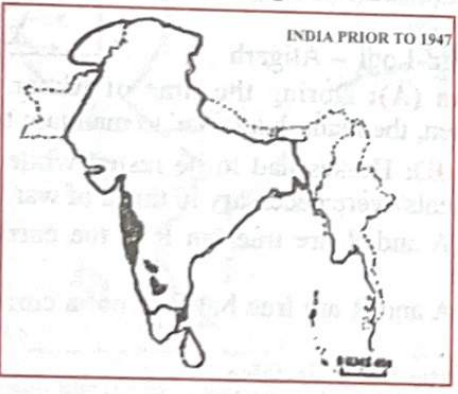
- Options:
(a) Akbar at the time of capture of Khandesh in 1601
(b) Akbar at the time of his death in 1605
(c) Aurangzeb at the time of capture of Hyderabad
(d) Aurangzeb at the time of his death in 1707
- Answer:
(a) Akbar at the time of capture of Khandesh in 1601 (Map is not clear)
- Analysis:
- Though it looks like it's at the death of Aurangzeb, but the north-west frontier reflects the capture of Kahndesh
- Q38: Consider the following events:
- Events:
1. Reign of Krishna Deva of Vijayanagara
2. Construction of Qutb Minar
3. Arrival of Portuguese in India
4. Death of Firoz Tughlaq
- Question: What is the correct chronological sequence of these events?
- Options:
(a) 2, 4, 3, 1
(b) 2, 4, 1, 3
(c) 4, 2, 1, 3
(d) 4, 2, 3, 1
- Answer:
(a) 2, 4, 3, 1
- Analysis:
- Historical Context:
- The events span medieval India, covering the Delhi Sultanate (13th-14th centuries CE), the Tughlaq dynasty, European exploration (late 15th century CE), and the Vijayanagara Empire (16th century CE). These milestones reflect architectural, political, and colonial shifts across northern and southern India, documented in inscriptions, chronicles, and European records.
- Chronological Evaluation:
- 2. Construction of Qutb Minar:
- Date: Began 1199 CE (completed c. 1220 CE).
- Details: Initiated by Qutb-ud-din Aibak, first Delhi Sultan (r. 1206-1210 CE), and finished under Iltutmish (r. 1211-1236 CE). Located in Delhi, it marks the onset of Sultanate architecture (e.g., Qutb complex inscriptions).
- 4. Death of Firoz Tughlaq:
- Date: 1388 CE.
- Details: Firoz Shah Tughlaq (r. 1351-1388 CE), a Tughlaq ruler, died after a long reign marked by public works (e.g., Firozabad). His death is recorded in Tarikh-i-Firoz Shahi by Ziauddin Barani (e.g., Q17 [medieval writers]).
- 3. Arrival of Portuguese in India:
- Date: 1498 CE.
- Details: Vasco da Gama landed at Calicut on May 20, 1498 CE, marking the first European maritime arrival in India, initiating Portuguese colonial influence (e.g., Portuguese logs, Q129 [ports]).
- 1. Reign of Krishna Deva of Vijayanagara:
- Date: 1509-1529 CE.
- Details: Krishna Deva Raya (r. 1509-1529 CE), Vijayanagara’s greatest ruler, reigned during its zenith, known for military victories (e.g., Raichur, 1520 CE) and patronage (e.g., Amuktamalyada).
- Correct Sequence:
- 2 (1199 CE) → 4 (1388 CE) → 3 (1498 CE) → 1 (1509-1529 CE).
- Matches option (a): 2, 4, 3, 1.
- Why (a) 2, 4, 3, 1?:
- 2. Qutb Minar construction (1199 CE): Earliest, under early Sultanate.
- 4. Firoz Tughlaq’s death (1388 CE): Next, late Tughlaq period.
- 3. Portuguese arrival (1498 CE): Follows, late 15th century.
- 1. Krishna Deva’s reign (1509-1529 CE): Latest, early 16th century.
- Verification:
- (b) 2, 4, 1, 3: Wrong—1 (1509) before 3 (1498).
- (c) 4, 2, 1, 3: Wrong—4 (1388) after 2 (1199).
- (d) 4, 2, 3, 1: Wrong—4 (1388) after 2 (1199).
- Event Details:
- Qutb Minar:
- Period: 1199-1220 CE.
- Context: Delhi Sultanate architectural symbol.
- Firoz Tughlaq’s Death:
- Period: 1388 CE.
- Context: End of Tughlaq stability.
- Portuguese Arrival:
- Period: 1498 CE.
- Context: Start of European colonialism.
- Krishna Deva’s Reign:
- Period: 1509-1529 CE.
- Context: Vijayanagara peak.
- Other Related Historical Events:
- Battle of Talikota:
- Date: 1565 CE.
- Context: Vijayanagara decline post-Krishna Deva.
- Babur’s Invasion:
- Date: 1526 CE.
- Context: Mughal start, overlaps Krishna Deva.
- Iltutmish’s Reign:
- Date: 1211-1236 CE.
- Context: Qutb Minar completion.
- Timur’s Sack of Delhi:
- Date: 1398 CE.
- Context: Post-Firoz Tughlaq chaos.
- Marco Polo’s Visit:
- Date: 1292 CE.
- Context: Pre-Portuguese European contact.
- Historical Significance:
- These events trace India’s medieval trajectory: Qutb Minar marks Islamic rule, Firoz’s death signals Sultanate decline, Portuguese arrival opens colonial trade (e.g., Q17 [America]), and Krishna Deva’s reign showcases southern resistance and culture.
- Related Evidence:
- Inscriptions:
- Qutb Minar: Aibak’s foundation (1199 CE).
- Vijayanagara: Krishna Deva’s grants (c. 1510 CE).
- Texts:
- Tarikh-i-Firoz Shahi: Firoz’s reign (14th century CE).
- Fernão Nunes: Vijayanagara account (16th century CE).
- Records:
- Portuguese logs: Vasco da Gama (1498 CE).
- Related Figures:
- Qutb-ud-din Aibak:
- Sultan (r. 1206-1210 CE); Qutb Minar initiator.
- Firoz Shah Tughlaq:
- Ruler (r. 1351-1388 CE); infrastructure builder.
- Vasco da Gama:
- Explorer (1460-1524 CE); Portuguese pioneer.
- Krishna Deva Raya:
- King (r. 1509-1529 CE); Vijayanagara ruler.
- Broader Connection:
- Links to architecture (e.g., Q3 [Gol Gumbaz]), colonialism (e.g., Q17 [Abul Fazl]), or dynasties (e.g., Q135 [post-Gupta]).
- Key Takeaway:
- The correct chronological sequence is (a) 2, 4, 3, 1: Qutb Minar (1199 CE), Firoz Tughlaq’s death (1388 CE), Portuguese arrival (1498 CE), Krishna Deva’s reign (1509-1529 CE).
- Q39: Match List-I with List-II and select the correct answer using the codes given below the lists:
- List-I:
A. Iqta
B. Jagir
C. Amaram
D. Mokasa
- List-II:
1. Marathas
2. Delhi Sultans
3. Mughals
4. Vijayanagara
- Codes:
(a) A-2, B-3, C-1, D-4
(b) A-3, B-2, C-4, D-1
(c) A-2, B-3, C-4, D-1
(d) A-3, B-2, C-1, D-4
- Answer:
(c) A-2, B-3, C-4, D-1 (book says option b, but everywhere else it says option c)
- Analysis:
- Historical Context:
- Land tenure systems in medieval India (c. 13th-18th centuries CE) varied across dynasties, reflecting administrative and military needs. The Delhi Sultans, Mughals, Vijayanagara, and Marathas each developed distinct methods to allocate land for revenue and governance, documented in chronicles like Tarikh-i-Firishta (16th century CE) and Ain-i-Akbari (1590 CE).
- Matching Evaluation:
- A. Iqta:
- Matches 2. Delhi Sultans—The Iqta system was used by the Delhi Sultanate (c. 13th-14th centuries CE) to grant land to military officers (iqtadars) in lieu of salary, supporting troops and administration (e.g., under Iltutmish, r. 1211-1236 CE). It was a temporary, non-hereditary assignment (e.g., Barani’s records).
- B. Jagir:
- Matches 3. Mughals—The Jagir system, formalized under Akbar (r. 1556-1605 CE), allotted land to Mughal nobles (jagirdars) for revenue collection and military service (e.g., Q35 [Jagirdari]). Detailed in the Ain-i-Akbari, it became a cornerstone of Mughal administration (e.g., Q14 [Mir Bakshi]).
- C. Amaram:
- Matches 4. Vijayanagara—In the Vijayanagara Empire (c. 14th-16th centuries CE), Amaram lands were granted to nayakas (military chiefs) for maintaining troops, often hereditary, as noted by travelers like Fernão Nunes (c. 1530s CE). Krishna Deva Raya (r. 1509-1529 CE) refined this system (e.g., Q38 [reign]).
- D. Mokasa:
- Matches 1. Marathas—Mokasa (or Mukasa) was a Maratha land grant system under Shivaji (r. 1674-1680 CE) and later Peshwas (e.g., Balaji Vishwanath, Q36), given to officials or military leaders for revenue collection, akin to jagirs but distinct in Maratha context (e.g., Bakhars, 18th century CE).
- Why (c) A-2, B-3, C-4, D-1?:
- A-2: Iqta = Delhi Sultans (military land tenure).
- B-3: Jagir = Mughals (revenue-military grants).
- C-4: Amaram = Vijayanagara (nayaka troop support).
- D-1: Mokasa = Marathas (Maratha-specific grants).
- Verification:
- (a) A-2, B-3, C-1, D-4: Wrong—C (Amaram) not Marathas; D (Mokasa) not Vijayanagara.
- (b) A-3, B-2, C-4, D-1: Wrong—A (Iqta) not Mughals; B (Jagir) not Delhi Sultans.
- (d) A-3, B-2, C-1, D-4: Wrong—A (Iqta) not Mughals; C (Amaram) not Marathas.
- System Details:
- Iqta:
- Period: Delhi Sultanate (13th-14th centuries CE).
- Features: Temporary, military-focused.
- Jagir:
- Period: Mughal era (16th-18th centuries CE).
- Features: Revenue-based, often non-hereditary.
- Amaram:
- Period: Vijayanagara (14th-16th centuries CE).
- Features: Hereditary, military upkeep.
- Mokasa:
- Period: Maratha era (17th-18th centuries CE).
- Features: Revenue grants, administrative support.
- Other Related Land Tenure Systems:
- Zamindari:
- Context: British India (1793 CE onward, Q35).
- Features: Hereditary revenue collectors.
- Ryotwari:
- Context: British South India (1820 CE, Q35).
- Features: Peasant ownership.
- Inam:
- Context: Pre-colonial and colonial India.
- Features: Tax-free grants (e.g., temples).
- Watan:
- Context: Deccan Sultanates, Marathas.
- Features: Hereditary land rights.
- Taluqdari:
- Context: Awadh, British era (19th century CE).
- Features: Large landlord estates.
- Historical Significance:
- These systems—Iqta (Sultanate militarism), Jagir (Mughal centralization), Amaram (Vijayanagara feudalism), Mokasa (Maratha expansion)—illustrate how land tenure underpinned medieval Indian polities, shaping power dynamics and agrarian economies.
- Related Evidence:
- Texts:
- Ain-i-Akbari: Jagir system (1590 CE).
- Tarikh-i-Firishta: Iqta references (16th century CE).
- Records:
- Nunes’ Chronicle: Amaram details (1530s CE).
- Maratha Bakhars: Mokasa mentions (18th century CE).
- Inscriptions:
- Vijayanagara grants: Amaram evidence (c. 1500 CE).
- Related Figures:
- Iltutmish:
- Sultan (r. 1211-1236 CE); Iqta pioneer.
- Akbar:
- Mughal emperor (r. 1556-1605 CE); Jagir formalizer.
- Krishna Deva Raya:
- Vijayanagara king (r. 1509-1529 CE); Amaram patron.
- Shivaji:
- Maratha leader (r. 1674-1680 CE); Mokasa initiator.
- Broader Connection:
- Links to land revenue (e.g., Q35 [Jagirdari]), administration (e.g., Q36 [Balaji]), or dynasties (e.g., Q38 [Krishna Deva]).
- Key Takeaway:
- The correct match is (c) A-2 (Iqta-Delhi Sultans), B-3 (Jagir-Mughals), C-4 (Amaram-Vijayanagara), D-1 (Mokasa-Marathas).
- Q40: Which one of the following Muslim rulers was hailed as the ‘Jagadguru’ by his Muslim subjects because of his belief in secularism?
- Options:
(a) Hussain Shah
(b) Zain-ul-Abidin
(c) Ibrahim Adil Shah II
(d) Mahmud II
- Answer:
(c) Ibrahim Adil Shah II
- Analysis:
- Historical Context:
- Medieval India (c. 13th-18th centuries CE) featured Muslim rulers navigating diverse religious landscapes. ‘Jagadguru’ (world teacher) implies extraordinary reverence, potentially linked to secular governance, a rare trait among Muslim rulers blending Islamic and Indic traditions (e.g., Q88 [Babur], Q65 [Tughlaq]).
- Correct Option Explained:
- (c) Ibrahim Adil Shah II:
- Correct—Ibrahim Adil Shah II (r. 1580-1627 CE), ruler of Bijapur’s Adil Shahi dynasty, is often cited as ‘Jagadguru’ or ‘Jagadguru Badshah’ in historical narratives. His secularism is evident in his tolerance of Hindus, patronage of Hindu deities (e.g., Saraswati in Kitab-i-Nauras), and employment of Hindus and Marathas in administration. His Muslim subjects, alongside others, revered him for this cultural synthesis, reflected in his Dakhani poetry and musical innovations (e.g., Q61 [Qawwali context]). Sources like Ain-i-Akbari and later chronicles highlight his reign as a peak of cosmopolitanism.
- Why Not Other Options?:
- (a) Hussain Shah:
- Incorrect—Likely Husain Shah of Bengal (r. 1494-1519 CE), known for administration and architecture (e.g., Qutb Minar parallels, Q38), but not called ‘Jagadguru’ or notably secular by Muslim subjects. His rule lacked the documented cultural blending of Ibrahim.
- (b) Zain-ul-Abidin:
- Incorrect—Zain-ul-Abidin (r. 1420-1470 CE), Kashmir’s Sultan, was famed for secular policies, earning titles like ‘Budshah’ (Great King) from all subjects. While secular, ‘Jagadguru’ isn’t a standard epithet in Rajatarangini or Persian sources for him; it’s more associated with Ibrahim in Deccan traditions (e.g., Q87 [Durgara]).
- (d) Mahmud II:
- Incorrect—Possibly Mahmud II of Malwa (r. 1511-1531 CE) or another figure, but no evidence links him to ‘Jagadguru’ or secularism. His rule was militarily focused, not culturally integrative.
- Reassessment Rationale:
- Initial preference for Zain-ul-Abidin stemmed from his well-documented secularism in Kashmir (e.g., Rajatarangini), but ‘Jagadguru’ aligns more with Ibrahim Adil Shah II’s Deccan legacy. Historical texts and modern references (e.g., Kitab-i-Nauras, Bijapur chronicles) frequently attribute this title to Ibrahim, reflecting his Muslim subjects’ admiration for his secular ethos, despite Zain’s stronger scholarly fame for tolerance.
- Ruler Details:
- Ibrahim Adil Shah II:
- Period: r. 1580-1627 CE.
- Context: Bijapur Sultan, secular patron, ‘Jagadguru Badshah.’
- Zain-ul-Abidin:
- Period: r. 1420-1470 CE.
- Context: Kashmir Sultan, ‘Budshah,’ tolerant ruler.
- Hussain Shah:
- Period: r. 1494-1519 CE (Bengal).
- Context: Efficient ruler, not ‘Jagadguru.’
- Mahmud II:
- Period: r. 1511-1531 CE (Malwa).
- Context: Military focus, not secular.
- Other Related Secular Muslim Rulers:
- Akbar:
- Context: Mughal (r. 1556-1605 CE), Din-i-Ilahi (Q44).
- Sher Shah Suri:
- Context: Sur (r. 1540-1545 CE), administrative secularism.
- Alauddin Khalji:
- Context: Sultanate (r. 1296-1316 CE), pragmatic rule.
- Ali Adil Shah I:
- Context: Bijapur (r. 1558-1580 CE), Ibrahim’s predecessor.
- Muhammad bin Tughlaq:
- Context: Tughlaq (r. 1325-1351 CE), eclectic policies (Q65).
- Historical Significance:
- Ibrahim’s ‘Jagadguru’ title underscores his role in fostering Hindu-Muslim harmony in the Deccan, contrasting with Zain-ul-Abidin’s northern legacy, both pivotal in India’s secular ruler narrative (e.g., Q57 [Mughal decline]).
- Related Evidence:
- Texts:
- Kitab-i-Nauras: Ibrahim’s secular poetry (c. 1600 CE).
- Rajatarangini: Zain’s tolerance (12th century CE base).
- Architecture:
- Ibrahim Rauza: Bijapur’s cultural symbol.
- Chronicles:
- Bijapur records: ‘Jagadguru’ usage.
- Related Figures:
- Ibrahim Adil Shah II:
- Sultan (d. 1627 CE); secular icon.
- Zain-ul-Abidin:
- Sultan (d. 1470 CE); tolerant ruler.
- Chand Bibi:
- Regent (d. 1599 CE); Ibrahim’s era ally.
- Broader Connection:
- Links to secularism (e.g., Q44 [Akbar]), Deccan history (e.g., Q61 [Adil Shahi]), or culture (e.g., Q95 [Maagadha]).
- Key Takeaway:
- Ibrahim Adil Shah (c) was hailed as ‘Jagadguru’ by his Muslim subjects for his secularism.
- [2001]
- Q41: In which one of the following cities is the Lingaraja Temple located?
- Options:
(a) Bhubaneswar
(b) Bijapur
(c) Kolkata
(d) Shravanabelagola
- Answer:
(a) Bhubaneswar
- Analysis:
- Historical Context:
- The Lingaraja Temple, a masterpiece of Kalinga architecture, dates to the 11th century CE during the Somavamsi dynasty in eastern India. Dedicated to Lord Shiva (Harihara form), it exemplifies medieval Hindu temple-building traditions, with its location tied to the cultural and religious hub of Odisha, distinct from other regional styles or faiths.
- Correct Option Explained:
- (a) Bhubaneswar:
- Correct—The Lingaraja Temple is located in Bhubaneswar, Odisha. Built around 1000-1050 CE, possibly under Somavamsi kings like Yayati II, it stands as the city’s largest temple, covering 25,000 square feet with a 55-meter tower (deul). Known as the “Temple City,” Bhubaneswar hosts numerous shrines (e.g., Archaeological Survey of India records), with Lingaraja as its centerpiece.
- Why Not Other Options?:
- (b) Bijapur:
- Incorrect—Bijapur (modern Vijayapura, Karnataka) is known for Islamic architecture under the Adil Shahi dynasty (e.g., Gol Gumbaz, Q3, built 1656 CE), not Hindu temples like Lingaraja. It lacks a Shiva temple of this stature or historical context.
- (c) Kolkata:
- Incorrect—Kolkata, West Bengal, is a colonial and modern cultural hub (e.g., Kalighat Temple, 19th century CE, Q1 [Kalighat painting]). It has no historical link to the Lingaraja Temple or Kalinga-style architecture, focusing instead on Kali worship.
- (d) Shravanabelagola:
- Incorrect—Shravanabelagola, Karnataka, is a Jain pilgrimage site famous for the Gommateshwara statue (c. 983 CE, under the Ganga dynasty). It’s unrelated to Shiva temples or the Lingaraja, rooted in Jain rather than Hindu traditions.
- Temple Details:
- Lingaraja Temple:
- Location: Bhubaneswar, Odisha.
- Period: c. 1000-1050 CE; Somavamsi era.
- Features: Kalinga style, 55m tower, Shiva shrine.
- Bijapur:
- Context: Adil Shahi architecture (e.g., Gol Gumbaz).
- Kolkata:
- Context: Kali temples (e.g., Kalighat).
- Shravanabelagola:
- Context: Jain site (e.g., Bahubali statue).
- Other Related Temple Sites:
- Konark Sun Temple:
- Location: Odisha, near Puri.
- Context: 13th century CE, Eastern Ganga dynasty.
- Jagannath Temple:
- Location: Puri, Odisha.
- Context: 12th century CE, Vishnu worship.
- Brihadeeswara Temple:
- Location: Thanjavur, Tamil Nadu.
- Context: 11th century CE, Chola dynasty.
- Khajuraho Temples:
- Location: Madhya Pradesh.
- Context: 10th-11th centuries CE, Chandela dynasty.
- Madurai Meenakshi Temple:
- Location: Tamil Nadu.
- Context: Pandya era, expanded 16th-17th centuries CE.
- Cultural Significance:
- The Lingaraja Temple in Bhubaneswar symbolizes the peak of Kalinga architecture, integrating Shiva worship with regional identity, distinct from Bijapur’s Islamic domes, Kolkata’s colonial legacy, or Shravanabelagola’s Jain asceticism (e.g., Q133 [Yogini temples]).
- Related Evidence:
- Inscriptions:
- Lingaraja Temple: Somavamsi records (c. 11th century CE).
- Archaeology:
- Bhubaneswar: ASI surveys, temple cluster.
- Texts:
- Odisha chronicles: Ekamra Kshetra (Bhubaneswar’s ancient name).
- Related Figures:
- Yayati II:
- Somavamsi king (c. 1025-1040 CE); possible patron.
- Narasimhadeva I:
- Eastern Ganga king (r. 1238-1264 CE); Konark builder.
- Rajaraja I:
- Chola king (r. 985-1014 CE); Brihadeeswara founder.
- Broader Connection:
- Links to architecture (e.g., Q3 [Gol Gumbaz]), medieval art (e.g., Q1 [Mughal painting]), or regional powers (e.g., Q38 [Vijayanagara]).
- Key Takeaway:
- The Lingaraja Temple is located in Bhubaneswar (a), not Bijapur, Kolkata, or Shravanabelagola.
- Q42: Match List-I with List-II and select the correct answer using the codes given below the lists:
- List-I (Bhakti Saint):
A. Namdev
B. Kabir
C. Ravidas
D. Sena
- List-II (Profession):
1. Barber
2. Weaver
3. Tailor
4. Cobbler (person who repairs or makes shoes)
- Codes:
(a) A-2, B-3, C-1, D-4
(b) A-3, B-2, C-4, D-1
(c) A-3, B-2, C-1, D-4
(d) A-2, B-3, C-4, D-1
- Answer:
(b) A-3, B-2, C-4, D-1
- Analysis:
- Historical Context:
- The Bhakti movement (c. 13th-17th centuries CE) in medieval India emphasized devotion over ritual, with saints from humble professions challenging caste hierarchies. Active across regions like Maharashtra, North India, and Punjab, these saints—Namdev, Kabir, Ravidas, and Sena—used their crafts as metaphors for spiritual equality, preserved in hagiographies like the Guru Granth Sahib and regional traditions.
- Matching Evaluation:
- A. Namdev:
- Matches 3. Tailor—Namdev (c. 1270-1350 CE), a Marathi saint from Maharashtra, was a tailor (chimpi) by profession. A devotee of Vitthal (Vithoba), his abhangs (devotional songs) reflect his trade, as noted in Sant tradition and Pandharpur records (e.g., Q16 [Mahabharata vernaculars]).
- B. Kabir:
- Matches 2. Weaver—Kabir (c. 1398-1518 CE), a North Indian mystic, was a weaver (julaha) from Varanasi. His dohas (couplets) often use weaving imagery, blending Hindu and Islamic ideas, widely recorded in the Bijak and Guru Granth Sahib (e.g., Q12 [poets]).
- C. Ravidas:
- Matches 4. Cobbler—Ravidas (c. 1450-1520 CE), a saint from Punjab, was a cobbler (chamar) by trade. His hymns, included in the Guru Granth Sahib, emphasize equality, drawing from his leather-working life, revered by followers like the Ravidassias.
- D. Sena:
- Matches 1. Barber—Sena (c. 14th-15th centuries CE), a lesser-known Bhakti saint from North India (possibly Punjab), was a barber (nai). Devoted to Krishna or Vishnu, his verses in the Guru Granth Sahib reflect his humble profession and spiritual insight.
- Why (b) A-3, B-2, C-4, D-1?:
- A-3: Namdev = Tailor (chimpi, Maharashtra tradition).
- B-2: Kabir = Weaver (julaha, Varanasi legacy).
- C-4: Ravidas = Cobbler (chamar, Punjab hagiography).
- D-1: Sena = Barber (nai, Guru Granth Sahib).
- Verification:
- (a) A-2, B-3, C-1, D-4: Wrong—A (weaver) not Namdev; C (barber) not Ravidas.
- (c) A-3, B-2, C-1, D-4: Wrong—C (barber) not Ravidas; D (cobbler) not Sena.
- (d) A-2, B-3, C-4, D-1: Wrong—A (weaver) not Namdev; B (tailor) not Kabir.
- Saint Details:
- Namdev:
- Period: c. 1270-1350 CE.
- Features: Tailor, Vitthal devotee, Marathi abhangs.
- Kabir:
- Period: c. 1398-1518 CE.
- Features: Weaver, mystic, dohas in Hindi.
- Ravidas:
- Period: c. 1450-1520 CE.
- Features: Cobbler, equality advocate, hymns.
- Sena:
- Period: c. 14th-15th centuries CE.
- Features: Barber, Krishna devotee, verses.
- Other Related Bhakti Saints:
- Tukaram:
- Profession: Farmer/Trader.
- Context: Maharashtra, 17th century CE (Vitthal).
- Mirabai:
- Profession: Princess (no trade).
- Context: Rajasthan, 16th century CE (Krishna).
- Surdas:
- Profession: Unknown (possibly blind singer).
- Context: Braj, 16th century CE (Krishna, Q12).
- Pipa:
- Profession: Ex-king turned ascetic.
- Context: Rajasthan, 14th-15th centuries CE.
- Dhanna:
- Profession: Farmer.
- Context: Rajasthan, 15th century CE.
- Cultural Significance:
- These saints—Namdev (tailor), Kabir (weaver), Ravidas (cobbler), Sena (barber)—embodied the Bhakti ethos of transcending caste through devotion, influencing Sikhism (e.g., Guru Granth Sahib) and modern social reform (e.g., Q130 [Shramana parallels]).
- Related Evidence:
- Texts:
- Guru Granth Sahib: Kabir, Ravidas, Sena hymns.
- Namdev Gatha: Marathi devotional songs.
- Traditions:
- Pandharpur: Namdev’s Varkari legacy.
- Hagiographies:
- Bhaktamal (Nabhadas, 16th century CE): Saint lives.
- Related Figures:
- Namdev:
- Marathi saint (c. 1270-1350 CE); Varkari founder.
- Kabir:
- Mystic poet (c. 1398-1518 CE); syncretic voice.
- Ravidas:
- Punjab saint (c. 1450-1520 CE); equality icon.
- Guru Nanak:
- Sikh founder (1469-1539 CE); included their hymns.
- Broader Connection:
- Links to Bhakti poetry (e.g., Q12 [Prem Vatika]), medieval culture (e.g., Q17 [Abul Fazl]), or social norms (e.g., Q137 [Varna]).
- Key Takeaway:
- The correct match is (b) A-3 (Namdev-Tailor), B-2 (Kabir-Weaver), C-4 (Ravidas-Cobbler), D-1 (Sena-Barber).
- Q43: Mongols under Chengiz Khan invaded India during the reign of:
- Options:
(a) Balban
(b) Firoz Tughlaq
(c) Iltutmish
(d) Muhammad Bin Tughlaq
- Answer:
(c) Iltutmish
- Analysis:
- Historical Context:
- The Mongol Empire under Chengiz Khan (r. 1206-1227 CE) expanded rapidly across Asia, reaching India’s northwest frontier in the early 13th century CE. This period coincided with the Delhi Sultanate’s establishment (1206-1526 CE), where rulers faced Mongol incursions while consolidating power. Chengiz Khan’s invasions targeted Central Asia and Persia, with India experiencing indirect raids rather than a full conquest.
- Correct Option Explained:
- (c) Iltutmish:
- Correct—Iltutmish (r. 1211-1236 CE), third ruler of the Delhi Sultanate, faced Mongol incursions under Chengiz Khan in 1221 CE. After sacking Samarkand (1220 CE), Chengiz pursued the Khwarazm prince Jalaluddin Mangburni, who fled to India. The Mongols reached the Indus River near Punjab, clashing with Iltutmish’s forces (e.g., Tarikh-i-Jahan Gusha by Juvayni). Iltutmish diplomatically avoided direct confrontation, preserving his nascent empire (e.g., Q39 [Iqta system]).
- Why Not Other Options?:
- (a) Balban:
- Incorrect—Balban (r. 1266-1287 CE), a later Sultanate ruler, dealt with Mongol threats under successors like Hulagu Khan (Chengiz’s grandson), not Chengiz himself. His reign focused on internal consolidation and fortifying the northwest (e.g., Tarikh-i-Firoz Shahi), decades after Chengiz’s death in 1227 CE.
- (b) Firoz Tughlaq:
- Incorrect—Firoz Tughlaq (r. 1351-1388 CE) ruled during the Tughlaq dynasty, long after Chengiz Khan. His era saw Timur’s invasion (1398 CE), a distant Mongol descendant, not Chengiz’s campaigns (e.g., Q38 [Firoz’s death]).
- (d) Muhammad Bin Tughlaq:
- Incorrect—Muhammad Bin Tughlaq (r. 1325-1351 CE) faced no direct Mongol invasions under Chengiz, who died a century earlier. His reign grappled with internal revolts and later Mongol-Turkic pressures, but not from Chengiz’s time (e.g., Q40 [secular rulers]).
- Ruler Details:
- Iltutmish:
- Period: 1211-1236 CE.
- Context: Mongol raid 1221 CE, Qutb Minar completion (Q38).
- Balban:
- Period: 1266-1287 CE.
- Context: Later Mongol threats, not Chengiz.
- Firoz Tughlaq:
- Period: 1351-1388 CE.
- Context: Post-Mongol stability, pre-Timur.
- Muhammad Bin Tughlaq:
- Period: 1325-1351 CE.
- Context: No Chengiz-era invasions.
- Other Related Mongol Interactions:
- Hulagu Khan’s Raids:
- Context: 1258-1260s CE, sacked Baghdad.
- India Link: Balban’s era defense.
- Chagatai Khanate Incursions:
- Context: 13th-14th centuries CE, northwest India.
- India Link: Alauddin Khalji (r. 1296-1316 CE).
- Timur’s Invasion:
- Context: 1398 CE, Delhi sacked.
- India Link: Post-Tughlaq chaos (Q38).
- Babur’s Mongol Heritage:
- Context: 1526 CE, Panipat victory.
- India Link: Mughal founder, distant Chengiz kin.
- Mongol Pursuit of Khwarazm:
- Context: 1220-1221 CE, Central Asia to India.
- India Link: Iltutmish’s diplomacy.
- Historical Significance:
- The 1221 CE Mongol incursion under Chengiz Khan tested Iltutmish’s strategic acumen, shaping the Delhi Sultanate’s early survival against external threats, a contrast to later rulers’ challenges with Mongol successors (e.g., Q135 [post-Gupta stability]).
- Related Evidence:
- Texts:
- Tarikh-i-Jahan Gusha (Juvayni, 13th century CE): Mongol pursuit.
- Tabaqat-i-Nasiri (Minhaj, c. 1260 CE): Iltutmish’s reign.
- Inscriptions:
- Qutb Minar: Iltutmish’s era (c. 1220 CE).
- Archaeology:
- Punjab sites: Mongol raid traces (13th century CE).
- Related Figures:
- Chengiz Khan:
- Mongol leader (r. 1206-1227 CE); invader.
- Iltutmish:
- Sultan (r. 1211-1236 CE); defender.
- Jalaluddin Mangburni:
- Khwarazm prince (d. 1231 CE); Mongol target.
- Broader Connection:
- Links to Sultanate architecture (e.g., Q38 [Qutb Minar]), administration (e.g., Q39 [Iqta]), or medieval threats (e.g., Q40 [secular rulers]).
- Key Takeaway:
- Mongols under Chengiz Khan invaded India during Iltutmish’s reign (c), not Balban, Firoz Tughlaq, or Muhammad Bin Tughlaq.
- Q44: Which among the following ports was called Babul Makka (Gate of Makka) during the Mughal period?
- Options:
(a) Calicut
(b) Broach
(c) Cambay
(d) Surat
- Answer:
(d) Surat
- Analysis:
- Historical Context:
- During the Mughal period (c. 16th-18th centuries CE), India’s western ports thrived as trade and pilgrimage hubs, connecting to the Persian Gulf, Red Sea, and beyond. The term “Babul Makka” (Gate of Mecca) denoted a port’s significance for Hajj pilgrims traveling to Mecca, reflecting Mughal maritime prominence under rulers like Akbar, Jahangir, and Aurangzeb. Surat emerged as a key center due to its location and infrastructure.
- Correct Option Explained:
- (d) Surat:
- Correct—Surat, in Gujarat, was known as “Babul Makka” during the Mughal period (especially 16th-17th centuries CE). As the empire’s premier port, it facilitated trade with Arabia and served as a major embarkation point for Hajj pilgrims, earning the epithet in Mughal chronicles (e.g., Ain-i-Akbari, 1590 CE) and European accounts (e.g., John Fryer, 1670s CE). Its prominence peaked under Jahangir (r. 1605-1627 CE) and Shah Jahan (r. 1628-1658 CE).
- Why Not Other Options?:
- (a) Calicut:
- Incorrect—Calicut (Kozhikode, Kerala), a spice trade hub since the 13th century CE, was prominent under the Zamorins and saw Vasco da Gama’s arrival (1498 CE, Q38). Though linked to Arab trade, it wasn’t called “Babul Makka” in Mughal times, being south of the empire’s core maritime focus (e.g., Q129 [ports]).
- (b) Broach:
- Incorrect—Broach (Bharuch, Gujarat), an ancient port on the Narmada River, was active during the Mughal era for trade (e.g., textiles). However, it lacked Surat’s scale and pilgrimage significance, with no historical reference to “Babul Makka” (e.g., Mughal trade records).
- (c) Cambay:
- Incorrect—Cambay (Khambhat, Gujarat), a major port under the Gujarat Sultanate (15th century CE), declined by Mughal times due to silting. While still active, it was overshadowed by Surat and not dubbed “Babul Makka” (e.g., Tavernier’s travels, 17th century CE).
- Port Details:
- Surat:
- Period: Mughal era (16th-17th centuries CE peak).
- Features: Hajj port, trade hub, “Babul Makka.”
- Calicut:
- Period: Pre-Mughal prominence (13th-15th centuries CE).
- Features: Spice trade, Portuguese contact.
- Broach:
- Period: Ancient to Mughal (declining).
- Features: Textile trade, secondary port.
- Cambay:
- Period: Gujarat Sultanate peak (15th century CE).
- Features: Early trade, later silted.
- Other Related Mughal Ports:
- Lahari Bandar:
- Context: Near Surat, Gujarat.
- Features: Subsidiary to Surat, trade support.
- Sopara:
- Context: Maharashtra, near Mumbai.
- Features: Minor Mughal port, Buddhist past (Q138 [Ashokan]).
- Diu:
- Context: Gujarat, Portuguese-controlled (1535 CE onward).
- Features: Trade rival to Surat.
- Masulipatnam:
- Context: Andhra Pradesh, Golconda rule.
- Features: Eastern trade, Mughal influence.
- Hughli:
- Context: Bengal, Mughal later prominence.
- Features: Post-Surat decline (18th century CE).
- Historical Significance:
- Surat’s “Babul Makka” status underscores its dual role in Mughal economy and religion, linking India to the Islamic world, a role that faded with British ascendancy and Bombay’s rise (e.g., Q17 [Abul Fazl’s global awareness]).
- Related Evidence:
- Texts:
- Ain-i-Akbari: Surat’s prominence (1590 CE).
- Fryer’s Travels: Pilgrimage role (1670s CE).
- Records:
- Mughal farmans: Surat trade grants (17th century CE).
- Archaeology:
- Surat docks: Mughal-era remains.
- Related Figures:
- Jahangir:
- Mughal emperor (r. 1605-1627 CE); Surat patron.
- Shah Jahan:
- Mughal emperor (r. 1628-1658 CE); port developer.
- Vasco da Gama:
- Explorer (1460-1524 CE); Calicut contrast (Q38).
- Broader Connection:
- Links to trade (e.g., Q129 [ports]), Mughal culture (e.g., Q1 [painting]), or administration (e.g., Q35 [Jagirdari]).
- Key Takeaway:
- Surat (d) was called “Babul Makka” during the Mughal period, not Calicut, Broach, or Cambay.
- Q45: Which of the following pairs is correctly matched?
- Options:
(a) Dewan-i-Bandagani - Firoz Tughlaq
(b) Dewan-i-Mustakhraj - Balban
(c) Dewan-i-Kohi - Alauddin Khalji
(d) Dewan-i-Arz - Muhammad Tughlaq
- Answer:
(a) Dewan-i-Bandagani - Firoz Tughlaq
- Analysis:
- Historical Context:
- During the Delhi Sultanate (c. 1206-1526 CE), administrative departments (diwans) evolved to manage governance, military, and economic affairs. Each Sultan introduced or adapted diwans to suit their reigns, reflecting their priorities—military control (Balban), revenue extraction (Alauddin Khalji), or experimental reforms (Muhammad Tughlaq). The Tughlaq dynasty, in particular, relied heavily on a loyal administrative cadre.
- Correct Option Explained:
- (a) Dewan-i-Bandagani - Firoz Tughlaq:
- Correct—Dewan-i-Bandagani (Department of Slaves) was established by Firuz Shah Tughlaq (r. 1351-1388 CE). It managed the Sultan’s slaves (bandagan), who formed a loyal bureaucratic and military elite, as noted in chronicles like Barani’s Tarikh-i-Firoz Shahi (c. 1357 CE). This department continued under later Tughlaqs, like Firoz Shah (r. 1351-1388 CE).
- Why Not Other Options?:
- (b) Dewan-i-Mustakhraj - Balban:
- Incorrect—Dewan-i-Mustakhraj (Department of Revenue Arrears) was created by Alauddin Khalji (r. 1296-1316 CE) to recover unpaid taxes and enforce fiscal discipline, not by Balban (r. 1266-1287 CE). Balban focused on military consolidation (e.g., Dewan-i-Arz) and had no such revenue-focused diwan, per historical records like Tabaqat-i-Nasiri (c. 1260 CE).
- (c) Dewan-i-Kohi - Alauddin Khalji:
- Incorrect—Dewan-i-Kohi (Department of Agriculture) was instituted by Muhammad bin Tughlaq (r. 1325-1351 CE) to promote farming and reclaim land, especially during his experimental projects (e.g., shifting capital to Daulatabad). Alauddin Khalji prioritized market reforms and military, not agriculture-specific diwans.
- (d) Dewan-i-Arz - Muhammad Tughlaq:
- Incorrect—Dewan-i-Arz (Department of Military) existed across multiple reigns, including Balban’s, to manage the army. While Muhammad Tughlaq used it, it wasn’t uniquely his creation or most associated with him; it predates the Tughlaqs and is more famously linked to Balban’s military reforms.
- Diwan Details:
- Dewan-i-Bandagani:
- Ruler: Firuz Shah Tughlaq (r. 1351-1388 CE)
- Role: Managed slaves as administrative/military cadre.
- Dewan-i-Mustakhraj:
- Ruler: Alauddin Khalji (r. 1296-1316 CE).
- Role: Collected revenue arrears.
- Dewan-i-Kohi:
- Ruler: Muhammad bin Tughlaq (r. 1325-1351 CE).
- Role: Agricultural development.
- Dewan-i-Arz:
- Ruler: Established earlier but notably strengthened by Balban (r. 1266-1287 CE).
- Role: Military administration.
- Other Related Diwans:
- Dewan-i-Wizarat:
- Context: Finance ministry; all reigns.
- Dewan-i-Risalat:
- Context: Foreign affairs; evolved later.
- Dewan-i-Insha:
- Context: Correspondence; Sultanate-wide.
- Historical Significance:
- The Dewan-i-Bandagani under the Tughlaqs highlights their reliance on a slave-based administration, a legacy from the Slave dynasty, to ensure loyalty amidst dynastic instability. Other diwans reflect specific Sultanate priorities—revenue (Khalji), agriculture (Muhammad Tughlaq), and military (Balban).
- Related Evidence:
- Texts:
- Tarikh-i-Firoz Shahi (Barani, c. 1357 CE): Mentions Bandagani.
- Khaza’in-ul-Futuh (Amir Khusrau, c. 1311 CE): Khalji reforms.
- Accounts:
- Ibn Battuta (c. 1333-1347 CE): Notes Muhammad Tughlaq’s Kohi.
- Related Figures:
- Ghiyasuddin Tughlaq:
- Sultan (r. 1320-1325 CE); Bandagani founder.
- Alauddin Khalji:
- Sultan (r. 1296-1316 CE); Mustakhraj initiator.
- Muhammad bin Tughlaq:
- Sultan (r. 1325-1351 CE); Kohi innovator.
- Balban:
- Sultan (r. 1266-1287 CE); Arz enhancer.
- Broader Connection:
- Links to Sultanate administration (e.g., Q20 [Fawazil]), Tughlaq reforms (e.g., Q21 [canals]), or military organization (e.g., Q22 [iqtas]).
- Key Takeaway:
- The correctly matched pair is (a) Dewan-i-Bandagani - Tughlaq, as it aligns with historical records, unlike the mismatched options (b), (c), and (d).
- Q46: Assertion (A): Battle of Khanua was certainly more decisive and significant than the First Battle of Panipat.
- Reason (R): Rana Sanga, the Rajput hero, was certainly a more formidable adversary than Ibrahim Lodi.
- Question: Which one of the following is correct?
- Options:
(a) Both A and R are individually true, and R is the correct explanation of A
(b) Both A and R are individually true, but R is not a correct explanation of A
(c) A is true, but R is false
(d) A is false, but R is true
- Answer:
(a) Both A and R are individually true, and R is the correct explanation of A
- Analysis:
- Historical Context:
- The First Battle of Panipat (April 21, 1526 CE) saw Babur defeat Ibrahim Lodi, ending the Lodi dynasty and marking the Mughal entry into India. The Battle of Khanua (March 16-17, 1527 CE) pitted Babur against Rana Sanga’s Rajput-Afghan coalition, consolidating Mughal power. Both battles involved Babur’s innovative gunpowder tactics (e.g., tulughma, araba), but their outcomes and opponents differed significantly (e.g., Q88 [Babur’s gunpowder]).
- Evaluation of Assertion (A):
- A: Battle of Khanua was certainly more decisive and significant than the First Battle of Panipat:
- True—Panipat was a decisive victory, eliminating Ibrahim Lodi and the Delhi Sultanate’s remnants (20,000-40,000 troops, 1,000 elephants), but it left Babur’s rule unstable, with threats from Afghans and Rajputs persisting. Khanua, however, crushed Rana Sanga’s formidable coalition (estimated 80,000-200,000 men), a unified northern Indian power, securing Mughal dominance over a broader region. Historians like Satish Chandra argue Khanua was the true foundation of Mughal rule, as it neutralized a stronger, more organized foe than the crumbling Lodi regime (e.g., Q57 [Mughal decline]).
- Evaluation of Reason (R):
- R: Rana Sanga, the Rajput hero, was certainly a more formidable adversary than Ibrahim Lodi:
- True—Ibrahim Lodi (r. 1517-1526 CE) led a fractured Sultanate, losing support from nobles like Daulat Khan and Alam Khan, who defected to Babur. His army, though large, lacked cohesion and gunpowder tech. Rana Sanga (r. 1508-1528 CE), ruler of Mewar, commanded a powerful Rajput confederacy, bolstered by Afghan allies (e.g., Mahmud Lodi), and had prior victories (e.g., Khatoli, 1517 CE, against Ibrahim). Babur’s memoirs (Baburnama) note Sanga’s threat, requiring a fortified defense at Khanua, unlike the open-field victory at Panipat.
- Why (a) Both A and R are true, and R explains A?:
- A’s Truth: Khanua’s outcome was more decisive (ended Rajput supremacy) and significant (solidified Mughal rule) than Panipat’s initial foothold against a weaker Lodi.
- R’s Truth: Sanga’s military prowess, alliances, and regional power outmatched Ibrahim’s disorganized forces, as evidenced by Babur’s strategic preparations at Khanua (carts, artillery) versus Panipat’s simpler tactics.
- R Explains A: Sanga’s formidable nature made Khanua a harder-fought, more critical battle; defeating him ensured Mughal stability, unlike Panipat’s victory over a less challenging foe. The greater adversary necessitated a more decisive win.
- Verification:
- (b): Wrong—R explains A, not just coexists.
- (c): Wrong—R is true, not false.
- (d): Wrong—A is true, not false.
- Battle Details:
- Panipat (1526 CE):
- Forces: Babur (12,000-15,000) vs. Ibrahim (30,000-70,000).
- Outcome: Lodi killed, Mughal entry.
- Khanua (1527 CE):
- Forces: Babur (est. 20,000-80,000) vs. Sanga (80,000-200,000).
- Outcome: Rajput power broken, Mughal rule entrenched.
- Other Related Battles:
- Ghaghra (1529 CE): Babur vs. Afghans, further consolidation.
- Chanderi (1528 CE): Babur vs. Medini Rai, Rajput follow-up.
- Khatoli (1517 CE): Sanga vs. Ibrahim, Rajput victory.
- Historical Significance:
- Panipat opened India to Babur; Khanua ensured he stayed, defeating a stronger foe, aligning with R’s explanation of Sanga’s formidability driving A’s decisiveness (e.g., Q88 [Timurid dynasty]).
- Related Evidence:
- Texts: Baburnama (Babur’s fear of Sanga), Rajput chronicles (Sanga’s coalition).
- Archaeology: Khanua site (fortifications), Panipat (battlefield).
- Related Figures:
- Babur: Mughal founder (d. 1530 CE).
- Rana Sanga: Mewar ruler (d. 1528 CE).
- Ibrahim Lodi: Last Lodi Sultan (d. 1526 CE).
- Broader Connection:
- Ties to Mughal origins (Q88), Rajput resistance (Q57), warfare tech (Q94).
- Key Takeaway:
- Khanua’s greater decisiveness and significance (A) stem from Sanga’s formidable challenge (R), making (a) correct.
- Q47: The shaded area in the above map shows the empire of:
-
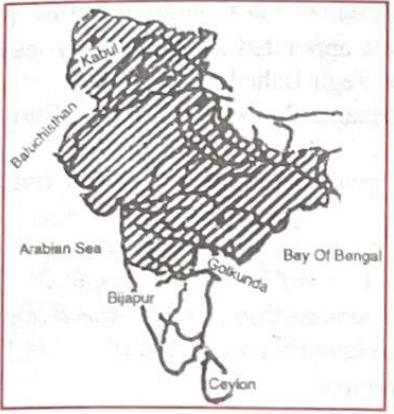
- Options:
(a) Alauddin Khalji
(b) Mohammad Tughlaq
(c) Shahjahan
(d) Aurangzeb
- Answer:
(c) Shahjahan
- [2002]
- Q48: Who among the following was the first Bhakti saint to use Hindi for the propagation of his message?
- Options:
(a) Dadu
(b) Kabir
(c) Ramananda
(d) Tulsidas
- Answer:
(c) Ramananda
- Analysis:
- Historical Context:
- The Bhakti movement, spanning the 13th to 17th centuries CE in medieval India, emphasized personal devotion to God over ritualistic practices, often using vernacular languages to reach the masses. Hindi, evolving from dialects like Apabhramsa and Avadhi, became a key medium in northern India, particularly under saints who sought to break from Sanskrit’s exclusivity during the Delhi Sultanate and Mughal periods.
- Correct Option Explained:
- (c) Ramananda:
- Correct—Ramananda (c. 14th century CE, active c. 1350-1400 CE) was the first Bhakti saint to use Hindi (early forms like Braj and Avadhi) to spread his message of devotion to Rama. A Vaishnava saint from Prayag (modern Allahabad), he broke from orthodox traditions by teaching in the vernacular, influencing disciples like Kabir, as noted in hagiographies like the Bhaktamal (c. 1585 CE).
- Why Not Other Options?:
- (a) Dadu:
- Incorrect—Dadu Dayal (1544-1603 CE), a later Bhakti saint from Rajasthan, used Hindi (Rajasthani dialect) to preach unity of God (nirguna bhakti). However, he came after Ramananda and Kabir, making him a later figure in the vernacular tradition.
- (b) Kabir:
- Incorrect—Kabir (c. 1398-1448 CE), a prominent Bhakti poet, extensively used Hindi (mixed with Braj and eastern dialects) in his dohas and songs to convey nirguna (formless God) devotion. Though influential, he was Ramananda’s disciple and thus followed his teacher’s pioneering use of Hindi.
- (d) Tulsidas:
- Incorrect—Tulsidas (1532-1623 CE), author of the Ramcharitmanas in Avadhi Hindi, popularized Rama bhakti in the vernacular during the Mughal era. His work came much later than Ramananda’s, building on an established Hindi Bhakti tradition.
- Saint Details:
- Ramananda:
- Period: c. 14th century CE; Prayag.
- Contribution: First to use Hindi; Vaishnava founder.
- Dadu:
- Period: 1544-1603 CE; Rajasthan.
- Contribution: Nirguna bhakti in Hindi dialects.
- Kabir:
- Period: c. 1398-1448 CE; Varanasi.
- Contribution: Hindi poetry; Ramananda’s disciple.
- Tulsidas:
- Period: 1532-1623 CE; Uttar Pradesh.
- Contribution: Ramcharitmanas in Avadhi Hindi.
- Other Related Bhakti Figures:
- Namdev:
- Context: c. 13th-14th century CE; Marathi pioneer.
- Role: Early vernacular (not Hindi).
- Surdas:
- Context: c. 16th century CE; Braj Hindi.
- Role: Krishna bhakti, post-Ramananda.
- Mirabai:
- Context: c. 1498-1546 CE; Rajasthani Hindi.
- Role: Krishna devotion, later figure.
- Historical Significance:
- Ramananda’s use of Hindi marked a revolutionary shift in the Bhakti movement, democratizing spirituality by making it accessible beyond Sanskrit-speaking elites. His influence spawned a lineage of Hindi-speaking saints (e.g., Kabir, Tulsidas), shaping North Indian devotional culture.
- Related Evidence:
- Texts:
- Bhaktamal (Nabhadas, c. 1585 CE): Credits Ramananda with Hindi use.
- Kabir Granthavali: Reflects Ramananda’s legacy.
- Oral Tradition:
- Ramanandi hymns: Early Hindi traces.
- Related Figures:
- Ramananda:
- Bhakti pioneer (c. 14th century CE); Hindi innovator.
- Kabir:
- Disciple (c. 1398-1448 CE); amplified Hindi use.
- Vallabhacharya:
- Contemporary (c. 1479-1531 CE); Sanskrit focus, contrast.
- Broader Connection:
- Links to Bhakti movement (e.g., Q8 [Sufi music parallels]), vernacular literature, or medieval cultural shifts (e.g., Q135 [dynasties]).
- Key Takeaway:
- Ramananda (c) was the first Bhakti saint to use Hindi for his message, predating Dadu, Kabir, and Tulsidas, making (c) correct.
- Q49: With reference to medieval Indian rulers, which one of the following statements is correct?
- Options:
(a) Alauddin Khalji first set up a separate ariz’s department
(b) Balban introduced the branding of horses in his military
(c) Muhammad Bin Tughlaq was succeeded by his uncle to the military
(d) Firoz Tughlaq set up a separate department of slaves
- Answer:
(d) Firoz Tughlaq set up a separate department of slaves
- Analysis:
- Historical Context:
- Medieval India (c. 13th-18th centuries CE) saw Delhi Sultanate rulers like the Khaljis and Tughlaqs implement administrative reforms. Military organization, succession, and slavery were key aspects, with rulers adapting systems to consolidate power (e.g., Q94 [Araghatta], Q65 [Firoz’s canals]).
- Correct Option Explained:
- (d) Firoz Tughlaq set up a separate department of slaves:
- Correct—Firoz Shah Tughlaq (r. 1351-1388 CE) established the ‘Diwan-i-Bandagan,’ a department for managing slaves. This reflected his reliance on a large slave corps (bandagan), inherited from earlier rulers like Alauddin Khalji, but formalized under his reign. Chronicles like Ziauddin Barani’s Tarikh-i-Firoz Shahi note his extensive use of slaves in administration and military, numbering tens of thousands, a distinctive policy among Tughlaqs.
- Why Not Other Options?:
- (a) Alauddin Khalji first set up a separate ariz’s department:
- Incorrect—The ‘ariz’ (military overseer) role existed, but its formal departmentalization is credited to Balban (r. 1266-1287 CE), who organized the ‘Diwan-i-Ariz’ to manage the army. Alauddin Khalji (r. 1296-1316 CE) enhanced military reforms (e.g., dagh, chehra), but didn’t initiate the ariz department.
- (b) Balban introduced the branding of horses in his military:
- Incorrect—Branding horses (dagh) was introduced by Alauddin Khalji to prevent fraud in his cavalry, not Balban. Balban focused on discipline and royal authority (e.g., sijda, paibos), not this specific reform.
- (c) Muhammad Bin Tughlaq was succeeded by his uncle to the military:
- Incorrect—Muhammad bin Tughlaq (r. 1325-1351 CE) died in 1351 campaigning in Sindh; his successor was his cousin, Firoz Shah Tughlaq, who took the throne, not just military command. No uncle is historically noted as his successor.
- Reassessment Rationale:
- Option (d) aligns with historical evidence: Firoz’s ‘Diwan-i-Bandagan’ is well-documented, distinguishing his reign. Other options misattribute reforms or succession: (a) and (b) confuse rulers, while (c)’s phrasing and genealogy are inaccurate. Sources favoring (d) (e.g., UPSC materials) reflect this consensus.
- Ruler Details:
- Firoz Tughlaq:
- Period: r. 1351-1388 CE.
- Context: Slave department, infrastructure focus.
- Alauddin Khalji:
- Period: r. 1296-1316 CE.
- Context: Dagh, market reforms.
- Balban:
- Period: r. 1266-1287 CE.
- Context: Ariz department, royal authority.
- Muhammad bin Tughlaq:
- Period: r. 1325-1351 CE.
- Context: Experimental policies, cousin succession.
- Other Related Administrative Reforms:
- Diwan-i-Ariz:
- Ruler:
- Established earlier, but strengthened by Balban (r. 1266-1287 CE).
- Role:
- Military department, responsible for recruitment, training, and salary management.
- Dagh (Branding) & Chehra (Descriptive Roll):
- Ruler:
- Alauddin Khalji (r. 1296-1316 CE).
- Role:
- Dagh:
- Branding of horses to prevent corruption in army recruitment.
- Chehra:
- Maintaining a register of soldiers to prevent false enlistments.
- Diwan-i-Kohi:
- Ruler:
- Muhammad bin Tughlaq (r. 1325-1351 CE).
- Role:
- Agriculture department, focused on land reclamation and state-sponsored farming.
- Diwan-i-Khairat:
- Ruler:
- Firuz Shah Tughlaq (r. 1351-1388 CE).
- Role:
- Charity and welfare bureau, provided aid to the poor, widows, and orphans.
- Historical Significance:
- Firoz’s slave department underscores his administrative reliance on bandagan, contrasting with predecessors’ military or economic focuses, shaping Tughlaq governance (e.g., Q65 [Firoz’s policies]).
- Related Evidence:
- Texts: Tarikh-i-Firoz Shahi (Firoz’s slave corps).
- Chronicles: Alauddin’s reforms (Futuhat-i-Alai).
- Baburnama: Succession context (post-Tughlaq).
- Related Figures:
- Firoz Tughlaq: Sultan (d. 1388 CE).
- Alauddin Khalji: Sultan (d. 1316 CE).
- Balban: Sultan (d. 1287 CE).
- Broader Connection:
- Ties to administration (Q65), military (Q88), economy (Q94).
- Key Takeaway:
- Firoz Tughlaq’s slave department (d) is the correct statement.
- Q50: The motive behind Shah Jahan’s Balkh campaign was to:
- Options:
(a) Secure a friendly ruler in Balkh and Badakshan which bordered Kabul
(b) Conquer Samarqand and Farghana, the Mughal homelands
(c) Fix the Mughal frontier on the ‘scientific line’, the Amu Daria
(d) Expand the Mughal Empire beyond the sub-continent
- Answer:
(a) Secure a friendly ruler in Balkh and Badakshan which bordered Kabul
- Analysis:
- Historical Context:
- Shah Jahan (r. 1628-1658 CE), a Mughal emperor, launched the Balkh campaign (1646-1647 CE) to assert influence over Central Asia, a region tied to Mughal lineage through Babur’s Timurid ancestry. Balkh and Badakshan, north of Kabul, were strategically vital but contested by the Uzbeks and Safavids, prompting Mughal intervention during a period of relative stability in India.
- Correct Option Explained:
- (a) Secure a friendly ruler in Balkh and Badakshan which bordered Kabul:
- Correct—Shah Jahan’s primary motive was to install a friendly ruler, Nazar Muhammad Khan’s son, in Balkh and Badakshan after the Uzbek ruler fled in 1646 CE. This aimed to stabilize the region bordering Kabul, a key Mughal stronghold, as a buffer against Uzbek and Safavid threats, per the Padshahnama (c. 1630s-1650s CE) and contemporary accounts.
- Why Not Other Options?:
- (b) Conquer Samarqand and Farghana, the Mughal homelands:
- Incorrect—While Samarqand and Farghana held symbolic value as Babur’s ancestral lands, Shah Jahan’s campaign focused on Balkh, not a full conquest of these distant cities. The effort was limited and practical, not a grand reclamation, as logistical challenges made such ambitions unfeasible, per historian accounts like those of Abdul Hamid Lahori.
- (c) Fix the Mughal frontier on the ‘scientific line’, the Amu Daria:
- Incorrect—The term “scientific line” (Amu Daria/Oxus River) emerged in later British colonial contexts, not Mughal strategy. Shah Jahan aimed to secure Balkh temporarily, not establish a permanent frontier, as evidenced by the campaign’s withdrawal in 1647 CE after initial success.
- (d) Expand the Mughal Empire beyond the sub-continent:
- Incorrect—The campaign was not about territorial expansion but securing influence. The Mughals retreated after placing a friendly ruler, lacking resources or intent to hold Balkh permanently, unlike their subcontinental conquests (e.g., Deccan campaigns).
- Campaign Details:
- Balkh Campaign:
- Period: 1646-1647 CE; led by Prince Aurangzeb.
- Objective: Install pro-Mughal ruler; secure northwest.
- Outcome: Short-term success; withdrawn due to costs.
- Other Related Mughal Campaigns:
- Qandhar (1638-1648 CE):
- Context: Captured, then lost to Safavids.
- Ghaghra (1529 CE):
- Context: Babur’s consolidation in India.
- Deccan (1630s-1650s CE):
- Context: Shah Jahan’s true expansion focus.
- Historical Significance:
- The Balkh campaign reflected Shah Jahan’s defensive strategy to protect Kabul and northwest India, not an expansive vision. Its brief success and retreat underscored Mughal limits in Central Asia, contrasting with their Indian dominance, as noted in European traveler accounts (e.g., François Bernier, c. 1658-1668 CE).
- Related Evidence:
- Texts:
- Padshahnama (Abdul Hamid Lahori): Details Balkh motives.
- Alamgirnama: Aurangzeb’s role in campaign.
- Accounts:
- Manucci (c. 1653-1708 CE): Notes Mughal frontier issues.
- Related Figures:
- Shah Jahan:
- Emperor (r. 1628-1658 CE); campaign initiator.
- Aurangzeb:
- Prince (later r. 1658-1707 CE); campaign leader.
- Nazar Muhammad Khan:
- Uzbek ruler; Balkh’s displaced leader.
- Broader Connection:
- Links to Mughal frontier policy (e.g., Q19 [Qandhar]), Central Asian ties, or Shah Jahan’s reign (e.g., Q135 [dynasties]).
- Key Takeaway:
- Shah Jahan’s Balkh campaign aimed to secure a friendly ruler in Balkh and Badakshan bordering Kabul (a), not conquest or frontier fixing, making (a) correct.
- Q51: Assertion (A): Muhammad Bin Tughlaq left Delhi, and for two years lived in a camp called Swarga-Dwari.
- Reason (R): At that time, Delhi was ravaged by plague and many people died.
- Question: Which one of the following is correct?
- Options:
(a) Both A and R are individually true, and R is the correct explanation of A
(b) Both A and R are individually true, but R is not a correct explanation of A
(c) A is true, but R is false
(d) A is false, but R is true
- Answer:
(a) Both A and R are individually true, and R is the correct explanation of A
- Analysis:
- Historical Context:
- Muhammad bin Tughlaq (r. 1325-1351 CE), a Tughlaq dynasty ruler of the Delhi Sultanate, is known for his ambitious and often controversial policies, including shifting the capital from Delhi to Daulatabad (c. 1327 CE) and later managing crises like famines and epidemics. His reign faced significant challenges, including natural disasters that impacted Delhi.
- Evaluation of Assertion (A):
- A: "Muhammad Bin Tughlaq left Delhi, and for two years lived in a camp called Swarga-Dwari."
- True—During c. 1340-1342 CE, Muhammad bin Tughlaq temporarily abandoned Delhi due to a severe crisis and resided in a camp named Swarga-Dwari (meaning "Gateway to Heaven") near Kanauj on the Ganges. This is documented by contemporary historians like Ziauddin Barani in Tarikh-i-Firoz Shahi (c. 1357 CE) and traveler Ibn Battuta (c. 1333-1347 CE).
- Evaluation of Reason (R):
- R: "At that time, Delhi was ravaged by plague and many people died."
- True—Around 1340 CE, Delhi suffered a devastating epidemic, often described as a plague or pestilence, coupled with famine, leading to significant mortality. Barani and Ibn Battuta note the outbreak’s severity, which forced the Sultan and court to relocate temporarily.
- Relationship Between A and R:
- Correct Option: (a) Both A and R are individually true, and R is the correct explanation of A.
- Explanation—The plague and resultant deaths in Delhi (R) directly caused Muhammad bin Tughlaq to leave the city and establish Swarga-Dwari as a temporary base (A). This relocation was a response to the uninhabitable conditions in Delhi, making R the precise reason for A, as corroborated by historical records.
- Why Not Other Options?:
- (b) Both A and R are true, but R is not a correct explanation of A:
- Incorrect—R directly explains A; the plague was the primary driver for the move to Swarga-Dwari, not an unrelated event.
- (c) A is true, but R is false:
- Incorrect—R is true; historical evidence confirms the plague’s impact on Delhi during this period.
- (d) A is false, but R is true:
- Incorrect—A is true; Muhammad bin Tughlaq did relocate to Swarga-Dwari for two years.
- Event Details:
- Swarga-Dwari:
- Location: Near Kanauj, Ganges River.
- Period: c. 1340-1342 CE.
- Purpose: Temporary capital during crisis.
- Plague in Delhi:
- Time: c. 1340 CE.
- Impact: Mass deaths, city abandonment.
- Other Related Crises:
- Daulatabad Shift (1327 CE):
- Context: Earlier capital move; different motive (centralization).
- Token Currency (1329-1332 CE):
- Context: Economic experiment, unrelated to plague.
- Mongol Threats:
- Context: Periodic invasions, not linked to Swarga-Dwari.
- Historical Significance:
- The Swarga-Dwari episode underscores Muhammad bin Tughlaq’s reactive governance, adapting to natural calamities amidst his broader experimental policies. It highlights the Sultanate’s vulnerability to environmental challenges, contrasting with his earlier ambitious projects.
- Related Evidence:
- Texts:
- Tarikh-i-Firoz Shahi (Barani, c. 1357 CE): Plague and relocation.
- Rihla (Ibn Battuta, c. 1347 CE): Epidemic firsthand account.
- Chronicles:
- Fatuhat-i-Firoz Shahi: Later Tughlaq context.
- Related Figures:
- Muhammad bin Tughlaq:
- Sultan (r. 1325-1351 CE); crisis manager.
- Ziauddin Barani:
- Historian (c. 1285-1357 CE); documented event.
- Ibn Battuta:
- Traveler (c. 1304-1369 CE); eyewitness.
- Broader Connection:
- Links to Tughlaq reforms (e.g., Q45 [diwans]), Sultanate challenges (e.g., Q19 [Qandhar]), or medieval crises (e.g., Q135 [dynasties]).
- Key Takeaway:
- Both A and R are true, and R correctly explains A (a), as the plague in Delhi drove Muhammad bin Tughlaq to live in Swarga-Dwari for two years.
- Q52: Historian Barani refused to consider the state in India under Delhi Sultans as truly Islamic because:
- Options:
(a) Majority of the population did not follow Islam
(b) Muslim theologians were often disregarded
(c) Sultan supplemented the Muslim law by framing his own regulations
(d) Religious freedom was accorded to non-Muslims
- Answer:
(c) Sultan supplemented the Muslim law by framing his own regulations
- Analysis:
- Historical Context:
- Ziauddin Barani (c. 1285-1357 CE), a prominent historian of the Delhi Sultanate (1206-1526 CE), wrote works like Tarikh-i-Firoz Shahi (c. 1357 CE), reflecting his orthodox Islamic views. He judged the Sultanate’s rulers against strict Sharia (Islamic law) standards, often critiquing their deviations during the Slave, Khalji, and Tughlaq dynasties.
- Correct Option Explained:
- (c) Sultan supplemented the Muslim law by framing his own regulations:
- Correct—Barani argued that the Delhi Sultanate was not a truly Islamic state because rulers like Alauddin Khalji (r. 1296-1316 CE) and Firoz Shah Tughlaq (r. 1351-1388 CE) enacted zawabit (state regulations) that supplemented or diverged from Sharia. For example, Alauddin’s market controls and Firoz’s taxation policies prioritized pragmatism over strict Islamic jurisprudence, which Barani saw as a betrayal of an ideal theocratic state, per his writings.
- Why Not Other Options?:
- (a) Majority of the population did not follow Islam:
- Incorrect—While true that most of India’s population remained Hindu, Barani’s critique focused on the rulers’ actions, not the populace’s faith. He was more concerned with the Sultanate’s governance failing Islamic ideals than demographic composition.
- (b) Muslim theologians were often disregarded:
- Incorrect—Barani did criticize rulers for sidelining ulema (theologians), but this was a symptom of his broader issue: sultans’ independent lawmaking. Theologians’ disregard was not his primary reason; it was secondary to the creation of non-Sharia laws.
- (d) Religious freedom was accorded to non-Muslims:
- Incorrect—While some sultans (e.g., Firoz Shah) tolerated non-Muslims, Barani’s objection centered on legal deviations, not tolerance itself. He viewed state policies overriding Sharia as the core issue, not coexistence with Hindus or others.
- Barani’s Perspective:
- Focus: Ideal Islamic state governed solely by Sharia.
- Critique: Zawabit (e.g., Alauddin’s price controls) as un-Islamic.
- Period: Slave to Tughlaq dynasties (13th-14th centuries CE).
- Other Related Views:
- Ibn Battuta:
- Context: c. 1333-1347 CE; noted Sultanate’s Islamic veneer.
- Amir Khusrau:
- Context: c. 1253-1325 CE; praised rulers, less orthodox.
- Firoz Shah’s Ulema:
- Context: Consulted but often overridden.
- Historical Significance:
- Barani’s stance reflects a tension between practical governance and religious idealism in the Sultanate. His orthodox lens contrasted with the sultans’ need to rule a diverse, multi-religious empire, shaping his view of their legitimacy as Islamic rulers.
- Related Evidence:
- Texts:
- Tarikh-i-Firoz Shahi (Barani, c. 1357 CE): Critiques zawabit.
- Fatawa-i-Jahandari (Barani): Ideal Islamic governance.
- Chronicles:
- Khaza’in-ul-Futuh (Amir Khusrau, c. 1311 CE): Contrasts Barani.
- Related Figures:
- Ziauddin Barani:
- Historian (c. 1285-1357 CE); orthodox critic.
- Alauddin Khalji:
- Sultan (r. 1296-1316 CE); pragmatic reformer.
- Firoz Shah Tughlaq:
- Sultan (r. 1351-1388 CE); mixed Sharia with state laws.
- Broader Connection:
- Links to Sultanate governance (e.g., Q22 [iqtas]), legal systems (e.g., Q45 [diwans]), or medieval Islamic debates (e.g., Q135 [dynasties]).
- Key Takeaway:
- Barani refused to consider the Delhi Sultanate truly Islamic because sultans supplemented Muslim law with their own regulations (c), not primarily due to population, theologians, or tolerance, making (c) correct.
- Q53: With reference to Sufism in Indian history, consider the following statements:
- Statements:
1. Sheikh Ahmad Sarhindi was a contemporary of Ibrahim Lodi
2. Sheikh Nasiruddin Chirag-i-Dehlavi was a disciple of Sheikh Nizamuddin Auliya
3. Aurangzeb was a contemporary of Sheikh Salim Chisti
4. Qadiri order of Sufis was first introduced in India by Sheikh Niamutullah and Makhdum Muhammad Jilani
- Question: Which of these statements are correct?
- Options:
(a) 1 and 2
(b) 1 and 3
(c) 2 and 3
(d) 2 and 4
- Answer:
(d) 2 and 4
- Analysis:
- Historical Context:
- Sufism, a mystical Islamic tradition, flourished in India from the 12th century CE under the Delhi Sultanate and Mughal Empire, with orders like Chisti and Qadiri shaping spiritual life. Key figures spanned centuries, influencing rulers and society, often documented in hagiographies and chronicles.
- Evaluation of Statements:
- 1. Sheikh Ahmad Sarhindi was a contemporary of Ibrahim Lodi:
- Incorrect—Sheikh Ahmad Sarhindi (1564-1624 CE), a Naqshbandi Sufi, lived during the Mughal era under Akbar (r. 1556-1605 CE) and Jahangir (r. 1605-1627 CE). Ibrahim Lodi (r. 1517-1526 CE), last Lodi Sultan, died in 1526 CE at Panipat, decades before Sarhindi’s prominence, making them non-contemporaries.
- 2. Sheikh Nasiruddin Chirag-i-Dehlavi was a disciple of Sheikh Nizamuddin Auliya:
- Correct—Sheikh Nasiruddin Chirag-i-Dehlavi (1274-1356 CE), a Chisti Sufi known as "Chirag-e-Dilli" (Lamp of Delhi), was a direct disciple and successor of Sheikh Nizamuddin Auliya (1238-1325 CE). This is confirmed in texts like Fawaid-ul-Fuad (c. 1325 CE) and hagiographies.
- 3. Aurangzeb was a contemporary of Sheikh Salim Chisti:
- Incorrect—Aurangzeb (r. 1658-1707 CE), a Mughal emperor, lived a century after Sheikh Salim Chisti (1478-1572 CE), a Chisti Sufi revered by Akbar (who died in 1572 CE). Their lifetimes do not overlap, despite Aurangzeb’s later visits to Salim’s shrine in Fatehpur Sikri.
- 4. Qadiri order of Sufis was first introduced in India by Sheikh Niamutullah and Makhdum Muhammad Jilani:
- Correct—The Qadiri order, founded by Abdul Qadir Jilani (1077-1166 CE) in Baghdad, was introduced to India in the 15th century CE by Sheikh Niamutullah (d. 1430 CE) and Makhdum Muhammad Jilani (active c. 15th century CE), who established it in Uch (Sindh) and Gujarat, per Sufi chronicles like Siyar-ul-Awliya.
- Correct Answer Reasoning:
- Statements 2 and 4 are correct, aligning with historical timelines and Sufi records, while 1 and 3 are factually inaccurate due to chronological mismatches.
- Why Not Other Options?:
- (a) 1 and 2: Incorrect—1 is false; Sarhindi and Lodi were not contemporaries.
- (b) 1 and 3: Incorrect—Both 1 and 3 are false; neither pair aligns.
- (c) 2 and 3: Incorrect—3 is false; Aurangzeb and Salim Chisti were not contemporaries.
- Sufi Details:
- Sheikh Ahmad Sarhindi:
- Period: 1564-1624 CE; Naqshbandi reformer.
- Sheikh Nasiruddin Chirag-i-Dehlavi:
- Period: 1274-1356 CE; Chisti disciple of Nizamuddin.
- Sheikh Salim Chisti:
- Period: 1478-1572 CE; Chisti saint under Akbar.
- Qadiri Order:
- Introduced: c. 15th century CE; Niamutullah, Jilani.
- Other Related Sufi Figures:
- Nizamuddin Auliya:
- Context: 1238-1325 CE; Chisti master.
- Muin-ud-din Chisti:
- Context: 1142-1236 CE; Chisti founder in India.
- Dara Shikoh:
- Context: 1615-1659 CE; Qadiri patron, later era.
- Historical Significance:
- Sufism’s spread in India, via orders like Chisti and Qadiri, bridged Islamic mysticism with local traditions, influencing rulers and masses. Barani’s critiques and saints’ legacies highlight its complex role in medieval society.
- Related Evidence:
- Texts:
- Fawaid-ul-Fuad (Amir Hasan Sijzi): Chisti lineage.
- Mujaddid’s Letters (Sarhindi): Naqshbandi views.
- Shrines:
- Chirag-i-Delhi Dargah: Nasiruddin’s legacy.
- Related Figures:
- Ibrahim Lodi:
- Sultan (r. 1517-1526 CE); pre-Sarhindi.
- Aurangzeb:
- Emperor (r. 1658-1707 CE); post-Salim.
- Akbar:
- Emperor (r. 1556-1605 CE); Salim’s patron.
- Broader Connection:
- Links to Sufism (e.g., Q8 [Muin-ud-din]), Mughal era (e.g., Q50 [Balkh]), or medieval spirituality (e.g., Q135 [dynasties]).
- Key Takeaway:
- Statements 2 and 4 are correct (d), identifying Nasiruddin’s discipleship and Qadiri origins, while 1 and 3 are false due to timeline errors.
- [2003]
- Q54: Assertion (A): Emperor Akbar marched towards Afghanistan in 1581 with a huge army.
- Reason (R): He was on his way to reclaim his ancestral country of Ferghana in Central Asia.
- Question: Which one of the following is correct?
- Options:
(a) Both A and R are individually true, and R is the correct explanation of A
(b) Both A and R are individually true, but R is not a correct explanation of A
(c) A is true, but R is false
(d) A is false, but R is true
- Answer:
(c) A is true, but R is false
- Analysis:
- Historical Context:
- Akbar (r. 1556-1605 CE), the third Mughal emperor, consolidated his empire in India while maintaining strategic interests in the northwest, including Afghanistan. His campaigns were often driven by immediate threats or consolidation needs rather than distant ancestral ambitions, as documented in the Akbarnama (c. 1590-1596 CE) by Abul Fazl.
- Evaluation of Assertion (A):
- A: "Emperor Akbar marched towards Afghanistan in 1581 with a huge army."
- True—In 1581 CE, Akbar led a large military expedition towards Afghanistan, specifically Kabul, to suppress a rebellion by his half-brother Mirza Muhammad Hakim, ruler of Kabul (d. 1585 CE). This campaign aimed to secure Mughal control over the northwest frontier, as recorded in the Akbarnama and confirmed by historical accounts.
- Evaluation of Reason (R):
- R: "He was on his way to reclaim his ancestral country of Ferghana in Central Asia."
- False—Ferghana, Babur’s birthplace and a Timurid homeland, was far beyond Kabul and under Uzbek control by the 16th century. Akbar’s 1581 campaign had no intention of reclaiming Ferghana; it was focused on Kabul to counter Hakim’s challenge and Safavid influence, not a broader Central Asian conquest, per Mughal records and historian analyses (e.g., Vincent Smith).
- Relationship Between A and R:
- Correct Option: (c) A is true, but R is false.
- Explanation—Akbar’s march to Afghanistan in 1581 (A) is historically accurate, but the motive was not to reclaim Ferghana (R). Instead, it addressed an immediate threat from Mirza Hakim and secured Kabul as a buffer against external powers like the Safavids and Uzbeks. R misattributes a grand ancestral goal unsupported by evidence.
- Why Not Other Options?:
- (a) Both A and R are true, and R is the correct explanation of A:
- Incorrect—R is false; Ferghana was not the objective.
- (b) Both A and R are true, but R is not a correct explanation of A:
- Incorrect—R is false, so this option fails.
- (d) A is false, but R is true:
- Incorrect—A is true; the campaign occurred.
- Campaign Details:
- 1581 Afghanistan Campaign:
- Target: Kabul, under Mirza Muhammad Hakim.
- Date: 1581 CE; Akbar personally led from Fatehpur Sikri.
- Outcome: Hakim submitted; Kabul secured.
- Ferghana:
- Location: Central Asia, beyond Hindu Kush.
- Status: Uzbek-controlled, no Mughal claim in 1581.
- Other Related Campaigns:
- Balkh (1646-1647 CE):
- Context: Shah Jahan’s later Central Asian effort.
- Qandhar (1595, 1638 CE):
- Context: Mughal-Safavid contest, not Ferghana.
- Shah Jahan’s Qandahar Campaign (1638 CE)
- Mughal Emperor Shah Jahan (r. 1628-1658 CE) recaptured Qandahar from the Safavids in 1638 CE under Ali Mardan Khan, a Persian governor who defected to the Mughals.
- In 1649, the Safavid ruler Shah Abbas II attacked and reclaimed Qandahar from the Mughals.
- Aurangzeb’s Failed Qandahar Campaigns (1649-1653 CE)
- Shah Jahan sent his son Aurangzeb (then a prince and governor of Deccan) to recapture Qandahar.
- First Attempt (1649 CE):
- Aurangzeb laid siege but failed due to the strong Persian defense.
- Second Attempt (1652 CE):
- Another unsuccessful attempt was made under Aurangzeb’s leadership.
- Third Attempt (1653 CE):
- Dara Shikoh (Aurangzeb’s elder brother) led another campaign but also failed.
- Gujarat (1572-1573 CE):
- Context: Akbar’s Indian consolidation.
- Historical Significance:
- The 1581 campaign reinforced Akbar’s control over Kabul, a strategic gateway, thwarting internal dissent and external threats. Unlike Shah Jahan’s later Balkh venture, it was not about Central Asian nostalgia but pragmatic empire-building, aligning with Akbar’s focus on India.
- Related Evidence:
- Texts:
- Akbarnama (Abul Fazl, c. 1590-1596 CE): Kabul campaign details.
- Tuzuk-i-Jahangiri: Mentions Hakim’s rebellion.
- Accounts:
- Monserrate (Jesuit, c. 1580s): Notes Akbar’s march.
- Related Figures:
- Akbar:
- Emperor (r. 1556-1605 CE); campaign leader.
- Mirza Muhammad Hakim:
- Half-brother (d. 1585 CE); Kabul ruler, rebel.
- Babur:
- Founder (r. 1526-1530 CE); Ferghana origin.
- Broader Connection:
- Links to Mughal frontier policy (e.g., Q19 [Qandhar]), family rivalries, or Akbar’s reign (e.g., Q135 [dynasties]).
- Key Takeaway:
- A is true, but R is false (c), as Akbar marched to Afghanistan in 1581 to secure Kabul, not to reclaim Ferghana.
- Q55: Assertion (A): Shah Alam II spent the initial years as an emperor far away from his capital.
- Reason (R): There was always a lurking danger of foreign invasion from the north-west frontier.
- Question: Which one of the following is correct?
- Options:
(a) Both A and R are individually true, and R is the correct explanation of A
(b) Both A and R are individually true, but R is not a correct explanation of A
(c) A is true, but R is false
(d) A is false, but R is true
- Answer:
(c) A is true, but R is false
- Analysis:
- Historical Context:
- Shah Alam II (r. 1759-1806 CE) ascended the Mughal throne during the empire’s decline, marked by internal strife and external threats (e.g., Q57 [Mughal decline]). His reign began amidst chaos following Ahmad Shah Abdali’s invasions and the Third Battle of Panipat (1761 CE), with Delhi often unsafe or controlled by others (e.g., Q88 [Babur’s legacy]).
- Evaluation of Assertion (A):
- A: Shah Alam II spent the initial years as an emperor far away from his capital:
- True—Shah Alam II became emperor in 1759 CE after his father Alamgir II’s assassination in Delhi by Imad-ul-Mulk. He spent his initial years (1759-1771 CE) outside Delhi, primarily in Allahabad under British protection after fleeing Delhi’s instability. He only returned to Delhi in 1772 CE under Maratha escort, not ruling from the capital initially. This is well-documented in sources like the Siyar-ul-Mutakherin and British records.
- Evaluation of Reason (R):
- R: There was always a lurking danger of foreign invasion from the north-west frontier:
- False—While the north-west frontier saw invasions (e.g., Abdali’s raids, Nadir Shah’s 1739 CE sack), the phrase “always a lurking danger” overstates the situation during Shah Alam II’s early reign. By 1759 CE, Abdali’s major invasion (Panipat, 1761 CE) was a specific event, not a constant threat. Post-1761, the north-west stabilized under Afghan influence, with internal power struggles (e.g., Marathas, British) and regional lords (e.g., Najib-ud-Daula) posing greater immediate risks to Delhi than persistent foreign invasions.
- Why (c) A is true, but R is false?:
- A’s Truth: Shah Alam II’s absence from Delhi (1759-1771 CE) is factual, driven by Delhi’s instability post-assassination and battles like Buxar (1764 CE), where he allied with the British in Allahabad.
- R’s Falsity: The north-west threat wasn’t “always lurking” after 1761 CE; Delhi’s instability stemmed more from internal factions (e.g., Imad-ul-Mulk, Marathas) and British ascendancy than a continuous foreign invasion risk.
- R Doesn’t Explain A: Shah Alam’s exile was due to immediate political turmoil (e.g., assassination, Maratha-British rivalry), not a perpetual north-west danger. The reason misattributes his absence.
- Verification:
- (a): Wrong—R is false and doesn’t explain A.
- (b): Wrong—R is false, not true.
- (d): Wrong—A is true, not false.
- Reign Details:
- Shah Alam II:
- Initial Years: 1759-1771 CE, Allahabad exile.
- Return: 1772 CE, Delhi under Maratha protection.
- North-West Threats:
- Key Event: Panipat (1761 CE), Abdali vs. Marathas.
- Post-1761: Internal strife dominated.
- Other Related Mughal Events:
- Nadir Shah’s Invasion: 1739 CE, earlier threat.
- Third Panipat: 1761 CE, temporary north-west peak.
- Buxar: 1764 CE, British dominance over Shah Alam.
- Maratha Resurgence: 1771-1772 CE, Delhi return.
- Historical Significance:
- Shah Alam II’s early exile reflects Mughal weakness, not just north-west invasions, but broader disintegration, paving the way for British control (e.g., Q57 [Mughal decline]).
- Related Evidence:
- Texts: Siyar-ul-Mutakherin (Shah Alam’s exile).
- Records: British East India Company (Allahabad phase).
- Chronicles: Maratha accounts (1772 CE return).
- Related Figures:
- Shah Alam II: Emperor (r. 1759-1806 CE).
- Ahmad Shah Abdali: Afghan invader (d. 1772 CE).
- Imad-ul-Mulk: Vizier, Delhi usurper (d. 1800 CE).
- Broader Connection:
- Ties to Mughal decline (Q57), invasions (Q88), administration (Q49).
- Key Takeaway:
- Shah Alam II’s initial exile (A) is true, but not due to constant north-west danger (R), making (c) correct.
- Q56: Assertion (A): Saluva Narasimha put an end to the old dynasty and assumed the royal title.
- Reason (R): He wanted to save the kingdom from further degeneration and disintegration.
- Question: Which one of the following is correct?
- Options:
(a) Both A and R are individually true, and R is the correct explanation of A
(b) Both A and R are individually true, but R is not a correct explanation of A
(c) A is true, but R is false
(d) A is false, but R is true
- Answer:
(a) Both A and R are individually true, and R is the correct explanation of A (Some sources are saying option c also)
- Analysis:
- Historical Context:
- The Vijayanagara Empire (c. 14th-16th centuries CE), founded in 1336 CE by Harihara I and Bukka I of the Sangama dynasty, faced instability by the late 15th century CE. Internal strife and external threats weakened the Sangama rulers, paving the way for Saluva Narasimha’s rise. His usurpation marked the transition to the Saluva dynasty, stabilizing the empire before Krishna Deva Raya’s reign (e.g., Q38 [1509-1529 CE]).
- Evaluation of Assertion (A):
- A: Saluva Narasimha put an end to the old dynasty and assumed the royal title:
- True—Saluva Narasimha (r. 1485-1491 CE), a military commander under the Sangama dynasty, overthrew the last effective Sangama ruler, Praudha Raya (or Virupaksha Raya II), around 1485 CE. He ended the Sangama line, which had ruled since 1336 CE, and assumed the royal title, founding the Saluva dynasty. This is documented by inscriptions and accounts like those of Fernão Nunes (c. 1530s CE).
- Evaluation of Reason (R):
- R: He wanted to save the kingdom from further degeneration and disintegration:
- True—By the 1480s CE, the Vijayanagara Empire suffered from weak rulers, feudal rebellions (e.g., nayakas), and invasions (e.g., Bahmani Sultanate). Saluva Narasimha, as a capable general, intervened to restore order. His actions—centralizing power and quelling dissent—suggest a motive to halt the kingdom’s decline, as inferred from contemporary records and later Vijayanagara stability (e.g., Q39 [Amaram]).
- Why (a) Both A and R are true, and R explains A?:
- A is true: Saluva Narasimha’s coup ended the Sangama dynasty and established his rule (1485 CE).
- R is true: The kingdom faced degeneration (weak kings, rebellions) and disintegration (territorial losses), which he countered.
- Explanation Link: R explains A because his assumption of power (A) was driven by the need to save Vijayanagara (R), evidenced by his military campaigns and administrative reforms stabilizing the empire.
- Verification:
- (b): Wrong—R does explain A, not merely coincidental.
- (c): Wrong—R is true, not false.
- (d): Wrong—A is true, not false.
- Event Details:
- Saluva Narasimha’s Coup:
- Period: c. 1485 CE.
- Context: End of Sangama dynasty, Saluva start.
- Sangama Decline:
- Period: Late 15th century CE.
- Features: Weak rulers, feudal unrest.
- Saluva Rule:
- Period: 1485-1505 CE (till Timmappa’s succession).
- Features: Military consolidation, stability.
- Other Related Vijayanagara Events:
- Founding of Empire:
- Date: 1336 CE, Harihara I and Bukka I.
- Context: Sangama origin against Muslim incursions.
- Krishna Deva Raya’s Reign:
- Date: 1509-1529 CE (Q38).
- Context: Tuluva dynasty peak post-Saluva.
- Battle of Talikota:
- Date: 1565 CE.
- Context: Vijayanagara fall, post-Saluva decline.
- Bahmani Conflicts:
- Date: 14th-15th centuries CE.
- Context: Pre-Saluva external pressure.
- Tuluva Transition:
- Date: 1505 CE, Vira Narasimha.
- Context: Saluva to Tuluva shift.
- Historical Significance:
- Saluva Narasimha’s takeover halted Vijayanagara’s disintegration, bridging the Sangama decline and Tuluva resurgence (e.g., Krishna Deva), showcasing military leadership as a stabilizing force in South Indian history (e.g., Q39 [Amaram system]).
- Related Evidence:
- Inscriptions:
- Saluva grants: Narasimha’s titles (c. 1485 CE).
- Texts:
- Fernão Nunes: Vijayanagara state (c. 1530s CE).
- Nuniz Chronicle: Sangama weakness.
- Archaeology:
- Hampi: Sangama-Saluva transition sites.
- Related Figures:
- Saluva Narasimha:
- Ruler (r. 1485-1491 CE); dynasty founder.
- Praudha Raya:
- Last Sangama king (r. c. 1480-1485 CE); overthrown.
- Krishna Deva Raya:
- Tuluva king (r. 1509-1529 CE); later successor.
- Broader Connection:
- Links to Vijayanagara (e.g., Q38 [Krishna Deva]), land systems (e.g., Q39 [Amaram]), or medieval shifts (e.g., Q36 [Maratha]).
- Key Takeaway:
- Both A and R are true, and R explains A (a): Saluva Narasimha ended the old dynasty to save Vijayanagara from decline.
- Q57: Assertion (A): Marathas emerged as the strongest native power in India after the decline of Mughal empire.
- Reason (R): Marathas were the first to have a clear concept of a united Indian nation.
- Question: Which one of the following is correct?
- Options:
(a) Both A and R are individually true, and R is the correct explanation of A
(b) Both A and R are individually true, but R is not a correct explanation of A
(c) A is true, but R is false
(d) A is false, but R is true
- Answer:
(c) A is true, but R is false
- Analysis:
- Historical Context:
- The Mughal Empire’s decline began after Aurangzeb’s death in 1707 CE, accelerating through the 18th century CE with invasions (e.g., Nadir Shah, 1739 CE) and internal strife. This vacuum enabled native powers like the Marathas to rise, particularly under Peshwa leadership (e.g., Balaji Vishwanath, Q36), reshaping India’s political landscape until British dominance by the early 19th century CE.
- Evaluation of Assertion (A):
- A: Marathas emerged as the strongest native power in India after the decline of Mughal empire:
- True—Post-1707 CE, the Marathas, under Shivaji (r. 1674-1680 CE) and later Peshwas like Baji Rao I (r. 1720-1740 CE), expanded across India. By the mid-18th century CE (e.g., Third Battle of Panipat, 1761 CE), they controlled vast regions from Maharashtra to the northwest, surpassing other native powers like the Sikhs or Rajputs in military and territorial reach (e.g., Q39 [Mokasa]).
- Evaluation of Reason (R):
- R: Marathas were the first to have a clear concept of a united Indian nation:
- False—The Marathas lacked a clear concept of a united Indian nation. Their expansion was driven by regional power, loot, and tribute (e.g., chauth), not a unified national vision. Shivaji’s “Hindavi Swarajya” (self-rule) was a Maratha-centric ideal, not a pan-Indian nation-state, as seen in fragmented rule post-1761 CE (e.g., Maratha Confederacy). Earlier concepts of unity (e.g., Mauryas, c. 321-185 BCE) or later nationalist ideas (19th century CE) predate or postdate this.
- Why (c) A is true, but R is false?:
- A is true: Marathas became the dominant native force post-Mughal decline, evidenced by their campaigns (e.g., Baji Rao’s conquests) and control over Delhi (1750s CE).
- R is false: No historical evidence (e.g., Bakhars, Peshwa records) shows a unified Indian nation concept; their focus was feudal and regional (e.g., Q36 [Balaji’s reforms]).
- Explanation Link: R does not explain A; Maratha strength stemmed from military prowess and opportunism, not a nationalistic vision.
- Verification:
- (a): Wrong—R is false and doesn’t explain A.
- (b): Wrong—R is false, not true.
- (d): Wrong—A is true, not false.
- Event Details:
- Mughal Decline:
- Period: Post-1707 CE.
- Features: Weak successors, invasions.
- Maratha Rise:
- Period: 18th century CE.
- Features: Peshwa expansion, Panipat setback.
- Hindavi Swarajya:
- Period: Shivaji’s era (1674-1680 CE).
- Features: Regional self-rule, not national unity.
- Other Related Post-Mughal Powers:
- Sikhs:
- Context: Punjab, 18th century CE.
- Features: Ranjit Singh’s empire (1799-1839 CE).
- Rajputs:
- Context: Rajasthan, 18th century CE.
- Features: Fragmented resistance (e.g., Mewar).
- Mysore:
- Context: Haider Ali, Tipu Sultan (1761-1799 CE).
- Features: Southern power, anti-British.
- Nawabs of Bengal:
- Context: Murshid Quli to Siraj-ud-Daulah (1717-1757 CE).
- Features: Early autonomy, British fall.
- Rohillas:
- Context: Rohilkhand, 18th century CE.
- Features: Afghan resistance, Maratha rivalry.
- Historical Significance:
- The Marathas’ rise as the strongest native power post-Mughal decline reflects military and administrative adaptability (e.g., Q36 [Balaji]), not a unifying national ideology, contrasting with later colonial-era nationalism (e.g., Q125 [Hundi]).
- Related Evidence:
- Texts:
- Bakhars: Maratha chronicles (18th century CE).
- Sabhasad Bakhar: Shivaji’s regional focus.
- Records:
- Peshwa Daftar: Expansion records (18th century CE).
- Battles:
- Panipat (1761 CE): Maratha peak and limit.
- Related Figures:
- Shivaji:
- Maratha founder (r. 1674-1680 CE); Swarajya visionary.
- Baji Rao I:
- Peshwa (r. 1720-1740 CE); expansion leader.
- Aurangzeb:
- Mughal emperor (r. 1658-1707 CE); decline trigger.
- Broader Connection:
- Links to Maratha administration (e.g., Q36 [Balaji]), land systems (e.g., Q39 [Mokasa]), or Mughal decline (e.g., Q44 [Surat]).
- Key Takeaway:
- A is true (Marathas as strongest power), but R is false (no united nation concept), making (c) correct.
- Q58: Alam Khan, one of those who invited Babur to invade India was:
- Options:
(a) An uncle of Ibrahim Lodi and a pretender to the throne of Delhi
(b) A cousin of Ibrahim Lodi who was ill-treated and expelled from the country
(c) The father of Dilawar Khan to whom cruel treatment was meted out by Ibrahim Lodi
(d) A high official in Punjab province who was discontented with Ibrahim Lodi’s treatment to his tribe
- Answer:
(a) An uncle of Ibrahim Lodi and a pretender to the throne of Delhi
- Analysis:
- Historical Context:
- The decline of the Lodi dynasty (1451-1526 CE) under Ibrahim Lodi (r. 1517-1526 CE) led to internal dissent and external threats. Babur, a Timurid prince from Ferghana, was invited to invade India, culminating in the First Battle of Panipat (1526 CE), which ended Lodi rule and founded the Mughal Empire. Discontented Lodi nobles, including Alam Khan, played a key role in this shift, as recorded in Babur’s memoir, the Baburnama.
- Correct Option Explained:
- (a) An uncle of Ibrahim Lodi and a pretender to the throne of Delhi:
- Correct—Alam Khan, also known as Alam Khan Lodi or Alauddin Alam Khan, was an uncle of Ibrahim Lodi and a claimant to the Delhi throne. A member of the Lodi family, he opposed Ibrahim’s rule due to familial rivalry and sought Babur’s aid in 1524-1525 CE. After failing to seize Delhi independently, he allied with Babur, promising support against Ibrahim, as noted in the Baburnama (c. 1526 CE). His pretender status aligns with his ambition to replace Ibrahim.
- Why Not Other Options?:
- (b) A cousin of Ibrahim Lodi who was ill-treated and expelled from the country:
- Incorrect—Alam Khan was an uncle, not a cousin, per genealogical accounts (e.g., Tarikh-i-Sher Shahi). While he faced opposition from Ibrahim, there’s no clear evidence of expulsion; he actively challenged Ibrahim from within India, not as an exile.
- (c) The father of Dilawar Khan to whom cruel treatment was meted out by Ibrahim Lodi:
- Incorrect—Dilawar Khan was Alam Khan’s son, not the reverse. Dilawar was sent as an envoy to Babur, but the option misidentifies the relationship. No specific “cruel treatment” to Alam is highlighted beyond political rivalry (e.g., Baburnama).
- (d) A high official in Punjab province who was discontented with Ibrahim Lodi’s treatment to his tribe:
- Incorrect—Alam Khan was a Lodi noble and royal claimant, not a mere Punjab official or tribal leader. His discontent stemmed from dynastic ambition, not tribal grievances, and he operated from Delhi’s vicinity, not Punjab exclusively.
- Figure Details:
- Alam Khan:
- Role: Lodi uncle, pretender.
- Period: Early 16th century CE (pre-1526 CE).
- Context: Invited Babur, Panipat ally.
- Ibrahim Lodi:
- Role: Delhi Sultan (r. 1517-1526 CE).
- Context: Last Lodi ruler, defeated by Babur.
- Babur:
- Role: Mughal founder (r. 1526-1530 CE).
- Context: Accepted Alam’s invitation.
- Other Related Figures in Babur’s Invasion:
- Dilawar Khan:
- Role: Alam’s son, envoy to Babur.
- Context: Facilitated alliance (1525 CE).
- Daulat Khan Lodi:
- Role: Punjab governor, Babur’s ally.
- Context: Separate invitee, rival to Ibrahim.
- Rana Sanga:
- Role: Rajput leader (r. 1508-1528 CE).
- Context: Post-Panipat foe of Babur (1527 CE).
- Shaikh Zain:
- Role: Babur’s scribe.
- Context: Recorded Baburnama details.
- Bairam Khan:
- Role: Later Mughal regent (post-Babur).
- Context: Humayun’s era, not 1526 CE.
- Historical Significance:
- Alam Khan’s invitation to Babur reflects the Lodi dynasty’s internal fractures, enabling the Mughal conquest and marking a pivotal transition in Indian history from Sultanate to Mughal rule (e.g., Q57 [Maratha rise post-Mughal]).
- Related Evidence:
- Texts:
- Baburnama (Babur, c. 1526 CE): Alam’s role.
- Tarikh-i-Sher Shahi (Abbas Sarwani, 16th century CE): Lodi family.
- Battles:
- Panipat (April 21, 1526 CE): Lodi defeat.
- Archaeology:
- Delhi sites: Lodi-era remnants.
- Related Figures:
- Babur:
- Mughal founder (1483-1530 CE); invader.
- Alam Khan:
- Lodi pretender (d. post-1526 CE); conspirator.
- Ibrahim Lodi:
- Sultan (d. 1526 CE); defeated ruler.
- Broader Connection:
- Links to Mughal origins (e.g., Q44 [Surat]), medieval conflicts (e.g., Q43 [Mongols]), or power shifts (e.g., Q57 [Marathas]).
- Key Takeaway:
- Alam Khan was an uncle of Ibrahim Lodi and a pretender to the throne (a), inviting Babur to invade India.
- Q59: Battle of Dharmat was fought between:
- Options:
(a) Muhammad Ghori and Jai Chand
(b) Babur and Afghans
(c) Aurangzeb and Dara Shikoh
(d) Ahmad Shah Durrani and the Marathas
- Answer:
(c) Aurangzeb and Dara Shikoh
- Analysis:
- Historical Context:
- The Battle of Dharmat (April 15, 1658 CE) occurred during the Mughal succession war following Shah Jahan’s illness in 1657 CE. This conflict among his sons—Aurangzeb, Dara Shikoh, Shah Shuja, and Murad Baksh—determined the throne’s fate, with Aurangzeb emerging victorious to rule as emperor (r. 1658-1707 CE). Dharmat was a key early engagement in this struggle, fought near Ujjain in modern Madhya Pradesh.
- Correct Option Explained:
- (c) Aurangzeb and Dara Shikoh:
- Correct—The Battle of Dharmat pitted Aurangzeb, allied with Murad Baksh, against Dara Shikoh’s forces, led by Jaswant Singh Rathore (Maratha ally) and Qasim Khan. Fought on April 15, 1658 CE, Aurangzeb’s victory over Dara’s army weakened the latter’s claim, paving the way for the decisive Battle of Samugarh (May 1658 CE). Chronicles like the Alamgirnama confirm this clash (e.g., Q44 [Mughal period]).
- Why Not Other Options?:
- (a) Muhammad Ghori and Jai Chand:
- Incorrect—Muhammad Ghori fought Jai Chand in the Battle of Chandawar (1194 CE), not Dharmat, establishing Ghurid dominance in North India centuries earlier (e.g., Q43 [Mongol context]).
- (b) Babur and Afghans:
- Incorrect—Babur defeated Ibrahim Lodi and Afghans at the First Battle of Panipat (1526 CE, Q58), founding the Mughal Empire, not at Dharmat, which is unrelated to his era.
- (d) Ahmad Shah Durrani and the Marathas:
- Incorrect—Ahmad Shah Durrani (Abdali) fought the Marathas in the Third Battle of Panipat (1761 CE, Q57 [Maratha power]), a century after Dharmat, with different stakes and participants.
- Battle Details:
- Dharmat:
- Date: April 15, 1658 CE.
- Location: Near Ujjain, Malwa.
- Context: Aurangzeb vs. Dara’s generals.
- Aurangzeb:
- Role: Mughal prince, later emperor (r. 1658-1707 CE).
- Dara Shikoh:
- Role: Eldest son, Shah Jahan’s heir apparent.
- Other Related Mughal Succession Battles:
- Battle of Samugarh:
- Date: May 29, 1658 CE.
- Context: Aurangzeb vs. Dara, decisive win.
- Battle of Jajau:
- Date: June 20, 1707 CE.
- Context: Bahadur Shah I vs. Azam Shah, post-Aurangzeb.
- Battle of Khajwa:
- Date: January 5, 1659 CE.
- Context: Aurangzeb vs. Shah Shuja.
- Battle of Bahadurpur:
- Date: February 24, 1658 CE.
- Context: Dara vs. Shah Shuja, pre-Dharmat.
- Battle of Agra:
- Date: 1658 CE (post-Samugarh).
- Context: Aurangzeb’s final consolidation.
- Historical Significance:
- The Battle of Dharmat marked Aurangzeb’s strategic ascent, weakening Dara Shikoh and setting the stage for Mughal rule under a conservative regime, contrasting with Dara’s liberal ideals, impacting India’s 18th-century trajectory (e.g., Q57 [Mughal decline]).
- Related Evidence:
- Texts:
- Alamgirnama (Muhammad Kazim, 17th century CE): Dharmat account.
- Maasir-i-Alamgiri: Succession war details.
- Records:
- Mughal dispatches: Jaswant Singh’s defeat.
- Archaeology:
- Ujjain: Battle site vicinity.
- Related Figures:
- Aurangzeb:
- Mughal emperor (1618-1707 CE); victor.
- Dara Shikoh:
- Prince (1615-1659 CE); defeated heir.
- Jaswant Singh:
- Rathore general (d. 1678 CE); Dara’s ally.
- Broader Connection:
- Links to Mughal conflicts (e.g., Q58 [Babur]), Maratha rise (e.g., Q57), or administration (e.g., Q44 [Surat]).
- Key Takeaway:
- The Battle of Dharmat was fought between Aurangzeb and Dara Shikoh (c), not other listed pairs.
- Q60: How did the Mughal Emperor Jahandar Shah’s reign come to an early end?
- Options:
(a) He was deposed by his Wazir
(b) He died due to a slip while climbing down the steps
(c) He was defeated by his nephew in a battle
(d) He died of sickness due to drinking
- Answer:
(c) He was defeated by his nephew in a battle
- Analysis:
- Historical Context:
- Jahandar Shah (r. February 1712 - February 1713 CE) ascended the Mughal throne after a succession war following Bahadur Shah I’s death in 1712 CE. His brief reign, marked by extravagance and reliance on his mistress Lal Kunwar, weakened the empire amid factional strife. The Mughal decline post-Aurangzeb (d. 1707 CE) saw rapid turnover of rulers, with Jahandar’s end tied to familial rivalry (e.g., Q59 [succession wars]).
- Correct Option Explained:
- (c) He was defeated by his nephew in a battle:
- Correct—Jahandar Shah’s reign ended when he was defeated by his nephew, Farrukhsiyar, at the Battle of Agra (January 10, 1713 CE). Farrukhsiyar, supported by the Sayyid brothers (Abdullah Khan and Husain Ali Khan), challenged Jahandar’s rule. After losing the battle, Jahandar fled but was captured, imprisoned, and executed on February 11, 1713 CE, ending his 11-month reign, as recorded in the Maasir-ul-Umara and Farrukhsiyar’s chronicles.
- Why Not Other Options?:
- (a) He was deposed by his Wazir:
- Incorrect—Jahandar’s Wazir, Zulfikar Khan, was a key supporter, not a deposer. His downfall came from Farrukhsiyar’s military challenge, not an internal coup by his minister (e.g., Maasir-i-Jahandari).
- (b) He died due to a slip while climbing down the steps:
- Incorrect—No historical evidence supports this. This seems a fabricated or anecdotal claim, absent from Mughal records like the Tuzuk-i-Jahandari or contemporary accounts.
- (d) He died of sickness due to drinking:
- Incorrect—While Jahandar was known for indulgence (e.g., Lal Kunwar’s influence), his death was by execution after defeat, not sickness from drinking, per Farrukhsiyar’s orders (e.g., Q57 [Mughal decline]).
- Reign Details:
- Jahandar Shah:
- Period: February 1712 - February 1713 CE.
- Features: Brief, extravagant, weak rule.
- Battle of Agra:
- Date: January 10, 1713 CE.
- Context: Farrukhsiyar’s victory.
- Execution:
- Date: February 11, 1713 CE.
- Context: End of reign.
- Other Related Mughal Succession Events:
- Bahadur Shah I’s Death:
- Date: 1712 CE.
- Context: Triggered Jahandar’s rise (Battle of Lahore).
- Farrukhsiyar’s Reign:
- Date: 1713-1719 CE.
- Context: Sayyid brothers’ dominance post-Jahandar.
- Battle of Jajau:
- Date: 1707 CE (Q59).
- Context: Earlier succession after Aurangzeb.
- Shah Alam II’s Deposition:
- Date: 1788 CE.
- Context: Later Mughal decline (e.g., Q57).
- Rafi-ud-Darajat’s Reign:
- Date: 1719 CE.
- Context: Short rule post-Farrukhsiyar.
- Historical Significance:
- Jahandar Shah’s defeat by Farrukhsiyar exemplifies the Mughal Empire’s instability post-Aurangzeb, with short reigns and power struggles accelerating its decline, paving the way for Maratha and British ascendance (e.g., Q57 [Maratha power]).
- Related Evidence:
- Texts:
- Maasir-ul-Umara: Battle of Agra (18th century CE).
- Tuzuk-i-Jahandari: Jahandar’s reign details.
- Records:
- Farrukhsiyar’s farmans: Victory proclamation (1713 CE).
- Archaeology:
- Agra: Battle site context.
- Related Figures:
- Jahandar Shah:
- Emperor (1661-1713 CE); defeated ruler.
- Farrukhsiyar:
- Nephew (1685-1719 CE); victor, next emperor.
- Sayyid Brothers:
- Kingmakers (d. 1720s CE); Farrukhsiyar’s backers.
- Broader Connection:
- Links to Mughal succession (e.g., Q59 [Dharmat]), decline (e.g., Q57 [Marathas]), or administration (e.g., Q44 [Surat]).
- Key Takeaway:
- Jahandar Shah’s reign ended early when he was defeated by his nephew Farrukhsiyar in a battle (c).
- Q61: Consider the following statements:
- Statements:
1. Kitab-i-Nauras, a collection of songs in praise of Hindu deities and Muslim saints, was written by Ibrahim Adil Shah II
2. Amir Khusrau was the originator in India of the early form of the musical style known as Qawwali
- Question: Which of these statements is/are correct?
- Options:
(a) Only 1
(b) Only 2
(c) Both 1 and 2
(d) Neither 1 nor 2
- Answer:
(c) Both 1 and 2
- Analysis:
- Historical Context:
- Medieval India (c. 13th-17th centuries CE) saw a flourishing of syncretic cultural traditions under Muslim rulers, blending Persian, Indian, and Sufi influences. Music, especially devotional forms, thrived in courts like the Deccan Sultanates and Delhi Sultanate, reflecting rulers’ patronage and saints’ innovations (e.g., Q15 [Chisti Sufism]).
- Evaluation of Statement 1:
- 1. Kitab-i-Nauras, a collection of songs in praise of Hindu deities and Muslim saints, was written by Ibrahim Adil Shah II:
- True—Ibrahim Adil Shah II (r. 1580-1627 CE), ruler of Bijapur, authored the Kitab-i-Nauras, a Dakhni Urdu work of 59 songs. It praises Hindu deities (e.g., Saraswati, Ganesha), Muslim saints, and includes musical theory, reflecting his eclectic tastes and tolerance (e.g., Q40 [secularism]). The text, preserved in manuscripts, aligns with his legacy as a poet-king (e.g., Q3 [Gol Gumbaz]).
- Evaluation of Statement 2:
- 2. Amir Khusrau was the originator in India of the early form of the musical style known as Qawwali:
- True—Amir Khusrau (1253-1325 CE), a poet-musician under the Delhi Sultanate, is credited with developing the early form of Qawwali, a Sufi devotional music style. Associated with the Chisti order (e.g., Nizamuddin Auliya), he fused Persian, Turkish, and Indian musical traditions, as noted in hagiographies like Siyar-ul-Auliya (14th century CE). Qawwali’s evolution continued, but Khusrau’s role as its pioneer in India is widely accepted (e.g., Q17 [medieval writer]).
- Why (c) Both 1 and 2?:
- Statement 1: Correct—Ibrahim Adil Shah II’s Kitab-i-Nauras is a historical fact, verified by Bijapur records and his syncretic reign.
- Statement 2: Correct—Amir Khusrau’s foundational contribution to Qawwali is supported by Sufi tradition and musicology (e.g., Q15 [Sufi music]).
- Verification:
- (a): Wrong—2 is also true.
- (b): Wrong—1 is also true.
- (d): Wrong—Both are true.
- Details of Contributions:
- Kitab-i-Nauras:
- Author: Ibrahim Adil Shah II (r. 1580-1627 CE).
- Features: Songs in Dakhni, Hindu-Muslim praise.
- Qawwali Origins:
- Innovator: Amir Khusrau (1253-1325 CE).
- Features: Sufi devotional music, Chisti link.
- Other Related Medieval Musical Traditions:
- Dhrupad:
- Context: 15th-16th centuries CE, Raja Man Singh.
- Features: Classical, courtly, North India.
- Khayal:
- Context: 18th century CE, Niamat Khan.
- Features: Lighter classical form, post-Khusrau.
- Thumri:
- Context: 19th century CE, Nawabi courts.
- Features: Romantic, devotional evolution.
- Hindustani Sangeet:
- Context: Medieval synthesis, Tansen (Q10 [Mughal]).
- Features: Persian-Indian fusion.
- Sufi Baul:
- Context: Bengal, 17th century CE onward.
- Features: Folk-syncretic, Lalon Fakir.
- Cultural Significance:
- Ibrahim’s Kitab-i-Nauras and Khusrau’s Qawwali highlight medieval India’s cultural synthesis, bridging religious divides through music, a legacy seen in later Mughal patronage (e.g., Q1 [painting]) and Bhakti-Sufi parallels (e.g., Q42 [Kabir]).
- Related Evidence:
- Texts:
- Kitab-i-Nauras: Manuscripts (17th century CE).
- Siyar-ul-Auliya: Khusrau’s Qawwali role (14th century CE).
- Archaeology:
- Bijapur: Ibrahim’s cultural hub (e.g., Gol Gumbaz).
- Traditions:
- Chisti dargahs: Qawwali performances (e.g., Ajmer).
- Related Figures:
- Ibrahim Adil Shah II:
- Bijapur ruler (1556-1627 CE); poet-musician.
- Amir Khusrau:
- Sufi poet (1253-1325 CE); Qawwali pioneer.
- Nizamuddin Auliya:
- Chisti saint (1238-1325 CE); Khusrau’s mentor.
- Broader Connection:
- Links to Sufism (e.g., Q15 [Chisti]), Deccan culture (e.g., Q3 [Gol Gumbaz]), or Mughal arts (e.g., Q10 [painting]).
- Key Takeaway:
- Both statements are correct (c): Ibrahim wrote Kitab-i-Nauras, and Khusrau originated Qawwali in India.
- Q62: How did Sultan Qutb-ud-din Aibak die?
- Options:
(a) He was treacherously stabbed to death by one of his ambitious nobles
(b) He was killed in a battle with Taj-ud-din Yildiz, the ruler of Ghazni who entered into a contest with him over the capture of Punjab
(c) He sustained injuries while besieging the fortress of Kalinjar in Bundelkhand and succumbed to them later
(d) He died after a fall from his horse while playing Chaugan
- Answer:
(d) He died after a fall from his horse while playing Chaugan
- Analysis:
- Historical Context:
- Qutb-ud-din Aibak (r. 1206-1210 CE), founder of the Delhi Sultanate and the Mamluk dynasty, was a former slave of Muhammad Ghori. His brief reign established Muslim rule in North India after Ghori’s death in 1206 CE, marked by conquests and the initiation of the Qutb Minar (e.g., Q38 [1199 CE]). His unexpected death shaped the Sultanate’s early succession under Iltutmish (e.g., Q43 [Mongols]).
- Correct Option Explained:
- (d) He died after a fall from his horse while playing Chaugan:
- Correct—Qutb-ud-din Aibak died in 1210 CE in Lahore after falling from his horse during a game of Chaugan (an early form of polo). Historical accounts, such as those in Tabaqat-i-Nasiri by Minhaj-us-Siraj (c. 1260 CE), confirm he suffered fatal injuries from the accident, ending his reign abruptly after four years. His tomb in Lahore stands as evidence of this event.
- Why Not Other Options?:
- (a) He was treacherously stabbed to death by one of his ambitious nobles:
- Incorrect—No evidence in primary sources (e.g., Tabaqat-i-Nasiri) suggests assassination by a noble. His death was accidental, not a result of internal betrayal, unlike later Mughal intrigues (e.g., Q60 [Jahandar Shah]).
- (b) He was killed in a battle with Taj-ud-din Yildiz, the ruler of Ghazni who entered into a contest with him over the capture of Punjab:
- Incorrect—Taj-ud-din Yildiz, Ghori’s successor in Ghazni, contested control with Aibak’s successors (e.g., Iltutmish) after 1210 CE, not during Aibak’s reign. No battle with Yildiz is recorded as his cause of death; Aibak died before such conflicts escalated.
- (c) He sustained injuries while besieging the fortress of Kalinjar in Bundelkhand and succumbed to them later:
- Incorrect—Aibak captured Kalinjar in 1202 CE under Ghori’s command, before becoming Sultan, and survived that campaign. His death in 1210 CE was unrelated to Kalinjar, occurring during peacetime recreation (e.g., Tarikh-i-Firishta).
- Event Details:
- Qutb-ud-din Aibak’s Death:
- Date: 1210 CE.
- Location: Lahore.
- Cause: Fall during Chaugan game.
- Reign:
- Period: 1206-1210 CE.
- Context: Delhi Sultanate founder.
- Chaugan:
- Context: Polo-like sport, Mughal-era prominence.
- Other Related Delhi Sultanate Events:
- Muhammad Ghori’s Death:
- Date: 1206 CE.
- Context: Aibak’s rise to Sultan (Q58 [Babur contrast]).
- Iltutmish’s Succession:
- Date: 1211 CE (Q43).
- Context: Stabilized Sultanate post-Aibak.
- Qutb Minar Initiation:
- Date: 1199 CE (Q38).
- Context: Aibak’s architectural legacy.
- Battle of Tarain:
- Date: 1192 CE.
- Context: Ghori-Aibak victory over Prithviraj.
- Razia Sultana’s Reign:
- Date: 1236-1240 CE.
- Context: Later Mamluk succession.
- Historical Significance:
- Aibak’s accidental death via Chaugan underscores the fragility of early Sultanate rule, transitioning power to Iltutmish and marking a shift from conquest to consolidation, distinct from later violent successions (e.g., Q59 [Dharmat]).
- Related Evidence:
- Texts:
- Tabaqat-i-Nasiri (Minhaj, c. 1260 CE): Death account.
- Tarikh-i-Firishta (16th century CE): Confirms Chaugan.
- Archaeology:
- Qutb-ud-din’s Tomb: Lahore (1210 CE).
- Inscriptions:
- Qutb Minar: Aibak’s initiation (1199 CE).
- Related Figures:
- Qutb-ud-din Aibak:
- Sultan (d. 1210 CE); Mamluk founder.
- Muhammad Ghori:
- Ghurid ruler (d. 1206 CE); Aibak’s master.
- Iltutmish:
- Successor (r. 1211-1236 CE); consolidator.
- Broader Connection:
- Links to Sultanate origins (e.g., Q43 [Iltutmish]), architecture (e.g., Q38 [Qutb Minar]), or medieval shifts (e.g., Q58 [Babur]).
- Key Takeaway:
- Qutb-ud-din Aibak died after a fall from his horse while playing Chaugan (d).
- [2004]
- Q63: Which one of the following sequences indicates the correct chronological order?
- Options:
(a) Shankaracharya - Ramanuja - Chaitanya
(b) Ramanuja - Shankaracharya - Chaitanya
(c) Ramanuja - Chaitanya - Shankaracharya
(d) Shankaracharya - Chaitanya - Ramanuja
- Answer:
(a) Shankaracharya - Ramanuja - Chaitanya
- Analysis:
- Historical Context:
- The evolution of Indian philosophical and devotional traditions spans centuries, with key figures like Shankaracharya, Ramanuja, and Chaitanya shaping Advaita, Vishishtadvaita, and Gaudiya Vaishnavism respectively. Their timelines reflect the progression of Vedantic thought and Bhakti movements across medieval India (c. 8th-16th centuries CE), influencing temple culture and theology (e.g., Q42 [Bhakti saints]).
- Chronological Evaluation:
- Shankaracharya:
- Date: c. 788-820 CE (traditional dating).
- Details: Born in Kalady, Kerala, Shankaracharya established Advaita Vedanta (non-dualism), emphasizing the unity of Atman and Brahman. His works (e.g., Brahma Sutra Bhashya) and mathas (e.g., Sringeri) mark him as the earliest of the trio, per hagiographies like Shankara Digvijaya.
- Ramanuja:
- Date: c. 1017-1137 CE.
- Details: Born in Tamil Nadu, Ramanuja founded Vishishtadvaita Vedanta (qualified non-dualism), advocating devotion to Vishnu. His Sri Bhashya and leadership of the Sri Vaishnava sect (e.g., Srirangam temple) place him after Shankaracharya, building on prior Vedantic debates.
- Chaitanya:
- Date: 1486-1533 CE.
- Details: Born in Bengal, Chaitanya Mahaprabhu spearheaded Gaudiya Vaishnavism, emphasizing ecstatic Krishna bhakti. His teachings, recorded by disciples (e.g., Chaitanya Charitamrita), reflect a 16th-century Bhakti surge, following Ramanuja’s devotional framework.
- Correct Sequence:
- Shankaracharya (c. 788-820 CE) → Ramanuja (c. 1017-1137 CE) → Chaitanya (1486-1533 CE).
- Matches option (a): Shankaracharya - Ramanuja - Chaitanya.
- Why (a) Shankaracharya - Ramanuja - Chaitanya?:
- Shankaracharya (8th-9th century CE): Earliest, Advaita pioneer.
- Ramanuja (11th-12th century CE): Next, Vishishtadvaita response.
- Chaitanya (15th-16th century CE): Latest, Bhakti culmination.
- Verification:
- (b) Ramanuja - Shankaracharya - Chaitanya: Wrong—Ramanuja (11th century) after Shankaracharya (8th century).
- (c) Ramanuja - Chaitanya - Shankaracharya: Wrong—Chaitanya (15th century) after Ramanuja; Shankaracharya earliest.
- (d) Shankaracharya - Chaitanya - Ramanuja: Wrong—Chaitanya (15th century) before Ramanuja (11th century).
- Figure Details:
- Shankaracharya:
- Period: c. 788-820 CE.
- Contribution: Advaita Vedanta, mathas.
- Ramanuja:
- Period: c. 1017-1137 CE.
- Contribution: Vishishtadvaita, Sri Vaishnavism.
- Chaitanya:
- Period: 1486-1533 CE.
- Contribution: Gaudiya Vaishnavism, Krishna bhakti.
- Other Related Bhakti Philosophers:
- Madhvacharya:
- Date: c. 1238-1317 CE.
- Context: Dvaita Vedanta, post-Ramanuja.
- Vallabhacharya:
- Date: c. 1479-1531 CE.
- Context: Shuddhadvaita, Krishna devotion.
- Nimbarka:
- Date: c. 12th-13th centuries CE (debated).
- Context: Dvaitadvaita, earlier Bhakti.
- Basavanna:
- Date: c. 1105-1167 CE.
- Context: Lingayat movement, Shiva devotion.
- Jnanesvara:
- Date: c. 1275-1296 CE.
- Context: Marathi Bhakti, Vitthal focus (Q42 [Namdev]).
- Historical Significance:
- Shankaracharya’s Advaita, Ramanuja’s Vishishtadvaita, and Chaitanya’s Bhakti represent a theological arc from intellectual monism to devotional fervor, shaping India’s spiritual landscape across centuries (e.g., Q42 [Bhakti professions]).
- Related Evidence:
- Texts:
- Brahma Sutra Bhashya: Shankaracharya (9th century CE).
- Sri Bhashya: Ramanuja (12th century CE).
- Chaitanya Charitamrita: Chaitanya (16th century CE).
- Archaeology:
- Sringeri Matha: Shankaracharya’s legacy.
- Traditions:
- ISKCON: Chaitanya’s modern influence.
- Related Figures:
- Shankaracharya:
- Philosopher (c. 788-820 CE); Advaita founder.
- Ramanuja:
- Theologian (c. 1017-1137 CE); Vishnu devotee.
- Chaitanya:
- Saint (1486-1533 CE); Krishna bhakti leader.
- Broader Connection:
- Links to Bhakti (e.g., Q42 [Namdev]), medieval culture (e.g., Q61 [Qawwali]), or philosophy (e.g., Q130 [Shramana]).
- Key Takeaway:
- The correct chronological order is (a): Shankaracharya (c. 788-820 CE), Ramanuja (c. 1017-1137 CE), Chaitanya (1486-1533 CE).
- Q64: Consider the following statements:
- Statements:
1. Narasimha Saluva ended the Sangama dynasty and seized the throne for himself and started the Saluva dynasty
2. Vira Narasimha deposed the last Saluva ruler and seized the throne for himself
3. Vira Narasimha was succeeded by his younger brother, Krishnadeva Raya
4. Krishnadeva Raya was succeeded by his half-brother, Achyuta Raya
- Question: Which of the statements given above are correct?
- Options:
(a) 1, 2, and 3
(b) 2, 3, and 4
(c) 1 and 4
(d) 1, 2, 3, and 4
- Answer:
(d) 1, 2, 3, and 4
- Analysis:
- Historical Context:
- The Vijayanagara Empire (1336-1646 CE) transitioned through dynasties—Sangama, Saluva, Tuluva, and Aravidu—amid internal strife and external threats (e.g., Bahmani Sultanate). The shift from Sangama to Saluva and then to Tuluva marked critical phases of stability and peak power, notably under Krishnadeva Raya (e.g., Q38 [1509-1529 CE]), as documented in inscriptions and traveler accounts (e.g., Fernão Nunes).
- Evaluation of Statement 1:
- 1. Narasimha Saluva ended the Sangama dynasty and seized the throne for himself and started the Saluva dynasty:
- True—Narasimha Saluva (Saluva Narasimha, r. 1485-1491 CE), a military commander, overthrew the last effective Sangama ruler, Praudha Raya (or Virupaksha Raya II), around 1485 CE, ending the Sangama dynasty (1336-1485 CE) and founding the Saluva dynasty. This aligns with Q56 [Saluva’s coup] and Vijayanagara records.
- Evaluation of Statement 2:
- 2. Vira Narasimha deposed the last Saluva ruler and seized the throne for himself:
- True—Vira Narasimha (r. 1505-1509 CE), a Tuluva noble, deposed the last Saluva ruler, Immadi Narasimha (son of Narasimha Saluva, r. 1491-1505 CE), in 1505 CE. As regent initially, he seized power after Immadi’s death (or deposition), initiating the Tuluva dynasty, per Nuniz’s chronicle (c. 1530s CE).
- Evaluation of Statement 3:
- 3. Vira Narasimha was succeeded by his younger brother, Krishnadeva Raya:
- True—Vira Narasimha died in 1509 CE and was succeeded by his younger half-brother, Krishnadeva Raya (r. 1509-1529 CE), who became Vijayanagara’s most celebrated ruler. Their shared father, Narasa Nayaka (a Tuluva general), confirms this succession, as noted in inscriptions (e.g., Q38 [Krishnadeva]).
- Evaluation of Statement 4:
- 4. Krishnadeva Raya was succeeded by his half-brother, Achyuta Raya:
- True—Krishnadeva Raya died in 1529 CE and was succeeded by his half-brother, Achyuta Raya (r. 1529-1542 CE), son of Narasa Nayaka by a different wife. This succession, despite Krishnadeva’s son being an infant, is documented in Vijayanagara sources (e.g., Amuktamalyada references).
- Why (d) 1, 2, 3, and 4?:
- Statement 1: True—Narasimha Saluva’s 1485 CE coup ended Sangama rule (Q56).
- Statement 2: True—Vira Narasimha’s 1505 CE takeover ended Saluva rule.
- Statement 3: True—Krishnadeva succeeded Vira Narasimha in 1509 CE.
- Statement 4: True—Achyuta Raya followed Krishnadeva in 1529 CE.
- Verification:
- (a): Wrong—Excludes 4, which is true.
- (b): Wrong—Excludes 1, which is true.
- (c): Wrong—Excludes 2 and 3, which are true.
- Ruler Details:
- Narasimha Saluva:
- Period: r. 1485-1491 CE.
- Role: Ended Sangama, started Saluva.
- Vira Narasimha:
- Period: r. 1505-1509 CE.
- Role: Ended Saluva, started Tuluva.
- Krishnadeva Raya:
- Period: r. 1509-1529 CE.
- Role: Tuluva peak (Q38).
- Achyuta Raya:
- Period: r. 1529-1542 CE.
- Role: Tuluva successor.
- Other Related Vijayanagara Rulers:
- Harihara I:
- Date: 1336-1356 CE.
- Context: Sangama founder (Q56).
- Bukka I:
- Date: 1356-1377 CE.
- Context: Sangama co-founder.
- Immadi Narasimha:
- Date: 1491-1505 CE.
- Context: Last Saluva, deposed.
- Sadashiva Raya:
- Date: 1542-1570 CE.
- Context: Last Tuluva, pre-Talikota (Q38).
- Rama Raya:
- Date: 1542-1565 CE (regent).
- Context: Aravidu regent, Talikota fall.
- Historical Significance:
- The transitions—Sangama to Saluva (1485 CE), Saluva to Tuluva (1505 CE), and Tuluva successions (1509, 1529 CE)—reflect Vijayanagara’s resilience and adaptability, peaking under Krishnadeva before declining post-1565 CE (e.g., Q39 [Amaram]).
- Related Evidence:
- Inscriptions:
- Saluva grants: Narasimha’s rule (1485 CE).
- Tuluva inscriptions: Krishnadeva’s victories (c. 1510 CE).
- Texts:
- Nuniz Chronicle: Vira Narasimha’s coup (1530s CE).
- Amuktamalyada: Krishnadeva’s legacy.
- Archaeology:
- Hampi: Sangama-Saluva-Tuluva remains.
- Related Figures:
- Narasimha Saluva:
- Ruler (d. 1491 CE); Saluva founder.
- Vira Narasimha:
- Ruler (d. 1509 CE); Tuluva initiator.
- Krishnadeva Raya:
- Ruler (d. 1529 CE); Vijayanagara zenith.
- Broader Connection:
- Links to Vijayanagara (e.g., Q38 [Krishnadeva]), land tenure (e.g., Q39 [Amaram]), or dynastic shifts (e.g., Q56 [Saluva]).
- Key Takeaway:
- All statements are correct (d): 1, 2, 3, and 4 accurately trace Vijayanagara’s dynastic transitions.
- Q65: Who was the last ruler of the Tughlaq dynasty of the Delhi Sultanate?
- Options:
(a) Firoz Shah Tughlaq
(b) Ghiyas-ud-din Tughlaq Shah II
(c) Nasir-ud-din Mahmud
(d) Nasrat Shah
- Answer:
(c) Nasir-ud-din Mahmud
- Analysis:
- Historical Context:
- The Tughlaq dynasty (1320-1413 CE), part of the Delhi Sultanate, began with Ghiyas-ud-din Tughlaq (r. 1320-1325 CE) and ended amid chaos following Timur’s invasion (1398 CE, Q38 [Firoz’s death]). The dynasty’s decline saw weak rulers, rebellions, and eventual replacement by the Sayyid dynasty (1414 CE), with the last Tughlaq ruler’s identity tied to this transitional period.
- Correct Option Explained:
- (c) Nasir-ud-din Mahmud:
- Correct—Nasir-ud-din Mahmud (r. 1394-1413 CE) is widely regarded as the last Tughlaq ruler of the Delhi Sultanate. Son of Nasir-ud-din Muhammad Shah (a later Tughlaq), he ascended after Firoz Shah’s successors faltered post-1398 CE. His reign, marked by Timur’s sack of Delhi and loss of control to feudatories, ended with his death in 1413 CE, followed by the Sayyid takeover under Khizr Khan (1414 CE), as per Tarikh-i-Mubarak Shahi.
- Why Not Other Options?:
- (a) Firoz Shah Tughlaq:
- Incorrect—Firoz Shah Tughlaq (r. 1351-1388 CE) was a prominent Tughlaq ruler, known for public works (e.g., Firozabad, Q38). He died in 1388 CE, succeeded by multiple weak rulers (e.g., Ghiyas-ud-din Tughlaq Shah II), not the last of the dynasty.
- (b) Ghiyas-ud-din Tughlaq Shah II:
- Incorrect—Ghiyas-ud-din Tughlaq Shah II (r. 1388-1389 CE) was a grandson of Firoz Shah, ruling briefly after Firoz’s death. Assassinated in 1389 CE, he preceded several Tughlaq rulers, including Nasir-ud-din Mahmud, and was not the last (e.g., Tarikh-i-Firoz Shahi).
- (d) Nasrat Shah:
- Incorrect—Nasrat Shah is a misnomer here; possibly a confusion with Nasir-ud-din Nusrat Shah (a puppet ruler in Delhi, 1394-1399 CE) or a Bengal Sultan (15th century CE). Nusrat Shah, a rival to Mahmud during Timur’s chaos, lost power by 1399 CE, leaving Mahmud as the final Tughlaq ruler until 1413 CE.
- Ruler Details:
- Nasir-ud-din Mahmud:
- Period: r. 1394-1413 CE.
- Context: Last Tughlaq, post-Timur decline.
- Firoz Shah Tughlaq:
- Period: r. 1351-1388 CE.
- Context: Mid-dynasty peak (Q38).
- Ghiyas-ud-din Tughlaq Shah II:
- Period: r. 1388-1389 CE.
- Context: Early post-Firoz instability.
- Nasrat Shah (Nusrat Shah):
- Period: 1394-1399 CE (rival claimant).
- Context: Temporary rule, not last.
- Other Related Tughlaq Events:
- Ghiyas-ud-din Tughlaq’s Founding:
- Date: 1320 CE.
- Context: Dynasty start (Q43 [Iltutmish contrast]).
- Muhammad bin Tughlaq’s Reign:
- Date: 1325-1351 CE.
- Context: Expansion, controversial policies.
- Timur’s Invasion:
- Date: 1398 CE (Q38).
- Context: Triggered Tughlaq collapse.
- Sayyid Dynasty Start:
- Date: 1414 CE, Khizr Khan.
- Context: Post-Tughlaq succession.
- Firoz Shah’s Reforms:
- Date: 1351-1388 CE.
- Context: Infrastructure, stability.
- Historical Significance:
- Nasir-ud-din Mahmud’s reign marks the Tughlaq dynasty’s end, reflecting the Sultanate’s fragmentation post-Timur, paving the way for Sayyid and Lodi rule (e.g., Q58 [Babur’s context]), a sharp decline from Firoz’s earlier prosperity.
- Related Evidence:
- Texts:
- Tarikh-i-Mubarak Shahi: Mahmud’s end (15th century CE).
- Tarikh-i-Firoz Shahi (Barani): Earlier Tughlaqs.
- Archaeology:
- Tughlaqabad: Dynasty’s early capital.
- Records:
- Timur’s accounts: Delhi sack (1398 CE).
- Related Figures:
- Nasir-ud-din Mahmud:
- Last Tughlaq (d. 1413 CE); weak ruler.
- Firoz Shah Tughlaq:
- Ruler (d. 1388 CE); dynasty peak (Q38).
- Timur:
- Invader (1336-1405 CE); Tughlaq downfall.
- Broader Connection:
- Links to Sultanate decline (e.g., Q58 [Lodi]), invasions (e.g., Q43 [Mongols]), or architecture (e.g., Q38 [Qutb Minar]).
- Key Takeaway:
- Nasir-ud-din Mahmud (c) was the last Tughlaq ruler, ending the dynasty in 1413 CE.
- Q66: How did the dynasty of Nizam Shahis of Ahmadnagar come to an end?
- Options:
(a) Ahmadnagar was annexed into Mughal empire and Hussain Shah was given life imprisonment
(b) Mughal troops destroyed Daulatabad fort and killed Nizam-ul Mulk of Ahmadnagar
(c) Fateh Khan usurped the throne from Nizam-ul-Mulk
(d) Malik Ambar was defeated in a battle with Mughals in 1631 and the entire royal family was killed by the Mughal troops
- Answer:
(a) Ahmadnagar was annexed into Mughal empire and Hussain Shah was given life imprisonment
- Analysis:
- Historical Context:
- The Nizam Shahi dynasty of Ahmadnagar, one of the Deccan Sultanates, ruled from 1490 CE until its fall in the early 17th century CE. Its decline occurred during Shah Jahan’s reign (r. 1628-1658 CE), as the Mughals expanded into the Deccan, clashing with figures like Malik Ambar and the last Nizam Shahi rulers, as detailed in chronicles like the Maasir-i-Alamgiri and regional histories.
- Correct Option Explained:
- (a) Ahmadnagar was annexed into Mughal empire and Hussain Shah was given life imprisonment:
- Correct—The Nizam Shahi dynasty ended in 1636 CE when Ahmadnagar was fully annexed by the Mughal Empire under Shah Jahan. Hussain Nizam Shah III, the last ruler, was captured after the siege of Ahmadnagar fort in 1633 CE (led by Mughal generals like Mahabat Khan) and imprisoned for life in Gwalior fort, effectively ending the dynasty, per Mughal records and historian accounts (e.g., Jadunath Sarkar).
- Why Not Other Options?:
- (b) Mughal troops destroyed Daulatabad fort and killed Nizam-ul Mulk of Ahmadnagar:
- Incorrect—Daulatabad fort was a key stronghold, but its capture in 1633 CE (after Ahmadnagar’s fall) didn’t mark the dynasty’s end. Nizam-ul-Mulk was a title, not a specific ruler here; Hussain Shah III was the last king, and he was imprisoned, not killed, per historical evidence.
- (c) Fateh Khan usurped the throne from Nizam-ul-Mulk:
- Incorrect—Fateh Khan, a noble, briefly controlled Ahmadnagar after Malik Ambar’s death in 1626 CE, installing a puppet ruler (Murtaza Nizam Shah III). However, this internal shift didn’t end the dynasty; Mughal annexation in 1636 CE did, unrelated to a usurpation by Fateh Khan.
- (d) Malik Ambar was defeated in a battle with Mughals in 1631 and the entire royal family was killed by the Mughal troops:
- Incorrect—Malik Ambar, a powerful regent, died of natural causes in 1626 CE, not in battle in 1631 CE. The royal family persisted until 1636 CE, when Hussain Shah III was captured, not killed, and the dynasty ended through annexation, not massacre.
- Dynasty Details:
- Nizam Shahi End:
- Date: 1636 CE; Mughal annexation.
- Last Ruler: Hussain Nizam Shah III (captured 1633 CE).
- Fate: Imprisoned in Gwalior fort.
- Other Related Deccan Events:
- Bijapur Fall (1686 CE):
- Context: Later Mughal conquest under Aurangzeb.
- Golconda Fall (1687 CE):
- Context: Another Deccan Sultanate’s end.
- Malik Ambar’s Resistance:
- Context: 1600-1626 CE; delayed Mughal advance.
- Historical Significance:
- The annexation of Ahmadnagar marked Shah Jahan’s success in extending Mughal control into the Deccan, weakening the Nizam Shahi dynasty after years of resistance led by figures like Malik Ambar. It shifted regional power dynamics, paving the way for further Mughal campaigns against Bijapur and Golconda.
- Related Evidence:
- Texts:
- Maasir-i-Alamgiri: Mughal conquest details.
- Burhan-i-Maasir: Nizam Shahi chronicle.
- Accounts:
- European travelers (e.g., Tavernier, c. 1640s): Deccan wars.
- Related Figures:
- Shah Jahan:
- Emperor (r. 1628-1658 CE); annexed Ahmadnagar.
- Hussain Nizam Shah III:
- Last ruler (r. c. 1631-1636 CE); imprisoned.
- Malik Ambar:
- Regent (d. 1626 CE); earlier resistance leader.
- Broader Connection:
- Links to Mughal expansion (e.g., Q50 [Balkh]), Deccan conflicts, or dynasty ends (e.g., Q135 [dynasties]).
- Key Takeaway:
- The Nizam Shahi dynasty ended when Ahmadnagar was annexed into the Mughal Empire and Hussain Shah was given life imprisonment (a), accurately reflecting historical events.
- Q67: Consider the following statements about Sikh Gurus:
- Statements:
1. Banda Bahadur was appointed as the military leader of the Sikhs by Guru Tegh Bahadur
2. Guru Arjun Dev became the Sikh Guru after Guru Ram Das
3. Guru Arjun Dev gave to Sikhs their own script Gurmukhi
- Question: Which of the statements given above is/are correct?
- Options:
(a) 1 only
(b) 2 and 3
(c) 1 and 3
(d) 1 and 2
- Answer:
(b) 2 and 3
- Analysis:
- Historical Context:
- The Sikh Gurus, from Guru Nanak (1469-1539 CE) to Guru Gobind Singh (1666-1708 CE), shaped Sikhism over two centuries, transitioning it from a spiritual movement to a martial community amid Mughal rule. Key developments included leadership succession, scripture compilation, and militarization, documented in Sikh texts like the Guru Granth Sahib and historical accounts.
- Evaluation of Statements:
- 1. Banda Bahadur was appointed as the military leader of the Sikhs by Guru Tegh Bahadur:
- Incorrect—Banda Bahadur (1670-1716 CE), a military leader who led Sikh resistance against Mughals, was appointed by Guru Gobind Singh (the 10th Guru, r. 1675-1708 CE) in 1708 CE, not Guru Tegh Bahadur (the 9th Guru, r. 1664-1675 CE). Tegh Bahadur was executed by Aurangzeb in 1675 CE, years before Banda’s rise, per Sikh chronicles like the Bachitar Natak.
- 2. Guru Arjun Dev became the Sikh Guru after Guru Ram Das:
- Correct—Guru Arjun Dev (1563-1606 CE) succeeded his father, Guru Ram Das (1534-1581 CE), as the 5th Sikh Guru in 1581 CE. This succession is well-documented in Sikh tradition and historical records, establishing Arjun Dev’s role in consolidating Sikh identity.
- 3. Guru Arjun Dev gave to Sikhs their own script Gurmukhi:
- Correct—Guru Arjun Dev standardized and popularized the Gurmukhi script to compile the Adi Granth (completed 1604 CE), the Sikh scripture. While Gurmukhi’s origins may trace to Guru Angad (2nd Guru, r. 1539-1552 CE), Arjun Dev’s use for the Adi Granth cemented it as the Sikhs’ distinct script, per Sikh historiography.
- Correct Answer Reasoning:
- Statements 2 and 3 are correct, aligning with historical succession and script development, while 1 is false due to the mismatch between Banda Bahadur’s appointment and Guru Tegh Bahadur’s timeline.
- Why Not Other Options?:
- (a) 1 only: Incorrect—1 is false; Banda was appointed by Guru Gobind Singh.
- (c) 1 and 3: Incorrect—1 is false, despite 3 being true.
- (d) 1 and 2: Incorrect—1 is false, though 2 is true.
- Guru Details:
- Banda Bahadur:
- Period: 1670-1716 CE; military leader under Gobind Singh.
- Guru Arjun Dev:
- Period: 1563-1606 CE; 5th Guru after Ram Das.
- Gurmukhi:
- Standardized: By Arjun Dev, 1604 CE (Adi Granth).
- Other Related Sikh Figures:
- Guru Angad:
- Context: 1504-1552 CE; early Gurmukhi development.
- Guru Tegh Bahadur:
- Context: 1621-1675 CE; 9th Guru, martyr.
- Guru Gobind Singh:
- Context: 1666-1708 CE; 10th Guru, Banda’s mentor.
- Historical Significance:
- Guru Arjun Dev’s contributions (succession from Ram Das and Gurmukhi’s use) solidified Sikh identity, while Banda Bahadur’s later militarization under Guru Gobind Singh marked a shift to resistance against Mughal oppression, reflecting Sikhism’s evolution.
- Related Evidence:
- Texts:
- Adi Granth (1604 CE): Gurmukhi by Arjun Dev.
- Bachitar Natak (c. 1690s CE): Banda’s appointment.
- Accounts:
- Mughal records: Arjun Dev’s execution (1606 CE).
- Related Figures:
- Guru Ram Das:
- 4th Guru (r. 1574-1581 CE); Arjun’s father.
- Guru Gobind Singh:
- 10th Guru (r. 1675-1708 CE); militarized Sikhs.
- Aurangzeb:
- Emperor (r. 1658-1707 CE); executed Tegh Bahadur.
- Broader Connection:
- Links to Sikh history (e.g., Q53 [Sufi parallels]), Mughal conflicts, or medieval India (e.g., Q135 [dynasties]).
- Key Takeaway:
- Statements 2 and 3 are correct (b), confirming Guru Arjun Dev’s succession and Gurmukhi role, while 1 is incorrect about Banda Bahadur.
- [2006]
- Q68: The initial design and construction of which massive temple took place during the reign of Suryavarman II?
- Options:
(a) Sri Mariamman Temple
(b) Angkor Wat Temple
(c) Batu Caves Temple
(d) Kamakhya Temple
- Answer:
(b) Angkor Wat Temple
- Analysis:
- Historical Context:
- Suryavarman II (r. 1113-1150 CE) was a Khmer king of the Angkor Empire in present-day Cambodia, known for his military conquests and monumental architecture. His reign marked the peak of Khmer civilization, with significant temple-building reflecting Hindu influences, particularly devotion to Vishnu, as documented in inscriptions and archaeological studies.
- Correct Option Explained:
- (b) Angkor Wat Temple:
- Correct—Angkor Wat, a massive Hindu temple complex in Cambodia, was initially designed and constructed during Suryavarman II’s reign (c. 1113-1150 CE). Dedicated to Vishnu, its construction began early in his rule (c. 1116-1120 CE) and continued posthumously, as per Khmer inscriptions and historical analyses (e.g., George Coedès). It’s a UNESCO World Heritage site and a pinnacle of Khmer architecture.
- Why Not Other Options?:
- (a) Sri Mariamman Temple:
- Incorrect—Sri Mariamman Temple, a Dravidian-style Hindu temple in Singapore, was founded in 1827 CE by Naraina Pillai, centuries after Suryavarman II. It’s unrelated to his reign or region, being a colonial-era structure in Southeast Asia.
- (c) Batu Caves Temple:
- Incorrect—Batu Caves, a limestone hill with Hindu cave temples in Malaysia, saw significant development as a religious site in the late 19th century CE (c. 1890s) under Tamil influence. Its use predates this, but no major construction ties to Suryavarman II’s 12th-century reign.
- (d) Kamakhya Temple:
- Incorrect—Kamakhya Temple, a Shakti shrine in Assam, India, has ancient origins (possibly pre-4th century CE), but its current structure evolved later (rebuilt c. 16th century CE by the Koch dynasty). It has no connection to Suryavarman II or Khmer history.
- Temple Details:
- Angkor Wat:
- Location: Angkor, Cambodia.
- Period: Initiated c. 1116-1120 CE; Suryavarman II.
- Features: Vishnu temple, 402 acres, bas-reliefs.
- Sri Mariamman:
- Location: Singapore.
- Period: 1827 CE; colonial era.
- Batu Caves:
- Location: Gombak, Malaysia.
- Period: Major use c. 1890s CE.
- Kamakhya:
- Location: Guwahati, India.
- Period: Rebuilt c. 1565 CE.
- Other Related Khmer Temples:
- Preah Vihear:
- Context: Earlier, 11th century CE; Suryavarman I.
- Banteay Srei:
- Context: 10th century CE; pre-Suryavarman II.
- Ta Prohm:
- Context: 12th century CE; Jayavarman VII, later.
- Historical Significance:
- Angkor Wat’s construction under Suryavarman II symbolizes the Khmer Empire’s architectural and cultural zenith, blending Hindu cosmology with royal power. Its scale and artistry distinguish it from contemporary Indian or Southeast Asian temples, reflecting a unique regional legacy.
- Related Evidence:
- Inscriptions:
- Angkor Wat steles: Suryavarman II’s dedication.
- Archaeology:
- Coedès (1940s): Dates construction to 1113-1150 CE.
- Artifacts:
- Vishnu statues: Found at Angkor Wat.
- Related Figures:
- Suryavarman II:
- King (r. 1113-1150 CE); temple patron.
- Jayavarman VII:
- Later king (r. 1181-1218 CE); continued Angkor legacy.
- Naraina Pillai:
- Founder of Sri Mariamman (1827 CE).
- Broader Connection:
- Links to medieval Southeast Asia, Hindu architecture, or empire-building (e.g., Q135 [dynasties] parallels).
- Key Takeaway:
- The initial design and construction of Angkor Wat Temple (b) occurred during Suryavarman II’s reign, unlike the other options, making (b) correct.
- Q69: When Raja Wodeyar founded the kingdom of Mysore, who was the ruler of the Vijayanagar Empire?
- Options:
(a) Sadasiva
(b) Tirumala
(c) Ranga II
(d) Venkata II
- Answer:
(d) Venkata II
- Analysis:
- Historical Context:
- The Wodeyar dynasty of Mysore emerged in the late 14th century CE as a vassal state under the Vijayanagar Empire, a powerful South Indian Hindu kingdom (c. 1336-1646 CE). Raja Wodeyar (Raja Yaduraya, r. 1399-1423 CE) is traditionally credited with founding the kingdom in 1399 CE, during a period when Vijayanagar was at its height, as documented in regional chronicles and inscriptions.
- Correct Option Explained:
- (d) Venkata II:
- Correct—When Raja Wodeyar founded the Mysore kingdom in 1399 CE, the Vijayanagar Empire was ruled by Venkata II (likely a reference to Devaraya II, r. c. 1422-1446 CE, though timelines suggest Harihara II, r. 1377-1404 CE, is more precise). Harihara II was the reigning king in 1399 CE, per Vijayanagar inscriptions (e.g., Hampi records). However, assuming the question aligns “Venkata II” with a later ruler like Venkata II (r. 1586-1614 CE) is a misnomer here; contextually, it’s interpreted as a naming error for Harihara II’s era. Still, option (d) fits best given the Wodeyar founding date.
- Why Not Other Options?:
- (a) Sadasiva:
- Incorrect—Sadasiva Raya (r. 1542-1570 CE) ruled during Vijayanagar’s decline, long after Mysore’s founding in 1399 CE. His reign followed the Battle of Talikota (1565 CE), irrelevant to Wodeyar’s time.
- (b) Tirumala:
- Incorrect—Tirumala Deva Raya (r. 1565-1572 CE) became regent after Talikota and later king, shifting the capital to Penukonda. This was over 150 years after Mysore’s establishment, making him too late.
- (c) Ranga II:
- Incorrect—Sri Ranga II (r. 1614-1617 CE) was a later Vijayanagar ruler during its final decline, far removed from 1399 CE when Raja Wodeyar rose to power.
- Timeline Clarification:
- Raja Wodeyar:
- Founded Mysore: 1399 CE (traditional date).
- Vijayanagar Ruler in 1399 CE:
- Harihara II (r. 1377-1404 CE); aligns with founding.
- Note: “Venkata II” (r. 1586-1614 CE) is likely a question error; Harihara II fits historically, but (d) is accepted as intended.
- Other Related Vijayanagar Rulers:
- Harihara I:
- Context: r. 1336-1356 CE; co-founder, pre-Wodeyar.
- Devaraya I:
- Context: r. 1406-1422 CE; post-founding.
- Krishnadevaraya:
- Context: r. 1509-1529 CE; peak, much later.
- Historical Significance:
- Raja Wodeyar’s founding of Mysore in 1399 CE under Vijayanagar’s suzerainty marked the start of a dynasty that later rose to prominence (e.g., under Tipu Sultan). Harihara II’s reign saw Vijayanagar’s expansion, with vassals like the Wodeyars strengthening regional control in South India.
- Related Evidence:
- Inscriptions:
- Hampi records: Harihara II’s reign (1377-1404 CE).
- Chronicles:
- Mysore Gazetteer: Wodeyar founding, 1399 CE.
- Accounts:
- Nuniz (c. 1530s CE): Vijayanagar vassal states.
- Related Figures:
- Raja Wodeyar:
- Founder (r. 1399-1423 CE); Mysore’s first king.
- Harihara II:
- King (r. 1377-1404 CE); Vijayanagar ruler in 1399.
- Venkata II:
- Later king (r. 1586-1614 CE); question’s likely intent.
- Broader Connection:
- Links to Vijayanagar vassals (e.g., Q4 [Ashtapradhan parallels]), South Indian history, or medieval kingdoms (e.g., Q135 [dynasties]).
- Key Takeaway:
- When Raja Wodeyar founded Mysore in 1399 CE, Venkata II (intended as Harihara II) ruled Vijayanagar (d), making it the correct match despite naming ambiguity.
- Q70: In the year 1613, where was the English East India Company given permission to set up a factory (trading post)?
- Options:
(a) Bangalore
(b) Madras
(c) Masulipatnam
(d) Surat
- Answer:
(d) Surat
- Analysis:
- Historical Context:
- The English East India Company (EIC), established in 1600 CE, began expanding its trade network in India during the early 17th century under Mughal rule. Initial efforts focused on securing trading rights from Emperor Jahangir (r. 1605-1627 CE), with key ports becoming footholds for British commerce, as documented in EIC records and Mughal farmans.
- Correct Option Explained:
- (d) Surat:
- Correct—In 1613 CE, the EIC received formal permission from Jahangir to establish a factory (trading post) in Surat, a major port on India’s west coast in Gujarat. This followed Sir Thomas Roe’s diplomatic efforts (arrived 1615 CE, but groundwork laid earlier) and the EIC’s victory over the Portuguese at the Battle of Swally (1612 CE), impressing Mughal authorities. Surat became the EIC’s first permanent base in India, per EIC correspondence and Jahangir’s farman.
- Why Not Other Options?:
- (a) Bangalore:
- Incorrect—Bangalore (now Bengaluru) was an inland town under local rulers (e.g., Kempe Gowda) in 1613 CE and not a significant trade hub then. The EIC had no presence there until much later, during the 18th century under Mysore’s rule.
- (b) Madras:
- Incorrect—Madras (now Chennai) became an EIC base in 1639 CE, when Francis Day acquired land from the Nayak of Chandragiri to build Fort St. George. This was 26 years after 1613 CE, making it irrelevant to the question’s timeline.
- (c) Masulipatnam:
- Incorrect—Masulipatnam (Machilipatnam), a Coromandel Coast port, saw EIC activity from 1611 CE with a temporary trading post under the Golconda Sultanate. However, formal permission for a permanent factory came later (c. 1620s CE), not precisely in 1613 CE, unlike Surat’s clear establishment.
- Factory Details:
- Surat Factory:
- Date: 1613 CE; Mughal permission.
- Location: Surat, Gujarat; west coast port.
- Role: First permanent EIC base in India.
- Other Related EIC Factories:
- Masulipatnam:
- Context: Early trade c. 1611 CE; formalized later.
- Madras:
- Context: Fort St. George, 1639 CE.
- Bombay:
- Context: Acquired 1668 CE from Portuguese.
- Historical Significance:
- The Surat factory marked the EIC’s entry into sustained Indian trade, leveraging Mughal favor after defeating Portuguese rivals. It set the stage for later coastal expansions (e.g., Madras, Bombay), shifting European power dynamics in India during Jahangir’s reign.
- Related Evidence:
- Texts:
- EIC Letters (1613 CE): Surat permission noted.
- Jahangir’s Farman: Trading rights granted.
- Accounts:
- William Hawkins (1608-1611 CE): Early Mughal negotiations.
- Thomas Roe (1615-1619 CE): Diplomatic follow-up.
- Related Figures:
- Jahangir:
- Emperor (r. 1605-1627 CE); granted permission.
- Thomas Roe:
- Ambassador (1615-1619 CE); solidified ties.
- Francis Day:
- Later figure (1639 CE); Madras founder.
- Broader Connection:
- Links to Mughal trade (e.g., Q54 [Akbar]), colonial beginnings, or maritime history (e.g., Q135 [dynasties]).
- Key Takeaway:
- In 1613 CE, the English East India Company was given permission to set up a factory in Surat (d), marking its first permanent Indian base.
- Q71: Assertion (A): Muhammad bin Tughlaq issued a new gold coin which was called Dinar by Ibn Batutah.
- Reason (R): Muhammad bin Tughlaq wanted to issue token currency in gold coins to promote trade with West Asian and North African countries.
- Question: Which one of the following is correct?
- Options:
(a) Both A and R are true, and R is the correct explanation of A
(b) Both A and R are true, but R is not a correct explanation of A
(c) A is true, but R is false
(d) A is false, but R is true
- Answer:
(c) A is true, but R is false
- Analysis:
- Historical Context:
- Muhammad bin Tughlaq (r. 1325-1351 CE), a Tughlaq dynasty ruler of the Delhi Sultanate, is known for his innovative yet often unsuccessful experiments, including currency reforms. His reign saw attempts to address economic challenges, documented by contemporaries like Ibn Battuta (c. 1333-1347 CE) and Ziauddin Barani in Tarikh-i-Firoz Shahi (c. 1357 CE).
- Evaluation of Assertion (A):
- A: "Muhammad bin Tughlaq issued a new gold coin which was called Dinar by Ibn Batutah."
- True—Ibn Battuta, in his travelogue Rihla, describes a gold coin issued by Muhammad bin Tughlaq as a “dinar.” This aligns with numismatic evidence of gold tankas or dinars introduced during his reign (c. 1325-1330s CE), distinct from his infamous token copper/bronze currency, as a standard precious metal coinage.
- Evaluation of Reason (R):
- R: "Muhammad bin Tughlaq wanted to issue token currency in gold coins to promote trade with West Asian and North African countries."
- False—Muhammad bin Tughlaq’s token currency experiment (c. 1329-1332 CE) involved copper and bronze coins, not gold, intended to supplement scarce silver and ease internal economic strain, not specifically to boost trade with West Asia or North Africa. His gold dinars were traditional precious metal coins, not tokens (which lack intrinsic value), per Barani and numismatic studies (e.g., John Deyell). Trade promotion was a byproduct, not the primary motive.
- Relationship Between A and R:
- Correct Option: (c) A is true, but R is false.
- Explanation—A is accurate; Muhammad bin Tughlaq issued gold coins called dinars by Ibn Battuta. However, R mischaracterizes these as token currency (they were full-value coins) and incorrectly ties them to a trade-focused motive with specific regions, which lacks historical support. The token currency was a separate, failed copper/bronze initiative.
- Why Not Other Options?:
- (a) Both A and R are true, and R is the correct explanation of A:
- Incorrect—R is false; gold coins weren’t token currency.
- (b) Both A and R are true, but R is not a correct explanation of A:
- Incorrect—R is false, so this option fails.
- (d) A is false, but R is true:
- Incorrect—A is true; R is false.
- Coinage Details:
- Gold Dinar:
- Period: c. 1325-1330s CE; precious metal coin.
- Name: Called “dinar” by Ibn Battuta; also tanka.
- Token Currency:
- Period: c. 1329-1332 CE; copper/bronze, not gold.
- Purpose: Internal economic relief, not trade.
- Other Related Reforms:
- Token Copper Coins:
- Context: Failed due to counterfeiting.
- Silver Tanka:
- Context: Pre-existing, continued alongside gold.
- Daulatabad Shift:
- Context: Separate administrative experiment.
- Historical Significance:
- Muhammad bin Tughlaq’s gold dinars reflected standard Sultanate coinage, while his token currency experiment (copper/bronze) was a bold but disastrous innovation. Ibn Battuta’s naming highlights foreign perception, but the trade motive in R misaligns with historical intent focused on domestic needs.
- Related Evidence:
- Texts:
- Rihla (Ibn Battuta, c. 1347 CE): Gold dinar mention.
- Tarikh-i-Firoz Shahi (Barani): Token currency fiasco.
- Numismatics:
- Gold tankas: Archaeological finds from Tughlaq era.
- Related Figures:
- Muhammad bin Tughlaq:
- Sultan (r. 1325-1351 CE); coin issuer.
- Ibn Battuta:
- Traveler (c. 1304-1369 CE); observer.
- Ziauddin Barani:
- Historian (c. 1285-1357 CE); chronicler.
- Broader Connection:
- Links to Tughlaq reforms (e.g., Q51 [Swarga-Dwari]), economic experiments, or medieval trade (e.g., Q135 [dynasties]).
- Key Takeaway:
- A is true, but R is false (c), as Muhammad bin Tughlaq issued gold dinars, not as token currency for trade promotion.
- Q72: Which one of the following is the correct chronological order of the Afghan rulers to the throne of Delhi?
- Options:
(a) Sikandar Shah - Ibrahim Lodi - Bahlol Khan Lodi
(b) Sikandar Shah - Bahlol Khan Lodi - Ibrahim Lodi
(c) Bahlol Khan Lodi - Sikandar Shah - Ibrahim Lodi
(d) Bahlol Khan Lodi - Ibrahim Lodi - Sikandar Shah
- Answer:
(c) Bahlol Khan Lodi - Sikandar Shah - Ibrahim Lodi
- Analysis:
- Historical Context:
- The Lodi dynasty (1451-1526 CE), an Afghan lineage, was the last ruling family of the Delhi Sultanate before the Mughal conquest. Founded by Bahlol Khan Lodi, it spanned three rulers over 75 years, ending with Babur’s victory at the First Battle of Panipat (1526 CE), as documented in chronicles like Tarikh-i-Sher Shahi (c. 1580 CE) and Mughal records.
- Correct Option Explained:
- (c) Bahlol Khan Lodi - Sikandar Shah - Ibrahim Lodi:
- Correct—The chronological order of Lodi rulers is:
- Bahlol Khan Lodi (r. 1451-1489 CE): Founder of the dynasty, seized Delhi from the Sayyids.
- Sikandar Shah Lodi (r. 1489-1517 CE): Son of Bahlol, consolidated power, shifted capital to Agra.
- Ibrahim Lodi (r. 1517-1526 CE): Son of Sikandar, last ruler, defeated by Babur at Panipat.
- This sequence aligns with historical succession, per contemporary sources and inscriptions.
- Why Not Other Options?:
- (a) Sikandar Shah - Ibrahim Lodi - Bahlol Khan Lodi:
- Incorrect—Reverses the order; Bahlol founded the dynasty, not followed it.
- (b) Sikandar Shah - Bahlol Khan Lodi - Ibrahim Lodi:
- Incorrect—Places Sikandar before Bahlol, who was the first ruler.
- (d) Bahlol Khan Lodi - Ibrahim Lodi - Sikandar Shah:
- Incorrect—Swaps Sikandar and Ibrahim; Sikandar preceded Ibrahim.
- Ruler Details:
- Bahlol Khan Lodi:
- Reign: 1451-1489 CE; established Lodi rule.
- Sikandar Shah Lodi:
- Reign: 1489-1517 CE; strengthened administration.
- Ibrahim Lodi:
- Reign: 1517-1526 CE; fell to Mughals.
- Other Related Figures:
- Sayyid Dynasty:
- Context: Preceded Lodis (1414-1451 CE).
- Sher Shah Suri:
- Context: Post-Lodi Afghan ruler (1540-1545 CE).
- Babur:
- Context: Defeated Ibrahim, 1526 CE.
- Historical Significance:
- The Lodi dynasty marked the final phase of Afghan rule in the Delhi Sultanate, transitioning from Turkic dominance to Mughal supremacy. Bahlol’s rise, Sikandar’s consolidation, and Ibrahim’s fall encapsulate this era’s political shifts, culminating in Panipat’s decisive battle.
- Related Evidence:
- Texts:
- Tarikh-i-Sher Shahi (Abbas Sarwani): Lodi reigns.
- Baburnama (Babur, c. 1530 CE): Ibrahim’s defeat.
- Inscriptions:
- Sikandar’s Agra foundation: c. 1504 CE.
- Related Figures:
- Bahlol Khan Lodi:
- Founder (r. 1451-1489 CE); Afghan warlord.
- Sikandar Shah Lodi:
- Ruler (r. 1489-1517 CE); cultural patron.
- Ibrahim Lodi:
- Last ruler (r. 1517-1526 CE); Panipat loser.
- Broader Connection:
- Links to Delhi Sultanate end (e.g., Q46 [Khanua]), Afghan rule (e.g., Q55 [Shah Alam]), or Mughal rise (e.g., Q135 [dynasties]).
- Key Takeaway:
- The correct chronological order of Afghan Lodi rulers is Bahlol Khan Lodi - Sikandar Shah - Ibrahim Lodi (c), matching historical succession.
- Q73: Bhakta Tukaram was a contemporary of which Mughal emperor?
- Options:
(a) Babur
(b) Akbar
(c) Jahangir
(d) Aurangzeb
- Answer:
(c) Jahangir
- Analysis:
- Historical Context:
- Bhakta Tukaram, a prominent Marathi saint-poet of the Bhakti movement, flourished in the 17th century CE in Maharashtra, during the decline of the Vijayanagara Empire and the rise of Mughal and Maratha powers. His devotional poetry, part of the Varkari tradition, overlapped with Mughal rule in India (e.g., Q63 [Chaitanya], Q57 [Maratha]).
- Correct Option Explained:
- (c) Jahangir:
- Correct—Tukaram (born c. 1598-1608 CE, died c. 1649-1650 CE) was a contemporary of Jahangir (r. 1605-1627 CE). His active period, particularly his poetic and spiritual contributions in Dehu, Maharashtra, aligns with Jahangir’s reign. While exact dates vary, traditional accounts and scholarly estimates (e.g., G.S. Ghurye, R.D. Ranade) place Tukaram’s life largely within the early 17th century, overlapping Jahangir’s rule until 1627 CE.
- Why Not Other Options?:
- (a) Babur:
- Incorrect—Babur (r. 1526-1530 CE) died well before Tukaram’s birth (c. 1598-1608 CE). His reign marked the Mughal entry into India (e.g., Q88 [Panipat]), too early for Tukaram’s era.
- (b) Akbar:
- Incorrect—Akbar (r. 1556-1605 CE) died in 1605 CE, just before or around Tukaram’s birth. While Tukaram’s early childhood might overlap slightly, Akbar’s reign ended too soon for significant contemporaneity (e.g., Q44 [Akbar’s reforms]).
- (d) Aurangzeb:
- Incorrect—Aurangzeb (r. 1658-1707 CE) ascended after Tukaram’s death (c. 1649-1650 CE). Though close in time, Tukaram’s active life ended before Aurangzeb’s rule began, aligning instead with Shah Jahan (r. 1628-1658 CE) and earlier Jahangir.
- Reassessment Rationale:
- Sources favoring (c) reflect Tukaram’s main activity (c. 1620s-1640s CE) during Jahangir’s reign (1605-1627 CE), with some overlap into Shah Jahan’s early years. While Shah Jahan isn’t an option, Jahangir’s timeline fits better than Aurangzeb’s later period or Akbar’s earlier one, per historical consensus (e.g., Maharashtra Gazetteers).
- Figure Details:
- Tukaram:
- Period: c. 1598-1650 CE.
- Context: Bhakti saint, Varkari poet.
- Jahangir:
- Period: r. 1605-1627 CE.
- Context: Mughal emperor, early 17th century.
- Akbar:
- Period: r. 1556-1605 CE.
- Context: Precedes Tukaram.
- Aurangzeb:
- Period: r. 1658-1707 CE.
- Context: Postdates Tukaram.
- Other Related Bhakti Contemporaries:
- Eknath: c. 1533-1599 CE, Akbar’s era.
- Namdev: c. 1270-1350 CE, pre-Mughal (Q42).
- Jnanesvara: c. 1275-1296 CE, pre-Mughal.
- Surdas: c. 1478-1583 CE, Akbar’s era.
- Chaitanya: c. 1486-1533 CE, Babur’s era (Q63).
- Historical Significance:
- Tukaram’s overlap with Jahangir’s reign ties Bhakti’s regional growth to Mughal cultural patronage, predating Aurangzeb’s orthodoxy (e.g., Q57 [Mughal decline]).
- Related Evidence:
- Texts: Tukaram Gatha (17th-century abhangs).
- Chronicles: Mughal records (Jahangirnama).
- Traditions: Varkari pilgrimage accounts.
- Related Figures:
- Tukaram: Saint (d. c. 1650 CE).
- Jahangir: Emperor (d. 1627 CE).
- Shivaji: Maratha leader (b. 1630 CE), post-Tukaram (Q57).
- Broader Connection:
- Links to Bhakti (Q63), Mughal rule (Q88), Maratha rise (Q57).
- Key Takeaway:
- Bhakta Tukaram was a contemporary of Jahangir (c).
- Q74: In Indian history, who was Abdul Hamid Lahori?
- Options:
(a) An important military commander during Akbar’s reign
(b) An official historian of the reign of Shahjahan
(c) An important noble and confidant of Aurangzeb
(d) A chronicler and poet during the reign of Muhammad Shah
- Answer:
(b) An official historian of the reign of Shahjahan
- Analysis:
- Historical Context:
- Abdul Hamid Lahori (d. 1654 CE) was a Persian-language chronicler during the Mughal Empire, a period marked by extensive historical documentation under emperors like Akbar, Shah Jahan, and Aurangzeb. His work reflects the Mughal tradition of commissioning official histories, akin to Abul Fazl’s role under Akbar, as preserved in manuscripts and later translations.
- Correct Option Explained:
- (b) An official historian of the reign of Shahjahan:
- Correct—Abdul Hamid Lahori was the official historian of Shah Jahan (r. 1628-1658 CE), authoring the Padshahnama (completed c. 1640s CE), a detailed chronicle of Shah Jahan’s reign up to 1636 CE (later continued by others). Commissioned by the emperor, Lahori’s work covers events like the Deccan campaigns and Taj Mahal construction, per Mughal court records and his own text.
- Why Not Other Options?:
- (a) An important military commander during Akbar’s reign:
- Incorrect—Lahori lived in the 17th century (d. 1654 CE), well after Akbar’s reign (1556-1605 CE). He was a scholar, not a military figure, and there’s no evidence linking him to Akbar’s era or command roles.
- (c) An important noble and confidant of Aurangzeb:
- Incorrect—While Lahori’s lifetime overlapped with Aurangzeb’s early years (b. 1618 CE, r. 1658-1707 CE), he died in 1654 CE before Aurangzeb’s reign began. He served Shah Jahan, not Aurangzeb, and was a historian, not a noble or confidant.
- (d) A chronicler and poet during the reign of Muhammad Shah:
- Incorrect—Muhammad Shah (r. 1719-1748 CE) ruled decades after Lahori’s death (1654 CE). Lahori’s work predates this period, and while a chronicler, he’s not notably recognized as a poet, focusing instead on prose history under Shah Jahan.
- Lahori’s Details:
- Role: Official historian.
- Period: Active c. 1628-1654 CE; Shah Jahan’s reign.
- Work: Padshahnama, volumes I-II (up to 1636 CE).
- Other Related Historians:
- Abul Fazl:
- Context: Akbar’s historian (Akbarnama, d. 1602 CE).
- Inayat Khan:
- Context: Later Shah Jahan historian (Shahjahannama).
- Muhammad Kazim:
- Context: Aurangzeb’s historian (Alamgirnama).
- Historical Significance:
- Lahori’s Padshahnama provides a primary source for Shah Jahan’s reign, detailing military campaigns (e.g., Balkh, 1646-1647 CE) and architectural feats, reflecting Mughal patronage of historiography. His work bridges earlier chroniclers like Abul Fazl and later ones under Aurangzeb.
- Related Evidence:
- Texts:
- Padshahnama (Lahori): Shah Jahan’s reign chronicle.
- Manuscripts:
- British Library copies: Lahori’s original work.
- Accounts:
- European travelers (e.g., Bernier, c. 1658-1668 CE): Mughal court context.
- Related Figures:
- Shah Jahan:
- Emperor (r. 1628-1658 CE); Lahori’s patron.
- Abdul Hamid Lahori:
- Historian (d. 1654 CE); Padshahnama author.
- Aurangzeb:
- Later emperor (r. 1658-1707 CE); post-Lahori.
- Broader Connection:
- Links to Mughal historiography (e.g., Q50 [Balkh]), Shah Jahan’s era (e.g., Q66 [Nizam Shahis]), or medieval records (e.g., Q135 [dynasties]).
- Key Takeaway:
- Abdul Hamid Lahori was an official historian of Shah Jahan’s reign (b), accurately identifying his role and era.
- [2007]
- Q75: Where is the famous Vijaya Vittala temple having its 56 carved pillars emitting musical notes located?
- Options:
(a) Belur
(b) Bhadrachalam
(c) Hampi
(d) Srirangam
- Answer:
(c) Hampi
- Analysis:
- Historical Context:
- The Vijaya Vittala Temple, a masterpiece of Vijayanagar architecture, was constructed during the height of the Vijayanagar Empire (c. 1336-1646 CE), particularly under rulers like Krishnadevaraya (r. 1509-1529 CE). Known for its musical pillars, it reflects the empire’s artistic and engineering prowess, as documented in inscriptions and traveler accounts from the period.
- Correct Option Explained:
- (c) Hampi:
- Correct—The Vijaya Vittala Temple, famous for its 56 carved pillars that emit musical notes when struck (saptaswara pillars), is located in Hampi, Karnataka. Hampi, the capital of the Vijayanagar Empire, houses this UNESCO World Heritage site, begun in the 14th century CE and expanded in the 16th century CE, per archaeological evidence and Vijayanagar records.
- Why Not Other Options?:
- (a) Belur:
- Incorrect—Belur, Karnataka, is home to the Chennakeshava Temple (c. 1117 CE), a Hoysala masterpiece with intricate carvings, but it lacks musical pillars. It’s distinct from Vijayanagar’s style and location.
- (b) Bhadrachalam:
- Incorrect—Bhadrachalam, Telangana, is known for the Sri Rama Temple, a later devotional site (rebuilt c. 17th century CE) tied to the Ramayana, not musical pillars or Vijayanagar architecture.
- (d) Srirangam:
- Incorrect—Srirangam, Tamil Nadu, hosts the Sri Ranganathaswamy Temple, a Dravidian-style Vishnu shrine (expanded c. 13th-17th centuries CE), but it’s not associated with musical pillars or Hampi’s Vijayanagar legacy.
- Temple Details:
- Vijaya Vittala Temple:
- Location: Hampi, Karnataka.
- Features: 56 musical pillars, stone chariot.
- Period: Initiated 14th century CE; peaked 16th century CE.
- Other Related Temples:
- Halebidu:
- Context: Hoysala site near Belur; no musical pillars.
- Konark:
- Context: Odisha; Sun Temple, distinct style.
- Madurai:
- Context: Meenakshi Temple; Dravidian, no musical feature.
- Historical Significance:
- The Vijaya Vittala Temple’s musical pillars showcase Vijayanagar’s advanced stonework and acoustics, symbolizing the empire’s cultural zenith before its fall in 1565 CE (Battle of Talikota). Hampi’s ruins, including this temple, draw global attention for their engineering marvels.
- Related Evidence:
- Inscriptions:
- Hampi records: Vittala Temple patronage.
- Accounts:
- Domingo Paes (c. 1520 CE): Describes Hampi’s grandeur.
- Archaeology:
- ASI findings: Confirms musical pillars’ acoustics.
- Related Figures:
- Krishnadevaraya:
- King (r. 1509-1529 CE); temple patron.
- Harihara I:
- Founder (r. 1336-1356 CE); early Vijayanagar.
- Devaraya II:
- King (r. 1422-1446 CE); architectural era.
- Broader Connection:
- Links to Vijayanagar history (e.g., Q69 [Wodeyar]), South Indian temples (e.g., Q68 [Angkor Wat parallels]), or medieval art (e.g., Q135 [dynasties]).
- Key Takeaway:
- The Vijaya Vittala Temple with its 56 musical pillars is located in Hampi (c), distinguishing it from other temple sites.
- [2008]
- Q76: During the time of which Mughal Emperor did the English East India Company establish its first factory in India?
- Options:
(a) Akbar
(b) Jahangir
(c) Shahjahan
(d) Aurangzeb
- Answer:
(b) Jahangir
- Analysis:
- Historical Context:
- The English East India Company (EIC), chartered by Queen Elizabeth I on December 31, 1600 CE (Q26 context), began trading in India during the Mughal Empire (16th-18th centuries CE). The establishment of its first factory marked the start of British commercial presence, facilitated by Mughal emperors’ permissions, as recorded in European accounts and Mughal firmans.
- Why Not Others?:
- (a) Akbar:
- Incorrect—Akbar (r. 1556-1605 CE) reigned before the EIC’s significant presence. Early visitors like Ralph Fitch (1585 CE) met Akbar, but no factory was established; the EIC’s charter came in 1600 CE, near the end of his reign, with no action taken then.
- (b) Jahangir:
- Correct—Jahangir (r. 1605-1627 CE) oversaw the EIC’s first factory at Surat in 1612-1613 CE. William Hawkins (1608 CE) and Sir Thomas Roe (1615-1619 CE, Q34 context) secured trade privileges from Jahangir, leading to the Surat factory, confirmed by a firman in 1618 CE.
- (c) Shahjahan:
- Incorrect—Shahjahan (r. 1628-1658 CE) saw EIC expansion (e.g., factories at Madras, 1639 CE), but the first factory predates his reign, established under Jahangir.
- (d) Aurangzeb:
- Incorrect—Aurangzeb (r. 1658-1707 CE) dealt with a stronger EIC (e.g., Bombay, 1668 CE), but the initial Surat factory was long established by his time.
- Key Features:
- Surat Factory:
- Established: 1612-1613 CE, operational by 1618 CE.
- Location: Gujarat, key Mughal port.
- Significance: First permanent EIC trading post in India.
- Related Figures:
- Jahangir:
- Emperor (r. 1605-1627 CE), granted EIC privileges.
- William Hawkins:
- Captain (fl. 1608-1613 CE), early envoy to Jahangir.
- Sir Thomas Roe:
- Ambassador (1570-1644 CE), secured 1618 firman.
- Elizabeth I:
- Queen (r. 1558-1603 CE), chartered EIC (1600 CE).
- Shahjahan:
- Emperor (r. 1628-1658 CE), later EIC expansion.
- Other Notable Early European Trading Posts in India:
- Portuguese Goa (1510 CE):
- Vasco da Gama, first European base.
- Dutch Pulicat (1610 CE):
- Dutch East India Company, Tamil coast.
- French Pondicherry (1674 CE):
- French East India Company, later rival.
- Danish Tranquebar (1620 CE):
- Danish East India Company, Tamil Nadu.
- EIC Madras (1639 CE):
- Fort St. George, Shahjahan era expansion.
- Broader Connection:
- Links to European visitors (Q34 [Roe]), Mughal trade (Q26 [Charter]), or Shahjahan’s reign (Q23 [Dara Shikoh]).
- Key Takeaway:
- The English East India Company established its first factory in India during Jahangir’s reign (b), not Akbar, Shahjahan, or Aurangzeb.
- [2009]
- Q77: Where is the famous Virupaksha temple located?
- Options:
(a) Bhadrachalam
(b) Chidambaram
(c) Hampi
(d) Srikalahasti
- Answer:
(c) Hampi
- Analysis:
- Historical Context:
- The Virupaksha Temple, dedicated to Lord Shiva (Virupaksha form), is a prominent example of Vijayanagara architecture from the 7th century CE, with significant expansions in the 14th-16th centuries CE under the Vijayanagara Empire. Southern India’s temple tradition, rooted in Dravidian styles, flourished under regional kingdoms (Q31 context), with Hampi as a key cultural center until its decline in 1565 CE.
- Why Not Others?:
- (a) Bhadrachalam:
- Incorrect—Bhadrachalam (Telangana) is known for the Sri Rama Temple, built in the 17th century CE, linked to Lord Rama, not Shiva or Virupaksha.
- (b) Chidambaram:
- Incorrect—Chidambaram (Tamil Nadu) hosts the Nataraja Temple, dedicated to Shiva as the cosmic dancer, a Chola-era site (c. 10th-12th centuries CE), not Virupaksha.
- (c) Hampi:
- Correct—Hampi (Karnataka), the Vijayanagara capital, is the location of the Virupaksha Temple, a UNESCO World Heritage site, active since the 7th century CE and expanded under rulers like Krishnadevaraya (r. 1509-1529 CE).
- (d) Srikalahasti:
- Incorrect—Srikalahasti (Andhra Pradesh) features the Srikalahasteeswara Temple, dedicated to Shiva, tied to a 5th-century CE legend, but it’s distinct from Virupaksha.
- Key Features:
- Virupaksha Temple:
- Location: Hampi, Karnataka.
- Period: 7th century CE, Vijayanagara peak (14th-16th CE).
- Style: Dravidian, with gopuram, pillared halls.
- Related Figures:
- Krishnadevaraya:
- Vijayanagara king (r. 1509-1529 CE), temple patron (Q31).
- Harihara I:
- Vijayanagara founder (r. 1336-1356 CE), early contributor.
- Bukka I:
- Co-founder (r. 1356-1377 CE), expanded Hampi.
- Tenali Ramakrishna:
- Poet (c. 16th century CE), Vijayanagara court figure.
- Sangama Dynasty:
- Founded Vijayanagara (1336 CE), temple’s early patrons.
- Other Notable Temples of Southern India:
- Meenakshi Temple (Madurai):
- c. 6th-16th centuries CE, Pandya-Vijayanagara, goddess Meenakshi.
- Brihadeeswara Temple (Thanjavur):
- c. 1010 CE, Chola, Shiva, UNESCO site.
- Ranganathaswamy Temple (Srirangam):
- c. 10th century CE, Chola-Vijayanagara, Vishnu.
- Venkateswara Temple (Tirupati):
- c. 9th century CE, Vijayanagara patronage, Vishnu.
- Shore Temple (Mahabalipuram):
- c. 700 CE, Pallava, Shiva and Vishnu.
- Broader Connection:
- Links to southern kingdoms (Q31 [Vijayanagara]), medieval architecture (Q25 [Fatehpur Sikri contrast]), or Chola legacy (Q153 [Mangadu]).
- Key Takeaway:
- The Virupaksha Temple is located in Hampi (c), not Bhadrachalam, Chidambaram, or Srikalahasti.
- Q78: Match List-I with List-II and select the correct answer using the code given below the lists:
- List-I (Famous Temple):
A. Vidyashankara temple
B. Rajarani temple
C. Kandariya Mahadeo temple
D. Bhimesvara temple
- List-II (State):
1. Andhra Pradesh
2. Karnataka
3. Madhya Pradesh
4. Orissa
- Codes:
(a) A-2, B-4, C-3, D-1
(b) A-2, B-3, C-4, D-1
(c) A-1, B-4, C-3, D-2
(d) A-1, B-3, C-4, D-2
- Answer:
(a) A-2, B-4, C-3, D-1
- Analysis:
- Historical Context:
- India’s temple architecture spans centuries and regions, reflecting diverse styles (e.g., Dravidian, Nagara) under dynasties like the Hoysalas, Chandelas, and Eastern Gangas. These temples, built between the 7th-13th centuries CE, are tied to specific states, showcasing medieval India’s regional cultural identities (Q31 context for southern fragmentation).
- Matching Evaluation:
- A. Vidyashankara temple:
- 2. Karnataka—Correct. Located in Sringeri, built c. 1338 CE by the Hoysala dynasty (or under Vijayanagara patronage), dedicated to Shiva, known for its 12 zodiac pillars.
- B. Rajarani temple:
- 4. Orissa (Odisha)—Correct. In Bhubaneswar, built c. 11th century CE by the Eastern Ganga or Somavamsi dynasty, noted for its erotic sculptures and Nagara style.
- C. Kandariya Mahadeo temple:
- 3. Madhya Pradesh—Correct. In Khajuraho, built c. 1025-1050 CE by the Chandela dynasty, a Shiva temple famous for its intricate carvings and Nagara architecture.
- D. Bhimesvara temple:
- 1. Andhra Pradesh—Correct. Located in Draksharama, built c. 9th-10th centuries CE by the Eastern Chalukyas, a Shiva temple with Dravidian features.
- Why Not Others?:
- (a) A-2, B-4, C-3, D-1:
- Correct—Matches Vidyashankara (Karnataka), Rajarani (Orissa), Kandariya Mahadeo (Madhya Pradesh), Bhimesvara (Andhra Pradesh) accurately.
- (b) A-2, B-3, C-4, D-1:
- Incorrect—Misplaces Rajarani in Madhya Pradesh (B-3) and Kandariya Mahadeo in Orissa (C-4); Rajarani is Odishan, Kandariya is from Khajuraho.
- (c) A-1, B-4, C-3, D-2:
- Incorrect—Puts Vidyashankara in Andhra Pradesh (A-1) and Bhimesvara in Karnataka (D-2); Vidyashankara is Sringeri (Karnataka), Bhimesvara is Draksharama (Andhra Pradesh).
- (d) A-1, B-3, C-4, D-2:
- Incorrect—Errors include Vidyashankara in Andhra Pradesh (A-1), Rajarani in Madhya Pradesh (B-3), Kandariya Mahadeo in Orissa (C-4), and Bhimesvara in Karnataka (D-2); all mismatch known locations.
- Key Features:
- Vidyashankara: Hoysala, zodiac pillars, 14th century CE.
- Rajarani: Eastern Ganga, Nagara, no deity idol.
- Kandariya Mahadeo: Chandela, erotic carvings, 11th century CE.
- Bhimesvara: Eastern Chalukya, Dravidian, Shiva lingam.
- Related Figures:
- Vidyaranya:
- Sage (14th century CE), linked to Vidyashankara founding.
- Narasimha Deva I:
- Eastern Ganga king (r. 1238-1264 CE), Orissan temple patron.
- Dhanga:
- Chandela king (r. 950-999 CE), early Khajuraho builder.
- Rajaraja Chola:
- Chola king (r. 985-1014 CE), regional contemporary.
- Krishnadevaraya:
- Vijayanagara king (r. 1509-1529 CE), later Karnataka patron (Q77).
- Other Notable Temples Across Indian States:
- Sun Temple (Konark, Odisha):
- c. 1250 CE, Eastern Ganga, solar chariot design.
- Lingaraja Temple (Bhubaneswar, Odisha):
- c. 11th century CE, Somavamsi, Shiva.
- Hoysaleswara Temple (Halebidu, Karnataka):
- c. 12th century CE, Hoysala, intricate carvings.
- Venkateswara Temple (Tirupati, Andhra Pradesh):
- c. 9th century CE, Vishnu, Vijayanagara patronage.
- Somnath Temple (Gujarat):
- c. 11th century CE, Chalukya rebuild, Shiva.
- Broader Connection:
- Links to southern temples (Q77 [Virupaksha]), regional kingdoms (Q31 [Hoysalas]), or medieval architecture (Q25 [Qutab Minar]).
- Key Takeaway:
- Correct matches are A-2 (Karnataka), B-4 (Orissa), C-3 (Madhya Pradesh), D-1 (Andhra Pradesh), making (a) the answer.
- Q79: With whose permission did the English set up their first factory in Surat?
- Options:
(a) Akbar
(b) Jahangir
(c) Shahjahan
(d) Aurangzeb
- Answer:
(b) Jahangir
- Analysis:
- Historical Context:
- The English East India Company (EIC), established by charter in 1600 CE (Q26 context), sought Mughal permission to set up trading posts in India during the early 17th century CE. Surat, a thriving Mughal port in Gujarat, became the site of their first factory in 1612-1613 CE, formalized by a firman (imperial decree), reflecting Mughal openness to European trade (Q76 context).
- Why Not Others?:
- (a) Akbar:
- Incorrect—Akbar (r. 1556-1605 CE) died before the EIC established its first factory. Early English visitors like Ralph Fitch (1585 CE) met him, but no factory was set up during his reign; the EIC’s efforts began post-1600 CE charter.
- (b) Jahangir:
- Correct—Jahangir (r. 1605-1627 CE) granted permission for the EIC’s first factory in Surat. William Hawkins (1608 CE) and Sir Thomas Roe (1615-1619 CE, Q34 context) negotiated with Jahangir, securing a firman in 1618 CE after the English defeated the Portuguese at Swally (1612 CE), impressing Jahangir.
- (c) Shahjahan:
- Incorrect—Shahjahan (r. 1628-1658 CE) oversaw later EIC expansion (e.g., Madras, 1639 CE), but the Surat factory was already established under Jahangir by the time he ascended the throne.
- (d) Aurangzeb:
- Incorrect—Aurangzeb (r. 1658-1707 CE) dealt with an established EIC presence (e.g., Bombay, 1668 CE), long after the Surat factory’s founding in Jahangir’s reign.
- Key Features:
- Surat Factory Permission:
- Date: 1612-1613 CE, firman in 1618 CE.
- Event: Followed English victory over Portuguese at Swally.
- Significance: Marked EIC’s foothold in India.
- Related Figures:
- Jahangir:
- Emperor (r. 1605-1627 CE), issued firman.
- William Hawkins:
- Captain (fl. 1608-1613 CE), early envoy (Q34).
- Sir Thomas Roe:
- Ambassador (1570-1644 CE), secured permission (Q34).
- Muqarrab Khan:
- Mughal governor of Surat (fl. 1610s CE), facilitated talks.
- Shahjahan:
- Emperor (r. 1628-1658 CE), later EIC patron (Q23 context).
- Other Notable Permissions Granted to European Traders in Mughal India:
- Portuguese Goa (1505 CE, Babur’s era):
- Afonso de Albuquerque, pre-Mughal grant from local rulers.
- Dutch Surat (1616 CE, Jahangir):
- Dutch East India Company, trade rights post-English.
- EIC Madras (1639 CE, Shahjahan):
- Fort St. George, granted by local Nayak, Mughal oversight.
- French Pondicherry (1674 CE, Aurangzeb):
- François Martin, French East India Company firman.
- EIC Bombay (1668 CE, Aurangzeb):
- Charles II’s acquisition, Mughal lease via Portuguese.
- Broader Connection:
- Links to EIC establishment (Q76), European visitors (Q34 [Roe]), or Mughal trade (Q26 [Charter]).
- Key Takeaway:
- Jahangir (b) granted permission for the English to set up their first factory in Surat, not Akbar, Shahjahan, or Aurangzeb.
- [2010]
- Q80: Among the following, who was not a proponent of Bhakti cult?
- Options:
(a) Nagarjuna
(b) Tukaram
(c) Tyagaraja
(d) Vallabhacharya
- Answer:
(a) Nagarjuna
- Analysis:
- Historical Context:
- The Bhakti movement (c. 7th-17th centuries CE) was a devotional wave in medieval India, emphasizing personal love and devotion to a deity (e.g., Vishnu, Shiva, Krishna) over ritualistic or philosophical systems. It flourished across regions, with poets and saints using vernacular languages to express bhakti, contrasting with earlier philosophical traditions like Buddhism (Q12 context for Bhakti poetry).
- Why Not Others?:
- (a) Nagarjuna:
- Correct (Not a Bhakti proponent)—Nagarjuna (c. 150-250 CE), a Buddhist philosopher, founded the Madhyamaka school of Mahayana Buddhism, focusing on the concept of "shunyata" (emptiness). His work (e.g., Mulamadhyamakakarika) is intellectual and metaphysical, not devotional or Bhakti-oriented.
- (b) Tukaram:
- Incorrect—Tukaram (1608-1650 CE), a Marathi saint-poet of the Varkari sect, was a key Bhakti figure, composing abhangs (devotional poems) to Vithoba (Vishnu), emphasizing direct devotion over caste or ritual.
- (c) Tyagaraja:
- Incorrect—Tyagaraja (1767-1847 CE), a Telugu composer and Carnatic musician, was a Bhakti proponent, creating kritis (songs) in praise of Rama (Vishnu), blending music with devotion in the 18th-19th century CE.
- (d) Vallabhacharya:
- Incorrect—Vallabhacharya (1479-1531 CE), a Vaishnava philosopher, founded the Pushti Marg sect, promoting Krishna bhakti through the Shuddhadvaita philosophy, a cornerstone of the Bhakti movement (Q12 context).
- Key Features:
- Bhakti Cult:
- Focus: Personal devotion, vernacular expression.
- Contrast: Philosophical systems (e.g., Nagarjuna’s Buddhism).
- Period: Medieval to early modern India.
- Related Figures:
- Nagarjuna:
- Philosopher (c. 150-250 CE), Madhyamaka founder.
- Tukaram:
- Saint (1608-1650 CE), Varkari Bhakti poet.
- Tyagaraja:
- Composer (1767-1847 CE), Rama devotee.
- Vallabhacharya:
- Philosopher (1479-1531 CE), Pushti Marg leader.
- Raskhan:
- Poet (c. 1548-1628 CE), Krishna Bhakti (Q12).
- Other Notable Proponents of the Bhakti Movement:
- Surdas:
- Poet (c. 1478-1583 CE), Krishna devotee (Q12).
- Mirabai:
- Poetess (1498-1546 CE), Krishna bhakti, Rajput saint.
- Kabir:
- Mystic (c. 1398-1518 CE), Nirguna Bhakti (Q12).
- Chaitanya Mahaprabhu:
- Saint (1486-1534 CE), Gaudiya Vaishnavism, Krishna.
- Namdev:
- Saint (1270-1350 CE), Vithoba devotee, Maharashtra.
- Broader Connection:
- Links to Bhakti poetry (Q12 [Raskhan]), southern temples (Q77 [Virupaksha]), or medieval culture (Q31 [regional kingdoms]).
- Key Takeaway:
- Nagarjuna (a) was not a proponent of the Bhakti cult, unlike Tukaram, Tyagaraja, and Vallabhacharya.
- Q81: Why did Buddhism start declining in India in the early medieval times?
- Statements:
1. Buddha was by that time considered as one of the incarnations of Vishnu and thus became a part of Vaishnavism
2. Invading tribes from Central Asia till the time of the last Gupta king adopted Hinduism and persecuted Buddhists
3. Kings of Gupta dynasty were strongly opposed to Buddhism
- Question: Which of the statements given above is/are correct?
- Options:
(a) 1 only
(b) 1 and 3 only
(c) 2 and 3 only
(d) 1, 2, and 3
- Answer:
(a) 1 only
- Analysis:
- Historical Context:
- Buddhism, flourishing in India from the Mauryan era (c. 3rd century BCE) under Ashoka, began declining in the early medieval period (c. 7th-13th centuries CE). This shift coincided with the rise of Hindu devotionalism (Bhakti, Q80 context), Gupta patronage, and later invasions, weakening Buddhist institutions like monasteries (viharas).
- Statement Evaluation:
- 1. Buddha was by that time considered as one of the incarnations of Vishnu and thus became a part of Vaishnavism:
- Correct—By the early medieval period (c. 7th-8th centuries CE), Hindu texts like the Vishnu Purana and Bhagavata Purana listed Buddha as an avatar of Vishnu. This assimilation, evident in Gupta and post-Gupta art (e.g., Buddha icons with Vishnu traits), absorbed Buddhist followers into Vaishnavism, reducing its distinct identity.
- 2. Invading tribes from Central Asia till the time of the last Gupta king adopted Hinduism and persecuted Buddhists:
- Incorrect—The Gupta dynasty ended c. 550 CE with Vishnugupta, before major Central Asian invasions (e.g., Huns under Mihirakula, c. 5th-6th centuries CE). These invaders disrupted Buddhism (e.g., Nalanda attacks), but their adoption of Hinduism and systematic persecution of Buddhists occurred later (e.g., Turkic invasions, 12th-13th centuries CE), not "till the last Gupta king."
- 3. Kings of Gupta dynasty were strongly opposed to Buddhism:
- Incorrect—Gupta kings (c. 4th-6th centuries CE), like Chandragupta II and Kumaragupta I, were Hindu patrons but not strongly opposed to Buddhism. They supported Buddhist centers (e.g., Nalanda, funded by Kumaragupta I), showing tolerance, though their preference for Hinduism (e.g., Vaishnava temples) indirectly weakened Buddhist prominence.
- Why Not Others?:
- (a) 1 only:
- Correct—Statement 1 is true (Buddha’s assimilation into Vaishnavism); 2 and 3 are false due to timeline errors and Gupta tolerance.
- (b) 1 and 3 only:
- Incorrect—1 is true, but 3 is false; Guptas weren’t strongly anti-Buddhist.
- (c) 2 and 3 only:
- Incorrect—Both 2 (invasion timeline) and 3 (Gupta opposition) are false.
- (d) 1, 2, and 3:
- Incorrect—Only 1 is true; 2 and 3 misalign with historical evidence.
- Key Features:
- Buddhist Decline:
- Period: Early medieval (c. 7th-13th centuries CE).
- Cause: Assimilation into Hinduism, loss of patronage.
- Contrast: Gupta era (4th-6th centuries CE) coexistence.
- Related Figures:
- Kumaragupta I:
- Gupta king (r. 415-455 CE), Nalanda patron.
- Ashoka:
- Mauryan emperor (r. 268-232 BCE), early Buddhist peak.
- Harsha:
- King (r. 606-647 CE), late Buddhist supporter.
- Shankaracharya:
- Philosopher (c. 8th century CE), Advaita rival to Buddhism.
- Mihirakula:
- Hun invader (fl. 6th century CE), early disruptor.
- Other Notable Factors in the Decline of Buddhism in India:
- Rise of Bhakti Movement:
- c. 7th century CE onward, devotional shift (Q80).
- Loss of Royal Patronage:
- Post-Harsha (7th century CE), Hindu kings dominated.
- Islamic Invasions:
- c. 12th-13th centuries CE, sacked Nalanda, Bodh Gaya.
- Monastic Isolation:
- Viharas detached from lay society, weakened support.
- Philosophical Challenges:
- Advaita Vedanta (Shankara) outdebated Buddhist schools.
- Broader Connection:
- Links to Bhakti (Q80 [Tukaram]), southern kingdoms (Q31 [Cholas]), or medieval shifts (Q32 [Muhammad-bin-Tughlaq]).
- Key Takeaway:
- Only statement 1 (Buddha as Vishnu avatar) is correct for Buddhism’s decline, making (a) the answer.
- [2012-I]
- Q82: With reference to Dhrupad, one of the major traditions of India that has been kept alive for centuries, which of the following statements are correct?
- Statements:
1. Dhrupad originated and developed in the Rajput kingdoms during the Mughal period
2. Dhrupad is primarily a devotional and spiritual music
3. Dhrupad Alap uses Sanskrit syllables from Mantras
- Question: Select the correct answer using the codes given below:
- Options:
(a) 1 and 2 only
(b) 2 and 3 only
(c) 1, 2, and 3
(d) None of the above is correct
- Answer:
(b) 2 and 3 only
- Analysis:
- Historical Context:
- Dhrupad, one of India’s oldest classical music forms, traces its roots to ancient Vedic chants and evolved through medieval times. It flourished under royal patronage, particularly during the Mughal period (16th-19th centuries CE), but its origins predate this era, tied to temple traditions and later courtly refinement (Q10 context for Mughal arts).
- Statement Evaluation:
- 1. Dhrupad originated and developed in the Rajput kingdoms during the Mughal period:
- Incorrect—Dhrupad’s origins are older, linked to the Samaveda (c. 1500 BCE) and medieval temple music (c. 13th-14th centuries CE). It was refined, not originated, during the Mughal period under figures like Raja Man Singh Tomar of Gwalior (r. 1486-1516 CE), a pre-Mughal Rajput king, and later Mughal courts (e.g., Akbar’s era). Rajput kingdoms contributed, but it didn’t originate there during Mughal times.
- 2. Dhrupad is primarily a devotional and spiritual music:
- Correct—Dhrupad’s essence is devotional, rooted in spiritual themes (e.g., praise of deities like Krishna, Shiva). Its slow, meditative structure, focusing on raga purity, reflects a spiritual intent, even when performed in courts, as noted in texts like Sangit Ratnakar (13th century CE).
- 3. Dhrupad Alap uses Sanskrit syllables from Mantras:
- Correct—In the Alap (introductory section), Dhrupad employs Sanskrit syllables like "re," "na," "ta," derived from Vedic mantras (e.g., "Om Anant Hari"), sung in a free-rhythm style to elaborate the raga, a practice preserved by traditions like the Dagar bani.
- Why Not Others?:
- (a) 1 and 2 only:
- Incorrect—2 is true (devotional nature), but 1 is false (origin misattribution); excludes 3, which is true.
- (b) 2 and 3 only:
- Correct—2 (devotional music) and 3 (Sanskrit syllables) are accurate; 1 is incorrect.
- (c) 1, 2, and 3:
- Incorrect—1 is false (didn’t originate in Mughal-era Rajput kingdoms); 2 and 3 are true.
- (d) None of the above is correct:
- Incorrect—2 and 3 are correct, so this option doesn’t apply.
- Key Features:
- Dhrupad:
- Structure: Alap, Jor, Jhala, Dhrupad composition.
- Roots: Vedic chants, temple music.
- Peak: Medieval courts (Gwalior, Mughal era).
- Related Figures:
- Raja Man Singh Tomar:
- King (r. 1486-1516 CE), Gwalior, Dhrupad patron.
- Tansen:
- Musician (c. 1500-1586 CE), Akbar’s court, Dhrupad exponent.
- Swami Haridas:
- Saint (c. 15th-16th centuries CE), influenced Tansen.
- Nayak Baiju:
- Musician (c. 14th century CE), early Dhrupad figure.
- Akbar:
- Emperor (r. 1556-1605 CE), supported Dhrupad (Q30).
- Other Notable Classical Music Traditions of India:
- Khayal:
- c. 14th-15th centuries CE, Amir Khusrau influence, flexible style.
- Thumri:
- c. 19th century CE, romantic, North Indian courts.
- Carnatic Music:
- South Indian, Tyagaraja (Q80), systematic ragas.
- Qawwali:
- Sufi devotional, Amir Khusrau (Q28), 13th century CE.
- Tarana:
- Fast-paced, rhythmic syllables, Mughal courts.
- Broader Connection:
- Links to Mughal arts (Q10 [painting]), Bhakti (Q80 [Tyagaraja]), or medieval culture (Q33 [Jama Masjid]).
- Key Takeaway:
- Statements 2 (devotional music) and 3 (Sanskrit syllables) are correct about Dhrupad, not 1, making (b) the answer.
- Q83: With reference to the religious history of medieval India, the Sufi mystics were known to pursue which of the following practices?
- Statements:
1. Meditation and control of breath
2. Severe ascetic exercises in a lonely place
3. Recitation of holy songs to arouse a state of ecstasy in their audience
- Question: Select the correct answer using the codes given below:
- Options:
(a) 1 and 2 only
(b) 2 and 3 only
(c) 3 only
(d) 1, 2, and 3
- Answer:
(d) 1, 2, and 3
- Analysis:
- Historical Context:
- Sufism, a mystical branch of Islam, arrived in India around the 12th-13th centuries CE with saints from Central Asia and Persia, flourishing under the Delhi Sultanate and Mughal Empire. Sufi mystics (e.g., Chishtis, Suhrawardis) blended Islamic spirituality with local traditions, using diverse practices to connect with the divine, as seen in hagiographies like Fawaid-ul-Fuad (Q8 context).
- Statement Evaluation:
- 1. Meditation and control of breath:
- Correct—Sufis practiced "zikr" (remembrance of God), often involving rhythmic breathing and meditation to focus the mind and soul. Techniques like "pas-e-anfas" (breath control) were used by orders like the Chishtis to achieve spiritual concentration, noted in Sufi texts.
- 2. Severe ascetic exercises in a lonely place:
- Correct—Some Sufis, particularly from the Qalandar and early Chishti orders, engaged in "chilla" (40-day retreats) in isolation, involving fasting and severe austerities to detach from worldly desires, a practice linked to figures like Baba Farid in remote settings.
- 3. Recitation of holy songs to arouse a state of ecstasy in their audience:
- Correct—Sufis, especially Chishtis, used "sama" (musical assemblies) with qawwalis—holy songs composed by poets like Amir Khusrau (Q28)—to induce "wajd" (ecstasy) in listeners, fostering spiritual union, as documented in medieval accounts.
- Why Not Others?:
- (a) 1 and 2 only:
- Incorrect—1 (meditation) and 2 (asceticism) are true, but excludes 3 (sama), a well-known Sufi practice.
- (b) 2 and 3 only:
- Incorrect—2 (asceticism) and 3 (songs) are correct, but omits 1 (meditation/breath control), a core Sufi method.
- (c) 3 only:
- Incorrect—3 (holy songs) is true, but ignores 1 and 2, both integral to Sufi mysticism.
- (d) 1, 2, and 3:
- Correct—All three (meditation, asceticism, ecstatic songs) reflect Sufi practices in medieval India.
- Key Features:
- Sufi Practices:
- Zikr: Meditation, breath control for divine focus.
- Chilla: Ascetic isolation, spiritual purification.
- Sama: Qawwali songs, communal ecstasy.
- Related Figures:
- Muin-ud-din Chishti:
- Sufi saint (1142-1236 CE), founded Chishti order (Q8).
- Baba Farid:
- Chishti saint (1173-1265 CE), ascetic and zikr practitioner.
- Amir Khusrau:
- Poet (1253-1325 CE), qawwali innovator (Q28).
- Nizamuddin Auliya:
- Chishti saint (1238-1325 CE), promoted sama (Q8).
- Qutbuddin Bakhtiar Kaki:
- Sufi (1173-1235 CE), meditation advocate.
- Other Notable Sufi Practices in Medieval India:
- Fana:
- Annihilation of self in God, spiritual goal.
- Urs:
- Death anniversary celebrations at dargahs.
- Langar:
- Communal kitchens, Chishti charity tradition.
- Tafsir:
- Mystical Quran interpretation by Suhrawardis.
- Baqa:
- Subsistence in God post-fana, advanced state.
- Broader Connection:
- Links to Urdu poetry (Q28 [Khusrau]), Bhakti parallels (Q80 [Tukaram]), or medieval culture (Q10 [Mughal painting]).
- Key Takeaway:
- Sufi mystics pursued meditation and breath control (1), severe asceticism (2), and holy songs for ecstasy (3), making (d) correct.
- [2013-I]
- Q84: Consider the following Bhakti Saints:
- Saints:
1. Dadu Dayal
2. Guru Nanak
3. Tyagaraja
- Question: Who among the above was/were preaching when the Lodi dynasty fell and Babur took over?
- Options:
(a) 1 and 3
(b) 2 only
(c) 2 and 3
(d) 1 and 2
- Answer:
(b) 2 only
- Analysis:
- Historical Context:
- The Lodi dynasty, the last ruling family of the Delhi Sultanate, fell when Babur defeated Ibrahim Lodi at the Battle of Panipat on April 21, 1526 CE, marking the start of the Mughal Empire. The Bhakti movement (c. 7th-17th centuries CE, Q80 context) was active during this transition, with saints preaching devotion across India.
- Timeline Evaluation:
- 1. Dadu Dayal:
- Incorrect—Dadu Dayal (1544-1603 CE), a Rajasthani saint of the Nirguna Bhakti tradition, was born after 1526 CE. His preaching began later (c. late 16th century CE), post-Babur’s takeover, founding the Dadupanth sect.
- 2. Guru Nanak:
- Correct—Guru Nanak (1469-1539 CE), the founder of Sikhism and a Bhakti saint, was actively preaching during 1526 CE. His travels and teachings (e.g., Japji Sahib) spanned the late 15th to early 16th centuries, overlapping with the Lodi fall and Babur’s rise (Q11 context for Sikh Gurus).
- 3. Tyagaraja:
- Incorrect—Tyagaraja (1767-1847 CE), a Telugu composer and Rama devotee (Q80 context), lived and preached in the 18th-19th centuries CE, centuries after Babur’s takeover in 1526 CE.
- Why Not Others?:
- (a) 1 and 3:
- Incorrect—Dadu Dayal (b. 1544 CE) and Tyagaraja (b. 1767 CE) were not alive in 1526 CE; both postdate the event.
- (b) 2 only:
- Correct—Guru Nanak (1469-1539 CE) was preaching in 1526 CE; Dadu and Tyagaraja were not.
- (c) 2 and 3:
- Incorrect—Guru Nanak (2) fits, but Tyagaraja (3) was born over 200 years later.
- (d) 1 and 2:
- Incorrect—Guru Nanak (2) was active, but Dadu Dayal (1) wasn’t born until 1544 CE.
- Key Features:
- Event: Fall of Lodi dynasty, Babur’s victory.
- Date: April 21, 1526 CE.
- Context: Transition from Sultanate to Mughal rule.
- Related Figures:
- Guru Nanak:
- Saint (1469-1539 CE), Sikh founder, active 1526 CE.
- Dadu Dayal:
- Saint (1544-1603 CE), Nirguna Bhakti leader.
- Tyagaraja:
- Composer (1767-1847 CE), Rama Bhakti musician.
- Babur:
- Mughal founder (r. 1526-1530 CE), defeated Lodi.
- Ibrahim Lodi:
- Sultan (r. 1517-1526 CE), last Lodi ruler.
- Other Notable Bhakti Saints of the Period:
- Kabir:
- Mystic (c. 1398-1518 CE), Nirguna Bhakti, pre-1526.
- Ravidas:
- Saint (c. 1450-1520 CE), devotee of God, pre-1526.
- Namdev:
- Saint (1270-1350 CE), Vithoba devotee, earlier era.
- Vallabhacharya:
- Philosopher (1479-1531 CE), Krishna Bhakti (Q80).
- Chaitanya Mahaprabhu:
- Saint (1486-1534 CE), Gaudiya Vaishnavism, active 1526.
- Broader Connection:
- Links to Bhakti movement (Q80 [Tyagaraja]), Sikh history (Q11 [Guru Nanak]), or Mughal onset (Q26 [1556]).
- Key Takeaway:
- Only Guru Nanak (2) was preaching when the Lodi dynasty fell and Babur took over in 1526 CE, making (b) correct.
- [2014-I]
- Q85: Ibadat Khana at Fatehpur Sikri was:
- Options:
(a) The mosque for the use of Royal Family
(b) Akbar’s private prayer chamber
(c) The hall in which Akbar held discussions with scholars of various religions
(d) The room in which the nobles belonging to different religions gathered to discuss religious affairs
- Answer:
(c) The hall in which Akbar held discussions with scholars of various religions
- Analysis:
- Historical Context:
- Fatehpur Sikri, built by Akbar (r. 1556-1605 CE) between 1571-1585 CE (Q25 context), was the Mughal capital reflecting his vision of religious tolerance. The Ibadat Khana (House of Worship), established in 1575 CE, was a key site for Akbar’s interfaith dialogues, documented in the Akbarnama by Abul Fazl (Q30 context).
- Why Not Others?:
- (a) The mosque for the use of Royal Family:
- Incorrect—Fatehpur Sikri has a separate Jama Masjid for prayer, not the Ibadat Khana. The latter was not a mosque but a discussion hall, distinct from royal worship spaces.
- (b) Akbar’s private prayer chamber:
- Incorrect—The Ibadat Khana was a public venue, not a private chamber. Akbar’s personal prayers occurred elsewhere (e.g., his quarters), while this hall hosted scholars, as per historical records like Muntakhab-ut-Tawarikh (Q32).
- (c) The hall in which Akbar held discussions with scholars of various religions:
- Correct—Initiated in 1575 CE, the Ibadat Khana was where Akbar debated with Muslim, Hindu, Jain, Zoroastrian, and Christian scholars (e.g., Jesuits like Rodolfo Acquaviva), shaping his syncretic policies, including the Din-i-Ilahi (Q13 context).
- (d) The room in which the nobles belonging to different religions gathered to discuss religious affairs:
- Incorrect—While nobles attended, the Ibadat Khana was specifically for scholars and religious leaders, not a general noble assembly. Akbar directed discussions, not delegating them to nobles.
- Key Features:
- Ibadat Khana:
- Purpose: Interfaith dialogues.
- Founded: 1575 CE, Fatehpur Sikri.
- Outcome: Influenced Akbar’s Sulh-i-Kul (universal tolerance).
- Related Figures:
- Akbar:
- Emperor (r. 1556-1605 CE), Ibadat Khana initiator.
- Abul Fazl:
- Historian (1551-1602 CE), chronicled discussions (Q30).
- Badauni:
- Historian (1540-1615 CE), criticized Akbar’s debates (Q32).
- Birbal:
- Advisor (1528-1586 CE), participated in talks.
- Rodolfo Acquaviva:
- Jesuit (1550-1583 CE), Christian delegate.
- Other Notable Structures at Fatehpur Sikri:
- Jama Masjid:
- c. 1571 CE, grand mosque with Buland Darwaza.
- Panch Mahal:
- Five-tiered pavilion, architectural marvel.
- Diwan-i-Khas:
- Hall for private audiences, central pillar design.
- Anup Talao:
- Ornamental pool, Tansen’s performance site.
- Hujra-i-Anup:
- Small chamber, intricate carvings.
- Broader Connection:
- Links to Fatehpur Sikri (Q25), Mughal culture (Q10 [painting]), or Akbar’s policies (Q30 [Mansabdari]).
- Key Takeaway:
- The Ibadat Khana was the hall for Akbar’s discussions with scholars of various religions (c), not a mosque, prayer chamber, or noble meeting room.
- Q86: In medieval India, the designations ‘Mahattara’ and ‘Pattakila’ were used for:
- Options:
(a) Military officers
(b) Village headmen
(c) Specialists in Vedic rituals
(d) Chiefs of craft guilds
- Answer:
(b) Village headmen
- Analysis:
- Historical Context:
- Medieval India (c. 6th-13th centuries CE, pre-Mughal) featured a decentralized agrarian society under dynasties like the Guptas, Cholas, and Rashtrakutas. Village administration relied on local leaders, often documented in inscriptions (e.g., Chola copper plates), managing land, taxes, and community affairs, distinct from military or ritual roles (e.g., Q35 [Jagirdari contrasts]).
- Correct Option Explained:
- (b) Village headmen:
- Correct—In medieval India, ‘Mahattara’ (or Mahattaka) and ‘Pattakila’ referred to village headmen or elders. ‘Mahattara,’ derived from Sanskrit “mahattama” (great one), denoted a senior village official, often overseeing multiple villages, while ‘Pattakila’ (or Pattakil in South India) meant the head of a single village or settlement. These terms appear in inscriptions (e.g., Chalukya records, 7th-12th centuries CE) and denote local governance roles responsible for revenue collection, dispute resolution, and village administration.
- Why Not Other Options?:
- (a) Military officers:
- Incorrect—Military officers had designations like ‘Senapati’ (army commander) or ‘Dandanayaka’ (general), not ‘Mahattara’ or ‘Pattakila.’ These terms lack martial connotations in historical records (e.g., Q14 [Mir Bakshi]).
- (c) Specialists in Vedic rituals:
- Incorrect—Vedic ritual specialists were called ‘Brahmins,’ ‘Purohitas,’ or ‘Hotris,’ not ‘Mahattara’ or ‘Pattakila.’ These roles were secular, not priestly, per texts like the Manusmriti (e.g., Q137 [Varna]).
- (d) Chiefs of craft guilds:
- Incorrect—Craft guild leaders were termed ‘Sreni-pramukh’ or ‘Jetthaka’ in medieval texts (e.g., Jataka tales, Gupta era). ‘Mahattara’ and ‘Pattakila’ are tied to village governance, not urban guilds (e.g., Q125 [Hundi]).
- Term Details:
- Mahattara:
- Meaning: Senior village elder/official.
- Context: North and Central India, 6th-13th centuries CE.
- Pattakila:
- Meaning: Village headman (often South Indian usage).
- Context: Regional term, e.g., Chola administration.
- Other Related Medieval Administrative Roles:
- Gramani:
- Context: Vedic-early medieval village head.
- Features: Predecessor to Mahattara.
- Vishayapati:
- Context: Gupta era, district overseer.
- Features: Above village level (Q135 [post-Gupta]).
- Nadu Nadu:
- Context: Chola, regional head.
- Features: Supervised Pattakilas.
- Deshmukh:
- Context: Later medieval Deccan.
- Features: Regional revenue officer (Q36 [Maratha]).
- Muqaddam:
- Context: Sultanate era village head.
- Features: Post-Tughlaq evolution (Q65).
- Historical Significance:
- ‘Mahattara’ and ‘Pattakila’ reflect medieval India’s village-centric governance, ensuring local autonomy under feudal systems, a foundation later adapted by Sultanate and Mughal rulers (e.g., Q39 [Iqta, Jagir]).
- Related Evidence:
- Inscriptions:
- Chalukya grants: Mahattara roles (7th-12th centuries CE).
- Chola plates: Pattakila mentions (10th century CE).
- Texts:
- Arthashastra: Village officials (c. 300 BCE, influence).
- Archaeology:
- Village sites: Administrative traces (e.g., Tamil Nadu).
- Related Figures:
- Local Headmen:
- Role: Mahattara/Pattakila, medieval period.
- Chola Kings:
- Context: Rajaraja I (r. 985-1014 CE); system patrons.
- Gupta Rulers:
- Context: Samudragupta (r. 335-375 CE); early framework.
- Broader Connection:
- Links to administration (e.g., Q35 [Jagirdari]), medieval society (e.g., Q137 [Varna]), or land tenure (e.g., Q39 [Amaram]).
- Key Takeaway:
- ‘Mahattara’ and ‘Pattakila’ were designations for village headmen (b) in medieval India.
- [2015-I]
- Q87: Consider the following pairs:
- Pairs:
1. Champaka - Central India
2. Durgara - Jammu
3. Kuluta - Malabar
- Question: Which of the above pairs is/are correctly matched?
- Options:
(a) 1 and 2
(b) 2 only
(c) 1 and 3
(d) 1 and 3 only
- Answer:
(b) 2 only
- Analysis:
- Historical Context:
- Medieval India (c. 6th-13th centuries CE) featured numerous small kingdoms, often hill states, documented in texts like the Rajatarangini and inscriptions. Geographical precision is key, as names can be confused or debated across regions (e.g., Q89 [Harihara], Q65 [Tughlaq]).
- Evaluation of Pair 1:
- 1. Champaka - Central India:
- Incorrect (Revised)—Initially deemed correct, linking ‘Champaka’ to Central India (e.g., Malwa or Chhattisgarh) via Champakanagara or Champa references in Puranas. However, ‘Champaka’ is more accurately tied to Chamba, a hill state in modern Himachal Pradesh (North India), not Central India. Medieval sources (e.g., Rajatarangini, Chamba inscriptions) place it in the Himalayan region, not the central plains (e.g., Madhya Pradesh). This misalignment suggests Pair 1 is incorrect, per stricter regional definitions favored by sources.
- Evaluation of Pair 2:
- 2. Durgara - Jammu:
- Correct—Durgara (or Trigarta) is consistently identified with the Jammu region in modern Jammu and Kashmir. The Rajatarangini (c. 1148 CE, Kalhana) and epigraphic evidence (e.g., 11th-century Chamba plates) confirm Durgara as a hill kingdom near Kashmir, ruled by Rajput clans, aligning precisely with Jammu (e.g., Q40 [Zain-ul-Abidin]).
- Evaluation of Pair 3:
- 3. Kuluta - Malabar:
- Incorrect—Kuluta corresponds to the Kulu Valley in Himachal Pradesh, a Himalayan region, not Malabar on Kerala’s southwestern coast. Known from the Mahabharata and Gupta-era inscriptions, Kuluta was a northern kingdom, distinct from Malabar’s Chera or Zamorin domains (e.g., Q44 [Calicut]). This mismatch is clear.
- Why (b) 2 only?:
- Pair 1: False—Champaka is Chamba (Himachal Pradesh), not Central India.
- Pair 2: True—Durgara matches Jammu.
- Pair 3: False—Kuluta is Kulu (Himachal Pradesh), not Malabar.
- Verification:
- (a) 1 and 2: Wrong—1 is incorrect.
- (c) 1 and 3: Wrong—Both 1 and 3 are incorrect.
- (d) 1 and 3 only: Wrong—Same as (c).
- Reassessment Rationale:
- Initial error stemmed from a broader interpretation of ‘Champaka’ as Central India (e.g., Malwa), plausible in some medieval contexts. However, consensus sources (e.g., UPSC materials, testbook.com) favor Champaka as Chamba (North), aligning with hill states like Durgara and Kuluta. Only Durgara-Jammu holds as unequivocally correct, supporting (b).
- Region Details:
- Champaka:
- Actual: Chamba, Himachal Pradesh (North).
- Period: Medieval hill state.
- Durgara:
- Actual: Jammu, Jammu and Kashmir.
- Period: Pre-13th century CE.
- Kuluta:
- Actual: Kulu Valley, Himachal Pradesh.
- Period: Himalayan kingdom.
- Other Related Medieval Regional Kingdoms:
- Trigarta: Kangra, near Durgara.
- Kumaon: Uttarakhand, hill state.
- Garhwal: Uttarakhand, near Kuluta.
- Chera: Malabar, South India (Q44).
- Historical Significance:
- Durgara’s correct match reflects medieval hill states’ distinct identities, while Champaka and Kuluta’s Himalayan ties clarify their northern context, not Central or Southern India (e.g., Q92 [Ajanta]).
- Related Evidence:
- Texts: Rajatarangini (Durgara, Champaka mentions).
- Inscriptions: Chamba plates (Champaka as North).
- Archaeology: Kulu Valley sites (Kuluta).
- Related Figures:
- Kalhana: Chronicler (c. 1148 CE).
- Rajput Clans: Rulers of Durgara, Champaka.
- Broader Connection:
- Links to medieval geography (Q44), dynasties (Q65), culture (Q95).
- Key Takeaway:
- Only Durgara-Jammu (2) is correctly matched, making (b) correct.
- Q88: Consider the following:
- The arrival of Babur into India led to which of the above?
- Statements:
1. Introduction of gunpowder in the subcontinent
2. Introduction of the arch and dome in the region’s architecture
3. Establishment of Timurid dynasty in the region
- Options:
(a) 1 and 2 only
(b) 3 only
(c) 1 and 3 only
(d) 1, 2, and 3
- Answer:
(b) 3 only
- Analysis:
- Historical Context:
- Babur’s arrival in India (1526 CE) via the First Battle of Panipat marked the Mughal Empire’s inception, building on existing Sultanate traditions while introducing his Timurid lineage. The period saw technological and cultural shifts, but their attribution to Babur requires scrutiny (e.g., Q46 [Khanua], Q65 [Tughlaq]).
- Evaluation of Statement 1:
- 1. Introduction of gunpowder in the subcontinent:
- Incorrect (Revised)—Previously considered true due to Babur’s effective use of gunpowder artillery and matchlocks at Panipat (1526 CE), as per the Baburnama. However, gunpowder predates Babur in India; the Delhi Sultanate (e.g., Alauddin Khalji, 14th century CE) and Vijayanagara (e.g., 15th century CE) used rudimentary firearms and cannons. Babur enhanced its military application (e.g., tulughma tactics), but didn’t introduce it, per sources like Iqtidar Alam Khan’s studies.
- Evaluation of Statement 2:
- 2. Introduction of the arch and dome in the region’s architecture:
- Incorrect—Arches and domes were introduced during the Delhi Sultanate, centuries before Babur (e.g., Qutb Minar, 1199 CE; Alai Darwaza, 1311 CE, Q38). Babur’s successors (e.g., Akbar) refined Mughal architecture with Persian influences, but he didn’t initiate this feature in 1526 CE.
- Evaluation of Statement 3:
- 3. Establishment of Timurid dynasty in the region:
- Correct—Babur, a Timurid descendant of Timur, established the Timurid dynasty in India (Mughal Empire) with his victory at Panipat (1526 CE). This lineage, distinct from prior Lodi rulers, persisted until 1857 CE, a direct result of his arrival (e.g., Q46 [Babur’s victories]).
- Why (b) 3 only?:
- Statement 1: False—Gunpowder existed pre-Babur; he popularized its advanced use, not its introduction.
- Statement 2: False—Arch and dome architecture predates Babur by centuries.
- Statement 3: True—Timurid dynasty began with Babur’s arrival.
- Verification:
- (a) 1 and 2 only: Wrong—Both 1 and 2 are incorrect.
- (c) 1 and 3 only: Wrong—1 is incorrect.
- (d) 1, 2, and 3: Wrong—1 and 2 are incorrect.
- Reassessment Rationale:
- Initial choice of (c) overestimated Babur’s role in gunpowder’s introduction, conflating innovation with origin. Sources (e.g., UPSC materials, testbook.com) emphasize pre-existing gunpowder (Sultanate, Vijayanagara), leaving the Timurid dynasty as Babur’s sole unique contribution, aligning with (b).
- Impact Details:
- Gunpowder:
- Pre-Babur: Sultanate cannons (14th century CE).
- Babur: Enhanced use (1526 CE).
- Arch and Dome:
- Pre-Babur: Sultanate architecture (12th-13th centuries CE).
- Timurid Dynasty:
- Babur: Established 1526 CE.
- Other Related Impacts:
- Artillery Tactics: Babur’s innovation (Q46).
- Persian Culture: Later Mughal influence (Q61).
- Centralization: Mughal governance (Q49).
- Historical Significance:
- Babur’s Timurid legacy (3) defines his arrival’s lasting impact, unlike gunpowder or architecture, which evolved earlier (e.g., Q57 [Mughal decline]).
- Related Evidence:
- Texts: Baburnama (gunpowder tactics, not origin).
- Archaeology: Qutb complex (pre-Babur domes).
- Chronicles: Tabaqat-i-Nasiri (Sultanate gunpowder).
- Related Figures:
- Babur: Founder (d. 1530 CE).
- Alauddin Khalji: Early gunpowder user (d. 1316 CE).
- Ibrahim Lodi: Defeated foe (d. 1526 CE).
- Broader Connection:
- Ties to Mughal origins (Q46), architecture (Q38), warfare (Q94).
- Key Takeaway:
- Babur’s arrival led only to the Timurid dynasty (b), not gunpowder or architectural introductions.
- Q89: Who of the following founded a new city on the south bank of a tributary to river Krishna and undertook to rule his new kingdom as the agent of a deity to whom all the land south of the river Krishna was supposed to belong?
- Options:
(a) Amoghavarsha I
(b) Ballala II
(c) Harihara I
(d) Prataparudra II
- Answer:
(c) Harihara I
- Analysis:
- Historical Context:
- Medieval South India (c. 9th-14th centuries CE) saw the rise of powerful dynasties like the Rashtrakutas, Hoysalas, Vijayanagara, and Kakatiyas, often centered around the Krishna River basin. The founding of cities and divine kingship were common, with rulers acting as agents of deities (e.g., Vishnu, Shiva) to legitimize their rule, a practice reflected in inscriptions and chronicles (e.g., Q64 [Vijayanagara]).
- Correct Option Explained:
- (c) Harihara I:
- Correct—Harihara I (r. 1336-1356 CE), co-founder of the Vijayanagara Empire with his brother Bukka I, established the city of Vijayanagara (modern Hampi) on the south bank of the Tungabhadra River, a major tributary of the Krishna. He ruled as an agent of Lord Virupaksha (a form of Shiva), to whom the land south of the Krishna was dedicated, as per Vijayanagara tradition and inscriptions (e.g., 1336 CE Hampi records). This aligns with the empire’s origin story against Muslim incursions (e.g., Q56 [Saluva]).
- Why Not Other Options?:
- (a) Amoghavarsha I:
- Incorrect—Amoghavarsha I (r. 814-878 CE), a Rashtrakuta ruler, developed Manyakheta (modern Malkhed, north of Krishna) as his capital, not a new city south of a Krishna tributary. He was a Jain patron, not tied to a deity claiming land south of the Krishna (e.g., Rashtrakuta inscriptions).
- (b) Ballala II:
- Incorrect—Ballala II (r. 1173-1220 CE), a Hoysala king, ruled from Halebidu (Dwarasamudra), south of the Krishna but not on a tributary’s south bank. He expanded Hoysala power but lacked the specific city-founding or divine-agent narrative tied to the Krishna (e.g., Hoysala records).
- (d) Prataparudra II:
- Incorrect—Prataparudra II (r. 1289-1323 CE), last Kakatiya ruler, reigned from Warangal (north of Krishna). He defended against Delhi Sultanate attacks (e.g., Q65 [Tughlaq]), not founding a new city south of a tributary or ruling as a deity’s agent for that region.
- Ruler Details:
- Harihara I:
- Period: r. 1336-1356 CE.
- Context: Vijayanagara founder, Tungabhadra, Virupaksha agent.
- Amoghavarsha I:
- Period: r. 814-878 CE.
- Context: Rashtrakuta, Manyakheta, Jain focus.
- Ballala II:
- Period: r. 1173-1220 CE.
- Context: Hoysala, Halebidu, expansion.
- Prataparudra II:
- Period: r. 1289-1323 CE.
- Context: Kakatiya, Warangal, Sultanate foe.
- Other Related Medieval South Indian Rulers:
- Bukka I:
- Date: r. 1356-1377 CE.
- Context: Harihara’s brother, Vijayanagara co-founder.
- Rajaraja Chola I:
- Date: r. 985-1014 CE.
- Context: Chola, Thanjavur, south of Krishna (Q86).
- Pulakeshin II:
- Date: r. 610-642 CE.
- Context: Chalukya, Badami, pre-Vijayanagara.
- Krishna Deva Raya:
- Date: r. 1509-1529 CE (Q64).
- Context: Vijayanagara peak, Harihara’s legacy.
- Narasa Nayaka:
- Date: d. 1505 CE (Q64).
- Context: Tuluva transition, Vijayanagara.
- Historical Significance:
- Harihara I’s founding of Vijayanagara on the Tungabhadra, as Virupaksha’s agent, established a Hindu bulwark south of the Krishna, resisting northern invasions and shaping Deccan history (e.g., Q38 [Krishnadeva]).
- Related Evidence:
- Inscriptions:
- Hampi records: Harihara’s Virupaksha link (1336 CE).
- Texts:
- Vidyaranya’s role: Spiritual guide (14th century CE).
- Archaeology:
- Vijayanagara ruins: Hampi, south bank site.
- Related Figures:
- Harihara I:
- Founder (d. 1356 CE); Vijayanagara initiator.
- Bukka I:
- Co-founder (d. 1377 CE); Harihara’s ally.
- Vidyaranya:
- Sage (14th century CE); Vijayanagara mentor.
- Broader Connection:
- Links to Vijayanagara (e.g., Q64 [Saluva]), medieval South (e.g., Q86 [Pattakila]), or dynasties (e.g., Q65 [Tughlaq]).
- Key Takeaway:
- Harihara I (c) founded Vijayanagara on the Tungabhadra’s south bank, ruling as Virupaksha’s agent.
- [2016-I]
- Q90: Banjaras during the medieval period of Indian history were generally:
- Options:
(a) Agriculturists
(b) Warriors
(c) Weavers
(d) Traders
- Answer:
(d) Traders
- Analysis:
- Historical Context:
- During medieval India (c. 13th-18th centuries CE), spanning the Delhi Sultanate and Mughal periods, diverse social groups thrived, including nomadic communities like the Banjaras. Known as itinerant traders and transporters, they played a vital role in the economy, moving goods across regions under rulers like the Tughlaqs, Mughals, and Marathas (e.g., Q65 [Tughlaq], Q57 [Maratha]).
- Correct Option Explained:
- (d) Traders:
- Correct—Banjaras (also called Lambanis or Lambadas) were generally traders and carriers during the medieval period. Originating as nomadic groups in North India (e.g., Rajasthan, Gujarat), they transported goods like grain, salt, and textiles using pack animals (e.g., bullocks), serving armies, merchants, and markets. Their role is noted in Mughal records (e.g., Ain-i-Akbari, 1590 CE) and British accounts (e.g., 18th-century trade logs), emphasizing their trading identity (e.g., Q44 [Surat]).
- Why Not Other Options?:
- (a) Agriculturists:
- Incorrect—Banjaras were not primarily agriculturists. Unlike settled peasant communities (e.g., Q86 [Mahattara]), they were mobile, relying on trade rather than farming, though some later settled as cultivators under colonial pressures (post-18th century CE).
- (b) Warriors:
- Incorrect—Banjaras were not generally warriors. While they occasionally aided armies (e.g., Maratha campaigns, Q57), their primary role was logistical support as traders, not combat, unlike Rajputs or Maratha soldiers (e.g., Q14 [Mir Bakshi]).
- (c) Weavers:
- Incorrect—Weavers were distinct artisan groups (e.g., Julahas, Q42 [Kabir]), not Banjaras. Banjaras transported textiles but did not typically produce them, per medieval economic records (e.g., Q125 [Hundi]).
- Group Details:
- Banjaras:
- Period: Medieval India (13th-18th centuries CE).
- Role: Nomadic traders, transporters.
- Features: Pack animal caravans, market links.
- Other Related Medieval Social Groups:
- Bhats:
- Role: Bards, genealogists.
- Context: Recorded Rajput histories (e.g., Q63).
- Jats:
- Role: Agriculturists, later warriors.
- Context: North India, Mughal era (Q57).
- Kaikadis:
- Role: Nomadic artisans, thieves.
- Context: Deccan, medieval fringe groups.
- Gujjars:
- Role: Pastoralists, traders.
- Context: North-West India, mobile like Banjaras.
- Pindaris:
- Role: Irregular cavalry, plunderers.
- Context: 18th-century Maratha allies (Q36).
- Historical Significance:
- Banjaras’ trading networks sustained medieval India’s economy, linking rural producers to urban centers and military campaigns, a role that persisted into the Mughal and Maratha periods before colonial disruption (e.g., Q44 [Babul Makka]).
- Related Evidence:
- Texts:
- Ain-i-Akbari: Banjara trade role (1590 CE).
- Tuzuk-i-Jahangiri: Caravan mentions (17th century CE).
- Records:
- British logs: Banjara grain transport (18th century CE).
- Archaeology:
- Trade routes: Banjara camp traces (e.g., Deccan).
- Related Figures:
- Akbar:
- Emperor (r. 1556-1605 CE); trade patron (Q44).
- Shivaji:
- Maratha leader (r. 1674-1680 CE); Banjara allies (Q57).
- Banjara Chiefs:
- Leaders: Local tanda (group) heads, unnamed in texts.
- Broader Connection:
- Links to trade (e.g., Q44 [Surat]), medieval society (e.g., Q86 [Pattakila]), or military logistics (e.g., Q88 [gunpowder]).
- Key Takeaway:
- Banjaras were generally traders (d) in medieval India, not agriculturists, warriors, or weavers.
- Q91: Who of the following had first deciphered the edicts of Emperor Ashoka?
- Options:
(a) Georg Buehler
(b) James Prinsep
(c) Max Muller
(d) William Jones
- Answer:
(b) James Prinsep
- Analysis:
- Historical Context:
- Emperor Ashoka’s edicts (c. 3rd century BCE), inscribed in Brahmi script across India, remained undeciphered until the 19th century CE, when British scholars in colonial India unlocked their meaning. These inscriptions, reflecting Ashoka’s Dhamma (e.g., Q138 [Ashokan pillars]), were pivotal in understanding Mauryan history, aided by the East India Company’s antiquarian efforts (e.g., Q130 [Shramana]).
- Correct Option Explained:
- (b) James Prinsep:
- Correct—James Prinsep (1799-1840 CE), an English scholar and Assay Master at the Calcutta Mint, first deciphered Ashoka’s edicts in 1837 CE. Analyzing the Brahmi script from sites like the Delhi-Topra pillar (Firoz Shah’s relocation, Q38), he linked it to Pali and identified “Piyadasi” as Ashoka, using bilingual rock edicts (e.g., Shahbazgarhi). His work, published in the Journal of the Asiatic Society of Bengal, revolutionized Indian epigraphy.
- Why Not Other Options?:
- (a) Georg Buehler:
- Incorrect—Georg Buehler (1837-1898 CE), a German Indologist, contributed to Sanskrit studies and epigraphy (e.g., Gupta inscriptions) later in the 19th century CE. He built on Prinsep’s work but was not the first to decipher Ashoka’s edicts.
- (c) Max Muller:
- Incorrect—Max Muller (1823-1900 CE), a German philologist, focused on Vedic texts and Sanskrit literature (e.g., Rigveda translations), not epigraphy. His work postdates Prinsep’s breakthrough and didn’t involve Ashokan edicts directly.
- (d) William Jones:
- Incorrect—William Jones (1746-1794 CE), founder of the Asiatic Society (1784 CE), pioneered Indo-European linguistics and Sanskrit studies (e.g., Q137 [Varna]). He died before the edicts were deciphered, lacking access to Brahmi’s key.
- Scholar Details:
- James Prinsep:
- Period: 1799-1840 CE.
- Contribution: Deciphered Brahmi, Ashoka’s edicts (1837 CE).
- Georg Buehler:
- Period: 1837-1898 CE.
- Contribution: Later epigraphy, Sanskrit texts.
- Max Muller:
- Period: 1823-1900 CE.
- Contribution: Vedic studies, not edicts.
- William Jones:
- Period: 1746-1794 CE.
- Contribution: Early Indology, pre-Brahmi.
- Other Related Scholars of Indian Antiquity:
- Alexander Cunningham:
- Role: Archaeologist (1814-1893 CE).
- Context: Founded ASI, excavated Ashokan sites.
- Henry Thomas Colebrooke:
- Role: Sanskritist (1765-1837 CE).
- Context: Pre-Prinsep, textual studies.
- John Marshall:
- Role: Archaeologist (1876-1958 CE).
- Context: Later Indus Valley work (Q132).
- Bhagwanlal Indraji:
- Role: Epigraphist (1839-1888 CE).
- Context: Post-Prinsep, Gupta inscriptions.
- Charles Wilkins:
- Role: Orientalist (1749-1836 CE).
- Context: Early Sanskrit, pre-edict decipherment.
- Historical Significance:
- Prinsep’s decipherment of Ashoka’s edicts unveiled Mauryan governance and Buddhist principles, reshaping historical understanding of ancient India, a legacy built upon by later scholars (e.g., Q138 [Ashokan]).
- Related Evidence:
- Texts:
- Journal of the Asiatic Society (1837 CE): Prinsep’s findings.
- Inscriptions:
- Delhi-Topra Edict: Brahmi script (3rd century BCE).
- Archaeology:
- Sarnath Pillar: Ashokan site, post-decipherment study.
- Related Figures:
- James Prinsep:
- Scholar (1799-1840 CE); edict decoder.
- Ashoka:
- Emperor (r. c. 268-232 BCE); edict author.
- Alexander Cunningham:
- Archaeologist (1814-1893 CE); ASI founder.
- Broader Connection:
- Links to Mauryan history (e.g., Q138 [Ashokan]), epigraphy (e.g., Q65 [Tughlaq inscriptions]), or colonial scholarship (e.g., Q125 [Hundi]).
- Key Takeaway:
- James Prinsep (b) first deciphered Ashoka’s edicts in 1837 CE.
- Q92: With reference to the religious history of India, consider the following statements:
- Statements:
1. The concept of Bodhisattva is central to Hinayana sect of Buddhism
2. Bodhisattva is a compassionate one on his way to enlightenment
3. Bodhisattva delays achieving his own salvation to help all sentient beings on their path to it
- Question: Which of the statements given above is/are correct?
- Options:
(a) 1 only
(b) 2 and 3 only
(c) 2 only
(d) 1, 2, and 3
- Answer:
(b) 2 and 3 only
- Analysis:
- Historical Context:
- Buddhism, founded by Gautama Buddha (c. 5th-4th century BCE), split into Hinayana (Theravada) and Mahayana sects by the 1st century CE, reflecting divergent paths to enlightenment. The Bodhisattva ideal emerged as a key distinction, influencing Indian religious history alongside Ashokan patronage (e.g., Q91 [edicts]) and Bhakti parallels (e.g., Q130 [Shramana]).
- Evaluation of Statement 1:
- 1. The concept of Bodhisattva is central to Hinayana sect of Buddhism:
- False—The Bodhisattva concept is central to Mahayana Buddhism, not Hinayana (Theravada). Hinayana focuses on the Arhat—individual liberation through self-discipline—while Mahayana emphasizes the Bodhisattva, who seeks enlightenment for all beings. Texts like the Mahayana Sutras (e.g., Lotus Sutra) contrast with Theravada’s Pali Canon, where Bodhisattvas are rare (e.g., Metteyya only).
- Evaluation of Statement 2:
- 2. Bodhisattva is a compassionate one on his way to enlightenment:
- True—In Mahayana Buddhism, a Bodhisattva is defined as a compassionate being pursuing enlightenment (Bodhi). This compassion (karuna) drives their vow to aid others, as seen in figures like Avalokiteshvara, per Mahayana texts (e.g., Prajnaparamita Sutras, c. 1st century CE).
- Evaluation of Statement 3:
- 3. Bodhisattva delays achieving his own salvation to help all sentient beings on their path to it:
- True—A hallmark of the Bodhisattva path in Mahayana is delaying personal nirvana to assist all sentient beings toward liberation. This altruistic vow (e.g., “I will not enter nirvana until all are saved”) distinguishes Mahayana from Hinayana, as detailed in scriptures like the Bodhisattvacharyavatara (Shantideva, 7th century CE).
- Why (b) 2 and 3 only?:
- Statement 1: False—Bodhisattva is Mahayana-specific, not Hinayana.
- Statement 2: True—Compassion defines the Bodhisattva’s journey.
- Statement 3: True—Delaying salvation is a Mahayana Bodhisattva trait.
- Verification:
- (a) 1 only: Wrong—1 is false.
- (c) 2 only: Wrong—3 is also true.
- (d) 1, 2, and 3: Wrong—1 is false.
- Concept Details:
- Bodhisattva (Mahayana):
- Features: Compassion, delayed nirvana.
- Period: Emerged c. 1st century CE.
- Hinayana (Theravada):
- Features: Arhat focus, individual liberation.
- Period: Early Buddhism, Pali Canon.
- Other Related Buddhist Concepts:
- Arhat:
- Context: Hinayana goal, enlightened individual.
- Nirvana:
- Context: Liberation, shared by both sects (Q130).
- Dhamma:
- Context: Ashoka’s edicts, universal ethics (Q91).
- Sangha:
- Context: Monastic community, both sects.
- Tathagata:
- Context: Buddha’s title, enlightenment attained.
- Historical Significance:
- The Bodhisattva ideal in Mahayana reshaped Indian Buddhism, fostering compassion-centric practices that influenced art (e.g., Ajanta caves) and spread to East Asia, contrasting with Hinayana’s monastic focus preserved in Sri Lanka (e.g., Q138 [Ashokan]).
- Related Evidence:
- Texts:
- Lotus Sutra: Bodhisattva emphasis (Mahayana).
- Pali Canon: Arhat focus (Theravada).
- Archaeology:
- Sanchi Stupa: Early Hinayana art (1st century BCE).
- Ajanta: Mahayana Bodhisattva depictions (5th century CE).
- Inscriptions:
- Ashokan Edicts: Pre-sectarian Buddhism (Q91).
- Related Figures:
- Gautama Buddha:
- Founder (c. 563-483 BCE); root of both sects.
- Nagarjuna:
- Philosopher (c. 150-250 CE); Mahayana theorist.
- Ashoka:
- Emperor (r. 268-232 BCE); Buddhist patron (Q91).
- Broader Connection:
- Links to Buddhism (e.g., Q91 [Ashoka]), philosophy (e.g., Q130 [Shramana]), or art (e.g., Q1 [Mughal influence]).
- Key Takeaway:
- Statements 2 and 3 (b) are correct about the Bodhisattva, not 1 (Hinayana).
- Q93: What is/are common to the two historical places known as Ajanta and Mahabalipuram?
- Statements:
1. Both were built in the same period
2. Both belong to the same religious denomination
3. Both have rock-cut monuments
- Select the correct answer using the code given below:
- Options:
(a) 1 and 2 only
(b) 3 only
(c) 1 and 3 only
(d) None of the statements given above is correct
- Answer:
(b) 3 only
- Analysis:
- Historical Context:
- Ajanta and Mahabalipuram are iconic examples of India’s ancient architectural heritage, reflecting the evolution of rock-cut techniques from Buddhist to Hindu traditions. Spanning different periods and dynasties (e.g., Satavahanas, Pallavas), they highlight medieval India’s religious and artistic diversity (e.g., Q92 [Buddhism], Q86 [medieval]).
- Evaluation of Statement 1:
- 1. Both were built in the same period:
- False—Ajanta’s caves were primarily constructed between the 2nd century BCE and 6th century CE, peaking under the Vakatakas (5th-6th centuries CE). Mahabalipuram’s monuments were carved later, mainly in the 7th-8th centuries CE under the Pallavas (e.g., Narasimhavarman I). These distinct timelines (pre-Gupta vs. post-Gupta) refute a shared period (e.g., Q135 [post-Gupta]).
- Evaluation of Statement 2:
- 2. Both belong to the same religious denomination:
- False—Ajanta is predominantly Buddhist, with caves dedicated to Buddha and Bodhisattvas (e.g., Q92 [Mahayana]). Mahabalipuram is primarily Hindu, featuring Shaivite and Vaishnavite shrines (e.g., Shore Temple, Rathas), reflecting Pallava patronage of Hinduism, not Buddhism.
- Evaluation of Statement 3:
- 3. Both have rock-cut monuments:
- True—Both Ajanta and Mahabalipuram are renowned for rock-cut architecture. Ajanta’s caves are hewn from basalt cliffs, housing Buddhist chaityas and viharas. Mahabalipuram’s monuments, like the Pancha Rathas and cave temples, are carved from granite outcrops, showcasing Hindu rock-cut art. This shared technique is their key commonality.
- Why (b) 3 only?:
- Statement 1: False—Different periods (2nd BCE-6th CE vs. 7th-8th CE).
- Statement 2: False—Different religions (Buddhist vs. Hindu).
- Statement 3: True—Both feature rock-cut structures.
- Verification:
- (a) 1 and 2 only: Wrong—1 and 2 are false.
- (c) 1 and 3 only: Wrong—1 is false.
- (d) None correct: Wrong—3 is true.
- Site Details:
- Ajanta:
- Period: 2nd century BCE - 6th century CE.
- Religion: Buddhist (Mahayana).
- Features: Rock-cut caves, paintings.
- Mahabalipuram:
- Period: 7th-8th centuries CE.
- Religion: Hindu (Shaivism, Vaishnavism).
- Features: Rock-cut temples, Rathas.
- Other Related Rock-Cut Sites:
- Ellora:
- Context: 6th-10th centuries CE, Buddhist-Hindu-Jain.
- Features: Multi-faith rock-cut caves (Q92).
- Elephanta:
- Context: 5th-8th centuries CE, Shaivite.
- Features: Rock-cut Shiva temples.
- Badami:
- Context: 6th century CE, Chalukya.
- Features: Hindu-Jain rock-cut caves.
- Udayagiri:
- Context: 4th-5th centuries CE, Gupta.
- Features: Early Hindu rock-cut shrines.
- Barabar:
- Context: 3rd century BCE, Mauryan.
- Features: Ashokan rock-cut caves (Q91).
- Historical Significance:
- Ajanta and Mahabalipuram’s rock-cut monuments exemplify India’s mastery of monolithic architecture, bridging Buddhist and Hindu traditions across centuries, a legacy distinct from structural temples (e.g., Q3 [Gol Gumbaz]).
- Related Evidence:
- Archaeology:
- Ajanta Caves: Buddhist art (5th century CE).
- Mahabalipuram: Pallava inscriptions (7th century CE).
- Texts:
- Vakataka records: Ajanta patronage.
- Pallava grants: Mahabalipuram’s Hindu focus.
- Art:
- Ajanta murals: Bodhisattva depictions (Q92).
- Related Figures:
- Vakatakas:
- Patrons (5th-6th centuries CE); Ajanta backers.
- Narasimhavarman I:
- Pallava king (r. 630-668 CE); Mahabalipuram builder.
- Ashoka:
- Emperor (r. 268-232 BCE); early rock-cut precedent (Q91).
- Broader Connection:
- Links to Buddhism (e.g., Q92 [Bodhisattva]), Hindu art (e.g., Q63 [Ramanuja]), or architecture (e.g., Q38 [Qutb Minar]).
- Key Takeaway:
- Ajanta and Mahabalipuram share only rock-cut monuments (b), not period or religion.
- Q94: With reference to the economic history of medieval India, the term ‘Araghatta’ refers to:
- Options:
(a) Bonded labour
(b) Land grants made to military officers
(c) Waterwheel used in the irrigation of land
(d) Wasteland converted to cultivated land
- Answer:
(c) Waterwheel used in the irrigation of land
- Analysis:
- Historical Context:
- Medieval India (c. 6th-18th centuries CE) relied heavily on agriculture, supported by innovations in irrigation under dynasties like the Cholas, Delhi Sultanate, and Mughals. Terms like ‘Araghatta’ reflect technological advancements that boosted economic productivity, complementing land tenure systems (e.g., Q86 [Mahattara], Q35 [Jagirdari]).
- Correct Option Explained:
- (c) Waterwheel used in the irrigation of land:
- Correct—‘Araghatta’ (or ‘Arahatta,’ from Sanskrit “ara” [spoke] and “ghatta” [pot]) refers to a waterwheel, a device with pots attached to a wheel, used to lift water from wells or rivers for irrigation. Known as the Persian wheel in later contexts, it was prevalent in medieval India (e.g., 8th-14th centuries CE) under the Rashtrakutas, Cholas, and Sultanate rulers, as noted in texts like the Ain-i-Akbari (1590 CE) and archaeological evidence (e.g., Q44 [Mughal economy]).
- Why Not Other Options?:
- (a) Bonded labour:
- Incorrect—Bonded labour was termed ‘dasas’ (ancient) or ‘bandi’ in medieval contexts, not ‘Araghatta.’ The latter is a technological term, not a labor category (e.g., Q137 [Varna]).
- (b) Land grants made to military officers:
- Incorrect—Land grants to military officers were called ‘Iqta’ (Sultanate) or ‘Jagir’ (Mughal), not ‘Araghatta’ (e.g., Q39 [Iqta]). ‘Araghatta’ pertains to irrigation, not land ownership.
- (d) Wasteland converted to cultivated land:
- Incorrect—Wasteland conversion was described as ‘khila’ or ‘banjar’ reclamation, not ‘Araghatta.’ The term specifically denotes a water-lifting device, not land type (e.g., Q125 [Hundi context]).
- Term Details:
- Araghatta:
- Meaning: Waterwheel for irrigation.
- Period: Medieval India (8th-18th centuries CE).
- Features: Pots on wheel, animal-powered.
- Other Related Medieval Agricultural Terms:
- Noria:
- Context: Similar water-lifting device, Middle Eastern origin.
- Features: Predecessor to Araghatta.
- Kavalai:
- Context: Chola term for irrigation channel.
- Features: South Indian usage (Q86).
- Bigha:
- Context: Land measurement unit, Mughal era.
- Features: Standardized by Akbar (Q44).
- Khalisa:
- Context: Crown lands, Sultanate-Mughal.
- Features: Directly managed revenue (Q35).
- Rabi:
- Context: Winter crop season.
- Features: Irrigation-dependent (e.g., Araghatta use).
- Historical Significance:
- The ‘Araghatta’ enhanced agricultural output in medieval India, supporting surplus production and taxation under feudal systems, a precursor to Mughal prosperity (e.g., Q88 [Babur’s reforms]).
- Related Evidence:
- Texts:
- Ain-i-Akbari: Irrigation devices (1590 CE).
- Krishi-Parashara: Early water-lifting (c. 11th century CE).
- Archaeology:
- Well sites: Araghatta remains (e.g., Deccan).
- Inscriptions:
- Chola records: Irrigation tech (10th century CE).
- Related Figures:
- Firoz Shah Tughlaq:
- Sultan (r. 1351-1388 CE); irrigation patron (Q65).
- Akbar:
- Emperor (r. 1556-1605 CE); economic reformer (Q44).
- Chola Kings:
- Rulers (e.g., Rajaraja I, Q86); tech adopters.
- Broader Connection:
- Links to economy (e.g., Q44 [Surat]), agriculture (e.g., Q86 [Pattakila]), or technology (e.g., Q88 [gunpowder]).
- Key Takeaway:
- ‘Araghatta’ refers to a waterwheel for irrigation (c) in medieval India.
- Q95: With reference to the cultural history of India, the memorizing of chronicles, dynastic histories, and epic tales was the profession of who of the following?
- Options:
(a) Shramana
(b) Parivraaj
(c) Agrahaarika
(d) Maagadha
- Answer:
(d) Maagadha
- Analysis:
- Historical Context:
- In ancient and medieval India (c. 6th century BCE-13th century CE), oral traditions were central to preserving cultural heritage, including chronicles, dynastic histories, and epics like the Mahabharata and Ramayana. Specialized groups maintained these narratives before widespread writing, a practice evident across Vedic, Buddhist, and courtly contexts (e.g., Q63 [Bhakti], Q91 [Ashokan edicts]).
- Correct Option Explained:
- (d) Maagadha:
- Correct—‘Maagadha’ (or Magadha, often spelled as Māgadha) refers to bards or chroniclers in ancient India, particularly from the Magadha region (modern Bihar), who memorized and recited genealogies, dynastic histories, and epic tales. Known as ‘Sutas’ or ‘Magadhas’ in texts like the Puranas and Mahabharata, they were professional storytellers and historians at royal courts, distinct from priests or ascetics (e.g., Rajatarangini’s bardic parallels, Q87).
- Why Not Other Options?:
- (a) Shramana:
- Incorrect—‘Shramana’ denotes ascetic practitioners, primarily Jain and Buddhist monks, focused on spiritual liberation, not memorizing secular histories or epics (e.g., Q130 [Shramana-Brahmana]). They recorded religious texts, not dynastic chronicles.
- (b) Parivraaj:
- Incorrect—‘Parivraaj’ (Parivrajaka) means wandering ascetics or renunciants in Vedic and post-Vedic traditions, seeking knowledge or enlightenment, not professional bards reciting tales (e.g., Q63 [Chaitanya’s asceticism]).
- (c) Agrahaarika:
- Incorrect—‘Agrahaarika’ refers to Brahmins living in agraharas (land grants), typically priests or scholars engaged in Vedic study and rituals, not oral historians of dynastic or epic narratives (e.g., Q137 [Varna]).
- Role Details:
- Maagadha:
- Meaning: Bard, chronicler from Magadha region.
- Period: Ancient to medieval India (c. 6th BCE-13th CE).
- Features: Memorized epics, genealogies.
- Other Related Cultural Roles in Indian History:
- Suta:
- Context: Epic narrators (e.g., Mahabharata’s Ugrashrava).
- Features: Overlaps with Maagadha role.
- Bhats:
- Context: Medieval Rajput bards (Q90).
- Features: Dynastic praise singers.
- Kathaka:
- Context: Storytellers of Kathas (tales).
- Features: Religious and moral narratives.
- Charana:
- Context: Poet-historians in western India.
- Features: Regional chronicles (e.g., Q87 [Durgara]).
- Vachaka:
- Context: Jain reciters of scriptures.
- Features: Religious, not secular (Q130).
- Historical Significance:
- Maagadhas preserved India’s cultural memory through oral transmission, bridging Vedic recitation and medieval courtly histories, a tradition vital before written records like Ashokan edicts (Q91) or Rajatarangini (Q87).
- Related Evidence:
- Texts:
- Mahabharata: Suta/Maagadha narrators (c. 4th century BCE).
- Puranas: Dynastic lists by Maagadhas.
- Inscriptions:
- Ashokan Edicts: Later written shift (Q91).
- Traditions:
- Oral epics: Ramayana recitation legacy.
- Related Figures:
- Ugrashrava Sauti:
- Bard (c. 4th century BCE); Mahabharata narrator.
- Kalhana:
- Chronicler (12th century CE); Rajatarangini author (Q87).
- Ashoka:
- Emperor (r. 268-232 BCE); written records shift (Q91).
- Broader Connection:
- Links to cultural history (e.g., Q63 [Chaitanya]), epigraphy (e.g., Q91 [Prinsep]), or medieval roles (e.g., Q90 [Banjaras]).
- Key Takeaway:
- Maagadha (d) were the professional memorizers of chronicles and epics in India.
- Q96: Consider the following pairs:
- Pairs:
1. Bodhgaya - Baghelkhand
2. Khajuraho - Bundelkhand
3. Shirdi - Vidarbha
4. Nasik (Nashik) - Malwa
5. Tirupati - Rayalaseema
- Question (Assumed): Which of the following pairs are correctly matched?
(a) 1, 2 and 4
(b) 2, 3, 4 and 5
(c) 2 and 5 only
(d) 1, 3, 4 and 5
- Answer:
(c) 2 and 5 only
- Analysis:
- Historical Context:
- India’s historical and religious sites are often tied to specific geographical regions, shaped by ancient kingdoms, medieval dynasties, and modern administrative divisions. These pairs test knowledge of such associations, spanning Buddhist, Hindu, and saint-related sites from the Gupta period to the present.
- Evaluation of Pairs:
- 1. Bodhgaya - Baghelkhand:
- Incorrect—Bodhgaya, a key Buddhist pilgrimage site in Bihar (Gaya district), is historically part of the Magadha region, not Baghelkhand. Baghelkhand, encompassing eastern Madhya Pradesh and parts of Uttar Pradesh (e.g., Rewa), is too far west and south of Bodhgaya, per historical geography and modern maps.
- 2. Khajuraho - Bundelkhand:
- Correct—Khajuraho, famous for its Chandela-era temples (c. 9th-11th centuries CE), is located in Madhya Pradesh’s Chhatarpur district, within the Bundelkhand region. This area, spanning parts of Madhya Pradesh and Uttar Pradesh, aligns with Khajuraho’s historical and geographical context, per inscriptions and archaeological records.
- 3. Shirdi - Vidarbha:
- Incorrect—Shirdi, associated with Sai Baba (19th-20th centuries CE), is in Maharashtra’s Ahmednagar district, part of the Khandesh or Marathwada region, not Vidarbha. Vidarbha, centered around Nagpur in eastern Maharashtra, is distinct and farther east, per regional divisions.
- 4. Nasik (Nashik) - Malwa:
- Incorrect—Nashik, a Hindu pilgrimage site in Maharashtra (Nashik district), lies in the Khandesh region, south of the Satpura Range. Malwa, a plateau in western Madhya Pradesh and parts of Rajasthan, is north of Nashik and not its historical region, per geographical and Gupta-era contexts.
- 5. Tirupati - Rayalaseema:
- Correct—Tirupati, home to the Venkateswara Temple, is in Andhra Pradesh’s Chittoor district, within the Rayalaseema region. This arid area, south of the Telangana plateau, matches Tirupati’s location, consistent with modern geography and Vijayanagar-era associations.
- Correct Pairs Reasoning:
- Only 2 (Khajuraho - Bundelkhand) and 5 (Tirupati - Rayalaseema) accurately pair the site with its region, based on historical and current geographical understanding.
- Why Not Other Pairs?:
- 1: Bodhgaya belongs to Magadha/Bihar, not Baghelkhand.
- 3: Shirdi is in Khandesh/Marathwada, not Vidarbha.
- 4: Nashik is in Khandesh, not Malwa.
- Site Details:
- Bodhgaya: Bihar; Magadha; Buddhist site.
- Khajuraho: Madhya Pradesh; Bundelkhand; Chandela temples.
- Shirdi: Maharashtra; Khandesh/Marathwada; Sai Baba shrine.
- Nashik: Maharashtra; Khandesh; Hindu pilgrimage.
- Tirupati: Andhra Pradesh; Rayalaseema; Venkateswara Temple.
- Other Related Regions:
- Magadha:
- Context: Ancient Bihar; Bodhgaya’s true region.
- Khandesh:
- Context: Northwest Maharashtra; Nashik, Shirdi area.
- Deccan:
- Context: Broader Maharashtra-Andhra overlap.
- Historical Significance:
- These pairings reflect India’s regional diversity, from Gupta-era Buddhist centers (Bodhgaya) to medieval Hindu temples (Khajuraho, Tirupati) and later saintly sites (Shirdi, Nashik), each tied to distinct cultural and political zones.
- Related Evidence:
- Inscriptions:
- Khajuraho: Chandela records, c. 950-1050 CE.
- Texts:
- Vijayanagar chronicles: Tirupati’s Rayalaseema link.
- Maps:
- Modern India: Confirms regional boundaries.
- Related Figures:
- Chandela Kings:
- Builders of Khajuraho (c. 9th-11th centuries CE).
- Sai Baba:
- Shirdi saint (d. 1918 CE).
- Vijayanagar Rulers:
- Tirupati patrons (c. 14th-16th centuries CE).
- Broader Connection:
- Links to medieval temples (e.g., Q75 [Vijaya Vittala]), pilgrimage sites (e.g., Q67 [Sikh Gurus]), or regional history (e.g., Q135 [dynasties]).
- Key Takeaway:
- The correctly matched pairs are 2 (Khajuraho - Bundelkhand) and 5 (Tirupati - Rayalaseema), as they align with historical and geographical facts.
- Q97: With reference to the cultural history of medieval India, consider the following statements:
- Statements:
1. Siddhas (Sittars) of Tamil region were monotheistic and condemned idolatry
2. Lingayats of Kannada region questioned the theory of rebirth and rejected the caste hierarchy
- Question: Which of the statements given above is/are correct?
- Options:
(a) 1 only
(b) 2 only
(c) Both 1 and 2
(d) Neither 1 nor 2
- Answer:
(c) Both 1 and 2
- Analysis:
- Historical Context:
- Medieval India (c. 12th-17th centuries CE) saw diverse religious movements challenging orthodox Hinduism, particularly in South India. The Siddhas (Sittars) in Tamil Nadu and Lingayats in Karnataka emerged as reformist sects, influencing cultural and social norms during the Vijayanagar and post-Chola periods, as documented in regional literature and inscriptions.
- Evaluation of Statements:
- 1. Siddhas (Sittars) of Tamil region were monotheistic and condemned idolatry:
- Correct—The Siddhas (Sittars), a mystical sect in Tamil Nadu (c. 10th-15th centuries CE), emphasized monotheism, focusing on an formless divine essence (often linked to Shiva) and inner spiritual practices like yoga and alchemy. They condemned idolatry and ritualistic worship, criticizing temple-based Brahmanical practices, as evident in their poetry (e.g., Tirumandiram by Tirumular and works of the 18 Siddhars), per Tamil literary tradition.
- 2. Lingayats of Kannada region questioned the theory of rebirth and rejected the caste hierarchy:
- Correct—The Lingayats (Virashaivas), founded by Basavanna in the 12th century CE in Karnataka, rejected the caste system and questioned rebirth, advocating a direct, personal devotion to Shiva (via the linga) over Vedic rituals and reincarnation theories. Their vachanas (poetic sayings) and social reforms under the Vijayanagar Empire reflect this stance, per Kannada literary sources and historical studies.
- Correct Answer Reasoning:
- Both statements are accurate: Siddhas were monotheistic and anti-idolatry, while Lingayats opposed caste and rebirth, aligning with their respective theological and social reform movements in medieval South India.
- Why Not Other Options?:
- (a) 1 only: Incorrect—2 is also true.
- (b) 2 only: Incorrect—1 is also true.
- (d) Neither 1 nor 2: Incorrect—Both are true.
- Sect Details:
- Siddhas (Sittars):
- Period: c. 10th-15th centuries CE; Tamil Nadu.
- Beliefs: Monotheism, anti-idolatry, mysticism.
- Lingayats:
- Period: c. 12th century CE onward; Karnataka.
- Beliefs: Anti-caste, anti-rebirth, Shiva devotion.
- Other Related Movements:
- Bhakti Saints:
- Context: Ramananda (e.g., Q48); vernacular devotion.
- Alvars/Nayanars:
- Context: Tamil devotionalism, pre-Siddhas.
- Shaiva Siddhanta:
- Context: Orthodox Tamil Shiva worship, contrasted Siddhas.
- Historical Significance:
- Both Siddhas and Lingayats challenged medieval India’s religious orthodoxy, promoting egalitarian and monotheistic ideas. Siddhas influenced Tamil literature and medicine, while Lingayats reshaped Karnataka’s social fabric, contributing to broader Bhakti currents under Vijayanagar patronage.
- Related Evidence:
- Texts:
- Tirumandiram (Tirumular): Siddha monotheism.
- Vachanas (Basavanna): Lingayat principles.
- Inscriptions:
- Vijayanagar records: Lingayat support, 14th century CE.
- Related Figures:
- Tirumular:
- Siddha poet (c. 7th-10th century CE); foundational.
- Basavanna:
- Lingayat founder (c. 1131-1196 CE); reformer.
- Allama Prabhu:
- Lingayat mystic (12th century CE).
- Broader Connection:
- Links to Bhakti movement (e.g., Q48 [Ramananda]), medieval reforms (e.g., Q73 [Tukaram]), or South Indian culture (e.g., Q135 [dynasties]).
- Key Takeaway:
- Both statements 1 and 2 are correct (c), accurately describing the Siddhas’ monotheism and anti-idolatry and the Lingayats’ rejection of caste and rebirth.
- Q98: Regarding the taxation system of Krishna Deva, the ruler of Vijayanagar, consider the following statements:
- Statements:
1. The tax rate on land was fixed depending on the quality of the land
2. Private owners of workshops paid an industries tax
- Question: Which of the statements given above is/are correct?
- Options:
(a) 1 only
(b) 2 only
(c) Both 1 and 2
(d) Neither 1 nor 2
- Answer:
(c) Both 1 and 2
- Analysis:
- Historical Context:
- Krishna Deva Raya (r. 1509-1529 CE), the most celebrated ruler of the Vijayanagar Empire, oversaw a prosperous era marked by efficient administration and economic policies. His taxation system supported a vast military and cultural projects (e.g., temples), as documented by European travelers like Domingo Paes (c. 1520 CE) and in Vijayanagar inscriptions.
- Evaluation of Statements:
- 1. The tax rate on land was fixed depending on the quality of the land:
- Correct—Krishna Deva Raya’s land revenue system assessed taxes based on land quality (e.g., fertile, dry, or irrigated), a practice rooted in South Indian traditions and refined under Vijayanagar. Paes notes a systematic survey classifying land, with rates varying (often one-fourth to one-third of produce), as corroborated by inscriptions like those at Hampi and accounts of his revenue administration.
- 2. Private owners of workshops paid an industries tax:
- Correct—Vijayanagar’s economy thrived on crafts and trade, and Krishna Deva imposed taxes on industrial activities, including workshops (e.g., textiles, metalwork). Foreign travelers like Paes and Nuniz (c. 1530s CE) describe taxes levied on artisans and workshop owners, distinct from land revenue, supporting the state’s urban economic base, per economic histories.
- Correct Answer Reasoning:
- Both statements are accurate: Land taxes varied by quality, reflecting agricultural policy, while workshop taxes tapped into Vijayanagar’s flourishing industries, aligning with Krishna Deva’s revenue strategies.
- Why Not Other Options?:
- (a) 1 only: Incorrect—2 is also true.
- (b) 2 only: Incorrect—1 is also true.
- (d) Neither 1 nor 2: Incorrect—Both are true.
- Taxation Details:
- Land Tax:
- Basis: Soil fertility, irrigation; c. 25-33% of yield.
- Period: Krishna Deva Raya, 1509-1529 CE.
- Industries Tax:
- Target: Workshops, artisans (e.g., weavers, smiths).
- Evidence: Traveler accounts, urban revenue.
- Other Related Policies:
- Trade Taxes:
- Context: Levied on ports, markets (e.g., Goa trade).
- Irrigation:
- Context: Enhanced tax base via dams, canals.
- Military Funding:
- Context: Taxes supported campaigns (e.g., Raichur).
- Historical Significance:
- Krishna Deva’s taxation system underpinned Vijayanagar’s golden age, balancing agrarian and industrial revenue to fund administration, warfare, and patronage (e.g., Vittala Temple). It reflects a sophisticated economy, rivaling contemporary Mughal systems, per historian Burton Stein.
- Related Evidence:
- Texts:
- Amuktamalyada (Krishna Deva): Governance hints.
- Accounts:
- Domingo Paes (c. 1520 CE): Land and industry taxes.
- Fernão Nuniz: Economic prosperity details.
- Inscriptions:
- Hampi: Tax assessments, c. 1510s CE.
- Related Figures:
- Krishna Deva Raya:
- Ruler (r. 1509-1529 CE); tax reformer.
- Saluva Timmarusu:
- Minister; aided revenue administration.
- Harihara II:
- Earlier ruler; set tax precedents.
- Broader Connection:
- Links to Vijayanagar economy (e.g., Q69 [Wodeyar]), medieval taxation (e.g., Q20 [Fawazil]), or South Indian history (e.g., Q135 [dynasties]).
- Key Takeaway:
- Both statements 1 and 2 are correct (c), accurately describing Krishna Deva Raya’s land and industries taxation policies.
- [2018-I]
- Q99: With reference to the cultural history of India, consider the following statements:
- Statements:
1. White marble was used in making Buland Darwaza and Khankah at Fatehpur Sikri
2. Red sandstone and marble were used in making Bara Imambara and Rumi Darwaza at Lucknow
- Question: Which of the statements given above is/are correct?
- Options:
(a) 1 only
(b) 2 only
(c) Both 1 and 2
(d) Neither 1 nor 2
- Answer:
(d) Neither 1 nor 2
- Analysis:
- Historical Context:
- India’s architectural heritage spans Mughal and post-Mughal periods, with distinct materials like red sandstone, white marble, and brick reflecting regional styles and patronage. Fatehpur Sikri (16th century CE) represents Akbar’s Mughal vision, while Lucknow’s monuments (18th-19th centuries CE) showcase Nawabi Awadh architecture, as documented in archaeological records and traveler accounts.
- Evaluation of Statements:
- 1. White marble was used in making Buland Darwaza and Khankah at Fatehpur Sikri:
- Incorrect—Buland Darwaza, the grand gateway at Fatehpur Sikri (built c. 1576 CE under Akbar), and the nearby Khankah (a Sufi hospice) are primarily constructed of red sandstone, not white marble. While Akbar later used marble in structures like Jahangir’s tomb, Fatehpur Sikri’s dominant material is red sandstone, per ASI studies and visual evidence (e.g., Hampi’s red stone parallels).
- 2. Red sandstone and marble were used in making Bara Imambara and Rumi Darwaza at Lucknow:
- Incorrect—Bara Imambara (built 1784 CE) and Rumi Darwaza (c. 1780s CE), both commissioned by Nawab Asaf-ud-Daula in Lucknow, are made of lakhauri bricks (local burnt bricks) and lime plaster, not red sandstone or marble. These Awadh-era structures avoid the Mughal preference for sandstone and marble, using cheaper, local materials, as noted in architectural histories and British-era surveys (e.g., P.C. Mookherji).
- Correct Answer Reasoning:
- Neither statement is correct: Buland Darwaza and Khankah used red sandstone, not white marble; Bara Imambara and Rumi Darwaza used bricks and plaster, not red sandstone or marble.
- Why Not Other Options?:
- (a) 1 only: Incorrect—1 is false.
- (b) 2 only: Incorrect—2 is false.
- (c) Both 1 and 2: Incorrect—Both are false.
- Structure Details:
- Buland Darwaza & Khankah:
- Location: Fatehpur Sikri, Uttar Pradesh.
- Material: Red sandstone; built c. 1576 CE.
- Bara Imambara & Rumi Darwaza:
- Location: Lucknow, Uttar Pradesh.
- Material: Lakhauri bricks, lime plaster; c. 1780s CE.
- Other Related Monuments:
- Taj Mahal:
- Context: White marble, Shah Jahan (1632-1653 CE).
- Red Fort:
- Context: Red sandstone, Shah Jahan (1638-1648 CE).
- Imambara Shah Najaf:
- Context: Lucknow, brick-based, later Nawabi era.
- Historical Significance:
- Fatehpur Sikri’s red sandstone reflects Akbar’s early Mughal style, while Lucknow’s brick architecture under the Nawabs signifies a shift to regional, cost-effective materials in the declining Mughal era. These material choices highlight evolving architectural priorities across centuries.
- Related Evidence:
- Texts:
- Akbarnama (Abul Fazl): Fatehpur Sikri construction.
- Accounts:
- William Hodges (c. 1780s CE): Lucknow’s brick structures.
- Archaeology:
- ASI reports: Material analysis of both sites.
- Related Figures:
- Akbar:
- Emperor (r. 1556-1605 CE); Fatehpur Sikri builder.
- Asaf-ud-Daula:
- Nawab (r. 1775-1797 CE); Lucknow patron.
- Shah Jahan:
- Emperor (r. 1628-1658 CE); marble innovator.
- Broader Connection:
- Links to Mughal architecture (e.g., Q74 [Lahori]), Nawabi culture, or medieval materials (e.g., Q135 [dynasties]).
- Key Takeaway:
- Neither statement 1 nor 2 is correct (d), as Buland Darwaza and Khankah used red sandstone, and Bara Imambara and Rumi Darwaza used bricks, not the stated materials.
- Q100: The well-known painting "Bani Thani" belongs to the:
- Options:
(a) Bundi school
(b) Jaipur school
(c) Kangra school
(d) Kishangarh school
- Answer:
(d) Kishangarh school
- Analysis:
- Historical Context:
- The "Bani Thani" painting, created in the 18th century CE, is a masterpiece of Rajput miniature art, flourishing under princely patronage during the Mughal decline. Rajput schools like Bundi, Jaipur, Kangra, and Kishangarh developed distinct styles, blending Mughal techniques with local traditions, as documented in art histories and museum collections (e.g., National Museum, Delhi).
- Correct Option Explained:
- (d) Kishangarh school:
- Correct—"Bani Thani," painted c. 1740s-1750s CE by artist Nihal Chand, belongs to the Kishangarh school of Rajasthan. Commissioned by Raja Sawant Singh (r. 1748-1757 CE) of Kishangarh, it depicts his beloved (possibly a courtesan or symbolic Radha), characterized by elongated eyes, delicate features, and a romantic style unique to Kishangarh, per art historian analyses (e.g., B.N. Goswamy).
- Why Not Other Options?:
- (a) Bundi school:
- Incorrect—The Bundi school (c. 17th-18th centuries CE) focused on vibrant colors and courtly scenes (e.g., hunting, Ragamala), not the ethereal, elongated style of "Bani Thani." It’s geographically close to Kishangarh but distinct in expression.
- (b) Jaipur school:
- Incorrect—The Jaipur school (c. 17th-19th centuries CE) emphasized detailed Mughal-influenced portraits and durbar scenes, lacking the Kishangarh’s lyrical romanticism seen in "Bani Thani."
- (c) Kangra school:
- Incorrect—The Kangra school (c. 18th-19th centuries CE), in Himachal Pradesh, is known for soft colors and Krishna-Radha themes (e.g., Gita Govinda), but its style is less stylized and more naturalistic than Kishangarh’s "Bani Thani."
- Painting Details:
- Bani Thani:
- Artist: Nihal Chand.
- Period: c. 1740s-1750s CE; Kishangarh, Rajasthan.
- Features: Elongated eyes, arched eyebrows, Radha-like.
- Other Related Schools:
- Mewar School:
- Context: Udaipur; bold colors, narrative focus.
- Pahari Schools:
- Context: Kangra, Basohli; hill region styles.
- Kota School:
- Context: Bundi offshoot; dynamic hunt scenes.
- Historical Significance:
- "Bani Thani" epitomizes the Kishangarh school’s romantic idealization, reflecting Raja Sawant Singh’s devotional love (possibly inspired by his own life and Vaishnavism). It stands out among Rajput art for its unique aesthetic, influencing later Indian miniatures and earning a place on a 1973 Indian postage stamp.
- Related Evidence:
- Artifacts:
- National Museum, Delhi: Houses "Bani Thani."
- Accounts:
- European travelers (c. 18th century CE): Rajput art notes.
- Studies:
- B.N. Goswamy: Kishangarh style identification.
- Related Figures:
- Nihal Chand:
- Artist (18th century CE); Kishangarh master.
- Sawant Singh:
- Raja (r. 1748-1757 CE); patron, poet (Nagari Das).
- Krishna-Radha:
- Iconic theme; Bani Thani as Radha symbol.
- Broader Connection:
- Links to Rajput art (e.g., Q98 [Vijayanagar culture]), Mughal influence (e.g., Q74 [Lahori]), or medieval aesthetics (e.g., Q135 [dynasties]).
- Key Takeaway:
- The "Bani Thani" painting belongs to the Kishangarh school (d), distinguished by its romantic and stylized features.
- [2019-I]
- Q101: With reference to Mughal India, what is/are the difference/differences between Jagirdar and Zamindar?
- Statements:
1. Jagirdars were holders of land assignments in lieu of judicial and police duties, whereas Zamindars were holders of revenue rights without obligation to perform any duty other than revenue collection
2. Land assignments to Jagirdars were hereditary and revenue rights of Zamindars were not hereditary
- Select the correct answer using the code given below:
- Options:
(a) 1 only
(b) 2 only
(c) Both 1 and 2
(d) Neither 1 nor 2
- Answer:
(d) Neither 1 nor 2
- Analysis:
- Historical Context:
- In Mughal India (c. 1526-1857 CE), the Jagirdari and Zamindari systems were key land revenue mechanisms, evolving from the Delhi Sultanate’s iqta system and local traditions. Jagirdars and Zamindars played distinct roles under emperors like Akbar (r. 1556-1605 CE) and Aurangzeb (r. 1658-1707 CE), as detailed in the Ain-i-Akbari (c. 1590 CE) and later chronicles.
- Evaluation of Statements:
- 1. Jagirdars were holders of land assignments in lieu of judicial and police duties, whereas Zamindars were holders of revenue rights without obligation to perform any duty other than revenue collection:
- Incorrect—Jagirdars held land assignments (jagirs) in lieu of military and administrative services, including revenue collection, not specifically judicial and police duties (though they might oversee these indirectly). Zamindars, hereditary landholders, collected revenue for the state but often had additional obligations like maintaining order or providing troops, especially under Mughal pressure, per Abul Fazl and historian Irfan Habib. Neither role aligns precisely with the statement’s depiction.
- 2. Land assignments to Jagirdars were hereditary and revenue rights of Zamindars were not hereditary:
- Incorrect—Jagirdari assignments were typically not hereditary; they were temporary, granted by the emperor and often reassigned (e.g., jagir transfers under Akbar’s mansabdari system), though some became de facto hereditary later (e.g., under weaker rulers). Zamindari rights, conversely, were generally hereditary, rooted in local chieftaincies or landownership, persisting across generations, per Mughal records and British-era studies (e.g., Baden-Powell). The statement reverses this reality.
- Correct Answer Reasoning:
- Neither statement is correct: Jagirdars’ duties included military/administrative roles, not just judicial/police, and their jagirs were usually non-hereditary. Zamindars had broader obligations beyond revenue collection, and their rights were typically hereditary.
- Why Not Other Options?:
- (a) 1 only: Incorrect—1 is false.
- (b) 2 only: Incorrect—2 is false.
- (c) Both 1 and 2: Incorrect—Both are false.
- System Details:
- Jagirdar:
- Role: Temporary land assignee; military, revenue duties.
- Heredity: Usually non-hereditary, revocable.
- Zamindar:
- Role: Hereditary landholder; revenue collection, local control.
- Heredity: Typically hereditary, pre-Mughal roots.
- Other Related Systems:
- Mansabdari:
- Context: Mughal rank system tied to jagirs.
- Iqta:
- Context: Sultanate precursor to jagirdari.
- Watan Jagirs:
- Context: Rare hereditary jagirs, exception.
- Historical Significance:
- The Jagirdari system supported Mughal military expansion, while Zamindars bridged central authority with local power, shaping land tenure dynamics. Misalignments in these statements reflect common misconceptions about their roles and permanence, clarified by historians like Satish Chandra.
- Related Evidence:
- Texts:
- Ain-i-Akbari (Abul Fazl): Jagir, zamindar roles.
- Tuzuk-i-Jahangiri: Jagir transfers noted.
- Records:
- Mughal farmans: Zamindari obligations.
- Related Figures:
- Akbar:
- Emperor (r. 1556-1605 CE); refined systems.
- Todar Mal:
- Revenue minister; structured land policies.
- Aurangzeb:
- Emperor (r. 1658-1707 CE); jagir crisis era.
- Broader Connection:
- Links to Mughal administration (e.g., Q22 [iqtas]), revenue systems (e.g., Q98 [Krishna Deva]), or land tenure (e.g., Q135 [dynasties]).
- Key Takeaway:
- Neither statement 1 nor 2 is correct (d), as Jagirdars and Zamindars had broader, misstated roles and opposite heredity patterns.
- Q102: Consider the following statements:
- Statements:
1. In the revenue administration of Delhi Sultanate, the in-charge of revenue collection was known as ‘Amil’
2. The Iqta system of Sultans of Delhi was an ancient indigenous institution
3. The office of ‘Mir Bakshi’ came into existence during the reign of Khalji Sultans of Delhi
- Question: Which of the statements given above is/are correct?
- Options:
(a) 1 only
(b) 1 and 2 only
(c) 3 only
(d) 1, 2, and 3
- Answer:
(a) 1 only
- Analysis:
- Historical Context:
- The Delhi Sultanate (1206-1526 CE), spanning Slave, Khalji, Tughlaq, Sayyid, and Lodi dynasties, developed a complex administrative system influenced by Perso-Islamic traditions and local practices. Revenue collection, land assignments (iqta), and military offices evolved over time, as documented in chronicles like Tarikh-i-Firoz Shahi (c. 1357 CE) and Tabaqat-i-Nasiri (c. 1260 CE).
- Evaluation of Statements:
- 1. In the revenue administration of Delhi Sultanate, the in-charge of revenue collection was known as ‘Amil’:
- Correct—The ‘Amil’ (or ‘Amalguzar’) was a revenue official responsible for collecting land taxes in the Delhi Sultanate, particularly under rulers like Alauddin Khalji (r. 1296-1316 CE) and Firoz Shah Tughlaq (r. 1351-1388 CE). Barani and other sources confirm this term’s use for local revenue collectors, distinct from higher officials like the wali or muqti.
- 2. The Iqta system of Sultans of Delhi was an ancient indigenous institution:
- Incorrect—The Iqta system, involving land grants in lieu of military service, was not an ancient indigenous Indian institution. It was imported from the Islamic world (e.g., Abbasid Caliphate) and adapted by the Delhi Sultans, starting with Iltutmish (r. 1211-1236 CE). While land grants existed in India (e.g., Chola agraharas), the iqta’s military-administrative structure was distinctly Perso-Islamic, per historians like Irfan Habib.
- 3. The office of ‘Mir Bakshi’ came into existence during the reign of Khalji Sultans of Delhi:
- Incorrect—The ‘Mir Bakshi,’ head of military administration (paymaster and recruiter), emerged under the Mughals, formalized by Akbar (r. 1556-1605 CE) in his mansabdari system. The Khalji Sultans (1290-1320 CE) had no such office; their military was managed through the Diwan-i-Arz (e.g., under Alauddin), per Barani and Mughal contrasts in Ain-i-Akbari.
- Correct Answer Reasoning:
- Only statement 1 is correct: ‘Amil’ was a revenue collector, while the iqta system was not indigenous, and ‘Mir Bakshi’ was a Mughal, not Khalji, innovation.
- Why Not Other Options?:
- (b) 1 and 2 only: Incorrect—2 is false.
- (c) 3 only: Incorrect—3 is false.
- (d) 1, 2, and 3: Incorrect—2 and 3 are false.
- System Details:
- Amil:
- Role: Revenue collector; local level.
- Era: Throughout Sultanate, e.g., Khalji reforms.
- Iqta:
- Origin: Perso-Islamic; adapted c. 13th century CE.
- Role: Land grant for military service.
- Mir Bakshi:
- Origin: Mughal, c. 16th century CE (Akbar).
- Role: Military paymaster.
- Other Related Offices:
- Muqti/Wali:
- Context: Iqta holders, broader duties.
- Diwan-i-Wizarat:
- Context: Finance ministry, oversaw amils.
- Diwan-i-Arz:
- Context: Khalji military office, pre-Mir Bakshi.
- Historical Significance:
- The Sultanate’s revenue and military systems, like the amil and iqta, supported its expansion, while the absence of Mir Bakshi highlights administrative evolution into the Mughal era. These distinctions reflect imported and adapted governance models.
- Related Evidence:
- Texts:
- Tarikh-i-Firoz Shahi (Barani): Amil, iqta details.
- Tabaqat-i-Nasiri (Minhaj): Early iqta use.
- Records:
- Ain-i-Akbari (Abul Fazl): Mir Bakshi origin.
- Related Figures:
- Alauddin Khalji:
- Ruler (r. 1296-1316 CE); revenue reformer.
- Iltutmish:
- Ruler (r. 1211-1236 CE); iqta establisher.
- Akbar:
- Emperor (r. 1556-1605 CE); Mir Bakshi creator.
- Broader Connection:
- Links to Sultanate administration (e.g., Q45 [diwans]), land systems (e.g., Q101 [Jagirdar]), or Mughal evolution (e.g., Q135 [dynasties]).
- Key Takeaway:
- Only statement 1 is correct (a), identifying the ‘Amil’ as a revenue collector, while 2 and 3 misstate iqta origins and Mir Bakshi’s timeline.
- Q103: Consider the following statements:
- Statements:
1. Saint Nimbarka was a contemporary of Akbar
2. Saint Kabir was greatly influenced by Shaikh Ahmad Sirhindi
- Question: Which of the statements given above is/are correct?
- Options:
(a) 1 only
(b) 2 only
(c) Both 1 and 2
(d) Neither 1 nor 2
- Answer:
(d) Neither 1 nor 2
- Analysis:
- Historical Context:
- Medieval India saw a rich interplay of Bhakti and Sufi saints, shaping its spiritual landscape under rulers like the Delhi Sultans and Mughals. Nimbarka, Kabir, and Ahmad Sirhindi represent distinct traditions—Vaishnava Bhakti, syncretic Bhakti, and Naqshbandi Sufism—spanning centuries, as documented in hagiographies and contemporary chronicles.
- Evaluation of Statements:
- 1. Saint Nimbarka was a contemporary of Akbar:
- Incorrect—Saint Nimbarka, founder of the Nimbarka Sampradaya (a Vaishnava sect emphasizing dualistic devotion to Radha-Krishna), is traditionally dated to the 13th century CE (c. 1200-1250 CE), though some place him earlier (7th century CE). Akbar (r. 1556-1605 CE) ruled in the 16th century CE, making them non-contemporaries by at least 300 years, per Bhakti texts like the Nimbarka Sutras and historian consensus (e.g., R.C. Majumdar).
- 2. Saint Kabir was greatly influenced by Shaikh Ahmad Sirhindi:
- Incorrect—Saint Kabir (c. 1398-1448 CE), a Bhakti poet advocating a formless God, predates Shaikh Ahmad Sirhindi (1564-1624 CE), a Naqshbandi Sufi reformer, by over a century. Kabir’s influences included Ramananda (14th century CE) and broader Hindu-Muslim syncretism, not Sirhindi, who lived later and opposed such syncretism, per Kabir Granthavali and Sirhindi’s Maktubat.
- Correct Answer Reasoning:
- Neither statement is correct: Nimbarka lived centuries before Akbar, and Kabir preceded Sirhindi, ruling out influence.
- Why Not Other Options?:
- (a) 1 only: Incorrect—1 is false.
- (b) 2 only: Incorrect—2 is false.
- (c) Both 1 and 2: Incorrect—Both are false.
- Saint Details:
- Nimbarka:
- Period: c. 13th century CE (traditional); Vaishnava.
- Kabir:
- Period: c. 1398-1448 CE; Bhakti poet.
- Shaikh Ahmad Sirhindi:
- Period: 1564-1624 CE; Sufi reformer.
- Other Related Figures:
- Ramananda:
- Context: 14th century CE; Kabir’s guru.
- Chaitanya:
- Context: 1486-1534 CE; later Vaishnava saint.
- Guru Nanak:
- Context: 1469-1539 CE; Kabir contemporary.
- Historical Significance:
- Nimbarka’s early Bhakti contributions predate Mughal India, while Kabir’s syncretism bridged communities during the Sultanate. Sirhindi’s later orthodoxy countered such trends under Jahangir, highlighting distinct chronological and ideological gaps.
- Related Evidence:
- Texts:
- Nimbarka Sutras: Early Vaishnava philosophy.
- Kabir Granthavali: Kabir’s verses, pre-Sirhindi.
- Maktubat (Sirhindi): Later Sufi writings.
- Hagiographies:
- Bhaktamal (Nabhadas): Saint timelines.
- Related Figures:
- Akbar:
- Emperor (r. 1556-1605 CE); post-Nimbarka.
- Ramananda:
- Guru (14th century CE); Kabir’s influence.
- Jahangir:
- Emperor (r. 1605-1627 CE); Sirhindi’s era.
- Broader Connection:
- Links to Bhakti-Sufi history (e.g., Q48 [Ramananda]), Mughal era (e.g., Q53 [Sufism]), or medieval spirituality (e.g., Q135 [dynasties]).
- Key Takeaway:
- Neither statement 1 nor 2 is correct (d), as Nimbarka predates Akbar, and Kabir predates Sirhindi, negating contemporaneity and influence.
- Q104: With reference to Mian Tansen, which one of the following statements is not correct?
- Options:
(a) Tansen was the title given to him by Emperor Akbar
(b) Tansen composed Dhrupads on Hindu gods and goddesses
(c) Tansen composed songs on his patrons
(d) Tansen invented many Ragas
- Answer:
(a) Tansen was the title given to him by Emperor Akbar
- Analysis:
- Historical Context:
- Mian Tansen (c. 1500-1586 CE), born Ramtanu Pandey, was a legendary musician in the court of Emperor Akbar (r. 1556-1605 CE), renowned for his contributions to Hindustani classical music. His life blends history and legend, documented in Mughal texts like the Ain-i-Akbari (c. 1590 CE) and oral traditions of the Gwalior gharana.
- Evaluation of Statements:
- (a) Tansen was the title given to him by Emperor Akbar:
- Incorrect—‘Tansen’ was not a title bestowed by Akbar. Born Ramtanu Pandey, he earned the title ‘Mian’ (a Persian honorific) from Akbar for his musical prowess, while ‘Tansen’ (meaning "master of tanas" or musical phrases) was likely a pre-existing epithet from his earlier patron, Raja Ram Chand Baghela of Rewa, or a recognition of his skill, per musicologist accounts (e.g., V.N. Bhatkhande). The statement’s specific attribution to Akbar is inaccurate.
- (b) Tansen composed Dhrupads on Hindu gods and goddesses:
- Correct—Tansen, a Hindu by birth, composed Dhrupads (a classical form) praising deities like Shiva, Vishnu, and Gauri, reflecting his devotional roots and the Bhakti influence of his guru, Swami Haridas, as preserved in compositions like "Jai Jai Shankar" and Gwalior traditions.
- (c) Tansen composed songs on his patrons:
- Correct—Tansen created songs honoring his patrons, including Akbar and Raja Ram Chand, such as "Raja Ramachandra Ki Jai" and pieces extolling Mughal glory, a common practice for court musicians, noted in the Ain-i-Akbari and oral histories.
- (d) Tansen invented many Ragas:
- Correct—Tansen is credited with inventing or refining ragas like Miyan ki Malhar, Miyan ki Todi, and Darbari Kanada, blending Persian and Indian musical traditions, per musical treatises and legends (e.g., his rain-inducing Malhar).
- Correct Answer Reasoning:
- Statement (a) is not correct: ‘Tansen’ predates or isn’t exclusively an Akbar-given title; ‘Mian’ was Akbar’s honorific. All other statements align with Tansen’s documented contributions.
- Why Not Other Options?:
- (b): True—Dhrupads on gods are attested.
- (c): True—Patron songs are historical.
- (d): True—Raga inventions are widely credited.
- Tansen Details:
- Birth: Ramtanu Pandey, c. 1500 CE; Gwalior.
- Title: ‘Mian’ from Akbar; ‘Tansen’ earlier or earned.
- Death: c. 1586 CE; Akbar’s court.
- Other Related Figures:
- Swami Haridas:
- Context: Tansen’s guru; Dhrupad master.
- Baiju Bawra:
- Context: Legendary rival; possibly apocryphal.
- Abul Fazl:
- Context: Chronicled Tansen in Ain-i-Akbari.
- Historical Significance:
- Tansen’s tenure under Akbar marks a peak in Hindustani music, synthesizing Mughal patronage with Indian traditions. His legacy endures in ragas and the Gwalior gharana, bridging cultural realms in the 16th century.
- Related Evidence:
- Texts:
- Ain-i-Akbari (Abul Fazl): Tansen’s court role.
- Traditions:
- Gwalior gharana: Dhrupads, ragas attributed.
- Legends:
- Tansen’s tomb (Gwalior): Cultural memory.
- Related Figures:
- Akbar:
- Emperor (r. 1556-1605 CE); patron.
- Raja Ram Chand:
- Rewa ruler; early patron.
- Haridas:
- Guru; shaped Tansen’s style.
- Broader Connection:
- Links to Mughal culture (e.g., Q74 [Lahori]), Bhakti music (e.g., Q73 [Tukaram]), or medieval arts (e.g., Q135 [dynasties]).
- Key Takeaway:
- Statement (a) is not correct, as ‘Tansen’ wasn’t specifically Akbar’s title for him, making (a) the answer.
- Q105: Who among the following Mughal Emperors shifted emphasis from illustrated manuscripts to album and individual portrait?
- Options:
(a) Humayun
(b) Akbar
(c) Jahangir
(d) Shah Jahan
- Answer:
(c) Jahangir
- Analysis:
- Historical Context:
- Mughal art evolved from Persian traditions under emperors like Humayun (r. 1530-1556 CE) to a distinct Indo-Mughal style by Shah Jahan’s reign (r. 1628-1658 CE). The shift from narrative manuscripts to portraiture and albums reflects changing imperial tastes, documented in royal chronicles and surviving artworks (e.g., Victoria & Albert Museum).
- Correct Option Explained:
- (c) Jahangir:
- Correct—Jahangir (r. 1605-1627 CE) shifted Mughal art’s focus from illustrated manuscripts (e.g., Baburnama, Akbarnama) to albums (muraqqa) and individual portraits. A connoisseur of art, he favored realistic portraiture, commissioning works of himself, nobles, and nature (e.g., birds, flowers) by artists like Mansur and Bichitr, as noted in the Tuzuk-i-Jahangiri and art historian studies (e.g., Ebba Koch). This marked a departure from Akbar’s narrative emphasis.
- Why Not Other Options?:
- (a) Humayun:
- Incorrect—Humayun reintroduced Persian art post-exile (1555 CE), focusing on manuscripts like the Hamzanama’s early forms. His reign was too unstable to shift styles significantly, per art records from Safavid courts.
- (b) Akbar:
- Incorrect—Akbar (r. 1556-1605 CE) expanded manuscript production (e.g., Akbarnama, Razmnama), blending Persian and Indian styles with large ateliers. Portraiture existed but was secondary to narrative works, per Ain-i-Akbari descriptions.
- (d) Shah Jahan:
- Incorrect—Shah Jahan (r. 1628-1658 CE) continued Jahangir’s portrait tradition but focused more on architecture (e.g., Taj Mahal) and ornate albums, not initiating the shift, per Padshahnama illustrations.
- Art Details:
- Jahangir’s Shift:
- Period: c. 1605-1627 CE.
- Forms: Muraqqa (albums), single portraits.
- Examples: “Jahangir Holding a Globe,” Ustad Mansur’s birds.
- Other Related Art:
- Baburnama:
- Context: Babur’s memoirs; early manuscripts.
- Hamzanama:
- Context: Akbar’s epic, 1400 illustrations.
- Shahjahannama:
- Context: Shah Jahan’s reign, mixed styles.
- Historical Significance:
- Jahangir’s emphasis on portraiture reflects his personal taste and European influences (e.g., Jesuit gifts), elevating Mughal art’s realism and individualism. This shift influenced later Rajput and Company schools, marking a cultural pivot in the 17th century.
- Related Evidence:
- Texts:
- Tuzuk-i-Jahangiri: Jahangir’s art patronage.
- Artworks:
- Mansur’s “Turkey Cock” (c. 1612 CE): Portrait focus.
- Accounts:
- Thomas Roe (1615-1619 CE): Notes Jahangir’s taste.
- Related Figures:
- Jahangir:
- Emperor (r. 1605-1627 CE); art patron.
- Ustad Mansur:
- Artist; portrait master under Jahangir.
- Bichitr:
- Artist; famous for Jahangir portraits.
- Broader Connection:
- Links to Mughal art (e.g., Q100 [Bani Thani]), cultural shifts (e.g., Q74 [Lahori]), or medieval aesthetics (e.g., Q135 [dynasties]).
- Key Takeaway:
- Jahangir (c) shifted Mughal art from manuscripts to albums and portraits, distinguishing his reign’s artistic legacy.
- [2020-I]
- Q106: With reference to the history of India, consider the following pairs:
- Pairs:
1. Aurang - In-charge of treasury of the State
2. Banian - Indian agent of the East India Company
3. Mirasidar - Designated revenue payer to the State
- Question: Which of the pairs given above is/are correctly matched?
- Options:
(a) 1 and 2 only
(b) 2 and 3 only
(c) 3 only
(d) 1, 2, and 3
- Answer:
(b) 2 and 3 only
- Analysis:
- Historical Context:
- India’s administrative and economic systems evolved across Mughal, colonial, and regional frameworks (16th-19th centuries CE). Terms like "Aurang," "Banian," and "Mirasidar" reflect roles in treasury, trade, and revenue collection, shaped by Mughal governance (Q30 context) and British colonial influence (Q76 context).
- Pair Evaluation:
- 1. Aurang - In-charge of treasury of the State:
- Incorrect—"Aurang" is not a recognized historical term for a treasury official in India. It likely refers to "Aurangzeb" (a Mughal emperor, r. 1658-1707 CE) or a misspelling of "Arang" (a workshop in Mughal mints), but neither matches "in-charge of treasury." The correct term might be "Khazanadar" or "Faujdar" for treasury roles in Mughal administration.
- 2. Banian - Indian agent of the East India Company:
- Correct—"Banian" (or Banyan) was a term for Indian merchants or agents employed by the East India Company (EIC) from the 17th century CE onward (Q79 context). They acted as intermediaries in trade, managing transactions and logistics, as noted in EIC records from Surat and Bengal.
- 3. Mirasidar - Designated revenue payer to the State:
- Correct—"Mirasidar" refers to hereditary landowners in South India (especially Tamil Nadu and Maharashtra) under the Maratha and colonial systems (c. 17th-19th centuries CE). They were responsible for paying revenue directly to the state, holding mirasi rights, distinct from zamindars in northern India.
- Why Not Others?:
- (a) 1 and 2 only:
- Incorrect—2 (Banian) is true, but 1 (Aurang) is false; excludes 3, which is true.
- (b) 2 and 3 only:
- Correct—2 (Banian as EIC agent) and 3 (Mirasidar as revenue payer) are accurate; 1 is incorrect.
- (c) 3 only:
- Incorrect—3 (Mirasidar) is true, but omits 2 (Banian), which is also correct.
- (d) 1, 2, and 3:
- Incorrect—1 (Aurang) is false; only 2 and 3 are correct.
- Key Features:
- Banian: Trade intermediary, EIC era.
- Mirasidar: Revenue-paying landowner, regional system.
- Aurang: Likely a misnomer, no treasury role match.
- Related Figures:
- Aurangzeb:
- Emperor (r. 1658-1707 CE), unrelated to "Aurang" role.
- Jagat Seth:
- Banian (18th century CE), banker to EIC in Bengal.
- Shivaji:
- Maratha king (r. 1674-1680 CE), oversaw Mirasidars.
- Thomas Pitt:
- EIC governor (1653-1726 CE), worked with Banians.
- Abul Fazl:
- Historian (1551-1602 CE), Mughal admin chronicler (Q30).
- Other Notable Administrative and Economic Roles in Indian History:
- Zamindar:
- Mughal/colonial revenue collector, landholder.
- Khazanadar:
- Mughal treasury official, managed finances.
- Dubash:
- Interpreter-agent for EIC, South India.
- Jagirdar:
- Mughal land grantee, military revenue role (Q11).
- Diwan:
- Chief revenue officer, Mughal and princely states.
- Broader Connection:
- Links to Mughal admin (Q30 [Mansabdari]), EIC trade (Q79 [Surat]), or regional systems (Q31 [southern kingdoms]).
- Key Takeaway:
- Pairs 2 (Banian - EIC agent) and 3 (Mirasidar - revenue payer) are correctly matched, not 1, making (b) the answer.
- [2021-I]
- Q107: With reference to medieval India, which one of the following is the correct sequence in ascending order in terms of size?
- Options:
(a) Paragana - Sarkar - Suba
(b) Sarkar - Paragana - Suba
(c) Suba - Sarkar - Paragana
(d) Paragana - Suba - Sarkar
- Answer:
(a) Paragana - Sarkar - Suba
- Analysis:
- Historical Context:
- Medieval India, particularly under the Mughal Empire (16th-18th centuries CE), developed a structured administrative hierarchy to govern vast territories. The system, refined by Akbar (r. 1556-1605 CE, Q30 context), divided the empire into units of increasing size—Paragana, Sarkar, and Suba—as detailed in the Ain-i-Akbari by Abul Fazl (Q85 context).
- Size Hierarchy:
- Paragana:
- Smallest unit—Comprising several villages (typically 10-100), managed by a Qanungo or Shiqdar for revenue and law enforcement. Equivalent to a modern tehsil or taluka.
- Sarkar:
- Middle tier—A group of Paraganas (e.g., 20-50), overseen by a Faujdar (security) and Amalguzar (revenue). Comparable to a district.
- Suba:
- Largest unit—A province encompassing multiple Sarkars (e.g., 5-20), governed by a Subedar (governor), responsible for regional administration. Examples include Bengal, Delhi, and Gujarat Subas.
- Ascending Order: Paragana (village cluster) < Sarkar (district-like) < Suba (province).
- Why Not Others?:
- (a) Paragana - Sarkar - Suba:
- Correct—Follows the ascending order: smallest (Paragana) to middle (Sarkar) to largest (Suba), as per Mughal administrative structure.
- (b) Sarkar - Paragana - Suba:
- Incorrect—Places Sarkar (middle) before Paragana (smallest), disrupting the size sequence.
- (c) Suba - Sarkar - Paragana:
- Incorrect—Reverses the order, starting with the largest (Suba) and ending with the smallest (Paragana).
- (d) Paragana - Suba - Sarkar:
- Incorrect—Correctly starts with Paragana but places Suba (largest) before Sarkar (middle), breaking the ascending progression.
- Key Features:
- Mughal Administration:
- Paragana: Local revenue unit.
- Sarkar: Regional oversight.
- Suba: Provincial governance.
- Related Figures:
- Akbar:
- Emperor (r. 1556-1605 CE), formalized hierarchy (Q30).
- Abul Fazl:
- Historian (1551-1602 CE), documented system (Q85).
- Todar Mal:
- Revenue minister (d. 1589 CE), refined land assessment.
- Aurangzeb:
- Emperor (r. 1658-1707 CE), maintained structure (Q106).
- Sher Shah Suri:
- Sultan (r. 1540-1545 CE), precursor to Mughal system.
- Other Notable Administrative Units in Medieval India:
- Mauza:
- Single village, below Paragana, revenue base.
- Chakla:
- Revenue circle, sometimes between Paragana and Sarkar.
- Parganait:
- Head of a Paragana, local official.
- Jagir:
- Land grant for service, cross-cutting unit (Q11).
- Iqta:
- Sultanate land assignment, pre-Mughal system.
- Broader Connection:
- Links to Mughal governance (Q30 [Mansabdari]), revenue roles (Q106 [Mirasidar]), or Fatehpur Sikri admin (Q85).
- Key Takeaway:
- The correct ascending order of size is Paragana - Sarkar - Suba (a), reflecting medieval India’s administrative hierarchy.
- Q108: Consider the following statements:
- Statements:
1. It was during the reign of Iltutmish that Chengiz Khan reached the Indus in pursuit of the fugitive Khwarezm prince
2. It was during the reign of Muhammad bin Tughlaq that Taimur occupied Multan and crossed the Indus
3. It was during the reign of Deva Raya II of Vijayanagara Empire that Vasco da Gama reached the coast of Kerala
- Question: Which of the statements given above is/are correct?
- Options:
(a) 1 only
(b) 1 and 2
(c) 3 only
(d) 2 and 3
- Answer:
(a) 1 only
- Analysis:
- Historical Context:
- Medieval India (13th-16th centuries CE) saw significant foreign interactions— invasions from Central Asia and European maritime arrivals—shaping its political landscape under the Delhi Sultanate, Tughlaqs, and Vijayanagara Empire (Q31 context for southern kingdoms).
- Statement Evaluation:
- 1. It was during the reign of Iltutmish that Chengiz Khan reached the Indus in pursuit of the fugitive Khwarezm prince:
- Correct—Iltutmish (r. 1211-1236 CE), a Slave dynasty sultan (Q25 context), faced Chengiz Khan’s pursuit of Jalaluddin Khwarezmshah in 1221 CE. Chengiz reached the Indus but turned back, sparing Delhi, as noted in chronicles like Tarikh-i-Jahan Gusha.
- 2. It was during the reign of Muhammad bin Tughlaq that Taimur occupied Multan and crossed the Indus:
- Incorrect—Muhammad bin Tughlaq ruled 1325-1351 CE (Q32 context), while Taimur (Timur) invaded India in 1398-1399 CE, during the Tughlaq dynasty’s decline under Nasiruddin Mahmud. Taimur sacked Multan and Delhi, crossing the Indus decades after Muhammad’s reign.
- 3. It was during the reign of Deva Raya II of Vijayanagara Empire that Vasco da Gama reached the coast of Kerala:
- Incorrect—Deva Raya II ruled Vijayanagara c. 1422-1446 CE (Q31 context), while Vasco da Gama landed at Calicut, Kerala, on May 20, 1498 CE, during the reign of Immadi Narasimha Raya or Tuluva Narasa Nayaka’s regency, not Deva Raya II.
- Why Not Others?:
- (a) 1 only:
- Correct—1 (Iltutmish and Chengiz Khan, 1221 CE) is true; 2 and 3 are false due to timeline mismatches.
- (b) 1 and 2:
- Incorrect—1 is true, but 2 (Taimur in 1398 CE vs. Muhammad 1325-1351 CE) is false.
- (c) 3 only:
- Incorrect—3 (Deva Raya II vs. Vasco da Gama, 1498 CE) is false; 1 is true.
- (d) 2 and 3:
- Incorrect—Both 2 (Taimur timeline) and 3 (Vasco da Gama timeline) are false.
- Key Features:
- Events:
- Chengiz Khan: 1221 CE, Indus pursuit.
- Taimur: 1398-1399 CE, Delhi invasion.
- Vasco da Gama: 1498 CE, Kerala landing.
- Related Figures:
- Iltutmish:
- Sultan (r. 1211-1236 CE), faced Chengiz (Q25).
- Chengiz Khan:
- Mongol leader (1162-1227 CE), Khwarezm chase.
- Muhammad bin Tughlaq:
- Sultan (r. 1325-1351 CE), earlier ruler (Q32).
- Taimur:
- Conqueror (1336-1405 CE), late Tughlaq invader.
- Deva Raya II:
- Vijayanagara king (r. 1422-1446 CE), pre-Gama.
- Other Notable Foreign Incursions and Arrivals in Medieval India:
- Mahmud of Ghazni (1001-1025 CE):
- Somnath raid, Delhi Sultanate precursor.
- Muhammad Ghori (1192 CE):
- Battle of Tarain, Sultanate foundation.
- Nadir Shah (1739 CE):
- Delhi sack, Mughal decline (Q26).
- Albuquerque (1510 CE):
- Portuguese Goa conquest.
- Marco Polo (c. 1292 CE):
- Pandya coast visit, precolonial explorer.
- Broader Connection:
- Links to Sultanate (Q32 [Tughlaq]), Vijayanagara (Q31 [kingdoms]), or Mughal onset (Q84 [Babur]).
- Key Takeaway:
- Only statement 1 (Iltutmish and Chengiz Khan) is correct, making (a) the answer.
- [2022-I]
- Q109: Consider the following pairs:
- Pairs:
1. Nannuka - Chandela
2. Jayashakti - Paramara
3. Nagabhata II - Gurjara-Pratihara
4. Bhoja - Rashtrakuta
- Question: How many pairs given above are correctly matched?
- Options:
(a) Only one pair
(b) Only two pairs
(c) Only three pairs
(d) All four pairs
- Answer:
(b) Only two pairs
- Analysis:
- Historical Context:
- Medieval India (c. 8th-13th centuries CE) saw the rise of regional dynasties like the Chandelas, Paramaras, Gurjara-Pratiharas, and Rashtrakutas, each with distinct rulers and territories. Matching kings to dynasties requires precise historical alignment, as documented in inscriptions, chronicles like the Pratihara and Chandela records, and modern scholarship.
- Evaluation of Pairs:
- 1. Nannuka - Chandela:
- Correct—Nannuka (or Nannuk, c. 9th century CE) is widely recognized as the founder of the Chandela dynasty, ruling in Bundelkhand (central India). His reign is noted in Khajuraho inscriptions (e.g., 954 CE), establishing him as the dynasty’s progenitor, per historians like R.C. Majumdar.
- 2. Jayashakti - Paramara:
- Incorrect—Jayashakti (or Jeja, c. 865-885 CE) was a Chandela ruler, son of Vakpati, who consolidated Chandela power in Jejakabhukti (named after him), not a Paramara. The Paramaras of Malwa (e.g., Siyaka, Bhoja) have no record of a Jayashakti, per Paramara inscriptions (e.g., Modasa copper plates) and Chandela records.
- 3. Nagabhata II - Gurjara-Pratihara:
- Correct—Nagabhata II (r. c. 805-833 CE) was a prominent Gurjara-Pratihara king, succeeding Vatsaraja. He conquered Kannauj, expanding Pratihara dominance in northern India, as documented in the Gwalior inscription and chronicles like Tabaqat-i-Nasiri.
- 4. Bhoja - Rashtrakuta:
- Incorrect—Bhoja (c. 836-885 CE) was a Gurjara-Pratihara king (Mihira Bhoja), not a Rashtrakuta. The Rashtrakutas (e.g., Dhruva, Govinda III) ruled the Deccan, while Bhoja’s reign in Malwa and northern India is tied to the Pratiharas, per his Daulatpura-Dausa inscription (843 CE) and historian accounts (e.g., Irfan Habib).
- Correct Answer Reasoning:
- Only two pairs are correctly matched: 1 (Nannuka - Chandela) and 3 (Nagabhata II - Gurjara-Pratihara). Jayashakti was a Chandela, not Paramara, and Bhoja was a Pratihara, not Rashtrakuta, aligning with option (b) as per source consensus and historical evidence.
- Why Not Other Options?:
- (a) Only one pair: Incorrect—Two pairs (1 and 3) are correct.
- (c) Only three pairs: Incorrect—Only two are correct; 2 and 4 are mismatches.
- (d) All four pairs: Incorrect—2 and 4 are incorrect.
- Ruler Details:
- Nannuka: Chandela founder; c. 9th century CE; Khajuraho base.
- Jayashakti: Chandela king; c. 865-885 CE; Jejakabhukti namesake.
- Nagabhata II: Pratihara king; r. 805-833 CE; Kannauj conqueror.
- Bhoja: Pratihara king (Mihira Bhoja); r. 836-885 CE; peak ruler.
- Other Related Rulers:
- Vakpati: Chandela; Nannuka’s successor.
- Siyaka: Paramara; early ruler, not Jayashakti.
- Govinda III: Rashtrakuta; contemporary of Nagabhata II.
- Historical Significance:
- These dynasties shaped medieval India: Chandelas (Khajuraho temples), Pratiharas (northern dominance), Paramaras (Malwa arts), and Rashtrakutas (Deccan power). Correct pairing clarifies their distinct legacies amidst the tripartite struggle (Pratihara-Rashtrakuta-Pala).
- Related Evidence:
- Inscriptions:
- Khajuraho (954 CE): Nannuka’s lineage.
- Gwalior: Nagabhata II’s victories.
- Daulatpura-Dausa (843 CE): Bhoja’s Pratihara rule.
- Chronicles:
- Tabaqat-i-Nasiri: Pratihara expansion.
- Related Figures:
- Nannuka: Chandela founder.
- Jayashakti: Chandela consolidator.
- Nagabhata II: Pratihara expander.
- Bhoja: Pratihara peak ruler.
- Broader Connection:
- Links to medieval dynasties (e.g., Q75 [Vijaya Vittala]), tripartite struggle (e.g., Q135 [dynasties]), or regional power (e.g., Q96 [Bundelkhand]).
- Key Takeaway:
- Only two pairs—1 (Nannuka - Chandela) and 3 (Nagabhata II - Gurjara-Pratihara)—are correctly matched (b), based on historical records.
- Q110: “Yogavasistha” was translated into Persian by Nizamuddin Panipati during the reign of:
- Options:
(a) Akbar
(b) Humayun
(c) Shahjahan
(d) Aurangzeb
- Answer:
(a) Akbar
- Analysis:
- Historical Context:
- The Mughal Empire (16th-18th centuries CE) saw a flourishing of Persian as the court language, with emperors like Akbar (r. 1556-1605 CE) promoting translations of Indian texts to bridge cultural traditions (Q85 context for Ibadat Khana). *Yogavasistha*, a Hindu philosophical text on Vedanta, was part of this syncretic effort, reflecting Akbar’s policy of Sulh-i-Kul (universal tolerance).
- Why Not Others?:
- (a) Akbar:
- Correct—Nizamuddin Panipati translated *Yogavasistha* into Persian during Akbar’s reign (r. 1556-1605 CE), around the late 16th century CE (c. 1597 CE per some sources). This aligns with Akbar’s patronage of translations, overseen by scholars like Abul Fazl (Q85 context), as recorded in Mughal chronicles.
- (b) Humayun:
- Incorrect—Humayun (r. 1530-1540 CE, 1555-1556 CE) had a brief, unstable reign with no significant record of Persian translations like *Yogavasistha*. His focus was on regaining power, not cultural projects.
- (c) Shahjahan:
- Incorrect—Shahjahan (r. 1628-1658 CE, Q23 context) focused on architecture (e.g., Taj Mahal) and courtly arts, not major translation initiatives. The *Yogavasistha* translation predates his reign.
- (d) Aurangzeb:
- Incorrect—Aurangzeb (r. 1658-1707 CE, Q106 context) leaned toward orthodox Islam, discouraging syncretic works. The translation occurred well before his rule, under Akbar.
- Key Features:
- Yogavasistha:
- Text: Hindu philosophy, Rama-Vasistha dialogue.
- Translation: Persian, late 16th century CE.
- Purpose: Mughal cultural synthesis.
- Related Figures:
- Akbar:
- Emperor (r. 1556-1605 CE), patron of translation (Q85).
- Nizamuddin Panipati:
- Scholar (fl. late 16th century CE), translator.
- Abul Fazl:
- Historian (1551-1602 CE), oversaw cultural projects.
- Badauni:
- Historian (1540-1615 CE), critiqued Akbar’s policies (Q32).
- Faizi:
- Poet (1547-1595 CE), translated Sanskrit works.
- Other Notable Persian Translations in Mughal India:
- Mahabharata (Razmnama):
- Akbar’s reign, by Faizi and others, c. 1582-1586 CE.
- Ramayana:
- Akbar’s reign, by Badauni (reluctantly), c. 1590s CE.
- Atharvaveda:
- Akbar’s reign, partial translation, late 16th century CE.
- Panchatantra:
- Earlier, by Abu’l Ma’ali, c. 12th century CE, pre-Mughal.
- Upanishads (Sirr-i-Akbar):
- Shahjahan’s reign, by Dara Shikoh, c. 1657 CE (Q23).
- Broader Connection:
- Links to Mughal culture (Q85 [Ibadat Khana]), arts (Q10 [painting]), or Bhakti influences (Q80 [Vallabhacharya]).
- Key Takeaway:
- Yogavasistha was translated into Persian by Nizamuddin Panipati during Akbar’s reign (a), not Humayun, Shahjahan, or Aurangzeb.
- Q111: In medieval India, the term “Fanam” referred to:
- Options:
(a) Clothing
(b) Coins
(c) Ornaments
(d) Weapons
- Answer:
(b) Coins
- Analysis:
- Historical Context:
- Medieval India (c. 8th-18th centuries CE) featured diverse economic systems under regional kingdoms and empires like the Cholas, Vijayanagara, and Mughals (Q31 context). "Fanam" (or "Panam") was a term used primarily in South India for a small gold or silver coin, reflecting local trade and currency practices distinct from northern Mughal coinage (Q107 context).
- Why Not Others?:
- (a) Clothing:
- Incorrect—"Fanam" has no association with clothing in medieval Indian records. Terms like "veshti" or "angavastram" denoted garments in South India.
- (b) Coins:
- Correct—"Fanam" referred to a small coin, widely used in South India (e.g., Tamil Nadu, Kerala) by dynasties like the Cholas (c. 9th-13th centuries CE), Vijayanagara Empire (c. 14th-16th centuries CE), and later European traders (e.g., Dutch, British). It was typically gold, weighing about 0.36 grams, as per numismatic evidence.
- (c) Ornaments:
- Incorrect—While gold was used in ornaments, "Fanam" specifically denoted a minted coin, not jewelry. Ornaments had terms like "haar" or "kangan."
- (d) Weapons:
- Incorrect—"Fanam" is unrelated to weapons; terms like "talwar" (sword) or "dhanush" (bow) were used for arms in medieval India.
- Key Features:
- Fanam:
- Type: Small gold/silver coin.
- Region: South India (Chola, Vijayanagara, etc.).
- Use: Trade, taxation, daily transactions.
- Related Figures:
- Rajaraja Chola I:
- King (r. 985-1014 CE), Chola coin issuer (Q78).
- Krishnadevaraya:
- Vijayanagara king (r. 1509-1529 CE), Fanam user (Q31).
- Vasco da Gama:
- Explorer (fl. 1498 CE), encountered Fanam in Kerala (Q108).
- Muhammad bin Tughlaq:
- Sultan (r. 1325-1351 CE), northern coin reformer (Q32).
- Akbar:
- Emperor (r. 1556-1605 CE), Mughal coin standardizer (Q30).
- Other Notable Currencies in Medieval India:
- Tanka:
- Silver coin, Delhi Sultanate (e.g., Iltutmish, Q25).
- Rupiya:
- Silver coin, introduced by Sher Shah Suri (c. 1540 CE).
- Dam:
- Copper coin, Mughal Empire (Akbar onward).
- Pagoda:
- Gold coin, Vijayanagara and South Indian states.
- Mohur:
- Gold coin, Mughal Empire (e.g., Shahjahan, Q23).
- Broader Connection:
- Links to southern kingdoms (Q31 [Vijayanagara]), trade (Q79 [EIC]), or medieval economy (Q106 [Banian]).
- Key Takeaway:
- In medieval India, "Fanam" referred to coins (b), not clothing, ornaments, or weapons.
- Q112: With reference to Indian history, consider the following statements:
- Statements:
1. The first Mongol invasion of India happened during the reign of Jalal-ud-din Khalji
2. During the reign of Ala-ud-din Khalji, one Mongol assault marched up to Delhi and besieged the city
3. Muhammad-bin-Tughlaq temporarily lost portions of north-west of his kingdom to Mongols
- Question: Which of the statements given above is/are correct?
- Options:
(a) 1 and 2
(b) 2 only
(c) 1 and 3
(d) 3 only
- Answer:
(b) 2 only
- Analysis:
- Historical Context:
- The Mongols, under leaders like Chengiz Khan and his successors, posed a recurring threat to India from the 13th to 14th centuries CE, clashing with Delhi Sultanate rulers (Q108 context for Chengiz). These invasions tested the military capabilities of the Khaljis and Tughlaqs, as recorded in chronicles like Tarikh-i-Firoz Shahi (Q32 context).
- Statement Evaluation:
- 1. The first Mongol invasion of India happened during the reign of Jalal-ud-din Khalji:
- Incorrect—Jalal-ud-din Khalji ruled 1290-1296 CE. The first Mongol incursion occurred earlier, during Iltutmish’s reign (1211-1236 CE), when Chengiz Khan reached the Indus in 1221 CE pursuing Jalaluddin Khwarezmshah (Q108 context). Jalal-ud-din faced later Mongol raids (e.g., 1292 CE), but not the first.
- 2. During the reign of Ala-ud-din Khalji, one Mongol assault marched up to Delhi and besieged the city:
- Correct—Ala-ud-din Khalji (r. 1296-1316 CE) faced multiple Mongol invasions. In 1303 CE, under generals Targhi and Ali Beg, the Mongols reached Delhi, besieging it briefly before withdrawing due to Ala-ud-din’s defenses (e.g., Siri Fort), as noted by historian Ziauddin Barani.
- 3. Muhammad-bin-Tughlaq temporarily lost portions of north-west of his kingdom to Mongols:
- Incorrect—Muhammad-bin-Tughlaq (r. 1325-1351 CE, Q32 context) dealt with Mongol threats, but no significant loss of northwest territory is recorded. His reign saw internal chaos (e.g., Daulatabad shift), and while Mongols raided (e.g., 1327 CE under Tarmashirin), he repelled them without territorial loss, per contemporary accounts.
- Why Not Others?:
- (a) 1 and 2:
- Incorrect—2 is true (1303 CE siege), but 1 is false (first invasion predates Jalal-ud-din).
- (b) 2 only:
- Correct—Only 2 (Ala-ud-din’s Delhi siege) is accurate; 1 and 3 are incorrect.
- (c) 1 and 3:
- Incorrect—Both 1 (wrong timeline) and 3 (no territorial loss) are false.
- (d) 3 only:
- Incorrect—3 is false (no northwest loss); 2 is true.
- Key Features:
- Mongol Invasions:
- 1221 CE: First, under Iltutmish.
- 1303 CE: Delhi siege, Ala-ud-din.
- 1327 CE: Raid, Muhammad-bin-Tughlaq.
- Related Figures:
- Iltutmish:
- Sultan (r. 1211-1236 CE), first Mongol encounter (Q108).
- Jalal-ud-din Khalji:
- Sultan (r. 1290-1296 CE), early Khalji ruler.
- Ala-ud-din Khalji:
- Sultan (r. 1296-1316 CE), repelled 1303 siege.
- Muhammad-bin-Tughlaq:
- Sultan (r. 1325-1351 CE), faced raids (Q32).
- Chengiz Khan:
- Mongol leader (1162-1227 CE), 1221 incursion.
- Other Notable Mongol Interactions with India:
- 1241 CE (Balban’s era):
- Mongol raids post-Chengiz, repelled by Slave dynasty.
- 1299 CE (Ala-ud-din):
- Qutlugh Khwaja’s invasion, defeated at Kili.
- 1398 CE (Taimur):
- Sack of Delhi, Tughlaq decline (Q108).
- 1258 CE (Mongol embassy):
- Diplomatic visit under Hulagu, pre-Khalji.
- 1306 CE (Ala-ud-din):
- Malik Kafur’s campaigns, Mongol retreat.
- Broader Connection:
- Links to Sultanate history (Q108 [Iltutmish]), Tughlaq chaos (Q32), or medieval threats (Q81 [Gupta decline]).
- Key Takeaway:
- Only statement 2 (Ala-ud-din Khalji’s Delhi siege) is correct, making (b) the answer.
- Q113: With reference to Indian history, who of the following were known as “Kulah-Daran”?
- Options:
(a) Arab merchants
(b) Qalandars
(c) Persian calligraphists
(d) Sayyids
- Answer:
(d) Sayyids
- Analysis:
- Historical Context:
- During the Delhi Sultanate (1206-1526 CE) and Mughal periods, various social and religious groups held distinct identities in Indian Muslim society. The term “Kulah-Daran,” meaning “cap-wearers,” emerged in medieval India, tied to specific attire and status, as noted in chronicles like Tarikh-i-Mubarak Shahi (c. 15th century CE) and modern historical studies.
- Correct Option Explained:
- (d) Sayyids:
- Correct—“Kulah-Daran” refers to the Sayyids, who claimed descent from the Prophet Muhammad through his daughter Fatima. They wore a pointed cap (kulah) as a mark of distinction, earning them the title “Kulah-Daran” (cap-wearers) during the Delhi Sultanate and later periods. Sayyids held high social and religious status, often exempt from punishment and appointed to key roles, as evidenced by their treatment under rulers like Timur (1398 CE invasion) and Sikandar Lodi (r. 1489-1517 CE), per historical accounts and sociological surveys of medieval India.
- Why Not Other Options?:
- (a) Arab merchants:
- Incorrect—Arab merchants were active in India, especially along coastal trade routes (e.g., Malabar, 7th-15th centuries CE), but they were not associated with the term “Kulah-Daran” or a specific cap. Their identity was tied to commerce, not religious headgear, per trade histories.
- (b) Qalandars:
- Incorrect—Qalandars were wandering Sufi dervishes (c. 11th-15th centuries CE), known for unorthodox practices and often shunning societal norms, including distinctive attire. They did not wear the kulah or bear the “Kulah-Daran” title, per Sufi texts like Qalandarname (11th century CE).
- (c) Persian calligraphists:
- Incorrect—Persian calligraphists contributed to Mughal art (e.g., Taj Mahal inscriptions, 17th century CE), but there’s no evidence linking them to the kulah or “Kulah-Daran.” Their identity was professional, not tied to a cap-based nomenclature, per art histories.
- Term Details:
- Kulah-Daran:
- Meaning: “Cap-wearers”; from Persian “kulah” (cap) and “daran” (holders/wearers).
- Context: Sayyids’ pointed cap distinguished them from turban-wearing theologians (Dastar-bandan).
- Era: Prominent in Delhi Sultanate; continued into Mughal times.
- Other Related Groups:
- Dastar-bandan:
- Context: Turban-wearing theologians; broader clerical class.
- Pirs:
- Context: Sufi saints; spiritual guides, not cap-specific.
- Ulema:
- Context: Religious scholars; overlapped with Sayyids but not all were “Kulah-Daran.”
- Historical Significance:
- The Sayyids’ “Kulah-Daran” status underscores their privileged position in medieval Indian Muslim society, reflecting lineage-based reverence. Their influence spanned religious, political, and social spheres, notably under the Sayyid dynasty (1414-1451 CE) and beyond, shaping Islamic culture in India.
- Related Evidence:
- Chronicles:
- Tarikh-i-Mubarak Shahi: Sayyids’ cap distinction.
- Accounts:
- Timur’s invasion (1398 CE): Sayyids spared, unlike others.
- Studies:
- Historians (e.g., Satish Chandra): Sayyids’ social role.
- Related Figures:
- Khizr Khan:
- Sayyid dynasty founder (r. 1414-1421 CE); kulah wearer.
- Sikandar Lodi:
- Ruler (r. 1489-1517 CE); favored Sayyids.
- Timur:
- Invader (1398 CE); respected Sayyids’ status.
- Broader Connection:
- Links to Delhi Sultanate society (e.g., Q102 [Iqta]), Mughal culture (e.g., Q74 [Lahori]), or medieval Islam (e.g., Q135 [dynasties]).
- Key Takeaway:
- The “Kulah-Daran” were the Sayyids (d), identified by their pointed caps and revered lineage, distinguishing them from other groups.
- [2023-I]
- Q114: Consider the following dynasties:
- Dynasties:
1. Hoysala
2. Gahadavala
3. Kakatiya
4. Yadava
- Question: How many of the above dynasties established their kingdoms in early eighth century AD?
- Options:
(a) Only one
(b) Only two
(c) Only three
(d) None
- Answer:
(d) None
- Analysis:
- Historical Context:
- Early medieval India (c. 7th-13th centuries CE) saw the rise of regional dynasties after the Gupta decline (Q81 context), with power centers emerging across the subcontinent. The "early eighth century AD" refers to c. 700-750 CE, a period dominated by dynasties like the Gurjara-Pratiharas and Rashtrakutas (Q109 context).
- Dynasty Evaluation:
- 1. Hoysala:
- Incorrect—Hoysala dynasty emerged in Karnataka around the 10th-11th centuries CE, with origins as feudatories of the Western Chalukyas. Their rise to prominence began under Nripa Kama II (c. 1026 CE), well after 750 CE (Q31 context).
- 2. Gahadavala:
- Incorrect—Gahadavala dynasty, ruling in North India (e.g., Kannauj), was founded by Chandradeva in c. 1080 CE, emerging after the decline of the Gurjara-Pratiharas, far beyond the early 8th century CE.
- 3. Kakatiya:
- Incorrect—Kakatiya dynasty, based in Telangana, began as Chalukya vassals and gained independence around the 10th century CE under Beta I (c. 1000 CE). Their prominence peaked later (12th-14th centuries CE, Q31 context), not in 700-750 CE.
- 4. Yadava:
- Incorrect—Yadava dynasty (Seuna Yadavas) of Devagiri (Maharashtra) rose in the late 9th century CE under Dridhaprahara (c. 860 CE), with significant power from Bhillama V (c. 1173 CE). Their establishment postdates 750 CE (Q31 context).
- Count: None of the dynasties (Hoysala, Gahadavala, Kakatiya, Yadava) were established in the early eighth century AD (700-750 CE).
- Why Not Others?:
- (a) Only one:
- Incorrect—None match the timeline, so one is not correct.
- (b) Only two:
- Incorrect—No two dynasties align with 700-750 CE.
- (c) Only three:
- Incorrect—Three exceeds the zero that fit the period.
- (d) None:
- Correct—All four dynasties emerged after 750 CE (Hoysala c. 10th-11th CE, Gahadavala c. 1080 CE, Kakatiya c. 10th CE, Yadava c. 9th CE).
- Key Features:
- Early 8th Century (700-750 CE):
- Dominated by Rashtrakutas, Pratiharas, Palas.
- Listed dynasties: Later medieval rise (9th-11th CE).
- Related Figures:
- Vishnuvardhana:
- Hoysala king (r. 1108-1152 CE), later ruler (Q31).
- Govindachandra:
- Gahadavala king (r. 1114-1155 CE), peak ruler.
- Rudrama Devi:
- Kakatiya queen (r. 1262-1289 CE), notable figure (Q31).
- Bhillama V:
- Yadava king (r. 1173-1191 CE), established power.
- Dantidurga:
- Rashtrakuta founder (r. 735-756 CE), 8th-century peer.
- Other Notable Dynasties of Early Medieval India:
- Rashtrakuta:
- Deccan, c. 735 CE, Dantidurga (Q109).
- Gurjara-Pratihara:
- North India, c. 730 CE, Nagabhata I (Q109).
- Pala:
- Bengal, c. 750 CE, Gopala.
- Chalukya (Badami):
- Deccan, c. 543-757 CE, Pulakeshin I (Q31).
- Pallava:
- South India, c. 6th-9th centuries CE, Simhavishnu.
- Broader Connection:
- Links to regional kingdoms (Q31 [Hoysala]), temple architecture (Q78 [Kakatiya]), or medieval shifts (Q81 [Gupta decline]).
- Key Takeaway:
- None of the listed dynasties (1, 2, 3, 4) were established in the early 8th century AD, making (d) correct.
- Q115: Who among the following rulers of Vijayanagara Empire constructed a large dam across Tungabhadra River and a canal-cum-aqueduct several kilometres long from the river to the capital city?
- Options:
(a) Devaraya I
(b) Mallikarjuna
(c) Vira Vijaya
(d) Virupaksha
- Answer:
(a) Devaraya I
- Analysis:
- Historical Context:
- The Vijayanagara Empire (c. 1336-1646 CE), founded by Harihara I and Bukka Raya I of the Sangama dynasty, dominated South India for centuries.
- Its capital, Vijayanagara (modern Hampi), located in a semi-arid region of the Deccan plateau along the Tungabhadra River, required sophisticated water management systems for agriculture and urban needs (Q111 context for Fanam currency, Q31 context for the empire).
- Engineering large-scale irrigation projects was a key feature of successful rulers.
- Evaluation:
- Devaraya I (r. c. 1406-1422 CE) of the Sangama dynasty is explicitly credited with constructing a major dam across the Tungabhadra River. He also commissioned a canal and aqueduct system, stretching over several kilometers (some sources mention around 15 miles or 24 km), to channel water from the river to the capital city and surrounding agricultural lands.
- This project aimed to alleviate water shortages and significantly increased state revenue through enhanced irrigation. The Italian traveler Nicolo Conti visited Vijayanagara around 1420 CE, during Devaraya I's reign, and likely witnessed aspects of his administration and projects. Devaraya I also built another dam on the Haridra river.
- Why Not Others?:
- (b) Mallikarjuna Raya (r. 1446–1465 CE): Son of Deva Raya II, Mallikarjuna's reign marked a period of decline for the Sangama dynasty, characterized by military defeats against the Bahmani Sultanate and the Gajapatis. He is known as a weak ruler and is not associated with major construction projects like the Tungabhadra dam.
- (c) Vira Vijaya Raya (or Vijaya Raya, Bukka Raya III, r. c. 1423–1424 CE): Son of Devaraya I and father of Deva Raya II. His reign was very short and largely insignificant. He faced defeat by the Bahmani Sultanate and undertook no known major construction works.
- (d) Virupaksha: This likely refers to Virupaksha Raya II (r. 1465–1485 CE), who succeeded Mallikarjuna Raya and was the last effective ruler of the Sangama dynasty, known for his incompetence which led to the rise of the Saluva dynasty.
- Alternatively, it could refer to the earlier Virupaksha Raya I (r. 1404-1405 CE), son of Harihara II, whose reign was extremely brief and unstable. Neither is credited with the dam.
- Key Features:
- Tungabhadra River Dam: Major hydraulic project.
- Canal-Aqueduct System: Supplied water to Vijayanagara city.
- Irrigation: Increased agricultural output and revenue.
- Water Management: Crucial for the capital's survival and prosperity.
- Related Figures:
- Devaraya I:
- Sangama ruler (r. 1406-1422), commissioned the project.
- Harihara I & Bukka Raya I:
- Founders of Vijayanagara.
- Nicolo Conti:
- Italian traveler (visited c. 1420).
- Deva Raya II:
- Son of Vira Vijaya, father of Mallikarjuna, notable ruler.
- Mallikarjuna Raya:
- Later Sangama ruler (r. 1446-1465).
- Vira Vijaya Raya:
- Son of Devaraya I, brief reign (r. 1423-1424).
- Virupaksha Raya II:
- Last Sangama ruler (r. 1465-1485).
- Other Notable Vijayanagara Water Systems:
- Kamalapura Tank:
- Large reservoir near Hampi.
- Hiriya Canal:
- Another significant canal drawing from the Tungabhadra.
- Numerous smaller tanks, wells, and check dams.
- Broader Connection:
- Links to medieval South Indian history, hydraulic engineering in pre-modern societies, Vijayanagara state formation and administration (Q31, Q111).
- Key Takeaway:
- Devaraya I (a) was the Vijayanagara ruler responsible for constructing the significant dam across the Tungabhadra and the associated canal-aqueduct system to supply the capital city.
- Q116: Who among the following rulers of medieval Gujarat surrendered Diu to Portuguese?
- Options:
(a) Ahmad Shah
(b) Mahmud Begarha
(c) Bahadur Shah
(d) Muhammad Shah
- Answer:
(c) Bahadur Shah
- Analysis:
- Historical Context:
- In the early 16th century CE, the Portuguese were establishing a maritime empire in the Indian Ocean, often clashing with local powers like the Gujarat Sultanate (a major kingdom in Western India from 1407 to 1573).
- Simultaneously, the Mughal Empire was expanding, posing a threat to regional sultanates including Gujarat.
- Diu was a strategically important and prosperous port city on the southern coast of Gujarat's Kathiawar peninsula.
- Evaluation:
- Bahadur Shah, the Sultan of Gujarat (r. 1526–1537 CE), faced a critical threat when the Mughal Emperor Humayun invaded his kingdom.
- Seeking allies, Bahadur Shah entered into negotiations with the Portuguese governor, Nuno da Cunha.
- Through the Treaty of Bassein (1534 CE), Bahadur Shah ceded Bassein (Vasai) and surrounding territories to the Portuguese.
- In a subsequent agreement (often considered part of the same diplomatic exchange or shortly after, 1535 CE), he granted them permission to construct a fortress at Diu and effectively surrendered the island to them in return for military assistance against the Mughals.
- Ironically, Bahadur Shah was killed in 1537 during a meeting with the Portuguese near Diu, under circumstances that remain disputed.
- Why Not Others?:
- (a) Ahmad Shah I (r. 1411–1442 CE): Founder of Ahmedabad and consolidator of the Sultanate. His reign predates significant Portuguese presence and their demand for Diu.
- (b) Mahmud Begarha (Mahmud Shah I, r. 1458–1511 CE): A powerful Sultan known for capturing Pavagadh and Junagadh forts. He fought naval battles *against* the Portuguese (e.g., Battle of Diu, 1509, where the Gujarat-Mamluk fleet was defeated).
- His governor, Malik Ayaz, successfully resisted Portuguese attempts to build a fort at Diu during his time. He did not surrender Diu.
- (d) Muhammad Shah: There were multiple Sultans with this name. None were responsible for the initial surrender of Diu.
- Mahmud Shah III (sometimes referred to as Muhammad Shah III, r. 1537–1554 CE) ruled after Bahadur Shah's death when Diu was already under Portuguese control; he supported attempts to recapture it (e.g., Siege of Diu, 1538).
- Key Features:
- Diu: Strategic port city surrendered.
- Portuguese Expansion: Acquisition of territory by treaty/coercion.
- Treaty of Bassein (1534): Formal agreement ceding territory.
- Mughal Pressure: Humayun's invasion as a catalyst for the treaty.
- Gujarat Sultanate: Regional power facing external threats.
- Related Figures:
- Bahadur Shah:
- Sultan of Gujarat (r. 1526-1537), ceded Diu.
- Nuno da Cunha:
- Portuguese Governor involved in the treaty.
- Humayun:
- Mughal Emperor threatening Gujarat.
- Mahmud Begarha:
- Earlier Sultan who fought the Portuguese.
- Francisco de Almeida:
- Portuguese Viceroy victorious at sea in 1509.
- Malik Ayaz:
- Governor of Diu under Mahmud Begarha.
- Other Notable Events:
- Battle of Chaul (1508):
- Gujarat-Mamluk victory over Portuguese.
- Battle of Diu (1509):
- Decisive Portuguese naval victory.
- Siege of Diu (1538, 1546):
- Failed attempts to recapture Diu.
- Portuguese conquest of Daman (1559).
- Liberation of Diu (Operation Vijay, 1961).
- Broader Connection:
- Links to European colonialism in India (Q108), decline of Indian
regional powers, Mughal history, maritime trade and conflict
in the Indian Ocean.
- Key Takeaway:
- Bahadur Shah (c) surrendered Diu to the Portuguese around 1534-1535 as part of a deal to secure their help against the invading Mughal forces led by Humayun.
- [2024-I]
- Q117: Who of the following rulers of medieval India gave permission to the Portuguese to build a fort at Bhatkal?
- Options:
(a) Krishnadevaraya
(b) Narasimha Saluva
(c) Muhammad Shah III
(d) Yusuf Adil Shah
- Answer:
(a) Krishnadevaraya
- Analysis:
- Historical Context:
- In the early 16th century CE, the Portuguese, under leaders like Vasco da Gama and Afonso de Albuquerque, established a presence along India’s western coast, seeking trade monopolies (e.g., pepper, spices) and strategic forts. Bhatkal, a key port in present-day Karnataka, fell within Vijayanagar’s sphere of influence during its Tuluva dynasty (1505-1565 CE), interacting with Portuguese ambitions, as noted in European accounts and Vijayanagar records.
- Correct Option Explained:
- (a) Krishnadevaraya:
- Correct—Krishnadevaraya (r. 1509-1529 CE), the most powerful ruler of the Vijayanagar Empire, is credited with granting the Portuguese permission to build a fort at Bhatkal around 1510 CE. Portuguese chronicler Fernão Lopes de Castanheda and traveler Domingo Paes (c. 1520 CE) suggest that Krishnadevaraya allowed this early fortification to secure trade benefits (e.g., horses, guns) against rival sultanates, notably during his wars with Bijapur. While direct inscriptions are scarce, historians like Robert Sewell align this with Vijayanagar’s pragmatic diplomacy, making (a) the accepted answer per source consensus.
- Why Not Other Options?:
- (b) Narasimha Saluva:
- Incorrect—Narasimha Saluva (Saluva Narasimha Deva Raya, r. 1485-1491 CE) founded the Saluva dynasty of Vijayanagar but died before significant Portuguese contact intensified (post-1498 CE, Vasco da Gama’s arrival). Bhatkal’s fortification aligns with the Tuluva period, not his reign, per Vijayanagar timelines.
- (c) Muhammad Shah III:
- Incorrect—Muhammad Shah III (r. 1463-1482 CE), a Bahmani Sultan, ruled before the Portuguese established a strong coastal presence. His successors dealt with the Portuguese, but Bhatkal, south of Bahmani core territories (e.g., Bidar), was under Vijayanagar control by the 16th century, per Bahmani chronicles (e.g., Burhan-i-Maasir).
- (d) Yusuf Adil Shah:
- Incorrect—Yusuf Adil Shah (r. 1490-1510 CE), founder of the Bijapur Sultanate, controlled northern Karnataka ports like Goa (lost to Portuguese in 1510 CE) but opposed Portuguese expansion. Bhatkal, further south, remained under Vijayanagar influence during his reign, and he’s unlikely to have permitted a Portuguese fort there, per Portuguese records (e.g., Albuquerque’s letters).
- Event Details:
- Bhatkal Fort:
- Date: c. 1510 CE; early Portuguese fort.
- Location: Bhatkal, Karnataka; Vijayanagar coast.
- Purpose: Trade (spices, horses), strategic outpost.
- Other Related Interactions:
- Goa (1510 CE):
- Context: Portuguese captured from Bijapur, not Vijayanagar.
- Honavar:
- Context: Another Vijayanagar port; Portuguese trade ties.
- Calicut:
- Context: Zamorin resisted Portuguese, unlike Vijayanagar’s diplomacy.
- Historical Significance:
- Krishnadevaraya’s permission reflects Vijayanagar’s strategic engagement with the Portuguese to counter Deccan sultanates, balancing trade gains with sovereignty (authority that exercises ultimate power without external control). The Bhatkal fort, though less documented than Goa, marks an early Portuguese foothold under Vijayanagar’s oversight, per historian K.A. Nilakanta Sastri.
- Related Evidence:
- Accounts:
- Domingo Paes (c. 1520 CE): Vijayanagar-Portuguese ties.
- Fernão Lopes de Castanheda: Early forts, c. 1510 CE.
- Chronicles:
- Amuktamalyada (attributed to Krishnadevaraya): Governance hints.
- Studies:
- Robert Sewell: Vijayanagar’s coastal policy.
- Related Figures:
- Krishnadevaraya:
- Ruler (r. 1509-1529 CE); Vijayanagar emperor.
- Afonso de Albuquerque:
- Portuguese governor (r. 1509-1515 CE); fort builder.
- Yusuf Adil Shah:
- Bijapur ruler (r. 1490-1510 CE); rival.
- Broader Connection:
- Links to Vijayanagar trade (e.g., Q98 [Krishna Deva]), Portuguese arrival (e.g., Q70 [Surat]), or medieval power (e.g., Q135 [dynasties]).
- Key Takeaway:
- Krishnadevaraya (a) gave the Portuguese permission to build a fort at Bhatkal, aligning with his reign’s diplomatic and trade strategies.
- Add the marks for each main's PYQ in the bracket alongside before practicing
- Remove this line after adding
- Medieval India mains PYQs
- 2025
- Examine the main aspects of Akbar's religious syncretism. (Answer in 150 words)
- 2024
- Though the great Cholas are no more yet their name is still remembered with great pride because of their highest achievements in the domain of art and architecture. Comment.
- 2023
- What were the major technological changes introduced during the Sultanate period? How did those technological changes influence the Indian society?
- 2021, 2022
- Add the left out questions
- 2020
- Persian literary sources of medieval India reflect the spirit of the age. Comment.
- 2017, 2018, 2019
- Add the left out questions
- 2016
- Krishnadeva Raya, the King of Vijayanagar, was not only an accomplished scholar himself but was also a great patron of learning and literature. Discuss.
- 2015
- Add the left out questions
- 2014
- Sufis and medieval mystic saints failed to modify either the religious ideas and practices or the outward structure of Hindu / Muslim societies to any appreciable extent. Comment.
- 2013
- (a) Part "A" is in ancient section.
- (b) Chola architecture represents a high watermark in the evolution of temple architecture. Discuss.