- Pillar 2B1: Finance Commission
- Definition:
- The Finance Commission is a constitutional and quasi-judicial body established under Article 280 of the Indian Constitution.
- It is constituted by the President of India every five years (or earlier) to ensure fiscal federalism by recommending:
- The distribution of net proceeds of taxes between the Union and State governments.
- The principles governing grants-in-aid to the states from the Consolidated Fund of India.
- Measures to augment the Consolidated Fund of a State to supplement the resources of Panchayats and Municipalities.
- Its role is to address imbalances in taxation and expenditure responsibilities between the Centre and States, thus promoting equitable financial governance.
- Context:
- Fiscal federalism involves dividing taxation and expenditure responsibilities across government levels (Union, States, Local Bodies). States have significant expenditure responsibilities under the 7th Schedule but limited taxation powers, making the Finance Commission critical for equitable revenue sharing.
- Significance for India:
- The Finance Commission promotes fiscal equity, supports state development, and ensures financial stability by recommending tax devolution, grants, and fiscal discipline measures, aligning with India’s goals of cooperative federalism and balanced regional growth.
- Structure:
- Comprises a Chairman and four members, appointed by the President, eligible for re-appointment. Recommendations are advisory but rarely rejected by the government.
- Functions:
- Recommends vertical tax devolution (Union to States) and horizontal distribution (among States).
- Suggests grants-in-aid to States for revenue deficits, local bodies, and disaster management.
- Advises on augmenting State Consolidated Funds for Panchayats and Municipalities.
- Addresses additional matters specified in Terms of Reference (ToR) by the President, such as fiscal discipline or specific state needs.
- 15th vs. 16th Finance Commission
- Membership:
-
| Aspect |
15th Finance Commission |
16th Finance Commission |
| Chairman |
N.K. Singh (IAS, Economist) |
Dr. Arvind Panagariya (Economist, Former Vice-Chairman, NITI Aayog) |
| Full-Time Members |
- Dr. Anoop Singh (Economist)
- Ajay Narayan Jha (Ex-IAS)
- Dr. Ashok Lahiri (Bandhan Bank)
|
- Ajay Narayan Jha (Ex-15th FC Member)
- Mrs. Annie George Mathew (Indian Audit and Accounts Service)
- Dr. Niranjan Rajadhyaksha (Artha Global, resigned Feb 2024, replacement pending)
|
| Part-Time Member |
Prof. Dr. Ramesh Chand (Agri-Economist) |
Dr. Soumya Kanti Ghosh (Group Chief Economic Advisor, SBI) |
| Member Secretary |
Arvind Mehta (IAS) |
Ritvik Pandey (IAS) |
- Timelines:
-
| Aspect |
15th Finance Commission |
16th Finance Commission |
| Formed |
November 2017 |
November 2023 |
| Report Coverage |
- Interim Report:
- 2020–21
'
- Final Report:
- 2021–22 to 2025–26 (ending 31 March 2026)
'
- Two reports due to Jammu & Kashmir’s reorganization (Article 370 revocation)
|
Five years: 2026–31 (starting 1 April 2026) |
| Deadline to Submit |
Not critical |
31 October 2025 |
- Note:
- The Constitution mandates FC formation every five years, but gaps (e.g., 6 years between 10th and 11th, 15th and 16th) occur due to the time taken for analysis and recommendations.
- Terms of Reference
- Definition:
- Terms of Reference (ToR) are directives from the President outlining the scope of FC recommendations, including tax devolution, grants, and fiscal policy measures.
-
| Terms of Reference |
15th Finance Commission |
16th Finance Commission |
| Tax Devolution and Grants |
Vertical devolution and horizontal distribution of Union taxes (excluding cess, surcharge, IGST); grants-in-aid to States |
Same as 15th FC |
| Local Bodies |
Augment State Consolidated Funds for Panchayats and Municipalities |
Same as 15th FC |
| Disaster Management |
Suggest funding for disaster management |
Same as 15th FC |
| Performance Incentives |
Reward States for population control, tax collection efficiency (incorporated in horizontal devolution formula) |
Propose performance-based incentives/grants |
| Union Expenditure Needs |
Consider Union’s expenses for defense, internal security, infrastructure, railways, climate change, and UTs (reduced States’ share from 42% to 41% for J&K, Ladakh) |
Not mentioned |
| National Development |
Align with programs like Swachh Bharat, Digital India; conditional grants for water/sanitation (criticized by non-BJP States) |
Not mentioned |
| Census Data |
Use Census-2011 data (criticized by Southern States for penalizing population control) |
Not mentioned |
| Fiscal Discipline |
Recommend measures for Union and State fiscal consolidation (e.g., curb populist schemes); no specific formula provided |
Not mentioned |
| Defense/Security Funds |
Suggest non-lapsable funds for defense and internal security |
Not mentioned |
| J&K Award |
Address J&K needs post-reorganization (2019) |
Not mentioned |
- Tax Devolution
- Definition:
- The share of Union Government's gross tax revenue transferred to State Governments as per the recommendations of the Finance Commission.
- Constitutional Basis:
- Article 280:
- Mandates constitution of Finance Commission to recommend distribution of tax revenue between Centre and States.
- Article 270:
- Governs distribution of net proceeds of taxes between Union and States (vertical devolution).
- Vertical Tax Devolution
- Definition:
- Vertical tax devolution is the process of distributing the divisible pool of Union taxes (excluding cess, surcharge, and IGST) between the Union and States, as recommended by the Finance Commission.
- Historical Trend:
-
| Finance Commission |
Chairman |
Period |
States’ Share |
| 12th FC |
C. Rangarajan |
2005–10 |
30.5% |
| 13th FC |
Vijay Kelkar |
2010–15 |
32% |
| 14th FC |
Y.V. Reddy |
2015–20 |
42% |
| 15th FC |
N.K. Singh |
2020–26 |
41% (1% reserved for J&K, Ladakh UTs) |
- Note:
- The 15th FC reduced the States’ share to 41% to account for Union expenses in managing J&K and Ladakh as Union Territories post-Article 370 revocation.
- Horizontal Tax Devolution
- Definition:
- Horizontal tax devolution determines how the States’ share of Union taxes is distributed among individual States based on a formula considering economic and demographic factors.
- 15th FC Formula:
-
| Component |
Description |
Weight |
| Income Distance |
Measures a State’s per capita GSDP relative to the highest (Haryana as benchmark); poorer States receive more funds |
45% |
| Area |
Larger geographical area receives more funds |
15% |
| Population |
Based on Census-2011; higher population receives more funds |
15% |
| Demographic Performance |
Rewards States with lower Total Fertility Rate (TFR) to incentivize population control |
12.5% |
| Forest and Ecology |
States with more forest cover receive more funds due to opportunity costs (e.g., restricted industrial development) |
10% |
| Tax Effort |
States improving per capita tax collection over the last three years receive more funds |
2.5% |
- 14th FC Formula:
-
| Component |
Description |
Weight |
| Population (1971 Census) |
Higher population receives more funds |
17% |
| Demographic Change (2011 Census) |
Considers population growth and migration |
10% |
| Income Distance |
Based on per capita income (GSDP/population); poorer States receive more funds |
50% |
| Area |
Larger area receives more funds |
15% |
| Forest Cover |
More forest cover receives more funds due to opportunity costs |
8% |
- Key States’ Shares (15th FC):
- Top:
- Uttar Pradesh (17.931%), Bihar (10.061%), Madhya Pradesh (7.886%), West Bengal (7.519%), Maharashtra (6.135%).
- Bottom:
- Goa (0.386%), Sikkim (0.388%), Mizoram (0.506%), Nagaland (0.573%), Tripura (0.709%).
- Union Territories:
- 0% in horizontal devolution; funded directly by Union.
- Finance Commissions & the Fate of UTs of J&K & Ladakh
- Background:
- Until the 10th Finance Commission, the commission also recommended the revenue-sharing formula between the Union Government and the Union Territories (UTs).
- However, from the 11th Finance Commission onwards, this practice was discontinued.
- Since then, the Ministry of Finance independently determines how much revenue is to be allocated to UTs, without any prescribed formula from the Finance Commission.
- Post-Reorganization of J&K:
- On 31st October 2019, the state of Jammu & Kashmir was officially bifurcated into two Union Territories:
- Union Territory of Jammu & Kashmir
- Union Territory of Ladakh
- The Jammu and Kashmir Reorganization Act, 2019 laid down the following provisions:
- The amount that the former state of J&K was eligible to receive from 31/10/2019 to 31/03/2020 (as per the 14th Finance Commission formula) would now be distributed between the two new UTs based on:
- Population ratio
- Other relevant parameters
- The President of India shall direct the 15th Finance Commission to make an award for the UT of J&K.
- In this context, the word "award" refers to a financial recommendation or allocation made by the Finance Commission.
- 15th Finance Commission's Stand:
- In its report, the 15th FC did not provide any separate vertical or horizontal share to the UTs of Jammu & Kashmir and Ladakh.
- Instead, it allocated 1% additional resources to the Union Government specifically to take care of the needs of J&K and Ladakh—this was in comparison to the allocations made by the 14th FC.
- Various Devolution Indeces
- Fiscal Health Index (NITI Aayog, Jan 2025):
- Definition:
- Ranks States on fiscal performance based on quality of expenditure, revenue mobilization, fiscal prudence, debt index, and debt sustainability.
- Top-5:
- Odisha, Chhattisgarh, Goa, Jharkhand, Gujarat.
- Bottom-5:
- Haryana, Kerala, West Bengal, Andhra Pradesh, Punjab.
- Panchayat Devolution Index (Ministry of Panchayati Raj, Feb 2025):
- Definition:
- Monitors transfer of funds and powers to Panchayats under the 73rd Amendment, based on framework, functions, finances, functionaries, capacity enhancement, and accountability.
- Top-3:
- Karnataka, Kerala, Tamil Nadu.
- Conducted by:
- Indian Institute of Public Administration (IIPA, Delhi).
- Grants from Union to States
- Definition:
- Grants-in-aid are non-repayable funds provided by the Union to States to address revenue deficits, support local bodies, disaster management, and sector-specific needs.
- 14th FC Grants:
- Local Bodies Grants:
- For Panchayati Raj Institutions (PRIs) and Urban Local Bodies (ULBs), split into basic grants and performance-based grants (10–20%).
- Disaster Management Grants:
- For National and State Disaster Response Funds.
- Post-Devolution Revenue Deficit Grants:
- For 14 States with revenue deficits post-tax devolution.
- 15th FC Grants (2021–26):
-
| Type |
Amount (₹ Lakh Crore) |
Description |
| Local Bodies Grants |
4.36 |
Rural (2.36) and Urban (1.00) for PRIs and ULBs |
| Post-Devolution Revenue Deficit Grants |
2.94 |
For 14 States (e.g., Assam, Himachal Pradesh) to cover deficits after tax devolution |
| Disaster Management Grants |
1.90 |
National Disaster Funds (0.68) and State Disaster Funds (1.22) |
| Sector-Specific Grants |
1.00+ |
Health, education, agriculture, rural roads, judiciary, statistics, aspirational districts |
| State-Specific Grants |
0.50 |
For tourism, historical monuments, infrastructure, water |
| Defense and Internal Security Fund |
2.38 |
Non-lapsable fund for Union’s defense and security needs |
| Total |
10.00+ |
Comprehensive support for States and Union |
- Post-Devolution Revenue Deficit Grants
- Definition:
- Grants provided to States that continue to face revenue deficits even after receiving their share of Union taxes, in order to maintain fiscal stability.
- Mechanism:
- Calculated as:
- Revenue Deficit = State’s Revenue Expenditure – Revenue Income – Share from Union Taxes
- Example:
- Andhra Pradesh (2020–21):
- Revenue Expenditure: ₹41,000 crore
- Union Tax Share: ₹35,000 crore
- Revenue Deficit: ₹6,000 crore
- Hence, receives a ₹6,000 crore grant to cover the deficit.
- Eligibility:
- 14 States are eligible.
- Includes:
- Assam, Himachal Pradesh, Manipur, Meghalaya, etc.
- Special Grants
- Definition:
- One-time compensatory grants provided to States that received a lower devolution amount in the 15th Finance Commission (2020–21) compared to the 14th Finance Commission, to address concerns of perceived fiscal injustice.
- Details:
- 2020–21:
- Total Allocation:
- ₹6,764 crore
- Beneficiary States:
- Karnataka, Telangana, Mizoram
- 2021–26:
- No special grants recommended or announced during this period.
- Local Bodies Grants
- Definition:
- Financial assistance provided to empower Panchayati Raj Institutions and Urban Local Bodies, aimed at enhancing grassroots governance and improving public service delivery mechanisms.
- Structure:
- Basic Grants:
- Allocated for general developmental needs listed in the 11th Schedule of the Constitution (excluding expenditure on salaries).
- Performance-Based Grants:
- Awarded based on outcomes such as achieving Open Defecation-Free (ODF) status, effective solid waste management, and sanitation improvements.
- 15th Finance Commission Allocation (2021–26):
- Rural Local Bodies:
- ₹2.36 lakh crore
- Urban Local Bodies:
- ₹1.00 lakh crore
- Disaster Management Grants
- Definition:
- Grants provided under the Disaster Management Act, 2005 to support both national and state-level disaster preparedness, response, and mitigation through dedicated risk management funds.
- Structure:
- National Disaster Risk Management Fund (NDRMF):
- Allocation:
- ₹0.68 lakh crore
- Breakdown:
- 80% allocated to National Disaster Response Fund (NDRF)
- 20% allocated to National Disaster Mitigation Fund (NDMF)
- State Disaster Risk Management Fund (SDRMF):
- Allocation:
- ₹1.22 lakh crore
- Breakdown:
- Distributed based on each state's historical disaster profile and risk exposure (area, population)
- States are required to contribute a share to the SDRMF
- Sector-Specific Grants
- Definition:
- Grants for targeted sectors to address critical development needs, often with performance-based incentives.
- 15th FC Allocations (2021–26):
-
| Sector |
Amount (₹ Crore) |
Description |
| Healthcare (Local Bodies) |
70,000 |
Convert Primary Health Centres to Health and Wellness Centres |
| Healthcare (Critical Care) |
15,000 |
Establish critical care hospitals (ICU, ventilators, dialysis) |
| Healthcare (Training) |
13,000 |
Train allied healthcare workforce (lab technicians, ASHA workers) |
| Healthcare (Doctor Training) |
2,000 |
Doctor training courses in district hospitals |
| Agriculture Reforms |
45,000 |
Groundwater conservation, oilseed/pulse production, agricultural exports |
| Rural Roads |
27,000 |
Maintenance of PMGSY roads |
| Judiciary |
10,000 |
Extra courts for property cases, marginalized groups, POSCO cases |
| Higher Education |
6,000 |
Online learning, regional language course translations |
| School Education Statistics |
4,800 |
Data collection for education |
- Additional Recommendations:
- Union and States to spend 2.5% of GDP on healthcare by 2025.
- Propose All India Medical and Health Service under All-India Services Act, 1951, for doctor recruitment via UPSC.
- Address concentration of medical colleges and super-specialty hospitals in Western/Southern India.
- Defense and Internal Security Fund
- Definition:
- A non-lapsable fund in the Public Account of India for Union’s defense and internal security modernization.
- Details:
- Amount:
- ₹2.38 lakh crore (2021–26).
- Purpose:
- Modernization Fund for Defence and Internal Security (MFDIS) to support defense infrastructure and security needs without annual parliamentary re-approval.
- Permanent Status for Finance Commission
- Context:
- Article 280 provides for the constitution of a Finance Commission every five years or earlier.
- Increasing complexity in Centre–State and State–Local fiscal relations led to calls for a more continuous and responsive institution.
- Some committees (e.g., 2nd Administrative Reforms Commission) and expert groups have recommended making the FC a permanent body.
- Proposal:
- Establish a permanent Finance Commission Secretariat with research, monitoring, and mid-cycle advisory functions.
- Retain the quinquennial award-making function, but supplement it with interim assessments and coordination roles.
- Current Status:
- Finance Commission remains an ad hoc body constituted every 5 years or earlier by the President.
- No institutional mechanism for continuity between successive Commissions.
- Implications of Permanence:
- Pros:
- Continuity in fiscal monitoring and coordination.
- Better data management, long-term policy advice.
- Support decentralisation and evolving federal needs.
- Cons:
- May overlap with other bodies like NITI Aayog, CAG, and Ministry of Finance.
- Legal amendment required for restructuring role beyond Article 280 scope.
- Finance Commission vs. Planning Commission vs. NITI Aayog
-
| Aspect |
Finance Commission |
Planning Commission |
NITI Aayog |
| Status |
Constitutional body (Article 280) |
Non-constitutional, non-statutory (1951–2014) |
Non-constitutional, non-statutory (2015–present) |
| Formation |
1951 (1st FC chaired by K.C. Neogy) |
1951 (by executive resolution) |
2015 (replaced Planning Commission) |
| Role |
Recommends tax devolution, grants-in-aid, fiscal consolidation targets |
Formulated Five-Year Plans, allocated Plan funds for States & CSS |
Acts as policy think tank, fosters cooperative federalism, monitors outcomes |
| Funding Powers |
Only recommends, doesn't allocate funds |
Had actual power to allocate Plan expenditure (Central Plan Assistance) |
No fund allocation powers; advisory only |
| Membership |
Chairperson + 4 members (appointed by President) |
Deputy Chairperson (Cabinet Rank), full-time members, State CM involvement was limited |
Chairperson: PM; VC: economist; members + ex-officio CMs + Regional Council |
| Approach |
Finance-centric, formula-based |
Top-down centralised planning |
Bottom-up, cooperative & competitive federalism |
| Key Outputs |
Vertical & horizontal tax devolution formulas, performance-based grants |
12 Five-Year Plans (1951–2012), Annual Plans |
Three-Year Action Agenda, Seven-Year Strategy, Fifteen-Year Vision Document |
| Criticism |
Limited role between award periods; lacks continuity |
Centralised, bureaucratic, State marginalisation |
Lacks statutory backing; implementation depends on ministries |
- Why Planning Commission Had More Power (Despite No Constitutional Status)
- It controlled Plan Expenditure, which used to form a large chunk of the central budget.
- All Centrally Sponsored Schemes (CSS), Five-Year Plans, etc., went through it.
- States had to approach it for plan grants and project approvals.
- As a result, it had significant discretionary power to:
- Allocate funds
- Approve state plans
- Guide national priorities
- This made state governments highly dependent on it for funding beyond just the tax devolutions recommended by Finance Commission.
- Special Category States (SCS)
- Concept & Background
- Created to recognize states facing unique structural disadvantages that hinder their development.
- These include geographic challenges, demographic backwardness, strategic concerns, and poor finances.
- Origin
- 1952:
- National Development Council (NDC) formed to approve Five-Year Plans.
- NDC (now defunct post-NITI Aayog) was responsible for granting SCS status till recent years.
- 1969:
- 5th Finance Commission recommended special tax reliefs for disadvantaged states.
- Criteria for Special Category Status
- Difficult terrain and hilly regions (e.g. Himalayas, NE states)
- Low population density and/or high tribal population
- Strategic location along international borders
- Economic and infrastructural backwardness
- Non-viable finances (i.e., poor internal revenue generation)
- States that Received SCS
- 11 traditional SCS states:
- 8 North-Eastern states
- 3 Himalayan states:
- Jammu & Kashmir, Himachal Pradesh, Uttarakhand
- Telangana was briefly given SCS after its formation in 2014 (by UPA govt)
- Post Article 370 abrogation (2019), J&K ceased to be an SCS due to reorganization into UT.
- Benefits of Special Category Status
- Higher Union share in Centrally Sponsored Schemes (CSS):
- Normal States:
- 60:40 (Centre:State)
- SCS States:
- 90:10
- Industrial incentives:
- Income tax and excise duty exemptions to industries setting up in SCS regions.
- More weightage in Finance Commission's formulae for fund devolution.
- This practice was ended by 14th Finance Commission.
- Decline of SCS System
- 15th Finance Commission:
- No provision for recommending SCS.
- Some states (e.g., Andhra Pradesh, Bihar, West Bengal) continue to demand SCS, especially before elections.
- As of now, no state officially classified as SCS for Finance Commission purposes.
- Union Govt may still offer benefits at its discretion through schemes and incentives.
- Vertical Fiscal Imbalance
- Definition:
- A mismatch between revenue and expenditure responsibilities across government levels, making States dependent on Union funds.
- Factors Responsible:
-
| Union |
States |
- Earns over ₹20 lakh crore from direct taxes (income, corporation).
- Collects over ₹2 lakh crore from customs duty (States lack this power).
- Cess and surcharges not shared with States.
|
- Limited by Constitution to ₹2,500 professional tax per year.
- Avoid taxing agricultural income for electoral reasons.
- Delays in GST compensation cess release by Union.
|
- Pillar 2B2: Black money & Allied Issues
- Definitions and concepts:
- Black money:
- Black money refers to income or transactions that are taxable but deliberately concealed from tax authorities to evade taxes. It operates within a parallel economy, undermining fiscal integrity and reducing government revenue for welfare and development. Unlike legal tax planning (e.g., investing in LIC or PPF for deductions), which is ethical and lawful, black money involves illegal practices like tax evasion or money laundering.
- Tax Planning / Tax Mitigation:
- Legally reducing tax liability using provisions like LIC, PPF, pension funds, etc.; it is legal and ethical.
- Tax evasion:
- Illegally hiding income or transactions to avoid tax (e.g., not declaring rental income); punishable under law.
- Tax Avoidance:
- Legally disclosing income but exploiting loopholes to reduce tax (e.g., profit shifting via shell companies); legal but often unethical.
- Tax Haven:
- Countries with low/zero tax and secrecy laws (e.g., Panama, Mauritius, Cayman Islands) that attract foreign individuals or firms seeking to avoid/evade taxes.
- Money laundering:
- Definition:
- The process of converting “dirty money” (illegally earned) into “clean money” (legally usable).
- Involves disguising the origin, ownership, or destination of money obtained through criminal activities.
- Money laundering generally presumes criminal origin, especially under Indian and international laws.
-

- Stages:
- Placement:
- Introducing illegal money into the financial system (e.g., via casinos, deposits).
- Layering:
- Complex transactions to obscure the money trail (e.g., shell companies).
- Integration:
- Reintroducing laundered money into the economy as clean (e.g., real estate, luxury purchases).
- Tools:
- Real estate, shell companies, hawala, foreign accounts, gold.
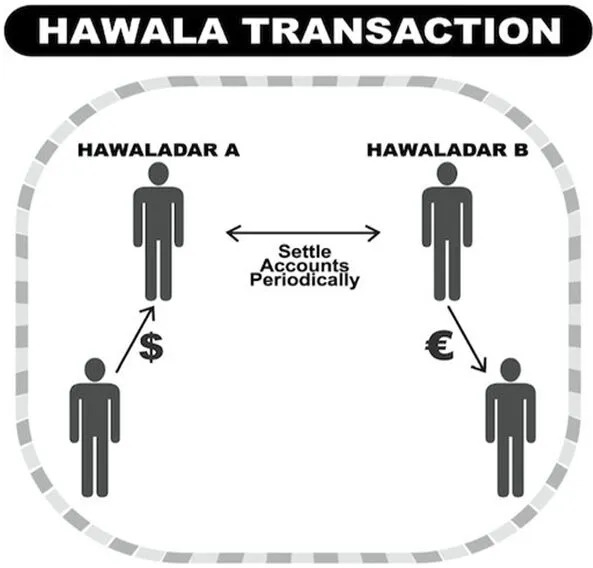
- Hawala:
- An informal and illegal system of money transfer that operates outside conventional banking or financial channels.
- Money is transferred without physical movement; instead, it relies on a network of brokers or agents (known as hawaladars).
-
- Context:
- Black money distorts economic equity, fuels corruption, and hampers India’s ability to fund public services. India has implemented stringent laws, international agreements, and digital reforms to combat black money, aligning with global efforts to enhance financial transparency.
- Significance for India:
- Tackling black money is crucial for increasing tax compliance, boosting revenue for infrastructure and social programs, and strengthening India’s global financial standing. It supports economic stability and aligns with initiatives like Atmanirbhar Bharat by fostering a transparent, inclusive economy.
- Notable Organisations
- Definition:
- Several specialized agencies in India and globally work to detect, prevent, and penalize activities related to black money, tax evasion, and money laundering, ensuring compliance with financial regulations.
- Key Organisations:
-
| Organisation |
Details |
| Enforcement Directorate (ED) |
- Established: 1956
- HQ: Delhi
- Under: Ministry of Finance (Department of Revenue)
- Acts Enforced:
- Prevention of money laundering Act (PMLA), 2002
- Foreign Exchange Management Act (FEMA), 1999
- COFEPOSA, 1974
- Functions: Investigations, searches, seizures, and arrests to combat money laundering, forex violations, and smuggling.
|
| Directorate of Revenue Intelligence (DRI) |
- Under: Ministry of Finance (CBIC)
- Functions:
- Investigates smuggling and illegal trade in customs, narcotics, wildlife, arms.
- Ensures compliance with customs and allied laws.
|
| Central Bureau of Narcotics (CBN) |
- HQ: Gwalior
- Under: Department of Revenue (CBIC)
- Alias: National Opium Agency
- Functions:
- Regulates opium/poppy cultivation in MP, UP, Rajasthan
- Combats drug trafficking under NDPS Act, 1985
|
| Central Economic Intelligence Bureau (CEIB) |
- Under: Ministry of Finance
- Role: Central repository for economic offenses data
- Inputs from:
- Coordinates intelligence on financial crimes
|
| Economic Intelligence Council (EIC) |
- Chairperson: Finance Minister
- Member-Secretary: Director General of CEIB
- Members include:
- CBDT
- CBIC
- ED
- SEBI
- RBI
- R&AW
- Function: Strategic oversight of financial intelligence
|
| Financial Intelligence Unit (FIU-India) |
- Established: 2004
- Role:
- Analyzes suspicious financial transactions (domestic & cross-border)
- Reports to EIC
- Aids in detecting money laundering and terror financing
|
| Customs, Excise and Service Tax Appellate Tribunal (CESTAT) |
- Jurisdiction: Appeals on Union indirect taxes (except GST)
- Appeal Flow:
- Stage 1: Junior Officer
- Stage 2: Commissioner
- Stage 3: CESTAT
- Stage 4: High Court / Supreme Court
|
| Financial Action Task Force (FATF) |
- Established: 1989 by G7
- HQ: Paris
- India: Joined in 2010
- Role:
- Global watchdog for money laundering & terror financing
- Maintains greylist & blacklist
- 2022 Greylist Removals: Mauritius, Pakistan
- Current Greylist: Syria, Yemen
- Blacklist: Iran, North Korea
|
| Organisation for Economic Co-operation and Development (OECD) |
- Established: 1961
- HQ: Paris
- India: Not a member but participates in tax reform discussions
- Key Initiative: BEPS (Base Erosion and Profit Shifting)
- Role: Coordinates global economic and tax policies
|
- Tax evasion laws (Hiding Income/Transaction)
- Prevention of money laundering Act (PMLA-2002)
- Definition:
- Enacted in 2002 following the 1998 UN General Assembly declaration on money laundering.
- Aims to combat money laundering through search, seizure, arrest, and penalties.
- Main Agency:
- Enforcement Directorate (ED) oversees implementation and enforcement.
- Judicial Process:
-
| Level | Authority |
|---|
| 1. Adjudicating Authority | PMLA Adjudicating Authority |
| 2. Appellate Body | PMLA Appellate Tribunal |
| 3. Higher Courts | High Court, Supreme Court |
- Regulatory Norms:
- RBI, SEBI, IRDAI, and other regulators set norms for banks and NBFCs.
- Example:
- RBI’s Know Your Customer (KYC) norms and Anti-money laundering (AML) standards.
- Enforcement Example:
- 2013:
- Cobrapost sting operation exposed ICICI, HDFC, and Axis Bank violating KYC/AML norms, leading to heavy RBI penalties.
- PMLA Reporting Norms for Crypto-Exchanges (2023)
- Definition:
- Crypto-exchanges are platforms for buying and selling cryptocurrencies (e.g., Bitcoin) and NFTs (e.g., Unocoin, Coinswitch).
- Requirements (2023):
- Must comply with KYC guidelines: collect ID proof, PAN/AADHAR, and verify residential addresses.
- Must report suspicious transactions to authorities.
- Legal Basis:
- Directives issued under the Prevention of money laundering Act (PMLA-2002).
- Benefits:
- Enhances transparency in cryptocurrency transactions, reducing risks of money laundering and tax evasion.
- Burden of Proof & PMLA
- Burden of Proof:
- The obligation on a party in a legal proceeding to prove or disprove a disputed fact.
- It lies primarily on the party who brings a claim or asserts a fact, usually the prosecution in criminal cases or the plaintiff in civil suits.
- Reverse Burden of Proof:
- A legal provision where the burden shifts from the prosecution to the accused to prove innocence.
- It is an exception to the general presumption of innocence and is used in cases involving national security, economic offenses, or narcotics where evidence is otherwise hard to obtain.
- Comparison:
-
| Aspect |
Standard Burden of Proof |
Reverse Burden of Proof |
| Responsibility |
On police/prosecution to prove accused committed the crime |
On accused to prove they did not commit the crime |
| Examples |
- Indian Penal Code (IPC)
- Future Bharatiya Nyaya Sanhita
|
- Terrorist and Disruptive Activities (Prevention) Act (e.g., Sanjay Dutt case)
- Narcotic Drugs and Psychotropic Substances Act, 1985 (e.g., Aryan Khan case)
- Prevention of money laundering Act, 2002 (e.g., Rahul Gandhi - National Herald case)
|
- PMLA Amendments via Finance Bill (2015-2019)
- Overview:
- Amendments to Prevention of money laundering Act (PMLA-2002) increased Enforcement Directorate (ED) powers for summons, arrests, and raids.
- Introduced reverse burden of proof, making bail nearly impossible for accused.
- Method:
- Amendments passed via Finance Bill (classified as Money Bill) to bypass Rajya Sabha scrutiny.
- Legal Challenge:
- Challenged in Supreme Court for violating fundamental rights due to reverse burden of proof.
- 2022:
- Supreme Court upheld government's actions, dismissing opposition and PIL claims.
- 2023:
- CJI D.Y. Chandrachud announced a seven-judge Constitution Bench to revisit the issue.
- Undisclosed Foreign Income & Assets Act (UFIA-2015)
- Definition:
- Requires Indian residents to disclose foreign assets (e.g., Dubai bungalow, Swiss bank account) and income from foreign sources (e.g., Cayman Islands shell company) in income tax returns.
- Tax and Penalties:
- Foreign income taxed at 30% with no deductions, exemptions, or rebates.
- Violation:
- Penalty + up to 10 years imprisonment.
- Corporate Liability:
- Company violations hold responsible individuals liable unless they prove lack of knowledge.
- International Cooperation:
- Empowers Union government to enter agreements with other countries for tax information exchange.
- Benefits:
- Increases transparency, reduces black money, and enhances tax compliance.
- Benami Transactions Prohibition Act (BTPA-1988, Amended 2016)
- Definition:
- Targets properties registered in the name of relatives, staff (e.g., driver, gardener), or fictitious persons to evade tax authorities.
- Example:
- 2018, Misa Bharti Yadav allegedly bought a farmhouse in her brother-in-law Nilesh Kumar’s name.
- Evolution:
- 1988 Act ineffective; amended in 2016 for stronger enforcement.
- Main Agency:
- Income Tax Department.
- Judicial Process:
- Cases heard by PMLA Adjudicating Authority and Appellate Tribunal.
- Violation:
- Property confiscation, penalty, and imprisonment.
- Govt Announcements
- Tax Surrender Schemes
- Definition:
- Allow tax evaders to declare undisclosed income, pay taxes and penalties, and avoid prosecution by the Income Tax Department (except for income from criminal activities like narcotics, kidnapping, or extortion).
- Older schemes:
-
| Scheme |
Period |
Details |
| Income Declaration Scheme (IDS) 2016 |
June 2016 - September 2016 |
- 45% of undisclosed income taken as tax (30%), surcharge, and penalty
- ~₹67,000 crore black money declared
|
| Pradhan Mantri Garib Kalyan Yojana (PMGKY) |
December 2016 - April 2017 |
- ~50% of undisclosed income taken as tax, penalty, and PM Garib Kalyan Cess
- 25% deposited in RBI’s PM Garib Kalyan Deposit Scheme (4-year fixed deposit, 0% interest)
- Funds used for irrigation, housing, toilets, infrastructure, education, health
- ~₹5,000 crore declared, less successful
|
| Sabka Vishwas Legacy Dispute Resolution Scheme 2019 |
Budget 2019 |
- For pending Service Tax and Excise Duty cases
- Businessmen admit fault
- Tax officials provide penalty/late-fee relief
- Disputes settled without prolonged litigation
|
- Vivad se Vishwas Scheme for Direct Taxes (Budget-2020)
- Definition:
- Scheme to settle pending direct tax (income tax, corporation tax) disputes, addressing >₹9 lakh crore in cases as of January 31, 2020.
- Scope:
- Covers appeals pending before Income Tax Commissioner (Appeals), Income Tax Appellate Tribunals (ITAT), High Court, or Supreme Court.
- Settlement:
- Taxpayers pay 50-100% of disputed tax amount (varies by case).
- Full waiver of interest and penalties.
- Validity:
- Initially valid until March 31, 2020; extended under Atma-Nirbhar Bharat package.
- Restart announced in Budget 2024 (July).
- Exclusions:
- Not applicable for criminal prosecutions or cases involving black money hidden abroad.
- Benefits:
- Reduces litigation, clears case backlog, and provides relief to taxpayers.
- Dispute Resolution Committee (DRC) (Budget-2021)
- Definition:
- Committee under Income Tax Act to settle small taxpayer disputes without formal appellate processes.
- Eligibility:
- Taxable income up to ₹50 lakh and disputed income up to ₹10 lakh.
- Powers:
- Can reduce/waive penalties or grant immunity from prosecution.
- Features:
- Faceless/online committee for efficiency, transparency, and accountability.
- Benefits:
- Saves small taxpayers time and legal expenses, bypassing appeals to IT Commissioner, ITAT, High Court, or Supreme Court.
- Interim Budget 2024: Amnesty for Small Taxpayers / Case Withdrawal
- Policy:
- Withdrawal of small direct tax cases to provide relief to ~1 crore taxpayers.
- Criteria:
-
| Case Year | Maximum Amount |
|---|
| 1962 to 2009–10 | ₹25,000 |
| 2010–11 to 2014–15 | ₹10,000 |
- Benefits:
- Reduces burden on small taxpayers and clears minor pending cases.
- Other Initiatives (Pre-Corona 2020)
- Banking Cash Transaction Tax (BCTT) (2005-09):
- 0.1% tax on cash withdrawals from banks to promote a less-cash economy and enable transaction data mining.
- Introduced by Chidambaram; withdrawn in 2009.
- (Suggested) Banking Transaction Tax (BTT):
- Proposed by a Pune-based think-tank to Baba Ramdev to replace all direct/indirect taxes with a 2% tax on banking transactions.
- Impractical; failed in Australia and other countries due to shifts to barter systems, diamonds, and gold.
- 2017:
- Government clarified no plans to implement.
- Supreme Court Special Investigation Team (SIT) on black money (2014):
- Chairman:
- Retired SC Justice MB Shah, with senior tax officials.
- Recommended measures against black money in India, overseas banks, and Participatory Notes.
- Supreme Court ordered implementation of recommendations.
- Operation Clean Money (2017):
- Income Tax Department verified large bank deposits post-demonetization to detect tax evasion.
- Restrictions on Cash Transactions (Budget 2017, Finance Act 2017):
- Penalty of 100% of cash received for transactions ≥₹2 lakh in a day or multiple transactions for one event.
- Exemptions:
- Banks, post offices, and government organizations.
- Political parties pay income tax on cash donations >₹2,000 to encourage cheque/NEFT/RTGS/Electoral Bonds.
- Electoral Bonds (2017):
- Refer to Pillar#1C (SEBI/Sharemarket handout) for details on encouraging transparent political funding.
- Tax Avoidance
- Definition:
- Declaring transactions in official records but using legal loopholes to minimize or avoid tax payments, unlike tax evasion which involves hiding transactions.
- Double Taxation Avoidance Agreement (DTAA) & Round Tripping
- Definition:
- Tax treaty between two or more countries to prevent taxpayers from paying direct taxes twice on the same income earned in different countries.
- Example:
- India-Mauritius DTAA (1982):
- No Capital Gains Tax (CGT) in India for Mauritius-based persons/companies selling Indian shares; only Mauritius can impose CGT (~0-3% vs. India’s 12.5-20%).
- Loophole:
- Indian entities (politicians, businessmen, Bollywood actors) transfer money via hawala to Mauritius shell companies, which reinvest in Indian assets/share market to avoid Indian CGT.
- Round Tripping:
- Process in which money leaves India and returns as foreign investment.
-

- Amendment:
- 2016:
- Modi government amended India-Mauritius and India-Singapore DTAA; investments now subject to Indian taxes.
- Principal Purpose Test (PPT):
- Introduced to deny DTAA benefits if tax evasion/avoidance is the principal purpose of a transaction.
- 2024 (March):
- India-Mauritius DTAA amended to include PPT, leading to foreign investors exiting Indian share market, causing SENSEX decline.
- Benefits:
- Reduces round tripping and Base Erosion and Profit Shifting (BEPS) by closing DTAA loopholes.
- International Law:
- Monism and Dualism & DTAA Application
- Comparison:
-
| Aspect | Monism | Dualism |
|---|
| Supremacy | International law prevails over domestic law | International and domestic laws are separate and independent |
| Conflict Resolution | International law takes precedence | Not necessary; domestic law may prevail |
| Application | International law applies automatically without amending domestic laws | International law applies only after domestic laws are amended |
| India’s System | Not followed | Followed |
- DTAA in India:
- 2023:
- Supreme Court ruled DTAA applies only after the Indian government amends/notifies it under the Income Tax Act, aligning with India’s dualist approach.
- Tax Avoidance through Non-Resident Status
- Tax Liability:
-
| Status | Tax on Income from India | Tax on Global Income |
|---|
| Ordinarily Resident | Yes | Yes (e.g., income from USA/China) |
| Non-Resident | Yes | No |
- Note:
- DTAA may alter tax obligations (e.g., Mauritius CGT loophole).
- Budget 2020 Changes:
-
| Definition | Before Budget 2020 | Budget 2020 |
|---|
| Ordinarily Resident | Stays in India ≥182 days/year | Stays in India ≥120 days/year |
| Non-Resident | Stays outside India ≥182 days/year | Stays outside India ≥246 days/year |
- Implication:
- Longer stay outside India required to claim non-resident status, reducing tax avoidance on global income.
- Place of Effective Management (POEM)
- Determines tax residency based on where key management and commercial decisions are made, preventing companies from claiming non-resident status to avoid taxes.
- Base Erosion and Profit Shifting (BEPS)
- Definition:
- MNCs shift profits from high-tax countries to tax havens to reduce tax liability.
- India’s Response:
- Signed OECD’s Multilateral Convention to Implement Tax Treaty Related Measures to Prevent BEPS (MLI), enhancing anti-BEPS measures in tax treaties.
- Transfer Pricing:
- Pricing of goods, services, loans, or intellectual property transferred between related entities of the same multinational group
- Applies to transactions between associated enterprises (parent–subsidiary, group companies)
- How manipulation happens:
- Group company in high-tax country buys from related company in low-tax country at inflated price
- Profit shifts to low-tax jurisdiction
- Tax liability reduced overall
- Authority for Advance Rulings (AAR):
- A quasi-judicial body that gave binding advance rulings on tax liability before a transaction was undertaken
- Purpose:
- Provide certainty to taxpayers (especially non-residents)
- Reduce future tax disputes and litigation
- Clarify tax treatment in advance
- Who could apply:
- Originally non-residents
- Specified categories of residents (later expanded with limits)
- General Anti-Avoidance Rules (GAAR)
- Definition:
- Introduced by UPA/Congress via Parthasarathi Shome panel; added to Income Tax Act.
- Empowers tax officials to issue notices for suspected tax avoidance (distinct from tax evasion laws like PMLA, UFIA, BTPA).
- Implementation:
- Delayed due to concerns of tax terrorism and business harassment; implemented April 1, 2017.
- Criticism:
- Critics argued GAAR could lead to excessive scrutiny, hindering ease of doing business.
- Safe Harbour Rules
- Definition:
- Provide legal immunity for specific transactions to reduce tax disputes.
- Prescribed conditions under which tax authorities automatically accept the taxpayer’s declared transfer price
- No detailed transfer pricing audit if rules are satisfied
- Examples:
-
| Context | Safe Harbour Rule |
|---|
| Social Media | No action against platforms (e.g., Facebook) for user-uploaded illegal content (e.g., pirated movies) if removed; action against user only |
| Direct Taxes | No action against foreign investors in certain transfer pricing transactions |
- Benefits:
- Reduces litigation and provides clarity for taxpayers and businesses.
- Retrospective Tax
- Introduction:
- Foreign companies create shell companies to indirectly transfer Indian assets, avoiding capital gains tax (CGT) in India.
- Definition:
- Demanding tax on past transactions that were not taxable at the time they occurred (e.g., 2012 demand for tax on a 2007 transaction not taxable in 2007).
- Vodafone Case:
- Context:
- Vodafone acquired Hutchison’s Indian assets in 2007 via an offshore transaction; Income Tax Department demanded CGT.
- Outcome:
- Case litigated; highlighted issues with retrospective tax demands.
- Cairn Energy Case:
- Context:
- Cairn Energy, a UK-based oil and gas exploration company, entered India in the 1990s through its Indian subsidiary Cairn India.
- Similar to Vodafone; Income Tax Department demanded CGT on Cairn’s 2006-07 transactions.
- Cairn challenged via Netherlands Arbitration Court under India-Britain Bilateral Investment Treaty.
- Arbitration Ruling (2020-21):
- Court ordered India to pay $1.2 billion to Cairn for tax harassment.
- Cairn sought to seize Indian assets abroad (e.g., Air India planes in the USA, Indian embassy properties in Paris) to recover compensation.
- Legislative Response (2021):
- August 2021:
- Finance Ministry introduced Taxation Laws (Amendment) Bill, 2021 to end retrospective tax.
- Rule:
- No tax demands on indirect transfers of Indian assets before May 28, 2012.
- Condition:
- Companies (e.g., Cairn, Vodafone) must drop all related cases in Indian and foreign courts.
- Resolution:
- September 2021:
- Cairn agreed to drop cases in France, Netherlands, USA, etc.; India dropped retrospective tax demands.
- Vodafone planned similar resolution.
- Global Minimum Tax
- Introduction:
- Tax Havens:
- Low-tax nations (e.g., Luxembourg: 1.39% corporation tax, British Virgin Islands: 0.07%, Cayman Islands: 0.2%) attract foreign investors/tourists due to their small size and limited viable economies.
- Issue:
- Multinational corporations (MNCs) register in tax havens to transfer profits, avoiding taxes in operating countries; India loses ~$100 crore annually, USA ~$500 crore.
- Context:
- USA’s Trump reduced corporation tax from 35% to 21%; Biden pushed for higher taxes for welfare and urged G20 for a global minimum corporation tax.
- G7 Framework (2021):
- Summit:
- Cornwall, England; theme: "Build Back Better"; members: USA, UK, France, Germany, Italy, Canada, Japan.
- Outcomes:
- Companies must pay taxes in countries where they conduct business.
- Global minimum tax framework set at 15% for corporations.
- Discourages tax-reduction races to attract FDI.
- Enables sanctions/lawsuits to pressure tax havens to increase taxes, reducing tax avoidance.
- Developments:
- 2021 (July):
- India supported the framework.
- 2025 (January):
- USA (Trump) withdrew, citing economic sovereignty and competitiveness concerns.
- G7-OECD (Organisation for Economic Co-operation and Development) Two-Pillar Solution:
- Purpose:
- Address tax challenges from digital economy under the 15% global minimum tax framework.
- OECD Global Tax Deal
- Pillar 1
- Applies to
- ~100 largest and most profitable MNCs
- Core rule
- Part of global profits reallocated to market countries
- Taxed where goods/services are actually sold
- Implication
- Countries must remove Digital Services Taxes
- Example: India Equalisation Levy / Google Tax
- Pillar 2
- Applies to
- Companies with > €750 million annual revenue
- Core rule
- Global minimum corporate tax = 15%
- Mechanism
- Qualified Domestic Minimum Top-up Tax (QDMTT)
- Implication
- If a firm pays below 15% somewhere, extra tax is collected to reach minimum level
- USA/Trump Withdrawal (2025):
- Trump declared the global minimum tax deal invalid in the USA, rejecting Biden’s commitments.
- Reason:
- Taxes paid abroad (e.g., to India) harm USA’s economic sovereignty and competitiveness.
- Reforms to Reduce Tax Terrorism/Harassment
- Context:
- Income Tax Department balances strict measures against tax evasion (e.g., cash transaction bans, Operation Clean Money) with taxpayer-friendly reforms to reduce harassment.
- Pre-filled Online Forms for Taxpayers:
- Mechanism:
- Income Tax Department extracts data from banks, NBFCs, stock exchanges, mutual funds, EPFO, and employers’ TDS submissions to provide pre-filled tax returns (salary, capital gains, bank interest).
- Benefits:
- Saves time/energy; reduces need for chartered accountants.
- Improves accuracy in income reporting and tax payments.
- Updated Return Form (Budget-2022):
- Purpose:
- Allows taxpayers to correct errors in income tax returns within two years of filing.
- Benefit:
- Reduces penalties and stress from unintentional mistakes.
- Faceless Interaction:
- Mechanism:
- Random computerized case allocation to IT officials without disclosing their name, designation, or location.
- Faceless assessment and appeals via email, Zoom, or video-conference.
- Benefit:
- Minimizes personal interaction, reducing harassment and bribery risks.
- Document Identification Number (DIN):
- Implementation:
- Since 2019, CBDT and CBIC assign computer-generated DIN to documents (e.g., search authorizations, summons, arrest memos, inspection notices).
- Benefits:
- Creates a digital directory for transparency, accountability, and efficient case clearance.
- Invalidates documents without DIN, preventing fake notices and harassment by corrupt officials.
- Note:
- Distinct from Director Identification Number (DIN) under the Companies Act, which monitors company directors.
- Taxpayers’ Charter (Budget-2020):
- Definition:
- A document outlining government commitments to citizens for service delivery.
- Context:
- Historically, tax administrations focused less on taxpayer services; modern global trend includes charters/rights for taxpayers (e.g., UK 1986/2009, USA 1988/1991, Canada 2007).
- Indian Charter (August 2020):
- Promises to Taxpayers:
- Impartial, courteous, professional treatment.
- Presumption of honesty unless proven otherwise.
- Timely, accurate information on rules and complaint mechanisms.
- Collection of only the correct tax amount.
- Respect for privacy and confidentiality.
- Accountability for officials’ wrongful actions.
- Option to appoint a representative/tax lawyer.
- Reduced compliance costs (e.g., fewer forms, photocopies).
- Expectations from Taxpayers:
- Be honest, pay taxes on time, maintain accurate records, stay informed, respond to notices promptly.
- Tax Ombudsman:
- Definition:
- An independent representative addressing citizen grievances; originated in Sweden (1809).
- Indian Experience:
-
| Type | Started | Abolished |
|---|
| Direct Tax Ombudsman | 2003 | 2019 |
| Indirect Tax Ombudsman | 2011 | 2019 |
- 2021 Economic Survey: Recommended reinstating tax ombudsman with statutory powers.
- Note:
- Refer to Lokpal and Lokayukta in Polity Book for related concepts.
- Online Portals/Apps:
-
| Initiative | Year | Details |
|---|
| Aaykar Setu | 2017 | CBDT mobile app for income tax, TDS refunds |
| ICEGATE | - | CBIC web portal for customs duty e-services |
| ICEDASH | 2019 (Nov) | CBIC web portal for daily customs clearance data at seaports/airports |
| ATITHI | 2019 (Nov) | CBIC mobile app for international travelers to file advance customs declarations |
| Transparent Taxation - Honouring the Honest | 2020 | Includes Taxpayers’ Charter, automated case allocation, faceless assessment/appeals |
| Turant Customs | 2021 | CBIC’s faceless, paperless, contactless processes for importers/exporters |
- Income Tax Return (ITR) Forms:
- Purpose:
- Disclose income and pay direct taxes; types include ITR-1 (Sahaj), ITR-4 (Sugam), ITR-2, etc., based on taxpayer category (salaried, freelance, company).
- Filing Statistics:
-
| Year | ITRs Filed |
|---|
| 2022 (Dec 31) | 7.51 crore |
| 2023 (Dec 31) | 8.18 crore |
- E-Governance Initiatives (Modi Era):
-
| Initiative | Year | Details |
|---|
| Non-Filers Monitoring System (NMS) | - | Monitors TDS/TCS, e-commerce transactions to identify non-filers of ITRs; issues notices to tax evaders |
| TRACES Portal | - | Manages TDS/TCS deposits and refunds; uses SBI as refund banker via NEFT/RTGS/cheque |
| Project Insight | 2017 | L&T Infotech-developed platform for data mining and tracking tax evaders |
| Project Saksham | 2016 | CBIC’s digital re-engineering for GST, focused on ease of tax payment |
| CASS | - | Computer Assisted Scrutiny Selection for selecting raid/prosecution cases |
- Direct Tax Code (DTC) Task Force (2017-2019)
- Purpose:
- The Direct Tax Code (DTC) Task Force was an expert committee constituted by the Government of India in November 2017 to review the existing Income Tax Act, 1961, and draft a new, simplified Direct Tax law.
- Overview:
- 2017:
- Finance Ministry established task force under CBDT member Arbind Modi; later chaired by Akhilesh Ranjan after Modi’s retirement.
- Members:
- IRS officers, chartered accountants, tax lawyers, corporate consultants.
- Report:
- Not fully public, but media reports highlight key suggestions.
- Suggestions:
- Replace Income Tax Act, 1961 with a simpler Direct Tax Code.
- Reduce corporation tax rates further to enhance competitiveness.
- Uniform tax rates for domestic and foreign companies to promote ease of doing business.
- Additional tax relief for startups (details in Pillar4B).
- Increase income tax slabs from three (5%, 20%, 30%) to four (10%, 20%, 30%, 35% for super-rich earning >₹2 crore).
- Abolish Dividend Distribution Tax (DDT); implemented in Budget 2020.
- Establish Litigation Management Unit for efficient handling of tax-related court cases.
- Other reforms noted, but limited cost-benefit value for further pursuit.
- Tax Harassment Measures (Budget 2024, July):
- Reduced Tax Deducted at Source (TDS) rates for certain transactions (refer to Pillar#2A1 for TDS theory).
- Policy to avoid reopening very old tax cases, reducing taxpayer harassment.
- Vivad se Vishwas Scheme:
- Restarted in Budget 2024 for out-of-court settlements of tax disputes.
- Income Tax Bill 2025
- Objective:
- Simplify and compress the Income Tax Act, 1961.
- Comparison:
-
| Aspect | Income Tax Act, 1961 | New Bill 2025 |
|---|
| Words | 5.12 lakh | 2.60 lakh |
- Simplification:
- Compressed paragraphs into tables, reducing chapters, sections, and pages.
- Criticism:
- Limited substantive reforms; primarily focuses on word compression.
- Notable Changes:
-
| Before | After (Bill 2025) |
|---|
| Assessment Year (AY): Assesses income from previous financial year (e.g., FY 2024-25 assessed in AY 2025-26) | Tax Year: Simpler 12-month period starting April 1 |
| Old Tax Regime (OTR) slabs written in law | OTR slabs not written, increasing flexibility |
| Limited clarity on searchable assets | Tax officers can search virtual digital spaces (e.g., email servers, social media, online banking, cloud servers, digital apps) |
| Property: Land, buildings, shares, gold, jewellery, paintings, sculptures | Property includes virtual digital assets (e.g., Bitcoin, cryptocurrencies, NFTs) subject to 30% capital gains tax on profit |
- Note:
- Bill not yet passed; changes may occur before final version.
- Taxation Related Global Treaties, Agreements & Indexes
- Tax Information Exchange Agreement (TIEA):
- India signed TIEAs with multiple countries to share information, detect tax avoidance/evasion.
- Example:
- 2019 TIEA with Marshall Islands.
- Nodal Agency: Central Board of Direct Taxes (CBDT).
- USA’s Foreign Account Tax Compliance Act (FATCA-2010):
- Requires foreign financial institutions (e.g., Indian banks, Pakistani insurance, Chinese mutual funds) to report American-held assets.
- Helps US tax authorities detect tax avoidance/evasion by Americans.
- Tax Inspectors Without Borders (TIWB):
- Joint initiative by UNDP and OECD for training tax inspectors.
- India participates, training tax officers in Eswatini (formerly Swaziland).
- Global Financial Secrecy Index:
- Prepared by:
- Tax Justice Network (TJN), London-based think tank.
- Ranks jurisdictions based on:
- Level of financial secrecy
- Ability to help hide wealth
- Facilitation of tax abuse and illicit financial flows
- It measures secrecy score (using 20 indicators):
- Laws and regulations enabling secrecy
- Banking transparency
- Beneficial ownership disclosure
- Corporate reporting rules
- 2022 Ranking:
- 1st: USA
- 2nd: Switzerland
- 3rd: Singapore
- 36th: India
- Finding:
- India loses >$10 billion annually due to MNC tax abuse.
- Demonetisation
- Definition:
- Wholesale withdrawal of currency notes from circulation under RBI Act, 1934.
- Process:
- RBI Central Board recommends; Finance Ministry’s Department of Economic Affairs issues gazette notification.
- History:
- 1946:
- ₹500 notes demonetised.
- 1978:
- ₹1,000, ₹5,000, ₹10,000 notes demonetised.
- 2016 (Nov 8):
- ₹500 and ₹1,000 Mahatma Gandhi series notes (Specified Bank Notes, SBN) ordered to be deposited in banks/post offices by Dec 30, 2016.
- Specified Bank Notes (Cessation of Liabilities) Ordinance/Act (2017):
- From Dec 31, 2016:
- RBI not obligated to honor/exchange SBN (except for NRIs with relaxed deadlines).
- Public prohibited from holding SBN, except for research/numismatics/museums in limited amounts.
- Global Context:
- Demonetisation also occurred in Sweden (2013), European Union (2016), Pakistan (2015).
- Purpose (2016):
- Combat corruption, black money, counterfeiting, terror financing.
- Context:
- India’s cash-to-GDP ratio (12.04%) was high
- Cash-to-GDP ratio of 12.04% means that the total value of currency in circulation was about 12.04% of India's GDP.
- Low soil rate (damage rate) of ₹500/₹1,000 notes suggested use for storing black money, not transactions.
- Estimate:
- ₹3 lakh crore (~2% GDP) of black money stored in Specified Bank Notes (SBN).
- Expected Outcome:
- Black money holders would avoid depositing SBN, fearing IT raids, destroying black money.
- Actual Outcome:
- ~99.3% SBN returned to banks; only ~₹10,720 crore black money destroyed.
- Supreme Court Verdict (2023):
- Challenge:
- Filed by Congress leader P. Chidambaram and others in 2016.
- Ruling:
- Upheld demonetisation in a 4:1 verdict.
- Tax-to-GDP Ratio: Why Low in India?
- Lack of civic sense regarding tax payment as a duty.
- Informal sector, parallel/cash-based economy enables income hiding.
- Low per capita income, high poverty, income concentration among few who evade/avoid taxes.
- Election funding fuels corruption and black money; politician-builder nexus.
- State/local governments avoid levying taxes (e.g., agricultural income) due to political considerations, narrowing the tax base.
- Loopholes in tax laws encourage avoidance; wealth tax, gift tax, estate duty (paper taxes) yielded low revenue and were abolished due to evasion and lax monitoring.
- Economic Survey 2019:
- Use Behavioural Economics to Improve Tax Compliance:
- Shifted to Mains-QEP (refer to Taarak Mehta Ka Ooltah Chashmah for context).
- Revenue Shortfall
- Definition:
- Occurs when government earns less tax than projected.
- Data:
-
| Year | Budget Estimate (BE, ₹ Crore) | Revised Estimate (RE, ₹ Crore) | Outcome |
|---|
| 2019-20 | 1,962,761 | 1,684,059 | Shortfall of 2.78 lakh crore |
| 2020-21 | 2,020,926 | 2,027,104 | Surplus |
| 2021-22 to 2024-25 | - | - | Wait and watch |
| 2025-26 | 4,270,233 | - | Wait and watch |
- Laffer Curve:
- Concept:
- By Arthur Laffer; high tax rates reduce revenue by discouraging work or encouraging evasion; tax cuts can increase revenue.
-

- Applications:
- Modi Budgets (2017+):
- Lowest income tax slab cut from 10% to 5%; corporation tax for small companies reduced from 30% to 25% (phased).
- Budget 2020:
- Optional income tax slabs introduced.
- USA Budget 2017:
- Corporation tax cut from 35% to 15%.
- Tax Buoyancy & Elasticity:
- Tax Elasticity:
- Measures the responsiveness of tax revenue to changes in GDP, assuming no change in tax rates or tax policy.
- Elasticity = responsiveness of one variable to change in another
- Formula:
- \(
\text{Tax Elasticity} = \frac{\%\ \Delta \text{Tax Revenue (adjusted for tax rate changes)}}{\%\ \Delta \text{GDP}}
\)
- Tax Buoyancy:
- Measures the degree to which tax revenue increases in response to an increase in GDP.
-

- Context:
- Buoyancy in physics = how strongly something rises when the surrounding medium rises.
- Tax buoyancy = how strongly tax revenue rises when the economy (GDP) rises.
- Formula:
- \(
\text{Tax Buoyancy} = \frac{\%\ \Delta \text{Tax Revenue}}{\%\ \Delta \text{GDP}}
\)
- Example (ES23):
- GST buoyancy = 1.12 (high; grows faster than GDP); pre-GST indirect taxes = 0.99 (low).
- Net Tax Revenue of Union:
-
| Component | Budget 2025 (₹ Crore) |
|---|
| A. Gross Tax Revenue (Union’s direct/indirect taxes, cess, surcharge) | 42 lakh |
| B. Union Territories without Legislature Taxes | 10,133 |
| C. Gross Tax Revenue (A+B) | ~42 lakh |
| D. Minus Tax Devolution to States (per Finance Commission) | (-) 14 lakh |
| E. Minus Contributions to National Disaster Response Fund | (-) 10,380 |
| Net Tax Revenue (C-D-E) | ~28 lakh |
- Note:
- National Disaster Response Fund (statutory under Disaster Management Act, 2005; formerly National Calamity Contingency Fund).
- Pillar 2B3: Revenue Expenditure
- Definition:
- Revenue expenditure refers to government spending on the day-to-day operations and maintenance of state functions, which does not create long-term income-generating or permanent assets. It includes expenses like salaries, pensions, subsidies, and interest payments on loans, critical for sustaining administrative, social, and economic services.
- Context:
- Revenue expenditure forms a significant portion of India’s Union Budget, ensuring the smooth functioning of executive, judiciary, legislature, and statutory bodies while supporting welfare schemes through subsidies and grants. Efficient management is vital to balance fiscal health and public welfare.
- Significance for India:
- Revenue expenditure supports essential services like defense, education, and healthcare, and funds welfare programs like subsidies for food, fuel, and fertilizers. It is crucial for maintaining governance and social equity but must be controlled to prevent fiscal deficits and ensure sustainable economic growth.
- Overview
- Characteristics:
- Does not result in income-generating or permanent assets (unlike capital expenditure, which creates assets like roads or buildings).
- Funds the operational costs of executive, judiciary, legislature, constitutional bodies (e.g., Election Commission), and statutory bodies (e.g., SEBI).
- Includes payments for social services (health, education), economic services (agriculture, transport), and administrative functions (police, external affairs).
- Key Components:
- Interest Payments:
- Payments on interest for loans (principal repayment is capital expenditure). This is the largest revenue expenditure, reflecting India’s debt servicing obligations.
- Subsidies:
- Financial assistance to reduce the burden on citizens or industries (e.g., food, fertilizer, fuel subsidies).
- Salaries and Pensions:
- Compensation for government employees and retirees, including dearness allowances to offset inflation.
- Grants-in-Aid:
- Funds provided to states, local bodies, or institutions (e.g., disaster management, Panchayati Raj) without repayment obligations.
- Defense Expenditure:
- Salaries, fuel, and maintenance for armed forces (e.g., fuel for tanks, soldier salaries).
- Union Territories without Legislature:
- Operational expenses for UTs like Chandigarh and Lakshadweep.
- Subsidies
- Definition:
- Subsidies are financial benefits provided by the government to individuals, farmers, or industries to reduce costs, promote welfare, or support economic activities. Unlike taxes, subsidies are voluntary and not punishable if refused.
- Comparison with Taxes:
-
| Aspect |
Tax |
Subsidy |
| Nature |
Compulsory contribution to the state; non-payment is punishable. |
Voluntary benefit to reduce burden; refusal is not penalized. |
| Benefit |
No direct or specific goods/services guaranteed (e.g., Mukesh Ambani’s taxes don’t ensure pothole-free roads). |
Provides specific benefits (e.g., Rs. 6,000 under PM-KISAN, subsidized LPG). |
- Types of Subsidies
- Subsidies are categorized based on their delivery mechanism and purpose, aimed at promoting affordability, equity, or economic growth.
- Types and Examples:
- Direct Cash Subsidies:
- Transferred directly to beneficiaries’ bank accounts (e.g., PM-KISAN: Rs. 6,000 annually for farmers; DBT-PAHAL: ~Rs. 200 per LPG cylinder).
- In-Kind Subsidies:
- Non-monetary benefits like free school bags, uniforms, books for poor students, free medicines in public hospitals, or free insurance schemes (e.g., Ayushman Bharat).
- Indirect Subsidies:
- Government pays organizations to offer goods/services at reduced rates (e.g., low fees in government colleges, subsidized kerosene, urea, or crop insurance premiums).
- Implicit Subsidies:
- Government policies suppress supply to raise prices for a sector’s benefit (e.g., banning American poultry imports creates a shortage, allowing Indian poultry farmers to charge higher prices, indirectly subsidizing them).
- Cross-Subsidization:
- One group’s higher payments offset another’s lower costs (e.g., Indian Railways charges higher freight rates to keep passenger fares affordable for the poor).
- Regulatory Subsidies:
- Mandated price caps by regulators (e.g., State Electricity Regulatory Commission limits electricity rates for farmers to Rs. 2–4 per unit).
- Procurement Subsidies:
- Government purchases at above-market prices (e.g., Food Corporation of India buys food grains at Minimum Support Price to support farmers).
- Interest Subsidies (Subvention):
- Government pays part of the interest on loans for farmers, MSMEs, or affordable housing (e.g., LIC’s Vaya Vandana Yojana for senior citizens).
- Impact of Subsidies
- Positive Impacts:
- Merit Goods:
- Subsidies on healthcare, education, LPG, solar panels, and windmills increase access and generate positive externalities (e.g., LPG subsidies reduce firewood use, preserving trees and reducing indoor air pollution).
- Economic Support:
- Subsidies like PM-KISAN and fertilizer subsidies stabilize farmers’ incomes, enhancing agricultural productivity and rural welfare.
- Social Equity:
- In-kind subsidies (e.g., free school supplies) and indirect subsidies (e.g., cheap college fees) promote access to education and healthcare for the poor.
- Negative Impacts:
- Environmental Harm:
- Subsidies on diesel, kerosene, and urea lead to negative externalities like air pollution, soil degradation, water pollution, and algae blooms due to overuse.
- Subsidy Leakage:
- Inefficiencies like ghost beneficiaries (non-existent recipients created by corrupt officials) and ineligible beneficiaries (e.g., wealthy individuals receiving subsidies) waste resources.
- Fiscal Burden:
- High subsidy costs strain government budgets, potentially increasing fiscal deficits (e.g., food subsidies alone cost ~Rs. 2 lakh crore in Budget 2024–25).
- Market Distortion:
- Implicit subsidies (e.g., poultry import bans) and procurement subsidies (e.g., MSP) can distort market prices, affecting economic efficiency.
- Subsidy Delivery → JAM and DBT
- Definition:
- JAM (Jan Dhan, Aadhaar, Mobile) and Direct Benefit Transfer (DBT) are mechanisms to deliver subsidies efficiently by linking bank accounts, Aadhaar, and mobile numbers to reduce leakage and ensure benefits reach intended recipients.
- Economic Survey Observations (2015–23):
- 2015–16:
- JAM introduced to streamline subsidy delivery, reducing middlemen and ghost beneficiaries.
- 2016–17:
- DBT saved ~Rs. 36,000 crore by eliminating fake LPG connections.
- 2018–19:
- Highlighted DBT’s role in food subsidies (e.g., PDS) and MGNREGA payments, ensuring transparency.
- 2022–23:
- DBT expanded to 300+ schemes, transferring ~Rs. 6.3 lakh crore annually, with Aadhaar-based authentication minimizing fraud.
- Process:
- Beneficiaries’ bank accounts are linked to Aadhaar and mobile numbers.
- Subsidies (e.g., PM-KISAN, LPG) are transferred directly to accounts, bypassing intermediaries.
- Example:
- PAHAL scheme transfers LPG subsidies to consumers’ accounts, reducing black-market sales of cylinders.
- Challenges:
- Digital divide in rural areas limits access to mobile/internet for DBT.
- Aadhaar authentication failures due to biometric mismatches exclude genuine beneficiaries.
- High administrative costs for maintaining DBT infrastructure.
- National Recruitment Agency (NRA)
- Definition:
- Established in 2020 under Budget 2020, NRA conducts a Common Eligibility Test (CET) to shortlist candidates for non-gazetted Group B and C posts in central government and public sector banks (PSBs).
- Objectives:
- Streamline recruitment by replacing multiple agency exams with a single CET, reducing time and cost for candidates and recruiters.
- SSC and IBPS conduct subsequent mains exams for specific posts.
- Features:
- Computerized test centers in every district for accessibility.
- CET scores valid for multiple agencies, simplifying the application process.
- Focus on aspirational districts (117) to enhance employment opportunities.
- Significance:
- Reduces duplication of exams (e.g., SSC, IBPS, Railways) and lowers financial burden on candidates.
- Enhances transparency and efficiency in government recruitment.
- Note:
- NRA is not a constitutional body and was not established in 2014, nor does it facilitate private-sector jobs.
- Salaries
- Definition:
- Salaries and related allowances for central government employees and retirees form a significant portion of revenue expenditure, ensuring workforce compensation and inflation protection.
- 7th Pay Commission (2014–16):
- Overview:
- Constituted by the Ministry of Finance (Department of Expenditure) under Justice A.K. Mathur, effective from 1 January 2016. The first commission was led by Srinivasa Varadachariar (1946).
- Key Recommendations:
- Introduced Pay Matrix, replacing pay bands and grade pay for simplified salary structures.
- Increased minimum salary to Rs. 18,000/month (Group D) and maximum to Rs. 2.25 lakh/month (Apex scale, e.g., Department Secretary) and Rs. 2.5 lakh/month (Cabinet Secretary).
- Regulatory body salaries raised (e.g., Chairman: Rs. 4.5 lakh/month).
- Adopted Dr. Aykroyd’s formula to adjust wages based on commodity price changes, potentially eliminating the need for future pay commissions.
- Strengthened Modified Assured Career Progression (MACP) to ensure merit-based promotions, curbing automatic promotions for underperforming officials.
- Reforms for defense and Central Armed Police Forces (CAPF), including better allowances and service conditions.
- 8th Pay Commission (Budget 2025)
- Overview:
- Announced in Budget 2025, but chairman details were unavailable as of 1 February 2025. Aims to further refine salary structures and address inflation and employee welfare.
- Context:
- Likely to build on the 7th Pay Commission’s Pay Matrix and Aykroyd formula, ensuring dynamic salary adjustments.
- Expected to address concerns like rising living costs and pension disparities.
- Dearness Allowance (DA) and Dearness Relief (DR)
- Definition:
- Dearness Allowance (DA) is a cost-of-living adjustment for serving central government employees to offset inflation.
- Dearness Relief (DR) is a similar allowance for retired employees.
- Mechanism:
- Calculated as a percentage of basic salary/pension, based on the All India Consumer Price Index (AICPI).
- Revised biannually (January and July) by the Department of Expenditure.
- Key Developments:
- 2020:
- DA/DR frozen due to COVID-19 fiscal constraints.
- 2021 (July):
- Resumed at 28% (from 17%), with arrears paid to employees and pensioners.
- 2024:
- DA increased to 50% of basic salary for ~1 crore employees and pensioners, reflecting inflation adjustments.
-
| Aspect |
DA |
DR |
| Beneficiaries |
Serving employees |
Retired employees |
| Purpose |
Protect against inflation |
Protect against inflation |
| 2021 Update |
Resumed at 28% |
Resumed at 28% |
- Bonus to Government Employees
- Definition:
- Bonuses are additional payments beyond regular salaries, given occasionally to boost morale or reward performance.
- Types:
- Productivity-Linked Bonus (PLB):
- Tied to measurable output (e.g., files cleared, trees planted, or sales improved in postal/railways departments).
- Non-Productivity-Linked (Ad-Hoc) Bonus:
- Given regardless of performance, e.g., Diwali bonus (up to Rs. 7,000 for non-gazetted employees in 2024).
- Example:
- 2024:
- Productivity-linked bonuses for railway employees based on train operation efficiency; ad-hoc Diwali bonuses for Group C and D staff.
- Miscellaneous Terms
- House Rent Allowance (HRA):
- Provided to cover accommodation costs, varying by city classification (e.g., 27% of basic salary in metro cities like Delhi, 9% in smaller towns under 7th Pay Commission).
- Gratuity:
- Lump-sum payment for employees with continuous service (typically 5+ years), governed by the Payment of Gratuity Act, 1972. Maximum limit: Rs. 20 lakh (2024).
- One Rank One Pension (OROP):
- Introduced in 2015 for military personnel to ensure equal pensions for the same rank and service length, regardless of retirement date. Criticisms include disputes over base year and calculation formulas, with ex-servicemen seeking revisions.