- UNIT 1- LINKAGES BETWEEN DEVELOPMENT AND SPREAD OF EXTREMISM
- 1. Extremism in India- An Overview
-

- Extremism refers to beliefs or actions that are far beyond what society considers normal or acceptable. It is characterized by:
- Intolerance towards opposing views
- Advocacy of radical measures or violence to achieve political, social, or religious goals
- In India, extremism is a significant internal security threat, arising from a combination of historical, political, and social grievances. The manifestations of extremism in India can be broadly categorized as follows:
-
| S.No. | Category | Type of Extremism | Description | Key Examples/Details |
|---|
| 1 | Religious Extremism | Islamic Extremism | Driven by radical religious ideologies, justifying violence or intolerance. |
- Motivated by global jihadi movements and state-sponsored agendas.
- Radicalization of youth to join groups like ISIS and Al-Qaeda.
- Goal: Establishment of an Islamic caliphate or inciting communal violence.
|
| 2 | Ethno-Nationalist Extremism | Insurgency in Northeast India | Driven by ethnic identity and a desire for autonomy or secession. |
- Groups like ULFA and NSCN factions are waging armed struggles.
- Rooted in grievances related to neglect by the mainland.
|
| 3 | Ethno-Nationalist Extremism | Separatist Movements | Movements advocating for secession or independence from the Indian Union. |
- Kashmir Insurgency: Fueled by cross-border support.
- Khalistan Movement: Periodically revived in Punjab, often overlapping with religious extremism.
|
| 4 | Left-Wing Extremism (LWE) | Naxalism | Radical far-left ideology rooted in communist principles aiming for a classless society through revolution. |
- Focuses on socio-economic inequality and exploitation of marginalized communities.
- Primarily affects tribal and rural populations in the "Red Corridor" with deep-seated developmental grievances.
|
- Understanding Insurgency vs Terrorism
-
| Attribute | Insurgency | Terrorism |
|---|
| Definition | Organized, protracted armed rebellion against an established authority | Use of violence or threat to instill fear for political ends |
| Motivation | Political, social, economic, or ethnic grievances; regime change | Political, religious, or ideological objectives |
| Targets | Primarily government forces, military, infrastructure | Civilians, non-combatants, symbolic targets |
| Tactics | Guerrilla warfare, sabotage, ambushes, hit-and-run attacks | Bombings, assassinations, hostage-taking, suicide attacks |
| Goals | Overthrow/challenge government, control territory, autonomy | Instill fear, provoke overreaction, force political change |
| Organization | Often hierarchical, with command and control | Often decentralized, cell-based, secretive |
- 1.1. Left-Wing Extremism (Naxalism)
- "Political power grows out of the barrel of a gun." - Mao Zedong.
- Mao Zedong (also spelled Mao Tse-tung) was a Chinese communist revolutionary and political leader, best known as the founder of the People’s Republic of China (PRC) in 1949. He led China from 1949 until his death in 1976.
- This famous quote directly encapsulates the Maoist philosophy of violent struggle for political power, central to LWE ideology. LWE or Naxalism refers to the use of violence by various communist guerrilla groups to destabilize and ultimately overthrow the democratically elected state.
- It is a form of insurgency that seeks to capture state power through violent armed struggle.
- The Union Government has categorized the Communist Party of India (Maoist), or CPI (Maoist), and all its front organizations as a 'terrorist organization' under the Unlawful Activities (Prevention) Act (UAPA).
- Marxism-Leninism-Maoism forms the ideological foundation of Left-Wing Extremism (LWE) in India. The Naxalites see India as a semi-feudal, semi-colonial state controlled by a wealthy class. They follow Mao Zedong's idea that "political power grows out of the barrel of a gun", rejecting democracy and aiming for a New Democratic Revolution through a 'Protracted People's War', a military strategy. This involves:
- 1. Armed insurgency by guerrilla armies.
- 2. Mass mobilization of marginalized groups, particularly Adivasis and poor peasants.
- 3. Building alliances with sympathetic groups to strengthen their cause.
- Maoist Paradox- Beliefs vs. Battleground
- Maoists are Marxist atheists — they reject religion and spiritualism, calling such beliefs “false consciousness.”
- Tribal communities, on the other hand, are deeply spiritual — they worship forests, mountains, and land (like Dharti Mata, Niyam Raja, etc.).
- Yet, Maoists depend on these very tribals to mobilize resistance against mining or forest clearances. So they strategically use tribal faith and emotional attachment to land, even though they ideologically reject it.
- Global Parallel- Peru's Shining Path
- The Shining Path (Sendero Luminoso) was a Maoist insurgent movement in Peru (South America) during the 1980s–1990s.
- It followed the ideology of Mao Zedong — believing that a rural peasant revolution could overthrow the state and establish a communist order.
- At first, the Shining Path successfully mobilized poor indigenous Andean peasants by promising equality and liberation from state neglect — just as Indian Maoists claim to fight for Adivasis.
- The “Global Parallel” shows a universal Maoist contradiction — even if such movements start with the promise of liberating the oppressed, their ideological rigidity and violent methods ultimately:
- alienate the same communities they claim to represent, and
- destroy the moral legitimacy of their struggle.
- Historical Evolution of LWE in India
- The Naxalbari Uprising (1967) and its Legacy
- The origins of Naxalism lie in the Naxalbari Uprising (1967) in West Bengal, led by Charu Majumdar, Kanu Sanyal, and Jangal Santhal. It was a response to the exploitation of peasants by landlords and the failure of land reforms.
- Though the uprising was suppressed, it sparked similar movements across India, giving rise to the term "Naxalism."
- Side note
- Post-Rebellion Pathway- Philippines
- The Philippines' Hukbalahap Rebellion settlement is a key best practice in post-rebellion reconciliation. It successfully integrated former rebels into society, primarily through impactful land reforms.
- This example highlights the critical importance of addressing core grievances and offering socio-economic pathways to disarmed combatants for lasting peace and stability.
- Phases of Consolidation, Expansion, and Decline
- Initial Phase (1967-1980):
- The movement spread but was largely crushed by the state by the mid-1970s.
- Resurgence and Consolidation (1980-2004):
- The People's War Group (PWG) in Andhra Pradesh and Maoist Communist Centre of India (MCCI) in Bihar grew as the most powerful outfits.
- Peak Expansion (2004-2010):
- The merger of PWG and MCCI formed the CPI (Maoist) in 2004, leading to a significant escalation in violence and territorial expansion, particularly the "Red Corridor."
-
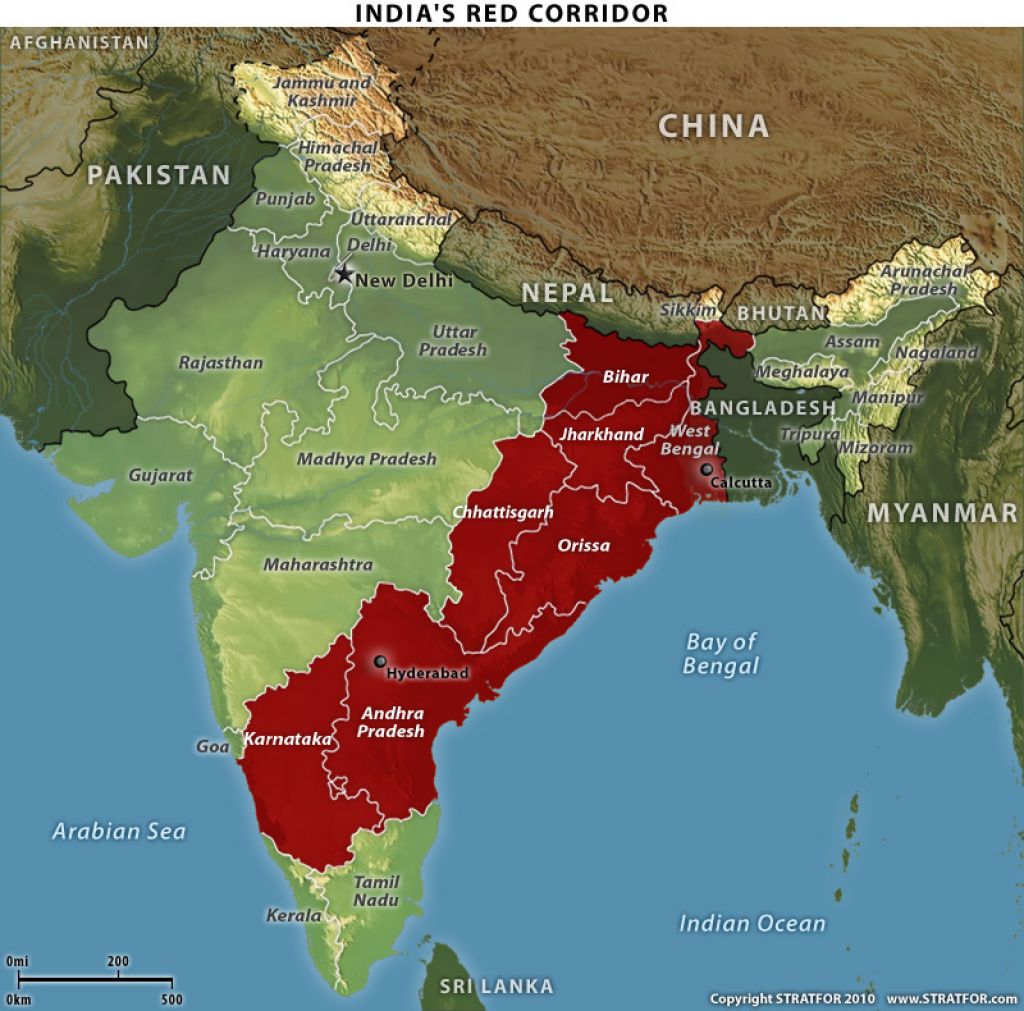
- Decline (2011-Present):
- Government strategies combining security actions and development initiatives have led to a decline in LWE violence and influence.
- 1.1.1. The Core Nexus- Determinants of Left-Wing Extremism
- Left-Wing Extremism (LWE) is influenced by socio-economic, developmental, and governance failures. It is not just a law-and-order challenge but a deep-rooted problem that thrives on grievances exploited by extremist groups. Key determinants of LWE include:
- Development-Extremism Vicious Cycle
-
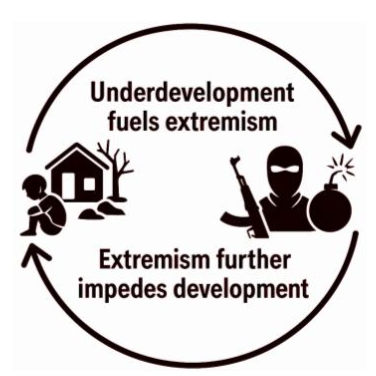
- The link between underdevelopment and extremism is cyclical:
- Underdevelopment fuels extremism, and
- Extremism further impedes development, creating a self-perpetuating trap.
- How Underdevelopment Creates Fertile Ground for Extremism
- Severe Infrastructure Deficits:
- Lack of roads, electricity, water, and healthcare fuels frustration, making people vulnerable to extremism.
- High Poverty and Unemployment:
- Limited jobs and high poverty create fertile ground for Naxal recruitment.
- Low Human Development Indicators:
- Low education, poor healthcare, and social deprivation fuel frustration, aiding extremist ideologies.
- How Extremism Impedes Development
- Destruction of Infrastructure:
- Naxalites destroy infrastructure such as schools, roads, and communication towers to isolate the population and disrupt governance.
- Deterrence of Investment:
- Extremist activities create a high-risk environment, deterring investment and halting critical development projects.
- Cycle of Underdevelopment:
- Extremism blocks development, maintaining the cycle of poverty and underdevelopment in the region.
- Developmental and Economic Determinants
-
- The conflict over resources, particularly land and water, is central to LWE in tribal regions, often summed up by the slogan “Jal, Jangal, Jameen” (Water, Forest, Land).
- 1. Land Alienation and Forced Displacement
- Flawed development model:
- Large projects like dams and mining have displaced tribal communities.
- Mass displacement:
- Tribals have been displaced without proper compensation or rehabilitation, leading to their status as "ecological refugees."
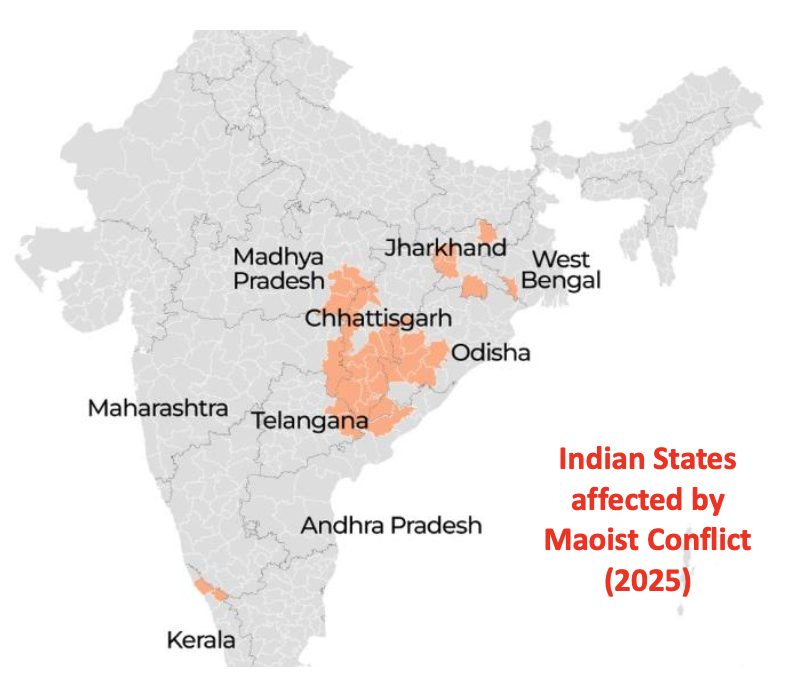
- Indian States affected by Maoist Conflict (2025)
- 2. Impact of Large Industries and Mining Projects on Tribal Populations
- State-corporate nexus:
- State policies often enable the acquisition of tribal land for corporate use, ignoring exposure to pollution and unsafe working conditions.
- Loss of traditional rights:
- Mining and industrialization destroy tribal economies and deny them access to forest resources.
- 3. The "Resource Curse"
- Unequal distribution of benefits:
- Although rich in minerals like coal and iron ore, these regions rarely benefit from the profits. Instead, they face environmental damage and loss of livelihood.
- Global Parallel:
- Lessons from Colombia's "Resource Curse"
- Colombia has actively managed its "Resource Curse" by implementing royalty-sharing with communities in mining zones.
- This aims to distribute wealth more equitably, fostering local development & to counter armed groups.
- 4. Lack of Livelihood Opportunities and Food Insecurity
- Destruction of traditional economies, without alternatives, has led to chronic unemployment and food insecurity, pushing people towards extremism.
- Governance and Administrative Deficits
- The state's failure to protect its citizens and deliver services creates a void that Naxalites have exploited.
- 1. Failure to Implement Constitutional Safeguards
- Article 244 and the Fifth Schedule grant autonomy to Scheduled Areas to protect tribal land and culture, but the state has been ineffective in ensuring protection.
- 2. Poor Implementation of Protective Legislations
- PESA Act, 1996:
- Intended to grant Gram Sabhas the right to self-governance, but its provisions have been violated.
- Forest Rights Act (FRA), 2006:
- Meant to restore the rights of forest-dwelling communities, but poor implementation has left many communities disenfranchised.
- 3. Administrative Vacuum, Corruption, and Ineffective Grievance Redressal
- In many LWE-affected areas, state presence is minimal, and Naxalites have established a parallel government (Janatana Sarkar), administering justice through Jan Adalats and collecting "taxes."
- Social and Political Determinants
- In addition to economic and governance issues, deep-seated social injustices contribute to the persistence of LWE.
- 1. Social Exclusion, Oppression, and Erosion of Tribal Dignity
- Tribal communities have long faced:
- Cultural oppression and humiliation.
- Their unique languages, cultures, and traditions are often viewed as "backward," leading to a loss of dignity and a sense of alienation.
- 2. Lack of Political Mobilization and Voice for Tribal Communities:
- Despite reservations in legislatures, the political voice of tribal communities remains weak, with tribal leaders often co-opted, leaving extremism as the only viable alternative.
- Side note
- Indigenous Empowerment- Canada's Model
- Canada's Indigenous Self-Government Agreements serve as a global Tribal Governance Model. These agreements explicitly grant land and resource rights to Indigenous communities, recognizing their inherent autonomy.
- This approach aims to directly reduce the historical alienation, fostering self-determination and improving socio-economic outcomes through self-governance.
- 1.2. Government of India's Multi-Layered Counter-Strategy for LWE
-
- The Government of India previously focused on LWE as a pure security concern. However, it has shifted from a purely security-centric approach to a more holistic and multi-layered strategy to counter Left-Wing Extremism. This approach tackles the problem on multiple fronts: security, development, and perception.
- The National Policy and Action Plan (2015)
- The cornerstone of the government's new approach is the National Policy and Action Plan, introduced in 2015. The policy treats LWE as a shared responsibility between the Centre and the States and is based on a two-pronged strategy:
- 1. Security Interventions:
- These aim to create a secure environment that allows development to take place.
- 2. Development and Rights:
- Focuses on addressing the root causes of the conflict by ensuring the rights and entitlements of local populations and accelerating development.
- 1.1.1. Security-Based Interventions- Role of Security Forces
- The security aspect of the strategy focuses on reducing violence and curbing the influence of Naxalites.
- 1. Operations by Central Armed Police Forces (CAPFs) and State Police
- A robust security framework has been established in affected areas:
- COBRA Battalions:
- Specially trained Commando Battalions for Resolute Action (COBRA) have been deployed for jungle warfare and targeted operations.
- State-Level Forces:
- Specialized forces like the Greyhounds in Andhra Pradesh and Telangana, and the Black Panthers in Chhattisgarh, have proven highly effective.
- Bastariya Battalion:
- The CRPF has created a unique initiative by recruiting local tribal youth from Bastar into a specialized Bastariya Battalion, leveraging their local knowledge and language skills.
- 2. Strengthening Intelligence Networks and Inter-State Coordination
- Intelligence is central to counter-LWE operations.
- Strengthening state intelligence bureaus and improving coordination through platforms like the Multi-Agency Centre (MAC) ensures better collaboration between states.
- Joint task forces help prevent extremists from exploiting administrative boundaries.
- 1.1.2. Development-Based Interventions- Role of Civil Administration
-
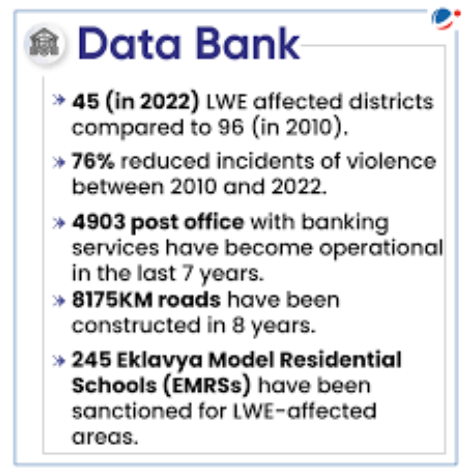
- The civil administration plays a critical role in breaking the Naxalite narrative of state apathy.
- 1. Infrastructure Development:
- Road Requirement Plan (RRP) and Mobile Tower Projects
- To counter developmental deficit, significant efforts are being made to enhance infrastructure:
- Road Connectivity:
- The Road Requirement Plan (RRP) focuses on improving road access in remote areas, aiding both security forces and economic activity.
- Digital Connectivity:
- A mobile tower project is underway to improve communication, administration, and public service delivery.
- 2. Socio-Economic Development Schemes- Education, Health, and Skilling
- Targeted socio-economic initiatives are being implemented for marginalized communities:
- Education:
- New schools, including Eklavya Model Residential Schools and Kendriya Vidyalayas, are being established to offer quality education to tribal children.
- Skilling and Livelihoods:
- The Roshni scheme is a placement-linked skill development program aimed at rural youth from LWE-affected districts.
- 3. Financial Inclusion and Public Service Delivery
- To extend the formal economy and state services:
- New bank branches, post offices, and ATMs are being opened to promote financial inclusion.
- The Direct Benefit Transfer (DBT) system is being used to ensure the delivery of welfare schemes.
- 4. Aspirational Districts Programme
- A significant number of LWE-affected districts are also part of the Aspirational Districts Programme. This data-driven initiative focuses on improving socio-economic indicators through coordinated efforts by the central and state governments.
- Side note
- Community-Driven Development (CDD) in the Philippines- Empowering Locals
- The Kalahi-CIDSS program in the Philippines empowers communities in conflict zones to implement small-scale development projects, fostering ownership and self-reliance.
- A World Bank study found that a 10% increase in CDD funding led to a 3.5% decrease in violent incidents, countering insurgent narratives of state neglect and promoting peacebuilding.
-
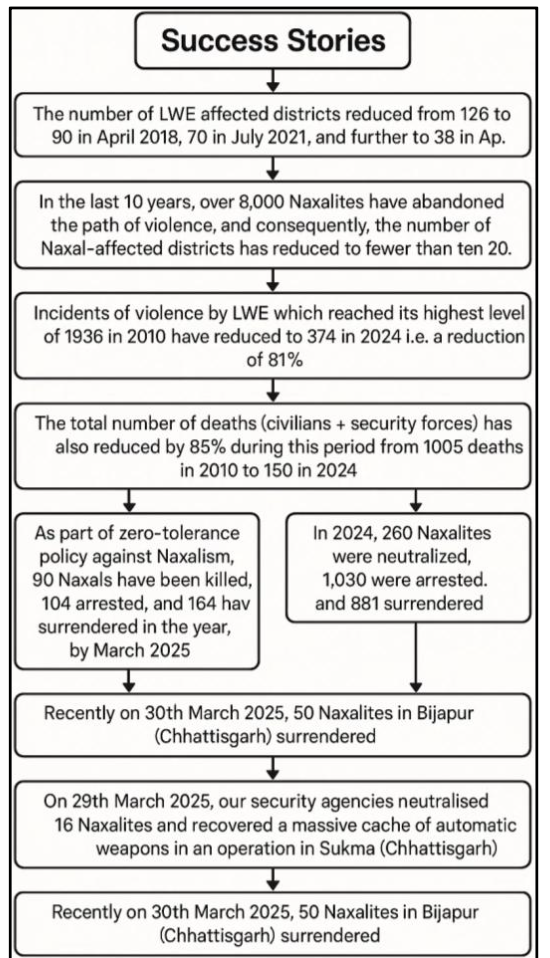
- 1.1.3. Perception Management and Political Engagement
- 1. "Winning Hearts and Minds" (WHAM) Approach
- The government employs Civic Action Programmes where security forces engage with the local community.
- These programs offer medical assistance, distribute essential goods, and organize sports events to bridge the trust deficit between the people and the state.
- 2. Surrender and Rehabilitation Policies
- States have implemented Surrender and Rehabilitation Policies to encourage Naxalites to renounce violence and reintegrate into mainstream society.
- These policies offer financial assistance, vocational training, and other incentives to weaken the extremist ranks.
- The SAMADHAN Doctrine
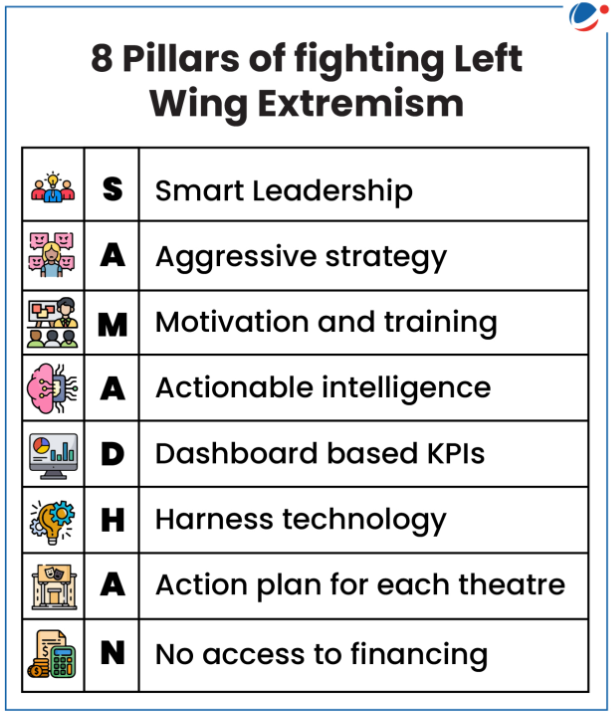
- In 2017, the government introduced the SAMADHAN Doctrine, a holistic framework for security operations. This doctrine emphasizes proactive, intelligence-driven operations supported by technology.
- 1.3. Current Status and Geographical Spread of LWE
-
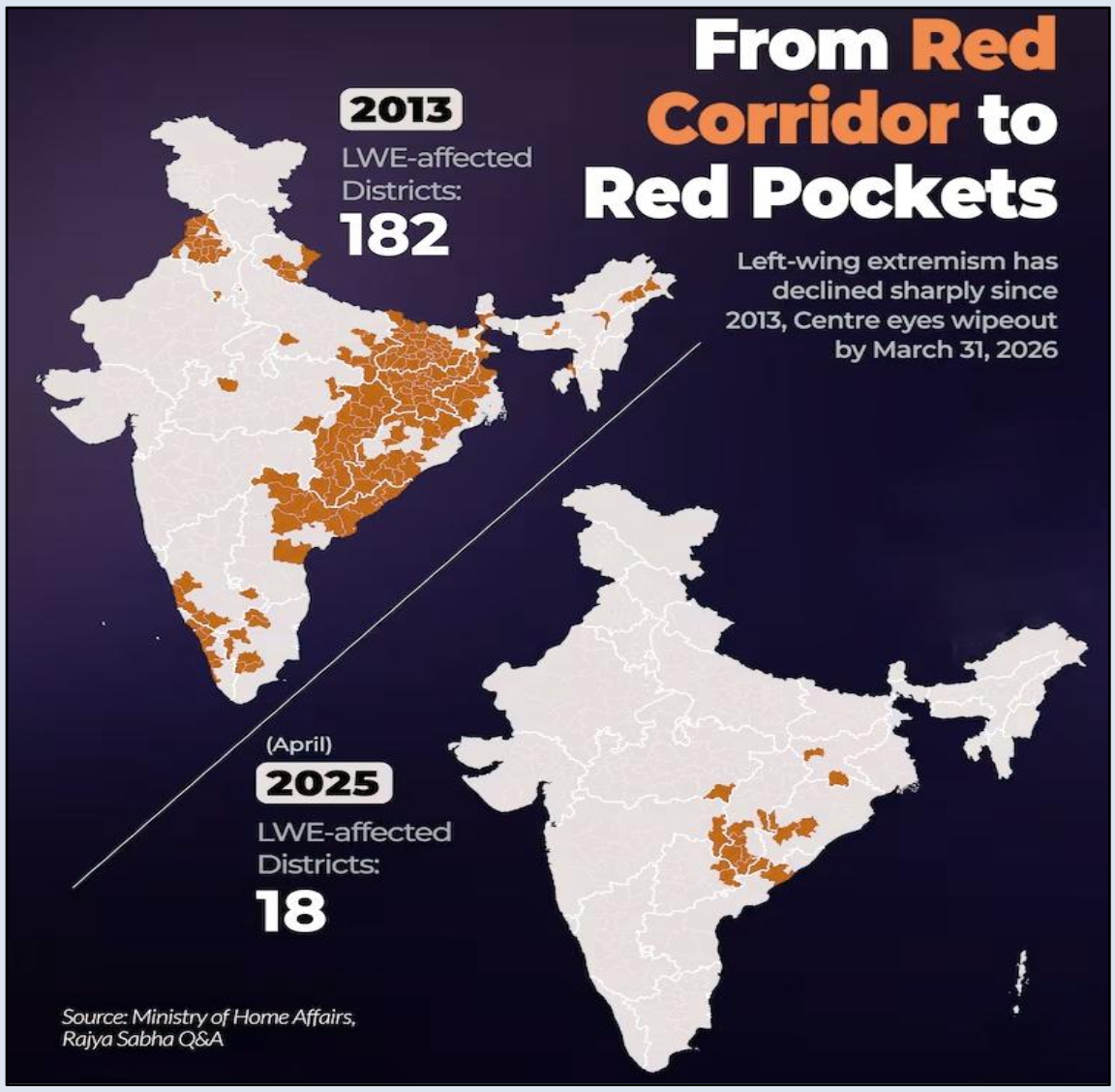
- Contraction of the "Red Corridor":
- 90% of all LWE violence is now concentrated in just 18 districts, with states like Chhattisgarh, Jharkhand, and Odisha remaining the epicenters.
- Government of India to End Left-Wing Extremism (LWE) by 2026
- The Government of India’s approach aims to completely eliminate LWE by 2026 through enhanced security, development, and rehabilitation efforts, marking the final phase of the LWE fight. The approach includes a zero-tolerance policy, strong Centre-State cooperation, and public participation to eliminate extremist support.
- 1.3.1. LWE as a "Violent Internal Security Threat" in current time
-
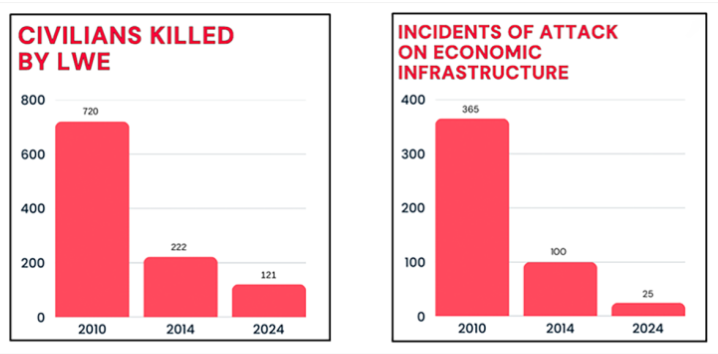
- Despite the decline, LWE continues to be a significant internal security challenge.
- Official Designation:
- Former Prime Minister Manmohan Singh described LWE as the "single biggest internal security threat" to India.
- Deadliest Outfit:
- CPI (Maoist), identified by the Global Terrorism Index (GTI) as the deadliest terrorist group in India, remains responsible for significant terror-related attacks and deaths, threatening national security.
- 1.4. Emerging Issues and Challenges
- Despite significant successes in containing Left-Wing Extremism (LWE), the movement continues to evolve, presenting new challenges that require adaptive and corrective strategies. These challenges reflect changes in tactics, funding, and operations that need urgent attention.
- 1. "Urban Naxals" and Frontal Organizations
- As their influence diminishes in rural areas, Naxalites have increasingly focused on building networks in urban settings. This shift is marked by:
- "Urban Naxals":
- The term, although not defined officially by the Government of India, refers to intellectuals, activists, and students in urban areas who are seen as providing ideological justification, legal aid, and logistical support for the LWE movement. These individuals often serve as the propaganda machinery, creating a sympathetic narrative for the extremists.
- Frontal Organizations:
- These are seemingly legitimate civil society groups used by Naxalites to raise funds, spread Maoist ideology, and mobilize support. They operate in the grey zone, blurring the lines between activism and extremism.
- 2. Diversification of Funding:
- From Extortion to Linkages with Organized Crime
- Naxalites have diversified their financial streams, moving beyond traditional extortion to engage in more sophisticated operations:
- Extortion Economy:
- They continue to collect "taxes" from contractors, businesses, and corrupt officials in affected areas.
- Linkages with Organized Crime:
- Growing evidence suggests connections with criminal syndicates involved in drug trafficking, illegal mining, and other illicit activities, which help fund their operations.
- 3. Use of Technology for Propaganda and Improvised Explosive Devices (IEDs)
- Naxalites have increasingly used technology to further their cause:
- Propaganda:
- Social media and digital platforms have become essential tools for spreading propaganda and recruiting youth to their cause.
- IEDs:
- The use of Improvised Explosive Devices (IEDs) remains a critical challenge, with these weapons being responsible for a significant number of casualties among security forces. The growing sophistication of IEDs has made countermeasures more difficult.
- 4. The Challenge of Preventing the Re-emergence of LWE in Cleared Areas
- Once an area is cleared of Naxalite influence, the administrative and developmental vacuum must be filled swiftly to prevent the resurgence of extremism. The failure to establish effective governance and development in cleared areas creates a risk for the Naxalites to regroup and regain control.
- 1.5. Corrective Strategies and the Way Forward
- To address the evolving challenges of Left-Wing Extremism, several corrective strategies need to be implemented:
- 1. Ensuring Effective Implementation of Protective Laws (FRA, PESA)
- A key corrective strategy is the effective implementation of protective laws such as the Forest Rights Act (FRA) and the PESA Act. This includes:
- Recognizing community forest rights.
- Empowering Gram Sabhas to take control over local resources.
- Ensuring that the intended benefits of these laws reach the local populations, thus addressing some of the root causes of the conflict.
- 2. Adopting a More People-Centric and Participatory Development Model
- The development model should be more inclusive and participatory:
- Local communities must be active stakeholders in planning and implementing development projects.
- A shift away from top-down approaches to more grassroots-driven initiatives can help empower local populations and reduce discontent.
- 3. Strengthening Local Self-Governance and Empowering Gram Sabhas
- Empowering local democratic institutions is crucial:
- Granting true administrative and financial autonomy to Gram Sabhas as envisioned in the PESA Act is essential.
- This empowerment fosters a sense of ownership and counters the Naxalite narrative of an exploitative state, thus addressing key socio-political grievances.
- 4. Police Reforms and Sensitization of Security Forces
- To build trust, there is a need for continuous sensitization of security forces:
- Security personnel must be trained in human rights and the local culture of tribal populations.
- Police forces should be viewed as service providers and protectors, rather than merely instruments of state coercion. This would help in building stronger relationships between the local population and the authorities.
- Insights from Recommendations of Key Committees
- D. Bandyopadhyay Committee:
- This committee highlighted that the state had abdicated its responsibility in affected areas. It recommended a tribal-friendly land acquisition and rehabilitation policy, which should be adopted to address longstanding grievances and ensure a lasting solution to the LWE problem.
- Model of Success for LWE- Case Study
-
| Model | Key Features | Approach |
|---|
| Andhra Pradesh "Greyhounds" Model |
- Greyhounds is a police special forces unit of the Andhra Pradesh and Telangana Police in India. They specialise in counter-insurgency operations against Naxalite-Maoist terrorists.
- Elite Commando Force: Specially trained forces in jungle warfare and guerrilla tactics.
- Local Intelligence Network: Grassroots intelligence network for targeted operations.
- Small Team Operations: Small, well-equipped teams with high mobility.
- Leadership and Political Will: Strong backing from state leadership ensuring resources and autonomy.
- Effective Surrender Policy: Encouraged Naxal cadres to surrender and reintegrate into society.
| Security-driven, targeting Maoist strongholds with high mobility and precision. |
| Saranda Development Plan (Jharkhand) |
- Clear-Hold-Build Strategy: Three-phase strategy: Clear (military operation), Hold (establish security), Build (development).
- Saturation of Development: Post-security stabilization with large-scale infrastructure development.
- Winning Trust: Focus on tangible benefits for local communities to counter Maoist propaganda.
| Integrated security and development model with a focus on reclaiming and developing areas. |
- 2. North-East Insurgency
- The North-Eastern region of India, comprising the 'Seven Sister' states, has historically been a hotbed of insurgent activities.
- 2.1. Root Causes of Insurgency
-

- 1. Historical Alienation and Identity Issues:
- After independence, regions inhabited by Tibeto-Burman/Mongoloid ethnic groups felt disconnected from the newly formed Indian nation-state. The colonial frontier area approach led to a lack of central governance, fostering a distinct identity and ethnic conflicts.
- 2. Immigration and Demographic Shifts:
- Influxes of immigrants, especially from Bangladesh, have caused anxiety among indigenous populations about preserving their cultural identity and control over resources, fueling nativist sentiments and conflicts.
- 3. Economic Underdevelopment and Negligence:
- Despite rich natural resources, the region faces economic underdevelopment, high unemployment, and poor infrastructure. The perception of central government negligence and corruption has created frustration, which insurgent groups exploit for recruitment.
- 4. Geographical Terrain and External Support:
- The rugged terrain along borders with Myanmar, Bangladesh, and Bhutan provides safe havens for insurgents. Support from neighboring countries and criminal groups, like the Golden Triangle’s drug trade, has helped sustain these insurgencies.
- 5. Political Motivations and Demands:
- Insurgents gain popular support by articulating political causes, such as demands for sovereignty (e.g., Greater Nagalim by NSCN-IM) or separate states based on ethnic identity (e.g., Bodoland by NDFB, Kuki homeland by UKLF).
- 2.2. State-wise Overview of Insurgency
-
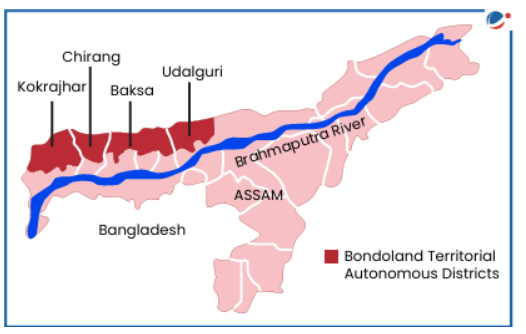
- Assam:
- Key Issues:
- Assam has historically faced insurgency from groups like the United Liberation Front of Assam (ULFA), National Democratic Front of Bodoland (NDFB), and Kamtapur Liberation Organization (KLO).
- These groups often articulate demands for sovereignty or separate homelands based on ethnic identity.
- The state also grapples with issues of illegal immigration, leading to demographic shifts and the contentious National Register of Citizens (NRC) process.
- Inter-state border disputes with neighboring North-Eastern states have also been a persistent challenge.
- Approach:
- The government has pursued a multi-pronged strategy. Peace accords, such as the Bodo Peace Accord (2020) with various Bodo groups, have aimed to resolve long-standing demands for a separate Bodoland, resulting in increased autonomy for the Bodoland Territorial Region (BTR).
- Other agreements, including the Adivasi Peace Accord (2022) and Karbi Anglong Agreement (2021), address grievances of other ethnic communities.
- Boundary agreements with Arunachal Pradesh (2023) and Meghalaya (2022) are resolving inter-state border disputes.
- The NRC update was a significant, albeit controversial, measure to identify illegal immigrants.
- Manipur:
-
- Key Issues:
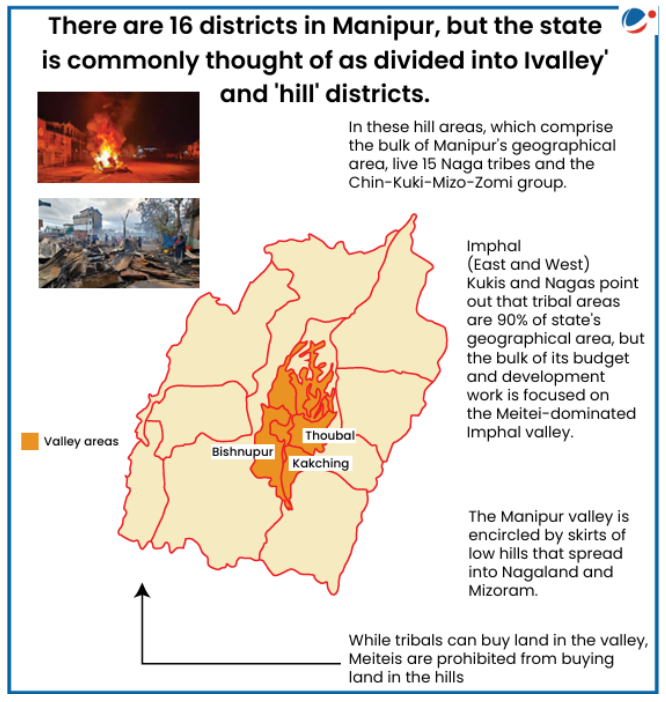
- Manipur experiences insurgency from numerous valley-based groups like the People's Liberation Army (PLA), United National Liberation Front (UNLF), and various factions of PREPAK, KCP, KYKL, MPLF, and RPF.
- The state has recently witnessed significant ethnic violence, particularly the conflict between the Meitei community (residing primarily in the valley) and Kuki-Zomi tribes (inhabiting the hills).
- This conflict is fueled by complex issues including land rights, demographic changes, demands for Scheduled Tribe status for the Meiteis, and concerns over illegal settlements, exacerbated by refugees from Myanmar.
- Approach:
- The government has engaged in peace agreements, such as with the UNLF, to bring insurgent groups into the mainstream.
- Long-term measures include strengthening border management to prevent illegal entry, promoting development in remote hill areas, and carefully deliberating the Meitei community's demand for ST status, considering recommendations from various expert committees.
- The Manipur Ethnic Violence Crisis- A Brief Overview
-
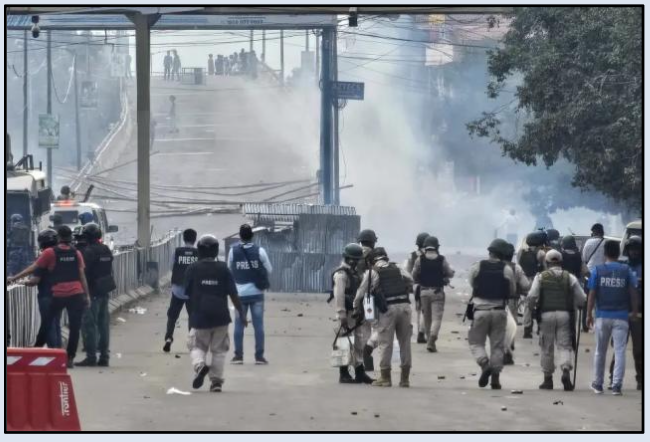
- On May 3, 2023, large-scale ethnic violence broke out in Manipur between the Meitei community (Hindu, majority, in Imphal valley) and the Kuki-Zo tribal community (Christian, in the hills). Over 260 killed, 60,000 displaced, thousands of homes destroyed, and many people are still living in relief camps.
- The violence was triggered by a protest against the Manipur High Court's order recommending Scheduled Tribe (ST) status for the Meitei community.
- This would grant the Meiteis access to reserved jobs and land rights, which the Kuki-Zo feared would diminish their own protections.
- Factors That Escalated the Violence
- Ethnic Tensions:
- Long-standing disputes over land, jobs, and political power between the Meitei and Kuki-Zo communities.
- Historical Grievances:
- Tribal groups felt marginalized by government policies and demographic shifts.
- Other Factors:
- Armed groups, drug trafficking routes from Myanmar, and looted weapons contributed to escalating violence.
- Government Response
- Curfews and internet shutdowns were imposed.
- Thousands of security personnel deployed, and “shoot at sight” orders issued to control the violence.
- Additional security forces were sent, and a peace committee was set up, though it failed due to lack of trust.
- President's Rule was imposed in February 2025 after the Chief Minister's resignation which still continues till date.
- Despite interventions, peace has not been achieved, and the state remains divided along ethnic lines. Displaced families still face uncertainty.
- Nagaland:
-
- Key Issues:
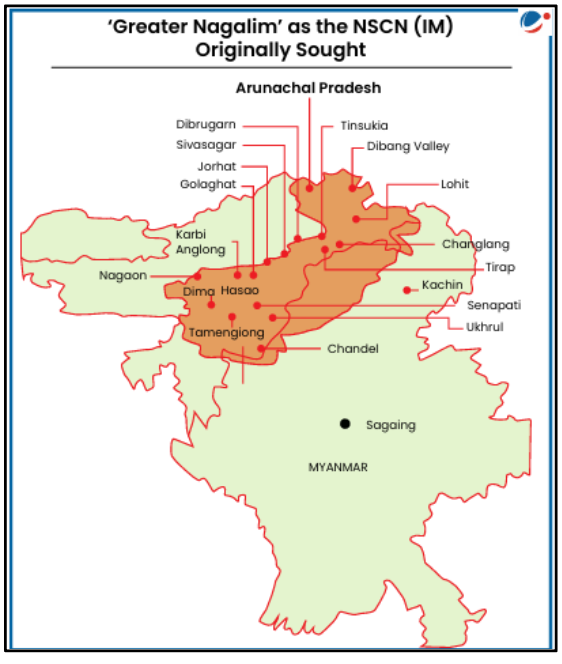
- Nagaland's insurgency is deeply rooted in the demand for Naga sovereignty and the creation of 'Greater Nagalim', a unified Naga homeland encompassing Naga-inhabited areas across Nagaland, Manipur, Assam, Arunachal Pradesh, and parts of Myanmar.
- Key groups include the National Socialist Council of Nagalim (Isak-Muivah) [NSCN-IM] and other factions like NSCN(K), NSCN(KN), and NSCN(R).
- The issue is complicated by inter-tribal conflicts and the sensitivities of neighboring states regarding territorial integrity.
- Approach:
- Peace talks with the NSCN-IM have been ongoing since 1997, marked by ceasefire agreements. However, a final resolution remains elusive due to persistent demands for a separate Naga flag and constitution, and the contentious 'Greater Nagalim' concept.
- The government aims for an inclusive dialogue involving all Naga factions and the governments of neighboring affected states to find a solution within the constitutional framework. It also seeks to address the limitations of Article 371A concerning land and resource ownership.
- Tripura:
- Key Issues:
- Historically, Tripura faced insurgency from groups like the All Tripura Tiger Force (ATTF) and the National Liberation Front of Tripura (NLFT), driven by ethnic tensions and demands for greater autonomy.
- The state also dealt with the prolonged Bru-Reang refugee crisis, involving the displacement of thousands of tribal people.
- Approach:
- Significant progress has been made through peace agreements. The NLFT (SD) Agreement (2019) led to the surrender of cadres and their reintegration.
- The Bru-Reang Agreement (2020) resolved the 23-year-old refugee crisis by facilitating the permanent settlement of over 37,000 displaced individuals within Tripura, with substantial financial assistance from the central government. Consequently, Tripura is now largely free from active insurgency.
- Meghalaya:
- Key Issues:
- Meghalaya has experienced insurgency, notably from the Hynniewtrep National Liberation Council (HNLC), which historically sought an independent Hynniewtrep homeland.
- Approach:
- The government has banned such groups under the Unlawful Activities (Prevention) Act, 1967. Through sustained security operations and peace initiatives, the state has largely brought insurgency under control, contributing to the overall improvement in the region's security situation.
- Mizoram and Sikkim:
- Key Issues:
- These states have largely remained free from significant insurgent activities.
- Mizoram successfully resolved its long-standing insurgency through the Mizo Peace Accord in 1986, which granted it statehood and significant autonomy.
- Sikkim has historically enjoyed a peaceful environment.
- Approach:
- The relative peace in these states serves as a model for conflict resolution through political dialogue and the fulfillment of genuine aspirations within the Indian federal structure.
- 2.3. Approach to Handling Insurgency in NE
-

- The government's strategy in the North-East has evolved into a multi-pronged approach encompassing proportionate use of force, dialogue, and structural changes.
- Armed Forces (Special Powers) Act (AFSPA), 1958:
- This act grants special powers to armed forces in 'disturbed areas' to maintain public order.
- While deemed necessary by the state to tackle insurgency and prevent security gaps, it faces strong opposition due to allegations of human rights violations.
- Recent Supreme Court rulings (e.g., 2016, 2017) emphasize minimum force and accountability, and various committees (e.g., Jeevan Reddy, Santosh Hegde) have recommended its repeal or stricter implementation.
- As of July 2025, AFSPA remains in force in parts of Nagaland, Manipur, and Arunachal Pradesh.
- Peace Process and Dialogue:
- The Central Government actively pursues talks and negotiations with groups that abjure violence and seek solutions within the Indian Constitution. Numerous Suspension of Operations (SoO) agreements and Memoranda of Settlements (MoS) have been signed, leading to the dissolution of some outfits.
- Scheme for Surrender-cum-Rehabilitation:
- This scheme provides financial assistance (e.g., Rs. 4 lakhs immediate grant, Rs. 6000/month stipend for 3 years) and vocational training to militants who surrender, encouraging their reintegration into society.
- Reimbursement of Security Related Expenditure (SRE):
- This non-plan scheme reimburses states for expenses incurred on security measures, including training, logistics for CAPFs, ex-gratia payments to victims, and maintenance of designated camps for groups under SoO.
- Civic Action Programmes (CAP):
- Implemented by Army and Central Armed Police Forces, these programs undertake welfare activities (medical camps, sanitation drives, distribution of study material) to build trust and improve the image of security forces among local populations.
- Modernization of Police Force:
- The Scheme for Modernization of State Police Forces (MPF) aims to upgrade police infrastructure, weaponry, communication, and training to meet internal security challenges.
- Border Management:
- Measures include construction of border fencing, floodlighting, and implementation of Comprehensive Integrated Border Management System (CIBMS) with smart fencing (e.g., BOLD-QIT on Indo-Bangladesh border) to deter illegal infiltration.
- Act East Policy:
- This policy aims to enhance connectivity, trade, and relations with Eastern neighbors, with a focus on developing North Eastern states and improving their infrastructure.
- Side note
- UK's "Operation Banner" - Militarization Erodes Trust
- The UK's "Operation Banner" in Northern Ireland (1969–2007) showed how long-term militarization can deeply damage community trust. The extended military presence, along with controversial tactics, ended up alienating a large part of the population.
- This case clearly highlights the need for building trust in conflict situations, as excessive military intervention can unintentionally fuel resentment and instability.
- 3. Jammu and Kashmir Insurgency
- The insurgency in Jammu and Kashmir (J&K) has evolved from a dispute over local autonomy into a significant internal security challenge.
- 3.1. Root Causes of Insurgency
- Historical Context and Autonomy Dispute:
- Despite accession to India in 1947, aspirations for independence persisted in the region since 1947. Limited democratic development until the late 1970s and the reversal of reforms by 1988 curtailed non-violent expression of discontent.
- Alleged Rigging of 1987 Assembly Elections:
- This event is widely considered a catalyst, leading some legislative assembly members to form armed insurgent groups and contributing to anti-government sentiment.
- External Sponsorship (ISI's Role):
- Pakistan's Inter-Services Intelligence (ISI) has allegedly encouraged and aided the Kashmir independence movement, sponsoring terrorism to distract Indian troops and internationalize the issue. The FBI in 2011 openly acknowledged ISI's role in sponsoring terrorism in Kashmir.
- Mujahideen Influence:
- Post-Soviet invasion of Afghanistan, Mujahideen fighters infiltrated Kashmir, aiming to spread radical Islamist ideology, further complicating the conflict with strong Jihadist elements.
- Sense of Alienation and Religious Marginalisation:
- As India's only Muslim-majority state, a feeling of political, cultural, and economic marginalization compared to Hindus in the rest of India has fueled discontent.
- Humanitarian Abuses:
- Accusations of humanitarian abuses and extrajudicial killings by Indian troops operating under emergency powers have eroded public support for the government.
- 3.2. Approach to Handling Insurgency
-
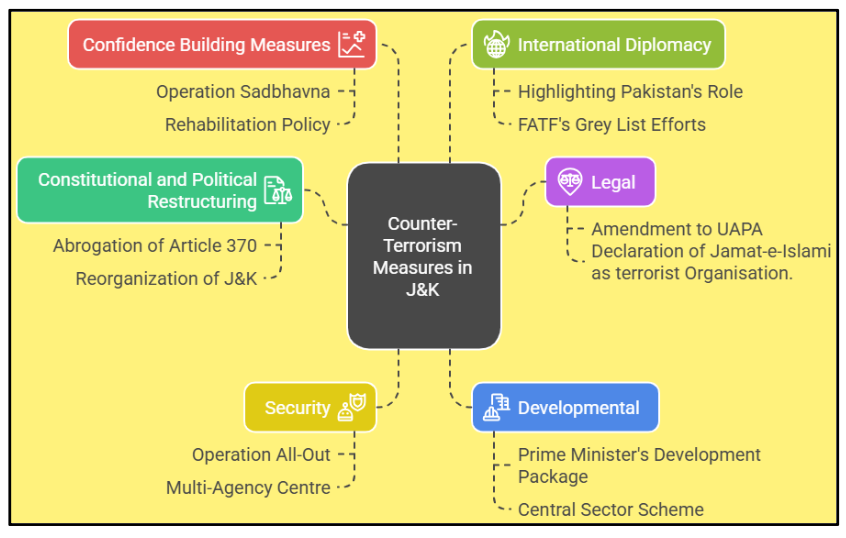
- India's response to the J&K insurgency has shifted from a heavy-handed approach to a more nuanced strategy emphasizing peacebuilding, development, and counter-terrorism.
- 1. Security Measures:
- Counter-Terrorist Operations:
- Focus on intelligence-based surgical operations, reducing the presence of uniformed personnel in population centers, and ensuring transparency with zero tolerance for human rights abuses.
- Over Ground Workers (OGWs) Neutralization:
-
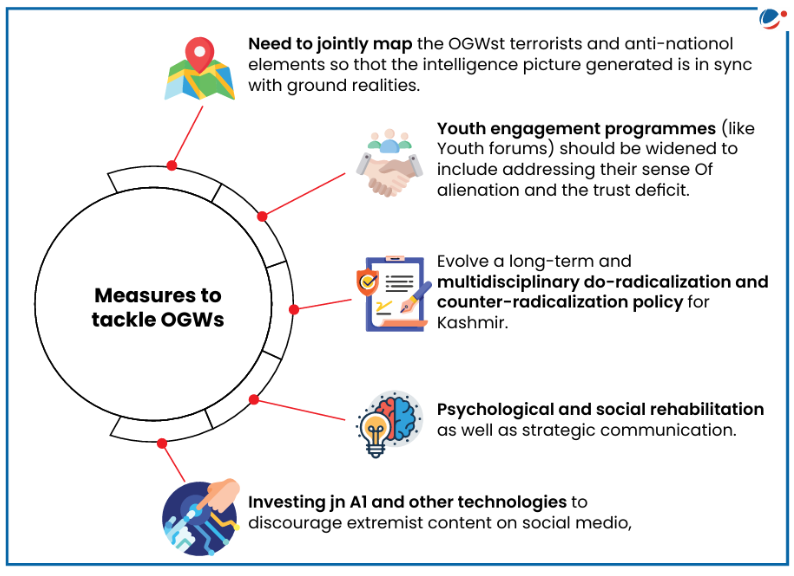
- OGWs provide logistical support, funding, ideological backing, radicalization, and recruitment for militants.
- Strategies involve categorizing OGWs (e.g., logistic support, funding, ideological support, recruitment, perception generation) and developing targeted responses.
- This includes intelligence-based sting operations, psychological and social rehabilitation, strategic communication, and controlling social interactions (including digital) of OGWs.
- Investing in AI and other technologies to discourage extremist content on social media is also crucial.
- Operation All Out:
- Aims to eliminate militant networks, OGWs, and top militant commanders.
- Tackling Hybrid Terrorists:
- Addressing the rise of 'part-time' or 'hybrid' terrorists who are not officially listed but are radicalized and carry out small-scale attacks before returning to normal life.
- 2. Developmental and Rehabilitation Initiatives:
- UDAAN Scheme:
- A Special Industry Initiative providing exposure and training to J&K graduates and post-graduates in corporate India, aiming to address unemployment.
- NISHTHA Scheme:
- A capacity-building program for improving the quality of school education through integrated teacher training.
- Himayat Mission:
- Focuses on generating sustainable livelihood opportunities through self-employment and entrepreneurial skill development for J&K youth.
- Rehabilitation and Surrender Policies:
- Offer facilities and incentives for terrorists who undergo a change of heart, accept India's integrity, and are willing to return to the mainstream.
- Economic Reconstruction:
- Post-revocation of Article 370, efforts focus on attracting investments, extending social security measures (e.g., PM-KISAN, Atal Pension Yojana), and building transit accommodation for Kashmiri Pandits.
- 3. Political and Governance Reforms:
- Removal of Article 370 (2019):
-

- This significant move converted the State of J&K into two Union Territories (J&K with an assembly, and Ladakh), abolishing its special status.
- Positive Outcomes:
- Extended reach of Indian Constitution and laws (e.g., RTI, RPA), new Domicile rules, decreased terrorism-related deaths, fall in terrorist recruitment, and fulfillment of Ladakh's aspirations.
- Negative Outcomes:
- Raised concerns about Kashmiri identity, severely affected education and economy due to shutdowns and internet blockades, increased cross-border infiltration attempts, and internationalization of the Kashmir issue.
- 2024 assembly elections:
- Recent elections in Jammu and Kashmir restored stability by enabling democratic governance, fostering public participation, and reducing alienation through legitimate political representation.
- Dialogue and Devolution:
- Dialogue with state and non-state actors, demilitarization, and devolution of power to all three regions (Jammu, Ladakh, Kashmir) to prevent communal polarization.
- Restoring Trust:
- Rebuilding trust in democratic machinery, addressing economic distress, lifting internet shutdowns, and robustly pushing education through scholarships and funding.
UNIT 2- ROLE OF EXTERNAL STATE AND NON-STATE ACTORS IN CREATING CHALLENGES TO INTERNAL SECURITY
- "Terrorism is not a conventional war with standing armies... It exploits the seams of legal systems." – Robert Mueller
- 1. External Threats to India's Internal Security
- India’s internal security challenges arise from both internal vulnerabilities and ongoing external efforts to create instability. These challenges are complex, with threats coming from both conventional and non-conventional external sources.
-
| Category | Conventional External Threats | Internal Security Threats from External Sources |
|---|
| Nature of Threats | Acts of military aggression or declared wars between countries. | More covert threats, where external powers support non-state actors or internal groups causing unrest. |
| Method of Action | Official armed forces of a state directly involved in actions. | Uses internal groups or non-state actors to create problems, avoiding direct involvement. |
| Plausible Deniability | No deniability, as the actions are officially sanctioned by the state. | Allows the external state to deny involvement, avoiding direct responsibility. |
| Impact on India | Clear and identifiable external aggression. | Internal instability that complicates India's security situation. |
- LeT- A Hybrid Terror Threat
- Lashkar-e-Taiba (LeT) (Chief Hafiz Saeed) is a Pakistan-backed Violent Non-State Actor (VNSA).
- It uniquely blends a localized insurgency agenda, primarily focused on Kashmir, with a broader ideology of global jihadism.
- This dual nature makes LeT a significant, complex threat. It operates as a proxy for state interests while simultaneously pursuing international extremist goals, posing challenges for both regional and global security.
- 1.1. State Actors and Violent Non-State Actors (VNSAs)
- The entities that perpetrate these threats can be broadly classified into two categories:
- State Actors:
- These are governments and their official agencies, such as the military or intelligence services, that use their resources to destabilize another nation.
- A prime example is Pakistan's Inter-Services Intelligence (ISI), which has been documented to fund, train, and direct terrorist operations against India.
- Non-State Actors (NSAs):
- These are armed groups that are wholly or partly independent of state governments and use violence to achieve their goals. The South Asia Terrorism Portal has listed over 180 such groups that have operated within India, many with transnational linkages. They include:
- Terrorist Groups:
- Such as Lashkar-e-Taiba (LeT), Jaish-e-Mohammed (JeM), and global outfits like ISIS and Al-Qaeda.
- Insurgent Outfits:
- Ethnic or secessionist groups, particularly in the North-East (e.g., NSCN factions) and Jammu & Kashmir.
- Organized Crime Syndicates:
- Including drug cartels and human trafficking networks, which often work in nexus with terrorist groups.
- Kinetic and non-kinetic warfare are strategic approaches used to target both state and non-state actors. While kinetic warfare focuses on the physical destruction of assets, non-kinetic warfare disrupts operations or morale through non-physical means, such as cyberattacks or psychological operations.
-
| Aspect | Kinetic War | Non-Kinetic War |
|---|
| Nature | Direct physical force and violence, Highly visible (battlefield, news coverage) | Indirect, non-physical methods (psychological, cyber, etc.) Often covert or unattributed |
| Means | Bullets, bombs, missiles, tanks, armed forces | Cyberattacks, disinformation, sanctions, electronic warfare |
| Actors | Primarily state militaries | States, non-state actors, hackers, proxy groups |
| Cost | High human, material, and financial costs | Lower direct cost but possible large long-term consequences |
| Examples | Airstrikes, invasions, artillery, direct combat | Cyber warfare, propaganda, sanctions, electronic jamming |
- India's Geopolitical Landscape- Navigating a Volatile Neighbourhood
- India is located in a troubled and hostile neighborhood, where many of its security problems trace back to the 1947 Partition.
- Longstanding issues like the Jammu & Kashmir dispute, which is a "conflict of ideas" with Pakistan, and border disputes with China over areas like Aksai Chin, create a very tense environment.
- External actors do not create conflicts out of a vacuum; they exploit India’s existing internal weaknesses to destabilize the country. They use these existing fault lines to destabilize the country, providing money, arms, and safe sanctuaries to internal conflict groups:
- Proxy War:
- A strategy where an external power instigates or significantly supports a conflict while doing only a small portion of the actual fighting itself. This allows external actors to achieve their strategic objectives at a low cost.
- Exploiting Fault Lines:
- External state actors use subversive propaganda to amplify grievances among marginalized or disaffected groups within India.
- Socio-Economic Disparities:
- Grievances of tribal populations in Central India due to lack of development are exploited by China, allegedly providing philosophical, financial, and intellectual support to the Maoist movement.
- Ethnic and Religious Tensions:
- Pakistan's ISI has historically supported Sikh militant groups in their pursuit of Khalistan and has tried to exploit communal fault lines across India to radicalize youth and incite violence. This strategy of using Non State Actors as proxies allows external actors to destabilize India with minimal costs, famously referred to as "bleeding India with a thousand cuts."
- The combination of unresolved historical conflicts, internal vulnerabilities, and external interference has made India’s security situation more complex and multifaceted than that of many other nations.
- 2. Challenges from External State Actors
- The challenges range from direct sponsorship of terrorism to a more subtle and sustained strategic encirclement.
- 2.1. Pakistan- The Epicenter of State-Sponsored Terrorism
- Pakistan poses the most significant state-sponsored external threat to India's internal security. After failing in conventional wars, Pakistan adopted a state policy of low-cost proxy warfare against India. This strategy, famously known as "bleeding India with a thousand cuts," is a form of asymmetric warfare designed to inflict continuous damage on India's security, economy, and social fabric without engaging in direct military conflict. This approach allows Pakistan to pursue its strategic goals while maintaining plausible deniability.
- 1. The Architect of Terror- The "Deep State" and ISI
- The execution of this proxy war is orchestrated by Pakistan's "Deep State"—a powerful nexus of its military and intelligence agencies.
- The Inter-Services Intelligence (ISI) is the primary agency responsible for directing this strategy.
- It actively handles the funding, training, and arming of various terrorist and insurgent groups that target India.
- 2. Instruments of Violence- Nurturing Terror Proxies
- The ISI has cultivated several terrorist organizations as strategic assets, with Lashkar-e-Taiba (LeT) and Jaish-e-Mohammed (JeM) being the most prominent. These groups operate with impunity from Pakistani soil and have been responsible for some of the most heinous attacks on India, including:
- The 2001 Parliament Attack
- The 26/11 Mumbai Terror Attacks (2008)
- The 2019 Pulwama suicide bombing
- Pahalgam attack (2025)
- 3. A Multi-Front Assault on India's Security
- Pakistan's strategy extends beyond specific terror attacks and targets multiple fronts to weaken India.
- Destabilizing Jammu & Kashmir
- Pakistan consistently fuels the conflict in the region by:
- Providing unwavering support to separatist and terrorist groups. Its tactics include radicalizing local youth.
- Infiltrating foreign terrorists across the Line of Control (LoC), and ensuring a constant supply of arms and funds to sustain the insurgency.
- Economic Warfare
- Pakistan also actively works to destabilize India's economy through a crime-terror nexus. This involves:
- Fake Indian Currency Notes (FICN):
- Pushing high-quality counterfeit currency into India to finance terrorism and disrupt the economy.
- Narco-trafficking:
- Leveraging its proximity to the "Golden Crescent" (Afghanistan-Pakistan-Iran) to facilitate drug trafficking into India.
- Side note
- Terrorism's Asymmetric Calculus- Low Cost, High Impact
- Terrorism provides an asymmetric cost-benefit scenario for those carrying out attacks. The cost of executing attacks is relatively low; for example, the 9/11 attacks reportedly cost around $500,000. However, the impact is massive, creating immense psychological fear and significant political disruption.
- The 9/11 attacks alone cost the US around $73 billion in direct damages. Globally, counter-terrorism spending and the resulting economic disruption far exceed the initial attack costs, demonstrating how terrorism can cause severe societal strain with minimal investment.
- 2.2. China- An Ongoing Strategic Threat
-
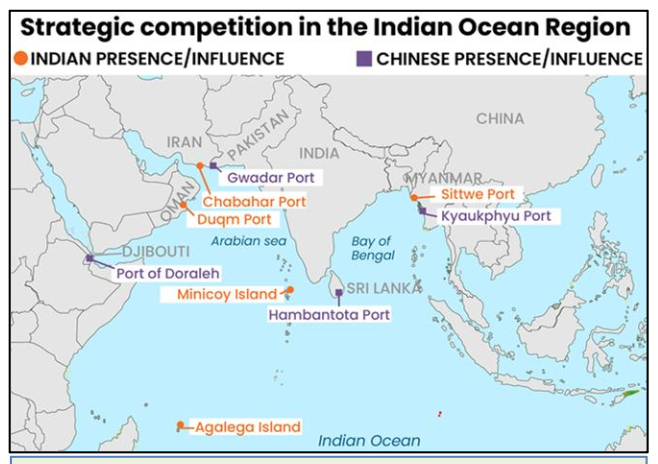
- China’s challenge to India is strategic, long-term, and multi-dimensional, aimed at containing India’s rise and undermining its stability. This threat manifests across several domains, from direct military pressure along the border to covert operations in the economic, cyber, and social spheres.
- 1. Military and Border Threats- The Unresolved Frontier
- The 3,488 km India-China border remains the world’s longest disputed frontier and a primary flashpoint. China employs a strategy of Grey-Zone Warfare—coercive actions that fall below the threshold of conventional war—to exert pressure and alter the status quo.
- Grey-Zone Tactics on the LAC:
- Along the Line of Actual Control (LAC), China uses tactics like "Salami Slicing", which involves the gradual capture of territory through minor transgressions and infrastructure construction in disputed areas.
- This is complemented by military intimidation through aggressive patrolling and standoffs, exemplified by the Doklam (2017) and Galwan Valley (2020) incidents.
- The Galwan clash, the deadliest confrontation in decades, highlights the constant risk of escalation.
- Military Modernization:
- China’s defense budget, which rose to $245 billion in 2025, heavily funds high-altitude warfare capabilities, advanced surveillance, and rapid infrastructure development in Tibet and Xinjiang, enabling swift troop mobilization along the LAC.
- The Two-Front Challenge:
- The deep, "all-weather" strategic nexus between China and Pakistan amplifies the risk of a two-front challenge for India.
- A key element of this is the China-Pakistan Economic Corridor (CPEC), a flagship project of the Belt and Road Initiative (BRI) that passes through Pakistan-Occupied Kashmir (PoK). This directly undermines India’s sovereignty and territorial integrity while solidifying the strategic encirclement.
- 2. Cyber and Hybrid Warfare- The Digital Battlefield
- China has intensified its use of asymmetric tactics in the digital domain to achieve its strategic objectives without direct confrontation.
- Escalating Cyberattacks:
- Chinese state-linked hacking groups have increased their cyber operations against India’s critical infrastructure, government agencies, financial institutions, and media through data theft, malware, and phishing campaigns.
- Hybrid Threats:
- Beijing employs hybrid tactics that merge digital and physical elements. These operations combine cyberattacks with sophisticated disinformation campaigns and support to proxy actors to foment unrest and destabilize India’s internal environment.
- Crypto-Terror-Funding Insurgency
- Violent Non-State Actors (VNSAs), including groups like ISIS, increasingly use cryptocurrencies such as Bitcoin.
- This allows them to evade state control over financial transactions, facilitating illicit funding.
- These digital currencies offer anonymity, decentralization, and global reach. This presents a significant challenge for counter-terrorism financing, making it harder to track and disrupt extremist funding networks.
- 3. Economic and Technological Leverage
- China uses its economic influence as a tool for coercion and espionage, exploiting India’s dependencies.
- Economic Coercion:
- India’s reliance on Chinese imports in critical sectors like electronics, telecom, and pharmaceuticals (Active Pharmaceutical Ingredients or APIs) creates a significant vulnerability. Beijing can weaponize this dependency by restricting trade or manipulating supply chains.
- Data Espionage and Tech Control:
- Chinese commercial entities and mobile applications in India have been implicated in collecting personal and strategic data.
- Investigations have revealed networks of shell companies used for economic espionage and influencing Indian firms through investments.
- Furthermore, the dominance of Chinese firms in telecom hardware raises serious concerns about backdoor access and the potential for sabotage.
- 4. Support to Insurgency and Internal Destabilization
- A key component of China’s strategy is to fuel internal conflicts within India by providing support to various militant and extremist groups.
- Northeast Insurgent Groups:
- China has a long history of providing arms, training, financial support, and sanctuary to insurgent groups in Northeast India, including Naga (NSCN), Mizo, Meitei, and ULFA outfits. This support serves as leverage to keep the sensitive region destabilized.
- Left-Wing Extremism (Maoists):
- China is also believed to provide ideological, moral, and financial support to Left-Wing Extremist (Maoist) groups in India. By leveraging a shared Maoist ideology, it aims to brew internal security challenges and weaken the Indian state from within.
- 5. Regional and Maritime Encirclement
- China is actively working to expand its strategic footprint in India’s neighborhood, particularly in the maritime domain, to limit India’s influence.
- Indian Ocean Expansion:
- China’s growing naval presence in the Indian Ocean, including submarine deployments and access to ports in neighboring countries like Sri Lanka and Pakistan, is a core part of its "String of Pearls" strategy to encircle India and threaten its vital sea lanes of communication.
- Regional Influence:
- Through strategic investments and infrastructure projects like CPEC, China seeks to gain leverage over South Asian nations, further tightening its strategic encirclement of India.
- Decoding the "String of Pearls"
-
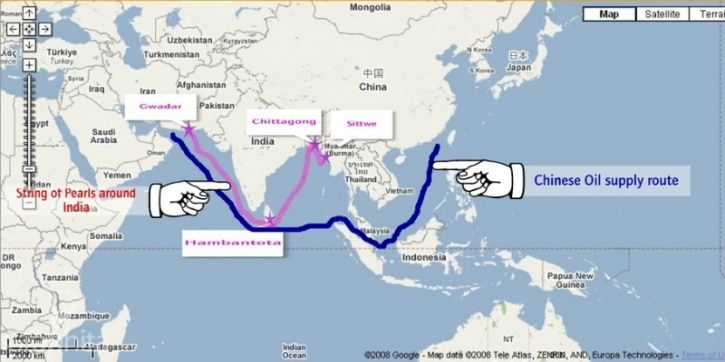
- The "String of Pearls" is China’s strategy to expand its influence in the Indian Ocean Region (IOR) by developing ports and naval facilities along key maritime trade routes, from mainland China to Africa.
- India’s Counter-Strategy:
- The "Necklace of Diamonds":
-
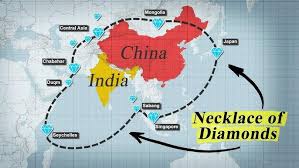
- In response, India views this as a strategic encirclement and is pursuing the "Necklace of Diamonds" to protect its interests.
- Port Development:
- India is securing ports like Chabahar (Iran) and Sittwe (Myanmar).
- Strengthening Alliances:
- India has military access at Oman’s Duqm Port and Mauritius’s Agalega Islands, collaborating with QUAD countries (USA, Japan, Australia) to ensure a free and open Indo-Pacific.
- 2.3. Spillover Challenges from Other Neighbours
-
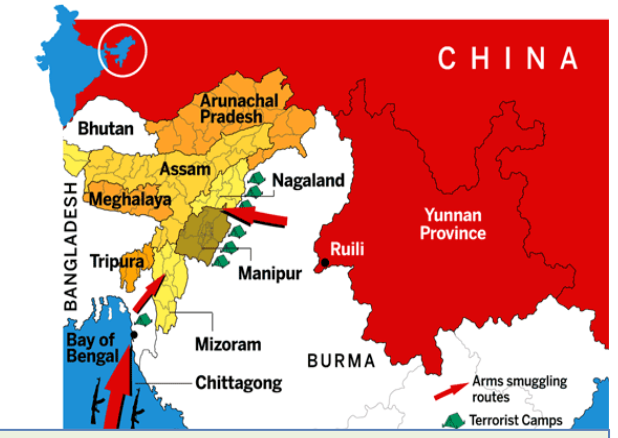
- Significant security threats often spill over into India, not necessarily from state-sponsored action, but as a direct result of the internal instability and weak governance within neighboring countries.
- 1. Myanmar- Porous Borders and Political Instability
- Porous Border:
- The 1,643 km long border with Myanmar, combined with dense forests, provides safe havens and operational bases for various North-East insurgent groups.
- Political Instability:
- The military coup in Myanmar has worsened the security situation, further destabilizing the region.
- Rohingya Refugees:
- The influx of Rohingya refugees from Myanmar presents security concerns, with fears of their vulnerability to radicalization by terrorist groups.
- India’s Response:
- India has decided to scrap the Free Movement Regime (FMR) and fence the border to prevent cross-border threats.
- Side note:
- Myanmar Nexus- Arms Flow to Northeast Insurgents
- The Chin National Army (CNA), a rebel group in Myanmar, operates in areas very close to the Indian border. A major security headache for India is the very real problem of arms trafficking that thrives across this porous border.
- Weapons are frequently smuggled from Myanmar’s conflict zones and end up in the hands of Northeast Indian insurgents. This constant flow of illegal arms highlights the serious cross-border threats India faces.
- 2. Bangladesh- Illegal Migration and Past Sanctuaries
-
- Illegal Migration:
- Despite improved security cooperation with Bangladesh, large-scale illegal migration remains a significant challenge, especially in Assam and West Bengal. This has caused demographic changes and ethnic tensions in border states.
- Past Sanctuaries:
- In the past, Indian Insurgent Groups (IIGs) like ULFA used Bangladesh as a sanctuary, though the current government has cracked down on these groups.
- Spillover Risks from Neighbourhood Posturing- Bangladesh’s Statement on Oceanic Leverage
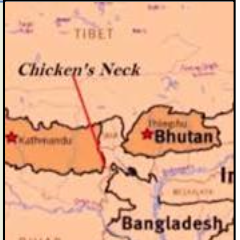
- In March 2025, Bangladesh’s interim leader Muhammad Yunus referred to his country as the “only guardian of the ocean” for India’s landlocked (the Chicken Neck Corridor) northeastern states, during an official visit to China.
- By inviting greater Chinese engagement in the region and implying strategic leverage over India’s connectivity, the statement was seen as diplomatically provocative.
- Indian policymakers viewed this as a concerning instance of neighbourhood rhetoric aligning with external powers, potentially complicating regional security and stability.
- The episode highlights how political shifts in neighbouring countries can spill over into India’s internal and strategic concerns.
- 3. Nepal & Bhutan- Misuse of Open Borders
- Open Borders:
- India shares open borders with Nepal and Bhutan, symbolizing friendly relations, but these borders are often misused by external actors.
- Cross-Border Movement:
- These borders serve as convenient transit routes for terrorists, criminals, and smugglers, facilitating the movement of arms, Fake Indian Currency Notes (FICN), and narcotics into India.
- ISI Activities:
- Pakistan’s ISI has a history of using this vulnerability for its anti-India operations. Two key examples prove this point:
- In December 1999, terrorists hijacked flight IC 814 after it departed from Nepal.
- In August 2013, Indian Mujahideen terrorist Yasin Bhatkal was captured near the India-Nepal border after using it to hide.
- 3. Challenges from Non-State Actors
- India faces significant security challenges from a wide variety of non-state actors operating both within and across its borders. These groups fuel everything from organized crime and internal insurgencies to deadly cross-border terrorism.
- Overview
- Terrorism:
- Over 180 terrorist groups have operated in India. Lashkar-e-Taiba (LeT) and Jaish-e-Mohammed (JeM), originating from Pakistan, have carried out major attacks, such as the 2008 Mumbai attacks and Pulwama attack in 2019.
- Left-Wing Extremism:
- Maoist groups such as the CPI (Maoist) operate in Chhattisgarh, Jharkhand, and Odisha, obstructing development by targeting government projects and spreading propaganda to recruit vulnerable youth.
- Insurgency in the Northeast:
- Groups like the United Liberation Front of Assam (ULFA) and Nationalist Socialist Council of Nagaland (NSCN) fuel insurgency in the Northeast due to inter-tribal conflicts and illegal migration from Bangladesh, creating an environment conducive for non-state actors.
- Drug Trafficking:
- India’s proximity to the Golden Triangle (Myanmar, Laos, Thailand) and Golden Crescent (Afghanistan, Pakistan, Iran) makes it vulnerable to drug trafficking. For example, heroin is smuggled into India through land borders with Myanmar and Afghanistan, while sea routes from the Indian Ocean are also exploited.
- Golden crescent
- The Golden Crescent is one of the world’s largest illicit opium-producing regions, forming a crescent-shaped zone covering three countries:
- Afghanistan, Iran, and Pakistan.
Afghanistan is the world’s largest producer of opium, accounting for over 80–85% of global production (as per UNODC reports).
Opium from here is processed into heroin and trafficked through Pakistan and Iran, eventually reaching India, Europe, and Africa.
India faces major challenges as a transit country, especially across its Punjab and Rajasthan borders.
- Golden triangle
- The Golden Triangle is one of the world’s major opium-producing regions, situated in Southeast Asia, where the borders of Myanmar (Burma), Laos, and Thailand meet — hence the term “triangle.”
- Myanmar remains one of the top producers of illicit opium.
- Drug routes move through China, Vietnam, and Bangladesh, and sometimes enter India via the Northeast (Manipur, Mizoram, Nagaland).
- The term “Golden” in Golden Triangle or Golden Crescent doesn’t refer to the color of the drug, but to the economic value of the trade — the gold-like profits generated by the narcotics economy.
- Human Trafficking:
- Despite being illegal, human trafficking remains a major issue. For instance, Nepalese women are often trafficked through India for commercial sexual exploitation, and Bonded Labour is widespread in industries like brick kilns in states like Tamil Nadu and Andhra Pradesh.
- Civil Society Organisations:
- Foreign-funded NGOs in Kerala and Kochi have been reported to be involved in protests against the Kochi Marina Project, raising concerns about external influence.
- Although state actors pose a strategic threat, the most direct and frequent challenges to India’s internal security arise from Violent Non-State Actors (VNSAs). The primary form of this threat is terrorism, which the upcoming section will explore in detail.
- 3.1. Terrorism
- 3.1.1. The Challenge of Defining “Terrorism”
-
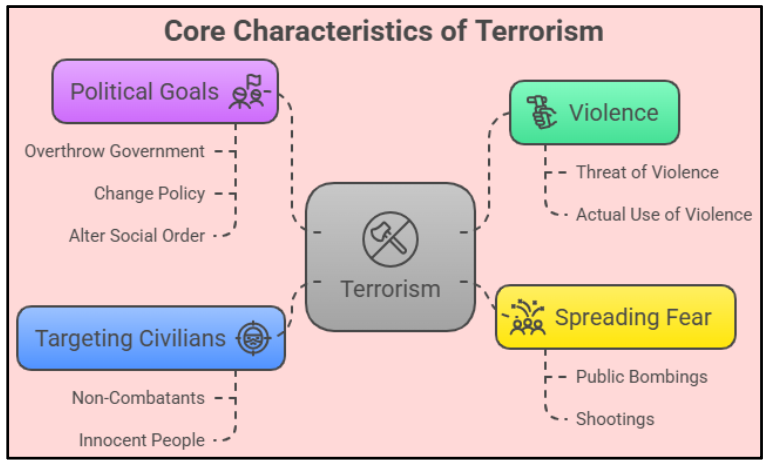
- Defining terrorism remains controversial and difficult, as the term is often shaped by political, ideological, or strategic biases. The core dilemma is that “one person’s terrorist is another person’s freedom fighter”—what qualifies as terrorism depends largely on perspective.
- Importantly, most frameworks do not define terrorism as a concept, but rather describe specific acts considered terrorist in nature based on intent and effect.
- International Framework:
- UN General Assembly Resolution 49/60:
- The UNGA Resolution 49/60 (1994) does not define terrorism per se but criminalizes certain acts widely seen as terrorist. It states:
- “Criminal acts intended or calculated to provoke a state of terror in the general public, a group of persons or particular persons for political purposes are in any circumstance unjustifiable, whatever the considerations of a political, philosophical, ideological, racial, ethnic, religious or any other nature that may be invoked to justify them.”
- This description focuses on the intent to spread fear for political purposes, dismissing any ideological justification.
- Indian Legal Framework:
- Bharatiya Nyaya Sanhita, 2023:
- The Bharatiya Nyaya Sanhita (BNS), 2023, similarly refrains from defining terrorism directly. Instead, it classifies a terrorist act as:
- Any act intended to threaten the unity, integrity, sovereignty, or economic security of India, or to strike terror in the people, typically involving the use of violence for ideological or social objectives.
- This approach prioritizes national security and public fear as key indicators of terrorism, irrespective of the actor’s motivation.
- 3.1.2. Classifying Terrorist Threats in the Indian Context
- Terrorism in and around India is a complex issue, with different categories based on the actors and motivations:
-
| Category | Description | Examples |
|---|
| State-Sponsored Terrorism | Involves a foreign government supporting terrorist groups, providing safe haven, financial aid, military training, and ideological justification. | Pakistan’s support for groups like Lashkar-e-Taiba and Jaish-e-Mohammed. |
| Violent Non-State Terrorism | Carried out by armed groups not affiliated with any government. | Narcotics cartels and ideologically driven groups like paramilitary militias. |
| Ethno-Nationalist Terrorism | The goal here is to create a separate state for a particular ethnic group or to elevate one ethnic group over others. |
- The insurgency in Jammu & Kashmir, driven by secessionist groups often supported from across the border.
- The Khalistan movement in Punjab during the 1980s, which demanded a separate Sikh state.
- Various insurgent groups in Northeast India fighting for independence or autonomy.
- Tamil Nationalist groups like the LTTE in Sri Lanka.
|
- Different Types of Terrorism
- Terrorists adapt their tactics to exploit modern vulnerabilities:
- Cyber-Terrorism:
- Involves using information technology to attack critical infrastructure, like hacking government networks or disrupting financial markets, causing fear without physical bombs.
- Narco-Terrorism:
- Links drug trafficking with terrorism. Drug cartels use violence to influence governments, while terrorist groups fund their operations through narcotics sales.
- Bio-Terrorism:
- The intentional release of biological agents like viruses or bacteria to harm and scare populations. High-threat agents include Anthrax, Smallpox, and Plague.
- Nuclear Terrorism:
- The most dangerous form, involving attacks on nuclear power plants, the use of a dirty bomb, or acquiring nuclear weapons to cause widespread destruction.
- A dirty bomb — also known as a radiological dispersal device (RDD) — is a weapon that combines conventional explosives (like TNT) with radioactive material.
- When the bomb explodes, the blast itself causes the main damage — just like any other bomb.
- But it also scatters radioactive particles into the surrounding area, contaminating it with radiation.
- Its purpose is mainly psychological and economic: to spread fear, panic, and long-term contamination, rather than large-scale immediate destruction.
- 3.1.3. India’s Two-Front War on Terror
- India continues to face significant and evolving security threats from terrorist organizations operating from beyond its borders. These groups can be broadly divided into those sponsored by neighboring states and larger, global networks.
- 1. The Enduring Threat from Pakistan-Backed Groups
- For decades, India has been the target of terrorism from groups based in Pakistan. Organizations like Lashkar-e-Taiba (LeT), Jaish-e-Mohammad (JeM), and Hizb-ul-Mujahideen (HM) operate with significant financial, logistical, and moral support from elements within the Pakistani establishment.
- These groups have a long and brutal history of carrying out deadly attacks, not just in Jammu & Kashmir, but in major cities across the country. Some of the most infamous incidents include:
- The 2001 Parliament Attack in Delhi.
- The horrific 2008 Mumbai Attacks (26/11), a three-day siege that killed over 170 people.
- The deadly 2019 Pulwama Attack, where a suicide bomber killed 40 CRPF personnel.
- The nature of this threat continues to evolve. In a recent and alarming development on April 22, 2025, militants attacked a village in Pahalgam, J&K, killing 26 people, including 25 Indian tourists. The attack was claimed by The Resistance Front (TRF), which is widely considered a front organization or proxy for LeT. This incident signaled a dangerous shift towards targeting civilians to spark communal tension in India.
- In a firm response, India launched Operation Sindoor on May 7, 2025. This decisive military action targeted nine terror camps belonging to LeT, JeM, and HM inside Pakistan and Pakistan-occupied Kashmir, hitting key operational hubs like Muridke (LeT headquarters) and Bahawalpur (JeM headquarters).
- 2. The Growing Influence of Global Terror Networks
- Beyond the immediate threat from Pakistan, India also faces challenges from transnational jihadist organizations like Al-Qaeda and the Islamic State (ISIS), particularly its regional branch, the Islamic State Khorasan Province (ISKP).
- Modus Operandi:
- Online Radicalization:
- These groups use social media and encrypted messaging apps to radicalize and recruit vulnerable youth through high-quality propaganda in regional languages. They also disseminate bomb-making manuals and plan operations through the darknet.
- Lone Wolf Attacks:
-

- These organizations encourage individuals to carry out self-radicalized attacks with minimal intelligence footprint. A “lone wolf” is an individual who is radicalized—often online—and commits violent acts alone, without direct command or material support from a larger group. These attacks are extremely difficult for security agencies to detect and prevent.
- They remain a concern due to the volatile neighborhood, access to social media, and the youth population vulnerable to radicalization.
- While India’s strict gun laws make it harder for lone wolves to acquire sophisticated weapons, the use of vehicles, knives, and homemade explosives remains a potent threat.
- Indian security agencies have successfully foiled several plots and arrested ISIS sympathizers in states like Maharashtra, Kerala, Telangana, and West Bengal. Furthermore, Al-Qaeda in the Indian Subcontinent (AQIS) has attempted to establish cells in Assam and West Bengal.
- While the direct operational capability of these global groups in India remains limited compared to the Pakistan-backed outfits, the threat from their sleeper cells and persistent online radicalization efforts remains a serious and ongoing concern.
- Cyber Caliphate- ISIS’s Digital Warfare
-

- ISIS consistently utilizes platforms like Telegram for online radicalization and recruitment, a verified global tactic. India has genuinely seen instances where individuals, notably from Kerala, have been influenced by such digital propaganda.
- This highlights a critical internal security challenge:
- how digital networks are exploited to draw youth into extremism. Combating this demands continuous social media monitoring and robust counter-narrative strategies to prevent radicalization.
- Combating Online Radicalization- EU’s Model
- The European Union provides a strong model for India on how to tackle online terrorist propaganda. Through units like Europol’s Internet Referral Unit, the EU actively works with tech companies to quickly find and remove harmful content from groups like ISIS.
- This effort is backed by powerful laws like the Terrorist Content Online (TCO) Regulation, creating a structured system for social media monitoring that helps counter radicalization effectively.
- Covert Operations, Pre-emptive Strikes, and Surgical Strikes:
-
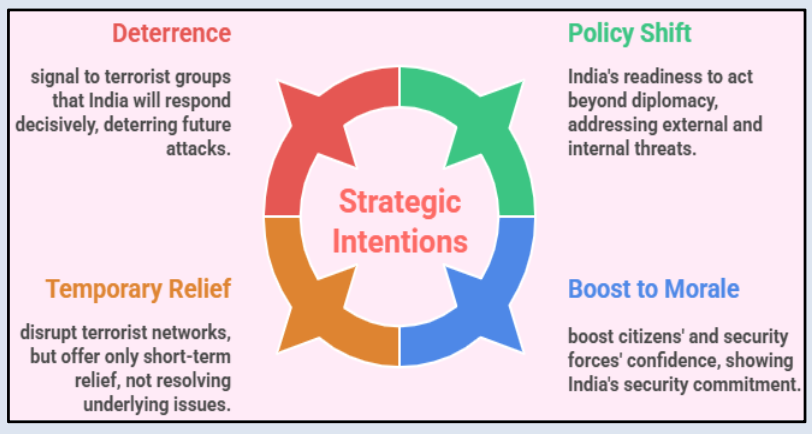
- Strategic Approaches in India’s Internal Security
- The strategic responses, such as covert operations, pre-emptive strikes, and surgical strikes, play a vital role in India’s counterterrorism strategy, complementing broader efforts to safeguard national security and maintain regional stability.
- Covert Operations:
- Secret missions conducted to achieve objectives without direct attribution or open involvement by the state. These operations are designed to remain undetected and achieve strategic goals.
- Pre-emptive Strikes:
- Attacks launched to neutralize imminent threats before they can result in harm, preventing attacks before they occur.
- Hot Pursuit:
- A military or law enforcement action where forces chase and attack terrorists or criminals across borders without waiting for permission, often in response to an ongoing threat.
- Surgical Strikes:
- Carefully planned, targeted attacks, typically on terrorist camps or specific threats, designed to minimize collateral damage while achieving precise objectives.
- 3.1.4. The Modern Playbook of Terrorism- New Threats and Emerging Challenges
-
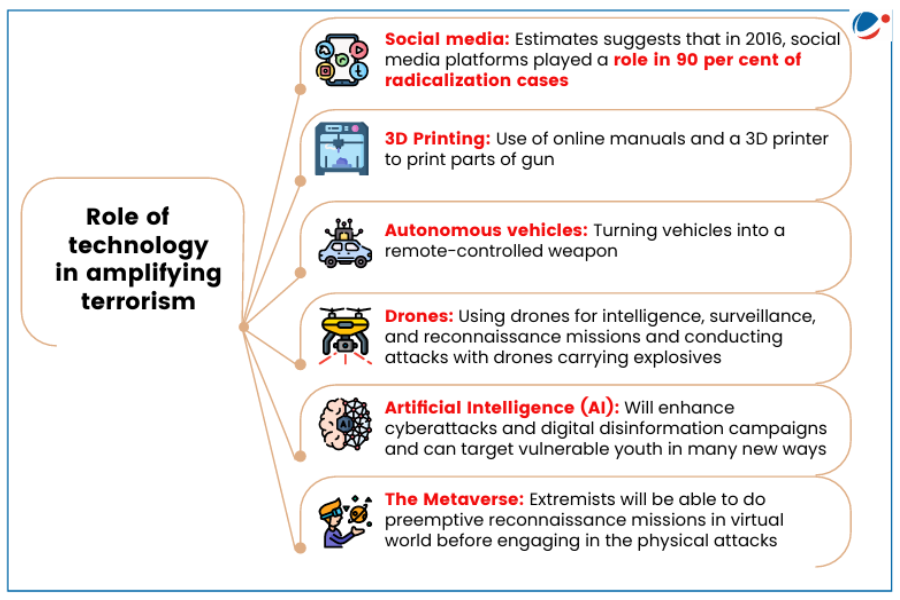
- Terrorism today has transformed into a global, fast-moving threat. It no longer relies solely on traditional methods. Modern terrorists have adopted a sophisticated playbook that leverages technology, exploits urban vulnerabilities, and blurs the lines between crime, terror, and warfare.
- 3.1.4.1. Hybrid Threats- Technology as a Weapon
-
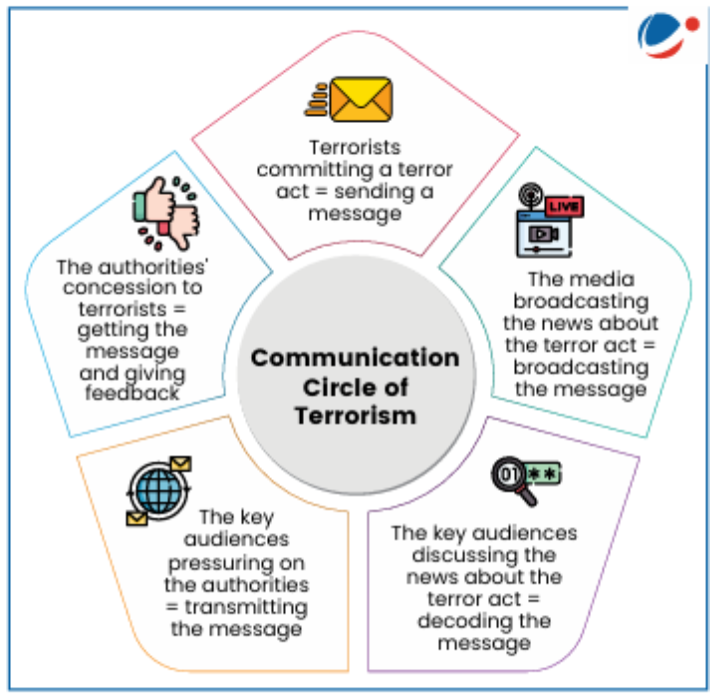
- Technology is the central nervous system of modern terrorism.
- The Digital Battlefield
- The digital domain has become a primary battleground for a new kind of war, with adversaries leveraging various tactics to destabilize societies. Terrorist organizations use digital tools for every aspect of their operations, turning the internet into a primary battlefield. The core principle is simple: a terror act is a message, and technology is the ultimate megaphone to broadcast that message to a global audience.
- Propaganda and Recruitment:
- Social media platforms and encrypted messaging apps are used to spread extremist ideology. High-quality videos, online magazines, and AI-generated content like deepfakes are used to justify violence, radicalize vulnerable youth, and recruit new members. It’s estimated that social media plays a role in up to 90% of radicalization cases.
- Financing and Planning:
- The internet makes it easy to raise and move funds through online payment systems, cryptocurrencies, and fundraising for seemingly legitimate charities. Encrypted communication allows terrorist cells across different continents to plan attacks securely.
- Training and Execution:
- Groups provide online manuals and instructional materials for everything from bomb-making to counter-intelligence and hacking.
- Use of Social Media for Disinformation and Psychological Warfare:
- Weaponizing information:
- Adversaries are using social media platforms to run coordinated disinformation campaigns, spread fake news, and propagate divisive narratives.
- Psychological warfare:
- These tactics aim to create social discord, undermine trust in state institutions, and polarize society, weakening the national fabric from within.
- Cross-border Cyber Attacks on Critical Information Infrastructure (CII):
- Cyber threats:
- State-sponsored hackers and cyber-terrorists pose significant risks to India’s Critical Information Infrastructure (CII), which includes sectors like banking, power grids, transport, and healthcare.
- The Challenge of Deepfakes and AI-generated Content:
- Emerging technologies:
- The rise of Artificial Intelligence (AI) has introduced new threats, including deepfakes—AI-synthesized videos or audio that can create highly convincing but false content.
- Impact:
- These can be used for sophisticated propaganda, defaming public figures, or fabricating false evidence to incite social unrest, making it increasingly difficult to distinguish fact from fiction.
- The Drone/UAV Threat
- The use of low-cost, commercially available Unmanned Aerial Vehicles (UAVs) or drones has added a new and dangerous dimension to cross-border threats.
- Use of Drones for Cross-border Smuggling
- Adversaries, particularly from Pakistan, are increasingly using drones to smuggle arms, ammunition, and narcotics across the border into Punjab and Jammu & Kashmir.
- The small size and low flight altitude of these drones make them difficult to detect using conventional radar systems, allowing them to operate with relative ease.
- The Potential for Weaponized Drones
- Beyond smuggling, there is a growing threat of drones being weaponized.
- Drones can be modified to carry Improvised Explosive Devices (IEDs), posing a significant risk to security installations, critical infrastructure, and public gatherings, as demonstrated in conflict zones worldwide.
- India’s Initiatives to Tackle Drone Threats
- Counter Drone System (D4 System):
- Developed by DRDO and Bharat Electronics, the D4 system detects, tracks, and neutralizes micro/small UAVs.
- Anti-Rogue Drone Technology Committee (ARDTC):
- Ministry of Home Affairs established ARDTC to evaluate, certify counter-drone technologies, ensuring effectiveness in dealing with rogue drone threats.
- Deployment of Anti-Drone Systems at Borders:
- D4 systems and Netra drones are deployed along Indo-Pak and Jammu & Kashmir borders to counter smuggling and terrorist drone activities.
- Detailed Vulnerability Mapping:
- Vulnerability mapping along the Indo-Pak border uses specialized vehicles, infrared sensors, and cameras.
- National Counter-Rogue Drone Guidelines (2019):
- National Counter-Rogue Drone Guidelines provide a framework for drone detection, registration, and issuing Unique Identification Numbers (UINs) for regulation.
- Very Short Range Air Defence System (VSHORAD):
- VSHORAD is an indigenous missile system designed to intercept and destroy low-altitude aerial threats, including drones, like SAMAR-1 and Igla-S.
- Asymmetric warfare using Low cost Drones
-
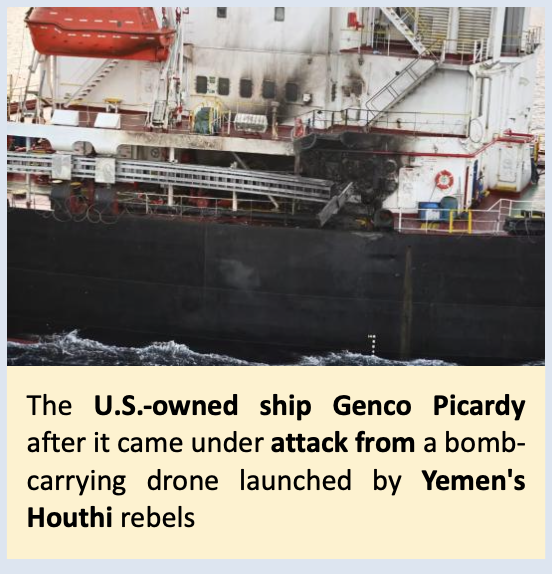
- Low-cost drones have completely changed the rules of modern warfare for instance:
- Houthi rebels used cheap drones to successfully attack a U.S. ship, forcing the American military to spend over a billion dollars on expensive missiles just to shoot them down.
- In the Ukraine war, simple commercial drones fitted with grenades are being used for deadly attacks and reconnaissance against advanced armies.
- This creates a huge problem for powerful militaries, which are built to fight other big nations, not swarms of inexpensive drones. To counter this, countries are now racing to develop cheaper, cost-effective counter-drone solutions.
- Drone Warfare During Operation Sindoor
-
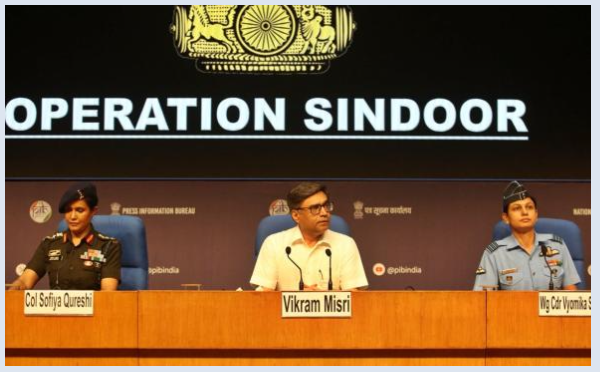
- During the conflict surrounding Operation Sindoor, drones became the main weapon for both India and Pakistan. This was the first time unmanned systems played such a central and coordinated role in a conflict between the two nuclear-armed neighbors, marking a new chapter in modern warfare.
- India’s Drone-Led Offense
-
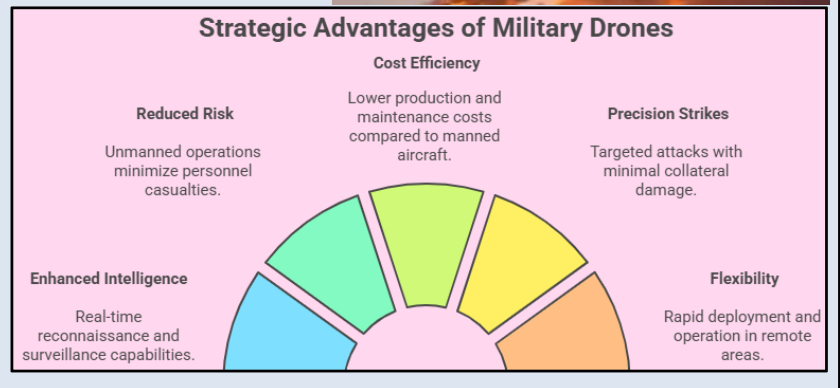
- From the very beginning of Operation Sindoor, India integrated drones into its attack plans. The initial strikes on terror camps were supported by loitering munitions (also called kamikaze drones) to ensure precision and effectiveness.
- The initial assault included the use of SkyStriker suicide drones, which carry a 10kg warhead.
- As the conflict escalated, India retaliated against Pakistani aggression by using advanced Israeli-made Harop drones to destroy key Pakistani air defence and radar sites.
- Pakistan’s Mass Drone Counter-Attack
- Pakistan’s response, named Operation Bunyan al-Marsus, was a massive drone-led assault.
- In a major offensive between May 8th and 9th, Pakistan launched an estimated 300-400 drones from 36 different locations.
- These were likely Turkish-made Asisguard Songar drones and were used to target Indian military installations across a wide area, including in Jammu & Kashmir, Punjab, Rajasthan, and Gujarat.
- The Defensive Battle
- To defend against this large-scale drone attack, India activated its Integrated Counter-UAS (Unmanned Aerial Systems) Grid. This created a powerful, multi-layered defensive shield using a combination of systems:
- The Russian S-400 Triumf long-range system.
- India-Israel jointly developed Barak-8 MRSAM.
- The indigenous Akash missile system.
- India also used its own Harpy drones in a counter-attack role.
- This drone war highlights a major shift in modern conflict. Both countries used drones as a less risky first step than sending manned jets, allowing them to test each other’s defenses.
- India’s efforts to combat drone threats include public awareness campaigns in border areas, encouraging citizens to report suspicious activities, and international collaboration for intelligence sharing. To further enhance security, India could invest in advanced drone detection systems, establish dedicated drone response units, improve regulatory frameworks, and increase research and development for innovative anti-drone technologies, ensuring comprehensive defense against evolving drone threats.
-

- 3.1.4.2. Shifting Battlegrounds- From Borders to Cities and Individuals
- While border regions remain volatile, the focus of modern terrorism has increasingly shifted to cities and towns, a phenomenon known as Urban Terrorism.
- Why Cities are Prime Targets:
- Anonymity and Logistics:
- The diverse and dense population of cities provides anonymity, making it harder to detect terrorists. Logistical needs like transportation, communication, and arms are also more readily available.
- High-Impact Targets:
- Cities contain critical infrastructure, mass gatherings, and symbolic landmarks. Attacking these maximizes casualties and media attention, spreading fear more effectively. The 2008 Mumbai attacks are a classic example of a coordinated urban terror assault.
- Media Amplification:
- With a heavy concentration of print and electronic media, cities guarantee that the “propaganda by the deed” is broadcast instantly and widely.
- Lone Wolf Terrorism in India- Coimbatore & Bengaluru Cases
-
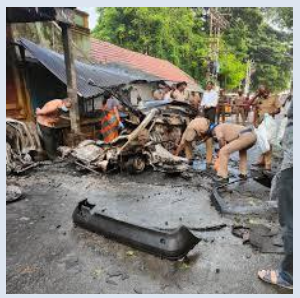
-
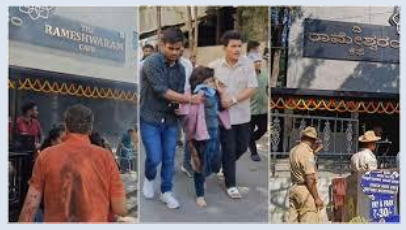
- India is facing a growing threat from lone wolf terrorism, where individuals, radicalized in isolation, carry out attacks on their own.
- Recent incidents like the Coimbatore car explosion (October 2022) near a temple and the IED blast at Bengaluru’s Rameshwaram Cafe (March 2024) highlight this dangerous trend. In both cases, a single attacker operated with minimal external support, using homemade bombs to target civilians.
- These lone wolf attackers are a major challenge because they are incredibly difficult to detect. Fueled by online extremist content, they operate without a group, making them elusive yet dangerous to internal security.
- 3.1.4.3. The Invisible Ecosystem of Terror- Over-Ground Workers and Sleeper Cells
- 1. Over-Ground Workers (OGWs)
-
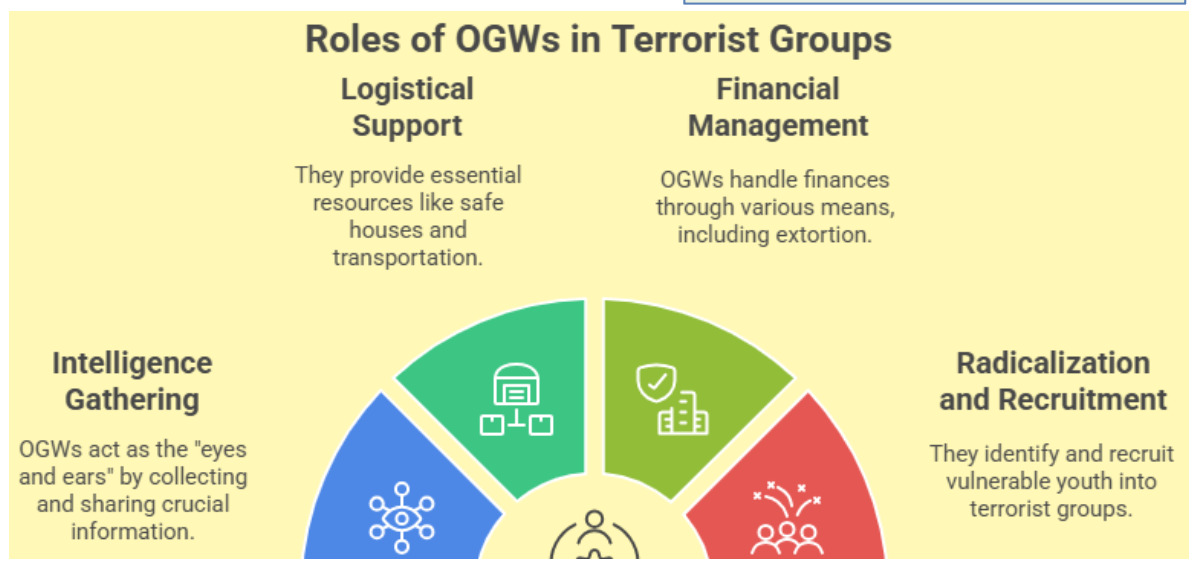
- The network of Over-Ground Workers (OGWs) is the invisible logistical and ideological backbone that sustains terrorism and insurgency on the ground.
- OGWs as the “Eyes and Ears” and Logistical Backbone
- OGWs are not armed combatants, but they are essential for the survival and operations of terrorist organizations. Operating under civilian cover, they act as the “lifeline” for these groups, linking underground cadres with the local population. Their covert nature makes them difficult to identify and prosecute.
- Pulwama’s (2019) Hidden Facilitators- The OGW Network
-
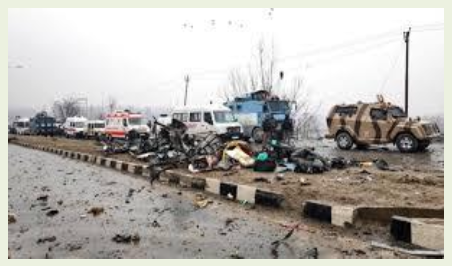
- The 2019 Pulwama attack unequivocally highlighted the critical role of Over-Ground Workers (OGWs).
- Investigations into this specific incident confirmed OGWs, the logistical backbone for terrorists, provided the explosives-laden car and crucial support like shelter for the perpetrators.
- 2. Sleeper Cell
- A sleeper cell is a hidden group of terrorists or spies who live normal, unnoticed lives within a community. They remain inactive for years until they are “activated” by overseas handlers to carry out attacks, gather intelligence, or provide support for operations.
- Delhi ISI Sleeper Cell (2025):
- Delhi Police arrested two ISI agents, including a Nepali national, for leaking sensitive military information to Pakistan.
- ISIS Sleeper Cell in Pune (2023–2025):
- NIA arrested two radicalized Indians linked to an ISIS module that conducted bomb-making workshops and planned terror attacks.
- These sleeper cells are extremely difficult to detect because their members blend in so well with the local population. They often use encrypted communication and engage in long-term planning, posing a serious and widespread challenge to India’s internal security.
- 3.1.4.4. The Blurring Lines- Grey-Zone Warfare
-
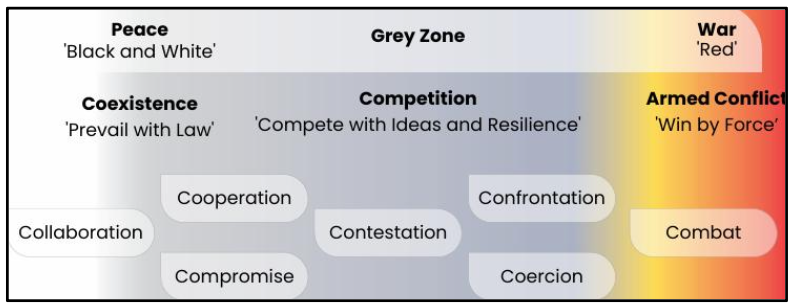
- One of the most complex challenges today is Grey-Zone Warfare, which involves the use of unconventional tactics that fall just below the threshold of traditional war. The goal is to weaken an adversary without triggering a full-scale military response.
- Key Tools of Grey-Zone Warfare:
- Cyber Operations:
- Hacking critical infrastructure, such as the 2020 cyberattack on the power grid in Maharashtra.
- Information Warfare:
- Using propaganda, fake news, and social media manipulation to create social division and undermine trust in government.
- Economic Coercion:
- Imposing trade restrictions or manipulating markets to damage a target nation’s economy.
- Support to Proxy Forces:
- This is a classic tactic where a state supports non-state actors like insurgents or terrorists to fight on its behalf.
- Pakistan’s “Deep State” (influential elements within its military and intelligence agencies) has historically used terrorism as a foreign policy instrument, nurturing groups like Lashkar-e-Taiba (LeT) and Jaish-e-Mohammed (JeM) as strategic assets against India. This is a prime example of grey-zone conflict through proxy forces.
- 3.1.4.5. Evolving Threats- From Military Targets to Civilians in Jammu & Kashmir
- Over the past five years, Jammu & Kashmir (J&K) has witnessed a troubling shift in terrorism patterns, with increasing attacks on civilians and tourists. These incidents have primarily targeted religious minorities and non-local visitors, indicating a new strategy by militants to create communal divisions and disrupt the region’s economy, particularly tourism.
- Targeting Religious Minorities and Tourists
- Sectarian Attacks:
- Terrorists have deliberately targeted Hindu and Sikh minorities, as well as tourists visiting pilgrimage sites. The attacks often single out victims based on their religious identity, as seen in the 2025 Pahalgam massacre, where Hindu tourists were separated and executed based on religion.
- Tourism Under Attack:
- Tourism has been a frequent target, especially during the spring and summer months, a crucial time for the local economy. Attacks on hotels, pilgrimage convoys, and travel routes have been aimed at derailing efforts to revive tourism in the region.
-
| Year | Major Attack/Incident | Location | Target | Key Features |
|---|
| 2017 | Amarnath Yatra massacre | Anantnag, J&K | Hindu pilgrims (Amarnath Yatra) | Bus ambushed; 8 killed, 18 injured; LeT blamed |
| 2021 | Series of attacks on minorities | Various (J&K) | Minorities, migrant workers | Attacks near temples and transit points |
| 2024 | Reasi bus attack | Reasi district, Jammu | Hindu pilgrims | Ambush; bus plunged into gorge; 9 killed, 41 injured |
| 2025 | Pahalgam massacre | Pahalgam, Kashmir Valley | Hindu, Christian tourists | Religion-based segregation and killings; 26 killed |
- Geographic Shifts
- Increased Attacks in Jammu:
- While violence in the Kashmir Valley declined after 2019 due to increased security, there has been a rise in attacks in Jammu, which is known for its communal diversity. Militants exploit local tensions in this region, often time their attacks to disrupt political or religious events.
- Psychological and Communal Impact
- Psychological Warfare:
- Terrorists aim to generate fear and trauma by attacking civilians, especially tourists, to create communal polarization. The 2025 Pahalgam massacre exemplified this, with survivors being forced to narrate their traumatic experiences to political leaders, amplifying the communal message.
- Displacement and Fear:
- These targeted attacks have caused significant trauma to survivors, particularly those from outside Kashmir, leading many to reconsider their travel plans. This, in turn, affects both tourism and inter-community relations.
- 3.1.4.6. Mobilization of Diaspora for Terrorism
- Khalistan terrorism, which originated from the demand for a separate Sikh homeland in Punjab, has seen a resurgence due to diaspora support in recent years. While largely suppressed within India, the Khalistani movement has gained momentum abroad, primarily driven by online radicalization and funding from overseas Sikh communities.
- Diaspora-Led Radicalization and Funding
- Radicalization through Social Media:
- Khalistani extremist groups, such as Sikhs for Justice (SFJ), Babbar Khalsa International (BKI), and the World Sikh Organisation, use online campaigns, community centers, and social media to spread the separatist ideology and recruit youth, particularly from the Sikh diaspora.
- Funding Channels:
- These groups raise funds through international charities, community events, and donations, funnelling money into extremist activities in India.
- Global Pro-Khalistan Mobilization and Referendums
- Khalistan Referendums:
- SFJ and other pro-Khalistan groups have organized unofficial Khalistan referendums in several countries, particularly in Canada, the UK, and the US. These events aim to internationalize the Khalistan issue but have also sparked violent clashes with opposing communities.
- Canada’s Extremist Base
- The Canadian Security Intelligence Service (CSIS) officially confirms Khalistani extremists are actively using Canadian soil as a base. They engage in promotion, fundraising, and planning violence, primarily targeting India.
- This significant acknowledgement validates India’s long-standing concerns, highlighting an ongoing national security threat stemming from Canada-based extremist activities.
- Attacks on Indian Diplomatic Missions and Vandalism
- Vandalism and Protests Abroad:
- Pro-Khalistan activists have vandalized Indian embassies in cities like London, Ottawa, and San Francisco, desecrating the Indian flag and other symbols. Hindu temples in areas with large Sikh populations have also been targeted.
- Case Study- D-Company and ISI – A Snapshot of the Crime-Terror Nexus
- The growing convergence between organized crime and terrorism poses a serious threat to national security. This relationship exists along a crime-terror continuum, ranging from loose cooperation such as providing fake documents or transport, to complete confluence where criminal and terror operations overlap.
- A striking example is the 1993 Mumbai serial blasts, which illustrate a deadly collaboration between:
- D-Company, the crime syndicate led by Dawood Ibrahim, which used its smuggling networks to bring RDX via the coast and arrange logistics for the attack.
- Pakistan’s ISI, a state sponsor of terrorism, which provided financial backing, training, and operational guidance.
- This partnership reveals how organized crime syndicates enable terrorism, offering access to illegal finance channels (like hawala), arms smuggling routes, and safe movement for operatives.
- We discuss this nexus in detail in the later unit- “Linkages with Internal Security- Crime-Terror Nexus.”
- 3.1.5. India’s Multi-Pronged Counter-Strategy to Terrorism
- To combat this complex and evolving threat matrix, India has adopted a dynamic and multi-pronged counter-strategy that integrates diplomatic, legal, security, and financial measures.
- Diplomatic and Political Measures
- India has adopted several diplomatic and political strategies to counter terrorism.
- Isolating State Sponsors of Terrorism:
- India has consistently worked to expose and isolate states that sponsor terrorism, with a particular focus on Pakistan. Through sustained diplomatic efforts at global forums such as the United Nations, India successfully pushed for Pakistan’s inclusion on the FATF “grey list,” curbing its financial channels for terrorism.
- Pushing for CCIT:
- India continues to advocate for the Comprehensive Convention on International Terrorism (CCIT) at the United Nations. The goal of CCIT is to establish a universal legal framework that criminalizes all forms of international terrorism and cuts off the resources that sustain such networks.
- Bilateral and Multilateral Security Cooperation:
- India has strengthened cooperation with like-minded nations through both bilateral agreements and multilateral platforms such as the QUAD and the Shanghai Cooperation Organisation (SCO). Within the SCO, the Regional Anti-Terrorist Structure (RATS) plays a vital role in promoting coordination and intelligence-sharing among member states.
- Strengthening the Legal and Investigative Framework
- To counter terrorism effectively, India has fortified its legal and investigative institutions.
- Strengthening Anti-Terror Laws:
- The Unlawful Activities (Prevention) Act (UAPA) was amended in 2019 to empower the government to designate not just organizations but also individuals as terrorists. Similarly, amendments to the NIA Act now allow the National Investigation Agency (NIA) to investigate terror crimes committed even outside India.
- Empowering the NIA:
- The NIA has evolved into the premier agency for probing terror-related crimes, especially those involving interstate and international linkages, ensuring a unified national response to terrorism.
- Upgrading Security and Intelligence Architecture
- India has undertaken major steps to modernize and integrate its security apparatus.
- Enhancing Border Management:
- The Comprehensive Integrated Border Management System (CIBMS) has been implemented to create a technologically advanced “smart fence” along sensitive borders. Additionally, fencing projects along the Indo-Myanmar border aim to curb cross-border infiltration and smuggling.
- Strengthening Intelligence Sharing:
- The National Intelligence Grid (NATGRID) has been operationalized to provide centralized access to security data for authorized agencies. The Multi-Agency Centre (MAC) has been revamped to ensure real-time intelligence sharing between national and state-level security entities.
- Proactive Military and Security Doctrines
- India has shifted towards a proactive security posture, abandoning a purely defensive approach. This change is reflected in the Surgical Strikes (2016) and the Balakot Airstrike (2019), both aimed at dismantling terror infrastructure across the border, signaling India’s resolve to retaliate decisively against terrorist provocations.
- Countering Illicit Financial Flows
- Recognizing that terrorism thrives on financial networks, India has taken decisive measures to choke the flow of illicit money.
- Choking Terror Financing and Money Laundering:
- Stringent enforcement of the Prevention of Money Laundering Act (PMLA) and enhanced financial surveillance mechanisms have been put in place to dismantle terror funding pipelines.
- Role of FIU and NMFT:
- The Financial Intelligence Unit (FIU-IND) plays a key role in analyzing and disseminating financial intelligence. India has hosted the “No Money for Terror” (NMFT) Ministerial Conference to disrupt global terror financing networks. Furthermore, a specialized Terror Funding and Fake Currency (TFFC) Cell within the NIA conducts focused investigations into terror financing and counterfeit currency cases.
- FATF’s Grip- Economic Pressure on Terror Financing
- Financial Action Task Force (FATF) is an intergovernmental organization founded in 1989 on the initiative of the G7 to develop policis to combat money laundering and to maintain certain interest. In 2001, its mandate expanded to include terrorism financing.
-
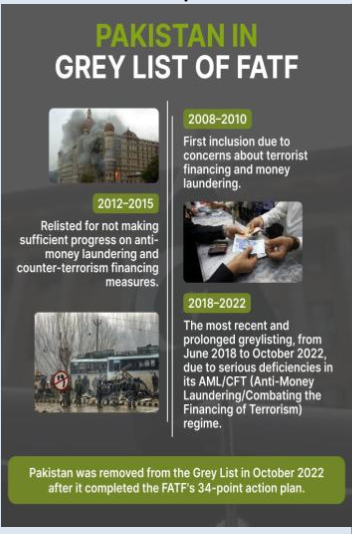
- FATF’s grey-listing (2018-2022) inflicted substantial economic pain on Pakistan, estimated at $38 billion.
- Under this international pressure, Pakistan notably convicted Hafiz Saeed on terror financing charges.
- Despite China providing a diplomatic shield, this case exemplifies how global financial pressure can compel states to act against terrorist financing. It underscores FATF’s powerful role in international security.
- Cutting Terror Funds- Hawala to Crypto
- India’s FIU-IND actively combats terror financing via Hawala crackdowns, freezing significant funds (e.g., ₹1,200 cr scale in 2022-23) and initiating PMLA cases.
- However, crypto-financing presents a crucial, evolving unregulated gap. This highlights the continuous challenge of disrupting illicit financial flows for terrorism across new digital channels.
- Operation Sindoor
-
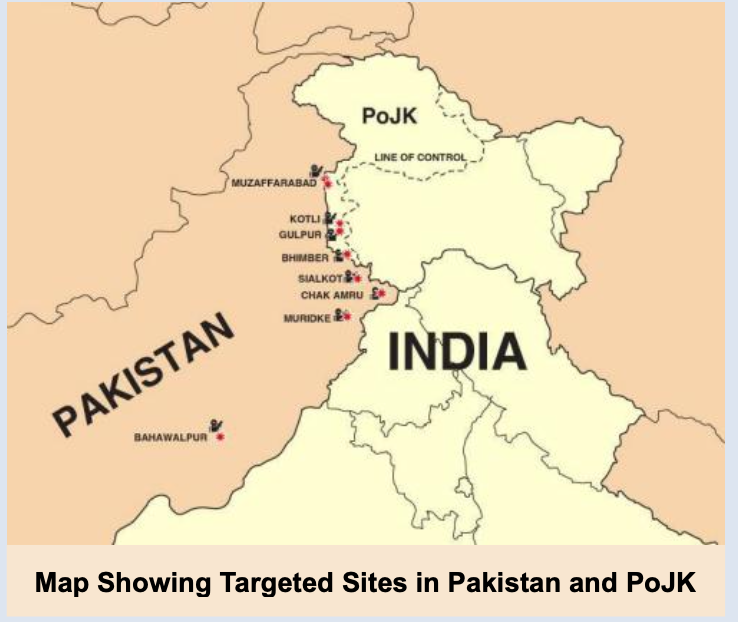
- Operation Sindoor, launched in May 2025, was a significant military campaign in response to the Pahalgam terror attack. This operation marked a pivotal shift in India’s national security strategy, transitioning from a longstanding policy of strategic restraint to a more assertive and proactive security posture.
- In this operation, Indian fighter jets used advanced stand-off weapons, launching their attack from within India’s own territory.
- They relied on two main systems:
- the SCALP, a stealthy cruise missile designed to hit targets deep inside enemy lines, and the HAMMER, a jam-proof, all-weather precision bomb.
- The mission also involved SkyStriker suicide drones, each capable of carrying a 10kg warhead.
- Key Highlights:
- End of Strategic Restraint:
- Operation Sindoor signified the end of India’s policy of strategic restraint, marking a shift to a more assertive security approach. This new approach clearly established “redlines,” declaring state-sponsored terrorism as an act of war and rejecting the use of nuclear blackmail.
- Operation Sindoor showcased the Cold Start Doctrine in action, with India launching swift, precise conventional strikes inside Pakistan in response to terror attacks, without triggering nuclear escalation.
- Commitment to Decisive Retaliation:
- The operation demonstrated India’s readiness to take decisive retaliatory action, targeting terror infrastructure across Pakistan. The campaign included military and non-kinetic actions aimed at weakening terrorist networks.
- In a recent statement, India’s National Security Advisor confirmed that the military had identified and struck 9 terror-related targets across the border, successfully eliminating all without a single failure.
- Imposing Tangible Costs on Pakistan:
- The operation underscored India’s commitment to imposing tangible costs on Pakistan for its role in sponsoring terrorism, reshaping regional security dynamics.
- India launched precision strikes on 11 Pakistani airbases—including Nur Khan, Sargodha, Bholari, and Skardu—and simultaneously destroyed major terror infrastructure across Muzaffarabad, Kotli, Rawalakot, and Bagh, including the demolition of Masjid wa Markaz Taiba in Muridke (LeT HQ) and Jamia Masjid Subhan Allah in Bahawalpur (JeM HQ).
- Surgical Strike (2016)
- A few years earlier, in September, 2016, the Indian Army carried out a surgical strike in direct response to a terrorist attack by Pakistan-based militants on an Indian Army camp in Uri, Jammu & Kashmir, on September 18, 2016, which resulted in the deaths of 19 Indian soldiers.
- India launched a coordinated military operation across the Line of Control (LoC) into Pakistan-occupied Kashmir.
- Elite Indian Special Forces targeted multiple terrorist launch pads, where militants were preparing to infiltrate into Indian territory.
- The operation, called a “surgical strike” by the Indian government, was highly precise, limited in scope, and designed to avoid escalating the situation while showing India’s ability to respond decisively against cross-border terrorism.
- By publicly owning the operation, India shifted its defense stance from strategic restraint to a more assertive approach towards Pakistan’s use of terror groups as proxies in Kashmir. The surgical strike sent a strong political and military message to Pakistan, signaling that India would act decisively to defend its sovereignty and would no longer tolerate cross-border terrorism.
- India’s 5 Point Non-military Measure against Pakistan after Pahalgam Attack
- India’s national security strategy has evolved sharply in response to cross-border terror attacks like the Uri strike (2016) and Pulwama bombing (2019), both linked to Pakistan-based groups such as Jaish-e-Mohammed (JeM) and Lashkar-e-Taiba (LeT). Post-2016 Uri Attack and 2019 Abrogation of Article 370, India’s approach has become more assertive, with actions like the surgical strikes (2016), Balakot Airstrikes (2019) and Operation Sindoor (2025), marking a shift from restraint to ‘deterrence by punishment’, holding terrorists and their state sponsors directly accountable.
- Unlike earlier responses, Operation Sindoor was followed by a 5-point non-military strategy:
- Suspension of the Indus Waters Treaty:
- India has suspended the 1960 Indus Waters Treaty with Pakistan, halting river water sharing until Pakistan ends its support for cross-border terrorism.
- Closure of Attari-Wagah Border Check Post:
- India has shut the Attari-Wagah border, halting cross-border movement of people and goods, except for those with valid documents, who can return by May 1, 2025.
- Cancellation of SAARC Visa Exemption Scheme (SVES):
- Background
- The SAARC Visa Exemption Scheme (SVES) is an initiative launched under the South Asian Association for Regional Cooperation (SAARC) to facilitate easier movement of people among the member states — Afghanistan, Bangladesh, Bhutan, India, Maldives, Nepal, Pakistan, and Sri Lanka.
- The exemption is not for all citizens, but for specific categories of individuals who are seen as contributors to regional connectivity and diplomacy like diplomats, gov. officials, journalists, sports persons, cultural delegates, etc
- India has revoked the SAARC Visa Exemption Scheme for Pakistani nationals, canceling all issued visas and giving a 48-hour deadline for those in India to leave.
- Expulsion of Pakistani Military Advisors:
- India has expelled all Pakistani military, naval, and air advisors from the High Commission in New Delhi, with a reciprocal withdrawal of Indian military advisors from Islamabad.
- Reduction of Diplomatic Personnel:
- India will reduce its diplomatic staff in Islamabad to 30 by May 1, 2025, down from 55, further limiting bilateral engagement.
- Together, these actions will ensure a more comprehensive and lasting impact of India’s response.
-
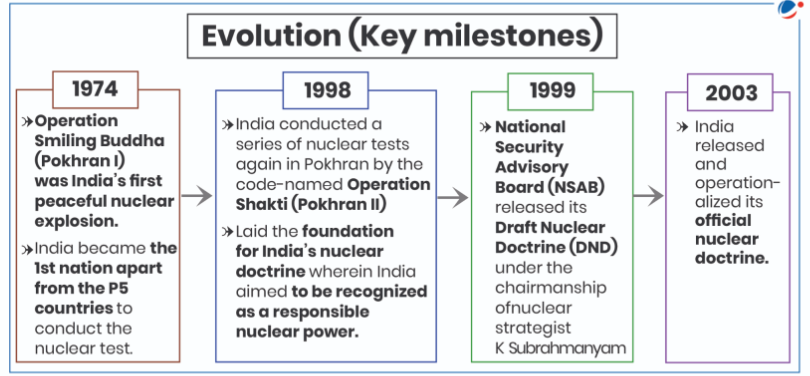
- India’s Nuclear Doctrine and Operation Sindoor- Evolving Policies and Responses
-
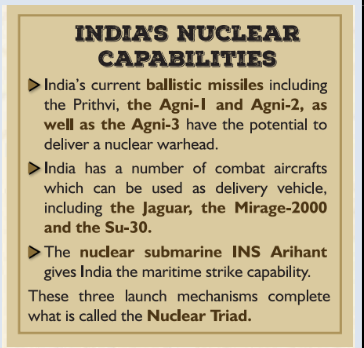
- India’s Nuclear Doctrine is based on Credible Minimum Deterrence (CMD) and a commitment to No First Use (NFU)—meaning nuclear weapons will be used only in retaliation to a nuclear attack. In such a case, India promises Massive Retaliation, ensuring Mutually Assured Destruction (MAD) to deter first use by adversaries.
- It also pledges non-use against non-nuclear weapon states, reinforcing India’s image as a responsible nuclear power. However, India reserves the right to respond with nuclear weapons in the event of chemical or biological attacks.
- The doctrine is controlled by the Nuclear Command Authority (NCA):
- The Political Council, chaired by the Prime Minister, authorises use.
- The Executive Council, led by the NSA, executes the order.
- Following recent terror attacks emanating from Pakistan (Uri till Pathankot), there have been strong calls to review the doctrine, especially the NFU policy. The turning point in this doctrine came with Operation Sindoor, where India launched swift conventional action despite Pakistan’s nuclear threats.
- Although the doctrine hasn’t been officially updated, many analysts noted that India “called off the nuclear bluff” — challenging Pakistan’s assumption that it could use tactical nuclear threats to shield terrorism or proxy warfare. Some commentators argued that Op Sindoor effectively neutralised Pakistan’s preemptive strike posture, without breaching India’s public nuclear stance.
- Israel’s Integrated Security Model
- The “Whole-of-Government” approach emphasizes integrated, collaborative security efforts. Israel’s National Security Council exemplifies this as a best practice model, merging Mossad, IDF, and cyber units.
- This seamless integration ensures comprehensive coordination across intelligence, military, and digital domains. It’s crucial for swift, unified responses to complex national security challenges, demonstrating effective strategic synergy.
- 4. Addressing India’s Evolving and Interconnected Security Challenges
- “Security is not a department; it is a culture.” – K. Subrahmanyam
- India’s security challenges are multifaceted and interconnected, requiring a comprehensive and coordinated approach to safeguard its sovereignty and stability.
- Addressing the Interconnected Nature of External Threats
- India’s security challenges are deeply interconnected, involving hostile state actors, violent non-state actors, and organized crime syndicates.
- New domains like cyberspace and information warfare amplify traditional threats, creating a complex security environment.
- Adopting a Dynamic, “Whole-of-Government” Approach
- A static or siloed response is ineffective. India must implement a dynamic strategy, requiring seamless coordination among various agencies such as the Home Affairs, Defence, External Affairs, and financial intelligence agencies.
- The approach should integrate diplomatic, military, and internal security responses to address evolving threats.
- Building National Resilience
- Strengthening India from within is crucial. This involves economic development, social cohesion, and reinforcing democratic institutions to ensure all citizens feel secure.
- A strong, united, and prosperous India is the best defense against external threats undermining its stability.
- Side note
- Israel's Integrated Security Model
- The "Whole-of-Government" approach emphasizes integrated, collaborative security efforts. Israel's National Security Council exemplifies this as a best practice model, merging Mossad, IDF, and cyber units.
- This seamless integration ensures comprehensive coordination across intelligence, military, and digital domains. It's crucial for swift, unified responses to complex national security challenges, demonstrating effective strategic synergy.
- 4.1. National Security Strategy- India’s Urgent Need
- An NSS is a concise summary (formal policy document) of a country’s strategic vision and objectives, encompassing both domestic and external challenges. It addresses traditional and non-traditional threats and opportunities, and is updated periodically to remain relevant to evolving security dynamics.
- Why does India need a written National Security Strategy?
- Lack of Written Policy & Continuity in Defence Planning:
- India’s National Security Strategy (NSS) relies on the 2009 Raksha Mantri’s operational directive, which remains outdated. The absence of 5-year and long-term defence plans adds urgency to formalizing an updated, coherent NSS for strategic consistency.
- Meet Changing Security Dynamics & Framework for Long-term Planning:
- A written NSS would ensure regular reviews of global security trends and evolving threats like hybrid warfare and Chinese naval growth, fostering long-term planning while avoiding short-term, ad-hoc decisions on national security issues.
- Strategic Signaling in World Order:
- An NSS will clarify India’s strategic intent, solidify its role as a security provider in the Indian Ocean, and strengthen cooperation with international partners, highlighting India’s commitment to global security.
- Operational Clarity & Reduce Ambiguity:
- An NSS will provide operational clarity on key decisions such as delegation and theatre command operationalization, reducing ambiguity and enabling accountability, serving as a reference for think tanks to assess and refine security strategies.
- Adopt Whole of Nation Approach:
- A well-defined NSS will build synergy among national institutions, effectively coordinating operations to leverage comprehensive national power in addressing multi-dimensional security challenges.
- Challenges in Codifying NSS in India
- Lack of Political Will
- Political consensus on national security issues is lacking, and concerns over accountability, along with limited expertise on defence matters, have hindered the formulation of a formal National Security Strategy (NSS).
- Loss of Strategic Flexibility
- Implementing an NSS would lock the political leadership into a specific approach, whereas ad-hoc policymaking allows flexibility, similar to how Israel operates without a formalized NSS.
- Resource Allocation
- Effective implementation of the NSS requires adequate financial resources, human resources, and capability-building to meet its objectives, which has been a challenge in India.
- Weak Institutional Support and Policy Feedback
- India has only a few defence and security think-tanks, leading to a lack of strong institutional support and policy feedback, which limits the effectiveness of the National Security Strategy.
- India’s Previous Steps Taken to Draft NSS
- The Kargil Review Committee Report (2000):
- It provided recommendations on national security, but did not lead to immediate National Security Strategy (NSS) formulation.
- The Naresh Chandra Committee on Security (2011):
- Facilitated comprehensive security reforms discussions, but failed to drive the actual development of a formal NSS.
- The Defence Planning Committee (2018):
- Chaired by the National Security Advisor, this permanent body is tasked with preparing a draft National Security Strategy.
- Hooda Committee (2018):
- The Hooda Committee was formed to propose a comprehensive National Security Strategy to address evolving security challenges and enhance India’s defense capabilities. It suggested tenets for the draft NSS, such as global role, neighbourhood stability, internal peace, economic security, and strengthening capabilities in maritime borders, space, and strategic communications.
-

- National Security Strategy (NSS) should outline clear ends, ways, and means, leveraging delegation, synergy, and operational freedom. It should encourage initiative, innovation, and improvisation at the cutting-edge level.
- The Doval Doctrine- India’s Assertive Security Paradigm
- The Doval Doctrine, developed by National Security Adviser Ajit Doval, represents a shift from passive restraint to a proactive, decisive, and pre-emptive approach in India’s security strategy. It emphasizes national defense, counter-terrorism, and strategic deterrence, based on Doval’s experience in counter-insurgency and intelligence.
- Key Tenets of the Doval Doctrine
- Proactive National Defense:
- India reserves the right to act offensively to neutralize threats, as seen in the 2016 surgical strikes and 2019 Balakot airstrikes.
- Defensive-Offense Strategy:
- A graduated response spectrum from defensive to offensive, signaling strong retaliation.
- Zero Tolerance Towards Terrorism:
- Terrorism and its sponsors are equally targeted, with an uncompromising response to all forms of cross-border terrorism.
- Whole-of-Government Approach:
- Military, intelligence, police, and diplomatic arms coordinate in a unified strategy.
- Psychological and Informational Warfare:
- Doval’s doctrine includes countering radical narratives and waging information wars.
- Security and Development Integration:
- Combining security operations with development initiatives, particularly in Kashmir and Left-Wing Extremism.
- No Compromise on Sovereignty:
- India’s sovereignty and territorial integrity are non-negotiable, particularly against expansionist threats.
- Doctrine in Action
- 2016 Surgical Strikes & 2019 Balakot Airstrikes:
- Decisive actions in response to cross-border terrorism.
- Abrogation of Article 370 (2019):
- Integration of Jammu & Kashmir using both hard and soft power.
- Crackdown on Radical Groups:
- Operations against extremist funding and support networks.
- China Standoff:
- Forward deployment and muscular diplomacy against China’s expansionism.
UNIT 3- CHALLENGES TO INTERNAL SECURITY THROUGH COMMUNICATION NETWORKS, BASICS OF CYBER SECURITY AND ROLE OF MEDIA AND SOCIAL NETWORKING SITES IN INTERNAL SECURITY CHALLENGES
- "Cyberspace is the fifth domain of warfare, alongside land, sea, air, and space." – General Bipin Rawat, India’s first Chief of Defence Staff
- 1. Communication Networks and Cyberspace
-
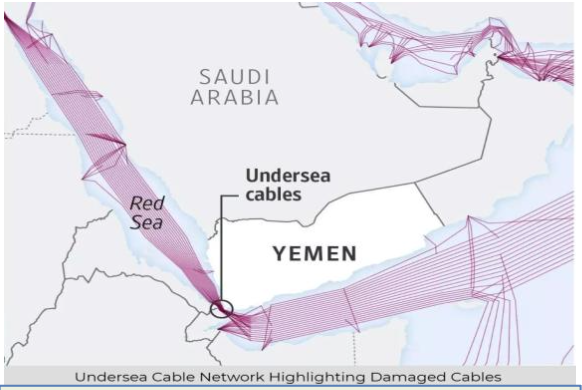
- The 21st century has introduced cyberspace and communication networks as critical domains of conflict, essential to national security. This digital ecosystem, comprising both physical and intangible infrastructure, has become a key driver of progress and a significant vector for internal security threats.
- Communication Networks
- Communication networks form the backbone of cyberspace, comprising both tangible and intangible infrastructure:
- Physical Infrastructure:
- Includes optical fiber cables, undersea cables, and satellites that connect global communication systems.
- Wireless Infrastructure:
- Covers cellular networks (from 2G to 5G), Wi-Fi, and other radio-based systems facilitating wireless communication.
- Hardware and Software:
- Includes routers, servers, mobile devices, and the protocols governing their interactions.
- Emerging Technologies:
- The Internet of Things (IoT), which links a vast network of interconnected sensors and devices.
- Cyberspace
-
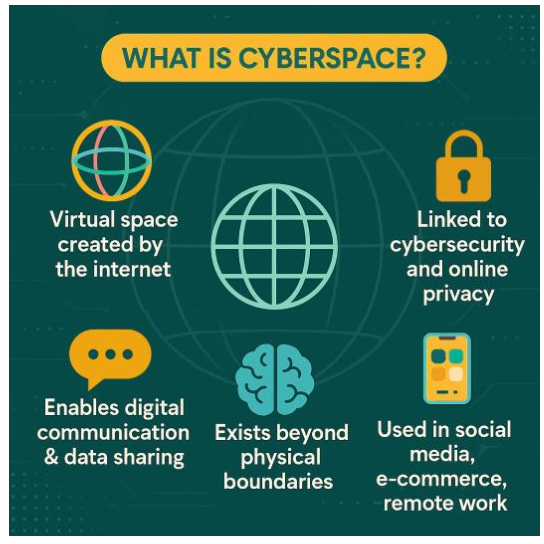
-
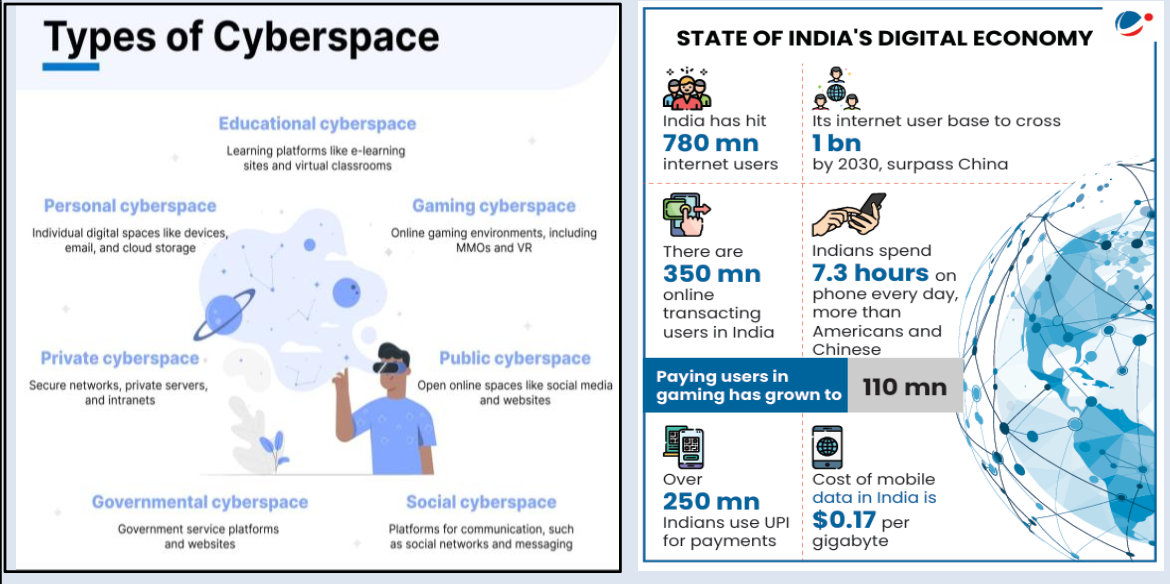
- Defined by India’s National Cyber Security Policy (2013), cyberspace is described as a "complex environment" involving interactions between people, software, and services supported by global ICT networks.
- Cyberspace is a global domain consisting of interconnected networks, computer systems, and embedded processors. Unlike traditional physical domains, cyberspace is borderless, intangible, and offers anonymity to actors, making it incredibly difficult to defend against malicious activities.
- This evolving digital landscape presents significant challenges to national security, requiring robust strategies to safeguard communication networks and cyberspace.
- Undersea Cables- Global Internet's Fragile Lifelines
- In 2024, damage of undersea cables in the Red Sea disrupted 25% of data traffic between Europe and Asia. This authentic incident exposed critical vulnerabilities in global internet infrastructure.
- Such physical threats to vital communication networks pose a significant cybersecurity challenge. Protecting these fragile lifelines is crucial for maintaining global connectivity and economic stability.
- 1.1. Criticality of Communication Networks for National Security
-
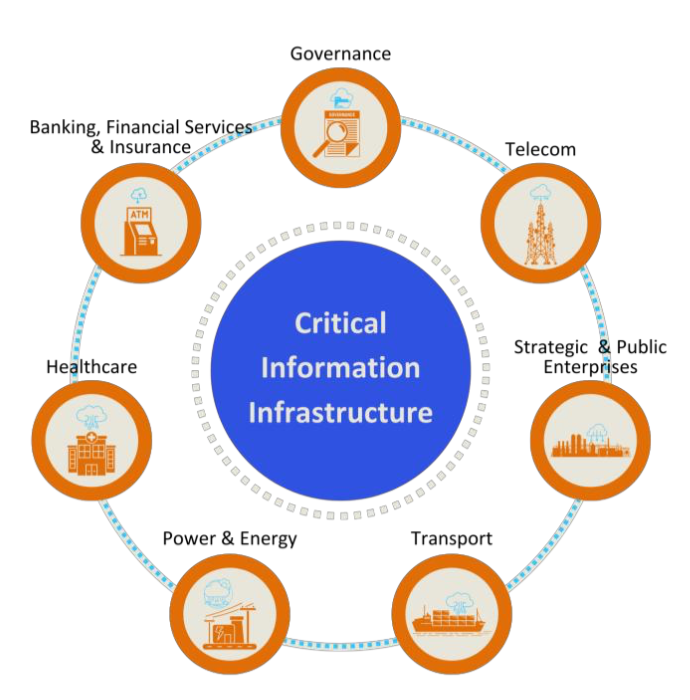
- The increasing integration of communication networks into every aspect of modern life has made them essential for national functioning. As a result, these networks have become high-value targets for adversaries seeking to disrupt national security.
- Networks as Critical Information Infrastructure (CII)
- Under Section 70 of India’s Information Technology (IT) Act, 2000, certain digital assets are designated as Critical Information Infrastructure (CII).
- CII is defined as "computer resources, the incapacitation or destruction of which, shall have a debilitating impact on national security, economy, public health, or safety."
- This official recognition highlights the paramount importance of securing these networks.
- Recently, the IT resources of ICICI Bank, HDFC Bank, and NPCI were declared as CII.
- Interdependence of National Sectors and the "Cascading Effect"
- Modern critical sectors such as finance, energy, banking, transport, healthcare, and defence are deeply interconnected and depend heavily on communication networks. A failure in one network can trigger a "cascading effect" across other sectors.
- For instance, a disruption in the communication network of the power grid could paralyze the banking system, transportation networks, and even emergency services, leading to widespread chaos.
- Importance for National Initiatives and Associated Vulnerabilities
- The success of major government initiatives like Digital India, Smart Cities Mission, and the expansion of e-governance is heavily reliant on a stable and secure digital ecosystem.
- India now has over 820 million active internet users, including a large proportion in rural areas. While this drives progress, it also vastly expands the attack surface, increasing the vulnerability of both the population and national infrastructure to cyber threats.
- The Current State of Cybersecurity in India
-
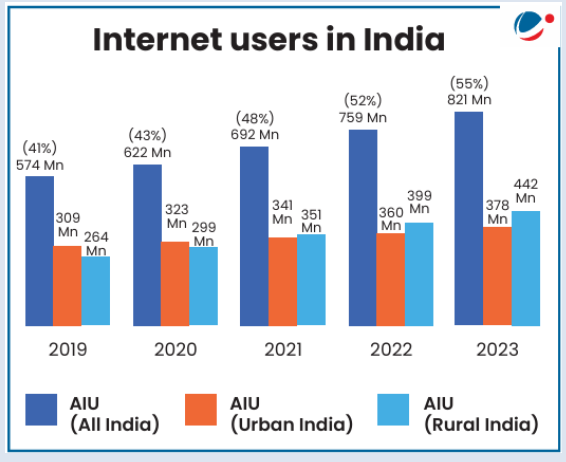
- India is rapidly becoming a digital society, with over 820 million active internet users today. More than half of these users, 442 million, are from rural areas, and the total user base is projected to cross 1 billion by 2030. While this massive growth, fueled by government programs like Digital India, drives progress, it also makes the country a prime target for cyber threats.
- The scale of the problem is alarming. According to the National Crime Records Bureau (NCRB), India saw a 24% rise in registered cybercrimes in 2022 compared to the previous year. The primary motive for these crimes is fraud, accounting for nearly 65% of all cases, followed by extortion (5.5%) and sexual exploitation (5.2%). Globally, a 2021 FBI report ranked India third in the world among the top 20 countries victimized by internet crimes. The intensity of these threats is also increasing, with the average Indian organization facing 2,807 cyber-attacks per week in the first quarter of 2024—a 33% increase from the year before.
- India has experienced several high-profile cyber-attacks that highlight its vulnerabilities:
- In 2012, a major breach compromised the email accounts of about 12,000 people, including officials from the Ministry of Home Affairs, DRDO, and the Indo-Tibetan Border Police (ITBP).
- In 2013, the Nuclear Power Corporation of India (NPCIL) reported that it had to block up to ten targeted attacks per spokesman.
- In 2016, a massive data breach comprised 32 lakh debit cards across the country.
- The hacker group ‘Legion’ claimed to have accessed over 40,000 servers in India, including those of private hospital chains and some Indian banks.
- Food-tech company Zomato had the data of 17 million users stolen and put up for sale on the dark web.
- The global WannaCry ransomware attack impacted thousands of computers in India, including systems belonging to the Andhra Pradesh police and utilities in West Bengal.
- The Petya Ransomware attack in 2017 disrupted container handling functions at a terminal in Mumbai’s Jawaharlal Nehru Port Trust.
- 2. Threats in the Digital Domain- Cyber Warfare, Crime, and Terrorism
- The digital domain has become a battleground where adversaries target the infrastructure that supports a nation’s economy and governance. These cyber threats, which range from state-sponsored cyber warfare to financially motivated cybercrime, aim to paralyze, disrupt, and inflict economic and strategic damage.
- 2.1. State-Sponsored Cyber Warfare and Espionage
-
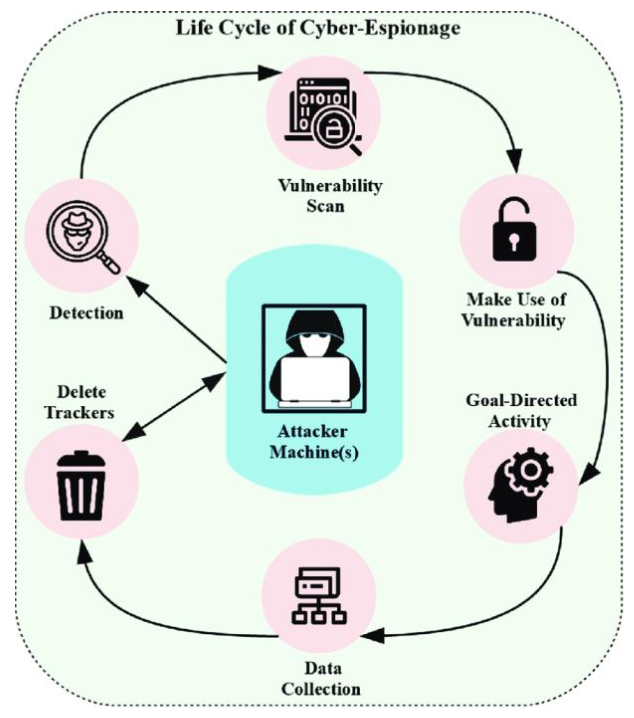
- Nations now use cyberspace as a primary tool of state power. Government-backed actors conduct aggressive attacks to disrupt infrastructure or carry out covert espionage to steal secrets, turning the digital world into a new battlefield for international conflict.
- 2.1.1. Cyber Warfare- State-Sponsored Digital Assaults
- Cyber warfare is the use of computer technology by a state to disrupt the activities of another state, typically by attacking information systems for strategic or military purposes.
- Objective:
- Disable or destroy an adversary's critical infrastructure, such as power grids, financial systems, and military networks.
- Case Study (International):
- The Stuxnet worm was a sophisticated, state-sponsored malware designed to damage Iran’s nuclear centrifuges by manipulating their industrial control systems.
- Indian Context (Operation Sindoor, May 2025):
- The conflict following Operation Sindoor marked the first time cyberspace became an active and coordinated theatre of war between India and Pakistan. Pakistani threat actors, often with support from China, launched a massive wave of attacks to create a "fog of war", including:
- Distributed Denial of Service (DDoS) Attacks:
- A spike in DDoS attacks targeted at least 15 major Indian government organizations, including the Income Tax Department, Hindustan Aeronautics Limited (HAL), and Indian Railways.
- A report by Maharashtra Cyber recorded over 1.5 million cyberattacks during the crisis period.
- Malware Deployment:
- A prominent Pakistani group, APT-36 (also known as Transparent Tribe), deployed malware like the Crimson Remote Access Trojan (RAT) to target Indian government and defence personnel and harvest sensitive information.
- Website Defacements:
- A familiar tactic was the defacement of Indian websites, including that of the Armoured Vehicle Nigam Ltd, a defence public sector unit.
- 2.1.2. Cyber Espionage- Covert Theft of Sensitive Data
- Cyber espionage involves the illicit access of confidential information through computer networks, aimed at stealing strategic, military, or economic secrets.
- Case Study (International):
- The NSA surveillance program, revealed by Edward Snowden, exposed large-scale data collection and espionage globally, including against India.
- Case Study (China):
- The Zhenhua Data leak revealed a Chinese company linked to its government, collecting vast personal data on foreign leaders, military figures, and influential individuals, highlighting digital espionage for "threat intelligence".
- Side note
- Stuxnet- Cyber Warfare Physical Impact
- Stuxnet (2010), a US-Israeli cyberweapon (Operation Olympic Games), destroyed around 1,000 Iranian nuclear centrifuges. This marked the first known cyber attack causing physical destruction.
- It starkly demonstrated Critical Information Infrastructure (CII)'s vulnerability to state-sponsored attacks. This case cemented cyberspace as a new, potent domain of warfare, with real-world consequences.
- 2.2. Cybercrime- Attacks for Disruption and Financial Gain
- Cybercrime encompasses a wide range of illegal activities conducted over digital platforms. These attacks exploit vulnerabilities in systems and human behavior—affecting individuals, businesses, and government infrastructure—all with the intent of financial gain, data theft, or geopolitical disruption.
- 2.2.1. Extortion-Based Attacks- Coercion for Profit
- These sophisticated crimes use intimidation and digital lockdowns to force victims to pay money, representing a severe and growing threat.
- Ransomware Attacks:
-
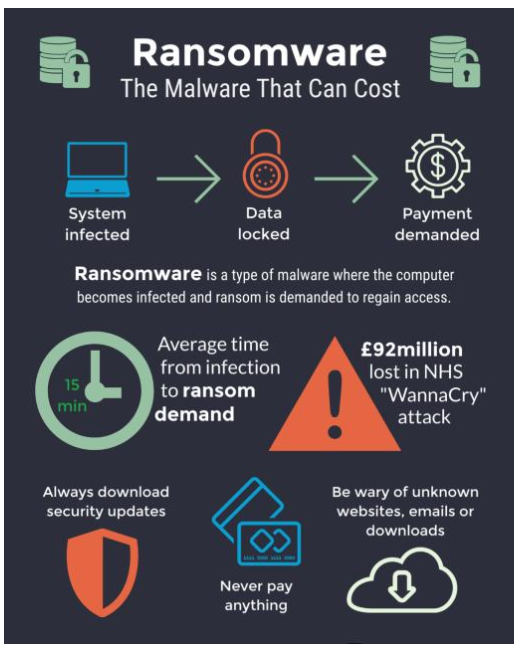
- Ransomware remains one of the most damaging forms of cyber extortion. In these attacks, malware encrypts key files and systems, demanding payment—usually in cryptocurrencies—for access to be restored. India saw a record 69% surge in ransomware attacks between 2022 and 2023. Cyber threat reports also note healthcare and public infrastructure sectors as prime targets due to their lack of real-time backup systems.
- Case Study:
- AIIMS New Delhi Ransomware Attack (2022) India’s premier medical institute, AIIMS, suffered a crippling ransomware attack in November 2022. The attack paralyzed its patient registration, diagnostic, billing, and eHospital systems for over two weeks. The attackers, suspected to be Chinese-origin cybercriminals, demanded nearly ₹200 crore in cryptocurrency and leaked patient data online.
- Digital Arrest Scams:
-
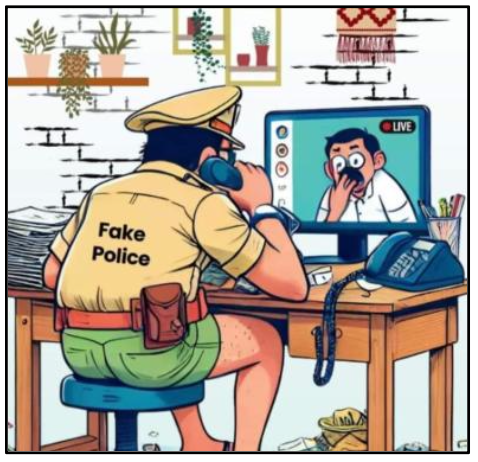
- A rising form of social engineering cybercrime, digital arrest scams saw a dramatic increase in 2024. Criminals impersonate law enforcement agencies like the CBI or cybercrime branch, using fabricated arrest warrants and fake documentation to threaten victims. The scam's success relies on a combination of psychological manipulation (using fear and authority) and digital. Victims are coerced into “digital house arrest” by staying on continuous video calls and paying hefty “bail” amounts.
- In just three months of 2024, over ₹120 crore was lost due to these scams. In many cases, foreign-based call centers and WhatsApp numbers were traced as the source of the crime.
- 2.2.2. Theft and Fraud-Based Attacks- Stealing Data and Money
-
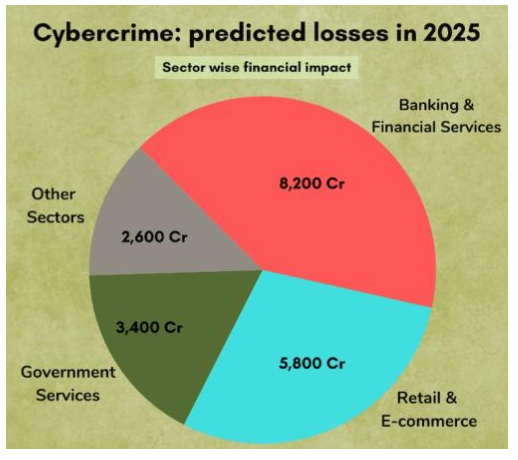
- These attacks are focused on illicitly acquiring funds or valuable personal information through technical breaches and deception.
- Hacking Financial Systems & Accounts:
- There has been a flagged rise in unauthorized remote access fraud, with criminals taking control of desktops via fake customer support links (e.g., AnyDesk scams). A major scam in February 2024 breached YES Bank’s UPI services, affecting over 12,000 users with estimated losses exceeding ₹10 crore.
- Credit/Debit Card Data Theft:
- Card cloning and skimming scams have become the most reported online financial fraud, making up 42% of all cyber complaints. Leaked datasets with millions of Indian card details were found on the dark web in May 2025, traced to breaches in payment gateway plugins.
- Phishing Attacks:
- Phishing continues to be a primary technique for credential theft in India. A recent mass phishing campaign impersonated the Income Tax Department, targeting PAN and Aadhaar holders by offering fake refunds. In April 2025, cyber police in Hyderabad busted a ring stealing KYC data from over 1.6 lakh Indians and selling it online.
- Main Cyber Players and Their Motives
-
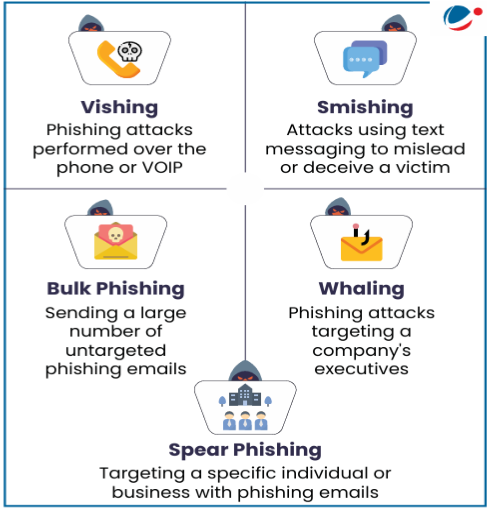
- Cyber Criminals:
- Seeking commercial gain from hacking banks and financial institutions, as well as phishing scams and computer ransomware.
- Phishing is a broad term for cyberattacks that use social engineering to trick victims into paying money, handing over sensitive information, or downloading malware.
- Cyber Terrorists:
- With the mission to penetrate and attack critical assets and national infrastructure for aims relating to political power and “branding”.
- Cyber Hacktivists:
- Groups such as “Anonymous” with political agendas that hack sites and servers to virally communicate the “message” for specific campaigns.
- 2.3. Cyber Terrorism- The Digital Front of Fear
- Cyber terrorism is the politically or ideologically motivated use of technology to carry out disruptive attacks against computer systems and networks. The primary goal is not financial gain, but to instill fear, cause widespread harm, or intimidate a society to achieve a political objective. It represents a modern form of terrorism where the battlefield is digital, but the consequences can be devastatingly real.
- Objective:
- To destabilize society by attacking critical national infrastructure, generate widespread fear through high-profile disruptions, and advance a political, religious, or ideological agenda by causing severe economic damage or even loss of life.
- Primary Methods:
- Disruptive Attacks:
- Crippling essential services using Distributed Denial of Service (DDoS) attacks. During Operation Sindoor (May 2025), over 1.5 million DDoS attacks were recorded against Indian digital infrastructure, targeting the Income Tax Portal, Indian Railways, and HAL. Botnets traced to Pakistani and Chinese locations were linked to these attacks.
- Infrastructure Sabotage:
- Introducing malicious software like the Stuxnet worm to damage physical systems, such as power grids or industrial controls. Malware families such as Emotet, Lokibot, and Crimson RAT (used by Pakistan-based APT-36/Transparent Tribe) are actively used to target India’s strategic sectors mainly affecting small and medium enterprises (SMEs) and educational institutions.
- Hacking and Data Breaches:
- Infiltrating government or military networks to steal, alter, or destroy sensitive data.
- Common Targets:
- Critical National Infrastructure:
- Power grids, water supply systems, transportation networks, and hospitals.
- Government & Financial Systems:
- Military command networks, emergency services, and banking institutions.
- Public Information Platforms:
- Media outlets, which can be manipulated to spread propaganda and misinformation.
- The Key Distinction from Cybercrime:
- What separates cyber terrorism from standard cybercrime is motivation. While cybercriminals seek financial gain, cyberterrorists aim for political or ideological impact. An attack to steal credit card data is cybercrime; an attack to shut down a nation's power grid to cause panic is cyber terrorism.
- Global Context & Challenges:
- There is currently no universal legal definition of cyberterrorism, making international cooperation complex. Meanwhile, the threat grows as attacks become more sophisticated and anonymous, with both non-state groups and clandestine state agents leveraging technology for terror.
- 3. The Evolving Threat Matrix- The Next Generation of Challenges
- 3.1. The Security Implications of 5G Technology
- "Who controls 5G controls the battlefield."– NATO Cyber Defence Report, 2023
- The rollout of 5G technology, which promises ultra-low latency and enhanced connectivity, introduces new security vulnerabilities that could compromise both infrastructure and national security.
- Increased Attack Surface and Supply Chain Vulnerabilities
- Increased Attack Vectors:
- With the connection of billions of devices under the Internet of Things (IoT), from smart cities to industrial control systems, 5G significantly expands the attack surface. This creates far more entry points for potential cyber attackers than 4G networks.
- Software-Defined Networking:
- Unlike previous generations that relied on centralized hardware, 5G networks are software-defined and virtualized, meaning an attacker controlling the software could potentially seize control of the entire network.
- Supply Chain Risks:
- A major concern is the reliance on foreign vendors for 5G equipment. Hardware from companies with potential links to foreign governments may contain embedded malware, spyware, or backdoors that could be exploited for espionage or to disrupt networks in times of crisis.
- 3.2. Artificial Intelligence (AI) as a Dual-Use Technology
- AI is a transformative technology that serves both defenders and attackers, significantly altering the landscape of cybersecurity.
- 1. AI-Powered Malware and Automated Cyber-Attacks
- AI-powered malware is evolving to become smarter, learning, adapting, and altering its code to evade detection by traditional antivirus systems.
- Automated cyber-attacks:
- AI enables large-scale automated attacks that can find vulnerabilities and exploit them without human intervention, creating a much more dangerous and effective form of cyber warfare.
- 2. Deepfakes for Disinformation
- Deepfakes, highly realistic AI-generated videos or audio clips, can make it appear as though individuals have said or done things they never did.
- Impact:
- Deepfakes can be used for disinformation, propaganda, and defamation, posing serious threats to social stability by misleading the public and inciting unrest or violence.
- Deepfakes in Warfare- Zelenskyy's Test
-

- During the Ukraine War, a deepfake video of Zelenskyy "surrendering" circulated (notably 2022). Its aim was to demoralize troops.
- This highlights AI's weaponization for information warfare. It shows how manipulated media can significantly impact morale and security.
- 3. Hybrid and Grey-Zone Warfare
- Hybrid warfare blends conventional and unconventional tools, including cyberattacks, information operations, and economic coercion, to achieve strategic goals without formal military conflict.
- Understanding Hybrid Warfare
- Hybrid Warfare combines kinetic and non-kinetic tools, operating in the "Grey Zone", a space between peace and full-scale war. It allows adversaries to act ambiguously and deniably.
- Example:
- Israeli and Iranian hybrid tactics involve aerospace strikes, cyber operations, assassinations, and drone warfare to target critical infrastructure. Both nations use proxy mobilization, psychological operations, and disinformation to exert influence, relying on asymmetric strategies for covert, deniable attacks.
- 4. Building Digital Resilience - India’s Counter-Strategy
- The digital domain is increasingly being weaponized by state and non-state actors to wage a new form of warfare. This conflict not only targets physical infrastructure but also seeks to undermine social cohesion and governance. At the heart of this warfare is Information Warfare, with the objective of controlling narratives, manipulating public opinion, and sowing discord.
- This evolving threat necessitates a multi-layered approach to safeguard its critical infrastructure, counter cyber threats, and promote national security in cyberspace.
- Asymmetric Warfare- Strategies of Unequal Combat
- Asymmetric warfare is a conflict between two sides with very unequal military power. Instead of fighting a conventional battle they would likely lose, the weaker side uses clever and unconventional tactics.
- These methods include guerrilla warfare, cyberattacks, terrorism, sabotage, and proxy warfare. The goal isn't to win a head-on fight, but to inflict damage and cause disruption through speed and surprise.
- This type of conflict is often seen between a nation's regular army and non-state actors. Key examples include the war in Ukraine (against Russia), the conflict in Yemen (Houthi Rebels vs. Saudi-led Coalition), and the Israel-Palestine conflict involving groups like Hamas.
- 4.1. Legal and Policy Framework
- The Information Technology (IT) Act, 2000 and Amendments:
- The IT Act, 2000 is India’s primary legislation for cybercrime and electronic commerce.
- Amendments have strengthened the focus on cybersecurity, criminalizing identity theft, phishing, and cyber terrorism. It provides the legal basis for actions such as blocking websites and online content threatening national security.
- The Digital Personal Data Protection Act, 2023:
- Enacted to address data security, this Act ensures individuals' rights and data fiduciaries' obligations regarding the protection of personal data.
- It establishes a Data Protection Board of India to handle grievances, ensuring accountability and minimizing data misuse.
- National Cyber Security Policy (NCSP), 2013:
- India’s first dedicated policy aimed at creating a secure cyberspace. It set ambitious goals, including the training of 500,000 cybersecurity professionals. However, challenges such as a shortage of skilled manpower remain, necessitating updates to the policy.
- The IT (Intermediary Guidelines and Digital Media Ethics Code) Rules, 2021:
- These rules regulate social media intermediaries, requiring them to appoint grievance officers, identify the first originator of harmful content, and remove content flagged by authorities.
- 4.2. Institutional Architecture
- CERT-In (Indian Computer Emergency Response Team):
- The national nodal agency responsible for responding to cybersecurity incidents, issuing advisories, and coordinating the national response to cyber threats.
- National Cybersecurity Coordination Centre (NCCC):
- A cyberspace intelligence agency focused on security and electronic surveillance. It screens communications metadata to detect real-time cyber threats and coordinates with law enforcement for intelligence gathering.
- NCIIPC (National Critical Information Infrastructure Protection Centre):
- Mandated to protect critical infrastructure from cyber threats, NCIIPC ensures the security of key sectors like energy, banking, and healthcare.
- I4C (Indian Cyber Crime Coordination Centre):
- Operates under the Ministry of Home Affairs and provides a platform for citizens to report cybercrimes, ensuring better coordination between law enforcement agencies.
- Role of NSCS and NCSC:
- The National Security Council Secretariat (NSCS) and National Cyber Security Coordinator (NCSC) play a key role in coordinating national strategies and advising the Prime Minister’s Office on security matters.
- Side note
- Budapest Convention-International Cybercrime Framework
- The Budapest Convention is the first legally binding international treaty on cybercrime, aiming to harmonize national laws on offenses like hacking and fraud, improve investigative techniques, and foster international cooperation for collecting electronic evidence.
- India declined to sign the Budapest Convention due to concerns over sovereignty and data access provisions. Instead, India advocated for a new UN Cybercrime Convention, which was adopted in 2024 and will open for signature in 2025.
- Bharat NCX 2024-Boosting Cyber Defenses
- CERT-In's Bharat NCX 2024, India's largest cyber drill, simulated 2,000 attacks on vital banking and power grids. It successfully trained 150 agencies, significantly enhancing India's cybersecurity preparedness against complex threat.
- National Cybersecurity Coordinator (NCSC)
- The National Cybersecurity Coordinator (NCSC) was created under the National Security Council Secretariat (NSCS) to coordinate national cybersecurity efforts. It aligns the efforts of central agencies, state governments, and international bodies to secure India’s digital infrastructure. The NCSC is responsible for advising the Prime Minister’s Office (PMO) on cyber threats and policy.
- Functions and Responsibilities:
- NCSC leads a whole-of-government approach, coordinating cybersecurity policies across ministries and sectors. It provides strategic direction and monitors cyber threat detection, response efforts, and cybercrime investigations. It collaborates with CERT-In, NCIIPC, and sectoral regulators like RBI and TRAI to enhance national cybersecurity resilience.
- Leadership:
- Lt. Gen. M U Nair assumed the role of NCSC in 2023, bringing expertise in cyber warfare, signal intelligence, and communication technologies.
- Key Challenges:
- NCSC faces challenges in maintaining cybersecurity preparedness amidst an evolving cyber threat landscape. Strengthening its response capacity, ensuring inter-agency cooperation, and increasing international collaboration are key areas of focus to overcome these challenges. The NCSC is essential for India’s long-term cyber resilience and defense.
- CyberDome- Collaborative Security
- Kerala’s CyberDome is a best practice PPP initiative. It effectively links police, ethical hackers, and academia to bolster cybersecurity. Its focus on threat intelligence and drills helps protect Critical Information Infrastructure (CII). This collaborative model is crucial for robust cyber defense.
- 4.3. Other Key Initiatives and Doctrines
- Cyber Swachhta Kendra:
- A government initiative providing free tools to citizens to detect and remove malware and botnets, promoting digital hygiene.
- Cooperation with Other Countries:
- India collaborates with countries like the UK, USA, China, and Singapore on cybersecurity training, information exchange, and joint combat against cybercrime.
- State Government Initiatives:
- Telangana:
- First state with a cybersecurity policy and Cybersecurity Center of Excellence.
- Kerala:
- Cyberdome for police training in combating emerging cyber threats.
- Maharashtra:
- Cyber Safe Women initiative to raise awareness on cyber safety.
- Audit of Government Websites:
- Empaneling organizations to audit and implement information security best practices.
- Digital Armed Force:
- There is growing discourse on establishing a dedicated Cyber Command with both defensive and offensive capabilities to protect India’s cyber interests.
- 4.4. United Nations Convention on Cybercrime
-
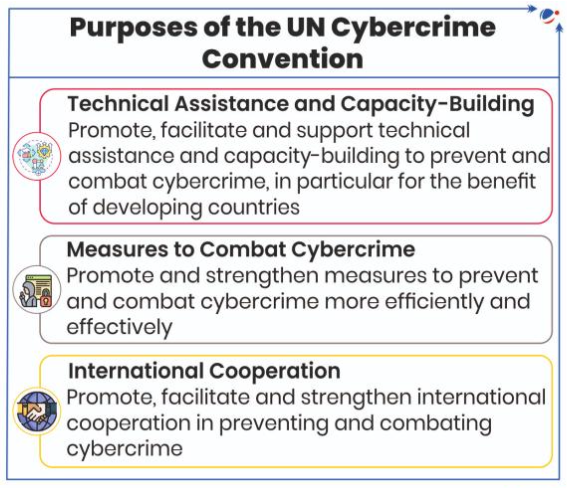
- The UN Cybercrime Convention is the first legally binding UN instrument on cybercrime, adopted by 193 member states. It focuses on preventing, investigating, and prosecuting cybercrimes, and ensures electronic evidence sharing. It will be signed in 2025, effective after 40 states join.
- Key Provisions of the Convention
-
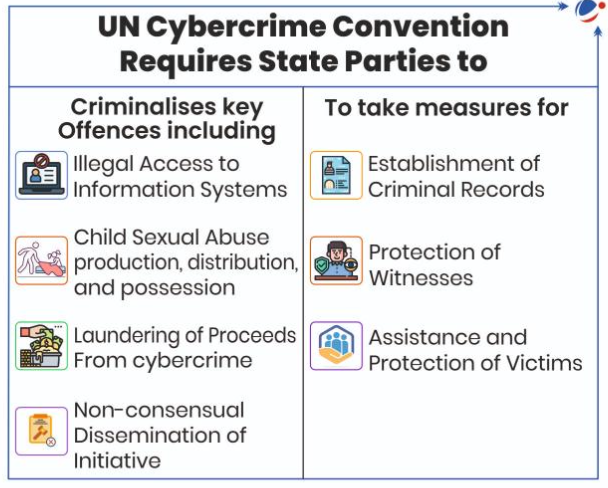
- International Cooperation & Data Sharing:
- Facilitates mutual legal assistance, extradition, and a 24/7 network for urgent cooperation.
- Procedural Measures:
- Provides guidelines for law enforcement on preserving, searching, and seizing electronic data.
- Protection of Personal Data:
- Ensures compliance with privacy laws and encourages bilateral agreements for data sharing.
- Protection of Human Rights:
- Safeguards human rights and freedoms during the implementation of cybercrime procedures.
- Other Provisions:
- Covers extradition, transfer of sentenced persons, criminal proceedings, and joint investigations.
- The Convention addresses the growing risks of cybercrime due to increased connectivity, especially in Southeast Asia. It promotes global cooperation, rapid evidence-sharing, and adaptation to technological advancements. It also ensures child protection and rehabilitates victims of cybercrimes.
- 4.5 Digital Public Infrastructure
- Digital Public Infrastructure (DPI) comprises shared digital systems like identity, payments, and data exchange, built on open standards. These foundational "digital rails" enable efficient, inclusive delivery of essential public and private services at a societal scale.
- India's DPI, including Aadhaar, UPI, and CoWIN, is projected to be a $1 trillion economic asset by 2030. This makes it a powerful geopolitical tool for global expansion.
- However, its international spread introduces substantial cyber-espionage risks, making its integrity and robust cybersecurity paramount against malicious actors.
-
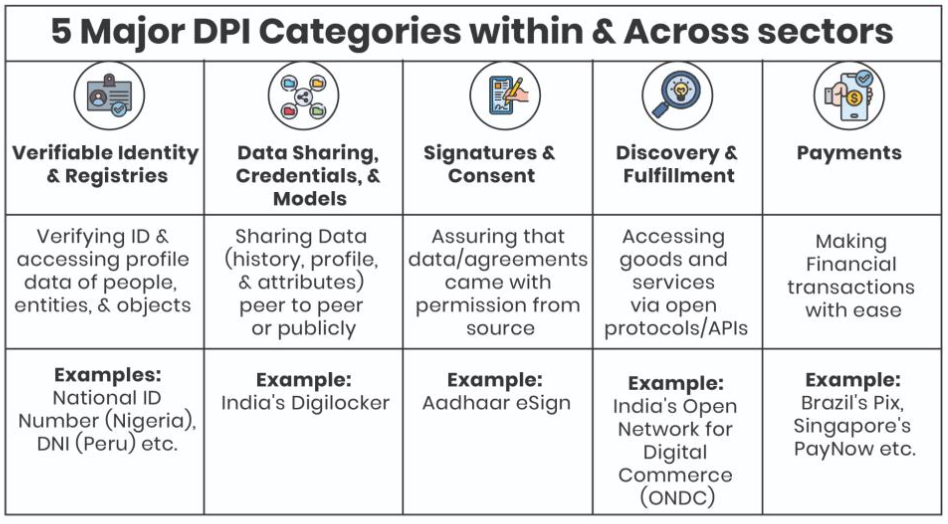
-

- Challenges in Building Resilient Digital Infrastructure
- Dependence on Imported Hardware and Software:
- India’s reliance on imported telecom hardware exposes it to supply chain vulnerabilities, highlighting the need for self-reliance in 5G technology and domestic manufacturing.
- Shortage of Cybersecurity Workforce:
- Despite the National Cyber Security Policy (2013), India faces a shortage of cybersecurity professionals, requiring greater training and capacity building to meet goals.
- Balancing Security and Privacy:
- India struggles with the balance between national security and citizen privacy rights, particularly concerning end-to-end encryption and law enforcement efforts.
- Inter-agency Coordination:
- Fragmented central-state coordination creates gaps in information sharing, with India’s federal structure complicating cybersecurity implementation across jurisdictions.
- Recommendations for Building Resilient Digital Infrastructure
- Building Indigenous Capabilities (‘Aatmanirbhar’ in Cyberspace):
- India must focus on domestic manufacturing and R&D in telecom hardware and cybersecurity solutions, ensuring self-sufficiency and enhanced security.
- Strengthening International Cooperation:
- India must enhance international collaboration, focusing on real-time intelligence sharing and joint cyber investigations to counter transnational cyber threats effectively.
- Public-Private Partnerships (PPP):
- Strong public-private partnerships like CyberDome in Kerala will boost CII protection and cybersecurity efforts, improving state-level cooperation for defense.
- Promoting Cyber Hygiene and Public Awareness:
- A national awareness campaign focusing on strong passwords, multi-factor authentication, and phishing prevention will help create a cyber-resilient society.
- 5. Role of Media and Social Networking Sites in Internal Security Challenges
-
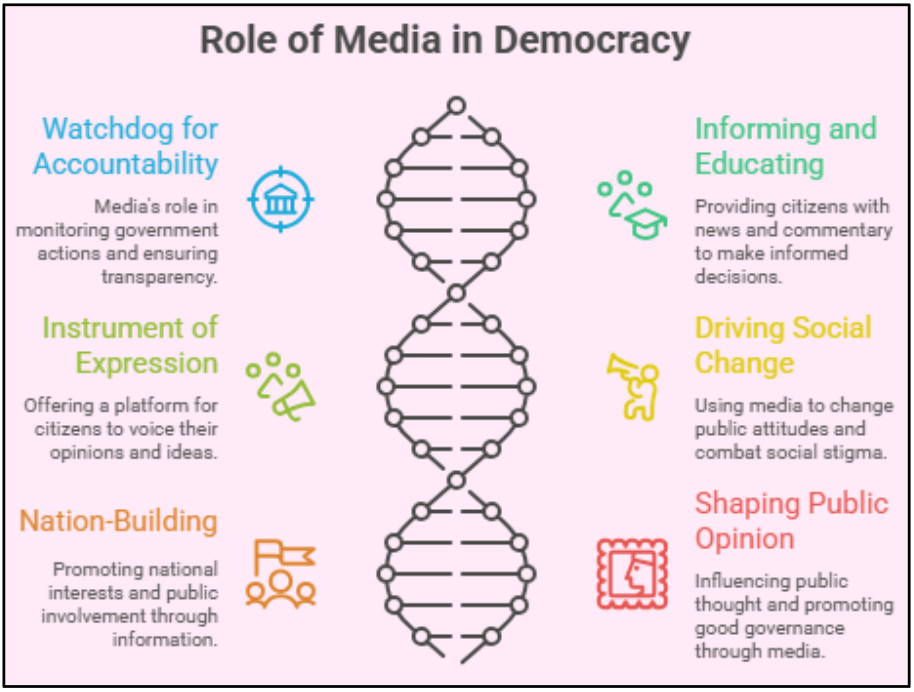
- India's media ecosystem is diverse and multifaceted, comprising various types that cater to its vast and multilingual population. The main kinds of media in India include:
- Print Media:
- Traditional newspapers and magazines published in multiple languages remain influential sources of news, opinions, and entertainment.
- Broadcast Media:
- Television:
- Includes public broadcaster Doordarshan and multiple private channels offering news, entertainment, regional content, and satellite services.
- Radio:
- Both public (AIR - All India Radio) and private FM stations broadcast news, music, and cultural programming.
- Over-The-Top (OTT) Media Services:
- Streaming platforms delivering video-on-demand over the internet. India hosts about 57 OTT providers, such as Amazon Prime Video, Netflix, JioCinema, Disney+ Hotstar, ZEE5, SonyLIV, and regional platforms like Aha (Telugu), Planet Marathi, and more, offering content in numerous regional languages.
- Digital and Social Media:
- Rapidly growing platforms essential for communication, news dissemination, and entertainment. Key social media platforms widely used across India include:
- WhatsApp:
- Leading instant messaging app with over 400 million users.
- Facebook:
- Over 320 million users, serving as a broad social networking site.
- Instagram:
- Popular among youth for photo and video sharing, with around 230 million users.
- YouTube:
- A top video-sharing platform hosting diverse content tuned to Indian audiences.
- 5.1. Internal Security Threats from Broadcast and Print Media
- Both television channels (broadcast media) and newspapers (print media) can pose serious threats to India's internal security. Based on past events and legal observations, these threats can be categorized as follows:
- 1. Revealing Sensitive Operational Details
- Live, minute-by-minute reporting of military or anti-terror operations is one of the most direct threats to national security.
- During the 26/11 Mumbai terror attack, the Supreme Court heavily criticized TV channels for their live coverage. By showing the real-time movements of security forces, the media was essentially providing a playbook to the terrorists' handlers, putting the lives of both security personnel and citizens in jeopardy.
- Similarly, during the military mobilisation in December 2001, the media’s detailed reporting on troop movements was so extensive that it was compared to doing the spying job for Pakistan's intelligence agency, the ISI.
- 2. Fueling Communal and Social Unrest
- The media can act as a catalyst for social instability and communal violence through irresponsible reporting and the spread of unverified news.
- Sensationalism and Fake News:
- The relentless competition for "Breaking News" often leads to channels airing unverified information that can cause widespread panic. A key example is the 2016 Kairana "exodus" story, where false claims of Hindu families fleeing a Muslim-majority town were amplified by certain media outlets, leading to severe communal polarization.
- Targeted Narratives and “Information Warfare”:
- The media can become a tool in information warfare when it broadcasts inflammatory content that makes a religious minority a target or harms a community's dignity. Furthermore, the trend of conducting "Media Trials" creates a form of "tele-terror" or "digital violence" that can destroy reputations and incite public anger, interfering with the legal process long before a court has delivered a verdict.
- 3. Platforming Divisive and Secessionist Forces
- The media becomes a direct threat when it gives a platform to individuals or groups that aim to harm the country's unity. By providing airtime and print space to secessionist groups, the media can unintentionally legitimize their cause and help them broadcast their divisive ideologies to a wider audience, thereby threatening the integrity of the nation.
- 4. Misrepresenting Critical Security Issues
- The media can be irresponsible when it politicizes or oversimplifies complex national security challenges. For example, in its coverage of the long-running Pakistani Proxy War in Jammu & Kashmir, the media has, at times, ignored India's "strategic sensitivities". By focusing heavily on themes like Kashmiri alienation without a balanced perspective, it can create a distorted understanding of the conflict and weaken the national resolve.
- Indian TV Media and Operation Sindoor- A Tale of Two Narratives
- During Operation Sindoor, the Indian public received information from two very different sources: fast-paced private news channels and disciplined official government channels, each telling the story in its own distinct way.
- Private News Channels- Sensationalism and 24/7 Coverage
- Private networks like Aaj Tak, News18, and India Today provided round-the-clock coverage defined by a high-energy, breaking-news culture.
- Reporting Style:
- Their reporting often prioritized speed over verification, leading to sensationalism. This included airing unconfirmed reports and speculative military analysis.
- Studio Debates:
- Their dramatic studio debates, often accused of war-mongering and of discussing strategy and the risks of nuclear escalation, blurred the lines between information and entertainment.
- Security Concerns:
- A major issue was the broadcasting of live footage from sensitive areas, which risked revealing tactical information and could have compromised operational secrecy.
- Countering Misinformation:
- The fact-checking of Pakistani propaganda was inconsistent. While some channels worked to debunk rumors, others inadvertently spread them through uncritical reporting.
- Official Channels- A Message of Control and Clarity
- Government channels, led by Doordarshan (DD) News and official briefings from the Ministry of Defence and Ministry of External Affairs, adopted a highly disciplined and fact-driven approach.
- Authoritative Updates:
- Information was disseminated through carefully worded, centralized press briefings from senior military and government officials.
- Consistent Messaging:
- The official narrative consistently emphasized that Operation Sindoor was a calibrated response targeting only terror infrastructure, not civilians, in order to minimize escalation.
- Countering Propaganda:
- Senior officials, including National Security Adviser (NSA) Ajit Doval, directly countered false narratives from Pakistan with on-record denials. They also criticized some media outlets for amplifying speculation and urged the public to rely on verified official updates.
- The two approaches had very different effects. Private media drove high public engagement and national debate but also risked stoking public anxiety and compromising operational security. In contrast, official channels focused on maintaining a unified national message, promoting calm, and ensuring information security.
- 5.2. The Evolving Threat of Social Media to India’s Internal Security
-
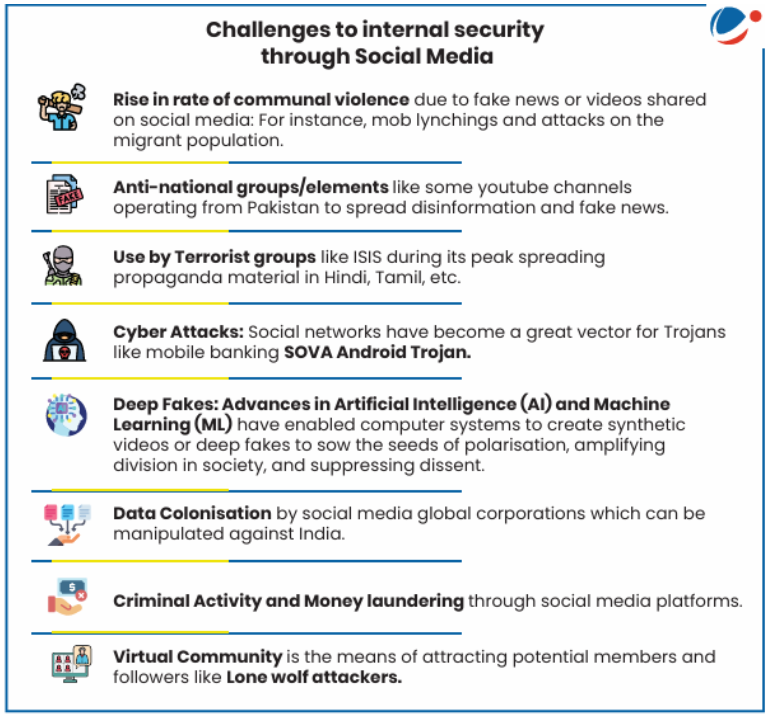
- In recent years, social media platforms like Facebook, Twitter, WhatsApp, and YouTube have transformed from simple communication tools into major vectors for internal security threats in India. Their power to instantly spread information has been exploited by various groups, placing them at the center of several national crises.
- 1. Misinformation, Disinformation, and Incitement to Violence
- The most immediate threat from social media is its use to spread false information that can provoke real-world violence and communal discord.
- Misinformation Deadly Impact- The Dhule Case
-
- The Dhule Lynchings (2018) tragically resulted in 5 deaths in Maharashtra. This brutal incident was directly fueled by viral WhatsApp rumors about "child-lifters."
- Fake News and Propaganda:
- A significant portion of fake news on Indian social media is political or religious, designed to fuel sectarian divides. This was evident in the Muzaffarnagar riots (2013) and the Dadri lynching (2015), where doctored videos and hate speech spread rapidly, playing a key role in mobilizing violence.
- Deepfakes and AI-driven Threats:
- The rise of Artificial Intelligence (AI) has introduced deepfakes—hyper-realistic but fake videos and audio clips. These can be used to create social polarization, suppress dissent, and manipulate public opinion with frightening authenticity.
- Echo Chambers and Polarization:
- Social media algorithms often create filter bubbles or echo chambers, where users are only shown content that reinforces their existing beliefs. This insulates them from different views, deepens polarization, and increases the risk of sudden, flashpoint violence.
- 2. Tool for Radicalization and Extremist Recruitment
- Terrorist and extremist groups have effectively weaponized social media to advance their dangerous agendas.
- Recruitment and Radicalization:
- Groups like ISIS have used social media to spread propaganda in Indian languages, including Hindi and Tamil, to attract and radicalize vulnerable youth.
- Transnational Threats:
- These platforms enable extremists to communicate with foreign handlers using encrypted apps, bypassing traditional surveillance and creating a significant transnational threat.
- Psychological Operations (PsyOps):
- By live-streaming attacks and celebrating acts of violence, terrorists aim to instill fear, challenge state legitimacy, and project an image of power, thus attracting more followers.
- Lone Wolf Attackers:
- The "virtual community" on social media is a powerful tool for inspiring individuals to carry out attacks on their own, known as lone wolf attackers, who are radicalized entirely online.
- The Digital Rabbit Hole- How Algorithms Fuel Radicalization
- Social media algorithms are designed to keep us engaged by showing us content we are likely to interact with. However, this same process can lead to Algorithmic Radicalization—a dangerous digital "rabbit hole" that pushes users towards extremist propaganda and polarizing views. This creates echo chambers and filter bubbles that reinforce a user's biases (confirmation bias) and can lead them down a path to extremism.
- Recent Threats from Social Media to India's Internal Security
- Misinformation During Operation Sindoor (2025):
- After Operation Sindoor, fake claims like “India seized Karachi” and “Pakistani generals arrested” spread on X, WhatsApp, YouTube, and Facebook, increasing public tension and risking escalation.
- Deepfake Election Disinformation (2024–2025):
- Deepfake videos featuring celebrities falsely endorsing political parties circulated on Instagram, WhatsApp, and Facebook, triggering police investigations and raising concerns about AI-generated disinformation, similar to Cambridge Analytica.
- Communal Rumors & Hate Speech:
- Platforms like WhatsApp and Facebook spread fake videos, provocative messages, and hate speech during events like the 2020 Delhi riots, CAA protests, and 2024 Nuh violence, escalating tensions.
- Public Health Misinformation During COVID-19:
- Misinformation about cures, anti-vaccine conspiracies, and false preventive measures spread on WhatsApp, Twitter, and YouTube, undermining public health efforts and creating confusion.
- Why It's So Hard to Stop
- The algorithms themselves are often complex "black boxes."
- Globally:
- The EU’s Digital Services Act 2023 demands more transparency, platforms like YouTube use AI-driven moderation, and the Christchurch Call forms a global coalition against extremist content.
- In India:
- The Ministry of Electronics and Information Technology (MeitY) actively flags and removes harmful URLs, and the IT Rules 2021 provide a legal framework for tracing and removing such content.
- Extremist groups like IS and al-Qaeda use coded language and symbols (modulated content) to evade automated detection.
- There is a constant struggle to balance content moderation with free speech.
- Algorithms often fail to understand crucial local contexts in different countries.
-
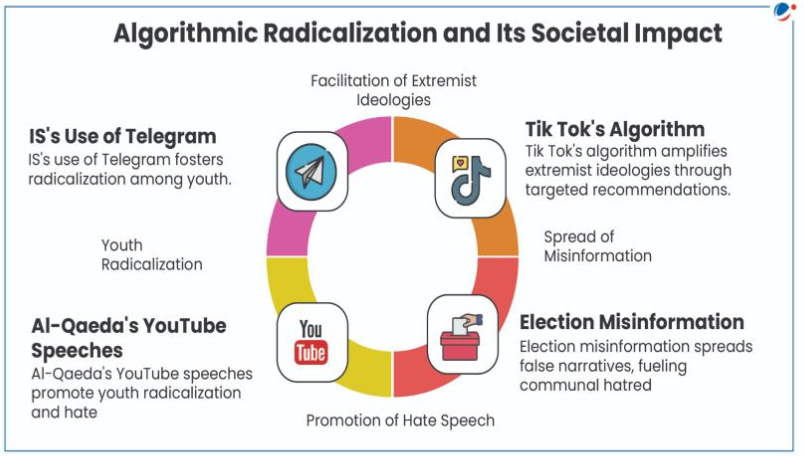
- A lack of international regulation hinders a unified global response.
- 3. Foreign Interference and Information Warfare
- Hostile state and non-state actors use social media to conduct information warfare against India, particularly during elections or major policy debates as seen in 2020–2021 Indian farmers' protest.
- Influence Operations:
- These actors manipulate hashtags, promote divisive narratives, and launch coordinated disinformation campaigns to destabilize India’s social fabric.
- Anonymity and Impunity:
- The borderless nature of social media allows foreign powers to target India's internal discourse with a degree of anonymity and impunity, making it difficult to trace the source of the interference.
- 4. New-Age Cybersecurity and Criminal Threats
- Beyond direct violence, social media has opened the door to a new generation of complex security challenges.
- Cyber Attacks and Financial Fraud:
- Social networks are a common pathway for financial crimes. Hackers use these platforms to spread malicious software like the SOVA Android Trojan, which targets mobile banking apps, and to carry out phishing attacks.
- Data Colonisation:
- Global social media corporations collect massive amounts of data from Indian users. This creates a situation of "data colonisation," where this valuable information is stored and controlled outside the country and could be manipulated against India's interests.
- Targeting Vulnerable Populations:
- Social media is often used to target women and children through cyberbullying, doxxing, and targeted harassment campaigns, causing significant psychological harm.
- Organized Crime:
- The platforms are also used for other illegal activities, including money laundering and coordinating criminal operations.
- Information Warfare During Operation Sindoor
- The military conflict of Operation Sindoor was fought just as intensely online. This "war of perception" saw both India and Pakistan use social media and digital platforms to control the story and influence global opinion.
- Pakistan's Disinformation Strategy
- Pakistan's campaign was a coordinated effort led by its military media wing, the DGISPR, to mislead domestic and international audiences.
- Core Narrative:
- The main goal was to portray the initial Pahalgam attack as a 'false flag' operation conducted by India and to fabricate stories of military success.
- Digital Tactics:
- They used social media platforms like X (Twitter) with specific hashtags, state-aligned influencers, and automated botnets to spread propaganda.
- Visual Deception:
- They created billboards in Pakistani cities with photoshopped images of downed Indian aircraft and reused old conflict footage, a tactic called 'narrative laundering'.
- Chinese Support:
- This campaign was actively amplified by Chinese state media, highlighting a digital nexus between the two countries.
- India's Fact-Based Counter-Narrative
- India's official response was led by the military's ADGPI, the government's PIB, and the Ministry of External Affairs (MEA).
- Core Strategy:
- India chose a 'truth-driven approach', using facts and evidence to counter lies instead of creating its own propaganda. The message was that India's actions were a calibrated response against terror.
- Key Action:
- To debunk fake videos of downed helicopters, India released official timestamped satellite imagery showing the aircraft returning safely to base.
- Platform Action:
- India requested social media platform X to block over 8,000 accounts that were spreading misinformation.
- Key Takeaways
- The Challenge of Speed:
- A key criticism noted in the reports was that India's strategic communication, while factual, was sometimes 'clumsy and slow', allowing Pakistan's propaganda to spread first. This highlights the need for rapid response in crisis communication.
- The New Battlefield:
- The conflict proved that information warfare is a central battlefield. For civil servants, managing this 'war of perception' is as critical as managing the physical conflict itself, as it shapes diplomatic support and domestic morale.
- 5.3. Government Measures to Counter Media and Social Media Threats
- The Indian government has implemented a multi-pronged and dynamic approach to address the internal security challenges posed by both traditional and new age digital media.
- 5.3.1. Regulating Traditional and Digital News Media
- To ensure responsible reporting and prevent the dissemination of information that could harm national security, the government relies on a set of established laws, regulatory bodies, and direct advisories.
- Constitutional and Legislative Framework:
- Constitutional Provisions:
- While Article 19 guarantees freedom of speech, it is subject to reasonable restrictions for national security.
- Key Statutes:
- Laws such as the Press Council Act of 1978, National Security Act of 1980, Defence of India Act, 1962, and the Civil Defence Act, 1968 provide the legal basis for regulating media content to protect national interests.
- Regulatory Bodies and Codes:
- The Press Council of India (PCI) acts as a watchdog for print media ethics. For electronic media, the self-regulatory Broadcasting Code and bodies like the News Broadcasting Standards Authority (NBSA) and the Indian Broadcasting Foundation (IBF) set content guidelines.
- Direct Media Advisories:
- During national security operations, the government issues specific advisories to news channels to exercise discretion and avoid live coverage that could reveal sensitive operational details or amplify unverified information.
- Judicial Intervention:
- The Supreme Court has repeatedly guided media conduct, notably criticizing the live coverage of the 26/11 Mumbai terror attacks for kindizing national security.
- 5.3.2. Tackling Threats from Social Media and Online Platforms
- Recognizing the unique challenges of speed and anonymity on social media, the government has adopted a strategy combining legal tools, active monitoring, public awareness, and technological adaptation.
- Legal Tools for Online Regulation:
- The Information Technology (IT) Act, 2000:
- Section 69A is actively used to block fake content and malicious websites.
- IT (Intermediary Guidelines and Digital Media Ethics Code) Rules, 2021:
- These rules are critical for regulating social media platforms, mandating the swift removal of misinformation and the appointment of grievance redressal officers. These tools have been deployed during events like Operation Sindoor to manage the information space.
- Active Counter-Measures and Fact-Checking:
- Fact-Checking and Debunking Propaganda:
- The Press Information Bureau (PIB) Fact Check Unit serves as a vital instrument in combating misinformation. For instance, it played a key role in debunking several Pakistani propaganda claims following security operations, including false reports about downed Rafale jets or Indian military surrender.
- Monitoring and Blocking Harmful Accounts:
- Authorities actively identify and block thousands of influential Pakistan-linked social media handles and accounts found spreading misinformation and communal hatred, especially during major crises like the CAA protests and other violent incidents.
- Banning Anti-National Content:
- The government has blocked numerous YouTube channels and other online resources found to be spreading anti-India propaganda.
- Technological Infrastructure and Surveillance:
- India has bolstered its e-surveillance capabilities with projects like the National Intelligence Grid (NATGRID), Central Monitoring System (CMS), and Network Traffic Analysis (NETRA).
- Specialized agencies like CERT-In (Indian Computer Emergency Response Team) and the National Critical Information Infrastructure Protection Centre (NCIIPC) form the core of the nation's cybersecurity defense.
- Public Awareness and Citizen Vigilance:
- The government has initiated official campaigns urging citizens to verify information before sharing and to report dubious content. Public calls to use official portals like PIBFactCheck and dedicated reporting channels on WhatsApp and email foster a grassroots approach to tackling fake news.
- Addressing Emerging Challenges:
- The government remains focused on updating regulations to counter new and evolving threats. This includes policy considerations for tackling AI deepfakes and continuously strengthening national cybersecurity measures to stay ahead of sophisticated threats.
- Way Forward- Key Recommendations to Strengthen Internal Security
- To tackle evolving threats from media and social networking sites, a multi-dimensional strategy is essential, focusing on strengthening legal frameworks, enhancing technological capabilities, and promoting public awareness.
- Strengthening Institutional and Legal Frameworks:
- Empower Regulatory Bodies:
- Grant Press Council of India (PCI) statutory powers and consider granting statutory status to the News Broadcasters Association (NBA).
- Independent Industry Regulator:
- Establish a body to enforce media ethics with powers to impose fines for violations.
- National Social Media Policy:
- Create a comprehensive Social Media Policy to tackle platform-specific challenges.
- Code on Disinformation:
- Adopt a formal code on disinformation similar to the EU’s, disrupting revenue for fake news.
- Regulate Media Trials:
- Establish clear rules to balance free speech with the right to a fair trial.
- Strengthen Data Protection Laws:
- Enhance personal data protection and define data ownership clearly.
- Enhancing Technological and Intelligence Capabilities:
- Boost Domestic Data Infrastructure:
- Support local data centers with energy and connectivity.
- Develop Advanced Intelligence Models:
- Utilize SOCMINT for predictive tools to monitor and prevent risks.
- Expand Pilot Projects:
- Launch social media pilot projects for better data and intelligence.
- Fostering Public-Private Collaboration and Awareness:
- Empower Agencies and Build Talent:
- Equip government agencies with legal and technical expertise.
- Increase Public Awareness:
- Educate citizens on the risks of social networking and privacy.
- Promote Corporate Responsibility:
- Encourage corporations to adopt revised security models for information sharing.
UNIT 4- MONEY LAUNDERING AND ITS PREVENTION, AND LINKAGES OF ORGANIZED CRIME WITH TERRORISM
- "Money laundering is the financial reflex to crime" -FATF Report
- 1. MONEY LAUNDERING
- Money laundering is a clandestine and complex process that forms the bedrock of almost all profit-generating criminal activities. It is not merely an economic offense but a grave threat to a nation's financial sovereignty and internal security.
- Essentially, money laundering is the process of making "dirty money" (money from crime) look "clean" (like it's from a legal source). It involves three main actions:
- 1. Conversion:
- Actively moving or changing money to hide its criminal source, or helping the criminals involved avoid getting caught.
- 2. Concealment:
- Intentionally hiding the truth about dirty money, such as who really owns it or where it came from.
- 3. Acquisition:
- Simply accepting, holding, or using any money or property that you know is the result of a crime.
-

- Panama Papers (2016)- Offshore Secrets Exposed
- The Panama Papers (2016), a massive leak, exposed how global elites used shell companies via Mossack Fonseca to potentially hide $2.1 trillion in assets, often for tax evasion and money laundering.
- In response, India launched 150+ investigations into individuals linked to the leaks, demonstrating a significant effort to tackle illicit financial flows and undisclosed offshore wealth.
- India's primary legislation, the Prevention of Money Laundering Act (PMLA), 2002, defines the offense of money laundering in a comprehensive manner. It states:
- "Whosoever directly or indirectly attempts to indulge or knowingly assists or knowingly is a party or is actually involved in any process or activity connected with the proceeds of crime and projecting it as untainted property shall be guilty of the offense of money-laundering."-PMLA Section 3
- The scale of money laundering is staggering, posing a significant threat to the global economy.
- Global Estimates:
- The International Monetary Fund (IMF) estimates that the aggregate amount of money laundered globally in one year is between \(2\%\) to \(5\%\) of the world's Gross Domestic Product (GDP).
- Indian Context:
- The UN Office on Drugs and Crime (UNODC) has estimated that criminal proceeds in India could account for as much as \(4.6\%\) of the country's GDP.
- The Basel Anti-Money Laundering (AML) Index has also consistently ranked India among countries with a significant risk of money laundering.
- 1.1. The Three-Stage Process of Money Laundering
-
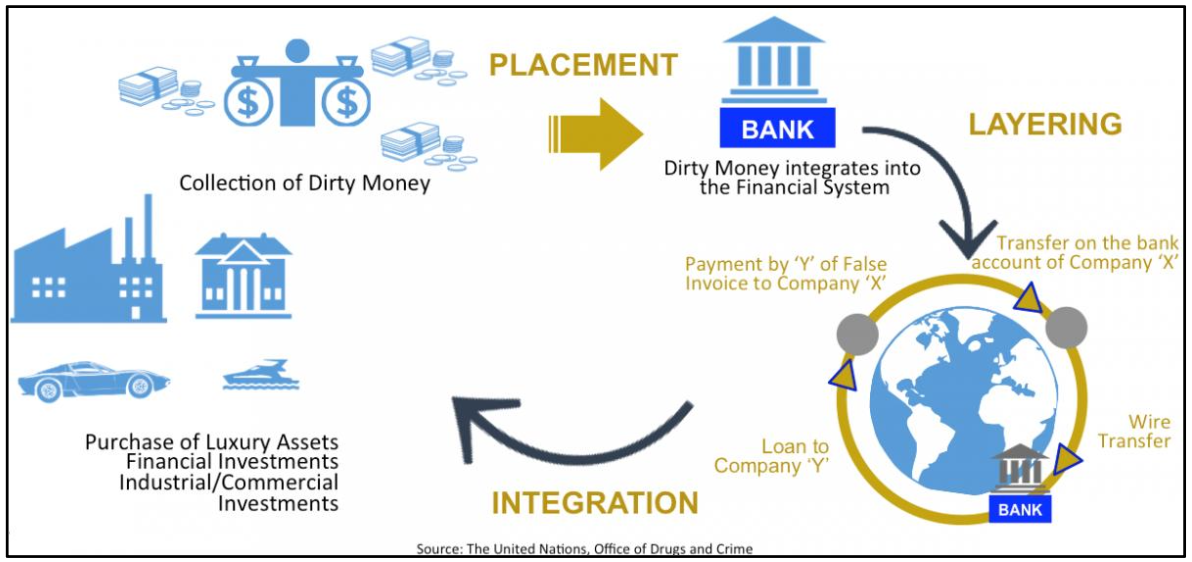
- "Placement, Layering, Integration- The 'lifecycle' of dirty money"
- Money laundering is typically carried out in three distinct stages- Placement, Layering and Integration, each designed to progressively obscure the illicit source of the funds.
- 1. Placement
- First, criminals place the dirty money into the financial system. They often break up large amounts into smaller, less suspicious deposits to avoid detection.
- 2. Layering
- Next, they create a complex web of transactions to hide the money's origin. This layering involves multiple bank transfers and buying assets to make the trail impossible to follow.
- 3. Integration
- Finally, the now "clean" money is integrated back into the legitimate economy. It appears legal and can be spent or invested freely.
- 1.2. The Evolving Modus Operandi of Money Laundering
- "Without dirty money, crime wouldn’t pay" – Stolen Asset Recovery Initiative (World Bank/UNODC)
- 1.2.1. Traditional Approaches of Money Laundering
- 1. Structuring/Smurfing
- This technique involves breaking down large amounts of cash into smaller deposits below the mandatory reporting threshold of financial institutions. Multiple individuals, known as "smurfs", make these deposits into various bank accounts to avoid detection.
- 2. Hawala
- "No records, no trail, just trust; Moving millions in the shadows’ dust."
- Hawala is an informal, parallel remittance system that operates outside the formal banking network. It involves a network of hawaladars who transfer value across borders without physical currency, making it untraceable. It is banned in India under PMLA and FEMA.
- 3. Trade-Based Money Laundering (TBML)
- TBML disguises illicit proceeds through legitimate trade transactions, including:
- Over-invoicing or under-invoicing of goods and services.
- Issuing multiple invoices for the same shipment.
- Falsifying goods or services descriptions.
- 4. Use of Shell Companies and Third-Party Cheques
- Shell companies are fictitious entities used to create fake invoices and transactions, making illicit funds appear legitimate.
- Third-party cheques are also used to disguise the real origin of funds.
- 5. Use of Cash-Intensive Businesses
- Businesses dealing with large volumes of cash, such as casinos, restaurants, and real estate, are used to mix illicit funds with legitimate revenue, making the dirty money harder to trace.
- Side note
- Sahara's Money Laundering Allegations
- The Sahara Group Case (2013) illustrates alleged money laundering. Illicit funds were routed through 34,000 shell companies (Placement), introducing them into the system and obscuring their origin.
- Subsequently, these funds were sent via offshore entities (Layering) to hide their trail.
- Finally, the money was integrated back into the legitimate economy by purchasing luxury hotels (Integration), providing a clean façade for illicit wealth.
- India's Hawala Scandal- A Web of Politics and Terror
- The 1991 Hawala Scandal was a major corruption case in India where top politicians and bureaucrats secretly received illegal payments.
- The money was funneled through hawala brokers, primarily the Jain brothers.
- The scandal came to light after the arrest of Ashfak Hussain Lone, a member Hizbul Mujahideen. He revealed that his organization was also receiving funds through these same hawala channels.
- This directly linked political corruption with terrorist financing.
- The 26/11 Attacks- Funded Through Hawala
- The tragic 26/11 Mumbai Attacks of 2008 were paid for using the Hawala system, with funds coming from Pakistan.
- This shadow banking network allowed the terror group Lashkar-e-Taiba to secretly send untraceable money for their cross-border terror operations. The attack was a powerful example of how Hawala serves as a dangerous financial tool for illicit activities.
- 1.2.2. Modern Approaches of Money Laundering
-
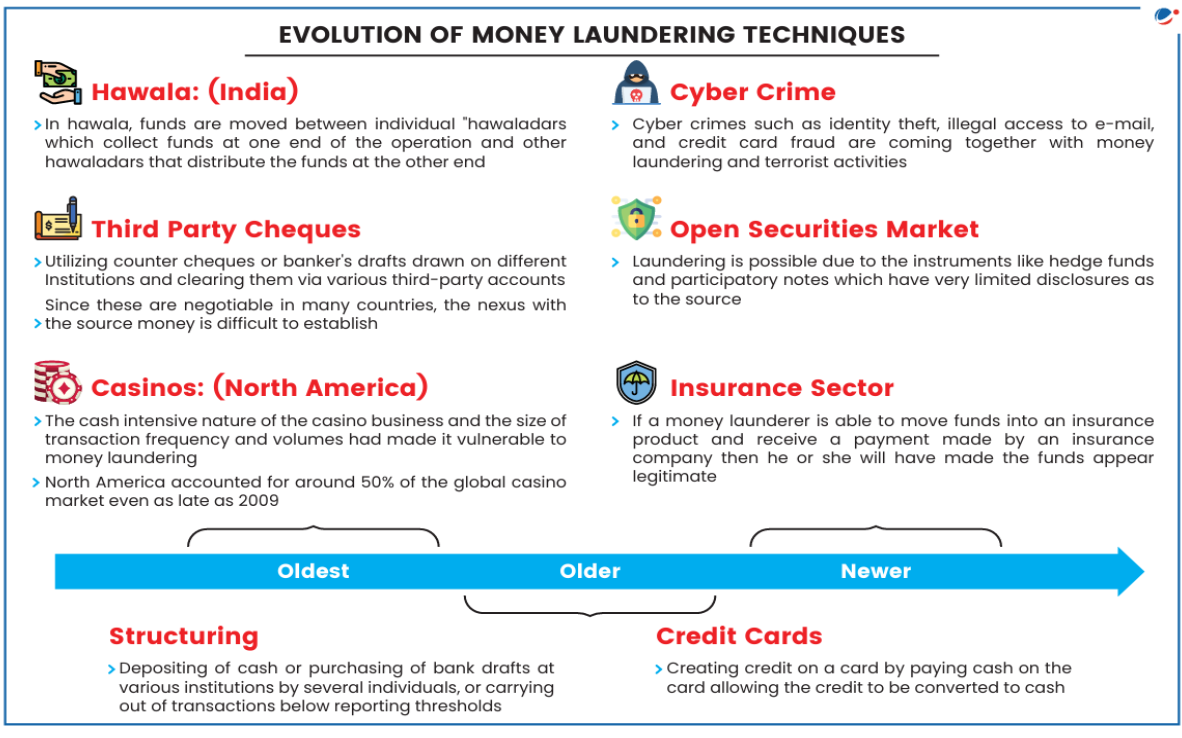
-
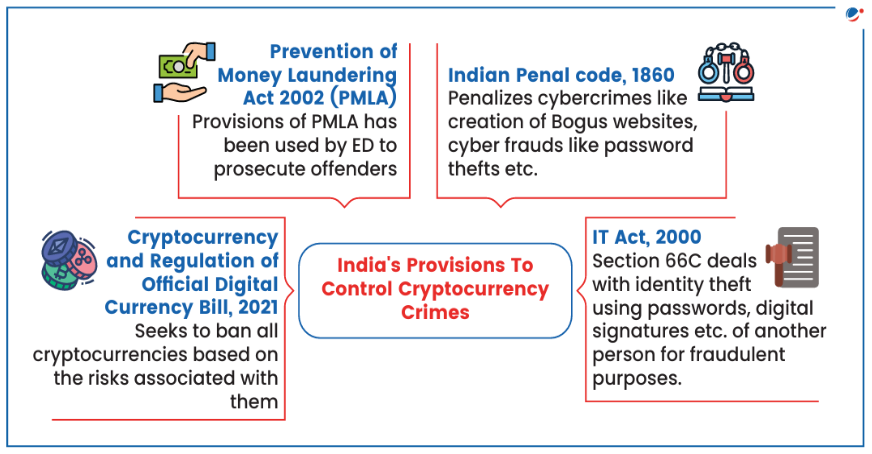
- 1. Cryptocurrencies
- Cryptocurrencies, like Bitcoin, offer a new tool for money launderers due to their pseudo-anonymous nature.
- Launderers use mixers or tumblers to pool and redistribute cryptocurrency, breaking the link between the original source and final destination.
- In 2021, illicit transactions using cryptocurrencies were estimated at $14 billion globally.
- In the WazirX case (2021), India's The Enforcement Directorate (ED) froze over ₹64 crore, showing how easily cryptocurrency can be used for money laundering. While publicly linked to loan app frauds, the case highlighted the broader problem of hiding illicit proceeds in digital assets.
- 2. Cybercrime
- Cybercrime proceeds, such as funds from hacking, phishing scams, or ransomware attacks, are laundered via complex digital pathways, often involving multiple jurisdictions to obscure the origin of the funds.
- 3. Linkages with Illegal Wildlife Trade (IWT)
-
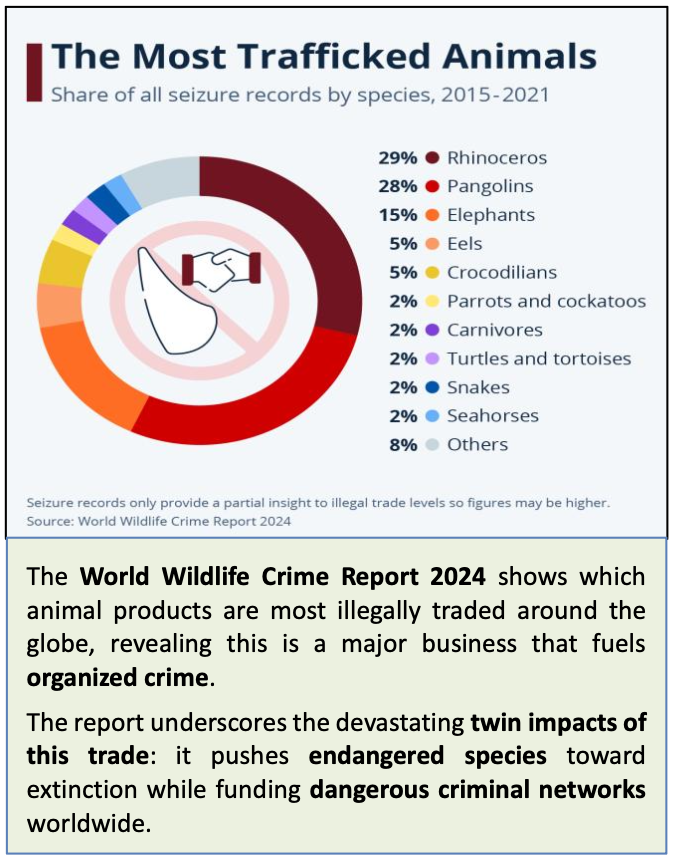
- The Illegal Wildlife Trade (IWT) is more than just an environmental issue; it's a massive criminal enterprise that generates billions in illicit proceeds.
- The World Wildlife Crime Report 2024 shows which animal products are most illegally traded around the globe, revealing this is a major business that fuels organized crime.
- The report underscores the devastating twin impacts of this trade:
- it pushes endangered species toward extinction while funding dangerous criminal networks worldwide.
- To "clean" this dirty money, traffickers use classic money laundering tactics. They hide the cash using front companies, like private zoos or farms, and wire the funds through countries with weak enforcement.
- In India, wildlife traffickers are deeply connected to powerful organized crime networks. These are often the same groups involved in human trafficking, illicit drugs, and corruption.
- Illegal wildlife trade in India is a high-profit, low-risk activity linked to terrorism and insurgency.
- Wildlife trafficking syndicates fund militant groups, especially in Northeast India. Poaching profits are used for arms purchases and terror activities.
- Trafficking routes overlap with those used for drugs, arms, and human trafficking.
-
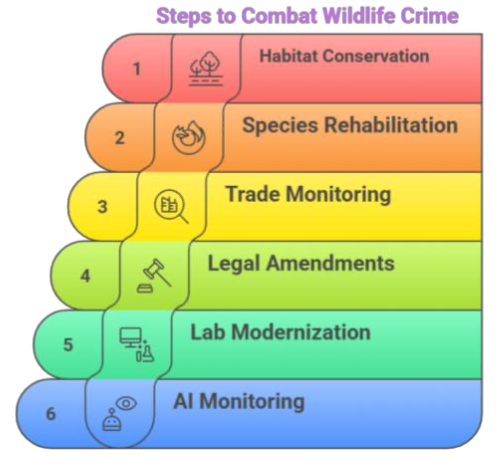
- 4. Misuse of the Insurance Sector and Open Securities Market
- Launderers misuse the insurance sector by buying policies with illicit funds and making fraudulent claims.
- In the securities market, they engage in complex transactions involving hedge funds, derivatives, and Participatory Notes (P-Notes) to launder money.
- 1.3. The Multifaceted Impact of Money Laundering
-
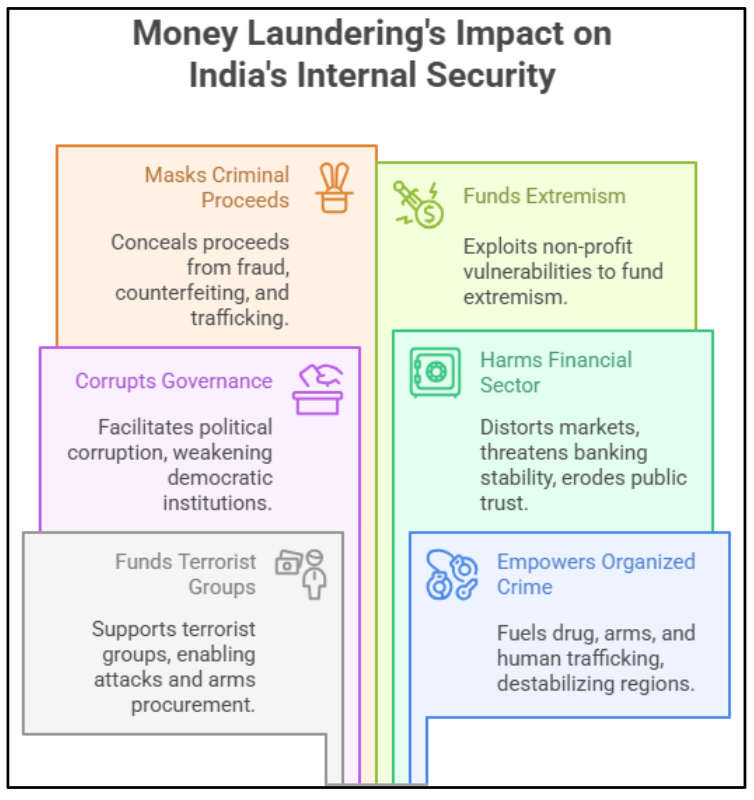
- "Ill-gotten gold paves highways to hell" – Adaptation from Tirukkural (Verse 281)
- Money laundering is more than just a financial crime; it deeply harms a nation's economy, political system, and social values, posing a major threat to internal security.
- Economic Impact
- Hurts Legitimate Businesses:
- Criminals use laundered money to fund their front companies, allowing them to sell goods below market price and drive honest, legitimate businesses into the ground.
- Disrupts Financial Markets:
- Large flows of dirty money can cause chaos in financial markets, leading to unstable exchange rates and interest rates.
- Reduces State Revenue:
- Since this money is hidden, it isn't taxed, leading to a massive loss of state revenue that could have funded public services.
- Damages Reputation:
- A reputation for corruption scares away crucial Foreign Direct Investment (FDI) and harms the credibility of the nation's financial institutions.
- Political Impact
- Fuels Corruption:
- Dirty money is used to bribe public officials, police, and judges, weakening the state from the inside.
- Criminalizes Politics:
- It leads to illegal electoral funding, creating a system where criminals can buy political power. A key example is the Narada Sting (2016), which caught TMC ministers in West Bengal on camera accepting bribes, directly linking laundered money to the criminalization of politics.
- Social Impact
- Damages the Social Fabric:
- It sends the message that crime pays better than honest work, eroding ethical standards.
- Empowers Criminality:
- By making crime so profitable, it encourages a rise in drug addiction, violence, and a general breakdown of law and order.
- 1.4. Key Challenges in Prevention of Money Laundering
- India's fight against money laundering continues to face significant hurdles despite its strong legal and institutional frameworks. A few critical challenges include:
- The Rapid Pace of Technological Change:
- Emerging technologies like cryptocurrencies, the darknet, and AI-driven tools are providing sophisticated and anonymous avenues for laundering money. These technologies outpace the current capabilities of enforcement agencies.
- The Challenge of Tax Havens and Financial Secrecy:
- Countries with tax havens and offshore financial centers often have stringent secrecy laws, making it hard to trace illicit funds or identify the ultimate beneficial owners.
- Lack of Awareness and Weak Compliance Culture:
- There is a lack of awareness about AML (Anti Money Laundering)/CFT obligations in certain sectors, particularly among non-financial businesses and professionals. This ignorance, combined with a weak compliance culture, leaves gaps that criminals can exploit to launder money without detection.
- Issues with Inter-agency Coordination and Resource Constraints:
- Tackling money laundering requires seamless inter-agency coordination. However, coordination issues persist between central and state agencies, hindering real-time information sharing. Additionally, agencies face resource and manpower constraints to combat money laundering operations.
- 1.5. The Global Fightback- International Mechanisms for Prevention of Money Laundering
- Since money laundering is a borderless crime that exploits the global financial system, international cooperation is crucial for combating it effectively. Several key international mechanisms and conventions form the foundation of this global fight
- 1.5.1. The Financial Action Task Force (FATF)
- "Follow the money, find the terror" – FATF guiding principle (1989).
- The FATF, established in 1989, is the most prominent inter-governmental body combating money laundering (AML- Anti Money Laundering) and terrorist financing (CFT- Countering the Financing of Terrorism). Its primary role is to promote effective implementation of legal, regulatory, and operational measures.
- FATF Recommendations:
- The FATF has issued 40 Recommendations, the international standard for AML/CFT, covering everything from criminalizing money laundering to establishing a Financial Intelligence Unit.
- Black and Grey Lists:
- The FATF monitors countries' compliance and publicly identifies jurisdictions with deficiencies.
- Grey List:
- Countries placed under increased monitoring, required to resolve deficiencies with an action plan.
- Black List:
- Countries, like North Korea and Iran, face severe global financial countermeasures.
- FATF Flags Digital Terror Funding
- The FATF warns that e-commerce platforms and online payment services are being abused for terror financing, citing the Pulwama (2019) and Gorakhnath (2022) attacks. The watchdog also flags state sponsorship of terrorism.
- Following the Pahalgam attack (April 2025), India requested Pakistan's re-listing on the FATF Grey List, highlighting ongoing cross-border terror funding concerns.
- 1.5.2. Key International Conventions
- International Conventions provide a global framework for combating money laundering, corruption, and organized crime. These treaties set legal standards for member states to address illicit financial flows
- UN Vienna Convention (1988):
- The UN Vienna Convention was the first international agreement to tackle money laundering linked to drug trafficking, requiring member states to criminalize such activities.
- Criminalizes laundering of proceeds from drug trafficking.
- Paved the way for global cooperation on narcotic-related financial crimes, fostering international cooperation through mechanisms like extradition, mutual legal assistance, and confiscation of proceeds of crime.
- Provides foundation for future treaties and frameworks on anti-money laundering.
- UN Palermo Convention (2000):
- The UN Palermo Convention expanded the scope of money laundering to include proceeds from all serious crimes, providing a comprehensive framework for combating organized crime.
- Criminalizes laundering of proceeds from all serious crimes, not just drugs.
- Emphasizes international collaboration and harmonization of laws.
- Key tool in addressing transnational crime and money laundering.
- UN Convention Against Corruption (2003):
- The UN Convention Against Corruption focuses on curbing corruption globally, promoting cooperation and the recovery of illicit assets.
- Addresses corruption and promotes asset recovery.
- Encourages international collaboration in corruption-related prosecutions.
- Supports transparency and accountability in public institutions
- 1.5.3. Other Global Initiatives
- The Egmont Group:
- A network of 165 Financial Intelligence Units (FIUs) facilitating secure information exchange to trace illicit financial flows. India's FIU-IND is an active member.
- Asia-Pacific Group on Money Laundering (APG):
- As a FATF-Style Regional Body (FSRB), India works with regional partners to implement FATF standards.
- Basel Committee's Principles:
- Provides guidelines for banks on preventing the criminal use of their facilities, focusing on Customer Due Diligence and cooperation with law enforcement.
- 1.6. India's Legal and Institutional Framework Against Money Laundering
- "Laundering isn't finance—it’s violence turned to numbers." – core message of Global Financial Integrity Report 2025
- India has developed a robust legal and institutional framework to combat the growing threat of money laundering, ensuring compliance with international standards while safeguarding its financial integrity. This framework focuses on detection, investigation, and prosecution of financial crimes.
- JAM Trinity's Impact
-

- India's JAM Trinity (Jan Dhan-Aadhaar-Mobile) significantly impact on cash laundering (e.g., a "\(\text{15% reduction}\)" by RBI 2024)
- Crucially, JAM enabled direct tracking of 440 million subsidies, leading to authentic and substantial savings of ₹1.78 lakh crore for the government by eliminating leakages and corruption.
- 1.6.1. Primary Legal Instrument- PMLA, 2002
- Key Provisions
- The Prevention of Money Laundering Act (PMLA), 2002, is the cornerstone of India's anti-money laundering efforts.
- Criminalizes Money Laundering:
- The Act criminalizes money laundering as a cognizable and non-bailable offense.
- Obligations on Reporting Entities:
- Banks, financial institutions, and intermediaries are required to perform KYC checks, maintain transaction records, and report suspicious activities to the Financial Intelligence Unit (FIU-IND).
- Powers of Attachment and Confiscation:
- The Enforcement Directorate (ED) has the authority to attach and confiscate property derived from proceeds of crime.
- Special Courts:
- Special Courts are established to expedite trials for PMLA offenses.
- Recent Amendments
- Expanded Definition of "Proceeds of Crime":
- Now includes property related to scheduled offenses.
- Money Laundering as a Stand-Alone Crime:
- A conviction for the predicate offense is no longer required for pursuing money laundering charges.
- Lowered Threshold for Beneficial Ownership:
- The definition of "beneficial owner" is tightened from \(\text{25%}\) to \(\text{10%}\) ownership.
- Inclusion of New Entities:
- The reporting entities now include professionals (e.g., chartered accountants) and transactions involving virtual digital assets (VDAs).
- 1.6.2. Institutional Mechanisms against Money Laundering
- Financial Intelligence Unit - India (FIU-IND):
- Established in 2004, FIU-IND is the central agency for India's anti-money laundering efforts. Functions:
- Collects financial data like Cash Transaction Reports (CTRs) and Suspicious Transaction Reports (STRs).
- Analyzes data to identify illicit financial activities.
- Shares actionable intelligence with law enforcement agencies.
- Enforcement Directorate (ED):
- The ED investigates money laundering offenses under the PMLA and prosecutes offenders in special courts. It is India's primary agency for handling financial crimes.
- ED's Broadened Powers:
- The Vijay Madanlal Choudhary vs. The UoI (2022) case was a landmark Supreme Court judgment that upheld the Enforcement Directorate's (ED) significant arrest powers under Section 19 of the PMLA, 2002. This ruling significantly strengthened the ED's hand in combating money laundering, validating its broad authority in investigations, arrests, and asset seizures under the Act.
- PMLA- Expanding its Digital Reach
- India's PMLA (2002) is the nation's key anti-money laundering law.
- Crucially, the Ministry of Finance's March 2023 notification explicitly brought Virtual Digital Assets (VDAs), including cryptocurrencies and NFTs (Non Fungible Tokens), under its purview.
- This allows the ED to seize such virtual assets, bolstering India's efforts to combat money laundering in the digital realm, aligning with global standards.
- 1.6.3. Supporting Legal Frameworks
- Foreign Exchange Management Act (FEMA)
- The Foreign Exchange Management Act (FEMA), introduced in 1999, is India's primary law for managing all foreign currency transactions. Its main purpose is to facilitate international trade and investment while maintaining a stable foreign exchange market, all under the regulation of the Reserve Bank of India (RBI).
- How FEMA Helps Prevent Money Laundering:
- Creates a Paper Trail:
- By forcing foreign exchange transactions into official, regulated channels, FEMA ensures there is a clear record. This makes it very difficult for criminals to secretly move illicit funds.
- Flags Illegal Activity:
- Any transaction that doesn't follow FEMA's strict rules is immediately flagged as illegal, helping authorities detect suspicious financial activity.
- Violating FEMA rules results in heavy penalties and fines, acting as a strong deterrent against the illegal movement of money.
- Black Money (Undisclosed Foreign Income and Assets) Act, 2015
- Black Money Act (2015) is a powerful law designed to target citizens who illegally hide undisclosed foreign income and assets.
- It directly prevents money laundering by attacking a key part of the process: stashing illicit funds abroad. The Act does this in two main ways:
- Creates Severe Deterrence:
- It imposes crippling financial consequences on offenders—a flat \(\text{30%}\) tax and an additional penalty of up to \(\text{90%}\) on the hidden asset, plus the threat of imprisonment for up to 7 years. This makes the risk of holding black money overseas extremely high.
- Forces Financial Transparency:
- The law requires Indian residents to declare all their foreign holdings. This destroys the secrecy that criminals need to successfully hide and "clean" their illegal wealth.
- The Benami Transactions (Prohibition) Act, 1988
- The act targets property held in a fake name or in the name of a proxy (Benamidar) to hide the identity of the real owner. This Act is a powerful tool against money laundering because it directly attacks a common method criminals use to hide their ill-gotten wealth.
- It prevents money laundering by:
- Breaking the Ownership Chain:
- Launderers often buy assets in someone else's name to disconnect themselves from the dirty money. The Act makes this core act of hiding behind a proxy illegal, destroying the anonymity criminals rely on.
- Creating Severe Deterrence:
- The law’s biggest threat is confiscation—the government can simply take away the entire benami property. On top of losing the asset, the real owner faces imprisonment for up to 7 years and a heavy fine of up to \(\text{25%}\) of the property's market value.
- This risk of total asset loss makes using benami transactions an extremely dangerous and unattractive way to launder money.
- Public Gambling Act, 1867
- It helps tackle money laundering by acting as the legal "key" that unlocks the more powerful Prevention of Money Laundering Act (PMLA).
- Authorities can use the old Gambling Act to establish that an operation is an illegal crime.
- This initial crime then gives them the legal grounds to launch a full-scale PMLA investigation to trace and seize the laundered money from that illegal activity.
- A perfect example is the 2023 Probo Media Technologies case. The Enforcement Directorate (ED) first identified the platform's "opinion trading" as a form of illegal gambling. This allowed them to then apply the PMLA and freeze ₹284.5 crore in assets linked to the alleged money laundering scheme.
- 1.7. Strengthening Anti-Money Laundering Efforts
-
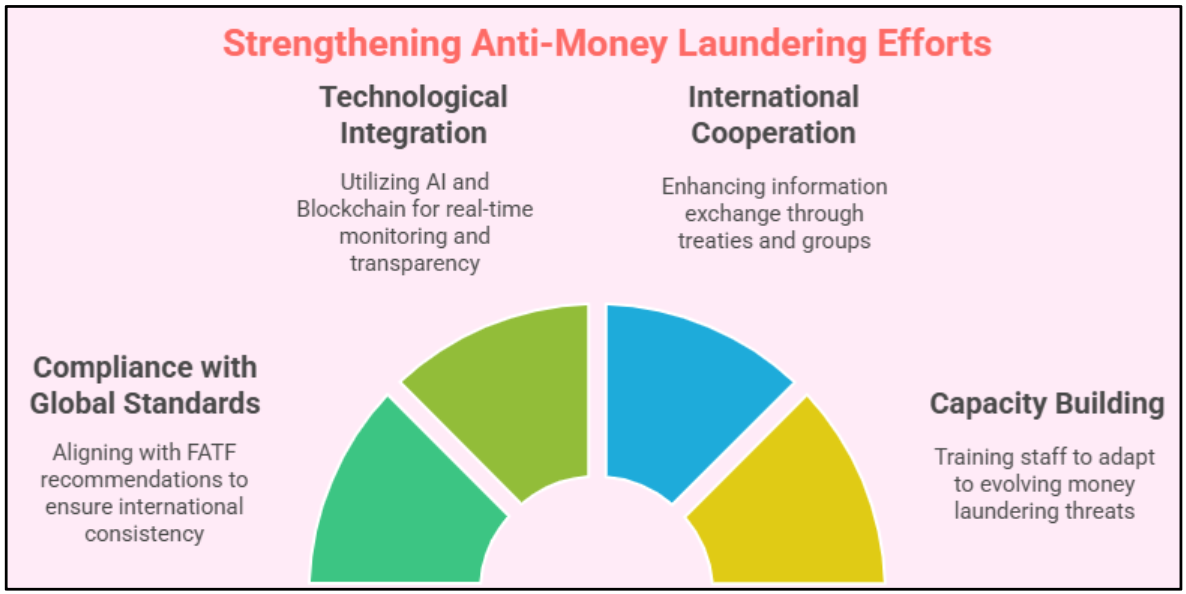
- To effectively combat money laundering, India needs to take a multifaceted approach, addressing both domestic challenges and global best practices.
- 2. LINKAGES OF ORGANIZED CRIME WITH TERRORISM
- Organized crime refers to serious criminal activities committed by a group of three or more persons, structured and coordinated to obtain financial or material benefits, as per the UN Convention against Transnational Organized Crime.
- These groups have a clear existence over time and operate with intentional planning.
- Organized Crime Groups (OCGs) are essentially criminal enterprises built to last. Here's what defines them:
-

-

- Structure and Goal:
- They are structured like a real business, with clear ranks and roles.
- Designed for continuity so they can outlive any single member.
- Their fundamental motive is simple- profit from illegal activities.
- How They Operate:
- Strict Membership:
- They are selective about who can join, often based on shared ethnicity or a criminal background.
- Modern Technology:
- They use advanced tools like social media and the dark web to communicate and operate in secrecy.
- Violence and Bribery:
- They use violence and threats to enforce discipline and protect their interests. They also infiltrate and bribe officials to look the other way.
- Meticulous Planning:
- Their criminal activities aren't random; they are carried out with careful and detailed planning.
- Side note
- The Rise of Cybercrime-as-a-Service
- Cybercrime-as-a-Service (CaaS) is a dangerous trend where hacking tools and services are rented out on dark web marketplaces.
- This model allows Organized Crime Groups (OCGs) and criminals with little technical skill to easily launch sophisticated attacks, dramatically lowering the barrier to entry for cybercrime. These criminal platforms offer ready-to-use products like:
- Ransomware Kits to lock data for payment,
- Phishing Kits to steal credentials with fake websites,
- Access to Hired Hackers for specific jobs, and
- Botnets for Rent to launch website-crashing DDoS attacks.
- 'Ndrangheta- Europe's Cocaine Kingpin
- The 'Ndrangheta is a powerful Italian mafia group that acts as Europe's cocaine kingpin, controlling an estimated \(\text{80%}\) of the continent's cocaine trade.
- Operating globally in over 40 countries, its annual revenue reaches a staggering €60 billion.
- Their immense power comes from a unique combination of a secretive, clan-based structure and deep political infiltration and corruption.
- In the Indian context, organized crime is not only about financial gains. Activities such as rigging elections, manipulating public opinion, or fostering caste-based violence have also been categorized as organized crime when they are carried out systematically by criminal gangs.
- 2.1. Major Forms of Organized Crime in India
- "Drug trafficking sustains terror like oxygen sustains fire" – India’s UNSC Statement (2020) on narco-terrorism in Punjab and J&K
- The following major forms of organized crime are particularly relevant in India, with some closely tied to terrorism:
- Drug Trafficking:
- India’s strategic position between the Golden Triangle (Myanmar, Thailand, Laos) and the Golden Crescent (Iran, Afghanistan, Pakistan) makes it a significant transit point for narcotics, including heroin, hashish, opium, and methamphetamine. The illicit drug trade leads to several security threats, including narco-terrorism, social crimes, and corruption.
- Arms Smuggling:
- The illegal trade of weapons, explosives, and advanced technology is prevalent across India’s porous borders, particularly with Pakistan, Bangladesh, and Myanmar.
- Human Trafficking:
- This involves the recruitment, transport, and exploitation of people through coercion, fraud, or abduction. India serves as a source, destination, and transit point for human trafficking, with various states, including Assam, West Bengal, Tamil Nadu, and Telangana, reporting high numbers of cases.
- Counterfeiting (Fake Indian Currency Notes - FICN):
- The counterfeiting of currency, particularly FICN, is a significant source of terrorist financing, especially in Kashmir. FICN is often smuggled into India via Nepal, Bangladesh, and Pakistan. The Ministry of Home Affairs (MHA) has set up the FICN Coordination Group (FCORD) to tackle the issue through intelligence sharing.
- Cybercrime:
- Cyber-related threats, such as hacking, social engineering, cyber-attacks, and financial frauds, have become increasingly prominent in the digital era. These crimes not only undermine economic stability but also pose serious national security threats.
- Extortion and Kidnapping for Ransom:
- Particularly in regions like Northeast India, extortion is used to fund terrorist activities. Kidnapping for ransom is also employed to generate funds for terrorist groups.
- The Challenge of Counterfeit Currency in India
-
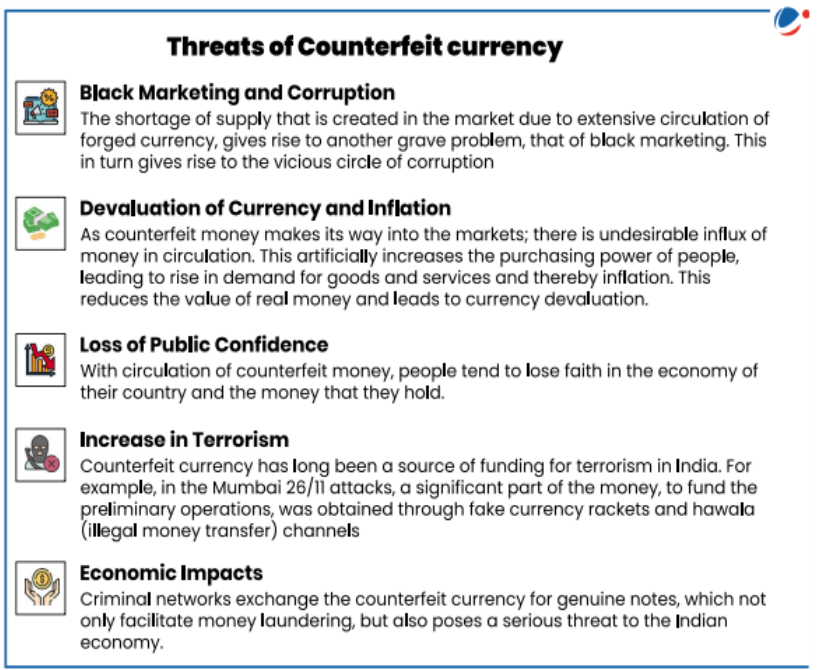
- Counterfeit currency, or Fake Indian Currency Notes (FICN), is the illegal imitation of real money, created with the intent to deceive.
- This is a serious threat that undermines the economy and is often linked to organized crime and terrorism.
- The Scale of the Problem and Demonetisation
- By 2016, India was facing a severe counterfeit currency crisis. At its peak, an estimated 250 out of every 10 lakh notes in circulation were fake.
- To combat this widespread problem, the government took the drastic step of demonetisation in November 2016, scrapping the old ₹500 and ₹1,000 banknotes.
- The value of FICN seized by law enforcement has surged, rising from ₹28 crore in 2017 to ₹92 crore in 2020. This indicates that smuggling operations are on the rise, with Bangladesh and Myanmar acting as key entry points for fake currency into India.
- India's Multi-Pronged Response
- Tougher Laws:
- The Unlawful Activities (Prevention) Act (UAPA), 1967, was amended to classify the production or smuggling of fake currency as a terrorist act. It is also a serious crime under the Indian Penal Code.
- RBI Security Measures:
- The Reserve Bank of India (RBI) continuously upgrades banknotes with advanced security features like watermarks, security threads, and latent images to make them harder to copy.
- National and International Cooperation:
- The FICN Coordination Group ensures intelligence sharing between different Indian agencies. The National Investigation Agency (NIA) specifically investigates terror funding links, and India actively cooperates with neighboring countries like Nepal and Bangladesh to stop cross-border smuggling.
- 2.2. Linkage between Organized Crime and Terrorism
- Both organized crime and terrorism are intertwined and mutually interchangeable due to their similarities. Some terrorist organizations are funded by organized crime, while certain criminal organizations use their financial power to pursue political ambitions through terrorism.
- Similarities between Organized Crime and Terrorism
- Similar Member Profiles:
- Both organized crime and terrorism recruit individuals from marginalized social groups, often attracted by excitement, risk-taking, and a disdain for social norms.
- Punishable by Law:
- Both entities engage in illegal activities, often utilizing advanced technology for high-tech crimes, and are subject to legal punishment.
- Strict Discipline and Planning:
- Both groups exhibit careful planning, rigorous discipline, and an internal system of punishment to maintain order and obedience within their ranks.
- Secrecy, Violence, and Interdependence:
- Both rely on secrecy, use violence for their goals, and are interconnected, with organized crime often financing terrorist activities and vice versa.
- Differences between Organized Crime and Terrorism
-
| Aspect | Terrorism | Organized Crime |
|---|
| Motivation | Ideological and Political Goals: Terrorists act out of a desire to achieve political, ideological, or religious goals. Example Al-Qaeda, ISIS, Boko Haram, and Taliban | Economic Gain: Organized crime groups are motivated by the pursuit of personal financial profit. Example Italian Mafia, Russian Mob, Yakuza |
| Visibility | High Visibility: Terrorists openly declare their intentions and claim responsibility for attacks to garner attention, spread their message, and gain support from sympathetic populations.
• Terrorists usually claim responsibility for their attacks | Low Visibility: Organized crime groups operate in the shadows, focusing on secrecy to avoid detection by authorities.
• Members of organized crime groups rarely, if ever, claim responsibility for criminal activities. |
| Relationship with the State | Confrontational: Terrorists actively challenge the state’s authority. They aim to overthrow or transform the government, often through violent means. | Covert and Corruptive: Organized crime groups may engage with the state through bribery, corruption, and infiltration. |
| Methods | Violence and Terror: Terrorists often use high-profile violent actions (bombings, kidnappings, assassinations) to disrupt society and instill fear. | Criminal Activities: Organized crime groups focus on illicit economic activities like drug trafficking, human trafficking, money laundering, and extortion. |
| Relationship with Society | Public Awareness: Terrorist groups aim to gain support from a segment of the population for their cause. | Invisible to the Public: They use their power to manipulate local communities, but their primary focus is on profit and secrecy, not public support or recognition. |
- 2.2.1. The Crime-Terror Nexus
- "Terrorism is funded by laundering; Anti-money Laundering is counter-terrorism" - UN Security Council
- While Organized Crime fundamentally seeks profit and Terrorism is driven by ideology, these two threats are increasingly connected in a dangerous partnership. They cooperate, share methods, and often rely on each other to survive and thrive.
- 1. Terrorist Financing
- Terror groups often run their own criminal enterprises to generate revenue. Classic examples include the financing of the Taliban through opium production. On the other hand, money laundering is often described as the "lifeblood of terrorism," providing terrorist organizations with the necessary financial resources to sustain their operations. These funds are used for:
- Procuring weapons and explosives
- Maintaining training camps
- Paying cadres and recruiting new members
- Carrying out propaganda activities
- As confirmed by India's Financial Intelligence Unit (FIU) and global bodies like the FATF, groups like Lashkar-e-Taiba funnel illicit money through legitimate businesses, NGOs, and informal channels like hawala.
- Side note
- Punjab's Double Edged Crisis- Drugs & Separatism
-

- Punjab battles a severe drug crisis affecting its youth. The Golden Crescent fuels this, with Pakistan-linked cartels trafficking heroin via drones into Punjab.
- These illicit funds directly finance Khalistani separatist groups.
- Rebels or Cartels? The Rise of Criminalized Insurgencies
- The UNODC highlights the trend of "Criminalized Insurgencies," where rebel groups begin to act more like powerful criminal cartels.
- A key example is Myanmar's Arakan Army, which relies on methamphetamine trafficking for as much as \(\text{60%}\) of its revenue. This deep involvement in illicit trade blurs the line between their political goals and their profit motives, creating dangerous hybrid groups where crime directly funds their military ambitions.
- 2. Narco-Terrorism
- Narco-terrorism is a vicious cycle where drug traffickers and terrorists collaborate for mutual benefit:
- Drug Trafficking Finances Terror:
- Insurgent and terrorist groups generate substantial funds by controlling and taxing narcotics cultivation and trafficking.
- Terror Protects Drug Routes:
- Terrorist groups use their military strength to protect drug routes from law enforcement, ensuring the smooth flow of contraband. India's proximity to the "Golden Crescent" and "Golden Triangle" makes it highly vulnerable to this threat.
- 3. The Illegal Arms Trade
- The illegal arms trade is a critical enabler for terror groups in India and worldwide.
- Weapons are acquired through clandestine networks that exploit porous borders and corrupt officials, often using the same smuggling routes as narcotics traffickers, especially in Northeast India and Jammu & Kashmir.
- These illicit arms directly strengthen groups like Lashkar-e-Taiba and ULFA, allowing them to carry out attacks and prolong internal conflicts.
- 4. Intellectual Property Crime
- A surprisingly massive source of funding comes from Intellectual Property Crime (IPC)—the illicit trade in counterfeit goods.
- This black market, sometimes considered larger than the global drug trade, is a key source of funds for groups like Al-Qaeda.
- For example, in 2016, terrorist groups in North Africa generated an estimated $1 billion from the contraband tobacco trade alone.
- 5. Human Trafficking as a Tool of Terror
- Recently, groups like ISIS and Boko Haram have used human trafficking not just for profit but also as a strategic tool. They use it to increase their manpower by recruiting child soldiers and for sexual abuse and intimidation, treating people like commodities on the black market.
- 2.2.2. Why the Linkage Matters
-
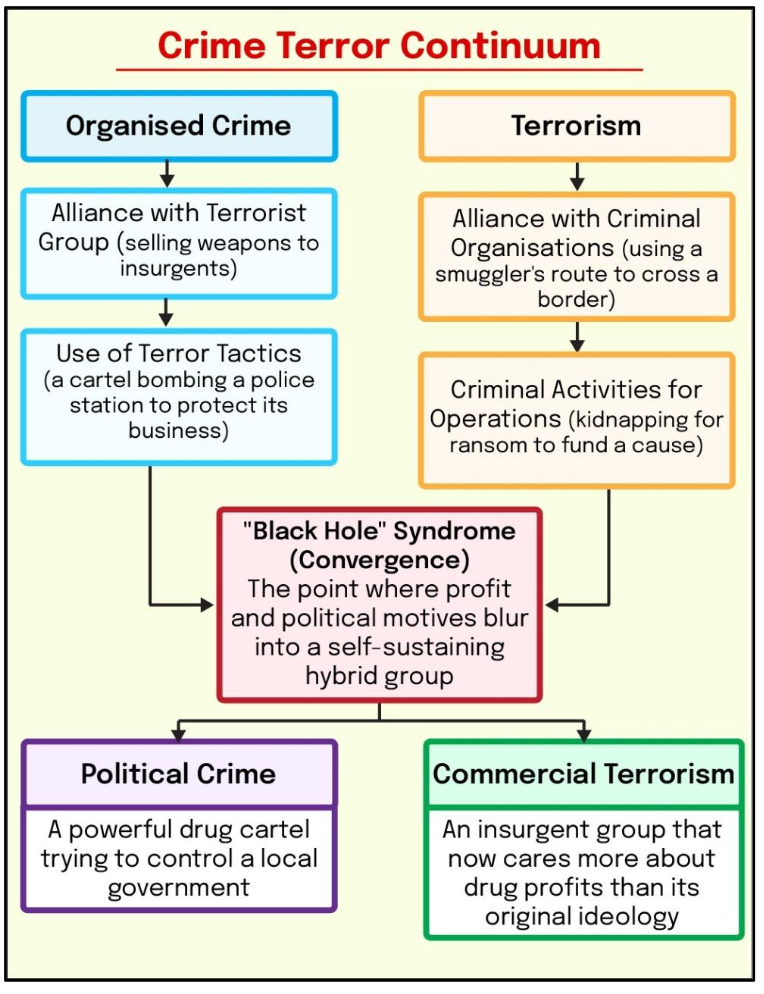
- The linkage between organized crime and terrorism creates a “force multiplier” for both, amplifying their threats to national security:
- Escalation of Threats:
- Their cooperation strengthens both groups' capacity to inflict damage, creating a bigger and more dangerous threat.
- Undermining State Sovereignty & Rule of Law:
- The criminal-political nexus erodes economic sovereignty, fosters corruption, and weakens the state.
- Challenges to National and International Security:
- These linkages, which transcend borders, require a global response to effectively tackle this cross-border threat.
- 2.2.3. Crime-Terror Nexus in the Indian Context
- Organized crime and terrorism in India are closely linked through illegal activities such as:
- Drug trafficking
- Arms smuggling
- Human trafficking
- Money laundering
- Key Areas of Convergence in India
- Jammu & Kashmir:
- State-sponsored Terrorism:
- Militant groups backed by Pakistan’s intelligence agency.
- Funding:
- Terrorist groups receive financial support from Pakistan and Gulf countries, facilitated through Hawala transactions.
- Narco-terrorism:
- Drug trafficking contributes to the funding of terrorism, accounting for about 15% of militant group finances.
- Punjab:
- Drug Crisis:
- Punjab faces a severe drug trafficking issue due to its proximity to Pakistan, especially near the Ferozepur sector.
- Drug Trafficking:
- Militant operations in Punjab are funded by the trade of heroin.
- Drones:
- Increased use of drones to smuggle arms, ammunition, and drugs, complicating border security.
- Northeast India:
- Golden Triangle:
- The region is a key point in the global drug trade, exploited by insurgent groups for illicit goods.
- Transnational Networks:
- International syndicates from Myanmar and Cambodia are involved in smuggling drugs, arms, and human trafficking.
- Parallel Governments:
- Insurgent groups establish parallel governments funded by extortion, undermining state control.
- Coastal Security:
- Vulnerability:
- The coastline faces challenges in controlling smuggling, including narcotics, arms, and explosives.
- Post-26/11 Security:
- Enhanced maritime security since the 26/11 Mumbai attacks, with better surveillance and intelligence gathering.
- Cyber Domain:
- Cyber-Crime:
- India is the second-most-attacked nation in the Asia-Pacific region (2020).
- Technology-Terrorism Nexus:
- Terrorist groups exploit modern technologies like virtual assets and drones for financing and operations.
- 2.2.4. Fighting Organized Crime- Initiatives, Challenges, and the Way Forward
- This section outlines the key steps taken by India and the global community to fight organized crime, the major hurdles they face, and the recommended path forward.
- Indian Initiatives Against Organized Crime
- Combating Human Trafficking:
- The Ministry of Home Affairs (MHA) has set up an Anti-Trafficking Nodal Cell. The government also funds NGO-run shelters through the Ujjawala and Swadhar programs. The proposed Trafficking of Persons Bill, 2021, aims to create special courts and rehabilitation committees to strengthen these efforts further.
- Tackling Drug Trafficking:
- India uses laws like the Narcotics Drugs and Psychotropic Substances Act (NDPS Act), 1985, to fight the drug menace. As a signatory to all three UN Conventions on drugs, India cooperates with global bodies like the UNODC. A recent success was Operation Dhvast (2023), where the NIA busted a major terrorist-gangster-drug trafficking nexus.
- State-Level Legislation:
- While India lacks a single national law on organized crime, state-level laws like the Maharashtra Control of Organized Crime Act (MCOCA), 1999, have been very effective in curbing crime syndicates in Maharashtra and Delhi.
-
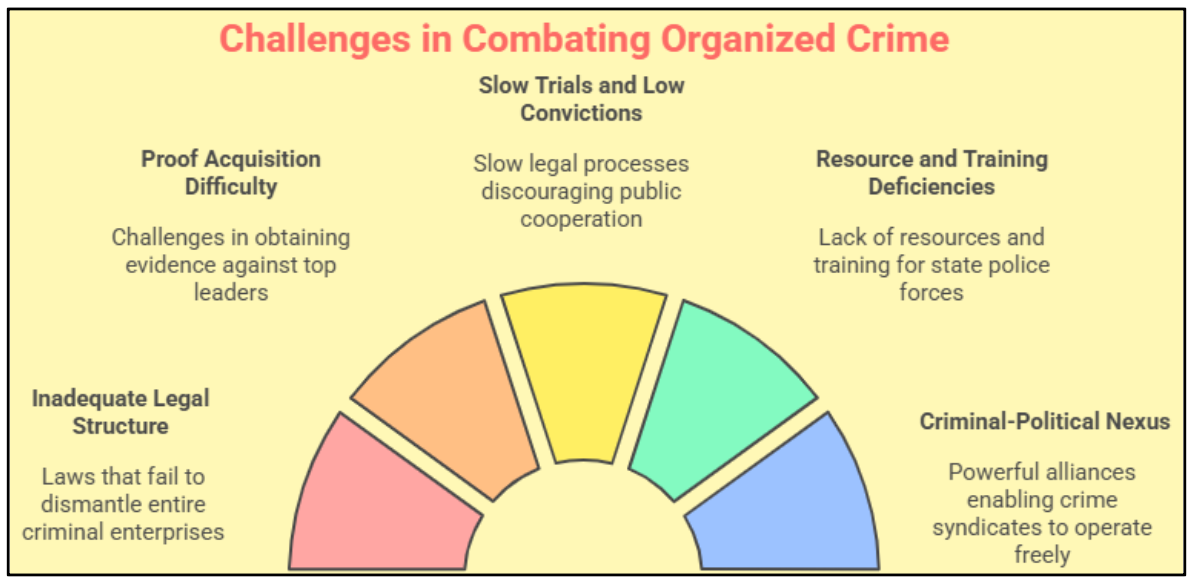
- Global Initiatives
- The primary international tool is the United Nations Convention against Transnational Organized Crime (UNTOC).
- This convention commits countries to create domestic laws against organized crime, money laundering, and corruption.
- It is supplemented by three specific Protocols targeting Trafficking in Persons (especially women and children), Smuggling of Migrants, and the Trafficking in Firearms.
- The Way Forward- What More Needs to be Done
- Improved Coordination:
- Set up a National Level body to act as a central hub for intelligence on organized crime.
- Enhanced International Cooperation:
- Focus on speedy extradition of fugitive criminals and strengthen the role of Interpol.
- Capacity Building and Awareness:
- Better training for police and intelligence agencies, effective implementation of strong laws like MCOCA, and raising public awareness to involve citizens in prevention.
- As former UN Secretary-General Ban Ki-moon stressed, the response to these interconnected threats must be coordinated and global.
UNIT 5- SECURITY CHALLENGES AND THEIR MANAGEMENT IN BORDER AREAS
- "Border management is not just about fences and guns; it is about creating a seamless interface between security and development." – K. Santhanam, IDSA
- 1. FOUNDATIONS OF BORDER MANAGEMENT
-
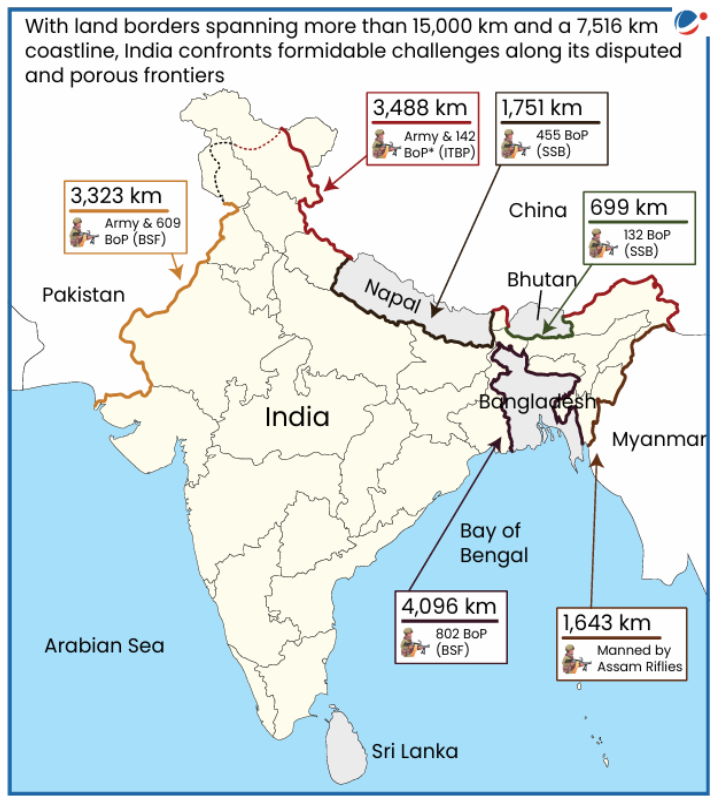
- Border management is a multifaceted and integrated strategy that goes beyond purely defensive measures. It involves coordinated actions across various sectors, including security, administration, diplomacy, intelligence, legal, and economic agencies.
- Key Objectives:
- Securing the Frontiers:
- The primary aim is to protect the nation from hostile threats like infiltration, cross-border terrorism, smuggling, and illegal migration.
- Facilitating Legitimate Trade and Transit:
- A crucial aspect is enabling legal cross-border trade and travel, promoting economic growth, and maintaining positive relations with neighboring countries.
- This approach recognizes that border security cannot operate in isolation. A balanced strategy is needed that considers both security needs and the socio-economic well-being of border populations, while also ensuring efficient and legal interactions across borders.
- India's Frontiers- An Overview
-
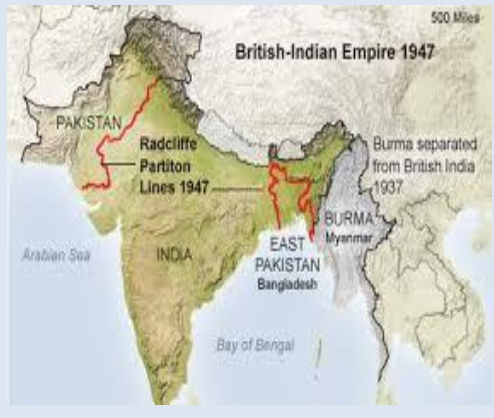
- A Statistical Look
-
| Border Type | Length | Description |
|---|
| Land Border | \(15,106.7 \, \text{km}\) | India shares a \(15,106.7 \, \text{km}\) long land border with seven countries, which requires constant vigilance and efficient border management systems. |
| Coastline | \(7,516.6 \, \text{km}\) | With a coastline stretching \(7,516.6 \, \text{km}\), including its island territories, India faces various maritime security threats that require specialized naval and coastal security measures. |
- Radcliffe Line- A Legacy of Conflict
- The Radcliffe Line (1947), an artificially drawn border between India and Pakistan, was hastily demarcated without local consideration. This flawed partition inherently ignited perpetual India-Pakistan disputes.
- Its arbitrary nature fueled mass migration, violence, and unresolved territorial claims, most notably Kashmir. This historical demarcation remains a fundamental source of enduring hostility between the two nations.
- Characteristics of India's Neighbourhood
- Diversity:
- The region is marked by significant cultural, political, and economic diversity, which presents both opportunities and challenges for cooperation.
- Asymmetry:
- India is much larger in terms of population and size compared to most of its neighbors, which creates a power imbalance and complex diplomatic relationships.
- Political Instability:
- While India has solidified its democratic structure, many of its neighbors continue to face political instability and incomplete nation-building, leading to spillover effects on India.
- Least Integrated Region:
- Despite many shared interests, South Asia remains one of the world’s least economically integrated regions, hindering regional stability and growth.
- Influence of External Powers:
- The region is also an arena for the influence and competition of major external powers, which adds layers of complexity to India’s security challenges.
- 2. KEY CHALLENGES IN INDIAN BORDER MANAGEMENT
- "Borders are not just lines on maps but complex interfaces of security, economy, and human dignity." – EU Black Sea Strategy, 2025
- India's border management is affected by a combination of geographical, political, administrative, and socio-economic challenges, many of which are common across its vast and diverse frontiers.
- 1. Geographical Challenges- Difficult and Diverse Terrains
- India's borders pass through some of the most difficult terrains in the world, making their security particularly challenging:
- Mountains:
- The high-altitude Himalayan ranges along the border with China.
- Deserts:
- The arid Thar Desert in Rajasthan.
- Marshes:
- The swampy, riverine terrain of the Rann of Kutch in Gujarat.
- Riverine Belts:
- Shifting river courses along the Indo-Bangladesh border make fencing and permanent demarcation difficult.
- Dense Forests:
- The thick jungles along the Indo-Myanmar border offer natural cover for insurgents and smugglers, contributing to porous borders and easy infiltration.
- Siachen- Nature's Ultimate Border Test
-
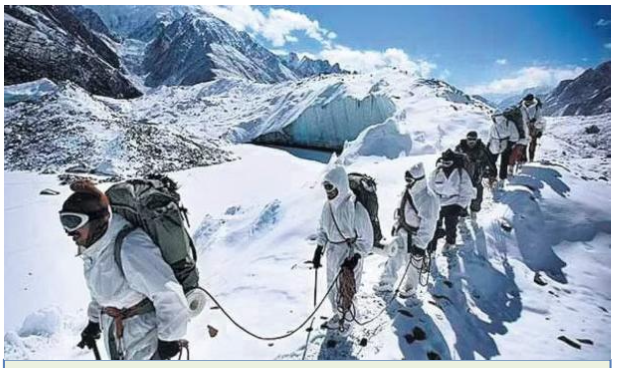
- The Himalayan glaciers, notably Siachen, present extreme geographical challenges for border management. Temperatures plunging to \(-60^\circ \text{C}\) create immense logistical nightmares for troops.
- This harsh environment tragically causes more casualties from weather (avalanches, frostbite) than from combat, highlighting the overwhelming natural dangers faced in securing these high-altitude borders.
- China’s Cartographic Warfare
-

- China is continuing its cartographic aggression. In a provocative move in May 2025, Beijing released new "standard maps" that falsely claim India's Arunachal Pradesh and the entire South China Sea as its own territory. This is a modern take on historical "cartographic colonialism."
- In response, India strongly counters these baseless claims. India is firmly using its existing stringent laws, which make it a criminal offense to depict the country's borders incorrectly.
- 2. Political & Historical Challenges- Un-demarcated and Disputed Borders
- India's borders are often a legacy of colonial-era decisions, which created boundaries that are not always aligned with natural features:
- Disputed Borders:
- India has unresolved disputes with Pakistan and China. The lack of a mutually agreed-upon Line of Control (LoC) with Pakistan and Line of Actual Control (LAC) with China leads to persistent tensions and military standoffs.
- Un-demarcated Sections:
- Even with friendly neighbors, some sections of the border remain un-demarcated, contributing to disagreements and potential friction.
- Centralized vs. Fragmented Border Security
- The EU's Frontex Agency showcases a model of centralized border force coordination across 27 nations, leveraging interoperable technology. This approach streamlines operations and enhances security.
- In contrast, India's border management, characterized by agencies like BSF, ITBP, and SSB, suffers from fragmentation. This highlights persistent coordination gaps, impacting efficiency and comprehensive border control.
- 3. Administrative Challenges- The Problem of Multiplicity of Forces
- The presence of multiple forces along India's borders creates coordination and management issues:
- Fragmented Command:
- For example, the border with China is managed by various forces, including the Indo-Tibetan Border Police (ITBP), Indian Army, and the Special Frontier Force, which leads to fragmented command and control.
- "One Border, One Force" Principle:
- While the government has adopted this policy to streamline border management, its implementation remains incomplete.
- 4. Socio-Economic Challenges- Alienation of Border Populations
- The border areas of India often suffer from underdevelopment, which contributes to socio-economic challenges:
- Psychological Alienation:
- These areas lack basic infrastructure and livelihood opportunities, leading to a sense of alienation among local populations.
- Security Implications:
- Discontented communities in border areas are vulnerable to exploitation by hostile state and non-state actors, who use them for intelligence gathering, logistics, and shelter. Integrating these communities and making them stakeholders in border security is a critical element of effective border management.
- Border Vulnerabilities:
- Punjab Border:
- In Punjab, "Drones & Discontent" (2025) highlights WHAM (Winning Hearts and Mind) gaps. Farmers near the International Border (IB) lack tech jobs, making them susceptible to smuggling networks offering lucrative drone-pilot roles, fueling illicit activities.
- Myanmar Border:
- Along the Myanmar border, Chin refugees fleeing junta violence (2024) reveal another WHAM challenge. Underdevelopment in these regions is exploited, aiding insurgent recruitment (e.g., NSCN-K), exacerbating regional instability.
- 3. BORDER-BY-BORDER ANALYSIS OF SECURITY CHALLENGES
- 3.1. Western Frontier- The India-Pakistan Border
-
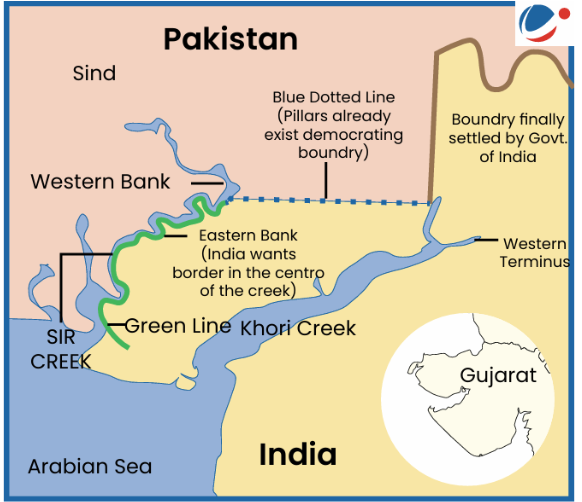
- India's border with Pakistan, spanning \(3,323 \, \text{km}\), is one of the most heavily militarized and volatile borders globally. It is a composite of different segments, each with unique security dynamics shaped by geography, political relations, and history.
- Nature of the Border
-
| Segment | Length | Description |
|---|
| International Border (IB) | - | Running from Gujarat to Jammu, this boundary is recognized internationally but faces constant infiltration attempts and smuggling activities. |
| Line of Control (LoC) | \(776 \, \text{km}\) | This de facto boundary emerged after the 1948 and 1971 wars. It is not internationally recognized but is a frequent site of military confrontations and ceasefire violations. |
| Actual Ground Position Line (AGPL) | \(110 \, \text{km}\) | A line in the Siachen Glacier region, marking the positions held by Indian and Pakistani troops. |
- Key Security Challenges
-
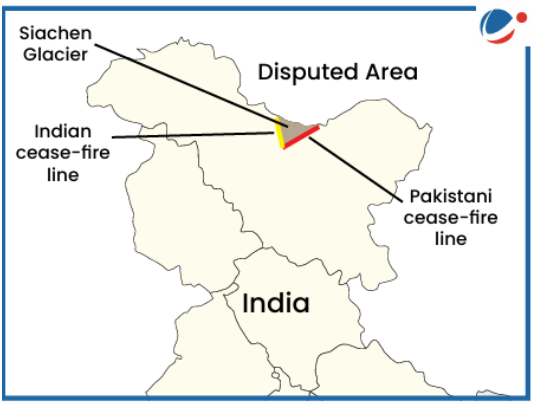
- Cross-Border Infiltration of Terrorists:
- The difficult terrain and cover of cross-border firing are exploited by Pakistan’s ISI to send well-trained terrorists into India particularly in Jammu & Kashmir
- Frequent Ceasefire Violations and Military Standoffs:
- The LoC is frequently marked by ceasefire violations, which are often strategic, used to facilitate infiltration attempts and keep the border tension-filled.
- Transborder Smuggling of Narcotics and Arms:
- The western frontier, especially in Punjab and Rajasthan, is a significant route for smuggling narcotics (mainly heroin) from the "Golden Crescent" region and arms used by terrorists and criminal syndicates operating within India.
- KAVACH laser walls
- "KAVACH laser walls" are an authentic, indigenous technology deployed along a \(198 \, \text{km}\) stretch of the India-Pakistan border in Jammu. This advanced system utilizes invisible infrared beams for intrusion detection.
- Upon detecting breaches, KAVACH immediately relays real-time alerts to BSF posts. This enhances border security, enabling rapid response to intrusions and bolstering the overall vigilance in challenging terrains.
- Unresolved Territorial Disputes:
- Siachen Glacier:
- The world’s highest battlefield, strategically important for India, remains a contested area. India pre-emptively occupied it in 1984 to counter Pakistan’s moves, safeguarding Ladakh and the Leh-Srinagar highway from Pakistani control and ensuring security against Chinese territorial ambitions.
- Sir Creek:
-
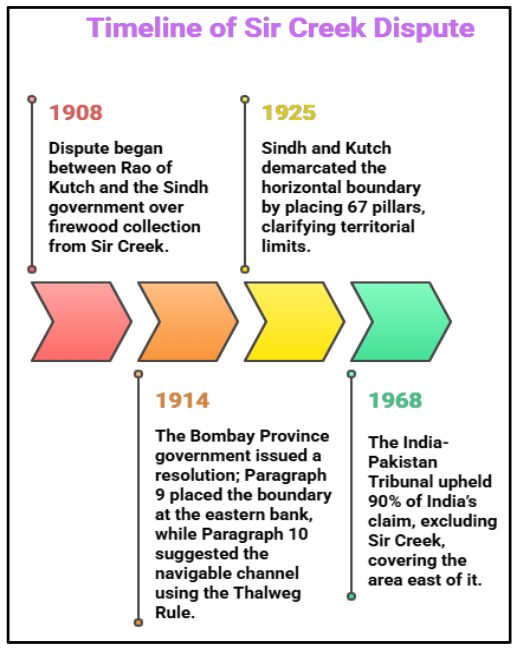
- A \(96 \, \text{km}\) tidal estuary in the marshy Rann of Kutch, the dispute centers around differing interpretations of a 1914 map.
- While India follows the Thalweg doctrine (boundary should follow the deepest part of the main navigable channel), Pakistan claims the entire creek.
- The unresolved dispute facilitates smuggling and terrorism, as demonstrated in the 26/11 Mumbai attacks, where terrorists used a sea route near Sir Creek to infiltrate India.
- 3.2. The Northern Frontier- Managing the India-China Border
-
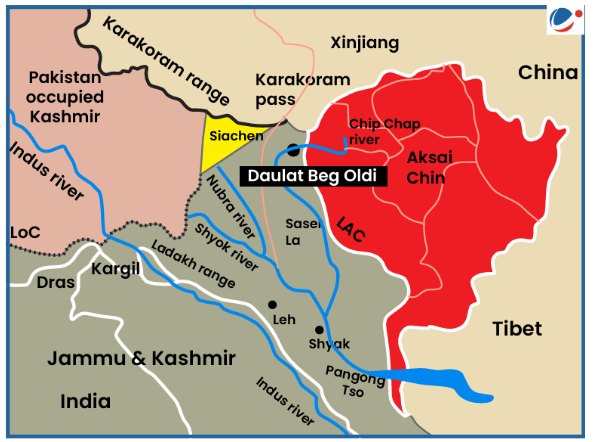
- The India-China border spans \(3,488 \, \text{km}\) and is marked by a fundamental disagreement over its alignment, making it a zone of strategic competition and military tension.
- Nature of the Border- The Contested Line of Actual Control (LAC)
- Unlike the Line of Control (LoC) with Pakistan, the Line of Actual Control (LAC) with China is not mutually agreed upon and remains un-demarcated over large stretches. Both countries have differing perceptions of the LAC, which often leads to overlapping claims and face-offs when patrols from either side assert their presence. The border is divided into three sectors:
- Western Sector (Ladakh)
- Middle Sector (Himachal Pradesh, Uttarakhand)
- Eastern Sector (Sikkim, Arunachal Pradesh)
- Key Security Challenges
-
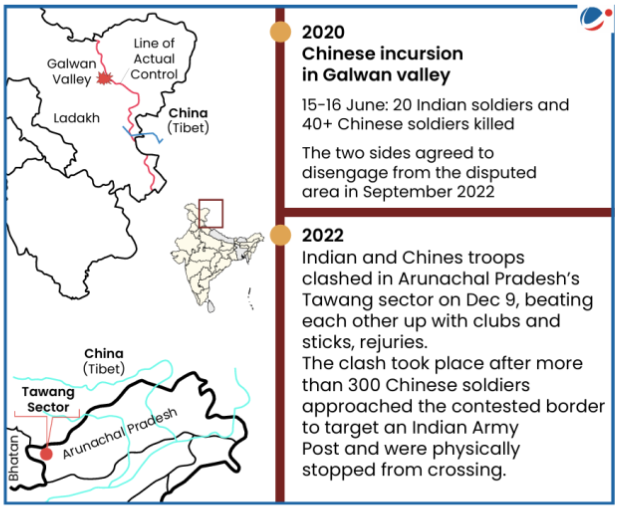
- Military Transgressions and Standoffs:
- Frequent transgressions by the People’s Liberation Army (PLA) result from differing perceptions of the LAC. These provocations are often deliberate, testing India’s resolve and asserting Chinese claims. Notable incidents include:
- Doklam (2017):
- Indian troops blocked the PLA from constructing a road on the disputed Doklam plateau, located at the India-Bhutan-China tri-junction. This road posed a threat to India's Siliguri Corridor (also called the "Chicken's Neck").
- Galwan Valley (2020):
- A violent clash between Indian and Chinese troops in Ladakh led to casualties on both sides. This was the first major clash in decades and marked a significant deterioration in bilateral relations.
- Doklam- Grey-Zone Challenge
-
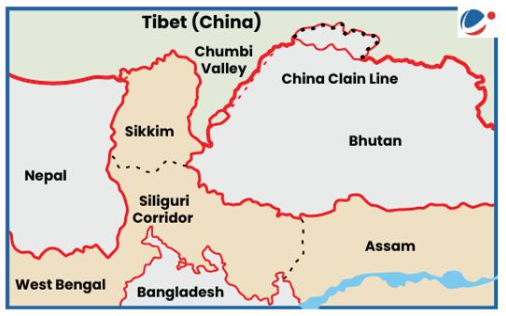
- The Doklam standoff (2017) exemplifies Grey-Zone warfare. China's road construction in disputed Bhutanese territory challenged India’s strategic dominance near the Siliguri Corridor, a critical vulnerability.
- Resolved after 73 days, the crisis ended through diplomatic coercion and mutual disengagement. This case highlighted how nations assert claims and test resolve without escalating to full-scale military conflict.
- China’s Use of "Grey-Zone Warfare" and "Salami Slicing"
- China employs Grey-Zone Warfare tactics to achieve strategic objectives without direct conflict.
- Salami slicing refers to small, incremental changes made to the status quo that are minor to provoke a major military response, but over time, they accumulate and alter the strategic landscape in China’s favor. This tactic is evident in China’s continuous construction of infrastructure like posts and roads along the LAC.
- Rapid Infrastructure Development and Strategic Asymmetry:
- China’s rapid development of infrastructure along the LAC in Tibet—including roads, railways, and airfields—has created a strategic asymmetry. This infrastructure enables the PLA to quickly mobilize troops and deploy equipment, putting India at a significant military disadvantage.
- The Strategic Implications of the China-Pakistan Economic Corridor (CPEC):
- The China-Pakistan Economic Corridor (CPEC), a key component of China’s Belt and Road Initiative, passes through Pakistan-Occupied Kashmir (PoK), which India claims as its own territory. This project undermines India’s sovereignty and territorial integrity.
- 3.3. The Eastern Frontiers - Managing Borders with Bangladesh and Myanmar
- India’s eastern borders are defined by diverse geographical features, ethnic continuities across borders, and a history of insurgency and illegal migration, presenting unique challenges.
- The India-Bangladesh Border
- Primary Challenge - Illegal Migration:
- The \(4,096 \, \text{km}\) India-Bangladesh border is the longest India shares with any neighbor. The primary security concern is the large-scale illegal migration from Bangladesh, which has led to demographic changes in states like Assam and West Bengal. This migration fuels social and ethnic tensions, increasing pressure on local resources and infrastructure.
- Other Challenges:
- The border is also notorious for cattle smuggling, with an estimated one lakh cattle being smuggled annually, leading to financial losses and violence. Other issues include human trafficking and the smuggling of contraband.
- Successes in Management - India-Bangladesh Land Boundary Agreement (2015):
- Despite challenges, the India-Bangladesh Land Boundary Agreement (2015) effectively resolved the complex enclave issue along their \(4,096 \, \text{km}\) border. This historic accord formally integrated territories, demonstrating successful diplomatic engagement.
- Crucially, the agreement directly benefited over 52,000 people, providing national identity and services. It stands as a powerful model for peaceful dispute resolution, significantly fostering stronger bilateral ties.
- Rohingya Muslims Issue in India – Bangladesh Connection
-
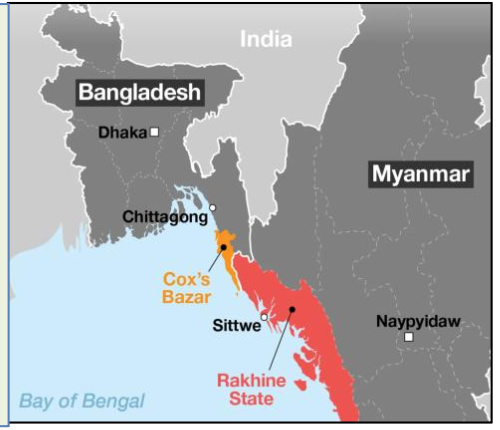
- Rohingya Muslims, fleeing violence in Myanmar since 2012, initially sought refuge in Bangladesh before crossing illegally into India. Their influx into West Bengal, Assam, and Jammu raises concerns over illegal immigration, security risks and resource strain.
- India balances security with humanitarian obligations while coordinating with Bangladesh on cross-border movement and deportations.
- The India-Myanmar Border
-

- Primary Challenge - A Haven for Insurgents:
- The \(1,643 \, \text{km}\) border with Myanmar passes through rugged terrain and dense forests, making it a security concern.
- The border’s porosity and the ethnic ties across it have allowed insurgent groups from North-East India (such as NSCN factions) to set up safe havens, training camps, and operational bases in Myanmar.
- Other Challenges:
- The border’s proximity to the Golden Triangle makes it a major route for drug trafficking (especially heroin and methamphetamine) and arms smuggling, which finances insurgent activities.
- The Free Movement Regime (FMR):
- The Free Movement Regime (FMR) allowed border populations to travel up to \(16 \, \text{km}\) across the border without a visa.
- While it facilitated social and trade ties, the regime was misused by insurgents for infiltration and smuggling, contributing to illegal immigration. In 2024, the Indian government decided to scrap the FMR and fence the entire border to curb these issues.
- Securing the Porous Frontier (2024-25)
- India's India-Myanmar border policy underwent a significant shift in 2024-2025. Driven by security concerns like insurgency and drug trafficking, the Free Movement Regime (FMR) was scrapped.
- Simultaneously, India is embarking on extensive border fencing along the \(1,643 \, \text{km}\) frontier. New rules, effective December 2024, mandate biometric border passes for tribal communities, tightening control and enhancing real-time vigilance through technology.
- 3.4. Open Borders - Managing Frontiers with Nepal and Bhutan
- India shares open, unfenced borders with Nepal (\(1,751 \, \text{km}\)) and Bhutan (\(699 \, \text{km}\)), governed by Friendship Treaties that allow for the free movement of people. While these arrangements foster close relations, they also present unique security challenges.
- Key Security Challenges
- Misuse as a Transit Route:
- A major security concern is the misuse of these open borders as a transit route for terrorists, criminals, and third-country nationals. Pakistan's ISI often facilitates the movement of terrorists, Fake Indian Currency Notes (FICN), and narcotics across these borders, using them as entry points into India.
- Smuggling of Goods:
- The borders are also exploited for the smuggling of goods, including Chinese-made electronics and forest products, which bypass customs and regulatory checks, causing significant revenue losses.
- Emerging Border Disputes:
- While the borders remain largely peaceful, border disputes have arisen, creating diplomatic friction. A prominent example is the Kalapani territorial dispute with Nepal, where Nepal claims areas that India considers part of its territory in Uttarakhand. This dispute has led to tensions between the two countries.
- Nepal- A Gold Smuggling Conduit
- Nepal serves as an authentic and significant transit point for gold smuggling into India, largely exploiting the porous open border. This long-standing issue allows illicit gold, often from China or the Middle East, to circumvent stricter Indian security measures.
- Recent Border Dispute with Nepal
-
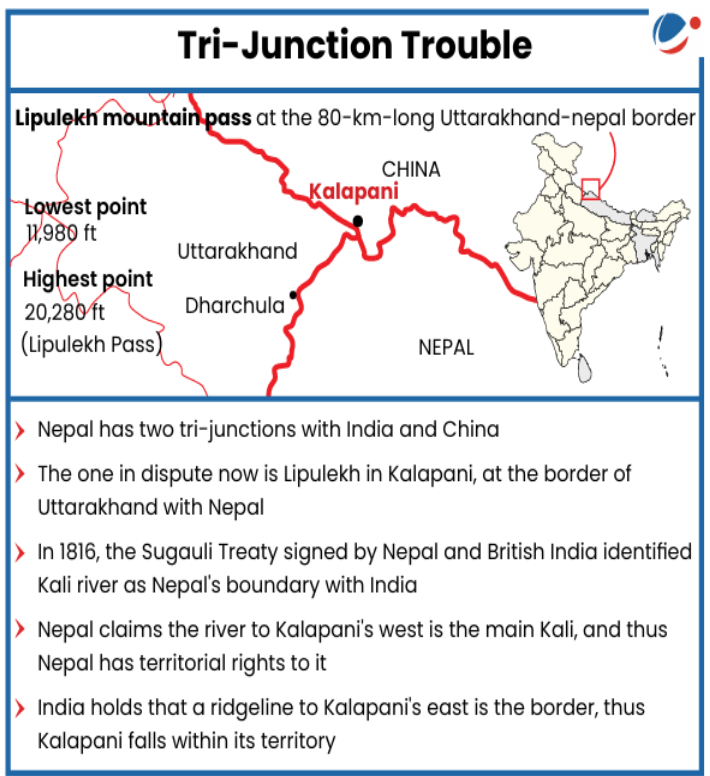
- Nepal recently released a new political map claiming Kalapani, Limpiyadhura, and Lipulekh—strategically important regions of Uttarakhand, India, as part of its territory, raising concerns over the border dispute.
- Nepal’s Viewpoint
- Nepal bases its claim on the 1816 Treaty of Sugauli, which set the Kali River (Mahakali in Nepal) as the north-western border. Nepal argues that the source of the Kali River lies near Limpiyadhura, so it claims the region, including Kalapani and Lipulekh, lies to its east.
- India’s Viewpoint
- India asserts the border starts at Kalapani, where the Kali River originates. India claims Kalapani has been part of Pithoragarh district in Uttarakhand since the 19th century and has been under Indian control since the 1950s, with infrastructure, administration, and military presence.
- China’s Recognition
- In 2015, China recognized India’s sovereignty over Kalapani and agreed to expand trade through the Lipulekh pass, further strengthening India’s claim.
- 3.5. Open Borders - Managing Frontiers with Sri Lanka
-

- Sri Lanka shares a maritime border with India and is a very important country strategically placed in the Indian ocean for India’s security.
- Key security Challenges along the border Sri Lankan Border:
- Katchatheevu Island:
- India ceded the uninhabited island to its southern neighbour in 1974 under a conditional accord. However, Indian fishermen considered it to be their traditional fishing area and want Katchatheevu to be used as fishing grounds for India as well.
- Fishermen Issue:
- The Fishermen Issue revolves around Indian fishermen frequently trespassing into Sri Lankan waters, not due to an unsettled maritime boundary, but because of the refusal of Indian fishermen to acknowledge the maritime boundary between India and Sri Lanka, especially in the Palk Bay. Sri Lanka has introduced tougher laws banning bottom trawling and imposing heavy fines on foreign vessels that trespass into its waters.
- Side note
- Black Sea's Three-Pronged Shield
- The EU's Black Sea Strategy integrates security, economic prosperity, and environmental resilience through a "Three-Pillar Framework".
- This approach stabilizes the region by addressing military, trade, and climate challenges synergistically, promoting sustainable growth and combating hybrid threats. India can apply a similar strategy to the Indo-Sri Lankan issue, focusing on connectivity, security, and climate resilience.
- 4. INDIA'S COMPREHENSIVE BORDER MANAGEMENT STRATEGY
- To address the multifaceted challenges along its borders, India has implemented a comprehensive border management strategy. This integrates policy, security force deployment, developmental initiatives, and technology to ensure both security and socio-economic development.
- 1. Policy and Administrative Framework
- The Principle of "One Border, One Force":
- India has adopted the "One Border, One Force" principle to improve accountability, coordination, and specialization in border management. The idea is to assign the security of each border to a single force. However, the implementation faces challenges, especially along the China border, where multiple forces currently operate.
- 2. Role of Border Guarding Forces (BGFs)
-
| Force | Responsibility |
|---|
| Border Security Force (BSF) | Manages the borders with Pakistan and Bangladesh. |
| Indo-Tibetan Border Police (ITBP) | Secures the high-altitude border with China. |
| Sashastra Seema Bal (SSB) | Guards the open borders with Nepal and Bhutan. |
| Assam Rifles | Manages the Indo-Myanmar border and conducts counter-insurgency operations in the North-East. |
- 3. Developmental Initiatives in Border Areas
- The Border Area Development Programme (BADP):
- A centrally sponsored scheme focused on improving infrastructure and socio-economic conditions in remote border areas. It emphasizes sectors like health, education, connectivity, and agriculture, helping reduce the sense of alienation among border populations.
- The Vibrant Villages Programme (2022):
- Launched to enhance the development of select villages along the northern border with China. The programme aims to improve living standards and encourage population retention, thereby bolstering both security and socio-economic stability in these strategically important regions.
- 4. Technological and Infrastructural Upgradation
- Comprehensive Integrated Border Management System (CIBMS):
- The CIBMS is a vital initiative to create a "smart fence" that combines technology with human resources.
- It includes the Project BOLD-QIT (Border Electronically Dominated QRT Interception Technique) for the riverine border with Bangladesh, designed to enhance security and interception techniques.
- Use of Surveillance Technology:
- Thermal imagers and night-vision devices for round-the-clock surveillance.
- Battlefield surveillance radars and underground monitoring sensors to detect hidden threats.
- Laser barriers and Unmanned Aerial Vehicles (UAVs) for continuous monitoring.
- Role of Space Technology
- India utilizes space technology for comprehensive border management. Satellites like the Cartosat series provide high-resolution imagery for real-time monitoring and intelligence gathering, greatly improving border surveillance capabilities.
- 5. Strengthening Physical Border Infrastructure
- Construction of Strategic Infrastructure:
- India is focusing on the construction of strategic infrastructure such as border roads, tunnels, and bridges to ensure all-weather connectivity, enabling quick troop deployment and efficient movement of supplies.
- Erection of Border Fencing and Floodlighting:
- To prevent infiltration and smuggling, the government is installing border fencing and floodlighting in vulnerable stretches, acting as physical barriers.
- Development of Integrated Check Posts (ICPs):
- To streamline trade and travel, Integrated Check Posts (ICPs) are being developed along borders. These modern facilities bring together customs, immigration, and security agencies, ensuring smoother cross-border trade and regulated movement.
- 6. Managing Border Populations
- Effective border management goes beyond fences and technology; it involves the people who live in border areas. These communities are crucial stakeholders, acting as either vulnerabilities or the first line of defense. A successful border strategy must integrate these communities into the national mainstream and earn their trust.
- Denying Local Support to Militants and Insurgents
- A core objective of counter-insurgency and counter-terrorism operations is to deny local support to militants and insurgents. These groups are heavily dependent on the local population for:
- Intelligence:
- Providing information on the movement of security forces.
- Logistics:
- Offering food, shelter, and medical aid.
- Recruitment:
- Supplying new cadres.
- Financial Support:
- Through contributions or extortion.
- Severing these links isolates militants and weakens their operational capacity, leading to their eventual neutralization.
- The "Winning Hearts and Minds" (WHAM) Approach
-
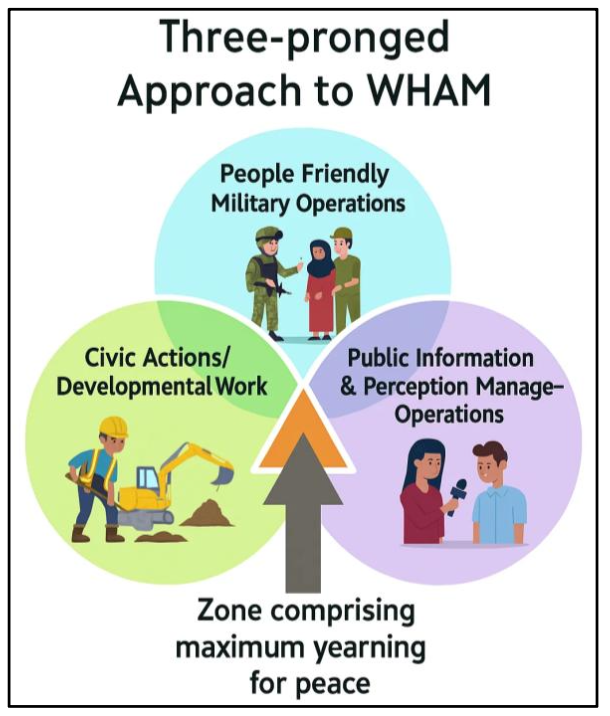
- To counter hostile propaganda and address the grievances of the border population, security forces have embraced the "Winning Hearts and Minds" (WHAM) approach. Key initiatives include:
- Operation Sadbhavana:
- In Jammu & Kashmir and Ladakh, the Indian Army runs community development projects like schools, medical camps, and vocational training programs for youth, aiming to foster goodwill and support.
- Civic Action Programmes:
- Border Guarding Forces (BGFs) also engage with local populations, offering assistance and building trust through direct interaction.
- Involving Local Communities in Border Management
- A proactive strategy involves empowering local communities to play an active role in securing the frontiers. This is achieved through:
- Village Defence Guards (VDG):
- In Jammu & Kashmir, villagers in remote areas are trained and armed to defend themselves against terrorist attacks, acting as the first line of defense.
- Community Policing:
- Establishing strong relationships through community policing generates valuable human intelligence and fosters shared responsibility for security, ensuring long-term success.
- Border defence during Operation Sindoor
-
- For border defence during Operation Sindoor, the Indian Army used precision-guided Excalibur artillery rounds and loitering munitions to secure the Line of Control, while the Border Security Force (BSF) played a critical role in thwarting infiltration attempts along the International Border. The operation as a whole showcased a new generation of advanced weaponry.
- The Spear- India's Offensive Weapons
- India's strikes relied on a sophisticated set of precision-guided weapons that allowed for deep penetration and surgical accuracy, all launched from within Indian airspace.
- SCALP Cruise Missile:
- This is a long-range, stealthy, air-launched missile used for deep strikes against high-value terrorist headquarters far inside Pakistan, such as those in Muridke and Bahawalpur.
- BrahMos Cruise Missile:
-
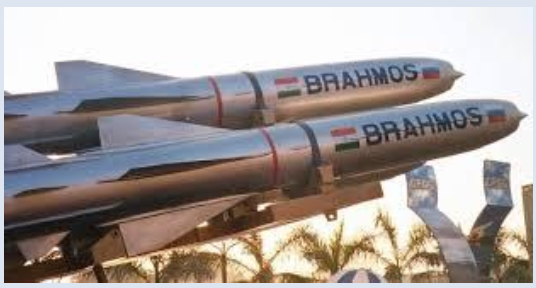
- This is a powerful supersonic air-launched cruise missile. After Pakistan escalated the conflict, India used BrahMos missiles to strike key Pakistan Air Force (PAF) bases, crippling their operational capacity.
- HAMMER Munition:
- This is an all-weather, precision-guided smart weapon. Fired from Rafale jets, HAMMER munitions were used to precisely hit terrorist infrastructure in the initial phase of the operation.
- Loitering Munitions (Kamikaze Drones):
- These are "suicide drones" that can circle a target before striking. The Israeli-made Harop was used to destroy Pakistani air defence radars, while the SkyStriker and the indigenous Nagastra-1 were used to devastating effect against terror camps.
- The Shield- India's Air Defence Systems
- One of the biggest successes of the operation was India's robust and multi-layered air defence architecture, which effectively neutralized waves of retaliatory Pakistani drone and missile attacks.
- S-400 Triumf:
-
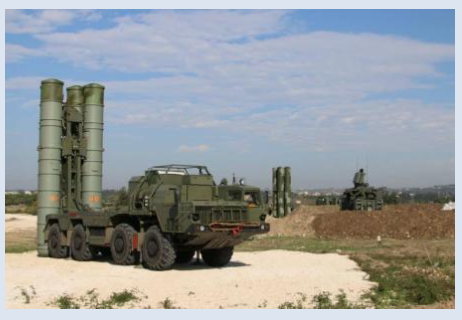
- Known in Indian service as the 'Sudarshan Chakra', this Russian-made long-range system formed the outermost layer of India's defence, capable of engaging threats up to \(400 \, \text{km}\) away.
- Akash Missile System:
-
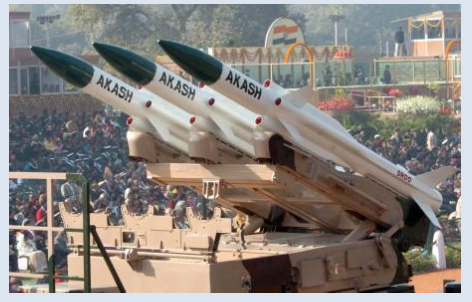
- This is an indigenously developed Short-Range Surface-to-Air Missile. Hailed as the "star" of the operation, the Akash system had a stellar performance, successfully intercepting multiple incoming drones and missiles launched by Pakistan.
- Barak-8 MRSAM:
- This is a Medium-Range Surface-to-Air Missile system jointly developed by India and Israel. It formed a critical part of the mid-layer of the defensive shield, helping to thwart Pakistani attacks.
- 5. SECURING THE MARITIME FRONTIERS
-
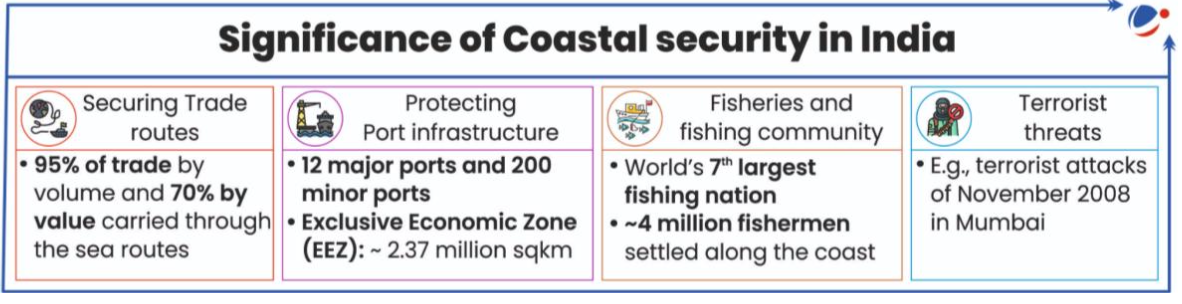
- "In borders, we see the nation’s anxieties and aspirations; their management demands the surgeon’s precision and the poet’s imagination." – Spirit of EU Black Sea Strategy
- India's maritime frontiers, with a vast coastline of \(7,516 \, \text{km}\), pose unique and complex security challenges. The 26/11 Mumbai terror attacks, in which terrorists infiltrated via the sea route, highlighted vulnerabilities and prompted a complete overhaul of India's coastal security architecture.
- India’s Coastline
- India's coastline recalculated to \(11,098.81 \, \text{km}\) from \(7,561.60 \, \text{km}\) due to a change in calculation methodology.
- The change is due to a revision in the methodology, which now uses more detailed mapping at a scale of 1:250,000, capturing more intricate features like bays and inlets.
- Unique Challenges:
- Porous Nature and Vastness:
- India's coastline is riddled with numerous landing points, creeks, small bays, and estuaries that are difficult to continuously monitor.
- Proximity to Volatile Regions:
- The coasts are adjacent to politically unstable and economically depressed countries, increasing the risk of infiltration, smuggling, and refugee influx.
- Piracy and armed robbery:
- Piracy by definition takes place on the high seas and, therefore, does not fall under the ambit of coastal security. However, in the case of India, the shallow waters of the Sunderbans have been witnessing ‘acts of violence and detention’ by gangs of criminals that are akin to piracy.
- Unsettled Maritime Boundaries:
- Disputed maritime boundaries, especially with Pakistan (Sir Creek) and Bangladesh, create legal ambiguities that criminals and terrorists exploit.
- High Volume of Maritime Traffic:
- The dense traffic of fishing boats and commercial vessels complicates the identification of suspicious activity.
- 5.1. Coastal Security Management
-
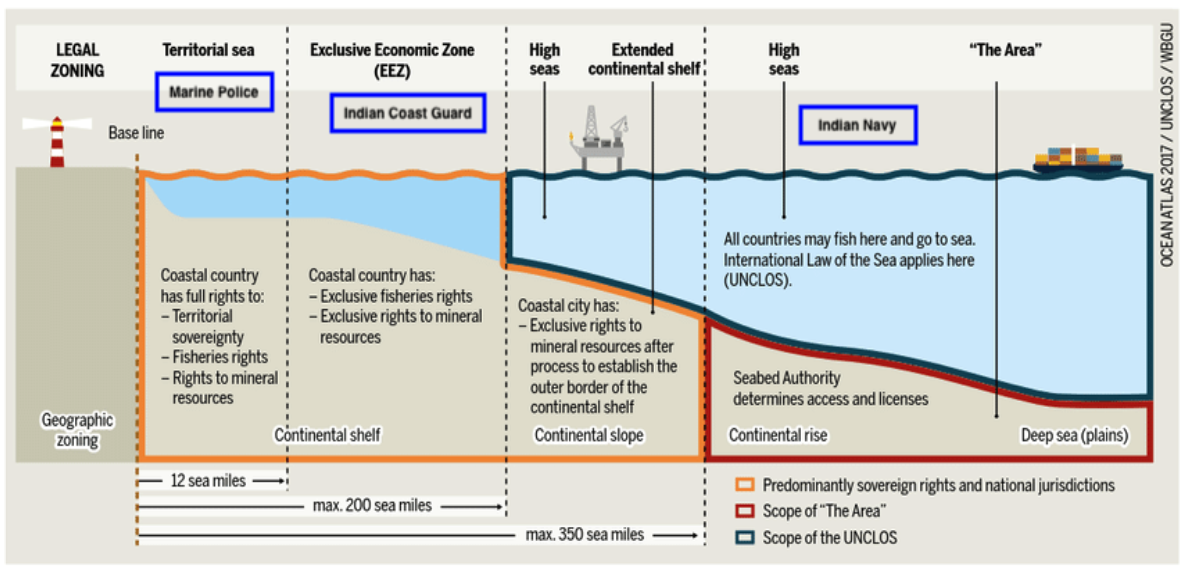
- 5.1.1. Three-Tiered Security Grid
- Post-26/11, India institutionalized a three-tiered coastal security grid to provide layered and in-depth security:
- Indian Navy:
- Responsible for maritime security on the high seas beyond 200 nautical miles.
- Indian Coast Guard (ICG):
- Secures territorial waters (up to 12 nautical miles) and Exclusive Economic Zone (EEZ), crucial in preventing smuggling, poaching, and piracy.
- State Marine Police:
- Patrolling shallow waters (up to 12 nautical miles) near the coast as part of the Coastal Security Scheme (CSS).
- Side note
- MARCOS- India’s Elite Marine Commandos
- MARCOS (Marine Commandos) is the elite special operations force of the Indian Navy, established in 1987, comparable to US Navy SEALs.
- What Do MARCOS Do?
- They specialize in high-risk operations, including:
- Reconnaissance and intelligence gathering
- Amphibious warfare
- Hostage rescue and counter-terrorism
- Anti-piracy and anti-hijack missions
- Underwater sabotage and raids.
- They’ve been involved in missions like the 26/11 Mumbai attacks.
- MARCOS undergo intense training in combat diving, skydiving, close-quarter battle, counter-insurgency, and urban warfare. MARCOS are key to India’s maritime security, working with other forces like the Para (SF) and Garud Commando Force.
- Sea Surveillance Excellence
- The EU's integrated Coastal Surveillance Network (CSR), a misnomer for the advanced Common Information Sharing Environment (CISE), effectively detects vessels as small as dinghies.
- This sophisticated maritime technology enhances security and monitoring across European waters.
- This advanced system serves as a valuable model for India's comprehensive three-tier coastal grid, highlighting the global push for enhanced maritime domain awareness and protection against diverse threats.
- Coastal Security Gaps Persist
- Despite significant post-26/11 reforms, coordination gaps between the Navy, Coast Guard, and Marine Police persistently hinder India's coastal security. This challenge remains evident even in 2024, impacting overall maritime vigilance.
- These ongoing "silos" in inter-agency functioning highlight the critical need for further integration and seamless cooperation to effectively protect India's vulnerable coastline from diverse threats.
- 5.1.2. Indian Coast Guard (ICG)
-
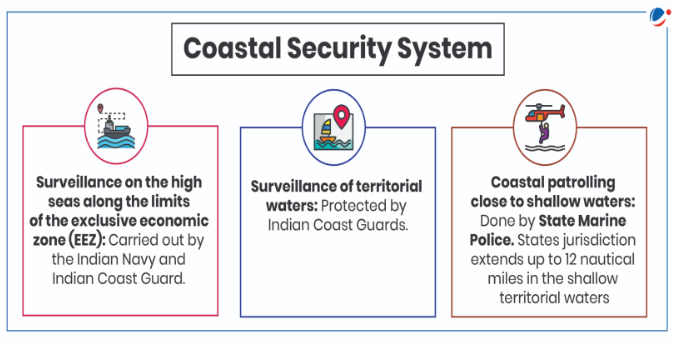
- The Indian Coast Guard (ICG), established under the Coast Guard Act of 1978, is responsible for maritime law enforcement, search and rescue, and marine pollution response. It operates under the Ministry of Defence and plays a vital role in maritime security.
- The Indian Coast Guard enforces maritime laws, protects artificial islands and offshore terminals, ensures safety of life and property, coordinates with customs for anti-smuggling operations, and preserves the marine environment while collecting scientific data.
- Challenges faced by Coast guard
- Coordination Issues
- Multiple agencies' involvement causes coordination problems despite efforts like SOPs, joint exercises, and committees.
- Staffing Deficiencies
- Acute staff shortages at police stations, with only \(\text{25%}\) of required personnel available.
- Training Gaps
- Absence of a dedicated training academy for the Indian Coast Guard limits effectiveness.
- Fishermen’s Concerns
- Coastal security depends on fisher communities, but their discontent hinders efficient operations and surveillance.
- Initiatives taken to strengthen Indian Coast Guard
- Inter-agency Maritime Exercise:
- ICG conducts inter-agency exercises like SAREX-2024 and Sagar Kavach to enhance coordination and readiness.
- Increased Responsibility:
- In 2009, ICG took on the responsibility for coastal security in territorial waters.
- Coastal Surveillance Network:
- A comprehensive network of radars, coastal radar chains, and AIS covers \(7,500 \, \text{km}\) of coastline.
- Joint Operations:
- ICG conducts joint operations like KAVACH with Navy and Air Force for improved maritime security.
- New Patrol Vessels:
- ICG commissioned new patrol vessels, including offshore patrol vessels and fast interceptor boats.
- Community Engagement:
- Outreach programs promote maritime security awareness among local communities and fishermen.
- The Indian Coast Guard (ICG) has become a key maritime agency, enhancing search and rescue frameworks and supporting India's SAGAR vision. Through effective stakeholder collaboration, it strengthens India’s global reputation as a reliable maritime partner in regional security and growth.
- 5.1.3. Preventing Maritime Piracy in the Indian Ocean
- Under Article 101 of the 1982 United Nations Convention on the Law of the Sea (UNCLOS) piracy is any act of violence, detention, or depredation carried out on the high seas or in areas beyond any state's jurisdiction for private gain.
- Piracy includes actions like seizing ships, their cargo, or kidnapping crew members. Recognized as a serious maritime crime, piracy is governed by international laws and conventions, ensuring global cooperation for combating these criminal acts.
- Consequences of Piracy at Sea/Ocean
- Threat to Life and Safety:
- Piracy puts seafarers at risk of injury, kidnapping, and death, with hostage situations being common. Humanitarian and commercial vessels are directly endangered.
- Economic Impact:
- Global economic losses from piracy range from $7–25 billion annually, including ransom payments, theft, and delays. Higher insurance premiums and security costs for shipping companies increase prices for consumers.
- Disruption of Trade and Supply Chains:
- Piracy disrupts major shipping routes, such as the Suez Canal, causing delays and rerouting. This harms supply chains and leads to shortages and price hikes.
- Increased Regional Instability:
- Piracy fuels political instability in regions with weak governance, exacerbating regional insecurity and undermining development prospects.
- Impact on Humanitarian Aid:
- Piracy can delay or halt the delivery of humanitarian assistance, risking food shortages and starvation.
- Broader Security Threats:
- Piracy threatens navigation safety, requiring multinational naval action. It also enables maritime crimes like smuggling and trafficking.
- Anti-Maritime Piracy Act, 2022
- This anti-piracy law targets illegal acts of violence, detention, or robbery committed for private purposes on the high seas, including in India's Exclusive Economic Zone (EEZ). It establishes Designated Courts for speedy trials and allows for the extradition of accused pirates to other countries.
- However, the law faces several legal concerns:
- Its death penalty provision may conflict with Supreme Court rulings.
- There are ambiguities in what it means to "aid" piracy, which complicates cases and extradition.
- Despite these issues, the law is crucial. It aligns with India's commitment to the UN Convention on the Law of the Sea (UNCLOS) and helps safeguard vital maritime routes like the Gulf of Aden, protecting global maritime trade from piracy.
- National-Level Measures to Combat Piracy
- Operational Measures:
- Naval ships with armed helicopters actively patrol piracy-prone regions, stationing Indian Naval and Shore Guard ships along critical coastal zones.
- Organizational Measures:
- Sharing ship risk information boosts maritime security; India established the Indian Ocean International Fusion Centre in 2018 to improve coordination.
- Institutional Measures:
- The SAGAR policy bolsters India’s regional maritime security responsibilities across the Indian Ocean (IOR).
- Other Measures:
- Enhanced technical surveillance via systems like Coastal Surveillance Network and National Maritime Domain Awareness strengthens overall maritime and coastal security.
- International Measures to Combat Piracy
- UNCLOS:
- The United Nations Convention on the Law of the Sea (UNCLOS) provides the legal framework for combating piracy on the high seas and in exclusive economic zones.
- The Convention for the Suppression of Unlawful Acts (SUA) (1988):
- The Convention for the Suppression of Unlawful Acts against the Safety of Maritime Navigation (SUA) ensures appropriate actions against individuals committing unlawful acts like piracy or hijacking of ships.
- 5.1.4. Post-26/11 Initiatives
-

- In response to the vulnerabilities exposed by the 26/11 attacks, India launched several initiatives to strengthen coastal security:
- Enhancing Maritime Domain Awareness (MDA):
- National Command Control Communication and Intelligence Network (NC3I):
- A centralized network that integrates data from sensors and databases to monitor maritime activity in real-time.
- Information Fusion Centre - Indian Ocean Region (IFC-IOR):
- A hub that shares maritime information regionally and collaborates with international partners to enhance security.
- Coastal Surveillance Network (CSN):
- A comprehensive surveillance system with coastal radars, AIS receivers, and cameras for round-the-clock monitoring along the coast.
- National Committee for Strengthening Maritime and Coastal Security (NCSMCS):
- Headed by the Cabinet Secretary, this body ensures coordination among over 15 central and state agencies involved in coastal security.
- These measures ensure a comprehensive, coordinated, and technologically enhanced response to the complex challenges posed by India’s maritime security.
- Coordinated Border Management (CBM)
-

- Coordinated Border Management (CBM) is a global best practice promoted by entities like the Inter-American Development Bank (IDB). It emphasizes interoperability among diverse border agencies.
- CBM aims to create a seamless interface for border operations, effectively reducing costs, enhancing security, and significantly facilitating legitimate trade across borders through collaborative efforts.
- 6. WAY AHEAD- HOLISTIC APPROACH TO BORDER MANAGEMENT IN INDIA
- "Borders are scars of history, but their management must be a surgery of precision." – Robert Kaplan, The Revenge of Geography
- India's border management requires coordinated efforts across security, diplomacy, administration, and development sectors.
- Holistic Approach to Border Security:
- Adopt a "Whole-of-Government" strategy integrating military, diplomatic, economic, and developmental efforts to tackle both traditional and non-traditional security threats.
- Balancing Security with Economic Growth:
- Ensure a balance between strengthening border security and facilitating trade and people-to-people exchanges, avoiding negative impacts on economic growth in border regions.
- Enhanced Surveillance and Technology Integration:
- Invest in advanced surveillance technologies like CIBMS, drones, and satellite-based monitoring to improve border surveillance and address security gaps.
- Development and Livelihood Creation:
- Focus on socio-economic upliftment of border populations through initiatives like the Border Area Development Programme (BADP) and Vibrant Villages Programme to ensure long-term stability.
- Diplomatic Engagement with Neighbors:
- Strengthen bilateral and multilateral dialogue with neighboring countries to resolve border disputes, establish cooperative border management frameworks, and enhance regional security.
UNIT 6- VARIOUS SECURITY FORCES AND AGENCIES AND THEIR MANDATE
- 1. THE MULTI-LAYERED NATURE OF INDIA'S SECURITY APPARATUS
- India's internal security apparatus is multi-layered and spans multiple levels of governance. The blurred lines between state and central powers often lead to challenges in coordination, especially when multi-state insurgencies or cross-border terrorism are involved.
- 1.1. Multi-Layered Security Architecture of India
-
| Layer | Union Government | State Governments |
|---|
| Political Layer | Cabinet formulates security policies. | State Governments formulate state-specific policies in cooperation with the Union Govt. |
| Administrative Layer | Ministry of Home Affairs manages internal security of the nation and coordinates with the various States. | Individual State Govt are responsible for law and order within their territory. |
| Intelligence Layer | IB, RAW, NTRO collect intelligence. | State Intelligence Units. |
| Enforcement Layer | CAPFs implement national security policies. | State police and specialized forces enforce state policies on Law and Order. |
| Constitutional Mandate | Powers defined under Various entries of Seventh Schedule and Articles allowing central assistance to maintain Law and Order in territory of India. | Law and order under State List of Seventh Schedule, States can seek central assistance constitutionally. |
- 2. NATIONAL SECURITY ARCHITECTURE OF INDIA
-
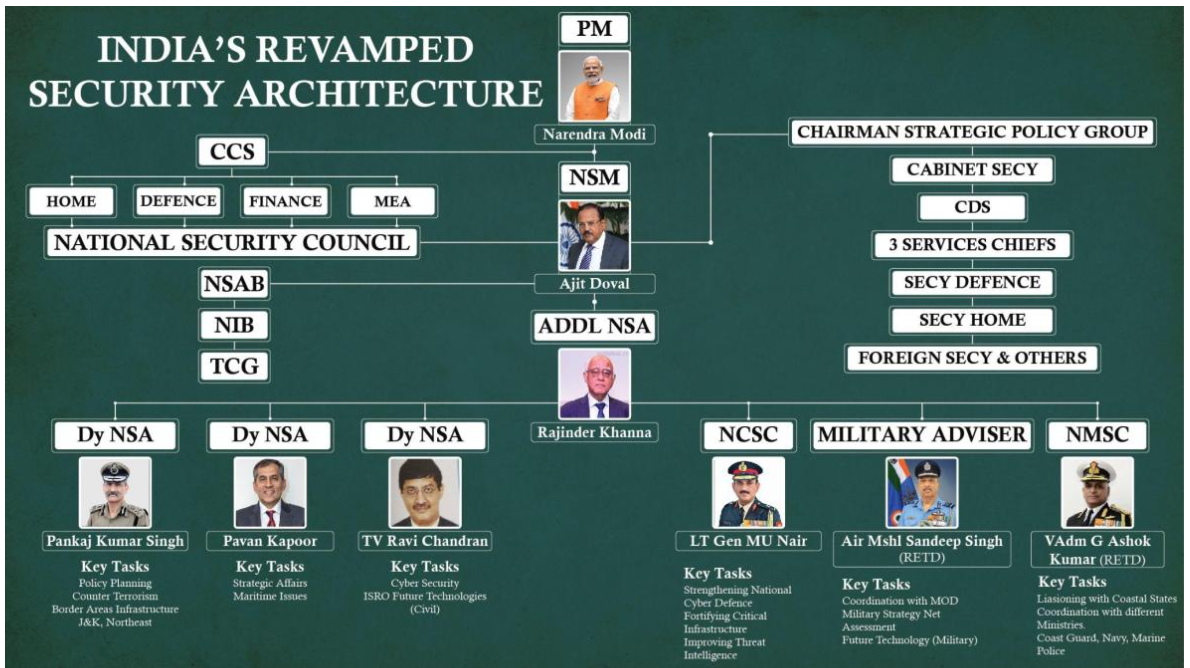
- India's national security architecture at its core has the National Security Council (NSC), the apex body responsible for advising the Prime Minister on national security and foreign policy matters. The NSC aims to ensure a comprehensive, coordinated approach to India's security.
- The National Security Council Secretariat (NSCS), the executive arm of the NSC, operates under the Prime Minister's Office (PMO) and plays a pivotal role in the implementation of national security policies. It coordinates the efforts of various ministries, intelligence agencies, and defense forces to address evolving security concerns. The NSCS is headed by the National Security Advisor (NSA), who acts as the principal advisor to the Prime Minister.
- Key Components:
- Strategic Policy Group (SPG):
- This inter-ministerial group, chaired by the NSA, is responsible for coordinating national security policies. It includes senior officials from key government bodies like the Vice Chairman of NITI Aayog, Cabinet Secretary, Defense and Home Secretaries, and the Chiefs of Armed Forces.
- National Security Advisory Board (NSAB):
- Comprising retired officials, academics, and experts, the NSAB provides long-term strategic analysis and recommendations on national security issues.
- National Security Council Secretariat (NSCS):
- The NSCS supports the NSC's objectives and coordinates the activities of various government ministries. It has several verticals, including Strategic Planning, Internal Affairs, Intelligence and Technology, and the Military vertical.
- Joint Intelligence Committee (JIC):
- This body assesses and synthesizes intelligence reports from various agencies such as the Intelligence Bureau (IB) and the Research and Analysis Wing (RAW).
- Key Tasks of the NSCS:
- Advising the Prime Minister:
- Providing expert advice on strategic assessments, policy options, and crisis management.
- Formulating National Security Strategy and Policy:
- The NSCS helps shape India's long-term security strategy and implements it across various sectors.
- Coordinating Ministries:
- It acts as a central hub for coordinating national security activities across ministries like Defense, External Affairs, Home Affairs, and Finance.
- Monitoring and Assessing Threats:
- The NSCS continuously monitors internal and external security threats, including cybersecurity risks, and helps shape India’s cybersecurity policies.
- Overseeing Intelligence:
- The NSA heads the NSCS and coordinates intelligence efforts, presenting findings to the Prime Minister.
-
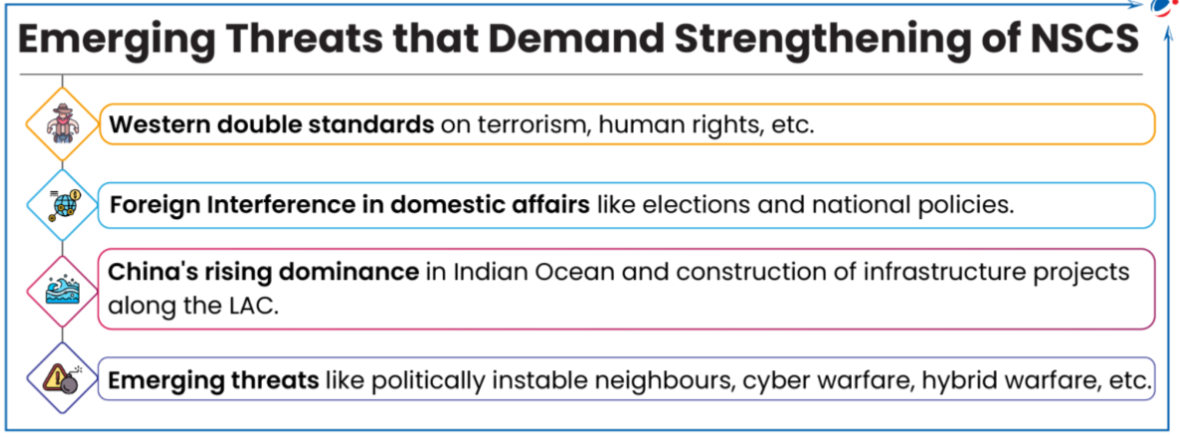
- 3. THE CENTRAL INTELLIGENCE, INVESTIGATION AND ENFORCEMENT AGENCIES
- 3.1. Intelligence Agencies
- Intelligence agencies play a crucial role in internal security, gathering information to prevent threats, terrorism, and criminal activities. Key intelligence agencies are RAW, IB, NIA, CBI and National Technical Research Organisation (NTRO), ensuring national stability and safety.
- 3.1.1. Intelligence Bureau (IB)
- The Intelligence Bureau (IB), considered the oldest surviving intelligence organization in the world, serves as India’s internal security agency responsible for mitigating domestic threats.
- The IB falls under the authority of the Ministry of Home Affairs.
- The IB Director is a part of the Strategic Policy Group and the Joint Intelligence Committee (JIC) of the National Security Council (NSC).
- The IB Director has the authority to report directly to the Prime Minister.
- Role of IB:
- Counterterrorism:
- IB tracks individuals, groups, and organizations with suspected terrorist links. It also counters separatist and violent movements, especially in the northeast. The Multi-Agency Center (MAC) coordinates intelligence sharing across agencies.
- Counterintelligence:
- IB combats foreign intelligence operations in India using advanced methods like remote viewing and satellite technologies. Its efforts are vital in preventing espionage.
- Border Intelligence:
- IB collects intelligence along India’s porous borders with Pakistan, Nepal, Bangladesh, Bhutan, Burma, and China. It collaborates with border protection forces to monitor and address cross-border threats.
- Security Threat Assessment:
- IB provides threat assessments and security guidelines for VIPs, coordinating with agencies like the Special Protection Group (SPG) and state police to ensure safety.
- Challenges of the Intelligence Bureau (IB)
- Coordination Challenges:
- Given the large number of intelligence agencies in India, there can be difficulties in ensuring effective coordination and collaboration, which could delay intelligence sharing and strategic decision-making.
- Political Surveillance Concerns:
- The risk of the IB being used for political purposes, such as surveillance on opposition parties or movements, undermines its credibility and creates trust issues within the public and government institutions.
- Territorial Reach and Jurisdiction:
- The IB’s operational scope may face limitations in terms of its territorial reach, particularly in remote areas or along international borders, where intelligence collection may be complicated by logistical and security challenges.
- Suggestions for Improving IB’s Effectiveness
- Appointment of a National Intelligence Coordinator:
- The Task Force on National Security, led by former cabinet secretary Naresh Chandra, recommends the creation of a National Intelligence Coordinator (intelligence czar) to oversee all intelligence agencies, facilitating effective coordination and enhancing intelligence sharing.
- Restrict IB to National Security Tasks:
- It is advised to restrict IB’s functions to national security-related tasks only, refraining from engaging in political surveillance, which would help maintain its impartiality and strengthen public trust.
- Clarify Territorial Reach of IB and RAW:
- Clearly define the territorial reach of IB and RAW in terms of intelligence collection, ensuring that their activities are well-coordinated, especially in border areas and regions facing external threats.
- 3.1.2. Research and Analysis Wing (R&AW)
- R&AW is India’s external intelligence agency responsible for intelligence related to foreign threats, espionage, and counterintelligence.
- Role:
- RAW primarily focuses on external intelligence gathering and countering espionage or covert operations from foreign powers.
- It has played a significant role in shaping India’s foreign policy and national security strategy, contributing to significant successes. Experts point to its role in the creation of Bangladesh in 1971 and enhancing India's nuclear security.
- RAW is said to also control the Special Frontier Force (SFF), a covert paramilitary unit crucial for high-risk operations.
- Challenges:
- RAW has faced inter-agency rivalries, particularly with the IB, which can lead to bureaucratic bottlenecks and delays in intelligence sharing and analysis.
- Lack of transparency, with RAW operating largely outside public scrutiny, leading to calls for increased oversight and accountability.
- 3.1.3. National Technical Research Organisation (NTRO)
- NTRO is India’s technical intelligence agency, responsible for gathering intelligence related to cybersecurity, satellite monitoring, and other technical aspects of national security.
- Role:
- NTRO plays a pivotal role in protecting India’s critical infrastructure, including space technology, communications, and nuclear facilities.
- It is tasked with cyber warfare operations and ensures the technical superiority of India’s security infrastructure.
- Challenges:
- NTRO has faced criticism for slow operationalization and failure to identify threats in real-time. For example, it failed to flag key cyber threats, such as the ShyamWitness issue.
- National Intelligence Grid (NATGRID)
- Overview & Background:
- Purpose:
- NATGRID is a counter-terrorism intelligence infrastructure designed to connect data from 21 security agencies to help preempt terrorism and locate terror suspects.
- Operational Since:
- December 31, 2020, under the Ministry of Home Affairs.
- Origin:
- It was established in response to the 26/11 Mumbai attacks, which exposed gaps in India’s intelligence-gathering and response capabilities.
- Complementary Agencies:
- Part of a larger overhaul of India’s security structure, NATGRID works alongside NIA and NCTC to strengthen intelligence operations and counter-terrorism efforts.
- Agencies Connected to NATGRID:
- Intelligence Bureau (IB)
- Research & Analysis Wing (R&AW)
- National Investigation Agency (NIA)
- Central Bureau of Investigation (CBI)
- Enforcement Directorate (ED)
- Directorate of Revenue Intelligence (DRI)
- Financial Intelligence Unit (FIU)
- Central Board of Direct Taxes (CBDT)
- Central Board of Excise and Customs (CBEC)
- Directorate General of Central Excise and Intelligence (DGCEI)
- Narcotics Control Bureau (NCB)
- Functionality:
- Goal:
- To consolidate intelligence from multiple agencies, providing a comprehensive and real-time understanding of potential security threats. The system supports intelligence sharing to identify, track, and prosecute terrorists before attacks occur.
- Data Sources:
- Immigration Data:
- Entry and exit information.
- Banking & Financial Transactions:
- Tracking financial activities.
- Telecom Data:
- Monitoring phone records.
- Taxpayer Information:
- Data on income and tax filings.
- Travel Data:
- Information on air and train travel.
- Expansion Plans:
- Initially connected to 11 agencies, NATGRID is set to expand to 950 organizations in the next phases, eventually connecting 1,000 more organizations.
- 3.2. Primary Investigative Agencies
-
| Agency | Establishment | Mandate | Key Challenges | Additional Notes |
|---|
| Central Bureau of Investigation (CBI) | 1946 (Renamed in 1963) | Corruption, economic offenses, special crimes, transnational crimes | 1. Credibility issues and political interference
2. Operates under weak legal basis (executive order)
3. Inter-state jurisdiction issues requiring state consent | Dubbed as the "caged parrot" by the Supreme Court due to political bias. Lacks strong statutory mandate. |
| National Investigation Agency (NIA) | Post 26/11 Mumbai Attacks | Terrorism-related crimes, human trafficking, cyber-terrorism, counterfeit currency | 1. Coordination issues with state police
2. Lack of resources to handle complex terrorism-related cases | Expanded powers in 2019 to tackle human trafficking, cyber-terrorism, and counterfeit currency. |
- Unlawful Activities (Prevention) Act (UAPA)
-

- The Unlawful Activities (Prevention) Act (UAPA), first enacted in 1967, was introduced to address growing concerns of anti-national activities and secessionist movements. The Act plays a vital role in safeguarding India's sovereignty, integrity, and internal security. Initially created in response to the Naxalbari uprising, it has evolved into India’s core anti-terrorism legislation over the years, aiming to counter various threats to national security.
- History and Evolution:
- 1967:
- The UAPA was enacted to deal with activities challenging the integrity of the Indian state, particularly in the context of the Naxalite movement.
- 2004 Amendment:
- UAPA was amended to incorporate provisions for combating terrorism after the Terrorist and Disruptive Activities (Prevention) Act (TADA) and Prevention of Terrorism Act (POTA) were repealed.
- 2008 Amendment:
- The law was expanded to allow the freezing of funds associated with terrorism and facilitated the establishment of the National Investigation Agency (NIA).
- 2019 Amendment:
- UAPA was further updated to include provisions for cyber-terrorism, terrorist financing, and the ability to designate individuals as terrorists.
- Key Provisions:
- Terrorist Designation:
- The central government has the power to declare individuals and organizations as terrorists, even without a formal judicial process.
- Punishment:
- Terrorist-related activities can result in life imprisonment or death penalties depending on the severity of the crime.
- Investigation by NIA:
- The National Investigation Agency (NIA) is the principal agency responsible for investigating terrorism-related offenses under the UAPA.
- Extended Detention and Bail Provisions:
- Under the UAPA, suspects can be detained for up to 180 days without trial, with strict bail conditions, effectively limiting the accused's chances for early release.
- Limitations and Controversies:
- Broad Definitions:
- Critics argue that the definitions of “unlawful activity” and “terrorist acts” are vague and subjective, leading to potential misuse of the law.
- Low Conviction Rates:
- According to the National Crime Records Bureau (NCRB), only \(\text{2.2%}\) of UAPA cases between 2016-2019 led to convictions, raising questions about the law’s effectiveness.
- Bail Restrictions:
- UAPA’s stringent provisions regarding bail, including denying it unless evidence is proven otherwise, can lead to prolonged detentions, often without conclusive evidence.
- Lack of Procedural Safeguards:
- Critics point out the absence of clear safeguards against wrongful arrests or designations, especially when governments don't disclose the evidence used to designate individuals or groups as terrorists.
- While the UAPA serves as an essential tool in the fight against terrorism, its overreach and potential misuse are significant concerns. The law's broad scope, coupled with lack of safeguards, makes it prone to human rights violations. For it to be effective while respecting fundamental rights, there must be a balance between national security and individual freedoms.
- 3.3. Law Enforcement Agencies
-
| Agency | Role | Challenges |
|---|
| Enforcement Directorate (ED) | Responsible for enforcing PMLA & FEMA, focusing on financial crimes and money laundering, investigating suspicious financial transactions. | Faces challenges related to the complexity of financial crimes and lack of transparency in operations. |
| Financial Intelligence Unit - India (FIU-IND) | Central agency for monitoring financial intelligence related to anti-money laundering (AML) and countering terrorism financing (CFT), ensures compliance with global financial standards. | Challenges with coordination between agencies, lack of resources to deal with complex financial crimes. |
| Directorate of Revenue Intelligence (DRI) | Specialized in smuggling, commercial frauds, and illegal trade, monitoring cross-border smuggling activities, especially drugs, gold, and wildlife trafficking. | Challenges include resource constraints and the increasing scale of cross-border smuggling. |
| Narcotics Control Bureau (NCB) | Works to combat drug trafficking and narco-terrorism, prevents narcotics smuggling that finances terrorism, and coordinates with international agencies like the UN. | Challenges include increasing drug trafficking and the need for international coordination to combat narco-terrorism. |
- 4. CENTRAL ARMED POLICE FORCES (CAPFS)
-
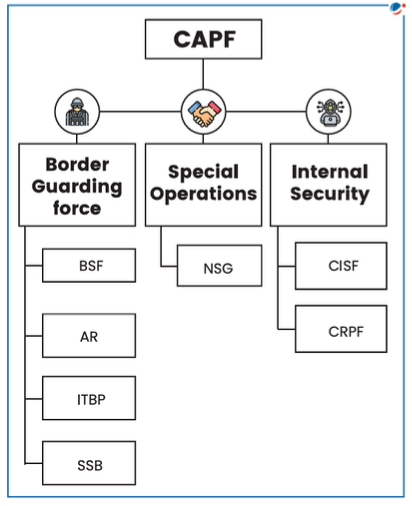
- The Central Armed Police Forces (CAPFs), also known as Central Paramilitary Forces (CPMFs), are tasked with ensuring India's internal security. They work under the Ministry of Home Affairs (MHA) and are crucial for border protection, counter-terrorism, law enforcement, and assisting in law and order situations.
- Administrative Control
- Ministry of Home Affairs (MHA):
- The MHA is responsible for overseeing the CAPFs, directing their operational activities, and coordinating with other central and state agencies. The MHA also manages the deployment of CAPFs in various internal security issues, including terrorism, insurgencies, and organized crime.
- Key Responsibilities:
- Ensuring coordination between central and state agencies.
- Providing resources, training, and intelligence sharing.
- Handling counter-terrorism and disaster management efforts.
- Coordination with State Agencies
- Union-State Collaboration:
- The MHA facilitates coordination between the central government and states to address internal security challenges. States often lack the resources to handle certain situations independently, making CAPFs' support indispensable. The MHA ensures effective deployment, particularly in areas affected by insurgency, terrorism, and ethnic conflict.
- Resource Deployment:
- CAPFs assist state police in handling complex security concerns by providing specialized forces. Their role spans border security, counter-insurgency operations, and crisis management, ensuring that state and central forces work together in response to evolving threats.
- 4.1. Border Guarding Forces
- The Border Guarding Forces (BGFs) are tasked with ensuring the security of India’s international borders, preventing illegal immigration, cross-border infiltration, and smuggling. Additionally, these forces play a critical role in counterinsurgency operations and can be deployed in wartime or peacekeeping missions.
- 4.1.1. Border Security Force (BSF)
- It was raised in 1965 after the Indo-Pakistan War to secure India's borders, particularly those with Pakistan and Bangladesh. The BSF is currently the largest border-guarding force in the world, with 250,000 personnel spread across 186 battalions.
- BSF holds powers of arrest, search, and seizure under multiple legal provisions, including the Passport Act and Customs Act.
- The motto of the Border Security Force (BSF) is "Duty Unto Death"
- BSF is the only CAPF with its own Air Wing, Marine Wing, and artillery units.
- The force has a unique Tear Smoke Unit (TSU), producing tear gas munitions for anti-riot operations.
-
| Aspect | Description |
|---|
| Primary Mandate | The BSF is tasked with securing India’s borders with Pakistan and Bangladesh, covering \(6,386 \, \text{km}\). This includes patrolling both international boundaries and the Line of Control (LoC) in Jammu and Kashmir. |
| Peacetime Tasks | - Prevents cross-border infiltration, smuggling, and illegal entry/exit.
- Monitors transnational crimes such as drug trafficking and arms smuggling.
- Promotes a sense of security among border populations.
- The Border Security Force has one Formed Police Unit deployed with the United Nations Stabilizations Mission in Democratic Republic of Congo (MONUSCO).
|
| Wartime Tasks | - Holds positions during conflict, assists the Army in border defense.
- Assists in counterinsurgency operations, provides security to critical installations like airports and nuclear sites.
- Performing special tasks like intelligence raids assigned by the Army.
- Anti-infiltration duties to prevent unauthorized entry at specified areas.
|
| Challenges | Due to its multifaceted role, the BSF is sometimes diverted from its primary function of border security to assist in internal security operations like counterinsurgency and riot control, which may stretch its resources. |
- Tech Bolsters Border Security
- The BSF deployed AI-enabled surveillance drones along the India-Pakistan border in 2024, significantly enhancing security. This best practice has notably improved their ability to detect and counter cross-border threats.
- While specific data varies, these advanced systems have contributed to a substantial reduction in illicit activities, including drone-based smuggling, making the border more secure.
- 4.1.2. Indo-Tibetan Border Police (ITBP)
- The ITBP was established in 1962 after the Sino-Indian War to secure the India-China border, particularly challenging high-altitude terrains. Initially designed as a guerrilla-cum-intelligence force, it began with and later evolved into a conventional border guarding force with specialized capabilities.
- The force's motto is "Shaurya-Dridhata-Karma Nishtha" (Valour, Determination, and Devotion).
- Initially part of the CRPF, the ITBP became an independent force through the ITBPF Act of 1992.
- In 2004, it was recognized as a full-fledged Central Armed Police Force under the Ministry of Home Affairs.
- Key Activities of ITBP
- UN Peacekeeping:
- The ITBP has excelled in UN peacekeeping operations, serving in Angola, Namibia, Bosnia, Mozambique, and Kosovo.
- Kailash Mansarovar Yatra Security:
- ITBP has provided security, communication, and medical cover for pilgrims since 1981.
- Disaster Response:
- ITBP is the first responder in the Himalayas, establishing 7 Regional Response Centres for rescue and relief.
-
| Aspect | Explanation |
|---|
| Primary Mandate | The ITBP secures \(3,488 \, \text{km}\) the India-China border with altitudes ranging from 9,000 feet to 18,750 feet in the Western, Middle and Eastern Sector of the Indo China Border from Karakoram Pass in Ladakh to Jachep La in Arunachal Pradesh. Its mandate extends to guarding the northern border from Himachal Pradesh to Uttarakhand and the Tibet Autonomous Region. |
| Duties | - Prevents illegal immigration, smuggling, and trans-border crimes.
- Provides border security and surveillance.
- Ensures security to important installations, including hospitals and VIPs.
|
| Special Training | Personnel are trained in high-altitude warfare, survival skills, and countering infiltration tactics used by hostile forces. |
| Challenges | Although primarily a border-guarding force, ITBP is occasionally used for internal security functions, which can detract from its core mission. |
- 4.1.3. Sashastra Seema Bal (SSB)
-
- The SSB was established in 1963 as the Special Services Bureau after the Chinese aggression in 1962. It became a border-guarding force in 2001 after the Kargil War.
- In January 2001, the SSB came under the control of the Ministry of Home Affairs.
- In 2001, the SSB was designated as the Lead Intelligence Agency for the Indo-Nepal border.
- In 2004, the SSB was also tasked with securing the Indo-Bhutan border.
-
| Aspect | Explanation |
|---|
| Primary Mandate | The SSB guards the India-Nepal (\(1,751 \, \text{km}\)) and India-Bhutan (\(699 \, \text{km}\)) borders, which are open borders with no physical barriers. |
| Duties | - Prevents illegal entry, smuggling, and criminal activities.
- Helps maintain law and order in sensitive border regions.
- Provides security to vital installations.
|
| Additional Roles | - The SSB also performs counter-insurgency operations in Jammu and Kashmir and anti-Naxal operations in Jharkhand, Bihar, and Chhattisgarh.
|
- 4.1.4. Assam Rifles (AR)
-

- Assam Rifles is India's oldest paramilitary force, formed in 1835 as the Cachar Levy to protect British tea estates. Renamed in 1917, it has its headquarters in Shillong and is mainly deployed in Northeastern India for counter-insurgency and border security along the India-Myanmar border.
- Known as the "Friends of the North East People," it conducts Civic Action Plans like building community halls, providing water supply, and organizing medical camps.
- It has played a significant role in World Wars and the Sino-Indian War of 1962.
- The dual control structure makes it unique, with operational control under the Indian Army (Ministry of Defence) and administrative control under the Ministry of Home Affairs (MHA).
- Assam Rifles remains highly awarded for its service and has earned respect from local populations and international bodies, including UN missions.
-
| Aspect | Explanation |
|---|
| Primary Mandate | The Assam Rifles is tasked with securing India-Myanmar borders and conducting counter-insurgency operations in India’s North-Eastern region. |
| Dual Control Structure | The Assam Rifles is unique in that it is run by both the Ministry of Defence (MOD) (for operational control) and the MHA (for administrative control). This dual control has caused issues with coordination and resource management. |
| Duties | - Counter-insurgency operations in North-East India.
- Provides rear security during conflicts and wars.
- Border security in India-China and India-Myanmar regions.
|
| Challenges | Dual control results in coordination problems, leading to operational inefficiencies. There are also training issues as personnel from the Army and MHA often have conflicting directives. |
- 4.2. Internal Security / Anti-Insurgency Forces
- These forces are specialized in maintaining internal security, dealing with terrorism, insurgency, and internal disturbances.
- 4.2.1. Central Reserve Police Force (CRPF)
-
- Formed in 1939 as the Crown Representative Police in Neemuch, Madhya Pradesh, it was renamed the Central Reserve Police Force (CRPF) in 1949 after India's independence. The CRPF’s motto is "Seva Aur Nishtha" (Service and Loyalty).
- The CRPF has 6 Mahila (Ladies) Battalions, making it the only paramilitary force in India with them.
-
| Aspect | Explanation |
|---|
| Primary Mandate | The primary mandate of CRPF is to assist in maintaining law and order and internal security. |
| Duties | - The main objective is to maintain Rule of Law, Public Order, and Internal Security.
- Duties include crowd control, riot management, counter-militancy, counter-insurgency, and dealing with Left-Wing Extremism (LWE).
|
| Additional Responsibilities | - Coordinates large-scale security arrangements for elections in disturbed areas.
- Fights enemy forces in times of war and participates in UN peacekeeping missions.
|
| Specialized Units | - Rapid Action Force (RAF): Handles communal disturbances and riots.
- Commando Battalions for Resolute Action (CoBRA): CoBRA (Commando Battalion for Resolute Action) is a specialized force created to counter Maoists and insurgents in Left Wing Extremism (LWE) affected areas. This unit is also known as Jungle Warriors.
- Raised between 2008-2011, 10 battalions have been deployed in LWE states like Chhattisgarh, Bihar, and Jharkhand.
- It is an elite commando unit, trained in jungle warfare and tactics at the CoBRA School, providing exclusive training for survival, combat, and tactics.
|
| Challenges | - Increased demand for CRPF units by state governments places stress on resources.
- The CRPF’s deployment in multiple duties causes manpower shortages.
|
- 4.2.2. Central Industrial Security Force (CISF)
-
- Founded in 1969, the Central Industrial Security Force (CISF) is one of India's largest CAPFs, originally created to secure public sector units (PSUs). Over time, it expanded its role, securing vital sectors related to economic and national security.
- With an initial strength of 2,800 personnel, the CISF now has 188,000 personnel, securing over 359 establishments nationwide.
- Specialized Services:
- CISF provides security for Delhi Metro, Parliament House, and other critical government buildings. Additionally, it offers fire protection services and safeguards heritage monuments.
-
| Aspect | Explanation |
|---|
| Primary Mandate | The CISF secures strategic sectors, including nuclear plants and space installations, airports, ports, power plants, and heritage sites like the Taj Mahal and Red Fort.- Fire Protection: It is the only CAPF with a dedicated fire wing, providing comprehensive fire protection to various sectors. It is one of the largest fire protection service providers in the country, safeguarding 102 PSUs with 7,716 personnel (2018-19).
- Airport Security: In 2000, CISF was assigned the task of airport security post IC-814 hijacking. It now secures 61 domestic and international airports.
- VIP Protection: CISF offers round-the-clock security to VIPs categorized under Z Plus, Z, X, and Y security levels.
- Private Sector Security: Post Mumbai terror attacks (2008), CISF's role expanded to protect private corporate entities and offer consultancy services for private sector security.
|
| Challenges | The CISF faces an increasing workload with more industrial and private-sector critical installations requiring security. |
- 4.3. Specialized Security Forces
- 4.3.1. National Security Guard (NSG)
-

- Established in 1984, the National Security Guard (NSG) is a specialized counter-terrorism force equipped to handle high-risk threats like hijackings, bomb disposal, and hostage rescues. The NSG comprises personnel from the Army, Central Armed Police Forces (CAPFs), and State Police, focusing on neutralizing terrorist threats.
- Regional Hubs:
- In response to the 26/11 Mumbai attacks, four regional hubs (Mumbai, Chennai, Hyderabad, Kolkata) were set up in 2008, with a fifth hub established in Gandhinagar (2016) to reduce response time across India.
- Expertise and Reputation:
- Known as the "Black Cats," NSG commandos are highly trained for counter-terrorism, counter-hijacking, bomb disposal, and hostage rescue operations. Their reputation for excellence stems from their high training standards and operational efficiency.
- Event Security:
- NSG units conduct Immediate Backup Security Operations (IBUS) for high-profile events like Republic Day and Independence Day, preventing terrorist attacks.
- Controversies:
- The delayed response during 26/11, where it took 10 hours to respond, and operational challenges like traffic delays have drawn criticism.
- Why the 26/11 Response Took Nearly 10 Hours?
- 1. Absence of a Rapid Deployment Force
- At that time (2008), India had no dedicated, quick-response counter-terror unit stationed across major cities.
- The National Security Guard (NSG) — India’s elite counterterror force — was based only in Manesar, Haryana, near Delhi.
- It took over 8 hours to transport commandos by air to Mumbai because:
- No NSG hub existed in western India.
- Delays occurred in aircraft mobilization and airspace clearance.
- 2. Delayed Information Flow & Poor Coordination
- Initial confusion prevailed between the Mumbai Police, Navy, Coast Guard, and intelligence agencies.
- There was no unified command structure — coordination between state and central forces was ad hoc and slow.
- The lack of real-time intelligence worsened the delay, as agencies couldn’t immediately assess the scale of the attack.
- 3. Logistical & Operational Hurdles
- The NSG had to be airlifted using an IAF aircraft, which itself took hours to be readied.
- Mumbai’s traffic congestion and poor urban tactical planning further slowed troop movement once on the ground.
- Local police were under-equipped, carrying outdated weapons and no body armor — they were largely unprepared for urban warfare against AK-47-armed terrorists.
- 4. Communication Breakdown
- Mumbai Police and NSG operated on different radio frequencies, preventing seamless coordination.
- There was no integrated communication network to manage simultaneous attacks across multiple sites (Taj, Oberoi, CST, Nariman House).
- 5. Structural Weakness Pre-2008
- Before 26/11, India’s counter-terror doctrine was largely reactive, not proactive.
- The focus was on intelligence gathering, not real-time crisis management or urban combat readiness.
- Post-26/11 Reforms (in response to these failures)
- Creation of NSG regional hubs (Mumbai, Chennai, Kolkata, Hyderabad).
- Establishment of National Investigation Agency (NIA).
- Operationalization of NATGRID and revamp of the Multi-Agency Centre (MAC).
- Strengthened Coastal Security, including the Coastal Police and Joint Operations Centres.
- Suggestions:
- There are calls for better transportation infrastructure, modernization, and faster expansion of the NSG to improve response efficiency and address existing vulnerabilities.
- The 2008 Mumbai attacks were a critical turning point, highlighting delays in counter-terror response. In direct consequence, the NSG (National Security Guard) established 4 regional hubs across India.
- These hubs, including Mumbai, Kolkata, Hyderabad, and Chennai, ensure rapid response by elite commandos, significantly reducing deployment times during future terror incidents.
- Elite Force, Global Training
- India's NSG "Black Cat" commandos consistently train with world-renowned counter-terrorism units like Germany's GSG 9 and Israel's Yamam. This collaboration ensures the adoption of best practices, including tactics like "flash-bang" grenades, enhancing India's elite force capabilities.
-
| Aspect | Explanation |
|---|
| Primary Mandate | The NSG is tasked with handling cases like terrorist attacks, counter-hijacking operations, and bomb disposal. |
| Duties | - Counter-terrorism operations and VIP protection.
- Sky marshals for aviation security.
- Provides security to critical installations.
- NSG’s specific tasks include handling hijacking situations, bomb disposal, post-blast investigation, and providing close protection.
|
| Challenges | - The NSG faces operational inefficiencies due to staff shortages, bureaucratic inefficiencies, and lack of modern equipment.
|
- Rashtriya Rifles- India’s Elite Counter-Insurgency Force
- Rashtriya Rifles (RR) is a specialist counter-insurgency force under the Indian Army, formed in 1990 to combat insurgency and terrorism, mainly in Jammu & Kashmir. It is composed of personnel drawn from various Army regiments, making it an all-Army composite unit.
- Role & Functions:
- Conducts anti-terrorism and counter-insurgency operations.
- Area domination, intelligence gathering, and target neutralization.
- Assists civil authorities in restoring peace and order.
- Runs civic action programs to build trust with local communities.
- Position in Defence System:
- RR is India’s largest and most experienced counter-insurgency force, directly controlled by the Indian Army, known for its effectiveness in high-conflict zones.
- Motto:
- “Dridhta aur Veerta” (Determination and Valour).
- 5. ROLE OF ARMED FORCES IN INTERNAL SECURITY
- In India, responsibility for internal security primarily falls under the Ministry of Home Affairs (MHA). The Indian Armed Forces—comprising the Army, Navy, and Air Force—play an essential but secondary role, providing support to the civilian administration only when threats escalate beyond the capacity of police and paramilitary forces.
- When deployed for such tasks, the armed forces report to the Ministry of Defence and act under the constitutional authority of the President of India. To handle these complex internal threats, they have developed highly specialized units, including the Army's Rashtriya Rifles, the Navy's MARCOS, and the Air Force's Garud Commando Force.
- Counter-Insurgency Operations:
- The Indian Army plays a key role in counterinsurgency operations, especially in Jammu and Kashmir and the North Eastern states.
- Rashtriya Rifles (RR):
- A specialized military unit formed in the 1990s, RR focuses on counterinsurgency in Jammu and Kashmir.
- Aid to Civil Authorities:
- The Armed Forces assist during communal riots, large-scale violence thereby helping in restoring law and order when requested by the government
- Disaster Response:
- The Indian Armed Forces are frequently deployed during natural disasters, such as earthquakes, floods, and pandemics.
- Their roles include:
- Search-and-rescue operations
- Providing medical and food assistance
- Restoring infrastructure (roads, bridges)
- Ensuring security in disaster-affected areas
- Armed Forces Special Powers Act (AFSPA):
- Enacted in 1958, AFSPA grants military forces extraordinary powers in regions with insurgent activity, primarily in Jammu & Kashmir and the North East.
- The Act allows the military to use force, conduct searches without warrants, and detain suspects without trial in "disturbed areas".
- Criticism:
- AFSPA has faced significant opposition for human rights violations, including allegations of fake encounters and torture.
- AFSPA- A Contentious Divide
- The partial AFSPA revocation in Nagaland (2022/2023), sparked by the tragic Oting killings, ignited intense debates. It starkly highlights the conflict between human rights and perceived operational necessity for security forces.
- This contentious issue, a recurring theme in India's Northeast, has even been a direct question in the UPSC examinations, underscoring its national significance.
- 5.1. Key Joint Military Exercises of India
- India regularly conducts joint military exercises with various countries to enhance interoperability, readiness, and defence cooperation. These exercises focus on different domains such as army, naval, and tri-service operations. The exercises strengthen partnerships and help in sharing best practices, counter-terrorism strategies, and disaster response tactics.
-
| Exercise | Participating Countries | Domain | Brief Description |
|---|
| Yudh Abhyas | India, USA | Army | Annual exercise focusing on high-altitude warfare, joint operations, and sharing best practices. |
| Malabar | India, USA, Japan, Australia | Naval | Multinational exercise enhancing maritime security and interoperability among Quad nations. |
| Varuna | India, France | Naval | Bilateral exercise fostering maritime cooperation and naval operational skills. |
| Shakti | India, France | Army | Biennial exercise focusing on counter-terrorism and joint military operations. |
| Nomadic Elephant | India, Mongolia | Army | Annual counter-insurgency and jungle warfare training exercise. |
| Surya Kiran | India, Nepal | Army | Annual exercise promoting bilateral army cooperation and operational readiness. |
| Sampriti | India, Bangladesh | Army | Annual exercise focusing on counter-terrorism and border security cooperation. |
| Hand-in-Hand | India, China | Army | Recurring confidence-building measure for counter-terrorism and disaster response. |
| Tiger Triumph | India, USA | Tri-service | Joint Navy, Army, Air Force exercise for humanitarian assistance and disaster relief. |
| Vajra Prahar | India, USA | Army Special Forces | Annual special forces training focused on counter-terrorism and interoperability. |
- 6. STATE POLICE FORCES AND THEIR MANDATE
- In India, the police system is primarily structured under state jurisdiction, with support from the Union Government in certain situations.
- State Responsibility:
- Police and public order are under the State List (List II) of the Seventh Schedule of the Constitution.
- Then, Where Does the IPS Fit?
- The Indian Police Service (IPS) is an All India Service (Article 312).
- Officers are recruited and trained by the Union Government (through UPSC) but serve under both the Centre and the States — making them a federal bridge between the two levels of government.
- Even though they are recruited by the Union Government, when posted in a state, they are legally and administratively answerable to that state.
- An IPS officer in the NIA or IB will not take orders from any state government — they work under the Union Home Secretary.
- Support of Union:
- Article 355:
- The Union Government is obligated to protect states from internal disturbances and ensure the government operates according to the Constitution.
- State Intervention:
- The Union Government can intervene if a state is unable to maintain law and order or control internal disturbances.
- Union Support:
- The Union Government thus provides intelligence, financial aid, and Central Armed Police Forces (CAPFs) when states require assistance or there is an emergent situation.
- Battling Digital Jihad
- The Maharashtra ATS recently busted an ISIS-inspired module in Pune, with investigations continuing into 2025. This crucial operation heavily relied on cyber-forensics.
- The case highlights the escalating threat of digital radicalization, where terror groups leverage online platforms for recruitment, indoctrination, and operational planning.
- 6.1. Structure and Hierarchy
- The Indian police system is structured to manage law and order across the country, with significant roles assigned to state police forces. The Police Act of 1861 governs the structure, which has evolved to include various specialized units addressing specific challenges.
- Police Organization:
- The State Police is structured across multiple hierarchical levels.
- District-level units handle day-to-day law enforcement, under the supervision of district police heads.
- Specialized Crime Branches focus on specific criminal activities, such as organized crime, drug trafficking, and corruption.
- Regional Divisions coordinate between various districts and help in managing law and order over larger territories.
- Police Headquarters in each state manage overall operations and resource allocation.
- Specialized Units:
- Anti-Terrorism Squads (ATS):
- These units handle terrorism-related issues and organized crime.
- Special Task Forces (STF):
- Created for specific threats like insurgency or high-profile criminal activities.
- Cyber Police:
- Established in some states to deal with growing cybercrimes.
- Economic Offenses Wing (EOW):
- These wings focus on tackling financial crimes, fraud, and corruption.
- As noted earlier, while law enforcement is primarily the responsibility of the state, the Union Government supports through intelligence sharing, coordination with CAPFs, and resources for national security.
- 6.2. Challenges Faced by State Police
- Modernization Deficit:
- There has been inadequate funding for modernizing police forces, affecting areas like technology, training, and infrastructure. The police force continues to use outdated equipment and lacks sufficient technological advancements for modern policing needs.
- Overburdened Police Force:
- Increased Crime:
- Crime rates have increased by \(\text{28%}\) over the past decade, while police personnel per lakh population stands at 137, far lower than the UN's recommended 181 and 222.
- Understaffed Forces:
- The inadequate number of police officers makes it harder to manage crimes and respond effectively to emerging security threats like terrorism and cybercrime.
- Bridging the Forensic Gap
- India faces a significant forensic modernization gap, with a low percentage of police stations having digital forensics labs. In contrast, the UK boasts more integrated capabilities, highlighting disparities in infrastructure.
- However, Delhi Police's CyPAD unit is a replicable model, successfully clearing numerous cyber cases in 2024. Its use of advanced forensics showcases a path to bridge this critical investigative gap.
- Police Modernization- A Tech-Driven Future
- India's police forces are undergoing continuous modernization, a long-standing "Best Practice."
- The Ministry of Home Affairs allocates substantial annual funds, with ₹4,069.24 crore budgeted for Police Modernization in 2025-26.
- This investment prioritizes AI-enabled CCTV for enhanced surveillance and the National Automated Fingerprint Identification System (NAFIS). These technologies are crucial for improving crime prevention, investigation, and overall law enforcement capabilities.
- Quality of Investigations:
- Low Conviction Rate:
- The conviction rate for crimes stands at just \(\text{47%}\), largely due to lack of training in criminal investigations and insufficient legal knowledge and forensic resources.
- Outdated Infrastructure:
- There is a lack of forensic labs, cybercrime units, and trained officers, leading to poor-quality investigations and a lower conviction rate.
- Police Accountability:
- Political interference in police matters often leads to abuse of power, criminalization, and corruption within the force. Police decision-making becomes compromised due to political pressure, affecting independence and objectivity.
- Lack of Infrastructure:
- Outdated Equipment:
- Police forces face delays in procuring new equipment, vehicles, and modern technology. Many police stations are under-equipped, and training academies often suffer from poor infrastructure.
- Training Deficiencies:
- Police training often fails to address modern challenges, including cybercrime and advanced forensic procedures.
- Public Perception:
- Negative Image:
- The public perceives the police more as trouble creators than trouble-shooters, with high levels of corruption and abuse of power being common complaints.
- Community Cooperation:
- The police heavily depend on community cooperation for crime investigations but often fail to build trust due to poor relations with the public.
- Human Rights Concerns:
- Significant human rights violations, such as custodial deaths, encounter killings, and police brutality, persist. These issues reflect systemic problems within the police forces, including a lack of accountability, poor working conditions, and insufficient training in human rights.
- Janamaithri Suraksha Project-People-Friendly Policing
- Kerala's "Janamaithri Suraksha Project" is an authentic, acclaimed community beat policing initiative. Launched in 2008, it fosters police-public trust through dedicated beat officers, effectively enhancing crime prevention via citizen participation.
- Modernization of Police & Police Reforms
- MPF Scheme (Modernization of Police Forces)
- The MPF Scheme was initiated in 1969-70 to modernize police forces across India. In recent years, the fund allocation has been increased, reflecting a commitment to improve policing infrastructure and law enforcement capabilities. Key Features:
- Improving Law and Order:
- Focus on enhancing police capacity for maintaining internal security, especially in areas vulnerable to left-wing extremism, terrorism, and organized crime.
- Women’s Security:
- The scheme allocates funds for enhancing women's security by providing specialized units for addressing crimes against women.
- Infrastructure Development:
- Funds are allocated for upgrading police stations, acquiring modern weapons, improving police mobility, and setting up forensic science labs.
- Training & Equipment:
- The scheme promotes the modernization of police training academies, equipping police with advanced technology for cybercrime investigations, surveillance, and crime tracking.
- Linking Criminal Justice System:
- Integration with the Crime and Criminal Tracking Network and System (CCTNS) and other critical pillars like prisons, prosecution offices, and forensic labs.
- Prakash Singh Case (2006) – Supreme Court Judgment
- The Prakash Singh case (2006) involved the Supreme Court's landmark ruling, which recommended a series of police reforms to improve the independence, accountability, and professionalism of the Indian police. The Court issued comprehensive directions:
- State Security Commissions (SSCs):
- Create autonomous bodies to ensure independence of police forces from political influence.
- Police Establishment Boards (PEBs):
- Establish boards to handle transfers, promotions, and appointments within the police, reducing political interference.
- Police Complaints Authority (PCA):
- Set up independent authorities at the state and district levels to investigate police misconduct and ensure accountability.
- Director General of Police (DGP):
- Ensure the DGP is selected from the top three senior-most officers, with a two-year tenure to provide stability and continuity in leadership.
- Separation of Investigation and Law Enforcement:
- Create separate wings for investigation and law enforcement to improve the quality and effectiveness of criminal investigations.
- Justice Thomas Committee:
- The Justice Thomas Committee was tasked with monitoring the implementation of the Supreme Court’s directives in the Prakash Singh case.
- It reported that some states did not fully comply with the Court's suggestions, especially regarding the composition of the State Security Commissions and the Police Establishment Boards.
- The committee emphasized tenure security for officers and recommended that DGPs be selected from the senior-most officers, ensuring a minimum two-year tenure.
- The Committee also stressed the need for proper infrastructure, training, and independent operations for investigating police.
- Despite the SC’s directions, many states have failed to implement the recommendations. There are issues with the composition and powers of SSCs, and many states continue to have political control over police forces. The removal of officers on arbitrary grounds, as seen in cases like T.P. Senkumar (Kerala), reflects the lack of security of tenure.
- 6.3. Recommendations for Reform
- Increase Police Personnel:
- To meet the increasing crime rates, the number of police personnel should be raised in line with UN recommendations (181 per lakh population).
- Infrastructure & Technological Upgrades:
- Invest in modernizing police infrastructure, improving training, and providing advanced equipment like cybercrime units and forensic labs.
- Separation of Investigation and Law Enforcement:
- Establish separate wings for investigation and law enforcement to improve the quality of investigations and reduce overburdening of police officers.
- Leadership Reform:
- Ensure fixed tenure for key leadership positions like DGP to maintain continuity and stability in police operations.
- Enhanced Accountability:
- Set up independent Police Complaints Authorities at state and district levels to address police misconduct and ensure transparency.
- 7. CHALLENGES AND REFORMS IN INDIA'S SECURITY APPARATUS
-
| Challenges | Details |
|---|
| Inter-Agency Coordination Gaps | - Intelligence Sharing
- CBI and IB were criticized for poor coordination and delayed responses, e.g., 26/11 Mumbai attacks.
- MAC and NATGRID efforts hampered by turf wars and political resistance.
- State police find IB's intelligence vague, complicating actions during crises.
- MHA-MoD Turf Wars
- Assam Rifles faces dual control under MHA and MoD, leading to complex management.
- CAPFs face mission creep, causing resource misallocation.
- Centre-State Coordination Issues
- State governments often rely on the Centre for resources and coordination, especially in high-risk areas.
- Conflicts between federal (e.g., CBI) and state governments erode state power, creating a fragile balance in internal security.
|
| Modernization & Capacity Building | - Technological Upgrades
- Cybercrime is on the rise, with attacks on Aadhaar and critical systems.
- CCTNS faces implementation delays due to data quality issues and outdated technology.
- NATGRID was delayed due to internal conflicts over intelligence sharing.
- Training and Skill Development
- The training budget was just \(\text{1.13%}\) in 2019-2020, and specialized cybercrime training is lacking.
- State police are often underprepared for evolving challenges.
- Infrastructure Gaps
- Police stations lack essential equipment, and many state forces are underequipped with modern weaponry.
- Forensic labs suffer from poor infrastructure, leading to delays and weak criminal justice.
|
| Human Resource Challenges | - Understaffing & Recruitment
- Police-to-population ratio in India is low (\(1.58\) officers per 1000 people).
- High vacancy rate (\(\text{25%}\)) and manipulation in recruitment processes, especially for constables.
- Police personnel face long hours with insufficient leave or training.
- Welfare & Working Conditions
- Outdated Police Act 1861 assumes civil police should operate like soldiers, leading to overwork and poor conditions.
- Attrition & Motivation
- High suicides and stress levels indicate poor morale and alienation.
- Overburdened and underprepared forces lead to poor motivation and high attrition rates.
|
| Accountability & Human Rights Concerns | - Excesses and Lack of Oversight
- AFSPA grants immunity to security forces, despite human rights violations like extrajudicial killings and torture.
- CBI, NIA, and IB operate with minimal oversight and face credibility issues due to political influence.
- Balancing Security with Human Rights
- Preventive detention laws and extraordinary powers under AFSPA and counterterrorism laws often infringe on civil liberties.
- The Supreme Court has prioritized public order over individual rights, making it cautious in dealing with human rights violations.
|
- Theaterisation Plan
- India's "Theaterisation" plan integrates the Army, Navy, and Air Force under single theatre commanders responsible for geographical or functional areas. This model is inspired by the US Unified Command Plan, which consists of 11 combatant commands.
- Operational Control
- The Chief of Defence Staff (CDS) oversees operational control of the ITCs. The service chiefs remain responsible for training, equipping, and administering their respective forces. General Bipin Rawat was India's first CDS (2019–2021), followed by General Anil Chauhan (2025).
- 7.1. India’s Integrated Theatre Commands (ITC)
- India's transition to Integrated Theatre Commands (ITCs), set for 2025, is a major military reform aimed at improving coordination and operational synergy among the Army, Navy, and Air Force. By consolidating control under unified commands for specific regions, the ITCs seek to enhance efficiency, speed, and coordination during both wartime and peacetime operations.
- Current Structure
- Before the ITC reform, India had:
- 17 single-service commands:
- 7 Army, 7 Air Force, 3 Navy.
- 2 tri-service commands:
- Andaman and Nicobar Command (ANC):
- India’s only fully operational tri-service command.
- Strategic Forces Command (SFC):
- Handles India’s nuclear arsenal.
- Key Developments in 2025
- New Legislative Framework:
- The Inter-Services Organisations (Command, Control, and Discipline) Act, 2023 gives theatre commanders full control over personnel from all services, strengthening joint operations.
- Headquarters Designations:
- Northern Theatre Command (Lucknow):
- Focuses on the China border.
- Western Theatre Command (Jaipur):
- Focuses on the Pakistan border.
- Maritime Theatre Command:
- Likely in Karwar or Mumbai (discussions continue).
- Operational Timeline:
- ITCs are expected to be phased in by 2026, with full operational status by 2027/2028.
- Cyber, Space, and Special Operations:
- The ITC reform includes integrating cyber, space, and special operations units to address modern warfare and technology-driven threats.
- Strategic Objectives of ITCs
- Improved Coordination:
- ITCs ensure better collaboration and interoperability between the Army, Navy, and Air Force, facilitating joint operations.
- Resource Optimization:
- Streamlined operations reduce redundancy and improve logistics management.
- Faster Decision-Making:
- Unified command allows quicker responses to security challenges.
- Modern Warfare Readiness:
- ITCs integrate new capabilities in cyber, space, and information warfare.
- Challenges in Implementing ITCs
- Cultural Integration:
- The merging of diverse operational cultures from each armed service presents a challenge.
- Inter-Service Rivalry:
- Balancing priorities and interests between the services may lead to friction.
- Implementation Complexity:
- The structural overhaul required for ITCs demands careful planning and execution.
- 7.2. The Changing Face of Combat- Women in Action
- Women in the military have gradually shifted from auxiliary and support roles to active combat positions. They now serve in frontline combat units such as infantry, special forces, and aviation. Many nations have begun integrating women into roles traditionally reserved for men, highlighting their capabilities in modern warfare.
- In 2021, the Supreme Court allowed women’s admission to the National Defence Academy (NDA). The first female batch joined in 2022. Established in 1954 at Khadakwasla, NDA is the world’s first tri-service academy, training cadets from the Army, Navy, and Air Force.
- The Supreme Court has directed the Centre to ensure that women are granted permanent commission (PC) in the Indian Coast Guard (ICG), stating that if the government doesn't, the court will intervene.
- Leading from the Front- Women’s Impact in Operation Sindoor
- Operation Sindoor saw two prominent women officers, Colonel Sophia Qureshi and Wing Commander Vyomika Singh, play key roles. They led the media briefing on India’s military response to terrorist camps in Pakistan, reflecting India's inclusive defense strategy and women's growing leadership in the armed forces.
- Colonel Qureshi, an officer in the Army's Corps of Signals with UN peacekeeping experience, and Wing Commander Singh, an expert helicopter pilot, represented the operational excellence of women in India's defense. Their leadership marked a significant milestone in gender inclusivity within the armed forces.
- Significance of Women Participation in Defense Forces
- Gender Equality:
- Women's participation in the defense forces aligns with constitutional principles of equality (Articles 14, 15, 16), promoting non-discriminatory opportunities and fostering a culture of equal rights and access to all positions within the military.
- Talent Pool and Recruitment:
- In the era of cyber warfare and digitally equipped weapons, women can play a crucial role, as they possess the skills to handle advanced technology and weaponry, contributing to a diverse and capable workforce.
- Humanitarian Role of Defense Forces:
- Women can effectively engage with local populations in conflict zones, particularly in regions where societal norms may limit the interactions of male soldiers, enabling the military to carry out Military Civic Action programs successfully.
- Humanitarian and Peacekeeping Missions:
- Women’s presence in peacekeeping missions allows for building trust and fostering connections with local populations, especially in culturally sensitive areas where women may feel more comfortable interacting with female soldiers rather than male counterparts.
- Challenges Faced by Women in Combat
- Physical and Mental Demands:
- Combat roles require intense physical and mental stamina, and women often face higher scrutiny due to preconceived notions about their physical capabilities.
- Gender Bias:
- Despite progress, women in combat still face gender biases, including discrimination from their male counterparts, which can hinder their performance and integration into combat units.
- Sexual Harassment:
- A pervasive issue across many militaries is the prevalence of sexual harassment. Women in combat often encounter inappropriate behavior, creating a hostile work environment that can disrupt operations.
- Workplace Inequality:
- Women in combat roles sometimes experience unequal opportunities for advancement, training, and leadership positions due to systemic biases.
-

- Suggestions for Improvement
- Policy Revisions:
- Governments should create policies that fully support gender equality in combat roles, ensuring equal access to all positions, training, and promotions for women in the military.
- Combat-Specific Training for Women:
- Tailored fitness and combat training programs should be developed to address the unique physical needs of female soldiers, ensuring they are fully prepared for the demands of their roles.
- Zero Tolerance for Harassment:
- Strict policies should be implemented to prevent and address sexual harassment and gender-based violence within military forces, ensuring a safe and supportive environment for all soldiers.
- Leadership and Mentorship Programs:
- Establish mentorship and leadership development programs for women to ensure they are equipped to take on higher ranks and leadership roles, promoting career advancement.
- Public Awareness and Cultural Change:
- Public awareness campaigns should challenge traditional gender stereotypes and highlight the contributions of women in combat, fostering broader acceptance within society and the military.
- By implementing these measures, the military can build a more inclusive, effective, and diverse force, where both men and women serve equally in defense of their countries.
- Add the marks for each main's PYQ in the bracket alongside before practicing
- Remove this line after adding
- Internal security mains PYQs
- 2025
- Terrorism is a global scourge. How has it manifested in India? Elaborate with contemporary examples. What are the counter measures adopted by the State? Explain. (150 words)
- The Government of India recently stated that Left Wing Extremism (LWE) will be eliminated by 2026. What do you understand by LWE and how are the people affected by it? What measures have been taken by the government to eliminate LWE? (Answer in 150 words)
- What are the major challenges to internal security and peace process in the North-Eastern States? Map the various peace accords and agreements initiated by the government in the past decade. (Answer in 250 words)
- Why is maritime security vital to protect India's sea trade? Discuss maritime and coastal security challenges and the way forward. (250 words)
- 2024
- Explain how narco-terrorism has emerged as a serious threat across the country. Suggest suitable measures to counter narco-terrorism.
- India has a long and troubled border with China and Pakistan fraught with contentious issues. Examine the conflicting issues and security challenges along the border. Also give out the development Programme (BADP) and Border Infrastructure and Management (BM) Scheme.
- 2023
- Winning of 'Hearts and Minds' in terrorism-affected areas is an essential step in restoring the trust of the population. Discuss the measures adopted by the Government in this respect as part of the conflict resolution in Jammu and Kashmir.
- The use of unmanned aerial vehicles (UAVs) by our adversaries across the borders to ferry arms/ammunitions, drugs, etc., is a serious threat to the internal security. Comment on the measures being taken to tackle this threat.
- What are the internal security challenges being faced by India? Give out the role of Central Intelligence and Investigative Agencies tasked to counter such threats.
- Give out the major sources of terror funding in India and the efforts being made to curtail these sources. In the light of this, also discuss the aim and objective of the No Money for Terror (NMFT)' Conference recently held at New Delhi in November 2022.
- 2022
- Discuss the types of organised crimes. Describe the linkages between terrorists and organised crime that exist at the national and transnational levels.
- What are the maritime security challenges in India? Discuss the organisational, technical and procedural initiatives taken to improve the maritime security.
- What are the different elements of cyber security? Keeping in view the challenges in cyber security, examine the extent to which India has successfully developed a comprehensive National Cyber Security Strategy.
- Naxalism is a social, economic and developmental issue manifesting as a violent internal security threat. In this context, discuss the emerging issues and suggest a multilayered strategy to tackle the menace of Naxalism.
- 2021
- Discuss how emerging technologies and globalisation contribute to money laundering. Elaborate measures to tackle the problem of money laundering both at national and international levels.
- Keeping in view of India’s internal security, analyse the impact of cross-border cyber-attacks. Also, discuss defensive measures against these sophisticated attacks.
- Analyse the multidimensional challenges posed by external state and non-state actors, to the internal security of India. Also discuss measures required to be taken to combat these threats.
- Analyse the complexity and intensity of terrorism, its causes, linkages and obnoxious nexus. Also suggest measures required to be taken to eradicate the menace of terrorism.
- 2020
- Discuss different types of cyber crimes and measures required to be taken to fight the menace.
- For effective border area management, discuss the steps required to be taken to deny local support to militants and also suggest ways to manage favourable perception among locals.
- What are the determinants of left-wing extremism in Eastern part of India? What strategy should the Government of India, civil administration and security forces adopt to counter the threat in the affected areas?
- Analyze internal security threats and transborder crimes along Myanmar, Bangladesh and Pakistan borders including Line of Control (LoC). Also discuss the role played by various security forces in this regard.
- 2019
- Add the left out questions
- 2018
- The China-Pakistan Economic Corridor (CPEC) is viewed as a cardinal subset of China’s larger ‘One Belt One Road’ initiative. Give a brief description of CPEC and enumerate the reasons why India has distanced itself from the same.
- Left Wing Extremism (LWE) is showing a downward trend, but still affects many parts of the country. Briefly explain the Government of India’s approach to counter the challenges posed by LWE.
- Data security has assumed significant importance in the digitized world due to rising cyber crimes. The Justice B.N. Srikrishna Committee Report addresses issues related to data security. What, in your view, are the strengths and weaknesses of the Report relating to protection of personal data in cyber space?
- India’s proximity to the two of the world’s biggest illicit opium growing states has enhanced her internal security concerns. Explain the linkages between drug trafficking and other illicit activities such as gunrunning, money laundering and human trafficking. What counter measures should be taken to prevent the same?
- 2017
- Discuss the potential threats of Cyber attack and the security framework to prevent it.
- The North-Eastern region of India has been infested with insurgency for a very long time. Analyze the major reasons for the survival of armed insurgency in this region.
- Mob violence is emerging as a serious law and order problem in India. By giving suitable examples, analyze the causes and consequences of such violence.
- The scourge of terrorism is a grave challenge to national security. What solutions do you suggest to curb this growing menace? What are the major sources of terrorist funding?
- 2016
- The terms ‘Hot Pursuit’ and ‘Surgical Strikes’ are often used in connection with armed action against terrorist attacks. Discuss the strategic impact of such actions.
- ‘Terrorism is emerging as a competitive industry over the last few decades.” Analyse the above statement.
- Border management is a complex task due to difficult terrain and hostile relations with some countries. Elucidate the challenges and strategies for effective border management.
- Use of internet and social media by non-state actors for subversive activities is a major security concern. How have these been misused in the recent past? Suggest effective guidelines to curb the above threat.
- 2015
- Discuss the advantages and security implications of cloud hosting of servers vis-a-vis in-house machine-based hosting for government businesses.
- Human right activists constantly highlight the view that the Armed Forces (Special Powers) Act, 1958 (AFSPA) is a draconian act leading to cases of human rights abuses by the security forces. What sections of AFSPA are opposed by the activists? Critically evaluate the requirement with reference to the view held by the Apex Court.
- Religious indoctrination via digital media has resulted in Indian youth joining the ISIS. What is ISIS and its mission? How can ISIS be dangerous to the internal security of our country?
- The persisting drives of the Government for development of large industries in backward areas have resulted in isolating the tribal population and the farmers who face multiple displacements. With Malkangiri and Naxalbari foci, discuss the corrective strategies needed to win the Left Wing Extremism (LWE) doctrine affected citizens back into the mainstream of social and economic growth.
- Considering the threats cyberspace poses for the country, India needs a “Digital Armed Forces” to prevent crimes. Critically evaluate the National Cyber Security Policy, 2013 outlining the challenges perceived in its effective implementation.
- 2014
- “The diverse nature of India as a multi-religious and multi-ethnic society is not immune to the impact of radicalism which is seen in her neighbourhood.” Discuss along with strategies to be adopted to counter this environment.
- International civil aviation laws provide all countries complete and exclusive sovereignty over the airspace above their territory. What do you understand by ‘airspace? What are the implications of these laws on the space above this airspace? Discuss the challenges which this poses and suggest ways to contain the threat.
- How does illegal transborder migration pose a threat to India’s security? Discuss the strategies to curb this, bringing out the factors which give impetus to such migration.
- In 2012, the longitudinal marking for high-risk areas for piracy was moved from 65 degrees east to 78 degrees east in the Arabian Sea by the International Maritime Organization. What impact does this have on India’s maritime security concerns?
- China and Pakistan have entered into an agreement for development of an economic corridor. What threat does this pose for India’s security? Critically examine.
- 2013
- Money laundering poses a serious security threat to a country’s economic sovereignty. What is its significance for India and what steps are required to be taken to control this menace?
- What are social networking sites and what security implications do these sites present?
- Cyber warfare is considered by some defense analysts to be a larger threat than even Al Qaeda or terrorism. What do you understand by Cyber warfare? Outline the cyber threats which India is vulnerable to and bring out the state of the country’s preparedness to deal with the same.
- Article 244 of the Indian Constitution relates to administration of scheduled areas and tribal areas. Analyse the impact of non-implementation of the provisions of the Fifth schedule on the growth of Left Wing extremism.
- How far are India’s internal security challenges linked with border management particularly in view of the long porous borders with most countries of South Asia and Myanmar?